IPE 4101:Industrial and Business Management
Lecture Series on Marketing Management
Analyzing
Consumer Markets
Copyright © 2011 Pearson Education, Inc. Publishing as Prentice Hall 6-3
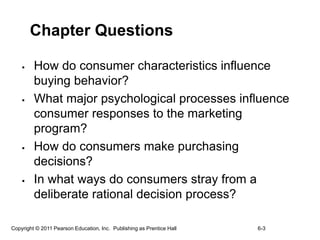
Chapter Questions
 How do consumer characteristics influence
buying behavior?
 What major psychological processes influence
consumer responses to the marketing
program?
 How do consumers make purchasing
decisions?
 In what ways do consumers stray from a
deliberate rational decision process?
Consumer Behavior
Copyright © 2011 Pearson Education, Inc. Publishing as Prentice Hall 6-4
Copyright © 2011 Pearson Education, Inc. Publishing as Prentice Hall 6-5
What Influences
Consumer Behavior?
Cultural Factors
Social Factors
Personal Factors
Copyright © 2011 Pearson Education, Inc. Publishing as Prentice Hall 6-6
What is Culture?
Culture is the fundamental determinant of a
person’s wants and behaviors acquired
through socialization processes with family
and other key institutions.
Copyright © 2011 Pearson Education, Inc. Publishing as Prentice Hall 6-7
Subcultures
 Nationalities
 Religions
 Racial groups
 Geographic regions
Copyright © 2011 Pearson Education, Inc. Publishing as Prentice Hall 6-8
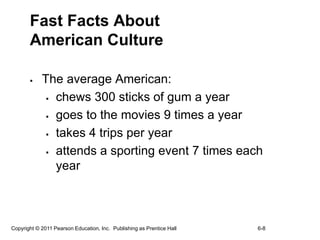
Fast Facts About
American Culture
 The average American:
 chews 300 sticks of gum a year
 goes to the movies 9 times a year
 takes 4 trips per year
 attends a sporting event 7 times each
year
Copyright © 2011 Pearson Education, Inc. Publishing as Prentice Hall 6-9
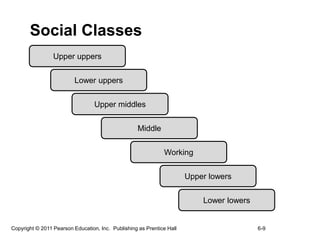
Social Classes
Upper uppers
Lower uppers
Upper middles
Middle
Working
Upper lowers
Lower lowers
Copyright © 2011 Pearson Education, Inc. Publishing as Prentice Hall 6-10
Social Factors
Reference groups
Family
Social roles
Statuses
Copyright © 2011 Pearson Education, Inc. Publishing as Prentice Hall 6-11
Reference Groups
 Membership groups
 Primary groups
 Secondary groups
 Aspirational groups
 Disassociative groups
Copyright © 2011 Pearson Education, Inc. Publishing as Prentice Hall 6-12
Family Distinctions
Affecting Buying Decisions
Copyright © 2011 Pearson Education, Inc. Publishing as Prentice Hall 6-13
Personal Factors
 Age
 Life cycle stage
 Occupation
 Wealth
 Personality
 Values
 Lifestyle
 Self-concept
Age and Stage of Lifecycle
Copyright © 2011 Pearson Education, Inc. Publishing as Prentice Hall 6-14
Occupation and Economic
Circumstances
Copyright © 2011 Pearson Education, Inc. Publishing as Prentice Hall 6-15
Personality
Copyright © 2011 Pearson Education, Inc. Publishing as Prentice Hall 6-16
Copyright © 2011 Pearson Education, Inc. Publishing as Prentice Hall 6-17
Brand Personality
 Sincerity
 Excitement
 Competence
 Sophistication
 Ruggedness
Figure 6.1 Model of
Consumer Behavior
Copyright © 2011 Pearson Education, Inc. Publishing as Prentice Hall 6-18
Copyright © 2011 Pearson Education, Inc. Publishing as Prentice Hall 6-19
Motivation
Freud’s
Theory
Behavior
is guided by
subconscious
motivations
Maslow’s
Hierarchy
of Needs
Behavior
is driven by
lowest,
unmet need
Herzberg’s
Two-Factor
Theory
Behavior is
guided by
motivating
and hygiene
factors
Maslow’s Hierarchy
Copyright © 2011 Pearson Education, Inc. Publishing as Prentice Hall 6-20
Copyright © 2011 Pearson Education, Inc. Publishing as Prentice Hall 6-21
Perception
 Selective attention:- It means the marketers must work
hard to attract consumers notice. Here, some findings:
 People are more likely to notice stimuli that relate to a current need.
 People are more likely to notice stimuli they anticipate.
 People are more likely to notice stimuli with large deviations .
 Selective retention:
 Consumers will often distort information to be consistent with prior brand and
product beliefs.
We remember good points about a product we like
And forget bad points
Advantage of strong brands
Perception
 Selective distortion:
 -It is a Tendency to interpret information in a way that will fit our
preconceptions
 Comsumer will often distort information to be consistant with prior
brand, product believe and expectations.
 Subliminal perception:
 Its mechanisms requires consumers active engagements and
thought. It has long long fascinated armchair marketers, Hidden
message conveyed through the advertisement but Consumers
are not consciously aware of them,yet the affect behavior. Here
Mental Processes include many subtle subconscious effects.
Copyright © 2011 Pearson Education, Inc. Publishing as Prentice Hall 6-22
Learning
Copyright © 2011 Pearson Education, Inc. Publishing as Prentice Hall 6-23
Learning: It induces changes in our permanent behavior
arising from the experience.
Drive:A strong internal stimuli's impelling actions.
Cue: are stimuli's that determines when, where and how a
person responds.
Generalization: Example of HP laptops Promotes HP
Pointers.
Discrimination: A countertendency of Generalization.
Emotions
Copyright © 2011 Pearson Education, Inc. Publishing as Prentice Hall 6-24
Emotions: Consumer response is not all cognitive and rational; much
may be emotional and invoke different kinds of feelings. A brand or
product may make a consumer feel proud, excited or confident. An ad
may create feelings of amusement, disgust or wonder.
Amusement
Disgust
Wonder
Memory
Copyright © 2011 Pearson Education, Inc. Publishing as Prentice Hall 6-25
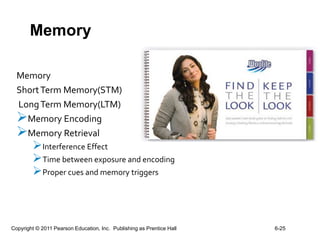
Memory
ShortTerm Memory(STM)
LongTerm Memory(LTM)
Memory Encoding
Memory Retrieval
Interference Effect
Time between exposure and encoding
Proper cues and memory triggers
Figure 6.3 State Farm Mental Map
Copyright © 2011 Pearson Education, Inc. Publishing as Prentice Hall 6-26
Copyright © 2011 Pearson Education, Inc. Publishing as Prentice Hall 6-27
Figure 6.4 Consumer Buying Process
Problem Recognition
Information Search
Evaluation of alternatives
Purchase Decision
Postpurchase Behavior
Copyright © 2011 Pearson Education, Inc. Publishing as Prentice Hall 6-28
Sources of Information
Commercial
Personal
Public Experiential
Figure 6.5 Successive Sets in
Decision Making
Copyright © 2011 Pearson Education, Inc. Publishing as Prentice Hall 6-29
Table 6.4 A Consumer’s Brand
Beliefs about Laptop Computers
Copyright © 2011 Pearson Education, Inc. Publishing as Prentice Hall 6-30
Figure 6.6 Steps Between
Alternative Evaluation
and Purchase
Copyright © 2011 Pearson Education, Inc. Publishing as Prentice Hall 6-31

Chapter 6.ppt

  • 1.
    IPE 4101:Industrial andBusiness Management Lecture Series on Marketing Management
  • 2.
  • 3.
    Copyright © 2011Pearson Education, Inc. Publishing as Prentice Hall 6-3 Chapter Questions  How do consumer characteristics influence buying behavior?  What major psychological processes influence consumer responses to the marketing program?  How do consumers make purchasing decisions?  In what ways do consumers stray from a deliberate rational decision process?
  • 4.
    Consumer Behavior Copyright ©2011 Pearson Education, Inc. Publishing as Prentice Hall 6-4
  • 5.
    Copyright © 2011Pearson Education, Inc. Publishing as Prentice Hall 6-5 What Influences Consumer Behavior? Cultural Factors Social Factors Personal Factors
  • 6.
    Copyright © 2011Pearson Education, Inc. Publishing as Prentice Hall 6-6 What is Culture? Culture is the fundamental determinant of a person’s wants and behaviors acquired through socialization processes with family and other key institutions.
  • 7.
    Copyright © 2011Pearson Education, Inc. Publishing as Prentice Hall 6-7 Subcultures  Nationalities  Religions  Racial groups  Geographic regions
  • 8.
    Copyright © 2011Pearson Education, Inc. Publishing as Prentice Hall 6-8 Fast Facts About American Culture  The average American:  chews 300 sticks of gum a year  goes to the movies 9 times a year  takes 4 trips per year  attends a sporting event 7 times each year
  • 9.
    Copyright © 2011Pearson Education, Inc. Publishing as Prentice Hall 6-9 Social Classes Upper uppers Lower uppers Upper middles Middle Working Upper lowers Lower lowers
  • 10.
    Copyright © 2011Pearson Education, Inc. Publishing as Prentice Hall 6-10 Social Factors Reference groups Family Social roles Statuses
  • 11.
    Copyright © 2011Pearson Education, Inc. Publishing as Prentice Hall 6-11 Reference Groups  Membership groups  Primary groups  Secondary groups  Aspirational groups  Disassociative groups
  • 12.
    Copyright © 2011Pearson Education, Inc. Publishing as Prentice Hall 6-12 Family Distinctions Affecting Buying Decisions
  • 13.
    Copyright © 2011Pearson Education, Inc. Publishing as Prentice Hall 6-13 Personal Factors  Age  Life cycle stage  Occupation  Wealth  Personality  Values  Lifestyle  Self-concept
  • 14.
    Age and Stageof Lifecycle Copyright © 2011 Pearson Education, Inc. Publishing as Prentice Hall 6-14
  • 15.
    Occupation and Economic Circumstances Copyright© 2011 Pearson Education, Inc. Publishing as Prentice Hall 6-15
  • 16.
    Personality Copyright © 2011Pearson Education, Inc. Publishing as Prentice Hall 6-16
  • 17.
    Copyright © 2011Pearson Education, Inc. Publishing as Prentice Hall 6-17 Brand Personality  Sincerity  Excitement  Competence  Sophistication  Ruggedness
  • 18.
    Figure 6.1 Modelof Consumer Behavior Copyright © 2011 Pearson Education, Inc. Publishing as Prentice Hall 6-18
  • 19.
    Copyright © 2011Pearson Education, Inc. Publishing as Prentice Hall 6-19 Motivation Freud’s Theory Behavior is guided by subconscious motivations Maslow’s Hierarchy of Needs Behavior is driven by lowest, unmet need Herzberg’s Two-Factor Theory Behavior is guided by motivating and hygiene factors
  • 20.
    Maslow’s Hierarchy Copyright ©2011 Pearson Education, Inc. Publishing as Prentice Hall 6-20
  • 21.
    Copyright © 2011Pearson Education, Inc. Publishing as Prentice Hall 6-21 Perception  Selective attention:- It means the marketers must work hard to attract consumers notice. Here, some findings:  People are more likely to notice stimuli that relate to a current need.  People are more likely to notice stimuli they anticipate.  People are more likely to notice stimuli with large deviations .  Selective retention:  Consumers will often distort information to be consistent with prior brand and product beliefs. We remember good points about a product we like And forget bad points Advantage of strong brands
  • 22.
    Perception  Selective distortion: -It is a Tendency to interpret information in a way that will fit our preconceptions  Comsumer will often distort information to be consistant with prior brand, product believe and expectations.  Subliminal perception:  Its mechanisms requires consumers active engagements and thought. It has long long fascinated armchair marketers, Hidden message conveyed through the advertisement but Consumers are not consciously aware of them,yet the affect behavior. Here Mental Processes include many subtle subconscious effects. Copyright © 2011 Pearson Education, Inc. Publishing as Prentice Hall 6-22
  • 23.
    Learning Copyright © 2011Pearson Education, Inc. Publishing as Prentice Hall 6-23 Learning: It induces changes in our permanent behavior arising from the experience. Drive:A strong internal stimuli's impelling actions. Cue: are stimuli's that determines when, where and how a person responds. Generalization: Example of HP laptops Promotes HP Pointers. Discrimination: A countertendency of Generalization.
  • 24.
    Emotions Copyright © 2011Pearson Education, Inc. Publishing as Prentice Hall 6-24 Emotions: Consumer response is not all cognitive and rational; much may be emotional and invoke different kinds of feelings. A brand or product may make a consumer feel proud, excited or confident. An ad may create feelings of amusement, disgust or wonder. Amusement Disgust Wonder
  • 25.
    Memory Copyright © 2011Pearson Education, Inc. Publishing as Prentice Hall 6-25 Memory ShortTerm Memory(STM) LongTerm Memory(LTM) Memory Encoding Memory Retrieval Interference Effect Time between exposure and encoding Proper cues and memory triggers
  • 26.
    Figure 6.3 StateFarm Mental Map Copyright © 2011 Pearson Education, Inc. Publishing as Prentice Hall 6-26
  • 27.
    Copyright © 2011Pearson Education, Inc. Publishing as Prentice Hall 6-27 Figure 6.4 Consumer Buying Process Problem Recognition Information Search Evaluation of alternatives Purchase Decision Postpurchase Behavior
  • 28.
    Copyright © 2011Pearson Education, Inc. Publishing as Prentice Hall 6-28 Sources of Information Commercial Personal Public Experiential
  • 29.
    Figure 6.5 SuccessiveSets in Decision Making Copyright © 2011 Pearson Education, Inc. Publishing as Prentice Hall 6-29
  • 30.
    Table 6.4 AConsumer’s Brand Beliefs about Laptop Computers Copyright © 2011 Pearson Education, Inc. Publishing as Prentice Hall 6-30
  • 31.
    Figure 6.6 StepsBetween Alternative Evaluation and Purchase Copyright © 2011 Pearson Education, Inc. Publishing as Prentice Hall 6-31