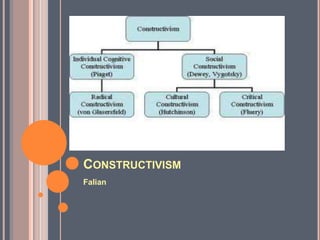
CONSTRUCTIVISM
Falian
OVERVIEW
   Constructivism is the theory that people construct their
    own understanding and knowledge of the world, through
    facing things and reflecting on those experiences. When
    learners encounter something new, they settle it with
    previous knowledge and experience. They may change
    what they believe, or they may discard the new
    information as irrelevant. To be active inventors of their
    knowledge however, they must be able to ask questions,
    explore and assess what they know. In the classroom,
    the constructivist view of learning means inspiring
    students to use active techniques such as experiments
    and real-world problem solving using true data if
    possible, and to create knowledge and reflect on their
    understanding.
TWO MAJOR STRANDS OF CONSTRUCTIVISM
THEORY
Cognitive                                Social
o  Aim to assist students in             o Encourages student to arrive at
  assimilating new information to          his or her vision.
  existing knowledge, and enabling       o Historical developments and
  them to make the appropriate             symbol systems, such as
  modifications to their existing          language, logic, and
  intellectual framework to                mathematical systems, are
  accommodate that information.            inherited by the learner as a
o  It allows for the use of “skill and     member of a particular culture
  drill” exercises in the                  and these are learned
  memorization of facts, formulae,         throughout the learner's life.
  and lists, they place greater          o  Stresses the importance of the
  importance on strategies that            nature of the learner's social
  help students to actively                interaction with knowledgeable
  assimilate and accommodate               members of the society.
  new material.
JEAN PIAGET
   Piaget was the first psychologist to make a systematic
    study of cognitive development.
    His contributions include a theory of cognitive child
    development, detailed observational studies of cognition
    in children, and a series of simple but ingenious tests to
    reveal different cognitive abilities.
   Before Piaget’s work, the common assumption in
    psychology was that children are merely less competent
    thinkers than adults.
    Piaget showed that young children think in strikingly
    different ways compared to adults. According to Piaget,
    children are born with a very basic mental structure on
    which all subsequent learning and knowledge is based.
PAIGET’S THREE COMPONENTS FOR
COGNITIVE THEORY

 Schemas
 (building blocks of knowledge)

 Processes that enable the transition from one stage
  to another (equilibrium, assimilation and
  accommodation)
 Stages of Development:

 sensorimotor

 preoperational

 concrete operational

 formal operational
CREDITS

o   Wikipedia.org
o   ndt-ed.org
o   Google pictures
o   Integrating technology in a connected world (book)

Constructivism theory

  • 1.
  • 2.
    OVERVIEW  Constructivism is the theory that people construct their own understanding and knowledge of the world, through facing things and reflecting on those experiences. When learners encounter something new, they settle it with previous knowledge and experience. They may change what they believe, or they may discard the new information as irrelevant. To be active inventors of their knowledge however, they must be able to ask questions, explore and assess what they know. In the classroom, the constructivist view of learning means inspiring students to use active techniques such as experiments and real-world problem solving using true data if possible, and to create knowledge and reflect on their understanding.
  • 3.
    TWO MAJOR STRANDSOF CONSTRUCTIVISM THEORY Cognitive Social o Aim to assist students in o Encourages student to arrive at assimilating new information to his or her vision. existing knowledge, and enabling o Historical developments and them to make the appropriate symbol systems, such as modifications to their existing language, logic, and intellectual framework to mathematical systems, are accommodate that information. inherited by the learner as a o It allows for the use of “skill and member of a particular culture drill” exercises in the and these are learned memorization of facts, formulae, throughout the learner's life. and lists, they place greater o Stresses the importance of the importance on strategies that nature of the learner's social help students to actively interaction with knowledgeable assimilate and accommodate members of the society. new material.
  • 4.
    JEAN PIAGET  Piaget was the first psychologist to make a systematic study of cognitive development.  His contributions include a theory of cognitive child development, detailed observational studies of cognition in children, and a series of simple but ingenious tests to reveal different cognitive abilities.  Before Piaget’s work, the common assumption in psychology was that children are merely less competent thinkers than adults.  Piaget showed that young children think in strikingly different ways compared to adults. According to Piaget, children are born with a very basic mental structure on which all subsequent learning and knowledge is based.
  • 5.
    PAIGET’S THREE COMPONENTSFOR COGNITIVE THEORY  Schemas  (building blocks of knowledge)  Processes that enable the transition from one stage to another (equilibrium, assimilation and accommodation)  Stages of Development:  sensorimotor  preoperational  concrete operational  formal operational
  • 6.
    CREDITS o Wikipedia.org o ndt-ed.org o Google pictures o Integrating technology in a connected world (book)