Introduction
Categorical Proof Theory
Back to the future: Linear Logic
Dialectica categories
Relevant Dialectica?
A Dialectica Model of
Relevant Type Theory
Valeria de Paiva
SYSMICS Final Meeting
Jan, 2019
Valeria de Paiva SYSMICS 2019 – Amsterdam
Introduction
Categorical Proof Theory
Back to the future: Linear Logic
Dialectica categories
Relevant Dialectica?
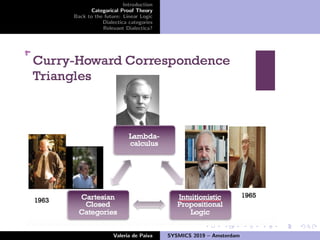
Thank you, Yde Venema and
Nick Bezhanishvili, for the invitation!
Valeria de Paiva SYSMICS 2019 – Amsterdam
Introduction
Categorical Proof Theory
Back to the future: Linear Logic
Dialectica categories
Relevant Dialectica?
Introduction
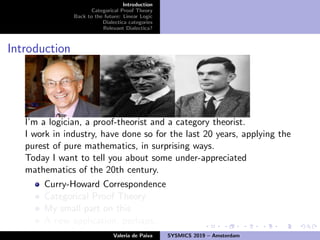
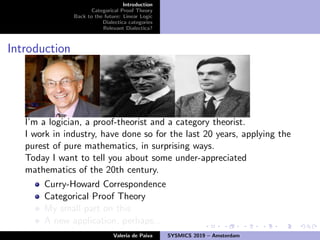
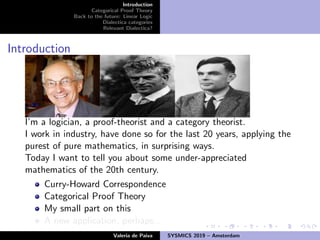
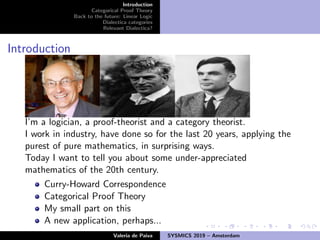
I’m a logician, a proof-theorist and a category theorist.
I work in industry, have done so for the last 20 years, applying the
purest of pure mathematics, in surprising ways.
Today I want to tell you about some under-appreciated
mathematics of the 20th century.
Curry-Howard Correspondence
Categorical Proof Theory
My small part on this
A new application, perhaps...
Valeria de Paiva SYSMICS 2019 – Amsterdam
Introduction
Categorical Proof Theory
Back to the future: Linear Logic
Dialectica categories
Relevant Dialectica?
Introduction
I’m a logician, a proof-theorist and a category theorist.
I work in industry, have done so for the last 20 years, applying the
purest of pure mathematics, in surprising ways.
Today I want to tell you about some under-appreciated
mathematics of the 20th century.
Curry-Howard Correspondence
Categorical Proof Theory
My small part on this
A new application, perhaps...
Valeria de Paiva SYSMICS 2019 – Amsterdam
Introduction
Categorical Proof Theory
Back to the future: Linear Logic
Dialectica categories
Relevant Dialectica?
Introduction
I’m a logician, a proof-theorist and a category theorist.
I work in industry, have done so for the last 20 years, applying the
purest of pure mathematics, in surprising ways.
Today I want to tell you about some under-appreciated
mathematics of the 20th century.
Curry-Howard Correspondence
Categorical Proof Theory
My small part on this
A new application, perhaps...
Valeria de Paiva SYSMICS 2019 – Amsterdam
Introduction
Categorical Proof Theory
Back to the future: Linear Logic
Dialectica categories
Relevant Dialectica?
Introduction
I’m a logician, a proof-theorist and a category theorist.
I work in industry, have done so for the last 20 years, applying the
purest of pure mathematics, in surprising ways.
Today I want to tell you about some under-appreciated
mathematics of the 20th century.
Curry-Howard Correspondence
Categorical Proof Theory
My small part on this
A new application, perhaps...
Valeria de Paiva SYSMICS 2019 – Amsterdam
Introduction
Categorical Proof Theory
Back to the future: Linear Logic
Dialectica categories
Relevant Dialectica?
Mathematics is full of surprises...
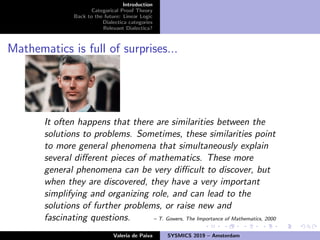
It often happens that there are similarities between the
solutions to problems. Sometimes, these similarities point
to more general phenomena that simultaneously explain
several different pieces of mathematics. These more
general phenomena can be very difficult to discover, but
when they are discovered, they have a very important
simplifying and organizing role, and can lead to the
solutions of further problems, or raise new and
fascinating questions. – T. Gowers, The Importance of Mathematics, 2000
Valeria de Paiva SYSMICS 2019 – Amsterdam
Introduction
Categorical Proof Theory
Back to the future: Linear Logic
Dialectica categories
Relevant Dialectica?
Proofs are Programs?
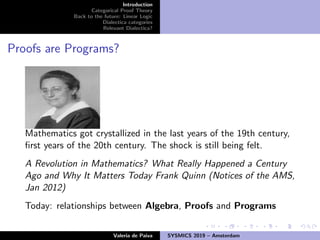
Mathematics got crystallized in the last years of the 19th century,
first years of the 20th century. The shock is still being felt.
A Revolution in Mathematics? What Really Happened a Century
Ago and Why It Matters Today Frank Quinn (Notices of the AMS,
Jan 2012)
Today: relationships between Algebra, Proofs and Programs
Valeria de Paiva SYSMICS 2019 – Amsterdam
Introduction
Categorical Proof Theory
Back to the future: Linear Logic
Dialectica categories
Relevant Dialectica?
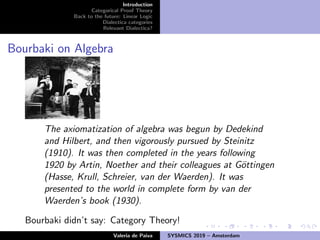
Bourbaki on Algebra
The axiomatization of algebra was begun by Dedekind
and Hilbert, and then vigorously pursued by Steinitz
(1910). It was then completed in the years following
1920 by Artin, Noether and their colleagues at G¨ottingen
(Hasse, Krull, Schreier, van der Waerden). It was
presented to the world in complete form by van der
Waerden’s book (1930).
Bourbaki didn’t say: Category Theory!
Valeria de Paiva SYSMICS 2019 – Amsterdam
Introduction
Categorical Proof Theory
Back to the future: Linear Logic
Dialectica categories
Relevant Dialectica?
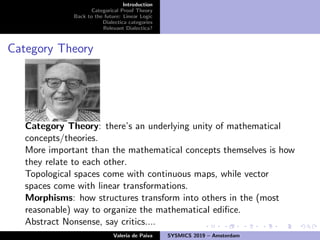
Category Theory
Category Theory: there’s an underlying unity of mathematical
concepts/theories.
More important than the mathematical concepts themselves is how
they relate to each other.
Topological spaces come with continuous maps, while vector
spaces come with linear transformations.
Morphisms: how structures transform into others in the (most
reasonable) way to organize the mathematical edifice.
Abstract Nonsense, say critics....
Valeria de Paiva SYSMICS 2019 – Amsterdam
Introduction
Categorical Proof Theory
Back to the future: Linear Logic
Dialectica categories
Relevant Dialectica?
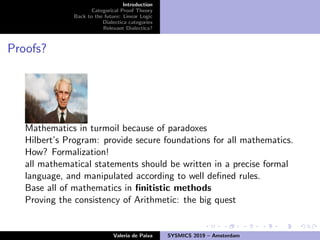
Proofs?
Mathematics in turmoil because of paradoxes
Hilbert’s Program: provide secure foundations for all mathematics.
How? Formalization!
all mathematical statements should be written in a precise formal
language, and manipulated according to well defined rules.
Base all of mathematics in finitistic methods
Proving the consistency of Arithmetic: the big quest
Valeria de Paiva SYSMICS 2019 – Amsterdam
Introduction
Categorical Proof Theory
Back to the future: Linear Logic
Dialectica categories
Relevant Dialectica?
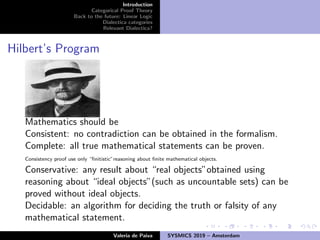
Hilbert’s Program
Mathematics should be
Consistent: no contradiction can be obtained in the formalism.
Complete: all true mathematical statements can be proven.
Consistency proof use only “finitistic”reasoning about finite mathematical objects.
Conservative: any result about “real objects”obtained using
reasoning about “ideal objects”(such as uncountable sets) can be
proved without ideal objects.
Decidable: an algorithm for deciding the truth or falsity of any
mathematical statement.
Valeria de Paiva SYSMICS 2019 – Amsterdam
Introduction
Categorical Proof Theory
Back to the future: Linear Logic
Dialectica categories
Relevant Dialectica?
G¨odel’s Incompleteness Theorems (1931)
Hilbert’s program impossible. BUT:
The development of proof theory itself is an outgrowth of
Hilbert’s program. Gentzen’s development of natural
deduction and the sequent calculus [too]. G¨odel obtained
his incompleteness theorems while trying to prove the
consistency of analysis. The tradition of reductive proof
theory of the Gentzen-Sch¨utte school is itself a direct
continuation of Hilbert’s program.
R. Zach, 2005
Valeria de Paiva SYSMICS 2019 – Amsterdam
Introduction
Categorical Proof Theory
Back to the future: Linear Logic
Dialectica categories
Relevant Dialectica?
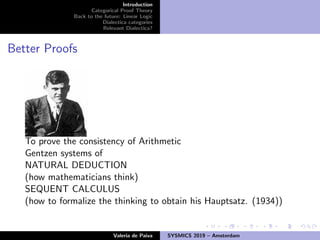
Better Proofs
To prove the consistency of Arithmetic
Gentzen systems of
NATURAL DEDUCTION
(how mathematicians think)
SEQUENT CALCULUS
(how to formalize the thinking to obtain his Hauptsatz. (1934))
Valeria de Paiva SYSMICS 2019 – Amsterdam
Introduction
Categorical Proof Theory
Back to the future: Linear Logic
Dialectica categories
Relevant Dialectica?
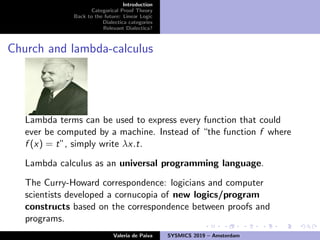
Church and lambda-calculus
Lambda terms can be used to express every function that could
ever be computed by a machine. Instead of “the function f where
f (x) = t”, simply write λx.t.
Lambda calculus as an universal programming language.
The Curry-Howard correspondence: logicians and computer
scientists developed a cornucopia of new logics/program
constructs based on the correspondence between proofs and
programs.
Valeria de Paiva SYSMICS 2019 – Amsterdam
Introduction
Categorical Proof Theory
Back to the future: Linear Logic
Dialectica categories
Relevant Dialectica?
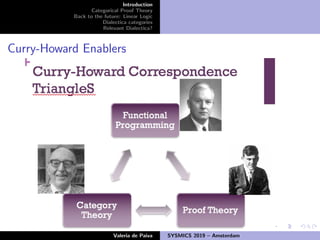
Curry-Howard Enablers
Valeria de Paiva SYSMICS 2019 – Amsterdam
Introduction
Categorical Proof Theory
Back to the future: Linear Logic
Dialectica categories
Relevant Dialectica?
Curry-Howard for Implication
Natural deduction rules for implication (without λ-terms)
A → B A
B
[A]
·
·
·
·
π
B
A → B
Natural deduction rules for implication (with λ-terms)
M : A → B N : A
M(N): B
[x : A]
·
·
·
·
π
M : B
λx.M : A → B
function application abstraction
Valeria de Paiva SYSMICS 2019 – Amsterdam
Introduction
Categorical Proof Theory
Back to the future: Linear Logic
Dialectica categories
Relevant Dialectica?
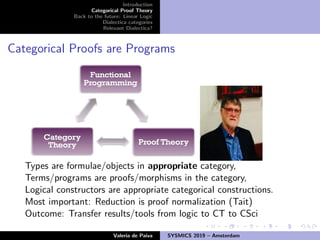
Categorical Proofs are Programs
Types are formulae/objects in appropriate category,
Terms/programs are proofs/morphisms in the category,
Logical constructors are appropriate categorical constructions.
Most important: Reduction is proof normalization (Tait)
Outcome: Transfer results/tools from logic to CT to CSci
Valeria de Paiva SYSMICS 2019 – Amsterdam
Introduction
Categorical Proof Theory
Back to the future: Linear Logic
Dialectica categories
Relevant Dialectica?
Valeria de Paiva SYSMICS 2019 – Amsterdam
Introduction
Categorical Proof Theory
Back to the future: Linear Logic
Dialectica categories
Relevant Dialectica?
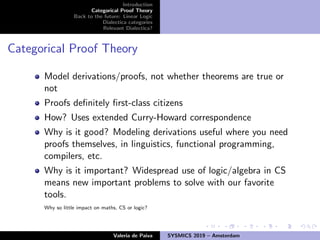
Categorical Proof Theory
Model derivations/proofs, not whether theorems are true or
not
Proofs definitely first-class citizens
How? Uses extended Curry-Howard correspondence
Why is it good? Modeling derivations useful where you need
proofs themselves, in linguistics, functional programming,
compilers, etc.
Why is it important? Widespread use of logic/algebra in CS
means new important problems to solve with our favorite
tools.
Why so little impact on maths, CS or logic?
Valeria de Paiva SYSMICS 2019 – Amsterdam
Introduction
Categorical Proof Theory
Back to the future: Linear Logic
Dialectica categories
Relevant Dialectica?
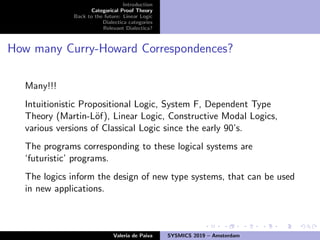
How many Curry-Howard Correspondences?
Many!!!
Intuitionistic Propositional Logic, System F, Dependent Type
Theory (Martin-L¨of), Linear Logic, Constructive Modal Logics,
various versions of Classical Logic since the early 90’s.
The programs corresponding to these logical systems are
‘futuristic’ programs.
The logics inform the design of new type systems, that can be used
in new applications.
Valeria de Paiva SYSMICS 2019 – Amsterdam
Introduction
Categorical Proof Theory
Back to the future: Linear Logic
Dialectica categories
Relevant Dialectica?
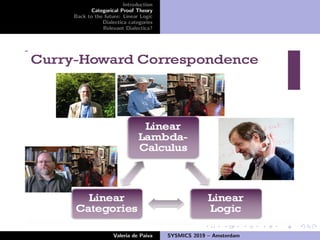
Valeria de Paiva SYSMICS 2019 – Amsterdam
Introduction
Categorical Proof Theory
Back to the future: Linear Logic
Dialectica categories
Relevant Dialectica?
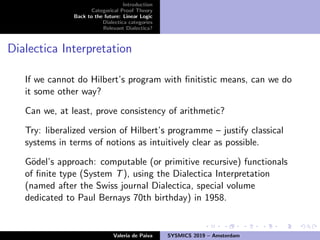
Dialectica Interpretation
If we cannot do Hilbert’s program with finitistic means, can we do
it some other way?
Can we, at least, prove consistency of arithmetic?
Try: liberalized version of Hilbert’s programme – justify classical
systems in terms of notions as intuitively clear as possible.
G¨odel’s approach: computable (or primitive recursive) functionals
of finite type (System T), using the Dialectica Interpretation
(named after the Swiss journal Dialectica, special volume
dedicated to Paul Bernays 70th birthday) in 1958.
Valeria de Paiva SYSMICS 2019 – Amsterdam
Introduction
Categorical Proof Theory
Back to the future: Linear Logic
Dialectica categories
Relevant Dialectica?
Dialectica Categories
Hyland suggested that to provide a categorical model of the
Dialectica Interpretation, one should look at the functionals
corresponding to the interpretation of logical implication.
The categories in my thesis proved to be a model of Linear Logic...
Linear Logic introduced by Girard (1987) as a proof-theoretic tool:
the symmetries of classical logic plus the constructive content of
proofs of intuitionistic logic.
Valeria de Paiva SYSMICS 2019 – Amsterdam
Introduction
Categorical Proof Theory
Back to the future: Linear Logic
Dialectica categories
Relevant Dialectica?
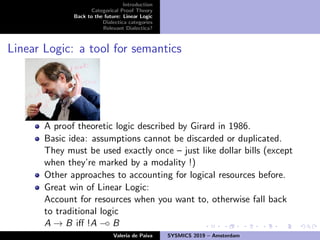
Linear Logic: a tool for semantics
A proof theoretic logic described by Girard in 1986.
Basic idea: assumptions cannot be discarded or duplicated.
They must be used exactly once – just like dollar bills (except
when they’re marked by a modality !)
Other approaches to accounting for logical resources before.
Great win of Linear Logic:
Account for resources when you want to, otherwise fall back
to traditional logic
A → B iff !A −◦ B
Valeria de Paiva SYSMICS 2019 – Amsterdam
Introduction
Categorical Proof Theory
Back to the future: Linear Logic
Dialectica categories
Relevant Dialectica?
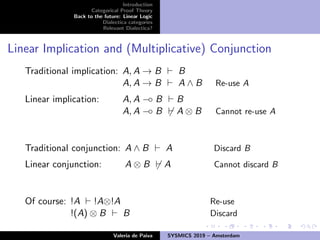
Linear Implication and (Multiplicative) Conjunction
Traditional implication: A, A → B B
A, A → B A ∧ B Re-use A
Linear implication: A, A −◦ B B
A, A −◦ B A ⊗ B Cannot re-use A
Traditional conjunction: A ∧ B A Discard B
Linear conjunction: A ⊗ B A Cannot discard B
Of course: !A !A⊗!A Re-use
!(A) ⊗ B B Discard
Valeria de Paiva SYSMICS 2019 – Amsterdam
Introduction
Categorical Proof Theory
Back to the future: Linear Logic
Dialectica categories
Relevant Dialectica?
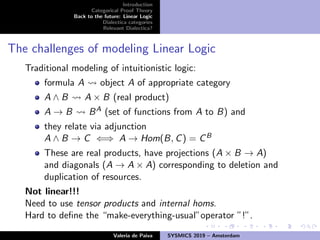
The challenges of modeling Linear Logic
Traditional modeling of intuitionistic logic:
formula A object A of appropriate category
A ∧ B A × B (real product)
A → B BA (set of functions from A to B) and
they relate via adjunction
A ∧ B → C ⇐⇒ A → Hom(B, C) = CB
These are real products, have projections (A × B → A)
and diagonals (A → A × A) corresponding to deletion and
duplication of resources.
Not linear!!!
Need to use tensor products and internal homs.
Hard to define the “make-everything-usual”operator ”!”.
Valeria de Paiva SYSMICS 2019 – Amsterdam
Introduction
Categorical Proof Theory
Back to the future: Linear Logic
Dialectica categories
Relevant Dialectica?
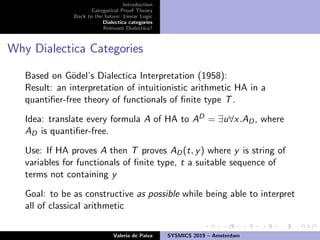
Why Dialectica Categories
Based on G¨odel’s Dialectica Interpretation (1958):
Result: an interpretation of intuitionistic arithmetic HA in a
quantifier-free theory of functionals of finite type T.
Idea: translate every formula A of HA to AD = ∃u∀x.AD, where
AD is quantifier-free.
Use: If HA proves A then T proves AD(t, y) where y is string of
variables for functionals of finite type, t a suitable sequence of
terms not containing y
Goal: to be as constructive as possible while being able to interpret
all of classical arithmetic
Valeria de Paiva SYSMICS 2019 – Amsterdam
Introduction
Categorical Proof Theory
Back to the future: Linear Logic
Dialectica categories
Relevant Dialectica?
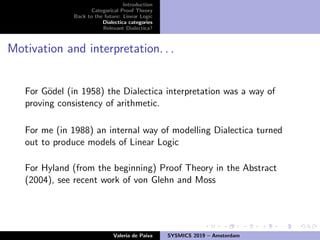
Motivation and interpretation. . .
For G¨odel (in 1958) the Dialectica interpretation was a way of
proving consistency of arithmetic.
For me (in 1988) an internal way of modelling Dialectica turned
out to produce models of Linear Logic
For Hyland (from the beginning) Proof Theory in the Abstract
(2004), see recent work of von Glehn and Moss
Valeria de Paiva SYSMICS 2019 – Amsterdam
Introduction
Categorical Proof Theory
Back to the future: Linear Logic
Dialectica categories
Relevant Dialectica?
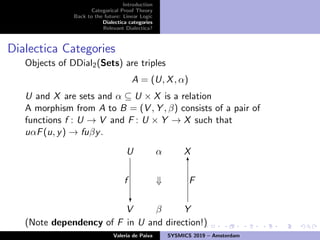
Dialectica Categories
Objects of DDial2(Sets) are triples
A = (U, X, α)
U and X are sets and α ⊆ U × X is a relation
A morphism from A to B = (V , Y , β) consists of a pair of
functions f : U → V and F : U × Y → X such that
uαF(u, y) → fuβy.
U α X
⇓
V
f
?
β Y
6
F
(Note dependency of F in U and direction!)
Valeria de Paiva SYSMICS 2019 – Amsterdam
Introduction
Categorical Proof Theory
Back to the future: Linear Logic
Dialectica categories
Relevant Dialectica?
Dialectica Categories
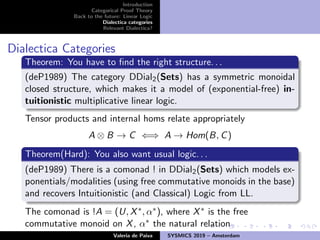
Theorem: You have to find the right structure. . .
(deP1989) The category DDial2(Sets) has a symmetric monoidal
closed structure, which makes it a model of (exponential-free) in-
tuitionistic multiplicative linear logic.
Tensor products and internal homs relate appropriately
A ⊗ B → C ⇐⇒ A → Hom(B, C)
Theorem(Hard): You also want usual logic. . .
(deP1989) There is a comonad ! in DDial2(Sets) which models ex-
ponentials/modalities (using free commutative monoids in the base)
and recovers Intuitionistic (and Classical) Logic from LL.
The comonad is !A = (U, X∗, α∗), where X∗ is the free
commutative monoid on X, α∗ the natural relation
Valeria de Paiva SYSMICS 2019 – Amsterdam
Introduction
Categorical Proof Theory
Back to the future: Linear Logic
Dialectica categories
Relevant Dialectica?
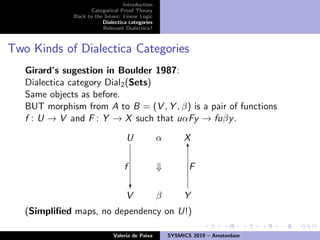
Two Kinds of Dialectica Categories
Girard’s sugestion in Boulder 1987:
Dialectica category Dial2(Sets)
Same objects as before.
BUT morphism from A to B = (V , Y , β) is a pair of functions
f : U → V and F : Y → X such that uαFy → fuβy.
U α X
⇓
V
f
?
β Y
6
F
(Simplified maps, no dependency on U!)
Valeria de Paiva SYSMICS 2019 – Amsterdam
Introduction
Categorical Proof Theory
Back to the future: Linear Logic
Dialectica categories
Relevant Dialectica?
Girard-style Dialectica Categories
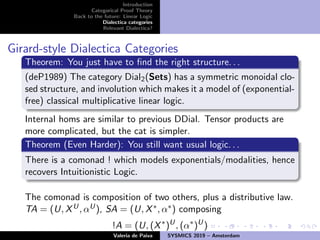
Theorem: You just have to find the right structure. . .
(deP1989) The category Dial2(Sets) has a symmetric monoidal clo-
sed structure, and involution which makes it a model of (exponential-
free) classical multiplicative linear logic.
Internal homs are similar to previous DDial. Tensor products are
more complicated, but the cat is simpler.
Theorem (Even Harder): You still want usual logic. . .
There is a comonad ! which models exponentials/modalities, hence
recovers Intuitionistic Logic.
The comonad is composition of two others, plus a distributive law.
TA = (U, XU, αU), SA = (U, X∗, α∗) composing
!A = (U, (X∗
)U
, (α∗
)U
)
Valeria de Paiva SYSMICS 2019 – Amsterdam
Introduction
Categorical Proof Theory
Back to the future: Linear Logic
Dialectica categories
Relevant Dialectica?
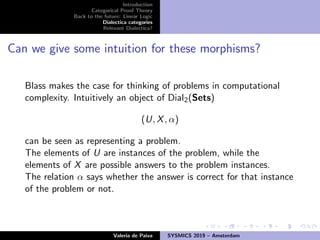
Can we give some intuition for these morphisms?
Blass makes the case for thinking of problems in computational
complexity. Intuitively an object of Dial2(Sets)
(U, X, α)
can be seen as representing a problem.
The elements of U are instances of the problem, while the
elements of X are possible answers to the problem instances.
The relation α says whether the answer is correct for that instance
of the problem or not.
Valeria de Paiva SYSMICS 2019 – Amsterdam
Introduction
Categorical Proof Theory
Back to the future: Linear Logic
Dialectica categories
Relevant Dialectica?
Can we give some intuition for these morphisms?
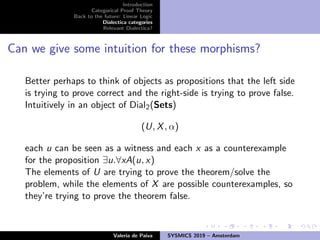
Better perhaps to think of objects as propositions that the left side
is trying to prove correct and the right-side is trying to prove false.
Intuitively in an object of Dial2(Sets)
(U, X, α)
each u can be seen as a witness and each x as a counterexample
for the proposition ∃u.∀xA(u, x)
The elements of U are trying to prove the theorem/solve the
problem, while the elements of X are possible counterexamples, so
they’re trying to prove the theorem false.
Valeria de Paiva SYSMICS 2019 – Amsterdam
Introduction
Categorical Proof Theory
Back to the future: Linear Logic
Dialectica categories
Relevant Dialectica?
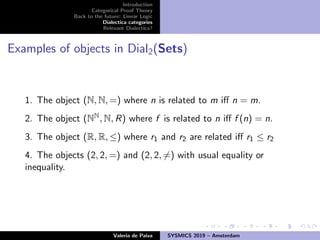
Examples of objects in Dial2(Sets)
1. The object (N, N, =) where n is related to m iff n = m.
2. The object (NN, N, R) where f is related to n iff f (n) = n.
3. The object (R, R, ≤) where r1 and r2 are related iff r1 ≤ r2
4. The objects (2, 2, =) and (2, 2, =) with usual equality or
inequality.
Valeria de Paiva SYSMICS 2019 – Amsterdam
Introduction
Categorical Proof Theory
Back to the future: Linear Logic
Dialectica categories
Relevant Dialectica?
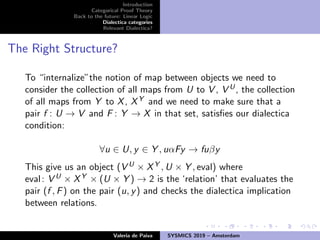
The Right Structure?
To “internalize”the notion of map between objects we need to
consider the collection of all maps from U to V , V U, the collection
of all maps from Y to X, XY and we need to make sure that a
pair f : U → V and F : Y → X in that set, satisfies our dialectica
condition:
∀u ∈ U, y ∈ Y , uαFy → fuβy
This give us an object (V U × XY , U × Y , eval) where
eval: V U × XY × (U × Y ) → 2 is the ‘relation’ that evaluates the
pair (f , F) on the pair (u, y) and checks the dialectica implication
between relations.
Valeria de Paiva SYSMICS 2019 – Amsterdam
Introduction
Categorical Proof Theory
Back to the future: Linear Logic
Dialectica categories
Relevant Dialectica?
The Right Structure!
Do the “reverse engineering” necessary to obtain a model of Linear
Logic...
A ⊗ B → C if and only if A → [B −◦ C]
U × V (α ⊗ β)XV
× Y U
U α X
⇓ ⇓
W
f
?
γ Z
6
(g1, g2)
W V
× Y Z
?
(β −◦ γ)V × Z
6
Valeria de Paiva SYSMICS 2019 – Amsterdam
Introduction
Categorical Proof Theory
Back to the future: Linear Logic
Dialectica categories
Relevant Dialectica?
Newest Old Application
Valeria de Paiva SYSMICS 2019 – Amsterdam
Introduction
Categorical Proof Theory
Back to the future: Linear Logic
Dialectica categories
Relevant Dialectica?
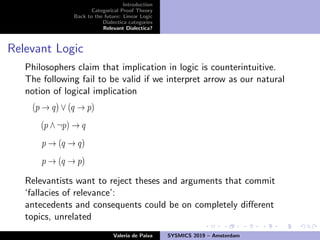
Relevant Logic
Philosophers claim that implication in logic is counterintuitive.
The following fail to be valid if we interpret arrow as our natural
notion of logical implication
Relevantists want to reject theses and arguments that commit
‘fallacies of relevance’:
antecedents and consequents could be on completely different
topics, unrelated
Valeria de Paiva SYSMICS 2019 – Amsterdam
Introduction
Categorical Proof Theory
Back to the future: Linear Logic
Dialectica categories
Relevant Dialectica?
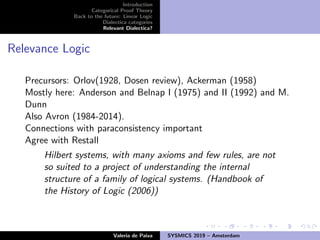
Relevance Logic
Precursors: Orlov(1928, Dosen review), Ackerman (1958)
Mostly here: Anderson and Belnap I (1975) and II (1992) and M.
Dunn
Also Avron (1984-2014).
Connections with paraconsistency important
Agree with Restall
Hilbert systems, with many axioms and few rules, are not
so suited to a project of understanding the internal
structure of a family of logical systems. (Handbook of
the History of Logic (2006))
Valeria de Paiva SYSMICS 2019 – Amsterdam
Introduction
Categorical Proof Theory
Back to the future: Linear Logic
Dialectica categories
Relevant Dialectica?
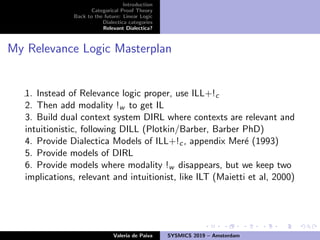
My Relevance Logic Masterplan
1. Instead of Relevance logic proper, use ILL+!c
2. Then add modality !w to get IL
3. Build dual context system DIRL where contexts are relevant and
intuitionistic, following DILL (Plotkin/Barber, Barber PhD)
4. Provide Dialectica Models of ILL+!c, appendix Mer´e (1993)
5. Provide models of DIRL
6. Provide models where modality !w disappears, but we keep two
implications, relevant and intuitionist, like ILT (Maietti et al, 2000)
Valeria de Paiva SYSMICS 2019 – Amsterdam
Introduction
Categorical Proof Theory
Back to the future: Linear Logic
Dialectica categories
Relevant Dialectica?
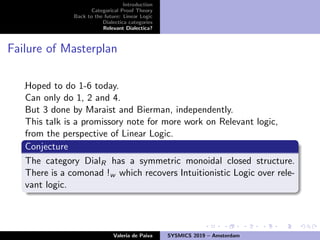
Failure of Masterplan
Hoped to do 1-6 today.
Can only do 1, 2 and 4.
But 3 done by Maraist and Bierman, independently.
This talk is a promissory note for more work on Relevant logic,
from the perspective of Linear Logic.
Conjecture
The category DialR has a symmetric monoidal closed structure.
There is a comonad !w which recovers Intuitionistic Logic over rele-
vant logic.
Valeria de Paiva SYSMICS 2019 – Amsterdam
Introduction
Categorical Proof Theory
Back to the future: Linear Logic
Dialectica categories
Relevant Dialectica?
(Weak) evidence for conjecture
DialR similar to DDial, but objects satisfy A −◦ A ⊗ A plus
coherence conditions.
Discussed in page 39 of ”The Dialectica Categories”,
(www.cl.cam.ac.uk/techreports/UCAM-CL-TR-213.pdf)
where we have a “tricky map”, (∆, D) : A → A ⊗ A.
Map defined by easy ∆=diagonal on U, BUT D(u, x, x ) = x , if
uαx, and x otherwise.
This is a new(?) example of Dosen/Petric’s “relevant category”,
as described in the nLab, I believe.
Valeria de Paiva SYSMICS 2019 – Amsterdam
Introduction
Categorical Proof Theory
Back to the future: Linear Logic
Dialectica categories
Relevant Dialectica?
Some Dialectica Categories Applications
Petri nets (more than 2 phds), non-commutative version for
Lambek calculus (linguistics), a model of state (Correa et al)
Generic models of Linear Logic (Schalk04), syntax-semantics
interface for Natural Language, the Glue Approach
(Dalrymple, Lamping and Gupta).
Biering’s ‘Copenhagen Interpretation’ (first fibrational
version), P. Hofstra ”The dialectica monad and its cousins”.
”The Compiler Forest”Budiu, Galenson and Plotkin (2012).
Pradic and Riba and (indep) Hyvernat
Von Glehn and Moss ”polynomials”/containers (2015),
(2017). Pedrot (2015) Krivine machine interpretation.
Shulman on 2-Chu-Dialectica construction arxiv:1806.06082.
Valeria de Paiva SYSMICS 2019 – Amsterdam
Introduction
Categorical Proof Theory
Back to the future: Linear Logic
Dialectica categories
Relevant Dialectica?
Conclusions
Introduced/reacquainted you with the Curry-Howard
correspondence.
Hinted at its importance for interdisciplinarity:
Categorical Proof Theory
Described two examples of Dialectica categories hinted at 3rd one
(only behavior involv modalities change)
Much more explaining needed... But pictures help.
Valeria de Paiva SYSMICS 2019 – Amsterdam
Introduction
Categorical Proof Theory
Back to the future: Linear Logic
Dialectica categories
Relevant Dialectica?
Valeria de Paiva SYSMICS 2019 – Amsterdam
Introduction
Categorical Proof Theory
Back to the future: Linear Logic
Dialectica categories
Relevant Dialectica?
Valeria de Paiva SYSMICS 2019 – Amsterdam
Introduction
Categorical Proof Theory
Back to the future: Linear Logic
Dialectica categories
Relevant Dialectica?
Valeria de Paiva SYSMICS 2019 – Amsterdam
Introduction
Categorical Proof Theory
Back to the future: Linear Logic
Dialectica categories
Relevant Dialectica?
Valeria de Paiva SYSMICS 2019 – Amsterdam
Introduction
Categorical Proof Theory
Back to the future: Linear Logic
Dialectica categories
Relevant Dialectica?
Thank you!
Valeria de Paiva SYSMICS 2019 – Amsterdam
Introduction
Categorical Proof Theory
Back to the future: Linear Logic
Dialectica categories
Relevant Dialectica?
Some References
(see https://github.com/vcvpaiva/DialecticaCategories)
A.Blass, Questions and Answers: A Category Arising in Linear Logic,
Complexity Theory, and Set Theory, Advances in Linear Logic (ed. J.-Y.
Girard, Y. Lafont, and L. Regnier) London Math. Soc. Lecture Notes 222
(1995).
de Paiva, A dialectica-like model of linear logic, Category Theory and
Computer Science, Springer, (1989) 341–356.
de Paiva, The Dialectica Categories, In Proc of Categories in Computer
Science and Logic, Boulder, CO, 1987. Contemporary Mathematics, vol
92, American Mathematical Society, 1989 (eds. J. Gray and A. Scedrov)
Valeria de Paiva SYSMICS 2019 – Amsterdam

A Dialectica Model of Relevant Type Theory

  • 1.
    Introduction Categorical Proof Theory Backto the future: Linear Logic Dialectica categories Relevant Dialectica? A Dialectica Model of Relevant Type Theory Valeria de Paiva SYSMICS Final Meeting Jan, 2019 Valeria de Paiva SYSMICS 2019 – Amsterdam
  • 2.
    Introduction Categorical Proof Theory Backto the future: Linear Logic Dialectica categories Relevant Dialectica? Thank you, Yde Venema and Nick Bezhanishvili, for the invitation! Valeria de Paiva SYSMICS 2019 – Amsterdam
  • 3.
    Introduction Categorical Proof Theory Backto the future: Linear Logic Dialectica categories Relevant Dialectica? Introduction I’m a logician, a proof-theorist and a category theorist. I work in industry, have done so for the last 20 years, applying the purest of pure mathematics, in surprising ways. Today I want to tell you about some under-appreciated mathematics of the 20th century. Curry-Howard Correspondence Categorical Proof Theory My small part on this A new application, perhaps... Valeria de Paiva SYSMICS 2019 – Amsterdam
  • 4.
    Introduction Categorical Proof Theory Backto the future: Linear Logic Dialectica categories Relevant Dialectica? Introduction I’m a logician, a proof-theorist and a category theorist. I work in industry, have done so for the last 20 years, applying the purest of pure mathematics, in surprising ways. Today I want to tell you about some under-appreciated mathematics of the 20th century. Curry-Howard Correspondence Categorical Proof Theory My small part on this A new application, perhaps... Valeria de Paiva SYSMICS 2019 – Amsterdam
  • 5.
    Introduction Categorical Proof Theory Backto the future: Linear Logic Dialectica categories Relevant Dialectica? Introduction I’m a logician, a proof-theorist and a category theorist. I work in industry, have done so for the last 20 years, applying the purest of pure mathematics, in surprising ways. Today I want to tell you about some under-appreciated mathematics of the 20th century. Curry-Howard Correspondence Categorical Proof Theory My small part on this A new application, perhaps... Valeria de Paiva SYSMICS 2019 – Amsterdam
  • 6.
    Introduction Categorical Proof Theory Backto the future: Linear Logic Dialectica categories Relevant Dialectica? Introduction I’m a logician, a proof-theorist and a category theorist. I work in industry, have done so for the last 20 years, applying the purest of pure mathematics, in surprising ways. Today I want to tell you about some under-appreciated mathematics of the 20th century. Curry-Howard Correspondence Categorical Proof Theory My small part on this A new application, perhaps... Valeria de Paiva SYSMICS 2019 – Amsterdam
  • 7.
    Introduction Categorical Proof Theory Backto the future: Linear Logic Dialectica categories Relevant Dialectica? Mathematics is full of surprises... It often happens that there are similarities between the solutions to problems. Sometimes, these similarities point to more general phenomena that simultaneously explain several different pieces of mathematics. These more general phenomena can be very difficult to discover, but when they are discovered, they have a very important simplifying and organizing role, and can lead to the solutions of further problems, or raise new and fascinating questions. – T. Gowers, The Importance of Mathematics, 2000 Valeria de Paiva SYSMICS 2019 – Amsterdam
  • 8.
    Introduction Categorical Proof Theory Backto the future: Linear Logic Dialectica categories Relevant Dialectica? Proofs are Programs? Mathematics got crystallized in the last years of the 19th century, first years of the 20th century. The shock is still being felt. A Revolution in Mathematics? What Really Happened a Century Ago and Why It Matters Today Frank Quinn (Notices of the AMS, Jan 2012) Today: relationships between Algebra, Proofs and Programs Valeria de Paiva SYSMICS 2019 – Amsterdam
  • 9.
    Introduction Categorical Proof Theory Backto the future: Linear Logic Dialectica categories Relevant Dialectica? Bourbaki on Algebra The axiomatization of algebra was begun by Dedekind and Hilbert, and then vigorously pursued by Steinitz (1910). It was then completed in the years following 1920 by Artin, Noether and their colleagues at G¨ottingen (Hasse, Krull, Schreier, van der Waerden). It was presented to the world in complete form by van der Waerden’s book (1930). Bourbaki didn’t say: Category Theory! Valeria de Paiva SYSMICS 2019 – Amsterdam
  • 10.
    Introduction Categorical Proof Theory Backto the future: Linear Logic Dialectica categories Relevant Dialectica? Category Theory Category Theory: there’s an underlying unity of mathematical concepts/theories. More important than the mathematical concepts themselves is how they relate to each other. Topological spaces come with continuous maps, while vector spaces come with linear transformations. Morphisms: how structures transform into others in the (most reasonable) way to organize the mathematical edifice. Abstract Nonsense, say critics.... Valeria de Paiva SYSMICS 2019 – Amsterdam
  • 11.
    Introduction Categorical Proof Theory Backto the future: Linear Logic Dialectica categories Relevant Dialectica? Proofs? Mathematics in turmoil because of paradoxes Hilbert’s Program: provide secure foundations for all mathematics. How? Formalization! all mathematical statements should be written in a precise formal language, and manipulated according to well defined rules. Base all of mathematics in finitistic methods Proving the consistency of Arithmetic: the big quest Valeria de Paiva SYSMICS 2019 – Amsterdam
  • 12.
    Introduction Categorical Proof Theory Backto the future: Linear Logic Dialectica categories Relevant Dialectica? Hilbert’s Program Mathematics should be Consistent: no contradiction can be obtained in the formalism. Complete: all true mathematical statements can be proven. Consistency proof use only “finitistic”reasoning about finite mathematical objects. Conservative: any result about “real objects”obtained using reasoning about “ideal objects”(such as uncountable sets) can be proved without ideal objects. Decidable: an algorithm for deciding the truth or falsity of any mathematical statement. Valeria de Paiva SYSMICS 2019 – Amsterdam
  • 13.
    Introduction Categorical Proof Theory Backto the future: Linear Logic Dialectica categories Relevant Dialectica? G¨odel’s Incompleteness Theorems (1931) Hilbert’s program impossible. BUT: The development of proof theory itself is an outgrowth of Hilbert’s program. Gentzen’s development of natural deduction and the sequent calculus [too]. G¨odel obtained his incompleteness theorems while trying to prove the consistency of analysis. The tradition of reductive proof theory of the Gentzen-Sch¨utte school is itself a direct continuation of Hilbert’s program. R. Zach, 2005 Valeria de Paiva SYSMICS 2019 – Amsterdam
  • 14.
    Introduction Categorical Proof Theory Backto the future: Linear Logic Dialectica categories Relevant Dialectica? Better Proofs To prove the consistency of Arithmetic Gentzen systems of NATURAL DEDUCTION (how mathematicians think) SEQUENT CALCULUS (how to formalize the thinking to obtain his Hauptsatz. (1934)) Valeria de Paiva SYSMICS 2019 – Amsterdam
  • 15.
    Introduction Categorical Proof Theory Backto the future: Linear Logic Dialectica categories Relevant Dialectica? Church and lambda-calculus Lambda terms can be used to express every function that could ever be computed by a machine. Instead of “the function f where f (x) = t”, simply write λx.t. Lambda calculus as an universal programming language. The Curry-Howard correspondence: logicians and computer scientists developed a cornucopia of new logics/program constructs based on the correspondence between proofs and programs. Valeria de Paiva SYSMICS 2019 – Amsterdam
  • 16.
    Introduction Categorical Proof Theory Backto the future: Linear Logic Dialectica categories Relevant Dialectica? Curry-Howard Enablers Valeria de Paiva SYSMICS 2019 – Amsterdam
  • 17.
    Introduction Categorical Proof Theory Backto the future: Linear Logic Dialectica categories Relevant Dialectica? Curry-Howard for Implication Natural deduction rules for implication (without λ-terms) A → B A B [A] · · · · π B A → B Natural deduction rules for implication (with λ-terms) M : A → B N : A M(N): B [x : A] · · · · π M : B λx.M : A → B function application abstraction Valeria de Paiva SYSMICS 2019 – Amsterdam
  • 18.
    Introduction Categorical Proof Theory Backto the future: Linear Logic Dialectica categories Relevant Dialectica? Categorical Proofs are Programs Types are formulae/objects in appropriate category, Terms/programs are proofs/morphisms in the category, Logical constructors are appropriate categorical constructions. Most important: Reduction is proof normalization (Tait) Outcome: Transfer results/tools from logic to CT to CSci Valeria de Paiva SYSMICS 2019 – Amsterdam
  • 19.
    Introduction Categorical Proof Theory Backto the future: Linear Logic Dialectica categories Relevant Dialectica? Valeria de Paiva SYSMICS 2019 – Amsterdam
  • 20.
    Introduction Categorical Proof Theory Backto the future: Linear Logic Dialectica categories Relevant Dialectica? Categorical Proof Theory Model derivations/proofs, not whether theorems are true or not Proofs definitely first-class citizens How? Uses extended Curry-Howard correspondence Why is it good? Modeling derivations useful where you need proofs themselves, in linguistics, functional programming, compilers, etc. Why is it important? Widespread use of logic/algebra in CS means new important problems to solve with our favorite tools. Why so little impact on maths, CS or logic? Valeria de Paiva SYSMICS 2019 – Amsterdam
  • 21.
    Introduction Categorical Proof Theory Backto the future: Linear Logic Dialectica categories Relevant Dialectica? How many Curry-Howard Correspondences? Many!!! Intuitionistic Propositional Logic, System F, Dependent Type Theory (Martin-L¨of), Linear Logic, Constructive Modal Logics, various versions of Classical Logic since the early 90’s. The programs corresponding to these logical systems are ‘futuristic’ programs. The logics inform the design of new type systems, that can be used in new applications. Valeria de Paiva SYSMICS 2019 – Amsterdam
  • 22.
    Introduction Categorical Proof Theory Backto the future: Linear Logic Dialectica categories Relevant Dialectica? Valeria de Paiva SYSMICS 2019 – Amsterdam
  • 23.
    Introduction Categorical Proof Theory Backto the future: Linear Logic Dialectica categories Relevant Dialectica? Dialectica Interpretation If we cannot do Hilbert’s program with finitistic means, can we do it some other way? Can we, at least, prove consistency of arithmetic? Try: liberalized version of Hilbert’s programme – justify classical systems in terms of notions as intuitively clear as possible. G¨odel’s approach: computable (or primitive recursive) functionals of finite type (System T), using the Dialectica Interpretation (named after the Swiss journal Dialectica, special volume dedicated to Paul Bernays 70th birthday) in 1958. Valeria de Paiva SYSMICS 2019 – Amsterdam
  • 24.
    Introduction Categorical Proof Theory Backto the future: Linear Logic Dialectica categories Relevant Dialectica? Dialectica Categories Hyland suggested that to provide a categorical model of the Dialectica Interpretation, one should look at the functionals corresponding to the interpretation of logical implication. The categories in my thesis proved to be a model of Linear Logic... Linear Logic introduced by Girard (1987) as a proof-theoretic tool: the symmetries of classical logic plus the constructive content of proofs of intuitionistic logic. Valeria de Paiva SYSMICS 2019 – Amsterdam
  • 25.
    Introduction Categorical Proof Theory Backto the future: Linear Logic Dialectica categories Relevant Dialectica? Linear Logic: a tool for semantics A proof theoretic logic described by Girard in 1986. Basic idea: assumptions cannot be discarded or duplicated. They must be used exactly once – just like dollar bills (except when they’re marked by a modality !) Other approaches to accounting for logical resources before. Great win of Linear Logic: Account for resources when you want to, otherwise fall back to traditional logic A → B iff !A −◦ B Valeria de Paiva SYSMICS 2019 – Amsterdam
  • 26.
    Introduction Categorical Proof Theory Backto the future: Linear Logic Dialectica categories Relevant Dialectica? Linear Implication and (Multiplicative) Conjunction Traditional implication: A, A → B B A, A → B A ∧ B Re-use A Linear implication: A, A −◦ B B A, A −◦ B A ⊗ B Cannot re-use A Traditional conjunction: A ∧ B A Discard B Linear conjunction: A ⊗ B A Cannot discard B Of course: !A !A⊗!A Re-use !(A) ⊗ B B Discard Valeria de Paiva SYSMICS 2019 – Amsterdam
  • 27.
    Introduction Categorical Proof Theory Backto the future: Linear Logic Dialectica categories Relevant Dialectica? The challenges of modeling Linear Logic Traditional modeling of intuitionistic logic: formula A object A of appropriate category A ∧ B A × B (real product) A → B BA (set of functions from A to B) and they relate via adjunction A ∧ B → C ⇐⇒ A → Hom(B, C) = CB These are real products, have projections (A × B → A) and diagonals (A → A × A) corresponding to deletion and duplication of resources. Not linear!!! Need to use tensor products and internal homs. Hard to define the “make-everything-usual”operator ”!”. Valeria de Paiva SYSMICS 2019 – Amsterdam
  • 28.
    Introduction Categorical Proof Theory Backto the future: Linear Logic Dialectica categories Relevant Dialectica? Why Dialectica Categories Based on G¨odel’s Dialectica Interpretation (1958): Result: an interpretation of intuitionistic arithmetic HA in a quantifier-free theory of functionals of finite type T. Idea: translate every formula A of HA to AD = ∃u∀x.AD, where AD is quantifier-free. Use: If HA proves A then T proves AD(t, y) where y is string of variables for functionals of finite type, t a suitable sequence of terms not containing y Goal: to be as constructive as possible while being able to interpret all of classical arithmetic Valeria de Paiva SYSMICS 2019 – Amsterdam
  • 29.
    Introduction Categorical Proof Theory Backto the future: Linear Logic Dialectica categories Relevant Dialectica? Motivation and interpretation. . . For G¨odel (in 1958) the Dialectica interpretation was a way of proving consistency of arithmetic. For me (in 1988) an internal way of modelling Dialectica turned out to produce models of Linear Logic For Hyland (from the beginning) Proof Theory in the Abstract (2004), see recent work of von Glehn and Moss Valeria de Paiva SYSMICS 2019 – Amsterdam
  • 30.
    Introduction Categorical Proof Theory Backto the future: Linear Logic Dialectica categories Relevant Dialectica? Dialectica Categories Objects of DDial2(Sets) are triples A = (U, X, α) U and X are sets and α ⊆ U × X is a relation A morphism from A to B = (V , Y , β) consists of a pair of functions f : U → V and F : U × Y → X such that uαF(u, y) → fuβy. U α X ⇓ V f ? β Y 6 F (Note dependency of F in U and direction!) Valeria de Paiva SYSMICS 2019 – Amsterdam
  • 31.
    Introduction Categorical Proof Theory Backto the future: Linear Logic Dialectica categories Relevant Dialectica? Dialectica Categories Theorem: You have to find the right structure. . . (deP1989) The category DDial2(Sets) has a symmetric monoidal closed structure, which makes it a model of (exponential-free) in- tuitionistic multiplicative linear logic. Tensor products and internal homs relate appropriately A ⊗ B → C ⇐⇒ A → Hom(B, C) Theorem(Hard): You also want usual logic. . . (deP1989) There is a comonad ! in DDial2(Sets) which models ex- ponentials/modalities (using free commutative monoids in the base) and recovers Intuitionistic (and Classical) Logic from LL. The comonad is !A = (U, X∗, α∗), where X∗ is the free commutative monoid on X, α∗ the natural relation Valeria de Paiva SYSMICS 2019 – Amsterdam
  • 32.
    Introduction Categorical Proof Theory Backto the future: Linear Logic Dialectica categories Relevant Dialectica? Two Kinds of Dialectica Categories Girard’s sugestion in Boulder 1987: Dialectica category Dial2(Sets) Same objects as before. BUT morphism from A to B = (V , Y , β) is a pair of functions f : U → V and F : Y → X such that uαFy → fuβy. U α X ⇓ V f ? β Y 6 F (Simplified maps, no dependency on U!) Valeria de Paiva SYSMICS 2019 – Amsterdam
  • 33.
    Introduction Categorical Proof Theory Backto the future: Linear Logic Dialectica categories Relevant Dialectica? Girard-style Dialectica Categories Theorem: You just have to find the right structure. . . (deP1989) The category Dial2(Sets) has a symmetric monoidal clo- sed structure, and involution which makes it a model of (exponential- free) classical multiplicative linear logic. Internal homs are similar to previous DDial. Tensor products are more complicated, but the cat is simpler. Theorem (Even Harder): You still want usual logic. . . There is a comonad ! which models exponentials/modalities, hence recovers Intuitionistic Logic. The comonad is composition of two others, plus a distributive law. TA = (U, XU, αU), SA = (U, X∗, α∗) composing !A = (U, (X∗ )U , (α∗ )U ) Valeria de Paiva SYSMICS 2019 – Amsterdam
  • 34.
    Introduction Categorical Proof Theory Backto the future: Linear Logic Dialectica categories Relevant Dialectica? Can we give some intuition for these morphisms? Blass makes the case for thinking of problems in computational complexity. Intuitively an object of Dial2(Sets) (U, X, α) can be seen as representing a problem. The elements of U are instances of the problem, while the elements of X are possible answers to the problem instances. The relation α says whether the answer is correct for that instance of the problem or not. Valeria de Paiva SYSMICS 2019 – Amsterdam
  • 35.
    Introduction Categorical Proof Theory Backto the future: Linear Logic Dialectica categories Relevant Dialectica? Can we give some intuition for these morphisms? Better perhaps to think of objects as propositions that the left side is trying to prove correct and the right-side is trying to prove false. Intuitively in an object of Dial2(Sets) (U, X, α) each u can be seen as a witness and each x as a counterexample for the proposition ∃u.∀xA(u, x) The elements of U are trying to prove the theorem/solve the problem, while the elements of X are possible counterexamples, so they’re trying to prove the theorem false. Valeria de Paiva SYSMICS 2019 – Amsterdam
  • 36.
    Introduction Categorical Proof Theory Backto the future: Linear Logic Dialectica categories Relevant Dialectica? Examples of objects in Dial2(Sets) 1. The object (N, N, =) where n is related to m iff n = m. 2. The object (NN, N, R) where f is related to n iff f (n) = n. 3. The object (R, R, ≤) where r1 and r2 are related iff r1 ≤ r2 4. The objects (2, 2, =) and (2, 2, =) with usual equality or inequality. Valeria de Paiva SYSMICS 2019 – Amsterdam
  • 37.
    Introduction Categorical Proof Theory Backto the future: Linear Logic Dialectica categories Relevant Dialectica? The Right Structure? To “internalize”the notion of map between objects we need to consider the collection of all maps from U to V , V U, the collection of all maps from Y to X, XY and we need to make sure that a pair f : U → V and F : Y → X in that set, satisfies our dialectica condition: ∀u ∈ U, y ∈ Y , uαFy → fuβy This give us an object (V U × XY , U × Y , eval) where eval: V U × XY × (U × Y ) → 2 is the ‘relation’ that evaluates the pair (f , F) on the pair (u, y) and checks the dialectica implication between relations. Valeria de Paiva SYSMICS 2019 – Amsterdam
  • 38.
    Introduction Categorical Proof Theory Backto the future: Linear Logic Dialectica categories Relevant Dialectica? The Right Structure! Do the “reverse engineering” necessary to obtain a model of Linear Logic... A ⊗ B → C if and only if A → [B −◦ C] U × V (α ⊗ β)XV × Y U U α X ⇓ ⇓ W f ? γ Z 6 (g1, g2) W V × Y Z ? (β −◦ γ)V × Z 6 Valeria de Paiva SYSMICS 2019 – Amsterdam
  • 39.
    Introduction Categorical Proof Theory Backto the future: Linear Logic Dialectica categories Relevant Dialectica? Newest Old Application Valeria de Paiva SYSMICS 2019 – Amsterdam
  • 40.
    Introduction Categorical Proof Theory Backto the future: Linear Logic Dialectica categories Relevant Dialectica? Relevant Logic Philosophers claim that implication in logic is counterintuitive. The following fail to be valid if we interpret arrow as our natural notion of logical implication Relevantists want to reject theses and arguments that commit ‘fallacies of relevance’: antecedents and consequents could be on completely different topics, unrelated Valeria de Paiva SYSMICS 2019 – Amsterdam
  • 41.
    Introduction Categorical Proof Theory Backto the future: Linear Logic Dialectica categories Relevant Dialectica? Relevance Logic Precursors: Orlov(1928, Dosen review), Ackerman (1958) Mostly here: Anderson and Belnap I (1975) and II (1992) and M. Dunn Also Avron (1984-2014). Connections with paraconsistency important Agree with Restall Hilbert systems, with many axioms and few rules, are not so suited to a project of understanding the internal structure of a family of logical systems. (Handbook of the History of Logic (2006)) Valeria de Paiva SYSMICS 2019 – Amsterdam
  • 42.
    Introduction Categorical Proof Theory Backto the future: Linear Logic Dialectica categories Relevant Dialectica? My Relevance Logic Masterplan 1. Instead of Relevance logic proper, use ILL+!c 2. Then add modality !w to get IL 3. Build dual context system DIRL where contexts are relevant and intuitionistic, following DILL (Plotkin/Barber, Barber PhD) 4. Provide Dialectica Models of ILL+!c, appendix Mer´e (1993) 5. Provide models of DIRL 6. Provide models where modality !w disappears, but we keep two implications, relevant and intuitionist, like ILT (Maietti et al, 2000) Valeria de Paiva SYSMICS 2019 – Amsterdam
  • 43.
    Introduction Categorical Proof Theory Backto the future: Linear Logic Dialectica categories Relevant Dialectica? Failure of Masterplan Hoped to do 1-6 today. Can only do 1, 2 and 4. But 3 done by Maraist and Bierman, independently. This talk is a promissory note for more work on Relevant logic, from the perspective of Linear Logic. Conjecture The category DialR has a symmetric monoidal closed structure. There is a comonad !w which recovers Intuitionistic Logic over rele- vant logic. Valeria de Paiva SYSMICS 2019 – Amsterdam
  • 44.
    Introduction Categorical Proof Theory Backto the future: Linear Logic Dialectica categories Relevant Dialectica? (Weak) evidence for conjecture DialR similar to DDial, but objects satisfy A −◦ A ⊗ A plus coherence conditions. Discussed in page 39 of ”The Dialectica Categories”, (www.cl.cam.ac.uk/techreports/UCAM-CL-TR-213.pdf) where we have a “tricky map”, (∆, D) : A → A ⊗ A. Map defined by easy ∆=diagonal on U, BUT D(u, x, x ) = x , if uαx, and x otherwise. This is a new(?) example of Dosen/Petric’s “relevant category”, as described in the nLab, I believe. Valeria de Paiva SYSMICS 2019 – Amsterdam
  • 45.
    Introduction Categorical Proof Theory Backto the future: Linear Logic Dialectica categories Relevant Dialectica? Some Dialectica Categories Applications Petri nets (more than 2 phds), non-commutative version for Lambek calculus (linguistics), a model of state (Correa et al) Generic models of Linear Logic (Schalk04), syntax-semantics interface for Natural Language, the Glue Approach (Dalrymple, Lamping and Gupta). Biering’s ‘Copenhagen Interpretation’ (first fibrational version), P. Hofstra ”The dialectica monad and its cousins”. ”The Compiler Forest”Budiu, Galenson and Plotkin (2012). Pradic and Riba and (indep) Hyvernat Von Glehn and Moss ”polynomials”/containers (2015), (2017). Pedrot (2015) Krivine machine interpretation. Shulman on 2-Chu-Dialectica construction arxiv:1806.06082. Valeria de Paiva SYSMICS 2019 – Amsterdam
  • 46.
    Introduction Categorical Proof Theory Backto the future: Linear Logic Dialectica categories Relevant Dialectica? Conclusions Introduced/reacquainted you with the Curry-Howard correspondence. Hinted at its importance for interdisciplinarity: Categorical Proof Theory Described two examples of Dialectica categories hinted at 3rd one (only behavior involv modalities change) Much more explaining needed... But pictures help. Valeria de Paiva SYSMICS 2019 – Amsterdam
  • 47.
    Introduction Categorical Proof Theory Backto the future: Linear Logic Dialectica categories Relevant Dialectica? Valeria de Paiva SYSMICS 2019 – Amsterdam
  • 48.
    Introduction Categorical Proof Theory Backto the future: Linear Logic Dialectica categories Relevant Dialectica? Valeria de Paiva SYSMICS 2019 – Amsterdam
  • 49.
    Introduction Categorical Proof Theory Backto the future: Linear Logic Dialectica categories Relevant Dialectica? Valeria de Paiva SYSMICS 2019 – Amsterdam
  • 50.
    Introduction Categorical Proof Theory Backto the future: Linear Logic Dialectica categories Relevant Dialectica? Valeria de Paiva SYSMICS 2019 – Amsterdam
  • 51.
    Introduction Categorical Proof Theory Backto the future: Linear Logic Dialectica categories Relevant Dialectica? Thank you! Valeria de Paiva SYSMICS 2019 – Amsterdam
  • 52.
    Introduction Categorical Proof Theory Backto the future: Linear Logic Dialectica categories Relevant Dialectica? Some References (see https://github.com/vcvpaiva/DialecticaCategories) A.Blass, Questions and Answers: A Category Arising in Linear Logic, Complexity Theory, and Set Theory, Advances in Linear Logic (ed. J.-Y. Girard, Y. Lafont, and L. Regnier) London Math. Soc. Lecture Notes 222 (1995). de Paiva, A dialectica-like model of linear logic, Category Theory and Computer Science, Springer, (1989) 341–356. de Paiva, The Dialectica Categories, In Proc of Categories in Computer Science and Logic, Boulder, CO, 1987. Contemporary Mathematics, vol 92, American Mathematical Society, 1989 (eds. J. Gray and A. Scedrov) Valeria de Paiva SYSMICS 2019 – Amsterdam