Objectives
• Understand theconcept of constructive
alignment.
• Identify the three key components:
ILOs, TLAs, and Assessments.
• Apply constructive alignment in
designing Mathematics lesson plans.
3.
What is Constructive
Alignment?
Aframework by John Biggs. Combines two ideas:
1. Constructivism: Students construct their own understanding.
2. Alignment: Teaching and assessment align with intended
outcomes.
1. Intended Learning
Outcomes(ILOs)
• Clear statements of what
students should achieve.
• Use SMART criteria.
Example in Math:
"Solve quadratic equations
using the quadratic formula."
6.
2. Teaching and
LearningActivities
(TLAs)
• Must support the
achievement of ILOs.
• Encourage active learning.
Example:
Group activity on solving real-
life problems involving
quadratic equations.
7.
3. Assessment
Tasks
• Measureif students
achieved the ILOs.
• Should match the level of
cognitive demand.
Example:
A quiz requiring students to
solve and explain steps in
solving quadratic equations.
8.
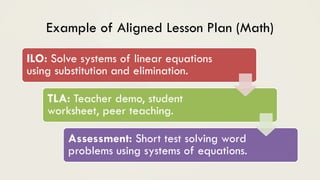
Example of AlignedLesson Plan (Math)
ILO: Solve systems of linear equations
using substitution and elimination.
TLA: Teacher demo, student
worksheet, peer teaching.
Assessment: Short test solving word
problems using systems of equations.
9.
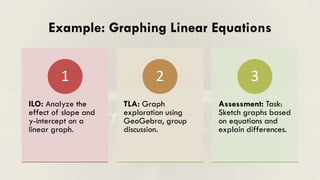
Example: Graphing LinearEquations
ILO: Analyze the
effect of slope and
y-intercept on a
linear graph.
1
TLA: Graph
exploration using
GeoGebra, group
discussion.
2
Assessment: Task:
Sketch graphs based
on equations and
explain differences.
3
10.
Benefits of ConstructiveAlignment
Clear teaching direction.
Encourages deep learning.
Transparent assessment.
Supports student accountability.
11.
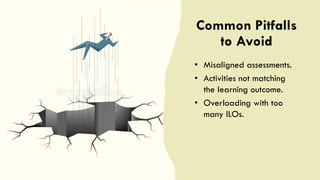
Common Pitfalls
to Avoid
•Misaligned assessments.
• Activities not matching
the learning outcome.
• Overloading with too
many ILOs.
12.
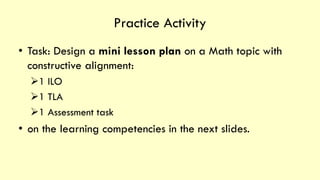
Practice Activity
• Task:Design a mini lesson plan on a Math topic with
constructive alignment:
➢1 ILO
➢1 TLA
➢1 Assessment task
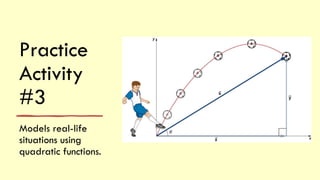
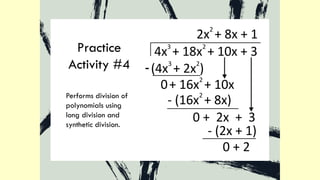
• on the learning competencies in the next slides.