Constructive alignment in
Geography
Ms. Nkosi
THINK-PAIR-SHARE
•“How can we get learners to
learn what we want them to
learn?
•“How can we design teaching
that engages the learner, has
appropriate content, and a clear
path to achievement?”
Constructive alignment
• Constructive alignment was derived from cognitive psychology and
constructivist theory.
• It is predicated on the belief that the learner constructs his or her own learning
through engaging in relevant learning activities.
• Learners’ construct meaning from what they do to learn.
• Involves selecting the most appropriate teaching and learning activities and
assessment tasks for each of the learning outcomes/objectives.
• There is a deliberate between the 3 aspects
• Promotes and assesses deep student learning (Biggs, 1996, Biggs & Tang, 2011)
• Strives for consistency across all educational aspects.
Intended learning outcomes/objectives
What are learners enabled to do after the Geography lesson?
• Lesson objectives serve as the guiding principles dictating what should be taught, how it
should be taught, and how to measure learners' grasp of the material.
• Conscious effort to provide the learner with a clearly specified goal
• Verbs in learning objectives statements are typically used as a basis for alignment and refer to
the specific steps that collectively lead the learners toward the objectives (Biggs & Tang,
2011; Jackson et al., 2003).
• Central to this approach is the articulation of the Geography CAPs through well-defined
objectives.
• These objectives outline the desired depth of comprehension, moving beyond a mere listing
of topics to understanding, application, and transference.
• Establish a clear understanding of the desired objectives for learners.
Example:
At the end of the lesson, learners should be able to:
• Articulate your understanding of the concept ‘slope’.
• Examine the different slope elements.
• Investigate the impact of the local community’s mining activities on
slope.
Teaching and learning strategies and methods
Which teaching and learning lead to achieving the desired objectives?
• Learners must be prompted to engage in tasks aligned with the specified objectives.
• If learners are to learn desired outcomes/objectives in an effective manner, then the
teacher's fundamental task is to get learners to engage in learning activities that are likely
to result in their achieving those outcomes/objectives.
• The selection of teaching strategies, methods, and techniques revolves around strategies
capable of effectively realizing these learning objectives.
• Learning takes place through the active behavior of the learner: it is what he does that he
learns, not what the teacher does.
• What the learner does is more important in determining what is learned than what the
teacher does.
• Provide a well-designed learning activity or activities that are appropriate for the learning
task
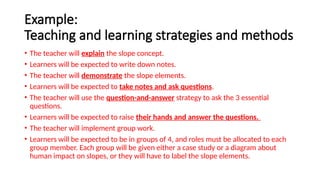
Example:
Teaching and learning strategies and methods
• The teacher will explain the slope concept.
• Learners will be expected to write down notes.
• The teacher will demonstrate the slope elements.
• Learners will be expected to take notes and ask questions.
• The teacher will use the question-and-answer strategy to ask the 3 essential
questions.
• Learners will be expected to raise their hands and answer the questions.
• The teacher will implement group work.
• Learners will be expected to be in groups of 4, and roles must be allocated to each
group member. Each group will be given either a case study or a diagram about
human impact on slopes, or they will have to label the slope elements.
Assessment tasks/learning tasks
How should formative/summative assessment be designed in order to assess the
achievement of learning results?
• The assessment component is designed to directly address the predetermined
objectives.
• Instructions and assessment methods must be tailored to harmonize the
predetermined lesson objectives.
• This approach ensures that the assessment process evaluates the learner's
attainment of the targeted understanding as articulated in the objectives.
• Assessments gauge learners' ability to be proficiency in accomplishing the
anticipated learning objectives.
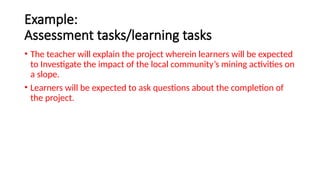
Example:
Assessment tasks/learning tasks
• The teacher will explain the project wherein learners will be expected
to Investigate the impact of the local community’s mining activities on
a slope.
• Learners will be expected to ask questions about the completion of
the project.
By now, you must be in the position to do the
following:
• Explain the term “constructive alignment”.
• Identify the three aspects/tenets of constructive alignment.
• Implement constructive alignment in lesson planning and the presentation thereof.
• Analyse case studies/scenarios.
• If you still do not understand the following, ask a question or schedule a consultation.

5. Constructive alignment...........pptx

  • 1.
  • 2.
    THINK-PAIR-SHARE •“How can weget learners to learn what we want them to learn? •“How can we design teaching that engages the learner, has appropriate content, and a clear path to achievement?”
  • 3.
    Constructive alignment • Constructivealignment was derived from cognitive psychology and constructivist theory. • It is predicated on the belief that the learner constructs his or her own learning through engaging in relevant learning activities. • Learners’ construct meaning from what they do to learn. • Involves selecting the most appropriate teaching and learning activities and assessment tasks for each of the learning outcomes/objectives. • There is a deliberate between the 3 aspects • Promotes and assesses deep student learning (Biggs, 1996, Biggs & Tang, 2011) • Strives for consistency across all educational aspects.
  • 4.
    Intended learning outcomes/objectives Whatare learners enabled to do after the Geography lesson? • Lesson objectives serve as the guiding principles dictating what should be taught, how it should be taught, and how to measure learners' grasp of the material. • Conscious effort to provide the learner with a clearly specified goal • Verbs in learning objectives statements are typically used as a basis for alignment and refer to the specific steps that collectively lead the learners toward the objectives (Biggs & Tang, 2011; Jackson et al., 2003). • Central to this approach is the articulation of the Geography CAPs through well-defined objectives. • These objectives outline the desired depth of comprehension, moving beyond a mere listing of topics to understanding, application, and transference. • Establish a clear understanding of the desired objectives for learners.
  • 5.
    Example: At the endof the lesson, learners should be able to: • Articulate your understanding of the concept ‘slope’. • Examine the different slope elements. • Investigate the impact of the local community’s mining activities on slope.
  • 6.
    Teaching and learningstrategies and methods Which teaching and learning lead to achieving the desired objectives? • Learners must be prompted to engage in tasks aligned with the specified objectives. • If learners are to learn desired outcomes/objectives in an effective manner, then the teacher's fundamental task is to get learners to engage in learning activities that are likely to result in their achieving those outcomes/objectives. • The selection of teaching strategies, methods, and techniques revolves around strategies capable of effectively realizing these learning objectives. • Learning takes place through the active behavior of the learner: it is what he does that he learns, not what the teacher does. • What the learner does is more important in determining what is learned than what the teacher does. • Provide a well-designed learning activity or activities that are appropriate for the learning task
  • 7.
    Example: Teaching and learningstrategies and methods • The teacher will explain the slope concept. • Learners will be expected to write down notes. • The teacher will demonstrate the slope elements. • Learners will be expected to take notes and ask questions. • The teacher will use the question-and-answer strategy to ask the 3 essential questions. • Learners will be expected to raise their hands and answer the questions. • The teacher will implement group work. • Learners will be expected to be in groups of 4, and roles must be allocated to each group member. Each group will be given either a case study or a diagram about human impact on slopes, or they will have to label the slope elements.
  • 8.
    Assessment tasks/learning tasks Howshould formative/summative assessment be designed in order to assess the achievement of learning results? • The assessment component is designed to directly address the predetermined objectives. • Instructions and assessment methods must be tailored to harmonize the predetermined lesson objectives. • This approach ensures that the assessment process evaluates the learner's attainment of the targeted understanding as articulated in the objectives. • Assessments gauge learners' ability to be proficiency in accomplishing the anticipated learning objectives.
  • 9.
    Example: Assessment tasks/learning tasks •The teacher will explain the project wherein learners will be expected to Investigate the impact of the local community’s mining activities on a slope. • Learners will be expected to ask questions about the completion of the project.
  • 11.
    By now, youmust be in the position to do the following: • Explain the term “constructive alignment”. • Identify the three aspects/tenets of constructive alignment. • Implement constructive alignment in lesson planning and the presentation thereof. • Analyse case studies/scenarios. • If you still do not understand the following, ask a question or schedule a consultation.