
The Islamic University – Gaza
Faculty of Engineering
Civil Engineering Department
Contracts, Specification
and Quantity Surveying( ECIV 4243)
Project Delivery system
(CONSTRUCTION MANAGEMENT-CM)
Done By :
Submitted to:
 Project delivery systems refer to the overall
processes by which a project is designed,
constructed, and/or Maintained .
 The generic term “project delivery system” describes
how the participants (Owners, designers, and contractors)
are make the decisions, provide the services, and perform
the work to deliver constructed projects or ganized to
interact, transforming the owner’s project goals and
objectives into a finished facility .
 Past practices, experience and the advice of
consultants .
 The effective use of staff and working
capital.
 The interests of other project stakeholders.
1) Design-bid-build ( DBB ) .
1) Design-build ( DB) .
2) Construction management ( CM ) .
1) When cost is primary important .
2) Schedule is secondary important.
3) scope is well defined.
 What is the meaning of CM ?
Construction project management (CM ) is the act of
planning, organizing and overseeing the various tasks
involved in a construction project. It is performed by
individuals known as project managers, who represent the
builder or contractor hired to perform the work.
Many owners engage construction managers (CMs) to assist in
developing bid documents and overseeing project
construction .
 Definition : -
Is the process of measuring and assessing the risks and develop
strategies to manage it. Such strategies include risk transfer to
the other and avoid and minimize negative impacts and to accept
some or all of its consequences.
.
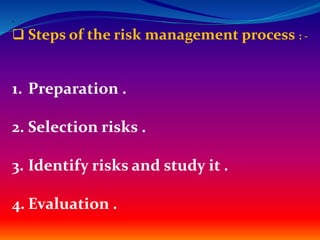
 Steps of the risk management process : -
1. Preparation .
2. Selection risks .
3. Identify risks and study it .
4. Evaluation .
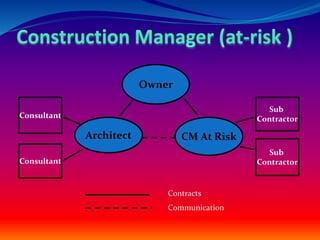
Owner
Architect CM At Risk
Consultant
Consultant
Contracts
Communication
Sub
Contractor
Sub
Contractor
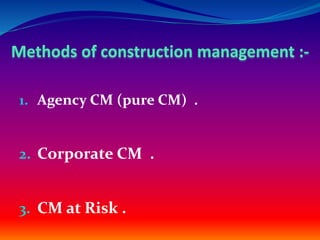
1. Agency CM (pure CM) .
2. Corporate CM .
3. CM at Risk .
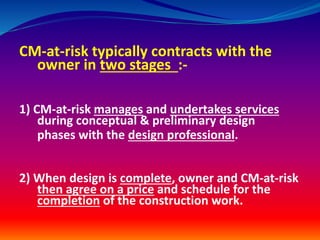
CM-at-risk typically contracts with the
owner in two stages :-
1) CM-at-risk manages and undertakes services
during conceptual & preliminary design
phases with the design professional.
2) When design is complete, owner and CM-at-risk
then agree on a price and schedule for the
completion of the construction work.
• Large projects with multiple phases and
contracts .
• Fast-tracking – Staged construction .
• Limited internal agency management
resources and expertise .
• Limited time or funding constraints.
• Allows for innovation and constructability
recommendations in the design phase, yet the
agency still retains significant control over the
design .
• CM holds construction contracts, transferring
performance risk to GC .
• GC puts more investment in cost
engineering and constructability
review than with CM-Agency
• Fixes project cost and completion .
• Large packages could exclude smaller
contractors from bidding .
• Without minimum work guarantees,
the possibility that selection for award
may not necessarily lead to work
orders may discourage potential
.bidders
• Without advance knowledge of the
timing and duration of task orders ,
it is more difficult for ID/IQ
contractors to manage resources .
Construction management cm

Construction management cm

  • 1.
    The Islamic University– Gaza Faculty of Engineering Civil Engineering Department Contracts, Specification and Quantity Surveying( ECIV 4243) Project Delivery system (CONSTRUCTION MANAGEMENT-CM) Done By : Submitted to:
  • 2.
     Project deliverysystems refer to the overall processes by which a project is designed, constructed, and/or Maintained .  The generic term “project delivery system” describes how the participants (Owners, designers, and contractors) are make the decisions, provide the services, and perform the work to deliver constructed projects or ganized to interact, transforming the owner’s project goals and objectives into a finished facility .
  • 4.
     Past practices,experience and the advice of consultants .  The effective use of staff and working capital.  The interests of other project stakeholders.
  • 5.
    1) Design-bid-build (DBB ) . 1) Design-build ( DB) . 2) Construction management ( CM ) .
  • 6.
    1) When costis primary important . 2) Schedule is secondary important. 3) scope is well defined.
  • 7.
     What isthe meaning of CM ? Construction project management (CM ) is the act of planning, organizing and overseeing the various tasks involved in a construction project. It is performed by individuals known as project managers, who represent the builder or contractor hired to perform the work. Many owners engage construction managers (CMs) to assist in developing bid documents and overseeing project construction .
  • 8.
     Definition :- Is the process of measuring and assessing the risks and develop strategies to manage it. Such strategies include risk transfer to the other and avoid and minimize negative impacts and to accept some or all of its consequences.
  • 9.
    .  Steps ofthe risk management process : - 1. Preparation . 2. Selection risks . 3. Identify risks and study it . 4. Evaluation .
  • 10.
    Owner Architect CM AtRisk Consultant Consultant Contracts Communication Sub Contractor Sub Contractor
  • 11.
    1. Agency CM(pure CM) . 2. Corporate CM . 3. CM at Risk .
  • 12.
    CM-at-risk typically contractswith the owner in two stages :- 1) CM-at-risk manages and undertakes services during conceptual & preliminary design phases with the design professional. 2) When design is complete, owner and CM-at-risk then agree on a price and schedule for the completion of the construction work.
  • 13.
    • Large projectswith multiple phases and contracts . • Fast-tracking – Staged construction . • Limited internal agency management resources and expertise . • Limited time or funding constraints.
  • 14.
    • Allows forinnovation and constructability recommendations in the design phase, yet the agency still retains significant control over the design . • CM holds construction contracts, transferring performance risk to GC .
  • 15.
    • GC putsmore investment in cost engineering and constructability review than with CM-Agency • Fixes project cost and completion .
  • 16.
    • Large packagescould exclude smaller contractors from bidding . • Without minimum work guarantees, the possibility that selection for award may not necessarily lead to work orders may discourage potential .bidders
  • 17.
    • Without advanceknowledge of the timing and duration of task orders , it is more difficult for ID/IQ contractors to manage resources .