Front
Cover
Industry Training Resources
Includes training
tasks
I
Construction
Induction
(White card)
CPCCWHS1001
Prepare to work safely in the
construction industry
About construction induction
7
© Easy Guides Australia Pty.
Ltd.
May not be
reproduced
ABOUT CONSTRUCTION INDUCTION
Workplace health and safety in the construction industry
People working in construction need proof that they have completed a general Workplace Health and Safety (WHS)
induction for the construction industry.
Previously, states and territories have had their own requirements or qualifications for a person to provide this
proof of training, for example, NSW – Green Card, VIC – Red Card, QLD – Blue Card etc.
While mutual recognition of these cards occurs between many states and territories, there is now a nationally recognised
general induction training qualification (CPCCWHS1001 Prepare to work safely in the construction industry) which has
been jointly developed and agreed upon by all state and territory health and safety authorities.
The national qualification is commonly known as the White Card.
Note:
Keep a photocopy of your White Card. If
you happen to lose the original you may
not be allowed on the worksite whilst
you are waiting for a new card.
8
© Easy Guides Australia Pty.
Ltd.
May not be
reproduced
ABOUT CONSTRUCTION INDUCTION
National code of practice of induction for construction work
The code brings together best practice approaches from Australian state and territory health and
safety authorities into a framework to promote a nationally uniform approach to workplace health and
safety induction training in the building and construction industry.
This code of practice provides guidance to persons working in the general and residential
construction sectors. It covers:
• The type of induction training that may be needed to provide construction workers with an
awareness and understanding of common hazards on construction sites.
• How these hazards should be managed.
The code is supported by the Unit of Competency — CPCCWHS1001 – Prepare to work safely in the construction
industry. This unit is contained in the CPC Construction, Plumbing and Services Training Package, enabling delivery
within the VET sector.
Induction training falls into three categories
• General induction
• Site specific induction
• Taskspecific induction
Site specific and Task specific induction training have no formal training
or assessment requirements.
However, an employer is under a duty of care under the health and safety
Act to provide employees with information, instruction, training and
supervision as is necessary to perform their work safely.
9
© Easy Guides Australia Pty.
Ltd.
May not be
reproduced
ABOUT CONSTRUCTION INDUCTION
Aims of general induction training
General induction training aims to provide persons with a basic knowledge of workplace health and safety
legislative requirements, principles of risk management and the prevention of injury and illness in the
construction industry.
General induction training should be undertaken by
anybody working in general construction (commercial
and civil) as well as those in the residential construction
sector.
General induction training should include a formal
training program that provides workers in the
construction industry with an awareness and
understanding of:
• their rights and responsibilities under health
and safety law
• common hazards and risks that are in the
construction industry
• basic risk management principles
• the standard of behaviour expected of workers on
construction sites.
10
© Easy Guides Australia Pty.
Ltd.
May not be
reproduced
ABOUT CONSTRUCTION INDUCTION
Aims of general induction training(continued)
General induction training is recommended for:
• Anybody carrying out construction work including
site managers, supervisors, surveyors, labourers
and trades persons.
• Anybody with access to operational construction
zones unaccompanied or not directly supervised by
an inducted person.
• Anybody whose employment causes them to
routinely enter operational construction zones.
General induction should be completed upon entry to the
industry before commencing construction work.
However, general induction may be repeated when the
person with control of the constructionwork decides that
there is a need for additional training.
This can be determined through supervision, incidents
that may occur, risk management, or when a person re-
enters the industry after an extended absence; for
example, two consecutive years.
11
© Easy Guides Australia Pty.
Ltd.
May not be
reproduced
This element covers the following performance criteria:
1. Basic roles, responsibilities and rights of duty holders are
identified and explained according to jurisdictional health
and safety legislative requirements.
2. Duty of care requirements are identified.
3. Construction safe work practices are identified
and explained.
Element
1 - Identify health and safety legislative
requirementsofconstructionwork
13
© Easy Guides Australia Pty.
Ltd.
May not be
reproduced
IDENTIFY HEALTH AND SAFETY LEGISLATIVE REQUIREMENTS OF CONSTRUCTION WORK
1.1 – Health & Safety Legislative requirements
Laws to keep your workplace safe
Health and safety requirements are
outlined in Acts, Regulations, Codes of
Practice and Australian Standards.
14
© Easy Guides Australia Pty.
Ltd.
May not be
reproduced
Acts
Acts are laws that explain how to improve health and safety in the
workplace. Check your state or territory regulator for the
current version. For example: Model Work Health and Safety Act or
Occupational Health and Safety Act.
Regulations
Regulations explain specific parts of the Act.
For example: Part 4.3 – Confined spaces, Part 4.4 – Falls
Codes of Practice/Compliance Codes
Codes of Practice are practical guidelines on how to comply with
(meet the rules of) legislation.
For example: HAZARDOUS MANUAL TASKS Code of Practice
Australian Standards
Australian Standards are work guidelines that set the minimum
accepted performance or quality for a specific hazard,process or
product. For example: AS 2550 – Cranes, hoists and winches
– safe use set.
PC 1.1
IDENTIFY HEALTH AND SAFETY LEGISLATIVE REQUIREMENTS OF CONSTRUCTION WORK
Examples of health and safety legislative requirements
• Duty of Care
• Construction industry health and safety standards and guidelines
• Licences, tickets or certificates of competency
• Health and safety officers/representatives, committees and supervisors
• National Code of Practice for Induction Training for Construction Work
• Health and safety, welfare and regulations
• Safety Codes of Practice.
It is important that you know about these legislative requirements and how
they affect the work that you do.
These laws, regulations and guidelines are in place to make your worksite a
safe place to work. They are there to protect you and the workers around you,
and will help you understand your legal responsibility for health
and safety.
PC 1.1
15
© Easy Guides Australia Pty.
Ltd.
May not be
reproduced
IDENTIFY HEALTH AND SAFETY LEGISLATIVE REQUIREMENTS OF CONSTRUCTION WORK
States not using the new laws
OHS Acts for Victoria and Western Australia can be
found on the relevant regulators website.
Not yetadopted
WA
NT
QLD
SA
NSW
VIC
TAS
ACT
Not yetadopted
16
© Easy Guides Australia Pty.
Ltd.
May not be
reproduced
National Work Health and Safety (WHS) Laws
The model WHS Act was finalised in June 2011. At the time of printing for this guide, Victoria and Western Australia
have not adopted the WHS act. The laws include a model WHS Act, model health and safety regulations, model codes
of practice and a National Compliance and Enforcement Policy.
These can be found at www.safeworkaustralia.gov.au.
States and Territories using the model WHS Acts
• Northern Territory
• Queensland
• New South Wales
• Australian Capital Territory
• South Australia
• Tasmania
PC 1.1
17
© Easy Guides Australia Pty.
Ltd.
May not be
reproduced
IDENTIFY HEALTH AND SAFETY LEGISLATIVE REQUIREMENTS OF CONSTRUCTION WORK
National Work Health and Safety (WHS) Laws (continued)
Although most states and territories have adopted the Model Act, you need to be aware of any variations that may exist.
Listed below are the acts which detail the legislative requirements for each jurisdiction (state or territory).
Australian CapitalTerritory
WorkHealth and Safety Act 2011
New SouthWales
WorkHealth and Safety Act 2011
Northern Territory
WorkHealth and Safety (National Uniform Legislation) Act2011
Queensland
WorkHealth and Safety Act 2011
South Australia
WorkHealth and Safety Act 2012
Tasmania
WorkHealth and Safety Act 2012
Victoria
Occupational Health and Safety Act2004
Western Australia
Occupational Safety and Health Act1984
PC 1.1
IDENTIFY HEALTH AND SAFETY LEGISLATIVE REQUIREMENTS OF CONSTRUCTION WORK
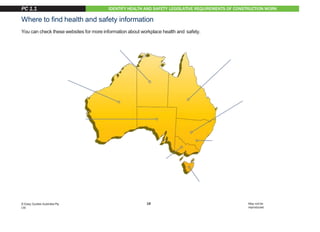
Where to find health and safety information
You can check these websites for more information about workplace health and safety.
VICWorkSafe
www.worksafe.vic.gov.au
TASWorkSafe
www.worksafe.tas.gov.au/home
NSWWorkCover
www.workcover.nsw.gov.au
ACT WorkCover
www.worksafe.act.gov.au
WAWorkSafe
www.commerce.wa.gov.au/WorkSafe
QLD WorkplaceHealth andSafety
www.justice.qld.gov.au
You can also read more about health and safety at:
www.safeworkaustralia.gov.au
NTWorkSafe
www.worksafe.nt.gov.au
SA SafeWork
www.safework.sa.gov.au
18
© Easy Guides Australia Pty.
Ltd.
May not be
reproduced
PC 1.1
IDENTIFY HEALTH AND SAFETY LEGISLATIVE REQUIREMENTS OF CONSTRUCTION WORK
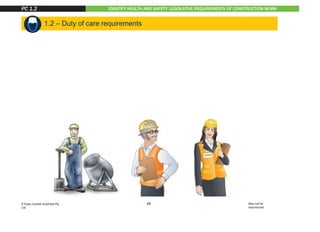
1.2 – Duty of care requirements
Note:
The following informationis based on the WHS Act. If your state is not using the WHS Act (ie Victoria, Western
Australia), your trainer will provide you with the relevant section of your state Occupational Health & Safety (OHS)
Act.
‘The national WHS Act sets out the legal responsibilities that apply to persons conducting a business or undertaking
(PCBU) and workers to make sure the workplace is as safe and healthy as possible.’
PCBUs (employer/workplace manager) and workers (employees) both have a duty of care responsibility to make sure
the workplace is a healthy and safe place to be. A ‘worker’ includes people who are employees, contractors, sub-
contractors, outworkers, employees of labour hire companies and volunteers.
The workplace must also not harm the health or safety of visitors or people nearby.
PC 1.2
19
© Easy Guides Australia Pty.
Ltd.
May not be
reproduced
IDENTIFY HEALTH AND SAFETY LEGISLATIVE REQUIREMENTS OF CONSTRUCTION WORK
Worker’s (employee’s) duty of care
By law, as a worker you must take care of your own
health and safety — and the health and safety of other
people in the workplace.
You must also:
• Do your best to follow reasonable safety
instructions from your PCBU/employer (boss).
• Follow workplace health and safety procedures
and policies.
• Do not do work if you
believe a hazard would
be a serious risk to your
health or safety.
PCBU’s (employer’s) duty of care
By law, a person undertaking a business or undertaking
PCBU has a number of obligations under the Health and
Safety Act.
These include:
• Provide a workplace that is safe and without risk to
health.
• Train workers to work in a way that is healthy and safe.
This must be in a way that is easy to understand.
• Report notifiable incidents.
• Consult (talk with) workers.
• Obey notices to comply with the Act.
• Make sure that all health and safety
representatives receive their training.
Penalties
If you are a PCBU/employer or worker, the government
can fine or even imprison you for failing your duty of care.
PC 1.2
20
© Easy Guides Australia Pty.
Ltd.
May not be
reproduced
IDENTIFY HEALTH AND SAFETY LEGISLATIVE REQUIREMENTS OF CONSTRUCTION WORK
Who has duty of care?
We have mentioned that both PCBUs (employers) and workers have a
duty of care responsibility to make sure the workplace is a healthy and
safe place to be.
On the following pages are some examples of people who have a
duty of care to make sure the workplace is a healthy and safe place
to be.
Duties of persons conducting businesses or undertakings
involving management or control of workplaces
The person with management or control of a workplace:
• must take reasonable care that the workplace is without risk to the
health or safety of anyone.
• must also make sure that people can enter and exit the workplace
without risk to their health or safety.
PC 1.2
22
© Easy Guides Australia Pty.
Ltd.
May not be
reproduced
IDENTIFY HEALTH AND SAFETY LEGISLATIVE REQUIREMENTS OF CONSTRUCTION WORK
Dogging, rigging, scaffolding
(over 4 metres)
Forklift trucks Elevating work platforms
(boom length 11 metres or more)
Cranes Pressure equipment
Licences, tickets or certificates of competency
Some tasks will require you to hold a current licence, certificate or other qualification. Here are some examples:
• Licences issued under the National Standard for Licensing Persons Performing High Risk work suchas:
PC 1.2
26
© Easy Guides Australia Pty.
Ltd.
May not be
reproduced
IDENTIFY HEALTH AND SAFETY LEGISLATIVE REQUIREMENTS OF CONSTRUCTION WORK
Licences, tickets or certificates of competency(continued)
Do not attempt any of these tasks without the proper training and qualifications
Other tasks that will require you to hold a current licence,
certificate or other qualifications include:
• Traffic control
• Transporting dangerous goods
• Pilot vehicle
• Asbestos removal
• Plumbing and gas fitting
• Producing, storing and transporting prescribed waste
• Dredging
• Road works
• Laying underground services in public areas.
27
© Easy Guides Australia Pty.
Ltd.
May not be
reproduced
PC 1.2
IDENTIFY HEALTH AND SAFETY LEGISLATIVE REQUIREMENTS OF CONSTRUCTION WORK
Personal protective equipment (PPE)
The purpose of PPE (clothing, equipment or protective
substances such as sunscreen) is to protect you from risk
of injury or illness.
You should use personal protective equipment and
clothing where necessary.
Safe work practices (continued)
Use of plant and equipment
Operate plant, equipment and machinery in a safe
and responsible way that does not put yourself or
others at risk.
If you are on medication you must notify your
supervisor before operating plant machinery.
29
© Easy Guides Australia Pty.
Ltd.
May not be
reproduced
PC 1.3
IDENTIFY HEALTH AND SAFETY LEGISLATIVE REQUIREMENTS OF CONSTRUCTION WORK
Keeping your work area clean
Keep your work area clean and remove and/or store
any debris, materials or equipment.
Tripping hazards are common, so try to keep walkways
clear of any debris or litter.
• stored in a safe manner
• stored in an organised manner
• able to be accessed safely and easily
• stored as per Safety Data Sheet (see SDS next page)
and WHS legislative requirements.
Storing materials and equipment
Make sure that materials and equipment are:
PC 1.3
30
© Easy Guides Australia Pty.
Ltd.
May not be
reproduced
IDENTIFY HEALTH AND SAFETY LEGISLATIVE REQUIREMENTS OF CONSTRUCTION WORK
Litter and debris
Litter and debris can get in the way, be a tripping hazard or a fire hazard.
Don’t let debris build up
– remove it continuously
throughout your day.
Always make sure that removal of debris
does not create a risk to, or impact badly
on the environment.
Always dispose of
litter in approved
and markedbins.
32
© Easy Guides Australia Pty.
Ltd.
May not be
reproduced
PC 1.3
IDENTIFY HEALTH AND SAFETY LEGISLATIVE REQUIREMENTS OF CONSTRUCTION WORK
Keep trucks and other vehicles on designated
travel routes.
Spread gravel at road access points to minimise the
amount of mud that is left on roads.
Cover loose loads to make sure
debris doesn’t fall from the back
of trucks onto the road.
33
© Easy Guides Australia Pty.
Ltd.
May not be
reproduced
Site disturbance and dust
Site disturbance could include spreading mud, dust or debris around and outside the worksite. To
help stop site disturbance you can:
PC 1.3
IDENTIFY HEALTH AND SAFETY LEGISLATIVE REQUIREMENTS OF CONSTRUCTION WORK
Procedures and processes for controlling hazards will need to be reviewed on a regular basisas
workplaces can be constantlychanging.
Site disturbance and dust(continued)
Control dust by wetting roads and stockpiles Make sure stormwater drains in the area have been
(water restrictions permitting). set up with a gravel sausage or gravel inlet filter to
stop mud making its way into the stormwater system.
Clean truck tyres
with a broom or
water to prevent
mud spreading
onto the road.
PC 1.3
34
© Easy Guides Australia Pty.
Ltd.
May not be
reproduced
IDENTIFY HEALTH AND SAFETY LEGISLATIVE REQUIREMENTS OF CONSTRUCTION WORK
Bullying and harassment
Take care of yourselves and each other.
Bullying and harassment do not belong in the
workplace. Report any bullying or harassment to
your supervisor or other relevant person.
Smoking in the workplace
Some workplaces have special places for people who
smoke. If you smoke, you must use these places to
prevent a risk to others who do not smoke. It also
removes the risk of a flame near flammable liquids.
Some sites may also have set smoking times.
PC 1.3
35
© Easy Guides Australia Pty.
Ltd.
May not be
reproduced
Element 2 - Identify construction
hazards and risk controlmeasures
39
© Easy Guides Australia Pty.
Ltd.
May not be
reproduced
This element covers thefollowing
performance criteria:
1. Basic principles of risk
management are identified.
2. Construction hazards are identified
and discussed.
3. Purpose and use of PPE are
identified and demonstrated.
4. Measures for controlling hazards
are identified.
IDENTIFY CONSTRUCTION HAZARDS AND RISK CONTROL MEASURES
Hazard
A hazard is any thing or any situation which could
injure or harm you.
In other words, it is anything that can hurt you.
Risk
A risk is the chance of a hazard causing injury
or harm.
In other words, how likely it is that somebody or
something may be harmed by the hazard.
2.1 – Basic principles of risk management
Hazard versus risk
What is the difference?
The constantly changing nature of construction work sets it apart from other types of work. Different hazards and
risks emerge constantly—sometimes instantly.
Co-ordinating risk management is made more difficult by the stop and start nature of a construction project, high
turnover of workers and temporary workplaces. These features contribute to the high levels of risk in the industry.
PC 2.1
40
© Easy Guides Australia Pty.
Ltd.
May not be
reproduced

Construction-Induction_Power Point-1.pptx

  • 1.
    Front Cover Industry Training Resources Includestraining tasks I Construction Induction (White card) CPCCWHS1001 Prepare to work safely in the construction industry
  • 2.
    About construction induction 7 ©Easy Guides Australia Pty. Ltd. May not be reproduced
  • 3.
    ABOUT CONSTRUCTION INDUCTION Workplacehealth and safety in the construction industry People working in construction need proof that they have completed a general Workplace Health and Safety (WHS) induction for the construction industry. Previously, states and territories have had their own requirements or qualifications for a person to provide this proof of training, for example, NSW – Green Card, VIC – Red Card, QLD – Blue Card etc. While mutual recognition of these cards occurs between many states and territories, there is now a nationally recognised general induction training qualification (CPCCWHS1001 Prepare to work safely in the construction industry) which has been jointly developed and agreed upon by all state and territory health and safety authorities. The national qualification is commonly known as the White Card. Note: Keep a photocopy of your White Card. If you happen to lose the original you may not be allowed on the worksite whilst you are waiting for a new card. 8 © Easy Guides Australia Pty. Ltd. May not be reproduced
  • 4.
    ABOUT CONSTRUCTION INDUCTION Nationalcode of practice of induction for construction work The code brings together best practice approaches from Australian state and territory health and safety authorities into a framework to promote a nationally uniform approach to workplace health and safety induction training in the building and construction industry. This code of practice provides guidance to persons working in the general and residential construction sectors. It covers: • The type of induction training that may be needed to provide construction workers with an awareness and understanding of common hazards on construction sites. • How these hazards should be managed. The code is supported by the Unit of Competency — CPCCWHS1001 – Prepare to work safely in the construction industry. This unit is contained in the CPC Construction, Plumbing and Services Training Package, enabling delivery within the VET sector. Induction training falls into three categories • General induction • Site specific induction • Taskspecific induction Site specific and Task specific induction training have no formal training or assessment requirements. However, an employer is under a duty of care under the health and safety Act to provide employees with information, instruction, training and supervision as is necessary to perform their work safely. 9 © Easy Guides Australia Pty. Ltd. May not be reproduced
  • 5.
    ABOUT CONSTRUCTION INDUCTION Aimsof general induction training General induction training aims to provide persons with a basic knowledge of workplace health and safety legislative requirements, principles of risk management and the prevention of injury and illness in the construction industry. General induction training should be undertaken by anybody working in general construction (commercial and civil) as well as those in the residential construction sector. General induction training should include a formal training program that provides workers in the construction industry with an awareness and understanding of: • their rights and responsibilities under health and safety law • common hazards and risks that are in the construction industry • basic risk management principles • the standard of behaviour expected of workers on construction sites. 10 © Easy Guides Australia Pty. Ltd. May not be reproduced
  • 6.
    ABOUT CONSTRUCTION INDUCTION Aimsof general induction training(continued) General induction training is recommended for: • Anybody carrying out construction work including site managers, supervisors, surveyors, labourers and trades persons. • Anybody with access to operational construction zones unaccompanied or not directly supervised by an inducted person. • Anybody whose employment causes them to routinely enter operational construction zones. General induction should be completed upon entry to the industry before commencing construction work. However, general induction may be repeated when the person with control of the constructionwork decides that there is a need for additional training. This can be determined through supervision, incidents that may occur, risk management, or when a person re- enters the industry after an extended absence; for example, two consecutive years. 11 © Easy Guides Australia Pty. Ltd. May not be reproduced
  • 7.
    This element coversthe following performance criteria: 1. Basic roles, responsibilities and rights of duty holders are identified and explained according to jurisdictional health and safety legislative requirements. 2. Duty of care requirements are identified. 3. Construction safe work practices are identified and explained. Element 1 - Identify health and safety legislative requirementsofconstructionwork 13 © Easy Guides Australia Pty. Ltd. May not be reproduced
  • 8.
    IDENTIFY HEALTH ANDSAFETY LEGISLATIVE REQUIREMENTS OF CONSTRUCTION WORK 1.1 – Health & Safety Legislative requirements Laws to keep your workplace safe Health and safety requirements are outlined in Acts, Regulations, Codes of Practice and Australian Standards. 14 © Easy Guides Australia Pty. Ltd. May not be reproduced Acts Acts are laws that explain how to improve health and safety in the workplace. Check your state or territory regulator for the current version. For example: Model Work Health and Safety Act or Occupational Health and Safety Act. Regulations Regulations explain specific parts of the Act. For example: Part 4.3 – Confined spaces, Part 4.4 – Falls Codes of Practice/Compliance Codes Codes of Practice are practical guidelines on how to comply with (meet the rules of) legislation. For example: HAZARDOUS MANUAL TASKS Code of Practice Australian Standards Australian Standards are work guidelines that set the minimum accepted performance or quality for a specific hazard,process or product. For example: AS 2550 – Cranes, hoists and winches – safe use set. PC 1.1
  • 9.
    IDENTIFY HEALTH ANDSAFETY LEGISLATIVE REQUIREMENTS OF CONSTRUCTION WORK Examples of health and safety legislative requirements • Duty of Care • Construction industry health and safety standards and guidelines • Licences, tickets or certificates of competency • Health and safety officers/representatives, committees and supervisors • National Code of Practice for Induction Training for Construction Work • Health and safety, welfare and regulations • Safety Codes of Practice. It is important that you know about these legislative requirements and how they affect the work that you do. These laws, regulations and guidelines are in place to make your worksite a safe place to work. They are there to protect you and the workers around you, and will help you understand your legal responsibility for health and safety. PC 1.1 15 © Easy Guides Australia Pty. Ltd. May not be reproduced
  • 10.
    IDENTIFY HEALTH ANDSAFETY LEGISLATIVE REQUIREMENTS OF CONSTRUCTION WORK States not using the new laws OHS Acts for Victoria and Western Australia can be found on the relevant regulators website. Not yetadopted WA NT QLD SA NSW VIC TAS ACT Not yetadopted 16 © Easy Guides Australia Pty. Ltd. May not be reproduced National Work Health and Safety (WHS) Laws The model WHS Act was finalised in June 2011. At the time of printing for this guide, Victoria and Western Australia have not adopted the WHS act. The laws include a model WHS Act, model health and safety regulations, model codes of practice and a National Compliance and Enforcement Policy. These can be found at www.safeworkaustralia.gov.au. States and Territories using the model WHS Acts • Northern Territory • Queensland • New South Wales • Australian Capital Territory • South Australia • Tasmania PC 1.1
  • 11.
    17 © Easy GuidesAustralia Pty. Ltd. May not be reproduced IDENTIFY HEALTH AND SAFETY LEGISLATIVE REQUIREMENTS OF CONSTRUCTION WORK National Work Health and Safety (WHS) Laws (continued) Although most states and territories have adopted the Model Act, you need to be aware of any variations that may exist. Listed below are the acts which detail the legislative requirements for each jurisdiction (state or territory). Australian CapitalTerritory WorkHealth and Safety Act 2011 New SouthWales WorkHealth and Safety Act 2011 Northern Territory WorkHealth and Safety (National Uniform Legislation) Act2011 Queensland WorkHealth and Safety Act 2011 South Australia WorkHealth and Safety Act 2012 Tasmania WorkHealth and Safety Act 2012 Victoria Occupational Health and Safety Act2004 Western Australia Occupational Safety and Health Act1984 PC 1.1
  • 12.
    IDENTIFY HEALTH ANDSAFETY LEGISLATIVE REQUIREMENTS OF CONSTRUCTION WORK Where to find health and safety information You can check these websites for more information about workplace health and safety. VICWorkSafe www.worksafe.vic.gov.au TASWorkSafe www.worksafe.tas.gov.au/home NSWWorkCover www.workcover.nsw.gov.au ACT WorkCover www.worksafe.act.gov.au WAWorkSafe www.commerce.wa.gov.au/WorkSafe QLD WorkplaceHealth andSafety www.justice.qld.gov.au You can also read more about health and safety at: www.safeworkaustralia.gov.au NTWorkSafe www.worksafe.nt.gov.au SA SafeWork www.safework.sa.gov.au 18 © Easy Guides Australia Pty. Ltd. May not be reproduced PC 1.1
  • 13.
    IDENTIFY HEALTH ANDSAFETY LEGISLATIVE REQUIREMENTS OF CONSTRUCTION WORK 1.2 – Duty of care requirements Note: The following informationis based on the WHS Act. If your state is not using the WHS Act (ie Victoria, Western Australia), your trainer will provide you with the relevant section of your state Occupational Health & Safety (OHS) Act. ‘The national WHS Act sets out the legal responsibilities that apply to persons conducting a business or undertaking (PCBU) and workers to make sure the workplace is as safe and healthy as possible.’ PCBUs (employer/workplace manager) and workers (employees) both have a duty of care responsibility to make sure the workplace is a healthy and safe place to be. A ‘worker’ includes people who are employees, contractors, sub- contractors, outworkers, employees of labour hire companies and volunteers. The workplace must also not harm the health or safety of visitors or people nearby. PC 1.2 19 © Easy Guides Australia Pty. Ltd. May not be reproduced
  • 14.
    IDENTIFY HEALTH ANDSAFETY LEGISLATIVE REQUIREMENTS OF CONSTRUCTION WORK Worker’s (employee’s) duty of care By law, as a worker you must take care of your own health and safety — and the health and safety of other people in the workplace. You must also: • Do your best to follow reasonable safety instructions from your PCBU/employer (boss). • Follow workplace health and safety procedures and policies. • Do not do work if you believe a hazard would be a serious risk to your health or safety. PCBU’s (employer’s) duty of care By law, a person undertaking a business or undertaking PCBU has a number of obligations under the Health and Safety Act. These include: • Provide a workplace that is safe and without risk to health. • Train workers to work in a way that is healthy and safe. This must be in a way that is easy to understand. • Report notifiable incidents. • Consult (talk with) workers. • Obey notices to comply with the Act. • Make sure that all health and safety representatives receive their training. Penalties If you are a PCBU/employer or worker, the government can fine or even imprison you for failing your duty of care. PC 1.2 20 © Easy Guides Australia Pty. Ltd. May not be reproduced
  • 15.
    IDENTIFY HEALTH ANDSAFETY LEGISLATIVE REQUIREMENTS OF CONSTRUCTION WORK Who has duty of care? We have mentioned that both PCBUs (employers) and workers have a duty of care responsibility to make sure the workplace is a healthy and safe place to be. On the following pages are some examples of people who have a duty of care to make sure the workplace is a healthy and safe place to be. Duties of persons conducting businesses or undertakings involving management or control of workplaces The person with management or control of a workplace: • must take reasonable care that the workplace is without risk to the health or safety of anyone. • must also make sure that people can enter and exit the workplace without risk to their health or safety. PC 1.2 22 © Easy Guides Australia Pty. Ltd. May not be reproduced
  • 16.
    IDENTIFY HEALTH ANDSAFETY LEGISLATIVE REQUIREMENTS OF CONSTRUCTION WORK Dogging, rigging, scaffolding (over 4 metres) Forklift trucks Elevating work platforms (boom length 11 metres or more) Cranes Pressure equipment Licences, tickets or certificates of competency Some tasks will require you to hold a current licence, certificate or other qualification. Here are some examples: • Licences issued under the National Standard for Licensing Persons Performing High Risk work suchas: PC 1.2 26 © Easy Guides Australia Pty. Ltd. May not be reproduced
  • 17.
    IDENTIFY HEALTH ANDSAFETY LEGISLATIVE REQUIREMENTS OF CONSTRUCTION WORK Licences, tickets or certificates of competency(continued) Do not attempt any of these tasks without the proper training and qualifications Other tasks that will require you to hold a current licence, certificate or other qualifications include: • Traffic control • Transporting dangerous goods • Pilot vehicle • Asbestos removal • Plumbing and gas fitting • Producing, storing and transporting prescribed waste • Dredging • Road works • Laying underground services in public areas. 27 © Easy Guides Australia Pty. Ltd. May not be reproduced PC 1.2
  • 18.
    IDENTIFY HEALTH ANDSAFETY LEGISLATIVE REQUIREMENTS OF CONSTRUCTION WORK Personal protective equipment (PPE) The purpose of PPE (clothing, equipment or protective substances such as sunscreen) is to protect you from risk of injury or illness. You should use personal protective equipment and clothing where necessary. Safe work practices (continued) Use of plant and equipment Operate plant, equipment and machinery in a safe and responsible way that does not put yourself or others at risk. If you are on medication you must notify your supervisor before operating plant machinery. 29 © Easy Guides Australia Pty. Ltd. May not be reproduced PC 1.3
  • 19.
    IDENTIFY HEALTH ANDSAFETY LEGISLATIVE REQUIREMENTS OF CONSTRUCTION WORK Keeping your work area clean Keep your work area clean and remove and/or store any debris, materials or equipment. Tripping hazards are common, so try to keep walkways clear of any debris or litter. • stored in a safe manner • stored in an organised manner • able to be accessed safely and easily • stored as per Safety Data Sheet (see SDS next page) and WHS legislative requirements. Storing materials and equipment Make sure that materials and equipment are: PC 1.3 30 © Easy Guides Australia Pty. Ltd. May not be reproduced
  • 20.
    IDENTIFY HEALTH ANDSAFETY LEGISLATIVE REQUIREMENTS OF CONSTRUCTION WORK Litter and debris Litter and debris can get in the way, be a tripping hazard or a fire hazard. Don’t let debris build up – remove it continuously throughout your day. Always make sure that removal of debris does not create a risk to, or impact badly on the environment. Always dispose of litter in approved and markedbins. 32 © Easy Guides Australia Pty. Ltd. May not be reproduced PC 1.3
  • 21.
    IDENTIFY HEALTH ANDSAFETY LEGISLATIVE REQUIREMENTS OF CONSTRUCTION WORK Keep trucks and other vehicles on designated travel routes. Spread gravel at road access points to minimise the amount of mud that is left on roads. Cover loose loads to make sure debris doesn’t fall from the back of trucks onto the road. 33 © Easy Guides Australia Pty. Ltd. May not be reproduced Site disturbance and dust Site disturbance could include spreading mud, dust or debris around and outside the worksite. To help stop site disturbance you can: PC 1.3
  • 22.
    IDENTIFY HEALTH ANDSAFETY LEGISLATIVE REQUIREMENTS OF CONSTRUCTION WORK Procedures and processes for controlling hazards will need to be reviewed on a regular basisas workplaces can be constantlychanging. Site disturbance and dust(continued) Control dust by wetting roads and stockpiles Make sure stormwater drains in the area have been (water restrictions permitting). set up with a gravel sausage or gravel inlet filter to stop mud making its way into the stormwater system. Clean truck tyres with a broom or water to prevent mud spreading onto the road. PC 1.3 34 © Easy Guides Australia Pty. Ltd. May not be reproduced
  • 23.
    IDENTIFY HEALTH ANDSAFETY LEGISLATIVE REQUIREMENTS OF CONSTRUCTION WORK Bullying and harassment Take care of yourselves and each other. Bullying and harassment do not belong in the workplace. Report any bullying or harassment to your supervisor or other relevant person. Smoking in the workplace Some workplaces have special places for people who smoke. If you smoke, you must use these places to prevent a risk to others who do not smoke. It also removes the risk of a flame near flammable liquids. Some sites may also have set smoking times. PC 1.3 35 © Easy Guides Australia Pty. Ltd. May not be reproduced
  • 24.
    Element 2 -Identify construction hazards and risk controlmeasures 39 © Easy Guides Australia Pty. Ltd. May not be reproduced This element covers thefollowing performance criteria: 1. Basic principles of risk management are identified. 2. Construction hazards are identified and discussed. 3. Purpose and use of PPE are identified and demonstrated. 4. Measures for controlling hazards are identified.
  • 25.
    IDENTIFY CONSTRUCTION HAZARDSAND RISK CONTROL MEASURES Hazard A hazard is any thing or any situation which could injure or harm you. In other words, it is anything that can hurt you. Risk A risk is the chance of a hazard causing injury or harm. In other words, how likely it is that somebody or something may be harmed by the hazard. 2.1 – Basic principles of risk management Hazard versus risk What is the difference? The constantly changing nature of construction work sets it apart from other types of work. Different hazards and risks emerge constantly—sometimes instantly. Co-ordinating risk management is made more difficult by the stop and start nature of a construction project, high turnover of workers and temporary workplaces. These features contribute to the high levels of risk in the industry. PC 2.1 40 © Easy Guides Australia Pty. Ltd. May not be reproduced