The current issue and full text archive of this journal is available at 
www.emeraldinsight.com/1460-1060.htm 
Constructing the first customer 
reference to support the growth 
of a start-up software 
technology company 
Jari Ruokolainen 
Department of Industrial Engineering and Management, 
Helsinki University of Technology, Finland 
Abstract 
Purpose – The purpose of this paper is to explore the important and distinctly under-researched 
topic of first customer references, for which a basic descriptive framework is created. The paper also 
tests the framework, validating it by means of new insights obtained from a longitudinal case study. 
Design/methodology/approach – The present work is an embedded single longitudinal case study 
with two levels of analysis units: the company and its customers. Pattern-matching logic and 
time-series analyses are used. The idea is to compare the observed patterns with those introduced 
through the basic descriptive framework. Each case is analyzed, after which a cross-case analysis is 
conducted over the specified time horizon. Programming theory is used to describe the iterative nature 
of the phenomenon of market entry, although natural language is used instead of formal notation. 
Findings – The longitudinal case study demonstrates various operational aspects of the framework 
in practice. The study indicates the correct business operations setup model after each customer case. 
The case study generally reveals, from the perspective of competence marketing, that there are no 
failed customer cases if experimental knowledge has been gained. 
Practical implications – In order to evaluate capabilities of start-up technology companies to enter 
the market, all customer cases should be evaluated, even the failed ones. Successful customer 
references may provide only a partial picture of the gained capabilities. 
Originality/value – This paper explores the important and distinctly under-researched topic of first 
customer references, for which a basic descriptive framework is created and will be of interest to 
companies trying to enter the very competitive business-to-business market for complex products. 
Keywords Referencing, Customers, Business-to-business marketing, Computer software, 
Communication technologies 
Paper type Research paper 
Introduction 
The first customer reference is especially important for companies trying to enter the 
very competitive business-to-business market for complex products. Without proof of 
functionality in the real world and a customer reference from a third party, it is difficult 
or even impossible to convince the next potential customer. The case company, 
The author gratefully acknowledges the financial support of the Finnish Foundation of 
Economic Education and the Jenny and Antti Wihuri Fund. He would also like to thank Asian 
Institute of Technology for its important support. Especially, gratitude is expressed to Dr Pimpa 
Kanarksunti, the managing director of T.J.S. Consultants Co., Ltd, for her support. Finally, 
thanks are extended to Dr Brian Bloch for his editing of the English. 
EJIM 
11,2 
282 
European Journal of Innovation 
Management 
Vol. 11 No. 2, 2008 
pp. 282-305 
q Emerald Group Publishing Limited 
1460-1060 
DOI 10.1108/14601060810869893
T.J.S. Consultants Co., Ltd, is an example of such circumstances in the software 
industry. 
The importance of the first customer reference is reflected in many aspects of 
business activity. A customer reference is assumed to reduce the perceived risk in a 
venture (Bauer, 1967; Hutt and Speh, 1992), to increase the suppliers’ credibility 
(Blomqvist, 1997; Levitt, 1967) and to enhance the supplier’s reputation (Herbig and 
Milewicz, 1993; Doney and Cannon, 1997). Accordingly, customer references can be 
expected to help start-up technology companies enter markets. The next potential 
customer may appreciate the credibility gained from the first customer reference more 
than the innovativeness or low price of the new product. The importance of the first 
customer reference is undeniable. Especially in the marketing of complex and 
software-intensive products, experimental knowledge is crucial (Johanson and Vahlne, 
1977). However, being successful in delivering the first customer reference is a 
significant challenge. When the product and supplier are previously unknown to the 
seller, the chances of failure are high. 
The use of a customer reference by start-up technology companies is distinctly 
under-researched. Salminen (1997) states that using an industrial reference has not yet 
been studied in the scientific literature. Beard and Easingwood (1996) write that the 
commercialization process is often neglected in the literature on new product 
development, innovation and high technology marketing. According to the Quarterly 
Bulletin of the Bank of England (Bank of England, 2001), there are only a few, quite 
recent studies that have dealt with the issues that are important for the success of 
start-up technology companies. Earlier research on start-up technology companies 
focused mostly on the characteristics of the entrepreneur and his or her teams. Despite 
the dearth of literature on the present topic, the studies of company entry into foreign 
markets (for example Johanson and Vahlne, 1977) could provide some useful and 
interesting points to consider. 
T.J.S. Consultants Co., Ltd has required first customer references several times, as it 
has been forced to change the focus of its products and customers during the start-up 
phase before the business took off. Each new start with a new software product was 
targeted at a new industrial field and a new group of customers. Within each customer 
group, a first customer reference was needed in order to enter the market. The 
sequential trials for building the first customer reference provide an opportunity to 
study the iterations of the factors from one customer case to another. 
A basic descriptive framework based on Ruokolainen and Igel (2004) and 
Ruokolainen (2005) explain the factors which seem to affect the development of a 
successful first customer reference. However, these studies did not take into account 
the consequence of sequential cases. The objective of the present paper is to test the 
basic descriptive framework of the use of the first customer reference by investigating 
the effect of sequential customer cases. The research question of the present article is 
whether market entry through sequential cases is supported by the basic descriptive 
framework. 
The Uppsala model (Johanson and Vahlne, 1977), which highlights the meaning of 
factors similar to those in the proposed basic descriptive framework, emphasizes the 
dynamic side of building the business: “We can say that the present state of 
internationalization is one important factor explaining the course of subsequent 
internationalization.” This indicates that internationalization is an iterative 
The first 
customer 
reference 
283
phenomenon. It can be proposed that start-up technology companies’ entry into a 
market is also similarly iterative. 
The present work is an embedded case study (Yin, 1994), with two levels of analysis 
units: the company and its customer cases. The three sequential customer cases, two 
failures and one success, are presented. In the next section, the basic descriptive 
framework on the use of the first customer reference and the related factors are 
presented in the light of the literature. In the case section, the history of the company is 
introduced briefly and the three customer cases are presented. In the following section, 
the lessons learned and the variable patterns are cross-analyzed over time. The 
iterative nature of the start-up technology company’s market entry is also discussed. In 
the discussion and conclusion section, suggestions for developing the framework 
further are made. Managerial implications are also considered. 
Descriptive framework 
There has been much skepticism on the high-technology market (Moriarty and Kosnik, 
1989; Beard and Easingwood, 1992), especially after the IT bubble burst at the 
beginning of the new millennium. Theoharakis and Wong (2002) argue that the high 
technology market is overloaded with hype and can be perceived by the market players 
as chaotic. Jae and Jung (2006) even state that where a dominant technology emerges, 
switching costs may make the new entrant’s position unassailable, unless there is a 
fundamental shift in the technology paradigm. New high-technology products and 
companies are appropriately considered as sources of high risk (Shanklin and Ryann, 
1987). Investments are made only when the start-up technology company is able to 
build sufficient credibility, regardless of expectations of fast growth and high returns. 
The first customer reference is essential in attaining the necessary credibility to convey 
trustworthy market messages. This statement is also supported by the fact that the 
increasing complexity of products creates barriers to customer adaptation of the new 
technology (Sheth and Ram, 1987). 
The partnership theory emphasizes the role of long-term cooperation, open and 
honest relationships, and mutual commitment (Keough, 1993; Spekman, 1988; Asmus 
and Griffin, 1993). If the seller is able to build and cultivate such partnership-based 
relationships with customers, the chances of success with the first customer reference 
are enhanced. If the existing cooperation is deep and long, it is more difficult for 
external forces or other players to disrupt it. Thus, the tendency towards longer-term 
cooperation, especially in high-technology industries, can hinder competition. New 
players might find it difficult to sever the existing relationships. 
Many managers of start-up technology companies tend to concentrate on solving 
technological problems at the expense of product commercialization (Freel, 1998). A 
successful first customer reference requires well-balanced management within the 
company. Prospective customer cases may not be identified, if managers focus 
excessively on technical issues. In addition, according to a recent study, almost half of 
start-up companies report that they have problems with marketing (Huang and Brown, 
1999). It has been reported that the failure rate of start-up companies often exceeds 50 
percent in the first eight years of business existence (Bygrave, 1997). In addition, 
Leonidoy and Katsikeas (1996) argue that the necessary market information can be 
accessed neither easily nor cheaply. 
The basic descriptive framework deals with the entry of start-up technology 
companies into the market, as illustrated above by means of the first customer 
EJIM 
11,2 
284
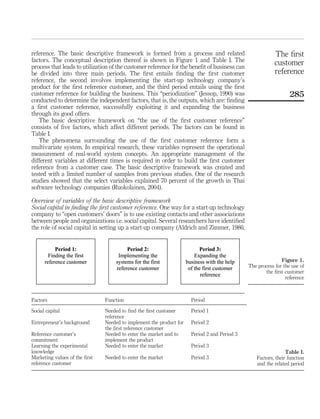
reference. The basic descriptive framework is formed from a process and related 
factors. The conceptual description thereof is shown in Figure 1 and Table I. The 
process that leads to utilization of the customer reference for the benefit of business can 
be divided into three main periods. The first entails finding the first customer 
reference, the second involves implementing the start-up technology company’s 
product for the first reference customer, and the third period entails using the first 
customer reference for building the business. This “periodization” (Jessop, 1990) was 
conducted to determine the independent factors, that is, the outputs, which are: finding 
a first customer reference, successfully exploiting it and expanding the business 
through its good offers. 
The basic descriptive framework on “the use of the first customer reference” 
consists of five factors, which affect different periods. The factors can be found in 
Table I. 
The phenomena surrounding the use of the first customer reference form a 
multivariate system. In empirical research, these variables represent the operational 
measurement of real-world system concepts. An appropriate management of the 
different variables at different times is required in order to build the first customer 
reference from a customer case. The basic descriptive framework was created and 
tested with a limited number of samples from previous studies. One of the research 
studies showed that the select variables explained 70 percent of the growth in Thai 
software technology companies (Ruokolainen, 2004). 
Overview of variables of the basic descriptive framework 
Social capital in finding the first customer reference. One way for a start-up technology 
company to “open customers’ doors” is to use existing contacts and other associations 
between people and organizations i.e. social capital. Several researchers have identified 
the role of social capital in setting up a start-up company (Aldrich and Zimmer, 1986; 
Factors Function Period 
Social capital Needed to find the first customer 
reference 
Period 1 
Entrepreneur’s background Needed to implement the product for 
the first reference customer 
Period 2 
Reference customer’s 
commitment 
Needed to enter the market and to 
implement the product 
Period 2 and Period 3 
Learning the experimental 
knowledge 
Needed to enter the market Period 3 
Marketing values of the first 
reference customer 
Needed to enter the market Period 3 
The first 
customer 
reference 
285 
Figure 1. 
The process for the use of 
the first customer 
reference 
Table I. 
Factors, their function 
and the related period
Otsgaard and Birley, 1994). Start-up companies can use the existing contacts of owners 
in order to find customers or acquire venture capital (Birley, 1995; Eisenhardt and 
Schoonhoven, 1996). In this context, Granovetter (1985) and Block (1990) argue that 
market activities are embedded in social relationships. Institutional theory seems to 
emphasize the role of trust as an essential part of social capital (e.g. Fukuyama, 1995; 
Putnam, 1993). It can also be assumed that those companies which have a relationship 
of trust with a customer, may have a better chance of succeeding in entering a market. 
Despite extensive research on social capital Davidsson and Honig (2003) still remark 
that knowledge on the processes of exploiting social capital is somewhat limited. 
Social capital, which includes the informal contacts of the new entrepreneur, seems 
to be an important asset in establishing a start-up technology company. First 
customers are typically found through old friends, friends of friends, family ties, 
colleagues, ex-employers, and other informal social channels (Ruokolainen, 2005). 
Granovetter (1973) illustrates this by identifying a similar role played by informal 
contacts in the US labour market. The next job is not usually found directly through 
close friends or family ties, but rather through the friends of friends and colleagues of 
colleagues etc. Existing social contacts also seem essential in building and preserving 
the success of the first customer reference. 
The technology market seldom pulls the products of start-up technology companies 
itself, and technology entrepreneurs rarely know how to push their products into the 
open market. Almost half of the small enterprises investigated, report major problems 
with marketing (Huang and Brown, 1999) including how to carry out promotions and 
how to execute market research. Dodge et al. (1994) also reports that start-up 
companies frequently encounter problems with financing and financial management. 
This can also be partly the result of sales and marketing difficulties. Ruokolainen and 
Igel (2004) argue that start-up technology companies have problems in finding the first 
customer reference in the open market. This statement is supported by Shanklin and 
Ryann (1987), who report skepticism in the technology market. This means that it is 
difficult for new players to enter the market. The remaining option for entrepreneurs is 
to use their previous contacts with potential customers. Many Thai start-up software 
technology companies seem to overcome such problems by using their social capital: 
70 percent of the start-up companies have had previous contacts with their first 
reference customers (Ruokolainen, 2005). 
Experimental knowledge gained and developed from the first customer reference. The 
first customer reference can provide a remarkable learning opportunity. A start-up 
technology company can learn essential knowledge from the first customer reference 
with regard to the development of the business. Start-up technology companies have 
reported that they use the first customer reference to develop the product further, find 
arguments for sales and marketing purposes, learn project skills, and study the 
business logic in their industry (Ruokolainen and Igel, 2004). Johanson and Vahlne 
(1977) investigated companies entering a foreign market. They, too, emphasize the role 
of experimental knowledge gained through practical cases in setting-up operations. 
Building the first customer reference is a good example of a practical case. 
Nearly half of the start-up software companies studied in Thailand had used the 
first reference to test their technology (Ruokolainen, 2005). However, such companies 
had a lower growth rate than other start-up software technology companies. Using the 
first customer reference as the basis for a sales argument seems to be infrequent. 
However, when this strategy was used by start-up software technology companies in 
EJIM 
11,2 
286
the Thai sample, it turned out to be successful. Learning the project skills and business 
logic, which are needed for building a software package, did not correlate statistically 
significantly with growth. The first customer reference is important, not only for 
testing the product technology, but also for verifying the business case. Such a concept 
includes understanding the business case behind the product, including sales 
arguments, support functions and the readiness to solve customer problems. This 
approach is supported by Gummesson’s (1987) multi-headed customer and seller 
concept, which emphasizes multi-level contacts between sellers and buyers. The 
interaction approach (Hakansson, 1982) also highlights the importance of relationships 
between companies, instead of focusing on single transactions. 
First reference customer’s commitment to the business of the start-up technology 
company. Traditionally, it is believed that competition and the principle of arm’s-length 
distance in buyer-seller relationships help acquire the lowest possible price, as well as 
the best delivery and quality terms for the buyer (Spekman, 1988). However, with high 
technologies and complex product systems, long-term cooperation between the buyer 
and seller is necessary. Intensive cooperation and open knowledge sharing are often 
required right from the research and development phase. The buyer needs the 
continuous cooperation of the seller in installing, operating, and maintaining a complex 
high-technology product. Partnership theory (Keough, 1993; Spekman, 1988; Asmus 
and Griffin, 1993) emphasizes the importance of long-term cooperation, an open 
relationship and mutual commitment. The consequences of not having these have been 
addressed in the literature in several ways: 
. Disputes over intellectual property rights of the first reference are not uncommon 
(Bruce et al., 1995). Smaller companies have gone bankrupt through losing the 
intellectual property rights to their new products or new technologies. The 
financial resources of a small company can be drained if the company is forced to 
defend these rights in legal proceedings, regardless of which party is legally in 
the right. An essential precondition for a successful first customer reference is 
that the intellectual property rights are properly managed. 
. There are also partly contradictory research results on the impact of customer 
involvement in company research and development processes. Companies can 
benefit from the lead user methodology (Herstatt and von Hippel, 1992), in which 
research and development are conducted in close cooperation with a lead user. 
The term “lead user” refers to the pilot customer for the new product or service. 
However, it has been noted that in research and development, that heavy 
customer involvement entails the risk of reducing the innovativeness of research 
and development (Bidault and Cummings, 1994). In some cases, a company 
developing a new product has ultimately lost its independence and ended up 
being, in effect, a research and development subcontractor to its customers. 
According to Johanson and Vahlne (1977), a company’s commitment to the foreign 
market is dependent on two factors, the amount of resources and the degree of 
commitment dependent on specializing in a specific market. The start-up technology 
companies’ commitment to the local market in terms of resources may be limited. 
However, the degree of commitment may be high, due to the need to specialize in a 
narrow market sector. Johanson’s and Vahlne’s view of the commitment is one-sided: 
The first 
customer 
reference 
287
they do not take into account customer commitment to the business of the supplier, as 
indicated by partnership theory. 
The anticipated benefits of a first customer reference can be attained only if the 
customer is willing to invest in the cooperation and demonstrates sufficiently strong 
commitment. In practice, it seems that building the necessary commitment entails the 
customer paying for part of the development costs. On the other hand, the need for 
clear contracts must be emphasized when the costs of product development are shared. 
An agreement on the ownership of the intellectual property rights should be drawn up 
by the partners in advance, when a common understanding prevails – not when 
conflicting perceptions of the ownership rights have already started to emerge. 
Background of the entrepreneur. The background of the start-up entrepreneur is a 
factor which is assumed to have an effect on the company’s success. The implications 
of various types of entrepreneurial backgrounds have been widely investigated in the 
literature. For example, Freeser and Willard (1990) state that those start-up companies 
whose products are related to the last company for which an entrepreneur worked 
before starting up his or her present company, tend to grow faster. 
In the case of start-up software technology companies in Thailand, most new 
entrepreneurs have a deep understanding of the technology of their company, based on 
their previous work experience. They usually have less experience in management and 
marketing. Freel (1998) states that technical entrepreneurs tend to concentrate on 
technical aspects at the expense of commercialization. It can be argued that the 
background of an entrepreneur may either help or hinder implementation of the first 
customer reference. Some Thai entrepreneurs of start-up technology companies had 
gained international experience from Siemens, IBM, and Microsoft. However, 
Ruokolainen (2005) was unable to find support for the notion that work experience 
in large international enterprises led to success for their start-up companies. 
The findings from Thailand support the hypothesis that the more educated the 
entrepreneur, the more substantial the growth of his or her start-up software company 
(Ruokolainen, 2005). Contradictory results have also been reported in research studies 
(Maes, 2001). Johanson and Vahlne (1977) refer to the knowledge gained through 
education as “objective knowledge”. They consider the knowledge gained through 
experimentation as more important in the internationalisation process than objective 
knowledge. 
The market value of the first reference customer. Beard and Easingwood (1996) 
prefer large companies to small ones as reference customers. The assumption is that 
potential customers find large companies more convincing as reference customers than 
small ones. This credibility of the reference customer can be referred to as “the market 
value of the reference customer”. Other features, such as age or business sector, might 
also increase the market value of the reference customer. It was assumed that if the 
first reference customer operates in the key industrial cluster of the country, the 
start-up technology company providing the product would grow faster. According to 
recent research on Thai start-up software technology companies, the market value of 
the first reference customer does not correlate with the growth of a start-up software 
technology company (Ruokolainen, 2005). According to the same study, together with 
the other variables in a regression analysis, the key industrial cluster explains nearly 
70 percent (adjusted R square) of growth. 
EJIM 
11,2 
288
Methodology 
Yin (1994) and Eisenhardt (1989) describe in detail the use of case study research in 
management inquiry. The present work is an embedded case study (Yin, 1994), with two 
levels of analysis units: the company and its customer cases. Yin introduced three 
different dominant modes of analysis for case studies. In the present research, 
pattern-matching logic and time-series analyses were used. The idea is to compare the 
observed patterns with those introduced by the basic descriptive framework. Each case 
was analyzed and a cross-case analysis then carried out over the time horizon. 
The longitudinal single case study is also used to study the iterative phenomena of 
the start-up technology companies’ entry into the market by following-up the iteration 
of the factors in the time horizon from one case to another. The nature of the 
phenomenon in the present research is contingent teleological. Unbounded design or 
contingent teleology occurs when the end-state is not predetermined specifically, but is 
the result of selecting of one of several available alternatives (Ayla, 1970). The 
construction of a customer reference aims at market entry, which can either fail or 
succeed. Holmlund (1977) writes that relationship management during building a 
customer reference can be divided into sequences and broken down further into 
episodes and acts. As in the Uppsala Model (Johansson and Valhne, 1977), the present 
state of acts, episodes and sequences affects the course of subsequent acts, episodes 
and sequences. In addition to the current state of the system investigated in the present 
research, company goals affect the actions planned in order to reach these goals. The 
goal can be described by a set of postconditions and the starting state can be described 
by a set of preconditions. The time span of the longitudinal case allows the real 
sequence of events to be followed in order to find out how the variables iterate from 
case-to-case toward the goal. 
The above approach can be formalized by using programming theory (Gries, 1983). 
According to this theory, programs can be presented by using the following notation 
{Q}S{R}, where Q and R are predicates and S is a program. The notation has the 
following interpretation: “Completion of S starts by satisfying Q and ends by 
satisfying R in a finite amount of time.” Q represents a precondition for starting the 
program, and R a post-condition that must be satisfied in order to exit the program. In 
the present research, S can entail completing one or more customer cases, where each 
customer case represents one iteration step, S’. During the completion of S’, the related 
factors might be altered, so that the state of the system also changes during each 
iteration step. It can be proposed that the notation {Q}S{R} provides a structure for 
presenting the results of an iterative phenomenon. The notation does not indicate 
whether the iteration is deterministic or heuristic. 
The case company was chosen, because it changed its business direction three times 
before the business took off. For each new start, it needed a new first customer 
reference. From the longitudinal case study point of view, the sequential changes in 
business direction provide a useful opportunity to follow the evolution of the variables 
from case to case. The collected information contributes to the present research by 
providing an overview of the events relating to three different customer cases, and how 
the company has grown since. Each of the three sequential customer cases represents 
an attempt to build the first customer reference. 
The history of the case company includes information dating from its birth in the 
mid-1980s until 2004. Researchers from an Asian and a European university first 
gathered information relating to the company, T.J.S. Consultants Co., Ltd, in the 
The first 
customer 
reference 
289
mid-1990s as part of a large survey on Thai technology companies. A follow-up study 
was conducted in the late 1990s. 
The author of the present study interviewed the entrepreneur for the first time in 2000 
in the premises of the Software Park, Thailand. In order to complete the history of events 
leading up to obtaining the first customer reference, the entrepreneur was interviewed 
several times during 2003 and 2004 (see Table II). The entrepreneur also lectured on the 
history of her company in a course at an Asian university in 2002. She talked openly 
about the difficulties and problems she had faced as an entrepreneur. In the interviews 
with the entrepreneur, the constructed story of the case company was reviewed in order 
to complete the picture. The entrepreneur was also approached by email to answer 
certain questions that occurred while writing up the research. In order to gain a better 
understanding of the meaning of the customer reference, one of the potential customers 
was also interviewed. In addition, the case-company-specific reports from the earlier 
surveys were available for the present research. All the material collected, such as 
marketing brochures, pages from the internet and reference customer lists were also very 
helpful for tracking the events of the company and their sequence. 
Material was collected for writing a teaching case study (Ruokolainen et al., 2005) 
including recent balance sheets, status of current competitors, staff interviews, and the 
potential next customer. The teaching case material was tested in several courses with 
technology entrepreneurs and MBA students from an Asian university. The students 
used the material in several lessons to evaluate the story from the venture capitalist’s 
perspective. The questions asked by students were discussed first in lessons and then 
in meetings with the entrepreneur. The case study material, as well as the earlier 
version of the present paper, was checked by the entrepreneur. The present research 
study focuses only on obtaining the first customer reference. Therefore, not all the 
collected materials are relevant from the perspective of this case study. 
It is believed that going through the history of the case company in different 
situations and points of time with the help of the previous research records did much to 
prevent a one-sided perception. The entrepreneur of the case company did not regard 
her business as successful at the time of the interviews. However, she preferred her 
entrepreneurial independence to working in an enterprise as an employee. Based on the 
previous facts, the data collected from the case company for the present single 
longitudinal research were considered useful and rather unique. 
Case data 
Background of the case company 
The case company, T.J.S. Consultants Co., Ltd, was founded in the mid-1980s in 
Thailand. It has produced complex software systems for human resource management 
Interviewee Date Place 
Managing Director 19.7.2000 In the premises of software park 
Managing Director 16.7.2001 At Asian Institute of Technology 
Human resource manager of the potential customer 3.1.2002 At the customer’s offices 
Managing Director 7.6.2002 At the offices of the case company 
Managing Director 7.1.2003 At the offices of the case company 
Managing Director 28.9.2004 At the offices of the case company 
EJIM 
11,2 
290 
Table II. 
Date and place of the 
interviews
for companies operating in Thailand since the beginning of the 1990s. In the start-up 
phase, the company was seeking a focus in its business by carrying out three different 
“first customer reference cases”, one after the other, before the business took off. In 
other words, three cases of trying to build the first customer reference are studied in 
this single longitudinal case study. The case company spent more than five years 
getting started. These three cases are introduced in the following sections. 
The entrepreneur has a doctoral degree in mechanical engineering from the USA. 
She worked as a programmer and software designer for an international oil company 
and subsequently, as the head of department in another company, after which, she set 
up her own business. 
The first customer case 
The first customer of the case company was one of the largest pig farms in Thailand, 
owned by a good friend of entrepreneur with whom she had often been in contact since 
their school days. This friend and customer had connections with major players in the 
pig-rearing industry. From the entrepreneur’s point of view, the case seemed a good 
opportunity for developing a software product for managing pig farms and for 
devising feeding plans for pigs. 
The idea of the software package was conceived and developed together with the 
first reference customer. The focus of the joint development was on determining the 
specifications and determining the business logic for the pig feeding system and 
implementing it. The first customer was willing to act as a test site, thus helping to 
verify the functionality of the new software. The entrepreneur contacted a professor at 
a local university in order to obtain a better understanding of the optimum feeding 
process. The software package was finalized with contributions from all the parties 
involved, without considering the question of ownership of the intellectual property 
rights. The entrepreneur commented that her team learned much about how to build 
software systems. 
The case company, T.J.S. Consultants Co., Ltd, together with a local university, 
arranged a seminar and exhibition for pig farmers, at which they introduced the 
opportunities offered by the new technology. In the seminar, the new software package 
and the first reference customer’s experiences with the new system were presented to 
the pig rearing industry as a success (case) story. Potential customers considered the 
price of the package to be modest. The development cost of the software product was 
paid by the case company. 
It soon turned out that only large pig farms wanted to use the software product 
offered by the case company. Small and medium-sized farms preferred to use software 
packages distributed free of charge by pharmaceutical companies. The latter delivered 
their software products to farms to support their sales. However, large pig farms did 
not want to become dependent on one pharmaceutical supplier. Therefore, they were 
interested in using software products provided by an independent software company. 
Taking into account the modest price of the new software package and the low number 
of large pig farms in Thailand, it was clear that the anticipated business would not be 
profitable. 
Because the home market could not generate enough revenue, the case company 
attempted to export the software product to a neighboring country. An agent, a local 
software company, was found to help in this endeavour and six software packages 
The first 
customer 
reference 
291
were sold, after which the agent suddenly disappeared. All subsequent efforts to 
contact his firm failed. 
Although the software product was developed and implemented successfully, 
attempts to earn revenue from selling the software to pig farms ended in failure. The 
entrepreneur felt afterwards that the work done at that time was valuable, although the 
project itself failed. During this initial business stage, the entrepreneur and her team 
gained valuable experience about markets. 
The second customer case 
After the first case, which failed to introduce a new product to the market, the business 
concept of the case company, T.J.S. Consultants Co., Ltd, was to provide customized 
software development services for mainframe computers. One of the ideas of the 
entrepreneur was to become a subcontractor for a large local company via IBM. The 
first contact with IBM was established earlier through the entrepreneur’s student 
colleague, who asked her to make a presentation of the case company, T.J.S. Consulting, 
for IBM in Thailand. 
One of the major Thai car part manufacturers had contacted IBM to obtain a 
quotation for a management information software system. IBM asked the case 
company, among other potential providers, to tender for a Human Resource 
Management System, which was part of the total delivery package. IBM had found 
that standard overseas software packages were not compliant with the complex Thai 
labor and tax legislation. The Human Resource Management System would be a large 
software package, including modules for managing recruitment, payroll, appraisal, 
and many other functions of the company. 
The entrepreneur gained invaluable assistance from a friend who joined her 
company to prepare the offer. This friend had experience preparing proposals for large 
projects in an international accounting company. The case company won the contract 
to produce the Human Resource Management System as a subcontractor to IBM at a 
fixed price. Although IBM subcontracted the systems from the case company, IBM’s 
role was more or less that of an intermediary. The case company was responsible for 
delivering the required system to the customer and dealt directly with the customer 
concerning the system’s delivery and development. Thus, the primary customer from 
the case company’s perspective was the car part manufacturer, although some of the 
requirements came from IBM. 
Developing the software package turned out to be more difficult than anticipated. 
The entrepreneur had no prior experience in managing software development and with 
projects of this size. In addition, IBM required the case company to use documentation 
and project management practices, with which the entrepreneur and her team were 
unfamiliar. As a result, the project was delayed by about one year. 
The end customer, the car part manufacturing company, also introduced 
requirements which had not been included in the original specification. According to 
the entrepreneur, another reason for the delay was that the project was over-staffed 
and employees of the case company did not have sufficient experience with the 
technology. The company had hired six new employees just before the project. The 
entrepreneur was busy managing the projects and teaching new employees and, 
therefore, did not have much time to spend on commercial aspects. 
Despite the delays, the case company was able to develop the software product 
successfully. The end customer applied the new software in its operations for four 
EJIM 
11,2 
292
years and was satisfied with the performance. The entrepreneur commented: “You 
could say that the company was my first reference customer in software development 
service for a large computer system.” The entrepreneur felt that it proved her ability to 
build large computer systems for customers, at least to herself. 
Despite the customer’s satisfaction, T.J.S. Consultants Co., Ltd had lost about 5 
million baht on the project. This sum was more than twice the initial capital of the 
company. After intense negotiations with the entrepreneur, IBM agreed to cover part of 
the losses arising from implementation of the additional requirements demanded by 
the end customer. IBM paid 1.2 million baht on top of the original contract. The case 
company was saved from bankruptcy by M-Group Holding Company, which was 
co-opted and invested 10 million baht. 
The third customer case 
The M-Group investment enabled the case company, T.J.S. Consultants Co., Ltd, to 
develop a new product. This was a commercial software package, based on the 
software delivered to the car part manufacturer as an outcome of the joint project with 
IBM. 
When this first customer found out that the case company was developing a 
commercial software package from the original software, it contacted the entrepreneur 
through IBM and accused it of violating its intellectual property rights. However, the 
COBOL programming language used in the original software had been replaced by a 
newer software package, Progress, a 4th generation programming language. A 
different platform and a different database were used. Therefore, it was not easy to 
prove the allegations. 
This first reference customer, the car part manufacturer, stopped all cooperation 
with the case company and started buying maintenance services from another 
company. The case company ended up not only losing its first customer, but also its 
first customer reference, even though the customer was using the product successfully. 
The case company again needed a first customer reference. 
In the research archives at an Asian university, there is a record of an interview 
with an entrepreneur made at the beginning of the 1990s. The entrepreneur told of 
having major problems with marketing and in finding customers. She had just lost her 
first customer reference, the customer of the second case, and was searching for a new 
customer reference in the open market. Even in 2003, the entrepreneur can recall that it 
was very difficult to find a new first customer reference for the revised Human 
Resource Management System software. She had a tough time convincing potential 
customers of the ability of her team to implement and maintain the revised Human 
Resource Management System and the advantages of this system. She also had 
difficulties persuading potential customers that the system was really worth the price. 
In other words, she had to devote considerable effort to developing sales arguments to 
convince customers of the benefits of her system, while she was not able to use the 
reference openly. 
Eventually, a large, well-known Thai construction company was found after an 
extensive search. They were interested in the Human Resource Management System, 
but the price of the software package had to be cut by about 50 percent, before the case 
company was able to secure the sale. The customer project went quite smoothly 
without major snags, with the help of the knowledge gained from the previous 
customer project with the car part manufacturing company in the second case, and the 
The first 
customer 
reference 
293
time spent in becoming familiar with the new technology. The construction company 
was ready to act as the first reference customer. The entrepreneur explained: “After we 
got the first reference customer, we were able to sell our package to other customers 
more easily.” She felt that the first customer reference had given credibility to her 
company and that the trust of potential customers in her team had increased. 
Growth after gaining the first customer reference 
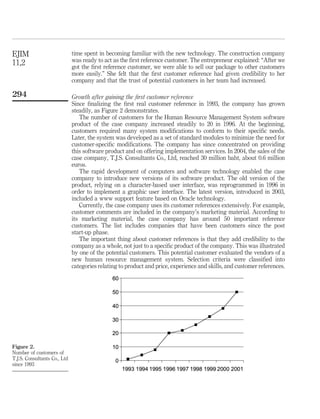
Since finalizing the first real customer reference in 1993, the company has grown 
steadily, as Figure 2 demonstrates. 
The number of customers for the Human Resource Management System software 
product of the case company increased steadily to 20 in 1996. At the beginning, 
customers required many system modifications to conform to their specific needs. 
Later, the system was developed as a set of standard modules to minimize the need for 
customer-specific modifications. The company has since concentrated on providing 
this software product and on offering implementation services. In 2004, the sales of the 
case company, T.J.S. Consultants Co., Ltd, reached 30 million baht, about 0.6 million 
euros. 
The rapid development of computers and software technology enabled the case 
company to introduce new versions of its software product. The old version of the 
product, relying on a character-based user interface, was reprogrammed in 1996 in 
order to implement a graphic user interface. The latest version, introduced in 2003, 
included a www support feature based on Oracle technology. 
Currently, the case company uses its customer references extensively. For example, 
customer comments are included in the company’s marketing material. According to 
its marketing material, the case company has around 50 important reference 
customers. The list includes companies that have been customers since the post 
start-up phase. 
The important thing about customer references is that they add credibility to the 
company as a whole, not just to a specific product of the company. This was illustrated 
by one of the potential customers. This potential customer evaluated the vendors of a 
new human resource management system. Selection criteria were classified into 
categories relating to product and price, experience and skills, and customer references. 
EJIM 
11,2 
294 
Figure 2. 
Number of customers of 
T.J.S. Consultants Co., Ltd 
since 1993
The case company and its rivals used their customer references, not only to 
substantiate the functionality and business benefits of their products, but also to 
provide evidence of their experience, skills and ability to take care of relationships. The 
number and size of the completed projects were also used for comparing vendors. The 
size of the reference customer was not highlighted. Since the products of the companies 
were similar, the real criteria for selecting a vendor were not product-related. 
The case company also uses existing reference customers to promote newer 
versions of the product in order to be short-listed by potential customers, as the above 
example shows, and as a way of keeping in touch with them. Customer references are 
collected to support the marketing effort. Their objective is quite clear, considering the 
number of customer testimonials on the company web site, as the following quotation 
illustrates: “Judging by the number of customer references on the web site, which are 
all from large companies, the company must be quite something.” 
Lessons learned 
All three cases demonstrate the use of factors relating to the basic descriptive 
framework. The benefit of the longitudinal approach is that the iteration of related 
variables can be followed over a long period. The development of the following factors, 
in particular, is evaluated from case-to-case: 
. how social capital helps secure the first customer reference; 
. how the focus of learning in the customer cases developed; 
. how the entrepreneur’s experience, skills and background evolved; and 
. how customer commitment changed. 
The market value of the reference customer is also discussed. The case-variable matrix 
in Table III gives the overview of the evolvement of the variables over the time horizon. 
The meaning of social capital according to the longitudinal case study 
In the first two cases, the initial contacts with customers were created through different 
social channels. In the first case, the contact was an old school friend. This contact was 
essential in obtaining this customer case. In the second case, a student colleague helped 
the entrepreneur establish the business contact. It can be assumed that this contact was 
also critical. The two cases clearly demonstrate the benefit of social capital, as 
highlighted by several researchers including Birley (1995) and Eisenhardt and 
Schoonhoven (1996). The meaning of social capital is also well demonstrated in the 
third case. The first customer reference in the second case was lost and the first 
customer reference had to be found again in the open market, which turned out to be 
difficult, as reported in a survey conducted by researchers from an Asian and a 
European university at the beginning of the 1990s. The entrepreneur also confirmed 
that finding the new first customer reference was difficult: she did not have the right 
contacts for a customer reference. 
After a successful implementation of the third case, the next customers were found 
more easily. The entrepreneur also stated that customer confidence in her team had 
increased. The history of the case company clearly demonstrates the importance of 
social capital in acquiring customers in the initial phase of the start-up technology 
company, and it also demonstrates the decreasing need for previous contacts for next 
potential customers, after securing the first reference customer. The reason why social 
The first 
customer 
reference 
295
Variables/condition 
type Case 1: 1986-. . . Case 2: 1988-. . . Case 3: 1992-. . . After: 1994-. . . 
Longitudinal pattern 
matchingoutcome: 
Prior contacts with 
the customer 
Q: Precondition 
The customer’s 
company was owned by 
a friend 
A student colleague No contacts: major 
difficulties in finding the 
first customer reference 
was reported 
Need to use previous 
contacts for finding 
new customers 
decreased 
Finding the first 
customer reference 
without social capital 
was problematic 
Education and 
previous work 
experience 
Q: Precondition 
PhD in Engineering, 
work experience in 
software engineering 
PhD in Engineering, 
work experience in 
software engineering 
PhD in Engineering, 
work experience in 
software engineering 
PhD in engineering, 
work experience in 
software engineering 
In cases, the 
implementations were 
successful 
Customers belonging 
to a key industrial 
sector 
Q: Precondition 
First reference customer 
operated in one of the 
key industry clusters 
First reference customer 
operated in one of the 
key industry clusters 
First reference customer 
did not operate in one of 
the key industry clusters 
Variety of business 
sectors 
No clear evidence of the 
significance of the first 
customer market value 
Learning focus not on 
technical skills: 
R: Post-condition 
Learning how to develop 
technical systems 
Learning to use the 
technology was one of 
the major efforts of the 
team 
Technical competence 
was already gained with 
help of case 2 
Case 3 proved that the 
basic competence 
existed; new 
technologies to be 
learnt 
In failed cases, focus on 
technology; 
accumulation of 
technological 
knowledge occurred 
Learning focus on 
sales arguments: 
R: Post-condition 
Insufficient focus on 
learning sales 
arguments 
No focus on sales 
arguments 
Focus on sales 
arguments – need to 
develop the sales 
arguments to gain case 3 
Sales arguments and 
the references exist to 
support sales 
argumentation 
In the final, successful 
case, the focus on 
developing sales 
arguments 
Mutual commitment 
through sharing cost 
R: Post-condition 
Cost shared, customer 
committed due to 
friendship, no issues 
raised over IPRs 
Cost not shared, 
customer not committed, 
issues raised over the 
IPRs 
Cost shared, significant 
discount given, 
customer committed, no 
issues raised over the 
IPRs 
No major difficulties 
except in exporting 
In one failed case, no 
customer commitment 
Cross variable pattern 
matching outcome: 
Case 1 failed: two 
post-conditions not 
fulfilled (italic font) 
Case 2 failed: three 
post-conditions not 
fulfilled (italic font) 
Case 3 succeeded: all 
post-conditions fulfilled; 
two preconditions not 
fulfilled; (italic font) 
References, sales 
arguments and skills in 
place 
Table III. 
Pattern matching-matrix 
describing and 
comparing each iteration 
round 
EJIM 
11,2 
296
capital is relatively unimportant for securing customers during the later phases could 
be that the work done for the first customer reference starts to “speak for itself”. That 
is, the potential customers can visit the reference site and listen to the reference 
customers’ experiences (Salminen and Mo¨ller, 2004). 
Maturing through learning – objective versus experimental knowledge 
None of the three first customer reference cases include elements in which the 
entrepreneur could have used her primary objective knowledge in mechanical 
engineering. It can be argued that in this respect, none of the cases represented an 
optimal first customer reference. The entrepreneur had a product development 
background and understood how to work systematically towards a complex objective. 
The knowledge and experience gained from working for an oil company as a 
programmer had helped her produce and implement the software packages in all three 
cases. 
The entrepreneur felt that the first case demonstrated that she knew little about 
marketing and selling. She did not know how to develop effective sales arguments. 
These should have been tested early on in the development phase, in order to find the 
sales arguments which would have made sense to the next potential customers. The 
customer in the third embedded case was found in the open market after devoting 
considerable effort to sales activities. The company learned sales arguments and how 
to use them to look for a new potential customer. 
The second case showed her that, before the case, she had not known enough about 
managing large projects and product management. She learnt the necessary project 
management skills while carrying out the projects. The entrepreneur also felt that the 
case company did not have sufficient technical knowledge. She had to hire new 
inexperienced staff for the second case. The first two cases were used by the company 
to learn major skills relating to technology including system-definition skills. The 
project in the second case was delayed, because of the lack of requisite skills mentioned 
previously. It can be assumed that, if the case company had few technical skills and the 
project was delayed, customer dissatisfaction increased. 
The most remarkable aspect, from the case company point of view, was that the 
entrepreneur learnt, with the help of the first two cases, how to transform the case 
company into one which could develop and deliver human resource management 
systems. This longitudinal case study shows how the entrepreneur succeeded in 
accumulating knowledge from the cases over the follow-up period. 
The basic descriptive framework states that start-up companies should focus on 
developing sales arguments and avoid testing technologies with the help of the first 
customer reference. All three cases demonstrate the combined effects of these two 
variables. In the third case, the focus was on finding the sales arguments in a situation 
where the technology expertise was at a sufficiently advanced level, so that it caused 
no major problems. In the previous two cases, one or both of these factors were 
missing. Johansson and Valhne (1977) emphasize the importance of experimental 
market knowledge which can be used to perceive specific opportunities. They also 
state that “especially in the marketing of complex and software-intensive products, 
experimental knowledge is crucial”. 
The present case study also demonstrates how the business knowledge of the 
entrepreneur developed since starting the company. The case also demonstrates the 
role of objective and experimental knowledge, both of which are needed. Objective 
The first 
customer 
reference 
297
knowledge and previous work experience are required before entering the market. The 
experimental knowledge learned through customer cases is essential in order to gain 
the market-specific knowledge relating to the product. 
The commitment of the first reference customer 
The commitment of the customers varied from case to case. In the first and third cases, 
the customers were committed to the success of the case company in different ways. In 
the first case, the commitment was established mainly through friendship, but also 
through paying part of the development cost, and in the third case, mutual 
commitment was achieved by sharing the costs. In the second case, the customer’s 
commitment was lacking: the development costs were paid by the customer and the 
customer might have felt that it owned the intellectual property rights of the product, 
and that this was surely not in the interests of the case company. The case company 
had no close working contact with the customer, that is, no one who would defend the 
interests of the case company. The three cases demonstrate on the one hand, the 
consequence of the iron-hand approach of the customer, but on the other hand, the 
importance of customer commitment from the perspective of the start-up company. 
Similar consequences to those reported in this study, with respect to both approaches, 
are considered in the literature (Spekman, 1988; Keough, 1993). 
In the second case, the approach of the customer nearly caused the project to fail and 
the case company to go insolvent. The customer approached the case company in the 
traditional way in order to gain various significant benefits. The customer had no 
interest in helping the case company survive. This was evident when the customer 
stated that it owned the intellectual property rights. 
The market value of the reference customer 
In all three embedded cases, the customers were large, established enterprises. In the 
first two cases, the customers belonged to the key industrial cluster of Thailand. In the 
third case, the first real customer reference did not come from the key Thai industrial 
cluster as the framework proposes. It was thought that those customers operating in 
key industrial clusters of the country might have valuable and competitive business 
practices that they could teach the start-up technology company. However, this 
research did not clearly support the proposition relating to the importance of the 
market value of the reference customer. 
Having a large enterprise as a first reference customer did not necessarily make it 
easier to acquire additional customers, as recommended by Beard and Easingwood 
(1992). On the contrary, large enterprises are capable of ruining the business of the 
start-up technology company if they so desire, as the second customer case with the car 
part manufacturing company clearly demonstrated. One of the entrepreneurs in 
Thailand reported that it is sufficient, if the first reference customer is a small or 
medium-sized company with a good reputation. According to Wilkinson et al. (2005), 
companies seek business partners similar to themselves. There is a tendency for large 
companies to select other large companies as their partners, rather then small ones. 
Wilkinson and Bernett (1987) illustrate this well, by referring to a small Australian 
exporter who stated that the company deliberately sought smaller companies as 
distributors, because they “stayed on the same wavelength”. 
EJIM 
11,2 
298
Describing iteration of the multivariate system 
The purpose of the current research was to test the basic descriptive framework in the 
light of the sequential cases. The longitudinal case study demonstrates how the 
variables iterated from case-to-case towards the state in which the business eventually 
took off. Both, the present research and the Uppsala Model (Johanson and Vahlne, 
1977), emphasize the iterative nature of the companies’ entry to new markets. As 
postulated earlier, the description of the iteration can be developed by using following 
the notation {Q}S{R}. In the present research, each customer case represents one 
iteration step, S’, and S, the ability to enter the market through one or more sequential 
customer cases, in other words, one or more iteration steps. Q represents a 
precondition, which must be satisfied before starting the iteration. R represents the 
post-condition, which must be satisfied in order to exit the iteration. When carrying out 
S, the related variables and resources can be altered as the end result of each iteration 
step, S’. In other words, the completion of a customer case can change the state of the 
system in question. Using the classification as proposed, the key results of the present 
research are as follows: 
. The precondition, Q, for starting the iteration process for building the first 
customer references to support growth through one or several customer cases, 
consists of the following elements: previous work experience and education, 
which are needed to build the customer reference and redevelop of the product if 
necessary. Previous work experience and education are static variables. They 
were unchanged during the realization of S. Previous contacts to customers are 
emphasized by the present research. The contacts were needed to obtain the 
potential first customer reference. 
. The necessary post-condition, R, for exiting the iterative process, consists of the 
following items: solid marketing and sales arguments are needed in order to 
acquire subsequent customers; the focus should not be on testing the product 
technology while building the first customer reference; and the commitment of 
this customer to the start-up technology company is also necessary. Other exit 
criteria may be related to the exhaustion of resources such as financial and social 
capital. If no resources are available, in most cases, the specified goals cannot be 
achieved. 
. Each iteration step, S’, can change the variables and state of the system, because, 
in each iteration round, during the completion of a customer case, start-up 
technology companies can gain experimental knowledge, such as sales 
arguments and technology-related issues, from the customer cases. Resources 
are either gained or lost, and, therefore, before completing a new customer case, 
for example, both social, and financial capital must usually be checked before a 
new iteration step. 
The precondition and post-condition concretize the meaning and role of the variables 
for basic descriptive framework. Some of the variables are needed to fulfill the 
precondition for carrying out S, while the others are needed to fulfill the post-condition 
in order to stop carrying out S. Table III illustrates the business taking off after all the 
post-conditions were satisfied. Gries (1983) promotes using the weakest precondition in 
order to prove the rationale. Other preconditions might ensure the success of the 
program, S, but the rationale behind the program might be difficult to validate. 
The first 
customer 
reference 
299
Conclusion and discussion 
While the external validity of any case study research may be limited due to the limited 
sample size, the cases introduced here clearly yield valuable conclusions and useful 
future research topics. The company case and the three embedded cases demonstrate 
the basic descriptive framework in practice. Previous contacts with the customer are 
often needed in order to convince the first reference customer. It is proposed that the 
focus should not be on testing technology, if the primary intent is to use the first 
customer reference to support the growth of the start-up company. Concentrating on 
developing sales arguments, which often relate to the proven benefits of the customer 
reference, can help obtain further business. The start-up technology company should 
also ensure the commitment of the customer to its business, for example, that there are 
no problems with intellectual property rights. Objective knowledge and previous work 
experience are usually needed for creating the customer reference. The successful use 
of the first customer reference forms a multivariate system, the practices of which were 
described in the basic descriptive framework. There may be other variables that affect 
business success, but the present research proposes that, in combination, the variables 
which have been studied, can affect success in entering the market. 
However, it can be concluded that the basic descriptive framework only provides a 
limited view of the start-up technology companies’ market entry. The research 
indicates that market entry can also occur iteratively by completing sequential 
customer cases. In practice, this means that the identified factors and variables should 
be divided into post-conditions and preconditions as shown in Table III. Preconditions 
should be met before starting the iteration and post-conditions need to be fulfilled 
before ceasing the iteration. In order to improve the basic descriptive framework, the 
following proposition could be made: 
P1. The entry of the start-up technology company into the market is a stochastic 
iterative process,S, which satisfies preconditions, Q, and post-conditions, R, and 
consists of one or more iteration steps, S’. The activities within an iteration step 
can change the current state, and the next state depends on the current state. 
One problem with the basic descriptive framework is that it does not clearly highlight the 
iterative accumulation of knowledge. For example, the basic descriptive framework 
proposes that the business knowledge provided by key industrial clusters within the 
country could be useful. The present research shows that the first two cases could have 
provided this knowledge, but not the third case. If the prediction had been based on the 
third case, it could have yielded false results. This means that the status of the variables 
should be followed upover the iteration steps. This isimportant, because itmeans that the 
entire history of the start-up technology company should be considered. Each customer 
case, even failed ones, should be studied in order to determine whether a start-up 
technologycompanyhasacquired the necessarycompetencies. Buildingthemarket entry 
could be analogous to solving a jigsawpuzzle: pieces need to be in place before the picture 
is complete, but some can be put in a place in a different order and at different points in 
time. In order to enlarge the basic descriptive framework so that is more dynamic this 
factor should be taken into account. The following proposition can be formulated: 
P2. In order to evaluate a start-up technology company’s capability to deliver, its 
entire customer history should be studied, including failed cases. This can 
mean that from the competence-marketing point-of-view, there are no failed 
customer cases, if experimental knowledge has been gained. 
EJIM 
11,2 
300
The problem with the iterative market entry is that it can take a long time. Each step 
can last several years and consume resources that may be scarce to the start-up 
technology company. Further development could aim at minimizing the number of 
iterations needed to find the right set-up for the various factors. It seems that if the 
company’s technological base is broad and solid enough to support the customers’ 
problem solving, the implementation focus could be on the generation of marketing 
and sales arguments. It is also assumed that there would be customer commitment in 
place. In order to promote research, the following proposition is made: 
P3. The number of iterations can be reduced by building a solid and broad 
foundation of technological know-how into a start-up technology company, 
before commencing the customer cases and obtaining customer commitment 
to the business of the start-up technology company. 
An interesting market-entry-design perspective is that an entrepreneur could plan in 
advanced how many steps he or she might need. One of the design parameters could be 
the amount of social capital owned by the entrepreneur. The other design parameter 
could be the knowledge needed. A good example of the exhaustion of social capital was 
the case in which the company had no suitable previous contacts remaining to secure 
the next customer after the second customer case. A good example of using up the 
stock of financial capital, which nearly caused the company’s insolvency, occurred in 
the second case. The problem with designing market entry is that a customer can 
seldom be chosen. It can be a major effort for a start-up technology company even to 
sell its product to one customer. 
The basic descriptive framework has been developed and tested by the past cases. 
In constructing software or other high technology business based on the use of first 
reference customers, several aspects must be taken into account beforehand. For 
example, the lack of technological expertise can easily be verified afterwards, but the 
problem is how to measure adequacy in advance. Another key question for 
entrepreneurs is how to determine whether their social capital supports them well 
enough to start their own business, for example, if it helps them to find their potential 
first customer references. Potential avenues for future research include testing and 
further developing the basic descriptive framework, with a view to finding out how the 
first customer reference cases should be designed and selected beforehand, so as to 
achieve a successful outcome. 
The idea of using an approach based on programming science in order to study 
topic-related business can be considered as the construction of a business program. The 
cycle time of an iteration step in a business program can last years or even decades. For 
example, learning to use new sales arguments can take years. It should also be 
emphasized that a business program is stochastic by nature, rather than deterministic. 
Managerial implications 
The first implication is that an awareness of the topics presented in this paper should 
be increased among software, and other start-up technology companies, and especially 
among those that can be identified as reference-driven. Awareness can be developed 
through education. Huang and Brown (1999) write that there are clearly opportunities 
for market programs and courses to educate the entrepreneurs of small enterprises. 
The author of the present study supports this proposal. 
The first 
customer 
reference 
301
Another key implication is that software and other start-up technology companies 
should focus on solid technological expertise, before starting with the first customer 
reference, in order to be able to respond to problems raised by the customer. This and 
earlier research (Ruokolainen, 2005) demonstrate the effect of neglecting the 
development of sales arguments and placing too much effort on learning and testing 
technology in customer cases. 
Not all possible problems concerning initial commercial products can be predicted 
and they can be hard to avoid. The recommendation is that venture capital financing 
should be employed to increase the technology maturity of start-up technology 
companies, instead of forcing them to design commercial products hastily. The funding 
can also be used to boost social capital, the relationship-building capabilities of the 
entrepreneurs and to improve the entrepreneurs’ knowledge of commercial and 
marketing skills. The recommendation is to assess the maturity of the technological 
knowledge, the strength of social capital, and usability of the sales and marketing 
arguments from time-to-time. 
According to Johanson and Vahlne (1977), lack of knowledge is one of the main 
obstacles to internalization. Knowledge can be divided into two classes, objective and 
experimental knowledge. Objective knowledge is gained through education, and 
experimental knowledge through personal experience. Johanson and Vahlne state that 
market-specific knowledge can be gained mainly through experience in the market, 
and therefore, this experimental knowledge is not generally easily available. Based on 
this research, the same can be said for the market entry of start-up technology 
companies. Without learning, that is, without gaining experimental knowledge, the 
iteration towards market breakthrough might never reach a successful conclusion. 
Therefore, start-up technology companies should use their first customer cases to 
learning about market-related issues. 
One interesting observation was that in several cases, the Thai entrepreneurs 
emphasized the role of their software start-up company in developing and bringing 
technology-related new business practices to their customers in the long run. At the 
beginning, small start-up companies acquire business knowledge from their customers 
through the customer cases. The start-up company can be seen as a centre for 
gathering, developing, and accumulating knowledge from different sources, including 
customers, and then transferring the knowledge to sellable systems or products. In the 
long run, start-up companies can also disseminate new business knowledge back to the 
industry. This role change can be referred to as a “marketing and selling maturation of 
the start-up company”. Customers should regard partnerships with small start-up 
companies as a long-term investment, which may guarantee their own business 
success. Such an approach is supported by partnership theory. 
References 
Aldrich, H. and Zimmer, C. (1986), “Entrepreneurship through social networks”, in Sexton, D. and 
Similor, R. (Eds), The Art and Science of Entrepreneurship, Ballinger, New York, NY, 
pp. 3-23. 
Asmus, D. and Griffin, J. (1993), “Harnessing the power of your suppliers”, The McKinsey 
Quarterly, Vol. 3, pp. 63-78. 
Ayala, F. (1970), “Teleological explanations in evolutionary biology”, Philosophy of Science, 
Vol. 37, pp. 1-15. 
EJIM 
11,2 
302
Bank of England (2001), “The financing of technology based small firms”, Quarterly Bulletin, 
Bank of England Domestic Finance Division, February. 
Bauer, R. (1967), “Consumer behavior as risk taking”, in Cox, D. (Ed.), Risk Taking and 
Information Handling in Consumer Behavior, Graduate School of Business 
Administration, Harvard University, Boston, MA. 
Beard, C. and Easingwood, C. (1992), “Sources of competitive advantage for the marketing of 
high-tech products and processes in the UK”, European Journal of Marketing, Vol. 26, 
pp. 7-20. 
Beard, C. and Easingwood, C. (1996), “New product launch – marketing action and launch tactics 
for high-technology products”, Industrial Marketing Management, Vol. 25, pp. 87-103. 
Bidault, F. and Cummings, T. (1994), “Innovating through alliances: expectations and 
limitations”, R&D Management, Vol. 24, pp. 33-45. 
Birley, S. (1995), “The small firm – set at the start”, in Ronstadt, R., Hornday, J., Petersen, R. and 
Vesper, K. (Eds), Frontiers of Entrepreneurship Research, Badson College, Wellesley, MA, 
pp. 267-80. 
Block, F. (1990), Postindustrial Possibilities: A Critique of Economic Discourse, University of 
California Press, Berkeley, CA. 
Blomqvist, K. (1997), “The many faces of trust”, Scandinavian Journal of Management, Vol. 13 
No. 3, pp. 271-86. 
Bruce, M., Leverick, F., Littler, D. and Wilson, D. (1995), “Success factors for collaborative 
product development: a study of suppliers of information and communication technology”, 
R&D Management, Vol. 11, pp. 134-45. 
Bygrave, W. (1997), The Portable MBA in Entrepreneurship, John Wiley & Sons, New York, NY. 
Davidsson, P. and Honig, B. (2003), “The role of social and human capital among nascent 
entrepreneurs’”, Journal of Business Venturing, Vol. 18 No. 3, pp. 301-31. 
Dodge, H., Fullerton, S. and Robbins, J. (1994), “Stage of the organizational life cycle and 
competition for small businesses”, Strategic Management Journal, Vol. 15, pp. 121-34. 
Doney, P. and Cannon, J. (1997), “An examination of the nature of trust in buyer-seller 
relationships”, Journal of Marketing, Vol. 61, pp. 35-51. 
Eisenhardt, K. (1989), “Building theories from case study research”, Academy of Management 
Review, Vol. 14 No. 4, pp. 532-50. 
Eisenhardt, K. and Schoonhoven, C. (1996), “Resource-based view of strategic alliance formation: 
strategic and social effects in entrepreneurial firms”, Organization Science, Vol. 7 No. 2, 
pp. 136-50. 
Freel, M. (1998), “Evolution, innovation and learning: evidence from case studies”, 
Entrepreneurship and Regional Development, Vol. 10 No. 2, pp. 60-80. 
Freeser, H. and Willard, G. (1990), “Founding the strategy and performance: a comparison of high 
and low growth high tech firms”, Strategic Management Journal, Vol. 11 No. 2, pp. 87-98. 
Fukuyama, F. (1995), Trust: The Social Virtues and the Creation of Prosperity, Hamish Hamilton, 
London. 
Granovetter, M. (1973), “The strength of weak ties”, American Journal of Sociology, Vol. 78 No. 6, 
pp. 1360-70. 
Granovetter, M. (1985), “Economic action and social structure: the problem of embeddedness”, 
American Journal of Sociology, Vol. 3, pp. 481-510. 
Gries, D. (1983), The Science of Programming, Springer-Verlag, Berlin. 
The first 
customer 
reference 
303
Gummesson, E. (1987), “The new marketing – developing long-term interactive relationships”, 
Long Range Planning, Vol. 20, pp. 10-20. 
Hakansson, H. (1982), International Marketing and Purchasing of Industrial Goods: An 
Interaction Approach, John Wiley & Sons, Chichester. 
Herbig, P. and Milewicz, J. (1993), “The relationship of reputation and credibility to brand 
success”, Journal of Consumer Marketing, Vol. 10 No. 3, pp. 18-24. 
Herstatt, C. and von Hippel, E. (1992), “Developing new product concepts via the lead user 
method: a case study in a low-tech field”, Journal of Product Innovation Management, 
Vol. 9, pp. 213-21. 
Huang, X. and Brown, A. (1999), “An analysis and classification of problems in small business”, 
International Small Business Journal, October-December, pp. 73-85. 
Hutt, M. and Speh, T. (1992), Business Marketing Management: A Strategic View of Industrial 
and Organizational Markets, 4th ed., The Dryden Press, Chicago, IL. 
Holmlund, M. (1997), Perceived Quality on Business Relationship, Hanken Swedish School of 
Economics, Helskinki/CERFS, Helsingfors. 
Jae, H. and Jung, S. (2006), “Technology advancement strategy on patronage decisions: the role of 
switching costs in high-technology markets”, Omega, Vol. 34 No. 1, pp. 19-27. 
Jessop, B. (1990), “Regulation theory in retrospective and perspective”, Economy and Society, 
Vol. 19 No. 2, pp. 153-216. 
Johanson, J. and Vahlne, J. (1977), “The internationalization process of the firm – a model of 
knowledge development and increasing foreign market commitment”, Journal of 
International Business Studies, Vol. 8 No. 1, pp. 23-32. 
Leonidoy, L. and Katsikeas, C. (1996), “The export development process: an integrative review of 
empirical models”, Journal of International Business Studies, Vol. 27 No. 3, pp. 517-51. 
Levitt, T. (1967), “Communications and industrial selling”, Journal of Marketing, Vol. 31, April, 
pp. 15-21. 
Keough, M. (1993), “Buying your way to the top”, The McKinsey Quarterly, Vol. 3, pp. 41-62. 
Maes, J. (2001), “Small business performance: exploring the link between management practices 
and the financial performance of small and medium-sized Belgian construction company”, 
in Rent XV, Research in Entrepreneurship and Small Business, Turku, Finland, November, 
pp. 22-3. 
Moriarty, R. and Kosnik, T. (1989), “High-tech marketing: concepts, continuity and change”, 
Sloan Management Review, Vol. 30 No. 4, pp. 7-17. 
Otsgaard, T. and Birley, S. (1994), “Personal networks and firm competitive strategy – a strategic 
and coincidental match?”, Journal of Business Venturing, Vol. 9, pp. 281-305. 
Putnam, R. (1993), Making Democracy Work: Civic Traditions in Modern Italy, Princeton 
University Press, Princeton, NJ. 
Ruokolainen, J. (2005), “Gear up your software start-up company by the first reference customer 
– nomothetic research study in the Thai software industry”, Technovation, Vol. 25 No. 2, 
pp. 135-44. 
Ruokolainen, J. and Igel, B. (2004), “The factors of making the first successful customer reference 
to leverage the business of a start-up software company-multiple case study in the Thai 
software industry”, Technovation, Vol. 24 No. 9, pp. 673-81. 
Ruokolainen, J., Kauranen, I. and Igel, B. (2005), “‘T.J.S Consultants’ first customer references – a 
teaching case for IT firms entering business”, Management Case Study Journal, Vol. 5 
No. 2, pp. 51-68. 
EJIM 
11,2 
304
Salminen, R. (1997), “Role of references in international industrial marketing – a theory-building 
case study about supplier’s processes of utilizing references”, Lappeenranta University, 
Lappeenranta. 
Salminen, R. and Mo¨ller, K. (2004), “Use of references in industrial bidding – a decision process 
analysis”, Journal of Marketing Management, Vol. 20, pp. 133-55. 
Shanklin, W. and Ryann, J. (1987), Essentials of Marketing High Technology, Lexington Books, 
Lexington, MA. 
Sheth, J. and Ram, S. (1987), Bringing Innovation to Market, John Wiley & Sons, New York, NY. 
Spekman, R. (1988), “Strategic supplier selection: understanding long-term buyer relationship”, 
Business Horizons, Vol. 3, July-August. 
Theoharakis, V. and Wong, V. (2002), “Marking high-technology market evolution through the 
foci of market stories: the case of local area networks”, Journal of Product Innovation 
Management, Vol. 19 No. 6, pp. 400-11. 
Yin, R. (1994), Case Study Research: Design and Methods, Applied social research methods series, 
Sage Publications, Newbury Park, CA. 
Wilkinson, I. (1987), In Search of Excellence in Exporting: An Analysis of the 1986 Australian 
Export Award Winners, Australian Trade Commission, Austrade, Sydney. 
Wilkinson, I., Young, L. and Freytag, P. (2005), “Business mating: who chooses and who gets 
chosen?”, Industrial Marketing Management, Vol. 34, pp. 669-80. 
Further reading 
Ford, D., Ha°kansson, H., Gadde, L. and Snehota, I. (2003), Managing Business Relationship, 2nd 
ed., John Wiley & Sons, Chichester. 
Ford, D. and Redwood, M. (2005), “Making sense of network dynamics through network pictures: 
a longitudinal case study”, Industrial Marketing Management, Vol. 34, pp. 648-57. 
Ha°kansson, H. and Snehota, I. (1995), Developing Relationships in Business Networks, Routledge, 
London. 
About the author 
Jari Ruokolainen received his Master of Science in Engineering (1989) and Licentiate in 
Technology (1997) from Helsinki University of Technology. In recent years, he has researched 
Thai software companies. Jari Ruokolainen can be contacted at jari.ruokolainen@pp1.inet.fi 
The first 
customer 
reference 
305 
To purchase reprints of this article please e-mail: reprints@emeraldinsight.com 
Or visit our web site for further details: www.emeraldinsight.com/reprints

Constructing first customer_reference

  • 1.
    The current issueand full text archive of this journal is available at www.emeraldinsight.com/1460-1060.htm Constructing the first customer reference to support the growth of a start-up software technology company Jari Ruokolainen Department of Industrial Engineering and Management, Helsinki University of Technology, Finland Abstract Purpose – The purpose of this paper is to explore the important and distinctly under-researched topic of first customer references, for which a basic descriptive framework is created. The paper also tests the framework, validating it by means of new insights obtained from a longitudinal case study. Design/methodology/approach – The present work is an embedded single longitudinal case study with two levels of analysis units: the company and its customers. Pattern-matching logic and time-series analyses are used. The idea is to compare the observed patterns with those introduced through the basic descriptive framework. Each case is analyzed, after which a cross-case analysis is conducted over the specified time horizon. Programming theory is used to describe the iterative nature of the phenomenon of market entry, although natural language is used instead of formal notation. Findings – The longitudinal case study demonstrates various operational aspects of the framework in practice. The study indicates the correct business operations setup model after each customer case. The case study generally reveals, from the perspective of competence marketing, that there are no failed customer cases if experimental knowledge has been gained. Practical implications – In order to evaluate capabilities of start-up technology companies to enter the market, all customer cases should be evaluated, even the failed ones. Successful customer references may provide only a partial picture of the gained capabilities. Originality/value – This paper explores the important and distinctly under-researched topic of first customer references, for which a basic descriptive framework is created and will be of interest to companies trying to enter the very competitive business-to-business market for complex products. Keywords Referencing, Customers, Business-to-business marketing, Computer software, Communication technologies Paper type Research paper Introduction The first customer reference is especially important for companies trying to enter the very competitive business-to-business market for complex products. Without proof of functionality in the real world and a customer reference from a third party, it is difficult or even impossible to convince the next potential customer. The case company, The author gratefully acknowledges the financial support of the Finnish Foundation of Economic Education and the Jenny and Antti Wihuri Fund. He would also like to thank Asian Institute of Technology for its important support. Especially, gratitude is expressed to Dr Pimpa Kanarksunti, the managing director of T.J.S. Consultants Co., Ltd, for her support. Finally, thanks are extended to Dr Brian Bloch for his editing of the English. EJIM 11,2 282 European Journal of Innovation Management Vol. 11 No. 2, 2008 pp. 282-305 q Emerald Group Publishing Limited 1460-1060 DOI 10.1108/14601060810869893
  • 2.
    T.J.S. Consultants Co.,Ltd, is an example of such circumstances in the software industry. The importance of the first customer reference is reflected in many aspects of business activity. A customer reference is assumed to reduce the perceived risk in a venture (Bauer, 1967; Hutt and Speh, 1992), to increase the suppliers’ credibility (Blomqvist, 1997; Levitt, 1967) and to enhance the supplier’s reputation (Herbig and Milewicz, 1993; Doney and Cannon, 1997). Accordingly, customer references can be expected to help start-up technology companies enter markets. The next potential customer may appreciate the credibility gained from the first customer reference more than the innovativeness or low price of the new product. The importance of the first customer reference is undeniable. Especially in the marketing of complex and software-intensive products, experimental knowledge is crucial (Johanson and Vahlne, 1977). However, being successful in delivering the first customer reference is a significant challenge. When the product and supplier are previously unknown to the seller, the chances of failure are high. The use of a customer reference by start-up technology companies is distinctly under-researched. Salminen (1997) states that using an industrial reference has not yet been studied in the scientific literature. Beard and Easingwood (1996) write that the commercialization process is often neglected in the literature on new product development, innovation and high technology marketing. According to the Quarterly Bulletin of the Bank of England (Bank of England, 2001), there are only a few, quite recent studies that have dealt with the issues that are important for the success of start-up technology companies. Earlier research on start-up technology companies focused mostly on the characteristics of the entrepreneur and his or her teams. Despite the dearth of literature on the present topic, the studies of company entry into foreign markets (for example Johanson and Vahlne, 1977) could provide some useful and interesting points to consider. T.J.S. Consultants Co., Ltd has required first customer references several times, as it has been forced to change the focus of its products and customers during the start-up phase before the business took off. Each new start with a new software product was targeted at a new industrial field and a new group of customers. Within each customer group, a first customer reference was needed in order to enter the market. The sequential trials for building the first customer reference provide an opportunity to study the iterations of the factors from one customer case to another. A basic descriptive framework based on Ruokolainen and Igel (2004) and Ruokolainen (2005) explain the factors which seem to affect the development of a successful first customer reference. However, these studies did not take into account the consequence of sequential cases. The objective of the present paper is to test the basic descriptive framework of the use of the first customer reference by investigating the effect of sequential customer cases. The research question of the present article is whether market entry through sequential cases is supported by the basic descriptive framework. The Uppsala model (Johanson and Vahlne, 1977), which highlights the meaning of factors similar to those in the proposed basic descriptive framework, emphasizes the dynamic side of building the business: “We can say that the present state of internationalization is one important factor explaining the course of subsequent internationalization.” This indicates that internationalization is an iterative The first customer reference 283
  • 3.
    phenomenon. It canbe proposed that start-up technology companies’ entry into a market is also similarly iterative. The present work is an embedded case study (Yin, 1994), with two levels of analysis units: the company and its customer cases. The three sequential customer cases, two failures and one success, are presented. In the next section, the basic descriptive framework on the use of the first customer reference and the related factors are presented in the light of the literature. In the case section, the history of the company is introduced briefly and the three customer cases are presented. In the following section, the lessons learned and the variable patterns are cross-analyzed over time. The iterative nature of the start-up technology company’s market entry is also discussed. In the discussion and conclusion section, suggestions for developing the framework further are made. Managerial implications are also considered. Descriptive framework There has been much skepticism on the high-technology market (Moriarty and Kosnik, 1989; Beard and Easingwood, 1992), especially after the IT bubble burst at the beginning of the new millennium. Theoharakis and Wong (2002) argue that the high technology market is overloaded with hype and can be perceived by the market players as chaotic. Jae and Jung (2006) even state that where a dominant technology emerges, switching costs may make the new entrant’s position unassailable, unless there is a fundamental shift in the technology paradigm. New high-technology products and companies are appropriately considered as sources of high risk (Shanklin and Ryann, 1987). Investments are made only when the start-up technology company is able to build sufficient credibility, regardless of expectations of fast growth and high returns. The first customer reference is essential in attaining the necessary credibility to convey trustworthy market messages. This statement is also supported by the fact that the increasing complexity of products creates barriers to customer adaptation of the new technology (Sheth and Ram, 1987). The partnership theory emphasizes the role of long-term cooperation, open and honest relationships, and mutual commitment (Keough, 1993; Spekman, 1988; Asmus and Griffin, 1993). If the seller is able to build and cultivate such partnership-based relationships with customers, the chances of success with the first customer reference are enhanced. If the existing cooperation is deep and long, it is more difficult for external forces or other players to disrupt it. Thus, the tendency towards longer-term cooperation, especially in high-technology industries, can hinder competition. New players might find it difficult to sever the existing relationships. Many managers of start-up technology companies tend to concentrate on solving technological problems at the expense of product commercialization (Freel, 1998). A successful first customer reference requires well-balanced management within the company. Prospective customer cases may not be identified, if managers focus excessively on technical issues. In addition, according to a recent study, almost half of start-up companies report that they have problems with marketing (Huang and Brown, 1999). It has been reported that the failure rate of start-up companies often exceeds 50 percent in the first eight years of business existence (Bygrave, 1997). In addition, Leonidoy and Katsikeas (1996) argue that the necessary market information can be accessed neither easily nor cheaply. The basic descriptive framework deals with the entry of start-up technology companies into the market, as illustrated above by means of the first customer EJIM 11,2 284
  • 4.
    reference. The basicdescriptive framework is formed from a process and related factors. The conceptual description thereof is shown in Figure 1 and Table I. The process that leads to utilization of the customer reference for the benefit of business can be divided into three main periods. The first entails finding the first customer reference, the second involves implementing the start-up technology company’s product for the first reference customer, and the third period entails using the first customer reference for building the business. This “periodization” (Jessop, 1990) was conducted to determine the independent factors, that is, the outputs, which are: finding a first customer reference, successfully exploiting it and expanding the business through its good offers. The basic descriptive framework on “the use of the first customer reference” consists of five factors, which affect different periods. The factors can be found in Table I. The phenomena surrounding the use of the first customer reference form a multivariate system. In empirical research, these variables represent the operational measurement of real-world system concepts. An appropriate management of the different variables at different times is required in order to build the first customer reference from a customer case. The basic descriptive framework was created and tested with a limited number of samples from previous studies. One of the research studies showed that the select variables explained 70 percent of the growth in Thai software technology companies (Ruokolainen, 2004). Overview of variables of the basic descriptive framework Social capital in finding the first customer reference. One way for a start-up technology company to “open customers’ doors” is to use existing contacts and other associations between people and organizations i.e. social capital. Several researchers have identified the role of social capital in setting up a start-up company (Aldrich and Zimmer, 1986; Factors Function Period Social capital Needed to find the first customer reference Period 1 Entrepreneur’s background Needed to implement the product for the first reference customer Period 2 Reference customer’s commitment Needed to enter the market and to implement the product Period 2 and Period 3 Learning the experimental knowledge Needed to enter the market Period 3 Marketing values of the first reference customer Needed to enter the market Period 3 The first customer reference 285 Figure 1. The process for the use of the first customer reference Table I. Factors, their function and the related period
  • 5.
    Otsgaard and Birley,1994). Start-up companies can use the existing contacts of owners in order to find customers or acquire venture capital (Birley, 1995; Eisenhardt and Schoonhoven, 1996). In this context, Granovetter (1985) and Block (1990) argue that market activities are embedded in social relationships. Institutional theory seems to emphasize the role of trust as an essential part of social capital (e.g. Fukuyama, 1995; Putnam, 1993). It can also be assumed that those companies which have a relationship of trust with a customer, may have a better chance of succeeding in entering a market. Despite extensive research on social capital Davidsson and Honig (2003) still remark that knowledge on the processes of exploiting social capital is somewhat limited. Social capital, which includes the informal contacts of the new entrepreneur, seems to be an important asset in establishing a start-up technology company. First customers are typically found through old friends, friends of friends, family ties, colleagues, ex-employers, and other informal social channels (Ruokolainen, 2005). Granovetter (1973) illustrates this by identifying a similar role played by informal contacts in the US labour market. The next job is not usually found directly through close friends or family ties, but rather through the friends of friends and colleagues of colleagues etc. Existing social contacts also seem essential in building and preserving the success of the first customer reference. The technology market seldom pulls the products of start-up technology companies itself, and technology entrepreneurs rarely know how to push their products into the open market. Almost half of the small enterprises investigated, report major problems with marketing (Huang and Brown, 1999) including how to carry out promotions and how to execute market research. Dodge et al. (1994) also reports that start-up companies frequently encounter problems with financing and financial management. This can also be partly the result of sales and marketing difficulties. Ruokolainen and Igel (2004) argue that start-up technology companies have problems in finding the first customer reference in the open market. This statement is supported by Shanklin and Ryann (1987), who report skepticism in the technology market. This means that it is difficult for new players to enter the market. The remaining option for entrepreneurs is to use their previous contacts with potential customers. Many Thai start-up software technology companies seem to overcome such problems by using their social capital: 70 percent of the start-up companies have had previous contacts with their first reference customers (Ruokolainen, 2005). Experimental knowledge gained and developed from the first customer reference. The first customer reference can provide a remarkable learning opportunity. A start-up technology company can learn essential knowledge from the first customer reference with regard to the development of the business. Start-up technology companies have reported that they use the first customer reference to develop the product further, find arguments for sales and marketing purposes, learn project skills, and study the business logic in their industry (Ruokolainen and Igel, 2004). Johanson and Vahlne (1977) investigated companies entering a foreign market. They, too, emphasize the role of experimental knowledge gained through practical cases in setting-up operations. Building the first customer reference is a good example of a practical case. Nearly half of the start-up software companies studied in Thailand had used the first reference to test their technology (Ruokolainen, 2005). However, such companies had a lower growth rate than other start-up software technology companies. Using the first customer reference as the basis for a sales argument seems to be infrequent. However, when this strategy was used by start-up software technology companies in EJIM 11,2 286
  • 6.
    the Thai sample,it turned out to be successful. Learning the project skills and business logic, which are needed for building a software package, did not correlate statistically significantly with growth. The first customer reference is important, not only for testing the product technology, but also for verifying the business case. Such a concept includes understanding the business case behind the product, including sales arguments, support functions and the readiness to solve customer problems. This approach is supported by Gummesson’s (1987) multi-headed customer and seller concept, which emphasizes multi-level contacts between sellers and buyers. The interaction approach (Hakansson, 1982) also highlights the importance of relationships between companies, instead of focusing on single transactions. First reference customer’s commitment to the business of the start-up technology company. Traditionally, it is believed that competition and the principle of arm’s-length distance in buyer-seller relationships help acquire the lowest possible price, as well as the best delivery and quality terms for the buyer (Spekman, 1988). However, with high technologies and complex product systems, long-term cooperation between the buyer and seller is necessary. Intensive cooperation and open knowledge sharing are often required right from the research and development phase. The buyer needs the continuous cooperation of the seller in installing, operating, and maintaining a complex high-technology product. Partnership theory (Keough, 1993; Spekman, 1988; Asmus and Griffin, 1993) emphasizes the importance of long-term cooperation, an open relationship and mutual commitment. The consequences of not having these have been addressed in the literature in several ways: . Disputes over intellectual property rights of the first reference are not uncommon (Bruce et al., 1995). Smaller companies have gone bankrupt through losing the intellectual property rights to their new products or new technologies. The financial resources of a small company can be drained if the company is forced to defend these rights in legal proceedings, regardless of which party is legally in the right. An essential precondition for a successful first customer reference is that the intellectual property rights are properly managed. . There are also partly contradictory research results on the impact of customer involvement in company research and development processes. Companies can benefit from the lead user methodology (Herstatt and von Hippel, 1992), in which research and development are conducted in close cooperation with a lead user. The term “lead user” refers to the pilot customer for the new product or service. However, it has been noted that in research and development, that heavy customer involvement entails the risk of reducing the innovativeness of research and development (Bidault and Cummings, 1994). In some cases, a company developing a new product has ultimately lost its independence and ended up being, in effect, a research and development subcontractor to its customers. According to Johanson and Vahlne (1977), a company’s commitment to the foreign market is dependent on two factors, the amount of resources and the degree of commitment dependent on specializing in a specific market. The start-up technology companies’ commitment to the local market in terms of resources may be limited. However, the degree of commitment may be high, due to the need to specialize in a narrow market sector. Johanson’s and Vahlne’s view of the commitment is one-sided: The first customer reference 287
  • 7.
    they do nottake into account customer commitment to the business of the supplier, as indicated by partnership theory. The anticipated benefits of a first customer reference can be attained only if the customer is willing to invest in the cooperation and demonstrates sufficiently strong commitment. In practice, it seems that building the necessary commitment entails the customer paying for part of the development costs. On the other hand, the need for clear contracts must be emphasized when the costs of product development are shared. An agreement on the ownership of the intellectual property rights should be drawn up by the partners in advance, when a common understanding prevails – not when conflicting perceptions of the ownership rights have already started to emerge. Background of the entrepreneur. The background of the start-up entrepreneur is a factor which is assumed to have an effect on the company’s success. The implications of various types of entrepreneurial backgrounds have been widely investigated in the literature. For example, Freeser and Willard (1990) state that those start-up companies whose products are related to the last company for which an entrepreneur worked before starting up his or her present company, tend to grow faster. In the case of start-up software technology companies in Thailand, most new entrepreneurs have a deep understanding of the technology of their company, based on their previous work experience. They usually have less experience in management and marketing. Freel (1998) states that technical entrepreneurs tend to concentrate on technical aspects at the expense of commercialization. It can be argued that the background of an entrepreneur may either help or hinder implementation of the first customer reference. Some Thai entrepreneurs of start-up technology companies had gained international experience from Siemens, IBM, and Microsoft. However, Ruokolainen (2005) was unable to find support for the notion that work experience in large international enterprises led to success for their start-up companies. The findings from Thailand support the hypothesis that the more educated the entrepreneur, the more substantial the growth of his or her start-up software company (Ruokolainen, 2005). Contradictory results have also been reported in research studies (Maes, 2001). Johanson and Vahlne (1977) refer to the knowledge gained through education as “objective knowledge”. They consider the knowledge gained through experimentation as more important in the internationalisation process than objective knowledge. The market value of the first reference customer. Beard and Easingwood (1996) prefer large companies to small ones as reference customers. The assumption is that potential customers find large companies more convincing as reference customers than small ones. This credibility of the reference customer can be referred to as “the market value of the reference customer”. Other features, such as age or business sector, might also increase the market value of the reference customer. It was assumed that if the first reference customer operates in the key industrial cluster of the country, the start-up technology company providing the product would grow faster. According to recent research on Thai start-up software technology companies, the market value of the first reference customer does not correlate with the growth of a start-up software technology company (Ruokolainen, 2005). According to the same study, together with the other variables in a regression analysis, the key industrial cluster explains nearly 70 percent (adjusted R square) of growth. EJIM 11,2 288
  • 8.
    Methodology Yin (1994)and Eisenhardt (1989) describe in detail the use of case study research in management inquiry. The present work is an embedded case study (Yin, 1994), with two levels of analysis units: the company and its customer cases. Yin introduced three different dominant modes of analysis for case studies. In the present research, pattern-matching logic and time-series analyses were used. The idea is to compare the observed patterns with those introduced by the basic descriptive framework. Each case was analyzed and a cross-case analysis then carried out over the time horizon. The longitudinal single case study is also used to study the iterative phenomena of the start-up technology companies’ entry into the market by following-up the iteration of the factors in the time horizon from one case to another. The nature of the phenomenon in the present research is contingent teleological. Unbounded design or contingent teleology occurs when the end-state is not predetermined specifically, but is the result of selecting of one of several available alternatives (Ayla, 1970). The construction of a customer reference aims at market entry, which can either fail or succeed. Holmlund (1977) writes that relationship management during building a customer reference can be divided into sequences and broken down further into episodes and acts. As in the Uppsala Model (Johansson and Valhne, 1977), the present state of acts, episodes and sequences affects the course of subsequent acts, episodes and sequences. In addition to the current state of the system investigated in the present research, company goals affect the actions planned in order to reach these goals. The goal can be described by a set of postconditions and the starting state can be described by a set of preconditions. The time span of the longitudinal case allows the real sequence of events to be followed in order to find out how the variables iterate from case-to-case toward the goal. The above approach can be formalized by using programming theory (Gries, 1983). According to this theory, programs can be presented by using the following notation {Q}S{R}, where Q and R are predicates and S is a program. The notation has the following interpretation: “Completion of S starts by satisfying Q and ends by satisfying R in a finite amount of time.” Q represents a precondition for starting the program, and R a post-condition that must be satisfied in order to exit the program. In the present research, S can entail completing one or more customer cases, where each customer case represents one iteration step, S’. During the completion of S’, the related factors might be altered, so that the state of the system also changes during each iteration step. It can be proposed that the notation {Q}S{R} provides a structure for presenting the results of an iterative phenomenon. The notation does not indicate whether the iteration is deterministic or heuristic. The case company was chosen, because it changed its business direction three times before the business took off. For each new start, it needed a new first customer reference. From the longitudinal case study point of view, the sequential changes in business direction provide a useful opportunity to follow the evolution of the variables from case to case. The collected information contributes to the present research by providing an overview of the events relating to three different customer cases, and how the company has grown since. Each of the three sequential customer cases represents an attempt to build the first customer reference. The history of the case company includes information dating from its birth in the mid-1980s until 2004. Researchers from an Asian and a European university first gathered information relating to the company, T.J.S. Consultants Co., Ltd, in the The first customer reference 289
  • 9.
    mid-1990s as partof a large survey on Thai technology companies. A follow-up study was conducted in the late 1990s. The author of the present study interviewed the entrepreneur for the first time in 2000 in the premises of the Software Park, Thailand. In order to complete the history of events leading up to obtaining the first customer reference, the entrepreneur was interviewed several times during 2003 and 2004 (see Table II). The entrepreneur also lectured on the history of her company in a course at an Asian university in 2002. She talked openly about the difficulties and problems she had faced as an entrepreneur. In the interviews with the entrepreneur, the constructed story of the case company was reviewed in order to complete the picture. The entrepreneur was also approached by email to answer certain questions that occurred while writing up the research. In order to gain a better understanding of the meaning of the customer reference, one of the potential customers was also interviewed. In addition, the case-company-specific reports from the earlier surveys were available for the present research. All the material collected, such as marketing brochures, pages from the internet and reference customer lists were also very helpful for tracking the events of the company and their sequence. Material was collected for writing a teaching case study (Ruokolainen et al., 2005) including recent balance sheets, status of current competitors, staff interviews, and the potential next customer. The teaching case material was tested in several courses with technology entrepreneurs and MBA students from an Asian university. The students used the material in several lessons to evaluate the story from the venture capitalist’s perspective. The questions asked by students were discussed first in lessons and then in meetings with the entrepreneur. The case study material, as well as the earlier version of the present paper, was checked by the entrepreneur. The present research study focuses only on obtaining the first customer reference. Therefore, not all the collected materials are relevant from the perspective of this case study. It is believed that going through the history of the case company in different situations and points of time with the help of the previous research records did much to prevent a one-sided perception. The entrepreneur of the case company did not regard her business as successful at the time of the interviews. However, she preferred her entrepreneurial independence to working in an enterprise as an employee. Based on the previous facts, the data collected from the case company for the present single longitudinal research were considered useful and rather unique. Case data Background of the case company The case company, T.J.S. Consultants Co., Ltd, was founded in the mid-1980s in Thailand. It has produced complex software systems for human resource management Interviewee Date Place Managing Director 19.7.2000 In the premises of software park Managing Director 16.7.2001 At Asian Institute of Technology Human resource manager of the potential customer 3.1.2002 At the customer’s offices Managing Director 7.6.2002 At the offices of the case company Managing Director 7.1.2003 At the offices of the case company Managing Director 28.9.2004 At the offices of the case company EJIM 11,2 290 Table II. Date and place of the interviews
  • 10.
    for companies operatingin Thailand since the beginning of the 1990s. In the start-up phase, the company was seeking a focus in its business by carrying out three different “first customer reference cases”, one after the other, before the business took off. In other words, three cases of trying to build the first customer reference are studied in this single longitudinal case study. The case company spent more than five years getting started. These three cases are introduced in the following sections. The entrepreneur has a doctoral degree in mechanical engineering from the USA. She worked as a programmer and software designer for an international oil company and subsequently, as the head of department in another company, after which, she set up her own business. The first customer case The first customer of the case company was one of the largest pig farms in Thailand, owned by a good friend of entrepreneur with whom she had often been in contact since their school days. This friend and customer had connections with major players in the pig-rearing industry. From the entrepreneur’s point of view, the case seemed a good opportunity for developing a software product for managing pig farms and for devising feeding plans for pigs. The idea of the software package was conceived and developed together with the first reference customer. The focus of the joint development was on determining the specifications and determining the business logic for the pig feeding system and implementing it. The first customer was willing to act as a test site, thus helping to verify the functionality of the new software. The entrepreneur contacted a professor at a local university in order to obtain a better understanding of the optimum feeding process. The software package was finalized with contributions from all the parties involved, without considering the question of ownership of the intellectual property rights. The entrepreneur commented that her team learned much about how to build software systems. The case company, T.J.S. Consultants Co., Ltd, together with a local university, arranged a seminar and exhibition for pig farmers, at which they introduced the opportunities offered by the new technology. In the seminar, the new software package and the first reference customer’s experiences with the new system were presented to the pig rearing industry as a success (case) story. Potential customers considered the price of the package to be modest. The development cost of the software product was paid by the case company. It soon turned out that only large pig farms wanted to use the software product offered by the case company. Small and medium-sized farms preferred to use software packages distributed free of charge by pharmaceutical companies. The latter delivered their software products to farms to support their sales. However, large pig farms did not want to become dependent on one pharmaceutical supplier. Therefore, they were interested in using software products provided by an independent software company. Taking into account the modest price of the new software package and the low number of large pig farms in Thailand, it was clear that the anticipated business would not be profitable. Because the home market could not generate enough revenue, the case company attempted to export the software product to a neighboring country. An agent, a local software company, was found to help in this endeavour and six software packages The first customer reference 291
  • 11.
    were sold, afterwhich the agent suddenly disappeared. All subsequent efforts to contact his firm failed. Although the software product was developed and implemented successfully, attempts to earn revenue from selling the software to pig farms ended in failure. The entrepreneur felt afterwards that the work done at that time was valuable, although the project itself failed. During this initial business stage, the entrepreneur and her team gained valuable experience about markets. The second customer case After the first case, which failed to introduce a new product to the market, the business concept of the case company, T.J.S. Consultants Co., Ltd, was to provide customized software development services for mainframe computers. One of the ideas of the entrepreneur was to become a subcontractor for a large local company via IBM. The first contact with IBM was established earlier through the entrepreneur’s student colleague, who asked her to make a presentation of the case company, T.J.S. Consulting, for IBM in Thailand. One of the major Thai car part manufacturers had contacted IBM to obtain a quotation for a management information software system. IBM asked the case company, among other potential providers, to tender for a Human Resource Management System, which was part of the total delivery package. IBM had found that standard overseas software packages were not compliant with the complex Thai labor and tax legislation. The Human Resource Management System would be a large software package, including modules for managing recruitment, payroll, appraisal, and many other functions of the company. The entrepreneur gained invaluable assistance from a friend who joined her company to prepare the offer. This friend had experience preparing proposals for large projects in an international accounting company. The case company won the contract to produce the Human Resource Management System as a subcontractor to IBM at a fixed price. Although IBM subcontracted the systems from the case company, IBM’s role was more or less that of an intermediary. The case company was responsible for delivering the required system to the customer and dealt directly with the customer concerning the system’s delivery and development. Thus, the primary customer from the case company’s perspective was the car part manufacturer, although some of the requirements came from IBM. Developing the software package turned out to be more difficult than anticipated. The entrepreneur had no prior experience in managing software development and with projects of this size. In addition, IBM required the case company to use documentation and project management practices, with which the entrepreneur and her team were unfamiliar. As a result, the project was delayed by about one year. The end customer, the car part manufacturing company, also introduced requirements which had not been included in the original specification. According to the entrepreneur, another reason for the delay was that the project was over-staffed and employees of the case company did not have sufficient experience with the technology. The company had hired six new employees just before the project. The entrepreneur was busy managing the projects and teaching new employees and, therefore, did not have much time to spend on commercial aspects. Despite the delays, the case company was able to develop the software product successfully. The end customer applied the new software in its operations for four EJIM 11,2 292
  • 12.
    years and wassatisfied with the performance. The entrepreneur commented: “You could say that the company was my first reference customer in software development service for a large computer system.” The entrepreneur felt that it proved her ability to build large computer systems for customers, at least to herself. Despite the customer’s satisfaction, T.J.S. Consultants Co., Ltd had lost about 5 million baht on the project. This sum was more than twice the initial capital of the company. After intense negotiations with the entrepreneur, IBM agreed to cover part of the losses arising from implementation of the additional requirements demanded by the end customer. IBM paid 1.2 million baht on top of the original contract. The case company was saved from bankruptcy by M-Group Holding Company, which was co-opted and invested 10 million baht. The third customer case The M-Group investment enabled the case company, T.J.S. Consultants Co., Ltd, to develop a new product. This was a commercial software package, based on the software delivered to the car part manufacturer as an outcome of the joint project with IBM. When this first customer found out that the case company was developing a commercial software package from the original software, it contacted the entrepreneur through IBM and accused it of violating its intellectual property rights. However, the COBOL programming language used in the original software had been replaced by a newer software package, Progress, a 4th generation programming language. A different platform and a different database were used. Therefore, it was not easy to prove the allegations. This first reference customer, the car part manufacturer, stopped all cooperation with the case company and started buying maintenance services from another company. The case company ended up not only losing its first customer, but also its first customer reference, even though the customer was using the product successfully. The case company again needed a first customer reference. In the research archives at an Asian university, there is a record of an interview with an entrepreneur made at the beginning of the 1990s. The entrepreneur told of having major problems with marketing and in finding customers. She had just lost her first customer reference, the customer of the second case, and was searching for a new customer reference in the open market. Even in 2003, the entrepreneur can recall that it was very difficult to find a new first customer reference for the revised Human Resource Management System software. She had a tough time convincing potential customers of the ability of her team to implement and maintain the revised Human Resource Management System and the advantages of this system. She also had difficulties persuading potential customers that the system was really worth the price. In other words, she had to devote considerable effort to developing sales arguments to convince customers of the benefits of her system, while she was not able to use the reference openly. Eventually, a large, well-known Thai construction company was found after an extensive search. They were interested in the Human Resource Management System, but the price of the software package had to be cut by about 50 percent, before the case company was able to secure the sale. The customer project went quite smoothly without major snags, with the help of the knowledge gained from the previous customer project with the car part manufacturing company in the second case, and the The first customer reference 293
  • 13.
    time spent inbecoming familiar with the new technology. The construction company was ready to act as the first reference customer. The entrepreneur explained: “After we got the first reference customer, we were able to sell our package to other customers more easily.” She felt that the first customer reference had given credibility to her company and that the trust of potential customers in her team had increased. Growth after gaining the first customer reference Since finalizing the first real customer reference in 1993, the company has grown steadily, as Figure 2 demonstrates. The number of customers for the Human Resource Management System software product of the case company increased steadily to 20 in 1996. At the beginning, customers required many system modifications to conform to their specific needs. Later, the system was developed as a set of standard modules to minimize the need for customer-specific modifications. The company has since concentrated on providing this software product and on offering implementation services. In 2004, the sales of the case company, T.J.S. Consultants Co., Ltd, reached 30 million baht, about 0.6 million euros. The rapid development of computers and software technology enabled the case company to introduce new versions of its software product. The old version of the product, relying on a character-based user interface, was reprogrammed in 1996 in order to implement a graphic user interface. The latest version, introduced in 2003, included a www support feature based on Oracle technology. Currently, the case company uses its customer references extensively. For example, customer comments are included in the company’s marketing material. According to its marketing material, the case company has around 50 important reference customers. The list includes companies that have been customers since the post start-up phase. The important thing about customer references is that they add credibility to the company as a whole, not just to a specific product of the company. This was illustrated by one of the potential customers. This potential customer evaluated the vendors of a new human resource management system. Selection criteria were classified into categories relating to product and price, experience and skills, and customer references. EJIM 11,2 294 Figure 2. Number of customers of T.J.S. Consultants Co., Ltd since 1993
  • 14.
    The case companyand its rivals used their customer references, not only to substantiate the functionality and business benefits of their products, but also to provide evidence of their experience, skills and ability to take care of relationships. The number and size of the completed projects were also used for comparing vendors. The size of the reference customer was not highlighted. Since the products of the companies were similar, the real criteria for selecting a vendor were not product-related. The case company also uses existing reference customers to promote newer versions of the product in order to be short-listed by potential customers, as the above example shows, and as a way of keeping in touch with them. Customer references are collected to support the marketing effort. Their objective is quite clear, considering the number of customer testimonials on the company web site, as the following quotation illustrates: “Judging by the number of customer references on the web site, which are all from large companies, the company must be quite something.” Lessons learned All three cases demonstrate the use of factors relating to the basic descriptive framework. The benefit of the longitudinal approach is that the iteration of related variables can be followed over a long period. The development of the following factors, in particular, is evaluated from case-to-case: . how social capital helps secure the first customer reference; . how the focus of learning in the customer cases developed; . how the entrepreneur’s experience, skills and background evolved; and . how customer commitment changed. The market value of the reference customer is also discussed. The case-variable matrix in Table III gives the overview of the evolvement of the variables over the time horizon. The meaning of social capital according to the longitudinal case study In the first two cases, the initial contacts with customers were created through different social channels. In the first case, the contact was an old school friend. This contact was essential in obtaining this customer case. In the second case, a student colleague helped the entrepreneur establish the business contact. It can be assumed that this contact was also critical. The two cases clearly demonstrate the benefit of social capital, as highlighted by several researchers including Birley (1995) and Eisenhardt and Schoonhoven (1996). The meaning of social capital is also well demonstrated in the third case. The first customer reference in the second case was lost and the first customer reference had to be found again in the open market, which turned out to be difficult, as reported in a survey conducted by researchers from an Asian and a European university at the beginning of the 1990s. The entrepreneur also confirmed that finding the new first customer reference was difficult: she did not have the right contacts for a customer reference. After a successful implementation of the third case, the next customers were found more easily. The entrepreneur also stated that customer confidence in her team had increased. The history of the case company clearly demonstrates the importance of social capital in acquiring customers in the initial phase of the start-up technology company, and it also demonstrates the decreasing need for previous contacts for next potential customers, after securing the first reference customer. The reason why social The first customer reference 295
  • 15.
    Variables/condition type Case1: 1986-. . . Case 2: 1988-. . . Case 3: 1992-. . . After: 1994-. . . Longitudinal pattern matchingoutcome: Prior contacts with the customer Q: Precondition The customer’s company was owned by a friend A student colleague No contacts: major difficulties in finding the first customer reference was reported Need to use previous contacts for finding new customers decreased Finding the first customer reference without social capital was problematic Education and previous work experience Q: Precondition PhD in Engineering, work experience in software engineering PhD in Engineering, work experience in software engineering PhD in Engineering, work experience in software engineering PhD in engineering, work experience in software engineering In cases, the implementations were successful Customers belonging to a key industrial sector Q: Precondition First reference customer operated in one of the key industry clusters First reference customer operated in one of the key industry clusters First reference customer did not operate in one of the key industry clusters Variety of business sectors No clear evidence of the significance of the first customer market value Learning focus not on technical skills: R: Post-condition Learning how to develop technical systems Learning to use the technology was one of the major efforts of the team Technical competence was already gained with help of case 2 Case 3 proved that the basic competence existed; new technologies to be learnt In failed cases, focus on technology; accumulation of technological knowledge occurred Learning focus on sales arguments: R: Post-condition Insufficient focus on learning sales arguments No focus on sales arguments Focus on sales arguments – need to develop the sales arguments to gain case 3 Sales arguments and the references exist to support sales argumentation In the final, successful case, the focus on developing sales arguments Mutual commitment through sharing cost R: Post-condition Cost shared, customer committed due to friendship, no issues raised over IPRs Cost not shared, customer not committed, issues raised over the IPRs Cost shared, significant discount given, customer committed, no issues raised over the IPRs No major difficulties except in exporting In one failed case, no customer commitment Cross variable pattern matching outcome: Case 1 failed: two post-conditions not fulfilled (italic font) Case 2 failed: three post-conditions not fulfilled (italic font) Case 3 succeeded: all post-conditions fulfilled; two preconditions not fulfilled; (italic font) References, sales arguments and skills in place Table III. Pattern matching-matrix describing and comparing each iteration round EJIM 11,2 296
  • 16.
    capital is relativelyunimportant for securing customers during the later phases could be that the work done for the first customer reference starts to “speak for itself”. That is, the potential customers can visit the reference site and listen to the reference customers’ experiences (Salminen and Mo¨ller, 2004). Maturing through learning – objective versus experimental knowledge None of the three first customer reference cases include elements in which the entrepreneur could have used her primary objective knowledge in mechanical engineering. It can be argued that in this respect, none of the cases represented an optimal first customer reference. The entrepreneur had a product development background and understood how to work systematically towards a complex objective. The knowledge and experience gained from working for an oil company as a programmer had helped her produce and implement the software packages in all three cases. The entrepreneur felt that the first case demonstrated that she knew little about marketing and selling. She did not know how to develop effective sales arguments. These should have been tested early on in the development phase, in order to find the sales arguments which would have made sense to the next potential customers. The customer in the third embedded case was found in the open market after devoting considerable effort to sales activities. The company learned sales arguments and how to use them to look for a new potential customer. The second case showed her that, before the case, she had not known enough about managing large projects and product management. She learnt the necessary project management skills while carrying out the projects. The entrepreneur also felt that the case company did not have sufficient technical knowledge. She had to hire new inexperienced staff for the second case. The first two cases were used by the company to learn major skills relating to technology including system-definition skills. The project in the second case was delayed, because of the lack of requisite skills mentioned previously. It can be assumed that, if the case company had few technical skills and the project was delayed, customer dissatisfaction increased. The most remarkable aspect, from the case company point of view, was that the entrepreneur learnt, with the help of the first two cases, how to transform the case company into one which could develop and deliver human resource management systems. This longitudinal case study shows how the entrepreneur succeeded in accumulating knowledge from the cases over the follow-up period. The basic descriptive framework states that start-up companies should focus on developing sales arguments and avoid testing technologies with the help of the first customer reference. All three cases demonstrate the combined effects of these two variables. In the third case, the focus was on finding the sales arguments in a situation where the technology expertise was at a sufficiently advanced level, so that it caused no major problems. In the previous two cases, one or both of these factors were missing. Johansson and Valhne (1977) emphasize the importance of experimental market knowledge which can be used to perceive specific opportunities. They also state that “especially in the marketing of complex and software-intensive products, experimental knowledge is crucial”. The present case study also demonstrates how the business knowledge of the entrepreneur developed since starting the company. The case also demonstrates the role of objective and experimental knowledge, both of which are needed. Objective The first customer reference 297
  • 17.
    knowledge and previouswork experience are required before entering the market. The experimental knowledge learned through customer cases is essential in order to gain the market-specific knowledge relating to the product. The commitment of the first reference customer The commitment of the customers varied from case to case. In the first and third cases, the customers were committed to the success of the case company in different ways. In the first case, the commitment was established mainly through friendship, but also through paying part of the development cost, and in the third case, mutual commitment was achieved by sharing the costs. In the second case, the customer’s commitment was lacking: the development costs were paid by the customer and the customer might have felt that it owned the intellectual property rights of the product, and that this was surely not in the interests of the case company. The case company had no close working contact with the customer, that is, no one who would defend the interests of the case company. The three cases demonstrate on the one hand, the consequence of the iron-hand approach of the customer, but on the other hand, the importance of customer commitment from the perspective of the start-up company. Similar consequences to those reported in this study, with respect to both approaches, are considered in the literature (Spekman, 1988; Keough, 1993). In the second case, the approach of the customer nearly caused the project to fail and the case company to go insolvent. The customer approached the case company in the traditional way in order to gain various significant benefits. The customer had no interest in helping the case company survive. This was evident when the customer stated that it owned the intellectual property rights. The market value of the reference customer In all three embedded cases, the customers were large, established enterprises. In the first two cases, the customers belonged to the key industrial cluster of Thailand. In the third case, the first real customer reference did not come from the key Thai industrial cluster as the framework proposes. It was thought that those customers operating in key industrial clusters of the country might have valuable and competitive business practices that they could teach the start-up technology company. However, this research did not clearly support the proposition relating to the importance of the market value of the reference customer. Having a large enterprise as a first reference customer did not necessarily make it easier to acquire additional customers, as recommended by Beard and Easingwood (1992). On the contrary, large enterprises are capable of ruining the business of the start-up technology company if they so desire, as the second customer case with the car part manufacturing company clearly demonstrated. One of the entrepreneurs in Thailand reported that it is sufficient, if the first reference customer is a small or medium-sized company with a good reputation. According to Wilkinson et al. (2005), companies seek business partners similar to themselves. There is a tendency for large companies to select other large companies as their partners, rather then small ones. Wilkinson and Bernett (1987) illustrate this well, by referring to a small Australian exporter who stated that the company deliberately sought smaller companies as distributors, because they “stayed on the same wavelength”. EJIM 11,2 298
  • 18.
    Describing iteration ofthe multivariate system The purpose of the current research was to test the basic descriptive framework in the light of the sequential cases. The longitudinal case study demonstrates how the variables iterated from case-to-case towards the state in which the business eventually took off. Both, the present research and the Uppsala Model (Johanson and Vahlne, 1977), emphasize the iterative nature of the companies’ entry to new markets. As postulated earlier, the description of the iteration can be developed by using following the notation {Q}S{R}. In the present research, each customer case represents one iteration step, S’, and S, the ability to enter the market through one or more sequential customer cases, in other words, one or more iteration steps. Q represents a precondition, which must be satisfied before starting the iteration. R represents the post-condition, which must be satisfied in order to exit the iteration. When carrying out S, the related variables and resources can be altered as the end result of each iteration step, S’. In other words, the completion of a customer case can change the state of the system in question. Using the classification as proposed, the key results of the present research are as follows: . The precondition, Q, for starting the iteration process for building the first customer references to support growth through one or several customer cases, consists of the following elements: previous work experience and education, which are needed to build the customer reference and redevelop of the product if necessary. Previous work experience and education are static variables. They were unchanged during the realization of S. Previous contacts to customers are emphasized by the present research. The contacts were needed to obtain the potential first customer reference. . The necessary post-condition, R, for exiting the iterative process, consists of the following items: solid marketing and sales arguments are needed in order to acquire subsequent customers; the focus should not be on testing the product technology while building the first customer reference; and the commitment of this customer to the start-up technology company is also necessary. Other exit criteria may be related to the exhaustion of resources such as financial and social capital. If no resources are available, in most cases, the specified goals cannot be achieved. . Each iteration step, S’, can change the variables and state of the system, because, in each iteration round, during the completion of a customer case, start-up technology companies can gain experimental knowledge, such as sales arguments and technology-related issues, from the customer cases. Resources are either gained or lost, and, therefore, before completing a new customer case, for example, both social, and financial capital must usually be checked before a new iteration step. The precondition and post-condition concretize the meaning and role of the variables for basic descriptive framework. Some of the variables are needed to fulfill the precondition for carrying out S, while the others are needed to fulfill the post-condition in order to stop carrying out S. Table III illustrates the business taking off after all the post-conditions were satisfied. Gries (1983) promotes using the weakest precondition in order to prove the rationale. Other preconditions might ensure the success of the program, S, but the rationale behind the program might be difficult to validate. The first customer reference 299
  • 19.
    Conclusion and discussion While the external validity of any case study research may be limited due to the limited sample size, the cases introduced here clearly yield valuable conclusions and useful future research topics. The company case and the three embedded cases demonstrate the basic descriptive framework in practice. Previous contacts with the customer are often needed in order to convince the first reference customer. It is proposed that the focus should not be on testing technology, if the primary intent is to use the first customer reference to support the growth of the start-up company. Concentrating on developing sales arguments, which often relate to the proven benefits of the customer reference, can help obtain further business. The start-up technology company should also ensure the commitment of the customer to its business, for example, that there are no problems with intellectual property rights. Objective knowledge and previous work experience are usually needed for creating the customer reference. The successful use of the first customer reference forms a multivariate system, the practices of which were described in the basic descriptive framework. There may be other variables that affect business success, but the present research proposes that, in combination, the variables which have been studied, can affect success in entering the market. However, it can be concluded that the basic descriptive framework only provides a limited view of the start-up technology companies’ market entry. The research indicates that market entry can also occur iteratively by completing sequential customer cases. In practice, this means that the identified factors and variables should be divided into post-conditions and preconditions as shown in Table III. Preconditions should be met before starting the iteration and post-conditions need to be fulfilled before ceasing the iteration. In order to improve the basic descriptive framework, the following proposition could be made: P1. The entry of the start-up technology company into the market is a stochastic iterative process,S, which satisfies preconditions, Q, and post-conditions, R, and consists of one or more iteration steps, S’. The activities within an iteration step can change the current state, and the next state depends on the current state. One problem with the basic descriptive framework is that it does not clearly highlight the iterative accumulation of knowledge. For example, the basic descriptive framework proposes that the business knowledge provided by key industrial clusters within the country could be useful. The present research shows that the first two cases could have provided this knowledge, but not the third case. If the prediction had been based on the third case, it could have yielded false results. This means that the status of the variables should be followed upover the iteration steps. This isimportant, because itmeans that the entire history of the start-up technology company should be considered. Each customer case, even failed ones, should be studied in order to determine whether a start-up technologycompanyhasacquired the necessarycompetencies. Buildingthemarket entry could be analogous to solving a jigsawpuzzle: pieces need to be in place before the picture is complete, but some can be put in a place in a different order and at different points in time. In order to enlarge the basic descriptive framework so that is more dynamic this factor should be taken into account. The following proposition can be formulated: P2. In order to evaluate a start-up technology company’s capability to deliver, its entire customer history should be studied, including failed cases. This can mean that from the competence-marketing point-of-view, there are no failed customer cases, if experimental knowledge has been gained. EJIM 11,2 300
  • 20.
    The problem withthe iterative market entry is that it can take a long time. Each step can last several years and consume resources that may be scarce to the start-up technology company. Further development could aim at minimizing the number of iterations needed to find the right set-up for the various factors. It seems that if the company’s technological base is broad and solid enough to support the customers’ problem solving, the implementation focus could be on the generation of marketing and sales arguments. It is also assumed that there would be customer commitment in place. In order to promote research, the following proposition is made: P3. The number of iterations can be reduced by building a solid and broad foundation of technological know-how into a start-up technology company, before commencing the customer cases and obtaining customer commitment to the business of the start-up technology company. An interesting market-entry-design perspective is that an entrepreneur could plan in advanced how many steps he or she might need. One of the design parameters could be the amount of social capital owned by the entrepreneur. The other design parameter could be the knowledge needed. A good example of the exhaustion of social capital was the case in which the company had no suitable previous contacts remaining to secure the next customer after the second customer case. A good example of using up the stock of financial capital, which nearly caused the company’s insolvency, occurred in the second case. The problem with designing market entry is that a customer can seldom be chosen. It can be a major effort for a start-up technology company even to sell its product to one customer. The basic descriptive framework has been developed and tested by the past cases. In constructing software or other high technology business based on the use of first reference customers, several aspects must be taken into account beforehand. For example, the lack of technological expertise can easily be verified afterwards, but the problem is how to measure adequacy in advance. Another key question for entrepreneurs is how to determine whether their social capital supports them well enough to start their own business, for example, if it helps them to find their potential first customer references. Potential avenues for future research include testing and further developing the basic descriptive framework, with a view to finding out how the first customer reference cases should be designed and selected beforehand, so as to achieve a successful outcome. The idea of using an approach based on programming science in order to study topic-related business can be considered as the construction of a business program. The cycle time of an iteration step in a business program can last years or even decades. For example, learning to use new sales arguments can take years. It should also be emphasized that a business program is stochastic by nature, rather than deterministic. Managerial implications The first implication is that an awareness of the topics presented in this paper should be increased among software, and other start-up technology companies, and especially among those that can be identified as reference-driven. Awareness can be developed through education. Huang and Brown (1999) write that there are clearly opportunities for market programs and courses to educate the entrepreneurs of small enterprises. The author of the present study supports this proposal. The first customer reference 301
  • 21.
    Another key implicationis that software and other start-up technology companies should focus on solid technological expertise, before starting with the first customer reference, in order to be able to respond to problems raised by the customer. This and earlier research (Ruokolainen, 2005) demonstrate the effect of neglecting the development of sales arguments and placing too much effort on learning and testing technology in customer cases. Not all possible problems concerning initial commercial products can be predicted and they can be hard to avoid. The recommendation is that venture capital financing should be employed to increase the technology maturity of start-up technology companies, instead of forcing them to design commercial products hastily. The funding can also be used to boost social capital, the relationship-building capabilities of the entrepreneurs and to improve the entrepreneurs’ knowledge of commercial and marketing skills. The recommendation is to assess the maturity of the technological knowledge, the strength of social capital, and usability of the sales and marketing arguments from time-to-time. According to Johanson and Vahlne (1977), lack of knowledge is one of the main obstacles to internalization. Knowledge can be divided into two classes, objective and experimental knowledge. Objective knowledge is gained through education, and experimental knowledge through personal experience. Johanson and Vahlne state that market-specific knowledge can be gained mainly through experience in the market, and therefore, this experimental knowledge is not generally easily available. Based on this research, the same can be said for the market entry of start-up technology companies. Without learning, that is, without gaining experimental knowledge, the iteration towards market breakthrough might never reach a successful conclusion. Therefore, start-up technology companies should use their first customer cases to learning about market-related issues. One interesting observation was that in several cases, the Thai entrepreneurs emphasized the role of their software start-up company in developing and bringing technology-related new business practices to their customers in the long run. At the beginning, small start-up companies acquire business knowledge from their customers through the customer cases. The start-up company can be seen as a centre for gathering, developing, and accumulating knowledge from different sources, including customers, and then transferring the knowledge to sellable systems or products. In the long run, start-up companies can also disseminate new business knowledge back to the industry. This role change can be referred to as a “marketing and selling maturation of the start-up company”. Customers should regard partnerships with small start-up companies as a long-term investment, which may guarantee their own business success. Such an approach is supported by partnership theory. References Aldrich, H. and Zimmer, C. (1986), “Entrepreneurship through social networks”, in Sexton, D. and Similor, R. (Eds), The Art and Science of Entrepreneurship, Ballinger, New York, NY, pp. 3-23. Asmus, D. and Griffin, J. (1993), “Harnessing the power of your suppliers”, The McKinsey Quarterly, Vol. 3, pp. 63-78. Ayala, F. (1970), “Teleological explanations in evolutionary biology”, Philosophy of Science, Vol. 37, pp. 1-15. EJIM 11,2 302
  • 22.
    Bank of England(2001), “The financing of technology based small firms”, Quarterly Bulletin, Bank of England Domestic Finance Division, February. Bauer, R. (1967), “Consumer behavior as risk taking”, in Cox, D. (Ed.), Risk Taking and Information Handling in Consumer Behavior, Graduate School of Business Administration, Harvard University, Boston, MA. Beard, C. and Easingwood, C. (1992), “Sources of competitive advantage for the marketing of high-tech products and processes in the UK”, European Journal of Marketing, Vol. 26, pp. 7-20. Beard, C. and Easingwood, C. (1996), “New product launch – marketing action and launch tactics for high-technology products”, Industrial Marketing Management, Vol. 25, pp. 87-103. Bidault, F. and Cummings, T. (1994), “Innovating through alliances: expectations and limitations”, R&D Management, Vol. 24, pp. 33-45. Birley, S. (1995), “The small firm – set at the start”, in Ronstadt, R., Hornday, J., Petersen, R. and Vesper, K. (Eds), Frontiers of Entrepreneurship Research, Badson College, Wellesley, MA, pp. 267-80. Block, F. (1990), Postindustrial Possibilities: A Critique of Economic Discourse, University of California Press, Berkeley, CA. Blomqvist, K. (1997), “The many faces of trust”, Scandinavian Journal of Management, Vol. 13 No. 3, pp. 271-86. Bruce, M., Leverick, F., Littler, D. and Wilson, D. (1995), “Success factors for collaborative product development: a study of suppliers of information and communication technology”, R&D Management, Vol. 11, pp. 134-45. Bygrave, W. (1997), The Portable MBA in Entrepreneurship, John Wiley & Sons, New York, NY. Davidsson, P. and Honig, B. (2003), “The role of social and human capital among nascent entrepreneurs’”, Journal of Business Venturing, Vol. 18 No. 3, pp. 301-31. Dodge, H., Fullerton, S. and Robbins, J. (1994), “Stage of the organizational life cycle and competition for small businesses”, Strategic Management Journal, Vol. 15, pp. 121-34. Doney, P. and Cannon, J. (1997), “An examination of the nature of trust in buyer-seller relationships”, Journal of Marketing, Vol. 61, pp. 35-51. Eisenhardt, K. (1989), “Building theories from case study research”, Academy of Management Review, Vol. 14 No. 4, pp. 532-50. Eisenhardt, K. and Schoonhoven, C. (1996), “Resource-based view of strategic alliance formation: strategic and social effects in entrepreneurial firms”, Organization Science, Vol. 7 No. 2, pp. 136-50. Freel, M. (1998), “Evolution, innovation and learning: evidence from case studies”, Entrepreneurship and Regional Development, Vol. 10 No. 2, pp. 60-80. Freeser, H. and Willard, G. (1990), “Founding the strategy and performance: a comparison of high and low growth high tech firms”, Strategic Management Journal, Vol. 11 No. 2, pp. 87-98. Fukuyama, F. (1995), Trust: The Social Virtues and the Creation of Prosperity, Hamish Hamilton, London. Granovetter, M. (1973), “The strength of weak ties”, American Journal of Sociology, Vol. 78 No. 6, pp. 1360-70. Granovetter, M. (1985), “Economic action and social structure: the problem of embeddedness”, American Journal of Sociology, Vol. 3, pp. 481-510. Gries, D. (1983), The Science of Programming, Springer-Verlag, Berlin. The first customer reference 303
  • 23.
    Gummesson, E. (1987),“The new marketing – developing long-term interactive relationships”, Long Range Planning, Vol. 20, pp. 10-20. Hakansson, H. (1982), International Marketing and Purchasing of Industrial Goods: An Interaction Approach, John Wiley & Sons, Chichester. Herbig, P. and Milewicz, J. (1993), “The relationship of reputation and credibility to brand success”, Journal of Consumer Marketing, Vol. 10 No. 3, pp. 18-24. Herstatt, C. and von Hippel, E. (1992), “Developing new product concepts via the lead user method: a case study in a low-tech field”, Journal of Product Innovation Management, Vol. 9, pp. 213-21. Huang, X. and Brown, A. (1999), “An analysis and classification of problems in small business”, International Small Business Journal, October-December, pp. 73-85. Hutt, M. and Speh, T. (1992), Business Marketing Management: A Strategic View of Industrial and Organizational Markets, 4th ed., The Dryden Press, Chicago, IL. Holmlund, M. (1997), Perceived Quality on Business Relationship, Hanken Swedish School of Economics, Helskinki/CERFS, Helsingfors. Jae, H. and Jung, S. (2006), “Technology advancement strategy on patronage decisions: the role of switching costs in high-technology markets”, Omega, Vol. 34 No. 1, pp. 19-27. Jessop, B. (1990), “Regulation theory in retrospective and perspective”, Economy and Society, Vol. 19 No. 2, pp. 153-216. Johanson, J. and Vahlne, J. (1977), “The internationalization process of the firm – a model of knowledge development and increasing foreign market commitment”, Journal of International Business Studies, Vol. 8 No. 1, pp. 23-32. Leonidoy, L. and Katsikeas, C. (1996), “The export development process: an integrative review of empirical models”, Journal of International Business Studies, Vol. 27 No. 3, pp. 517-51. Levitt, T. (1967), “Communications and industrial selling”, Journal of Marketing, Vol. 31, April, pp. 15-21. Keough, M. (1993), “Buying your way to the top”, The McKinsey Quarterly, Vol. 3, pp. 41-62. Maes, J. (2001), “Small business performance: exploring the link between management practices and the financial performance of small and medium-sized Belgian construction company”, in Rent XV, Research in Entrepreneurship and Small Business, Turku, Finland, November, pp. 22-3. Moriarty, R. and Kosnik, T. (1989), “High-tech marketing: concepts, continuity and change”, Sloan Management Review, Vol. 30 No. 4, pp. 7-17. Otsgaard, T. and Birley, S. (1994), “Personal networks and firm competitive strategy – a strategic and coincidental match?”, Journal of Business Venturing, Vol. 9, pp. 281-305. Putnam, R. (1993), Making Democracy Work: Civic Traditions in Modern Italy, Princeton University Press, Princeton, NJ. Ruokolainen, J. (2005), “Gear up your software start-up company by the first reference customer – nomothetic research study in the Thai software industry”, Technovation, Vol. 25 No. 2, pp. 135-44. Ruokolainen, J. and Igel, B. (2004), “The factors of making the first successful customer reference to leverage the business of a start-up software company-multiple case study in the Thai software industry”, Technovation, Vol. 24 No. 9, pp. 673-81. Ruokolainen, J., Kauranen, I. and Igel, B. (2005), “‘T.J.S Consultants’ first customer references – a teaching case for IT firms entering business”, Management Case Study Journal, Vol. 5 No. 2, pp. 51-68. EJIM 11,2 304
  • 24.
    Salminen, R. (1997),“Role of references in international industrial marketing – a theory-building case study about supplier’s processes of utilizing references”, Lappeenranta University, Lappeenranta. Salminen, R. and Mo¨ller, K. (2004), “Use of references in industrial bidding – a decision process analysis”, Journal of Marketing Management, Vol. 20, pp. 133-55. Shanklin, W. and Ryann, J. (1987), Essentials of Marketing High Technology, Lexington Books, Lexington, MA. Sheth, J. and Ram, S. (1987), Bringing Innovation to Market, John Wiley & Sons, New York, NY. Spekman, R. (1988), “Strategic supplier selection: understanding long-term buyer relationship”, Business Horizons, Vol. 3, July-August. Theoharakis, V. and Wong, V. (2002), “Marking high-technology market evolution through the foci of market stories: the case of local area networks”, Journal of Product Innovation Management, Vol. 19 No. 6, pp. 400-11. Yin, R. (1994), Case Study Research: Design and Methods, Applied social research methods series, Sage Publications, Newbury Park, CA. Wilkinson, I. (1987), In Search of Excellence in Exporting: An Analysis of the 1986 Australian Export Award Winners, Australian Trade Commission, Austrade, Sydney. Wilkinson, I., Young, L. and Freytag, P. (2005), “Business mating: who chooses and who gets chosen?”, Industrial Marketing Management, Vol. 34, pp. 669-80. Further reading Ford, D., Ha°kansson, H., Gadde, L. and Snehota, I. (2003), Managing Business Relationship, 2nd ed., John Wiley & Sons, Chichester. Ford, D. and Redwood, M. (2005), “Making sense of network dynamics through network pictures: a longitudinal case study”, Industrial Marketing Management, Vol. 34, pp. 648-57. Ha°kansson, H. and Snehota, I. (1995), Developing Relationships in Business Networks, Routledge, London. About the author Jari Ruokolainen received his Master of Science in Engineering (1989) and Licentiate in Technology (1997) from Helsinki University of Technology. In recent years, he has researched Thai software companies. Jari Ruokolainen can be contacted at jari.ruokolainen@pp1.inet.fi The first customer reference 305 To purchase reprints of this article please e-mail: reprints@emeraldinsight.com Or visit our web site for further details: www.emeraldinsight.com/reprints