Course Content
1. Introductionto construction materials management
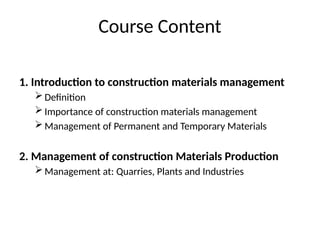
Definition
Importance of construction materials management
Management of Permanent and Temporary Materials
2. Management of construction Materials Production
Management at: Quarries, Plants and Industries
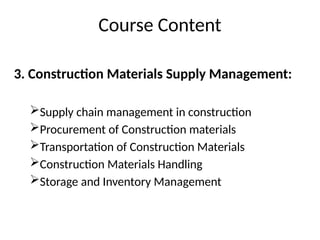
3.
Course Content
3. ConstructionMaterials Supply Management:
Supply chain management in construction
Procurement of Construction materials
Transportation of Construction Materials
Construction Materials Handling
Storage and Inventory Management
4.
Course Content
4. ConstructionMaterials Standard and Quality
management.
Evaluation and Requirements for the completion of the course
Assignment 10 %
Class participation 10 %
Written examinations 80%
Attendance requirement 75%
Reference
Lecture note
Any related materials to the subject
Introduction Contd…
• Materialsmanagement is part of logistics and
refers to the location and movement of the
physical items or products. There are three
main processes associated with materials
management: spare parts, quality control, and
inventory management.
7.
Introduction Contd…
Definition
Materials Management
“Materialsmanagement is a process: It is how a
building is designed and how materials are estimated.
It is how materials are acquired and even how the
packaging is specified. It is how the delivery schedule
is designed. It is how contractors plan materials use
and how they manage previously used materials and
cuts. It is how waste is managed for use elsewhere or
recycling rather than being discarded in a landfill.”
[Construction Materials Management Guideline, A
Chapter of the American Institute of Architects]
8.
Introduction Contd…
• MaterialsManagement is The planning and control of
the functions supporting the complete cycle (flow) of
materials, and the associated flow of information. These
functions include (1) identification, (2) cataloging, (3)
standardization, (4) need determination, (5) scheduling,
(6) procurement, (7) inspection, (8) quality control, (9)
packaging, (10) storage, (11) inventory control, (12)
distribution, and (13) disposal.
9.
Introduction Contd…
Materialsmanagement in construction is the efficient use of
goods and equipment before, during and upon completion of a
building process.
It deals with material cost, material supply material storage,
utilization and handling
The scope of materials management applicable to construction
industry involves the planning of materials, procurement of
materials, packaging, storage, inventory control, transportation
of materials, material handling, disposal of scrap and surplus
Successful materials management requires the participation of
all persons involved in a construction process.
10.
Objectives of MaterialsManagement
• Economy in Materials Cost
• Efficient control of inventories
• Ensure Uniform flow of Materials for
production/construction
• Ensure right quality at right price
• Establish and Maintain good relations with
customers
• Economical consumption of important items and
finding their substitutes
11.
Why is CMMimportant?
• One of the three cost components in Construction is Material . Hence,
Materials management is an important element in project planning and
control to make construction projects cost efficient.
• Materials represent a major expense in construction, so minimizing
procurement or purchase costs presents important opportunities for
reducing costs.
• Poor materials management can also result in large and unavoidable costs
during construction.
• First, if materials are purchased early, capital may be tied up and interest
charges incurred on the excess inventory of materials.
• Even worse, materials may deteriorate during storage or be stolen unless
special care is taken.
• Second, delays and extra expenses may be incurred if materials required for
particular activities are not available. Accordingly, insuring a timely flow of
material is an important concern of project managers.
12.
Why is CMMimportant?
• Materials management is not just a concern during the
monitoring stage in which construction is taking place.
• Decisions about material procurement may also be required
during the initial planning and scheduling stages. For
example, activities can be inserted in the project schedule to
represent purchasing of major items such as elevators for
buildings.
• The availability of materials may greatly influence the
schedule in projects with a fast track or very tight time
schedule: sufficient time for obtaining the necessary
materials must be allowed.
• In some case, more expensive suppliers or shippers may be
employed to save time.
13.
Who are involvedin CMM?
• Many People are Involved
Successful materials management like
any successful project relies on the skills of many
professionals from the architect and designers
through project management to the trade
contractors.
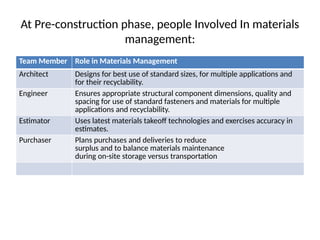
14.
At Pre-construction phase,people Involved In materials
management:
Team Member Role in Materials Management
Architect Designs for best use of standard sizes, for multiple applications and
for their recyclability.
Engineer Ensures appropriate structural component dimensions, quality and
spacing for use of standard fasteners and materials for multiple
applications and recyclability.
Estimator Uses latest materials takeoff technologies and exercises accuracy in
estimates.
Purchaser Plans purchases and deliveries to reduce
surplus and to balance materials maintenance
during on-site storage versus transportation
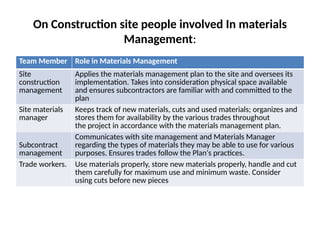
15.
On Construction sitepeople involved In materials
Management:
Team Member Role in Materials Management
Site
construction
management
Applies the materials management plan to the site and oversees its
implementation. Takes into consideration physical space available
and ensures subcontractors are familiar with and committed to the
plan
Site materials
manager
Keeps track of new materials, cuts and used materials; organizes and
stores them for availability by the various trades throughout
the project in accordance with the materials management plan.
Subcontract
management
Communicates with site management and Materials Manager
regarding the types of materials they may be able to use for various
purposes. Ensures trades follow the Plan's practices.
Trade workers. Use materials properly, store new materials properly, handle and cut
them carefully for maximum use and minimum waste. Consider
using cuts before new pieces
Management of constructionmaterials
Construction materials cover all types of materials used in construction including
electrical and mechanical fittings fixture, devices and instruments that are incorporated
during the construction of permanent works and temporary supporting works at site.
permanent works: Materials used for the construction of permanent works are named
as permanent materials
temporary supporting works: those materials used for the construction of temporary
works are categorized under here. ( engineers facilities, offices, false works,
formworks…)
In construction projects, materials account more than 40% of the project cost.
Hence a small saving of material cost through efficient management result in a large
contribution in overall cost saving/profit maximization
Efficient materials management in project environments calls for an integrated approach
covering numerous functions such as materials planning, purchasing, inventory control,
store-keeping and warehousing, handling and transportation, codification and
standardization, and the disposal of the surplus.
* Materials planning, which is the key function of materials management, is closely
linked with project planning and control set-up.
aim to develop a plan for procurement and stocking of construction materials so as
to provide at the site materials of the right quality in right quantity at the right
prices from the right sources at the right time.
18.
ABC Classification ofconstruction Materials
The primary concept purpose of classifying materials is
to control quality, cost and timely supply. There are
many factors that need consideration while classifying
materials. These include storage space, shelf life,
supply reliability, inventory costs, ease of identification,
construction sequence, transportation requirement,
price, procurement time, procurement source and
project life. Some of the general categories are;
(a) bulky, one –time purchase, repetitive use, and minor
materials
(b)Vital, essential and desirable materials
(c) Indigenous and imported materials
(d)High price, medium price and low price materials
(e)High usage value, medium usage value and low-usage
value materials
19.
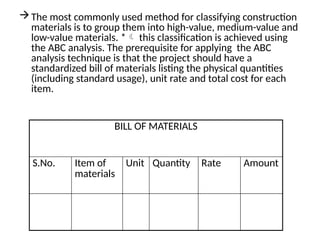
The most commonlyused method for classifying construction
materials is to group them into high-value, medium-value and
low-value materials. * this classification is achieved using
the ABC analysis. The prerequisite for applying the ABC
analysis technique is that the project should have a
standardized bill of materials listing the physical quantities
(including standard usage), unit rate and total cost for each
item.
BILL OF MATERIALS
S.No. Item of
materials
Unit Quantity Rate Amount
20.
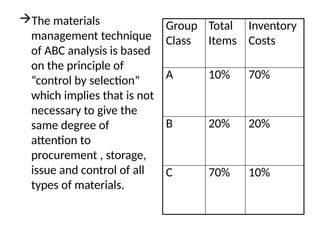
The materials
management technique
ofABC analysis is based
on the principle of
“control by selection”
which implies that is not
necessary to give the
same degree of
attention to
procurement , storage,
issue and control of all
types of materials.
Group
Class
Total
Items
Inventory
Costs
A 10% 70%
B 20% 20%
C 70% 10%
21.
ABC Classification
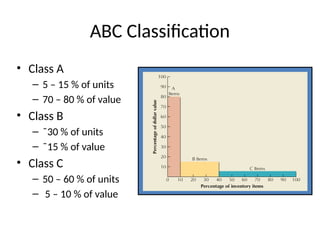
• ClassA
– 5 – 15 % of units
– 70 – 80 % of value
• Class B
– ˜30 % of units
– ˜15 % of value
• Class C
– 50 – 60 % of units
– 5 – 10 % of value
22.
Methodology
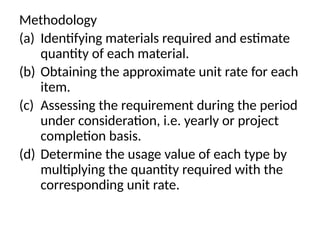
(a) Identifying materialsrequired and estimate
quantity of each material.
(b) Obtaining the approximate unit rate for each
item.
(c) Assessing the requirement during the period
under consideration, i.e. yearly or project
completion basis.
(d) Determine the usage value of each type by
multiplying the quantity required with the
corresponding unit rate.
23.
Methods contd…
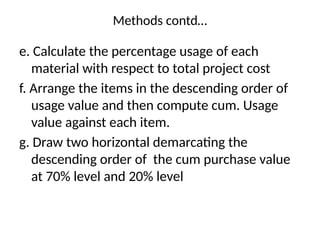
e. Calculatethe percentage usage of each
material with respect to total project cost
f. Arrange the items in the descending order of
usage value and then compute cum. Usage
value against each item.
g. Draw two horizontal demarcating the
descending order of the cum purchase value
at 70% level and 20% level
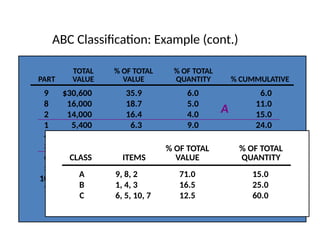
ABC Classification: Example(cont.)
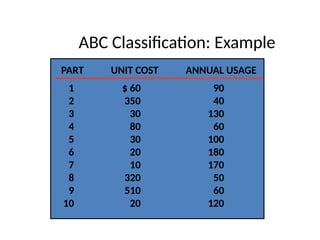
Example 10.1
1 $ 60 90
2 350 40
3 30 130
4 80 60
5 30 100
6 20 180
7 10 170
8 320 50
9 510 60
10 20 120
PART UNIT COST ANNUAL USAGE
TOTAL % OF TOTAL % OF TOTAL
PART VALUE VALUE QUANTITY % CUMMULATIVE
9 $30,600 35.9 6.0 6.0
8 16,000 18.7 5.0 11.0
2 14,000 16.4 4.0 15.0
1 5,400 6.3 9.0 24.0
4 4,800 5.6 6.0 30.0
3 3,900 4.6 10.0 40.0
6 3,600 4.2 18.0 58.0
5 3,000 3.5 13.0 71.0
10 2,400 2.8 12.0 83.0
7 1,700 2.0 17.0 100.0
$85,400
A
B
C
% OF TOTAL % OF TOTAL
CLASS ITEMS VALUE QUANTITY
A 9, 8, 2 71.0 15.0
B 1, 4, 3 16.5 25.0
C 6, 5, 10, 7 12.5 60.0
26.
Plant and equipmentmanagement in Material
production
• Introduction
– Construction Materials produced at quarries and plants: masonry, concrete aggregate,
sand, concrete, asphalt, etc
– Machineries and plants are required (such as batching plants, dozers, excavators,
loaders, dump trucks,…)
– Plant and machineries, if poorly managed on construction projects, suffers from low
utilization rates. Therefore the principal contractor needs to concentrate efforts on the
removal of non-value-adding activities.
• Plant and equipment Management
– Considerable care is necessary when purchasing plant and equipment of any kind. The
person charged with making the purchase needs to thoroughly investigate the various
aspects identified below.
– The successful and profitable operation of plant is dependent not only on the price paid
but also on the necessity to conduct a critical evaluation of its suitability.
– This is an activity that should not be left solely to a plant department but should involve
consultation with the operational and user personnel.
– The plant department should not function in isolation or this will impact upon operational
effectiveness and efficiency.
27.
Plant and equipmentmanagement in...
If due consideration is given during consultations between plant department and
operations the benefits available include:
● simple installations
● minimum commissioning time
● rapid training of operators (learning curve theory)
● high utilization with the minimum of ‘down time’
● longer life of plant (doing the job for which it was designed)
● lower operational costs
● ease of maintenance with the minimum investment in spare parts.
During purchasing plants and equipments one can ensure an adequate return on
investment by paying attention to:
● maintainability
● reliability
● installation and commissioning
● product support
● costs.
• Down time is the non-operational time of equipment/plants that results from lack of
maintenance.
• Stand by time is the idle time that an equipment/plant spends because of the reason
that there is no activity to engage plants/equipments or lack of operators…
28.
Plant and equipmentmanagement in...
Maintainability
• The designers of all industrial plant should ensure that their designs
provide:
– a minimum maintenance requirement
– rapid fault diagnosis and repair
– low maintenance and repair costs.
– Equipment which conforms to these three objectives has maintainability.
Reliability
• This is demonstrated by the length of time between breakdowns in
operational service.
Installation and Commissioning
• The signs of an unsatisfactory purchase usually become obvious during
the installation and commissioning period. This is the time when plant
is delivered and put into operation.
Product Support
• This includes the following:
29.
Plant and equipmentmanagement in...
• operating, installation and maintenance manuals
• maintenance schedules
• training aids
• special tools
• technical assistance
Cost
– The total cost is the cost of the equipment plus
the cost of delivery, installation, servicing and
product support (life-cycle cost).
30.
Plant and equipmentmanagement in...
• Some of the benefits to be obtained through
careful procurement of plant and equipment
are explained below.
31.
Plant and equipmentmanagement in...
Commissioning
• This can be a long process if the purchaser selects the wrong vendor or
incorrect equipment. A competent vendor arrives on site with proof in the
specification that the plant meets set objectives Installation, testing and
operator training should not take long if the plant attains the required
performance and if the technical information for training is available.
Minimum Down Time
• This is the time in which the plant is not available for production because
of a need for maintenance or repair. Down time can be caused by a
breakdown of plant or by a shutdown period for preventive maintenance.
Long Life
• The purchasers must assure themselves of the ability of the plant to attain
long service. This is closely linked with ‘reliability’.
32.
Plant and equipmentmanagement in...
Low Operating Costs
A vendor should be asked for predictions of
operating costs and its approach to this problem
will indicate whether it has adequately assessed
this before selling its product. Operating costs in
each year could include:
cost of fuel
cost of operating labor
cost of maintenance
cost of down time
33.
Plant and equipmentmanagement in...
• During Operation of plants and equipments
procedures that has to be followed to ensure
efficiency in materials production:
Setting hourly/daily performance standards
Evaluating outputs against standards
Identifying reasons for recorded production below
minimum performance threshold, if any.
Take remedial measures
SCM
Definitions
A supply chainis a system of organizations,
people, technology, activities, information
and resources involved in moving a product
or service from supplier to customer.
Supply chain activities transform natural
resources, raw materials and components
into a finished product that is delivered to
the end customer
36.
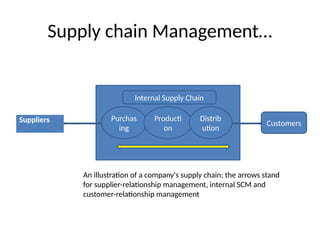
Supply chain Management…
Customers
SuppliersPurchas
ing
Producti
on
Distrib
ution
Internal Supply Chain
An illustration of a company's supply chain; the arrows stand
for supplier-relationship management, internal SCM and
customer-relationship management
37.
Supply chain Management…
•SCM has been defined as “the network of
organizations that are involved, through
upstream and downstream linkages, in the
different processes and activities that produce
value in the form of products and services in
the hands of the ultimate customer” (Vrijhoef
and Koskela, 1999).
38.
Supply chain Management…
●Handfield and Nichols (1999) have also expanded the supply chain definition to
include upstream supplier networks and downstream distribution channels. They
have argued that SCM is not as simple as materials demand and supply networks;
it also includes the management of information systems, procurement,
production scheduling, order processing, inventory management, warehousing,
customer service and after-market disposition of packaging and materials. The
supplier network consists of all organizations that provide inputs, either directly
or indirectly, to the host firm. Thus a supply chain includes internal functions,
upstream suppliers and downstream customers, defined as:
● a firm’s internal functions include the different processes used in transforming the
inputs provided by the supplier network
● the upstream supplier network consists of all organizations that provide inputs,
either directly or indirectly, to the host company
● the external downstream supply chain encompasses all the downstream
distribution channels, processes and functions that the product passes through on
its way to the customer.
39.
Supply chain managementin construction
The Emergence of SCM
• Supply chain management (SCM) is a concept that has flourished in
manufacturing, originating from Just-In-Time (JIT) and logistics; it represents an
autonomous managerial concept.
• SCM endeavors to scrutinize the entire scope of a supply chain and offers a
methodology for addressing the myopic (narrow) control in supply chains that has
been reinforcing wastage problems in construction (Vrijhoef and Koskela,1999).
• The first signs of SCM were perceptible in the JIT delivery system as part of the
Toyota Production Process which aimed to regulate supplies to the Toyota motor
factory (noted previously under JIT).
• The main objective of Toyota was to drastically decrease inventory and to regulate
the suppliers’ interaction with the production line more efficiently and effectively
(Vrijhoef and Koskela, 1999).
• After its emergence in the Japanese automotive industry as part of a production
system, the conceptual evolution of SCM has become a distinct subject of
scientific research.
40.
Supply chain Management…
•SCM combines particular features from various
concepts including Total Quality Management
(TQM), JIT, Value Management, Risk Management
and Partnering.
• The traditional way of managing is essentially based
on a conversion (or transformation) view on
production, whereas SCM is based on a flow view of
production.
• The conversion view suggests that each stage of
production is controlled independently,
• whereas the flow view focuses on the control of the
total flow of production (Koskela 1992).
41.
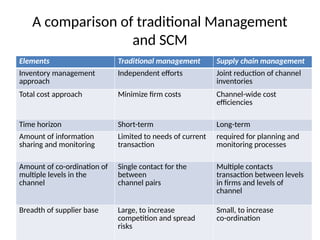
A comparison oftraditional Management
and SCM
Elements Traditional management Supply chain management
Inventory management
approach
Independent efforts Joint reduction of channel
inventories
Total cost approach Minimize firm costs Channel-wide cost
efficiencies
Time horizon Short-term Long-term
Amount of information
sharing and monitoring
Limited to needs of current
transaction
required for planning and
monitoring processes
Amount of co-ordination of
multiple levels in the
channel
Single contact for the
between
channel pairs
Multiple contacts
transaction between levels
in firms and levels of
channel
Breadth of supplier base Large, to increase
competition and spread
risks
Small, to increase
co-ordination
42.
SCM
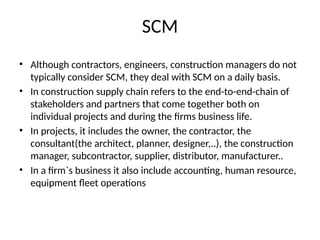
• Although contractors,engineers, construction managers do not
typically consider SCM, they deal with SCM on a daily basis.
• In construction supply chain refers to the end-to-end-chain of
stakeholders and partners that come together both on
individual projects and during the firms business life.
• In projects, it includes the owner, the contractor, the
consultant(the architect, planner, designer,..), the construction
manager, subcontractor, supplier, distributor, manufacturer..
• In a firm`s business it also include accounting, human resource,
equipment fleet operations
43.
SCM
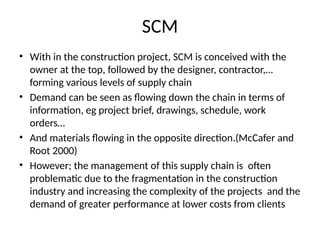
• With inthe construction project, SCM is conceived with the
owner at the top, followed by the designer, contractor,…
forming various levels of supply chain
• Demand can be seen as flowing down the chain in terms of
information, eg project brief, drawings, schedule, work
orders…
• And materials flowing in the opposite direction.(McCafer and
Root 2000)
• However; the management of this supply chain is often
problematic due to the fragmentation in the construction
industry and increasing the complexity of the projects and the
demand of greater performance at lower costs from clients
44.
Advantages of DeployingSCM
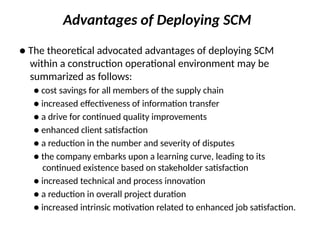
● The theoretical advocated advantages of deploying SCM
within a construction operational environment may be
summarized as follows:
● cost savings for all members of the supply chain
● increased effectiveness of information transfer
● a drive for continued quality improvements
● enhanced client satisfaction
● a reduction in the number and severity of disputes
● the company embarks upon a learning curve, leading to its
continued existence based on stakeholder satisfaction
● increased technical and process innovation
● a reduction in overall project duration
● increased intrinsic motivation related to enhanced job satisfaction.
45.
Methods in SCM
•A generic methodology of SCM can be deduced
combining and generalizing the commonalities of
different SCM methods. In a way, the SCM methodology
bears resemblance to the Deming Cycle .
• Generically, the methodology of SCM consists of four
main elements:
(1) Supply chain assessment,
(2) Supply chain redesign,
(3)Supply chain control, and
(4) Continuous supply chain improvement
46.
SCM
• The firststep is to assess the current process across the
supply chain in order to detect actual waste and
problems. The issue here is to find the causality between
the waste and problems, and locate their root causes.
• Once the causality is understood, and having found out
about the root causes, the next step is to redesign the
supply chain in order to introduce structural resolution
of the problems. This includes redistribution of roles,
tasks and responsibilities among the actors in the supply
chain, and a review of procedures.
47.
SCM
• The nextstep is to control the supply chain according to its
new configuration. An important part of the control is the
installation of a monitoring mechanism to continuously
assess how the supply chain operates. This includes systems
to measure and estimate waste across the supply chain
process, and feedback systems to discuss and evaluate
underlying problems.
• The objective is to continuously identify new opportunities,
and find new initiatives to develop the supply chain. In fact,
this continuous improvement implies the ongoing
evaluation of the supply chain process, and the recurring
deployment of the previous three steps: assessment,
redesign and control
48.
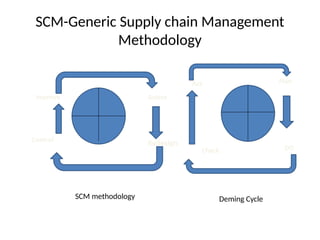
SCM-Generic Supply chainManagement
Methodology
Act
Control
Assess
Redesign
Plan
DO
Check
Improve
Deming Cycle
SCM methodology
49.
SCM
ROLES OF SUPPLYCHAIN MANAGEMENT IN CONSTRUCTION
• The generic concepts, methods and lessons learnt, which have
been developed in the framework of SCM, can be used in different
ways for the improvement of construction supply chains. In the
following, illustration of how the methodology of SCM can
contribute to the understanding of construction supply chain
problems, and in giving direction to improvement efforts.
SUPPLY CHAIN MANAGEMENT’S CONTRIBUTION TO RESOLVE
BASIC PROBLEMS IN CONSTRUCTION: UNDERSTANDING
CONSTRUCTION SUPPLY CHAIN PROBLEMS
• Based on the insight gained by means of supply chain assessment,
the SCM methodology needs to be fully applied to resolve the
problems that were found in the construction supply chain.
50.
SCM
• Because mostproblems spread across (a
considerable part of) the supply chain,
solutions are needed that equally cover
multiple stages of the supply chain, including
the actors involved. The range of the solutions
and the part of the supply chain involved
depend on the scale of the problems.
51.
SCM
• After havingassessed the supply chain, the SCM
methodology suggests redesign (reconfiguring the
supply chain’s structure), control (coordinating the
supply chain according to the new configuration) and
continuous improvement. For instance, towards
suppliers, the methodology could include reengineering
the procurement process, installing joint coordination
of logistics and recurring product development
programs. Typically, such activities include joint
activities between separate actors in the supply chain.
52.
SCM
• Supply chainarrangements counteracting adversarial relations
with other actors (e.g., partnership) are needed to enlarge the
magnitude of the SCM methodology, and clear the way for
resolution of interdependency-based problems and myopic
control. In fact, actors are dependent on each other for
implementing the supply chain methodology successfully.
• Supply chain development should take place in co-operation with
a growing number of actors tackling a growing number of issues.
• The actors involved should have a common development goal,
share the same view on the development, and adopt the same
approach to issues such as grasping concrete and objective
performance information, and searching for improvement
opportunities cooperatively (Wegelius-Lehtonen and Pahkala
1998).
53.
SCM-Conclusion
• The conceptof SCM represents a logical continuation
of previous management developments.
• It has been influenced by other management
concepts such as JIT, TQM, Value Management and
Partnering.
• The most critical issue in SCM is the achievement of
a co-operative relationship between all supply chain
partners. SCM would enable the efficient and
effective utilization of both plant and materials.
54.
Procurement of Constructionmaterials
INTRODUCTION
Construction of materials needed for a project work
vary with the nature of the project.
In road projects-materials required may be few in
number
In building-may be counted in hundreds
The determination of the type, quantity and
specification of construction materials needs a
detailed study of the contract document , including
The BOQ, Drawings, Specifications, pretender
estimates, preliminary vendor enquiries
55.
INTRODUCTION
• Materials provisioningto the site should be
planned in the sequence of their requirement
on the site.
• For example materials that are required for site
development, foundation work, superstructure
frame, which are needed in the early stages of
construction, are considered first.
• The procurement management , the provision
of construction materials to construction
projects, have the following processes.
56.
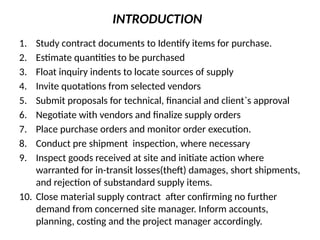
INTRODUCTION
1. Study contractdocuments to Identify items for purchase.
2. Estimate quantities to be purchased
3. Float inquiry indents to locate sources of supply
4. Invite quotations from selected vendors
5. Submit proposals for technical, financial and client`s approval
6. Negotiate with vendors and finalize supply orders
7. Place purchase orders and monitor order execution.
8. Conduct pre shipment inspection, where necessary
9. Inspect goods received at site and initiate action where
warranted for in-transit losses(theft) damages, short shipments,
and rejection of substandard supply items.
10. Close material supply contract after confirming no further
demand from concerned site manager. Inform accounts,
planning, costing and the project manager accordingly.
57.
Material Procurement Management
•Procurement management is one of the
important factors to be considered on
construction projects since it is the major source
of expenditure that is incurred .
• It converts plans and programs in to
commitments to utilize resources.
• Materials of poor standard and ineffective quality
control will cause delay in the implementation of
the project and the resources may get wasted,
thus increasing the overall cost of the project
Material Procurement Management
Identificationof materials and materials package
Materials break down can be determined from the BOQ which
contains work items with quantities involved
Details regarding finishes can be read from the architectural
drawings/engineering drawings.
In case of electrical and mechanical items, a detailed scrutiny
is required to identify the items and its components. In some
cases these items may have to be designed.
Materials package includes all types and qualities of materials
needed to perform a given activity or a work item . For
Example a work package of Concreting of foundation requires
cement, sand, aggregate, water, formwork.
60.
Material Procurement Management
MaterialsQuantity Estimation and scheduling of materials
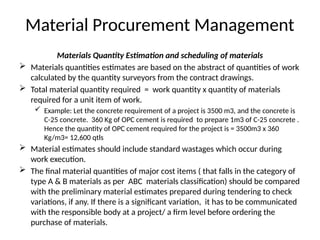
Materials quantities estimates are based on the abstract of quantities of work
calculated by the quantity surveyors from the contract drawings.
Total material quantity required = work quantity x quantity of materials
required for a unit item of work.
Example: Let the concrete requirement of a project is 3500 m3, and the concrete is
C-25 concrete. 360 Kg of OPC cement is required to prepare 1m3 of C-25 concrete .
Hence the quantity of OPC cement required for the project is = 3500m3 x 360
Kg/m3= 12,600 qtls
Material estimates should include standard wastages which occur during
work execution.
The final material quantities of major cost items ( that falls in the category of
type A & B materials as per ABC materials classification) should be compared
with the preliminary material estimates prepared during tendering to check
variations, if any. If there is a significant variation, it has to be communicated
with the responsible body at a project/ a firm level before ordering the
purchase of materials.
61.
Material Procurement Management
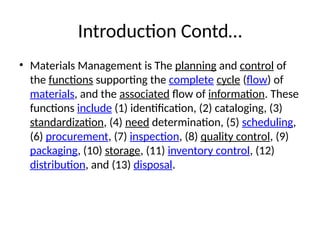
MaterialsUsage Standard
Some wastage is inevitable in actual work. This wastage in
materials is generally expressed as a percentages of
materials calculated theoretically from the quantities of the
work involved, and are termed as ‘standard wastage'. The
total quantity of materials to be provisioned should cater
for the standard wastage by increasing the theoretical
quantity, proportionally.
Materials to be provisioned;
=Theoretical quantity of materials X
[{100+standard Wastage(%)}/100]
It may be noted that standard wastage caters for wastage
during utilization only for causes considered beyond control
at the site. In addition to the controllable wastage, there is
wastage which falls in the category of uncontrollable
wastage. The main cause of controllable wastage are;
62.
Material Procurement Management
MaterialsUsage Standard
(a) Wastage on account of designers specifying non-standard
materials having unattainable specifications.
(b) Wastage due to incorrect purchasing resulting in over buying,
wrong buying, unnecessary buying and untimely buying.
(c) Wastage in transpiration and handling including breakage and
pilferage.
(d) Wastage during storage resulting from deterioration,
improper storage, breakage, obsolescence and theft.
since, controllable wastage falls under the purview of the
materials management staff the additional provisions to
compensate for such wastage should be made by them so as
to ensure that the right quantity of materials are available at
the right time.
63.
Material Procurement Management
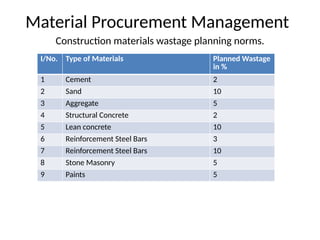
Constructionmaterials wastage planning norms.
I/No. Type of Materials Planned Wastage
in %
1 Cement 2
2 Sand 10
3 Aggregate 5
4 Structural Concrete 2
5 Lean concrete 10
6 Reinforcement Steel Bars 3
7 Reinforcement Steel Bars 10
8 Stone Masonry 5
9 Paints 5
64.
Material Procurement Management
MaterialsQuantity Estimation and scheduling of
materials
After materials required for the work are
evaluated, a usage schedule at the site based
on the project construction plan is prepared
with a view to evolve their delivery schedules
and the stocking policy.
65.
Material Procurement Management
MaterialsProcurement Enquiries
• Investigation for developing sources for procurement of
materials are made by floating enquiry indents (floating
tender and inviting vendors to offer their price).
• Material inquiry indents containing quantities,
specifications and delivery times are jointly prepared by
the project planning cell and material procurement
department
• Inviting of tenders for quotations with samples of
materials, where applicable is carried out by material
procurement department
66.
Material Procurement Management
MaterialsProcurement Enquiries
On receipt of the quotations, a comparative study of
the price, quality, delivery time, terms of delivery,
payment terms is made jointly by both materials and
project planning in charges
Vendors proposal are compared with enquiry
specification and stipulated requirements for and the
resulting deviations are examined for acceptability.
Vendors enlistment is based on its size, capability,
past performance, market reputation and if necessary
this may be confirmed by a visit to the vendor`s
works.
67.
Material Procurement Management
MaterialsProcurement Enquiries
Criteria's for evaluating vendors is:
Quality of the material-its past records, recent test reports,
performance reports, performance reports from old users,…
Company`s financial status
Company`s management team and their professional
competency and engineering skills
Support services
If there is deviation from stipulated specifications and
delivery timings it should be discussed with the project
manager/ manager concerned and if required with the
consultants
68.
Material Procurement Management
Finalizationof Source of Materials Procurement
The following activities has to be undergone before placing of
purchase order
a. Approval in principle for processing proposals
effect of prices on profitability
in case of changes in offers, approval by project management prior
to commencing further negotiations with the suppliers.
b. Client`s approval of proposed materials- as per the terms of
agreement and standard construction practices, the contractor
submits proposals to the client/consultant for approval of the
materials.
The proposals can be in the form of :
Samples of materials
The manufacturers write up on the materials
The materials test results…
69.
Material Procurement Management
Finalizationof Source of Materials Procurement
C. Negotiations of terms of supply-final negotiations with the vendor
prior to the placing of order are carried out to evolve mutually
agreed terms for supply particularly, with respect to the following:
To finalize prices through negotiations by securing a better price offer
To finalize mode of transportation of materials up to site
To finalize payment terms including the opening letter of credits, if
required
To finalize prior delivery and post delivery inspection/quality control
procedures with particular reference to contract stipulations and design
specifications
To finalize the material delivery schedule
To finalize guarantees and penalties
Before finalizing negotiations, a recheck is done to ensure that the
necessary documents needed for manufacturing
70.
Material Procurement Management
MonitoringMaterials delivery Schedule
After the purchase order is placed with the vendor, steps
necessary to ensure that right quantity and right quality
materials arrive at the site at the right time are:
i. Preparation and monitoring materials movement schedule
ii. Conduct pre-transportation inspection where necessary
iii. Obtain periodic information on shipment/transportation status
iv. Keep ready the documents necessary for clearing customs and
other formalities during transit
v. Plan in advance for receiving materials at the site
vi. Checking the quality and quantity as per requirement and
bringing out discrepancies, if any, for further action including
timely replacement/reordering and claiming
insurance/compensation if applicable
71.
OPERATIONS RESEARCH
Transportation Problem
•Introduction: The objective of the
transportation problem is to transport
various quantities of a single homogenous
commodity, which are initially stored at
various origins to various destinations in such
a way that the total transportation cost is
minimum
72.
Transportation Problem
Definitions:
• BasicFeasible solution: A feasible solution to a m-
origin, n-destination problem is said to be basic if the
number of positive allocations are equal to (m+n-1).
• Feasible Solution: A set of positive individual
allocations which simultaneously removes
deficiencies is called a feasible solution.
• Optimal Solution: A feasible solution (not basically
basic) is said to be optimal if it minimizes the total
transportation cost.
73.
Transportation Problem
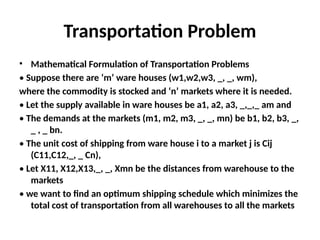
• MathematicalFormulation of Transportation Problems
• Suppose there are ‘m’ ware houses (w1,w2,w3, _, _, wm),
where the commodity is stocked and ‘n’ markets where it is needed.
• Let the supply available in ware houses be a1, a2, a3, _,_,_ am and
• The demands at the markets (m1, m2, m3, _, _, mn) be b1, b2, b3, _,
_ , _ bn.
• The unit cost of shipping from ware house i to a market j is Cij
(C11,C12,_, _ Cn),
• Let X11, X12,X13,_, _, Xmn be the distances from warehouse to the
markets
• we want to find an optimum shipping schedule which minimizes the
total cost of transportation from all warehouses to all the markets
74.
Transportation Problem
• Thetotal minimum transportation cost is
Z = X11C11 + X12C12 + _ _ _ + XmnCmn
• Types of Transportation Problems
1. Minimisation Balanced Transportation Problems
2. Minimisation Unbalanced Transportation Problems
3. Maximisation Balanced Transportation Problems
4. Maximisation unbalanced Transportation Problems
5. All the above models with degeneracy.
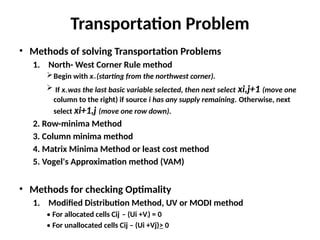
75.
Transportation Problem
• Methodsof solving Transportation Problems
1. North- West Corner Rule method
Begin with x11 (starting from the northwest corner).
If xi,j was the last basic variable selected, then next select xi,j+1 (move one
column to the right) if source i has any supply remaining. Otherwise, next
select xi+1,j (move one row down).
2. Row-minima Method
3. Column minima method
4. Matrix Minima Method or least cost method
5. Vogel's Approximation method (VAM)
• Methods for checking Optimality
1. Modified Distribution Method, UV or MODI method
• For allocated cells Cij – (Ui +Vj) = 0
• For unallocated cells Cij – (Ui +Vj)> 0
76.
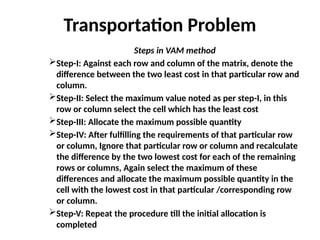
Transportation Problem
Steps inVAM method
Step-I: Against each row and column of the matrix, denote the
difference between the two least cost in that particular row and
column.
Step-II: Select the maximum value noted as per step-I, in this
row or column select the cell which has the least cost
Step-III: Allocate the maximum possible quantity
Step-IV: After fulfilling the requirements of that particular row
or column, Ignore that particular row or column and recalculate
the difference by the two lowest cost for each of the remaining
rows or columns, Again select the maximum of these
differences and allocate the maximum possible quantity in the
cell with the lowest cost in that particular /corresponding row
or column.
Step-V: Repeat the procedure till the initial allocation is
completed
77.
Transportation Problem
• PROBLEMS:
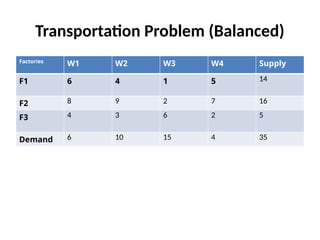
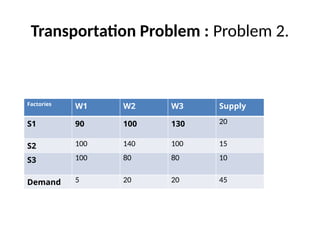
1.Solve the following transportation problem
by North-West corner rule, Row Minima,
Column Minima, Matrix Minima and VAM
Method:
Planning materials Inventory
The term ‘Inventory’ implies the cost of materials in stock at a
given time. This stock of materials is held to act as a cushion
between supply and demand. The monetary value of
inventory indicates the extent of investment required to
maintain minimum stock of materials for smooth running of
the project. Higher inventory implies higher investment, and
less inventory carries the risk of supplies falling behind
demand. A balanced inventory act as a cushion between
supply and site requirement till supplies are received. This
include predetermined safety stock to cater for slippages in
delivery schedules. It is therefore, necessary to hold a
planned stock of construction materials at the project site to
ensure a timely supply of the expected quantity of materials
at the appropriate time for smooth execution of planned
construction activities with least investment on inventory.
81.
Costs of inventory
Theeffective management of inventory involves a tradeoff between having
too little and also too much inventory.
Inventory costs:
i. Ordering Costs: requisitioning, preparation of purchase order, expediting,
transport and receiving and placing in storage, set-up costs
ii. Carrying Costs: interest on capital locked up in inventory, storage and
handling costs, insurance, depreciation, and property taxes.
iii. Shortage Costs: arise when inventories are short of requirement for
meeting the needs of production or the demand of customers.
Loss of sales, loss of customer goodwill, disruption of production
schedules.
82.
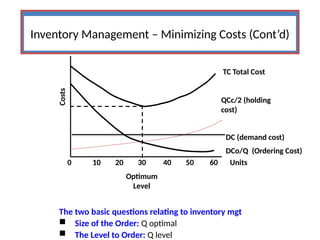
Inventory Management –Minimizing Costs
• The goal of effective inventory management is to
minimize the total costs that are associated with
ordering and holding inventories.
• Choose the level of inventory with the lowest total
cost after estimating the different expenses with
varying inventory levels.
83.
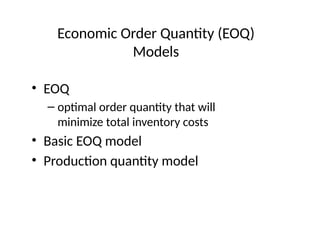
Economic Order Quantity(EOQ)
Models
• EOQ
– optimal order quantity that will
minimize total inventory costs
• Basic EOQ model
• Production quantity model
84.
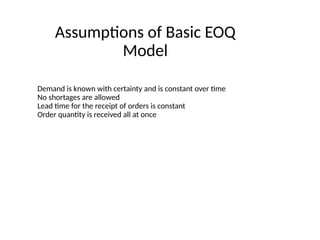
Assumptions of BasicEOQ
Model
Demand is known with certainty and is constant over time
No shortages are allowed
Lead time for the receipt of orders is constant
Order quantity is received all at once
85.
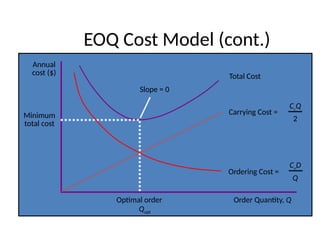
EOQ Cost Model(cont.)
Order Quantity, Q
Annual
cost ($) Total Cost
Carrying Cost =
CcQ
2
Slope = 0
Minimum
total cost
Optimal order
Qopt
Ordering Cost =
CoD
Q
86.
Inventory Management –Minimizing Costs (Cont’d)
The two basic questions relating to inventory mgt
Size of the Order: Q optimal
The Level to Order: Q level
10
10 20 30 40 50 60 Units
0
Costs
TC Total Cost
QCc/2 (holding
cost)
DC (demand cost)
DCo/Q (Ordering Cost)
Optimum
Level
87.
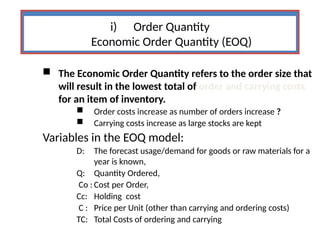
i) Order Quantity
EconomicOrder Quantity (EOQ)
The Economic Order Quantity refers to the order size that
will result in the lowest total of order and carrying costs
for an item of inventory.
Order costs increase as number of orders increase ?
Carrying costs increase as large stocks are kept
Variables in the EOQ model:
D: The forecast usage/demand for goods or raw materials for a
year is known,
Q: Quantity Ordered,
Co : Cost per Order,
Cc: Holding cost
C : Price per Unit (other than carrying and ordering costs)
TC: Total Costs of ordering and carrying
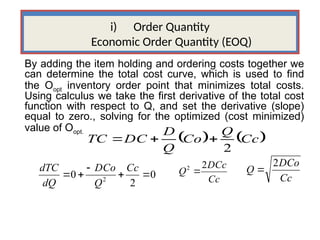
i) Order Quantity
EconomicOrder Quantity (EOQ)
By adding the item holding and ordering costs together we
can determine the total cost curve, which is used to find
the Oopt inventory order point that minimizes total costs.
Using calculus we take the first derivative of the total cost
function with respect to Q, and set the derivative (slope)
equal to zero., solving for the optimized (cost minimized)
value of Oopt.
Cc
Q
Co
Q
D
DC
TC
2
0
2
0 2
Cc
Q
DCo
dQ
dTC
Cc
DCc
Q
2
2
Cc
DCo
Q
2
90.
i) Order Quantity
EconomicOrder Quantity (EOQ)
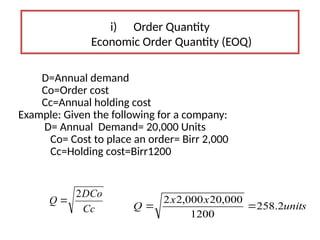
D=Annual demand
Co=Order cost
Cc=Annual holding cost
Example: Given the following for a company:
D= Annual Demand= 20,000 Units
Co= Cost to place an order= Birr 2,000
Cc=Holding cost=Birr1200
units
x
x
Q 2
.
258
1200
000
,
20
000
,
2
2
Cc
DCo
Q
2
91.
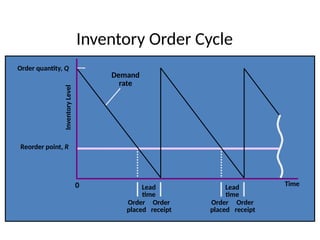
ii) Order Level
EconomicOrder Quantity (EOQ)
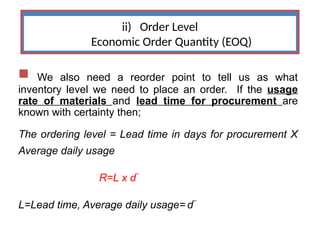
We also need a reorder point to tell us as what
inventory level we need to place an order. If the usage
rate of materials and lead time for procurement are
known with certainty then;
The ordering level = Lead time in days for procurement X
Average daily usage
R=L x d
_
L=Lead time, Average daily usage= d
_
92.
Reorder Point
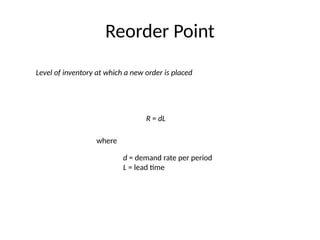
Level ofinventory at which a new order is placed
R = dL
where
d = demand rate per period
L = lead time
93.
EOQ Example
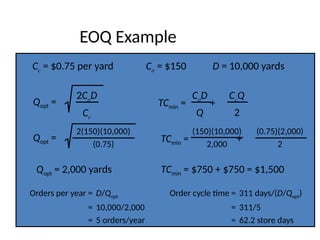
Cc =$0.75 per yard Co = $150 D = 10,000 yards
Qopt =
2CoD
Cc
Qopt =
2(150)(10,000)
(0.75)
Qopt = 2,000 yards
TCmin = +
CoD
Q
CcQ
2
TCmin = +
(150)(10,000)
2,000
(0.75)(2,000)
2
TCmin = $750 + $750 = $1,500
Orders per year = D/Qopt
= 10,000/2,000
= 5 orders/year
Order cycle time = 311 days/(D/Qopt)
= 311/5
= 62.2 store days
94.
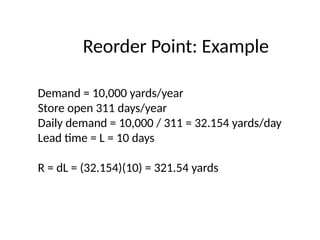
Reorder Point: Example
Demand= 10,000 yards/year
Store open 311 days/year
Daily demand = 10,000 / 311 = 32.154 yards/day
Lead time = L = 10 days
R = dL = (32.154)(10) = 321.54 yards
95.
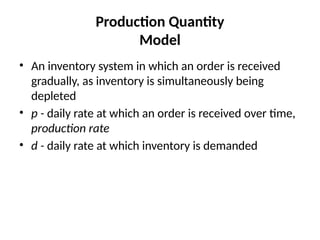
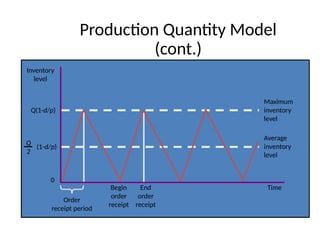
Production Quantity
Model
• Aninventory system in which an order is received
gradually, as inventory is simultaneously being
depleted
• p - daily rate at which an order is received over time,
production rate
• d - daily rate at which inventory is demanded
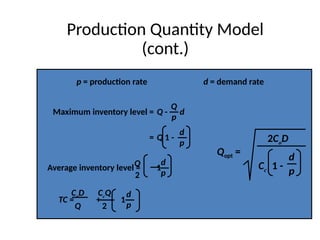
Production Quantity Model
(cont.)
p= production rate d = demand rate
Maximum inventory level = Q - d
= Q 1 -
Q
p
d
p
Average inventory level = 1 -
Q
2
d
p
TC = + 1 -
d
p
CoD
Q
CcQ
2
Qopt =
2CoD
Cc 1 -
d
p
98.
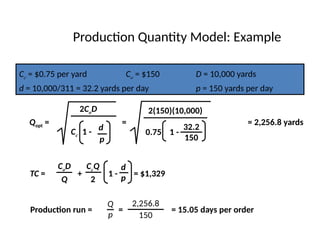
Production Quantity Model:Example
Cc = $0.75 per yard Co = $150 D = 10,000 yards
d = 10,000/311 = 32.2 yards per day p = 150 yards per day
Qopt = = = 2,256.8 yards
2CoD
Cc 1 - d
p
2(150)(10,000)
0.75 1 -
32.2
150
TC = + 1 - = $1,329
d
p
CoD
Q
CcQ
2
Production run = = = 15.05 days per order
Q
p
2,256.8
150
99.
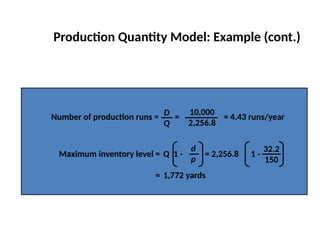
Production Quantity Model:Example (cont.)
Number of production runs = = = 4.43 runs/year
D
Q
10,000
2,256.8
Maximum inventory level = Q 1 - = 2,256.8 1 -
= 1,772 yards
d
p
32.2
150
100.
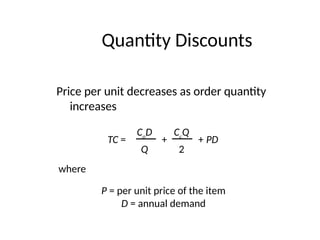
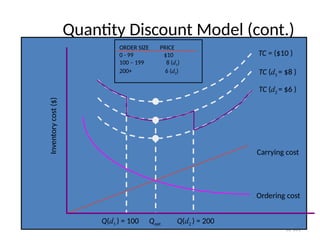
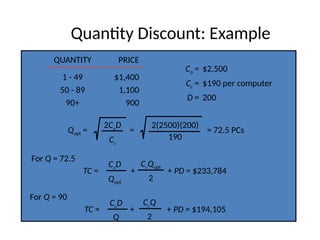
Quantity Discounts
Price perunit decreases as order quantity
increases
TC = + + PD
CoD
Q
CcQ
2
where
P = per unit price of the item
D = annual demand
![Introduction Contd…
Definition
Materials Management
“Materials management is a process: It is how a
building is designed and how materials are estimated.
It is how materials are acquired and even how the
packaging is specified. It is how the delivery schedule
is designed. It is how contractors plan materials use
and how they manage previously used materials and
cuts. It is how waste is managed for use elsewhere or
recycling rather than being discarded in a landfill.”
[Construction Materials Management Guideline, A
Chapter of the American Institute of Architects]](https://image.slidesharecdn.com/constractionmaterialmanagement4-250508034328-73627177/85/constraction-material-constraction-material-management-pptx4-pptx-7-320.jpg)
![Material Procurement Management
Materials Usage Standard
Some wastage is inevitable in actual work. This wastage in
materials is generally expressed as a percentages of
materials calculated theoretically from the quantities of the
work involved, and are termed as ‘standard wastage'. The
total quantity of materials to be provisioned should cater
for the standard wastage by increasing the theoretical
quantity, proportionally.
Materials to be provisioned;
=Theoretical quantity of materials X
[{100+standard Wastage(%)}/100]
It may be noted that standard wastage caters for wastage
during utilization only for causes considered beyond control
at the site. In addition to the controllable wastage, there is
wastage which falls in the category of uncontrollable
wastage. The main cause of controllable wastage are;](https://image.slidesharecdn.com/constractionmaterialmanagement4-250508034328-73627177/85/constraction-material-constraction-material-management-pptx4-pptx-61-320.jpg)