Constituent assem
bly
BACK
GROU
ND
● C
om
m
onw
ealtho
f India bill- Annie Besant
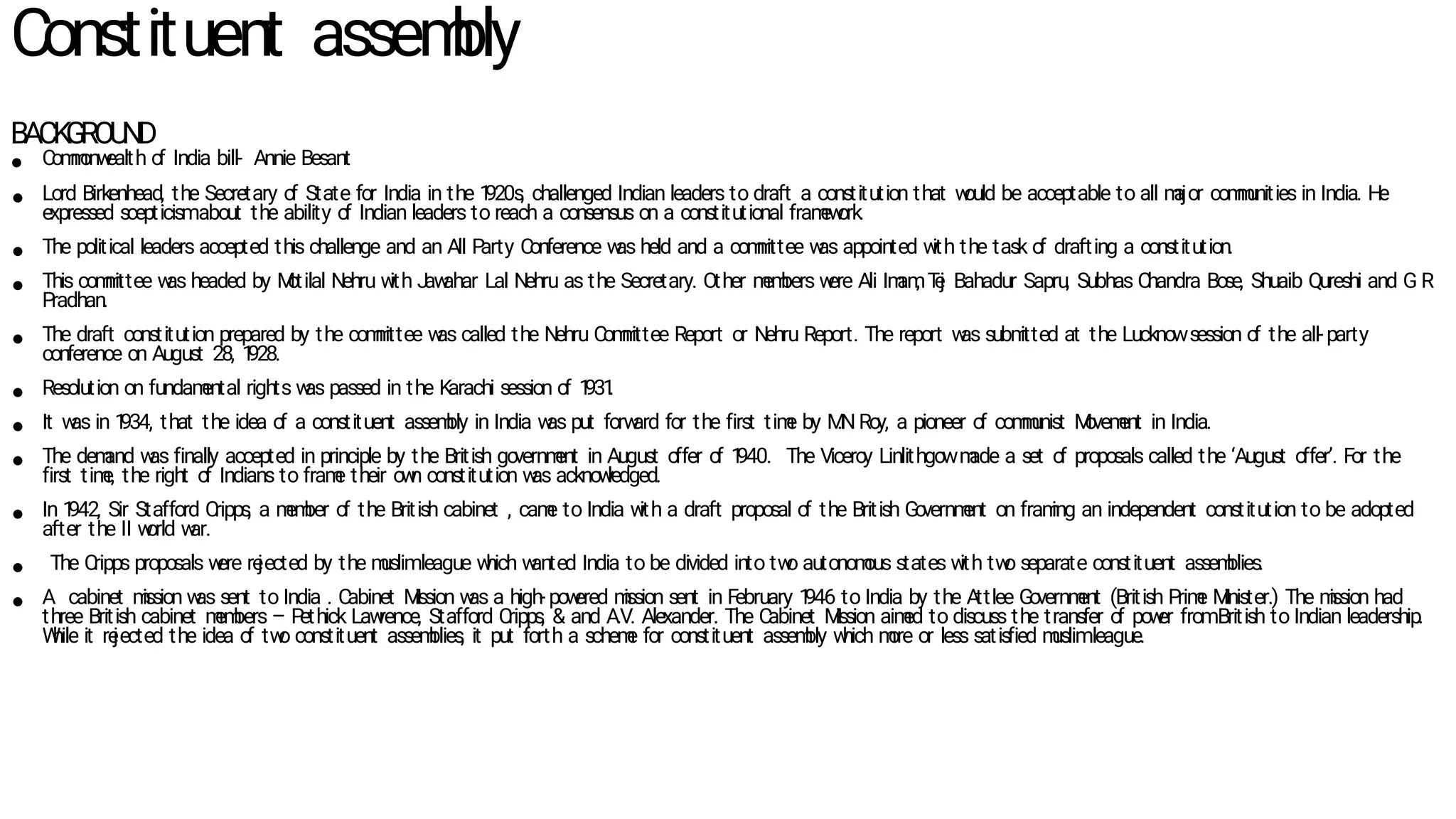
● Lord Birkenhead, the Secretary o
f State for India in the 1
920s, challenged Indian leaders to draft a constitution that w
ould be acceptable to all m
ajor com
m
unities in India. H
e
expressed scepticismabout the ability o
f Indian leaders to reach a consensus on a constitutional fram
ew
ork.
● The political leaders accepted this challenge and an All P
arty C
onference w
as held and a com
m
ittee w
as appointed w
ith the task o
f drafting a constitution.
● This com
m
ittee w
as headed by M
o
tilal N
ehru w
ith J
aw
ahar Lal N
ehru as the Secretary. Other m
em
bers w
ere Ali Im
am
, T
e
j Bahadur Sapru, Subhas Chandra Bose, Shuaib Qureshi and G R
Pradhan.
● The draft constitution prepared by the com
m
ittee w
as called the N
ehru C
om
m
ittee Report or N
ehru Report. The report w
as subm
itted at the Lucknowsession o
f the all- party
conference on August 28, 1
928.
● Resolution on fundam
ental rights w
as passed in the K
arachi session o
f 1
931
.
● It w
as in 1
934, that the idea o
f a constituent assem
bly in India w
as put forw
ard for the first tim
e by M
.NRo
y, a pioneer o
f com
m
unist M
o
vem
ent in India.
● The dem
and w
as finally accepted in principle by the British go
vernm
ent in August o
ffer o
f 1
940. The Vicero
y Linlithgowm
ade a set o
f proposals called the ‘August o
ffer’. For the
first tim
e, the right o
f Indians to fram
e their ow
n constitution w
as acknow
ledged.
● In 1
942, Sir Stafford C
ripps, a m
em
ber o
f the British cabinet , cam
e to India w
ith a draft proposal o
f the British Go
vernm
ent on fram
ing an independent constitution to be adopted
after the II w
orld w
ar.
● The C
ripps proposals w
ere re
jected by the m
uslimleague w
hich w
anted India to be divided into tw
o autonom
ous states w
ith tw
o separate constituent assem
blies.
● A cabinet m
ission w
as sent to India . C
abinet M
ission w
as a high- pow
ered m
ission sent in February 1
946 to India by the A
ttlee Go
vernm
ent (British Prim
e M
inister.) The m
ission had
three British cabinet m
em
bers – P
ethick Law
rence, Stafford C
ripps, and A.V. Alexander. The C
abinet M
ission aim
ed to discuss the trans
fer o
f pow
er fromBritish to Indian leadership.
W
hile it re
jected the idea o
f tw
o constituent assem
blies, it put forth a schem
e for constituent assem
bly w
hich m
ore or less satis
fied m
uslimleague.
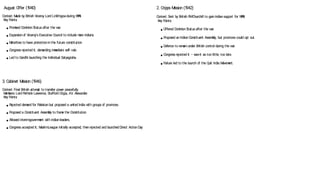
2.
August O
ffer (1
940)
C
on
text:M
ade by British Viceroy Lord Linlithgowduring W
W
II.
K
ey P
oin
ts:
● P
rom
ised D
om
inionStatusafter the w
ar.
● Expansiono
f Viceroy’s Executive C
ouncil to include m
ore Indians.
● M
inorities to have protectioninthe future constitution
.
● C
ongress re
jected it, dem
anding im
m
ediate self-rule.
● Led to G
andhi launching the Individual Satyagraha.
3. Cabinet M
ission (1
946)
C
on
text: Final British attem
p
t to transfer pow
er peacefully.
M
em
bers: Lord P
ethick-Law
rence, Stafford C
ripp
s, A.V. Alexander.
K
ey P
oin
ts:
● Re
jected dem
and for P
akistan but proposed a united India w
ith group
s o
f provinces.
● P
roposed a C
onstituen
t Assem
bly to fram
e the C
onstitution
.
● Allow
ed in
terimgovernm
en
t w
ith Indianleaders.
● C
ongress accep
ted it; M
uslimLeague initially accep
ted, thenre
jected and launched D
irect ActionD
ay
2. Cripps M
ission (1
942)
C
on
text: Sen
t by British P
MC
hurchill to gainIndiansupport for W
W
II.
K
ey P
oin
ts:
● Offered D
om
inionStatusafter the w
ar.
● P
roposed an IndianC
onstituen
t Assem
bly, but provinces could op
t out.
● D
efence to rem
ainunder British con
trol during the w
ar.
● C
ongress re
jected it – sawit as too little, too late.
● Failure led to the launch o
f the Quit India M
ovem
en
t.
3.
CO
M
PO
SITIO
N
● The constituentassem
bly w
as constituted in N
o
vem
ber 1
946 under the schem
e form
ulated by the cabinet m
ission plan. The features o
f
the schem
e w
ere:
● T
o
tal strength- 389; out o
f these 296 seats w
ere to be allo
tted to British India and 93 seats to princely states.
● Out o
f the 296 seats allo
tted to the British India, 292 m
em
bers w
ere to be draw
n from1
1go
vernor's pro
vinces and 4 fromchief
com
m
issioner's pro
vinces.
● Each pro
vince and princely state w
ere to be allo
tted seats in proportion to their respective population . Roughly one seat w
as to be
allo
tted for every m
illion people.
● Seats allo
tted to each British pro
vince w
ere to be divided am
ong three principle com
m
unities- M
uslim
s, Sikhs and general ( all except
M
uslim
s and Sikhs), in proportion to their population.
● The representatives o
f each com
m
unity w
ere to be elected by m
em
bers o
f that com
m
unity in the Pro
vincial legislative assem
bly (m
em
bers o
f
these w
ere elected on the basis o
f lim
ited franchise) and vo
ting w
as to be by the m
ethod o
f proportional representation by m
eans o
f
single trans
ferable vo
te.
● The representatives o
f Princely States w
ere to be nom
inated by the heads o
f princely states.
● 93 seats allo
tted to princely states w
ere no
t filled as they decided to stay aw
ay fromthe constituent assem
bly.
● Although the assem
bly w
as no
t directly elected by the people on the basis o
f universal adult franchise , it included m
em
bers o
f all
sections o
f the society. The assem
bly included all im
portant personalities at the tim
e, w
ith the exception o
f M
ahatm
a Gandhi.
● The constituent Assem
bly held its first m
eeting on Decem
ber 9, 1
946. The M
uslimLeague bo
yco
tted the m
eeting and insisted on separate
state o
f P
akistan. The m
eeting w
as thus attended by only 21
1m
em
bers. After the Indian Independence act 1
947, the M
uslimleague
w
ithdrewfromconstituent Assem
bly o
f India . Consequently, the to
tal strength o
f the assem
bly cam
e dow
n to 299. The strength o
f Indian
pro
vinces w
as reduced from296 to 229, and those o
f the princely states from93 to 70.
4.
● Dr. Sachindanandasinha , the oldest m
em
ber, w
as elected as the tem
porary president o
f the assem
bly, follow
ing the French practise.
● Later Dr. Rajendra Prasad w
as elected as the President o
f the assem
bly. Bo
th H
.C M
ukher
jee and V.T. Krishnam
achari w
ere elected as the Vice Presidents o
f the Assem
bly.
● Ob
jectives Resolution w
as proposed by J
aw
ahar Lal N
ehru on 1
3th D
ecem
ber 1
946. It w
as adopted on 22nd J
anuary 1
947. It laid dow
n the fundam
entals and philosoph
y o
f the
constitutional structure. Fewo
f its pro
visions w
ere - resolve o
f the constituent assem
bly to constitute India into an independent, so
vereign, Republic; to safeguard m
inorities.
● This resolution influenced the eventual shaping o
f the constitution . Its m
odified version form
s the Pream
ble o
f the present constitution.
● Changes that cam
e after the Indian Independence act 1
947- The constituent assem
bly also used to function as the first P
arliam
ent o
f free India and it enacted ordinary law
s. W
hen
the assem
bly m
et as a constituent body it w
as chaired by Rajendra Prasad and w
hen it m
et as a legislative body, G.V M
avalankar used to head the proceedings. It also elected Dr.
Rajendra Prasad as the first President o
f India on 24th J
anuary 1
950. The constituent assem
bly m
et for 2 years, 1
1m
onths and 1
8 days.
● The constituent assem
bly adopted the national flag, national anthem
.
● The em
blemo
f the constituent assem
bly w
as the elephant.
● The secretary o
f the constituent assem
bly w
as Iyengar.
● Chief Draftsm
an w
as H
.C
.M
ukher
jee.
● Legal advisor w
as B.N
.Rao.
● There w
ere m
ajor and m
inor com
m
ittees.
● - M
ajor com
m
ittees- Union P
ow
ers com
m
ittee- J
aw
ahar Lal N
ehru
● - Union constitution com
m
ittee - J
aw
ahar Lal N
ehru
● - Pro
vincial constitution com
m
ittee- Sardar V
allabhai P
atel
● - Drafting com
m
ittee- B.R.Am
bedkar
● - Advisory com
m
ittee on fundam
ental rights, m
inorities and tribal and excluded areas- Sardar V
allabhai P
atel
● - States com
m
ittee- J
aw
ahar Lal N
ehru
● - Steering com
m
ittee- Rajendra Prasad
5.
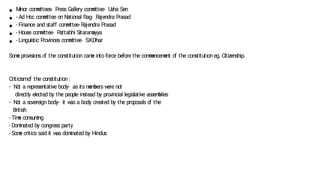
● M
inor com
m
ittees-Press Gallery com
m
ittee- U
sha Sen
● - Ad Hoc com
m
ittee on N
ational flag- Rajendra Prasad
● - Finance and staff com
m
ittee- Rajendra Prasad
● - House com
m
ittee- P
attabhi Sitaram
ayya
● - Linguistic Provinces com
m
ittee- S.K.Dhar
Som
e provisions o
f the constitution cam
e into force before the com
m
encem
ent o
f the constitution eg. Citizenship.
Criticismo
f the constitution :
- N
ot a representative body- as its m
em
bers w
ere not
directly elected by the people instead by provincial legislative assem
blies
- N
ot a sovereign body- it w
as a body created by the proposals o
f the
British
- Tim
e consum
ing
- Dom
inated by congress party
- Som
e critics said it w
as dom
inated by Hindus
6.
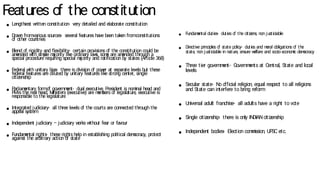
Features o
f theconstitution
● Lengthiest w
ritten constitution- very detailed and elaborate constitution
● Draw
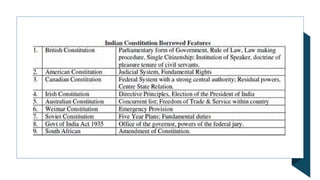
n fromvarious sources- several features have been taken fromconstitutions
o
f other countries
● Blend o
f rigidity and flexibility- certain provisions o
f the constitution could be
am
ended w
ith sim
ple m
a
jority like ordinary law
s, som
e are am
ended through a
special procedure requiring special m
a
jority and ratification by states (Article 368)
● Federal w
ith unitary bias- there is division o
f pow
er at separate levels but these
federal features are diluted by unitary features like strong center, single
citizenship
● P
arliam
entary formo
f governm
ent- dual executive, President is nom
inal head and
P
Mis the real head, M
inisters (executive) are m
em
bers o
f legislature, executive is
responsible to the legislature
● Integrated judiciary- all three levels o
f the courts are connected through the
appeal system
● Independent judiciary – judiciary w
orks w
ithout fear or favour
● Fundam
ental rights- these rights help in establishing political dem
ocracy, protect
against the arbitrary action o
f state
● Fundam
ental duties- duties o
f the citizens, non justiciable
● Directive principles o
f state policy- duties and m
oral obligations o
f the
state, non justiciable in nature, ensure w
elfare and socio- econom
ic dem
ocracy
● Three tier go
vernm
ent- Go
vernm
ents at Central, State and local
levels
● Secular state- N
o o
fficial religion, equal respect to all religions
and State can interfere to bring reform
● Universal adult franchise- all adults have a right to vo
te
● Single citizenship- there is only IN
DIANcitizenship
● Independent bodies- Election com
m
ission, UP
SC etc.
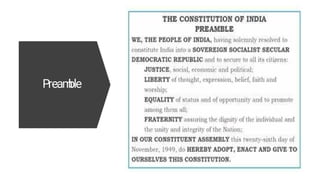
● The pream
blereveals four com
ponents :
Source o
f authority [ w
e the people] ,
nature o
f Indian state [ sovereign, socialist, secular, dem
ocratic, republic],
ob
jectives o
f the constitution [justice, liberty, equality, fraternity] ,
date o
f adoption [ 26th Novem
ber 1
949]
Key w
ords :
● Sovereign – free to conduct its internal and external affairs
● Socialist – India follow
s dem
ocratic socialism
. Both public and private sectors exist. Governm
ent provides services to end poverty,
inequality, disease.
● Secular - No o
fficial religion, equal respect to all religions and State can interfere to bring reform
● Dem
ocratic- people vote and select their representatives. W
e have parliam
entary formo
f representative dem
ocracy
● Republic- head o
f the state is elected. Public o
ffices are open to all citizens
● J
ustice – every individual gets his/her due. No discrim
ination and inequality o
f incom
e or property.
● Liberty – absence o
f restraints and providing opportunities for developm
ent
● Equality- absence o
f special privileges, equal opportunities for all
● Fraternity- brotherhood
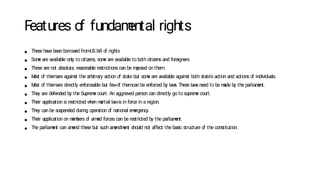
Features o
f fundam
entalrights
● These have been borrow
ed fromUS bill o
f rights
● Som
e are available only to citizens, som
e are available to both citizens and foreigners
● These are not absolute, reasonable restrictions can be im
posed on them
● M
ost o
f themare against the arbitrary action o
f state but som
e are available against both state's action and actions o
f individuals.
● M
ost o
f themare directly enforceable but fewo
f themcan be enforced by law
s. These law
s need to be m
ade by the parliam
ent.
● They are defended by the Suprem
e court. An aggrieved person can directly go to suprem
e court.
● Their application is restricted w
hen m
artial lawis in force in a region.
● They can be suspended during operation o
f national em
ergency.
● Their application on m
em
bers o
f arm
ed forces can be restricted by the parliam
ent.
● The parliam
ent can am
end these but such am
endm
ent should not affect the basic structure o
f the constitution.
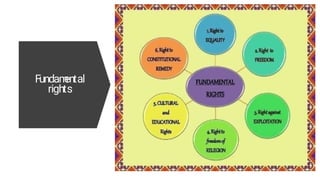
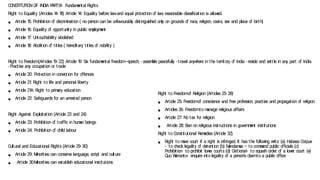
12.
C
O
N
STITUTIO
NOF INDIA P
ART:IIIFundam
ental Rights
Right to Equality (Articles 1
4- 1
8) Article 1
4: Equality before lawand equal pro
tection o
f law
, reasonable classification is allow
ed.
● Article 1
5: Prohibition o
f discrim
ination ( no person can be unfavourably distinguished only on grounds o
f race, religion, caste, sex and place o
f birth)
● Article 1
6: Equality o
f opportunity in public em
plo
ym
ent
● Article 1
7: Untouchability abolished
● Article 1
8: Abolition o
f titles ( hereditary titles o
f nobility )
Right to Freedom(Articles 1
9- 22) Article 1
9: Six fundam
ental freedom–speech, - assem
ble peacefully - travel anyw
here in the territory o
f India - reside and settle in any part o
f India
- Practise any occupation or trade
● Article 20: Pro
tection in conviction for o
ffences
● Article 21
: Right to life and personal liberty
● Article 21
A: Right to prim
ary education
● Article 22: Safeguards for an arrested person
Right Against Exploitation (Article 23 and 24)
● Article 23: Prohibition o
f traffic in hum
an beings
● Article 24: Prohibition o
f child labour
C
ultural and Educational Rights (Article 29- 30)
● Article 29: M
inorities can conserve language, script and culture
● Article 30:M
inorities can establish educational institutions
Right to Freedomo
f Religion (Articles 25- 28)
● Article 25: Freedomo
f conscience and free pro
fession, practise and propagation o
f religion
● Articles 26: Freedomto m
anage religious affairs
● Article 27: N
o tax for religion
● Article 28: Ban on religious instructions in go
vernm
ent institutions
Right to C
onstitutional Rem
edies (Article 32)
● Right to m
o
ve court if a right is infringed. It has the follow
ing w
rits: (a) H
abeas C
orpus-
- to check legality o
f detention (b) M
andam
us – to com
m
and public o
fficials (c)
Prohibition- to prohibit low
er courts (d) C
ertiorari- to squash order o
f a low
er court (e)
Quo W
arranto- enquire into legality o
f a person's claimto a public o
ffice
13.
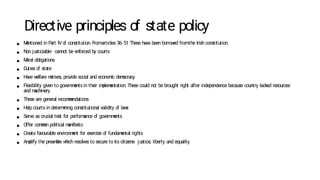
Directive principles o
fstate policy
● M
entioned in P
art IVo
f constitution. Fromarticles 36- 51
. These have been borrow
ed fromthe Irish constitution.
● Non justiciable- cannot be enforced by courts
● M
oral obligations
● Duties o
f state
● Have w
elfare m
otives, provide social and econom
ic dem
ocracy
● Flexibility given to governm
ents in their im
plem
entation. These could not be brought right after independence because country lacked resources
and m
achinery.
● These are general recom
m
endations
● Help courts in determ
ining constitutional validity o
f law
s
● Serve as crucial test for perform
ance o
f governm
ents
● Offer com
m
on political m
anifesto
● Create favourable environm
ent for exercise o
f fundam
ental rights
● Am
plify the pream
ble w
hich resolves to secure to its citizens- justice, liberty and equality.
14.
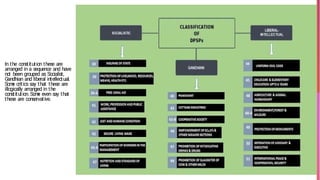
In the constitutionthese are
arranged in a sequence and have
no
t been grouped as Socialist,
Gandhian and liberal intellectual.
Som
e critics say that these are
illogically arranged in the
constitution. Som
e even say that
these are conservative.
15.
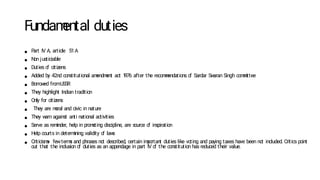
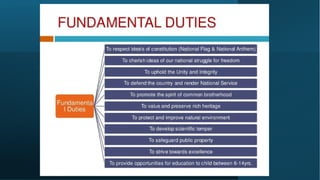
Fundam
ental duties
● P
artIV A, article 51A
● N
on justiciable
● Duties o
f citizens
● Added by 42nd constitutional am
endm
ent act 1
976 after the recom
m
endations o
f Sardar Sw
aran Singh com
m
ittee
● Borrow
ed fromU
SSR
● They highlight Indian tradition
● Only for citizens
● They are m
oral and civic in nature
● They w
arn against anti national activities
● Serve as rem
inder, help in prom
o
ting discipline, are source o
f inspiration
● Help courts in determ
ining validity o
f law
s
● Criticism
s- fewterm
s and phrases no
t described, certain im
portant duties like vo
ting and paying taxes have been no
t included. Critics point
out that the inclusion o
f duties as an appendage in part IV o
f the constitution has reduced their value.

![● The pream
ble reveals four com
ponents :
Source o
f authority [ w
e the people] ,
nature o
f Indian state [ sovereign, socialist, secular, dem
ocratic, republic],
ob
jectives o
f the constitution [justice, liberty, equality, fraternity] ,
date o
f adoption [ 26th Novem
ber 1
949]
Key w
ords :
● Sovereign – free to conduct its internal and external affairs
● Socialist – India follow
s dem
ocratic socialism
. Both public and private sectors exist. Governm
ent provides services to end poverty,
inequality, disease.
● Secular - No o
fficial religion, equal respect to all religions and State can interfere to bring reform
● Dem
ocratic- people vote and select their representatives. W
e have parliam
entary formo
f representative dem
ocracy
● Republic- head o
f the state is elected. Public o
ffices are open to all citizens
● J
ustice – every individual gets his/her due. No discrim
ination and inequality o
f incom
e or property.
● Liberty – absence o
f restraints and providing opportunities for developm
ent
● Equality- absence o
f special privileges, equal opportunities for all
● Fraternity- brotherhood](https://image.slidesharecdn.com/constituentassemblyfeaturesoftheconsfrfddpsppreamble-250913102744-b7c97cba/85/Constituent_assembly-_features_of_the_cons_-_FR-_FD-_DPSP-_Preamble-pdf-9-320.jpg)



![CONSTITUTIONAL DEVELOPMENT IN INDIA [Autosaved].pptx](https://cdn.slidesharecdn.com/ss_thumbnails/constitutionaldevelopmentinindiaautosaved-241124140823-e14a42fa-thumbnail.jpg?width=640&height=640&fit=bounds)


