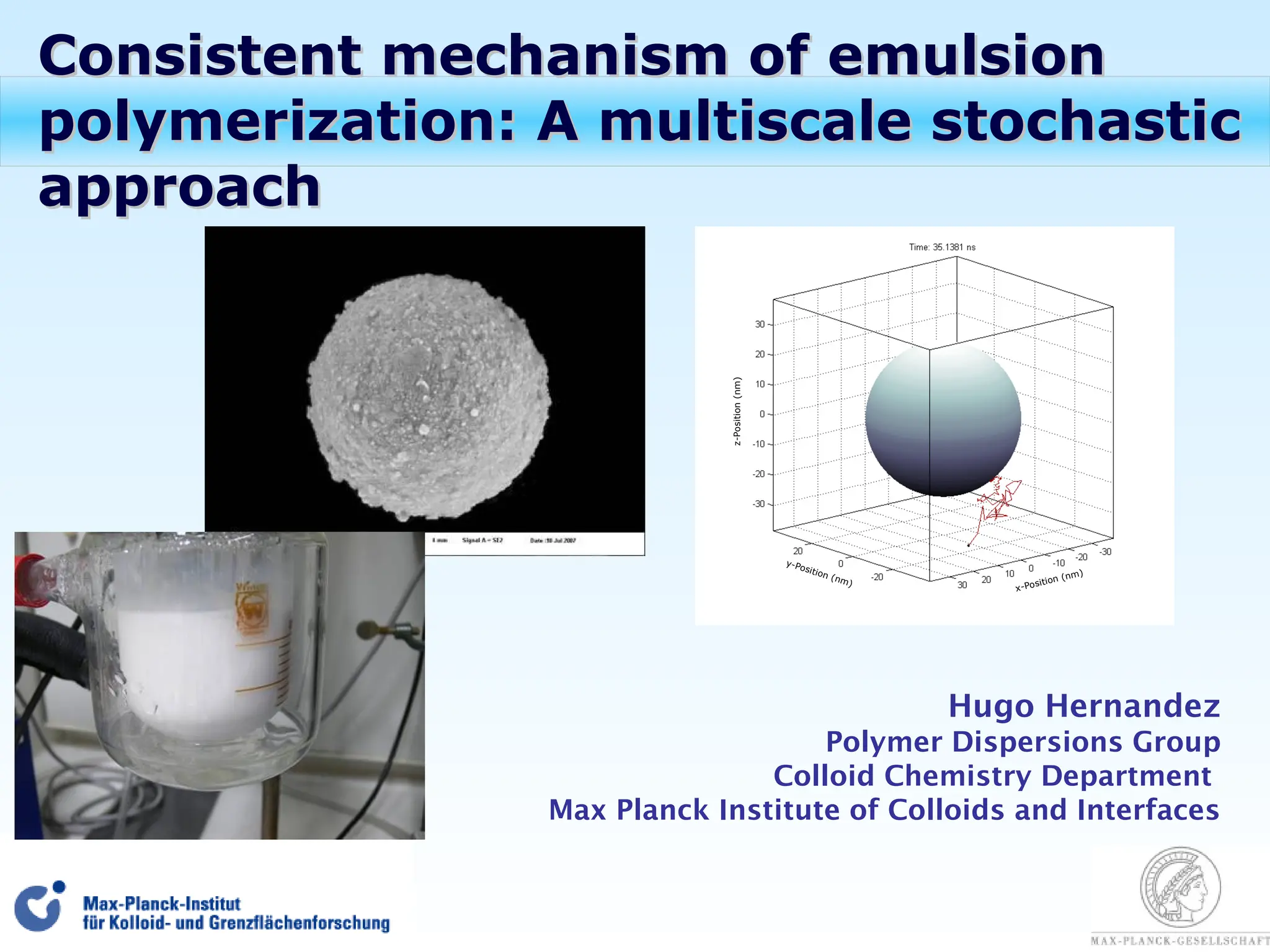
Consistent mechanism of emulsion
polymerization: A multiscale stochastic
approach
approach
Hugo Hernandez
Polymer Dispersions Group
Colloid Chemistry Department
Max Planck Institute of Colloids and Interfaces
z-Position
(nm)
y-Position (nm)
x-Position (nm)
z-Position
(nm)
y-Position (nm)
x-Position (nm)
2
Outline
Outline
• Motivation
• Colloidal scale
• Macromolecular scale
• Molecular scale
• Microscopic scale
• Multi-scale integration
• Outlook
• Acknowledgments
3
Comprehensive modeling
• Design of polymer particles:
– Morphology
– Particle size distribution
– Molecular weight distribution
– Mechanical properties
– Stability
– Performance
• Industrial production:
– Process optimization
– Quality control
 Motivation
Motivation
4
Some unresolved issues
A complete consistent picture of emulsion
polymerization is not available.
Some controversial topics:
– Particle nucleation
– Radical capture
– Radical desorption
– Monomer swelling
Limitations:
– Lack of adequate experimental methods
– Models developed for very specific conditions
– Unreliable model discrimination
Better models and more accurate validation data are
needed!
 Motivation
Motivation
5
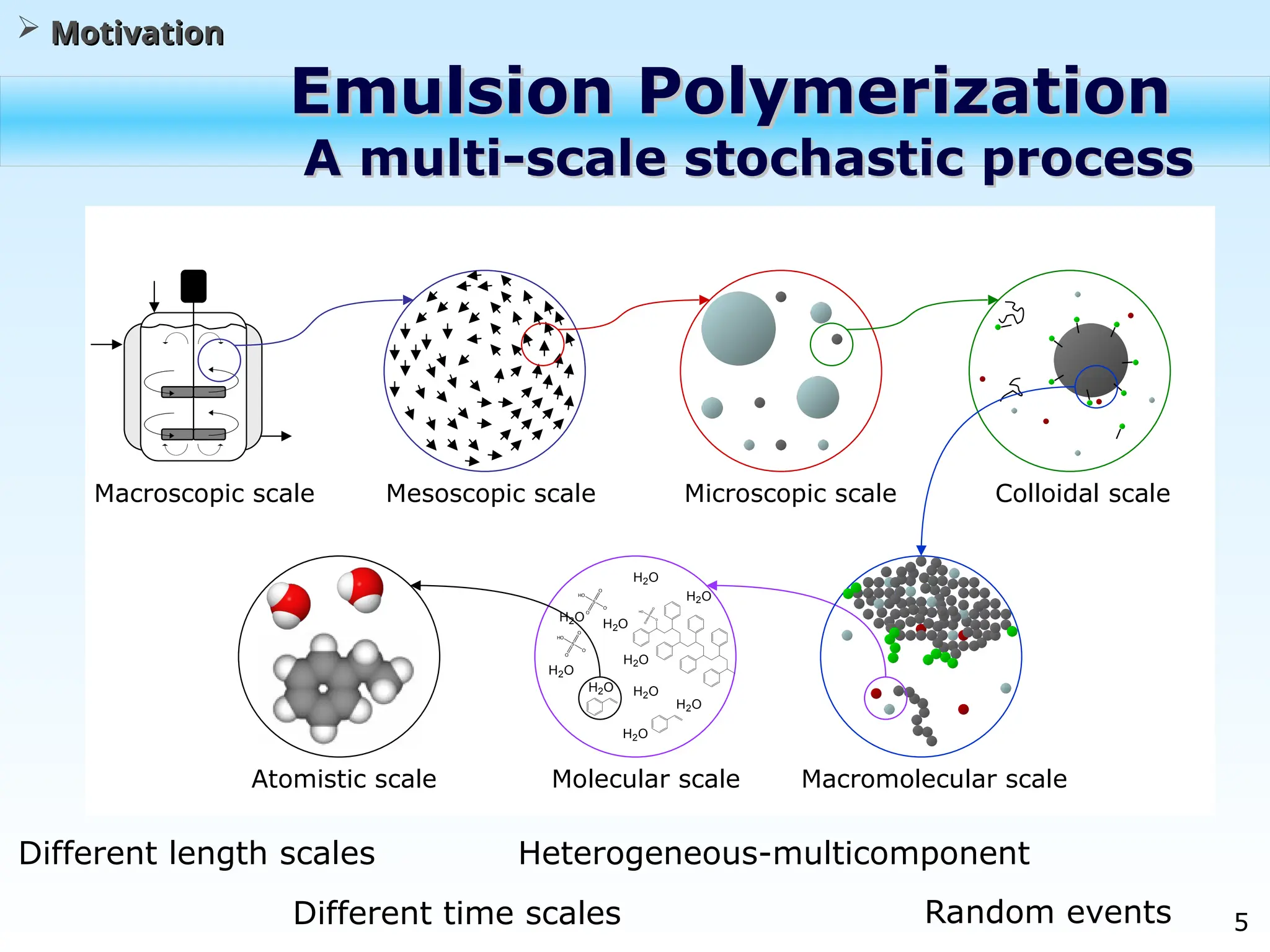
Macroscopic scale Mesoscopic scale Microscopic scale Colloidal scale
Molecular scale
O-
S
O
O
HO
O-
S
O
O
HO
O
S
O
O
HO
H2O
H2O
H2O
H2O
H2O
H2O
H2O
H2O
H2O
H2O
Emulsion Polymerization
A multi-scale stochastic process
Macromolecular scale
Atomistic scale
Different length scales
 Motivation
Motivation
Heterogeneous-multicomponent
Different time scales Random events
6
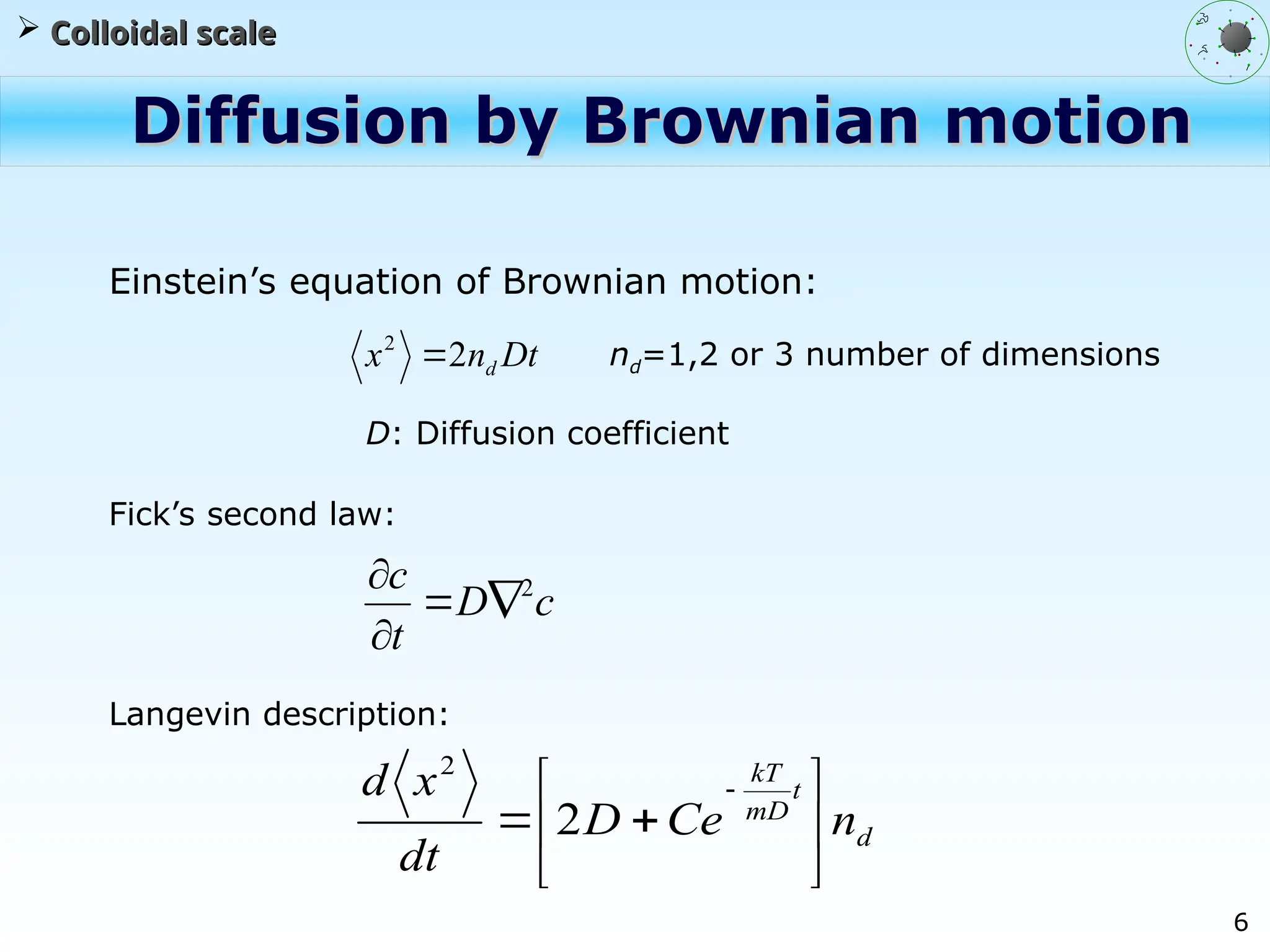
Diffusion by Brownian motion
Dt
n
x d
2
2

 Colloidal scale
Colloidal scale
Einstein’s equation of Brownian motion:
Langevin description:
nd=1,2 or 3 number of dimensions
Fick’s second law:
D: Diffusion coefficient
c
D
t
c 2




d
t
mD
kT
n
Ce
D
dt
x
d









2
2
7
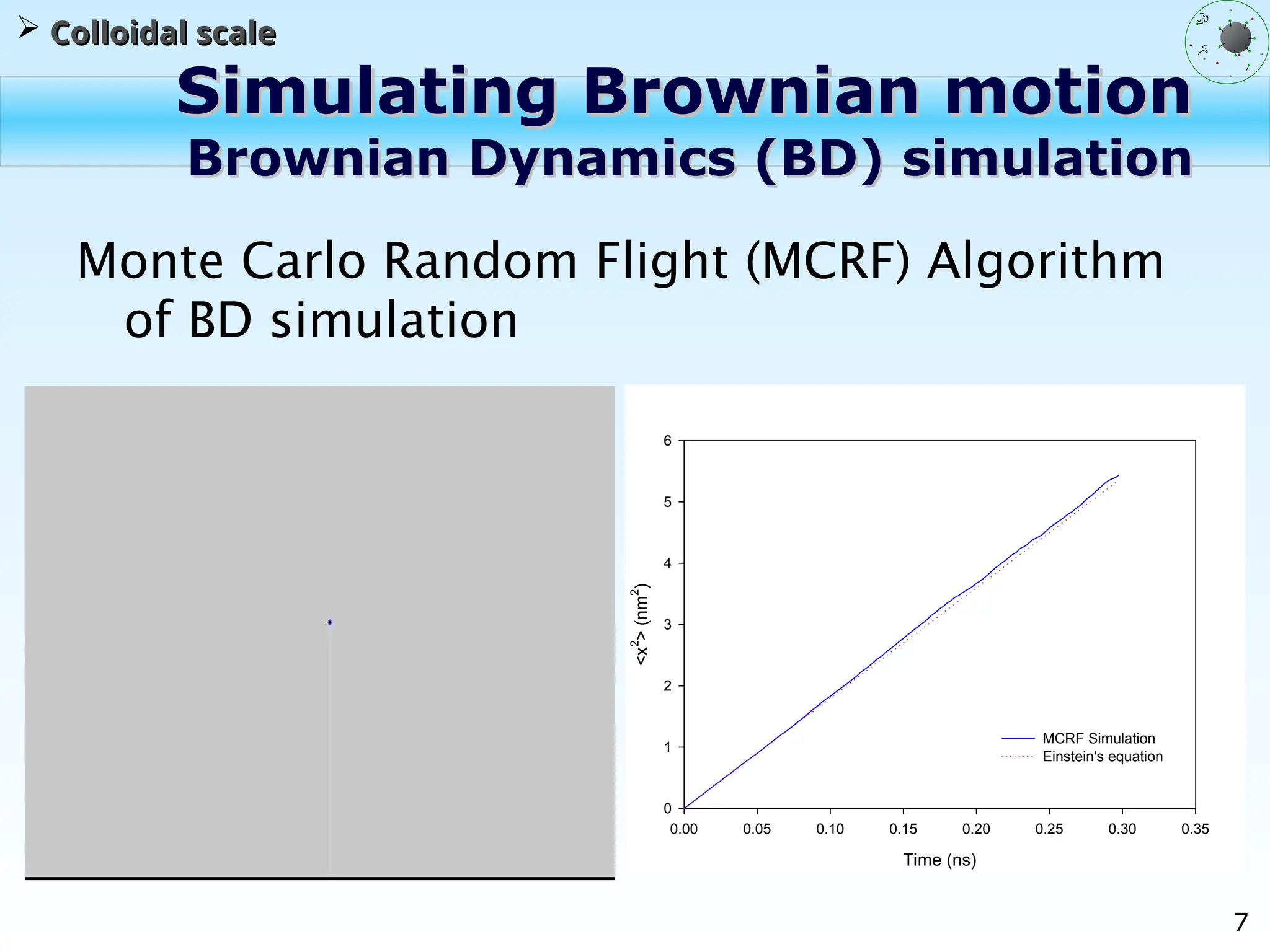
Simulating Brownian motion
Brownian Dynamics (BD) simulation
Monte Carlo Random Flight (MCRF) Algorithm
of BD simulation
 Colloidal scale
Colloidal scale
Time (ns)
0.00 0.05 0.10 0.15 0.20 0.25 0.30 0.35
<x
2
>
(nm
2
)
0
1
2
3
4
5
6
MCRF Simulation
Einstein's equation
8
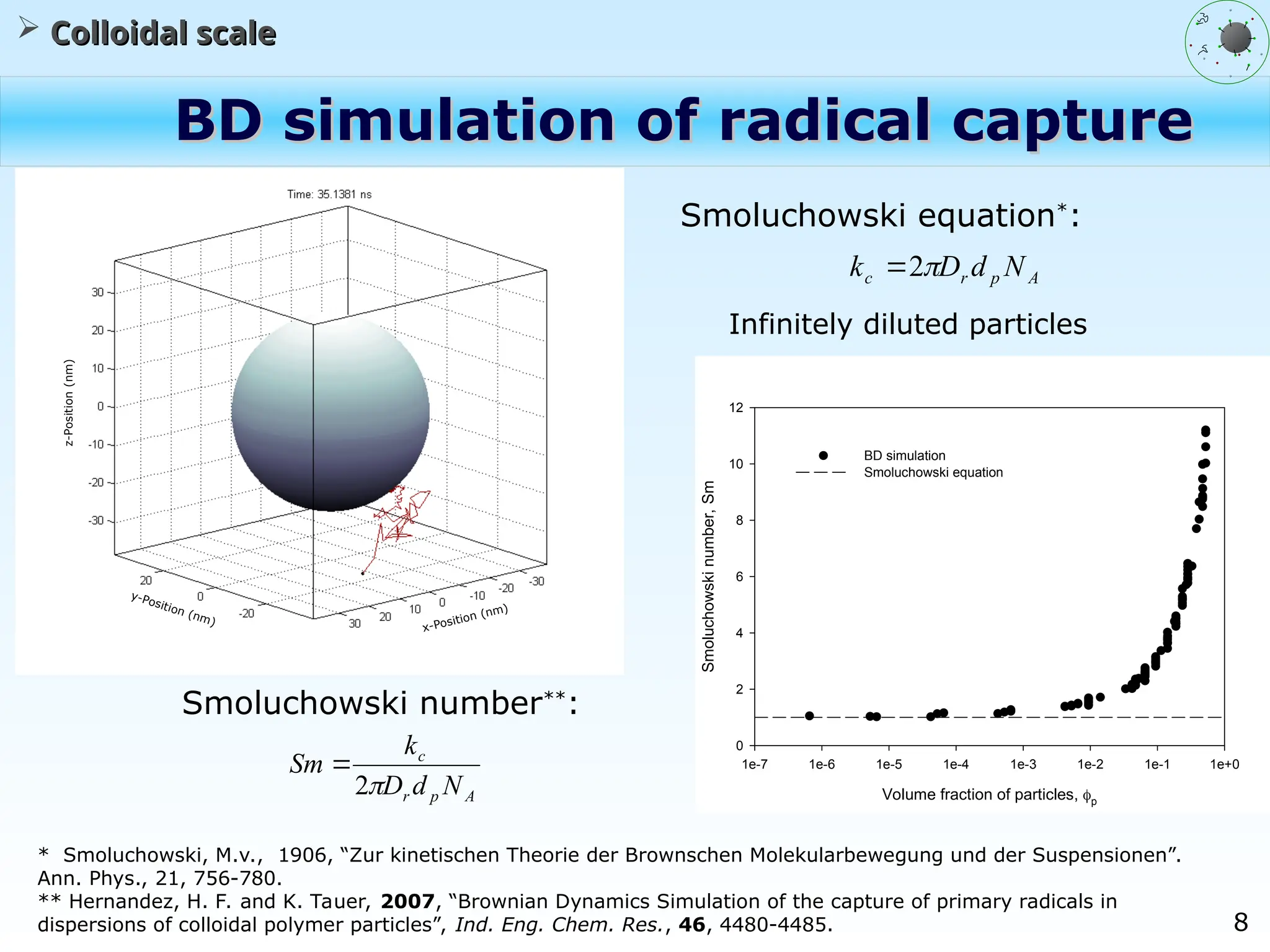
BD simulation of radical capture
A
p
r
c N
d
D
k 
2

z-Position
(nm)
y-Position (nm)
x-Position (nm)
z-Position
(nm)
y-Position (nm)
x-Position (nm)
 Colloidal scale
Colloidal scale
* Smoluchowski, M.v., 1906, “Zur kinetischen Theorie der Brownschen Molekularbewegung und der Suspensionen”.
Ann. Phys., 21, 756-780.
** Hernandez, H. F. and K. Tauer, 2007, “Brownian Dynamics Simulation of the capture of primary radicals in
dispersions of colloidal polymer particles”, Ind. Eng. Chem. Res., 46, 4480-4485.
Volume fraction of particles, p
1e-7 1e-6 1e-5 1e-4 1e-3 1e-2 1e-1 1e+0
Smoluchowski
number,
Sm
0
2
4
6
8
10
12
BD simulation
Smoluchowski equation
Smoluchowski equation*
:
Infinitely diluted particles
A
p
r
c
N
d
D
k
Sm

2

Smoluchowski number**
:
9
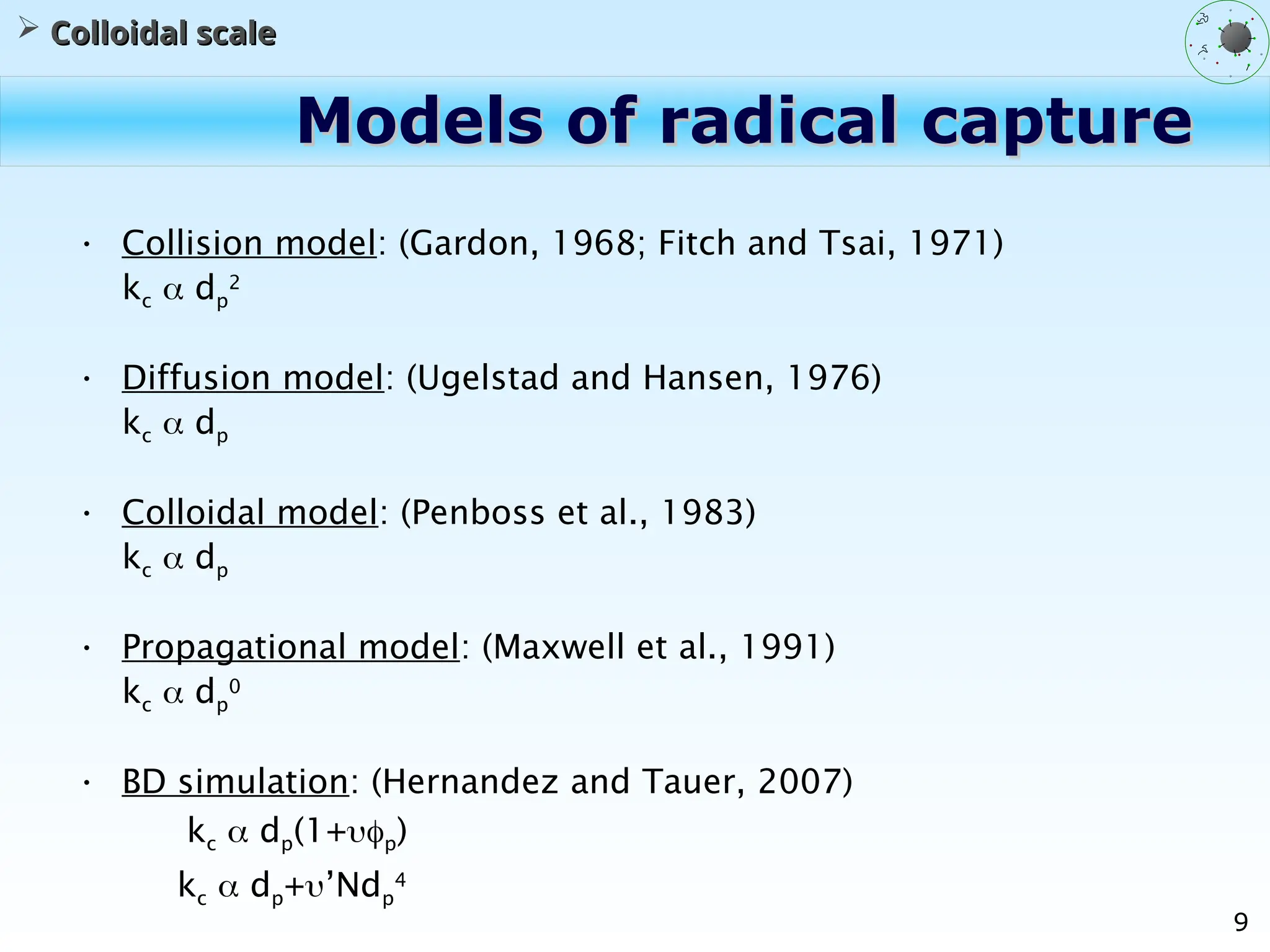
Models of radical capture
 Colloidal scale
Colloidal scale
• Collision model: (Gardon, 1968; Fitch and Tsai, 1971)
kc  dp
2
• Diffusion model: (Ugelstad and Hansen, 1976)
kc  dp
• Colloidal model: (Penboss et al., 1983)
kc  dp
• Propagational model: (Maxwell et al., 1991)
kc  dp
0
• BD simulation: (Hernandez and Tauer, 2007)
kc  dp(1+p)
kc  dp+’Ndp
4
10
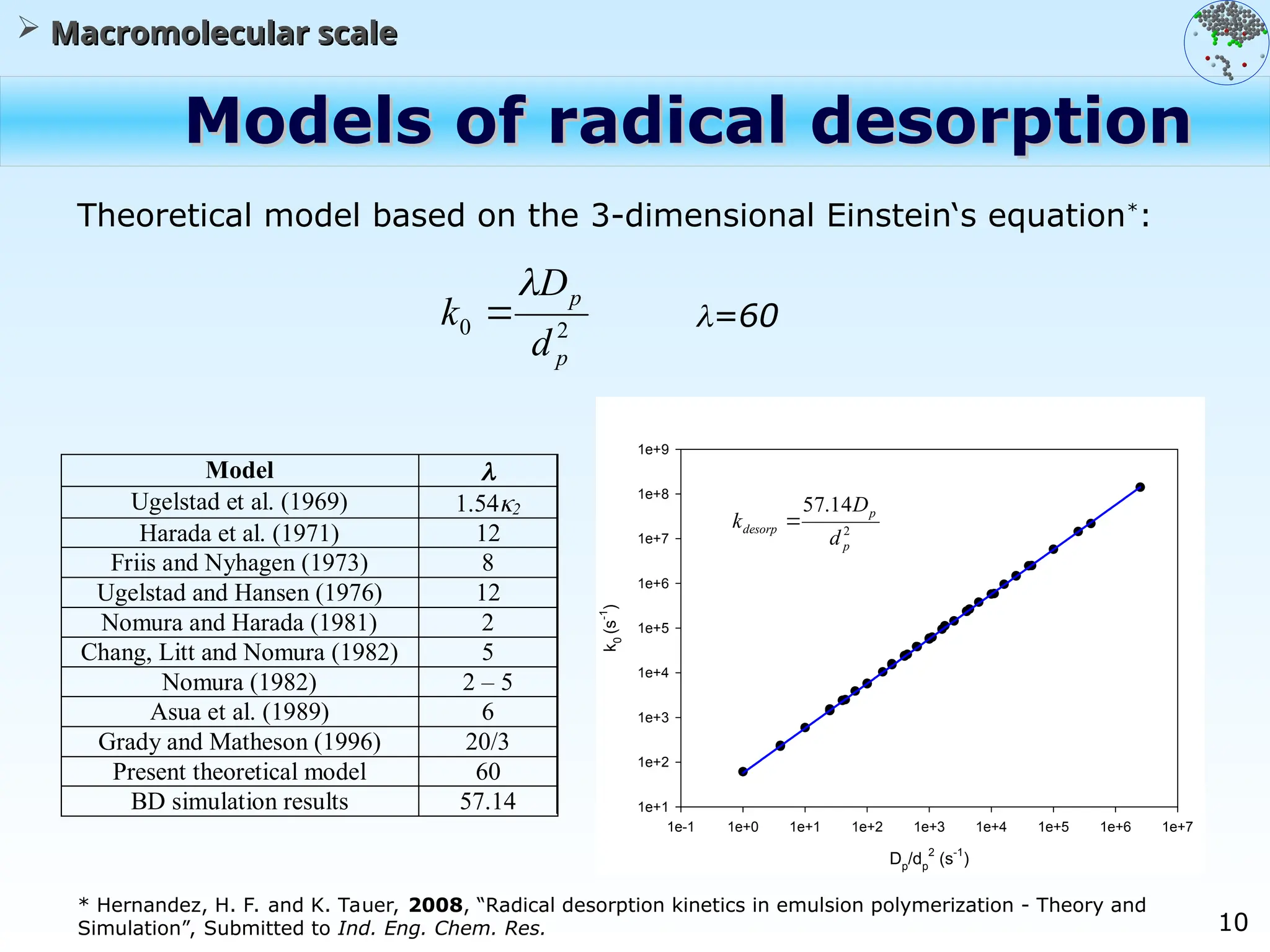
Models of radical desorption
2
0
p
p
d
D
k


 Macromolecular scale
Macromolecular scale
* Hernandez, H. F. and K. Tauer, 2008, “Radical desorption kinetics in emulsion polymerization - Theory and
Simulation”, Submitted to Ind. Eng. Chem. Res.
Theoretical model based on the 3-dimensional Einstein‘s equation*
:
Model 
Ugelstad et al. (1969) 1.542
Harada et al. (1971) 12
Friis and Nyhagen (1973) 8
Ugelstad and Hansen (1976) 12
Nomura and Harada (1981) 2
Chang, Litt and Nomura (1982) 5
Nomura (1982) 2 – 5
Asua et al. (1989) 6
Grady and Matheson (1996) 20/3
Present theoretical model 60
BD simulation results 57.14
Dp
/dp
2
(s-1
)
1e-1 1e+0 1e+1 1e+2 1e+3 1e+4 1e+5 1e+6 1e+7
k
0
(s
-1
)
1e+1
1e+2
1e+3
1e+4
1e+5
1e+6
1e+7
1e+8
1e+9
2
14
.
57
p
p
desorp
d
D
k 
=60
11
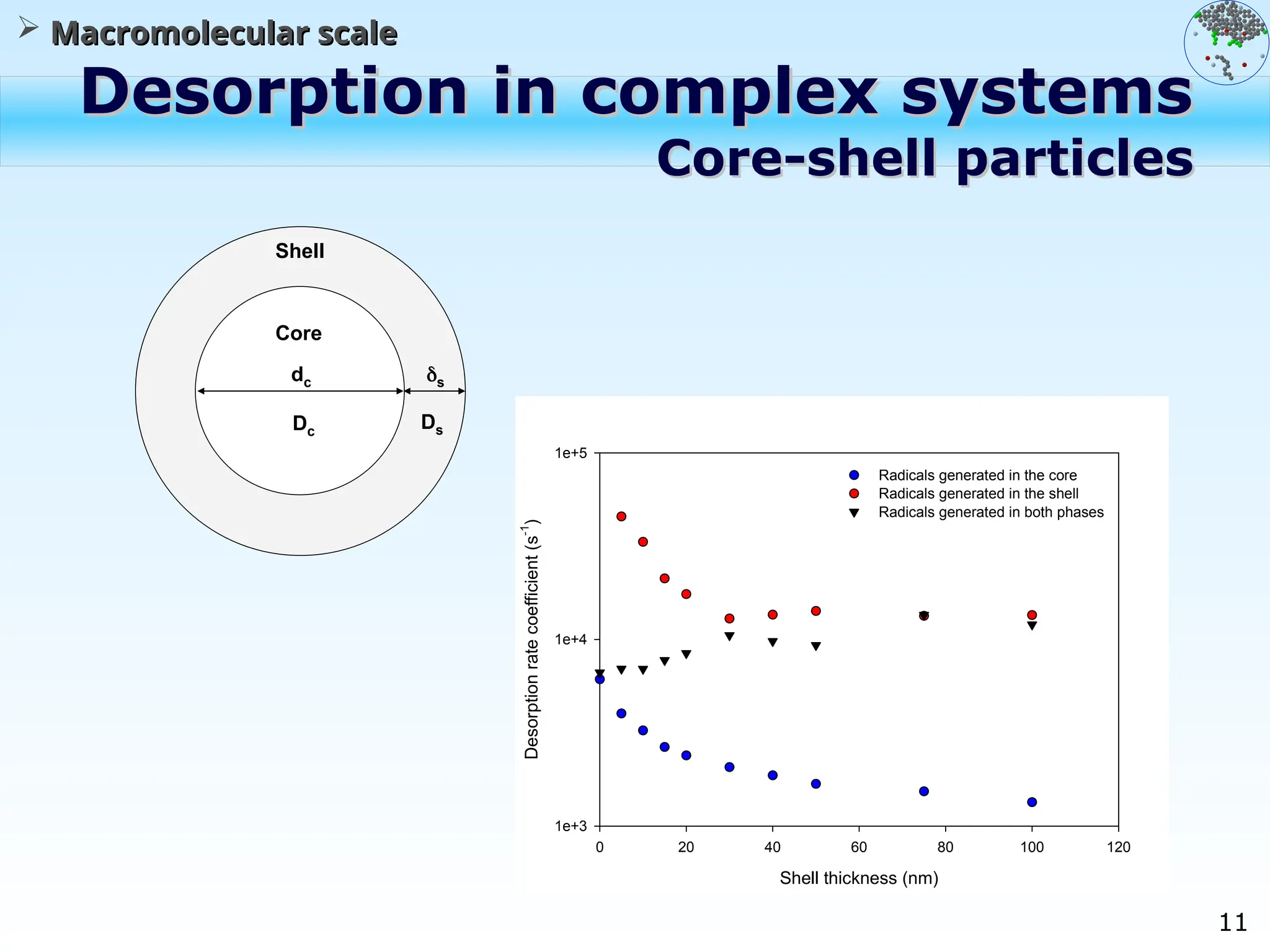
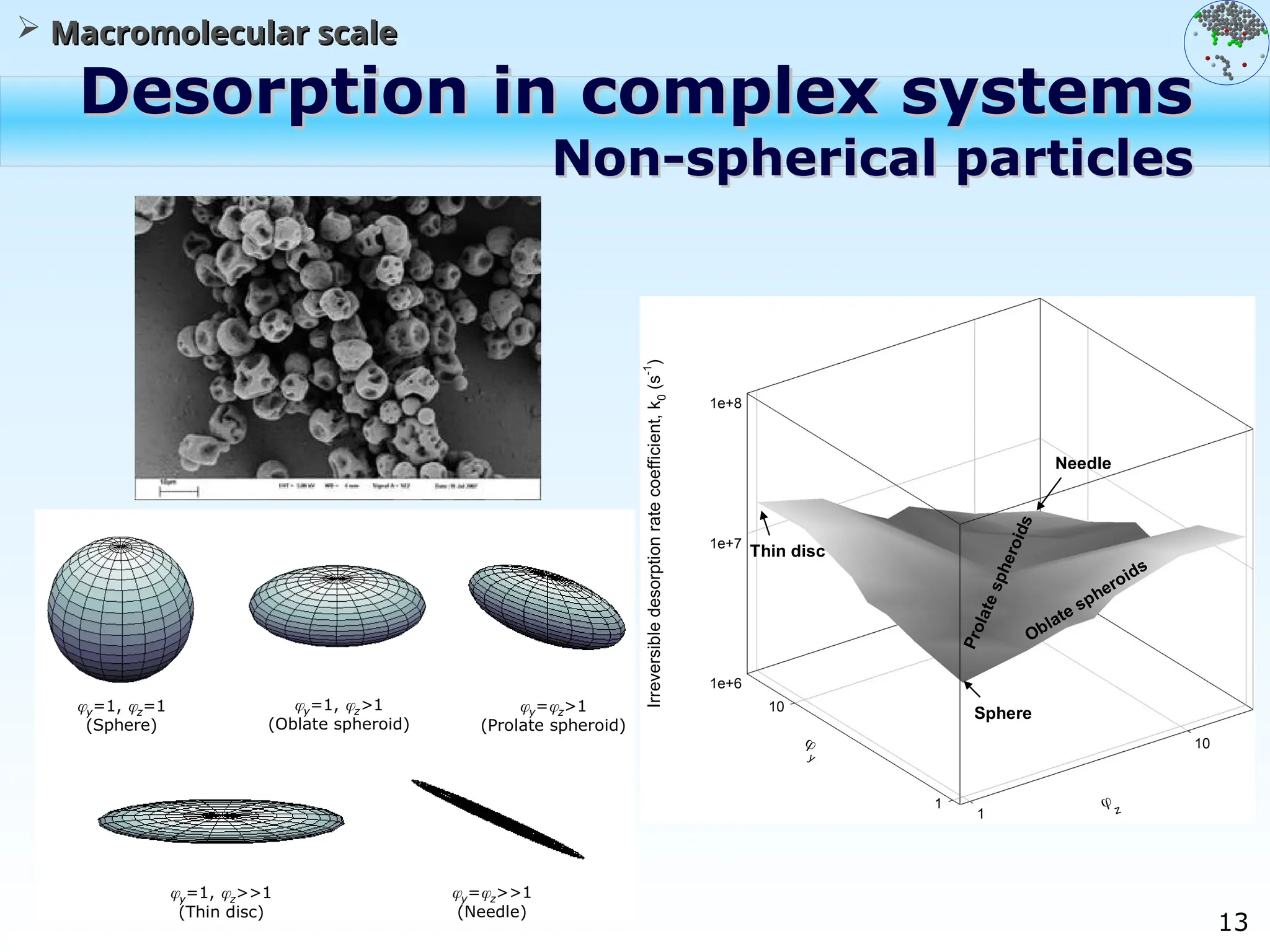
Desorption in complex systems
Core-shell particles
Shell
Core
dc s
Dc
Ds
 Macromolecular scale
Macromolecular scale
Shell thickness (nm)
0 20 40 60 80 100 120
Desorption
rate
coefficient
(s
-1
)
1e+3
1e+4
1e+5
Radicals generated in the core
Radicals generated in the shell
Radicals generated in both phases
12
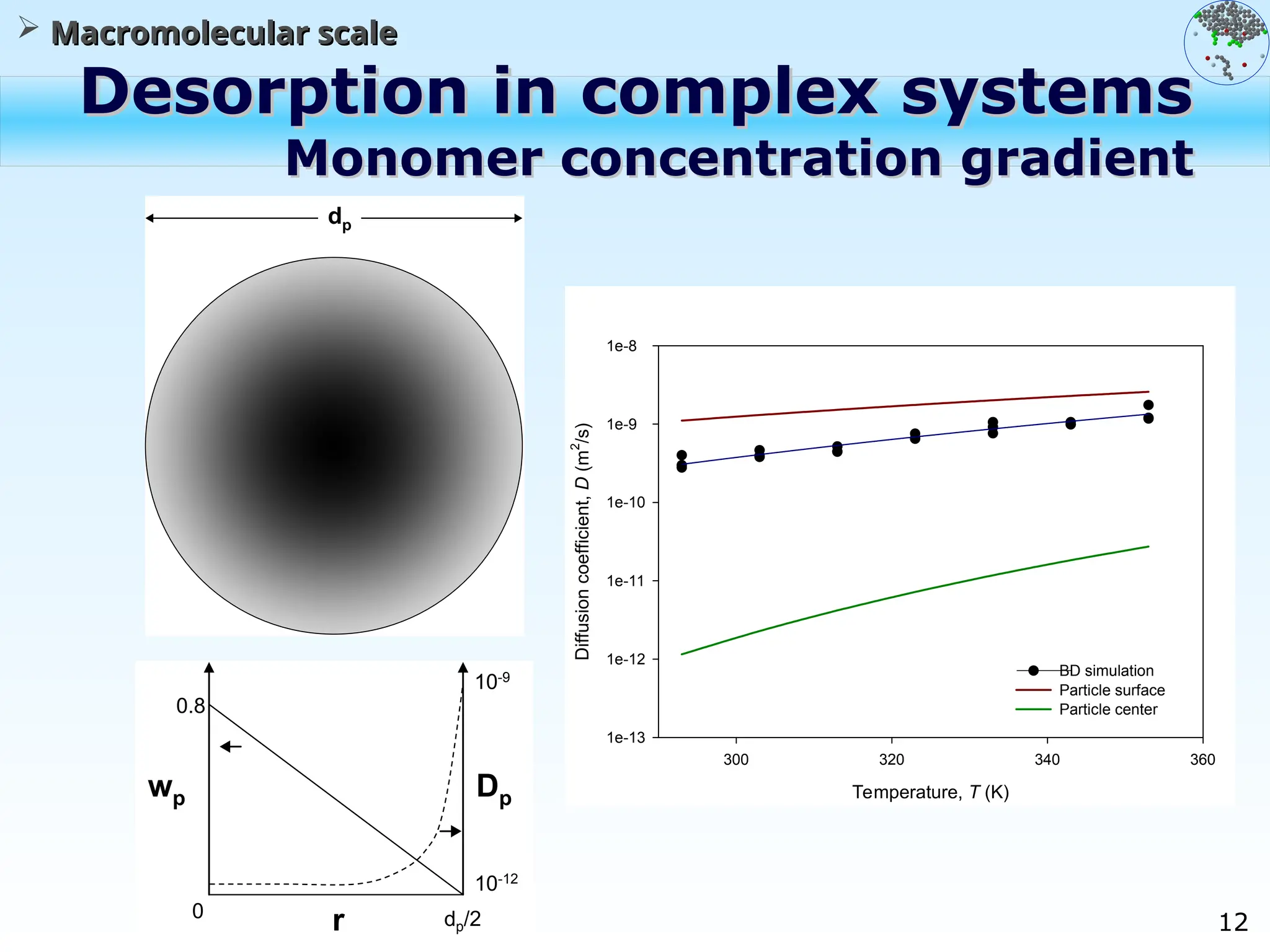
Desorption in complex systems
Monomer concentration gradient
 Macromolecular scale
Macromolecular scale
Temperature, T (K)
300 320 340 360
Diffusion
coefficient,
D
(m
2
/s)
1e-13
1e-12
1e-11
1e-10
1e-9
1e-8
BD simulation
Particle surface
Particle center
dp
wp
0.8
0 dp/2
r
Dp
10-9
10-12
13
Desorption in complex systems
Non-spherical particles
 Macromolecular scale
Macromolecular scale
y=1, z=1
(Sphere)
y=1, z>1
(Oblate spheroid)
y=z>1
(Prolate spheroid)
y=1, z>>1
(Thin disc)
y=z>>1
(Needle)
1e+6
1e+7
1e+8
1
10
1
10
Irreversible
desorption
rate
coefficient,
k
0
(s
-1
)
 z

y
Sphere
Needle
Thin disc
Oblate spheroids
P
r
o
l
a
t
e
s
p
h
e
r
o
i
d
s
14
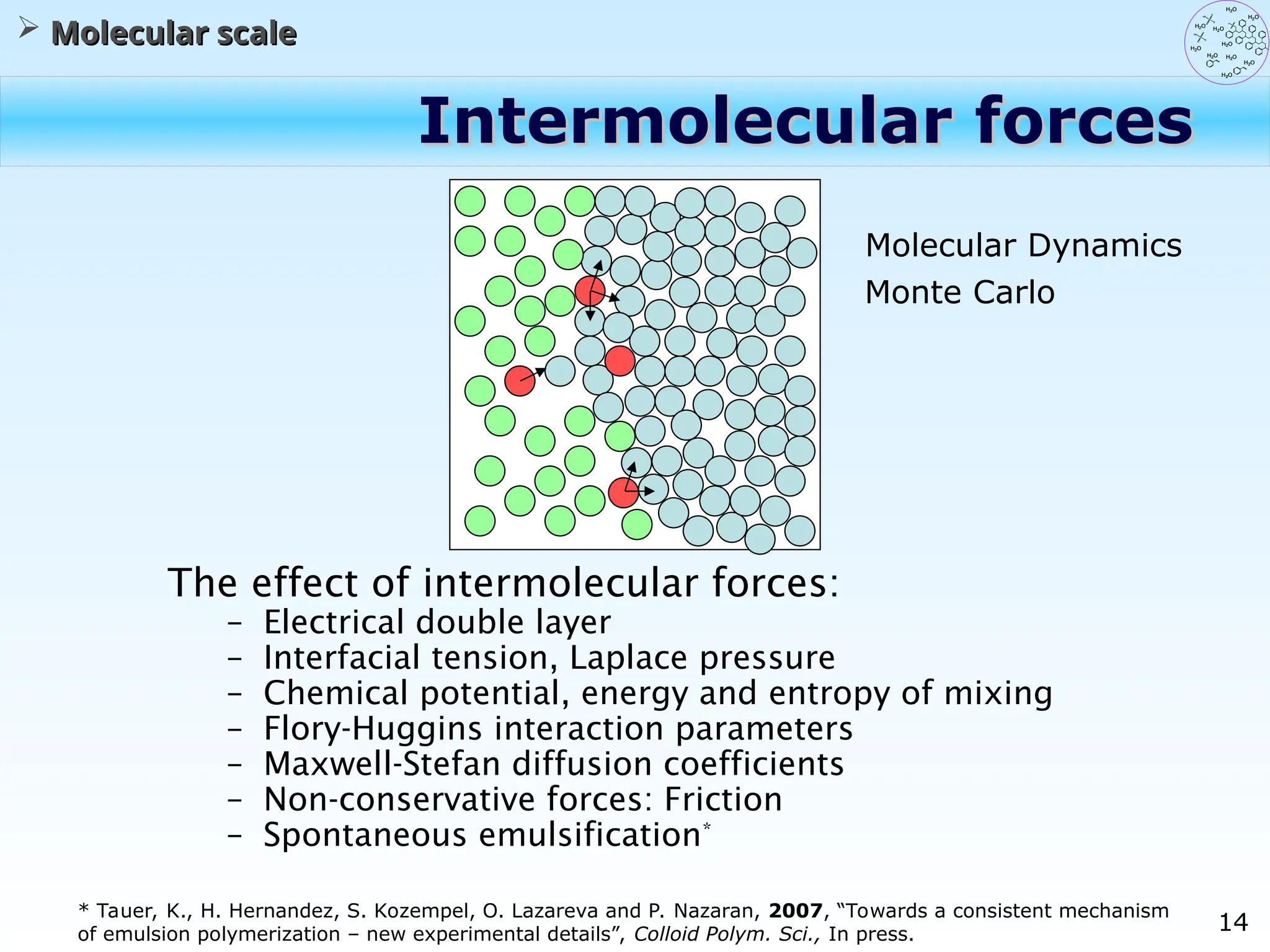
Intermolecular forces
 Molecular scale
Molecular scale
The effect of intermolecular forces:
– Electrical double layer
– Interfacial tension, Laplace pressure
– Chemical potential, energy and entropy of mixing
– Flory-Huggins interaction parameters
– Maxwell-Stefan diffusion coefficients
– Non-conservative forces: Friction
– Spontaneous emulsification*
Molecular Dynamics
Monte Carlo
* Tauer, K., H. Hernandez, S. Kozempel, O. Lazareva and P. Nazaran, 2007, “Towards a consistent mechanism
of emulsion polymerization – new experimental details”, Colloid Polym. Sci., In press.
O-
S
O
O
HO
O-
S
O
O
HO
O
S
O
O
HO
H2O
H2O
H2O
H2O
H2O
H2O
H2O
H2O
H2O
H2O
O-
S
O
O
HO
O-
S
O
O
HO
O
S
O
O
HO
H2O
H2O
H2O
H2O
H2O
H2O
H2O
H2O
H2O
H2O
15
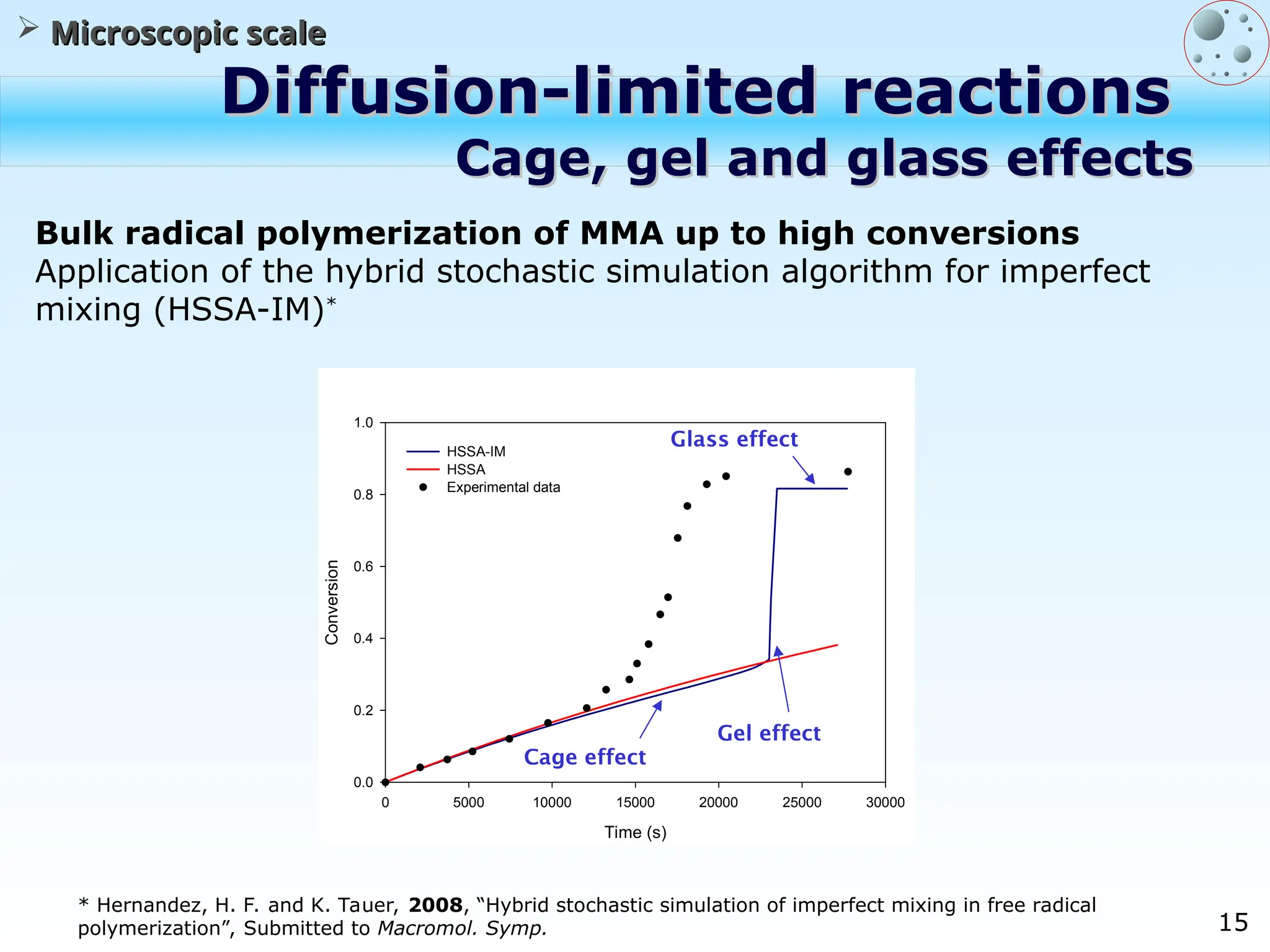
Diffusion-limited reactions
Cage, gel and glass effects
 Microscopic scale
Microscopic scale
Time (s)
0 5000 10000 15000 20000 25000 30000
Conversion
0.0
0.2
0.4
0.6
0.8
1.0
HSSA-IM
HSSA
Experimental data
Cage effect
Gel effect
Glass effect
* Hernandez, H. F. and K. Tauer, 2008, “Hybrid stochastic simulation of imperfect mixing in free radical
polymerization”, Submitted to Macromol. Symp.
Bulk radical polymerization of MMA up to high conversions
Application of the hybrid stochastic simulation algorithm for imperfect
mixing (HSSA-IM)*
16
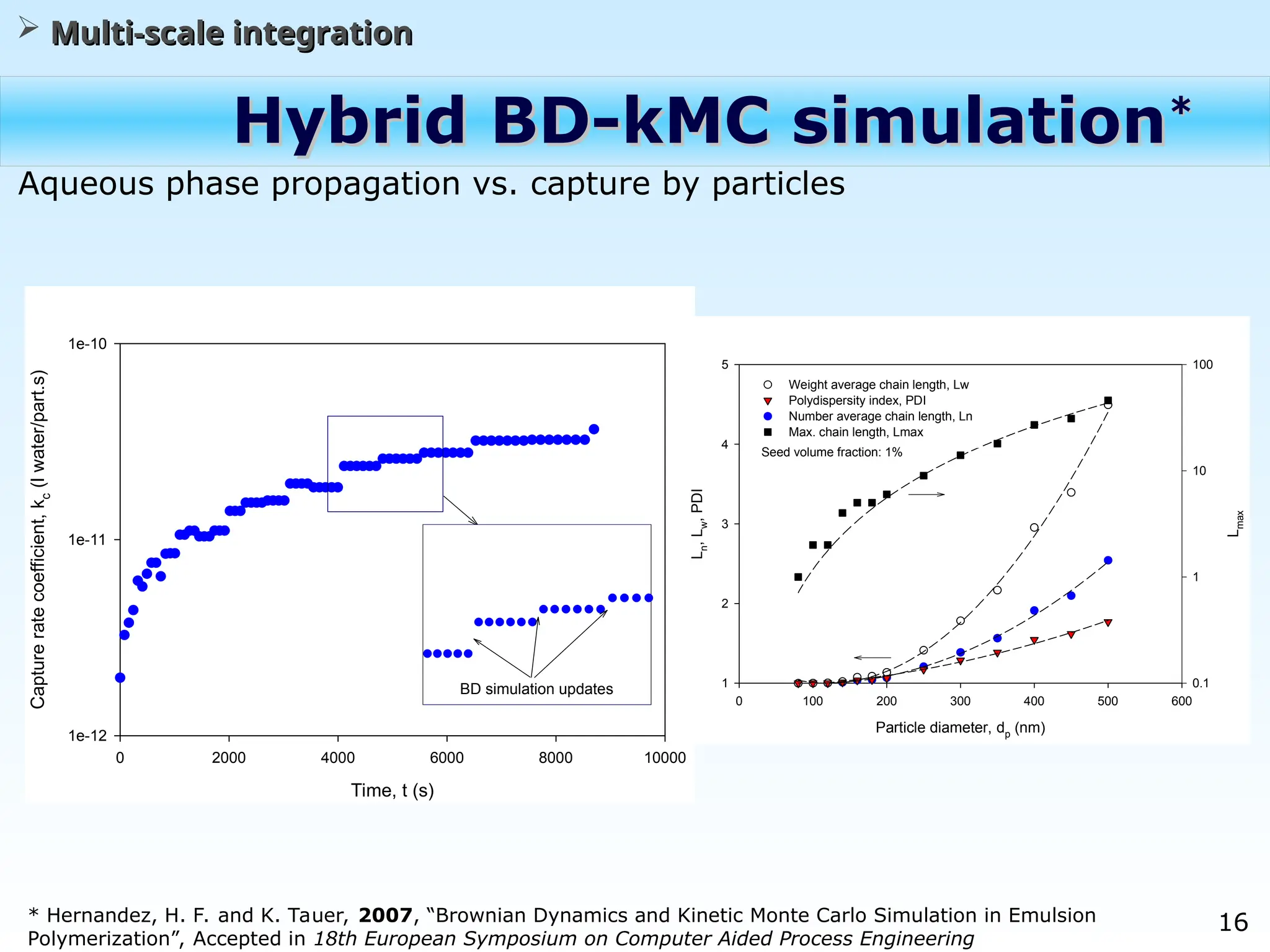
Hybrid BD-kMC simulation
Hybrid BD-kMC simulation*
*
Time, t (s)
0 2000 4000 6000 8000 10000
Capture
rate
coefficient,
k
c
(l
water/part.s)
1e-12
1e-11
1e-10
BD simulation updates
 Multi-scale integration
Multi-scale integration
Aqueous phase propagation vs. capture by particles
Particle diameter, dp (nm)
0 100 200 300 400 500 600
L
n
,
L
w
,
PDI
1
2
3
4
5
L
max
0.1
1
10
100
Weight average chain length, Lw
Polydispersity index, PDI
Number average chain length, Ln
Max. chain length, Lmax
Seed volume fraction: 1%
* Hernandez, H. F. and K. Tauer, 2007, “Brownian Dynamics and Kinetic Monte Carlo Simulation in Emulsion
Polymerization”, Accepted in 18th European Symposium on Computer Aided Process Engineering
17
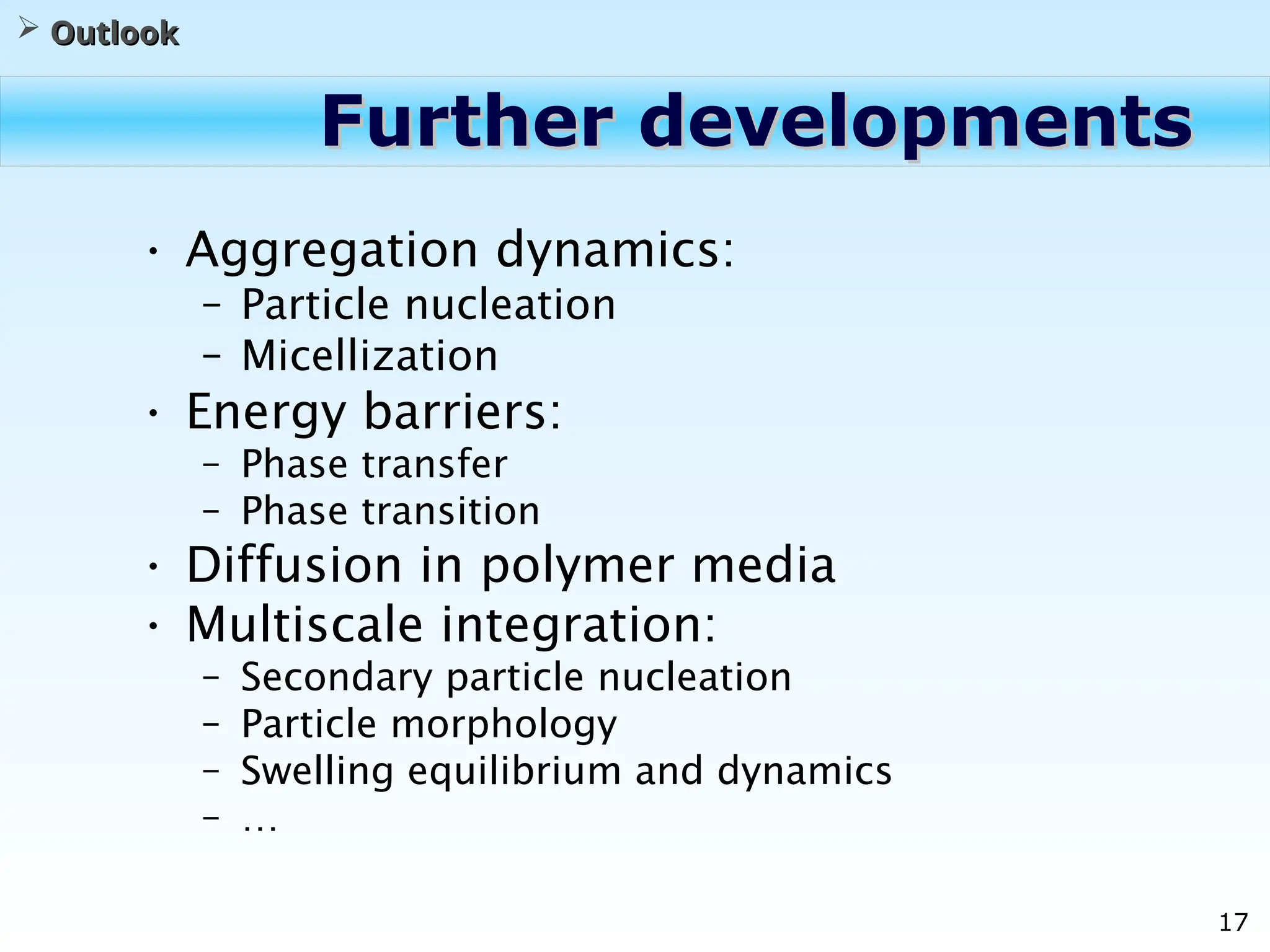
Further developments
• Aggregation dynamics:
– Particle nucleation
– Micellization
• Energy barriers:
– Phase transfer
– Phase transition
• Diffusion in polymer media
• Multiscale integration:
– Secondary particle nucleation
– Particle morphology
– Swelling equilibrium and dynamics
– …
 Outlook
Outlook
18
Concluding remarks
Concluding remarks
• Emulsion polymerization is a complex multiscale
stochastic process.
• A consistent mechanism of emulsion polymerization
can only be formulated within this framework.
• The modeling, simulation and integration of the
different scales is a powerful tool for the investigation
and understanding of emulsion polymerization.
• Some of these results can be generalized to other
types of heterogeneous and homogeneous
polymerization processes.
 Outlook
Outlook

Consistent mechanism of emulsion polymerization - A multi-scale stochastic approach

  • 1.
    Consistent mechanism ofemulsion Consistent mechanism of emulsion polymerization: A multiscale stochastic polymerization: A multiscale stochastic approach approach Hugo Hernandez Polymer Dispersions Group Colloid Chemistry Department Max Planck Institute of Colloids and Interfaces z-Position (nm) y-Position (nm) x-Position (nm) z-Position (nm) y-Position (nm) x-Position (nm)
  • 2.
    2 Outline Outline • Motivation • Colloidalscale • Macromolecular scale • Molecular scale • Microscopic scale • Multi-scale integration • Outlook • Acknowledgments
  • 3.
    3 Comprehensive modeling Comprehensive modeling •Design of polymer particles: – Morphology – Particle size distribution – Molecular weight distribution – Mechanical properties – Stability – Performance • Industrial production: – Process optimization – Quality control  Motivation Motivation
  • 4.
    4 Some unresolved issues Someunresolved issues A complete consistent picture of emulsion polymerization is not available. Some controversial topics: – Particle nucleation – Radical capture – Radical desorption – Monomer swelling Limitations: – Lack of adequate experimental methods – Models developed for very specific conditions – Unreliable model discrimination Better models and more accurate validation data are needed!  Motivation Motivation
  • 5.
    5 Macroscopic scale Mesoscopicscale Microscopic scale Colloidal scale Molecular scale O- S O O HO O- S O O HO O S O O HO H2O H2O H2O H2O H2O H2O H2O H2O H2O H2O Emulsion Polymerization Emulsion Polymerization A multi-scale stochastic process A multi-scale stochastic process Macromolecular scale Atomistic scale Different length scales  Motivation Motivation Heterogeneous-multicomponent Different time scales Random events
  • 6.
    6 Diffusion by Brownianmotion Diffusion by Brownian motion Dt n x d 2 2   Colloidal scale Colloidal scale Einstein’s equation of Brownian motion: Langevin description: nd=1,2 or 3 number of dimensions Fick’s second law: D: Diffusion coefficient c D t c 2     d t mD kT n Ce D dt x d          2 2
  • 7.
    7 Simulating Brownian motion SimulatingBrownian motion Brownian Dynamics (BD) simulation Brownian Dynamics (BD) simulation Monte Carlo Random Flight (MCRF) Algorithm of BD simulation  Colloidal scale Colloidal scale Time (ns) 0.00 0.05 0.10 0.15 0.20 0.25 0.30 0.35 <x 2 > (nm 2 ) 0 1 2 3 4 5 6 MCRF Simulation Einstein's equation
  • 8.
    8 BD simulation ofradical capture BD simulation of radical capture A p r c N d D k  2  z-Position (nm) y-Position (nm) x-Position (nm) z-Position (nm) y-Position (nm) x-Position (nm)  Colloidal scale Colloidal scale * Smoluchowski, M.v., 1906, “Zur kinetischen Theorie der Brownschen Molekularbewegung und der Suspensionen”. Ann. Phys., 21, 756-780. ** Hernandez, H. F. and K. Tauer, 2007, “Brownian Dynamics Simulation of the capture of primary radicals in dispersions of colloidal polymer particles”, Ind. Eng. Chem. Res., 46, 4480-4485. Volume fraction of particles, p 1e-7 1e-6 1e-5 1e-4 1e-3 1e-2 1e-1 1e+0 Smoluchowski number, Sm 0 2 4 6 8 10 12 BD simulation Smoluchowski equation Smoluchowski equation* : Infinitely diluted particles A p r c N d D k Sm  2  Smoluchowski number** :
  • 9.
    9 Models of radicalcapture Models of radical capture  Colloidal scale Colloidal scale • Collision model: (Gardon, 1968; Fitch and Tsai, 1971) kc  dp 2 • Diffusion model: (Ugelstad and Hansen, 1976) kc  dp • Colloidal model: (Penboss et al., 1983) kc  dp • Propagational model: (Maxwell et al., 1991) kc  dp 0 • BD simulation: (Hernandez and Tauer, 2007) kc  dp(1+p) kc  dp+’Ndp 4
  • 10.
    10 Models of radicaldesorption Models of radical desorption 2 0 p p d D k    Macromolecular scale Macromolecular scale * Hernandez, H. F. and K. Tauer, 2008, “Radical desorption kinetics in emulsion polymerization - Theory and Simulation”, Submitted to Ind. Eng. Chem. Res. Theoretical model based on the 3-dimensional Einstein‘s equation* : Model  Ugelstad et al. (1969) 1.542 Harada et al. (1971) 12 Friis and Nyhagen (1973) 8 Ugelstad and Hansen (1976) 12 Nomura and Harada (1981) 2 Chang, Litt and Nomura (1982) 5 Nomura (1982) 2 – 5 Asua et al. (1989) 6 Grady and Matheson (1996) 20/3 Present theoretical model 60 BD simulation results 57.14 Dp /dp 2 (s-1 ) 1e-1 1e+0 1e+1 1e+2 1e+3 1e+4 1e+5 1e+6 1e+7 k 0 (s -1 ) 1e+1 1e+2 1e+3 1e+4 1e+5 1e+6 1e+7 1e+8 1e+9 2 14 . 57 p p desorp d D k  =60
  • 11.
    11 Desorption in complexsystems Desorption in complex systems Core-shell particles Core-shell particles Shell Core dc s Dc Ds  Macromolecular scale Macromolecular scale Shell thickness (nm) 0 20 40 60 80 100 120 Desorption rate coefficient (s -1 ) 1e+3 1e+4 1e+5 Radicals generated in the core Radicals generated in the shell Radicals generated in both phases
  • 12.
    12 Desorption in complexsystems Desorption in complex systems Monomer concentration gradient Monomer concentration gradient  Macromolecular scale Macromolecular scale Temperature, T (K) 300 320 340 360 Diffusion coefficient, D (m 2 /s) 1e-13 1e-12 1e-11 1e-10 1e-9 1e-8 BD simulation Particle surface Particle center dp wp 0.8 0 dp/2 r Dp 10-9 10-12
  • 13.
    13 Desorption in complexsystems Desorption in complex systems Non-spherical particles Non-spherical particles  Macromolecular scale Macromolecular scale y=1, z=1 (Sphere) y=1, z>1 (Oblate spheroid) y=z>1 (Prolate spheroid) y=1, z>>1 (Thin disc) y=z>>1 (Needle) 1e+6 1e+7 1e+8 1 10 1 10 Irreversible desorption rate coefficient, k 0 (s -1 )  z  y Sphere Needle Thin disc Oblate spheroids P r o l a t e s p h e r o i d s
  • 14.
    14 Intermolecular forces Intermolecular forces Molecular scale Molecular scale The effect of intermolecular forces: – Electrical double layer – Interfacial tension, Laplace pressure – Chemical potential, energy and entropy of mixing – Flory-Huggins interaction parameters – Maxwell-Stefan diffusion coefficients – Non-conservative forces: Friction – Spontaneous emulsification* Molecular Dynamics Monte Carlo * Tauer, K., H. Hernandez, S. Kozempel, O. Lazareva and P. Nazaran, 2007, “Towards a consistent mechanism of emulsion polymerization – new experimental details”, Colloid Polym. Sci., In press. O- S O O HO O- S O O HO O S O O HO H2O H2O H2O H2O H2O H2O H2O H2O H2O H2O O- S O O HO O- S O O HO O S O O HO H2O H2O H2O H2O H2O H2O H2O H2O H2O H2O
  • 15.
    15 Diffusion-limited reactions Diffusion-limited reactions Cage,gel and glass effects Cage, gel and glass effects  Microscopic scale Microscopic scale Time (s) 0 5000 10000 15000 20000 25000 30000 Conversion 0.0 0.2 0.4 0.6 0.8 1.0 HSSA-IM HSSA Experimental data Cage effect Gel effect Glass effect * Hernandez, H. F. and K. Tauer, 2008, “Hybrid stochastic simulation of imperfect mixing in free radical polymerization”, Submitted to Macromol. Symp. Bulk radical polymerization of MMA up to high conversions Application of the hybrid stochastic simulation algorithm for imperfect mixing (HSSA-IM)*
  • 16.
    16 Hybrid BD-kMC simulation HybridBD-kMC simulation* * Time, t (s) 0 2000 4000 6000 8000 10000 Capture rate coefficient, k c (l water/part.s) 1e-12 1e-11 1e-10 BD simulation updates  Multi-scale integration Multi-scale integration Aqueous phase propagation vs. capture by particles Particle diameter, dp (nm) 0 100 200 300 400 500 600 L n , L w , PDI 1 2 3 4 5 L max 0.1 1 10 100 Weight average chain length, Lw Polydispersity index, PDI Number average chain length, Ln Max. chain length, Lmax Seed volume fraction: 1% * Hernandez, H. F. and K. Tauer, 2007, “Brownian Dynamics and Kinetic Monte Carlo Simulation in Emulsion Polymerization”, Accepted in 18th European Symposium on Computer Aided Process Engineering
  • 17.
    17 Further developments Further developments •Aggregation dynamics: – Particle nucleation – Micellization • Energy barriers: – Phase transfer – Phase transition • Diffusion in polymer media • Multiscale integration: – Secondary particle nucleation – Particle morphology – Swelling equilibrium and dynamics – …  Outlook Outlook
  • 18.
    18 Concluding remarks Concluding remarks •Emulsion polymerization is a complex multiscale stochastic process. • A consistent mechanism of emulsion polymerization can only be formulated within this framework. • The modeling, simulation and integration of the different scales is a powerful tool for the investigation and understanding of emulsion polymerization. • Some of these results can be generalized to other types of heterogeneous and homogeneous polymerization processes.  Outlook Outlook

Editor's Notes

  • #25 I: modified Bessel function of the first kind
  • #27 Fractal: Geometric structure that repeats itself, being self-similar irrespective of the scale on which it is observed.