END OF LIFE DECISIONS ABOUT
WITHHOLDING OR WITHDRAWING THERAPY


    MEDICAL, ETHICAL AND RELIGIO-CULTURAL
               CONSIDERATIONS
Author: Dr. Liza C. Manalo, MSc.

         Palliative Care Unit, Cancer Center, The Medical City, Pasig City &
Supportive & Palliative Care Service, Department of Community & Family Medicine,
                      FEU-NRMF Medical Center, Quezon City,
                                   PHILIPPINES
What happens towards the end of life?


                   Physicians face dilemmas of
              discontinuing life-sustaining treatments


                  …In some circumstances,
         these treatments are no longer of benefit,
while in others the patient or family no longer want them…
What does this mean?

Should life-sustaining treatment be continued just the same?
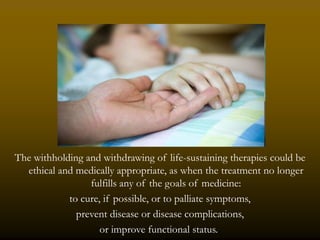
The withholding and withdrawing of life-sustaining therapies could be
  ethical and medically appropriate, as when the treatment no longer
                 fulfills any of the goals of medicine:
            to cure, if possible, or to palliate symptoms,
              prevent disease or disease complications,
                    or improve functional status..
Physicians are not obligated to and should not offer or provide
                useless or futile treatments, i.e.,
    treatments that no longer offers benefit to the patient.

            Even in the name of patient autonomy.

And yet, physicians still seek and obtain patient or proxy consent
                   when CPR is not indicated
      before writing a Do Not Resuscitate (DNR) order.
WHY?
Due to fear of legal repercussions/misconceptions, limited physician-
 patient relationships, time constraints, institutional culture, guilt, grief,
                 and concerns about the family’s reaction.


 Other obstacles are insufficient legal and palliative knowledge, and
              treatment requests by patients or families.
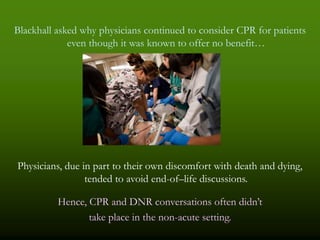
Blackhall asked why physicians continued to consider CPR for patients
             even though it was known to offer no benefit…


Physicians, due in part to their own discomfort with death and dying,
                 tended to avoid end-of–life discussions.

          Hence, CPR and DNR conversations often didn’t
                 take place in the non-acute setting.
Patients typically do not make these decisions proactively.
It is the family members who often decide on the patient’s behalf.
 Family members are then faced with the pressure of considering
    —on the spot—what their loved one ―would have wanted.‖

      Most patients lacked the medical knowledge needed
             to fully understand the role of CPR.

           Blackhall challenged the presumption that
              patients always have a right to CPR
           any more than they have a right to receive
               a medically nonsensical treatment.
It is much easier and less uncomfortable for physicians to present CPR
   as an option than to inform a patient that she will die soon regardless
                            of the intervention.


 Physicians were, on average, rather poor at having these discussions.
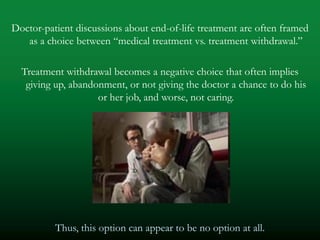
Doctor-patient discussions about end-of-life treatment are often framed
   as a choice between ―medical treatment vs. treatment withdrawal.‖

  Treatment withdrawal becomes a negative choice that often implies
   giving up, abandonment, or not giving the doctor a chance to do his
                    or her job, and worse, not caring.


          Thus, this option can appear to be no option at all.
In a study by Eliott and Olver, a common assumption underpinning
     patients’ and families’ discussions about a DNR decision is that it
                  requires a choice between life and death.


Choosing to forgo CPR was construed as choosing to let the patient die.
               Either the patient was not worth saving,
           or the family did not care enough to save them.
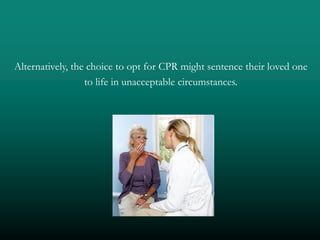
Alternatively, the choice to opt for CPR might sentence their loved one
                  to life in unacceptable circumstances.
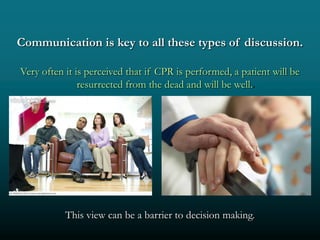
Communication is key to all these types of discussion.

Very often it is perceived that if CPR is performed, a patient will be
               resurrected from the dead and will be well..


           This view can be a barrier to decision making.
DNR should be in the context of a discussion about the
           patient’s understanding of his or her illness,
                   prognosis, and goals of care.

The patient should be made aware of the benefits and burdens of CPR.

             DNR does not mean “Do Not Treat.”
Agreement to DNR does not preclude other supportive measures.

       Although CPR will not be given, maximal medical therapy
                   that meets patient’s goals, and
      supportive measures that maximizes the patient’s comfort
                           will continue.
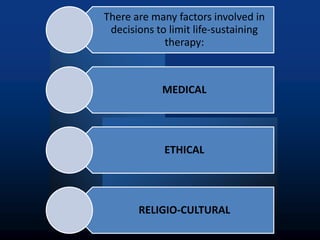
There are many factors involved in
 decisions to limit life-sustaining
             therapy:


            MEDICAL


             ETHICAL


       RELIGIO-CULTURAL
From the medical perspective, the first requirement is that there is at
   least acceptance and at best consensus among the members of the
       health care team to limit therapy when hope for recovery is
                 outweighed by burden of the treatment

Treatments should not be withheld because of the mistaken fear that if
            these are begun, they cannot later be withdrawn.

  Instead, a time limited trial of therapy could be used to clarify the
                            patient’s prognosis.

     At the end of the trial, a conference should be held to review
                    and revise the treatment plan.
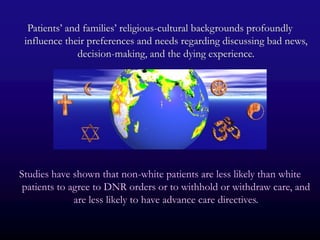
Patients’ and families’ religious-cultural backgrounds profoundly
 influence their preferences and needs regarding discussing bad news,
               decision-making, and the dying experience.


Studies have shown that non-white patients are less likely than white
 patients to agree to DNR orders or to withhold or withdraw care, and
              are less likely to have advance care directives.
In certain cultures, such as the Philippines, removing the ventilator and
            giving opioids could be perceived as mercy-killing.

      In accordance with the Vatican Declaration on Euthanasia,
 when inevitable death is imminent, it is permitted, with the patient's
      consent, to refuse forms of treatment that would only secure a
          precarious and burdensome prolongation of life, and
to interrupt means provided by the most advanced medical techniques
                where the results fall short of expectations.
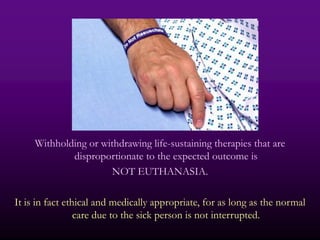
Withholding or withdrawing life-sustaining therapies that are
             disproportionate to the expected outcome is
                      NOT EUTHANASIA.

It is in fact ethical and medically appropriate, for as long as the normal
                 care due to the sick person is not interrupted.
Even so, some family members may be reluctant to withdraw treatments
             even when they believe that the patient would
                  not have wanted them continued.

 The physician should try to resolve these situations by addressing the
             families’ feelings of guilt, fear, and concern that
       their ill relative may suffer as life support is withdrawn.

      The physician should ensure that all appropriate measures
             to relieve distress are used, as well as explain
    the physician’s ethical obligation to follow the patient’s wishes.
Withholding and withdrawing therapy require
attending physicians to be excellent communicators
            with patients and families .

      Jox et al proposed an algorithm that focuses
          primarily on goals of treatment, and
           secondarily on treatment measures.

      Two ethical grounds of treatment decisions:
       Patient autonomy & Patient wellbeing.
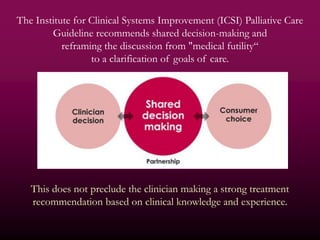
The Institute for Clinical Systems Improvement (ICSI) Palliative Care
        Guideline recommends shared decision-making and
           reframing the discussion from "medical futility―
                  to a clarification of goals of care.


   This does not preclude the clinician making a strong treatment
   recommendation based on clinical knowledge and experience.
Acceptable clinical practice on withdrawing or
    withholding treatment is based on an understanding
    of the medical, ethical, cultural, and religious issues.

There is a need to individualize care option discussions to illness status,
     and patient and family preferences, beliefs, values, and cultures.

Shared decision-making on treatment preferences should be periodically
            revisited as the goals evolve and change over time.


                                             Full text available at:
                                  Palliative Care: Research and Treatment
                                            Libertas Academica
http://www.la-press.com/end-of-life-decisions-about-withholding-or-withdrawing-therapy-medical-article-a3582

Considerations when deciding about withholding or withdrawing life-sustaining therapy

  • 1.
    END OF LIFEDECISIONS ABOUT WITHHOLDING OR WITHDRAWING THERAPY MEDICAL, ETHICAL AND RELIGIO-CULTURAL CONSIDERATIONS
  • 2.
    Author: Dr. LizaC. Manalo, MSc. Palliative Care Unit, Cancer Center, The Medical City, Pasig City & Supportive & Palliative Care Service, Department of Community & Family Medicine, FEU-NRMF Medical Center, Quezon City, PHILIPPINES
  • 3.
    What happens towardsthe end of life? Physicians face dilemmas of discontinuing life-sustaining treatments …In some circumstances, these treatments are no longer of benefit, while in others the patient or family no longer want them…
  • 4.
    What does thismean? Should life-sustaining treatment be continued just the same?
  • 5.
    The withholding andwithdrawing of life-sustaining therapies could be ethical and medically appropriate, as when the treatment no longer fulfills any of the goals of medicine: to cure, if possible, or to palliate symptoms, prevent disease or disease complications, or improve functional status..
  • 6.
    Physicians are notobligated to and should not offer or provide useless or futile treatments, i.e., treatments that no longer offers benefit to the patient. Even in the name of patient autonomy. And yet, physicians still seek and obtain patient or proxy consent when CPR is not indicated before writing a Do Not Resuscitate (DNR) order.
  • 7.
    WHY? Due to fearof legal repercussions/misconceptions, limited physician- patient relationships, time constraints, institutional culture, guilt, grief, and concerns about the family’s reaction. Other obstacles are insufficient legal and palliative knowledge, and treatment requests by patients or families.
  • 8.
    Blackhall asked whyphysicians continued to consider CPR for patients even though it was known to offer no benefit… Physicians, due in part to their own discomfort with death and dying, tended to avoid end-of–life discussions. Hence, CPR and DNR conversations often didn’t take place in the non-acute setting.
  • 9.
    Patients typically donot make these decisions proactively. It is the family members who often decide on the patient’s behalf. Family members are then faced with the pressure of considering —on the spot—what their loved one ―would have wanted.‖ Most patients lacked the medical knowledge needed to fully understand the role of CPR. Blackhall challenged the presumption that patients always have a right to CPR any more than they have a right to receive a medically nonsensical treatment.
  • 10.
    It is mucheasier and less uncomfortable for physicians to present CPR as an option than to inform a patient that she will die soon regardless of the intervention. Physicians were, on average, rather poor at having these discussions.
  • 11.
    Doctor-patient discussions aboutend-of-life treatment are often framed as a choice between ―medical treatment vs. treatment withdrawal.‖ Treatment withdrawal becomes a negative choice that often implies giving up, abandonment, or not giving the doctor a chance to do his or her job, and worse, not caring. Thus, this option can appear to be no option at all.
  • 12.
    In a studyby Eliott and Olver, a common assumption underpinning patients’ and families’ discussions about a DNR decision is that it requires a choice between life and death. Choosing to forgo CPR was construed as choosing to let the patient die. Either the patient was not worth saving, or the family did not care enough to save them.
  • 13.
    Alternatively, the choiceto opt for CPR might sentence their loved one to life in unacceptable circumstances.
  • 14.
    Communication is keyto all these types of discussion. Very often it is perceived that if CPR is performed, a patient will be resurrected from the dead and will be well.. This view can be a barrier to decision making.
  • 15.
    DNR should bein the context of a discussion about the patient’s understanding of his or her illness, prognosis, and goals of care. The patient should be made aware of the benefits and burdens of CPR. DNR does not mean “Do Not Treat.” Agreement to DNR does not preclude other supportive measures. Although CPR will not be given, maximal medical therapy that meets patient’s goals, and supportive measures that maximizes the patient’s comfort will continue.
  • 16.
    There are manyfactors involved in decisions to limit life-sustaining therapy: MEDICAL ETHICAL RELIGIO-CULTURAL
  • 17.
    From the medicalperspective, the first requirement is that there is at least acceptance and at best consensus among the members of the health care team to limit therapy when hope for recovery is outweighed by burden of the treatment Treatments should not be withheld because of the mistaken fear that if these are begun, they cannot later be withdrawn. Instead, a time limited trial of therapy could be used to clarify the patient’s prognosis. At the end of the trial, a conference should be held to review and revise the treatment plan.
  • 18.
    Patients’ and families’religious-cultural backgrounds profoundly influence their preferences and needs regarding discussing bad news, decision-making, and the dying experience. Studies have shown that non-white patients are less likely than white patients to agree to DNR orders or to withhold or withdraw care, and are less likely to have advance care directives.
  • 19.
    In certain cultures,such as the Philippines, removing the ventilator and giving opioids could be perceived as mercy-killing. In accordance with the Vatican Declaration on Euthanasia, when inevitable death is imminent, it is permitted, with the patient's consent, to refuse forms of treatment that would only secure a precarious and burdensome prolongation of life, and to interrupt means provided by the most advanced medical techniques where the results fall short of expectations.
  • 20.
    Withholding or withdrawinglife-sustaining therapies that are disproportionate to the expected outcome is NOT EUTHANASIA. It is in fact ethical and medically appropriate, for as long as the normal care due to the sick person is not interrupted.
  • 21.
    Even so, somefamily members may be reluctant to withdraw treatments even when they believe that the patient would not have wanted them continued. The physician should try to resolve these situations by addressing the families’ feelings of guilt, fear, and concern that their ill relative may suffer as life support is withdrawn. The physician should ensure that all appropriate measures to relieve distress are used, as well as explain the physician’s ethical obligation to follow the patient’s wishes.
  • 22.
    Withholding and withdrawingtherapy require attending physicians to be excellent communicators with patients and families . Jox et al proposed an algorithm that focuses primarily on goals of treatment, and secondarily on treatment measures. Two ethical grounds of treatment decisions: Patient autonomy & Patient wellbeing.
  • 23.
    The Institute forClinical Systems Improvement (ICSI) Palliative Care Guideline recommends shared decision-making and reframing the discussion from "medical futility― to a clarification of goals of care. This does not preclude the clinician making a strong treatment recommendation based on clinical knowledge and experience.
  • 24.
    Acceptable clinical practiceon withdrawing or withholding treatment is based on an understanding of the medical, ethical, cultural, and religious issues. There is a need to individualize care option discussions to illness status, and patient and family preferences, beliefs, values, and cultures. Shared decision-making on treatment preferences should be periodically revisited as the goals evolve and change over time. Full text available at: Palliative Care: Research and Treatment Libertas Academica http://www.la-press.com/end-of-life-decisions-about-withholding-or-withdrawing-therapy-medical-article-a3582