The Amazon
How should this important global commons be
managed and by whom?
May 21, 2015

DAVID ALLRED- 1
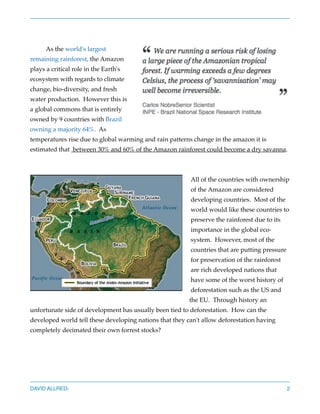
As the world's largest
remaining rainforest, the Amazon
plays a critical role in the Earth's
ecosystem with regards to climate
change, bio-diversity, and fresh
water production.  However this is
a global commons that is entirely
owned by 9 countries with Brazil
owning a majority 64%. As
temperatures rise due to global warming and rain patterns change in the amazon it is
estimated that between 30% and 60% of the Amazon rainforest could become a dry savanna.
All of the countries with ownership
of the Amazon are considered
developing countries.  Most of the
world would like these countries to
preserve the rainforest due to its
importance in the global eco-
system.  However, most of the
countries that are putting pressure
for preservation of the rainforest
are rich developed nations that
have some of the worst history of
deforestation such as the US and
the EU.  Through history an
unfortunate side of development has usually been tied to deforestation.  How can the
developed world tell these developing nations that they can't allow deforestation having
completely decimated their own forrest stocks?  
DAVID ALLRED- 2
However the current
situation of ownership by
these countries doesn't
seem to be working with
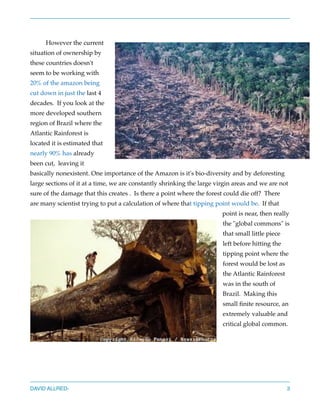
20% of the amazon being
cut down in just the last 4
decades.  If you look at the
more developed southern
region of Brazil where the
Atlantic Rainforest is
located it is estimated that
nearly 90% has already
been cut,  leaving it
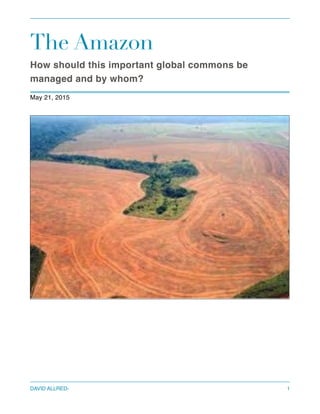
basically nonexistent. One importance of the Amazon is it's bio-diversity and by deforesting
large sections of it at a time, we are constantly shrinking the large virgin areas and we are not
sure of the damage that this creates .  Is there a point where the forest could die off?  There
are many scientist trying to put a calculation of where that tipping point would be.  If that
point is near, then really
the "global commons" is
that small little piece
left before hitting the
tipping point where the
forest would be lost as
the Atlantic Rainforest
was in the south of
Brazil.  Making this
small finite resource, an
extremely valuable and
critical global common.
DAVID ALLRED- 3
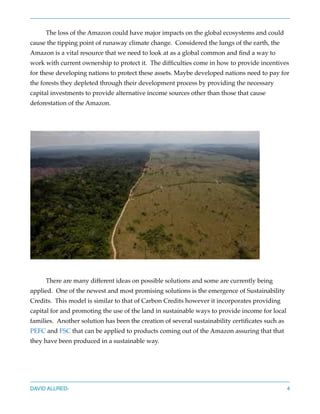
The loss of the Amazon could have major impacts on the global ecosystems and could
cause the tipping point of runaway climate change.  Considered the lungs of the earth, the
Amazon is a vital resource that we need to look at as a global common and find a way to
work with current ownership to protect it.  The difficulties come in how to provide incentives
for these developing nations to protect these assets. Maybe developed nations need to pay for
the forests they depleted through their development process by providing the necessary
capital investments to provide alternative income sources other than those that cause
deforestation of the Amazon.
There are many different ideas on possible solutions and some are currently being
applied.  One of the newest and most promising solutions is the emergence of Sustainability
Credits.  This model is similar to that of Carbon Credits however it incorporates providing
capital for and promoting the use of the land in sustainable ways to provide income for local
families.  Another solution has been the creation of several sustainability certificates such as
PEFC and FSC that can be applied to products coming out of the Amazon assuring that that
they have been produced in a sustainable way.
DAVID ALLRED- 4
FSC-Forest Stewardship Counsel is an international not for-profit, multi-stakeholder
organization established in 1993 to promote responsible management of the world’s forests. Its
main tools for achieving this are standard setting, certification and labeling of forest products.
According to the Food and Agriculture Organization of the United Nations, half of the world’s
forests have already been altered, degraded, destroyed or converted into other land uses. Much
of the remaining forests today suffer from illegal exploitation and otherwise poor management.
FSC was established as a response to these concerns over global deforestation. FSC is a global
forest certification system established for forests and forest products. From the perspective of the World Wildlife
Foundation (WWF) this voluntary mechanism can be regarded as one of the more interesting initiatives of the last
decade to promote better forest management. FSC is an international association of members. It is a platform for
forest owners, timber industries, social groups and environmental organizations to come together to find solutions
to improve forest management practices. FSC works to ensure the permanent existence of forest areas through
responsible forest management and conservation. Use of the FSC logo is intended to signify that the product
comes from responsible sources — environmentally appropriate, socially beneficial and economically viable. The
logo gives consumers the option of supporting responsible forestry by purchasing products with an independent,
global and credible label for forest products.
PEFC-Program for the Endorsement of Forest Certification is an international, non-profit,
non-governmental organization, which promotes sustainable forest management through
independent third party certification. It is considered the certification system of choice for small
forest owners. PEFC was founded in 1999 in response to the specific requirements of small- and
family forest owners as an international umbrella organization providing independent
assessment, endorsement and recognition of national forest certification systems. After the
successful endorsement of certification systems in Europe, Australia and Chile became the first non-European
national standards to be endorsed by PEFC in 2004. PEFC’s certification criteria are based on globally recognized
principles, guidelines and criteria developed by international and intergovernmental bodies with broad consensus
from interested stakeholders. Its 35 worldwide independent national forest certification systems represent more
than 240 million hectares of certified forests, making it the largest forest certification system in the world, covering
about two-thirds of the globally certified forest area.It is based in Geneva, Switzerland.
DAVID ALLRED- 5
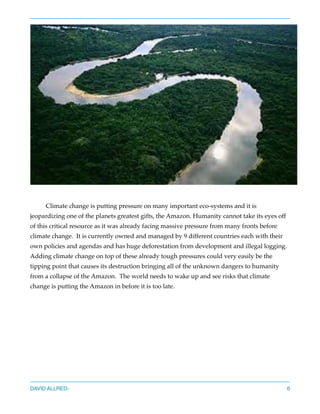
Climate change is putting pressure on many important eco-systems and it is
jeopardizing one of the planets greatest gifts, the Amazon. Humanity cannot take its eyes off
of this critical resource as it was already facing massive pressure from many fronts before
climate change. It is currently owned and managed by 9 different countries each with their
own policies and agendas and has huge deforestation from development and illegal logging.
Adding climate change on top of these already tough pressures could very easily be the
tipping point that causes its destruction bringing all of the unknown dangers to humanity
from a collapse of the Amazon. The world needs to wake up and see risks that climate
change is putting the Amazon in before it is too late.
DAVID ALLRED- 6

Losing the Amazon

  • 1.
    The Amazon How shouldthis important global commons be managed and by whom? May 21, 2015
 DAVID ALLRED- 1
  • 2.
    As the world'slargest remaining rainforest, the Amazon plays a critical role in the Earth's ecosystem with regards to climate change, bio-diversity, and fresh water production.  However this is a global commons that is entirely owned by 9 countries with Brazil owning a majority 64%. As temperatures rise due to global warming and rain patterns change in the amazon it is estimated that between 30% and 60% of the Amazon rainforest could become a dry savanna. All of the countries with ownership of the Amazon are considered developing countries.  Most of the world would like these countries to preserve the rainforest due to its importance in the global eco- system.  However, most of the countries that are putting pressure for preservation of the rainforest are rich developed nations that have some of the worst history of deforestation such as the US and the EU.  Through history an unfortunate side of development has usually been tied to deforestation.  How can the developed world tell these developing nations that they can't allow deforestation having completely decimated their own forrest stocks?   DAVID ALLRED- 2
  • 3.
    However the current situationof ownership by these countries doesn't seem to be working with 20% of the amazon being cut down in just the last 4 decades.  If you look at the more developed southern region of Brazil where the Atlantic Rainforest is located it is estimated that nearly 90% has already been cut,  leaving it basically nonexistent. One importance of the Amazon is it's bio-diversity and by deforesting large sections of it at a time, we are constantly shrinking the large virgin areas and we are not sure of the damage that this creates .  Is there a point where the forest could die off?  There are many scientist trying to put a calculation of where that tipping point would be.  If that point is near, then really the "global commons" is that small little piece left before hitting the tipping point where the forest would be lost as the Atlantic Rainforest was in the south of Brazil.  Making this small finite resource, an extremely valuable and critical global common. DAVID ALLRED- 3
  • 4.
    The loss ofthe Amazon could have major impacts on the global ecosystems and could cause the tipping point of runaway climate change.  Considered the lungs of the earth, the Amazon is a vital resource that we need to look at as a global common and find a way to work with current ownership to protect it.  The difficulties come in how to provide incentives for these developing nations to protect these assets. Maybe developed nations need to pay for the forests they depleted through their development process by providing the necessary capital investments to provide alternative income sources other than those that cause deforestation of the Amazon. There are many different ideas on possible solutions and some are currently being applied.  One of the newest and most promising solutions is the emergence of Sustainability Credits.  This model is similar to that of Carbon Credits however it incorporates providing capital for and promoting the use of the land in sustainable ways to provide income for local families.  Another solution has been the creation of several sustainability certificates such as PEFC and FSC that can be applied to products coming out of the Amazon assuring that that they have been produced in a sustainable way. DAVID ALLRED- 4
  • 5.
    FSC-Forest Stewardship Counselis an international not for-profit, multi-stakeholder organization established in 1993 to promote responsible management of the world’s forests. Its main tools for achieving this are standard setting, certification and labeling of forest products. According to the Food and Agriculture Organization of the United Nations, half of the world’s forests have already been altered, degraded, destroyed or converted into other land uses. Much of the remaining forests today suffer from illegal exploitation and otherwise poor management. FSC was established as a response to these concerns over global deforestation. FSC is a global forest certification system established for forests and forest products. From the perspective of the World Wildlife Foundation (WWF) this voluntary mechanism can be regarded as one of the more interesting initiatives of the last decade to promote better forest management. FSC is an international association of members. It is a platform for forest owners, timber industries, social groups and environmental organizations to come together to find solutions to improve forest management practices. FSC works to ensure the permanent existence of forest areas through responsible forest management and conservation. Use of the FSC logo is intended to signify that the product comes from responsible sources — environmentally appropriate, socially beneficial and economically viable. The logo gives consumers the option of supporting responsible forestry by purchasing products with an independent, global and credible label for forest products. PEFC-Program for the Endorsement of Forest Certification is an international, non-profit, non-governmental organization, which promotes sustainable forest management through independent third party certification. It is considered the certification system of choice for small forest owners. PEFC was founded in 1999 in response to the specific requirements of small- and family forest owners as an international umbrella organization providing independent assessment, endorsement and recognition of national forest certification systems. After the successful endorsement of certification systems in Europe, Australia and Chile became the first non-European national standards to be endorsed by PEFC in 2004. PEFC’s certification criteria are based on globally recognized principles, guidelines and criteria developed by international and intergovernmental bodies with broad consensus from interested stakeholders. Its 35 worldwide independent national forest certification systems represent more than 240 million hectares of certified forests, making it the largest forest certification system in the world, covering about two-thirds of the globally certified forest area.It is based in Geneva, Switzerland. DAVID ALLRED- 5
  • 6.
    Climate change isputting pressure on many important eco-systems and it is jeopardizing one of the planets greatest gifts, the Amazon. Humanity cannot take its eyes off of this critical resource as it was already facing massive pressure from many fronts before climate change. It is currently owned and managed by 9 different countries each with their own policies and agendas and has huge deforestation from development and illegal logging. Adding climate change on top of these already tough pressures could very easily be the tipping point that causes its destruction bringing all of the unknown dangers to humanity from a collapse of the Amazon. The world needs to wake up and see risks that climate change is putting the Amazon in before it is too late. DAVID ALLRED- 6