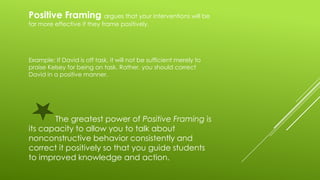
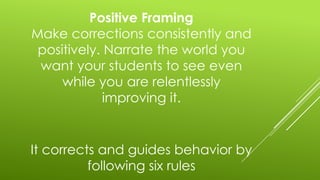
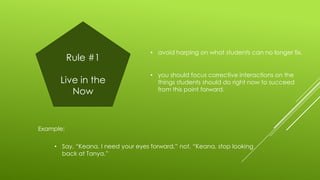
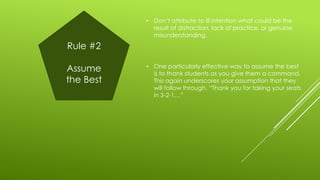
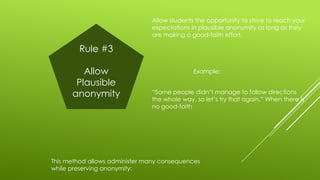
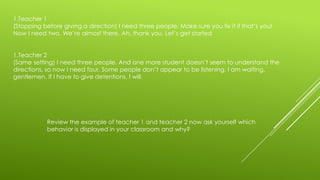
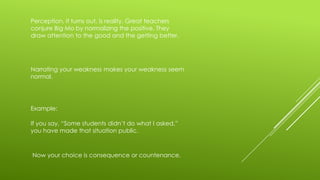
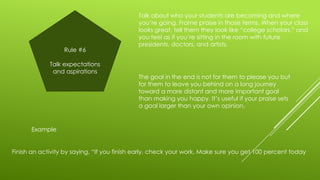
This document outlines the technique of positive framing to correct student behavior. It discusses six rules for positive framing: 1) live in the now, 2) assume the best, 3) allow plausible anonymity, 4) build momentum and narrate the positive, 5) challenge students, and 6) talk expectations and aspirations. The goal is to frame corrections and praise in a positive manner that guides students to improved learning and behavior.


![Keep their eyes on the prize by constantly referring to it.
Keep positive by avoiding two things
1. Rhetorical questions. Don’t ask questions that you don’t want an
answer to
Example:
Don’t make a charade by asking, “Would you like to join us, David?”
Just say, “Thank you for joining us on the rug, David.”
2.
Contingencies. Don’t say, “I’ll wait,” unless you will. The point is that
you won’t. “We [or I] need you with us” is much more productive,
positive, and strong.](https://image.slidesharecdn.com/43-positiveframing-gilbert-140217083441-phpapp02/85/Technique-43-positive-framing-gilbert-12-320.jpg)

![Classroom structures that_promote_standards_focused_instruction[1]](https://cdn.slidesharecdn.com/ss_thumbnails/classroomstructuresthatpromotestandardsfocusedinstruction1-110319175452-phpapp02-thumbnail.jpg?width=640&height=640&fit=bounds)


