Connectives
The teaching of reading,
 writing, communications
and maths is highly effective
     and well planned.
Connectives:
   why are they so important?

Connectives are words or phrases
 that tie one thought to another.
  Using them effectively shows a
  clear understanding of what is
being said and how ideas develop.
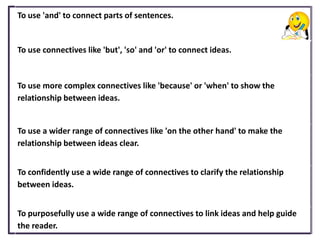
To use 'and' to connect parts of sentences.


To use connectives like 'but', 'so' and 'or' to connect ideas.


To use more complex connectives like 'because' or 'when' to show the
relationship between ideas.


To use a wider range of connectives like 'on the other hand' to make the
relationship between ideas clear.


To confidently use a wide range of connectives to clarify the relationship
between ideas.


To purposefully use a wide range of connectives to link ideas and help guide
the reader.
Joining parts of a sentence
Connectives of reason:
He was hungry because he had not eaten lunch.
Richard left late so he missed the bus.

Connectives of time:
Craig watched Eastenders before doing his work.
Until it was time for bed, Kerry did the ironing.

Connectives of place:
Wherever he goes, Dave watches out for traffic.
The dog could be found hiding under the table.
Joining parts of a paragraph
David knew he had lots of housework
to do. On the other hand, he wanted
to go to the pub to watch the cup
final. Surely he could just do a bit of
dusting and that would be enough?
Joining paragraphs
David knew he had lots of housework to do. On
the other hand, he wanted to go to the pub to
watch the cup final. Surely he could just do a bit
of dusting and that would be enough?


Suddenly, he realised that his mum was coming to
visit tomorrow and would hate the mess. However,
she was so much better at cleaning than him.
Therefore he would leave the housework and let
his mum do it.
•Next           •Meanwhile
•Then           •After
•First/second   •To begin with
•Finally        •Initially
•Above all
•In particular
•Especially
•Significantly
•Indeed
•Notably
•For example
•Such as
•For instance
•As revealed by
•Namely
•In the case of…
•Because
•So
•Therefore
•Thus
•Consequently
•As a result
•Similarly
•Also
•Likewise
•Too
•In like manner
•Equally
•As with
•However
•On the other hand
•Conversely
•On the contrary
•In contrast to this
•Otherwise
•Alternatively
•In addition
•Likewise
•Furthermore
•As well as this
•Also
•Moreover
•Too
On        Inside
  Within     Outside
Throughout     Near
  Beyond      Among
  Below      Beneath
    To       Towards
   From        Into
  Out of        Off
Before         During
   Earlier         Later
    Since       Meanwhile
In + _ hours    At + o’clock
Whenever          Already
   Till             Until
  Now          By + the time..
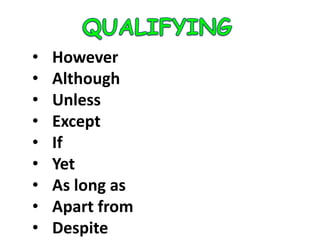
•   However
•   Although
•   Unless
•   Except
•   If
•   Yet
•   As long as
•   Apart from
•   Despite
Key messages
1. Connectives are really important in
   showing extended knowledge and
   can be utilised in all subjects.
2. We must be constantly
   encouraging students to use
   connectives in both their written
   and oral communication.
3. Students are given targets that are
   relevant in helping to develop their
   skills. We all have a responsibility
   to help the students meet these
   targets.

Connectives briefing

  • 1.
  • 2.
    The teaching ofreading, writing, communications and maths is highly effective and well planned.
  • 3.
    Connectives: why are they so important? Connectives are words or phrases that tie one thought to another. Using them effectively shows a clear understanding of what is being said and how ideas develop.
  • 4.
    To use 'and'to connect parts of sentences. To use connectives like 'but', 'so' and 'or' to connect ideas. To use more complex connectives like 'because' or 'when' to show the relationship between ideas. To use a wider range of connectives like 'on the other hand' to make the relationship between ideas clear. To confidently use a wide range of connectives to clarify the relationship between ideas. To purposefully use a wide range of connectives to link ideas and help guide the reader.
  • 5.
    Joining parts ofa sentence Connectives of reason: He was hungry because he had not eaten lunch. Richard left late so he missed the bus. Connectives of time: Craig watched Eastenders before doing his work. Until it was time for bed, Kerry did the ironing. Connectives of place: Wherever he goes, Dave watches out for traffic. The dog could be found hiding under the table.
  • 6.
    Joining parts ofa paragraph David knew he had lots of housework to do. On the other hand, he wanted to go to the pub to watch the cup final. Surely he could just do a bit of dusting and that would be enough?
  • 7.
    Joining paragraphs David knewhe had lots of housework to do. On the other hand, he wanted to go to the pub to watch the cup final. Surely he could just do a bit of dusting and that would be enough? Suddenly, he realised that his mum was coming to visit tomorrow and would hate the mess. However, she was so much better at cleaning than him. Therefore he would leave the housework and let his mum do it.
  • 8.
    •Next •Meanwhile •Then •After •First/second •To begin with •Finally •Initially
  • 9.
  • 10.
    •For example •Such as •Forinstance •As revealed by •Namely •In the case of…
  • 11.
  • 12.
  • 13.
    •However •On the otherhand •Conversely •On the contrary •In contrast to this •Otherwise •Alternatively
  • 14.
    •In addition •Likewise •Furthermore •As wellas this •Also •Moreover •Too
  • 15.
    On Inside Within Outside Throughout Near Beyond Among Below Beneath To Towards From Into Out of Off
  • 16.
    Before During Earlier Later Since Meanwhile In + _ hours At + o’clock Whenever Already Till Until Now By + the time..
  • 17.
    However • Although • Unless • Except • If • Yet • As long as • Apart from • Despite
  • 18.
    Key messages 1. Connectivesare really important in showing extended knowledge and can be utilised in all subjects. 2. We must be constantly encouraging students to use connectives in both their written and oral communication. 3. Students are given targets that are relevant in helping to develop their skills. We all have a responsibility to help the students meet these targets.