Inglés IV
ÍNDICE
• Review: uses of “will”.
• Review: uses of “going to”.
• Differences between “Will” and “going to.
Review
Uses
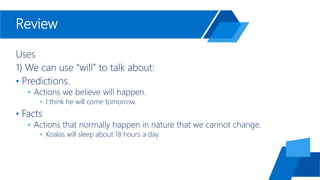
1) We can use “will” to talk about:
• Predictions.
• Actions we believe will happen.
• I think he will come tomorrow.
• Facts
• Actions that normally happen in nature that we cannot change.
• Koalas will sleep about 18 hours a day.
Review
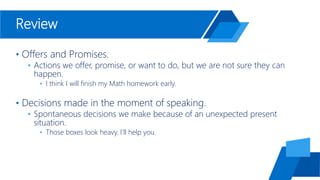
• Offers and Promises.
• Actions we offer, promise, or want to do, but we are not sure they can
happen.
• I think I will finish my Math homework early.
• Decisions made in the moment of speaking.
• Spontaneous decisions we make because of an unexpected present
situation.
• Those boxes look heavy. I’ll help you.
Review
2) We can use “going to” to talk about:
• Plans and intentions.
• Actions that we are sure will happen because there is a plan, or they were
programed.
• We’re going to have two exams next week.
• Predictions.
• Predictions that we can make when we have strong evidence.
• My brother is going to be late to work because he is still sleeping, and it´s almost time
to go.
Differences
1) General actions: offers, promises, intentions:
• Actions expressed with will + verb, indicate about a 50% possibility
of happening. We can talk about things we want to do, but we do
not have a plan.
Differences
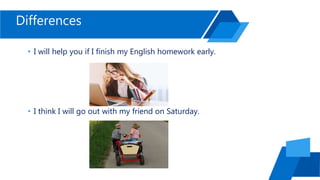
• I will help you if I finish my English homework early.
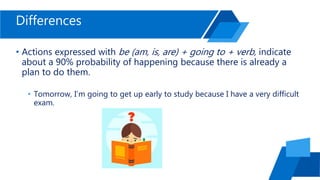
• I think I will go out with my friend on Saturday.
Differences
• Actions expressed with be (am, is, are) + going to + verb, indicate
about a 90% probability of happening because there is already a
plan to do them.
• Tomorrow, I’m going to get up early to study because I have a very difficult
exam.
Differences
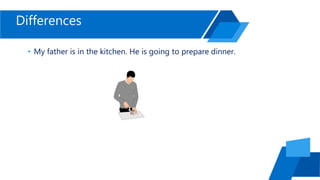
• My father is in the kitchen. He is going to prepare dinner.
Differences
2) Predictions:
• When we express that we want something to happen, or we think
something will happen, we use will + verb. With this, we express a
50% possibility.
Differences
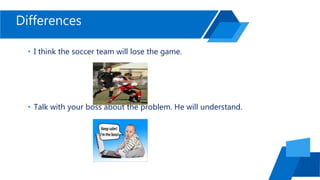
• I think the soccer team will lose the game.
• Talk with your boss about the problem. He will understand.
Differences
• When we have strong evidence that something is going to happen,
we use be + going to + verb. With this, we express a 90%
probability.
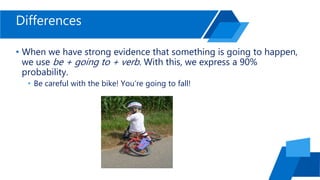
• Be careful with the bike! You’re going to fall!
Differences
• It’s 8:00 a.m.! I’m going to be late for work!
Derechos Reservados 2017 Tecnológico de Monterrey
Prohibida la reproducción total o parcial de esta obra
sin expresa autorización del Tecnológico de Monterrey.

Simple future. will vs going to

  • 1.
  • 2.
    ÍNDICE • Review: usesof “will”. • Review: uses of “going to”. • Differences between “Will” and “going to.
  • 3.
    Review Uses 1) We canuse “will” to talk about: • Predictions. • Actions we believe will happen. • I think he will come tomorrow. • Facts • Actions that normally happen in nature that we cannot change. • Koalas will sleep about 18 hours a day.
  • 4.
    Review • Offers andPromises. • Actions we offer, promise, or want to do, but we are not sure they can happen. • I think I will finish my Math homework early. • Decisions made in the moment of speaking. • Spontaneous decisions we make because of an unexpected present situation. • Those boxes look heavy. I’ll help you.
  • 5.
    Review 2) We canuse “going to” to talk about: • Plans and intentions. • Actions that we are sure will happen because there is a plan, or they were programed. • We’re going to have two exams next week. • Predictions. • Predictions that we can make when we have strong evidence. • My brother is going to be late to work because he is still sleeping, and it´s almost time to go.
  • 6.
    Differences 1) General actions:offers, promises, intentions: • Actions expressed with will + verb, indicate about a 50% possibility of happening. We can talk about things we want to do, but we do not have a plan.
  • 7.
    Differences • I willhelp you if I finish my English homework early. • I think I will go out with my friend on Saturday.
  • 8.
    Differences • Actions expressedwith be (am, is, are) + going to + verb, indicate about a 90% probability of happening because there is already a plan to do them. • Tomorrow, I’m going to get up early to study because I have a very difficult exam.
  • 9.
    Differences • My fatheris in the kitchen. He is going to prepare dinner.
  • 10.
    Differences 2) Predictions: • Whenwe express that we want something to happen, or we think something will happen, we use will + verb. With this, we express a 50% possibility.
  • 11.
    Differences • I thinkthe soccer team will lose the game. • Talk with your boss about the problem. He will understand.
  • 12.
    Differences • When wehave strong evidence that something is going to happen, we use be + going to + verb. With this, we express a 90% probability. • Be careful with the bike! You’re going to fall!
  • 13.
    Differences • It’s 8:00a.m.! I’m going to be late for work!
  • 14.
    Derechos Reservados 2017Tecnológico de Monterrey Prohibida la reproducción total o parcial de esta obra sin expresa autorización del Tecnológico de Monterrey.