Connections
research
Hermione Finch 2781
INITIAL RESEARCH
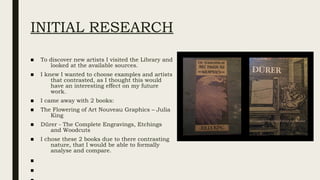
■ To discover new artists I visited the Library and
looked at the available sources.
■ I knew I wanted to choose examples and artists
that contrasted, as I thought this would
have an interesting effect on my future
work.
■ I came away with 2 books:
■ The Flowering of Art Nouveau Graphics – Julia
King
■ Dürer - The Complete Engravings, Etchings
and Woodcuts
■ I chose these 2 books due to there contrasting
nature, that I would be able to formally
analyse and compare.
■
■
BIOGRAPHY
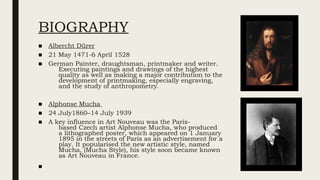
■ Albercht Dürer
■ 21 May 1471-6 April 1528
■ German Painter, draughtsman, printmaker and writer.
Executing paintings and drawings of the highest
quality as well as making a major contribution to the
development of printmaking, especially engraving,
and the study of anthropometry.
■ Alphonse Mucha
■ 24 July1860–14 July 1939
■ A key influence in Art Nouveau was the Paris-
based Czech artist Alphonse Mucha, who produced
a lithographed poster, which appeared on 1 January
1895 in the streets of Paris as an advertisement for a
play. It popularised the new artistic style, named
Mucha, (Mucha Style), his style soon became known
as Art Nouveau in France.
■
INFLUENCES
■ Art Nouveau – New Art
Art Nouveau is considered a "total" art style, embracing
architecture, graphic art, interior design, and most of the decorative arts.
The style was the first major artistic stylistic movement in which mass-
produced graphics (as opposed to traditional forms of printmaking, which
were not very important for the style) played a key role, often techniques
of colour printing developed relatively recently.
■
QUOTES
■ Albercht Dürer
■ “Why has God given me such magnificent talent? It is a curse as well as a great blessing.”
■ “Sane judgment abhors nothing so much as a picture perpetrated with no technical
knowledge, although with plenty of care and diligence.”
■ “As I grew older, I realized that it was much better to insist on the genuine forms of
nature, for simplicity is the greatest adornment of art.”
■
■ Alphonse Mucha
■ “The purpose of my work was never to destroy but always to create, to construct bridges,
because we must live in the hope that humankind will draw together and that the
better we understand each other the easier this will become.”
Bières de la Meuse
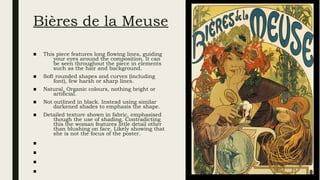
■ This piece features long flowing lines, guiding
your eyes around the composition. It can
be seen throughout the piece in elements
such as the hair and background.
■ Soft rounded shapes and curves (including
font), few harsh or sharp lines.
■ Natural, Organic colours, nothing bright or
artificial.
■ Not outlined in black. Instead using similar
darkened shades to emphasis the shape.
■ Detailed texture shown in fabric, emphasised
though the use of shading. Contradicting
this the woman features little detail other
than blushing on face. Likely showing that
she is not the focus of the poster.
■
■
■
■
Samson Rending
the Lion
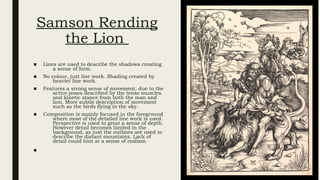
■ Lines are used to describe the shadows creating
a sense of form.
■ No colour, just line work. Shading created by
heavier line work.
■ Features a strong sense of movement, due to the
active poses described by the tense muscles
and kinetic stance from both the man and
lion. More subtle description of movement
such as the birds flying in the sky.
■ Composition is mainly focused in the foreground
where most of the detailed line work is used.
Perspective is used to great a sense of depth.
However detail becomes limited in the
background, as just the outlines are used to
describe the distant mountains. Lack of
detail could hint at a sense of realism.
■
COMPARISON
These pieces are very
different styles that contrast
each other well. However do
feature some similarities.
They both feature a lack of
detail in specific areas,
however I believe the reason
and purpose of this is for
different reasons.
The purpose and function of
these pieces are similar.
One being an piece of
Graphics and the other an
Illustration.

Connections research

  • 1.
  • 2.
    INITIAL RESEARCH ■ Todiscover new artists I visited the Library and looked at the available sources. ■ I knew I wanted to choose examples and artists that contrasted, as I thought this would have an interesting effect on my future work. ■ I came away with 2 books: ■ The Flowering of Art Nouveau Graphics – Julia King ■ Dürer - The Complete Engravings, Etchings and Woodcuts ■ I chose these 2 books due to there contrasting nature, that I would be able to formally analyse and compare. ■ ■
  • 3.
    BIOGRAPHY ■ Albercht Dürer ■21 May 1471-6 April 1528 ■ German Painter, draughtsman, printmaker and writer. Executing paintings and drawings of the highest quality as well as making a major contribution to the development of printmaking, especially engraving, and the study of anthropometry. ■ Alphonse Mucha ■ 24 July1860–14 July 1939 ■ A key influence in Art Nouveau was the Paris- based Czech artist Alphonse Mucha, who produced a lithographed poster, which appeared on 1 January 1895 in the streets of Paris as an advertisement for a play. It popularised the new artistic style, named Mucha, (Mucha Style), his style soon became known as Art Nouveau in France. ■
  • 4.
    INFLUENCES ■ Art Nouveau– New Art Art Nouveau is considered a "total" art style, embracing architecture, graphic art, interior design, and most of the decorative arts. The style was the first major artistic stylistic movement in which mass- produced graphics (as opposed to traditional forms of printmaking, which were not very important for the style) played a key role, often techniques of colour printing developed relatively recently. ■
  • 5.
    QUOTES ■ Albercht Dürer ■“Why has God given me such magnificent talent? It is a curse as well as a great blessing.” ■ “Sane judgment abhors nothing so much as a picture perpetrated with no technical knowledge, although with plenty of care and diligence.” ■ “As I grew older, I realized that it was much better to insist on the genuine forms of nature, for simplicity is the greatest adornment of art.” ■ ■ Alphonse Mucha ■ “The purpose of my work was never to destroy but always to create, to construct bridges, because we must live in the hope that humankind will draw together and that the better we understand each other the easier this will become.”
  • 6.
    Bières de laMeuse ■ This piece features long flowing lines, guiding your eyes around the composition. It can be seen throughout the piece in elements such as the hair and background. ■ Soft rounded shapes and curves (including font), few harsh or sharp lines. ■ Natural, Organic colours, nothing bright or artificial. ■ Not outlined in black. Instead using similar darkened shades to emphasis the shape. ■ Detailed texture shown in fabric, emphasised though the use of shading. Contradicting this the woman features little detail other than blushing on face. Likely showing that she is not the focus of the poster. ■ ■ ■ ■
  • 7.
    Samson Rending the Lion ■Lines are used to describe the shadows creating a sense of form. ■ No colour, just line work. Shading created by heavier line work. ■ Features a strong sense of movement, due to the active poses described by the tense muscles and kinetic stance from both the man and lion. More subtle description of movement such as the birds flying in the sky. ■ Composition is mainly focused in the foreground where most of the detailed line work is used. Perspective is used to great a sense of depth. However detail becomes limited in the background, as just the outlines are used to describe the distant mountains. Lack of detail could hint at a sense of realism. ■
  • 8.
    COMPARISON These pieces arevery different styles that contrast each other well. However do feature some similarities. They both feature a lack of detail in specific areas, however I believe the reason and purpose of this is for different reasons. The purpose and function of these pieces are similar. One being an piece of Graphics and the other an Illustration.