Connected Agriculture
The role of mobile in driving efficiency and
sustainability in the food and agriculture
value chain
Connected Agriculture: The role of mobile in driving efficiency and sustainability in the food and agriculture value chain1
FindingsContext AppendicesRecommendationsFindingsContext AppendicesRecommendations
Authors and contributors
Vodafone
Vodafone Group Plc is one of the world’s largest mobile communications companies
by revenue. It has a significant presence in Europe, the Middle East, Africa, Asia
Pacific and the US through the company’s subsidiaries, joint ventures, associated
undertakings and investments.
Vodafone plays an active role in seeking to address the challenges faced by
today’s emerging economies through the use of technology. Using the Millennium
Development Goals as a focal point, the company has worked in partnership with
other multinationals and organisations such as the GSMA, UN Foundation and the
UK Department for International Development to provide products and services that
help to tackle hunger, reduce child mortality and support women.
Vodafone’s mobile money transfer service, M-PESA, has proved extremely successful
at bringing basic financial services to the rural poor in Kenya and other countries,
together with a wide range of community benefits. Other examples include
programmes such as the GSMA mWomen initiative which aims to address barriers
preventing women from using mobile, and SMS for Life which is improving the
management of anti-malarial medication stocks in rural Tanzania.
Vodafone authors:
•	Matthew Kirk, Group External Affairs Director
•	Julie Steele, Sustainability Director, Group External Affairs (Project Sponsor)
•	Christèle Delbé, Head of Sustainability, Group External Affairs (Project Manager)
•	Laura Crow, Sustainability Analyst, Group External Affairs (Subject Matter Expert)
Vodafone key contributors:
•	Greg Reeve, Head of Mobile Payment Solutions, Group Commercial Development
•	Garren Bird, Principal Strategy Manager – New Business,
Group Commercial Development
•	Mike Ritchie-Cox, Head of Consumer Goods Industry, Vodafone Global Enterprise
•	Dylan Lennox, Managing Executive, New Technologies, Vodacom Tanzania Limited
Contents
Context
Foreword from Vittorio Colao, Vodafone		 3
Foreword from Peter Lacy, Accenture		 4
Foreword from Dame Barbara Stocking, Oxfam		 5
Executive summary		 7
Context			9
Findings
Improving access to financial services	 15
Provision of agricultural information	 19
Improving data visibility for supply
chain efficiency	 23
Enhancing access to markets	 28
Recommendations
Appendices
Appendix 1: Research methodology	 33
Appendix 2: Basis of analysis	 35
Appendix 3: Acknowledgements	 39
1
13
31
33
1 13 31 33
Connected Agriculture: The role of mobile in driving efficiency and sustainability in the food and agriculture value chain2
Context RecommendationsFindings Appendices
Accenture
Accenture is a global management consulting, technology services and outsourcing
company. Combining unparalleled experience, comprehensive capabilities across
all industries and business functions, and extensive research on the world’s most
successful companies, Accenture collaborates with clients to help them become
high-performance businesses and governments. With approximately 215,000 people
serving clients in more than 120 countries, the company generated net revenues of
US$21.5 billion for the fiscal year 2010.
Accenture Sustainability Services helps organisations achieve substantial
improvement in performance and value for their stakeholders. We help clients
leverage their assets and capabilities to drive innovation and profitable growth while
striving for a positive economic, environmental and social impact. We work with
clients across industries and geographies to integrate sustainability approaches
into their business strategies, operating models and critical processes. Our holistic
approach encompasses strategy, design and execution to increase revenue, reduce
cost, manage risk and enhance brand, reputation and intangible assets. Find out more
at www.accenture.com/sustainability or contact us at sustainability@accenture.com.
Accenture authors:
•	Justin Keeble, Director, Sustainability Services (Project Lead)
•	Caroline Fricke, Manager, Sustainability Services (Project Manager)
•	Richard Myerscough, Consultant, Strategy Practice
•	Gib Bulloch, Executive Director, Accenture Development Partnerships
Accenture key contributors:
•	Steven Yurisich, Industry Specialist, Communications and High Tech
•	Barry Nee, Agribusiness Practice Lead
•	Gareth Weir, Manager, Accenture Development Partnerships (Tanzania)
•	Kathryn Brownlie, Head of Agricultural Research
•	Oliver Grange, Manager, Strategy
Oxfam
Oxfam is a vibrant global movement of dedicated people fighting poverty. Our purpose
is to work with others to overcome poverty and suffering. We believe that in a world
rich in resources, poverty is not inevitable. It is an injustice which can, and must,
be overcome.
Working with local partner organisations in more than 60 of the poorest countries
around the world, Oxfam concentrates on three interlinking areas of work:
development projects that put poor people in charge of their lives and livelihoods,
campaigning for change that lasts, and rebuilding lives after emergencies.
Oxfam key contributors:
•	David Bright, Senior Advisor, Markets and Enterprise, Programme Policy Team
•	Liz Kirk, Global Advisor, Private Sector, Programme Policy Team
Connected Agriculture: The role of mobile in driving efficiency and sustainability in the food and agriculture value chain3
Context RecommendationsFindings Appendices
Foreword from Vittorio Colao, Vodafone
Group Chief Executive Officer
One third of humanity is fed through an estimated
500 million1
smallholder farms with less than two hectares
of land. In Asia and sub-Saharan Africa the dependence
is even higher, where small farms produce about 80%2
of the food consumed.
These holdings are typically managed by families with limited technical and
mechanical support and with poor access to finance. It is often difficult for them to
make ends meet, let alone grow their business. Looking ahead, the impact of climate
change, water scarcity and increasing land scarcity will make this even more difficult.
With the world’s population expected to grow by 750 million in 2020, and demand for
food to increase by 70% by 2050, it is clear that something has to be done to improve
the efficiency of food production and distribution.
Mobile has already had a huge impact on society, so much so that Jeffrey Sachs,
Director of the Earth Institute at Columbia University, has described the mobile phone
as the ‘single most transformative tool for development’. In part, this is because a
mobile phone does not have the same barriers to access as other forms of technology
and is simple, inexpensive and convenient to use. Access to mobile networks is now
widely available, even in remote areas. Soon it will be possible for everyone and – just
as importantly – everything to be connected. This not only offers people the ability to
stay in touch with friends and family but it also provides access to finance, improved
healthcare solutions, supply chain efficiencies and increasingly automated mobility.
As well as providing benefits to society, these services are commercially successful
and therefore, we believe, more sustainable in the long term.
Vodafone’s footprint extends across many parts of Africa and India. In addition,
we provide telecommunications services to some of the world’s largest food and
agricultural commodity businesses. It is a logical step for us to explore ways in which
mobile could improve productivity and income for agricultural producers, and reduce
costs and improve traceability for buyers and processors.
This report outlines some of our initial ideas. We cannot act on them without
the support of partners. As well as suggesting ways in which mobile can improve
agricultural productivity, this report is also an invitation to our customers, our
suppliers, government organisations and non-government organisations (NGOs).
We would like to collaborate with you to drive positive change in this vital sector.
I hope you find our ideas inspiring.
Vittorio Colao, Vodafone Group Chief Executive Officer
We are exploring ways to use mobile to
improve agricultural productivity. But we
cannot act on them without the support
of partners. This report is an invitation to
our customers, our suppliers, government
organisations and non-government
organisations to help us make
a difference.
1 Oxfam (2011) ‘Who will feed the world?’
2 International Fund for Agricultural Development (IFAD) (2011)
‘Smallholders can feed the world’
Connected Agriculture: The role of mobile in driving efficiency and sustainability in the food and agriculture value chain4
Context RecommendationsFindings Appendices
Foreword from Peter Lacy, Managing
Director, Accenture Sustainability
Services, EALA
The telecommunications industry has long been at the heart
of global commerce, having transformed businesses across
all industry sectors.
However, it is only in recent years that mobile communications technology has been
widely accepted as an enabler of sustainable growth. In developing markets, where
the deployment of mobile telecommunications networks has surpassed traditional
fixed-line technology, the mobile telecoms industry is well-placed as an enabler
of higher performance in the value chain. There is a distinct need for market-led
opportunities, and the opportunity for mobile operators to deliver these is significant.
It is to this end that Vodafone and Accenture have joined forces, together with
Oxfam, to identify the key underlying issues which could be addressed through the
application of mobile technology, and to quantify the potential benefits delivered.
Vodafone and its industry peers have a clear role to play in enabling higher efficiency
in the food and agricultural value chain and, in doing so, can deliver both direct and
indirect benefits to society and the environment.
Twelve opportunities have been identified that could have widespread multiplier
effects on the lives and livelihoods of many smallholder farmers in developing
countries through the provision of better access to markets, information and finance.
In 26 countries across Vodafone’s footprint, these 12 opportunities could together
increase agricultural income by US$138 billion in 2020, an increase of 11%.
Additional benefits could include avoided greenhouse gas emissions and reduced
freshwater withdrawals. It is estimated that around 549 million mobile connections
to services will be required to realise these benefits.
The findings and recommendations provide a firm basis to bring together the
multiple stakeholders that will be needed for long-term success. Mobile telecom
operators will need to work with governments, NGOs, donors and the private sector to
develop and implement new opportunities to drive high performance in the sector.
Peter Lacy, Managing Director, Accenture Sustainability Services, EALA
These 12 communications opportunities
can drive real efficiency in food and
agriculture value chains, increasing
farmers’ income by 11% – or
US$138 billion – in 2020 and reducing
waste and environmental impact.
Connected Agriculture: The role of mobile in driving efficiency and sustainability in the food and agriculture value chain5
Context RecommendationsFindings Appendices
Foreword from Dame Barbara Stocking,
Chief Executive Officer, Oxfam
Oxfam welcomes this report. Its focus on the opportunity
to improve agricultural productivity using mobile services
highlights the opportunity to bring new investment to a key
group: smallholder farmers. Oxfam recognises that mobile
telephony could have significant potential to help the
poorest farmers towards greater food and income security.
An estimated 1.5 to 2 billion people worldwide are dependent on smallholder
agriculture and these smallholders include half the world’s under-nourished people.3
Investment that can increase the productivity and incomes of smallholders
– particularly female smallholders – remains the best opportunity for these 1.5 to
2 billion people worldwide to feed themselves and trade their way out of poverty.
Investment in agriculture is complex, but has huge potential to impact the major
development issues we face today: climate change and hunger; economic growth
and gender inequity; poor health and nutrition; and environmental sustainability.
Investing in smallholder agriculture lies at the heart of Oxfam’s long-term strategy
both to increase the productivity of subsistence farmers, as well as to increase
smallholders’, particularly women’s, abilities to participate in agricultural markets.
Oxfam recognises that mobile telephony could have significant potential to help
the poorest farmers towards greater food and income security. In Tanzania, we
are trialling a programme working with government to monitor the quality of
government services to farmers using mobile telephony. In Cambodia, the Philippines
and Indonesia, we are testing market information accessibility through SMS servicing,
and in Bangladesh, we are working to provide storm warnings to fishing communities
via mobile phones.
Oxfam has not been involved in modelling the potential impacts included in
the report and therefore, we cannot comment on how these impacts have been
quantified. However, we particularly welcome the focus that this research places on:
•	Mobile financial services and mobile information platforms as areas offering
significant potential to support the poorest to invest in their farms. Mobile financial
services can fill the banking gap felt by the poorest farmers. With access to savings
or insurance services, farmers can reduce the impact of extreme weather events and
invest in improving production. Meanwhile, mobile information platforms open up
significant additional routes to potential markets, relaying information on prices for
inputs and produce sales, as well as information on how to grow and respond
to a context of climate change through the dissemination of reliable seasonal
weather forecasts4
•	How core business, rather than corporate philanthropy, can operate to have positive
developmental impact
•	The importance of developing new business models – models that offer greater
opportunities and reduce risks for smallholders, as either suppliers or consumers
in the value chain.
3	WDR (2008) ‘Agriculture for Development’ (p.3) states that there are
1.5 billion people in smallholder households; P. Hazell, C. Poulton,
S. Wiggins and A. Dorward (2006) ‘The Future of Small Farms’
(Synthesis Paper) states over 2 billion. These smallholders include
half of the world’s undernourished people, three-quarters of Africa’s
malnourished children, and the majority of people living in absolute
poverty (IFPRI, 2005).
4	Access to reliable seasonal forecasts, plus support on how to use
that information, has been demonstrated to increase yields by
9.4–18.7% in Zimbabwe, with even greater benefits reported from
some other parts of the world. Ref: Anthony Patt, Pablo Suarez, and
Chiedza Gwata (2005). Effects of seasonal climate forecasts and
participatory workshops among subsistence farmers in Zimbabwe.
Proceedings of the National Academy of Sciences of the United
States of America; vol. 102; no. 35; 12,623–12,628.
Connected Agriculture: The role of mobile in driving efficiency and sustainability in the food and agriculture value chain6
Context RecommendationsFindings Appendices
To ensure that the focus areas above can most effectively assist with poverty
reduction, it will be useful to take a further look at the following qualitative aspects
of deploying new mobile technologies:
•	How mobile technology could improve the efficiency of government safety net
systems that assist the poorest and most food insecure small farmers – rather
than looking only at the role that mobile technology can play in increasing farmer
productivity and income from agriculture
•	How companies such as Vodafone can better understand, document and address
barriers to the use of mobile technology affecting women. Getting new technology
owned and used by women often carries significant challenges, for example
overcoming illiteracy and cultural norms which mean that men tend to be the early
owners and beneficiaries of new technologies
•	How mobile technology could drive new agricultural practices rather than
simply greater efficiency in current practices, particularly around climate change
adaptation, and ensuring focus is given to a full range of opportunities around
climate change adaptation.
Oxfam welcomes the contribution that this report makes to the area of mobile
technology and sustainable, pro-poor, food and agricultural value chains. As an
organisation, we look forward to contributing evidence to the growing knowledge base
on this area from our global programme work. Finally, we would encourage donors and
NGOs to support companies such as Vodafone who are willing to invest in new business
models to enable more resilient, inclusive and sustainable agricultural development.
Dame Barbara Stocking, Chief Executive Officer, Oxfam
Oxfam welcomes this report. Its focus on
the opportunity to improve agricultural
productivity using mobile services
highlights the opportunity to bring new
investment to a key group: smallholder
farmers. Oxfam recognises that mobile
telephony could have significant potential
to help the poorest farmers towards greater
food and income security.
Connected Agriculture: The role of mobile in driving efficiency and sustainability in the food and agriculture value chain7
Context RecommendationsFindings Appendices
Executive summary
Mobile communications can help to meet the challenge
of feeding an estimated 9.2 billion people by 2050. The
12 specific opportunities explored in this study could
increase agricultural income by around US$138 billion
across 26 of Vodafone’s markets in 2020.
They could also cut carbon dioxide emissions by approximately 5 mega tonnes (Mt)
in these markets and reduce freshwater withdrawals for agricultural irrigation by 6%,
with significant savings in water-stressed regions. These benefits assume there will
be around 549 million mobile connections to relevant services in 2020.
This report aims to stimulate the necessary engagement between mobile operators,
governments, NGOs and businesses to realise these opportunities and explore others.
Benefits
The opportunities studied here would improve the efficiency of the agriculture and
food sectors as well as helping to raise the incomes of millions of poor farmers in
developing countries. Increased efficiency is also expected to lead to fewer food
losses – an important aspect of meeting the world’s growing demand for adequate
and affordable supplies of nutritious food.
These mobile services enable companies to access and interact directly with
different participants in the value chain, helping to build visibility of issues, capacity
and quality. They will support company sustainability objectives, and in particular,
progress towards the UN Millennium Development Goals by helping to reduce
poverty, improve health and increase funding for education.
The greatest potential benefits can be generated by enabling mobile financial
payments and mobile information provision, each delivering almost 40% of the
total estimated increase in agricultural income.
Mobile services can enable companies to
access and interact directly with different
participants in the value chain.
Connected Agriculture: The role of mobile in driving efficiency and sustainability in the food and agriculture value chain8
Context RecommendationsFindings Appendices
Opportunities
Mobile telecommunications can connect farmers to markets, finance and education,
making it possible to monitor resources and track products. This unlocks productivity
potential while helping to manage the impacts of increased production, such as
increased water use and greenhouse gas emissions.
This study focuses on 12 opportunities that deliver broad socio-economic and
environmental benefits. They are grouped in four categories that were identified
through stakeholder consultations as the most important.
Mobile-enabled solutions for food and agriculture: 12 opportunities
Improving access to
financial services
Mobile payment system
Increasing access and affordability of financial services
tailored for agricultural purposes
Micro-insurance system
Micro-lending platform
Provision of agricultural
information
Mobile information platform Delivering information relevant to farmers, such as agricultural
techniques, commodity prices and weather forecasts, where
traditional methods of communication are limitedFarmer helpline
Improving data visibility for
supply chain efficiency
Smart logistics
Optimising supply chain management across the sector, and
delivering efficiency improvements for transportation logistics
Traceability and tracking system
Mobile management of supplier networks
Mobile management of distribution networks
Enhancing access to markets
Agricultural trading platform
Enhancing the link between commodity exchanges, traders,
buyers and sellers of agricultural produce
Agricultural tendering platform
Agricultural bartering platform
Conclusion
The systems required to deliver these opportunities are both complex and
fragmented and, as such, need the collective support of key stakeholders across
the agricultural supply chain. Mobile network operators are well-positioned to
act as a catalyst for action. They have the technology, the distribution channels
and the customer relationships to drive these initiatives forward. However, NGOs,
private enterprises and governments must agree to contribute their knowledge and
expertise in order to ensure the delivery of the benefits to their full potential.
Critical success factors include the development of local relationships and
understanding, testing solutions and a sympathetic regulatory environment.
Consolidating these elements will help to ensure that the content and methods of
delivery are tailored to both markets and crop types, optimising the value for farmers.
Governments will also benefit through improved data collection and efficient, secure
methods of subsidy distribution and other transactions. Pilot projects will provide an
opportunity to test the technology, explore delivery partnerships, and create new
business models for the rural poor and other underserved groups, such as women
farmers. A regulatory environment that supports these innovations, in terms of both
the technology and the required business models, will be essential.
The potential multiplier effects of the social and economic benefits that these
opportunities could deliver will reach well beyond the immediate value chain. For
example, improved agricultural income can reduce pressure on social support systems.
It is clearly in the interest of all stakeholders to work together to ensure success.
Connected Agriculture: The role of mobile in driving efficiency and sustainability in the food and agriculture value chain9
Context RecommendationsFindings Appendices
Context
The challenge
The world’s population is projected to reach 9.2 billion by 2050.5
The UN Food and
Agriculture Organization (FAO) has estimated that farmers will need to produce
70% more food than in 2006 to meet this demand.6
Failure to do so will result in
shortages and poorer health in developing countries, with damaging consequences
for development and the potential for conflict within and between nations.
While agriculture productivity has been increasing, production capacity is growing
slowly, and food security remains a serious issue in many countries due to rising
prices as well as availability. Increasing costs of agricultural input, commodity
speculation and competition with other uses for crops (eg biofuels) resulted in a food
price spike in 2006–2008. In poorer nations, this increased the number of people
considered to be ‘food insecure’ because they could not afford enough food even if
it were available. Both productivity and absolute production need to increase if this
issue is to be addressed.
Food security is essential to support the health and nutrition that are vital for sustained
progress in developing nations. Up to one third of child mortality in these countries
is a direct consequence of malnutrition.7
Diseases like malaria are also spreading to
new geographic areas due to climate change,8
further impeding the productivity of
agricultural workers and others. Tackling the impacts of climate change on malaria,
malnutrition and diarrhoeal disease could add as much as 1% of current gross
domestic product (GDP) in sub-Saharan Africa and South-East Asia up to 2030.9
The OECD and FAO’s Agricultural Outlook for 2010–2019 suggests the world is on
track to meet growing demand for food.10
But the agricultural sector will need to
overcome four key hurdles as well as coping with rising production and distribution
costs: changing land use and availability, growing water scarcity, climate change and
food wastage.
• Land for agriculture is becoming more scarce. It is being lost to spreading urban and
industrial areas, use for growing biofuel crops, soil erosion as a result of intensive
and poor farming practices, and climate change. As people migrate to cities for
better education and employment, there are also fewer families in rural areas to
farm the land.
• Irrigated agriculture accounts for approximately 70%11
of global water usage, and
by 2030 almost half of the world’s population will be affected by water scarcity.12
In many developing countries, irrigation makes up over 90% of water withdrawals.13
• Climate change impacts farming practices and is influenced by them. Extreme
weather events, such as droughts and flooding, as well as longer-term changes in
climate, damage crop yields and change growing cycles. The agricultural industry is
currently responsible for around 30%14
of the world’s carbon emissions. This could
increase as a result of poor farming practices, deforestation and growing demand for
animal protein in people’s diets.
• While improved agricultural productivity is essential, reducing waste will also
increase availability. Around one third of the food in the supply chain is either lost
or wasted at the farm, during storage and distribution, or in households.15
5	World Business Council for Sustainable Development (WBCSD)
(2008) ‘Agricultural Ecosystems Facts and Trends’
6 	Food and Agriculture Organization (FAO) (2006)
‘World Agriculture: Towards 2030/2050. Interim Report’
7 	World Health Organization (WHO) (November 2009)
‘Fact sheet No 178, Children: reducing mortality’
www.who.int/mediacentre/factsheets/fs178/en/index.html
8 	Intergovernmental Panel on Climate Change (IPCC) (2007)
‘IPCC Fourth Assessment Report: Climate Change’
9 	Accenture, GlaxoSmithKline and the Smith School of Enterprise
and the Environment at the University of Oxford (May 2011)
‘Climate Change and Health: Framing the Issue’
10 	Organization for Economic Co-operation and Development (OECD)
and FAO (2010) ‘The OECD–FAO Agricultural Outlook, 2010–2019’
11	UN-Water (2009) ‘The United Nations World Water Development
Report 3: Water in a Changing World’
12 	OECD (2008) ‘OECD Environmental Outlook to 2030’ and WBCSD
(2009) ‘Water Facts and Trends’
13 	WBCSD (2009) ‘Water Facts and Trends’
14	International Assessment of Agricultural Knowledge, Science
and Technology for Development (IAASTD) (2008) ‘Agriculture
at a Crossroads’
15	FAO (2011) ‘Global food losses and Food Waste: Extent, Causes
and Prevention’
Agriculture will need to overcome four key
hurdles: changing land use and availability;
growing water scarcity; climate change; and
food waste.
Connected Agriculture: The role of mobile in driving efficiency and sustainability in the food and agriculture value chain10
Context RecommendationsFindings Appendices
The role of mobile
Mobile could have an important role to play in improving agricultural productivity in
developing countries through services for small-scale farmers and the food supply
chain. Vodafone commissioned Accenture in 2011 to research the potential for
mobile technology to improve agricultural efficiency and productivity, increase the
income of small-scale farmers and minimise the environmental impact of increasing
food production.
This report provides insights into the opportunities, potential barriers and benefits of
mobile in agriculture with recommendations for action by businesses, governments
and NGOs. It is not intended to present mobile technology as the panacea for the
complex challenges affecting food production and consumption. Instead it aims to
provide a basis for discussions between individuals and organisations to create ideas,
help prioritise opportunities with the biggest potential, and scale up many of the
existing pilot programmes in this area.
The study concentrates on 12 opportunities for mobile technology, in four key
areas highlighted by stakeholders: improving access to financial services, provision
of agricultural information, improving data visibility for supply chain efficiency
and enhancing access to markets. Where possible, researchers modelled the
anticipated total number of mobile connections to each service in 2020 and the
associated potential increase in agricultural incomes and reduction in carbon
dioxide (CO2) emissions.
The role of mobile in the agricultural supply chain
Value
chain
Primary
production
DistributionAggregation and
processing
Retail and
consumer
Enablingfactors
•	Agricultural extension
services
•	Access to financial
services
•	Empowerment
of women
•	Farmer co-operation
•	Health and nutrition
•	Transport infrastructure
•	Traceability
•	Low carbon
transportation
•	Post-harvest storage
•	Market access
•	Trade agreements
•	Transport infrastructure
•	Buyer­­­–seller matching
•	Quality standards
•	Consumer
education
•	Matching supply
and demand
•	Food appearance
standards
Scopeofmobile
opportunity
•	Opportunities for mobile technology lie mainly in supporting smallholder farmers in the primary
production and marketing processes, and improving the transport and aggregation of agricultural produce
•	Scope of mobile opportunity has identified four major levers
	 • Improving access to financial services
	 • Provision of agricultural information
	 • Improving data visibility for supply chain efficiency
	 • Enhancing access to markets
Connected Agriculture: The role of mobile in driving efficiency and sustainability in the food and agriculture value chain11
Context RecommendationsFindings Appendices
Scope and research methodology
This study focuses on the potential for market-based solutions to improve
agricultural productivity. Non-market mechanisms such as government subsidies
and infrastructure development are also important but are outside the scope of
this research.
The opportunities covered here were identified through desk research and
stakeholder consultation. Four workshops, in India, South Africa, Tanzania and the
UK, provided insights from over 50 external stakeholders from the private, public and
not-for-profit sectors, representing every stage of the value chain. In-depth interviews
were also conducted with four additional external stakeholders (see page 39 for the
list of stakeholders consulted).
This process identified the key challenges in the value chain and a list of approximately
100 potential opportunities. These were prioritised based on qualitative assessments
to a shortlist of 12. Detailed information on the shortlisting process and assumptions
underlying the analysis is available in the appendix (see page 33).
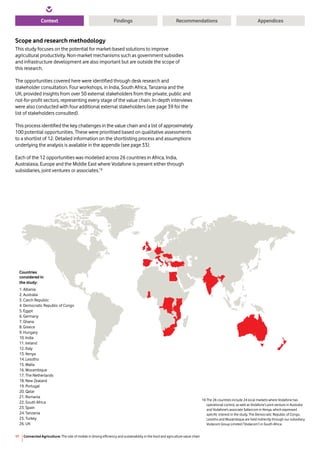
Each of the 12 opportunities was modelled across 26 countries in Africa, India,
Australasia, Europe and the Middle East where Vodafone is present either through
subsidiaries, joint ventures or associates.16
Countries
considered in
the study:
1. Albania
2. Australia
3. Czech Republic
4. Democratic Republic of Congo
5. Egypt
6. Germany
7. Ghana
8. Greece
9. Hungary
10. India
11. Ireland
12. Italy
13. Kenya
14. Lesotho
15. Malta
16. Mozambique
17. The Netherlands
18. New Zealand
19. Portugal
20. Qatar
21. Romania
22. South Africa
23. Spain
24. Tanzania
25. Turkey
26. UK
16 The 26 countries include 24 local markets where Vodafone has
operational control, as well as Vodafone’s joint venture in Australia
and Vodafone’s associate Safaricom in Kenya, which expressed
specific interest in the study. The Democratic Republic of Congo,
Lesotho and Mozambique are held indirectly through our subsidiary
Vodacom Group Limited (‘Vodacom’) in South Africa.
Connected Agriculture: The role of mobile in driving efficiency and sustainability in the food and agriculture value chain12
Context RecommendationsFindings Appendices
For each opportunity – or service – we aimed to estimate:
•	The anticipated total number of ‘connections’ – this describes the number of users
connected to an individual service. The overall number of connections to services
is likely to significantly exceed the number of people using mobile phones because
each user can access more than one service via their mobile
•	Potential incremental increase in agricultural income – this estimates the income
that the mobile service could help farmers obtain, in addition to their anticipated
income. This is the total additional income in 2020
•	Potential carbon abatement – total CO2 emissions that could be avoided by
implementing the service
•	Potential savings in freshwater withdrawals in 2020.
For some of the opportunities, it was not appropriate or possible to quantitatively
model one or more of these impacts – this is made clear in the findings where
relevant. The potential to reduce food loss was considered for each opportunity but
not modelled quantitatively due to a lack of data for some of the services and in
some of the countries within the scope of the research.
This report presents a first step in looking at the synergies between the agriculture
and mobile communications sector. It is anticipated that these 12 solutions will be
adapted into a wider range of applications, beyond those considered in the scope
of this report, as mobile operators better understand the needs of agricultural
businesses and workers, and awareness of the functionality and limitations of
mobile technology increases.
17 International Labour Organization (ILO) (2008)
18 ILO (2007)
19 IFAD Environment and Natural Resource Management Policy
(2011) ‘Resilient livelihoods through the sustainable use of
natural assets’
20 Oxfam (2011) ‘Who will feed the world?’
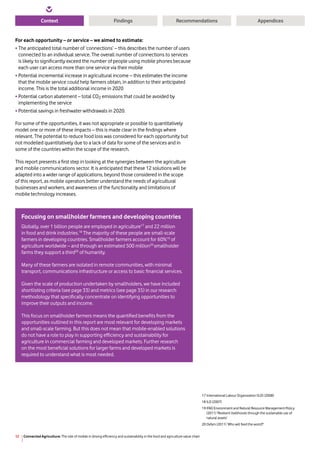
Focusing on smallholder farmers and developing countries
Globally, over 1 billion people are employed in agriculture17
and 22 million
in food and drink industries.18
The majority of these people are small-scale
farmers in developing countries. Smallholder farmers account for 60%19
of
agriculture worldwide – and through an estimated 500 million20
smallholder
farms they support a third20
of humanity.
Many of these farmers are isolated in remote communities, with minimal
transport, communications infrastructure or access to basic financial services.
Given the scale of production undertaken by smallholders, we have included
shortlisting criteria (see page 33) and metrics (see page 35) in our research
methodology that specifically concentrate on identifying opportunities to
improve their outputs and income.
This focus on smallholder farmers means the quantified benefits from the
opportunities outlined in this report are most relevant for developing markets
and small-scale farming. But this does not mean that mobile-enabled solutions
do not have a role to play in supporting efficiency and sustainability for
agriculture in commercial farming and developed markets. Further research
on the most beneficial solutions for larger farms and developed markets is
required to understand what is most needed.
Connected Agriculture: The role of mobile in driving efficiency and sustainability in the food and agriculture value chain13
Context RecommendationsFindings Appendices
Findings
	
Key findings
KEY
Mobile financial services
	 Mobile payment system
	 Micro-insurance system
	 Micro-lending platform
Mobile information provision
	 Mobile information platform
	 Farmers helpline
Mobile agricultural trade services
	 Agricultural trading platform
	 Agricultural tendering platform
	 Agricultural bartering platform
 Improving data visibility for
supply chain efficiency
	 Smart logistics
	 Traceability and tracking system
	 Management of supplier networks
	 Management of distribution networks
* Increase in income from improving data visibility for supply chain efficiency was not quantified.
The 12 opportunities for mobile identified in this study have
the potential to increase agricultural income by an estimated
US$138 billion across 26 countries in 2020. This represents
an 11% increase against the forecast for that year and the
significant proportion of this will be gained outside of Europe.
Further benefits could include reducing CO2-equivalent emissions by nearly
5 mega tonnes (Mt)21
and reducing freshwater withdrawals for agricultural irrigation
by 6% in 2020.
This is based on a total of around 549 million anticipated connections of users to the
individual services across the 12 opportunities.
21 To provide some comparison, this is approximately more than
the CO2 emissions from the Democratic Republic of Congo and
Mozambique combined. Source: International Energy Agency (IEA)
(2008), from fuel combustion only.
Increase in
agricultural income
in 2020 (US$ billion)*
Reduction in
freshwater
withdrawal
Carbon savings in 2020
(Mt CO2eq)
Connections to services
in 2020 (million)
35
51
52
0.4
1.9
2.1
0.5
Total
138
Total
4.9
240
174
133
2
1%
0%
Total
549
33%
10%
21%
11%
10%
4%
10%
35
51
52
0.4
1.9
2.1
0.5
Total
138
Total
4.9
240
133
2
0%
Total
549
33%
11%
10%
4%
10%
35
51
52
0.4
1.9
2.1
0.5
Total
138
Total
4.9
6%
Connected Agriculture: The role of mobile in driving efficiency and sustainability in the food and agriculture value chain14
Context RecommendationsFindings Appendices
The most significant increases in agricultural income can be achieved in developing
countries. Mobile is the most common form of communication in emerging markets
and is increasingly available in remote locations. There are over 3.5 billion mobile
connections in Africa, the Middle East, Latin America and the Asia-Pacific regions.22
Mobile has the most potential to improve the income of smallholder farmers in
developing countries in Africa, India and the Middle East, and this analysis focuses on
the benefits mobile can bring to these people. While some of the concepts discussed
in this study such as micro-insurance and micro-lending are not new, there are new
opportunities for farmers to access these services through mobile connections.
Although developing countries could benefit most from increased agricultural
income, developed countries are likely to see the greatest potential carbon savings
from the opportunities explored here, primarily through supply chain management
and optimisation.
This section outlines the findings in each of these categories:
•	Improving access to financial services
•	Provision of agricultural information
•	Improving data visibility for supply chain efficiency
•	Enhancing access to markets.
Mobile can help farmers improve agricultural productivity by giving them access
to basic financial services, new agricultural techniques and new markets, in turn
helping them to secure better prices for crops and a better return on investments.
As their income improves with each harvest, they can invest in better seeds, fertiliser
and chemicals.
The greatest potential for improving farmers’ income comes from access to financial
payments and agricultural information via mobile, together delivering approximately
75% of the total increase in agricultural income from the opportunities studied.
The mobile services analysed in this research could help rural people improve their
living standards, tackle illiteracy and access education. Over time, rural families
may be able to save enough to help family members to access education or better
employment, opening up much wider possibilities.
Improving the lives of farmers could have a particular impact on women. Over half of
agricultural workers are women23
and in some countries as many as 70%24
. Despite
women’s substantial contribution – they produce around half the world’s food
– rural women in developing countries often have less access than men to education
or training, and fewer rights to land. The solutions outlined in this report have the
potential to boost women’s productivity in agriculture, but to achieve this potential,
they must be tailored to women’s specific needs and must be marketed in ways that
appeal to women.
Mobile telecommunications can also help food growers, buyers, distributors and
exporters to trade with each other, help them track the movements of agricultural
inputs and food items, and help companies to increase transport efficiency.
By delivering the services discussed in this section, mobile operators and businesses
involved in the agricultural supply chain – from suppliers of seeds and fertiliser to
food distributors – can increase their revenue by being more efficient, improve their
relationship with existing customers and suppliers, showcase innovation, reduce CO2
emissions and fulfil their corporate sustainability objectives.
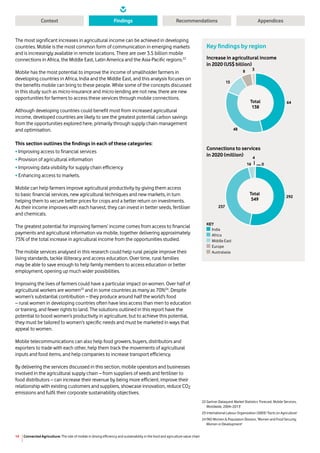
Key findings by region
Increase in agricultural income
in 2020 (US$ billion)
15
64
48
4
292
237
16
8 3
0
Total
138
Total
549
15
64
48
4
292
237
16
8 3
0
Total
138
Total
549
Connections to services
in 2020 (million)
KEY
	India
	 Africa
	 Middle East
	 Europe
	 Australasia
22 Gartner Dataquest Market Statistics ‘Forecast: Mobile Services,
Worldwide, 2004–2013’
23 International Labour Organization (2003) ‘Facts on Agriculture’
24 FAO Women  Population Division, ‘Women and Food Security,
Women in Development’
Connected Agriculture: The role of mobile in driving efficiency and sustainability in the food and agriculture value chain15
Context RecommendationsFindings Appendices
Improving access to financial services
Out of a global population of 6.7 billion people, only an estimated 2.7 billion have
access to basic financial services such as a bank account or insurance.25
People
in rural areas have to travel far to visit a bank branch, get funds or make transfers.
Having a low and unpredictable income makes it difficult to build up savings, buy
insurance or secure a loan. Women are often unable to access or manage household
finances as they do not earn or collect wages directly.
Offering money transfers, micro-insurance and micro-loans via mobile phone gives
the rural poor an opportunity to access low-cost, safe and secure financial services.
Farmers can benefit as they deal with challenges such as unpredictable weather,
animal or plant diseases, and unpredictable crop yields. They can use their mobile
phones to access insurance services, build up funds to cover emergencies and
access wages or subsidies without having to travel long distances. Financial services
help farmers improve agricultural productivity because they can invest in the tools,
machinery, seeds and other inputs they need to grow more and better crops. These
benefits are also likely to extend to the wider community as increased agricultural
income helps rural families afford education, healthcare and other services.
Improving farmers’ access to financial services could generate an additional
agricultural income of US$51 billion in 2020. This is based on an anticipated
240 million connections to these services.
This section focuses on three opportunities to improve the lives of farmers.
The financial services discussed are not new in themselves and some of them are
already being accessed via mobile. Here we explore their potential in the context
of smallholder farming.
•	Mobile payment system: a low-cost, secure and quick way to transfer money
to other individuals or businesses and accrue savings to invest in better
agricultural inputs.
•	Micro-insurance system: a convenient and affordable way to buy micro-insurance
against crop failure when buying seeds and fertiliser, and to receive payouts.
•	Micro-lending platform: a platform to secure loans from distant investors to buy
seeds, tools, machinery or animals to improve output.
Mobile payment system
Mobile payment systems offer people without access to financial
services an affordable and secure way to transfer and save money
using their mobile phones. By enabling smallholder farmers to save
small amounts of money, receive payments promptly in times of need
and pay for agricultural goods via their mobile phone, mobile payment
systems replace costly traditional transfer services and the need
to travel long distances to collect funds. They also provide a secure
means for employers to distribute wages to agricultural workers, and
for governments and NGOs to ensure agricultural subsidies go directly
to farmers.
25 The World Bank, Financial and Private Sector Development,
Financial Access Team (March 2010) ‘Measuring Financial Access
around the World’ Policy Research Working Paper 5253
26	CGAP ‘Poor People Using Mobile Financial Services: Observations
on Customer Usage and Impact from M-PESA’
Mobile payments provide a secure means
for employers to distribute wages to
agricultural workers, and for governments
and NGOs to ensure agricultural subsidies
go directly to farmers.
Basis of analysis:
Mobile payment system
The modelling assumed a high rate of
adoption of mobile payment systems.
Known rates of mobile penetration in each
market were used as a good indicator for
the proportion of people with access
to mobile phones. The frequency of
transactions per month was based on a
previous M-PESA study.26
Connected Agriculture: The role of mobile in driving efficiency and sustainability in the food and agriculture value chain16
Context RecommendationsFindings Appendices
27	Overseas Development Institute (ODA) (September 2008),
Deshingkar, Khandelwal and Farrington, ‘Support for migrant
workers: The missing link in India’s development’ Natural Resource
Perspectives 117
28	CGAP ‘Poor People Using Mobile Financial Services: Observations
on Customer Usage and Impact from M-PESA’
29 Grundfos Pumps Limited www.grundfos.co.uk
30 IRIS Center, University of Maryland (June 2010) ‘Community-Level
Economic Effects of M-PESA in Kenya: Initial Findings’
In practice: Vodafone M-PESA
brings mobile payment services
to Kenya
Vodafone’s mobile money transfer service,
M-PESA, is helping to boost agricultural
productivity among rural populations. The
M-PESA service was first deployed in Kenya
in 2007 – through Vodafone’s affiliate,
Safaricom – where it has rapidly taken off.
More than 10 million Kenyans now
use M-PESA and the service is bringing
significant benefits to users in rural
communities. A study by the Consultative
Group to Assist the Poor found that the
income of rural people in certain locations
of Kenya has increased by up to 30%
using M-PESA.28
Using the service to send and receive money
quickly is supporting improved agricultural
output. One farmer from the community of
Kitui, 200 kilometres east of Nairobi, said: “If I
call, my son will send money immediately to
purchase seed in case I finish seeds and am
not through with planting.”
Since its launch in Kenya, M-PESA has been
rolled out to a further six emerging markets
– Afghanistan, Fiji, India, Qatar, South Africa,
Tanzania – enabling people without access to
transfer services to send and receive money,
top up airtime and make bill payments.
In practice: Grundfos delivers community water with
Vodafone M-PESA
Vodafone’s M-PESA mobile money transfer service is enabling farmers in the
rural Kenyan community of Katitika to access secure water supplies through
an innovative partnership between water pump manufacturer Grundfos29
and
Vodafone affiliate, Safaricom.
Grundfos LIFELINK29
is piloting 11 automatic water systems in remote areas
where people lack access to safe water. To fund the systems, users pre-pay for
water using M-PESA, building up ‘water credits’ on a special key fob that they
use to access a water station.
Around 250 people in Katitika are using the system and their payments are
used to maintain the community-owned pump. Safe and reliable access to
water helps farmers cultivate their crops, deliver more fresh produce to market
and improve their overall productivity.30
Farmers simply register with an approved agent to use mobile payment systems. They
can then pay in or make withdrawals, receive funds from members of their family living
away from home, and pay for goods or services – all for just a small transfer fee. There is
no time limit on funds in the system so smallholder farmers can accrue savings, helping
them deal with the impact of unpredictable weather and crop yields.
Migration from rural areas to urban centres is common in developing countries as
people seek employment to increase their earning potential. In India alone, there are
an estimated 100 million internal migrant workers.27
Rural communities can benefit
from urban workers sending money home to their families. Mobile payments make
these transfers faster, cheaper and more secure.
Receiving timely one-off payments at critical times – to buy extra seed or other
inputs for instance – can also improve farmers’ agricultural productivity and, in turn,
their livelihoods.
A 2008 study by the Consultative Group to Assist the Poor found that urban migrants
from two Kenyan communities using the M-PESA system over 14 months had to
make fewer home visits.28
Sending money directly via mobile avoids the need for
farmers to travel long distances to collect payments, saving time and money, and
reducing environmental impacts from transport. This could save an estimated 0.4 Mt
of carbon emissions in 2020 from reduced journeys.
Mobile payment systems give farmers a more secure way to pay for agricultural
products and provide suppliers with enhanced reliability and traceability of payments.
The service can also enable wages and subsidies to be transferred confidently and
securely without the need for employers and government agencies to deal in cash.
A key benefit to the recipient is that they get the full intended value without others
making deductions.
Empowering women with the ability to perform key financial transactions via mobile
could also enable more efficient allocation of rural household spending.
Connected Agriculture: The role of mobile in driving efficiency and sustainability in the food and agriculture value chain17
Context RecommendationsFindings Appendices
The benefits of mobile transfers and savings outlined here could generate
US$51 billion additional income for smallholder farmers in 2020 across the
26 countries considered in this study. This is based on an anticipated 182 million
people using the service.
Potential barriers and recommendations:
Lack of awareness of mobile payment systems among rural poor:
mobile service providers, NGOs and governments can work together to promote
visibility of mobile payment systems in rural areas.
Financial regulations:
governments can help by looking at where regulation is creating a barrier to access
to financial services at the bottom of the pyramid, and work with financial service
and mobile service providers to enable innovative solutions to be deployed. Mobile
operators must ensure that regulators are fully briefed on the market and how
mobile payments work to enable them to make decisions on providing licences.
Micro-insurance system
Mobile micro-insurance systems can protect farmers against losses
when bad weather harms their harvest, encouraging them to buy higher-
quality seeds and invest in fertiliser and other inputs. This can improve
agricultural productivity and boost farmers’ livelihoods as well as
enabling suppliers to expand their market among smallholder farmers.
Farmers tend to use cheaper, low-quality seeds because the risk of losing the harvest
is high. In Kenya, currently only half of farmers use improved seeds and other
agricultural inputs.31
Micro-insurance can provide the confidence to invest. When buying agricultural inputs
such as seeds and fertiliser, a farmer can add insurance for a small premium. Insurance
companies remotely monitor the weather using sensors on mobile phone masts
or satellite information. When there is extremely bad weather, payments are made
automatically, via mobile payment systems based on the local weather data, to farmers
for the agricultural inputs they had used. If an area has suffered too little or too much
rain farmers receive compensation based on the estimated damage to their crops.
Protection against possible losses can encourage farmers to invest in higher-quality
products such as more resilient seed varieties.
Delivering micro-insurance via mobile avoids challenges with conventional channels
that can make insurance expensive. Insuring farmers in remote areas is difficult and
costly because of the need to visit farms to assess the validity of claims and the
standard of farm practices. This pushes up premiums, making it less attractive for
farmers. Remote monitoring of weather avoids the need for insurers to make farm
visits. With mobile micro-insurance systems, farmers also benefit from quick, secure
payouts using money transfer services.
We estimate that there could be 2 million farmers using this service in 2020.
Insuring agricultural inputs as outlined here is just one example of how micro-insurance
could help farmers. Micro-insurance could also be used more widely to insure
livestock or crops but this may be more difficult to assess remotely than insurance
based solely on weather data, which has been shown to be commercially viable and is
to date the most successful form of micro-insurance delivered via mobile.
31 Syngenta Foundation for Sustainable Agriculture
32 www.eurekalert.org/pub_releases/2010-09/bc-rst092010.php
Basis of analysis:
Micro-insurance system
The modelling was completed for land
under cereal production and assumed that
only crops susceptible to weather events
were insured. The modelling assumed a
medium rate of adoption of the system.
In practice: Safaricom and
Syngenta deliver mobile
micro-insurance using Vodafone
M-PESA in Kenya32
Kilimo Salama – a Swahili phrase meaning
‘safe farming’ – is a mobile micro-insurance
scheme protecting more than 10,000
smallholder farmers in Kenya against
extreme weather conditions.
The scheme is offered through a
partnership between Vodafone affiliate,
Safaricom, Syngenta Foundation for
Sustainable Agriculture and UAP Insurance.
Farmers pay a 5% premium to insure the
seeds, fertiliser and chemicals when they
buy them, and a further 5% premium
is covered by Mea Fertilizers Ltd and
Syngenta East Africa Limited.
Weather stations automatically send data
on rainfall to the insurance company,
triggering payouts via M-PESA, Vodafone’s
mobile money transfer service, when too
little or much rainfall is recorded. During
a drought in 2009, a 15% decline in crop
yields was predicted using data from
weather stations and affected farmers
received a payout equivalent to 15% of the
insured value of their products. The largest
payout was for 2,500 Kenyan Shillings
(about US$30); equivalent to about
12 kilogrammes of maize seed – enough
to plant one acre.
Connected Agriculture: The role of mobile in driving efficiency and sustainability in the food and agriculture value chain18
Context RecommendationsFindings Appendices
Potential barriers and recommendations:
Lack of trust in insurance schemes:
insurance companies and mobile service providers could identify a group of
smallholder farmers to act as ambassadors for the service, and demonstrate the
benefits of insurance.
Lack of sufficient mobile infrastructure to accurately monitor
weather events:
governments can support mobile service providers and encourage companies to
provide mobile infrastructure in remote areas.
Micro-lending platform
Micro-lending platforms could connect smallholders in developing
countries with individuals elsewhere willing to provide finance to help
the farmers to buy much-needed agricultural inputs. Mobile access
to micro-lending platforms provides a free and secure way for rural
and isolated borrowers to be matched to potential investors and gives
existing microfinance providers access to those who need loans the
most. Mobile payment records can be used as proof of credit history.
Boosting agricultural productivity in developing countries requires investment in
tools, machinery, seeds and fertiliser. Smallholders often lack the necessary savings
or access to capital. Their small, unreliable incomes make it difficult to get loans,
despite studies indicating that this group tends to have a low-risk profile. Borrowers
on low incomes make repayments higher than those of conventional borrowers and
the repayment rate can be as high as 97% in some regions.33
Farm yields suffer from the lack of funds. In hard times farmers may even have to
harvest their crops prematurely to provide food or cash, leading to a lower crop yield
and poor-quality produce that is difficult to sell.
A mobile micro-lending platform could give farmers the chance to advertise
their capital needs to a global audience online. Farmers could use their mobiles
to communicate the amount they need, the intended use of the money and the
expected return on investment. Investors could browse profiles of borrowers,
selecting a value and risk profile that suits them. Once a loan is agreed the funds
could be transferred directly to the farmer via a mobile payment system.
Such a platform could help to secure a flow of small investments to farmers and
boost agricultural productivity. This would benefit farmers by helping them to buy
better agriculture products, such as more resilient seeds, plant larger areas and avoid
having to harvest crops too early.
Our analysis estimates that a total of 56 million farmers could be connected to this
service in 2020 but we were not able to complete further quantification of benefits
from this opportunity due to lack of appropriate data.
Potential barriers and recommendations:
Investors’ perception of risk:
micro-finance providers can advertise their borrowers’ repayment rate and screen
individual loan requests for factors likely to lead to default on loans.
Lack of clarity over who is responsible for arbitration in the case of a dispute:
mobile lending platforms would need to have clear rules on dealing with disputes
among users. Governments have a role in regulating emerging technology to
protect users.
33 www.ruralpovertyportal.org
34 www.kiva.org/lend/192713
Basis of analysis:
Micro-lending platform
The modelling was completed for
smallholdings, defined as farms of two
hectares or less and assumed a medium
rate of adoption of mobile micro-lending
platforms. Known rates of mobile
penetration in the 26 local markets were
used as an indicator of the proportion of
people with access to mobile.
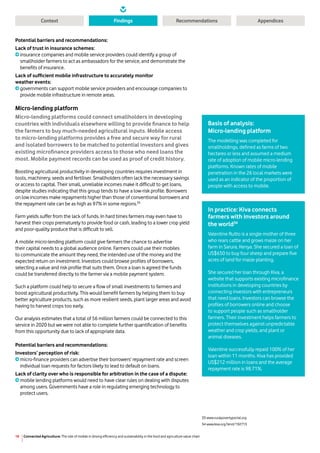
In practice: Kiva connects
farmers with investors around
the world34
Valentine Rutto is a single mother of three
who rears cattle and grows maize on her
farm in Sarura, Kenya. She secured a loan of
US$650 to buy four sheep and prepare five
acres of land for maize planting.
She secured her loan through Kiva, a
website that supports existing microfinance
institutions in developing countries by
connecting investors with entrepreneurs
that need loans. Investors can browse the
profiles of borrowers online and choose
to support people such as smallholder
farmers. Their investment helps farmers to
protect themselves against unpredictable
weather and crop yields, and plant or
animal diseases.
Valentine successfully repaid 100% of her
loan within 11 months. Kiva has provided
US$212 million in loans and the average
repayment rate is 98.71%.
Connected Agriculture: The role of mobile in driving efficiency and sustainability in the food and agriculture value chain19
Context RecommendationsFindings Appendices
Provision of agricultural information
Potential benefits in 2020:
•	Additional incremental income for farmers: US$52 billion
•	Water savings: 6% reduction in freshwater withdrawals
•	Carbon savings: 1.9 Mt
•	Anticipated connections to mobile information services: 174 million.
Farmers in developing countries struggle to get information about agricultural best
practices and new developments because poor transport and communications
infrastructure in isolated rural areas inhibit access to information sources. Using
mobile can bridge this information gap. Research conducted by Vodafone in 2009
indicated that mobile services, including mobile-enabled information services, were
already used in agriculture and starting to improve farmers’ knowledge and deliver
productivity improvements.35
Mobile phones make it possible to call a helpline or receive SMS alert messages,
giving farmers tips and advice to improve practices and productivity. Text and
voice-based services include weather forecasts, advice on tackling pests or diseases,
agricultural techniques, optimum times to plant crops, available subsidies, local fairs
and crop prices. Voice-based services also overcome the difficulties faced by those
unable to read or write, greatly improving their knowledge of good farming practices.
Using mobiles to increase access to expert agricultural information has the advantage
of providing real-time support, and could be a more cost-effective way of distributing
updates as well as complementing or reinforcing other sources of information that
help farmers.
Introducing new farming practices, securing better prices for crops and increasing the
productivity of farms improves communities’ standard of living. It also helps to save
farmers time, making it possible to supplement their income with other employment.
A mobile helpline can also help support services. By analysing the calls, agricultural
specialists and research organisations can build up a more accurate picture of the
challenges rural people face and the trends in agriculture.
This section focuses on two opportunities:
•	Mobile information platform: farmers receive text alerts direct to their mobile
phone, tailored to their location and the crops that they grow
•	Farmer helpline: farmers use their mobile phone to call a helpline staffed by
agricultural experts, giving them immediate advice.
Mobile information services could generate an additional US$52 billion in agricultural
income in 2020. This is based on an anticipated 174 million farmers being connected
to information platforms. Providing weather forecasts that help farmers to manage
water use for crop irrigation could save 6% of freshwater withdrawals for agriculture
in 2020, with potentially important savings in water-stressed India and Egypt. Farmers
using better techniques, machinery and products, and using agricultural inputs more
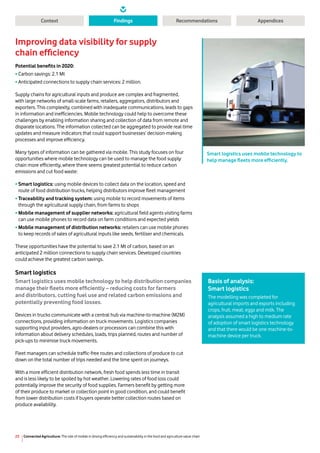
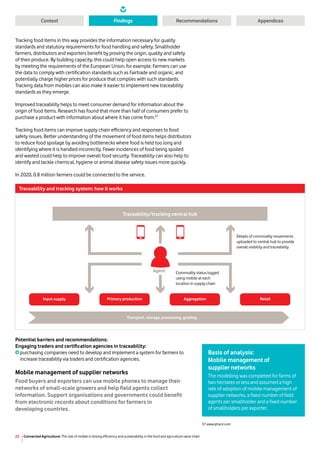
efficiently could lead to 1.9 Mt of carbon savings in 2020.
35	Vodafone Plc (January 2009) ‘India: The Impact of Mobile Phones’
The Policy Paper Series, Number 9
Using mobiles to increase access to
expert agricultural information has the
advantage of providing real-time support
and could be a more cost-effective way of
distributing updates.
Connected Agriculture: The role of mobile in driving efficiency and sustainability in the food and agriculture value chain20
Context RecommendationsFindings Appendices
Mobile information platform
Through mobile information platforms, farmers receive texts with news
and information that help to improve the productivity of their land
and increase their incomes. Governments and agricultural support
organisations can use the platforms to provide information about
available subsidies and programmes.
There are a number of services providing agricultural information via mobile already
available to farmers. One model is for users to pay a monthly fee to subscribe to
the information service through their existing mobile tariff. Other models include
applying a standalone charge. Farmers register their location and the type of
crops they grow so they can receive tailored text alerts specific to their needs. The
service providers work with partners such as commodity traders and government
meteorological departments to get the most up-to-date and relevant information.
Updates on local weather patterns help farmers plan planting, irrigation and
harvesting, while information on market prices and consumer trends helps them
choose which crops to plant and to get the best price for their produce. Technical
advice can improve farming practices to promote more sustainable agriculture and
better hygiene and processing techniques to reduce food wastage. The information
service could also cover government regulations and subsidies. Better-informed
farmers not only achieve higher productivity but may also save time, which they can
use to supplement their income with other employment.
As well as improving yields, receiving weather forecasts can help farmers save water
because if they know it is likely to rain, they can use less fresh water for crop irrigation.
In 2020, better information for farmers could reduce freshwater withdrawals by 6%
across the 26 countries included in the scope of this study. The greatest potential
for water savings is in countries with expected high uptake of mobile information
platforms and high freshwater usage for agricultural purposes (relative to total
freshwater availability). The Democratic Republic of Congo, Egypt, Mozambique,
India and Lesotho all have the potential to achieve more than 10% savings in total
freshwater withdrawals through provision of weather-related information and spread
of agricultural best practices through mobile information platforms.
Providing this information via mobile could provide additional agricultural income
of US$34 billion in 2020, based on an anticipated 116 million farmers using the
service. An estimated 1.3 Mt of CO2e could be saved by helping farmers
to use better techniques, machinery and products, and use agricultural inputs
more efficiently.
In practice: Vodafone provides
mobile information service for
farmers in Turkey
Vodafone is helping 350,000 farmers in
Turkey increase the productivity of their
farms by providing agricultural information
via SMS text messages to subscribers. The
‘Vodafone Farmers’ Club’ service provides
customised alerts including information on
the weather, crop diseases and infection
risks, agricultural rules and regulations,
marketplace prices for products, agricultural
donations and free invitations to fairs.
Subscribers to the service also benefit
from discounted handsets, free health
checks and accident insurance, and
discounts on farm machinery. Vodafone
Turkey provides the service in partnership
with Tarimsalpazarlama.com, which also
offers training sessions for subscribers on
sustainable agriculture and water awareness.
Partnerships with trusted parties such as the
Ministry of Agriculture and Rural Affairs help
them gather accurate information.
Basis of analysis:
Mobile information platform
The modelling was completed for
smallholder farms of two hectares or less
and assumed a high rate of adoption of
mobile information platforms. The analysis
of potential water savings was undertaken
for countries that are likely to experience
water stress and assumed a fixed percentage
saving on agricultural water use.
Connected Agriculture: The role of mobile in driving efficiency and sustainability in the food and agriculture value chain21
Context RecommendationsFindings Appendices
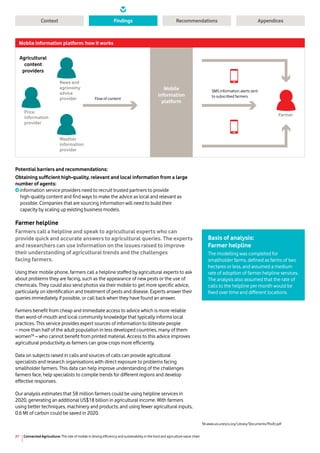
SMS information alerts sent
to subscribed farmers
Flow of content
Farmer
News and
agronomy
advice
provider
Price
information
provider
Agricultural
content
providers
Weather
information
provider
Mobile
information
platform
Mobile information platform: how it works
Potential barriers and recommendations:
Obtaining sufficient high-quality, relevant and local information from a large
number of agents:
information service providers need to recruit trusted partners to provide
high-quality content and find ways to make the advice as local and relevant as
possible. Companies that are sourcing information will need to build their
capacity by scaling up existing business models.
Farmer helpline
Farmers call a helpline and speak to agricultural experts who can
provide quick and accurate answers to agricultural queries. The experts
and researchers can use information on the issues raised to improve
their understanding of agricultural trends and the challenges
facing farmers.
Using their mobile phone, farmers call a helpline staffed by agricultural experts to ask
about problems they are facing, such as the appearance of new pests or the use of
chemicals. They could also send photos via their mobile to get more specific advice,
particularly on identification and treatment of pests and disease. Experts answer their
queries immediately if possible, or call back when they have found an answer.
Farmers benefit from cheap and immediate access to advice which is more reliable
than word-of-mouth and local community knowledge that typically informs local
practices. This service provides expert sources of information to illiterate people
– more than half of the adult population in less developed countries, many of them
women36
– who cannot benefit from printed material. Access to this advice improves
agricultural productivity as farmers can grow crops more efficiently.
Data on subjects raised in calls and sources of calls can provide agricultural
specialists and research organisations with direct exposure to problems facing
smallholder farmers. This data can help improve understanding of the challenges
farmers face, help specialists to compile trends for different regions and develop
effective responses.
Our analysis estimates that 58 million farmers could be using helpline services in
2020, generating an additional US$18 billion in agricultural income. With farmers
using better techniques, machinery and products, and using fewer agricultural inputs,
0.6 Mt of carbon could be saved in 2020.
36 www.uis.unesco.org/Library/Documents/PovEr.pdf
Basis of analysis:
Farmer helpline
The modelling was completed for
smallholder farms, defined as farms of two
hectares or less, and assumed a medium
rate of adoption of farmer helpline services.
The analysis also assumed that the rate of
calls to the helpline per month would be
fixed over time and different locations.
Connected Agriculture: The role of mobile in driving efficiency and sustainability in the food and agriculture value chain22
Context RecommendationsFindings Appendices
Potential barriers and recommendations:
Obtaining locally relevant agricultural information:
partnerships are needed between helplines and agents including agricultural
extension workers with local knowledge.
Managing operating costs of staffing helplines with agricultural experts:
governments, NGOs and private enterprises such as agricultural input distributors
and call centres need to work together to find the most cost-effective solutions.
Providing required communications infrastructure:
partnerships between mobile service providers and call centres are needed to
provide the infrastructure.
3. Query answered immediately
or after further research
Farmer
Agricultural
expert
1. Farmer places call to helpline 2. Farmer connected
directly to expert
Farmer
helpline
Farmer helpline: how it works
Connected Agriculture: The role of mobile in driving efficiency and sustainability in the food and agriculture value chain23
Context RecommendationsFindings Appendices
Improving data visibility for supply
chain efficiency
Potential benefits in 2020:
•	Carbon savings: 2.1 Mt
•	Anticipated connections to supply chain services: 2 million.
Supply chains for agricultural inputs and produce are complex and fragmented,
with large networks of small-scale farms, retailers, aggregators, distributors and
exporters. This complexity, combined with inadequate communications, leads to gaps
in information and inefficiencies. Mobile technology could help to overcome these
challenges by enabling information sharing and collection of data from remote and
disparate locations. The information collected can be aggregated to provide real-time
updates and measure indicators that could support businesses’ decision-making
processes and improve efficiency.
Many types of information can be gathered via mobile. This study focuses on four
opportunities where mobile technology can be used to manage the food supply
chain more efficiently, where there seems greatest potential to reduce carbon
emissions and cut food waste:
•	Smart logistics: using mobile devices to collect data on the location, speed and
route of food distribution trucks, helping distributors improve fleet management
•	Traceability and tracking system: using mobile to record movements of items
through the agricultural supply chain, from farms to shops
•	Mobile management of supplier networks: agricultural field agents visiting farms
can use mobile phones to record data on farm conditions and expected yields
•	Mobile management of distribution networks: retailers can use mobile phones
to keep records of sales of agricultural inputs like seeds, fertiliser and chemicals.
These opportunities have the potential to save 2.1 Mt of carbon, based on an
anticipated 2 million connections to supply chain services. Developed countries
could achieve the greatest carbon savings.
Smart logistics
Smart logistics uses mobile technology to help distribution companies
manage their fleets more efficiently – reducing costs for farmers
and distributors, cutting fuel use and related carbon emissions and
potentially preventing food losses.
Devices in trucks communicate with a central hub via machine-to-machine (M2M)
connections, providing information on truck movements. Logistics companies
supporting input providers, agro-dealers or processors can combine this with
information about delivery schedules, loads, trips planned, routes and number of
pick-ups to minimise truck movements.
Fleet managers can schedule traffic-free routes and collections of produce to cut
down on the total number of trips needed and the time spent on journeys.
With a more efficient distribution network, fresh food spends less time in transit
and is less likely to be spoiled by hot weather. Lowering rates of food loss could
potentially improve the security of food supplies. Farmers benefit by getting more
of their produce to market or collection point in good condition, and could benefit
from lower distribution costs if buyers operate better collection routes based on
produce availability.
Smart logistics uses mobile technology to
help manage fleets more efficiently.
Basis of analysis:
Smart logistics
The modelling was completed for
agricultural imports and exports including
crops, fruit, meat, eggs and milk. The
analysis assumed a high to medium rate
of adoption of smart logistics technology
and that there would be one machine-to-
machine device per truck.
Connected Agriculture: The role of mobile in driving efficiency and sustainability in the food and agriculture value chain24
Context RecommendationsFindings Appendices
Fewer trucks on the road and fewer trips mean less fuel is used. This keeps costs
down and our analysis estimates it could save 2.0 Mt of carbon in 2020. This is based
on an anticipated 0.2 million connections.
Potential barriers and recommendations:
The quality of road infrastructure in developing countries with single roads
connecting distribution points in many cases limits the number of potential
route alternatives:
public–private partnerships can help to attract further investment in vital
transport infrastructure.
Traceability and tracking system
Mobile technology can be used to track individual food products
through the supply chain from grower to retailer. Detailed tracking
improves supply chain efficiency and helps smallholder farmers, food
distributors and retailers provide the traceability that is increasingly
demanded by consumers. It can also help reduce food spoilage.
Mobiles can be used to log the location, quality and quantity of food items at
key points in the supply chain. Agents buying products at a farm and workers at
distribution centres can use mobile camera phones to scan product barcodes
providing details of the items. This information is sent to a central system to give
retailers, exporters and distributors a detailed view of product movements.
2. Smart logistics hub uses
knowledge of current position and
destination of each truck in the
fleet to calculate the optimum
routes, and provide details of any
additional pick-ups
1. Speed and location of each vehicle
in fleet communicated to hub
3. Routing information returned to each
truck, driver adapts to most efficient route
Smart
logistics
hub
Smart logistics: how it works
Truck
4. Additional pick-ups made if necessary
Basis of analysis:
Traceability and tracking system
The modelling was completed for farms of
two hectares or less and assumed a high
rate of adoption of mobile traceability and
tracking technology. It assumed that there
would be one mobile per agent.
Connected Agriculture: The role of mobile in driving efficiency and sustainability in the food and agriculture value chain25
Context RecommendationsFindings Appendices
Tracking food items in this way provides the information necessary for quality
standards and statutory requirements for food handling and safety. Smallholder
farmers, distributors and exporters benefit by proving the origin, quality and safety
of their produce. By building capacity, this could help open access to new markets
by meeting the requirements of the European Union, for example. Farmers can use
the data to comply with certification standards such as Fairtrade and organic, and
potentially charge higher prices for produce that complies with such standards.
Tracking data from mobiles can also make it easier to implement new traceability
standards as they emerge.
Improved traceability helps to meet consumer demand for information about the
origin of food items. Research has found that more than half of consumers prefer to
purchase a product with information about where it has come from.37
Tracking food items can improve supply chain efficiency and responses to food
safety issues. Better understanding of the movement of food items helps distributors
to reduce food spoilage by avoiding bottlenecks where food is held too long and
identifying where it is handled incorrectly. Fewer incidences of food being spoiled
and wasted could help to improve overall food security. Traceability can also help to
identify and tackle chemical, hygiene or animal disease safety issues more quickly.
In 2020, 0.8 million farmers could be connected to the service.
Potential barriers and recommendations:
Engaging traders and certification agencies in traceability:
purchasing companies need to develop and implement a system for farmers to
increase traceability via traders and certification agencies.
Mobile management of supplier networks
Food buyers and exporters can use mobile phones to manage their
networks of small-scale growers and help field agents collect
information. Support organisations and governments could benefit
from electronic records about conditions for farmers in
developing countries.
Traceability and tracking system: how it works
Details of commodity movements
uploaded to central hub to provide
overall visibility and traceability
Agent
Traceability/tracking central hub
Input supply Primary production Aggregation Retail
Transport, storage, processing, grading
Commodity status logged
using mobile at each
location in supply chain
Basis of analysis:
Mobile management of
supplier networks
The modelling was completed for farms of
two hectares or less and assumed a high
rate of adoption of mobile management of
supplier networks, a fixed number of field
agents per smallholder and a fixed number
of smallholders per exporter.
37 www.qtrace.com
Connected Agriculture: The role of mobile in driving efficiency and sustainability in the food and agriculture value chain26
Context RecommendationsFindings Appendices
Managing large numbers of small farms and growers requires networks of field
agents, auditors and technical staff to gather a wide range of information. They carry
out farm audits, check the quality and quantity of harvests, and report problems.
Keeping detailed paper records for this information is inefficient, can be erratic and
can lead to delayed decision making.
Equipping field agents with mobile phones improves the supplier management process,
providing a reliable, quick and cheap way of creating electronic records in a central
database. Field agents visiting farms can use their mobile phones to input data on
farmers’ locations, crops and expected yield. Mobile applications can provide prompts
for information required for tasks such as technical audits. More efficient processes
mean staff can visit more farms in less time, making fewer trips overall and reducing
carbon emissions as well as spreading best-practice information more effectively.
Agents visiting farms could collect information about agricultural conditions,
including diseases and pests, and social issues such as starvation and civil unrest.
This would provide NGOs, governments and research organisations with valuable data
on the challenges facing smallholder farmers and help to coordinate their response.
If agents use mobile to collect better data, they could help individual farmers within
their network of growers understand their performance, and suggest new techniques
and examples of best practice from other farms.
Farmers could also use mobiles to send information about their likely harvest
date and other key indicators to food buyers and other organisations. Buyers and
distributors could use this information to collect fresh food items more promptly
and get them to market as soon as possible, reducing food waste and increasing
agricultural incomes.
Managing grower networks could save 0.1 Mt of carbon in 2020, with an anticipated
0.6 million connections to mobile supplier management services.
Potential barriers and recommendations:
Lack of agriculture extension services network in some countries:
partnerships with NGOs and other stakeholders could facilitate the implementation
of extension services.
In practice: Mobile platform for
community care workers in South
Africa could be extended
to farmers38
Community health workers in South Africa
are already using mobile phones to collect
information about patients in the same way
that field agents could gather information
about farmers and their crops.
Nompilo is one example of how
Vodafone’s mobile platform is used by
community health workers to manage
data about patients and their treatments.
There are few medical facilities in rural
areas so community health workers
provide essential healthcare for patients
in their homes.
Through Nompilo, caregivers can access
patients’ health records and upload
new information on treatments or
request referrals. They can update records
more quickly and healthcare providers
can use the data on health workers’
location and progress to allocate
resources more effectively.
The technology behind Nompilo could
easily be adapted for agricultural field
workers visiting farms to keep records
about farmers and their crop yields.
Field agent visits allocated farms,
and records audit information
using mobile phone
Supplier network
data is uploaded
to central hub
for collation and
processing
Supplier
network
management
hub
Mobile management of supplier networks: how it works
Farmer
Field
agent
38 www.enterprise.vodafone.com/insight_news/2011-25-02-mobile-
technology-and-heathcare-south-africa.jsp
Connected Agriculture: The role of mobile in driving efficiency and sustainability in the food and agriculture value chain27
Context RecommendationsFindings Appendices
Mobile management of distribution networks
Distributors of agricultural inputs such as seeds, fertiliser and crop
protection products could use mobile to gather sales and stock data,
improving availability for farmers and increasing sales.
It can be difficult for distributors of seeds, fertiliser and crop protection products to
monitor and manage their wide network of retailers. Communications and transport
difficulties lead to information gaps. Mobile could help bridge the gaps and improve
understanding of sales and customer needs. Retailers could record sales using a
mobile camera phone to scan the barcode, sending this data straight to a central
system for analysis.
Building up a digital record of sales across a region could help distributors avoid
supply gaps. Improved understanding of supply and demand could also help identify
new market opportunities and tailor ranges to local needs. Farmers could benefit
through improved availability, lower travel costs to access agricultural inputs and
more consistent prices.
Our analysis estimates there could be a total of 0.4 million connections to services
for managing sales of agricultural inputs in 2020.
Potential barriers and recommendations:
Motivating agents and retailers to collect and supply data:
provide adequate incentives (such as free airtime), training and technical support
to users.
Purchases of agri-inputs are
recorded by distribution agents
using mobile phone
Customer purchase
data is uploaded to
central hub
Distribution
network
management
hub
Mobile management of distribution networks: how it works
Farmer
Distribution
agent
In practice: Using mobile to
manage stocks in Tanzania39
Staff in health clinics in Tanzania are using
mobile phones to record and manage stocks
of anti-malarial drugs. The technology used
to record the data could be transferred to
the agricultural sector and used by retailers
to keep track of sales of seeds and fertiliser.
The ‘SMS for Life’ service was developed
by Vodafone, pharmaceutical company
Novartis and the Roll Back Malaria
Partnership. At any one time, up to half of
the 5,000 dispensing locations in Tanzania
can lack vital supplies of anti-malarial
medication. The service sends SMS
messages to prompt staff in hospitals, clinics
and dispensaries to check medication stock
levels and they respond with a free message
to a central system. Healthcare authorities
use this data to make sure facilities are
stocked with the drugs they need. In a pilot
of the service, the number of health facilities
with stock-outs was reduced by over 75% in
one district alone.
The technology could be adapted to help
distributors of agricultural inputs monitor
shops’ seed and fertiliser stocks. Text
messages could be sent to remote retailers,
prompting them to send a message back
with information about their sales.
Basis of analysis: Mobile management of distribution networks
The modelling was completed for farms of two hectares or less, and assumed a
medium rate of adoption of mobile management of distribution networks and
one mobile device per agent.
39 www.vodafone.com/content/index/press/group_press_
releases/2010/sms_forlife.html
Connected Agriculture: The role of mobile in driving efficiency and sustainability in the food and agriculture value chain28
Context RecommendationsFindings Appendices
Enhancing access to markets
Potential benefits in 2020:
•	Additional incremental income for farmers: US$35 billion
•	Carbon savings: 0.5 Mt
•	Anticipated connections to mobile trading platforms: 133 million.
Mobile could help farmers in developing countries secure better prices for their crops
and improve competition in the supply chain through increased tendering.
Isolated smallholder farmers often have to sell their harvest at the farm gate with
little power to negotiate on price. Using mobile, farmers could access a marketplace
of potential buyers online and achieve better prices for their crops. As farmers
improve the return on their investment, they can afford more seeds and fertiliser and
plant larger areas, boosting their families’ incomes.
Similarly, a tendering platform could increase competition throughout the supply
chain. Farmers, food aggregators, distributors, exporters and wholesalers could post
and respond to tenders for contracts via mobile.
Mobile bartering platforms could help members of rural communities exchange
goods, services and skills with each other. Agricultural labourers could find work on
farms and growers could exchange surplus food after harvests.
The three opportunities for promoting agricultural trade are:
•	The agricultural trading platform: an online marketplace for farmers to trade
directly with buyers via their mobile phone
•	The agricultural tendering platform: a mobile platform for agricultural customers
and suppliers to post and respond to tenders for work and agree contracts
•	The agricultural bartering platform: a mobile platform where community
members can exchange goods and services with each other.
Linking customers and suppliers across the agricultural supply chain to trade, tender
or barter with each other could provide farmers with an additional US$35 billion in
income in 2020. This is based on an anticipated 133 million connections to mobile
trading platforms.
The agricultural trading platform
Linking smallholder farmers directly with potential buyers through
a mobile trading platform could help them to secure the best price
for their produce, as well as promoting investment in agriculture and
reducing food losses. Mobile trading platforms could help dealers
locate new sources of food when supplies are limited and could help
companies fulfil their commitment to sourcing from smaller and more
diverse businesses.
Smallholders in developing countries frequently get poor prices for their crops
because they have limited access to markets, and inadequate storage facilities mean
they cannot keep produce and wait for prices to rise. This results in low return on
investment and inhibits adoption of sustainable agricultural production practices.
Better knowledge of the market would encourage farmers to plant crops with better
return on their investment, while more efficient markets could reduce food waste.
Regional exchanges could combine to form country-wide trading networks, raising
the profile of developing countries’ agricultural output.
Basis of analysis:
Enhancing access to markets
The modelling was completed for farms of
two hectares or less with a medium rate of
adoption of mobile trading platforms and a
medium–low rate of adoption of agricultural
tendering and bartering platforms.
Connected Agriculture: The role of mobile in driving efficiency and sustainability in the food and agriculture value chain29
Context RecommendationsFindings Appendices
Farmers in developing countries could use their mobile phones to access online
commodity exchanges and trading platforms for agricultural products. Farmers could
achieve better immediate – or ‘spot’ – prices than dealing with traders buying at the
farm gate. With greater sophistication, farmers could buy futures or options at the start
of each growing season, providing certainty on how much they will get for their crops.
At the end of the season they can negotiate better prices for any surplus produce.
The platform could be combined with mobile payment systems to confirm the
transaction and could enable farmers to collect payments directly via mobile.
Boosting farmer income encourages farmers to invest more each season in better
quality seeds and fertiliser, and to plant larger areas for harvest. This could increase
agricultural income by US$16 billion in 2020, based on an anticipated 56 million
users accessing trading platforms via mobile. Reducing the number of trips to sell
produce could lead to 0.2 Mt of carbon being saved.
Potential barriers and recommendations:
Limited access to transport:
farmers either need access to transportation for their produce or need to trade with
buyers who can manage logistics. The trading platform should enable users to see
the logistics services that are available to each party.
Challenge of educating farmers about trading platforms:
trading platform providers and NGOs can work together to promote the benefits of
mobile trading to farmers and develop a network of ambassadors in communities
that have successfully used the service.
Lack of quality warehouse storage for agricultural produce:
governments and NGOs could help to improve infrastructure for storage. Mobile
technology could enable existing warehouses to be used more efficiently by
monitoring the produce stored and space available to reduce food waste and
track food stocks.
The agricultural tendering platform
Online platforms for submitting and bidding on tenders for food
distribution, processing and exporting could make the agricultural
supply chain more competitive and efficient.
There are many distribution, processing and export agents in developing countries
and poor communications make it difficult to achieve competitive business contracts
and tenders. Using mobile phones to access online tendering platforms could help
service users reach a wider supplier base and promote competition. For example,
a food aggregator could advertise a tender to a processing facility. Distribution
companies could browse tenders and submit their offers.
Providing mobile tendering platforms could provide an additional US$3 billion in
agricultural income in 2020 with an anticipated 22 million farmers using mobile
tendering platforms. More organised distribution networks could avoid 0.1 Mt of
carbon emissions.
Potential barriers and recommendations:
Lack of clarity over who is responsible for arbitration when disputes arise:
tendering platform providers would need to give clear instructions on their website
for dealing with disputes.
Working with farmer representative
organisations could support the uptake of
platforms helping to increase access
to markets.
Connected Agriculture: The role of mobile in driving efficiency and sustainability in the food and agriculture value chain30
Context RecommendationsFindings Appendices
The agricultural bartering platform
Mobile could help agricultural workers in rural communities exchange
goods and services and improve communities’ livelihoods.
For rural people with little or no disposable income, exchanging goods, services
and skills with community members is an important part of their livelihoods. Using
mobile, people could access an online bartering platform via their mobile phone,
significantly extending the network of people to barter with. Users could register their
location and the goods, services or skills they are offering, along with details of what
they need in return. SMS adverts could be sent to subscribed users, prompting them
to respond.
Transient agricultural workers could also use the platform to advertise their skills and
find work. Farm managers and owners could find workers at short notice, for instance
when they need to harvest crops early to stop them being ruined by bad weather.
Farmers could barter their surplus food items after a harvest so that food reaches
community members in need, rather than spoiling in poor storage.
Using mobile phones for bartering could help those most in need within agricultural
communities to access essential goods and services, and pass important skills from
one community member to another. Mobile bartering could increase agricultural
income by US$16 billion in 2020, with an anticipated 55 million farmers using the
service. Connecting local people to trade goods or services could reduce the number
of journeys they need to make, avoiding 0.2 Mt of carbon emissions.
Potential barriers and recommendations:
Lack of clarity over who is responsible for arbitration in the case of a dispute:
mobile bartering service providers would need to have clear rules on dealing
with disputes among users. Governments have a role in regulating emerging
technology to protect users.
In practice: Vodafone promotes
community bartering via mobile
in Egypt
A mobile bartering platform developed
by Vodafone Egypt is helping community
members exchange goods and services
through online adverts. The platform
could be used by agricultural workers in
rural communities.
Forsa, the Arabic word for opportunity,
is a mobile bartering platform that gives
low-income workers such as craftsmen and
domestic maids a low-cost way to advertise
their skills via their mobile phone. Forsa
helps to connect local people with each
other to exchange goods and services,
reducing the distances they have to travel
to make exchanges.
So far 3,000 adverts have been posted
through Forsa, helping people to make
exchanges with items like food crops,
petrol, or motorbike parts. Trained
‘ambassadors’ promote the service, earning
a small commission for showing new users
how to post adverts and find people to
exchange with.
31
Context RecommendationsFindings Appendices
Connected Agriculture: The role of mobile in driving efficiency and sustainability in the food and agriculture value chain
Mobile network operators have a leading role to play in the
successful realisation of the benefits outlined in this study,
but they will need the collective support of key stakeholders
across the agricultural supply chain. NGOs, private
enterprises and governments must also contribute their
knowledge and expertise to bring critical elements together.
The systems required to deliver the opportunities explored in this report are complex
and fragmented. In addition to the technology itself, there are a number of factors
which could help to overcome these complexities and support the implementation
and adoption of the services highlighted in this report. These include: building local
relationships and understanding local needs, testing options for delivery of services
through pilot projects and partnerships, and a favourable regulatory environment.
Building local relationships will be crucial in helping smallholder farmers to access
and benefit from mobile services. Engaging local stakeholders will help to ensure that
both the content provided and the services used to deliver this content are tailored to
their markets. Some services will need to be adapted for specific regions and, in some
cases, specific crops to maximise the benefits.
Pilot projects are important for testing new products and services with target customers
in local markets, helping mobile operators improve knowledge and understanding, as
well as gaining credibility with diverse stakeholders. Pilot projects help to identify and
solve problems, building the business case for the opportunities presented in this study.
They also provide an opportunity for partners to test out options for the delivery of
these services with a view to creating longer term partnerships.
The successful delivery of these opportunities will also require a supportive regulatory
environment. Governments have a vested interest in providing such support, with
potential tax revenues from successful initiatives and the social and economic benefits
generated which could, for example, alleviate pressure on support systems.
Each key stakeholder group has a role to play in putting these factors in place to
maximise the chances of successful implementation:
Non-governmental organisations: NGOs already have the relevant local
knowledge and relationships in place. Through strategic partnerships with mobile
network operators and governments, they can use this to extend the impacts of
their efforts well beyond their existing sphere of influence. Mobile operators will
look to them for guidance and local understanding to help ensure that the services
Recommendations
Connected Agriculture: The role of mobile in driving efficiency and sustainability in the food and agriculture value chain32
Context RecommendationsFindings Appendices
developed meet the needs of the end user, and that they are accessible to those
who need them the most, such as women farmers and farmers’ collectives and
associations. NGOs are critical to the empowerment of smallholders and are likely
to play an important role in implementing the services and related training. NGOs
themselves could also benefit from using mobile management of supplier networks
solutions, for example, to increase the visibility of field agents and collect better data
on the social and economic issues in rural communities.
Private sector: As key target customers for these services, companies in the agricultural
supply chain can help to: prioritise the most beneficial services, identify further
customisation for their supply chain and distribution needs, test the commercial, social
and environmental value they bring through partnerships, and support the scalable roll-
out of services. For example, food manufacturers could benefit from the supply chain
management and optimisation tools identified in this report to increase efficiency and
support their sustainability objectives in building capacity among smallholder farmers in
the value chain. By partnering with mobile network operators to develop these services,
companies could increase supply chain reliability and quality control. Similarly, financial
service providers could partner with mobile network operators to develop cost-effective
mobile payment, micro-insurance and micro-lending solutions.
Governments: Governments will need to work with and understand the role of banks,
commodity exchanges, mobile network operators, private enterprise and NGOs when
designing favourable policies. Governments can also help ensure the integrity of content
and support the development of locally relevant content through their agriculture
departments which, in many cases, have already collected much of the information
needed. There are existing cases of government agricultural departments successfully
partnering with mobile operators to provide this content. Governments could also derive
great benefit from these mobile services. Information platforms and management of
supplier networks via mobile could help civil servants gather agricultural field data.
Mobile payment solutions could help governments distribute agricultural subsidies
securely to the intended recipient, and data collection on farmers’ yield and transactions
could help governments ensure there is sufficient storage for harvested crops.
Mobile network operators: As the technology ‘owner’ or service provider, mobile
network operators are well-positioned to act as a catalyst for action and drive these
initiatives.Operatorshaveanumberofassetsandcapabilitiesthatreinforcethisposition:
•	Technology – the services addressed in the report will require the development of
mobile platforms which will draw on the technological expertise of mobile operators.
•	Long-term commitment – in many parts of the world, there has already been rapid
progress in providing mobile communications to underserved communities, often
leap-frogging other technologies. For example, access to a computer is no longer a
prerequisite for access to the internet thanks to the affordability and ease of access
through mobile. Through investment in licences and infrastructure, mobile network
operators are demonstrating a long-term commitment in markets to build coverage,
products and services which will deliver economic and social benefits.
•	Established distribution channels – mobile network operators already have
established distribution channels which can be used to distribute marketing and
training information on these services. For example, M-PESA agents could advertise
the benefits of mobile services for agriculture to their existing customers.
•	Trusted relationships – the trusted relationship that mobile operators have with
their customers could facilitate implementation. Customers already engage with
mobile operators on a daily basis, through distribution agents, the use of mobile
money transfer services and other services.
In conclusion, there is a clear need for close cooperation between mobile network
operators, governments, NGOs and the private sector to deliver the products,
services and potential benefits outlined in this report. The issues and interests of
these stakeholders are converging and it is in their long-term interests to make these
initiatives a success. By working together, they can use mobile technology to unlock
enormous benefits for the agricultural sector, particularly in the developing world.
Opportunities outlined in the report can
enable companies to increase efficiency
and support sustainability objectives in
building capacity among smallholder
farmers in the value chain.
Istock image - approval needed
Connected Agriculture: The role of mobile in driving efficiency and sustainability in the food and agriculture value chain33
Context RecommendationsFindings Appendices
Appendix 1: Research methodology
Opportunities for addressing key sustainability challenges faced by the food and
agricultural sector were identified through desk-based research and consultation
with representatives from across the sector.
All opportunities identified were then prioritised using a number of relevant
assessment criteria (see figure 1) to generate a shortlist representing the most
attractive opportunities. The 12 shortlisted opportunities span four main categories
(see figure 2).
See pages 11 to 12 for further information about the methodology.
Appendices
Figure 1: Assessment criteria for shortlisting of opportunities
Category Item Diagnostic
Commercial Market potential What is the market potential?
Implementation cost What are the costs associated with engaging and implementing the opportunity?
Social Agricultural income What is the potential to increase agricultural income (eg productivity, price,
input cost)?
Income diversification What is the potential to drive/develop alternative sources of income and/or
improve food security?
Gender equality What is the potential to promote gender equality and empower women?
Environmental Carbon What is the potential reduction in carbon emissions?
Water What is the potential reduction in water consumption?
Waste What is the potential reduction in waste production?
Chemicals What is the potential reduction in chemical inputs?
Bio-diversity What are the potential benefits for bio-diversity?
Connected Agriculture: The role of mobile in driving efficiency and sustainability in the food and agriculture value chain34
Context RecommendationsFindings Appendices
Figure 2: Shortlisted opportunities
Improving access to
financial services
Mobile payment system
Method of sending payments via cellular networks for
registered users
Micro-insurance system
Automatic funding of additional insurance premiums at the
time of purchase of input goods
Micro-lending platform
Provided by P2P transfers and/or by advertising to
external investors
Provision of agricultural
information
Mobile information platform
A choice of receiving a set number of push messages per
week, alerts only, or information on demand
Farmer helpline
Voice-based information-on-demand service, staffed by
agricultural experts
Improving data visibility for
supply chain efficiency
Smart logistics
Mobile-enabled tracking devices used to communicate
vehicle movements to fleet management systems
Traceability/tracking system Recording of movements of products along the food chain
Mobile management of supplier networks
Mobile technology for produce buyers to manage their
grower networks
Mobile management of distribution networks
Mobile technology for input supply companies to manage
their inventory and rural distribution networks
Enhancing access to markets
Agricultural trading platform
Use of a mobile (and online) portal to bring together farmers
and traders for the purposes of buying and selling goods,
tendering for services and bartering
Agricultural tendering platform
Agricultural bartering platform
Connected Agriculture: The role of mobile in driving efficiency and sustainability in the food and agriculture value chain35
Context RecommendationsFindings Appendices
Appendix 2: Basis of analysis
For each of the 12 opportunities analysed, models were developed to compute 2020
figures for the number of mobile connections to services and any potential social and
environmental benefits, such as increases in agricultural income and carbon savings
across 26 countries where Vodafone is present, either through subsidiaries, joint
ventures or associates.
For each opportunity, the increase in agricultural income was based on the potential
uplift in average value added per agricultural worker. The potential uplift factor was
based on empirical field studies where available, rather than attempting to model the
complex individual drivers responsible for increasing smallholder income.
Figure 3: Quantitative assessment methodology
Figure 4: Basis of quantitative analysis
For opportunities where it was not possible to model quantifiable benefits, the basis of analysis is not applicable
Country-
specific inputs
Country-
specific factorsSegmentation
Savings/
improvement
factors
Benefits
eg
•	total population
•	area of
agricultural land
•	size of
smallholder farms
eg
•	trip distance for
produce transport
•	percentage of
produce exported
eg
•	percentage of
population which
is rural
•	mobile
penetration rate
eg
•	percentage increase
in farmer income
•	percentage
reduction in trip
distance
•	distance reduction
in water use
eg
•	farmer income
•	carbon
•	water
Mobile payment
system
Micro-insurance
system
Micro-lending
platform
Base market
Metric
Number of people employed
in agriculture
Land under cereal
production
Number of smallholdings
Assumptions Age distribution fixed
Insure crops susceptible to
weather events only
Smallholding defined as
2 ha farm
Confidence High High Medium
Key segmentation
Metric Mobile penetration
Amount of fertiliser and
seeds applied
Mobile penetration
Assumptions
Used as proxy for proportion
of population who have
access to mobile
Fixed seed input rate across
time/geography
Used as proxy for proportion
of population who have
access to mobile
Confidence High Low High
Adoption rate Level (H/M/L) High Medium Medium
Commercial
Metric Transactions per month
Price per tonne fertiliser,
seeds
Agricultural input cost per
hectare of land
Assumptions
Transaction frequency based
on M-PESA study
Fixed price across time/
geography
Fixed % of this agricultural
input cost across time/
geography has to be
borrowed
Confidence High Low Low
1 2 3 4 5
Connected Agriculture: The role of mobile in driving efficiency and sustainability in the food and agriculture value chain36
Context RecommendationsFindings Appendices
Mobile payment
system
Micro-insurance
system
Micro-lending
platform
Environmental
Metric
Average distance between
cities
N/A N/A
Assumptions
Homogeneous distribution
of cities, fixed % of
remittance trips saved
N/A N/A
Confidence Low N/A N/A
Social
Metric
Valued added per agricultural
worker
N/A N/A
Assumptions
Fixed % increase on value
added per worker
N/A N/A
Confidence Medium N/A N/A
Mobile information services
Mobile information platform Farmer helpline
Base market
Metric Number of smallholdings Number of smallholdings
Assumptions Smallholding defined as 2 ha farm Smallholding defined as 2 ha farm
Confidence Medium Medium
Key segmentation
Metric Mobile penetration Mobile penetration
Assumptions
Used as proxy for proportion of
population who have access to
mobile
Used as proxy for proportion of
population who have access to
mobile
Confidence High High
Adoption rate Level (H/M/L) High Medium
Commercial
Metric Subscription rate per month Call rate per month
Assumptions Fixed rate over time/geography Fixed rate over time/geography
Confidence Medium Medium
Environmental
Metric
Water saving on agricultural
withdrawals, Carbon saving on
agricultural CO2 emissions
Carbon saving on agricultural CO2
emissions
Assumptions Fixed % saving on total withdrawals
and emissions
Fixed % saving on emissions
Confidence Medium Medium
Social
Metric Valued added per agricultural worker Valued added per agricultural worker
Assumptions Fixed % increase on value added per
worker
Fixed % increase on value added
per worker
Confidence Medium Medium
Connected Agriculture: The role of mobile in driving efficiency and sustainability in the food and agriculture value chain37
Context RecommendationsFindings Appendices
Supply chain management and optimisation
Smart logistics
Traceability and
tracking system
Management of
supplier networks
Management
of distribution
networks
Base market
Metric
Total exports and
imports of agricultural
goods
Number of
smallholdings
Number of
smallholdings
Number of
smallholdings
Assumptions
Crops, fruit, meat, eggs
and milk included
Smallholding defined as
2 ha farm
Smallholding defined
as 2 ha farm
Smallholding defined
as 2 ha farm
Confidence Medium Medium Medium Medium
Key segmentation
Metric Fixed % transported
by road
Number of monitoring
agents per exporter
Number of field agents
working for exporters
Number of distributors
per smallholder
Assumptions
Average tonnage per
truck, average distance
travelled per truck
Suppliers proportional
to ratio of export to
production
Fixed number of
smallholders per
exporter, fixed number of
agents per smallholder
Fixed number of
distributors per
smallholder
Confidence Medium Medium Low Low
Adoption rate Level (H/M/L) High–Medium High High Medium
Commercial
Metric Number of M2M
devices
Number of
mobile devices
Number of
mobile devices
Number of
mobile devices
Assumptions One device per unit One device per unit One device per unit One device per unit
Confidence High High High High
Environmental
Metric
Average saving on
distance
N/A Efficiency saving on
transported produce
N/A
Assumptions
Distance between
cities proxy for average
distance travelled
N/A Fixed efficiency saving N/A
Confidence Low N/A Low N/A
Social
Metric N/A N/A N/A N/A
Assumptions N/A N/A N/A N/A
Confidence N/A N/A N/A N/A
Connected Agriculture: The role of mobile in driving efficiency and sustainability in the food and agriculture value chain38
Context RecommendationsFindings Appendices
Mobile agricultural trade services
Agricultural
trading platform
Agricultural
tendering platform
Agricultural
bartering platform
Base market
Metric Number of smallholdings Number of smallholdings Number of smallholdings
Assumptions Smallholding defined as
2 ha farm
Smallholding defined as
2 ha farm
Smallholding defined as
2 ha farm
Confidence Medium Medium Medium
Key segmentation
Metric Mobile penetration Mobile penetration Mobile penetration
Assumptions
Used as proxy for proportion
of population who have
access to mobile
Used as proxy for proportion
of population who have
access to mobile
Used as proxy for proportion
of population who have
access to mobile
Confidence High High High
Adoption rate Level (H/M/L) Medium Medium–Low Medium–Low
Commercial
Metric Transactions per month Transactions per month Transactions per month
Assumptions Transaction frequency based
on M-PESA study
Transaction frequency based
on M-PESA study
Transaction frequency based
on M-PESA study
Confidence Low Low Low
Environmental
Metric Average distance
between cities
Average distance
between cities
Average distance
between cities
Assumptions
Homogeneous distribution
of cities, fixed % of trips to
market saved
Homogeneous distribution
of cities, fixed % of trips to
market saved
Homogeneous distribution
of cities, fixed % of trips to
market saved
Confidence Low Low Low
Social
Metric Valued added per
agricultural worker
Valued added per
agricultural worker
Valued added per
agricultural worker
Assumptions Fixed % increase on value
added per worker
Fixed % increase on value
added per worker
Fixed % increase on value
added per worker
Confidence Low Low Low
Connected Agriculture: The role of mobile in driving efficiency and sustainability in the food and agriculture value chain39
Context RecommendationsFindings Appendices
Appendix 3: Acknowledgements
The authors would like to thank the workshop participants,
Vodafone and Accenture participants, interviewees and special
advisors who were involved in this study.
External workshop participants
Ed Keturakis	 Abt Associates Inc.
Krishna Kumar	 ACDI/VOCA
Mboka Mwanitu	 Agricultural Council of Tanzania
Sujata Ramakrishna	 Bayer MaterialScience Pvt. Ltd.
Tom Harrison	 Business Innovation Facility
Sharbendu Banerjee	 CABI
Delly Mashele	 CARE International
Rehema Ambokile	 Centre for Sustainable
	 Development Initiatives
Burton Twisa	 Concern Worldwide
Geraldine Murphy	 Department for International
	 Development (UK)
Nick Evans	 Equal Exchange
Jim Vernon	 FINTRAC
Richard Pluke	 FINTRAC
Onesmo Mbelle 	 Food and Agriculture Organization of the 		
	 United Nations
Ritobaan Roy	 GIZ
Natalia Pshenichnaya	 GSMA Development Fund
Fiona Smith	 GSMA Development Fund
Diana Gayle	 GSMA Development Fund
Manju George	 Intellecap
Olaf Erz	 International Institute for Communication 	
	  Development
Nirmal Reddy	 ITC Ltd.
Michael Ogawa	 Khulisa Management Services
Rukudzo Murapa	 Khulisa Management Services
Mette Olsen	 Maersk Line
Kissinger Maponya	 MassMart Holdings Ltd.
Shelton Timm	 MassMart Holdings Ltd.
Brian Grant	 MEDA
Zach Jama	 MEDA
Ricki Justice	 MEDA
Alfred Mapunda	 Ministry of Industry, Trade and Marketing
Kobus Lindeque	 Monsanto
Jitesh Gupta	 Monsanto
Sarita Bahl	 Multi Commodity Exchange of India Ltd.
Sridhar K	 Olam
Krishna Kumar Pillai	 Olam
Naimur Rahman	 OneWorld Foundation
Tahseen Alam	 Oxfam India
Vanita Suneja	 Oxfam India
Avijit Dey	 Plan India
Mary Haule	 RENTC
Felix Maganjila	 RENTC
Helen Baker	 Sainsbury’s Supermarkets Ltd.
Casmir Makoye	 SME Competitiveness Facility
Jeffrey Lewis	 Southern Agricultural Growth Corridor
	 of Tanzania
Vikas Soni	 Syngenta
Mathieu Le Bras	 Syngenta
Elias Chikoto	 Syngenta
Ernest Massae	 Syngenta
Naiga Malilo	 TAHA
Katrine Plesner	 Tanzania Agriculture Partnership
Yvonne Lane	 Technoserve
Andrew Johnson	 Technoserve
Jacie Jones	 Technoserve
Andrew Emmott	 Twin  Twin Trading
Gene Peuse	 USAID
Ana Fernandez	 World Food Programme
Dominique Leclercq	 World Food Programme
External interviewees
Anna Swaites	 Kraft Foods Inc.
Mike Barry	 Marks  Spencer Group plc.
Nicola Jowell	 South African Breweries Ltd.
Patrick Mirbey	 Syngenta AG
Special advisors
Michael Riggs	 Food and Agriculture Organization of
	 the United Nations
Special thanks to Kavita Prakash-Mani, Head of Food Security
Agenda, Syngenta International AG, who provided her feedback on
the report.
Connected Agriculture: The role of mobile in driving efficiency and sustainability in the food and agriculture value chain40
Context RecommendationsFindings Appendices
Vodafone participants  interviewees
Rupal Vaidya	 Vodafone
Derek Appiah	 Vodafone (Ghana)
Chris Burgess	 Vodafone Group
Laura Crow	 Vodafone Group
Christèle Delbé	 Vodafone Group
Gustav Grundin	 Vodafone Group
Tobin Ireland	 Vodafone Group
Kerry Snelling	 Vodafone Group
Naveen Chopra	 Vodafone India (Essar)
Marc Sauter	 Vodafone M2M
Feroz Koor	 Vodacom (South Africa)
Dylan Lennox	 Vodacom (Tanzania)
Candice Rato	 Vodacom (Tanzania)
Jacques Voogt	 Vodacom (Tanzania)
Yigit Ozcan	 Vodafone Turkey
Garren Bird	 Vodafone UK
Scott Petty	 Vodafone UK
Andy McFarlane	 Vodafone (VGE)
Accenture participants  advisors
Pooja Bhatt	 Accenture Development
	 Partnerships (India)
Trip Allport	 Accenture Development Partnerships 		
	 (South Africa)
Puneet Chopra	 Communication  Hi-Tech (India)
Ryan Coffee	 High Performance Institute (India)
Raghav Narsalay	 High Performance Institute (India)
Mark Purdy	 High Performance Institute (UK)
Melissa Barrett	 Sustainability Services (UK)
Vodafone, the Vodafone logo, Vodacom and M-PESA are trademarks of the Vodafone Group. Other products and company names mentioned herein may be the trademarks of their respective owners.
Copyright © Vodafone Group 2011
Special thanks to Chris Burgess who helped develop the concept
of this report in his former role as Vodafone Group
Sustainability Director.
Accenture
Registered office:
1 Plantation Place
30 Fenchurch Street
London
EC3M 3BD
England
Tel: +44 (0) 20 7844 4000
Fax: +44 (0) 20 7844 4444
For more information visit: www.accenture.com/sustainability
Vodafone Group Plc
Registered office:
Vodafone House
The Connection
Newbury
Berkshire
RG14 2FN
England
Tel: +44 (0) 1635 33251
Fax: +44 (0) 1635 45713
For more information visit: www.vodafone.com/responsibility
Edited by Context
Design and production by Flag
Date of publication: September 2011

connected_agriculture

  • 1.
    Connected Agriculture The roleof mobile in driving efficiency and sustainability in the food and agriculture value chain
  • 2.
    Connected Agriculture: Therole of mobile in driving efficiency and sustainability in the food and agriculture value chain1 FindingsContext AppendicesRecommendationsFindingsContext AppendicesRecommendations Authors and contributors Vodafone Vodafone Group Plc is one of the world’s largest mobile communications companies by revenue. It has a significant presence in Europe, the Middle East, Africa, Asia Pacific and the US through the company’s subsidiaries, joint ventures, associated undertakings and investments. Vodafone plays an active role in seeking to address the challenges faced by today’s emerging economies through the use of technology. Using the Millennium Development Goals as a focal point, the company has worked in partnership with other multinationals and organisations such as the GSMA, UN Foundation and the UK Department for International Development to provide products and services that help to tackle hunger, reduce child mortality and support women. Vodafone’s mobile money transfer service, M-PESA, has proved extremely successful at bringing basic financial services to the rural poor in Kenya and other countries, together with a wide range of community benefits. Other examples include programmes such as the GSMA mWomen initiative which aims to address barriers preventing women from using mobile, and SMS for Life which is improving the management of anti-malarial medication stocks in rural Tanzania. Vodafone authors: • Matthew Kirk, Group External Affairs Director • Julie Steele, Sustainability Director, Group External Affairs (Project Sponsor) • Christèle Delbé, Head of Sustainability, Group External Affairs (Project Manager) • Laura Crow, Sustainability Analyst, Group External Affairs (Subject Matter Expert) Vodafone key contributors: • Greg Reeve, Head of Mobile Payment Solutions, Group Commercial Development • Garren Bird, Principal Strategy Manager – New Business, Group Commercial Development • Mike Ritchie-Cox, Head of Consumer Goods Industry, Vodafone Global Enterprise • Dylan Lennox, Managing Executive, New Technologies, Vodacom Tanzania Limited Contents Context Foreword from Vittorio Colao, Vodafone 3 Foreword from Peter Lacy, Accenture 4 Foreword from Dame Barbara Stocking, Oxfam 5 Executive summary 7 Context 9 Findings Improving access to financial services 15 Provision of agricultural information 19 Improving data visibility for supply chain efficiency 23 Enhancing access to markets 28 Recommendations Appendices Appendix 1: Research methodology 33 Appendix 2: Basis of analysis 35 Appendix 3: Acknowledgements 39 1 13 31 33 1 13 31 33
  • 3.
    Connected Agriculture: Therole of mobile in driving efficiency and sustainability in the food and agriculture value chain2 Context RecommendationsFindings Appendices Accenture Accenture is a global management consulting, technology services and outsourcing company. Combining unparalleled experience, comprehensive capabilities across all industries and business functions, and extensive research on the world’s most successful companies, Accenture collaborates with clients to help them become high-performance businesses and governments. With approximately 215,000 people serving clients in more than 120 countries, the company generated net revenues of US$21.5 billion for the fiscal year 2010. Accenture Sustainability Services helps organisations achieve substantial improvement in performance and value for their stakeholders. We help clients leverage their assets and capabilities to drive innovation and profitable growth while striving for a positive economic, environmental and social impact. We work with clients across industries and geographies to integrate sustainability approaches into their business strategies, operating models and critical processes. Our holistic approach encompasses strategy, design and execution to increase revenue, reduce cost, manage risk and enhance brand, reputation and intangible assets. Find out more at www.accenture.com/sustainability or contact us at sustainability@accenture.com. Accenture authors: • Justin Keeble, Director, Sustainability Services (Project Lead) • Caroline Fricke, Manager, Sustainability Services (Project Manager) • Richard Myerscough, Consultant, Strategy Practice • Gib Bulloch, Executive Director, Accenture Development Partnerships Accenture key contributors: • Steven Yurisich, Industry Specialist, Communications and High Tech • Barry Nee, Agribusiness Practice Lead • Gareth Weir, Manager, Accenture Development Partnerships (Tanzania) • Kathryn Brownlie, Head of Agricultural Research • Oliver Grange, Manager, Strategy Oxfam Oxfam is a vibrant global movement of dedicated people fighting poverty. Our purpose is to work with others to overcome poverty and suffering. We believe that in a world rich in resources, poverty is not inevitable. It is an injustice which can, and must, be overcome. Working with local partner organisations in more than 60 of the poorest countries around the world, Oxfam concentrates on three interlinking areas of work: development projects that put poor people in charge of their lives and livelihoods, campaigning for change that lasts, and rebuilding lives after emergencies. Oxfam key contributors: • David Bright, Senior Advisor, Markets and Enterprise, Programme Policy Team • Liz Kirk, Global Advisor, Private Sector, Programme Policy Team
  • 4.
    Connected Agriculture: Therole of mobile in driving efficiency and sustainability in the food and agriculture value chain3 Context RecommendationsFindings Appendices Foreword from Vittorio Colao, Vodafone Group Chief Executive Officer One third of humanity is fed through an estimated 500 million1 smallholder farms with less than two hectares of land. In Asia and sub-Saharan Africa the dependence is even higher, where small farms produce about 80%2 of the food consumed. These holdings are typically managed by families with limited technical and mechanical support and with poor access to finance. It is often difficult for them to make ends meet, let alone grow their business. Looking ahead, the impact of climate change, water scarcity and increasing land scarcity will make this even more difficult. With the world’s population expected to grow by 750 million in 2020, and demand for food to increase by 70% by 2050, it is clear that something has to be done to improve the efficiency of food production and distribution. Mobile has already had a huge impact on society, so much so that Jeffrey Sachs, Director of the Earth Institute at Columbia University, has described the mobile phone as the ‘single most transformative tool for development’. In part, this is because a mobile phone does not have the same barriers to access as other forms of technology and is simple, inexpensive and convenient to use. Access to mobile networks is now widely available, even in remote areas. Soon it will be possible for everyone and – just as importantly – everything to be connected. This not only offers people the ability to stay in touch with friends and family but it also provides access to finance, improved healthcare solutions, supply chain efficiencies and increasingly automated mobility. As well as providing benefits to society, these services are commercially successful and therefore, we believe, more sustainable in the long term. Vodafone’s footprint extends across many parts of Africa and India. In addition, we provide telecommunications services to some of the world’s largest food and agricultural commodity businesses. It is a logical step for us to explore ways in which mobile could improve productivity and income for agricultural producers, and reduce costs and improve traceability for buyers and processors. This report outlines some of our initial ideas. We cannot act on them without the support of partners. As well as suggesting ways in which mobile can improve agricultural productivity, this report is also an invitation to our customers, our suppliers, government organisations and non-government organisations (NGOs). We would like to collaborate with you to drive positive change in this vital sector. I hope you find our ideas inspiring. Vittorio Colao, Vodafone Group Chief Executive Officer We are exploring ways to use mobile to improve agricultural productivity. But we cannot act on them without the support of partners. This report is an invitation to our customers, our suppliers, government organisations and non-government organisations to help us make a difference. 1 Oxfam (2011) ‘Who will feed the world?’ 2 International Fund for Agricultural Development (IFAD) (2011) ‘Smallholders can feed the world’
  • 5.
    Connected Agriculture: Therole of mobile in driving efficiency and sustainability in the food and agriculture value chain4 Context RecommendationsFindings Appendices Foreword from Peter Lacy, Managing Director, Accenture Sustainability Services, EALA The telecommunications industry has long been at the heart of global commerce, having transformed businesses across all industry sectors. However, it is only in recent years that mobile communications technology has been widely accepted as an enabler of sustainable growth. In developing markets, where the deployment of mobile telecommunications networks has surpassed traditional fixed-line technology, the mobile telecoms industry is well-placed as an enabler of higher performance in the value chain. There is a distinct need for market-led opportunities, and the opportunity for mobile operators to deliver these is significant. It is to this end that Vodafone and Accenture have joined forces, together with Oxfam, to identify the key underlying issues which could be addressed through the application of mobile technology, and to quantify the potential benefits delivered. Vodafone and its industry peers have a clear role to play in enabling higher efficiency in the food and agricultural value chain and, in doing so, can deliver both direct and indirect benefits to society and the environment. Twelve opportunities have been identified that could have widespread multiplier effects on the lives and livelihoods of many smallholder farmers in developing countries through the provision of better access to markets, information and finance. In 26 countries across Vodafone’s footprint, these 12 opportunities could together increase agricultural income by US$138 billion in 2020, an increase of 11%. Additional benefits could include avoided greenhouse gas emissions and reduced freshwater withdrawals. It is estimated that around 549 million mobile connections to services will be required to realise these benefits. The findings and recommendations provide a firm basis to bring together the multiple stakeholders that will be needed for long-term success. Mobile telecom operators will need to work with governments, NGOs, donors and the private sector to develop and implement new opportunities to drive high performance in the sector. Peter Lacy, Managing Director, Accenture Sustainability Services, EALA These 12 communications opportunities can drive real efficiency in food and agriculture value chains, increasing farmers’ income by 11% – or US$138 billion – in 2020 and reducing waste and environmental impact.
  • 6.
    Connected Agriculture: Therole of mobile in driving efficiency and sustainability in the food and agriculture value chain5 Context RecommendationsFindings Appendices Foreword from Dame Barbara Stocking, Chief Executive Officer, Oxfam Oxfam welcomes this report. Its focus on the opportunity to improve agricultural productivity using mobile services highlights the opportunity to bring new investment to a key group: smallholder farmers. Oxfam recognises that mobile telephony could have significant potential to help the poorest farmers towards greater food and income security. An estimated 1.5 to 2 billion people worldwide are dependent on smallholder agriculture and these smallholders include half the world’s under-nourished people.3 Investment that can increase the productivity and incomes of smallholders – particularly female smallholders – remains the best opportunity for these 1.5 to 2 billion people worldwide to feed themselves and trade their way out of poverty. Investment in agriculture is complex, but has huge potential to impact the major development issues we face today: climate change and hunger; economic growth and gender inequity; poor health and nutrition; and environmental sustainability. Investing in smallholder agriculture lies at the heart of Oxfam’s long-term strategy both to increase the productivity of subsistence farmers, as well as to increase smallholders’, particularly women’s, abilities to participate in agricultural markets. Oxfam recognises that mobile telephony could have significant potential to help the poorest farmers towards greater food and income security. In Tanzania, we are trialling a programme working with government to monitor the quality of government services to farmers using mobile telephony. In Cambodia, the Philippines and Indonesia, we are testing market information accessibility through SMS servicing, and in Bangladesh, we are working to provide storm warnings to fishing communities via mobile phones. Oxfam has not been involved in modelling the potential impacts included in the report and therefore, we cannot comment on how these impacts have been quantified. However, we particularly welcome the focus that this research places on: • Mobile financial services and mobile information platforms as areas offering significant potential to support the poorest to invest in their farms. Mobile financial services can fill the banking gap felt by the poorest farmers. With access to savings or insurance services, farmers can reduce the impact of extreme weather events and invest in improving production. Meanwhile, mobile information platforms open up significant additional routes to potential markets, relaying information on prices for inputs and produce sales, as well as information on how to grow and respond to a context of climate change through the dissemination of reliable seasonal weather forecasts4 • How core business, rather than corporate philanthropy, can operate to have positive developmental impact • The importance of developing new business models – models that offer greater opportunities and reduce risks for smallholders, as either suppliers or consumers in the value chain. 3 WDR (2008) ‘Agriculture for Development’ (p.3) states that there are 1.5 billion people in smallholder households; P. Hazell, C. Poulton, S. Wiggins and A. Dorward (2006) ‘The Future of Small Farms’ (Synthesis Paper) states over 2 billion. These smallholders include half of the world’s undernourished people, three-quarters of Africa’s malnourished children, and the majority of people living in absolute poverty (IFPRI, 2005). 4 Access to reliable seasonal forecasts, plus support on how to use that information, has been demonstrated to increase yields by 9.4–18.7% in Zimbabwe, with even greater benefits reported from some other parts of the world. Ref: Anthony Patt, Pablo Suarez, and Chiedza Gwata (2005). Effects of seasonal climate forecasts and participatory workshops among subsistence farmers in Zimbabwe. Proceedings of the National Academy of Sciences of the United States of America; vol. 102; no. 35; 12,623–12,628.
  • 7.
    Connected Agriculture: Therole of mobile in driving efficiency and sustainability in the food and agriculture value chain6 Context RecommendationsFindings Appendices To ensure that the focus areas above can most effectively assist with poverty reduction, it will be useful to take a further look at the following qualitative aspects of deploying new mobile technologies: • How mobile technology could improve the efficiency of government safety net systems that assist the poorest and most food insecure small farmers – rather than looking only at the role that mobile technology can play in increasing farmer productivity and income from agriculture • How companies such as Vodafone can better understand, document and address barriers to the use of mobile technology affecting women. Getting new technology owned and used by women often carries significant challenges, for example overcoming illiteracy and cultural norms which mean that men tend to be the early owners and beneficiaries of new technologies • How mobile technology could drive new agricultural practices rather than simply greater efficiency in current practices, particularly around climate change adaptation, and ensuring focus is given to a full range of opportunities around climate change adaptation. Oxfam welcomes the contribution that this report makes to the area of mobile technology and sustainable, pro-poor, food and agricultural value chains. As an organisation, we look forward to contributing evidence to the growing knowledge base on this area from our global programme work. Finally, we would encourage donors and NGOs to support companies such as Vodafone who are willing to invest in new business models to enable more resilient, inclusive and sustainable agricultural development. Dame Barbara Stocking, Chief Executive Officer, Oxfam Oxfam welcomes this report. Its focus on the opportunity to improve agricultural productivity using mobile services highlights the opportunity to bring new investment to a key group: smallholder farmers. Oxfam recognises that mobile telephony could have significant potential to help the poorest farmers towards greater food and income security.
  • 8.
    Connected Agriculture: Therole of mobile in driving efficiency and sustainability in the food and agriculture value chain7 Context RecommendationsFindings Appendices Executive summary Mobile communications can help to meet the challenge of feeding an estimated 9.2 billion people by 2050. The 12 specific opportunities explored in this study could increase agricultural income by around US$138 billion across 26 of Vodafone’s markets in 2020. They could also cut carbon dioxide emissions by approximately 5 mega tonnes (Mt) in these markets and reduce freshwater withdrawals for agricultural irrigation by 6%, with significant savings in water-stressed regions. These benefits assume there will be around 549 million mobile connections to relevant services in 2020. This report aims to stimulate the necessary engagement between mobile operators, governments, NGOs and businesses to realise these opportunities and explore others. Benefits The opportunities studied here would improve the efficiency of the agriculture and food sectors as well as helping to raise the incomes of millions of poor farmers in developing countries. Increased efficiency is also expected to lead to fewer food losses – an important aspect of meeting the world’s growing demand for adequate and affordable supplies of nutritious food. These mobile services enable companies to access and interact directly with different participants in the value chain, helping to build visibility of issues, capacity and quality. They will support company sustainability objectives, and in particular, progress towards the UN Millennium Development Goals by helping to reduce poverty, improve health and increase funding for education. The greatest potential benefits can be generated by enabling mobile financial payments and mobile information provision, each delivering almost 40% of the total estimated increase in agricultural income. Mobile services can enable companies to access and interact directly with different participants in the value chain.
  • 9.
    Connected Agriculture: Therole of mobile in driving efficiency and sustainability in the food and agriculture value chain8 Context RecommendationsFindings Appendices Opportunities Mobile telecommunications can connect farmers to markets, finance and education, making it possible to monitor resources and track products. This unlocks productivity potential while helping to manage the impacts of increased production, such as increased water use and greenhouse gas emissions. This study focuses on 12 opportunities that deliver broad socio-economic and environmental benefits. They are grouped in four categories that were identified through stakeholder consultations as the most important. Mobile-enabled solutions for food and agriculture: 12 opportunities Improving access to financial services Mobile payment system Increasing access and affordability of financial services tailored for agricultural purposes Micro-insurance system Micro-lending platform Provision of agricultural information Mobile information platform Delivering information relevant to farmers, such as agricultural techniques, commodity prices and weather forecasts, where traditional methods of communication are limitedFarmer helpline Improving data visibility for supply chain efficiency Smart logistics Optimising supply chain management across the sector, and delivering efficiency improvements for transportation logistics Traceability and tracking system Mobile management of supplier networks Mobile management of distribution networks Enhancing access to markets Agricultural trading platform Enhancing the link between commodity exchanges, traders, buyers and sellers of agricultural produce Agricultural tendering platform Agricultural bartering platform Conclusion The systems required to deliver these opportunities are both complex and fragmented and, as such, need the collective support of key stakeholders across the agricultural supply chain. Mobile network operators are well-positioned to act as a catalyst for action. They have the technology, the distribution channels and the customer relationships to drive these initiatives forward. However, NGOs, private enterprises and governments must agree to contribute their knowledge and expertise in order to ensure the delivery of the benefits to their full potential. Critical success factors include the development of local relationships and understanding, testing solutions and a sympathetic regulatory environment. Consolidating these elements will help to ensure that the content and methods of delivery are tailored to both markets and crop types, optimising the value for farmers. Governments will also benefit through improved data collection and efficient, secure methods of subsidy distribution and other transactions. Pilot projects will provide an opportunity to test the technology, explore delivery partnerships, and create new business models for the rural poor and other underserved groups, such as women farmers. A regulatory environment that supports these innovations, in terms of both the technology and the required business models, will be essential. The potential multiplier effects of the social and economic benefits that these opportunities could deliver will reach well beyond the immediate value chain. For example, improved agricultural income can reduce pressure on social support systems. It is clearly in the interest of all stakeholders to work together to ensure success.
  • 10.
    Connected Agriculture: Therole of mobile in driving efficiency and sustainability in the food and agriculture value chain9 Context RecommendationsFindings Appendices Context The challenge The world’s population is projected to reach 9.2 billion by 2050.5 The UN Food and Agriculture Organization (FAO) has estimated that farmers will need to produce 70% more food than in 2006 to meet this demand.6 Failure to do so will result in shortages and poorer health in developing countries, with damaging consequences for development and the potential for conflict within and between nations. While agriculture productivity has been increasing, production capacity is growing slowly, and food security remains a serious issue in many countries due to rising prices as well as availability. Increasing costs of agricultural input, commodity speculation and competition with other uses for crops (eg biofuels) resulted in a food price spike in 2006–2008. In poorer nations, this increased the number of people considered to be ‘food insecure’ because they could not afford enough food even if it were available. Both productivity and absolute production need to increase if this issue is to be addressed. Food security is essential to support the health and nutrition that are vital for sustained progress in developing nations. Up to one third of child mortality in these countries is a direct consequence of malnutrition.7 Diseases like malaria are also spreading to new geographic areas due to climate change,8 further impeding the productivity of agricultural workers and others. Tackling the impacts of climate change on malaria, malnutrition and diarrhoeal disease could add as much as 1% of current gross domestic product (GDP) in sub-Saharan Africa and South-East Asia up to 2030.9 The OECD and FAO’s Agricultural Outlook for 2010–2019 suggests the world is on track to meet growing demand for food.10 But the agricultural sector will need to overcome four key hurdles as well as coping with rising production and distribution costs: changing land use and availability, growing water scarcity, climate change and food wastage. • Land for agriculture is becoming more scarce. It is being lost to spreading urban and industrial areas, use for growing biofuel crops, soil erosion as a result of intensive and poor farming practices, and climate change. As people migrate to cities for better education and employment, there are also fewer families in rural areas to farm the land. • Irrigated agriculture accounts for approximately 70%11 of global water usage, and by 2030 almost half of the world’s population will be affected by water scarcity.12 In many developing countries, irrigation makes up over 90% of water withdrawals.13 • Climate change impacts farming practices and is influenced by them. Extreme weather events, such as droughts and flooding, as well as longer-term changes in climate, damage crop yields and change growing cycles. The agricultural industry is currently responsible for around 30%14 of the world’s carbon emissions. This could increase as a result of poor farming practices, deforestation and growing demand for animal protein in people’s diets. • While improved agricultural productivity is essential, reducing waste will also increase availability. Around one third of the food in the supply chain is either lost or wasted at the farm, during storage and distribution, or in households.15 5 World Business Council for Sustainable Development (WBCSD) (2008) ‘Agricultural Ecosystems Facts and Trends’ 6 Food and Agriculture Organization (FAO) (2006) ‘World Agriculture: Towards 2030/2050. Interim Report’ 7 World Health Organization (WHO) (November 2009) ‘Fact sheet No 178, Children: reducing mortality’ www.who.int/mediacentre/factsheets/fs178/en/index.html 8 Intergovernmental Panel on Climate Change (IPCC) (2007) ‘IPCC Fourth Assessment Report: Climate Change’ 9 Accenture, GlaxoSmithKline and the Smith School of Enterprise and the Environment at the University of Oxford (May 2011) ‘Climate Change and Health: Framing the Issue’ 10 Organization for Economic Co-operation and Development (OECD) and FAO (2010) ‘The OECD–FAO Agricultural Outlook, 2010–2019’ 11 UN-Water (2009) ‘The United Nations World Water Development Report 3: Water in a Changing World’ 12 OECD (2008) ‘OECD Environmental Outlook to 2030’ and WBCSD (2009) ‘Water Facts and Trends’ 13 WBCSD (2009) ‘Water Facts and Trends’ 14 International Assessment of Agricultural Knowledge, Science and Technology for Development (IAASTD) (2008) ‘Agriculture at a Crossroads’ 15 FAO (2011) ‘Global food losses and Food Waste: Extent, Causes and Prevention’ Agriculture will need to overcome four key hurdles: changing land use and availability; growing water scarcity; climate change; and food waste.
  • 11.
    Connected Agriculture: Therole of mobile in driving efficiency and sustainability in the food and agriculture value chain10 Context RecommendationsFindings Appendices The role of mobile Mobile could have an important role to play in improving agricultural productivity in developing countries through services for small-scale farmers and the food supply chain. Vodafone commissioned Accenture in 2011 to research the potential for mobile technology to improve agricultural efficiency and productivity, increase the income of small-scale farmers and minimise the environmental impact of increasing food production. This report provides insights into the opportunities, potential barriers and benefits of mobile in agriculture with recommendations for action by businesses, governments and NGOs. It is not intended to present mobile technology as the panacea for the complex challenges affecting food production and consumption. Instead it aims to provide a basis for discussions between individuals and organisations to create ideas, help prioritise opportunities with the biggest potential, and scale up many of the existing pilot programmes in this area. The study concentrates on 12 opportunities for mobile technology, in four key areas highlighted by stakeholders: improving access to financial services, provision of agricultural information, improving data visibility for supply chain efficiency and enhancing access to markets. Where possible, researchers modelled the anticipated total number of mobile connections to each service in 2020 and the associated potential increase in agricultural incomes and reduction in carbon dioxide (CO2) emissions. The role of mobile in the agricultural supply chain Value chain Primary production DistributionAggregation and processing Retail and consumer Enablingfactors • Agricultural extension services • Access to financial services • Empowerment of women • Farmer co-operation • Health and nutrition • Transport infrastructure • Traceability • Low carbon transportation • Post-harvest storage • Market access • Trade agreements • Transport infrastructure • Buyer­­­–seller matching • Quality standards • Consumer education • Matching supply and demand • Food appearance standards Scopeofmobile opportunity • Opportunities for mobile technology lie mainly in supporting smallholder farmers in the primary production and marketing processes, and improving the transport and aggregation of agricultural produce • Scope of mobile opportunity has identified four major levers • Improving access to financial services • Provision of agricultural information • Improving data visibility for supply chain efficiency • Enhancing access to markets
  • 12.
    Connected Agriculture: Therole of mobile in driving efficiency and sustainability in the food and agriculture value chain11 Context RecommendationsFindings Appendices Scope and research methodology This study focuses on the potential for market-based solutions to improve agricultural productivity. Non-market mechanisms such as government subsidies and infrastructure development are also important but are outside the scope of this research. The opportunities covered here were identified through desk research and stakeholder consultation. Four workshops, in India, South Africa, Tanzania and the UK, provided insights from over 50 external stakeholders from the private, public and not-for-profit sectors, representing every stage of the value chain. In-depth interviews were also conducted with four additional external stakeholders (see page 39 for the list of stakeholders consulted). This process identified the key challenges in the value chain and a list of approximately 100 potential opportunities. These were prioritised based on qualitative assessments to a shortlist of 12. Detailed information on the shortlisting process and assumptions underlying the analysis is available in the appendix (see page 33). Each of the 12 opportunities was modelled across 26 countries in Africa, India, Australasia, Europe and the Middle East where Vodafone is present either through subsidiaries, joint ventures or associates.16 Countries considered in the study: 1. Albania 2. Australia 3. Czech Republic 4. Democratic Republic of Congo 5. Egypt 6. Germany 7. Ghana 8. Greece 9. Hungary 10. India 11. Ireland 12. Italy 13. Kenya 14. Lesotho 15. Malta 16. Mozambique 17. The Netherlands 18. New Zealand 19. Portugal 20. Qatar 21. Romania 22. South Africa 23. Spain 24. Tanzania 25. Turkey 26. UK 16 The 26 countries include 24 local markets where Vodafone has operational control, as well as Vodafone’s joint venture in Australia and Vodafone’s associate Safaricom in Kenya, which expressed specific interest in the study. The Democratic Republic of Congo, Lesotho and Mozambique are held indirectly through our subsidiary Vodacom Group Limited (‘Vodacom’) in South Africa.
  • 13.
    Connected Agriculture: Therole of mobile in driving efficiency and sustainability in the food and agriculture value chain12 Context RecommendationsFindings Appendices For each opportunity – or service – we aimed to estimate: • The anticipated total number of ‘connections’ – this describes the number of users connected to an individual service. The overall number of connections to services is likely to significantly exceed the number of people using mobile phones because each user can access more than one service via their mobile • Potential incremental increase in agricultural income – this estimates the income that the mobile service could help farmers obtain, in addition to their anticipated income. This is the total additional income in 2020 • Potential carbon abatement – total CO2 emissions that could be avoided by implementing the service • Potential savings in freshwater withdrawals in 2020. For some of the opportunities, it was not appropriate or possible to quantitatively model one or more of these impacts – this is made clear in the findings where relevant. The potential to reduce food loss was considered for each opportunity but not modelled quantitatively due to a lack of data for some of the services and in some of the countries within the scope of the research. This report presents a first step in looking at the synergies between the agriculture and mobile communications sector. It is anticipated that these 12 solutions will be adapted into a wider range of applications, beyond those considered in the scope of this report, as mobile operators better understand the needs of agricultural businesses and workers, and awareness of the functionality and limitations of mobile technology increases. 17 International Labour Organization (ILO) (2008) 18 ILO (2007) 19 IFAD Environment and Natural Resource Management Policy (2011) ‘Resilient livelihoods through the sustainable use of natural assets’ 20 Oxfam (2011) ‘Who will feed the world?’ Focusing on smallholder farmers and developing countries Globally, over 1 billion people are employed in agriculture17 and 22 million in food and drink industries.18 The majority of these people are small-scale farmers in developing countries. Smallholder farmers account for 60%19 of agriculture worldwide – and through an estimated 500 million20 smallholder farms they support a third20 of humanity. Many of these farmers are isolated in remote communities, with minimal transport, communications infrastructure or access to basic financial services. Given the scale of production undertaken by smallholders, we have included shortlisting criteria (see page 33) and metrics (see page 35) in our research methodology that specifically concentrate on identifying opportunities to improve their outputs and income. This focus on smallholder farmers means the quantified benefits from the opportunities outlined in this report are most relevant for developing markets and small-scale farming. But this does not mean that mobile-enabled solutions do not have a role to play in supporting efficiency and sustainability for agriculture in commercial farming and developed markets. Further research on the most beneficial solutions for larger farms and developed markets is required to understand what is most needed.
  • 14.
    Connected Agriculture: Therole of mobile in driving efficiency and sustainability in the food and agriculture value chain13 Context RecommendationsFindings Appendices Findings Key findings KEY Mobile financial services Mobile payment system Micro-insurance system Micro-lending platform Mobile information provision Mobile information platform Farmers helpline Mobile agricultural trade services Agricultural trading platform Agricultural tendering platform Agricultural bartering platform Improving data visibility for supply chain efficiency Smart logistics Traceability and tracking system Management of supplier networks Management of distribution networks * Increase in income from improving data visibility for supply chain efficiency was not quantified. The 12 opportunities for mobile identified in this study have the potential to increase agricultural income by an estimated US$138 billion across 26 countries in 2020. This represents an 11% increase against the forecast for that year and the significant proportion of this will be gained outside of Europe. Further benefits could include reducing CO2-equivalent emissions by nearly 5 mega tonnes (Mt)21 and reducing freshwater withdrawals for agricultural irrigation by 6% in 2020. This is based on a total of around 549 million anticipated connections of users to the individual services across the 12 opportunities. 21 To provide some comparison, this is approximately more than the CO2 emissions from the Democratic Republic of Congo and Mozambique combined. Source: International Energy Agency (IEA) (2008), from fuel combustion only. Increase in agricultural income in 2020 (US$ billion)* Reduction in freshwater withdrawal Carbon savings in 2020 (Mt CO2eq) Connections to services in 2020 (million) 35 51 52 0.4 1.9 2.1 0.5 Total 138 Total 4.9 240 174 133 2 1% 0% Total 549 33% 10% 21% 11% 10% 4% 10% 35 51 52 0.4 1.9 2.1 0.5 Total 138 Total 4.9 240 133 2 0% Total 549 33% 11% 10% 4% 10% 35 51 52 0.4 1.9 2.1 0.5 Total 138 Total 4.9 6%
  • 15.
    Connected Agriculture: Therole of mobile in driving efficiency and sustainability in the food and agriculture value chain14 Context RecommendationsFindings Appendices The most significant increases in agricultural income can be achieved in developing countries. Mobile is the most common form of communication in emerging markets and is increasingly available in remote locations. There are over 3.5 billion mobile connections in Africa, the Middle East, Latin America and the Asia-Pacific regions.22 Mobile has the most potential to improve the income of smallholder farmers in developing countries in Africa, India and the Middle East, and this analysis focuses on the benefits mobile can bring to these people. While some of the concepts discussed in this study such as micro-insurance and micro-lending are not new, there are new opportunities for farmers to access these services through mobile connections. Although developing countries could benefit most from increased agricultural income, developed countries are likely to see the greatest potential carbon savings from the opportunities explored here, primarily through supply chain management and optimisation. This section outlines the findings in each of these categories: • Improving access to financial services • Provision of agricultural information • Improving data visibility for supply chain efficiency • Enhancing access to markets. Mobile can help farmers improve agricultural productivity by giving them access to basic financial services, new agricultural techniques and new markets, in turn helping them to secure better prices for crops and a better return on investments. As their income improves with each harvest, they can invest in better seeds, fertiliser and chemicals. The greatest potential for improving farmers’ income comes from access to financial payments and agricultural information via mobile, together delivering approximately 75% of the total increase in agricultural income from the opportunities studied. The mobile services analysed in this research could help rural people improve their living standards, tackle illiteracy and access education. Over time, rural families may be able to save enough to help family members to access education or better employment, opening up much wider possibilities. Improving the lives of farmers could have a particular impact on women. Over half of agricultural workers are women23 and in some countries as many as 70%24 . Despite women’s substantial contribution – they produce around half the world’s food – rural women in developing countries often have less access than men to education or training, and fewer rights to land. The solutions outlined in this report have the potential to boost women’s productivity in agriculture, but to achieve this potential, they must be tailored to women’s specific needs and must be marketed in ways that appeal to women. Mobile telecommunications can also help food growers, buyers, distributors and exporters to trade with each other, help them track the movements of agricultural inputs and food items, and help companies to increase transport efficiency. By delivering the services discussed in this section, mobile operators and businesses involved in the agricultural supply chain – from suppliers of seeds and fertiliser to food distributors – can increase their revenue by being more efficient, improve their relationship with existing customers and suppliers, showcase innovation, reduce CO2 emissions and fulfil their corporate sustainability objectives. Key findings by region Increase in agricultural income in 2020 (US$ billion) 15 64 48 4 292 237 16 8 3 0 Total 138 Total 549 15 64 48 4 292 237 16 8 3 0 Total 138 Total 549 Connections to services in 2020 (million) KEY India Africa Middle East Europe Australasia 22 Gartner Dataquest Market Statistics ‘Forecast: Mobile Services, Worldwide, 2004–2013’ 23 International Labour Organization (2003) ‘Facts on Agriculture’ 24 FAO Women Population Division, ‘Women and Food Security, Women in Development’
  • 16.
    Connected Agriculture: Therole of mobile in driving efficiency and sustainability in the food and agriculture value chain15 Context RecommendationsFindings Appendices Improving access to financial services Out of a global population of 6.7 billion people, only an estimated 2.7 billion have access to basic financial services such as a bank account or insurance.25 People in rural areas have to travel far to visit a bank branch, get funds or make transfers. Having a low and unpredictable income makes it difficult to build up savings, buy insurance or secure a loan. Women are often unable to access or manage household finances as they do not earn or collect wages directly. Offering money transfers, micro-insurance and micro-loans via mobile phone gives the rural poor an opportunity to access low-cost, safe and secure financial services. Farmers can benefit as they deal with challenges such as unpredictable weather, animal or plant diseases, and unpredictable crop yields. They can use their mobile phones to access insurance services, build up funds to cover emergencies and access wages or subsidies without having to travel long distances. Financial services help farmers improve agricultural productivity because they can invest in the tools, machinery, seeds and other inputs they need to grow more and better crops. These benefits are also likely to extend to the wider community as increased agricultural income helps rural families afford education, healthcare and other services. Improving farmers’ access to financial services could generate an additional agricultural income of US$51 billion in 2020. This is based on an anticipated 240 million connections to these services. This section focuses on three opportunities to improve the lives of farmers. The financial services discussed are not new in themselves and some of them are already being accessed via mobile. Here we explore their potential in the context of smallholder farming. • Mobile payment system: a low-cost, secure and quick way to transfer money to other individuals or businesses and accrue savings to invest in better agricultural inputs. • Micro-insurance system: a convenient and affordable way to buy micro-insurance against crop failure when buying seeds and fertiliser, and to receive payouts. • Micro-lending platform: a platform to secure loans from distant investors to buy seeds, tools, machinery or animals to improve output. Mobile payment system Mobile payment systems offer people without access to financial services an affordable and secure way to transfer and save money using their mobile phones. By enabling smallholder farmers to save small amounts of money, receive payments promptly in times of need and pay for agricultural goods via their mobile phone, mobile payment systems replace costly traditional transfer services and the need to travel long distances to collect funds. They also provide a secure means for employers to distribute wages to agricultural workers, and for governments and NGOs to ensure agricultural subsidies go directly to farmers. 25 The World Bank, Financial and Private Sector Development, Financial Access Team (March 2010) ‘Measuring Financial Access around the World’ Policy Research Working Paper 5253 26 CGAP ‘Poor People Using Mobile Financial Services: Observations on Customer Usage and Impact from M-PESA’ Mobile payments provide a secure means for employers to distribute wages to agricultural workers, and for governments and NGOs to ensure agricultural subsidies go directly to farmers. Basis of analysis: Mobile payment system The modelling assumed a high rate of adoption of mobile payment systems. Known rates of mobile penetration in each market were used as a good indicator for the proportion of people with access to mobile phones. The frequency of transactions per month was based on a previous M-PESA study.26
  • 17.
    Connected Agriculture: Therole of mobile in driving efficiency and sustainability in the food and agriculture value chain16 Context RecommendationsFindings Appendices 27 Overseas Development Institute (ODA) (September 2008), Deshingkar, Khandelwal and Farrington, ‘Support for migrant workers: The missing link in India’s development’ Natural Resource Perspectives 117 28 CGAP ‘Poor People Using Mobile Financial Services: Observations on Customer Usage and Impact from M-PESA’ 29 Grundfos Pumps Limited www.grundfos.co.uk 30 IRIS Center, University of Maryland (June 2010) ‘Community-Level Economic Effects of M-PESA in Kenya: Initial Findings’ In practice: Vodafone M-PESA brings mobile payment services to Kenya Vodafone’s mobile money transfer service, M-PESA, is helping to boost agricultural productivity among rural populations. The M-PESA service was first deployed in Kenya in 2007 – through Vodafone’s affiliate, Safaricom – where it has rapidly taken off. More than 10 million Kenyans now use M-PESA and the service is bringing significant benefits to users in rural communities. A study by the Consultative Group to Assist the Poor found that the income of rural people in certain locations of Kenya has increased by up to 30% using M-PESA.28 Using the service to send and receive money quickly is supporting improved agricultural output. One farmer from the community of Kitui, 200 kilometres east of Nairobi, said: “If I call, my son will send money immediately to purchase seed in case I finish seeds and am not through with planting.” Since its launch in Kenya, M-PESA has been rolled out to a further six emerging markets – Afghanistan, Fiji, India, Qatar, South Africa, Tanzania – enabling people without access to transfer services to send and receive money, top up airtime and make bill payments. In practice: Grundfos delivers community water with Vodafone M-PESA Vodafone’s M-PESA mobile money transfer service is enabling farmers in the rural Kenyan community of Katitika to access secure water supplies through an innovative partnership between water pump manufacturer Grundfos29 and Vodafone affiliate, Safaricom. Grundfos LIFELINK29 is piloting 11 automatic water systems in remote areas where people lack access to safe water. To fund the systems, users pre-pay for water using M-PESA, building up ‘water credits’ on a special key fob that they use to access a water station. Around 250 people in Katitika are using the system and their payments are used to maintain the community-owned pump. Safe and reliable access to water helps farmers cultivate their crops, deliver more fresh produce to market and improve their overall productivity.30 Farmers simply register with an approved agent to use mobile payment systems. They can then pay in or make withdrawals, receive funds from members of their family living away from home, and pay for goods or services – all for just a small transfer fee. There is no time limit on funds in the system so smallholder farmers can accrue savings, helping them deal with the impact of unpredictable weather and crop yields. Migration from rural areas to urban centres is common in developing countries as people seek employment to increase their earning potential. In India alone, there are an estimated 100 million internal migrant workers.27 Rural communities can benefit from urban workers sending money home to their families. Mobile payments make these transfers faster, cheaper and more secure. Receiving timely one-off payments at critical times – to buy extra seed or other inputs for instance – can also improve farmers’ agricultural productivity and, in turn, their livelihoods. A 2008 study by the Consultative Group to Assist the Poor found that urban migrants from two Kenyan communities using the M-PESA system over 14 months had to make fewer home visits.28 Sending money directly via mobile avoids the need for farmers to travel long distances to collect payments, saving time and money, and reducing environmental impacts from transport. This could save an estimated 0.4 Mt of carbon emissions in 2020 from reduced journeys. Mobile payment systems give farmers a more secure way to pay for agricultural products and provide suppliers with enhanced reliability and traceability of payments. The service can also enable wages and subsidies to be transferred confidently and securely without the need for employers and government agencies to deal in cash. A key benefit to the recipient is that they get the full intended value without others making deductions. Empowering women with the ability to perform key financial transactions via mobile could also enable more efficient allocation of rural household spending.
  • 18.
    Connected Agriculture: Therole of mobile in driving efficiency and sustainability in the food and agriculture value chain17 Context RecommendationsFindings Appendices The benefits of mobile transfers and savings outlined here could generate US$51 billion additional income for smallholder farmers in 2020 across the 26 countries considered in this study. This is based on an anticipated 182 million people using the service. Potential barriers and recommendations: Lack of awareness of mobile payment systems among rural poor: mobile service providers, NGOs and governments can work together to promote visibility of mobile payment systems in rural areas. Financial regulations: governments can help by looking at where regulation is creating a barrier to access to financial services at the bottom of the pyramid, and work with financial service and mobile service providers to enable innovative solutions to be deployed. Mobile operators must ensure that regulators are fully briefed on the market and how mobile payments work to enable them to make decisions on providing licences. Micro-insurance system Mobile micro-insurance systems can protect farmers against losses when bad weather harms their harvest, encouraging them to buy higher- quality seeds and invest in fertiliser and other inputs. This can improve agricultural productivity and boost farmers’ livelihoods as well as enabling suppliers to expand their market among smallholder farmers. Farmers tend to use cheaper, low-quality seeds because the risk of losing the harvest is high. In Kenya, currently only half of farmers use improved seeds and other agricultural inputs.31 Micro-insurance can provide the confidence to invest. When buying agricultural inputs such as seeds and fertiliser, a farmer can add insurance for a small premium. Insurance companies remotely monitor the weather using sensors on mobile phone masts or satellite information. When there is extremely bad weather, payments are made automatically, via mobile payment systems based on the local weather data, to farmers for the agricultural inputs they had used. If an area has suffered too little or too much rain farmers receive compensation based on the estimated damage to their crops. Protection against possible losses can encourage farmers to invest in higher-quality products such as more resilient seed varieties. Delivering micro-insurance via mobile avoids challenges with conventional channels that can make insurance expensive. Insuring farmers in remote areas is difficult and costly because of the need to visit farms to assess the validity of claims and the standard of farm practices. This pushes up premiums, making it less attractive for farmers. Remote monitoring of weather avoids the need for insurers to make farm visits. With mobile micro-insurance systems, farmers also benefit from quick, secure payouts using money transfer services. We estimate that there could be 2 million farmers using this service in 2020. Insuring agricultural inputs as outlined here is just one example of how micro-insurance could help farmers. Micro-insurance could also be used more widely to insure livestock or crops but this may be more difficult to assess remotely than insurance based solely on weather data, which has been shown to be commercially viable and is to date the most successful form of micro-insurance delivered via mobile. 31 Syngenta Foundation for Sustainable Agriculture 32 www.eurekalert.org/pub_releases/2010-09/bc-rst092010.php Basis of analysis: Micro-insurance system The modelling was completed for land under cereal production and assumed that only crops susceptible to weather events were insured. The modelling assumed a medium rate of adoption of the system. In practice: Safaricom and Syngenta deliver mobile micro-insurance using Vodafone M-PESA in Kenya32 Kilimo Salama – a Swahili phrase meaning ‘safe farming’ – is a mobile micro-insurance scheme protecting more than 10,000 smallholder farmers in Kenya against extreme weather conditions. The scheme is offered through a partnership between Vodafone affiliate, Safaricom, Syngenta Foundation for Sustainable Agriculture and UAP Insurance. Farmers pay a 5% premium to insure the seeds, fertiliser and chemicals when they buy them, and a further 5% premium is covered by Mea Fertilizers Ltd and Syngenta East Africa Limited. Weather stations automatically send data on rainfall to the insurance company, triggering payouts via M-PESA, Vodafone’s mobile money transfer service, when too little or much rainfall is recorded. During a drought in 2009, a 15% decline in crop yields was predicted using data from weather stations and affected farmers received a payout equivalent to 15% of the insured value of their products. The largest payout was for 2,500 Kenyan Shillings (about US$30); equivalent to about 12 kilogrammes of maize seed – enough to plant one acre.
  • 19.
    Connected Agriculture: Therole of mobile in driving efficiency and sustainability in the food and agriculture value chain18 Context RecommendationsFindings Appendices Potential barriers and recommendations: Lack of trust in insurance schemes: insurance companies and mobile service providers could identify a group of smallholder farmers to act as ambassadors for the service, and demonstrate the benefits of insurance. Lack of sufficient mobile infrastructure to accurately monitor weather events: governments can support mobile service providers and encourage companies to provide mobile infrastructure in remote areas. Micro-lending platform Micro-lending platforms could connect smallholders in developing countries with individuals elsewhere willing to provide finance to help the farmers to buy much-needed agricultural inputs. Mobile access to micro-lending platforms provides a free and secure way for rural and isolated borrowers to be matched to potential investors and gives existing microfinance providers access to those who need loans the most. Mobile payment records can be used as proof of credit history. Boosting agricultural productivity in developing countries requires investment in tools, machinery, seeds and fertiliser. Smallholders often lack the necessary savings or access to capital. Their small, unreliable incomes make it difficult to get loans, despite studies indicating that this group tends to have a low-risk profile. Borrowers on low incomes make repayments higher than those of conventional borrowers and the repayment rate can be as high as 97% in some regions.33 Farm yields suffer from the lack of funds. In hard times farmers may even have to harvest their crops prematurely to provide food or cash, leading to a lower crop yield and poor-quality produce that is difficult to sell. A mobile micro-lending platform could give farmers the chance to advertise their capital needs to a global audience online. Farmers could use their mobiles to communicate the amount they need, the intended use of the money and the expected return on investment. Investors could browse profiles of borrowers, selecting a value and risk profile that suits them. Once a loan is agreed the funds could be transferred directly to the farmer via a mobile payment system. Such a platform could help to secure a flow of small investments to farmers and boost agricultural productivity. This would benefit farmers by helping them to buy better agriculture products, such as more resilient seeds, plant larger areas and avoid having to harvest crops too early. Our analysis estimates that a total of 56 million farmers could be connected to this service in 2020 but we were not able to complete further quantification of benefits from this opportunity due to lack of appropriate data. Potential barriers and recommendations: Investors’ perception of risk: micro-finance providers can advertise their borrowers’ repayment rate and screen individual loan requests for factors likely to lead to default on loans. Lack of clarity over who is responsible for arbitration in the case of a dispute: mobile lending platforms would need to have clear rules on dealing with disputes among users. Governments have a role in regulating emerging technology to protect users. 33 www.ruralpovertyportal.org 34 www.kiva.org/lend/192713 Basis of analysis: Micro-lending platform The modelling was completed for smallholdings, defined as farms of two hectares or less and assumed a medium rate of adoption of mobile micro-lending platforms. Known rates of mobile penetration in the 26 local markets were used as an indicator of the proportion of people with access to mobile. In practice: Kiva connects farmers with investors around the world34 Valentine Rutto is a single mother of three who rears cattle and grows maize on her farm in Sarura, Kenya. She secured a loan of US$650 to buy four sheep and prepare five acres of land for maize planting. She secured her loan through Kiva, a website that supports existing microfinance institutions in developing countries by connecting investors with entrepreneurs that need loans. Investors can browse the profiles of borrowers online and choose to support people such as smallholder farmers. Their investment helps farmers to protect themselves against unpredictable weather and crop yields, and plant or animal diseases. Valentine successfully repaid 100% of her loan within 11 months. Kiva has provided US$212 million in loans and the average repayment rate is 98.71%.
  • 20.
    Connected Agriculture: Therole of mobile in driving efficiency and sustainability in the food and agriculture value chain19 Context RecommendationsFindings Appendices Provision of agricultural information Potential benefits in 2020: • Additional incremental income for farmers: US$52 billion • Water savings: 6% reduction in freshwater withdrawals • Carbon savings: 1.9 Mt • Anticipated connections to mobile information services: 174 million. Farmers in developing countries struggle to get information about agricultural best practices and new developments because poor transport and communications infrastructure in isolated rural areas inhibit access to information sources. Using mobile can bridge this information gap. Research conducted by Vodafone in 2009 indicated that mobile services, including mobile-enabled information services, were already used in agriculture and starting to improve farmers’ knowledge and deliver productivity improvements.35 Mobile phones make it possible to call a helpline or receive SMS alert messages, giving farmers tips and advice to improve practices and productivity. Text and voice-based services include weather forecasts, advice on tackling pests or diseases, agricultural techniques, optimum times to plant crops, available subsidies, local fairs and crop prices. Voice-based services also overcome the difficulties faced by those unable to read or write, greatly improving their knowledge of good farming practices. Using mobiles to increase access to expert agricultural information has the advantage of providing real-time support, and could be a more cost-effective way of distributing updates as well as complementing or reinforcing other sources of information that help farmers. Introducing new farming practices, securing better prices for crops and increasing the productivity of farms improves communities’ standard of living. It also helps to save farmers time, making it possible to supplement their income with other employment. A mobile helpline can also help support services. By analysing the calls, agricultural specialists and research organisations can build up a more accurate picture of the challenges rural people face and the trends in agriculture. This section focuses on two opportunities: • Mobile information platform: farmers receive text alerts direct to their mobile phone, tailored to their location and the crops that they grow • Farmer helpline: farmers use their mobile phone to call a helpline staffed by agricultural experts, giving them immediate advice. Mobile information services could generate an additional US$52 billion in agricultural income in 2020. This is based on an anticipated 174 million farmers being connected to information platforms. Providing weather forecasts that help farmers to manage water use for crop irrigation could save 6% of freshwater withdrawals for agriculture in 2020, with potentially important savings in water-stressed India and Egypt. Farmers using better techniques, machinery and products, and using agricultural inputs more efficiently could lead to 1.9 Mt of carbon savings in 2020. 35 Vodafone Plc (January 2009) ‘India: The Impact of Mobile Phones’ The Policy Paper Series, Number 9 Using mobiles to increase access to expert agricultural information has the advantage of providing real-time support and could be a more cost-effective way of distributing updates.
  • 21.
    Connected Agriculture: Therole of mobile in driving efficiency and sustainability in the food and agriculture value chain20 Context RecommendationsFindings Appendices Mobile information platform Through mobile information platforms, farmers receive texts with news and information that help to improve the productivity of their land and increase their incomes. Governments and agricultural support organisations can use the platforms to provide information about available subsidies and programmes. There are a number of services providing agricultural information via mobile already available to farmers. One model is for users to pay a monthly fee to subscribe to the information service through their existing mobile tariff. Other models include applying a standalone charge. Farmers register their location and the type of crops they grow so they can receive tailored text alerts specific to their needs. The service providers work with partners such as commodity traders and government meteorological departments to get the most up-to-date and relevant information. Updates on local weather patterns help farmers plan planting, irrigation and harvesting, while information on market prices and consumer trends helps them choose which crops to plant and to get the best price for their produce. Technical advice can improve farming practices to promote more sustainable agriculture and better hygiene and processing techniques to reduce food wastage. The information service could also cover government regulations and subsidies. Better-informed farmers not only achieve higher productivity but may also save time, which they can use to supplement their income with other employment. As well as improving yields, receiving weather forecasts can help farmers save water because if they know it is likely to rain, they can use less fresh water for crop irrigation. In 2020, better information for farmers could reduce freshwater withdrawals by 6% across the 26 countries included in the scope of this study. The greatest potential for water savings is in countries with expected high uptake of mobile information platforms and high freshwater usage for agricultural purposes (relative to total freshwater availability). The Democratic Republic of Congo, Egypt, Mozambique, India and Lesotho all have the potential to achieve more than 10% savings in total freshwater withdrawals through provision of weather-related information and spread of agricultural best practices through mobile information platforms. Providing this information via mobile could provide additional agricultural income of US$34 billion in 2020, based on an anticipated 116 million farmers using the service. An estimated 1.3 Mt of CO2e could be saved by helping farmers to use better techniques, machinery and products, and use agricultural inputs more efficiently. In practice: Vodafone provides mobile information service for farmers in Turkey Vodafone is helping 350,000 farmers in Turkey increase the productivity of their farms by providing agricultural information via SMS text messages to subscribers. The ‘Vodafone Farmers’ Club’ service provides customised alerts including information on the weather, crop diseases and infection risks, agricultural rules and regulations, marketplace prices for products, agricultural donations and free invitations to fairs. Subscribers to the service also benefit from discounted handsets, free health checks and accident insurance, and discounts on farm machinery. Vodafone Turkey provides the service in partnership with Tarimsalpazarlama.com, which also offers training sessions for subscribers on sustainable agriculture and water awareness. Partnerships with trusted parties such as the Ministry of Agriculture and Rural Affairs help them gather accurate information. Basis of analysis: Mobile information platform The modelling was completed for smallholder farms of two hectares or less and assumed a high rate of adoption of mobile information platforms. The analysis of potential water savings was undertaken for countries that are likely to experience water stress and assumed a fixed percentage saving on agricultural water use.
  • 22.
    Connected Agriculture: Therole of mobile in driving efficiency and sustainability in the food and agriculture value chain21 Context RecommendationsFindings Appendices SMS information alerts sent to subscribed farmers Flow of content Farmer News and agronomy advice provider Price information provider Agricultural content providers Weather information provider Mobile information platform Mobile information platform: how it works Potential barriers and recommendations: Obtaining sufficient high-quality, relevant and local information from a large number of agents: information service providers need to recruit trusted partners to provide high-quality content and find ways to make the advice as local and relevant as possible. Companies that are sourcing information will need to build their capacity by scaling up existing business models. Farmer helpline Farmers call a helpline and speak to agricultural experts who can provide quick and accurate answers to agricultural queries. The experts and researchers can use information on the issues raised to improve their understanding of agricultural trends and the challenges facing farmers. Using their mobile phone, farmers call a helpline staffed by agricultural experts to ask about problems they are facing, such as the appearance of new pests or the use of chemicals. They could also send photos via their mobile to get more specific advice, particularly on identification and treatment of pests and disease. Experts answer their queries immediately if possible, or call back when they have found an answer. Farmers benefit from cheap and immediate access to advice which is more reliable than word-of-mouth and local community knowledge that typically informs local practices. This service provides expert sources of information to illiterate people – more than half of the adult population in less developed countries, many of them women36 – who cannot benefit from printed material. Access to this advice improves agricultural productivity as farmers can grow crops more efficiently. Data on subjects raised in calls and sources of calls can provide agricultural specialists and research organisations with direct exposure to problems facing smallholder farmers. This data can help improve understanding of the challenges farmers face, help specialists to compile trends for different regions and develop effective responses. Our analysis estimates that 58 million farmers could be using helpline services in 2020, generating an additional US$18 billion in agricultural income. With farmers using better techniques, machinery and products, and using fewer agricultural inputs, 0.6 Mt of carbon could be saved in 2020. 36 www.uis.unesco.org/Library/Documents/PovEr.pdf Basis of analysis: Farmer helpline The modelling was completed for smallholder farms, defined as farms of two hectares or less, and assumed a medium rate of adoption of farmer helpline services. The analysis also assumed that the rate of calls to the helpline per month would be fixed over time and different locations.
  • 23.
    Connected Agriculture: Therole of mobile in driving efficiency and sustainability in the food and agriculture value chain22 Context RecommendationsFindings Appendices Potential barriers and recommendations: Obtaining locally relevant agricultural information: partnerships are needed between helplines and agents including agricultural extension workers with local knowledge. Managing operating costs of staffing helplines with agricultural experts: governments, NGOs and private enterprises such as agricultural input distributors and call centres need to work together to find the most cost-effective solutions. Providing required communications infrastructure: partnerships between mobile service providers and call centres are needed to provide the infrastructure. 3. Query answered immediately or after further research Farmer Agricultural expert 1. Farmer places call to helpline 2. Farmer connected directly to expert Farmer helpline Farmer helpline: how it works
  • 24.
    Connected Agriculture: Therole of mobile in driving efficiency and sustainability in the food and agriculture value chain23 Context RecommendationsFindings Appendices Improving data visibility for supply chain efficiency Potential benefits in 2020: • Carbon savings: 2.1 Mt • Anticipated connections to supply chain services: 2 million. Supply chains for agricultural inputs and produce are complex and fragmented, with large networks of small-scale farms, retailers, aggregators, distributors and exporters. This complexity, combined with inadequate communications, leads to gaps in information and inefficiencies. Mobile technology could help to overcome these challenges by enabling information sharing and collection of data from remote and disparate locations. The information collected can be aggregated to provide real-time updates and measure indicators that could support businesses’ decision-making processes and improve efficiency. Many types of information can be gathered via mobile. This study focuses on four opportunities where mobile technology can be used to manage the food supply chain more efficiently, where there seems greatest potential to reduce carbon emissions and cut food waste: • Smart logistics: using mobile devices to collect data on the location, speed and route of food distribution trucks, helping distributors improve fleet management • Traceability and tracking system: using mobile to record movements of items through the agricultural supply chain, from farms to shops • Mobile management of supplier networks: agricultural field agents visiting farms can use mobile phones to record data on farm conditions and expected yields • Mobile management of distribution networks: retailers can use mobile phones to keep records of sales of agricultural inputs like seeds, fertiliser and chemicals. These opportunities have the potential to save 2.1 Mt of carbon, based on an anticipated 2 million connections to supply chain services. Developed countries could achieve the greatest carbon savings. Smart logistics Smart logistics uses mobile technology to help distribution companies manage their fleets more efficiently – reducing costs for farmers and distributors, cutting fuel use and related carbon emissions and potentially preventing food losses. Devices in trucks communicate with a central hub via machine-to-machine (M2M) connections, providing information on truck movements. Logistics companies supporting input providers, agro-dealers or processors can combine this with information about delivery schedules, loads, trips planned, routes and number of pick-ups to minimise truck movements. Fleet managers can schedule traffic-free routes and collections of produce to cut down on the total number of trips needed and the time spent on journeys. With a more efficient distribution network, fresh food spends less time in transit and is less likely to be spoiled by hot weather. Lowering rates of food loss could potentially improve the security of food supplies. Farmers benefit by getting more of their produce to market or collection point in good condition, and could benefit from lower distribution costs if buyers operate better collection routes based on produce availability. Smart logistics uses mobile technology to help manage fleets more efficiently. Basis of analysis: Smart logistics The modelling was completed for agricultural imports and exports including crops, fruit, meat, eggs and milk. The analysis assumed a high to medium rate of adoption of smart logistics technology and that there would be one machine-to- machine device per truck.
  • 25.
    Connected Agriculture: Therole of mobile in driving efficiency and sustainability in the food and agriculture value chain24 Context RecommendationsFindings Appendices Fewer trucks on the road and fewer trips mean less fuel is used. This keeps costs down and our analysis estimates it could save 2.0 Mt of carbon in 2020. This is based on an anticipated 0.2 million connections. Potential barriers and recommendations: The quality of road infrastructure in developing countries with single roads connecting distribution points in many cases limits the number of potential route alternatives: public–private partnerships can help to attract further investment in vital transport infrastructure. Traceability and tracking system Mobile technology can be used to track individual food products through the supply chain from grower to retailer. Detailed tracking improves supply chain efficiency and helps smallholder farmers, food distributors and retailers provide the traceability that is increasingly demanded by consumers. It can also help reduce food spoilage. Mobiles can be used to log the location, quality and quantity of food items at key points in the supply chain. Agents buying products at a farm and workers at distribution centres can use mobile camera phones to scan product barcodes providing details of the items. This information is sent to a central system to give retailers, exporters and distributors a detailed view of product movements. 2. Smart logistics hub uses knowledge of current position and destination of each truck in the fleet to calculate the optimum routes, and provide details of any additional pick-ups 1. Speed and location of each vehicle in fleet communicated to hub 3. Routing information returned to each truck, driver adapts to most efficient route Smart logistics hub Smart logistics: how it works Truck 4. Additional pick-ups made if necessary Basis of analysis: Traceability and tracking system The modelling was completed for farms of two hectares or less and assumed a high rate of adoption of mobile traceability and tracking technology. It assumed that there would be one mobile per agent.
  • 26.
    Connected Agriculture: Therole of mobile in driving efficiency and sustainability in the food and agriculture value chain25 Context RecommendationsFindings Appendices Tracking food items in this way provides the information necessary for quality standards and statutory requirements for food handling and safety. Smallholder farmers, distributors and exporters benefit by proving the origin, quality and safety of their produce. By building capacity, this could help open access to new markets by meeting the requirements of the European Union, for example. Farmers can use the data to comply with certification standards such as Fairtrade and organic, and potentially charge higher prices for produce that complies with such standards. Tracking data from mobiles can also make it easier to implement new traceability standards as they emerge. Improved traceability helps to meet consumer demand for information about the origin of food items. Research has found that more than half of consumers prefer to purchase a product with information about where it has come from.37 Tracking food items can improve supply chain efficiency and responses to food safety issues. Better understanding of the movement of food items helps distributors to reduce food spoilage by avoiding bottlenecks where food is held too long and identifying where it is handled incorrectly. Fewer incidences of food being spoiled and wasted could help to improve overall food security. Traceability can also help to identify and tackle chemical, hygiene or animal disease safety issues more quickly. In 2020, 0.8 million farmers could be connected to the service. Potential barriers and recommendations: Engaging traders and certification agencies in traceability: purchasing companies need to develop and implement a system for farmers to increase traceability via traders and certification agencies. Mobile management of supplier networks Food buyers and exporters can use mobile phones to manage their networks of small-scale growers and help field agents collect information. Support organisations and governments could benefit from electronic records about conditions for farmers in developing countries. Traceability and tracking system: how it works Details of commodity movements uploaded to central hub to provide overall visibility and traceability Agent Traceability/tracking central hub Input supply Primary production Aggregation Retail Transport, storage, processing, grading Commodity status logged using mobile at each location in supply chain Basis of analysis: Mobile management of supplier networks The modelling was completed for farms of two hectares or less and assumed a high rate of adoption of mobile management of supplier networks, a fixed number of field agents per smallholder and a fixed number of smallholders per exporter. 37 www.qtrace.com
  • 27.
    Connected Agriculture: Therole of mobile in driving efficiency and sustainability in the food and agriculture value chain26 Context RecommendationsFindings Appendices Managing large numbers of small farms and growers requires networks of field agents, auditors and technical staff to gather a wide range of information. They carry out farm audits, check the quality and quantity of harvests, and report problems. Keeping detailed paper records for this information is inefficient, can be erratic and can lead to delayed decision making. Equipping field agents with mobile phones improves the supplier management process, providing a reliable, quick and cheap way of creating electronic records in a central database. Field agents visiting farms can use their mobile phones to input data on farmers’ locations, crops and expected yield. Mobile applications can provide prompts for information required for tasks such as technical audits. More efficient processes mean staff can visit more farms in less time, making fewer trips overall and reducing carbon emissions as well as spreading best-practice information more effectively. Agents visiting farms could collect information about agricultural conditions, including diseases and pests, and social issues such as starvation and civil unrest. This would provide NGOs, governments and research organisations with valuable data on the challenges facing smallholder farmers and help to coordinate their response. If agents use mobile to collect better data, they could help individual farmers within their network of growers understand their performance, and suggest new techniques and examples of best practice from other farms. Farmers could also use mobiles to send information about their likely harvest date and other key indicators to food buyers and other organisations. Buyers and distributors could use this information to collect fresh food items more promptly and get them to market as soon as possible, reducing food waste and increasing agricultural incomes. Managing grower networks could save 0.1 Mt of carbon in 2020, with an anticipated 0.6 million connections to mobile supplier management services. Potential barriers and recommendations: Lack of agriculture extension services network in some countries: partnerships with NGOs and other stakeholders could facilitate the implementation of extension services. In practice: Mobile platform for community care workers in South Africa could be extended to farmers38 Community health workers in South Africa are already using mobile phones to collect information about patients in the same way that field agents could gather information about farmers and their crops. Nompilo is one example of how Vodafone’s mobile platform is used by community health workers to manage data about patients and their treatments. There are few medical facilities in rural areas so community health workers provide essential healthcare for patients in their homes. Through Nompilo, caregivers can access patients’ health records and upload new information on treatments or request referrals. They can update records more quickly and healthcare providers can use the data on health workers’ location and progress to allocate resources more effectively. The technology behind Nompilo could easily be adapted for agricultural field workers visiting farms to keep records about farmers and their crop yields. Field agent visits allocated farms, and records audit information using mobile phone Supplier network data is uploaded to central hub for collation and processing Supplier network management hub Mobile management of supplier networks: how it works Farmer Field agent 38 www.enterprise.vodafone.com/insight_news/2011-25-02-mobile- technology-and-heathcare-south-africa.jsp
  • 28.
    Connected Agriculture: Therole of mobile in driving efficiency and sustainability in the food and agriculture value chain27 Context RecommendationsFindings Appendices Mobile management of distribution networks Distributors of agricultural inputs such as seeds, fertiliser and crop protection products could use mobile to gather sales and stock data, improving availability for farmers and increasing sales. It can be difficult for distributors of seeds, fertiliser and crop protection products to monitor and manage their wide network of retailers. Communications and transport difficulties lead to information gaps. Mobile could help bridge the gaps and improve understanding of sales and customer needs. Retailers could record sales using a mobile camera phone to scan the barcode, sending this data straight to a central system for analysis. Building up a digital record of sales across a region could help distributors avoid supply gaps. Improved understanding of supply and demand could also help identify new market opportunities and tailor ranges to local needs. Farmers could benefit through improved availability, lower travel costs to access agricultural inputs and more consistent prices. Our analysis estimates there could be a total of 0.4 million connections to services for managing sales of agricultural inputs in 2020. Potential barriers and recommendations: Motivating agents and retailers to collect and supply data: provide adequate incentives (such as free airtime), training and technical support to users. Purchases of agri-inputs are recorded by distribution agents using mobile phone Customer purchase data is uploaded to central hub Distribution network management hub Mobile management of distribution networks: how it works Farmer Distribution agent In practice: Using mobile to manage stocks in Tanzania39 Staff in health clinics in Tanzania are using mobile phones to record and manage stocks of anti-malarial drugs. The technology used to record the data could be transferred to the agricultural sector and used by retailers to keep track of sales of seeds and fertiliser. The ‘SMS for Life’ service was developed by Vodafone, pharmaceutical company Novartis and the Roll Back Malaria Partnership. At any one time, up to half of the 5,000 dispensing locations in Tanzania can lack vital supplies of anti-malarial medication. The service sends SMS messages to prompt staff in hospitals, clinics and dispensaries to check medication stock levels and they respond with a free message to a central system. Healthcare authorities use this data to make sure facilities are stocked with the drugs they need. In a pilot of the service, the number of health facilities with stock-outs was reduced by over 75% in one district alone. The technology could be adapted to help distributors of agricultural inputs monitor shops’ seed and fertiliser stocks. Text messages could be sent to remote retailers, prompting them to send a message back with information about their sales. Basis of analysis: Mobile management of distribution networks The modelling was completed for farms of two hectares or less, and assumed a medium rate of adoption of mobile management of distribution networks and one mobile device per agent. 39 www.vodafone.com/content/index/press/group_press_ releases/2010/sms_forlife.html
  • 29.
    Connected Agriculture: Therole of mobile in driving efficiency and sustainability in the food and agriculture value chain28 Context RecommendationsFindings Appendices Enhancing access to markets Potential benefits in 2020: • Additional incremental income for farmers: US$35 billion • Carbon savings: 0.5 Mt • Anticipated connections to mobile trading platforms: 133 million. Mobile could help farmers in developing countries secure better prices for their crops and improve competition in the supply chain through increased tendering. Isolated smallholder farmers often have to sell their harvest at the farm gate with little power to negotiate on price. Using mobile, farmers could access a marketplace of potential buyers online and achieve better prices for their crops. As farmers improve the return on their investment, they can afford more seeds and fertiliser and plant larger areas, boosting their families’ incomes. Similarly, a tendering platform could increase competition throughout the supply chain. Farmers, food aggregators, distributors, exporters and wholesalers could post and respond to tenders for contracts via mobile. Mobile bartering platforms could help members of rural communities exchange goods, services and skills with each other. Agricultural labourers could find work on farms and growers could exchange surplus food after harvests. The three opportunities for promoting agricultural trade are: • The agricultural trading platform: an online marketplace for farmers to trade directly with buyers via their mobile phone • The agricultural tendering platform: a mobile platform for agricultural customers and suppliers to post and respond to tenders for work and agree contracts • The agricultural bartering platform: a mobile platform where community members can exchange goods and services with each other. Linking customers and suppliers across the agricultural supply chain to trade, tender or barter with each other could provide farmers with an additional US$35 billion in income in 2020. This is based on an anticipated 133 million connections to mobile trading platforms. The agricultural trading platform Linking smallholder farmers directly with potential buyers through a mobile trading platform could help them to secure the best price for their produce, as well as promoting investment in agriculture and reducing food losses. Mobile trading platforms could help dealers locate new sources of food when supplies are limited and could help companies fulfil their commitment to sourcing from smaller and more diverse businesses. Smallholders in developing countries frequently get poor prices for their crops because they have limited access to markets, and inadequate storage facilities mean they cannot keep produce and wait for prices to rise. This results in low return on investment and inhibits adoption of sustainable agricultural production practices. Better knowledge of the market would encourage farmers to plant crops with better return on their investment, while more efficient markets could reduce food waste. Regional exchanges could combine to form country-wide trading networks, raising the profile of developing countries’ agricultural output. Basis of analysis: Enhancing access to markets The modelling was completed for farms of two hectares or less with a medium rate of adoption of mobile trading platforms and a medium–low rate of adoption of agricultural tendering and bartering platforms.
  • 30.
    Connected Agriculture: Therole of mobile in driving efficiency and sustainability in the food and agriculture value chain29 Context RecommendationsFindings Appendices Farmers in developing countries could use their mobile phones to access online commodity exchanges and trading platforms for agricultural products. Farmers could achieve better immediate – or ‘spot’ – prices than dealing with traders buying at the farm gate. With greater sophistication, farmers could buy futures or options at the start of each growing season, providing certainty on how much they will get for their crops. At the end of the season they can negotiate better prices for any surplus produce. The platform could be combined with mobile payment systems to confirm the transaction and could enable farmers to collect payments directly via mobile. Boosting farmer income encourages farmers to invest more each season in better quality seeds and fertiliser, and to plant larger areas for harvest. This could increase agricultural income by US$16 billion in 2020, based on an anticipated 56 million users accessing trading platforms via mobile. Reducing the number of trips to sell produce could lead to 0.2 Mt of carbon being saved. Potential barriers and recommendations: Limited access to transport: farmers either need access to transportation for their produce or need to trade with buyers who can manage logistics. The trading platform should enable users to see the logistics services that are available to each party. Challenge of educating farmers about trading platforms: trading platform providers and NGOs can work together to promote the benefits of mobile trading to farmers and develop a network of ambassadors in communities that have successfully used the service. Lack of quality warehouse storage for agricultural produce: governments and NGOs could help to improve infrastructure for storage. Mobile technology could enable existing warehouses to be used more efficiently by monitoring the produce stored and space available to reduce food waste and track food stocks. The agricultural tendering platform Online platforms for submitting and bidding on tenders for food distribution, processing and exporting could make the agricultural supply chain more competitive and efficient. There are many distribution, processing and export agents in developing countries and poor communications make it difficult to achieve competitive business contracts and tenders. Using mobile phones to access online tendering platforms could help service users reach a wider supplier base and promote competition. For example, a food aggregator could advertise a tender to a processing facility. Distribution companies could browse tenders and submit their offers. Providing mobile tendering platforms could provide an additional US$3 billion in agricultural income in 2020 with an anticipated 22 million farmers using mobile tendering platforms. More organised distribution networks could avoid 0.1 Mt of carbon emissions. Potential barriers and recommendations: Lack of clarity over who is responsible for arbitration when disputes arise: tendering platform providers would need to give clear instructions on their website for dealing with disputes. Working with farmer representative organisations could support the uptake of platforms helping to increase access to markets.
  • 31.
    Connected Agriculture: Therole of mobile in driving efficiency and sustainability in the food and agriculture value chain30 Context RecommendationsFindings Appendices The agricultural bartering platform Mobile could help agricultural workers in rural communities exchange goods and services and improve communities’ livelihoods. For rural people with little or no disposable income, exchanging goods, services and skills with community members is an important part of their livelihoods. Using mobile, people could access an online bartering platform via their mobile phone, significantly extending the network of people to barter with. Users could register their location and the goods, services or skills they are offering, along with details of what they need in return. SMS adverts could be sent to subscribed users, prompting them to respond. Transient agricultural workers could also use the platform to advertise their skills and find work. Farm managers and owners could find workers at short notice, for instance when they need to harvest crops early to stop them being ruined by bad weather. Farmers could barter their surplus food items after a harvest so that food reaches community members in need, rather than spoiling in poor storage. Using mobile phones for bartering could help those most in need within agricultural communities to access essential goods and services, and pass important skills from one community member to another. Mobile bartering could increase agricultural income by US$16 billion in 2020, with an anticipated 55 million farmers using the service. Connecting local people to trade goods or services could reduce the number of journeys they need to make, avoiding 0.2 Mt of carbon emissions. Potential barriers and recommendations: Lack of clarity over who is responsible for arbitration in the case of a dispute: mobile bartering service providers would need to have clear rules on dealing with disputes among users. Governments have a role in regulating emerging technology to protect users. In practice: Vodafone promotes community bartering via mobile in Egypt A mobile bartering platform developed by Vodafone Egypt is helping community members exchange goods and services through online adverts. The platform could be used by agricultural workers in rural communities. Forsa, the Arabic word for opportunity, is a mobile bartering platform that gives low-income workers such as craftsmen and domestic maids a low-cost way to advertise their skills via their mobile phone. Forsa helps to connect local people with each other to exchange goods and services, reducing the distances they have to travel to make exchanges. So far 3,000 adverts have been posted through Forsa, helping people to make exchanges with items like food crops, petrol, or motorbike parts. Trained ‘ambassadors’ promote the service, earning a small commission for showing new users how to post adverts and find people to exchange with.
  • 32.
    31 Context RecommendationsFindings Appendices ConnectedAgriculture: The role of mobile in driving efficiency and sustainability in the food and agriculture value chain Mobile network operators have a leading role to play in the successful realisation of the benefits outlined in this study, but they will need the collective support of key stakeholders across the agricultural supply chain. NGOs, private enterprises and governments must also contribute their knowledge and expertise to bring critical elements together. The systems required to deliver the opportunities explored in this report are complex and fragmented. In addition to the technology itself, there are a number of factors which could help to overcome these complexities and support the implementation and adoption of the services highlighted in this report. These include: building local relationships and understanding local needs, testing options for delivery of services through pilot projects and partnerships, and a favourable regulatory environment. Building local relationships will be crucial in helping smallholder farmers to access and benefit from mobile services. Engaging local stakeholders will help to ensure that both the content provided and the services used to deliver this content are tailored to their markets. Some services will need to be adapted for specific regions and, in some cases, specific crops to maximise the benefits. Pilot projects are important for testing new products and services with target customers in local markets, helping mobile operators improve knowledge and understanding, as well as gaining credibility with diverse stakeholders. Pilot projects help to identify and solve problems, building the business case for the opportunities presented in this study. They also provide an opportunity for partners to test out options for the delivery of these services with a view to creating longer term partnerships. The successful delivery of these opportunities will also require a supportive regulatory environment. Governments have a vested interest in providing such support, with potential tax revenues from successful initiatives and the social and economic benefits generated which could, for example, alleviate pressure on support systems. Each key stakeholder group has a role to play in putting these factors in place to maximise the chances of successful implementation: Non-governmental organisations: NGOs already have the relevant local knowledge and relationships in place. Through strategic partnerships with mobile network operators and governments, they can use this to extend the impacts of their efforts well beyond their existing sphere of influence. Mobile operators will look to them for guidance and local understanding to help ensure that the services Recommendations
  • 33.
    Connected Agriculture: Therole of mobile in driving efficiency and sustainability in the food and agriculture value chain32 Context RecommendationsFindings Appendices developed meet the needs of the end user, and that they are accessible to those who need them the most, such as women farmers and farmers’ collectives and associations. NGOs are critical to the empowerment of smallholders and are likely to play an important role in implementing the services and related training. NGOs themselves could also benefit from using mobile management of supplier networks solutions, for example, to increase the visibility of field agents and collect better data on the social and economic issues in rural communities. Private sector: As key target customers for these services, companies in the agricultural supply chain can help to: prioritise the most beneficial services, identify further customisation for their supply chain and distribution needs, test the commercial, social and environmental value they bring through partnerships, and support the scalable roll- out of services. For example, food manufacturers could benefit from the supply chain management and optimisation tools identified in this report to increase efficiency and support their sustainability objectives in building capacity among smallholder farmers in the value chain. By partnering with mobile network operators to develop these services, companies could increase supply chain reliability and quality control. Similarly, financial service providers could partner with mobile network operators to develop cost-effective mobile payment, micro-insurance and micro-lending solutions. Governments: Governments will need to work with and understand the role of banks, commodity exchanges, mobile network operators, private enterprise and NGOs when designing favourable policies. Governments can also help ensure the integrity of content and support the development of locally relevant content through their agriculture departments which, in many cases, have already collected much of the information needed. There are existing cases of government agricultural departments successfully partnering with mobile operators to provide this content. Governments could also derive great benefit from these mobile services. Information platforms and management of supplier networks via mobile could help civil servants gather agricultural field data. Mobile payment solutions could help governments distribute agricultural subsidies securely to the intended recipient, and data collection on farmers’ yield and transactions could help governments ensure there is sufficient storage for harvested crops. Mobile network operators: As the technology ‘owner’ or service provider, mobile network operators are well-positioned to act as a catalyst for action and drive these initiatives.Operatorshaveanumberofassetsandcapabilitiesthatreinforcethisposition: • Technology – the services addressed in the report will require the development of mobile platforms which will draw on the technological expertise of mobile operators. • Long-term commitment – in many parts of the world, there has already been rapid progress in providing mobile communications to underserved communities, often leap-frogging other technologies. For example, access to a computer is no longer a prerequisite for access to the internet thanks to the affordability and ease of access through mobile. Through investment in licences and infrastructure, mobile network operators are demonstrating a long-term commitment in markets to build coverage, products and services which will deliver economic and social benefits. • Established distribution channels – mobile network operators already have established distribution channels which can be used to distribute marketing and training information on these services. For example, M-PESA agents could advertise the benefits of mobile services for agriculture to their existing customers. • Trusted relationships – the trusted relationship that mobile operators have with their customers could facilitate implementation. Customers already engage with mobile operators on a daily basis, through distribution agents, the use of mobile money transfer services and other services. In conclusion, there is a clear need for close cooperation between mobile network operators, governments, NGOs and the private sector to deliver the products, services and potential benefits outlined in this report. The issues and interests of these stakeholders are converging and it is in their long-term interests to make these initiatives a success. By working together, they can use mobile technology to unlock enormous benefits for the agricultural sector, particularly in the developing world. Opportunities outlined in the report can enable companies to increase efficiency and support sustainability objectives in building capacity among smallholder farmers in the value chain. Istock image - approval needed
  • 34.
    Connected Agriculture: Therole of mobile in driving efficiency and sustainability in the food and agriculture value chain33 Context RecommendationsFindings Appendices Appendix 1: Research methodology Opportunities for addressing key sustainability challenges faced by the food and agricultural sector were identified through desk-based research and consultation with representatives from across the sector. All opportunities identified were then prioritised using a number of relevant assessment criteria (see figure 1) to generate a shortlist representing the most attractive opportunities. The 12 shortlisted opportunities span four main categories (see figure 2). See pages 11 to 12 for further information about the methodology. Appendices Figure 1: Assessment criteria for shortlisting of opportunities Category Item Diagnostic Commercial Market potential What is the market potential? Implementation cost What are the costs associated with engaging and implementing the opportunity? Social Agricultural income What is the potential to increase agricultural income (eg productivity, price, input cost)? Income diversification What is the potential to drive/develop alternative sources of income and/or improve food security? Gender equality What is the potential to promote gender equality and empower women? Environmental Carbon What is the potential reduction in carbon emissions? Water What is the potential reduction in water consumption? Waste What is the potential reduction in waste production? Chemicals What is the potential reduction in chemical inputs? Bio-diversity What are the potential benefits for bio-diversity?
  • 35.
    Connected Agriculture: Therole of mobile in driving efficiency and sustainability in the food and agriculture value chain34 Context RecommendationsFindings Appendices Figure 2: Shortlisted opportunities Improving access to financial services Mobile payment system Method of sending payments via cellular networks for registered users Micro-insurance system Automatic funding of additional insurance premiums at the time of purchase of input goods Micro-lending platform Provided by P2P transfers and/or by advertising to external investors Provision of agricultural information Mobile information platform A choice of receiving a set number of push messages per week, alerts only, or information on demand Farmer helpline Voice-based information-on-demand service, staffed by agricultural experts Improving data visibility for supply chain efficiency Smart logistics Mobile-enabled tracking devices used to communicate vehicle movements to fleet management systems Traceability/tracking system Recording of movements of products along the food chain Mobile management of supplier networks Mobile technology for produce buyers to manage their grower networks Mobile management of distribution networks Mobile technology for input supply companies to manage their inventory and rural distribution networks Enhancing access to markets Agricultural trading platform Use of a mobile (and online) portal to bring together farmers and traders for the purposes of buying and selling goods, tendering for services and bartering Agricultural tendering platform Agricultural bartering platform
  • 36.
    Connected Agriculture: Therole of mobile in driving efficiency and sustainability in the food and agriculture value chain35 Context RecommendationsFindings Appendices Appendix 2: Basis of analysis For each of the 12 opportunities analysed, models were developed to compute 2020 figures for the number of mobile connections to services and any potential social and environmental benefits, such as increases in agricultural income and carbon savings across 26 countries where Vodafone is present, either through subsidiaries, joint ventures or associates. For each opportunity, the increase in agricultural income was based on the potential uplift in average value added per agricultural worker. The potential uplift factor was based on empirical field studies where available, rather than attempting to model the complex individual drivers responsible for increasing smallholder income. Figure 3: Quantitative assessment methodology Figure 4: Basis of quantitative analysis For opportunities where it was not possible to model quantifiable benefits, the basis of analysis is not applicable Country- specific inputs Country- specific factorsSegmentation Savings/ improvement factors Benefits eg • total population • area of agricultural land • size of smallholder farms eg • trip distance for produce transport • percentage of produce exported eg • percentage of population which is rural • mobile penetration rate eg • percentage increase in farmer income • percentage reduction in trip distance • distance reduction in water use eg • farmer income • carbon • water Mobile payment system Micro-insurance system Micro-lending platform Base market Metric Number of people employed in agriculture Land under cereal production Number of smallholdings Assumptions Age distribution fixed Insure crops susceptible to weather events only Smallholding defined as 2 ha farm Confidence High High Medium Key segmentation Metric Mobile penetration Amount of fertiliser and seeds applied Mobile penetration Assumptions Used as proxy for proportion of population who have access to mobile Fixed seed input rate across time/geography Used as proxy for proportion of population who have access to mobile Confidence High Low High Adoption rate Level (H/M/L) High Medium Medium Commercial Metric Transactions per month Price per tonne fertiliser, seeds Agricultural input cost per hectare of land Assumptions Transaction frequency based on M-PESA study Fixed price across time/ geography Fixed % of this agricultural input cost across time/ geography has to be borrowed Confidence High Low Low 1 2 3 4 5
  • 37.
    Connected Agriculture: Therole of mobile in driving efficiency and sustainability in the food and agriculture value chain36 Context RecommendationsFindings Appendices Mobile payment system Micro-insurance system Micro-lending platform Environmental Metric Average distance between cities N/A N/A Assumptions Homogeneous distribution of cities, fixed % of remittance trips saved N/A N/A Confidence Low N/A N/A Social Metric Valued added per agricultural worker N/A N/A Assumptions Fixed % increase on value added per worker N/A N/A Confidence Medium N/A N/A Mobile information services Mobile information platform Farmer helpline Base market Metric Number of smallholdings Number of smallholdings Assumptions Smallholding defined as 2 ha farm Smallholding defined as 2 ha farm Confidence Medium Medium Key segmentation Metric Mobile penetration Mobile penetration Assumptions Used as proxy for proportion of population who have access to mobile Used as proxy for proportion of population who have access to mobile Confidence High High Adoption rate Level (H/M/L) High Medium Commercial Metric Subscription rate per month Call rate per month Assumptions Fixed rate over time/geography Fixed rate over time/geography Confidence Medium Medium Environmental Metric Water saving on agricultural withdrawals, Carbon saving on agricultural CO2 emissions Carbon saving on agricultural CO2 emissions Assumptions Fixed % saving on total withdrawals and emissions Fixed % saving on emissions Confidence Medium Medium Social Metric Valued added per agricultural worker Valued added per agricultural worker Assumptions Fixed % increase on value added per worker Fixed % increase on value added per worker Confidence Medium Medium
  • 38.
    Connected Agriculture: Therole of mobile in driving efficiency and sustainability in the food and agriculture value chain37 Context RecommendationsFindings Appendices Supply chain management and optimisation Smart logistics Traceability and tracking system Management of supplier networks Management of distribution networks Base market Metric Total exports and imports of agricultural goods Number of smallholdings Number of smallholdings Number of smallholdings Assumptions Crops, fruit, meat, eggs and milk included Smallholding defined as 2 ha farm Smallholding defined as 2 ha farm Smallholding defined as 2 ha farm Confidence Medium Medium Medium Medium Key segmentation Metric Fixed % transported by road Number of monitoring agents per exporter Number of field agents working for exporters Number of distributors per smallholder Assumptions Average tonnage per truck, average distance travelled per truck Suppliers proportional to ratio of export to production Fixed number of smallholders per exporter, fixed number of agents per smallholder Fixed number of distributors per smallholder Confidence Medium Medium Low Low Adoption rate Level (H/M/L) High–Medium High High Medium Commercial Metric Number of M2M devices Number of mobile devices Number of mobile devices Number of mobile devices Assumptions One device per unit One device per unit One device per unit One device per unit Confidence High High High High Environmental Metric Average saving on distance N/A Efficiency saving on transported produce N/A Assumptions Distance between cities proxy for average distance travelled N/A Fixed efficiency saving N/A Confidence Low N/A Low N/A Social Metric N/A N/A N/A N/A Assumptions N/A N/A N/A N/A Confidence N/A N/A N/A N/A
  • 39.
    Connected Agriculture: Therole of mobile in driving efficiency and sustainability in the food and agriculture value chain38 Context RecommendationsFindings Appendices Mobile agricultural trade services Agricultural trading platform Agricultural tendering platform Agricultural bartering platform Base market Metric Number of smallholdings Number of smallholdings Number of smallholdings Assumptions Smallholding defined as 2 ha farm Smallholding defined as 2 ha farm Smallholding defined as 2 ha farm Confidence Medium Medium Medium Key segmentation Metric Mobile penetration Mobile penetration Mobile penetration Assumptions Used as proxy for proportion of population who have access to mobile Used as proxy for proportion of population who have access to mobile Used as proxy for proportion of population who have access to mobile Confidence High High High Adoption rate Level (H/M/L) Medium Medium–Low Medium–Low Commercial Metric Transactions per month Transactions per month Transactions per month Assumptions Transaction frequency based on M-PESA study Transaction frequency based on M-PESA study Transaction frequency based on M-PESA study Confidence Low Low Low Environmental Metric Average distance between cities Average distance between cities Average distance between cities Assumptions Homogeneous distribution of cities, fixed % of trips to market saved Homogeneous distribution of cities, fixed % of trips to market saved Homogeneous distribution of cities, fixed % of trips to market saved Confidence Low Low Low Social Metric Valued added per agricultural worker Valued added per agricultural worker Valued added per agricultural worker Assumptions Fixed % increase on value added per worker Fixed % increase on value added per worker Fixed % increase on value added per worker Confidence Low Low Low
  • 40.
    Connected Agriculture: Therole of mobile in driving efficiency and sustainability in the food and agriculture value chain39 Context RecommendationsFindings Appendices Appendix 3: Acknowledgements The authors would like to thank the workshop participants, Vodafone and Accenture participants, interviewees and special advisors who were involved in this study. External workshop participants Ed Keturakis Abt Associates Inc. Krishna Kumar ACDI/VOCA Mboka Mwanitu Agricultural Council of Tanzania Sujata Ramakrishna Bayer MaterialScience Pvt. Ltd. Tom Harrison Business Innovation Facility Sharbendu Banerjee CABI Delly Mashele CARE International Rehema Ambokile Centre for Sustainable Development Initiatives Burton Twisa Concern Worldwide Geraldine Murphy Department for International Development (UK) Nick Evans Equal Exchange Jim Vernon FINTRAC Richard Pluke FINTRAC Onesmo Mbelle Food and Agriculture Organization of the United Nations Ritobaan Roy GIZ Natalia Pshenichnaya GSMA Development Fund Fiona Smith GSMA Development Fund Diana Gayle GSMA Development Fund Manju George Intellecap Olaf Erz International Institute for Communication Development Nirmal Reddy ITC Ltd. Michael Ogawa Khulisa Management Services Rukudzo Murapa Khulisa Management Services Mette Olsen Maersk Line Kissinger Maponya MassMart Holdings Ltd. Shelton Timm MassMart Holdings Ltd. Brian Grant MEDA Zach Jama MEDA Ricki Justice MEDA Alfred Mapunda Ministry of Industry, Trade and Marketing Kobus Lindeque Monsanto Jitesh Gupta Monsanto Sarita Bahl Multi Commodity Exchange of India Ltd. Sridhar K Olam Krishna Kumar Pillai Olam Naimur Rahman OneWorld Foundation Tahseen Alam Oxfam India Vanita Suneja Oxfam India Avijit Dey Plan India Mary Haule RENTC Felix Maganjila RENTC Helen Baker Sainsbury’s Supermarkets Ltd. Casmir Makoye SME Competitiveness Facility Jeffrey Lewis Southern Agricultural Growth Corridor of Tanzania Vikas Soni Syngenta Mathieu Le Bras Syngenta Elias Chikoto Syngenta Ernest Massae Syngenta Naiga Malilo TAHA Katrine Plesner Tanzania Agriculture Partnership Yvonne Lane Technoserve Andrew Johnson Technoserve Jacie Jones Technoserve Andrew Emmott Twin Twin Trading Gene Peuse USAID Ana Fernandez World Food Programme Dominique Leclercq World Food Programme External interviewees Anna Swaites Kraft Foods Inc. Mike Barry Marks Spencer Group plc. Nicola Jowell South African Breweries Ltd. Patrick Mirbey Syngenta AG Special advisors Michael Riggs Food and Agriculture Organization of the United Nations Special thanks to Kavita Prakash-Mani, Head of Food Security Agenda, Syngenta International AG, who provided her feedback on the report.
  • 41.
    Connected Agriculture: Therole of mobile in driving efficiency and sustainability in the food and agriculture value chain40 Context RecommendationsFindings Appendices Vodafone participants interviewees Rupal Vaidya Vodafone Derek Appiah Vodafone (Ghana) Chris Burgess Vodafone Group Laura Crow Vodafone Group Christèle Delbé Vodafone Group Gustav Grundin Vodafone Group Tobin Ireland Vodafone Group Kerry Snelling Vodafone Group Naveen Chopra Vodafone India (Essar) Marc Sauter Vodafone M2M Feroz Koor Vodacom (South Africa) Dylan Lennox Vodacom (Tanzania) Candice Rato Vodacom (Tanzania) Jacques Voogt Vodacom (Tanzania) Yigit Ozcan Vodafone Turkey Garren Bird Vodafone UK Scott Petty Vodafone UK Andy McFarlane Vodafone (VGE) Accenture participants advisors Pooja Bhatt Accenture Development Partnerships (India) Trip Allport Accenture Development Partnerships (South Africa) Puneet Chopra Communication Hi-Tech (India) Ryan Coffee High Performance Institute (India) Raghav Narsalay High Performance Institute (India) Mark Purdy High Performance Institute (UK) Melissa Barrett Sustainability Services (UK) Vodafone, the Vodafone logo, Vodacom and M-PESA are trademarks of the Vodafone Group. Other products and company names mentioned herein may be the trademarks of their respective owners. Copyright © Vodafone Group 2011 Special thanks to Chris Burgess who helped develop the concept of this report in his former role as Vodafone Group Sustainability Director.
  • 42.
    Accenture Registered office: 1 PlantationPlace 30 Fenchurch Street London EC3M 3BD England Tel: +44 (0) 20 7844 4000 Fax: +44 (0) 20 7844 4444 For more information visit: www.accenture.com/sustainability Vodafone Group Plc Registered office: Vodafone House The Connection Newbury Berkshire RG14 2FN England Tel: +44 (0) 1635 33251 Fax: +44 (0) 1635 45713 For more information visit: www.vodafone.com/responsibility Edited by Context Design and production by Flag Date of publication: September 2011