Donald M. Edwards, CISSP, CCNA
https://www.linkedin.com/in/dmedwards
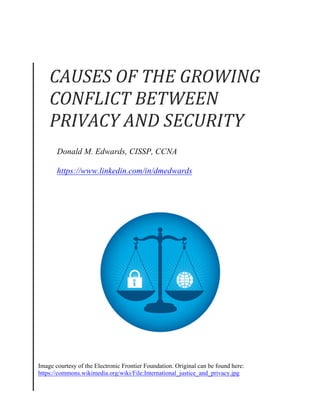
Image courtesy of the Electronic Frontier Foundation. Original can be found here:
https://commons.wikimedia.org/wiki/File:International_justice_and_privacy.jpg
CAUSES	
  OF	
  THE	
  GROWING	
  
CONFLICT	
  BETWEEN	
  
PRIVACY	
  AND	
  SECURITY	
  
Causes of the Growing Conflict between Privacy and Security
1
The struggle of maintaining an acceptable level of individual privacy is inherent in any
society which values group protection from both internal and external threats. In order to
understand the fundamental conflict between privacy and security, one must first understand that
absolute group security requires visibility into and control over internal affairs; this visibility and
control extends to the affairs of outside groups with threat capabilities as well. In contrast,
absolute personal privacy requires that individuals be able to conduct their affairs without
observation or interference from others. While it is normal for there to be occasional shifting of
the balance between privacy and security, that shift is typically gradual. However, there are
circumstances in which the balance swings abruptly toward security, usually when conflict
erupts and the relative importance of crime prevention supersedes that of individual privacy. The
conflict between security and privacy is becoming more intense because law enforcement’s
desire and capability to capture and assimilate large amounts of surveillance data is increasing
the ease with which individuals’ privacy can be violated. The conflict between security and
privacy occurs because of law enforcement’s needs to identify threat actors before crimes are
committed, to detect crimes quickly and in their early stages and to gather sufficient evidence to
attribute crimes to those who perpetrate them.
Motivation for Privacy Infringement
Speaking generally, each of these historical examples of the government’s limiting
privacy guarantees in the United States were done in the name of preventing internal threat
actors from inflicting significant damage. However, a more detailed look at the privacy-
infringing measures reveals three primary advantages being sought by law enforcement:
Causes of the Growing Conflict between Privacy and Security
2
Potential Threat Actor Identification
The Holy Grail of law enforcement is to identify those who intend to commit a crime
before they have an opportunity to act. In order to do that, law enforcement investigators must be
able to examine the behavior of everyone with means, motive and opportunity to be a threat.
Thanks to radio and other widely-available communication technology, means and opportunity
have had few limits since the beginning of the 20th
century. As a result, law enforcement is
forced to search for people giving an indication of having strong enough motive to represent a
threat. Both actively interviewing potential threat actors and passively monitoring their personal
communications represent violations of privacy, but are these violations are necessary in order to
identify individuals with motive before they take any action.
It was precisely that motive which prompted Congress to pass the Trading with the
Enemy Act of 1917 six months after the United States entered into World War I. German-
Americans were widely suspected of harboring secret loyalties to Germany. The Act included
provisions that allowed the government to intercept and read correspondence between the United
States and any foreign country during times of war (Sweeney, 2001), despite the fact that just 40
years previously the Supreme Court had ruled, “No law of Congress can place in the hands of
officials connected with the postal service any authority to invade the secrecy of letters and such
sealed packages in the mail” (U.S. Government Printing Office, 1893).
Event Early Detection
Serious crimes are seldom limited to an individual act. Instead, most major crimes require
a great deal of careful planning and many steps performed over a period of time. By examining
potential threat actors’ behavior, it may be possible to identify a crime in progress before the full
Causes of the Growing Conflict between Privacy and Security
3
plan is carried out. For example, the Oklahoma City bombing in 1995 could possibly have been
prevented if law enforcement had noticed that the bombers had rented a large truck and were
purchasing large amounts of fertilizer in multiple transactions, despite the fact that they had no
legitimate use for it (Mark E. Koltko-Rivera, 2004).
Attribution
After a crime is committed, law enforcement faces a significant challenge in piecing
together enough information to establish who was involved. In some types of crimes, such as
those involving physical violence, trace evidence is often left behind which can be used to help
identify the culprit. Many other crimes, however, leave no traces without some form of active
surveillance that records everyone’s actions to be examined in later investigation.
Basis of Growing Privacy Concerns
The most extreme suspension of privacy rights in U.S. history came in the wake of the
September 11, 2001 terrorist attacks. Shortly after the attacks, Congress enacted the USA
PATRIOT Act, which included provisions allowing warrantless domestic surveillance (Ahn,
2014), enabling the government to keep records on every electronic communication in the United
States. The acts of surveillance and keeping records are not necessarily privacy-infringing
themselves. Financial records, transaction histories and access logs, for example, are commonly
kept for essential purposes that are generally understood and accepted. However, when these
types of information are connected with other information or put to uses other than the ones for
which they were collected, privacy concerns are raised.
Thanks to continuing advances in computing power and data storage, it is now possible to
store and easily correlate staggering amounts of data which, when used appropriately, are a
powerful tool for law enforcement. However, as more information is collected and easily
Causes of the Growing Conflict between Privacy and Security
4
associated, the potential for error and abuse rises dramatically because of the ease with which it
can be accessed by those who possess it. For examples of these kinds of privacy violations, we
need only look as far as the National Security Agency’s own oversight reports that give details of
thousands of privacy violations discovered during internal records audits (National Security
Agency, 2014).
Conclusion
Surveillance and record keeping can be extremely powerful tools that can help law
enforcement maintain the security of the nation and its citizens. Like all powerful tools, however,
they can be easily misused by someone with the means, motive and opportunity to do so. When
used properly and for legitimate investigations, the collected information represents no threat to
privacy. However, because of the sheer volume of data and the ease with which it can be
accessed improperly, the threat to the right to privacy is significant and growing at the same pace
as the utility of that data to law enforcement. The enduring irony of collecting data to identify
people with malevolent motives is that in doing so it raises questions about the motives of law
enforcement itself.
Causes of the Growing Conflict between Privacy and Security
5
References
Ahn, J. (2014). Seizure of Electronic Data under the USA PATRIOT Act. Law School Student
Scholarship.
Deno, F., Diaz, C., Lliguicota, C., Norman, D., & González, R.-O. (2014). TSA SCREENING
PROCEDURES: A THREAT TO PRIVACY. International Journal of Arts & Sciences.
Mark E. Koltko-Rivera, P. (2004). Detection of Terrorist Preparations by an Artificial
Intelligence Expert System Employing Fuzzy Signal Detection Theory. Retrieved from
Defense Technical Information Center: http://www.dtic.mil/cgi-
bin/GetTRDoc?AD=ADA460204
National Security Agency. (2014). NSA Reports to the President's Intelligence Oversight Board
(IOB).
Smyth, D. J. (2008). Freedom of the Press and National Security in Four Wars: World War I,
World War II, the Vietnam War, and the War on Terrorism.
Sweeney, M. S. (2001). Secrets of Victory: The Office of Censorship and the American Press
and Radio in World War II.
U.S. Government Printing Office. (1893). Postal Laws and Regulations of the United States of
America.

Causes of the Growing Conflict Between Privacy and Security

  • 1.
    Donald M. Edwards,CISSP, CCNA https://www.linkedin.com/in/dmedwards Image courtesy of the Electronic Frontier Foundation. Original can be found here: https://commons.wikimedia.org/wiki/File:International_justice_and_privacy.jpg CAUSES  OF  THE  GROWING   CONFLICT  BETWEEN   PRIVACY  AND  SECURITY  
  • 2.
    Causes of theGrowing Conflict between Privacy and Security 1 The struggle of maintaining an acceptable level of individual privacy is inherent in any society which values group protection from both internal and external threats. In order to understand the fundamental conflict between privacy and security, one must first understand that absolute group security requires visibility into and control over internal affairs; this visibility and control extends to the affairs of outside groups with threat capabilities as well. In contrast, absolute personal privacy requires that individuals be able to conduct their affairs without observation or interference from others. While it is normal for there to be occasional shifting of the balance between privacy and security, that shift is typically gradual. However, there are circumstances in which the balance swings abruptly toward security, usually when conflict erupts and the relative importance of crime prevention supersedes that of individual privacy. The conflict between security and privacy is becoming more intense because law enforcement’s desire and capability to capture and assimilate large amounts of surveillance data is increasing the ease with which individuals’ privacy can be violated. The conflict between security and privacy occurs because of law enforcement’s needs to identify threat actors before crimes are committed, to detect crimes quickly and in their early stages and to gather sufficient evidence to attribute crimes to those who perpetrate them. Motivation for Privacy Infringement Speaking generally, each of these historical examples of the government’s limiting privacy guarantees in the United States were done in the name of preventing internal threat actors from inflicting significant damage. However, a more detailed look at the privacy- infringing measures reveals three primary advantages being sought by law enforcement:
  • 3.
    Causes of theGrowing Conflict between Privacy and Security 2 Potential Threat Actor Identification The Holy Grail of law enforcement is to identify those who intend to commit a crime before they have an opportunity to act. In order to do that, law enforcement investigators must be able to examine the behavior of everyone with means, motive and opportunity to be a threat. Thanks to radio and other widely-available communication technology, means and opportunity have had few limits since the beginning of the 20th century. As a result, law enforcement is forced to search for people giving an indication of having strong enough motive to represent a threat. Both actively interviewing potential threat actors and passively monitoring their personal communications represent violations of privacy, but are these violations are necessary in order to identify individuals with motive before they take any action. It was precisely that motive which prompted Congress to pass the Trading with the Enemy Act of 1917 six months after the United States entered into World War I. German- Americans were widely suspected of harboring secret loyalties to Germany. The Act included provisions that allowed the government to intercept and read correspondence between the United States and any foreign country during times of war (Sweeney, 2001), despite the fact that just 40 years previously the Supreme Court had ruled, “No law of Congress can place in the hands of officials connected with the postal service any authority to invade the secrecy of letters and such sealed packages in the mail” (U.S. Government Printing Office, 1893). Event Early Detection Serious crimes are seldom limited to an individual act. Instead, most major crimes require a great deal of careful planning and many steps performed over a period of time. By examining potential threat actors’ behavior, it may be possible to identify a crime in progress before the full
  • 4.
    Causes of theGrowing Conflict between Privacy and Security 3 plan is carried out. For example, the Oklahoma City bombing in 1995 could possibly have been prevented if law enforcement had noticed that the bombers had rented a large truck and were purchasing large amounts of fertilizer in multiple transactions, despite the fact that they had no legitimate use for it (Mark E. Koltko-Rivera, 2004). Attribution After a crime is committed, law enforcement faces a significant challenge in piecing together enough information to establish who was involved. In some types of crimes, such as those involving physical violence, trace evidence is often left behind which can be used to help identify the culprit. Many other crimes, however, leave no traces without some form of active surveillance that records everyone’s actions to be examined in later investigation. Basis of Growing Privacy Concerns The most extreme suspension of privacy rights in U.S. history came in the wake of the September 11, 2001 terrorist attacks. Shortly after the attacks, Congress enacted the USA PATRIOT Act, which included provisions allowing warrantless domestic surveillance (Ahn, 2014), enabling the government to keep records on every electronic communication in the United States. The acts of surveillance and keeping records are not necessarily privacy-infringing themselves. Financial records, transaction histories and access logs, for example, are commonly kept for essential purposes that are generally understood and accepted. However, when these types of information are connected with other information or put to uses other than the ones for which they were collected, privacy concerns are raised. Thanks to continuing advances in computing power and data storage, it is now possible to store and easily correlate staggering amounts of data which, when used appropriately, are a powerful tool for law enforcement. However, as more information is collected and easily
  • 5.
    Causes of theGrowing Conflict between Privacy and Security 4 associated, the potential for error and abuse rises dramatically because of the ease with which it can be accessed by those who possess it. For examples of these kinds of privacy violations, we need only look as far as the National Security Agency’s own oversight reports that give details of thousands of privacy violations discovered during internal records audits (National Security Agency, 2014). Conclusion Surveillance and record keeping can be extremely powerful tools that can help law enforcement maintain the security of the nation and its citizens. Like all powerful tools, however, they can be easily misused by someone with the means, motive and opportunity to do so. When used properly and for legitimate investigations, the collected information represents no threat to privacy. However, because of the sheer volume of data and the ease with which it can be accessed improperly, the threat to the right to privacy is significant and growing at the same pace as the utility of that data to law enforcement. The enduring irony of collecting data to identify people with malevolent motives is that in doing so it raises questions about the motives of law enforcement itself.
  • 6.
    Causes of theGrowing Conflict between Privacy and Security 5 References Ahn, J. (2014). Seizure of Electronic Data under the USA PATRIOT Act. Law School Student Scholarship. Deno, F., Diaz, C., Lliguicota, C., Norman, D., & González, R.-O. (2014). TSA SCREENING PROCEDURES: A THREAT TO PRIVACY. International Journal of Arts & Sciences. Mark E. Koltko-Rivera, P. (2004). Detection of Terrorist Preparations by an Artificial Intelligence Expert System Employing Fuzzy Signal Detection Theory. Retrieved from Defense Technical Information Center: http://www.dtic.mil/cgi- bin/GetTRDoc?AD=ADA460204 National Security Agency. (2014). NSA Reports to the President's Intelligence Oversight Board (IOB). Smyth, D. J. (2008). Freedom of the Press and National Security in Four Wars: World War I, World War II, the Vietnam War, and the War on Terrorism. Sweeney, M. S. (2001). Secrets of Victory: The Office of Censorship and the American Press and Radio in World War II. U.S. Government Printing Office. (1893). Postal Laws and Regulations of the United States of America.