I Roscilli Frozen
Mushrooms and Truffles
Bradford Hosking
Molly Holcombe
Payton Renner
Alec Gryski
Mission and Goals
• Mission
• “Provide transparency, quality, and innovation to a
high product turnover”
• Seeks to reach consumers with a strong appreciation
of unique food products
• Goals
• Expand business to global market – USA
• Introduce new branding method “gli ExPorcini”
Core Competencies
• I Roscilli intends to use core competencies:
• to establish themselves in the American market
• to gain a competitive edge
• Core Competencies
1. Offers highest quality mushrooms on the market
• 48% of Italy’s market
2. Innovative packaging technique
3. Produces multiple product packages from high
quality fungi and vegetables to frozen fruit varieties
The Problem
• Looking to expand business
• Frozen Mushroom market in US is small
• Fresh Mushrooms = 85% of market
• Ready-Made meals
• Consumer Education
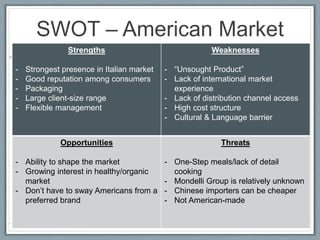
SWOT – American Market
Strengths
- Strongest presence in Italian market
- Good reputation among consumers
- Packaging
- Large client-size range
- Flexible management
Weaknesses
- “Unsought Product”
- Lack of international market
experience
- Lack of distribution channel access
- High cost structure
- Cultural & Language barrier
Opportunities
- Ability to shape the market
- Growing interest in healthy/organic
market
- Don’t have to sway Americans from a
preferred brand
Threats
- One-Step meals/lack of detail
cooking
- Mondelli Group is relatively unknown
- Chinese importers can be cheaper
- Not American-made
Market Summary - Global
• Global mushroom market has shown growth in
recent years, driven by:
• Increasing development of high yield systems
• Rising saturation in demand
• Consumer shift toward value-added products
• Increased demand for organic products
• Health awareness
Market Summary - USA
• Majority of processed mushroom imports = Chinese
• Majority of fresh mushroom imports = Canada
• Larger market for Fresh Mushrooms over
Frozen/Preserved
• America grows its mushrooms mostly in Pennsylvania
• Over 40%
• Majority of mushrooms are imported from other
countries
Target Market
• High-end grocery stores
• Upper middle class customers
• American food service industry
• After gaining a strong hold on retail
M
Risks
- Market transformation costs
- Advertising/marketing costs
- Foreign exchange rates
- Risks involved with diverse workforce
- Health risks
- Stigma and education of consumer
Limitations
- Lack of experience in US market
- Complex transportation
- Environmental constraints
- Prices
- Wage rates and labor availability
- Food preference of U.S. Customers
- Support of the industry through the USDA
(minimal)
Market Forecast
• Mushroom popularity is increasing
• High nutritional values – Healthy/low fat
• Substitute of meat
• Increasing shelf life
• Expected to grow at a CAGR of 9.5% between
2014-2019
Competition in the USA
• Store Brand Products
• Publix, Kroger, Trader Joes, etc.
• Fresh & Easy
• Nestle (Buitoni frozen food brand)
• Monterey
• Phillips Mushroom Farms, Inc.
• Giorgio Fresh Mushrooms
• Pennsylvania Dutchman
Competition in the USA
• Modern Mushroom Farms, Inc.
• Moonlight Mushrooms
• Fungus Amongus
• Dole
• Gourmet Mushrooms Inc.
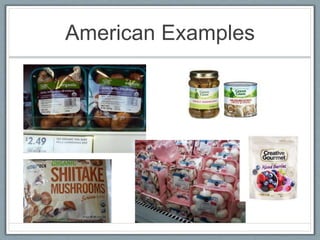
American Examples
Competitors in China
• Dalian Xinming Food Co. Ltd.
• Tianjin Kunyu International Co., Ltd.
• Qingdao Sinonut International Ltd.
• Greentasty Foodstuffs International Co., Ltd.
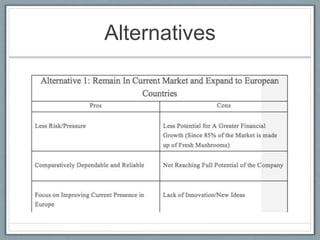
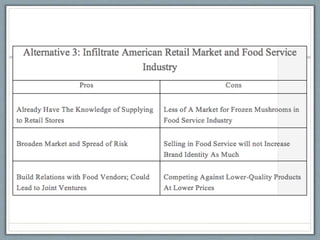
Alternatives
Decision and Decision
Justification
• The Opportunity
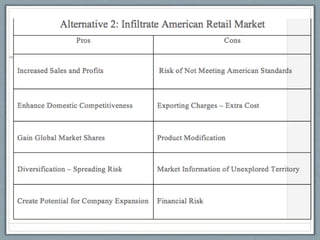
• Alternative Option #2
• “Discover” feature of grocery shopping
• Small existing market – easily penetrable
• Endorsements and Partners
• Familiarity
• American-made products/Celebrities
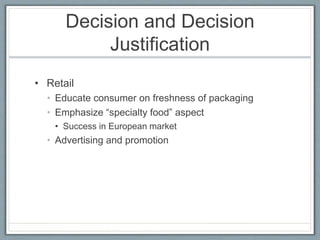
Decision and Decision
Justification
• Retail
• Educate consumer on freshness of packaging
• Emphasize “specialty food” aspect
• Success in European market
• Advertising and promotion
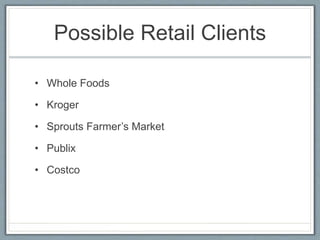
Possible Retail Clients
• Whole Foods
• Kroger
• Sprouts Farmer’s Market
• Publix
• Costco
Assumptions
1. I Roscilli has the existing capital and/or the ability to come up
with the capital to make the move to the US.
2. I Roscilli does not have a strong existing presence in the
American market.
3. The way that I Roscilli goes about obtaining the mushrooms,
packaging, and transportation is the most cost-efficient.
4. We assume that although I Roscilli has made some entrance
into the US market they are still in need of an efficient and
cost-effective strategy to distribute from the Italian
headquarters to the desired ports and clients.
5. The mushrooms sold by I Roscilli are Porcini and
Champignon; limited knowledge of specific varieties of
mushrooms.
Implementation
Year 1 – Introduction Stage:
Product
• Product
• Offer products aimed toward family-sized
consumption
• “I Roscilli” and “Le Valle dei Funghi” lines
• Test markets
Year 1 – Introduction Stage:
Packaging
• Packaging
• Keep innovative design – Frost-less vacuum seal
• Add education
• Recipes
• Preparation instructions
• Endorsements
Year 1 – Introduction Stage:
Price
• Price
• Price point lower than future goal
• Gain popularity
• Trend
• Prices escalate in winter
• Competitive pricing
• Biggest rivals: Monterey Mushrooms, Phillips
Mushrooms, and Store Brands ($1.99-2.99)
• Find a comfortable starting range
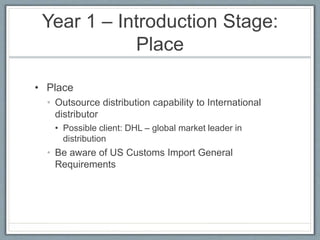
Year 1 – Introduction Stage:
Place
• Place
• Outsource distribution capability to International
distributor
• Possible client: DHL – global market leader in
distribution
• Be aware of US Customs Import General
Requirements
Year 1 – Introduction Stage:
Promotion
• Promotion
• Cost will be at its highest
• Increase customer awareness and education
• Play the company’s strengths
• Celebrity Endorsements
• Chef Giada De Laurentiis
• Chefs from Extra Virgin
• Debi Mazar and her Italian husband, Gabriele Corcos
• Chef from Dolce Vita
• David Rocco
• Television Commercial Costs
• Local stations: $200-$1,500 for 30 seconds
• National Stations: produced by agency for 30 seconds; $100,000-$350,000
• Preferred: Food Network, The Today Show, Good Morning America, Cooking Channel
• Timeslot for when target market is most likely watching
Year 1 – Introduction Stage:
Promotion
• Trade shows
• Average cost (per square foot) = $22.32
• Exhibit space = 28%
• Exhibit Design = 12%
• Show Services = 19%
• Shipping = 9%
• Travel & Entertainment = 21%
• Promotion = 6%
• Other = 5%
• The bigger the exhibit, the more memorable
Year 1 – Introduction Stage:
Promotion
• Online Advertising
• The larger the size, the larger the price
• Where the ad is located on the page will affect the price
• Unit CPM rates:
• 728 X 90= $14.88
• 300 X 250= $16.12
• 160 X 600= $15.25
• CPM Rates = Total site revenue/total site page views x
1,000
• CPC (cost per click)
• Highly trafficked sites
Year 1 – Introduction Stage:
Promotion
• Billboard Advertising (common roads)
• Typically 14 X 48 feet for 4 weeks
• 1. Albuquerque, New Mexico (adult population 680,000)
• $1,200 per billboard for 7 billboards
• 2. Atlanta, Georgia (adult population 4,762,000)
• $2,500 per billboard for 28 billboards
• 3. Ann Arbor, Michigan (adult population 268,000)
• $1,500 per billboard for 3 billboards
• Printing the advertisement itself (normally about 700
square feet) is about $500
Year 1 – Introduction Stage:
Promotion
• Grocery Store Marketing
• Sample taste tests in stores
• Recipe collaborations with other brands
• Social media awareness
• Enhance “fun”
• Include coupons
• Preferably digital
• 75.3% of shoppers redeem coupons on their phone (2013)
Year 5 – Growth Stage:
Product
• I Roscilli should have a better idea of what American consumers find appealing
• Adjust products accordingly
• Joint ventures
• Complementary goods and services
• Barilla --- The US and Italy
• Authentic staple food
• Large range of customers
• Buitoni --- US and Italy
• Authenticity and good reputation/reviews
• Large range of customers
• Joint Ventures cont.
• Store Brands
• Have specials combining the brand and Roscilli product
• Target grocery stores already selling the product
Year 5 – Growth Stage:
Packaging
• Continue with unique innovation
• Improve as technology evolves
• Presentation to customers
• Constant quality
Year 5 – Growth Stage:
Place and Promotion
• Place
• Assuming functionality, continue partnership with
DHL
• Promotion
• Allocate less on education – more on advertisement
• Allow for Word of Mouth
Year 10 – Maturity Stage
• Use knowledge gained and innovation capabilities
to:
• Continue increasing presence and market share in
the US Frozen Mushroom and Truffle Market
• Properly place the right products, to the right place,
at the right price in the US market
Outcome
• I Roscilli has the ability to create a better market
for the frozen mushroom industry
• Education – main beginning component
• Difference between frozen and fresh mushrooms
• Competitiveness of market may increase
Questions/Comments
Year 10 – Maturity Stage:
Product and Packaging
• Product and Packaging
• Should be comfortable meeting the American
consumer’s needs
• Flexibility
• Trends
Year 10 – Maturity Stage:
Pricing
• Raise the price slightly to make up for any
expense
• Better market share and reputation
• Be aware of cannibalization of new products
Year 10 – Maturity Stage:
Place and Promotion
• Place
• Strong partnership with distributor
• Have most efficient means of transportation
• See some discounts when it comes to larger rates
and quantity of shipments
• Promotion
• Increase spending on creating new products

I Roscilli Final Presentation

  • 1.
    I Roscilli Frozen Mushroomsand Truffles Bradford Hosking Molly Holcombe Payton Renner Alec Gryski
  • 2.
    Mission and Goals •Mission • “Provide transparency, quality, and innovation to a high product turnover” • Seeks to reach consumers with a strong appreciation of unique food products • Goals • Expand business to global market – USA • Introduce new branding method “gli ExPorcini”
  • 3.
    Core Competencies • IRoscilli intends to use core competencies: • to establish themselves in the American market • to gain a competitive edge • Core Competencies 1. Offers highest quality mushrooms on the market • 48% of Italy’s market 2. Innovative packaging technique 3. Produces multiple product packages from high quality fungi and vegetables to frozen fruit varieties
  • 4.
    The Problem • Lookingto expand business • Frozen Mushroom market in US is small • Fresh Mushrooms = 85% of market • Ready-Made meals • Consumer Education
  • 5.
    SWOT – AmericanMarket Strengths - Strongest presence in Italian market - Good reputation among consumers - Packaging - Large client-size range - Flexible management Weaknesses - “Unsought Product” - Lack of international market experience - Lack of distribution channel access - High cost structure - Cultural & Language barrier Opportunities - Ability to shape the market - Growing interest in healthy/organic market - Don’t have to sway Americans from a preferred brand Threats - One-Step meals/lack of detail cooking - Mondelli Group is relatively unknown - Chinese importers can be cheaper - Not American-made
  • 6.
    Market Summary -Global • Global mushroom market has shown growth in recent years, driven by: • Increasing development of high yield systems • Rising saturation in demand • Consumer shift toward value-added products • Increased demand for organic products • Health awareness
  • 7.
    Market Summary -USA • Majority of processed mushroom imports = Chinese • Majority of fresh mushroom imports = Canada • Larger market for Fresh Mushrooms over Frozen/Preserved • America grows its mushrooms mostly in Pennsylvania • Over 40% • Majority of mushrooms are imported from other countries
  • 8.
    Target Market • High-endgrocery stores • Upper middle class customers • American food service industry • After gaining a strong hold on retail
  • 9.
    M Risks - Market transformationcosts - Advertising/marketing costs - Foreign exchange rates - Risks involved with diverse workforce - Health risks - Stigma and education of consumer Limitations - Lack of experience in US market - Complex transportation - Environmental constraints - Prices - Wage rates and labor availability - Food preference of U.S. Customers - Support of the industry through the USDA (minimal)
  • 10.
    Market Forecast • Mushroompopularity is increasing • High nutritional values – Healthy/low fat • Substitute of meat • Increasing shelf life • Expected to grow at a CAGR of 9.5% between 2014-2019
  • 11.
    Competition in theUSA • Store Brand Products • Publix, Kroger, Trader Joes, etc. • Fresh & Easy • Nestle (Buitoni frozen food brand) • Monterey • Phillips Mushroom Farms, Inc. • Giorgio Fresh Mushrooms • Pennsylvania Dutchman
  • 12.
    Competition in theUSA • Modern Mushroom Farms, Inc. • Moonlight Mushrooms • Fungus Amongus • Dole • Gourmet Mushrooms Inc.
  • 13.
  • 14.
    Competitors in China •Dalian Xinming Food Co. Ltd. • Tianjin Kunyu International Co., Ltd. • Qingdao Sinonut International Ltd. • Greentasty Foodstuffs International Co., Ltd.
  • 15.
  • 18.
    Decision and Decision Justification •The Opportunity • Alternative Option #2 • “Discover” feature of grocery shopping • Small existing market – easily penetrable • Endorsements and Partners • Familiarity • American-made products/Celebrities
  • 19.
    Decision and Decision Justification •Retail • Educate consumer on freshness of packaging • Emphasize “specialty food” aspect • Success in European market • Advertising and promotion
  • 20.
    Possible Retail Clients •Whole Foods • Kroger • Sprouts Farmer’s Market • Publix • Costco
  • 21.
    Assumptions 1. I Roscillihas the existing capital and/or the ability to come up with the capital to make the move to the US. 2. I Roscilli does not have a strong existing presence in the American market. 3. The way that I Roscilli goes about obtaining the mushrooms, packaging, and transportation is the most cost-efficient. 4. We assume that although I Roscilli has made some entrance into the US market they are still in need of an efficient and cost-effective strategy to distribute from the Italian headquarters to the desired ports and clients. 5. The mushrooms sold by I Roscilli are Porcini and Champignon; limited knowledge of specific varieties of mushrooms.
  • 22.
  • 23.
    Year 1 –Introduction Stage: Product • Product • Offer products aimed toward family-sized consumption • “I Roscilli” and “Le Valle dei Funghi” lines • Test markets
  • 24.
    Year 1 –Introduction Stage: Packaging • Packaging • Keep innovative design – Frost-less vacuum seal • Add education • Recipes • Preparation instructions • Endorsements
  • 25.
    Year 1 –Introduction Stage: Price • Price • Price point lower than future goal • Gain popularity • Trend • Prices escalate in winter • Competitive pricing • Biggest rivals: Monterey Mushrooms, Phillips Mushrooms, and Store Brands ($1.99-2.99) • Find a comfortable starting range
  • 26.
    Year 1 –Introduction Stage: Place • Place • Outsource distribution capability to International distributor • Possible client: DHL – global market leader in distribution • Be aware of US Customs Import General Requirements
  • 27.
    Year 1 –Introduction Stage: Promotion • Promotion • Cost will be at its highest • Increase customer awareness and education • Play the company’s strengths • Celebrity Endorsements • Chef Giada De Laurentiis • Chefs from Extra Virgin • Debi Mazar and her Italian husband, Gabriele Corcos • Chef from Dolce Vita • David Rocco • Television Commercial Costs • Local stations: $200-$1,500 for 30 seconds • National Stations: produced by agency for 30 seconds; $100,000-$350,000 • Preferred: Food Network, The Today Show, Good Morning America, Cooking Channel • Timeslot for when target market is most likely watching
  • 28.
    Year 1 –Introduction Stage: Promotion • Trade shows • Average cost (per square foot) = $22.32 • Exhibit space = 28% • Exhibit Design = 12% • Show Services = 19% • Shipping = 9% • Travel & Entertainment = 21% • Promotion = 6% • Other = 5% • The bigger the exhibit, the more memorable
  • 29.
    Year 1 –Introduction Stage: Promotion • Online Advertising • The larger the size, the larger the price • Where the ad is located on the page will affect the price • Unit CPM rates: • 728 X 90= $14.88 • 300 X 250= $16.12 • 160 X 600= $15.25 • CPM Rates = Total site revenue/total site page views x 1,000 • CPC (cost per click) • Highly trafficked sites
  • 30.
    Year 1 –Introduction Stage: Promotion • Billboard Advertising (common roads) • Typically 14 X 48 feet for 4 weeks • 1. Albuquerque, New Mexico (adult population 680,000) • $1,200 per billboard for 7 billboards • 2. Atlanta, Georgia (adult population 4,762,000) • $2,500 per billboard for 28 billboards • 3. Ann Arbor, Michigan (adult population 268,000) • $1,500 per billboard for 3 billboards • Printing the advertisement itself (normally about 700 square feet) is about $500
  • 31.
    Year 1 –Introduction Stage: Promotion • Grocery Store Marketing • Sample taste tests in stores • Recipe collaborations with other brands • Social media awareness • Enhance “fun” • Include coupons • Preferably digital • 75.3% of shoppers redeem coupons on their phone (2013)
  • 32.
    Year 5 –Growth Stage: Product • I Roscilli should have a better idea of what American consumers find appealing • Adjust products accordingly • Joint ventures • Complementary goods and services • Barilla --- The US and Italy • Authentic staple food • Large range of customers • Buitoni --- US and Italy • Authenticity and good reputation/reviews • Large range of customers • Joint Ventures cont. • Store Brands • Have specials combining the brand and Roscilli product • Target grocery stores already selling the product
  • 33.
    Year 5 –Growth Stage: Packaging • Continue with unique innovation • Improve as technology evolves • Presentation to customers • Constant quality
  • 34.
    Year 5 –Growth Stage: Place and Promotion • Place • Assuming functionality, continue partnership with DHL • Promotion • Allocate less on education – more on advertisement • Allow for Word of Mouth
  • 35.
    Year 10 –Maturity Stage • Use knowledge gained and innovation capabilities to: • Continue increasing presence and market share in the US Frozen Mushroom and Truffle Market • Properly place the right products, to the right place, at the right price in the US market
  • 36.
    Outcome • I Roscillihas the ability to create a better market for the frozen mushroom industry • Education – main beginning component • Difference between frozen and fresh mushrooms • Competitiveness of market may increase
  • 37.
  • 38.
    Year 10 –Maturity Stage: Product and Packaging • Product and Packaging • Should be comfortable meeting the American consumer’s needs • Flexibility • Trends
  • 39.
    Year 10 –Maturity Stage: Pricing • Raise the price slightly to make up for any expense • Better market share and reputation • Be aware of cannibalization of new products
  • 40.
    Year 10 –Maturity Stage: Place and Promotion • Place • Strong partnership with distributor • Have most efficient means of transportation • See some discounts when it comes to larger rates and quantity of shipments • Promotion • Increase spending on creating new products

Editor's Notes