

PUNJAB GOVERNMENT SERVANTS(CONDUCT)
RULES, 1966
Resource Person
Mehr Khalid Ahmad
Senior Institutional Development Specialist
The Urban Unit, Govt of the Punjab
Contact: 0300-6361796
mehrkhalid29@gmail.com
2.
PUNJAB GOVERNMENT SERVANTS(CONDUCT)
RULES, 1966
(1ST September, 1966)
Extent of application.
Apply to all persons on duty or on leave, within or without
Punjab, serving in connection with the affairs of the Province
of Punjab , including the employees of the Provincial
Government deputed to service under the Federal Govt. with
the Statutory Corporation or with a non-Govt. employer .
3.
Member ofa Govt. Servants’ family.
(i) His wife, children and step-children, parents ,
sisters and minor bothers residing with and wholly
dependent upon the Govt. servant.
(ii) any other relative of the Govt. servant or his wife,
when residing with and wholly dependant upon him.
4.
Gifts (Rule5)
No Govt. servant shall, except with the previous
sanction of Govt. accept, or permit any member of his
family to accept, from any person any gift the receipt of
which will place him under any form of official
obligation to the donor.
If offer cannot be refused then gift deliver to Govt. for
decision.
If gift is offered by head or representative of a foreign
state.---- to avoid acceptance--- if not then report to
Govt. for orders as to its disposal.
5.
The officersof the rank of Secretaries may accept gifts
offered abroad or within Pakistan by institutions or official
dignitaries of foreign Govt. if value of the gift does not
exceed Rs.50,000/-
The recipient can retain gifts up to the monetary values of -
---
Gifts value up to Rs.10,000/- by employees (BPS-1 to BPS-
10)
Gifts valued above Rs. 10,000/------ on payment of 15% of
the value exceeding Rs. 10,000/-
Gifts of valuing Rs.4,00,000/- or more shall not be retained
by recipient. Deposited to Govt. Tosha Khana.
6.
Acceptance offoreign awards. (Rule 6)
No Govt. servant shall, except with the approval of the
Chief Minister of Punjab, accept a foreign award, title
or decoration.
Public demonstrations in honor of Govt.
Servants. (Rule 7)
No Govt. servant shall encourage meetings to be held
in his honour or presentation of address of which the
main purpose is to praise him.
7.
Gifts toMedical Officers. (Rule 8)
Subject to the departmental rules in this behalf, a Medical
Officer may accept any gift of moderate value offered in
good faith by any person or body of persons in recognition
of his professional service.
Subscriptions (Rule 9)
No Govt servant shall, except with the previous sanction of
the Govt. ask for or accept or in any way participate in the
raising of any subscription or other pecuniary assistance in
pursuance of any object whatsoever.
8.
Lending and borrowing.(Rule
10)
No Govt servant shall lend money to, or borrow money
from, or place himself under any pecuniary obligation
to any person within the local limits of his authority or
any person with whom he has any official dealings……..
But ordinary course of Joint Stock Company, Bank,
House Building Finance Corporation , Personal Friend.
9.
Declaration ofProperty. (Rule 12)
Every Govt. servant shall at the time of entering Govt.
Service, make a declaration of moveable and
immoveable property including shares, certificates,
securities, Insurance policies, cash & jewelry. Rs
50,000 or more
Disclosure of assets, immovable, movable and
liquid. (Rule 13)
when required by the Govt. furnish information
regarding assets, movable and immovable property,
shares certificates, insurance policy, jewelry, cash.
10.
Speculation andinvestment. (Rule 14)
(habitual purchase and sale of securities of notoriously
fluctuating value)
Not allowed to speculate in investments by the Govt.
servant or his family members.
Promotion and management of Companies
(Rule 15)
With the prior approval of the Govt, take part in
promotion, registration or management of any bank or
company
11.
Private trade,employment or work
(Rule 16)
With the prior approval of the Govt, engage in any trade or
undertake any employment or work, other than his official
duties.
Without such sanction, undertake honorary work of a religious,
social or charitable nature or occasional work of a literary or
artistic character, subject to the conditions that his official duties
do not suffer.
Non Gazetted Govt. servant , without sanction undertake small
enterprise which absorbs family labour .
sports activities and membership of recreation clubs are allowed
.
12.
Subletting ofresidential accmmodation allotted
by Govt. (Rule 16-A)
No Govt. servant shall, except with the prior
permission of the head of the Department, sublet
residential accommodation let to him by Government.
Govt. servant not to live beyond his means etc.
(Rule 16-B)
No Govt. servant shall live beyond his means or
indulge in ostentation (display of wealth or luxury) on
occasions of marriage or other ceremonies
13.
Insolvency (unableto pay debt) and
habitual indebtedness (Rule 17)
Govt. servant shall avoid habitual indebtedness attachment
of salary for debt.
Unauthorized communication of official
documents or information (Rule 18)
No Govt. servant shall, except in accordance with any
special or general order of the Govt. communicate directly
or indirectly any official information or the contents of any
official documents, to a Govt. servant unauthorized to
receive it, or to a non-official persons, or to the press.
14.
Approach tomembers of the assemblies
(Rule 19)
No Govt. servant shall, directly or indirectly, approach any
Member of the National Assembly or a Provincial Assembly
or any other non-official person to intervene on his behalf
in any matter.
Management of newspaper or periodicals
(Rule 20)
with the permission of Govt, conduct or participate in the
editing or management of , and newspaper or other
periodical publication.
15.
Radio broadcasts,Television Programme and
Communication to the press. (Rule 21)
With the permission of the Govt. broadcast, television
programme, contribute any article or writing letter
even anonymously, own name or in any other name
but not be considered likely to jeopardizes the
integrity of the Govt. servant, the security of Pakistan
or friendly relation with foreign states, to offend public
order, decency or morality, or to amount to contempt
of court, defamation or incitement of an offence.
No sanction required….. Purely literary, artistic,
scientific character, relates to specialized discipline.
16.
Publication ofinformation and public speeches
and television programmes capable of
embarrassing the Govt. (Rule 22)
Publish research papers on technical subject by
technical staff.
Teaching profession may publish such article, papers,
letter, books, and research material on the subject
related to their special discipline.
Not to express views on political issue, Govt. policy,
information of classified nature.
17.
Evidence before committees.(Rule
23)
No Govt. servant shall, give evidence before a public
committee except with the previous sanction of the
Govt.
Not criticise the policy or decisions of federal or any
provincial Govt.
Give evidence before statutory committee.
18.
Taking partin politics and elections. (Rule 24)
No Govt. servant shall take part in politics , in any political
movements, activities subversive of Govt, take part in any
election, canvassing or otherwise interfere or use his
influence as well as family members.
Propagation of sectarian creeds (Rule 25)
No Govt. servant shall propagate such sectarian creeds or
take part in such sectarian controversies or indulge in such
sectarian
Govt. servant not to express views detrimental to the
ideology or integrity of Pakistan (Rule 25 –A)
No Govt. servant shall to express views detrimental to the
ideology or integrity of Pakistan
19.
Govt. servantnot to take part in or assist, any
public demonstration against Govt. decision etc.
(Rule 25-B)
No Govt. servant shall take part in, or any manner
assist any public demonstration directed against a
Govt. decision or policy or permit any member of his
family dependent on him to do so.
20.
Nepotism, favoritismand victimization etc.
(Rule 26)
No Govt. servant shall indulge in provincialism,
parochialism, nepotism, favoritism, victimization and
willful abuse office.
Vindication (justify) by Govt. servant of their
public acts or character. (Rule 27)
Govt. servant may not, without the previous sanction
of govt. have recourse to any Court or to the press for
the vindication of his public acts or character from
defamatory attacks but with permission of Govt.
21.
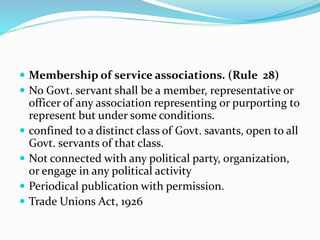
Membership ofservice associations. (Rule 28)
No Govt. servant shall be a member, representative or
officer of any association representing or purporting to
represent but under some conditions.
confined to a distinct class of Govt. savants, open to all
Govt. servants of that class.
Not connected with any political party, organization,
or engage in any political activity
Periodical publication with permission.
Trade Unions Act, 1926
22.
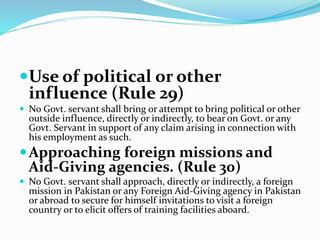
Use of politicalor other
influence (Rule 29)
No Govt. servant shall bring or attempt to bring political or other
outside influence, directly or indirectly, to bear on Govt. or any
Govt. Servant in support of any claim arising in connection with
his employment as such.
Approaching foreign missions and
Aid-Giving agencies. (Rule 30)
No Govt. servant shall approach, directly or indirectly, a foreign
mission in Pakistan or any Foreign Aid-Giving agency in Pakistan
or abroad to secure for himself invitations to visit a foreign
country or to elicit offers of training facilities aboard.
23.
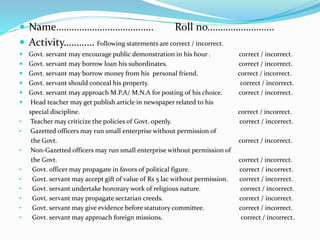
Name……………………………….. Rollno……………………..
Activity………… Following statements are correct / incorrect.
Govt. servant may encourage public demonstration in his hour . correct / incorrect.
Govt. servant may borrow loan his subordinates. correct / incorrect.
Govt. servant may borrow money from his personal friend. correct / incorrect.
Govt. servant should conceal his property. correct / incorrect.
Govt. servant may approach M.P.A/ M.N.A for posting of his choice. correct / incorrect.
Head teacher may get publish article in newspaper related to his
special discipline. correct / incorrect.
• Teacher may criticize the policies of Govt. openly. correct / incorrect.
• Gazetted officers may run small enterprise without permission of
the Govt. correct / incorrect.
• Non-Gazetted officers may run small enterprise without permission of
the Govt. correct / incorrect.
• Govt. officer may propagate in favors of political figure. correct / incorrect.
• Govt. servant may accept gift of value of Rs 5 lac without permission. correct / incorrect.
• Govt. servant undertake honorary work of religious nature. correct / incorrect.
• Govt. servant may propagate sectarian creeds. correct / incorrect.
• Govt. servant may give evidence before statutory committee. correct / incorrect.
• Govt. servant may approach foreign missions. correct / incorrect.