B.COM LLB(HONS) SEM- 5
LABOUR LAW-1
1
Made by:-
PARTH SABHAYA
SAWAN PARMAR
PARSHV PATEL
Submitted to :- HETAL MAM
2
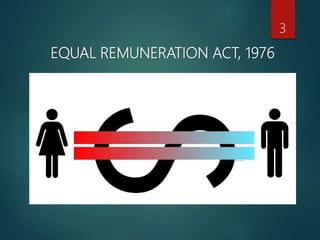
EQUAL REMUNERATION ACT, 1976
3
Object of the Act
The Equal Remuneration Act,
1976 aims to provide for the payment
of equal remuneration to men and
women workers and for the prevention
of discrimination, on the ground of sex,
against women in the matter of
employment and for matters connected
therewith or incidental thereto.
4
Constitutional provisions
 The principle of equal work to men and women
worker has been gaining increasing acceptance all
over the world. In many countries, law have been
passed prohibiting discrimination between men and
women in matters relating to payment of wages for
similar work.
 The D.P. State Policy article 39 (d) of the Constitution
envisages that the State shall direct its policy, among
other things, towards securing that there is equal pay
for equal work for both men and women.
5
 Article 16(2) makes a specific mention that “no
citizen shall on ground only of ….sex …be ineligible
for or discrimination against in respect of any
employment or office under state.”
 In the International Women’s Year, the President of
India promulgated the Equal Remuneration
Ordinance, 1975 on 26th September, 1975 to
provide for the payment of equal remuneration to
men and women workers
6
The Statute
I. Preliminary (1- 3)
II. Payment of remuneration at
equal rates to men and
women workers and other
matters (4-7)
III. Miscellaneous (8- 18)
7
Chapter I (Preliminary)
1. Short title and extent
 Called- the Equal Remuneration Act, 1976
 Whole India
 3 years from passing of the Act
8
2. Definitions.
 Appropriate Government
 Commencement of this Act
 Employer
 Man and woman
 Notification
 Prescribed
 Remuneration
 same work or work of a similar nature
 Worker
9
3. Overriding effect of the Act- The provisions of this
Act Shall Have effect notwithstanding anything
inconsistent therewith contained In any other law
or in the terms of any award, agreement or
contract of service, whether made before or after
this Act
10
Chapter- II
4. Duty of employer to pay equal remuneration
to men and women workers for same work of
work of a similar nature.
5. No discrimination to be made while
recruiting men and women workers for same
work or any work of similar nature.
Except where the employment of women in
such work is prohibited or restricted by or
under any law.
11
6. Advisory Committee
 one or more
 instituted to provide increasing employment
opportunities
 by the appropriate Government
 Shall consist of 10 or more members half of
which should be women.
 Members nominated by appropriate
Government
12
7. Power of appropriate Government to appoint
authorities for hearing and deciding claims and
complaints.
 Officer not below the rank of Labour Officer will
be appointed by the appropriate Government for
hearing and deciding claims and complaints
 Complaints in contravention of the Act & claims
arising out of non-payment of wages at equal
rates
 Will have powers of Civil Court
13
Chapter- III
8. Duty of employers to maintain registers. -- On and
from the commencement of this Act, every employer
shall maintain such registers and other documents in
relation to the workers employed by him as may be
prescribed.
14
9. Inspector
Appointed by appropriate Government
Deemed to be a public servant u/s. 21 of IPC
Powers of inspector
 Enter the premises at reasonable time
 Ask for the production of muster roll and register
 Take evidence to ascertain the adherence of the Act.
 Examine employer or any one in-charge
 Make copies or take extracts from any document.
15
10. Penalties
Simple imprisonment upto one month or fine upto
Rs.10,000 or both when the employer-
 omits or falls to maintain any register or other
document in relation to workers.
 omits or fails to produce any register, muster-roll or
other document.
 omits or refuses to give any evidence or prevents his
agent, servant, etc. from giving evidence, or
 omits or refuses to give any Information.
16
 Fine not less than Rs. 10,000 which may extend to Rs.20,000 or
imprisonment not less than 3 months which may extend upto one
year for 1st offence, and upto two years for second and
subsequent offences if any employer-
 makes any recruitment In contravention to the provisions of the
Act, or makes any payment of remuneration at unequal rates to
men and women workers, for the same work or work of a similar
nature, or
 makes any discrimination between men and women workers in
contravention of the provisions of the Act, or
 omits or fails to carry out any direction made by the appropriate
Government under sub-section (5) of section 6.
17
11. Offenses by companies: Every person, who at the time of the
offense was committed, was in charge of, and was responsible to the
company, as well as the company, shall be deemed guilty.
12. Cognizance and trial of the offenses: No court inferior to
Metropolitan Magistrate or a First Class Judicial Magistrate shall try
offenses related to this Act
 Take cognizance of an offense when the court receives a complaint
made by the Appropriate Government or an officer duly authorized
by it in its behalf or the person aggrieved by the offenses or by any
recognized welfare institution or organization.
18
13 & 14. The central government empowered to make rules for
carrying out the provisions of the Act & give directions to the
state government to carry out any execution related to the law.
15. Act does not apply in certain cases:
 When terms and conditions of a women's employment in
complying with the requirements of any law giving special
treatment to women or
 Special treatment accorded to women in connection with:
 Birth or expected birth of a child, or
 Terms & Conditions relating to retirement, marriage or death
or to any provisions made in connection with them
19
16. Power to make declaration. -- Where the
appropriate Government is, on a consideration of all
the circumstances of he case, satisfied that the
differences in regard to the remuneration, or a
particular species of remuneration, or men and women
workers in any establishment or employment is based
on a factor other than sex, it may, by notification, make
a declaration to that effect, and any act of the
employer attributable to such a difference shall not be
deemed to be contravention of any provision of this
Act.
20
17. Power to remove difficulties. -- If any
difficulty arises in giving effect to the
provisions of this Act, the Central
Government may, by notification, make any
order, not inconsistent with the provisions
of this Act, which appears to it to be
necessary for the purpose of removing the
difficulty.
21
18. Repeal and saving.
(1) The Equal Remuneration Ordinance, 1975 (12 of
1975) hereby repealed.
(2) Notwithstanding such repeal, anything done or any
action taken under the Ordinance, so repealed
(including any notification, nomination, appointment,
order or direction made thereunder) shall be deemed
to have been done or taken under the corresponding
provisions of this Act, as if this Act were in force when
such thing was done or action was taken.
22
THANK YOU
23

EQUAL REMUNERATION ACT , 1976

  • 1.
    B.COM LLB(HONS) SEM-5 LABOUR LAW-1 1
  • 2.
    Made by:- PARTH SABHAYA SAWANPARMAR PARSHV PATEL Submitted to :- HETAL MAM 2
  • 3.
  • 4.
    Object of theAct The Equal Remuneration Act, 1976 aims to provide for the payment of equal remuneration to men and women workers and for the prevention of discrimination, on the ground of sex, against women in the matter of employment and for matters connected therewith or incidental thereto. 4
  • 5.
    Constitutional provisions  Theprinciple of equal work to men and women worker has been gaining increasing acceptance all over the world. In many countries, law have been passed prohibiting discrimination between men and women in matters relating to payment of wages for similar work.  The D.P. State Policy article 39 (d) of the Constitution envisages that the State shall direct its policy, among other things, towards securing that there is equal pay for equal work for both men and women. 5
  • 6.
     Article 16(2)makes a specific mention that “no citizen shall on ground only of ….sex …be ineligible for or discrimination against in respect of any employment or office under state.”  In the International Women’s Year, the President of India promulgated the Equal Remuneration Ordinance, 1975 on 26th September, 1975 to provide for the payment of equal remuneration to men and women workers 6
  • 7.
    The Statute I. Preliminary(1- 3) II. Payment of remuneration at equal rates to men and women workers and other matters (4-7) III. Miscellaneous (8- 18) 7
  • 8.
    Chapter I (Preliminary) 1.Short title and extent  Called- the Equal Remuneration Act, 1976  Whole India  3 years from passing of the Act 8
  • 9.
    2. Definitions.  AppropriateGovernment  Commencement of this Act  Employer  Man and woman  Notification  Prescribed  Remuneration  same work or work of a similar nature  Worker 9
  • 10.
    3. Overriding effectof the Act- The provisions of this Act Shall Have effect notwithstanding anything inconsistent therewith contained In any other law or in the terms of any award, agreement or contract of service, whether made before or after this Act 10
  • 11.
    Chapter- II 4. Dutyof employer to pay equal remuneration to men and women workers for same work of work of a similar nature. 5. No discrimination to be made while recruiting men and women workers for same work or any work of similar nature. Except where the employment of women in such work is prohibited or restricted by or under any law. 11
  • 12.
    6. Advisory Committee one or more  instituted to provide increasing employment opportunities  by the appropriate Government  Shall consist of 10 or more members half of which should be women.  Members nominated by appropriate Government 12
  • 13.
    7. Power ofappropriate Government to appoint authorities for hearing and deciding claims and complaints.  Officer not below the rank of Labour Officer will be appointed by the appropriate Government for hearing and deciding claims and complaints  Complaints in contravention of the Act & claims arising out of non-payment of wages at equal rates  Will have powers of Civil Court 13
  • 14.
    Chapter- III 8. Dutyof employers to maintain registers. -- On and from the commencement of this Act, every employer shall maintain such registers and other documents in relation to the workers employed by him as may be prescribed. 14
  • 15.
    9. Inspector Appointed byappropriate Government Deemed to be a public servant u/s. 21 of IPC Powers of inspector  Enter the premises at reasonable time  Ask for the production of muster roll and register  Take evidence to ascertain the adherence of the Act.  Examine employer or any one in-charge  Make copies or take extracts from any document. 15
  • 16.
    10. Penalties Simple imprisonmentupto one month or fine upto Rs.10,000 or both when the employer-  omits or falls to maintain any register or other document in relation to workers.  omits or fails to produce any register, muster-roll or other document.  omits or refuses to give any evidence or prevents his agent, servant, etc. from giving evidence, or  omits or refuses to give any Information. 16
  • 17.
     Fine notless than Rs. 10,000 which may extend to Rs.20,000 or imprisonment not less than 3 months which may extend upto one year for 1st offence, and upto two years for second and subsequent offences if any employer-  makes any recruitment In contravention to the provisions of the Act, or makes any payment of remuneration at unequal rates to men and women workers, for the same work or work of a similar nature, or  makes any discrimination between men and women workers in contravention of the provisions of the Act, or  omits or fails to carry out any direction made by the appropriate Government under sub-section (5) of section 6. 17
  • 18.
    11. Offenses bycompanies: Every person, who at the time of the offense was committed, was in charge of, and was responsible to the company, as well as the company, shall be deemed guilty. 12. Cognizance and trial of the offenses: No court inferior to Metropolitan Magistrate or a First Class Judicial Magistrate shall try offenses related to this Act  Take cognizance of an offense when the court receives a complaint made by the Appropriate Government or an officer duly authorized by it in its behalf or the person aggrieved by the offenses or by any recognized welfare institution or organization. 18
  • 19.
    13 & 14.The central government empowered to make rules for carrying out the provisions of the Act & give directions to the state government to carry out any execution related to the law. 15. Act does not apply in certain cases:  When terms and conditions of a women's employment in complying with the requirements of any law giving special treatment to women or  Special treatment accorded to women in connection with:  Birth or expected birth of a child, or  Terms & Conditions relating to retirement, marriage or death or to any provisions made in connection with them 19
  • 20.
    16. Power tomake declaration. -- Where the appropriate Government is, on a consideration of all the circumstances of he case, satisfied that the differences in regard to the remuneration, or a particular species of remuneration, or men and women workers in any establishment or employment is based on a factor other than sex, it may, by notification, make a declaration to that effect, and any act of the employer attributable to such a difference shall not be deemed to be contravention of any provision of this Act. 20
  • 21.
    17. Power toremove difficulties. -- If any difficulty arises in giving effect to the provisions of this Act, the Central Government may, by notification, make any order, not inconsistent with the provisions of this Act, which appears to it to be necessary for the purpose of removing the difficulty. 21
  • 22.
    18. Repeal andsaving. (1) The Equal Remuneration Ordinance, 1975 (12 of 1975) hereby repealed. (2) Notwithstanding such repeal, anything done or any action taken under the Ordinance, so repealed (including any notification, nomination, appointment, order or direction made thereunder) shall be deemed to have been done or taken under the corresponding provisions of this Act, as if this Act were in force when such thing was done or action was taken. 22
  • 23.