CONDITIONALS PART 2
FIRST CONDITIONAL
Just a quick
review:
• Conditional sentences express a connection between
two actions or states. One thing happens because of
another. These connections can be general, specific, likely,
unlikely, real or imagined.
• Zero conditionals
• Used to refer to habits, general truths, scientific facts and
instructions and rules. One thing happens and because of
this something else happens. In zero conditionals if and
when have the same meaning.
• It gives you the idea of a real
situation
• It also brings the idea of
something that is likely
(probable) to happen.
• We use the first conditional
when we talk about future
situations we believe are real
or possible
First Conditional
FIRST CONDITIONAL
STRUCTURE:
IF-CLAUSE +
MAIN CLAUSE
IF-CLAUSE:
IF + ANY PRESENT FORM ( presente simple / presente
continous or presente perfect)
MAIN CLAUSE:
You can use a future form (simple / WILL /
continuous / WILL BE –ING / perfect / WILL
HAVE +PP ) OR MODAL (MAY/ SHOULD /
CAN / MUST)
If you don’t disturb me, I will have finished in an hour.
If I haven’t come back by 8 o’clock, call the police.
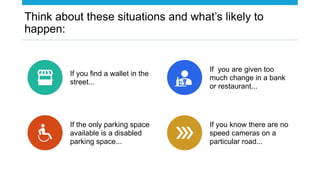
Think about these situations and what’s likely to
happen:
If you find a wallet in the
street...
If you are given too
much change in a bank
or restaurant...
If the only parking space
available is a disabled
parking space...
If you know there are no
speed cameras on a
particular road...
 I'll leave as soon as the babysitter arrives.
 I don't want to stay in London unless I get a well-paid job.
 I'll give you a key in case I'm not at home.
 You can go to the party, as long as you're back by midnight.
 If I go to the shops, I’ll get some bread. (I might not go to the shops)
 When I go to the shops, I’ll get some bread. (I’m definitely going to the shops)
 If you’ve finished your homework by six, you can go out and play.
 When you’re having your party, please keep the noise down!
It is also common to use this
structure with unless, as long as,
as soon as or in case instead of if.

CONDITIONALS PART 2.pptx

  • 1.
  • 2.
    Just a quick review: •Conditional sentences express a connection between two actions or states. One thing happens because of another. These connections can be general, specific, likely, unlikely, real or imagined. • Zero conditionals • Used to refer to habits, general truths, scientific facts and instructions and rules. One thing happens and because of this something else happens. In zero conditionals if and when have the same meaning.
  • 3.
    • It givesyou the idea of a real situation • It also brings the idea of something that is likely (probable) to happen. • We use the first conditional when we talk about future situations we believe are real or possible First Conditional
  • 4.
  • 5.
    IF-CLAUSE: IF + ANYPRESENT FORM ( presente simple / presente continous or presente perfect) MAIN CLAUSE: You can use a future form (simple / WILL / continuous / WILL BE –ING / perfect / WILL HAVE +PP ) OR MODAL (MAY/ SHOULD / CAN / MUST) If you don’t disturb me, I will have finished in an hour. If I haven’t come back by 8 o’clock, call the police.
  • 6.
    Think about thesesituations and what’s likely to happen: If you find a wallet in the street... If you are given too much change in a bank or restaurant... If the only parking space available is a disabled parking space... If you know there are no speed cameras on a particular road...
  • 7.
     I'll leaveas soon as the babysitter arrives.  I don't want to stay in London unless I get a well-paid job.  I'll give you a key in case I'm not at home.  You can go to the party, as long as you're back by midnight.  If I go to the shops, I’ll get some bread. (I might not go to the shops)  When I go to the shops, I’ll get some bread. (I’m definitely going to the shops)  If you’ve finished your homework by six, you can go out and play.  When you’re having your party, please keep the noise down! It is also common to use this structure with unless, as long as, as soon as or in case instead of if.