REVIEW
IT IS A VERB
COMBINED WITH
ANOTHER VERB TO
INDICATE MOOD
OR TENSE.
MODA
L
THESE MODALS
MAY EXPRESS…
1.
2.
3.
PERMISSION
OBLIGATION
PROHIBITION
IT IS USED TO
EXPRESS
PERMISSION IN A
FORMAL
CONVERSATION.
MAY
IT IS USED TO
EXPRESS
PROHIBITION
COMING FROM THE
SPEAKER.
MUSTN’
T
IT IS USED TO
EXPRESS
OBLIGATION IN A
SUBJECTIVE
OPINION.
SHOULD
“______ I GO TO
THE WASHROOM,
MA’AM?”
MAY
“AS A TEENAGER,
YOU ______ BE
RESPONSIBLE
WITH YOUR OWN
ACTIONS.”
“YOU _____ USE
YOUR CELLPHONES
IN CLASS.”
“YOU _____
FEED THE DOG
ON TIME.”
IT IS USED TO
EXPRESS AN
IMPERSONAL
OBLIGATION.
WHAT I NEED TO
KNOW…
WHAT I KNOW…
1. I will send her an invitation if I (find) her address.
a. would find b. will find
c. found d. find
2. Alan will mix the salad if Jane (give) him some of
her fresh recipes.
a. gives b. will give
c. gave d. would give
3. If I owned a lonely island, I (build) a huge house by
the beach.
a. would build b. would have built
c. built d. build
4. If I don’t see him this afternoon, I (phone) him
in the evening.
a. phone b. phoned
c. will phone d. would phone
5. If John has the money, he (buy) a yacht.
a. will buy b. buys
c. bought d. would buy
6. If we had a yacht, we (sail) the seven seas.
a. sail b. sailed
c. will sail d. would sail
7. Elaine (buy) the drinks if somebody helps her
carry the bottles.
a. will buy b. buys
c. bought d. would buy
8. Frank will play the DJ if others (bring) along
their favorite music tracks.
a. bring b. brings
c. brought d. would have brought
9. If he had more time, he (learn) karate.
a. learned c. learn
c. would learn d. would have learned
10. If our team had won the match, they (move up) in
the league.
a. move up b. would have moved up
c. will move up d. moved up
11. If Ben (tidy up) the kitchen, Anita will clean the
toilet.
a. will tidy up b. tidies up
c. tidied up d. would tidy up
12. If Caroline and Serena prepare the salad, Philip
(decorate) the house.
a. decorated b. decorates
c. will decorate d. would have decorated
13. It would have been a perfect day if it
(rain) so hard.
a. will rain b. rained
c. had rained d. had not rained
14. Ice cream (melt) if it is hot.
a. melts b. will melt
c. melted d. would melt
15. If I (know) the answer, I’d tell you.
a. will know b. had known
c. knew d. would know
1.D
2.A
3.A
4.C
5.A
6. D
7. A
8. A
9. C
10.B
11.B
12.C
13.D
14.A
15.C
to a cool mountain
escapade under woods
and trees,
or to a sandy getaway by
the beach and its waves?
If you were to spend your vacation after the
pandemic, where would you prefer to go,
CONDITIONAL
SENTENCES
Conditionals or conditional
sentences express a real or an
unreal condition. A conditional
sentence consists of two parts:
an if-clause and a main clause.
A conditional sentence expresses the
idea that the action in the main clause
(the result clause) can only happen
when a certain condition (the clause
that begins with if) is fulfilled. The if-
clause states the condition, and the
main clause states the result.
CONDITIONAL
SENTENCES
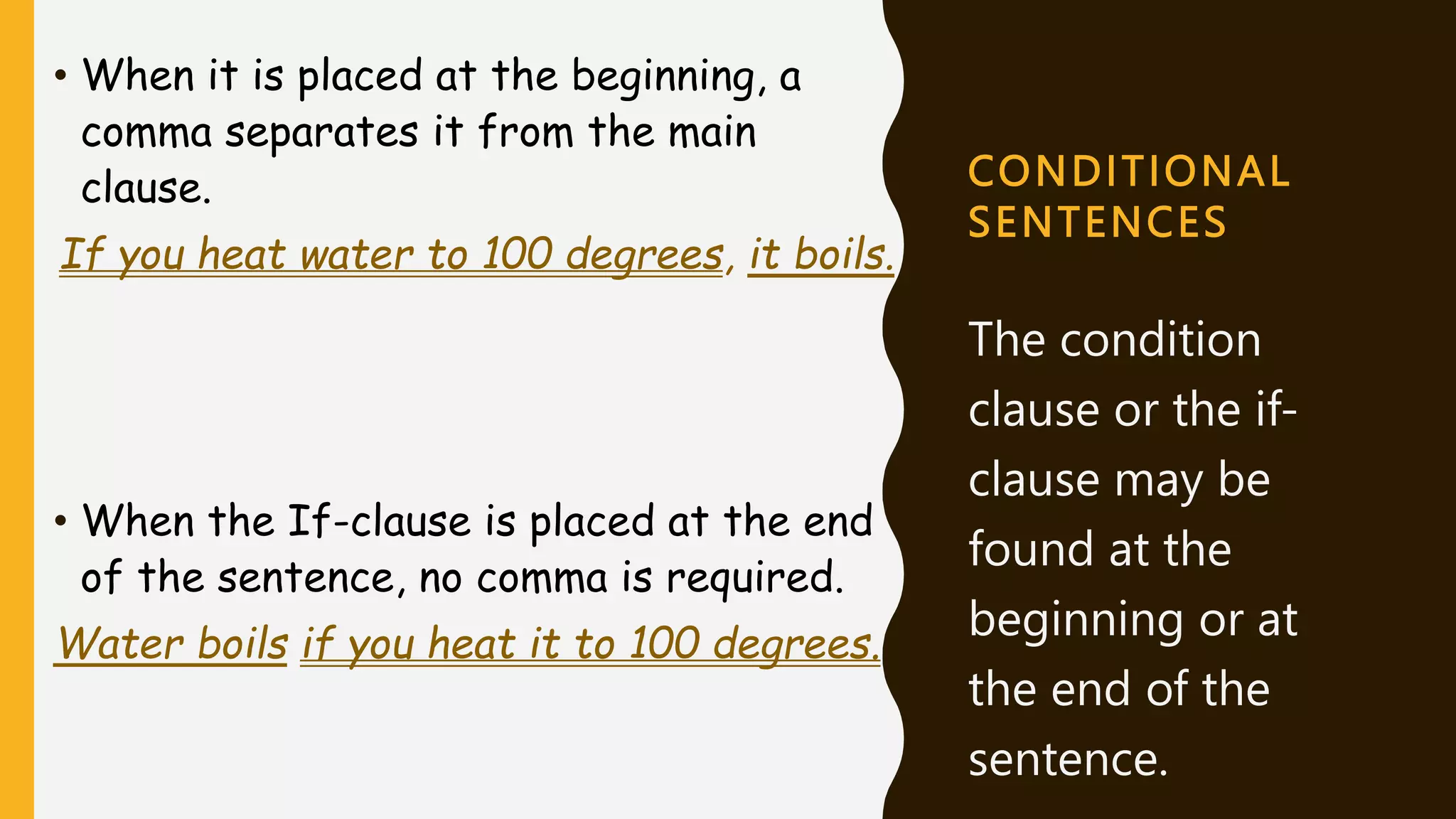
• When it is placed at the beginning, a
comma separates it from the main
clause.
If you heat water to 100 degrees, it boils.
• When the If-clause is placed at the end
of the sentence, no comma is required.
Water boils if you heat it to 100 degrees.
The condition
clause or the if-
clause may be
found at the
beginning or at
the end of the
sentence.
CONDITIONAL
SENTENCES
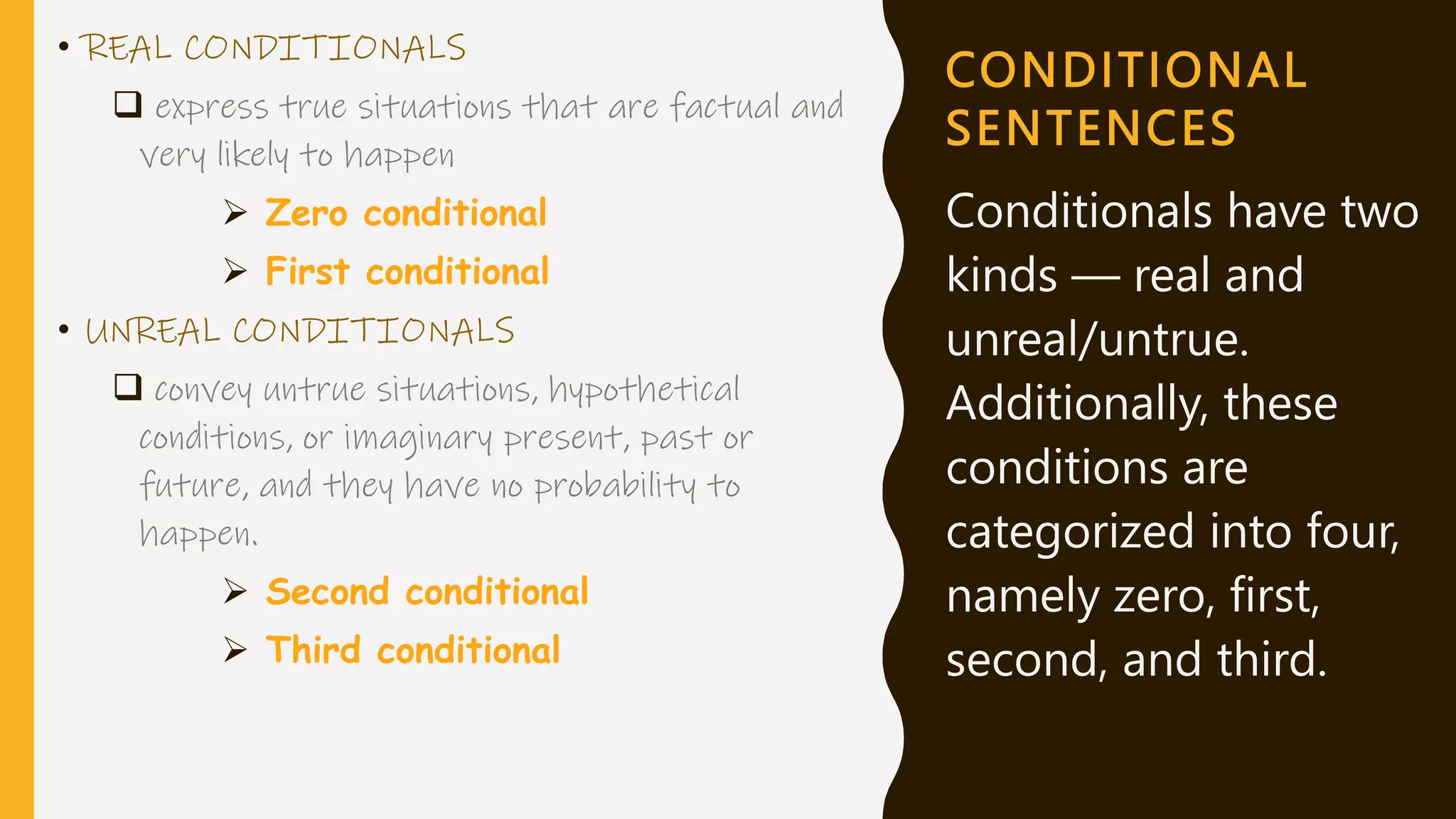
• REAL CONDITIONALS
 express true situations that are factual and
very likely to happen
 Zero conditional
 First conditional
• UNREAL CONDITIONALS
 convey untrue situations, hypothetical
conditions, or imaginary present, past or
future, and they have no probability to
happen.
 Second conditional
 Third conditional
Conditionals have two
kinds — real and
unreal/untrue.
Additionally, these
conditions are
categorized into four,
namely zero, first,
second, and third.
0
nal
sults are
fic facts and
of a verb] +
se of a verb].
tional
ges.
hey cry.
x hydrogen
1
NAL
ons
ure.
verb] +
of the
oes not
ters
nt, it
2
AL
s in
ing
hing
nd
erb]
the
y
he
if
3
REAL CONDITIONALS UNREAL CONDITIONALS
ZERO CONDITIONAL
-used when the results are always true,
like a scientific facts and general truths.
SECOND CONDITIONAL
-used to: (1) talk about conditions in
the future that are probably not going
to happen; and (2) talk about
something in the present, which is
impossible and imaginary.
[If + simple past tense of a verb,] +
[would + base form of a verb]
FIRST CONDITIONAL
-used to talk about conditions that
might happen in the future.
[If + present tense of a verb,] + [will +
base form of a verb]
THIRD CONDITIONAL
-often used when we regret something
or imagine a past unreal situation; a
past condition
that did not happen.
[If + past perfect tense of a verb,] +
[would + have + past participle
form of a verb]
CONDITIONAL SENTENCES.pptx

CONDITIONAL SENTENCES.pptx

  • 2.
  • 3.
    IT IS AVERB COMBINED WITH ANOTHER VERB TO INDICATE MOOD OR TENSE. MODA L
  • 4.
  • 5.
    IT IS USEDTO EXPRESS PERMISSION IN A FORMAL CONVERSATION. MAY
  • 6.
    IT IS USEDTO EXPRESS PROHIBITION COMING FROM THE SPEAKER. MUSTN’ T
  • 7.
    IT IS USEDTO EXPRESS OBLIGATION IN A SUBJECTIVE OPINION. SHOULD
  • 8.
    “______ I GOTO THE WASHROOM, MA’AM?” MAY
  • 9.
    “AS A TEENAGER, YOU______ BE RESPONSIBLE WITH YOUR OWN ACTIONS.”
  • 10.
    “YOU _____ USE YOURCELLPHONES IN CLASS.”
  • 11.
    “YOU _____ FEED THEDOG ON TIME.”
  • 12.
    IT IS USEDTO EXPRESS AN IMPERSONAL OBLIGATION.
  • 13.
    WHAT I NEEDTO KNOW…
  • 15.
  • 16.
    1. I willsend her an invitation if I (find) her address. a. would find b. will find c. found d. find 2. Alan will mix the salad if Jane (give) him some of her fresh recipes. a. gives b. will give c. gave d. would give 3. If I owned a lonely island, I (build) a huge house by the beach. a. would build b. would have built c. built d. build
  • 17.
    4. If Idon’t see him this afternoon, I (phone) him in the evening. a. phone b. phoned c. will phone d. would phone 5. If John has the money, he (buy) a yacht. a. will buy b. buys c. bought d. would buy 6. If we had a yacht, we (sail) the seven seas. a. sail b. sailed c. will sail d. would sail
  • 18.
    7. Elaine (buy)the drinks if somebody helps her carry the bottles. a. will buy b. buys c. bought d. would buy 8. Frank will play the DJ if others (bring) along their favorite music tracks. a. bring b. brings c. brought d. would have brought 9. If he had more time, he (learn) karate. a. learned c. learn c. would learn d. would have learned
  • 19.
    10. If ourteam had won the match, they (move up) in the league. a. move up b. would have moved up c. will move up d. moved up 11. If Ben (tidy up) the kitchen, Anita will clean the toilet. a. will tidy up b. tidies up c. tidied up d. would tidy up 12. If Caroline and Serena prepare the salad, Philip (decorate) the house. a. decorated b. decorates c. will decorate d. would have decorated
  • 20.
    13. It wouldhave been a perfect day if it (rain) so hard. a. will rain b. rained c. had rained d. had not rained 14. Ice cream (melt) if it is hot. a. melts b. will melt c. melted d. would melt 15. If I (know) the answer, I’d tell you. a. will know b. had known c. knew d. would know
  • 21.
    1.D 2.A 3.A 4.C 5.A 6. D 7. A 8.A 9. C 10.B 11.B 12.C 13.D 14.A 15.C
  • 22.
    to a coolmountain escapade under woods and trees, or to a sandy getaway by the beach and its waves? If you were to spend your vacation after the pandemic, where would you prefer to go,
  • 23.
  • 24.
    Conditionals or conditional sentencesexpress a real or an unreal condition. A conditional sentence consists of two parts: an if-clause and a main clause.
  • 25.
    A conditional sentenceexpresses the idea that the action in the main clause (the result clause) can only happen when a certain condition (the clause that begins with if) is fulfilled. The if- clause states the condition, and the main clause states the result.
  • 27.
    CONDITIONAL SENTENCES • When itis placed at the beginning, a comma separates it from the main clause. If you heat water to 100 degrees, it boils. • When the If-clause is placed at the end of the sentence, no comma is required. Water boils if you heat it to 100 degrees. The condition clause or the if- clause may be found at the beginning or at the end of the sentence.
  • 28.
    CONDITIONAL SENTENCES • REAL CONDITIONALS express true situations that are factual and very likely to happen  Zero conditional  First conditional • UNREAL CONDITIONALS  convey untrue situations, hypothetical conditions, or imaginary present, past or future, and they have no probability to happen.  Second conditional  Third conditional Conditionals have two kinds — real and unreal/untrue. Additionally, these conditions are categorized into four, namely zero, first, second, and third.
  • 30.
    0 nal sults are fic factsand of a verb] + se of a verb]. tional ges. hey cry. x hydrogen 1 NAL ons ure. verb] + of the oes not ters nt, it 2 AL s in ing hing nd erb] the y he if 3
  • 32.
    REAL CONDITIONALS UNREALCONDITIONALS ZERO CONDITIONAL -used when the results are always true, like a scientific facts and general truths. SECOND CONDITIONAL -used to: (1) talk about conditions in the future that are probably not going to happen; and (2) talk about something in the present, which is impossible and imaginary. [If + simple past tense of a verb,] + [would + base form of a verb] FIRST CONDITIONAL -used to talk about conditions that might happen in the future. [If + present tense of a verb,] + [will + base form of a verb] THIRD CONDITIONAL -often used when we regret something or imagine a past unreal situation; a past condition that did not happen. [If + past perfect tense of a verb,] + [would + have + past participle form of a verb]