Conceptualizing Opportunities and
Challenges Relevant to the Inclusion of
Humanoid Service Robots in the Context
of COVID-19
Selcen Öztürkcan, Ph.D.
Full Professor of Marketing
emlyon business school, France
Ozturkcan@em-lyon.com
https://orcid.org/0000-0003-2248-0802
Cite as:
Ozturkcan S., and Merdin-Uygur E. (2022), "Conceptualizing Opportunities and Challenges Relevant to the Inclusion of Humanoid Service Robots in the Context of COVID-19" chapter in Human
Interaction, Emerging Technologies, and Future Systems V, edited by Tareq Ahram, and Redha Taiar. Springer: Cham. https://doi.org/10.1007/978-3-030-85540-6_20
• introduction
• service robots
• covid-19 outbreak
• anthropomorphism
• opportunities and challenges
• conclusion
agenda
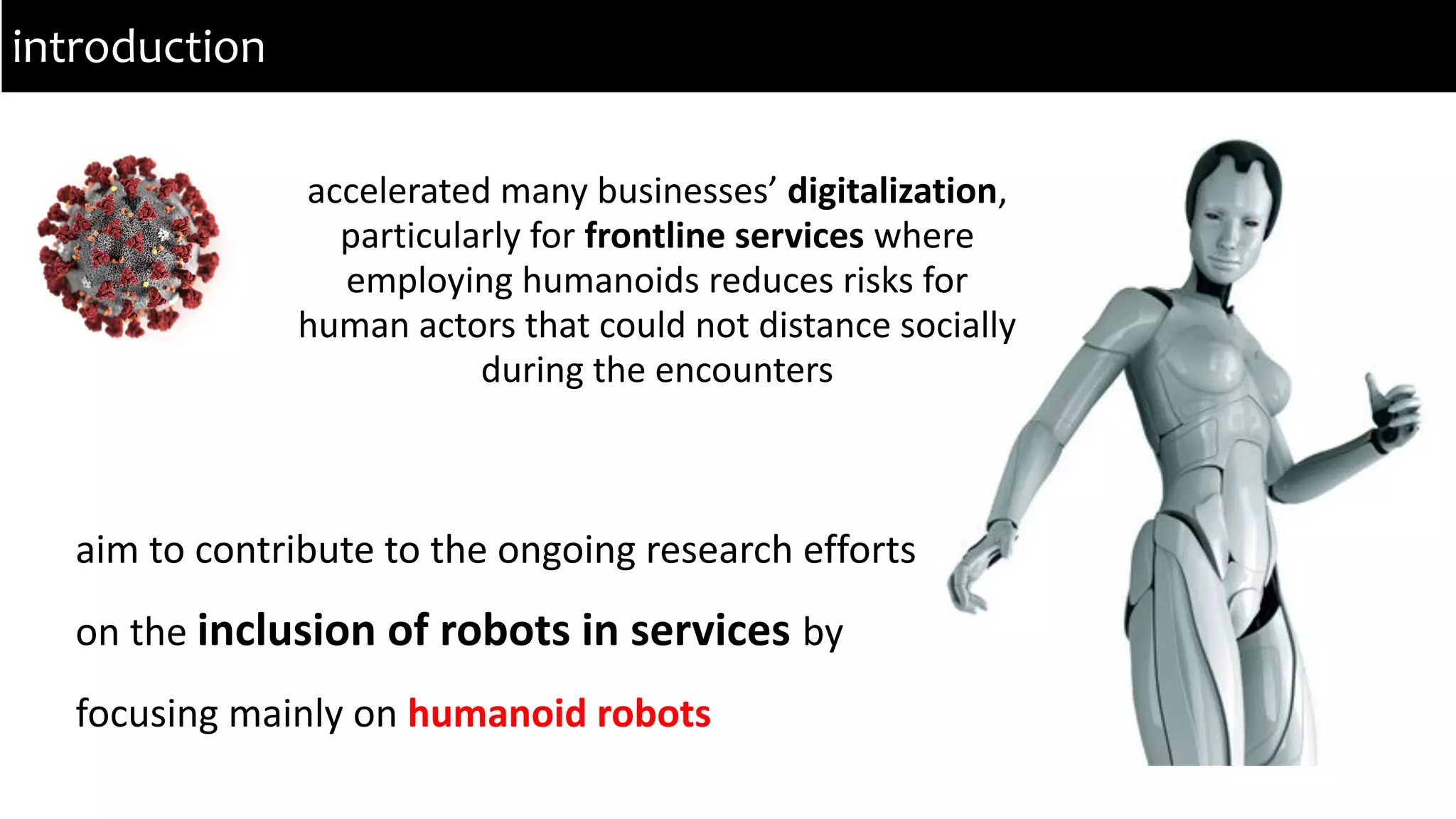
accelerated many businesses’ digitalization,
particularly for frontline services where
employing humanoids reduces risks for
human actors that could not distance socially
during the encounters
introduction
aim to contribute to the ongoing research efforts
on the inclusion of robots in services by
focusing mainly on humanoid robots
•robots possessing a certain degree of autonomy as they perform
personal or professional tasks for humans [6]
•capabilities in registering habits and attitudes of the humans that they
interact
• affect the perception of intimacy, privacy, bonding, and emotional support [7-9].
•look and move like humans
•human-like learning and creating abilities [10-12]
service robots (SR)
• accelerated adoption of SR
• offer contact-free reliable performance in various tasks
• delivery of food and medications, disinfecting, patrolling non-pharmaceutical social
interventions, and assisting in reception [13, 14]
• helpful in supporting the healthcare services that struggled to cope with increasing
demand [15-17]
• source of concern during the pandemic with already rising unemployment figures.
• replace human workers by
• serving drinks and food to customers in hotels and airport lounges [18]
• handling check-in and check-out services at hotels [19]
• preference for robot-staffed hotels when COVID-19 is salient [20]
covid-19 outbreak
• “the tendency to imbue the real or imagined
behavior of non-human agents with human
like characteristics, motivations, intentions, or
emotions” [21]
• inductive inference mechanism: individuals
assign distinct human characteristics to
non-humans - capacity for rationality and
conscious feeling [22]
anthropomorphism - (1/3)
• degree of anthropomorphic representation → determinant of both how a
person acts towards them or how a person should respond in relation to or in
the existence of them
• anthropomorphic virtual assistants: enhance users learning in software
programs by dealing with knowledge overload better [27]
• anthropomorphic faces and voices in the interface of a survival task:
individuals feel better understood [28]
• anthropomorphic features such as being named, gendered, and voiced in
autonomous vehicle: perceived as more competent [22]
• anthropomorphized vehicle: higher trust, more relaxed in an accident, and
blame their vehicle and related entities less for an accident caused by
another driver
anthropomorphism - (2/3)
• challenge: the theory of uncanny valley [30]
• presence and behavior of a robot made more
human → emotional response becomes more
optimistic and empathic - until a point is
reached at which a reaction of revulsion will
arise
• robots become more similar to humans →
humans avoid them: individuals do not choose
to cooperate and work with serious-looking
anthropomorphic robots [31]
anthropomorphism - (3/3)
• humanoid robots
• provided genuine human interactions → mitigated many negative and
unwanted effects of social exclusion
• satisfied the social assurance needs of individuals, in the absence of
other real human entities and reduced the need for socially close
others [33]
anthropomorphism & Covid-19
social distancing → severe exclusion of some members of the societies based on physical social contact
• vulnerable groups - older adults and persons with disabilities - faced exclusion from digital services that
aimed to compensate for the lack of physical contact [34]
• struggle with the double burden of social and digital exclusion
social exclusion - an additional challenge amid the pandemic [35]
social exclusion – opportunities & challenges
“capable of measuring
temperature with its thermal
camera on her chest or leading
morning exercise for the older
adults, it aimed to help take care
of sick and elderly. It was also
useful in helping to communicate,
giving therapy, and providing
social stimulation even in difficult
situations”[36]
Sophia,
the humanoid robot
introduced in 2016
• might also help with the loneliness
felt due to the social exclusion
• delivery of human warmth through
telepresence or autonomous
extension of human expertise
• positioning SR as our true friends??
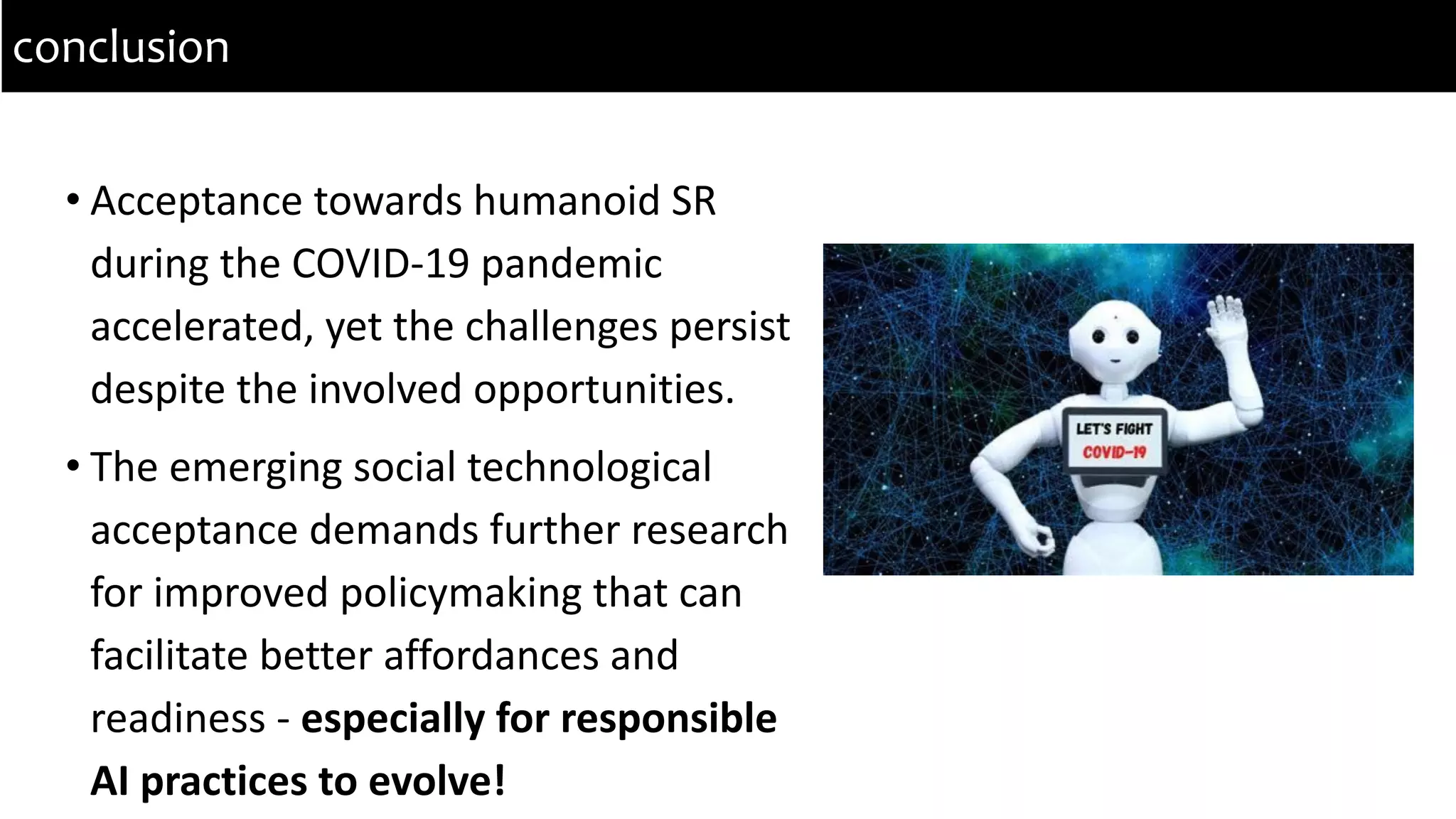
• Acceptance towards humanoid SR
during the COVID-19 pandemic
accelerated, yet the challenges persist
despite the involved opportunities.
• The emerging social technological
acceptance demands further research
for improved policymaking that can
facilitate better affordances and
readiness - especially for responsible
AI practices to evolve!
conclusion
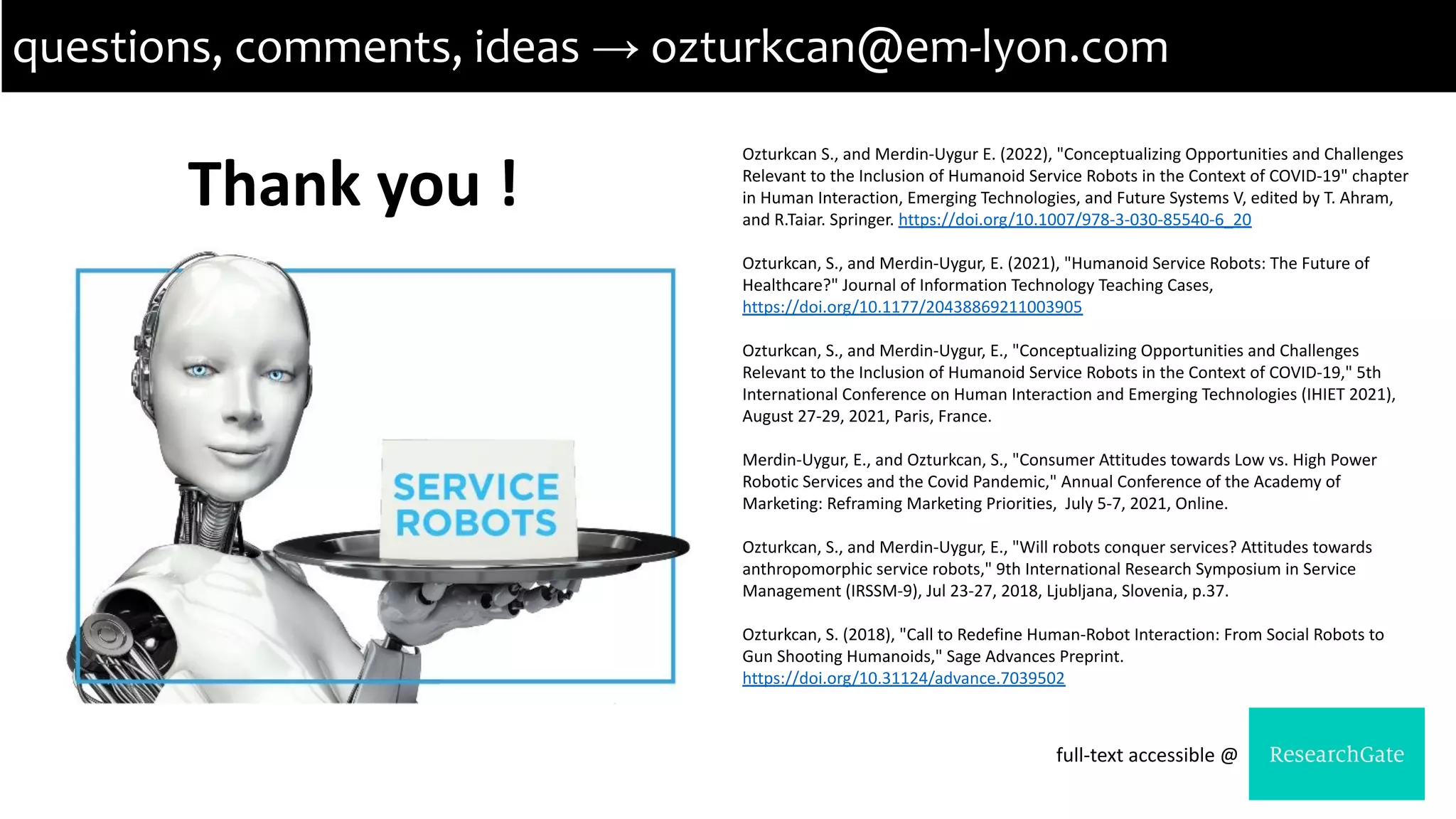
Thank you !
questions, comments, ideas → ozturkcan@em-lyon.com
Ozturkcan S., and Merdin-Uygur E. (2022), "Conceptualizing Opportunities and Challenges
Relevant to the Inclusion of Humanoid Service Robots in the Context of COVID-19" chapter
in Human Interaction, Emerging Technologies, and Future Systems V, edited by T. Ahram,
and R.Taiar. Springer. https://doi.org/10.1007/978-3-030-85540-6_20
Ozturkcan, S., and Merdin-Uygur, E. (2021), "Humanoid Service Robots: The Future of
Healthcare?" Journal of Information Technology Teaching Cases,
https://doi.org/10.1177/20438869211003905
Ozturkcan, S., and Merdin-Uygur, E., "Conceptualizing Opportunities and Challenges
Relevant to the Inclusion of Humanoid Service Robots in the Context of COVID-19," 5th
International Conference on Human Interaction and Emerging Technologies (IHIET 2021),
August 27-29, 2021, Paris, France.
Merdin-Uygur, E., and Ozturkcan, S., "Consumer Attitudes towards Low vs. High Power
Robotic Services and the Covid Pandemic," Annual Conference of the Academy of
Marketing: Reframing Marketing Priorities, July 5-7, 2021, Online.
Ozturkcan, S., and Merdin-Uygur, E., "Will robots conquer services? Attitudes towards
anthropomorphic service robots," 9th International Research Symposium in Service
Management (IRSSM-9), Jul 23-27, 2018, Ljubljana, Slovenia, p.37.
Ozturkcan, S. (2018), "Call to Redefine Human-Robot Interaction: From Social Robots to
Gun Shooting Humanoids," Sage Advances Preprint.
https://doi.org/10.31124/advance.7039502
full-text accessible @
references
1.Mattel, G.: Die, Robot: This Is Just the Beginning of Violence Against Job-Taking Robots. The Street, (2015)
2. Mende, M., Scott, M.L., van Doorn, J., Shanks, I., Grewal, D.: Service Robots Rising: How Humanoid Robots Influence Service Experiences and Food Consumption. Journal of Marketing Research 56, 535-556 (2017)
3. Glow, G.: COVID-19 And Unemployment: The Robots Are Coming. Forbes, (2020)
4. Chandrayan, A.: How is COVID-19 Impacting and Transforming the Humanoid Robot Industry? Robotics Tomorrow, (2020)
5. Ozturkcan, S., Merdin-Uygur, E.: Will robots conquer services? Attitudes towards anthropomorphic service robots. 9th International Research Symposium in Service Management (IRSSM-9), pp. 37, Ljubljana, Slovenia (2018)
6. ISO: Robots and robotic devices. vol. ISO 8373:2012. ISO (2012)
7. Lutz, C.: Privacy and Healthcare Robots@ An ANT Analysis. In: We Robot Conference, pp. 1-25. (2016)
8. Syrdal, D.S., Dautenhahn, K., Koay, K., Walters, M.: The Negative Attitudes towards Robots Scale and Reactions to Robot Behaviour in a Live Human-Robot Interaction Study. In: 23rd Convention of the Society for the Study of Artificial Intelligence
and Simulation of Behaviour, pp. 109-115. (2009)
9. Ozturkcan, S.: Call to Redefine Human-Robot Interaction: From Social Robots to Gun Shooting Humanoids. SageSubmissions. Preprint, (2018)
10. Rossi, S., Lee, D.: Special issue on user profiling and behavior adaptation for human-robot interaction. Pattern Recognition Letters 99, 1-2 (2017)
11. Ehlers, K., Brama, K.: A human-robot interaction interface for mobile and stationary robots based on real-time 3D human body and hand-finger pose estimation. In: IEEE 21st International Conference on Emerging Technologies and Factory
Automation, pp. 1-6. (2016)
12. Wehle, M., Weidemann, A., Boblan, I.W.: Research on Human Cognition for Biologically Inspired Developments: Human-Robot Interaction by Biomimetic AI. In: Vallverdú, J., Mazzara, M., Talanov, M., Distefano, S., Lowe, R. (eds.) Advanced
Research on Biologically Inspired Cognitive Architectures, pp. 83-116. IGI Global, Hershey, PA (2017)
13. Murphy, R., Gandudi, V., Adams, J.: Applications of Robots for COVID-19 Response. arXiv:2008.06976, (2020)
14. World Economic Forum, https://www.weforum.org/agenda/2020/05/robots-coronavirus-crisis/
15. R.L., B., Keri, V.C., Sinha, T.P., Bhoi, S.: Re-purposing humanoid robots for patient care in COVID-19 pandemic. The International Journal of Health Planning and Management 35, 1629-1631 (2020)
16. Ozturkcan, S., Merdin-Uygur, E.: Humanoid Service Robots: The Future of Healthcare? Journal of Information Technology Teaching Cases (2021)
17. HealthManagement: COVID-19 Paving the Way for Robots in Healthcare. HealthManagement.org - The Journal 20, 509-510 (2020)
18. MordorIntelligence: Service Robotics Market: Growth, Trends, COVID-19 Impact and Forecasts (2021 - 2026). Mordor Intelligence (2021)
19. Fusté-Forné, F., Jamal, T.: Co-Creating New Directions for Service Robots in Hospitality and Tourism. Tourism and Hospitality 2, 43-61 (2021)
20. Kim, S., Kim, J., Badu-Baiden, F., Giroux, M., Choi, Y.: Preference for robot service or human service in hotels? Impacts of the COVID-19 pandemic. International Journal of Hospitality Management 93, 102795 (2021)
21. Epley, N., Waytz, A., Cacioppo, J.T.: On seeing human: a three-factor theory of anthropomorphism. Psychological Review 114, 864-886 (2007)
22. Waytz, A., Heafner, J., Epley, N.: The mind in the machine: Anthropomorphism increases trust in an autonomous vehicle. Journal of Experimental Social Psychology 52, 113-117 (2014)
23. Dingjun, L., Rau, P.-L., Li, Y.: A Cross-cultural Study: Effect of Robot Appearance and Task. I. J. Social Robotics 2, 175-186 (2010)
24. Nass, C., Lee, K.: Does Computer-Synthesized Speech Manifest Personality? Experimental Tests of Recognition, Similarity-Attraction, and Consistency-Attraction. Journal of experimental psychology. Applied 7, 171-181 (2001)
25. Powers, A., Kiesler, S.: The Advisor Robot: Tracing People's Mental Model from a Robot's Physical Attributes. In: Proceedings of the 1st ACM SIGCHI/SIGART conference on Human-robot interaction, pp. 218-225. (2006)
26. Torrey, C., Powers, A., Marge, M., Fussell, S., Kiesler, S.: Effects of adaptive robot dialogue on information exchange and social relations. In: Proceedings of the 1st ACM SIGCHI/SIGART conference on Human-robot interaction, pp. 126-133.
(2006)
27. Moreale, E., Watt, S.: An Agent-Based Approach to Mailing List Knowledge Management. In: van Elst, L., Dignum, V., Abecker, A. (eds.) Agent-Mediated Knowledge Management, vol. 2926. Springer (2003)
28. Burgoon, J.K., Bonito, J.A., Bengtsson, B., Cederberg, C., Lundeberg, M., Allspach, L.: Interactivity in human–computer interaction: a study of credibility, understanding, and influence. Computers in Human Behavior 16, 553-574 (2000)
29. Wan, E., Chen, R., Jin, L.: Judging a Book by Its Cover? The Effect of Anthropomorphism on Product Attribute Processing and Consumer Preference. Journal of Consumer Research 43, 1008-1030 (2017)
30. Mori, M.: The Uncanny Valley. Energy 7, 33-35 (1970)
31. Kiesler, S., Goetz, J.: Mental models of robotic assistants. In: CHI'02 extended abstracts on Human Factors in Computing Systems, pp. 576-577. (2002)
32. Sims, V.K., Chin, M.G., Sushil, D.J., Barber, D.J., Ballion, T., Clark, B.R., Garfield, K.A., Dolezal, M.J., Shumaker, R., Finkelstein, N.: Anthropomorphism of Robotic Forms: A Response to Affordances? In: Proceedings of the Human Factors and
Ergonomics Society Annual Meeting, pp. 602-605. SAGE Publications Inc, (2005)
33. Mourey, J.A., Olson, J.G., Yoon, C.: Products as pals: Engaging with anthropomorphic products mitigates the effects of social exclusion. Journal of Consumer Research 44, 414-431 (2017)
34. Seifert, A., Cotten, S.R., Xie, B.: A Double Burden of Exclusion? Digital and Social Exclusion of Older Adults in Times of COVID-19. The Journals of Gerontology: Series B 76, e99-e103 (2020)
35. Graupmann, V., Pfundmair, M.: When social exclusion is mandated: COVID-19, social distancing, gender and psychological needs. PsyArXiv (2020)
36. Reuters: Sophia the robot maker plans mass rollout amid pandemic. Youtube (2021)
Conceptualizing Opportunities and
Challenges Relevant to the Inclusion of
Humanoid Service Robots in the Context
of COVID-19
Selcen Öztürkcan, Ph.D.
Full Professor of Marketing
emlyon business school, France
Ozturkcan@em-lyon.com
https://orcid.org/0000-0003-2248-0802
Cite as:
Ozturkcan, S., and Merdin-Uygur, E., "Conceptualizing Opportunities and Challenges Relevant to the Inclusion of Humanoid Service Robots in the Context of COVID-19," 5th International
Conference on Human Interaction and Emerging Technologies (IHIET 2021), August 27-29, 2021, Paris, France.

Conceptualizing Opportunities and Challenges Relevant to the Inclusion of Humanoid Service Robots in the Context of COVID-19

  • 1.
    Conceptualizing Opportunities and ChallengesRelevant to the Inclusion of Humanoid Service Robots in the Context of COVID-19 Selcen Öztürkcan, Ph.D. Full Professor of Marketing emlyon business school, France Ozturkcan@em-lyon.com https://orcid.org/0000-0003-2248-0802 Cite as: Ozturkcan S., and Merdin-Uygur E. (2022), "Conceptualizing Opportunities and Challenges Relevant to the Inclusion of Humanoid Service Robots in the Context of COVID-19" chapter in Human Interaction, Emerging Technologies, and Future Systems V, edited by Tareq Ahram, and Redha Taiar. Springer: Cham. https://doi.org/10.1007/978-3-030-85540-6_20
  • 2.
    • introduction • servicerobots • covid-19 outbreak • anthropomorphism • opportunities and challenges • conclusion agenda
  • 3.
    accelerated many businesses’digitalization, particularly for frontline services where employing humanoids reduces risks for human actors that could not distance socially during the encounters introduction aim to contribute to the ongoing research efforts on the inclusion of robots in services by focusing mainly on humanoid robots
  • 4.
    •robots possessing acertain degree of autonomy as they perform personal or professional tasks for humans [6] •capabilities in registering habits and attitudes of the humans that they interact • affect the perception of intimacy, privacy, bonding, and emotional support [7-9]. •look and move like humans •human-like learning and creating abilities [10-12] service robots (SR)
  • 5.
    • accelerated adoptionof SR • offer contact-free reliable performance in various tasks • delivery of food and medications, disinfecting, patrolling non-pharmaceutical social interventions, and assisting in reception [13, 14] • helpful in supporting the healthcare services that struggled to cope with increasing demand [15-17] • source of concern during the pandemic with already rising unemployment figures. • replace human workers by • serving drinks and food to customers in hotels and airport lounges [18] • handling check-in and check-out services at hotels [19] • preference for robot-staffed hotels when COVID-19 is salient [20] covid-19 outbreak
  • 6.
    • “the tendencyto imbue the real or imagined behavior of non-human agents with human like characteristics, motivations, intentions, or emotions” [21] • inductive inference mechanism: individuals assign distinct human characteristics to non-humans - capacity for rationality and conscious feeling [22] anthropomorphism - (1/3)
  • 7.
    • degree ofanthropomorphic representation → determinant of both how a person acts towards them or how a person should respond in relation to or in the existence of them • anthropomorphic virtual assistants: enhance users learning in software programs by dealing with knowledge overload better [27] • anthropomorphic faces and voices in the interface of a survival task: individuals feel better understood [28] • anthropomorphic features such as being named, gendered, and voiced in autonomous vehicle: perceived as more competent [22] • anthropomorphized vehicle: higher trust, more relaxed in an accident, and blame their vehicle and related entities less for an accident caused by another driver anthropomorphism - (2/3)
  • 8.
    • challenge: thetheory of uncanny valley [30] • presence and behavior of a robot made more human → emotional response becomes more optimistic and empathic - until a point is reached at which a reaction of revulsion will arise • robots become more similar to humans → humans avoid them: individuals do not choose to cooperate and work with serious-looking anthropomorphic robots [31] anthropomorphism - (3/3)
  • 9.
    • humanoid robots •provided genuine human interactions → mitigated many negative and unwanted effects of social exclusion • satisfied the social assurance needs of individuals, in the absence of other real human entities and reduced the need for socially close others [33] anthropomorphism & Covid-19
  • 10.
    social distancing →severe exclusion of some members of the societies based on physical social contact • vulnerable groups - older adults and persons with disabilities - faced exclusion from digital services that aimed to compensate for the lack of physical contact [34] • struggle with the double burden of social and digital exclusion social exclusion - an additional challenge amid the pandemic [35] social exclusion – opportunities & challenges “capable of measuring temperature with its thermal camera on her chest or leading morning exercise for the older adults, it aimed to help take care of sick and elderly. It was also useful in helping to communicate, giving therapy, and providing social stimulation even in difficult situations”[36] Sophia, the humanoid robot introduced in 2016 • might also help with the loneliness felt due to the social exclusion • delivery of human warmth through telepresence or autonomous extension of human expertise • positioning SR as our true friends??
  • 11.
    • Acceptance towardshumanoid SR during the COVID-19 pandemic accelerated, yet the challenges persist despite the involved opportunities. • The emerging social technological acceptance demands further research for improved policymaking that can facilitate better affordances and readiness - especially for responsible AI practices to evolve! conclusion
  • 12.
    Thank you ! questions,comments, ideas → ozturkcan@em-lyon.com Ozturkcan S., and Merdin-Uygur E. (2022), "Conceptualizing Opportunities and Challenges Relevant to the Inclusion of Humanoid Service Robots in the Context of COVID-19" chapter in Human Interaction, Emerging Technologies, and Future Systems V, edited by T. Ahram, and R.Taiar. Springer. https://doi.org/10.1007/978-3-030-85540-6_20 Ozturkcan, S., and Merdin-Uygur, E. (2021), "Humanoid Service Robots: The Future of Healthcare?" Journal of Information Technology Teaching Cases, https://doi.org/10.1177/20438869211003905 Ozturkcan, S., and Merdin-Uygur, E., "Conceptualizing Opportunities and Challenges Relevant to the Inclusion of Humanoid Service Robots in the Context of COVID-19," 5th International Conference on Human Interaction and Emerging Technologies (IHIET 2021), August 27-29, 2021, Paris, France. Merdin-Uygur, E., and Ozturkcan, S., "Consumer Attitudes towards Low vs. High Power Robotic Services and the Covid Pandemic," Annual Conference of the Academy of Marketing: Reframing Marketing Priorities, July 5-7, 2021, Online. Ozturkcan, S., and Merdin-Uygur, E., "Will robots conquer services? Attitudes towards anthropomorphic service robots," 9th International Research Symposium in Service Management (IRSSM-9), Jul 23-27, 2018, Ljubljana, Slovenia, p.37. Ozturkcan, S. (2018), "Call to Redefine Human-Robot Interaction: From Social Robots to Gun Shooting Humanoids," Sage Advances Preprint. https://doi.org/10.31124/advance.7039502 full-text accessible @
  • 13.
    references 1.Mattel, G.: Die,Robot: This Is Just the Beginning of Violence Against Job-Taking Robots. The Street, (2015) 2. Mende, M., Scott, M.L., van Doorn, J., Shanks, I., Grewal, D.: Service Robots Rising: How Humanoid Robots Influence Service Experiences and Food Consumption. Journal of Marketing Research 56, 535-556 (2017) 3. Glow, G.: COVID-19 And Unemployment: The Robots Are Coming. Forbes, (2020) 4. Chandrayan, A.: How is COVID-19 Impacting and Transforming the Humanoid Robot Industry? Robotics Tomorrow, (2020) 5. Ozturkcan, S., Merdin-Uygur, E.: Will robots conquer services? Attitudes towards anthropomorphic service robots. 9th International Research Symposium in Service Management (IRSSM-9), pp. 37, Ljubljana, Slovenia (2018) 6. ISO: Robots and robotic devices. vol. ISO 8373:2012. ISO (2012) 7. Lutz, C.: Privacy and Healthcare Robots@ An ANT Analysis. In: We Robot Conference, pp. 1-25. (2016) 8. Syrdal, D.S., Dautenhahn, K., Koay, K., Walters, M.: The Negative Attitudes towards Robots Scale and Reactions to Robot Behaviour in a Live Human-Robot Interaction Study. In: 23rd Convention of the Society for the Study of Artificial Intelligence and Simulation of Behaviour, pp. 109-115. (2009) 9. Ozturkcan, S.: Call to Redefine Human-Robot Interaction: From Social Robots to Gun Shooting Humanoids. SageSubmissions. Preprint, (2018) 10. Rossi, S., Lee, D.: Special issue on user profiling and behavior adaptation for human-robot interaction. Pattern Recognition Letters 99, 1-2 (2017) 11. Ehlers, K., Brama, K.: A human-robot interaction interface for mobile and stationary robots based on real-time 3D human body and hand-finger pose estimation. In: IEEE 21st International Conference on Emerging Technologies and Factory Automation, pp. 1-6. (2016) 12. Wehle, M., Weidemann, A., Boblan, I.W.: Research on Human Cognition for Biologically Inspired Developments: Human-Robot Interaction by Biomimetic AI. In: Vallverdú, J., Mazzara, M., Talanov, M., Distefano, S., Lowe, R. (eds.) Advanced Research on Biologically Inspired Cognitive Architectures, pp. 83-116. IGI Global, Hershey, PA (2017) 13. Murphy, R., Gandudi, V., Adams, J.: Applications of Robots for COVID-19 Response. arXiv:2008.06976, (2020) 14. World Economic Forum, https://www.weforum.org/agenda/2020/05/robots-coronavirus-crisis/ 15. R.L., B., Keri, V.C., Sinha, T.P., Bhoi, S.: Re-purposing humanoid robots for patient care in COVID-19 pandemic. The International Journal of Health Planning and Management 35, 1629-1631 (2020) 16. Ozturkcan, S., Merdin-Uygur, E.: Humanoid Service Robots: The Future of Healthcare? Journal of Information Technology Teaching Cases (2021) 17. HealthManagement: COVID-19 Paving the Way for Robots in Healthcare. HealthManagement.org - The Journal 20, 509-510 (2020) 18. MordorIntelligence: Service Robotics Market: Growth, Trends, COVID-19 Impact and Forecasts (2021 - 2026). Mordor Intelligence (2021) 19. Fusté-Forné, F., Jamal, T.: Co-Creating New Directions for Service Robots in Hospitality and Tourism. Tourism and Hospitality 2, 43-61 (2021) 20. Kim, S., Kim, J., Badu-Baiden, F., Giroux, M., Choi, Y.: Preference for robot service or human service in hotels? Impacts of the COVID-19 pandemic. International Journal of Hospitality Management 93, 102795 (2021) 21. Epley, N., Waytz, A., Cacioppo, J.T.: On seeing human: a three-factor theory of anthropomorphism. Psychological Review 114, 864-886 (2007) 22. Waytz, A., Heafner, J., Epley, N.: The mind in the machine: Anthropomorphism increases trust in an autonomous vehicle. Journal of Experimental Social Psychology 52, 113-117 (2014) 23. Dingjun, L., Rau, P.-L., Li, Y.: A Cross-cultural Study: Effect of Robot Appearance and Task. I. J. Social Robotics 2, 175-186 (2010) 24. Nass, C., Lee, K.: Does Computer-Synthesized Speech Manifest Personality? Experimental Tests of Recognition, Similarity-Attraction, and Consistency-Attraction. Journal of experimental psychology. Applied 7, 171-181 (2001) 25. Powers, A., Kiesler, S.: The Advisor Robot: Tracing People's Mental Model from a Robot's Physical Attributes. In: Proceedings of the 1st ACM SIGCHI/SIGART conference on Human-robot interaction, pp. 218-225. (2006) 26. Torrey, C., Powers, A., Marge, M., Fussell, S., Kiesler, S.: Effects of adaptive robot dialogue on information exchange and social relations. In: Proceedings of the 1st ACM SIGCHI/SIGART conference on Human-robot interaction, pp. 126-133. (2006) 27. Moreale, E., Watt, S.: An Agent-Based Approach to Mailing List Knowledge Management. In: van Elst, L., Dignum, V., Abecker, A. (eds.) Agent-Mediated Knowledge Management, vol. 2926. Springer (2003) 28. Burgoon, J.K., Bonito, J.A., Bengtsson, B., Cederberg, C., Lundeberg, M., Allspach, L.: Interactivity in human–computer interaction: a study of credibility, understanding, and influence. Computers in Human Behavior 16, 553-574 (2000) 29. Wan, E., Chen, R., Jin, L.: Judging a Book by Its Cover? The Effect of Anthropomorphism on Product Attribute Processing and Consumer Preference. Journal of Consumer Research 43, 1008-1030 (2017) 30. Mori, M.: The Uncanny Valley. Energy 7, 33-35 (1970) 31. Kiesler, S., Goetz, J.: Mental models of robotic assistants. In: CHI'02 extended abstracts on Human Factors in Computing Systems, pp. 576-577. (2002) 32. Sims, V.K., Chin, M.G., Sushil, D.J., Barber, D.J., Ballion, T., Clark, B.R., Garfield, K.A., Dolezal, M.J., Shumaker, R., Finkelstein, N.: Anthropomorphism of Robotic Forms: A Response to Affordances? In: Proceedings of the Human Factors and Ergonomics Society Annual Meeting, pp. 602-605. SAGE Publications Inc, (2005) 33. Mourey, J.A., Olson, J.G., Yoon, C.: Products as pals: Engaging with anthropomorphic products mitigates the effects of social exclusion. Journal of Consumer Research 44, 414-431 (2017) 34. Seifert, A., Cotten, S.R., Xie, B.: A Double Burden of Exclusion? Digital and Social Exclusion of Older Adults in Times of COVID-19. The Journals of Gerontology: Series B 76, e99-e103 (2020) 35. Graupmann, V., Pfundmair, M.: When social exclusion is mandated: COVID-19, social distancing, gender and psychological needs. PsyArXiv (2020) 36. Reuters: Sophia the robot maker plans mass rollout amid pandemic. Youtube (2021)
  • 14.
    Conceptualizing Opportunities and ChallengesRelevant to the Inclusion of Humanoid Service Robots in the Context of COVID-19 Selcen Öztürkcan, Ph.D. Full Professor of Marketing emlyon business school, France Ozturkcan@em-lyon.com https://orcid.org/0000-0003-2248-0802 Cite as: Ozturkcan, S., and Merdin-Uygur, E., "Conceptualizing Opportunities and Challenges Relevant to the Inclusion of Humanoid Service Robots in the Context of COVID-19," 5th International Conference on Human Interaction and Emerging Technologies (IHIET 2021), August 27-29, 2021, Paris, France.