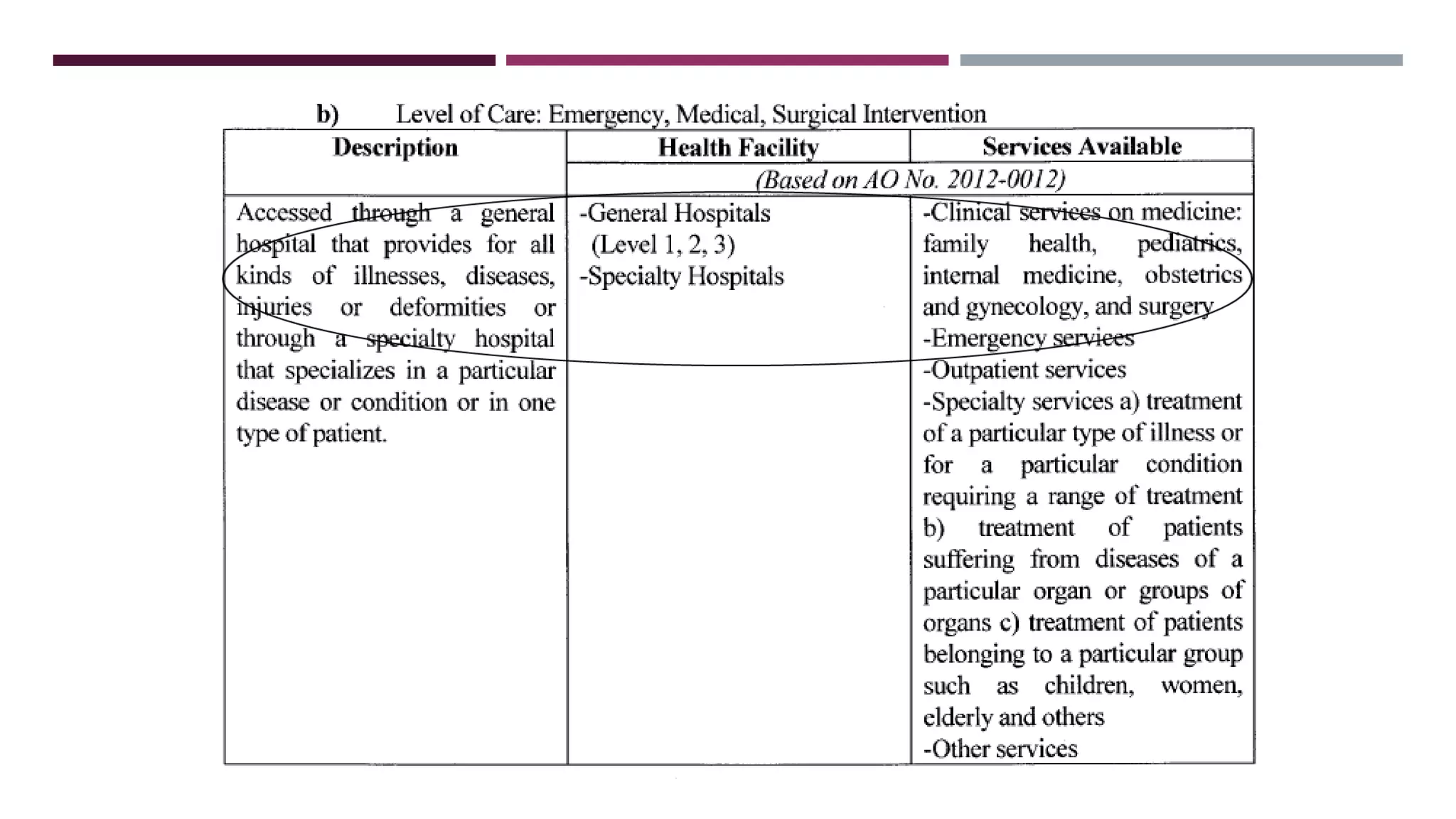
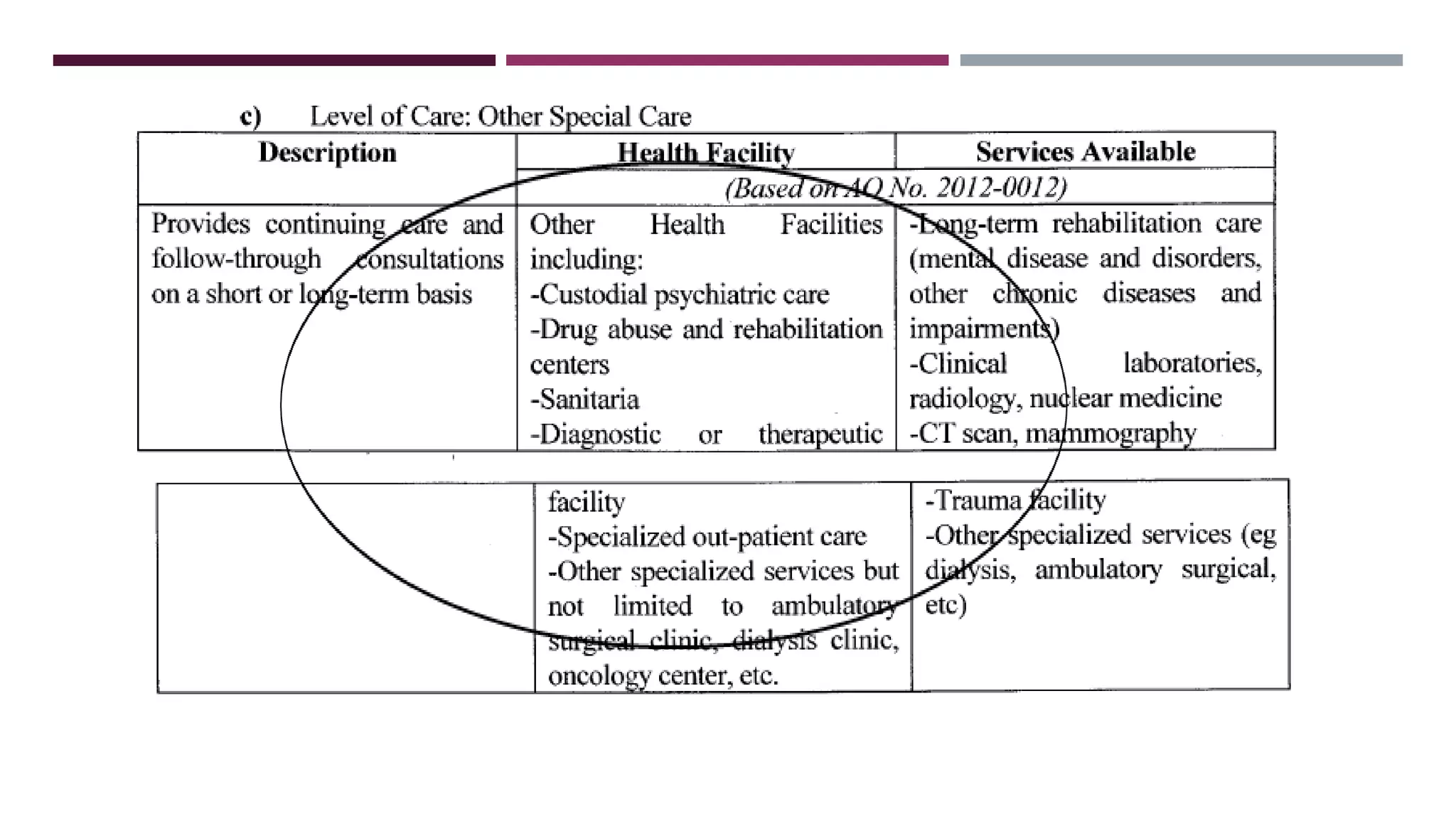
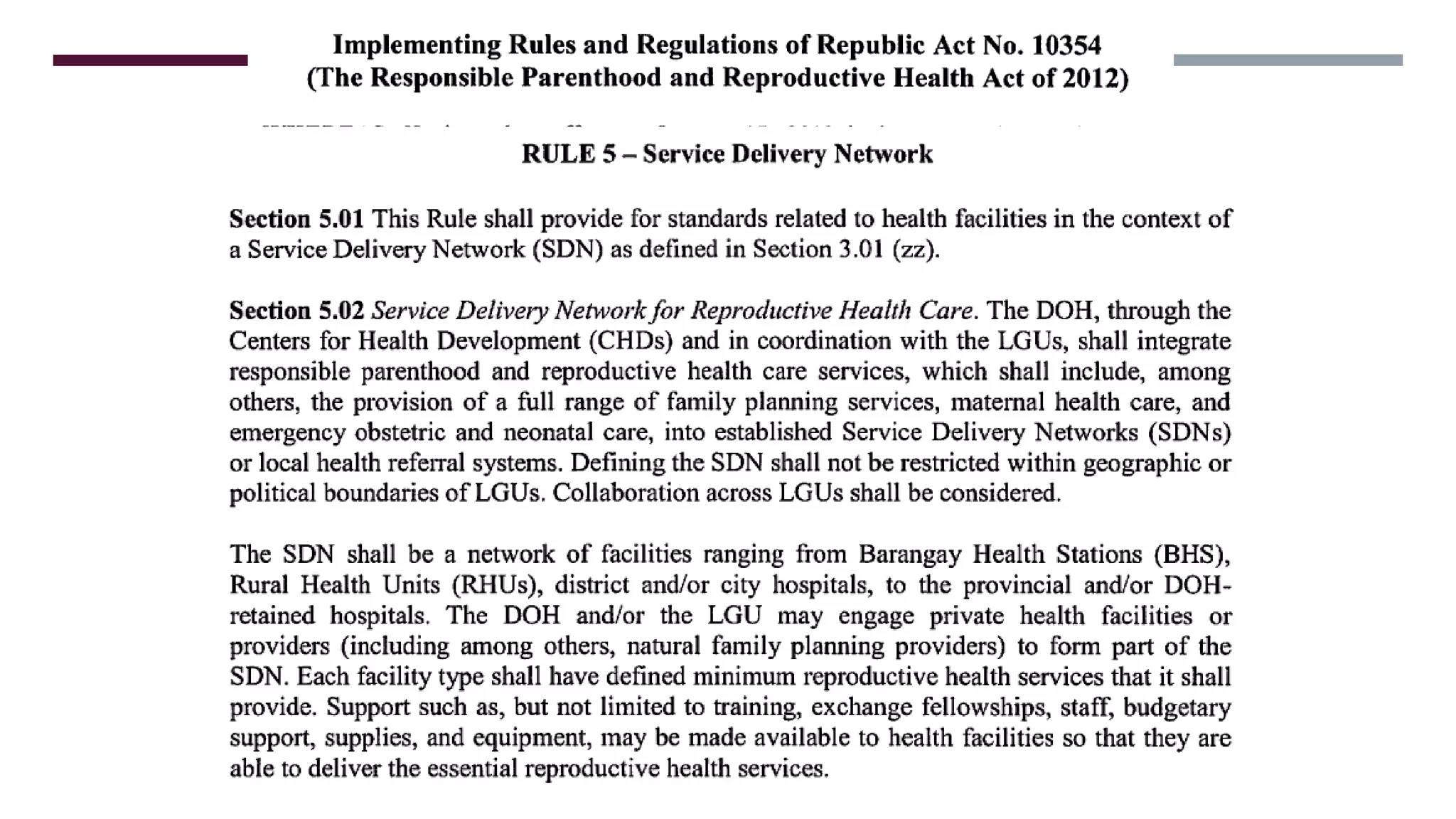

CONCEPT(S) OF SERVICE DELIVERY NETWORK (SDN)
ON DOH HEALTH PROGRAM
PROGRAMMATIC REVIEW OF SDN DEVELOPMENT PROCESSES AND IMPLEMENTATION
Rogelio M Ilagan, MD, MPH
+63908-819-7913
rogermilagan@gmail.com
All for Health
towards
Health for All
THE DUTERTE HEALTH AGENDA
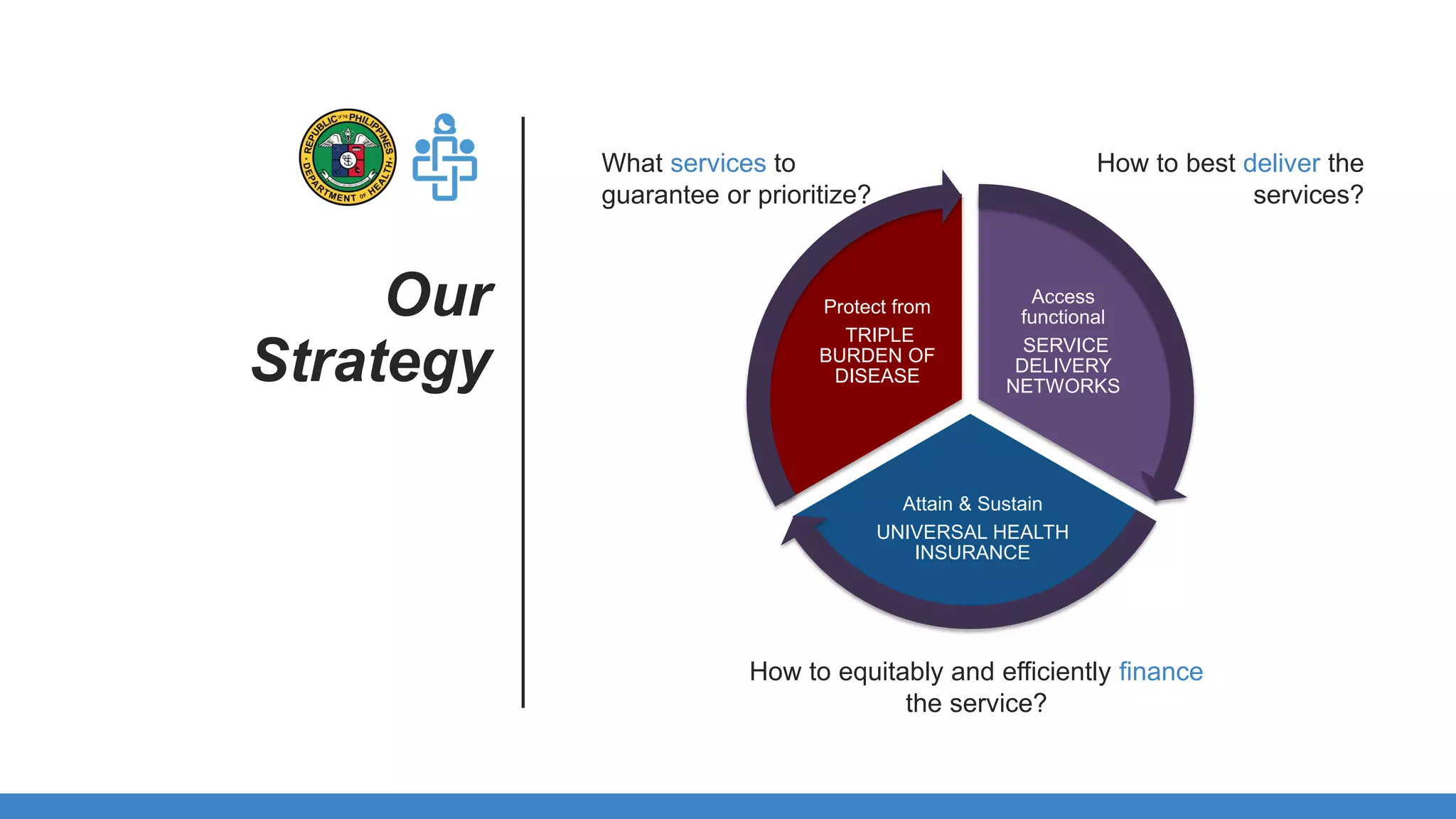
Access
functional
SERVICE
DELIVERY
NETWORKS
Attain & Sustain
UNIVERSAL HEALTH
INSURANCE
Protect from
TRIPLE
BURDEN OF
DISEASE
What services to
guarantee or prioritize?
How to best deliver the
services?
How to equitably and efficiently finance
the service?
Our
Strategy
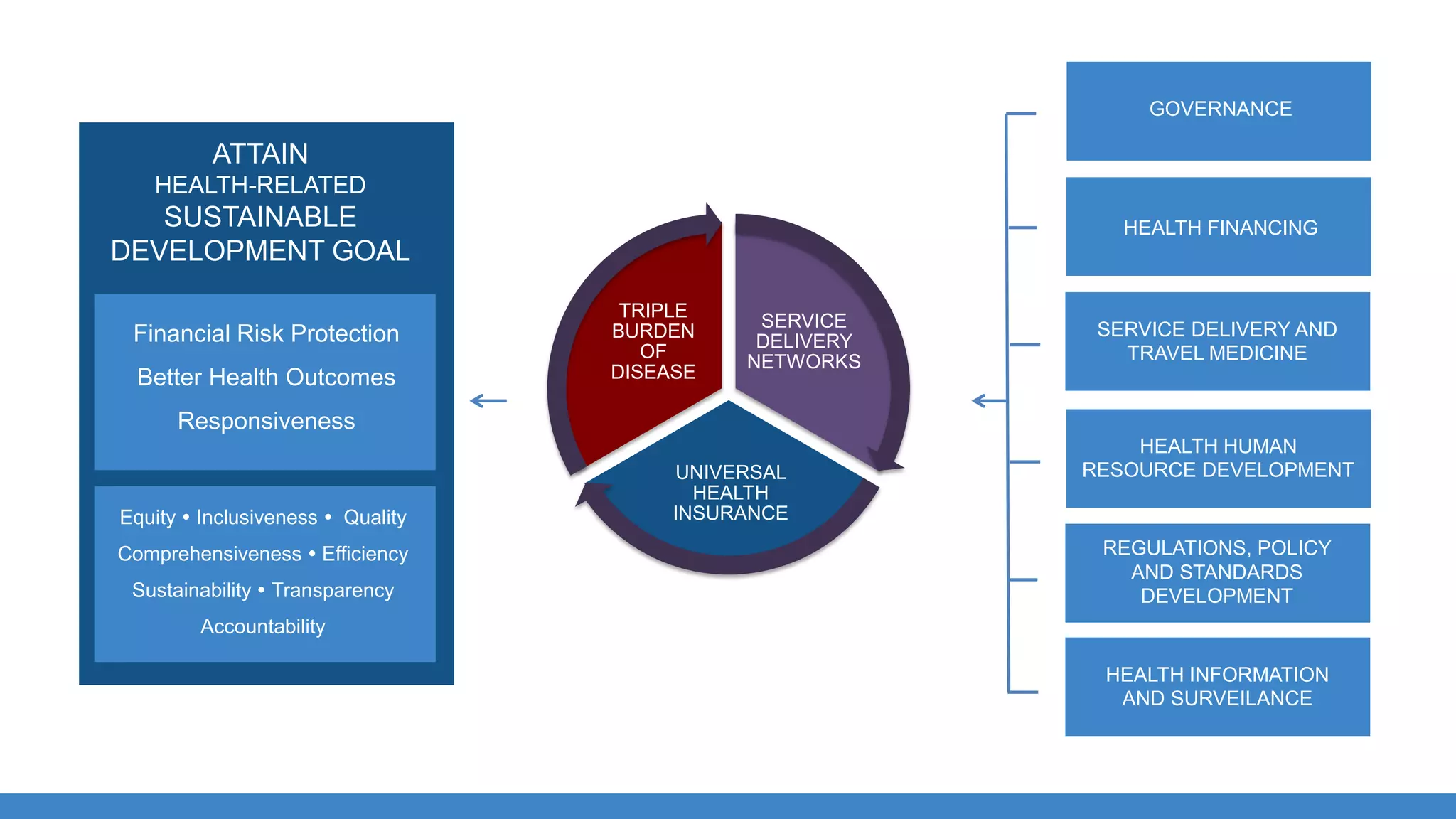
GOVERNANCE
HEALTH FINANCING
SERVICE DELIVERY AND
TRAVEL MEDICINE
HEALTH HUMAN
RESOURCE DEVELOPMENT
REGULATIONS, POLICY
AND STANDARDS
DEVELOPMENT
HEALTH INFORMATION
AND SURVEILANCE
ATTAIN
HEALTH-RELATED
SUSTAINABLE
DEVELOPMENT GOAL
Financial Risk Protection
Better Health Outcomes
Responsiveness
Equity  Inclusiveness  Quality
Comprehensiveness  Efficiency
Sustainability  Transparency
Accountability
SERVICE
DELIVERY
NETWORKS
UNIVERSAL
HEALTH
INSURANCE
TRIPLE
BURDEN
OF
DISEASE
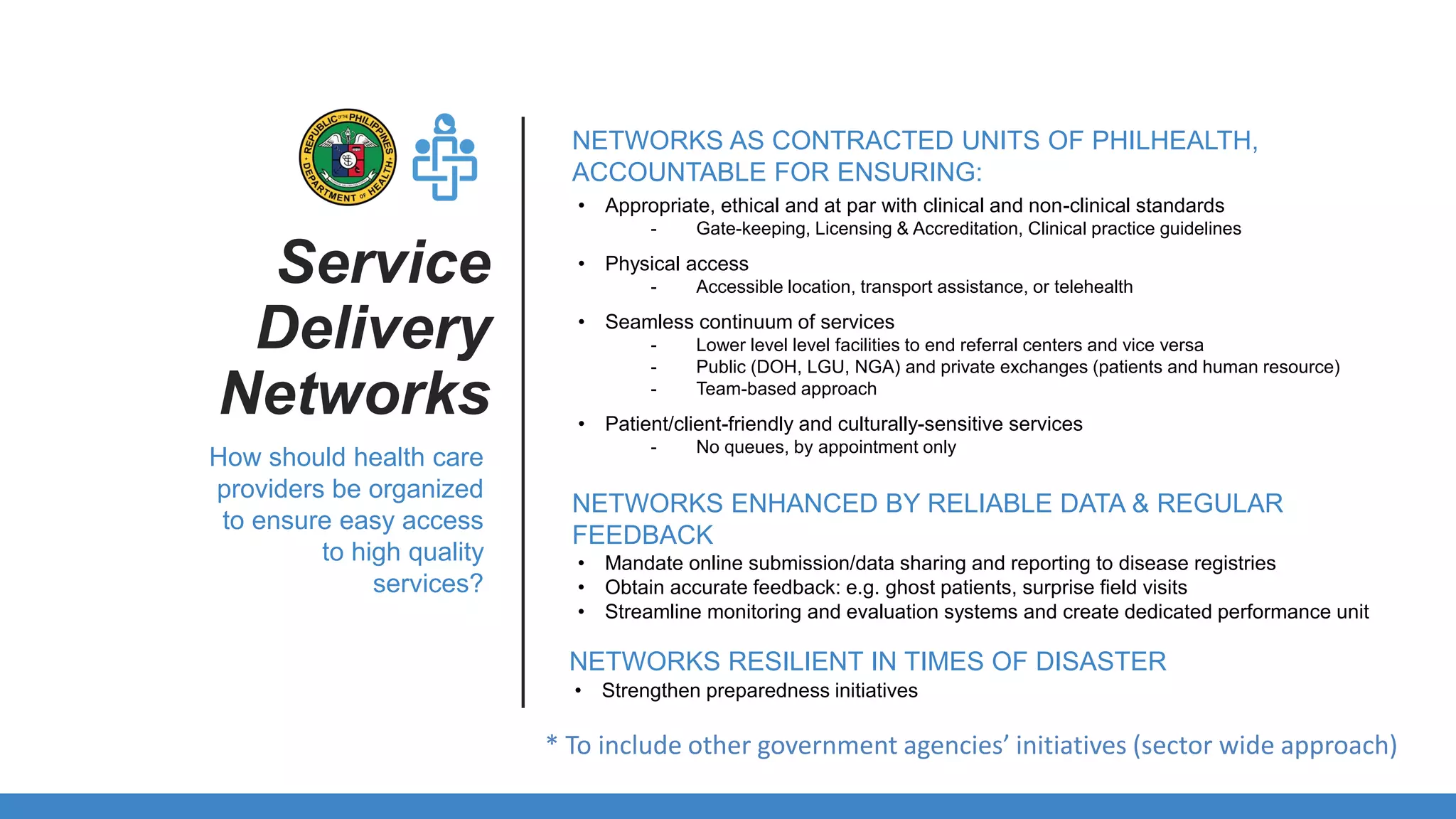
• Appropriate, ethical and at par with clinical and non-clinical standards
- Gate-keeping, Licensing & Accreditation, Clinical practice guidelines
• Physical access
- Accessible location, transport assistance, or telehealth
• Seamless continuum of services
- Lower level level facilities to end referral centers and vice versa
- Public (DOH, LGU, NGA) and private exchanges (patients and human resource)
- Team-based approach
• Patient/client-friendly and culturally-sensitive services
- No queues, by appointment only
Service
Delivery
Networks
NETWORKS AS CONTRACTED UNITS OF PHILHEALTH,
ACCOUNTABLE FOR ENSURING:
How should health care
providers be organized
to ensure easy access
to high quality
services?
NETWORKS ENHANCED BY RELIABLE DATA & REGULAR
FEEDBACK
• Mandate online submission/data sharing and reporting to disease registries
• Obtain accurate feedback: e.g. ghost patients, surprise field visits
• Streamline monitoring and evaluation systems and create dedicated performance unit
NETWORKS RESILIENT IN TIMES OF DISASTER
• Strengthen preparedness initiatives
* To include other government agencies’ initiatives (sector wide approach)
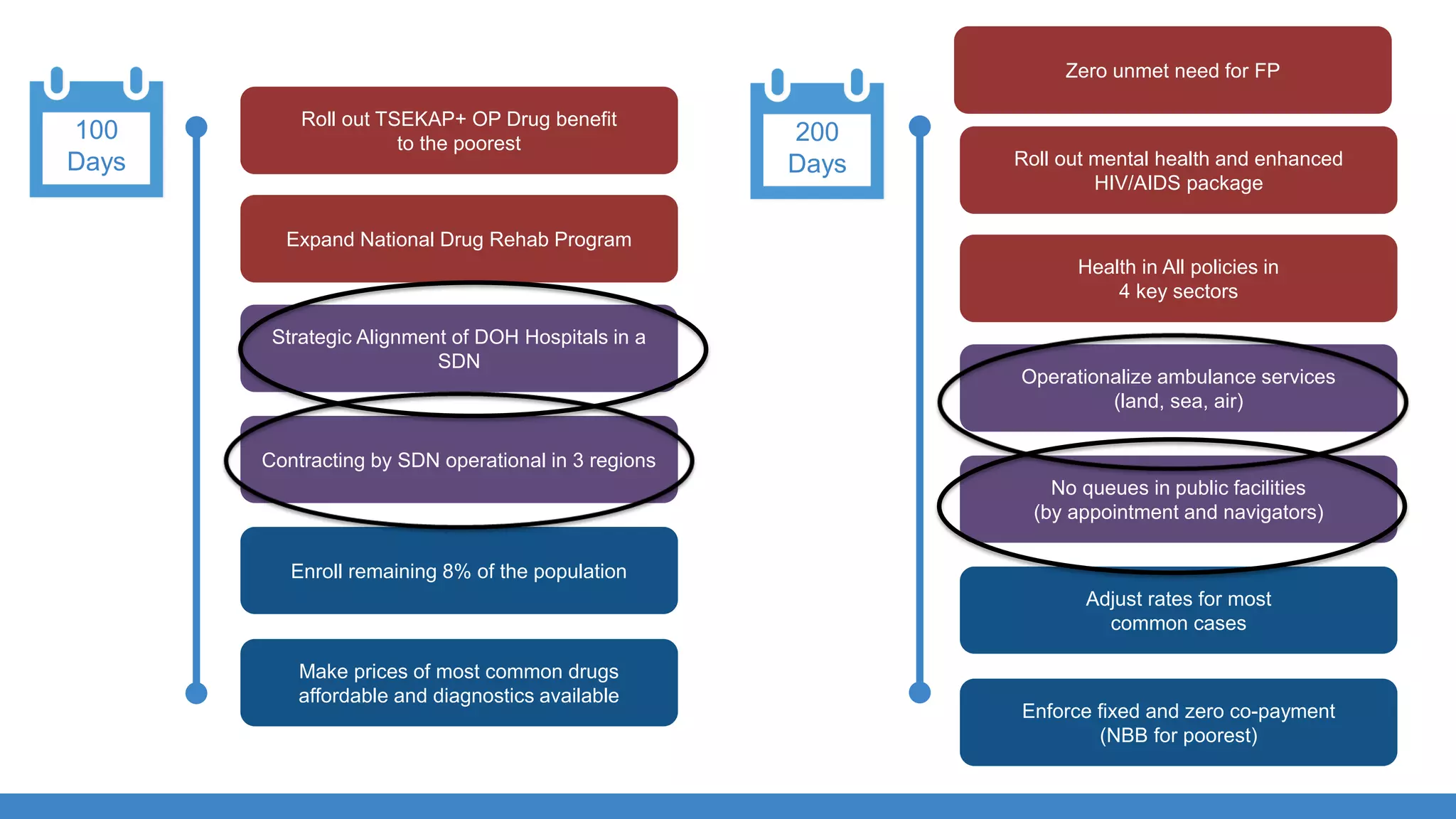
200
Days
Roll out TSEKAP+ OP Drug benefit
to the poorest
Expand National Drug Rehab Program
Strategic Alignment of DOH Hospitals in a
SDN
Contracting by SDN operational in 3 regions
Enroll remaining 8% of the population
Make prices of most common drugs
affordable and diagnostics available
100
Days Roll out mental health and enhanced
HIV/AIDS package
Health in All policies in
4 key sectors
Operationalize ambulance services
(land, sea, air)
No queues in public facilities
(by appointment and navigators)
Adjust rates for most
common cases
Enforce fixed and zero co-payment
(NBB for poorest)
Zero unmet need for FP
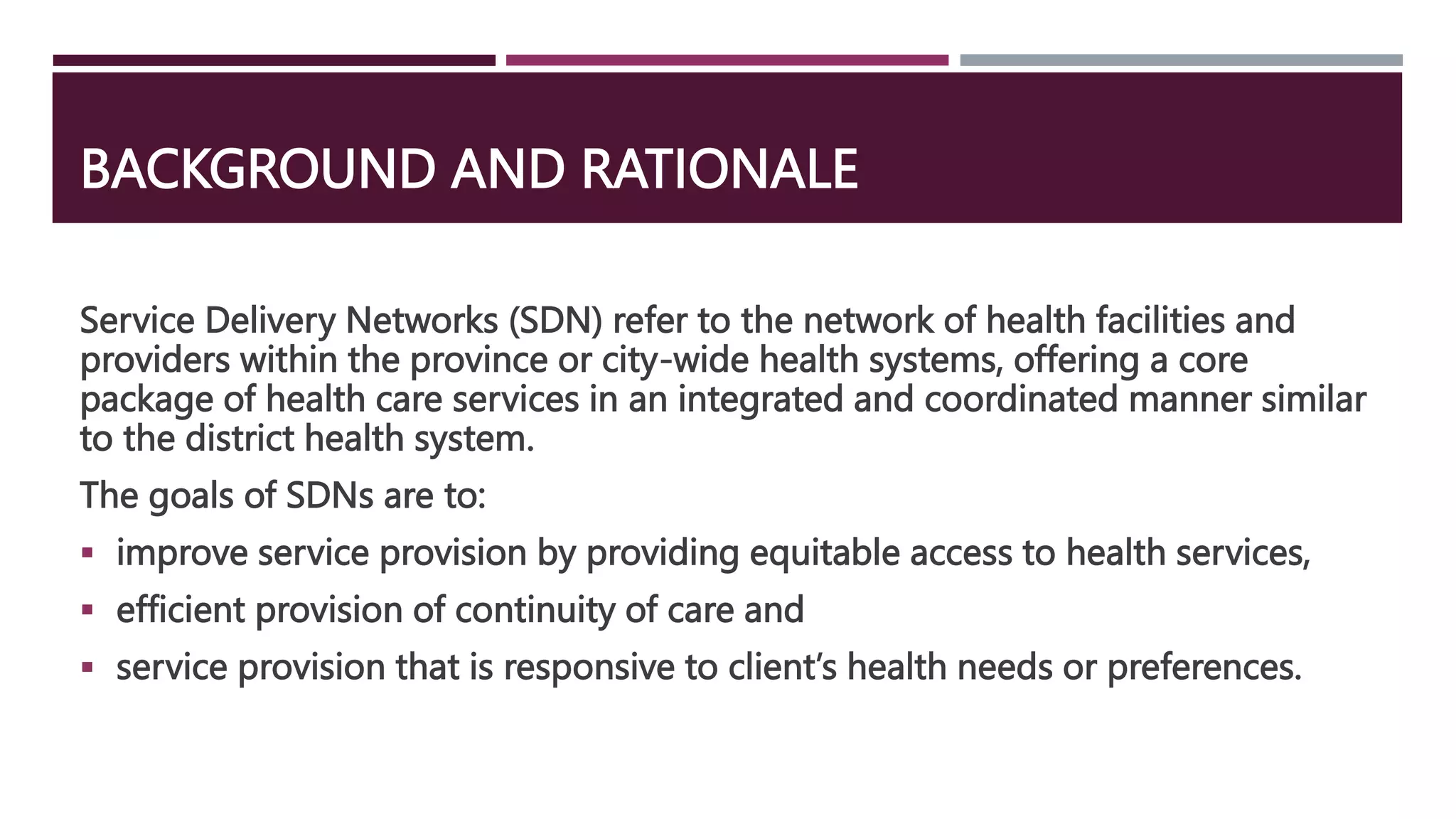
BACKGROUND AND RATIONALE
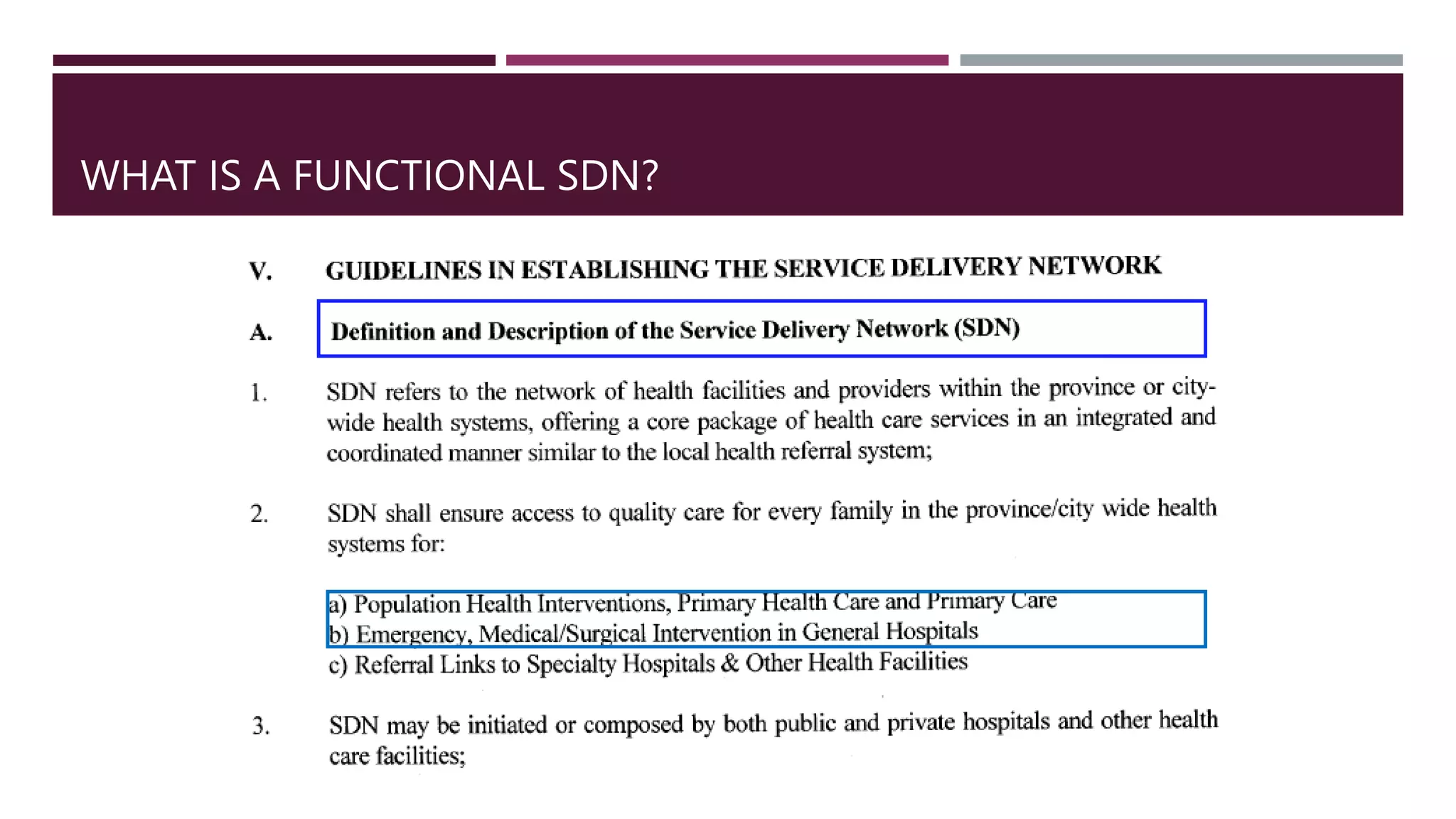
Service Delivery Networks (SDN) refer to the network of health facilities and
providers within the province or city-wide health systems, offering a core
package of health care services in an integrated and coordinated manner similar
to the district health system.
The goals of SDNs are to:
 improve service provision by providing equitable access to health services,
 efficient provision of continuity of care and
 service provision that is responsive to client’s health needs or preferences.
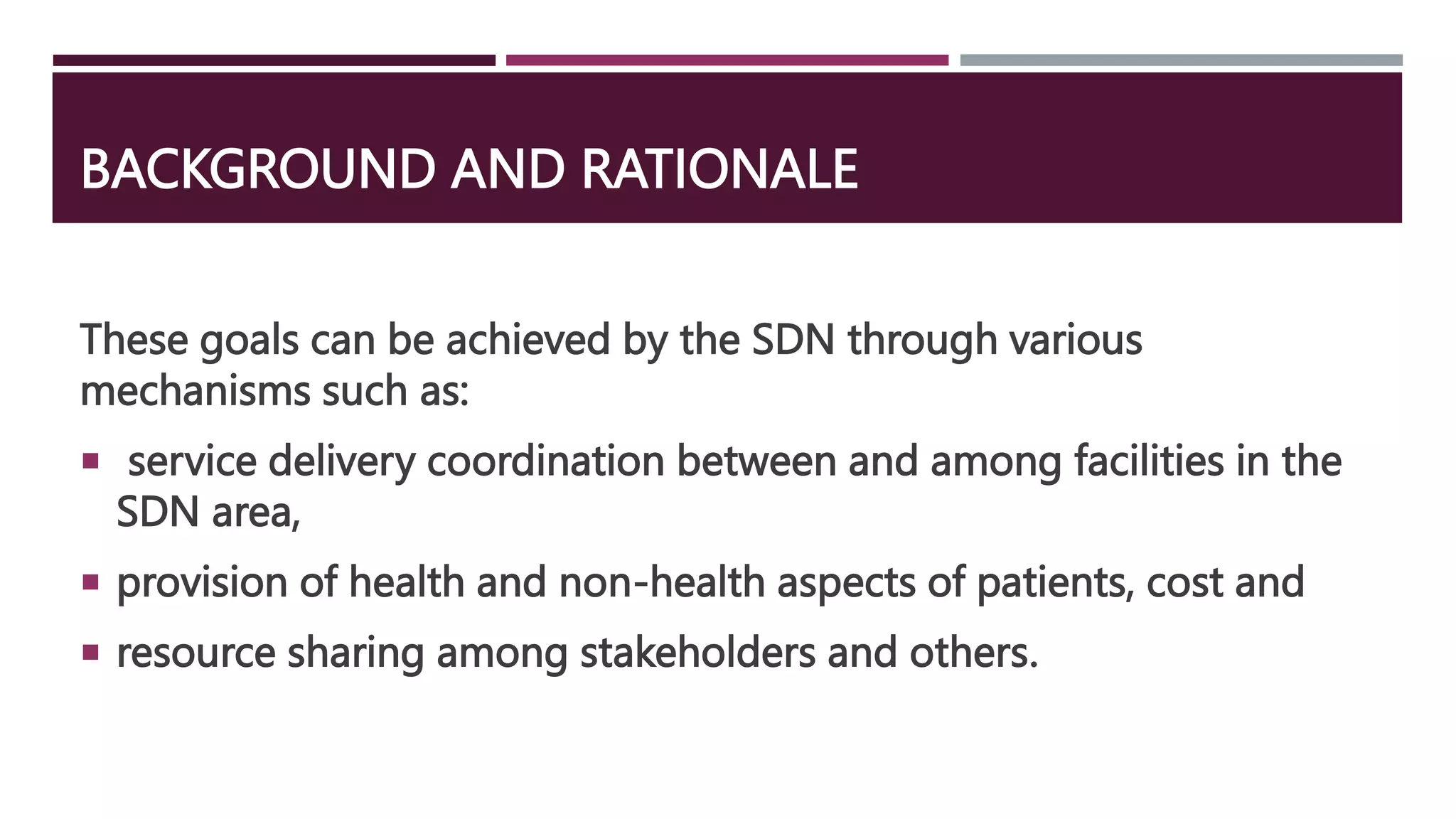
BACKGROUND AND RATIONALE
These goals can be achieved by the SDN through various
mechanisms such as:
 service delivery coordination between and among facilities in the
SDN area,
 provision of health and non-health aspects of patients, cost and
 resource sharing among stakeholders and others.
BACKGROUND AND RATIONALE
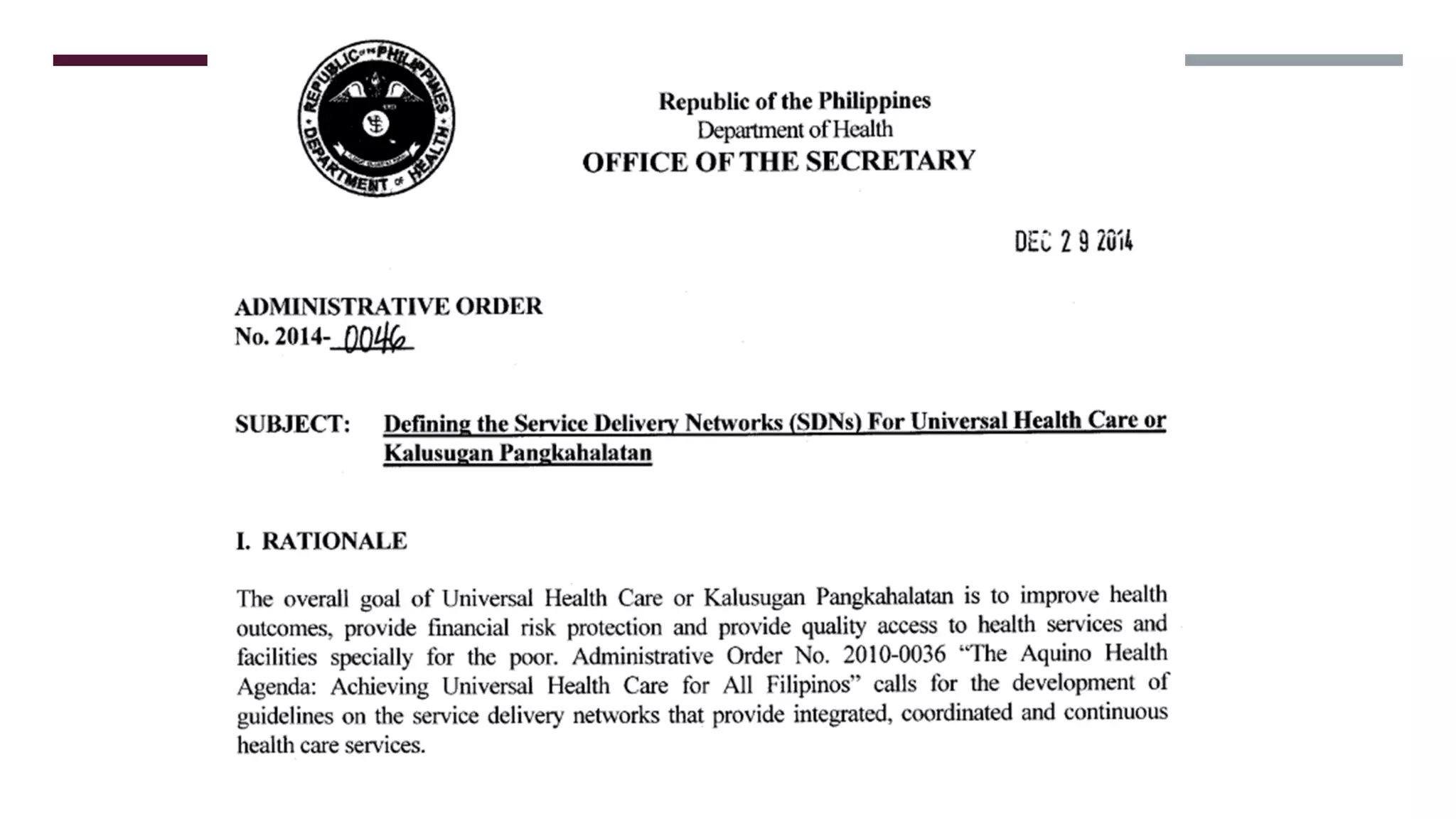
The recent Administrative Order issued by DoH on December 2016, redefined
the General Guidelines of the Service Delivery Network, particularly in areas of:
1) Catchment area and population,
2) Component care networks,
3) Governance and operational component,
4) Financing and fund sources,
5) Functional activities and
6) Entitlements of national population.
BACKGROUND AND RATIONALE
The new AO also expanded the roles and responsibilities of:
 DoH and its component internal bureaus,
 Philippine Health Insurance Corporation,
 Local Government Units and
 other collateral government and non-government agencies.
BACKGROUND AND RATIONALE
The ideal implementation of the Service Delivery Network approach will
result in:
 patients receiving effective and appropriate health services from any
facility in the network and
 inter-facility transfer utilizing a single set of medical history and
laboratory examination data to prevent duplication and delays of
particular services, treatment and intervention and
 will also result in the provision of patient’s health care needs from
preventive and promotive to curative and rehabilitative health services,
BACKGROUND AND RATIONALE
With the network facilitating patient transfer within and outside the
network, minimizing:
 patient waiting time,
 inadequate information on service or provider availability and
among member facilities of the SDN.
 lost of time and resources to collect, summarize and analyze
patients’ needs and feedback for the improvement of service
provision in the network.
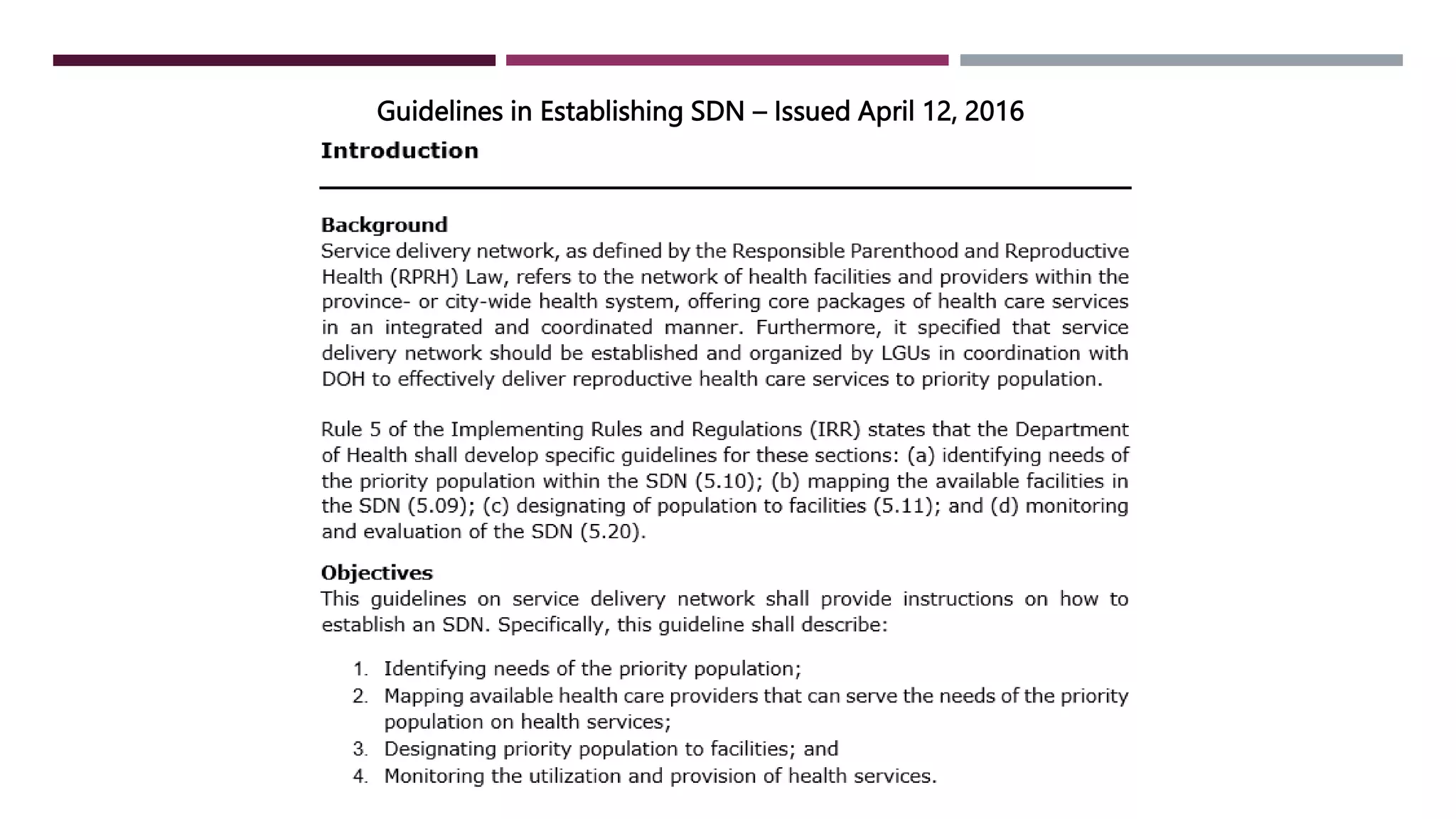
Guidelines in Establishing SDN – Issued April 12, 2016
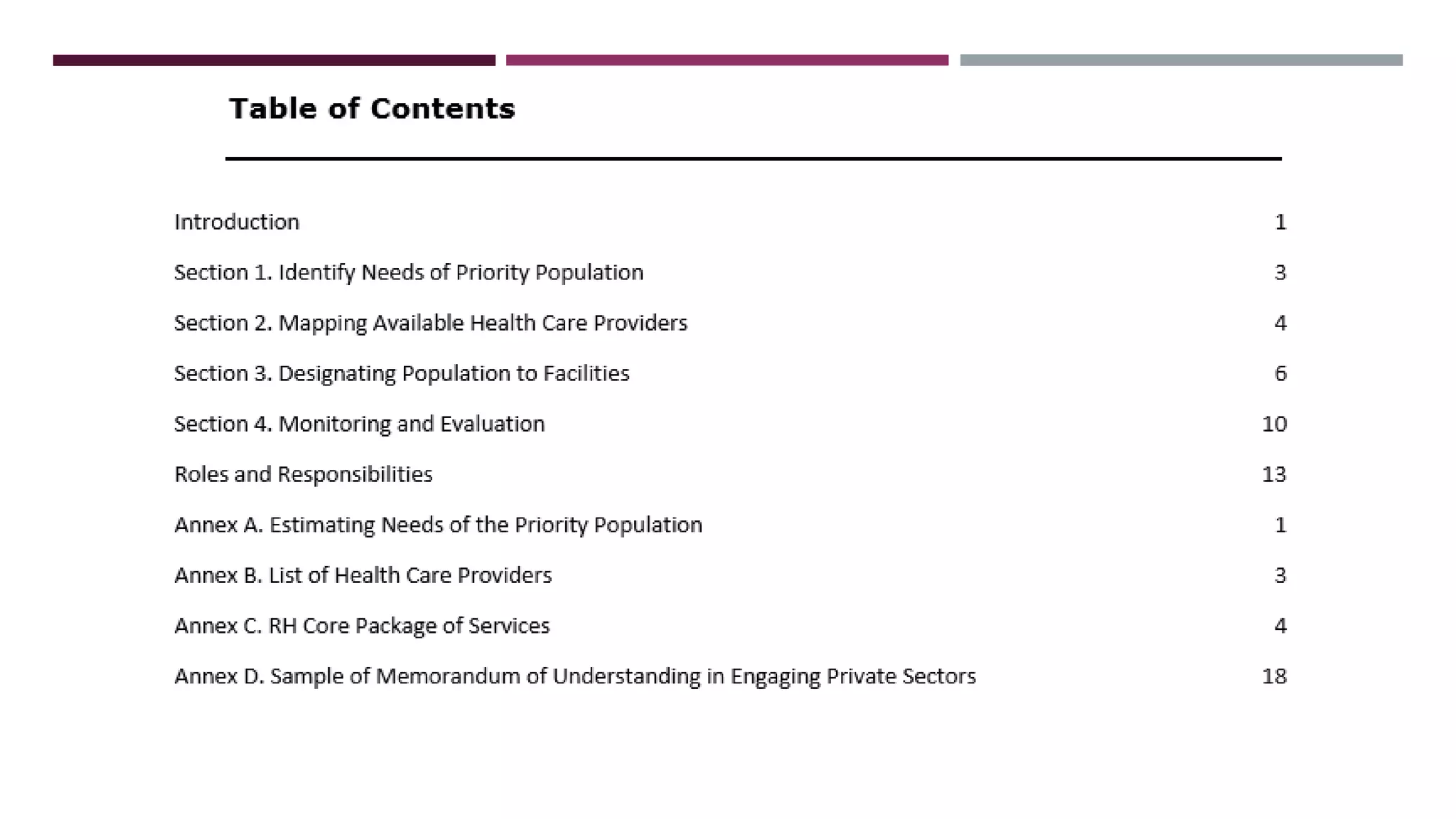
WHAT IS A FUNCTIONAL SDN?
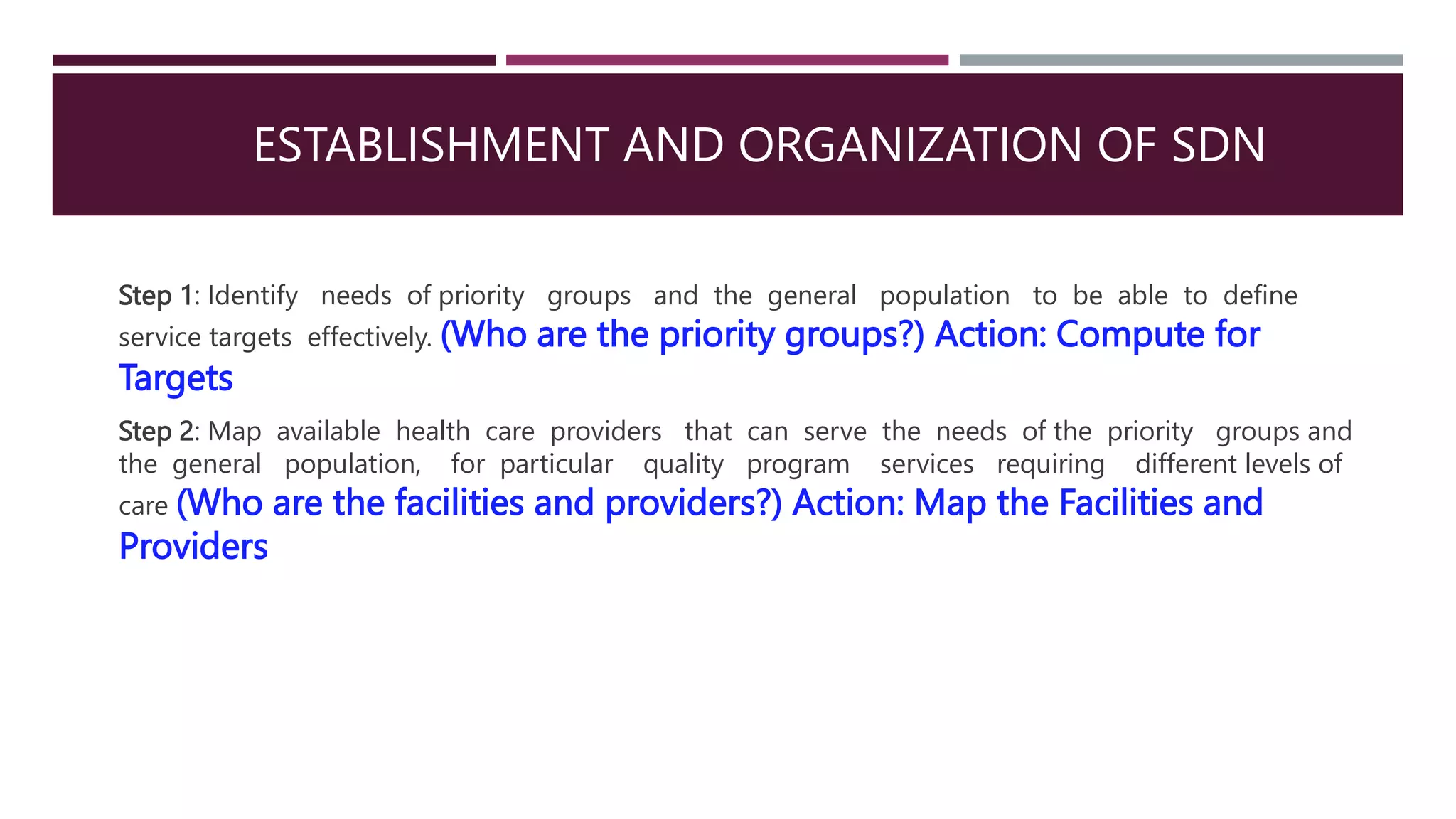
ESTABLISHMENT AND ORGANIZATION OF SDN
Step 1: Identify needs of priority groups and the general population to be able to define
service targets effectively. (Who are the priority groups?) Action: Compute for
Targets
Step 2: Map available health care providers that can serve the needs of the priority groups and
the general population, for particular quality program services requiring different levels of
care (Who are the facilities and providers?) Action: Map the Facilities and
Providers
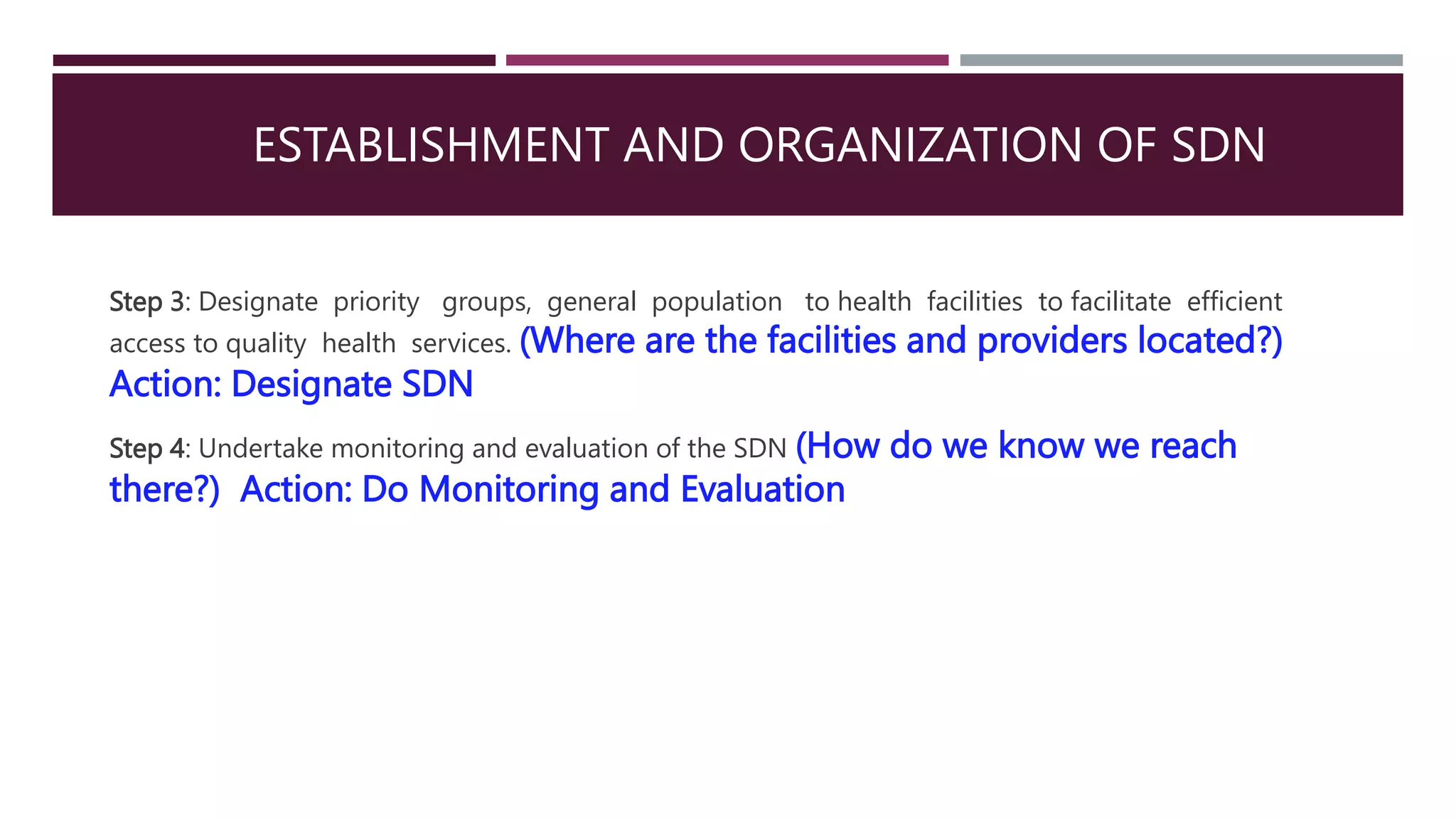
ESTABLISHMENT AND ORGANIZATION OF SDN
Step 3: Designate priority groups, general population to health facilities to facilitate efficient
access to quality health services. (Where are the facilities and providers located?)
Action: Designate SDN
Step 4: Undertake monitoring and evaluation of the SDN (How do we know we reach
there?) Action: Do Monitoring and Evaluation
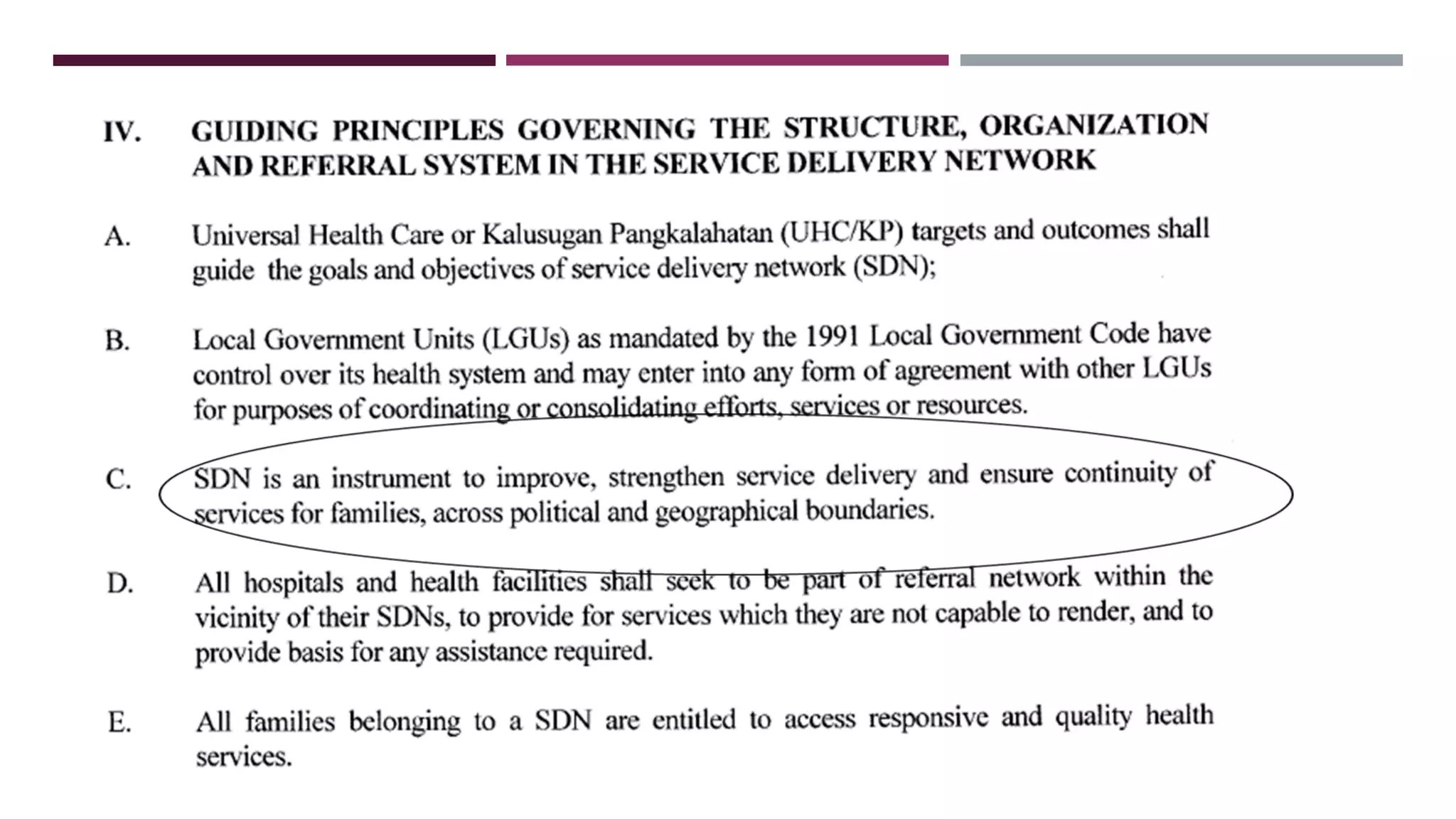
GUIDING PRINCIPLES GOVERNING THE STRUCTURE, ORGANIZATION AND REFERRAL
SYSTEM IN THE SERVICE DELIVERY NETWORK
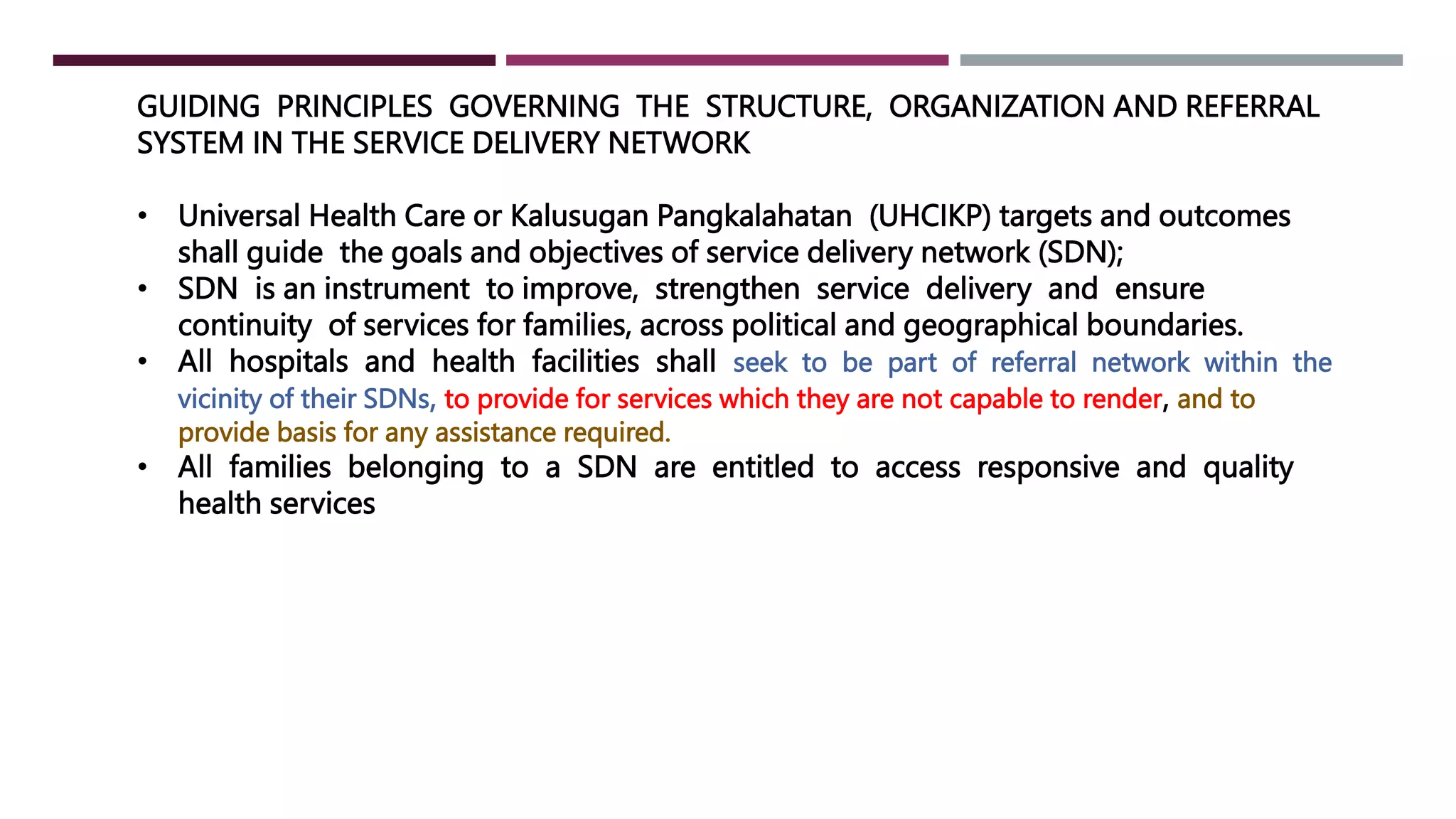
• Universal Health Care or Kalusugan Pangkalahatan (UHCIKP) targets and outcomes
shall guide the goals and objectives of service delivery network (SDN);
• SDN is an instrument to improve, strengthen service delivery and ensure
continuity of services for families, across political and geographical boundaries.
• All hospitals and health facilities shall seek to be part of referral network within the
vicinity of their SDNs, to provide for services which they are not capable to render, and to
provide basis for any assistance required.
• All families belonging to a SDN are entitled to access responsive and quality
health services
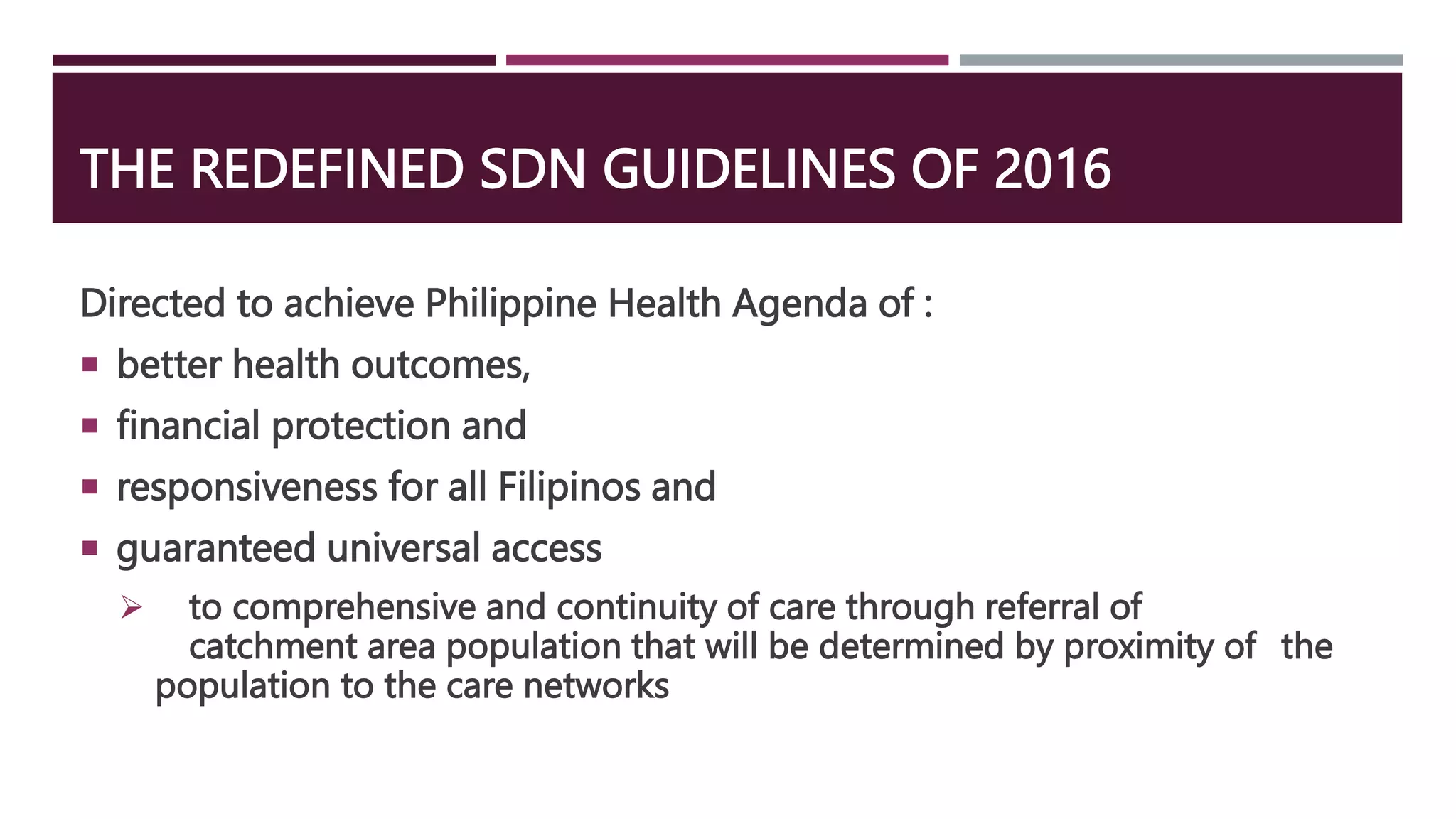
THE REDEFINED SDN GUIDELINES OF 2016
Directed to achieve Philippine Health Agenda of :
 better health outcomes,
 financial protection and
 responsiveness for all Filipinos and
 guaranteed universal access
 to comprehensive and continuity of care through referral of
catchment area population that will be determined by proximity of the
population to the care networks
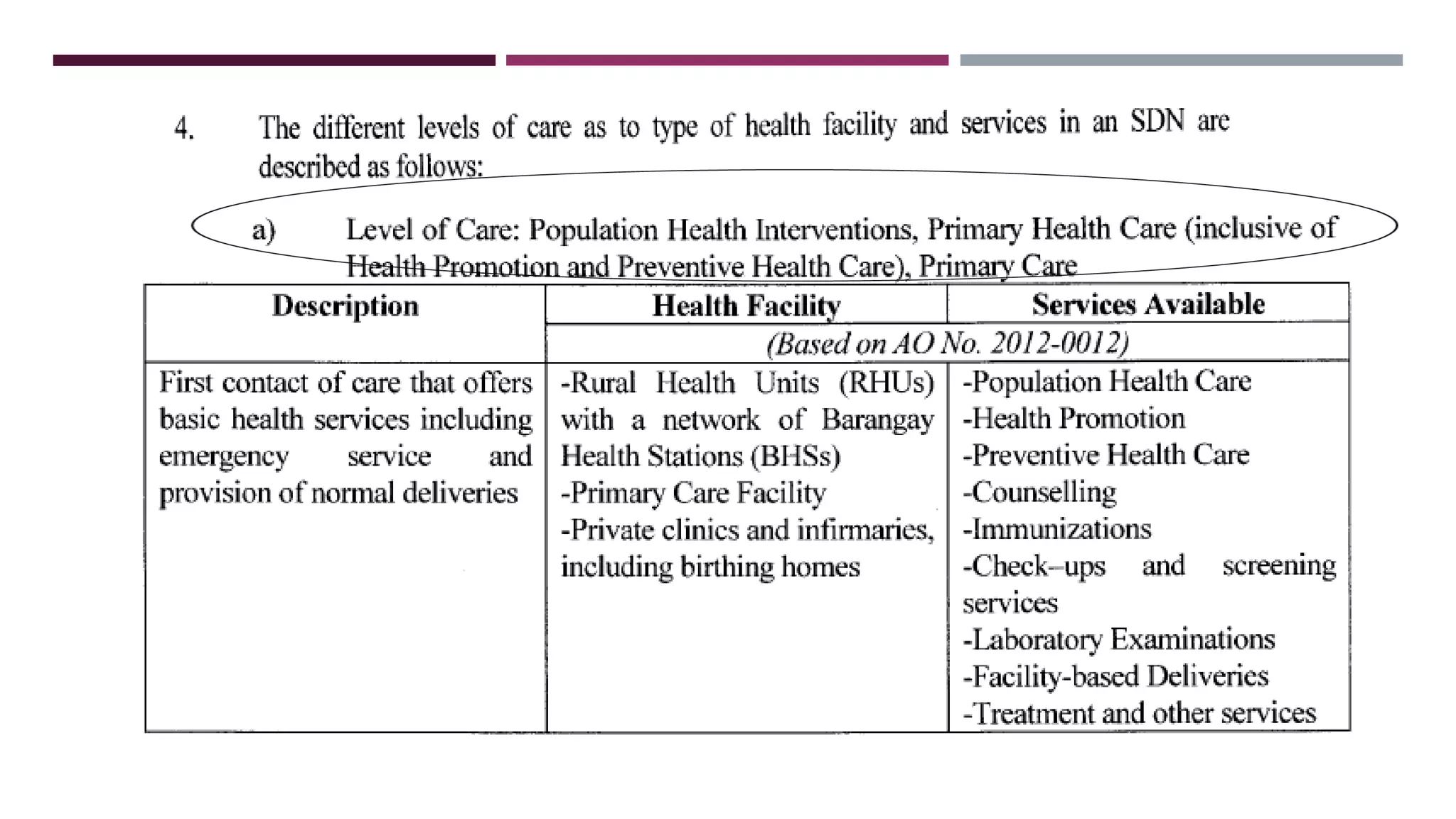
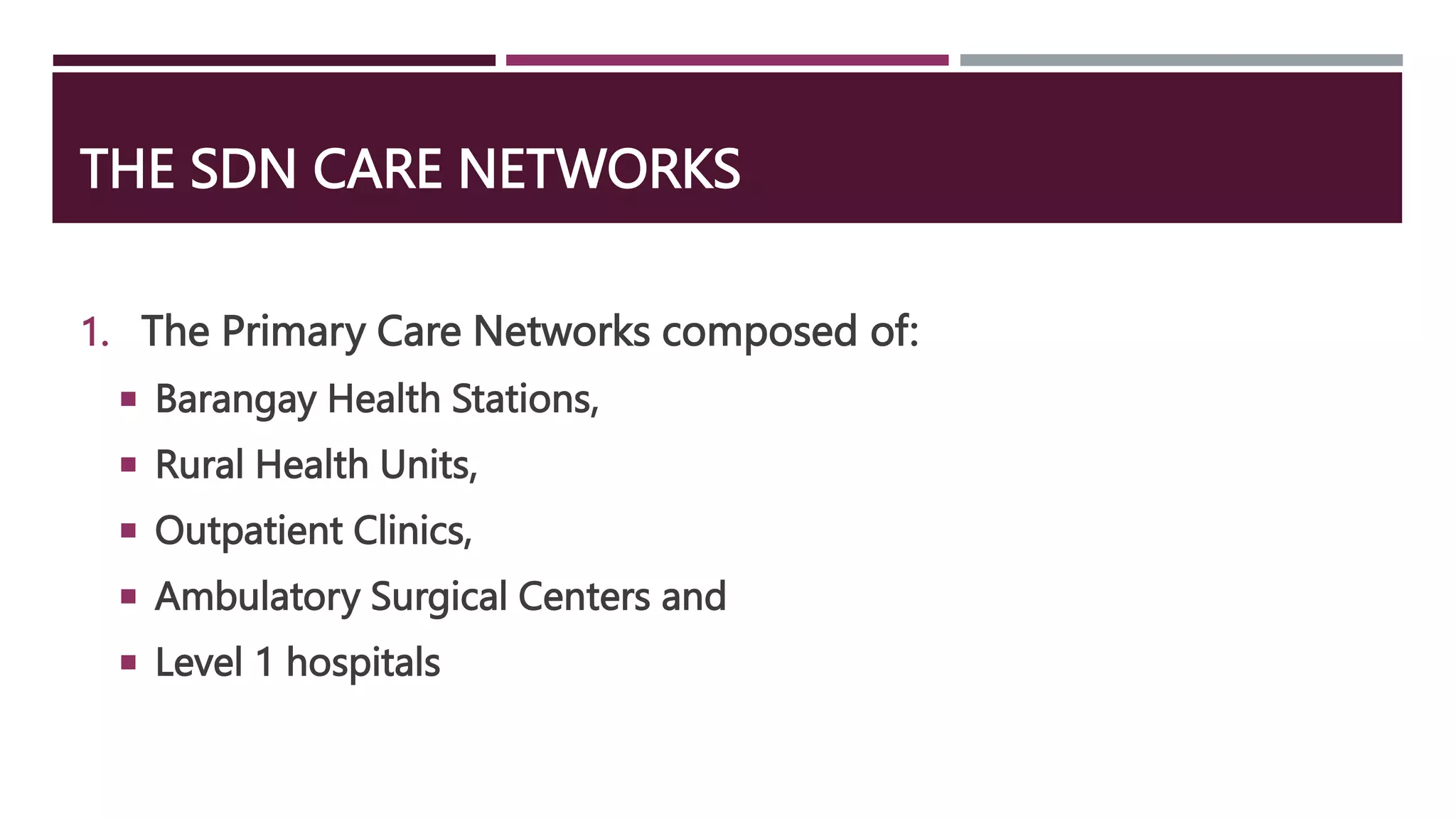
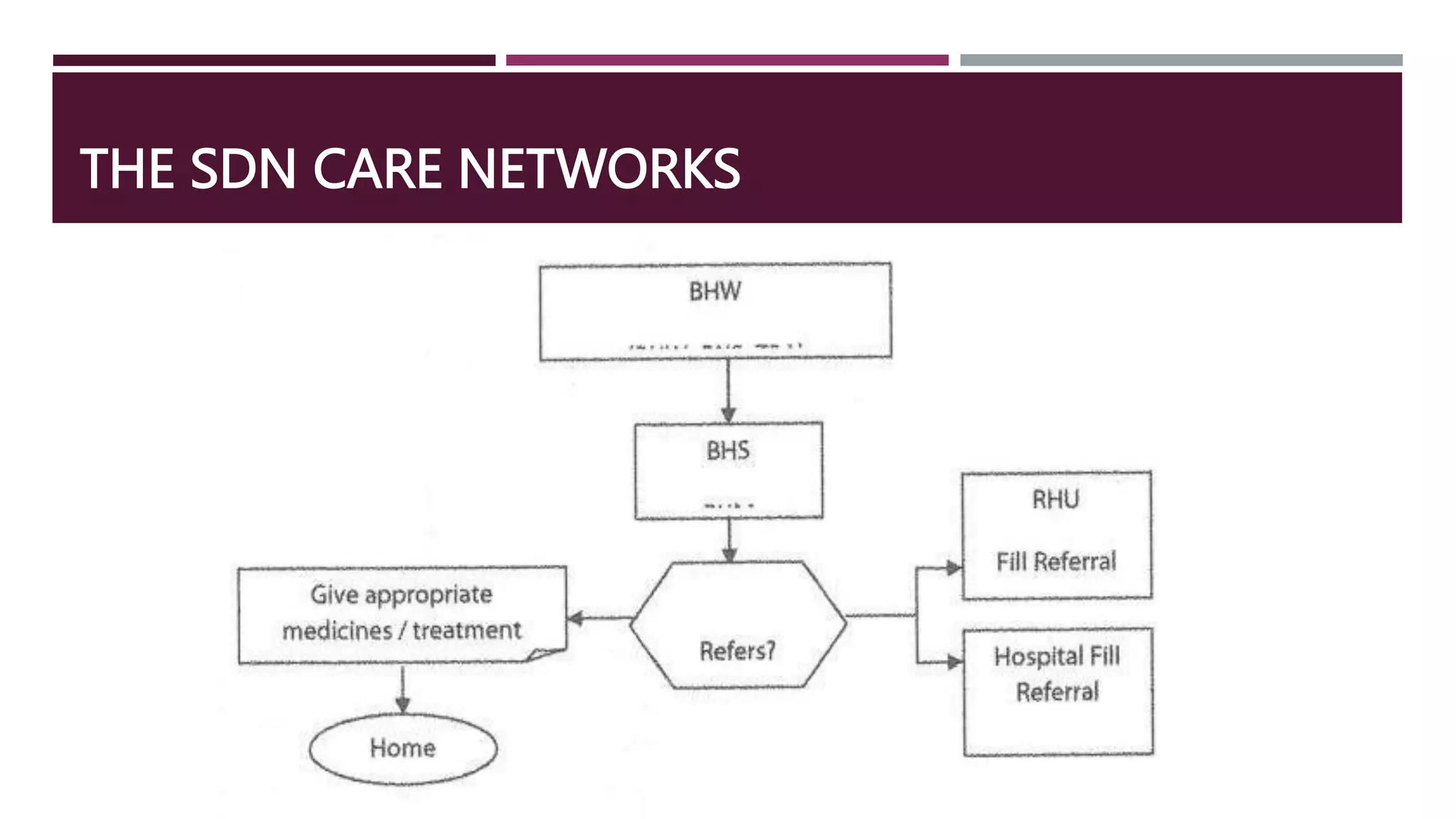
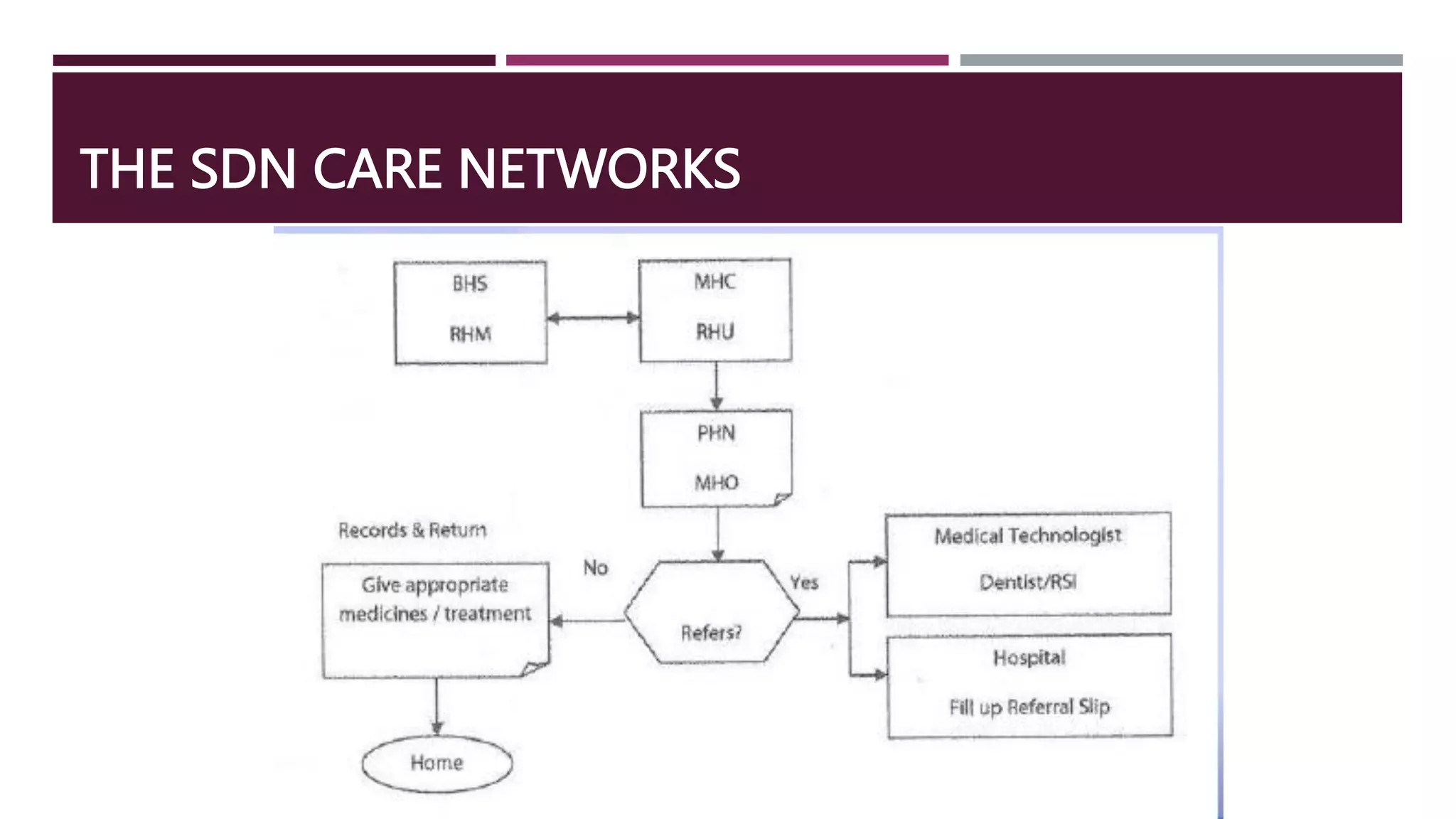
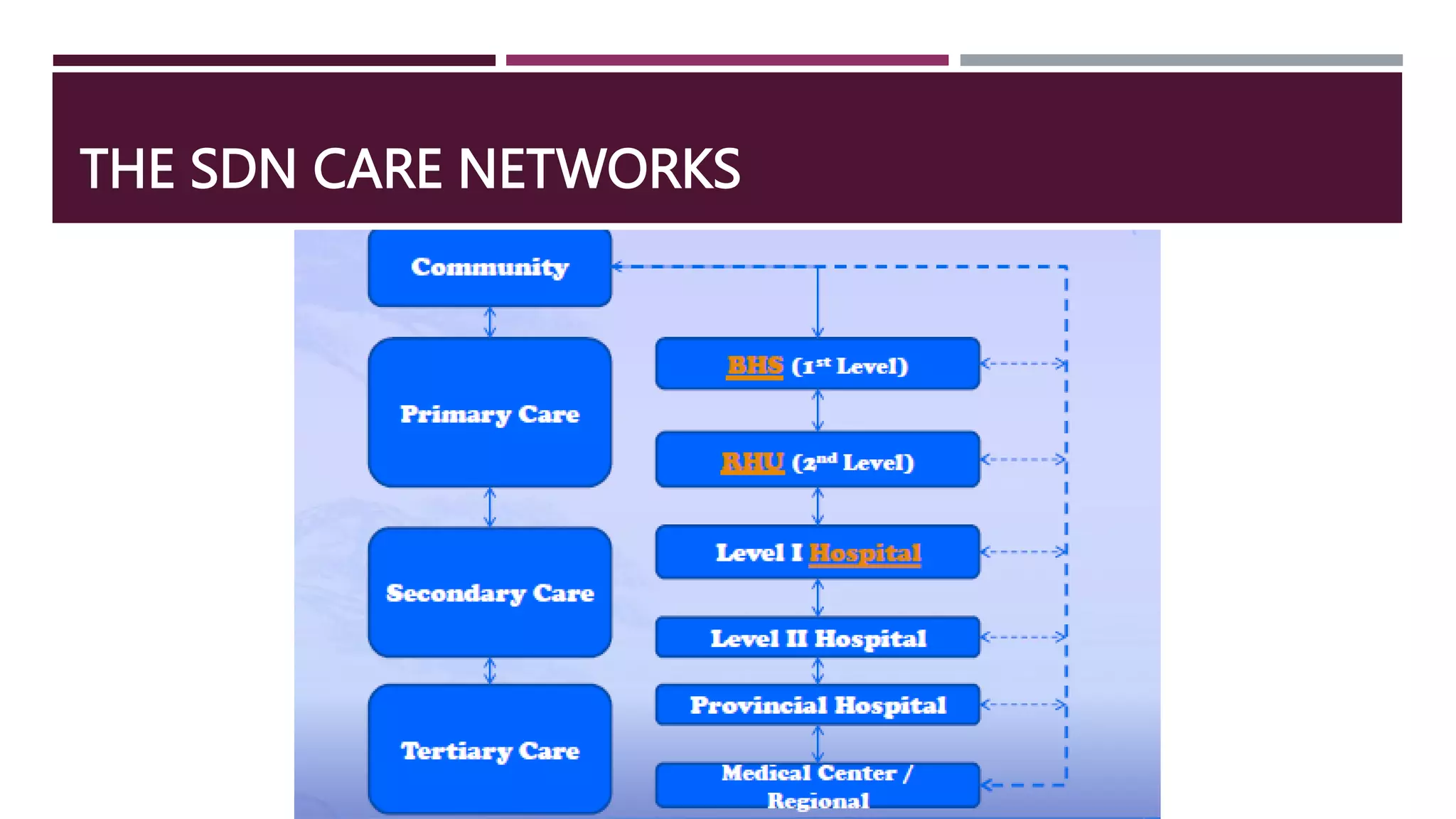
THE SDN CARE NETWORKS
1. The Primary Care Networks composed of:
 Barangay Health Stations,
 Rural Health Units,
 Outpatient Clinics,
 Ambulatory Surgical Centers and
 Level 1 hospitals
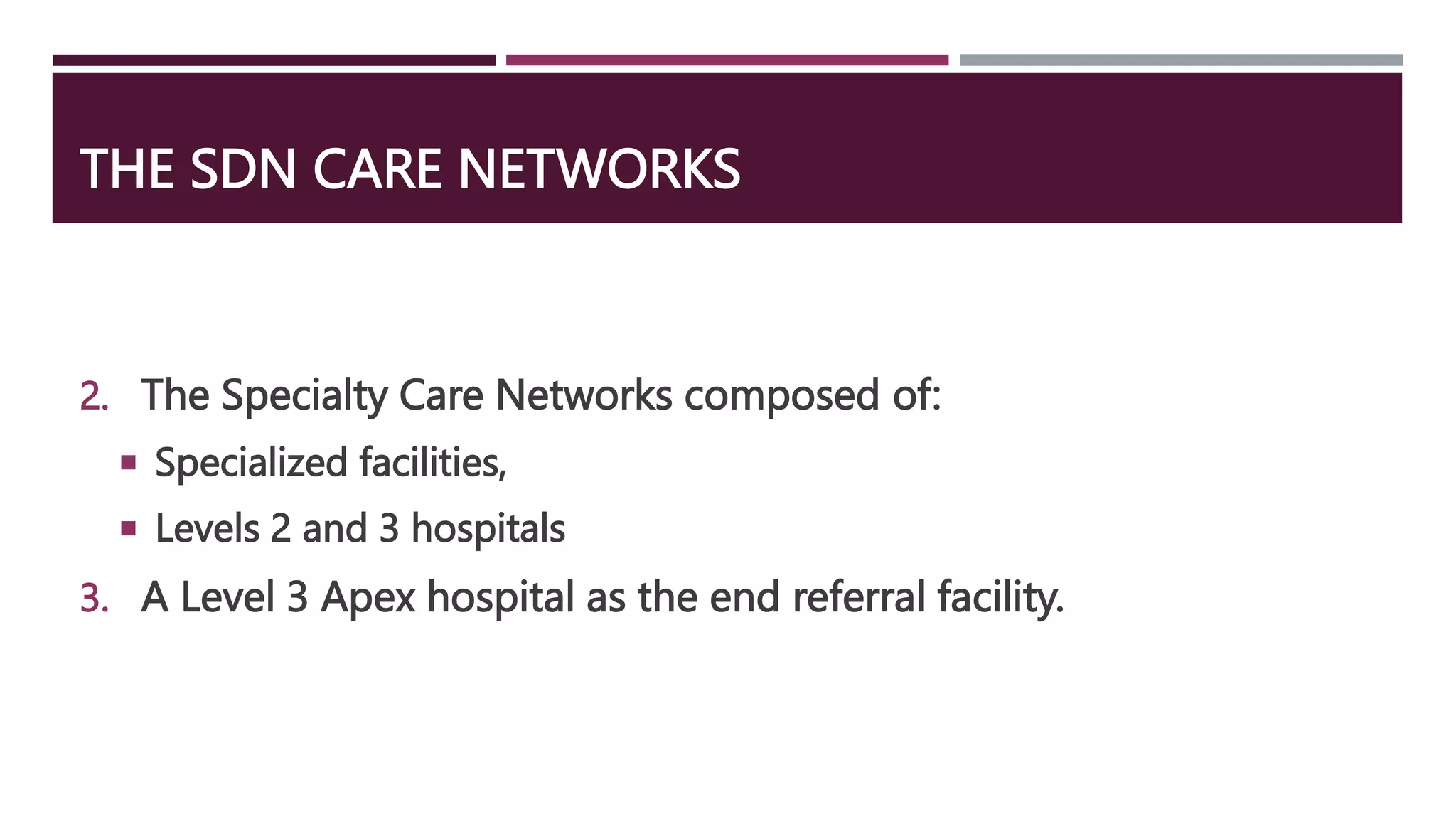
THE SDN CARE NETWORKS
2. The Specialty Care Networks composed of:
 Specialized facilities,
 Levels 2 and 3 hospitals
3. A Level 3 Apex hospital as the end referral facility.
THE SDN CARE NETWORKS
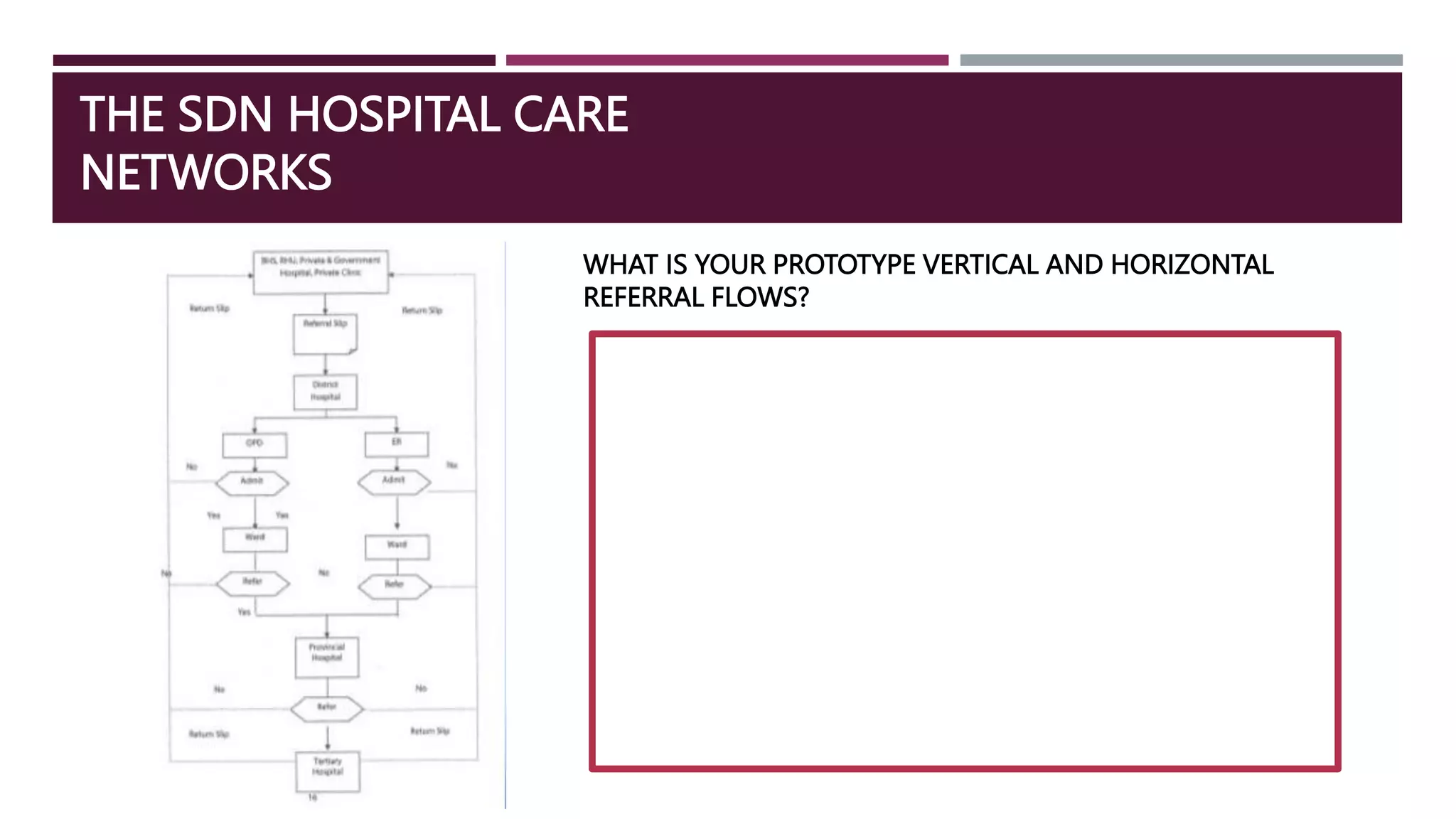
THE SDN HOSPITAL CARE
NETWORKS
WHAT IS YOUR PROTOTYPE VERTICAL AND HORIZONTAL
REFERRAL FLOWS?
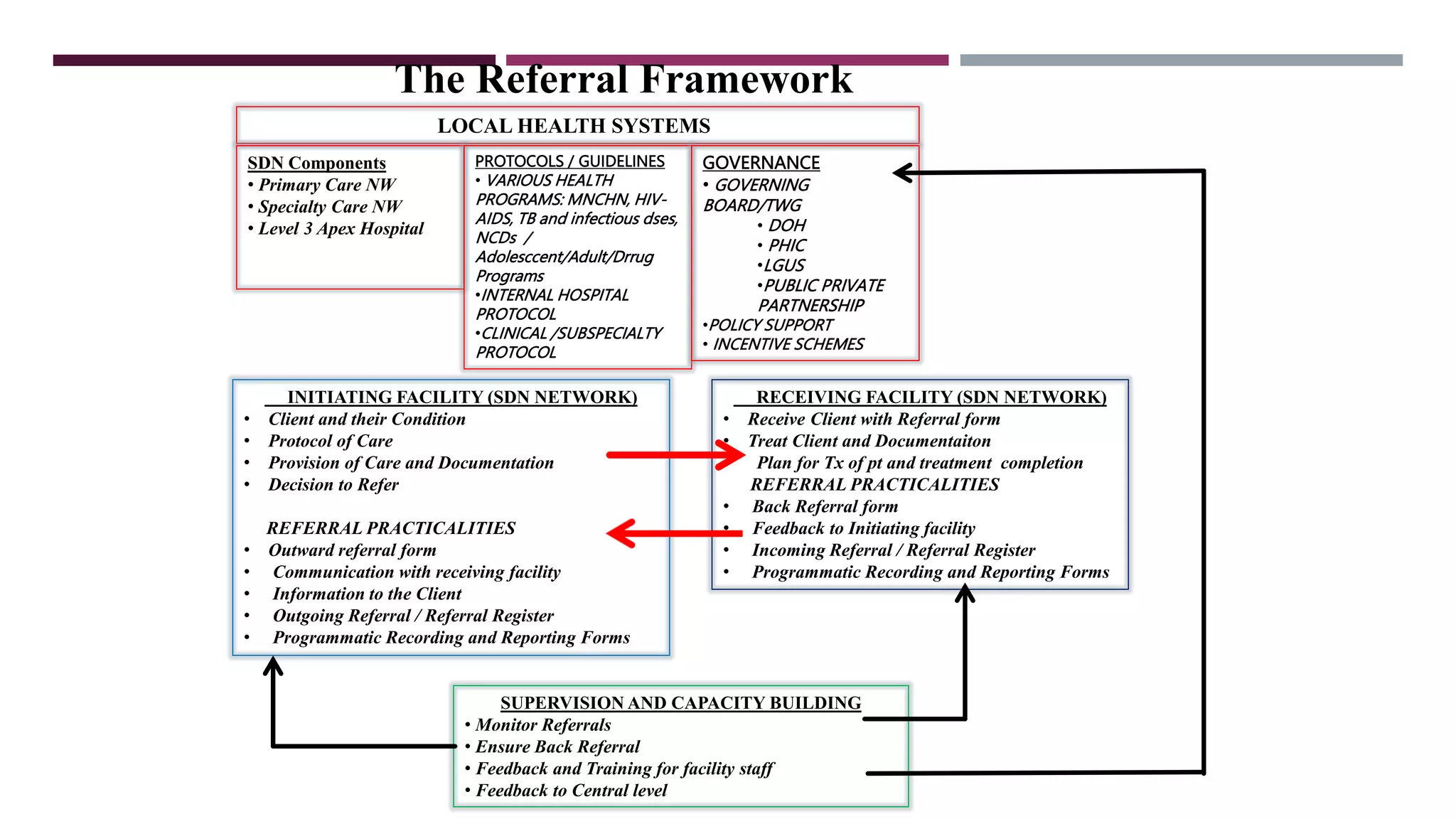
The Referral Framework
LOCAL HEALTH SYSTEMSHEALTH SYSTEMS
SDN Components
• Primary Care NW
• Specialty Care NW
• Level 3 Apex Hospital
PROTOCOLS / GUIDELINES
• VARIOUS HEALTH
PROGRAMS: MNCHN, HIV-
AIDS, TB and infectious dses,
NCDs /
Adolesccent/Adult/Drrug
Programs
•INTERNAL HOSPITAL
PROTOCOL
•CLINICAL /SUBSPECIALTY
PROTOCOL
GOVERNANCE
• GOVERNING
BOARD/TWG
• DOH
• PHIC
•LGUS
•PUBLIC PRIVATE
PARTNERSHIP
•POLICY SUPPORT
• INCENTIVE SCHEMES
INITIATING FACILITY (SDN NETWORK)
• Client and their Condition
• Protocol of Care
• Provision of Care and Documentation
• Decision to Refer
REFERRAL PRACTICALITIES
• Outward referral form
• Communication with receiving facility
• Information to the Client
• Outgoing Referral / Referral Register
• Programmatic Recording and Reporting Forms
RECEIVING FACILITY (SDN NETWORK)
• Receive Client with Referral form
• Treat Client and Documentaiton
• Plan for Tx of pt and treatment completion
REFERRAL PRACTICALITIES
• Back Referral form
• Feedback to Initiating facility
• Incoming Referral / Referral Register
• Programmatic Recording and Reporting Forms
SUPERVISION AND CAPACITY BUILDING
• Monitor Referrals
• Ensure Back Referral
• Feedback and Training for facility staff
• Feedback to Central level
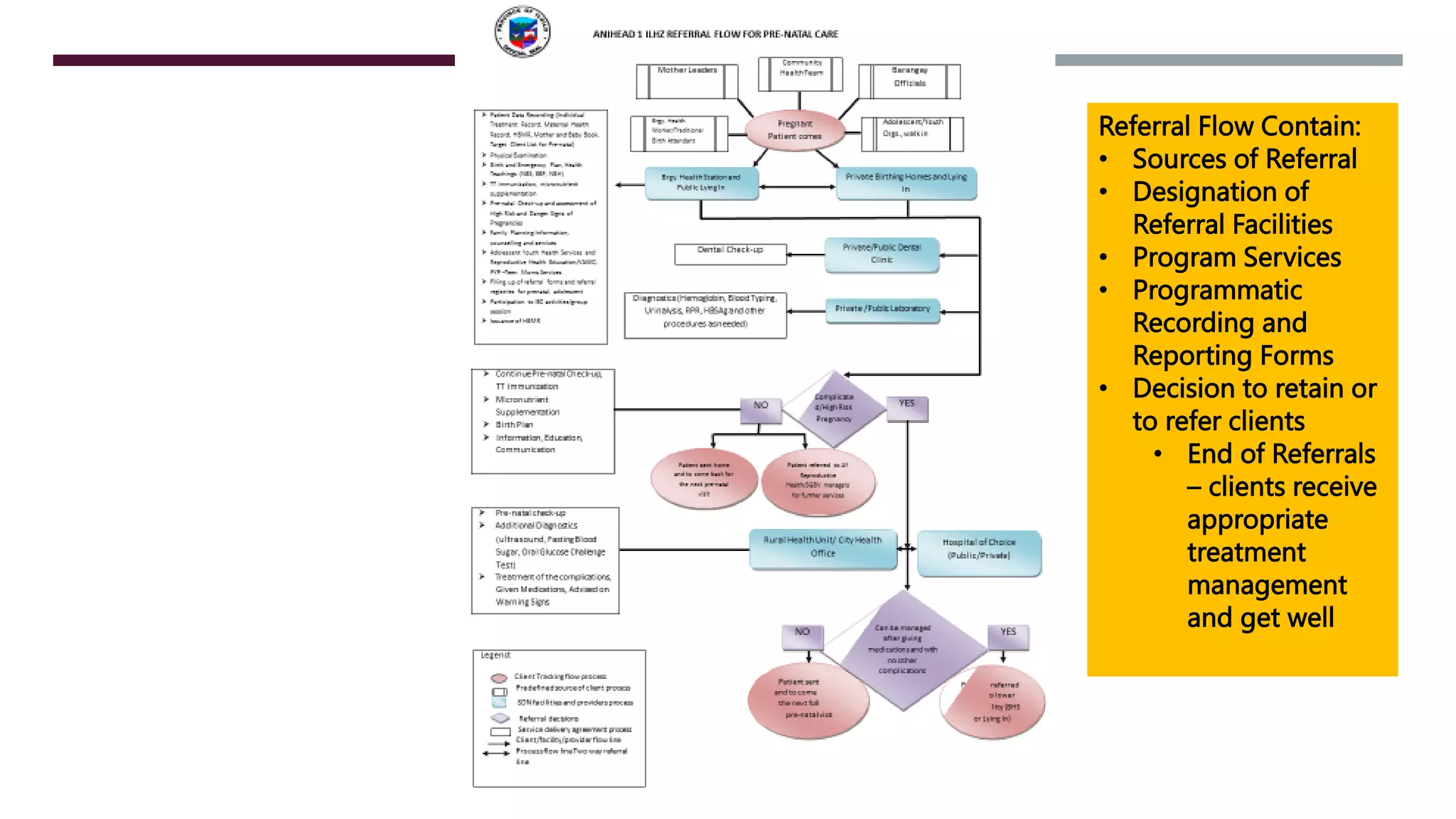
Referral Flow Contain:
• Sources of Referral
• Designation of
Referral Facilities
• Program Services
• Programmatic
Recording and
Reporting Forms
• Decision to retain or
to refer clients
• End of Referrals
– clients receive
appropriate
treatment
management
and get well
REVIEW OF SDN IMPLEMENTATION
Rogelio M Ilagan, MD, MPH
+63908-819-7913
rogermilagan@gmail.com
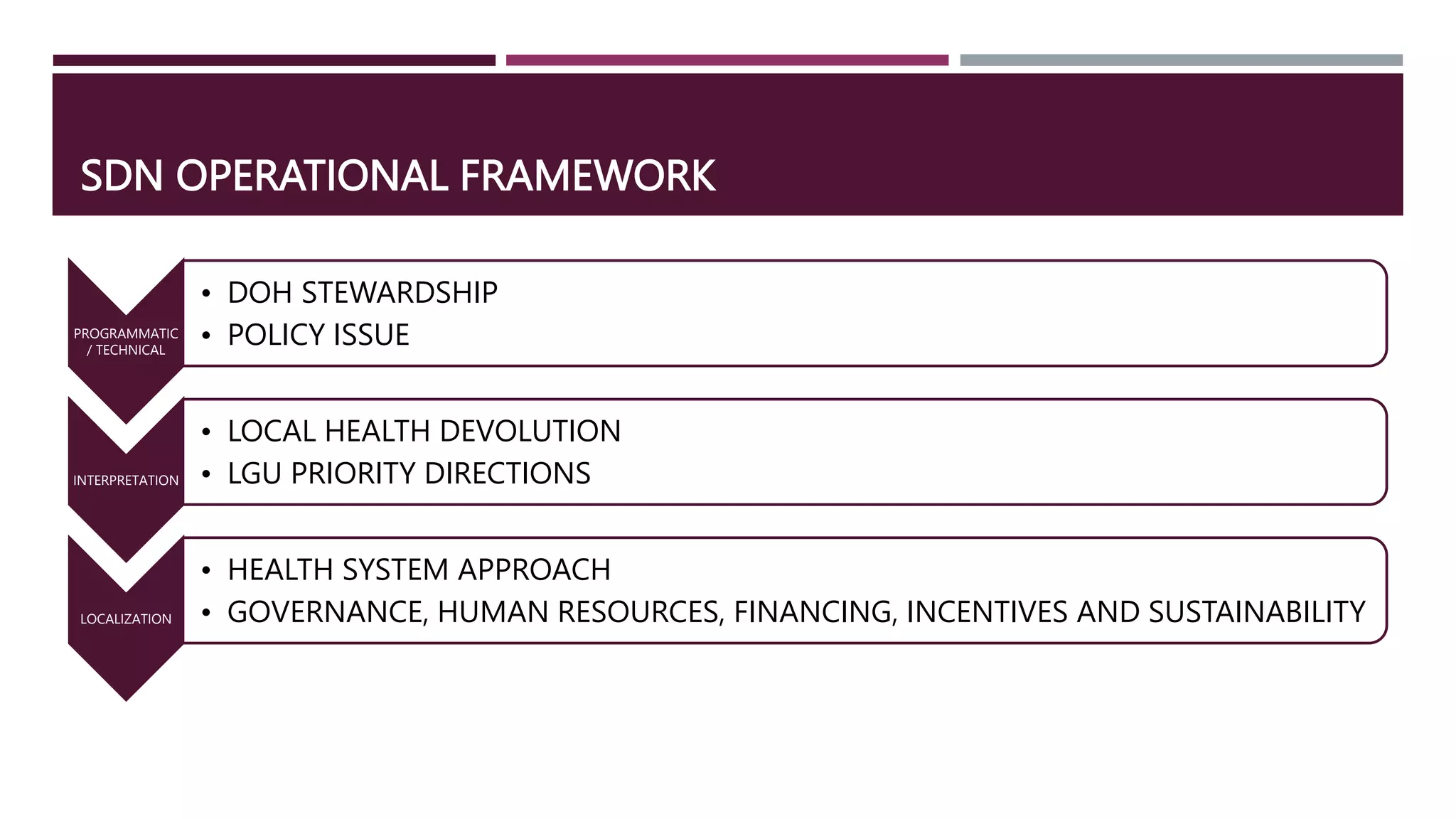
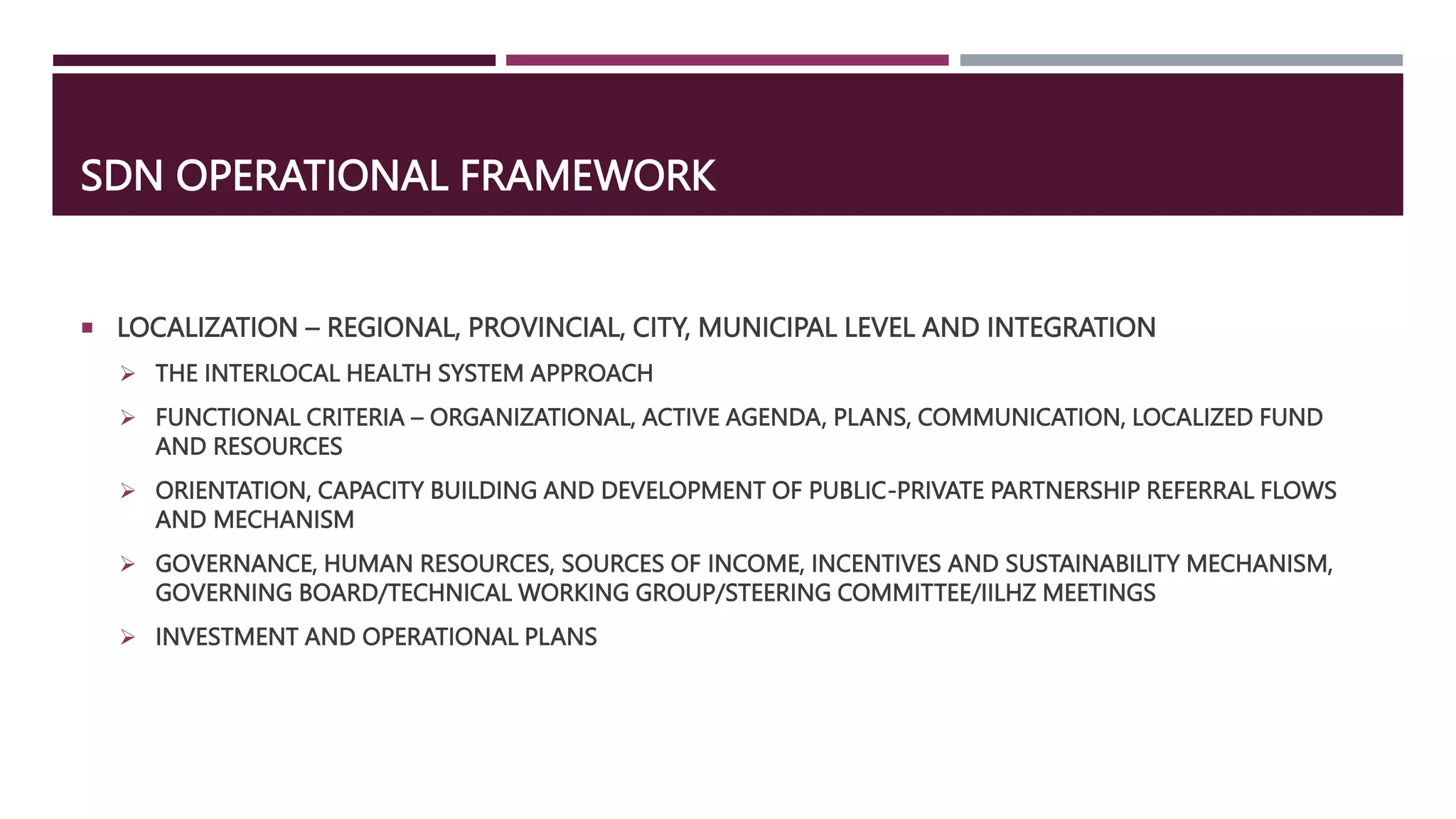
SDN OPERATIONAL FRAMEWORK
PROGRAMMATIC
/ TECHNICAL
• DOH STEWARDSHIP
• POLICY ISSUE
INTERPRETATION
• LOCAL HEALTH DEVOLUTION
• LGU PRIORITY DIRECTIONS
LOCALIZATION
• HEALTH SYSTEM APPROACH
• GOVERNANCE, HUMAN RESOURCES, FINANCING, INCENTIVES AND SUSTAINABILITY
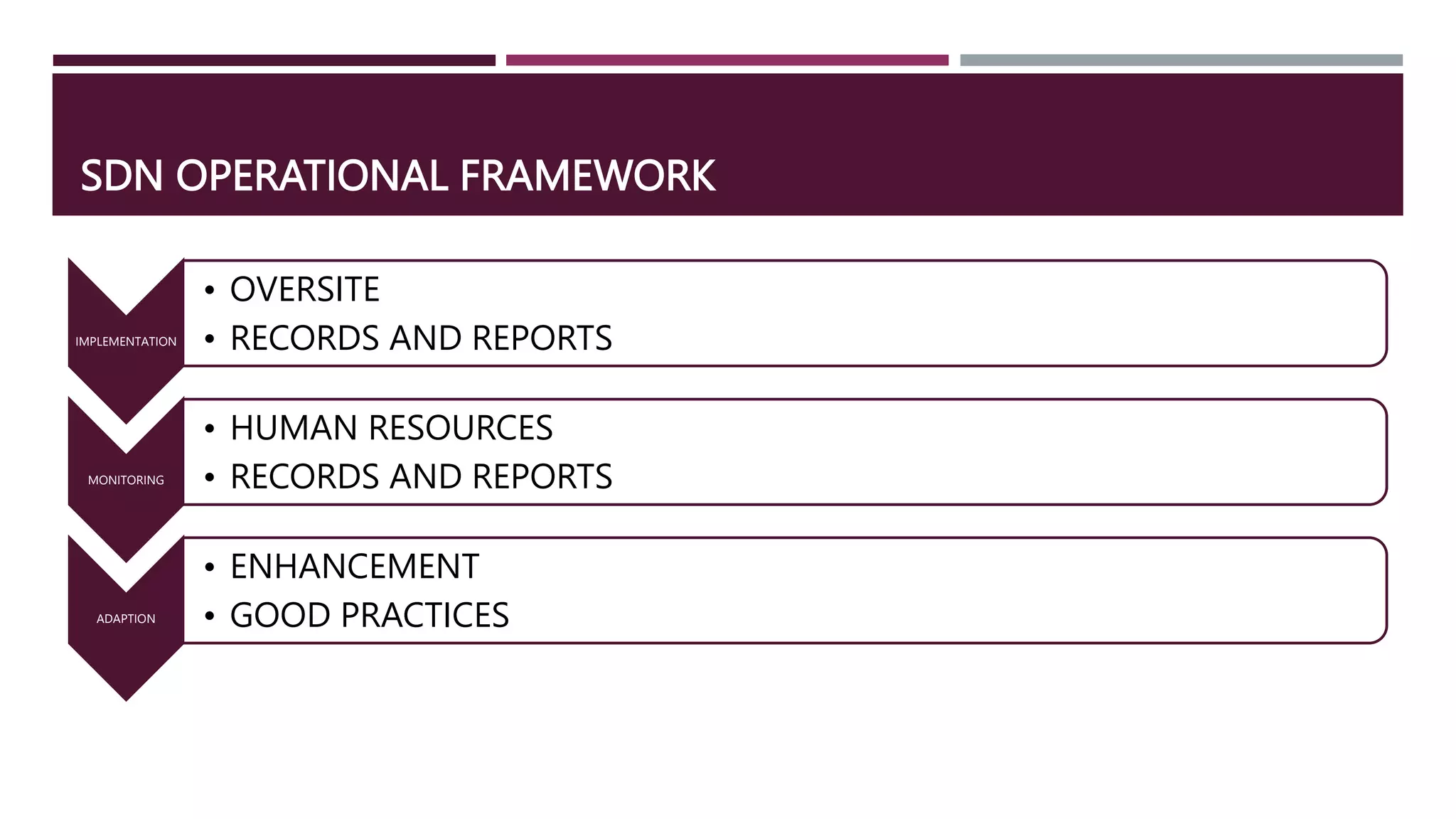
SDN OPERATIONAL FRAMEWORK
IMPLEMENTATION
• OVERSITE
• RECORDS AND REPORTS
MONITORING
• HUMAN RESOURCES
• RECORDS AND REPORTS
ADAPTION
• ENHANCEMENT
• GOOD PRACTICES
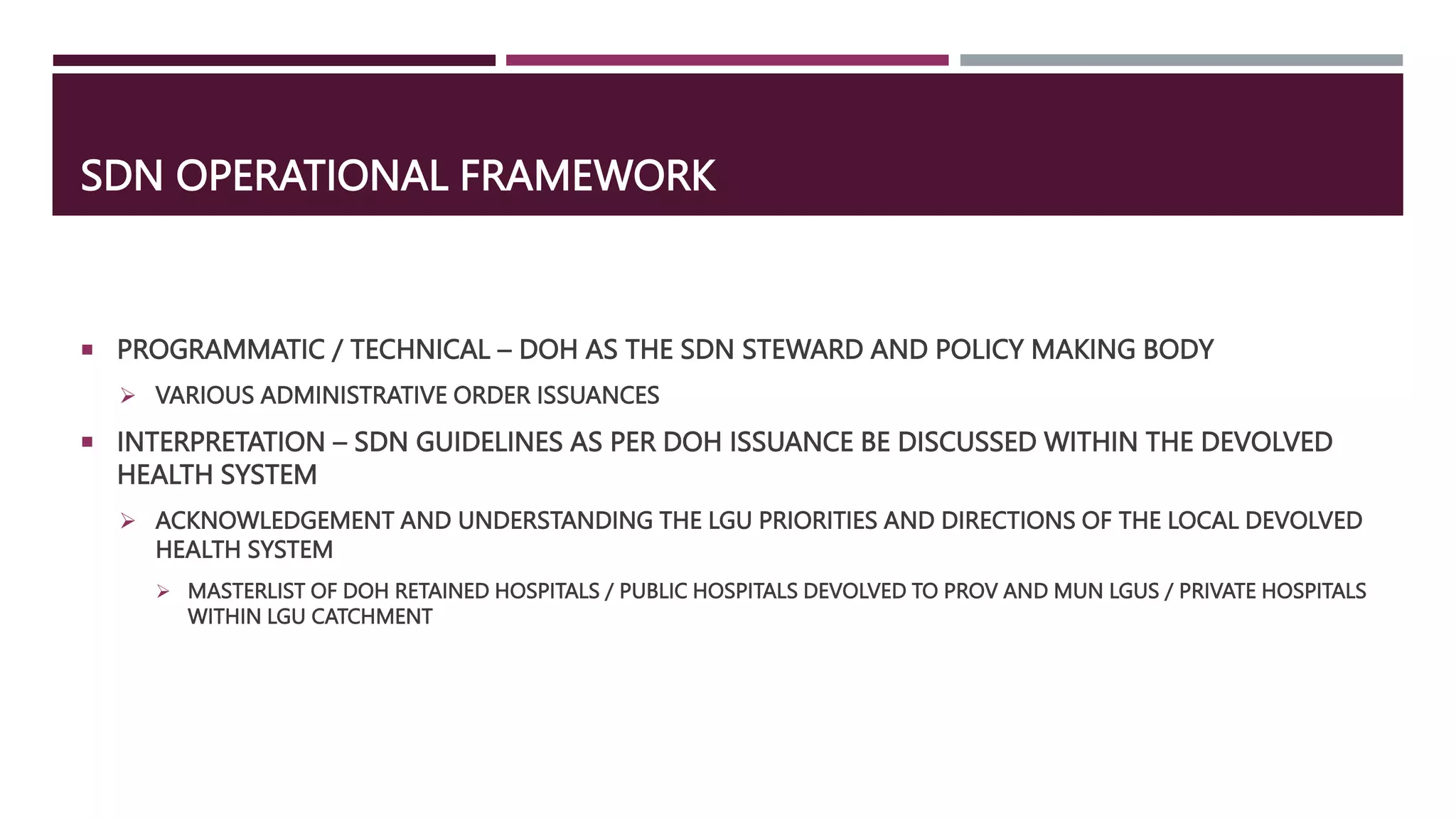
SDN OPERATIONAL FRAMEWORK
 PROGRAMMATIC / TECHNICAL – DOH AS THE SDN STEWARD AND POLICY MAKING BODY
 VARIOUS ADMINISTRATIVE ORDER ISSUANCES
 INTERPRETATION – SDN GUIDELINES AS PER DOH ISSUANCE BE DISCUSSED WITHIN THE DEVOLVED
HEALTH SYSTEM
 ACKNOWLEDGEMENT AND UNDERSTANDING THE LGU PRIORITIES AND DIRECTIONS OF THE LOCAL DEVOLVED
HEALTH SYSTEM
 MASTERLIST OF DOH RETAINED HOSPITALS / PUBLIC HOSPITALS DEVOLVED TO PROV AND MUN LGUS / PRIVATE HOSPITALS
WITHIN LGU CATCHMENT
SDN OPERATIONAL FRAMEWORK
 LOCALIZATION – REGIONAL, PROVINCIAL, CITY, MUNICIPAL LEVEL AND INTEGRATION
 THE INTERLOCAL HEALTH SYSTEM APPROACH
 FUNCTIONAL CRITERIA – ORGANIZATIONAL, ACTIVE AGENDA, PLANS, COMMUNICATION, LOCALIZED FUND
AND RESOURCES
 ORIENTATION, CAPACITY BUILDING AND DEVELOPMENT OF PUBLIC-PRIVATE PARTNERSHIP REFERRAL FLOWS
AND MECHANISM
 GOVERNANCE, HUMAN RESOURCES, SOURCES OF INCOME, INCENTIVES AND SUSTAINABILITY MECHANISM,
GOVERNING BOARD/TECHNICAL WORKING GROUP/STEERING COMMITTEE/IILHZ MEETINGS
 INVESTMENT AND OPERATIONAL PLANS
SDN OPERATIONAL FRAMEWORK
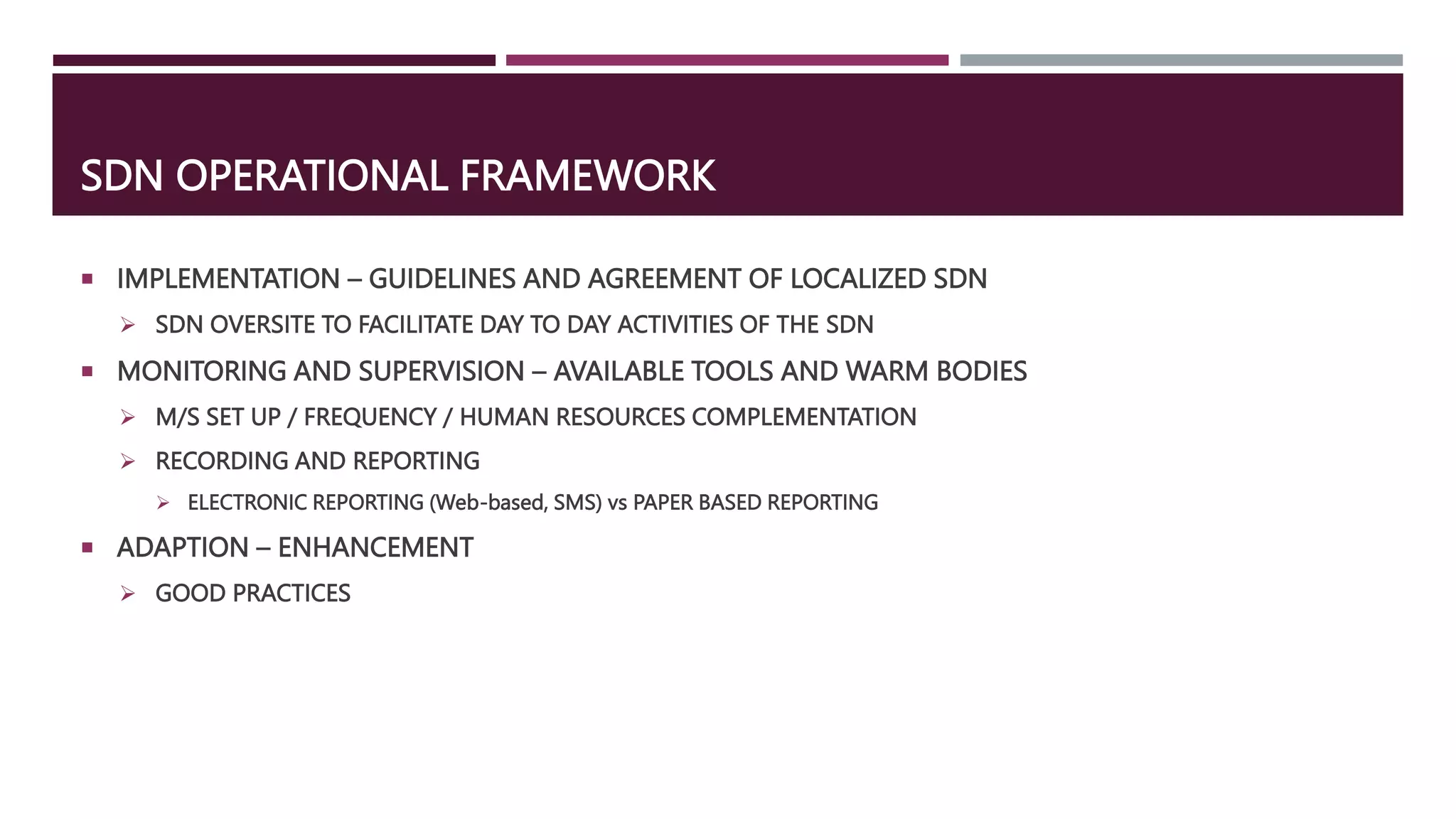
 IMPLEMENTATION – GUIDELINES AND AGREEMENT OF LOCALIZED SDN
 SDN OVERSITE TO FACILITATE DAY TO DAY ACTIVITIES OF THE SDN
 MONITORING AND SUPERVISION – AVAILABLE TOOLS AND WARM BODIES
 M/S SET UP / FREQUENCY / HUMAN RESOURCES COMPLEMENTATION
 RECORDING AND REPORTING
 ELECTRONIC REPORTING (Web-based, SMS) vs PAPER BASED REPORTING
 ADAPTION – ENHANCEMENT
 GOOD PRACTICES
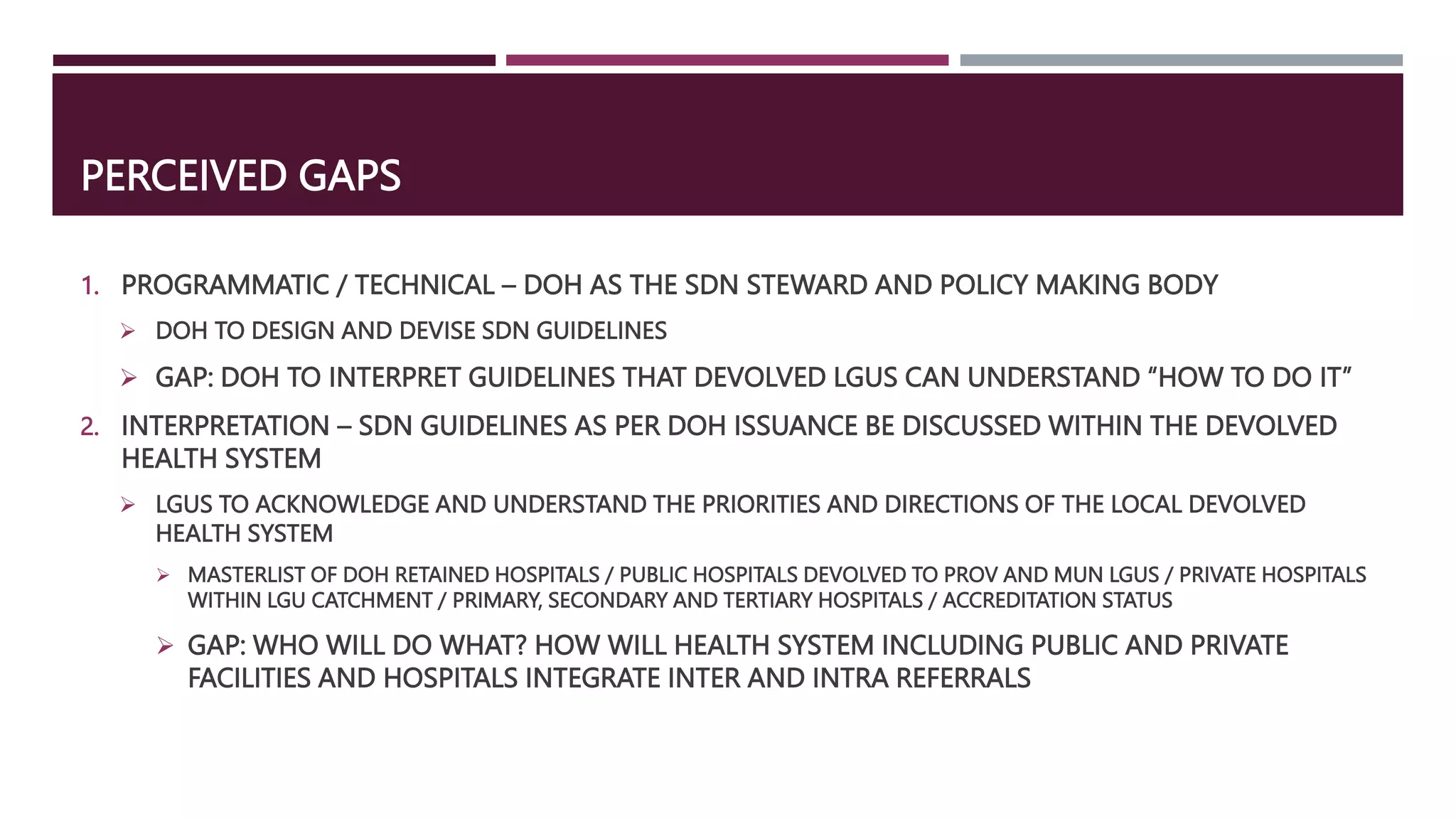
PERCEIVED GAPS
1. PROGRAMMATIC / TECHNICAL – DOH AS THE SDN STEWARD AND POLICY MAKING BODY
 DOH TO DESIGN AND DEVISE SDN GUIDELINES
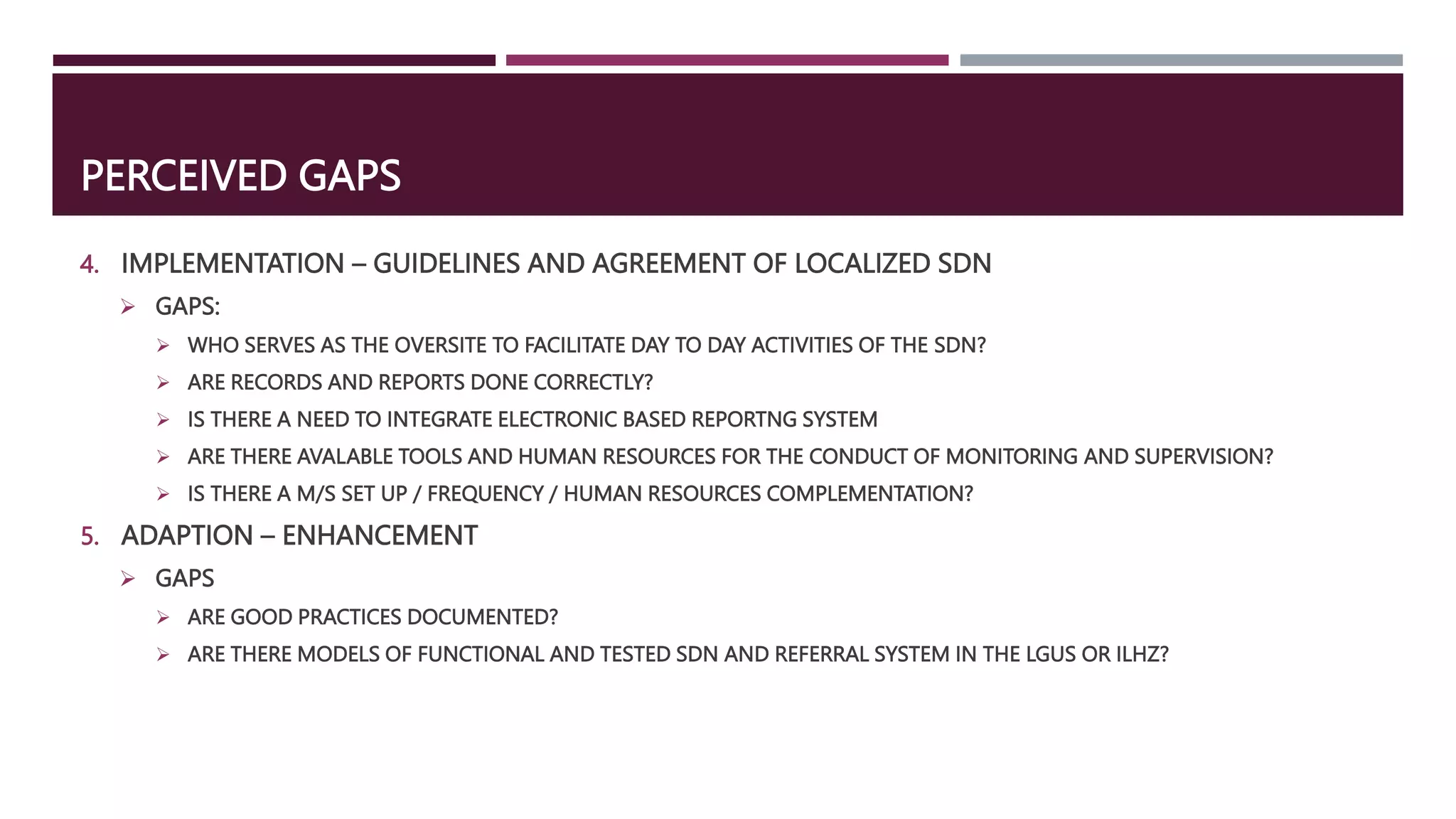
 GAP: DOH TO INTERPRET GUIDELINES THAT DEVOLVED LGUS CAN UNDERSTAND “HOW TO DO IT”
2. INTERPRETATION – SDN GUIDELINES AS PER DOH ISSUANCE BE DISCUSSED WITHIN THE DEVOLVED
HEALTH SYSTEM
 LGUS TO ACKNOWLEDGE AND UNDERSTAND THE PRIORITIES AND DIRECTIONS OF THE LOCAL DEVOLVED
HEALTH SYSTEM
 MASTERLIST OF DOH RETAINED HOSPITALS / PUBLIC HOSPITALS DEVOLVED TO PROV AND MUN LGUS / PRIVATE HOSPITALS
WITHIN LGU CATCHMENT / PRIMARY, SECONDARY AND TERTIARY HOSPITALS / ACCREDITATION STATUS
 GAP: WHO WILL DO WHAT? HOW WILL HEALTH SYSTEM INCLUDING PUBLIC AND PRIVATE
FACILITIES AND HOSPITALS INTEGRATE INTER AND INTRA REFERRALS
PERCEIVED GAPS
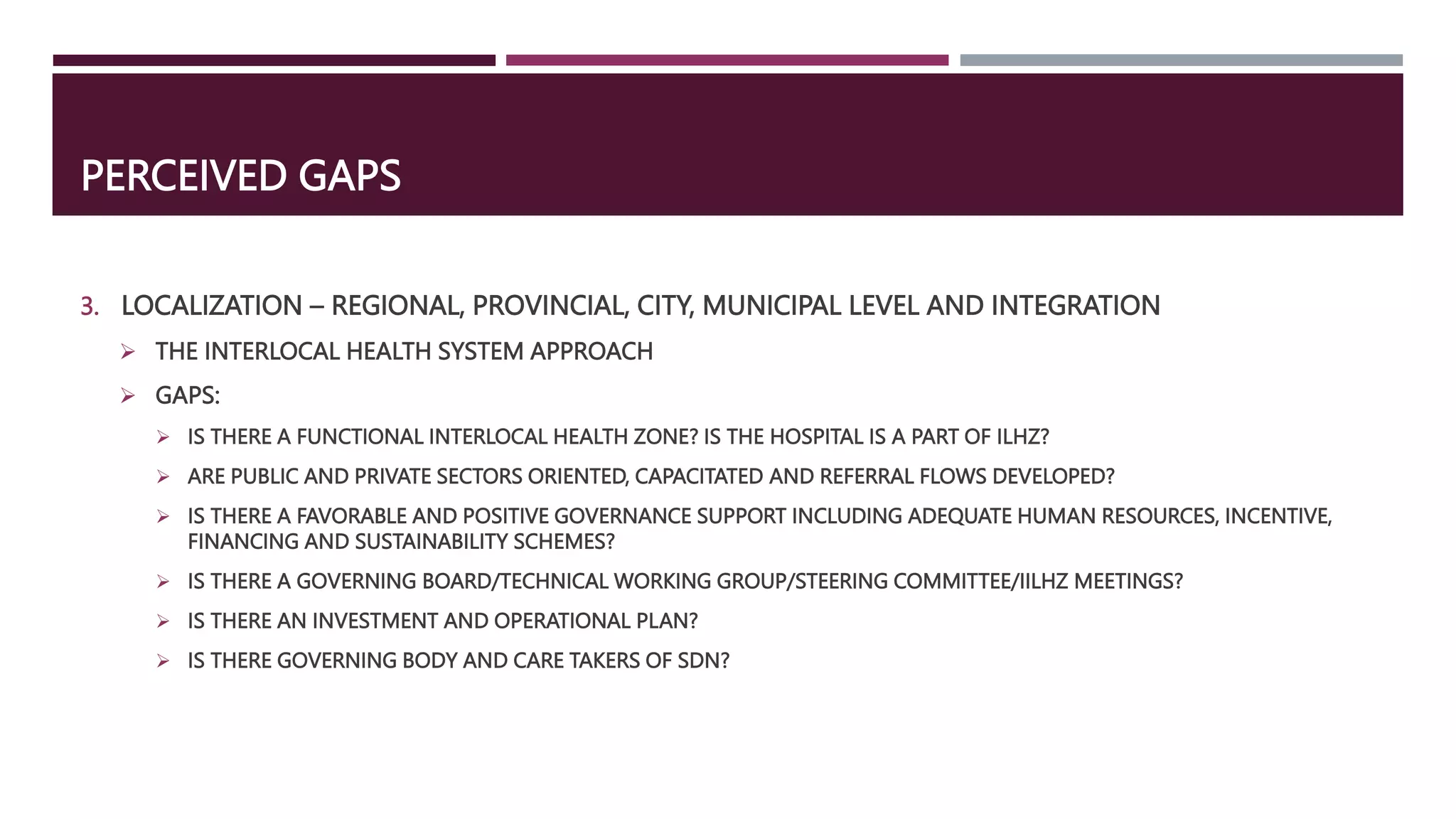
3. LOCALIZATION – REGIONAL, PROVINCIAL, CITY, MUNICIPAL LEVEL AND INTEGRATION
 THE INTERLOCAL HEALTH SYSTEM APPROACH
 GAPS:
 IS THERE A FUNCTIONAL INTERLOCAL HEALTH ZONE? IS THE HOSPITAL IS A PART OF ILHZ?
 ARE PUBLIC AND PRIVATE SECTORS ORIENTED, CAPACITATED AND REFERRAL FLOWS DEVELOPED?
 IS THERE A FAVORABLE AND POSITIVE GOVERNANCE SUPPORT INCLUDING ADEQUATE HUMAN RESOURCES, INCENTIVE,
FINANCING AND SUSTAINABILITY SCHEMES?
 IS THERE A GOVERNING BOARD/TECHNICAL WORKING GROUP/STEERING COMMITTEE/IILHZ MEETINGS?
 IS THERE AN INVESTMENT AND OPERATIONAL PLAN?
 IS THERE GOVERNING BODY AND CARE TAKERS OF SDN?
PERCEIVED GAPS
4. IMPLEMENTATION – GUIDELINES AND AGREEMENT OF LOCALIZED SDN
 GAPS:
 WHO SERVES AS THE OVERSITE TO FACILITATE DAY TO DAY ACTIVITIES OF THE SDN?
 ARE RECORDS AND REPORTS DONE CORRECTLY?
 IS THERE A NEED TO INTEGRATE ELECTRONIC BASED REPORTNG SYSTEM
 ARE THERE AVALABLE TOOLS AND HUMAN RESOURCES FOR THE CONDUCT OF MONITORING AND SUPERVISION?
 IS THERE A M/S SET UP / FREQUENCY / HUMAN RESOURCES COMPLEMENTATION?
5. ADAPTION – ENHANCEMENT
 GAPS
 ARE GOOD PRACTICES DOCUMENTED?
 ARE THERE MODELS OF FUNCTIONAL AND TESTED SDN AND REFERRAL SYSTEM IN THE LGUS OR ILHZ?
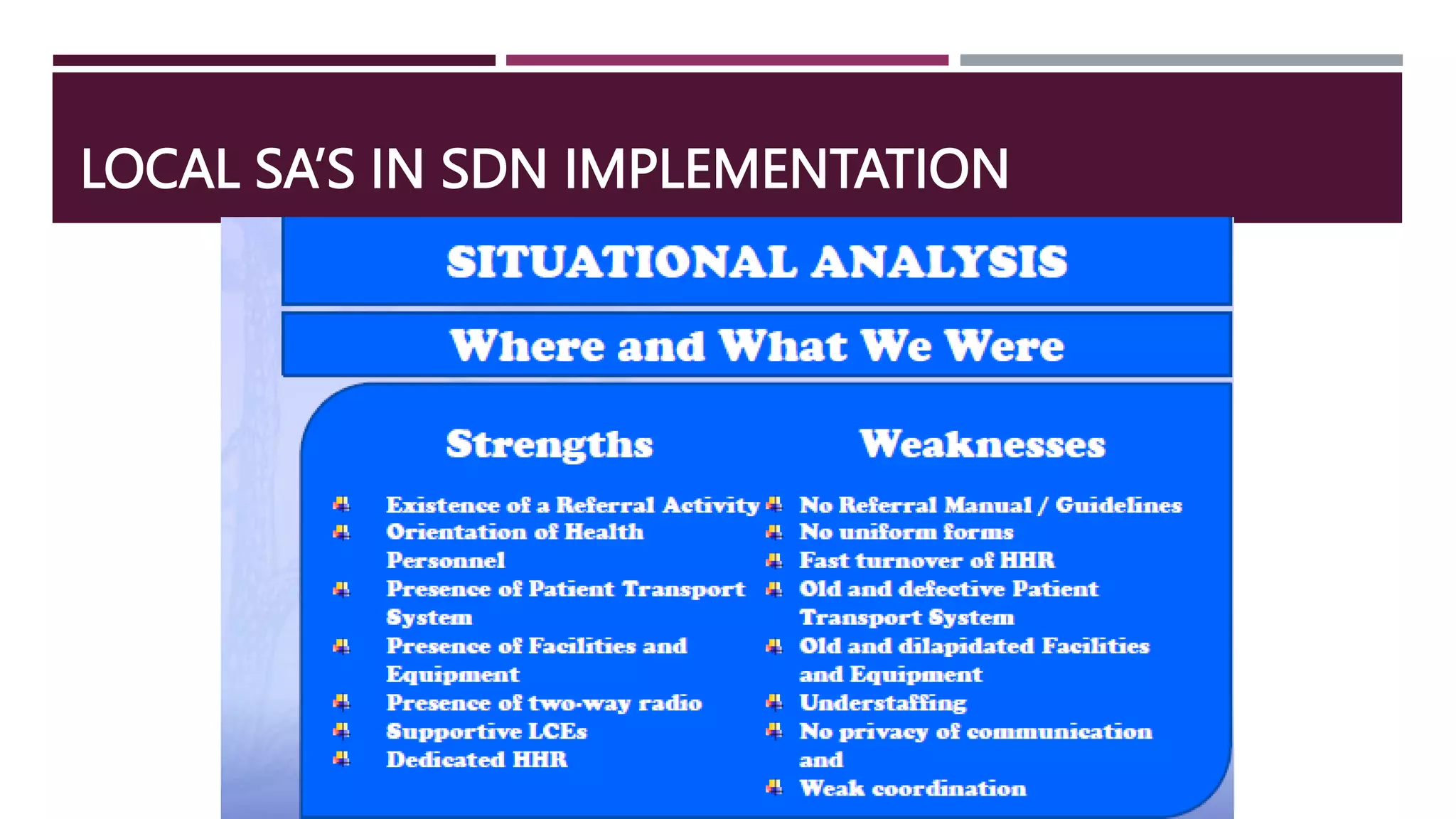
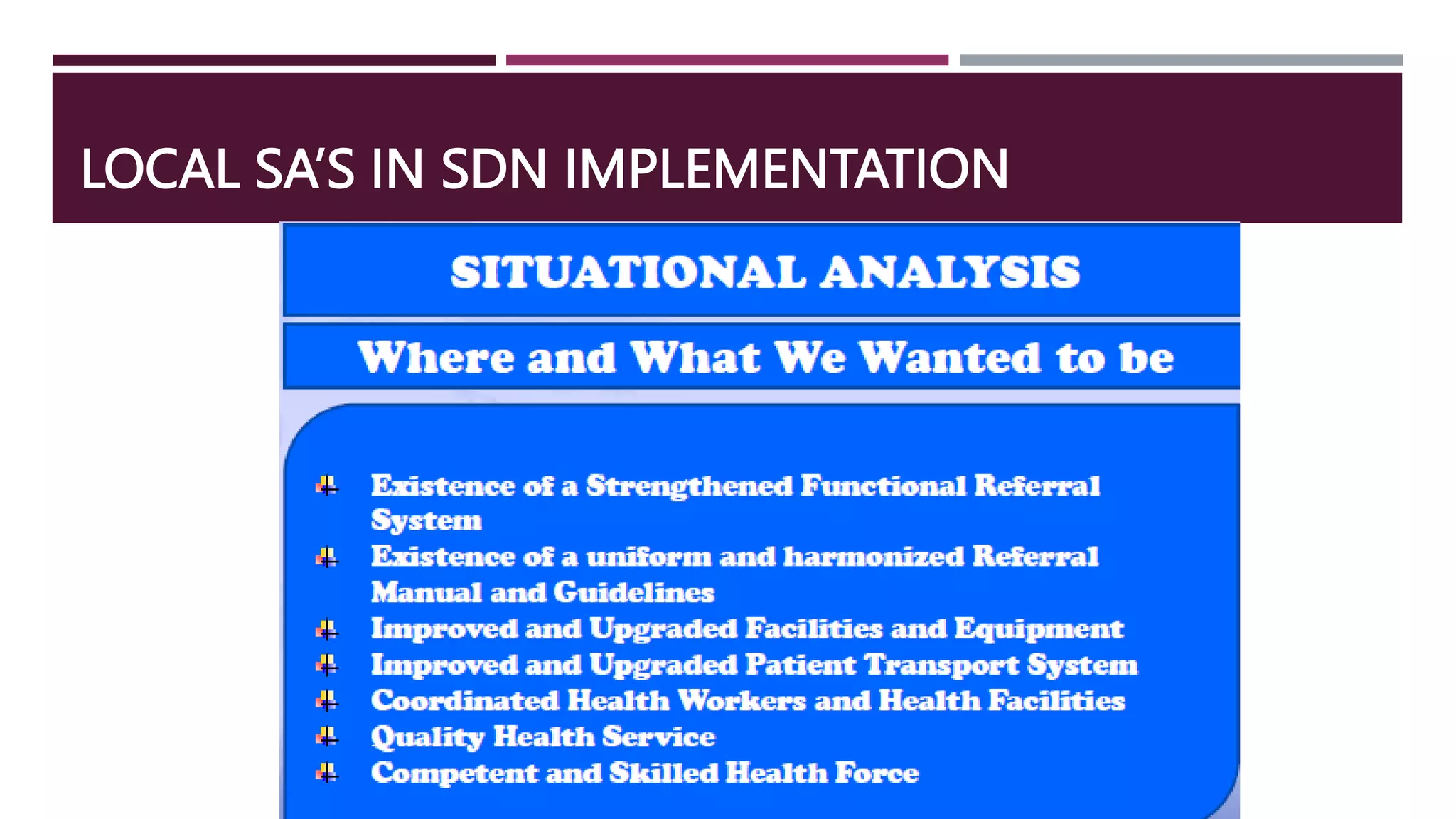
LOCAL SA’S IN SDN IMPLEMENTATION
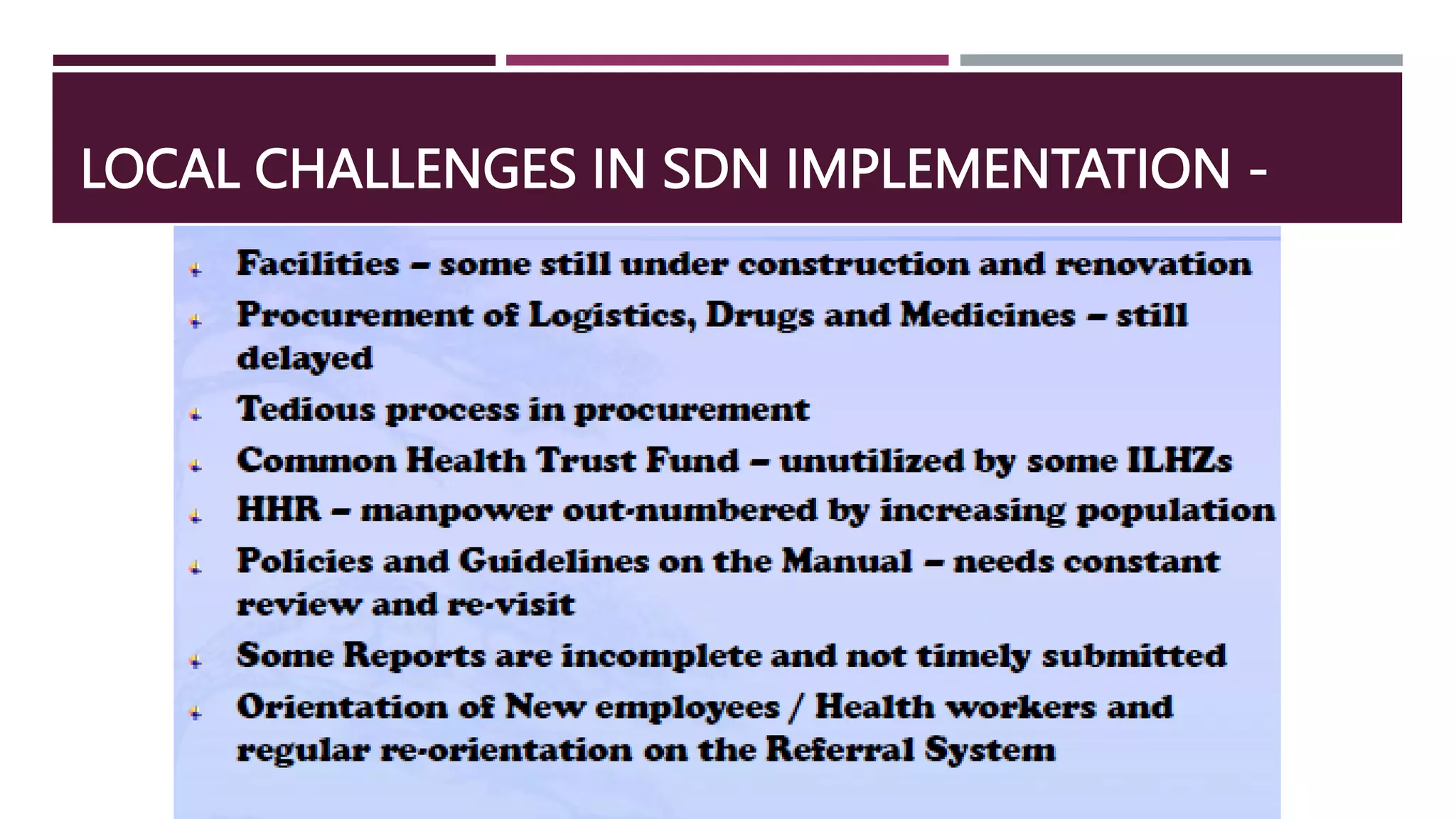
LOCAL CHALLENGES IN SDN IMPLEMENTATION -
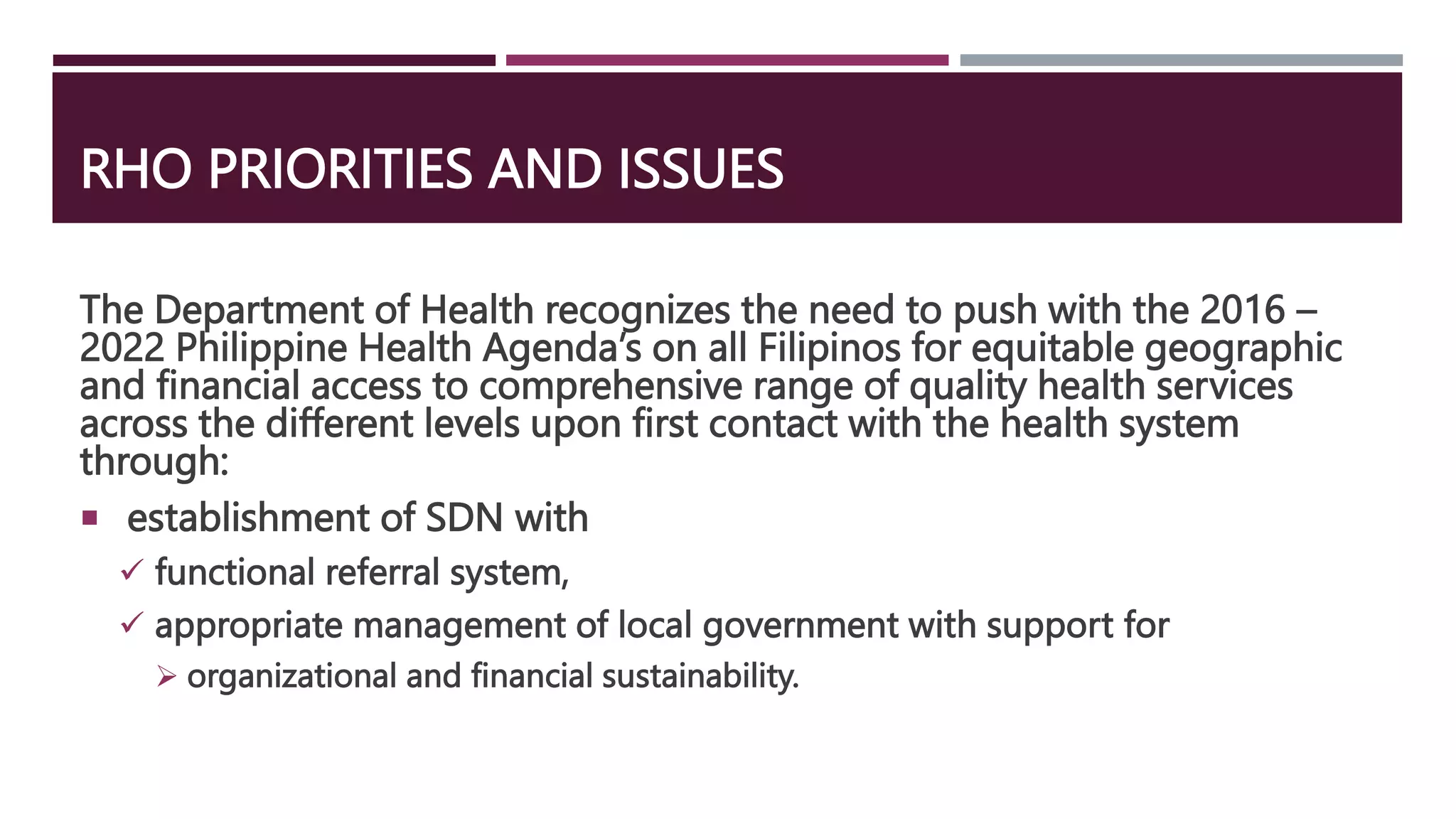
RHO PRIORITIES AND ISSUES
The Department of Health recognizes the need to push with the 2016 –
2022 Philippine Health Agenda’s on all Filipinos for equitable geographic
and financial access to comprehensive range of quality health services
across the different levels upon first contact with the health system
through:
 establishment of SDN with
 functional referral system,
 appropriate management of local government with support for
 organizational and financial sustainability.
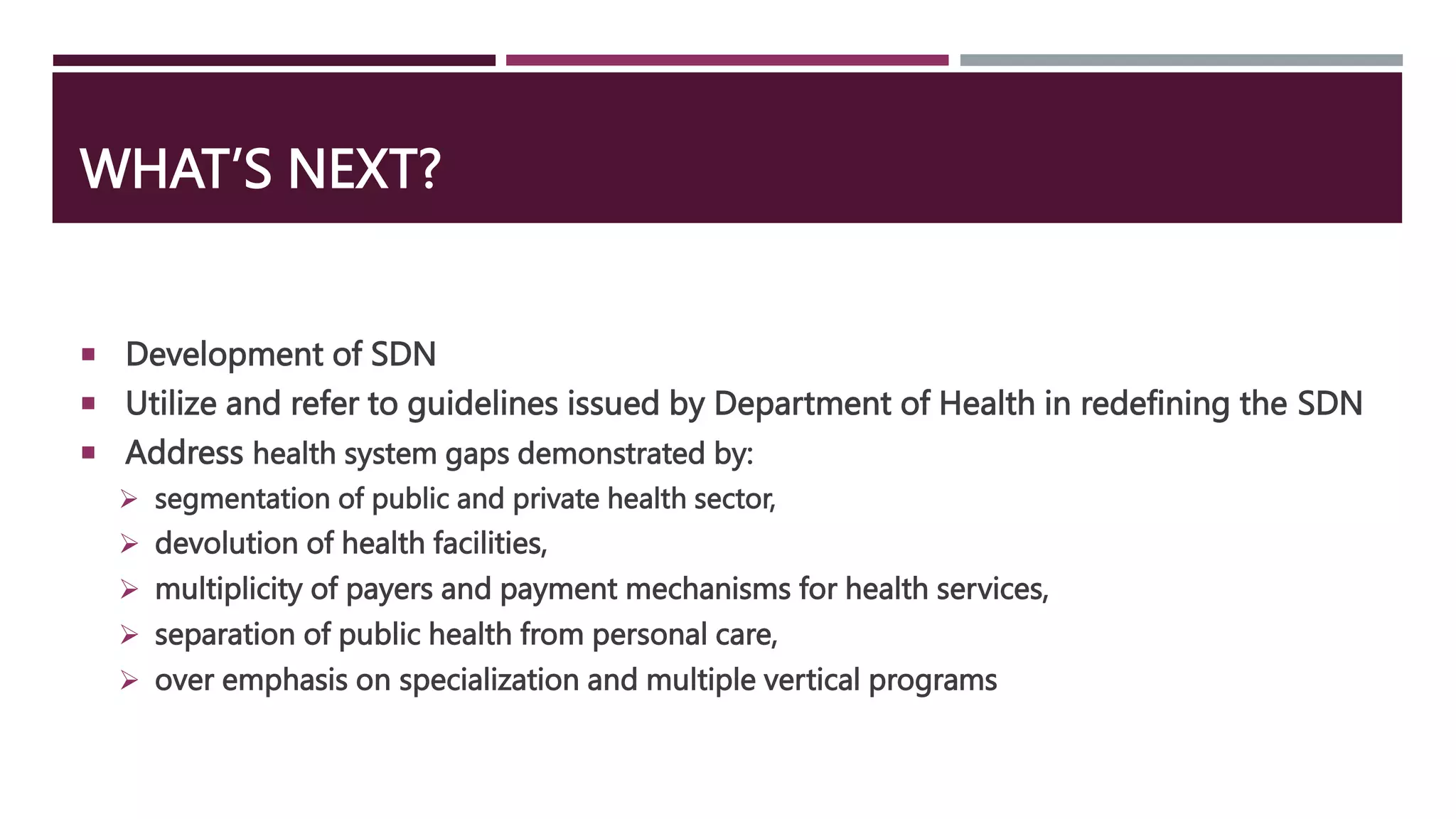
WHAT’S NEXT?
 Development of SDN
 Utilize and refer to guidelines issued by Department of Health in redefining the SDN
 Address health system gaps demonstrated by:
 segmentation of public and private health sector,
 devolution of health facilities,
 multiplicity of payers and payment mechanisms for health services,
 separation of public health from personal care,
 over emphasis on specialization and multiple vertical programs

Concepts of SDN Elements and Programmatic Review

  • 1.
    CONCEPT(S) OF SERVICEDELIVERY NETWORK (SDN) ON DOH HEALTH PROGRAM PROGRAMMATIC REVIEW OF SDN DEVELOPMENT PROCESSES AND IMPLEMENTATION Rogelio M Ilagan, MD, MPH +63908-819-7913 rogermilagan@gmail.com
  • 2.
    All for Health towards Healthfor All THE DUTERTE HEALTH AGENDA
  • 3.
    Access functional SERVICE DELIVERY NETWORKS Attain & Sustain UNIVERSALHEALTH INSURANCE Protect from TRIPLE BURDEN OF DISEASE What services to guarantee or prioritize? How to best deliver the services? How to equitably and efficiently finance the service? Our Strategy
  • 4.
    GOVERNANCE HEALTH FINANCING SERVICE DELIVERYAND TRAVEL MEDICINE HEALTH HUMAN RESOURCE DEVELOPMENT REGULATIONS, POLICY AND STANDARDS DEVELOPMENT HEALTH INFORMATION AND SURVEILANCE ATTAIN HEALTH-RELATED SUSTAINABLE DEVELOPMENT GOAL Financial Risk Protection Better Health Outcomes Responsiveness Equity  Inclusiveness  Quality Comprehensiveness  Efficiency Sustainability  Transparency Accountability SERVICE DELIVERY NETWORKS UNIVERSAL HEALTH INSURANCE TRIPLE BURDEN OF DISEASE
  • 5.
    • Appropriate, ethicaland at par with clinical and non-clinical standards - Gate-keeping, Licensing & Accreditation, Clinical practice guidelines • Physical access - Accessible location, transport assistance, or telehealth • Seamless continuum of services - Lower level level facilities to end referral centers and vice versa - Public (DOH, LGU, NGA) and private exchanges (patients and human resource) - Team-based approach • Patient/client-friendly and culturally-sensitive services - No queues, by appointment only Service Delivery Networks NETWORKS AS CONTRACTED UNITS OF PHILHEALTH, ACCOUNTABLE FOR ENSURING: How should health care providers be organized to ensure easy access to high quality services? NETWORKS ENHANCED BY RELIABLE DATA & REGULAR FEEDBACK • Mandate online submission/data sharing and reporting to disease registries • Obtain accurate feedback: e.g. ghost patients, surprise field visits • Streamline monitoring and evaluation systems and create dedicated performance unit NETWORKS RESILIENT IN TIMES OF DISASTER • Strengthen preparedness initiatives * To include other government agencies’ initiatives (sector wide approach)
  • 6.
    200 Days Roll out TSEKAP+OP Drug benefit to the poorest Expand National Drug Rehab Program Strategic Alignment of DOH Hospitals in a SDN Contracting by SDN operational in 3 regions Enroll remaining 8% of the population Make prices of most common drugs affordable and diagnostics available 100 Days Roll out mental health and enhanced HIV/AIDS package Health in All policies in 4 key sectors Operationalize ambulance services (land, sea, air) No queues in public facilities (by appointment and navigators) Adjust rates for most common cases Enforce fixed and zero co-payment (NBB for poorest) Zero unmet need for FP
  • 7.
    BACKGROUND AND RATIONALE ServiceDelivery Networks (SDN) refer to the network of health facilities and providers within the province or city-wide health systems, offering a core package of health care services in an integrated and coordinated manner similar to the district health system. The goals of SDNs are to:  improve service provision by providing equitable access to health services,  efficient provision of continuity of care and  service provision that is responsive to client’s health needs or preferences.
  • 8.
    BACKGROUND AND RATIONALE Thesegoals can be achieved by the SDN through various mechanisms such as:  service delivery coordination between and among facilities in the SDN area,  provision of health and non-health aspects of patients, cost and  resource sharing among stakeholders and others.
  • 9.
    BACKGROUND AND RATIONALE Therecent Administrative Order issued by DoH on December 2016, redefined the General Guidelines of the Service Delivery Network, particularly in areas of: 1) Catchment area and population, 2) Component care networks, 3) Governance and operational component, 4) Financing and fund sources, 5) Functional activities and 6) Entitlements of national population.
  • 10.
    BACKGROUND AND RATIONALE Thenew AO also expanded the roles and responsibilities of:  DoH and its component internal bureaus,  Philippine Health Insurance Corporation,  Local Government Units and  other collateral government and non-government agencies.
  • 11.
    BACKGROUND AND RATIONALE Theideal implementation of the Service Delivery Network approach will result in:  patients receiving effective and appropriate health services from any facility in the network and  inter-facility transfer utilizing a single set of medical history and laboratory examination data to prevent duplication and delays of particular services, treatment and intervention and  will also result in the provision of patient’s health care needs from preventive and promotive to curative and rehabilitative health services,
  • 12.
    BACKGROUND AND RATIONALE Withthe network facilitating patient transfer within and outside the network, minimizing:  patient waiting time,  inadequate information on service or provider availability and among member facilities of the SDN.  lost of time and resources to collect, summarize and analyze patients’ needs and feedback for the improvement of service provision in the network.
  • 20.
    Guidelines in EstablishingSDN – Issued April 12, 2016
  • 22.
    WHAT IS AFUNCTIONAL SDN?
  • 23.
    ESTABLISHMENT AND ORGANIZATIONOF SDN Step 1: Identify needs of priority groups and the general population to be able to define service targets effectively. (Who are the priority groups?) Action: Compute for Targets Step 2: Map available health care providers that can serve the needs of the priority groups and the general population, for particular quality program services requiring different levels of care (Who are the facilities and providers?) Action: Map the Facilities and Providers
  • 24.
    ESTABLISHMENT AND ORGANIZATIONOF SDN Step 3: Designate priority groups, general population to health facilities to facilitate efficient access to quality health services. (Where are the facilities and providers located?) Action: Designate SDN Step 4: Undertake monitoring and evaluation of the SDN (How do we know we reach there?) Action: Do Monitoring and Evaluation
  • 25.
    GUIDING PRINCIPLES GOVERNINGTHE STRUCTURE, ORGANIZATION AND REFERRAL SYSTEM IN THE SERVICE DELIVERY NETWORK • Universal Health Care or Kalusugan Pangkalahatan (UHCIKP) targets and outcomes shall guide the goals and objectives of service delivery network (SDN); • SDN is an instrument to improve, strengthen service delivery and ensure continuity of services for families, across political and geographical boundaries. • All hospitals and health facilities shall seek to be part of referral network within the vicinity of their SDNs, to provide for services which they are not capable to render, and to provide basis for any assistance required. • All families belonging to a SDN are entitled to access responsive and quality health services
  • 27.
    THE REDEFINED SDNGUIDELINES OF 2016 Directed to achieve Philippine Health Agenda of :  better health outcomes,  financial protection and  responsiveness for all Filipinos and  guaranteed universal access  to comprehensive and continuity of care through referral of catchment area population that will be determined by proximity of the population to the care networks
  • 28.
    THE SDN CARENETWORKS 1. The Primary Care Networks composed of:  Barangay Health Stations,  Rural Health Units,  Outpatient Clinics,  Ambulatory Surgical Centers and  Level 1 hospitals
  • 29.
    THE SDN CARENETWORKS 2. The Specialty Care Networks composed of:  Specialized facilities,  Levels 2 and 3 hospitals 3. A Level 3 Apex hospital as the end referral facility.
  • 30.
    THE SDN CARENETWORKS
  • 31.
    THE SDN CARENETWORKS
  • 32.
    THE SDN CARENETWORKS
  • 33.
    THE SDN HOSPITALCARE NETWORKS WHAT IS YOUR PROTOTYPE VERTICAL AND HORIZONTAL REFERRAL FLOWS?
  • 34.
    The Referral Framework LOCALHEALTH SYSTEMSHEALTH SYSTEMS SDN Components • Primary Care NW • Specialty Care NW • Level 3 Apex Hospital PROTOCOLS / GUIDELINES • VARIOUS HEALTH PROGRAMS: MNCHN, HIV- AIDS, TB and infectious dses, NCDs / Adolesccent/Adult/Drrug Programs •INTERNAL HOSPITAL PROTOCOL •CLINICAL /SUBSPECIALTY PROTOCOL GOVERNANCE • GOVERNING BOARD/TWG • DOH • PHIC •LGUS •PUBLIC PRIVATE PARTNERSHIP •POLICY SUPPORT • INCENTIVE SCHEMES INITIATING FACILITY (SDN NETWORK) • Client and their Condition • Protocol of Care • Provision of Care and Documentation • Decision to Refer REFERRAL PRACTICALITIES • Outward referral form • Communication with receiving facility • Information to the Client • Outgoing Referral / Referral Register • Programmatic Recording and Reporting Forms RECEIVING FACILITY (SDN NETWORK) • Receive Client with Referral form • Treat Client and Documentaiton • Plan for Tx of pt and treatment completion REFERRAL PRACTICALITIES • Back Referral form • Feedback to Initiating facility • Incoming Referral / Referral Register • Programmatic Recording and Reporting Forms SUPERVISION AND CAPACITY BUILDING • Monitor Referrals • Ensure Back Referral • Feedback and Training for facility staff • Feedback to Central level
  • 35.
    Referral Flow Contain: •Sources of Referral • Designation of Referral Facilities • Program Services • Programmatic Recording and Reporting Forms • Decision to retain or to refer clients • End of Referrals – clients receive appropriate treatment management and get well
  • 38.
    REVIEW OF SDNIMPLEMENTATION Rogelio M Ilagan, MD, MPH +63908-819-7913 rogermilagan@gmail.com
  • 39.
    SDN OPERATIONAL FRAMEWORK PROGRAMMATIC /TECHNICAL • DOH STEWARDSHIP • POLICY ISSUE INTERPRETATION • LOCAL HEALTH DEVOLUTION • LGU PRIORITY DIRECTIONS LOCALIZATION • HEALTH SYSTEM APPROACH • GOVERNANCE, HUMAN RESOURCES, FINANCING, INCENTIVES AND SUSTAINABILITY
  • 40.
    SDN OPERATIONAL FRAMEWORK IMPLEMENTATION •OVERSITE • RECORDS AND REPORTS MONITORING • HUMAN RESOURCES • RECORDS AND REPORTS ADAPTION • ENHANCEMENT • GOOD PRACTICES
  • 41.
    SDN OPERATIONAL FRAMEWORK PROGRAMMATIC / TECHNICAL – DOH AS THE SDN STEWARD AND POLICY MAKING BODY  VARIOUS ADMINISTRATIVE ORDER ISSUANCES  INTERPRETATION – SDN GUIDELINES AS PER DOH ISSUANCE BE DISCUSSED WITHIN THE DEVOLVED HEALTH SYSTEM  ACKNOWLEDGEMENT AND UNDERSTANDING THE LGU PRIORITIES AND DIRECTIONS OF THE LOCAL DEVOLVED HEALTH SYSTEM  MASTERLIST OF DOH RETAINED HOSPITALS / PUBLIC HOSPITALS DEVOLVED TO PROV AND MUN LGUS / PRIVATE HOSPITALS WITHIN LGU CATCHMENT
  • 42.
    SDN OPERATIONAL FRAMEWORK LOCALIZATION – REGIONAL, PROVINCIAL, CITY, MUNICIPAL LEVEL AND INTEGRATION  THE INTERLOCAL HEALTH SYSTEM APPROACH  FUNCTIONAL CRITERIA – ORGANIZATIONAL, ACTIVE AGENDA, PLANS, COMMUNICATION, LOCALIZED FUND AND RESOURCES  ORIENTATION, CAPACITY BUILDING AND DEVELOPMENT OF PUBLIC-PRIVATE PARTNERSHIP REFERRAL FLOWS AND MECHANISM  GOVERNANCE, HUMAN RESOURCES, SOURCES OF INCOME, INCENTIVES AND SUSTAINABILITY MECHANISM, GOVERNING BOARD/TECHNICAL WORKING GROUP/STEERING COMMITTEE/IILHZ MEETINGS  INVESTMENT AND OPERATIONAL PLANS
  • 43.
    SDN OPERATIONAL FRAMEWORK IMPLEMENTATION – GUIDELINES AND AGREEMENT OF LOCALIZED SDN  SDN OVERSITE TO FACILITATE DAY TO DAY ACTIVITIES OF THE SDN  MONITORING AND SUPERVISION – AVAILABLE TOOLS AND WARM BODIES  M/S SET UP / FREQUENCY / HUMAN RESOURCES COMPLEMENTATION  RECORDING AND REPORTING  ELECTRONIC REPORTING (Web-based, SMS) vs PAPER BASED REPORTING  ADAPTION – ENHANCEMENT  GOOD PRACTICES
  • 44.
    PERCEIVED GAPS 1. PROGRAMMATIC/ TECHNICAL – DOH AS THE SDN STEWARD AND POLICY MAKING BODY  DOH TO DESIGN AND DEVISE SDN GUIDELINES  GAP: DOH TO INTERPRET GUIDELINES THAT DEVOLVED LGUS CAN UNDERSTAND “HOW TO DO IT” 2. INTERPRETATION – SDN GUIDELINES AS PER DOH ISSUANCE BE DISCUSSED WITHIN THE DEVOLVED HEALTH SYSTEM  LGUS TO ACKNOWLEDGE AND UNDERSTAND THE PRIORITIES AND DIRECTIONS OF THE LOCAL DEVOLVED HEALTH SYSTEM  MASTERLIST OF DOH RETAINED HOSPITALS / PUBLIC HOSPITALS DEVOLVED TO PROV AND MUN LGUS / PRIVATE HOSPITALS WITHIN LGU CATCHMENT / PRIMARY, SECONDARY AND TERTIARY HOSPITALS / ACCREDITATION STATUS  GAP: WHO WILL DO WHAT? HOW WILL HEALTH SYSTEM INCLUDING PUBLIC AND PRIVATE FACILITIES AND HOSPITALS INTEGRATE INTER AND INTRA REFERRALS
  • 45.
    PERCEIVED GAPS 3. LOCALIZATION– REGIONAL, PROVINCIAL, CITY, MUNICIPAL LEVEL AND INTEGRATION  THE INTERLOCAL HEALTH SYSTEM APPROACH  GAPS:  IS THERE A FUNCTIONAL INTERLOCAL HEALTH ZONE? IS THE HOSPITAL IS A PART OF ILHZ?  ARE PUBLIC AND PRIVATE SECTORS ORIENTED, CAPACITATED AND REFERRAL FLOWS DEVELOPED?  IS THERE A FAVORABLE AND POSITIVE GOVERNANCE SUPPORT INCLUDING ADEQUATE HUMAN RESOURCES, INCENTIVE, FINANCING AND SUSTAINABILITY SCHEMES?  IS THERE A GOVERNING BOARD/TECHNICAL WORKING GROUP/STEERING COMMITTEE/IILHZ MEETINGS?  IS THERE AN INVESTMENT AND OPERATIONAL PLAN?  IS THERE GOVERNING BODY AND CARE TAKERS OF SDN?
  • 46.
    PERCEIVED GAPS 4. IMPLEMENTATION– GUIDELINES AND AGREEMENT OF LOCALIZED SDN  GAPS:  WHO SERVES AS THE OVERSITE TO FACILITATE DAY TO DAY ACTIVITIES OF THE SDN?  ARE RECORDS AND REPORTS DONE CORRECTLY?  IS THERE A NEED TO INTEGRATE ELECTRONIC BASED REPORTNG SYSTEM  ARE THERE AVALABLE TOOLS AND HUMAN RESOURCES FOR THE CONDUCT OF MONITORING AND SUPERVISION?  IS THERE A M/S SET UP / FREQUENCY / HUMAN RESOURCES COMPLEMENTATION? 5. ADAPTION – ENHANCEMENT  GAPS  ARE GOOD PRACTICES DOCUMENTED?  ARE THERE MODELS OF FUNCTIONAL AND TESTED SDN AND REFERRAL SYSTEM IN THE LGUS OR ILHZ?
  • 47.
    LOCAL SA’S INSDN IMPLEMENTATION
  • 48.
    LOCAL SA’S INSDN IMPLEMENTATION
  • 49.
    LOCAL CHALLENGES INSDN IMPLEMENTATION -
  • 50.
    RHO PRIORITIES ANDISSUES The Department of Health recognizes the need to push with the 2016 – 2022 Philippine Health Agenda’s on all Filipinos for equitable geographic and financial access to comprehensive range of quality health services across the different levels upon first contact with the health system through:  establishment of SDN with  functional referral system,  appropriate management of local government with support for  organizational and financial sustainability.
  • 51.
    WHAT’S NEXT?  Developmentof SDN  Utilize and refer to guidelines issued by Department of Health in redefining the SDN  Address health system gaps demonstrated by:  segmentation of public and private health sector,  devolution of health facilities,  multiplicity of payers and payment mechanisms for health services,  separation of public health from personal care,  over emphasis on specialization and multiple vertical programs