Database System Concept
Mrs. Ujjwala Sachin Patil (SITCOE)
1
Unit – I : Database System Concept
1.1 Concept of data, Database, DBMS, advantages of DBMS over file
processing system, Application of database.
1.2 Three Level Architecture of Database System.
1.3 Data Abstraction: Different Levels of data abstraction, Instance and
Schema, Data Independence.
1.4 Overall Structure of DBMS
1.5 Data Modeling: Record based logical model- Relational, Network,
Hierarchical
1.6 Data modeling using the E-R Model: Entity Relationship Model,
Strong Entity set, Weak Entity set, Types of Attributes, E-R Diagram.
Mrs. Ujjwala Sachin Patil (SITCOE)
2
What is Data?
•User input is known as Data.
•Data can be defined as collection of facts, figures or
numbers.
•Data is a collection of a distinct small unit of
information.
•Data is information that can be translated into a form for
efficient movement and processing.
Mrs. Ujjwala Sachin Patil (SITCOE)
3
Database:
•A database is a collection of information that is
organized so that it can be easily accessed,
managed and updated.
•A database is a collection of related data which
represents some aspect of the real world.
•A database is a collection of data which is
organized, which is also called as structured data.
•In Database, data is organized into tables which
consist of rows and columns and it is indexed so
data gets updated, expanded and deleted easily.
Mrs. Ujjwala Sachin Patil (SITCOE)
4
Database Management System (DBMS) :
A database is a collection of related data which represents
some aspect of the real world.
Database Management System (DBMS) is a software for
storing and retrieving users' data while considering
appropriate security measures. It consists of a group of
programs which manipulate the database.
DBMS allows users to create their own databases as per
their requirement. The term “DBMS” includes the user of
the database and other application programs.
It provides an interface between the data and the software
application.
Mrs. Ujjwala Sachin Patil (SITCOE)
5
Advantages of DBMS over File Processing System:
• Reducing Data Redundancy:
• Sharing of Data
• Data Integrity
• Data Security
• Privacy
• Backup and Recovery
• Data Consistency
Mrs. Ujjwala Sachin Patil (SITCOE)
6
Applications of Database Systems:
• Banking
• Airlines
• Universities
• Credit Card Transactions
• Telecommunication
• Finance
• Sales
• Manufacturing
• Human resources
• Railway Reservation Systems
• E –Commerce
Mrs. Ujjwala Sachin Patil (SITCOE)
7
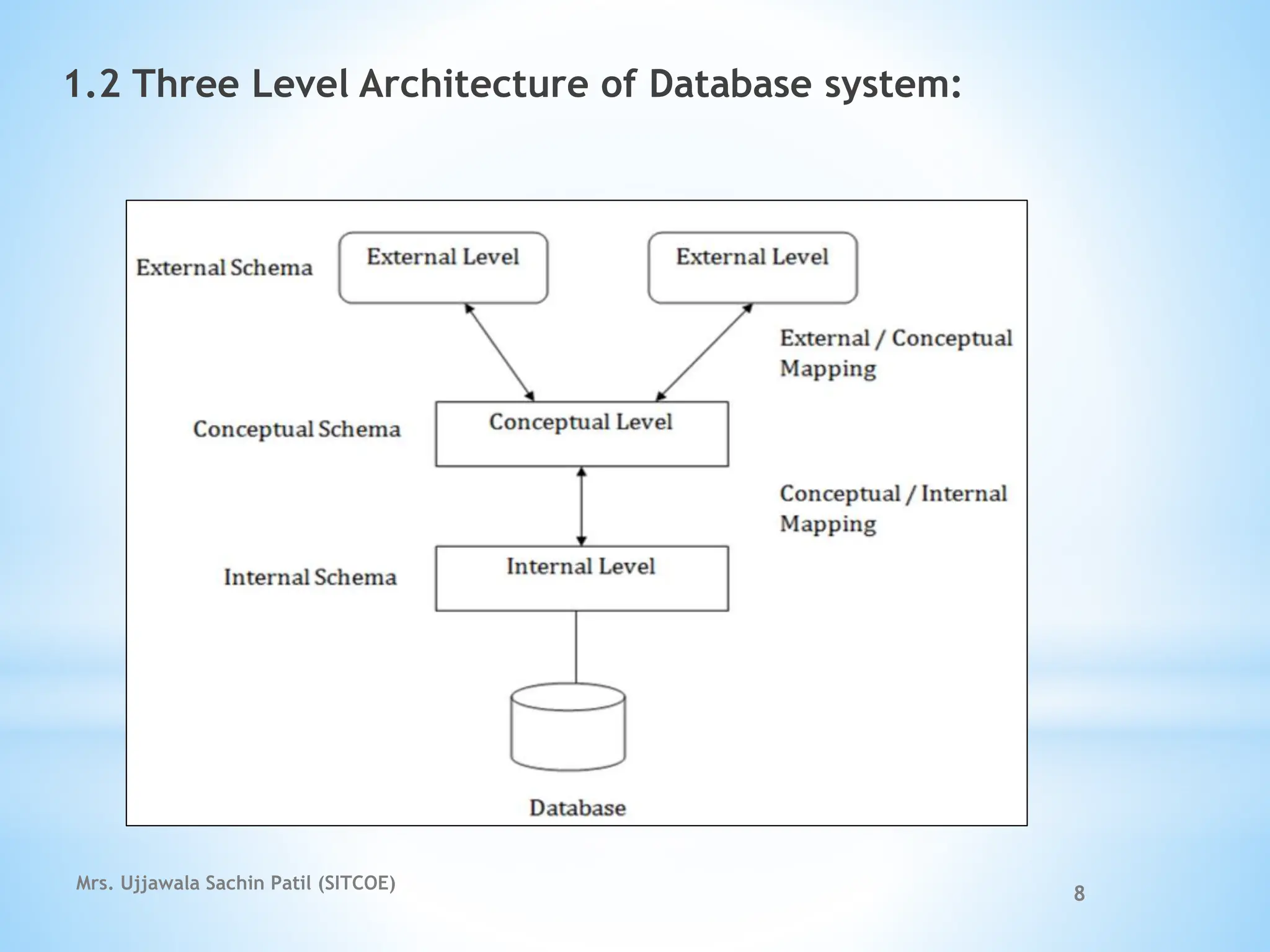
1.2 Three Level Architecture of Database system:
Mrs. Ujjawala Sachin Patil (SITCOE)
8
1. Internal Level:
The internal level has an internal schema which describes the physical
storage structure of the database.
The internal schema is also known as a physical schema.
It uses the physical data model. It is used to define that how the data will
be stored in a block.
The physical level is used to describe complex low-level data structures
in detail.
Mrs. Ujjawala Sachin Patil (SITCOE) 9
2. Conceptual Level
The conceptual schema describes the design of a database at the
conceptual level. Conceptual level is also known as logical level.
The conceptual schema describes the structure of the whole database.
The conceptual level describes what data are to be stored in the database
and also describes what relationship exists among those data.
In the conceptual level, internal details such as an implementation of the
data structure are hidden.
Programmers and database administrators work at this level.
Mrs. Ujjawala Sachin Patil (SITCOE) 10
3. External Level
At the external level, a database contains several schemas that sometimes
called as subschema. The subschema is used to describe the different view
of the database.
An external schema is also known as view schema.
Each view schema describes the database part that a particular user group
is interested and hides the remaining database from that user group.
The view schema describes the end user interaction with database
systems.
Mrs. Ujjawala Sachin Patil (SITCOE) 11
1.3 Data Abstraction
Data Abstraction can be defined as the process of hiding the complexity
of data and representing the data which needs to be shown to users.
The basic goal of database is to provide the user an efficient and
convenient way to access the data. Another major goal is to provide an
abstract view of the data.
Mrs. Ujjawala Sachin Patil (SITCOE) 12
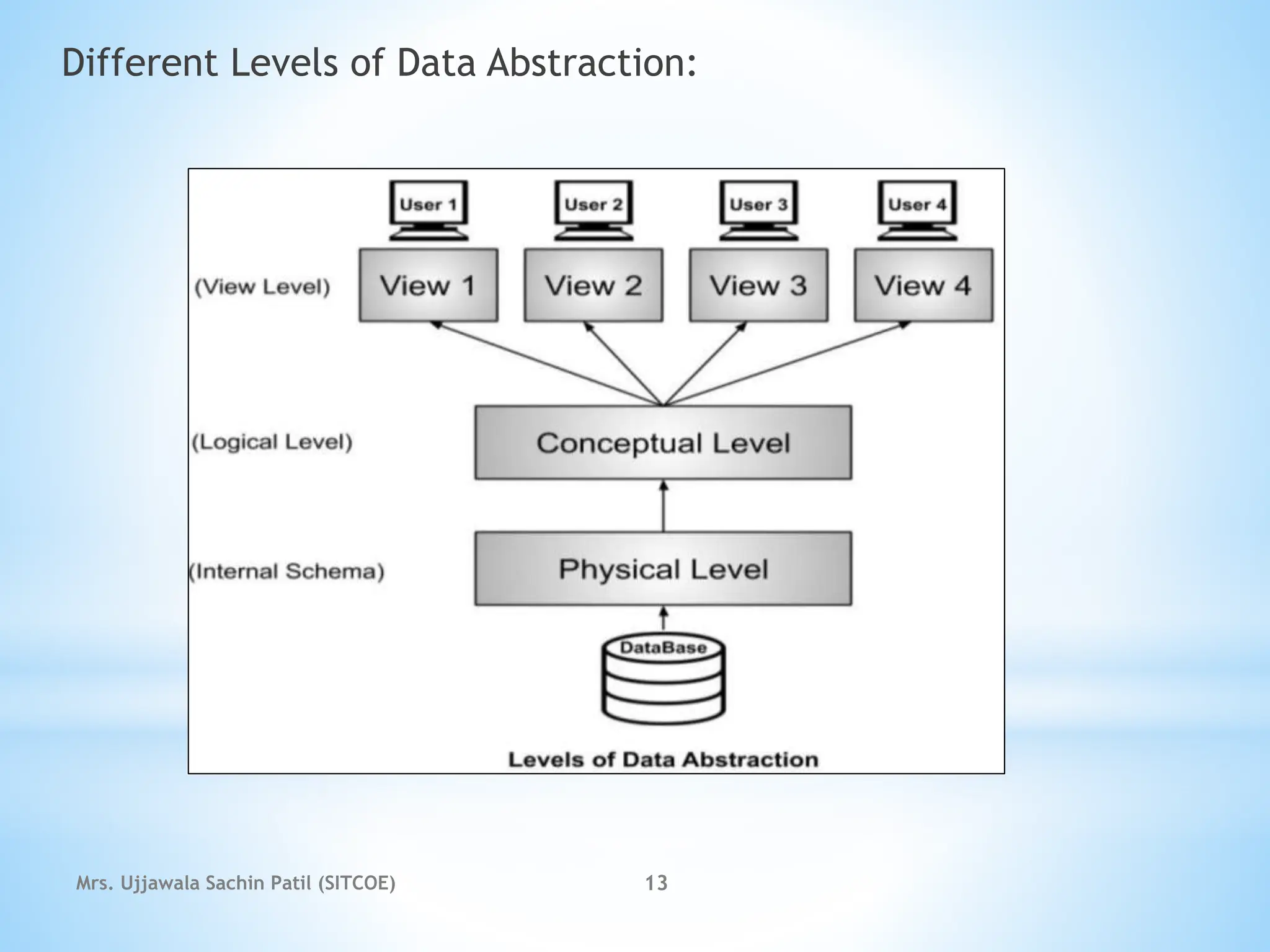
Different Levels of Data Abstraction:
Mrs. Ujjawala Sachin Patil (SITCOE) 13
Physical Level:
This is the lowest level of data abstraction. It tells us how the data is
actually stored in memory.
Logical Level:
This level comprises of the information that is actually stored in the
database in the form of tables.
View Level:
This is the highest level of abstraction. Only a part of the actual database
is viewed by the users. This level exists to ease the accessibility of the
database by an individual user.
Mrs. Ujjawala Sachin Patil (SITCOE) 14
Instance and Schema:
The collection of information stored in the database at a particular
moment is called an instance of the database.
Overall design of the database is called the database schema. Schemas
are not changed in frequently
Mrs. Ujjawala Sachin Patil (SITCOE) 15
Database systems have several schemas, partitioned according to the
levels of abstraction.
• Physical schema
• Logical schema
• Subschemas
Mrs. Ujjawala Sachin Patil (SITCOE) 16
Data Independence:
The ability to modify a schema definition in one level without affecting a
scheme definition in a higher level is called data independence. i.e. the
technique that allow data to be changed without affecting the application
that process it.
Mrs. Ujjawala Sachin Patil (SITCOE) 17
There are two types of data independence:
• Physical data independence:
The ability to modify the physical scheme without causing application
programs to be rewritten. Modifications at this level are usually to
improve performance of database.
• Logical data independence:
The ability to modify the logical scheme without causing application
programs to be rewritten is usually done when logical structure of
database is altered.
Logical data independence is harder to achieve the application programs
are usually heavy dependent on the logical structure of the data.
Mrs. Ujjawala Sachin Patil (SITCOE) 18
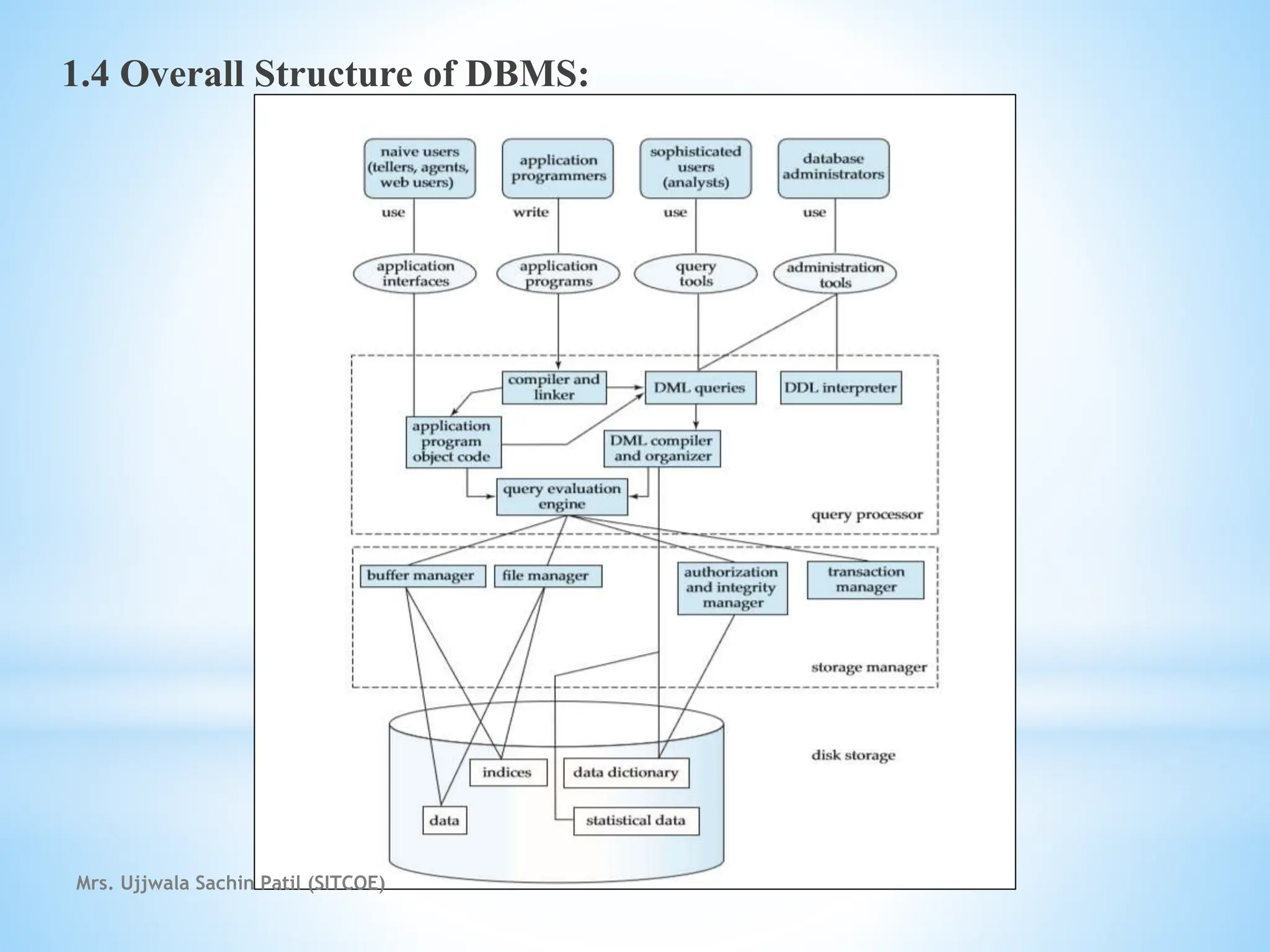
1.4 Overall Structure of DBMS:
Mrs. Ujjwala Sachin Patil (SITCOE)
• A database system is partitioned into modules that deal with each of the
responsibilities of the overall system. The functional components of a
database system can be broadly divided into the storage manager and
the query processor components.
• The storage manager is important because databases typically require a
large amount of storage space. Some Big organizations Database ranges
from Giga bytes to Tera bytes. So the main memory of computers
cannot store this much information, the information is stored on disks.
Data are moved between disk storage and main memory as needed.
• The query processor also very important because it helps the database
system simplify and facilitate access to data. So quick processing of
updates and queries is important. It is the job of the database system to
translate updates and queries written in a nonprocedural language.
Mrs. Ujjwala Sachin Patil (SITCOE)
Storage Manager Components:
•Authorization and integrity manager
•Transaction manager
•File manager
•Buffer manager
Mrs. Ujjwala Sachin Patil (SITCOE)
Query Processor Components:
DDL interpreter
DML compiler
Query evaluation engine
DML Compiler and Organizer
Compiler and Linker
Application Program Object Code
Mrs. Ujjwala Sachin Patil (SITCOE)
23

Concept of Database Management System.pptx

  • 1.
    Database System Concept Mrs.Ujjwala Sachin Patil (SITCOE) 1
  • 2.
    Unit – I: Database System Concept 1.1 Concept of data, Database, DBMS, advantages of DBMS over file processing system, Application of database. 1.2 Three Level Architecture of Database System. 1.3 Data Abstraction: Different Levels of data abstraction, Instance and Schema, Data Independence. 1.4 Overall Structure of DBMS 1.5 Data Modeling: Record based logical model- Relational, Network, Hierarchical 1.6 Data modeling using the E-R Model: Entity Relationship Model, Strong Entity set, Weak Entity set, Types of Attributes, E-R Diagram. Mrs. Ujjwala Sachin Patil (SITCOE) 2
  • 3.
    What is Data? •Userinput is known as Data. •Data can be defined as collection of facts, figures or numbers. •Data is a collection of a distinct small unit of information. •Data is information that can be translated into a form for efficient movement and processing. Mrs. Ujjwala Sachin Patil (SITCOE) 3
  • 4.
    Database: •A database isa collection of information that is organized so that it can be easily accessed, managed and updated. •A database is a collection of related data which represents some aspect of the real world. •A database is a collection of data which is organized, which is also called as structured data. •In Database, data is organized into tables which consist of rows and columns and it is indexed so data gets updated, expanded and deleted easily. Mrs. Ujjwala Sachin Patil (SITCOE) 4
  • 5.
    Database Management System(DBMS) : A database is a collection of related data which represents some aspect of the real world. Database Management System (DBMS) is a software for storing and retrieving users' data while considering appropriate security measures. It consists of a group of programs which manipulate the database. DBMS allows users to create their own databases as per their requirement. The term “DBMS” includes the user of the database and other application programs. It provides an interface between the data and the software application. Mrs. Ujjwala Sachin Patil (SITCOE) 5
  • 6.
    Advantages of DBMSover File Processing System: • Reducing Data Redundancy: • Sharing of Data • Data Integrity • Data Security • Privacy • Backup and Recovery • Data Consistency Mrs. Ujjwala Sachin Patil (SITCOE) 6
  • 7.
    Applications of DatabaseSystems: • Banking • Airlines • Universities • Credit Card Transactions • Telecommunication • Finance • Sales • Manufacturing • Human resources • Railway Reservation Systems • E –Commerce Mrs. Ujjwala Sachin Patil (SITCOE) 7
  • 8.
    1.2 Three LevelArchitecture of Database system: Mrs. Ujjawala Sachin Patil (SITCOE) 8
  • 9.
    1. Internal Level: Theinternal level has an internal schema which describes the physical storage structure of the database. The internal schema is also known as a physical schema. It uses the physical data model. It is used to define that how the data will be stored in a block. The physical level is used to describe complex low-level data structures in detail. Mrs. Ujjawala Sachin Patil (SITCOE) 9
  • 10.
    2. Conceptual Level Theconceptual schema describes the design of a database at the conceptual level. Conceptual level is also known as logical level. The conceptual schema describes the structure of the whole database. The conceptual level describes what data are to be stored in the database and also describes what relationship exists among those data. In the conceptual level, internal details such as an implementation of the data structure are hidden. Programmers and database administrators work at this level. Mrs. Ujjawala Sachin Patil (SITCOE) 10
  • 11.
    3. External Level Atthe external level, a database contains several schemas that sometimes called as subschema. The subschema is used to describe the different view of the database. An external schema is also known as view schema. Each view schema describes the database part that a particular user group is interested and hides the remaining database from that user group. The view schema describes the end user interaction with database systems. Mrs. Ujjawala Sachin Patil (SITCOE) 11
  • 12.
    1.3 Data Abstraction DataAbstraction can be defined as the process of hiding the complexity of data and representing the data which needs to be shown to users. The basic goal of database is to provide the user an efficient and convenient way to access the data. Another major goal is to provide an abstract view of the data. Mrs. Ujjawala Sachin Patil (SITCOE) 12
  • 13.
    Different Levels ofData Abstraction: Mrs. Ujjawala Sachin Patil (SITCOE) 13
  • 14.
    Physical Level: This isthe lowest level of data abstraction. It tells us how the data is actually stored in memory. Logical Level: This level comprises of the information that is actually stored in the database in the form of tables. View Level: This is the highest level of abstraction. Only a part of the actual database is viewed by the users. This level exists to ease the accessibility of the database by an individual user. Mrs. Ujjawala Sachin Patil (SITCOE) 14
  • 15.
    Instance and Schema: Thecollection of information stored in the database at a particular moment is called an instance of the database. Overall design of the database is called the database schema. Schemas are not changed in frequently Mrs. Ujjawala Sachin Patil (SITCOE) 15
  • 16.
    Database systems haveseveral schemas, partitioned according to the levels of abstraction. • Physical schema • Logical schema • Subschemas Mrs. Ujjawala Sachin Patil (SITCOE) 16
  • 17.
    Data Independence: The abilityto modify a schema definition in one level without affecting a scheme definition in a higher level is called data independence. i.e. the technique that allow data to be changed without affecting the application that process it. Mrs. Ujjawala Sachin Patil (SITCOE) 17
  • 18.
    There are twotypes of data independence: • Physical data independence: The ability to modify the physical scheme without causing application programs to be rewritten. Modifications at this level are usually to improve performance of database. • Logical data independence: The ability to modify the logical scheme without causing application programs to be rewritten is usually done when logical structure of database is altered. Logical data independence is harder to achieve the application programs are usually heavy dependent on the logical structure of the data. Mrs. Ujjawala Sachin Patil (SITCOE) 18
  • 19.
    1.4 Overall Structureof DBMS: Mrs. Ujjwala Sachin Patil (SITCOE)
  • 20.
    • A databasesystem is partitioned into modules that deal with each of the responsibilities of the overall system. The functional components of a database system can be broadly divided into the storage manager and the query processor components. • The storage manager is important because databases typically require a large amount of storage space. Some Big organizations Database ranges from Giga bytes to Tera bytes. So the main memory of computers cannot store this much information, the information is stored on disks. Data are moved between disk storage and main memory as needed. • The query processor also very important because it helps the database system simplify and facilitate access to data. So quick processing of updates and queries is important. It is the job of the database system to translate updates and queries written in a nonprocedural language. Mrs. Ujjwala Sachin Patil (SITCOE)
  • 21.
    Storage Manager Components: •Authorizationand integrity manager •Transaction manager •File manager •Buffer manager Mrs. Ujjwala Sachin Patil (SITCOE)
  • 22.
    Query Processor Components: DDLinterpreter DML compiler Query evaluation engine DML Compiler and Organizer Compiler and Linker Application Program Object Code Mrs. Ujjwala Sachin Patil (SITCOE)
  • 23.
    Mrs. Ujjwala SachinPatil (SITCOE) 23