CONCEPT
MAP
CHEMISTRY
GURUKUL FOR
JEE & NEET
CLASS 11
GURUKUL FOR JEE & NEET (GGN.) | WWW.PHYSICSGURUKUL.COM | CONTACT: 7065827902, 8595090558
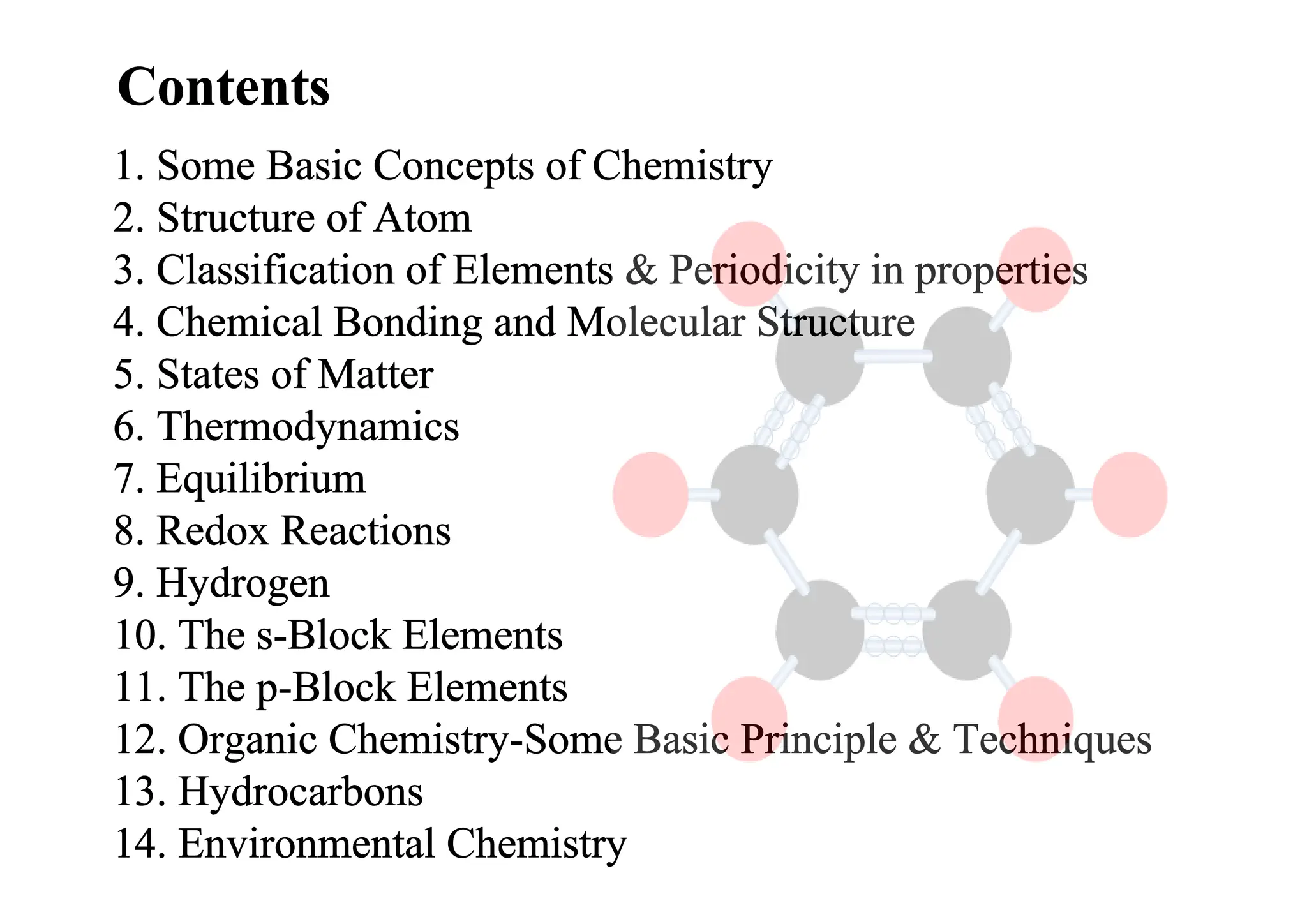
Contents
1. Some Basic Concepts of Chemistry
2. Structure of Atom
3. Classification of Elements & Periodicity in properties
4. Chemical Bonding and Molecular Structure
5. States of Matter
6. Thermodynamics
7. Equilibrium
8. Redox Reactions
9. Hydrogen
10. The s-Block Elements
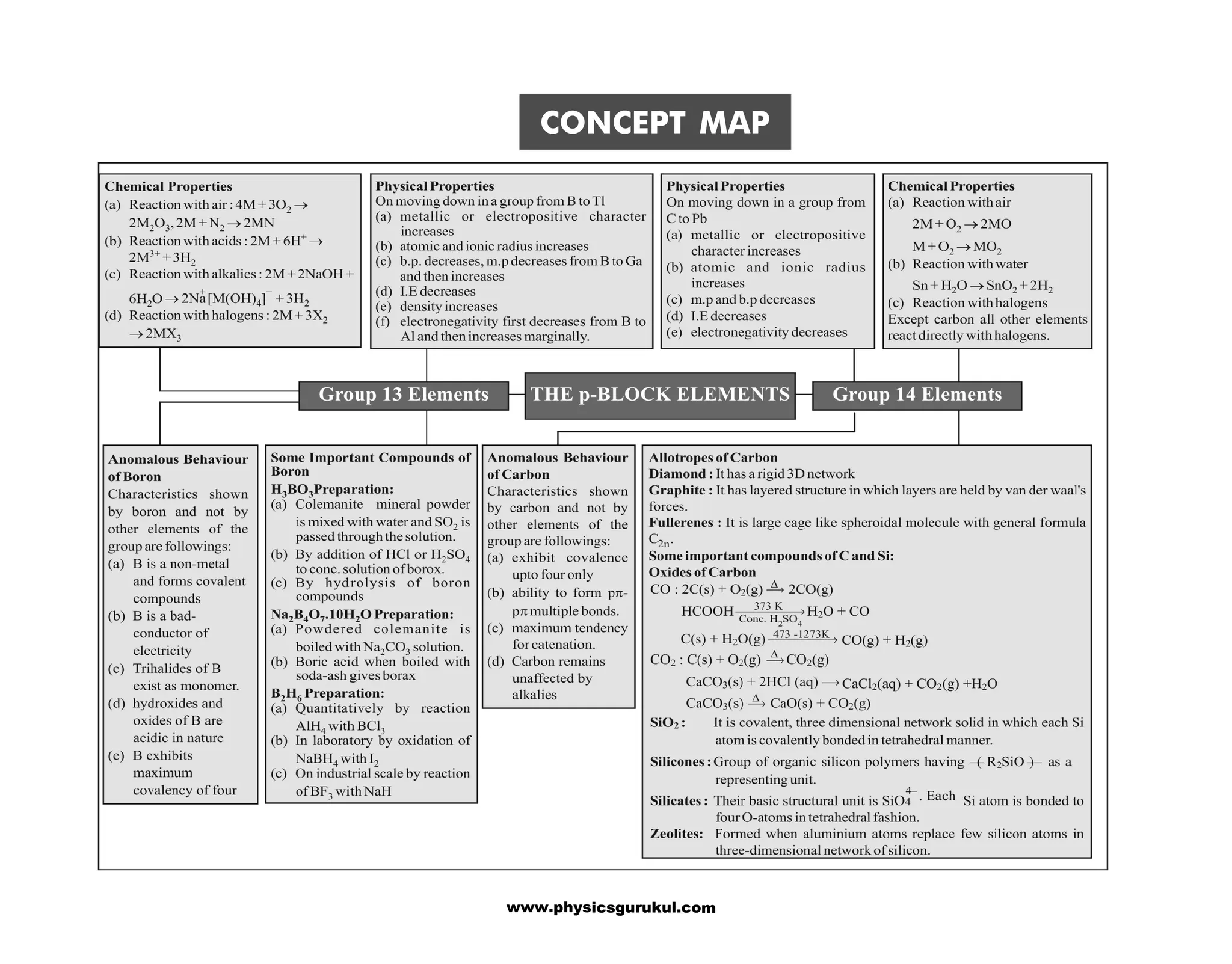
11. The p-Block Elements
12. Organic Chemistry-Some Basic Principle & Techniques
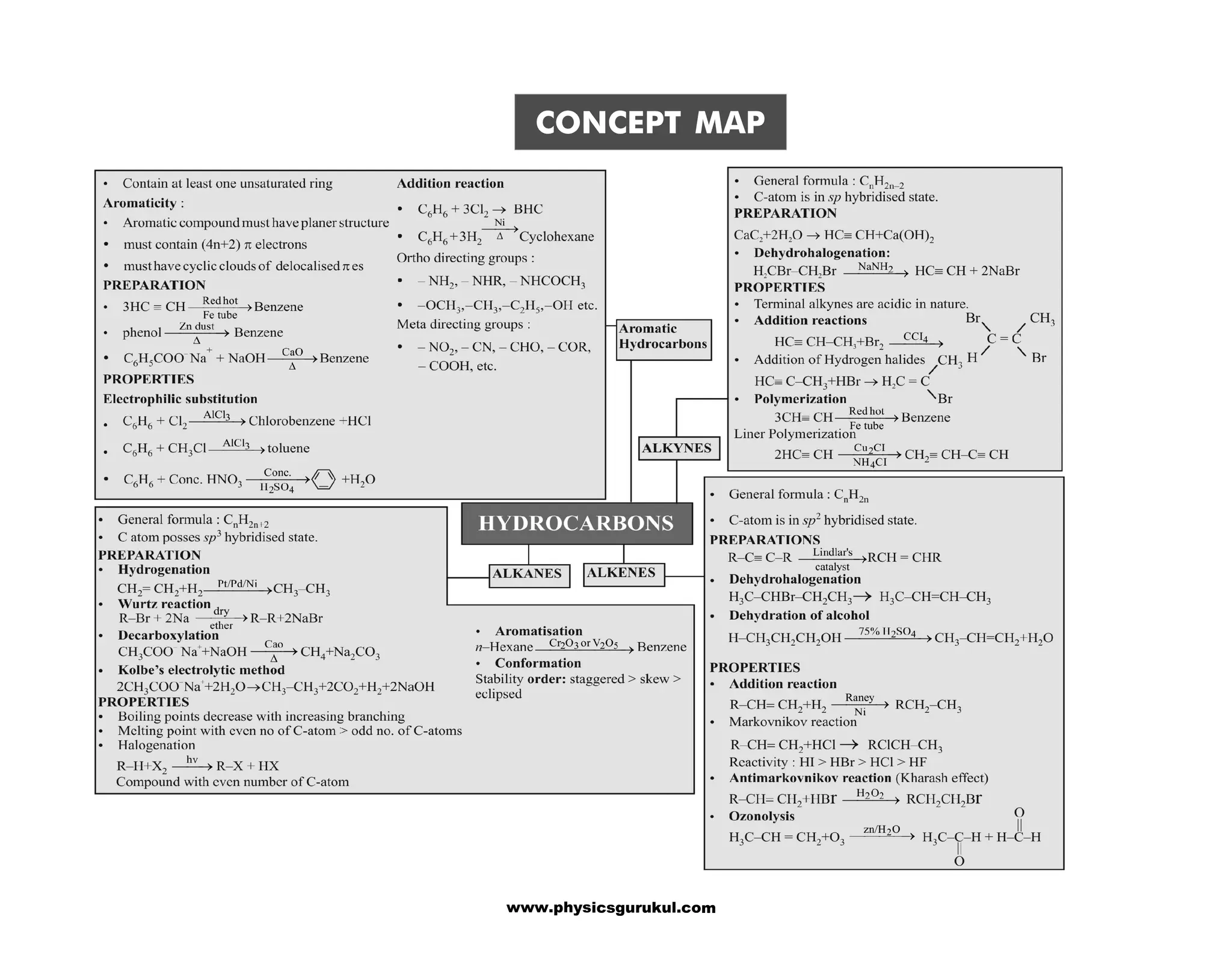
13. Hydrocarbons
14. Environmental Chemistry
CONCEPT MAP
www.physicsgurukul.com
CONCEPT MAP
www.physicsgurukul.com
CONCEPT MAP
Periodicity in Properties
Long form of
periodic table
Mendeleev’s
periodic table
Six horizontal rows –
periods
Eight vertical columns–
groups
Periods
Blocks , , ,
s p d f
Group1-18
columns
Alkali metal
Noble gas
Alkaline earths
metals
Halogens
Newland’s Law of
Octaves
Dobereiner’s Law
of Triads
Moselley’s
Law
Classification of elements
and periodicity in properties
Laws of periodic table
Mendeleev’s
Law
Grouped elements
into a triad
Arranged the elements in
increasing order of atomic
weight
Properties of elements are
periodic function of their
atomicweight
Properties of elements are
periodic function of their
atomicnumber
Ionisation
energy
Electron
affinity
Electronegativity Atomic &
ionic radii
Periodic trend in
chemical properties
Periods
group
­
¯
Periods
group
­
¯
Periods
group
­
¯
Periods
group
¯
¯
s p
& -block d f
&
Representative
elements
Transition metals
-block
d
Lanthanides
-block, I row
f
Actinides
-block II row
f
Metallic
character
Non-metallic
character
Decreases along
a periods
Increases along
a period
Valency
Increases from 1 to 4
and then decreases
upto 0 (noble gas)
Oxides
Extreme left
Extreme
right
Acidic Basic
Middle
Amphoteric
www.physicsgurukul.com
CONCEPT MAP
www.physicsgurukul.com
CONCEPT MAP
www.physicsgurukul.com
CONCEPT MAP
www.physicsgurukul.com
CONCEPT MAP
www.physicsgurukul.com
CONCEPT MAP
www.physicsgurukul.com
CONCEPT MAP
HeavyWater(D O)
Preparation :
Uses :
2
2 2
2
2
On a large scale, it is produced by
repeated electrolysis of ordinary water having alkali.
Physical properties of D O are different from H O
whereas chemical properties of D O are similar to
H O.
As a moderator in nuclear reactor and as a
tracercompound.
Dihydrogen
Occurence :
Isotopes :
Preparation :
Properties :
Uses
Mostabundantelementinthe
universe (70% of the total mass of the
universe)
Protium ( H), deuterium ( H)
andtritium ( H)
Reaction of Zn with dil.
acidoraqueousalkali.
Electrolysis of acidified water, by product
inmanufactureofNaOHandCl .
Reaction of steam on hydrocarbons or
coke at high temperatures in presence of
catalyst.
It is a colourless, odourless,
combustible gas, insoluble water. It
undergoes reaction with X , O , N ,
metals,organiccompoundsetc.
Itisusedin,
(a) Synthesis of NH
(b) Manufacture of vanaspati fat
(c) Manufacture of organic compounds
(d) Cutting and welding properties
1
1
2
1
3
1
2
2 2 2
3
Water:
Properties :
Major part ofall livingorganism.
Colourless, tasteless liquid with intermolecular
H – bonding. This leads to high freezing point, high boiling
point,highheatofvaporization,high heatoffusionetc.
It has amphoteric nature, undergoes hydrolysis reaction and
formhydrates.
Hard water. It contains bicarbonates, chlorides and sulphate
ofcalciumandmagnesium.
Temporary water hardness is due to bicarbonates of Ca and
Mg.
Permanent water hardness is dueto chloride and sulphates of
CaandMg.
HydrogenEconomy
It is one of the alternative to meet the energy needs
as dihydrogen releases large quantities of heat in
combustionwithoutcausing anymajor pollution.
Position in Periodic table : Outer shell
electronic configuration resembles both
alkali metals and halogens, still unique and
henceHisplacedseparately
HydrogenPeroxide(H O )
Preparation:
Manufacture:
Properties:
Storage:
Uses :
2 2
Bythe actionof H SO , H CO or
H PO onBaO .8H O
Electrolysisof50%H SO
Syrupy pale blue liquid, viscous,
diamagnetic and miscible with water, alcohol
and ether. H O acts as both oxidising as well as
reducingagent.
Keptinwaxlinedbottles.
Forbleaching, as antiseptic, as oxidant for
rocket, used to control environmental pollution
etc.
2 4 2 3
3 4 2 2
2 4
2 2
Hydrides :
(a) Ionic Hydrides:
(b) Covalent Hydrides:
(c) Metallic Hydrides:
Binary compounds formed by combination of
metalsandnon-metalswithH .
Stoichiometric compounds of H
with s-block elements
Dihydrogen forms molecular
compoundswithmostofthep-blockelements.
Non-stoichiometric compounds
of H with Be, Mg and d-and f-block elements.
Metalsofgroup7,8and9 donotformhydride.
2
2
2
HYDROGEN
www.physicsgurukul.com
CONCEPT MAP
www.physicsgurukul.com
CONCEPT MAP
www.physicsgurukul.com
CONCEPT MAP
www.physicsgurukul.com
CONCEPT MAP
www.physicsgurukul.com
CONCEPT MAP
www.physicsgurukul.com
SECTOR-38, GURGAON

concept-map-chemistrypdfdownloadneetchemistry

  • 1.
    CONCEPT MAP CHEMISTRY GURUKUL FOR JEE &NEET CLASS 11 GURUKUL FOR JEE & NEET (GGN.) | WWW.PHYSICSGURUKUL.COM | CONTACT: 7065827902, 8595090558
  • 2.
    Contents 1. Some BasicConcepts of Chemistry 2. Structure of Atom 3. Classification of Elements & Periodicity in properties 4. Chemical Bonding and Molecular Structure 5. States of Matter 6. Thermodynamics 7. Equilibrium 8. Redox Reactions 9. Hydrogen 10. The s-Block Elements 11. The p-Block Elements 12. Organic Chemistry-Some Basic Principle & Techniques 13. Hydrocarbons 14. Environmental Chemistry
  • 3.
  • 4.
  • 5.
    CONCEPT MAP Periodicity inProperties Long form of periodic table Mendeleev’s periodic table Six horizontal rows – periods Eight vertical columns– groups Periods Blocks , , , s p d f Group1-18 columns Alkali metal Noble gas Alkaline earths metals Halogens Newland’s Law of Octaves Dobereiner’s Law of Triads Moselley’s Law Classification of elements and periodicity in properties Laws of periodic table Mendeleev’s Law Grouped elements into a triad Arranged the elements in increasing order of atomic weight Properties of elements are periodic function of their atomicweight Properties of elements are periodic function of their atomicnumber Ionisation energy Electron affinity Electronegativity Atomic & ionic radii Periodic trend in chemical properties Periods group ­ ¯ Periods group ­ ¯ Periods group ­ ¯ Periods group ¯ ¯ s p & -block d f & Representative elements Transition metals -block d Lanthanides -block, I row f Actinides -block II row f Metallic character Non-metallic character Decreases along a periods Increases along a period Valency Increases from 1 to 4 and then decreases upto 0 (noble gas) Oxides Extreme left Extreme right Acidic Basic Middle Amphoteric www.physicsgurukul.com
  • 6.
  • 7.
  • 8.
  • 9.
  • 10.
  • 11.
    CONCEPT MAP HeavyWater(D O) Preparation: Uses : 2 2 2 2 2 On a large scale, it is produced by repeated electrolysis of ordinary water having alkali. Physical properties of D O are different from H O whereas chemical properties of D O are similar to H O. As a moderator in nuclear reactor and as a tracercompound. Dihydrogen Occurence : Isotopes : Preparation : Properties : Uses Mostabundantelementinthe universe (70% of the total mass of the universe) Protium ( H), deuterium ( H) andtritium ( H) Reaction of Zn with dil. acidoraqueousalkali. Electrolysis of acidified water, by product inmanufactureofNaOHandCl . Reaction of steam on hydrocarbons or coke at high temperatures in presence of catalyst. It is a colourless, odourless, combustible gas, insoluble water. It undergoes reaction with X , O , N , metals,organiccompoundsetc. Itisusedin, (a) Synthesis of NH (b) Manufacture of vanaspati fat (c) Manufacture of organic compounds (d) Cutting and welding properties 1 1 2 1 3 1 2 2 2 2 3 Water: Properties : Major part ofall livingorganism. Colourless, tasteless liquid with intermolecular H – bonding. This leads to high freezing point, high boiling point,highheatofvaporization,high heatoffusionetc. It has amphoteric nature, undergoes hydrolysis reaction and formhydrates. Hard water. It contains bicarbonates, chlorides and sulphate ofcalciumandmagnesium. Temporary water hardness is due to bicarbonates of Ca and Mg. Permanent water hardness is dueto chloride and sulphates of CaandMg. HydrogenEconomy It is one of the alternative to meet the energy needs as dihydrogen releases large quantities of heat in combustionwithoutcausing anymajor pollution. Position in Periodic table : Outer shell electronic configuration resembles both alkali metals and halogens, still unique and henceHisplacedseparately HydrogenPeroxide(H O ) Preparation: Manufacture: Properties: Storage: Uses : 2 2 Bythe actionof H SO , H CO or H PO onBaO .8H O Electrolysisof50%H SO Syrupy pale blue liquid, viscous, diamagnetic and miscible with water, alcohol and ether. H O acts as both oxidising as well as reducingagent. Keptinwaxlinedbottles. Forbleaching, as antiseptic, as oxidant for rocket, used to control environmental pollution etc. 2 4 2 3 3 4 2 2 2 4 2 2 Hydrides : (a) Ionic Hydrides: (b) Covalent Hydrides: (c) Metallic Hydrides: Binary compounds formed by combination of metalsandnon-metalswithH . Stoichiometric compounds of H with s-block elements Dihydrogen forms molecular compoundswithmostofthep-blockelements. Non-stoichiometric compounds of H with Be, Mg and d-and f-block elements. Metalsofgroup7,8and9 donotformhydride. 2 2 2 HYDROGEN www.physicsgurukul.com
  • 12.
  • 13.
  • 14.
  • 15.
  • 16.
  • 17.