COMPUTER
VISION
WEEK 1
WHAT IS COMPUTER VISION?
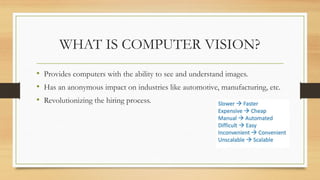
• Provides computers with the ability to see and understand images.
• Has an anonymous impact on industries like automotive, manufacturing, etc.
• Revolutionizing the hiring process.
APPLICATIONS
• Sifting videos
• Detection of metal and other structures in electric towers(divide into the
grid)
• Rust detection
• Rusted areas of the bridge
• Damage detection
RESEARCH IN COMPUTER VISION
• Detection of objects
• Detecting objects in self-driving cars
• Image-to-image translation(winter to summer)/(zebra to horse)
• Dance pose detection
WEEK 2
What is a digital image?
• A digital image can be interpreted as a rectangular array of a number
• The image is comprised of rectangular blocks called pixels
• Pixels can be represented as numbers called intensity values
• PIL import image module
• Show-plot image or matplotlib.imshow
• Attribute size is the no of pixels that make height and width
• Attribute mode color space
Manipulating Images
• Id function is used to find the object memory address
• Flipping images changes the images orientation
• Changing the index value of the image  flip the image
• PIL  images are flipped by using (flip, mirror, and transpose)
• Openvc  images are flipped by using (flip , rotate)
• Cropping is cutting out the part of image and throwing out the rest
• PIL  Imagedraw function to draw PIL image object
• ImageFont module for fonts
Pixels Transformations
• A histogram counts the no of occurrences of a pixel
• It understands and manipulates images
• Intensity transformation changes a image one pixel at a time
• S=2r+1
• Alpha-contrast control
• Beta-brightness control
• convertscaleAbs is used instead of array operations after applying transformations
• Histogram equalization—an algorithm that uses image histogram to adjust contrast
Pixels Transformations
• Func (equalizeHist)---improves contrast
Spatial operation in image processing
• Convolution or linear filtering is a standard way to Filter an image the filter is
called the kernel
• Z=wx(x is input image,w = kernel filter)
IMAGE CLASSIFICATION
• Image classification is the process of taking an image or picture and getting a
computer to automatically classify it, or try to provide the probability of the class
of the image.
• A large portion of data is used for training and a smaller for testing
• K nearest neighbour (knn) is slow.
• The use of all the samples in the dataset is called an epoch
• When we use all samples it is called batch gradient descent where one iteration
equals one epoch
Methods of object detection
• Sliding windows detection-----we start from one region and classify that
sub-image---we then shift the window and classify the next sub-image—
repeat
• Bounding boxes----- rectangular box
• An adaboost classifier is used to reduce the no. of features
• Strong classifier is the combination of weak classifiers

COMPUTER VISION presentation in ppt.pptx

  • 1.
  • 2.
  • 3.
    WHAT IS COMPUTERVISION? • Provides computers with the ability to see and understand images. • Has an anonymous impact on industries like automotive, manufacturing, etc. • Revolutionizing the hiring process.
  • 4.
    APPLICATIONS • Sifting videos •Detection of metal and other structures in electric towers(divide into the grid) • Rust detection • Rusted areas of the bridge • Damage detection
  • 5.
    RESEARCH IN COMPUTERVISION • Detection of objects • Detecting objects in self-driving cars • Image-to-image translation(winter to summer)/(zebra to horse) • Dance pose detection
  • 6.
  • 7.
    What is adigital image? • A digital image can be interpreted as a rectangular array of a number • The image is comprised of rectangular blocks called pixels • Pixels can be represented as numbers called intensity values • PIL import image module • Show-plot image or matplotlib.imshow • Attribute size is the no of pixels that make height and width • Attribute mode color space
  • 8.
    Manipulating Images • Idfunction is used to find the object memory address • Flipping images changes the images orientation • Changing the index value of the image  flip the image • PIL  images are flipped by using (flip, mirror, and transpose) • Openvc  images are flipped by using (flip , rotate) • Cropping is cutting out the part of image and throwing out the rest • PIL  Imagedraw function to draw PIL image object • ImageFont module for fonts
  • 9.
    Pixels Transformations • Ahistogram counts the no of occurrences of a pixel • It understands and manipulates images • Intensity transformation changes a image one pixel at a time • S=2r+1 • Alpha-contrast control • Beta-brightness control • convertscaleAbs is used instead of array operations after applying transformations • Histogram equalization—an algorithm that uses image histogram to adjust contrast
  • 10.
    Pixels Transformations • Func(equalizeHist)---improves contrast
  • 11.
    Spatial operation inimage processing • Convolution or linear filtering is a standard way to Filter an image the filter is called the kernel • Z=wx(x is input image,w = kernel filter)
  • 12.
    IMAGE CLASSIFICATION • Imageclassification is the process of taking an image or picture and getting a computer to automatically classify it, or try to provide the probability of the class of the image. • A large portion of data is used for training and a smaller for testing • K nearest neighbour (knn) is slow. • The use of all the samples in the dataset is called an epoch • When we use all samples it is called batch gradient descent where one iteration equals one epoch
  • 13.
    Methods of objectdetection • Sliding windows detection-----we start from one region and classify that sub-image---we then shift the window and classify the next sub-image— repeat • Bounding boxes----- rectangular box • An adaboost classifier is used to reduce the no. of features • Strong classifier is the combination of weak classifiers