team : Slower
SARFUDDINSIAM (251-15-228)
ATIK SHAHORIAR (251-15-353)
MD.RAFID JAKI (251-15-832)
SHAHRIAR KABIR (251-15-841)
MD. ABDULLAH (251-15-829)
3.
Introduction to Computer
Organization
Definition:Computer organization
refers to the structure and functioning
of a computer’s hardware
components.
Determines how different parts of a
computer interact to execute
instructions efficiently.
SIAM-228
4.
Basic Components ofa
Computer
Input Unit
Central Processing Unit (CPU)
Memory Unit
Output Unit
Storage Unit
SIAM-228
5.
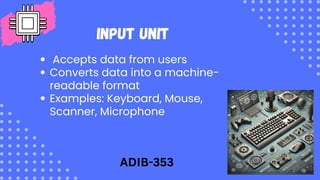
Input Unit
Accepts datafrom users
Converts data into a machine-
readable format
Examples: Keyboard, Mouse,
Scanner, Microphone
ADIB-353
6.
Storage Unit
Primary Storage:Directly accessed by CPU
(RAM, ROM).
Secondary Storage: Long-term data storage
(HDD, SSD, USB drives).
Tertiary Storage: Archival storage (Cloud,
Magnetic tapes).
ADIB-353
7.
Central Processing Unit
(CPU)
ArithmeticLogic Unit (ALU):
Performs calculations and logical
operations.
Control Unit (CU): Directs processor
operations.
Registers: Temporary storage for
quick data access.
RAFID-832
8.
Memory Unit
Primary Memory(RAM, ROM): Fast,
volatile storage.
Secondary Memory (HDD, SSD): Non-
volatile long-term storage.
Cache Memory: Faster access memory
to support CPU.
RAFID-832
9.
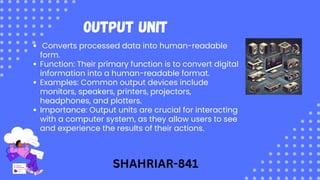
Output Unit
Converts processeddata into human-readable
form.
Function: Their primary function is to convert digital
information into a human-readable format.
Examples: Common output devices include
monitors, speakers, printers, projectors,
headphones, and plotters.
Importance: Output units are crucial for interacting
with a computer system, as they allow users to see
and experience the results of their actions.
SHAHRIAR-841
10.
System Bus &Communication
Data Bus: Transfers actual
data.
Address Bus: Carries memory
addresses.
Control Bus: Sends control
signals for coordination.
ABDULLAH-832
11.
Recap of computercomponents and their
functions.
Importance of understanding computer
organization.
Future advancements in computer architecture.
Summary & Conclusion
ABDULLAH-832




![Computer fundamental basic comuter organization [www.studysharebd.com]](https://cdn.slidesharecdn.com/ss_thumbnails/computerfundamentalbasiccomuterorganizationwww-200124111133-thumbnail.jpg?width=640&height=640&fit=bounds)


