COMPUTER
PROGRAMMING 2
CC103
Course Credit: 3 Units | Pre – Requisite(s): CC102
Lecture Units: 2 | Laboratory Units: 1
INSTRUCTOR:
MARK JOHN P. LADO
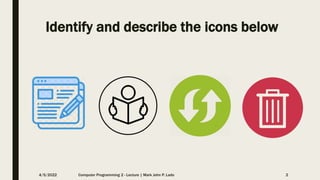
Identify and describe the icons below
4/5/2022 Computer Programming 2 - Lecture | Mark John P. Lado 2
CREATE
4/5/2022 Computer Programming 2 - Lecture | Mark John P. Lado 3
READ
4/5/2022 Computer Programming 2 - Lecture | Mark John P. Lado 4
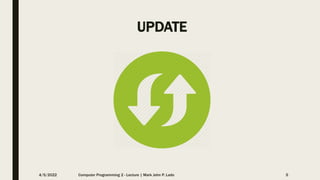
UPDATE
4/5/2022 Computer Programming 2 - Lecture | Mark John P. Lado 5
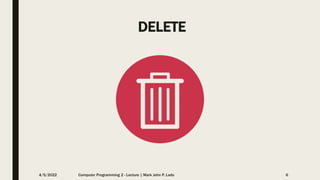
DELETE
4/5/2022 Computer Programming 2 - Lecture | Mark John P. Lado 6
Review of the previous topic
4/5/2022 Computer Programming 2 - Lecture | Mark John P. Lado 7
4/5/2022 Computer Programming 2 - Lecture | Mark John P. Lado 8
What is the full form of CRUD?
4/5/2022 Computer Programming 2 - Lecture | Mark John P. Lado 9
Objectives
Through a lecture-discussion, the students can:
1. describe what is a CRUD;
2. relate a TPS’s major operations;
3. assess the importance of CRUD in each TPS; and
4. explain how to use CRUD;
4/5/2022 Computer Programming 2 - Lecture | Mark John P. Lado 10
What is CRUD?
■ CRUD is an acronym that comes from
the world of computer programming
and refers to the four functions
that are considered necessary to
implement a persistent storage
application: create, read, update
and delete.
4/5/2022 Computer Programming 2 - Lecture | Mark John P. Lado 11
Explaining CRUD Operations
■ Organizations that keep track of customer
data, accounts, payment information,
health data, and other records require
data storage hardware and applications
that provide persistent storage. This data
is typically organized into a database,
which is simply an organized collection of
data that may be viewed electronically.
4/5/2022 Computer Programming 2 - Lecture | Mark John P. Lado 12
CRUD Databases and the Applications to
Manage Them
■ The CRUD acronym identifies all of
the major functions that are inherent
to relational databases and the
applications used to manage them,
which include Oracle Database,
Microsoft SQL Server, MySQL, SQLite
and others.
4/5/2022 Computer Programming 2 - Lecture | Mark John P. Lado 13
The four CRUD functions can be called by users
to perform different types of operations on
selected data within the database. This could
be accomplished using code or through a
graphical user interface.
4/5/2022 Computer Programming 2 - Lecture | Mark John P. Lado 14
The create function allows users to create a
new record in the database. In the SQL
relational database application, the Create
function is called INSERT. In Oracle HCM
Cloud, it is called create. Remember that a
record is a row and that columns are termed
attributes. A user can create a new row and
populate it with data that corresponds to
each attribute, but only an administrator
might be able to add new attributes to the
table itself.
CREATE
4/5/2022 Computer Programming 2 - Lecture | Mark John P. Lado 15
The read function is similar to a
search function. It allows users
to search and retrieve specific
records in the table and read
their values. Users may be able to
find desired records using
keywords, or by filtering the data
based on customized criteria.
READ
4/5/2022 Computer Programming 2 - Lecture | Mark John P. Lado 16
The update function is used to
modify existing records that
exist in the database. To
fully change a record, users
may have to modify information
in multiple fields.
UPDATE
4/5/2022 Computer Programming 2 - Lecture | Mark John P. Lado 17
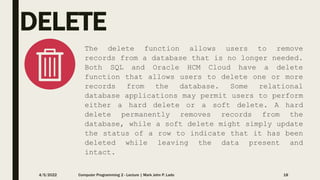
The delete function allows users to remove
records from a database that is no longer needed.
Both SQL and Oracle HCM Cloud have a delete
function that allows users to delete one or more
records from the database. Some relational
database applications may permit users to perform
either a hard delete or a soft delete. A hard
delete permanently removes records from the
database, while a soft delete might simply update
the status of a row to indicate that it has been
deleted while leaving the data present and
intact.
DELETE
4/5/2022 Computer Programming 2 - Lecture | Mark John P. Lado 18
CREATE
4/5/2022 Computer Programming 2 - Lecture | Mark John P. Lado 19
READ
4/5/2022 Computer Programming 2 - Lecture | Mark John P. Lado 20
UPDATE
4/5/2022 Computer Programming 2 - Lecture | Mark John P. Lado 21
DELETE
4/5/2022 Computer Programming 2 - Lecture | Mark John P. Lado 22
4/5/2022 Computer Programming 2 - Lecture | Mark John P. Lado 23
1. What is the full form of CRUD?
2. What are the TPS’s major operations?
3. Explain how to use CRUD?
4/5/2022 Computer Programming 2 - Lecture | Mark John P. Lado 24
Assignment
In a ½ crosswise yellow pad paper, answer the following questions and
submit them by the next meeting.
1. What exactly is a database?
2. Explore the evolution of databases.
3. List the various types of databases.
4/5/2022 Computer Programming 2 - Lecture | Mark John P. Lado 25
END
4/5/2022 Computer Programming 2 - Lecture | Mark John P. Lado 26

What is CRUD in TPS?

  • 1.
    COMPUTER PROGRAMMING 2 CC103 Course Credit:3 Units | Pre – Requisite(s): CC102 Lecture Units: 2 | Laboratory Units: 1 INSTRUCTOR: MARK JOHN P. LADO
  • 2.
    Identify and describethe icons below 4/5/2022 Computer Programming 2 - Lecture | Mark John P. Lado 2
  • 3.
    CREATE 4/5/2022 Computer Programming2 - Lecture | Mark John P. Lado 3
  • 4.
    READ 4/5/2022 Computer Programming2 - Lecture | Mark John P. Lado 4
  • 5.
    UPDATE 4/5/2022 Computer Programming2 - Lecture | Mark John P. Lado 5
  • 6.
    DELETE 4/5/2022 Computer Programming2 - Lecture | Mark John P. Lado 6
  • 7.
    Review of theprevious topic 4/5/2022 Computer Programming 2 - Lecture | Mark John P. Lado 7
  • 8.
    4/5/2022 Computer Programming2 - Lecture | Mark John P. Lado 8
  • 9.
    What is thefull form of CRUD? 4/5/2022 Computer Programming 2 - Lecture | Mark John P. Lado 9
  • 10.
    Objectives Through a lecture-discussion,the students can: 1. describe what is a CRUD; 2. relate a TPS’s major operations; 3. assess the importance of CRUD in each TPS; and 4. explain how to use CRUD; 4/5/2022 Computer Programming 2 - Lecture | Mark John P. Lado 10
  • 11.
    What is CRUD? ■CRUD is an acronym that comes from the world of computer programming and refers to the four functions that are considered necessary to implement a persistent storage application: create, read, update and delete. 4/5/2022 Computer Programming 2 - Lecture | Mark John P. Lado 11
  • 12.
    Explaining CRUD Operations ■Organizations that keep track of customer data, accounts, payment information, health data, and other records require data storage hardware and applications that provide persistent storage. This data is typically organized into a database, which is simply an organized collection of data that may be viewed electronically. 4/5/2022 Computer Programming 2 - Lecture | Mark John P. Lado 12
  • 13.
    CRUD Databases andthe Applications to Manage Them ■ The CRUD acronym identifies all of the major functions that are inherent to relational databases and the applications used to manage them, which include Oracle Database, Microsoft SQL Server, MySQL, SQLite and others. 4/5/2022 Computer Programming 2 - Lecture | Mark John P. Lado 13
  • 14.
    The four CRUDfunctions can be called by users to perform different types of operations on selected data within the database. This could be accomplished using code or through a graphical user interface. 4/5/2022 Computer Programming 2 - Lecture | Mark John P. Lado 14
  • 15.
    The create functionallows users to create a new record in the database. In the SQL relational database application, the Create function is called INSERT. In Oracle HCM Cloud, it is called create. Remember that a record is a row and that columns are termed attributes. A user can create a new row and populate it with data that corresponds to each attribute, but only an administrator might be able to add new attributes to the table itself. CREATE 4/5/2022 Computer Programming 2 - Lecture | Mark John P. Lado 15
  • 16.
    The read functionis similar to a search function. It allows users to search and retrieve specific records in the table and read their values. Users may be able to find desired records using keywords, or by filtering the data based on customized criteria. READ 4/5/2022 Computer Programming 2 - Lecture | Mark John P. Lado 16
  • 17.
    The update functionis used to modify existing records that exist in the database. To fully change a record, users may have to modify information in multiple fields. UPDATE 4/5/2022 Computer Programming 2 - Lecture | Mark John P. Lado 17
  • 18.
    The delete functionallows users to remove records from a database that is no longer needed. Both SQL and Oracle HCM Cloud have a delete function that allows users to delete one or more records from the database. Some relational database applications may permit users to perform either a hard delete or a soft delete. A hard delete permanently removes records from the database, while a soft delete might simply update the status of a row to indicate that it has been deleted while leaving the data present and intact. DELETE 4/5/2022 Computer Programming 2 - Lecture | Mark John P. Lado 18
  • 19.
    CREATE 4/5/2022 Computer Programming2 - Lecture | Mark John P. Lado 19
  • 20.
    READ 4/5/2022 Computer Programming2 - Lecture | Mark John P. Lado 20
  • 21.
    UPDATE 4/5/2022 Computer Programming2 - Lecture | Mark John P. Lado 21
  • 22.
    DELETE 4/5/2022 Computer Programming2 - Lecture | Mark John P. Lado 22
  • 23.
    4/5/2022 Computer Programming2 - Lecture | Mark John P. Lado 23
  • 24.
    1. What isthe full form of CRUD? 2. What are the TPS’s major operations? 3. Explain how to use CRUD? 4/5/2022 Computer Programming 2 - Lecture | Mark John P. Lado 24
  • 25.
    Assignment In a ½crosswise yellow pad paper, answer the following questions and submit them by the next meeting. 1. What exactly is a database? 2. Explore the evolution of databases. 3. List the various types of databases. 4/5/2022 Computer Programming 2 - Lecture | Mark John P. Lado 25
  • 26.
    END 4/5/2022 Computer Programming2 - Lecture | Mark John P. Lado 26