Computer
Networking
Group member
•Sabin Pyakurel
•Milan Raut
•Radheshyam Shah
•Niraj magar
Table of
contents
• Computer network
• Computer network and communication
• Types of network
• Local Area Network
• Wide Area Network
• Metropolitan Area Network
• Comparison of LAN, WAN, MAN
• Types of topology
• Bus Topology
• Star Topology
• Ring Topology
• Conclusion
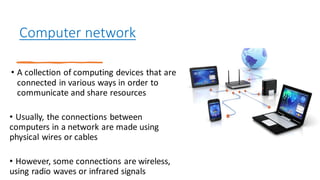
Computer network
• A collection of computing devices that are
connected in various ways in order to
communicate and share resources
• Usually, the connections between
computers in a network are made using
physical wires or cables
• However, some connections are wireless,
using radio waves or infrared signals
Computer network and communication
We transmitt information or data by using two
types of signals, namely analog and digital.
Computers communicate with digital signals.
The older forms of communications technology,
such as telephones and radio, use analog signals.
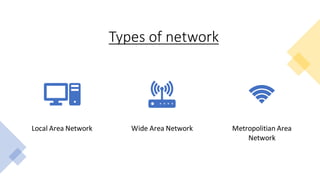
Types of network
Local Area Network Wide Area Network Metropolitian Area
Network
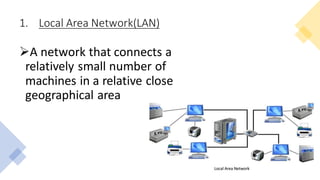
1. Local Area Network(LAN)
➢A network that connects a
relatively small number of
machines in a relative close
geographical area
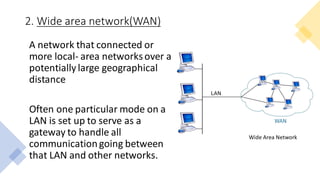
2. Wide area network(WAN)
A network that connected or
more local- area networksover a
potentially large geographical
distance
Often one particular mode on a
LAN is set up to serve as a
gateway to handle all
communicationgoing between
that LAN and other networks.
Wide Area Network
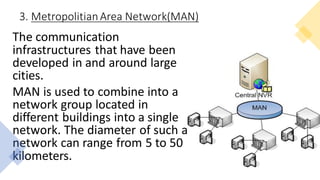
3. MetropolitianArea Network(MAN)
The communication
infrastructures that have been
developed in and around large
cities.
MAN is used to combine into a
network group located in
different buildings into a single
network. The diameter of such a
network can range from 5 to 50
kilometers.
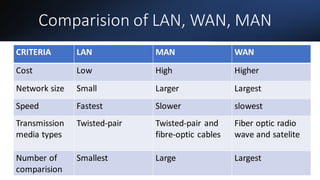
Comparision of LAN, WAN, MAN
CRITERIA LAN MAN WAN
Cost Low High Higher
Network size Small Larger Largest
Speed Fastest Slower slowest
Transmission
media types
Twisted-pair Twisted-pair and
fibre-optic cables
Fiber optic radio
wave and satelite
Number of
comparision
Smallest Large Largest
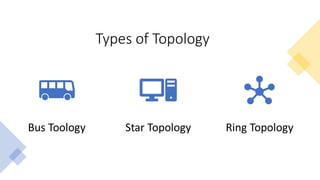
Types of Topology
Bus Toology Star Topology Ring Topology
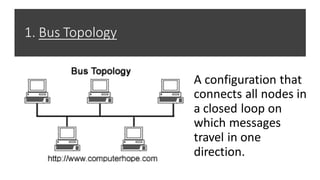
1. Bus Topology
A configuration that
connects all nodes in
a closed loop on
which messages
travel in one
direction.
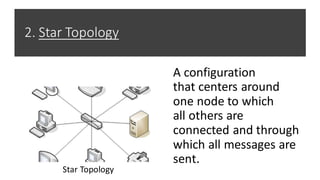
2. Star Topology
A configuration
that centers around
one node to which
all others are
connected and through
which all messages are
sent.
Star Topology
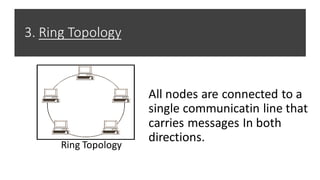
3. Ring Topology
All nodes are connected to a
single communicatin line that
carries messages In both
directions.
Ring Topology
Conclusion:-
Computer Networks basically used in sharing the informationor
data.
It also used to inter, intra and extra connect with each other
whatever the location is such as building, city, nation or country.
Computer network works on basis of topologies and technical
communicationbarriers which flows the effective information
for best visible growth. It also includes new developments
according today’s era.
Internet, server etc are the example of computer networks.
Thank you

Computer Networking

  • 1.
    Computer Networking Group member •Sabin Pyakurel •MilanRaut •Radheshyam Shah •Niraj magar
  • 2.
    Table of contents • Computernetwork • Computer network and communication • Types of network • Local Area Network • Wide Area Network • Metropolitan Area Network • Comparison of LAN, WAN, MAN • Types of topology • Bus Topology • Star Topology • Ring Topology • Conclusion
  • 3.
    Computer network • Acollection of computing devices that are connected in various ways in order to communicate and share resources • Usually, the connections between computers in a network are made using physical wires or cables • However, some connections are wireless, using radio waves or infrared signals
  • 4.
    Computer network andcommunication We transmitt information or data by using two types of signals, namely analog and digital. Computers communicate with digital signals. The older forms of communications technology, such as telephones and radio, use analog signals.
  • 5.
    Types of network LocalArea Network Wide Area Network Metropolitian Area Network
  • 6.
    1. Local AreaNetwork(LAN) ➢A network that connects a relatively small number of machines in a relative close geographical area
  • 7.
    2. Wide areanetwork(WAN) A network that connected or more local- area networksover a potentially large geographical distance Often one particular mode on a LAN is set up to serve as a gateway to handle all communicationgoing between that LAN and other networks. Wide Area Network
  • 8.
    3. MetropolitianArea Network(MAN) Thecommunication infrastructures that have been developed in and around large cities. MAN is used to combine into a network group located in different buildings into a single network. The diameter of such a network can range from 5 to 50 kilometers.
  • 9.
    Comparision of LAN,WAN, MAN CRITERIA LAN MAN WAN Cost Low High Higher Network size Small Larger Largest Speed Fastest Slower slowest Transmission media types Twisted-pair Twisted-pair and fibre-optic cables Fiber optic radio wave and satelite Number of comparision Smallest Large Largest
  • 10.
    Types of Topology BusToology Star Topology Ring Topology
  • 11.
    1. Bus Topology Aconfiguration that connects all nodes in a closed loop on which messages travel in one direction.
  • 12.
    2. Star Topology Aconfiguration that centers around one node to which all others are connected and through which all messages are sent. Star Topology
  • 13.
    3. Ring Topology Allnodes are connected to a single communicatin line that carries messages In both directions. Ring Topology
  • 14.
    Conclusion:- Computer Networks basicallyused in sharing the informationor data. It also used to inter, intra and extra connect with each other whatever the location is such as building, city, nation or country. Computer network works on basis of topologies and technical communicationbarriers which flows the effective information for best visible growth. It also includes new developments according today’s era. Internet, server etc are the example of computer networks.
  • 15.