Computer Based Assessment
By Salah
Chapter 1 : Introduction
1.1 Background of Study
• CBA is a test conducted using Personal Computer (PC) In which responses
are electronically recorded and assessed.
• CBA system supports the entire cycle of the evaluation process:
preparation, distribution, execution, submission, evaluation, delivery of
results, and filing.
• Computer Based Assessment (CBA) System is very useful for Educational
Institute to prepare an exam, save the time that will take to check the
paper and prepare mark sheets.
• Furthermore, Computer Based Assessment allows more innovative and
authentic assessments due to more advanced technological capacities.
1.2 Statement of Problem
• The challenges faced with TVET College or Training organizations is
their students adapted with Paper-Based Assessment and their
trainees subjected to a Computer Based Examination platform; in
which the performances of the trainees are reduced die to their
confusion with this new technology.
• The most adapted Paper Based Assessment is resource (materials,
energy, time,and human power) wastage.
1.3 Objectives of the study
• The aim of this project is to design and implement a computer based assessment system for Training
organizations with the following features.
• Provide user friendly
• Improve credibility of the exam by randomization of the questions.
• Provide real time processing of of results.
• Create strong and secret databases that allow for any connection in a secret way.
• Allow each department to create more than one exam with different way to create variant questions.
1.4 Scope of the Study
•The Study covered the design and implementation
of CBA with flexible features in our country
educational institutions or training organizations.
•System handles all the operations:
• Generate reports that include (name, mark, time spent
to solve the exam, and list of students by rank).
• Allows the students to see or display his/her answers
after the exam finished.
1.5 Limitation of system
• Limitation of the system to be designed are as follows:
• This system is designed for educational institutions (like school, universities,
college or training centers).
• Type of supported questions are multiple choices, true and false, free answer
and matching.
• The type of questions like working out, short answes and drawings are not
supported.
1.6 Significance of the study
• Reduce costs for many elements of testing life cycle.
• Provide more efficient system; reduce need of man power, reduce
lose of paper, reduce time and energy.
• Increased delivery, administration, and grading efficiency.
• Consistency and reliability.
• Faster decision making as the result of immediate grading and
reporting.
• Minimize Chance cheating on exam.
• Fewer errors caused by testing process.
Chapter 2 : Literature Review
2.1 Theoretical Background
• The technologies used in this system are web technologies:
• HTML
• CSS
• PHP
• JAVA SCRIPTS
• MYSQL
2.2 Review of Related Literatures
• Web-based Examination System is an effective solution for mass education evaluation (Zhenming et al,
2003). They developed a novel online examination system based on a Browser/Server framework which
carries out the examination and auto-grading for objective questions and operating questions, such as
programming, operating Microsoft Windows, editing Microsoft Word, Excel and PowerPoint, etc.
• It has been successfully applied to the distance evaluation of basic operating skills of computer
science, such as the course of computer skills in Universities and the nationwide examination for the high
school graduates in Zhejiang Province, China.
Chapter 3: System Analysis and Design
3.1 Introduction
• System Analysis is understanding of old system and determine how
Computer and software can be used to make operations effective.
• System Design is the process of preparing a prototype of new system
or one to replace existing system.
• System Analysis and Design relates to shaping organization improving
performance and achieving objectives for profitability and growth.
3.2 Methodology
• This study relied on information obtained from secondary sources especially online materials, documents of
relevant agencies. From these documents required information was obtained on the performance computer
based test in CCNA Certifications.
• The Object-Oriented Analysis and Design (OOAD) methodology was used during the software development.
• Unified Modelling Language (UML) notation is the design tool used for modelling in this research.UML used
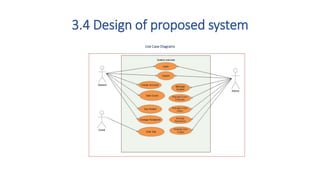
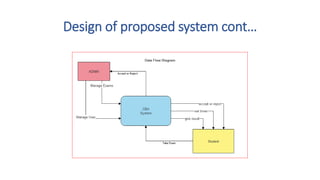
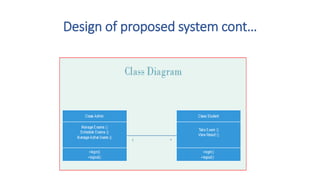
in the research includes: Use Case diagrams, Data Flow diagrams and Class diagrams.
3.3 Analysis of Proposed System
• There will be a registration page where administrator/instructor would be able to register students.
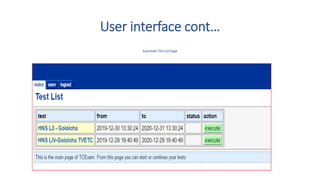
• Once a student has login into the system, he/she would see list of availabletests.
• Before a student attempts to take an assessment, aOne-Time Passcode would be entered which is issued
by the instructor before the commencement of an exams.
• Eachassessment may consists of many questions containing many options , in which the system would
randomized the questions for differentstudents.
• At the end of the assessment, a student would be able to see his/her scores (results).
Use Case Diagrams
3.4 Design of proposed system
Design of proposed system cont…
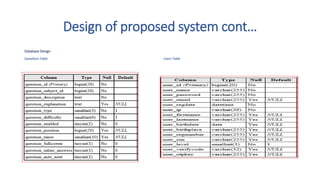
Database Design
Questions Table Users Table
Design of proposed system cont…
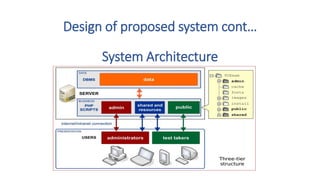
System Architecture
Design of proposed system cont…
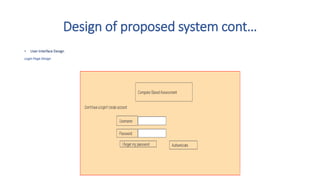
• User Interface Design
Login Page Design
Chapter 4:System Implementation and Testing
• Introduction
• Hardware and Software Acquisition
• Hardware tools
• Server
• Client computer
• Network cable / connection
• Printer
• Software tools
• Server Database: -MySQL
• Wamp Server: Apache 2.4.35 Port 80- PHP 7.2.10
• Editor: - Notepad ++
• Web browser: - Mozilla Firefox
• A Windows XP/ Vista/Window 7 / 8/10 Operating System.
System implementation and Testing cont…
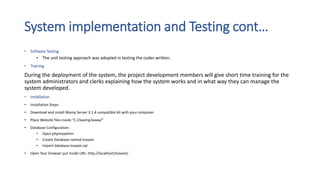
• Software Testing
• The unit testing approach was adopted in testing the codes written.
• Training
During the deployment of the system, the project development members will give short time training for the
system administrators and clerks explaining how the system works and in what way they can manage the
system developed.
• Installation
• Installation Steps:
• Download and install Wamp Server 3.1.4 compatible bit with your computer
• Place Website files inside “C://wamp/www/”
• Database Configuration:
• Open phpmyadmin
• Create Database named tcexam.
• Import database tcexam.sql
• Open Your browser put inside URL: http://localhost/tcexam/
System implementation and Testing cont…
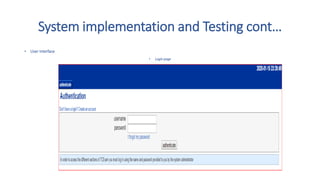
• User Interface
• Login page
User interface cont…
Examinee Test List Page
Computer Based Assessment.pptx

Computer Based Assessment.pptx

  • 1.
  • 3.
    Chapter 1 :Introduction 1.1 Background of Study • CBA is a test conducted using Personal Computer (PC) In which responses are electronically recorded and assessed. • CBA system supports the entire cycle of the evaluation process: preparation, distribution, execution, submission, evaluation, delivery of results, and filing. • Computer Based Assessment (CBA) System is very useful for Educational Institute to prepare an exam, save the time that will take to check the paper and prepare mark sheets. • Furthermore, Computer Based Assessment allows more innovative and authentic assessments due to more advanced technological capacities.
  • 4.
    1.2 Statement ofProblem • The challenges faced with TVET College or Training organizations is their students adapted with Paper-Based Assessment and their trainees subjected to a Computer Based Examination platform; in which the performances of the trainees are reduced die to their confusion with this new technology. • The most adapted Paper Based Assessment is resource (materials, energy, time,and human power) wastage.
  • 5.
    1.3 Objectives ofthe study • The aim of this project is to design and implement a computer based assessment system for Training organizations with the following features. • Provide user friendly • Improve credibility of the exam by randomization of the questions. • Provide real time processing of of results. • Create strong and secret databases that allow for any connection in a secret way. • Allow each department to create more than one exam with different way to create variant questions.
  • 6.
    1.4 Scope ofthe Study •The Study covered the design and implementation of CBA with flexible features in our country educational institutions or training organizations. •System handles all the operations: • Generate reports that include (name, mark, time spent to solve the exam, and list of students by rank). • Allows the students to see or display his/her answers after the exam finished.
  • 7.
    1.5 Limitation ofsystem • Limitation of the system to be designed are as follows: • This system is designed for educational institutions (like school, universities, college or training centers). • Type of supported questions are multiple choices, true and false, free answer and matching. • The type of questions like working out, short answes and drawings are not supported.
  • 8.
    1.6 Significance ofthe study • Reduce costs for many elements of testing life cycle. • Provide more efficient system; reduce need of man power, reduce lose of paper, reduce time and energy. • Increased delivery, administration, and grading efficiency. • Consistency and reliability. • Faster decision making as the result of immediate grading and reporting. • Minimize Chance cheating on exam. • Fewer errors caused by testing process.
  • 9.
    Chapter 2 :Literature Review 2.1 Theoretical Background • The technologies used in this system are web technologies: • HTML • CSS • PHP • JAVA SCRIPTS • MYSQL
  • 10.
    2.2 Review ofRelated Literatures • Web-based Examination System is an effective solution for mass education evaluation (Zhenming et al, 2003). They developed a novel online examination system based on a Browser/Server framework which carries out the examination and auto-grading for objective questions and operating questions, such as programming, operating Microsoft Windows, editing Microsoft Word, Excel and PowerPoint, etc. • It has been successfully applied to the distance evaluation of basic operating skills of computer science, such as the course of computer skills in Universities and the nationwide examination for the high school graduates in Zhejiang Province, China.
  • 11.
    Chapter 3: SystemAnalysis and Design 3.1 Introduction • System Analysis is understanding of old system and determine how Computer and software can be used to make operations effective. • System Design is the process of preparing a prototype of new system or one to replace existing system. • System Analysis and Design relates to shaping organization improving performance and achieving objectives for profitability and growth.
  • 12.
    3.2 Methodology • Thisstudy relied on information obtained from secondary sources especially online materials, documents of relevant agencies. From these documents required information was obtained on the performance computer based test in CCNA Certifications. • The Object-Oriented Analysis and Design (OOAD) methodology was used during the software development. • Unified Modelling Language (UML) notation is the design tool used for modelling in this research.UML used in the research includes: Use Case diagrams, Data Flow diagrams and Class diagrams.
  • 13.
    3.3 Analysis ofProposed System • There will be a registration page where administrator/instructor would be able to register students. • Once a student has login into the system, he/she would see list of availabletests. • Before a student attempts to take an assessment, aOne-Time Passcode would be entered which is issued by the instructor before the commencement of an exams. • Eachassessment may consists of many questions containing many options , in which the system would randomized the questions for differentstudents. • At the end of the assessment, a student would be able to see his/her scores (results).
  • 14.
    Use Case Diagrams 3.4Design of proposed system
  • 15.
    Design of proposedsystem cont…
  • 16.
    Design of proposedsystem cont…
  • 17.
    Design of proposedsystem cont… Database Design Questions Table Users Table
  • 18.
    Design of proposedsystem cont… System Architecture
  • 19.
    Design of proposedsystem cont… • User Interface Design Login Page Design
  • 20.
    Chapter 4:System Implementationand Testing • Introduction • Hardware and Software Acquisition • Hardware tools • Server • Client computer • Network cable / connection • Printer • Software tools • Server Database: -MySQL • Wamp Server: Apache 2.4.35 Port 80- PHP 7.2.10 • Editor: - Notepad ++ • Web browser: - Mozilla Firefox • A Windows XP/ Vista/Window 7 / 8/10 Operating System.
  • 21.
    System implementation andTesting cont… • Software Testing • The unit testing approach was adopted in testing the codes written. • Training During the deployment of the system, the project development members will give short time training for the system administrators and clerks explaining how the system works and in what way they can manage the system developed. • Installation • Installation Steps: • Download and install Wamp Server 3.1.4 compatible bit with your computer • Place Website files inside “C://wamp/www/” • Database Configuration: • Open phpmyadmin • Create Database named tcexam. • Import database tcexam.sql • Open Your browser put inside URL: http://localhost/tcexam/
  • 22.
    System implementation andTesting cont… • User Interface • Login page
  • 23.