Computer Applications
Lecture # 1
Today Plan
• What is Computer?
• Advantages & Dis-advantages of computer
• History of Computer
• Uses of Computer
What is Computer?
• Computer is an electronic device that is
designed to work with Information. The
term computer is derived from the
Latin term ‘computare’, this means
to calculate or programmable
machine. Computer can not do
anything without a Program.
What does computer Means
A computer is a machine or device that performs processes, calculations and
operations based on instructions provided by a software or hardware program. It has
the ability to accept data (input), process it, and then produce outputs.
Computers can also store data for later uses in appropriate storage devices, and
retrieve whenever it is necessary.
Modern computers are electronic devices used for a variety of purposes ranging from
browsing the web, writing documents, editing videos, creating applications, playing
video games, etc.
They are designed to execute applications and provide a variety of solutions by
combining integrated hardware and software components.
Advantages of Computers
 Reduction in Paper Work
 Reduction in Cost
 High Speed
 Accuracy
 Stores huge amount of data
 Reliability
 Internet
 Online education/ Trading/ Jobs
 Research
 Free from tiredness and lack of concentration
 Health Issues
 Virus and hacking attacks
 Computer can not take their own decision
 Negative effect on Environment
 Crashed networks
 Computer can not work on itself
 Spread of violence, hatred
 Online Cyber Crimes
 Data and Information violation
Dis-advantages of Computers
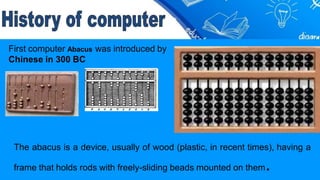
The abacus is a device, usually of wood (plastic, in recent times), having a
frame that holds rods with freely-sliding beads mounted on them.
First computer Abacus was introduced by
Chinese in 300 BC
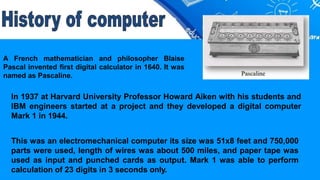
A French mathematician and philosopher Blaise
Pascal invented first digital calculator in 1640. It was
named as Pascaline.
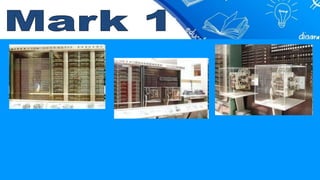
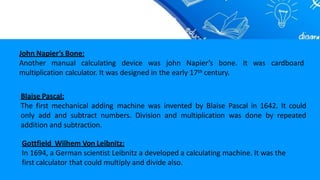
In 1937 at Harvard University Professor Howard Aiken with his students and
IBM engineers started at a project and they developed a digital computer
Mark 1 in 1944.
This was an electromechanical computer its size was 51x8 feet and 750,000
parts were used, length of wires was about 500 miles, and paper tape was
used as input and punched cards as output. Mark 1 was able to perform
calculation of 23 digits in 3 seconds only.
It was cardboard
John Napier’s Bone:
Another manual calculating device was john Napier’s bone.
multiplication calculator. It was designed in the early 17th century.
Blaise Pascal:
The first mechanical adding machine was invented by Blaise Pascal in 1642. It could
only add and subtract numbers. Division and multiplication was done by repeated
addition and subtraction.
Gottfield Wilhem Von Leibnitz:
In 1694, a German scientist Leibnitz a developed a calculating machine. It was the
first calculator that could multiply and divide also.
Charles Xavier:
A French scientist Charles Xavier developed a machine that could perform addition subtraction,
multiplication and division.
Punched Board:
A French engineer Joseph developed punchboard system for power looms. It was used to create specific weaving
pattern on cloths. Later on, the system was used in computing devices.
Charles Babbage:
In 1822, a mathematician Charles Babbage invented a “Difference Engine” for mathematical calculations. In 1842,
he developed Analytical Engine that was automatic. This engine could perform 60 additions per minute.
Herman Hollerith:
In 1889, Herman applied the idea of punchboards in computers. He used punch cards in computers for input and
output.
Computers play a role in every field of life. They are used
in homes, business, educational institutions, research
organizations, medical field, government offices,
entertainment, etc.
USES OF COMPUTER
Home
Computers are used at homes for several purposes like online bill payment, watching movies
or shows at home, home tutoring, social media access, playing games, internet access, etc.
They provide communication through electronic mail. They help to avail work from home
facility for corporate employees. Computers help the student community to avail online
educational support.
Medical Field
Computers are used in hospitals to maintain a database of patients’ history, diagnosis, X-rays,
live monitoring of patients, etc. Surgeons nowadays use robotic surgical devices to perform
delicate operations, and conduct surgeries remotely. Virtual reality technologies are also used
for training purposes. It also helps to monitor the fetus inside the mother’s womb.
Entertainment
Computers help to watch movies online, play games online; act as a virtual entertainer in
playing games, listening to music, etc. MIDI instruments greatly help people in the
entertainment industry in recording music with artificial instruments. Videos can be fed
from computers to full screen televisions. Photo editors are available with fabulous
features.
Industry
Computers are used to perform several tasks in industries like managing inventory,
designing purpose, creating virtual sample products, interior designing, video conferencing,
etc. Online marketing has seen a great revolution in its ability to sell various products to
inaccessible corners like interior or rural areas. Stock markets have seen phenomenal
participation from different levels of people through the use of computers.
Education
Computers are used in education sector through online classes, online examinations,
referring e-books, online tutoring, etc. They help in increased use of audio-visual aids in
the education field.
Government
In government sectors, computers are used in data processing, maintaining a database
of citizens and supporting a paperless environment. The country’s defense
organizations have greatly benefitted from computers in their use for missile
development, satellites, rocket launches, etc.

Computer Application Lecture 1

  • 1.
  • 2.
    Today Plan • Whatis Computer? • Advantages & Dis-advantages of computer • History of Computer • Uses of Computer
  • 3.
    What is Computer? •Computer is an electronic device that is designed to work with Information. The term computer is derived from the Latin term ‘computare’, this means to calculate or programmable machine. Computer can not do anything without a Program.
  • 4.
    What does computerMeans A computer is a machine or device that performs processes, calculations and operations based on instructions provided by a software or hardware program. It has the ability to accept data (input), process it, and then produce outputs. Computers can also store data for later uses in appropriate storage devices, and retrieve whenever it is necessary. Modern computers are electronic devices used for a variety of purposes ranging from browsing the web, writing documents, editing videos, creating applications, playing video games, etc. They are designed to execute applications and provide a variety of solutions by combining integrated hardware and software components.
  • 5.
    Advantages of Computers Reduction in Paper Work  Reduction in Cost  High Speed  Accuracy  Stores huge amount of data  Reliability  Internet  Online education/ Trading/ Jobs  Research  Free from tiredness and lack of concentration
  • 6.
     Health Issues Virus and hacking attacks  Computer can not take their own decision  Negative effect on Environment  Crashed networks  Computer can not work on itself  Spread of violence, hatred  Online Cyber Crimes  Data and Information violation Dis-advantages of Computers
  • 7.
    The abacus isa device, usually of wood (plastic, in recent times), having a frame that holds rods with freely-sliding beads mounted on them. First computer Abacus was introduced by Chinese in 300 BC
  • 8.
    A French mathematicianand philosopher Blaise Pascal invented first digital calculator in 1640. It was named as Pascaline. In 1937 at Harvard University Professor Howard Aiken with his students and IBM engineers started at a project and they developed a digital computer Mark 1 in 1944. This was an electromechanical computer its size was 51x8 feet and 750,000 parts were used, length of wires was about 500 miles, and paper tape was used as input and punched cards as output. Mark 1 was able to perform calculation of 23 digits in 3 seconds only.
  • 10.
    It was cardboard JohnNapier’s Bone: Another manual calculating device was john Napier’s bone. multiplication calculator. It was designed in the early 17th century. Blaise Pascal: The first mechanical adding machine was invented by Blaise Pascal in 1642. It could only add and subtract numbers. Division and multiplication was done by repeated addition and subtraction. Gottfield Wilhem Von Leibnitz: In 1694, a German scientist Leibnitz a developed a calculating machine. It was the first calculator that could multiply and divide also.
  • 11.
    Charles Xavier: A Frenchscientist Charles Xavier developed a machine that could perform addition subtraction, multiplication and division. Punched Board: A French engineer Joseph developed punchboard system for power looms. It was used to create specific weaving pattern on cloths. Later on, the system was used in computing devices. Charles Babbage: In 1822, a mathematician Charles Babbage invented a “Difference Engine” for mathematical calculations. In 1842, he developed Analytical Engine that was automatic. This engine could perform 60 additions per minute. Herman Hollerith: In 1889, Herman applied the idea of punchboards in computers. He used punch cards in computers for input and output.
  • 12.
    Computers play arole in every field of life. They are used in homes, business, educational institutions, research organizations, medical field, government offices, entertainment, etc. USES OF COMPUTER
  • 13.
    Home Computers are usedat homes for several purposes like online bill payment, watching movies or shows at home, home tutoring, social media access, playing games, internet access, etc. They provide communication through electronic mail. They help to avail work from home facility for corporate employees. Computers help the student community to avail online educational support. Medical Field Computers are used in hospitals to maintain a database of patients’ history, diagnosis, X-rays, live monitoring of patients, etc. Surgeons nowadays use robotic surgical devices to perform delicate operations, and conduct surgeries remotely. Virtual reality technologies are also used for training purposes. It also helps to monitor the fetus inside the mother’s womb.
  • 14.
    Entertainment Computers help towatch movies online, play games online; act as a virtual entertainer in playing games, listening to music, etc. MIDI instruments greatly help people in the entertainment industry in recording music with artificial instruments. Videos can be fed from computers to full screen televisions. Photo editors are available with fabulous features. Industry Computers are used to perform several tasks in industries like managing inventory, designing purpose, creating virtual sample products, interior designing, video conferencing, etc. Online marketing has seen a great revolution in its ability to sell various products to inaccessible corners like interior or rural areas. Stock markets have seen phenomenal participation from different levels of people through the use of computers.
  • 15.
    Education Computers are usedin education sector through online classes, online examinations, referring e-books, online tutoring, etc. They help in increased use of audio-visual aids in the education field. Government In government sectors, computers are used in data processing, maintaining a database of citizens and supporting a paperless environment. The country’s defense organizations have greatly benefitted from computers in their use for missile development, satellites, rocket launches, etc.