SSEEIISSMMIICC RREESSPPOONNSSEE OOFF AANN IINNSSTTRRUUMMEENNTTEEDD
BBUUIILLDDIINNGG IINNCCLLUUDDIINNGG SSOOIILL--SSTTRRUUCCTTUURREE
IINNTTEERRAACCTTIIOONN
PPhh..DD.. tthheessiiss
by
JJIITTEENNDDRRAA PPRRAATTAAPP SSIINNGGHH
Under the Supervision of
DDrr.. AAsshhookk KKuummaarr,,
AAssssoocciiaattee PPrrooffeessssoorr
DDrr.. PPaannkkaajj AAggaarrwwaall
AAssssiissttaanntt PPrrooffeessssoorr
DDrr.. SS..KK.. TThhaakkkkaarr
EExx.. PPrrooffeessssoorr
DDeeppaarrttmmeenntt ooff EEaarrtthhqquuaakkee EEnnggiinneeeerriinngg
IInnddiiaann IInnssttiittuuttee ooff TTeecchhnnoollooggyy RRoooorrkkeeee
RRoooorrkkeeee--224477666677 ((IINNDDIIAA))
AAuugguusstt 22000088
© INDIAN INSTITUTE OF TECHNOLOGY ROORKEE, ROORKEE, 2008
ALL RIGHTS RESERVED
INDIAN INSTITUTE OF TECHNOLOGY ROORKEE
ROORKEE
CANDIDATE’S DECLARATION
I hereby certify that the work which is being presented in the thesis entitled
SEISMIC RESPONSE OF AN INSTRUMENTED BUILDING INCLUDING SOIL-
STRUCTURE INTERACTION in partial fulfilment of the requirements for the award
of the Degree of Doctor of Philosophy and submitted in the Department of Earthquake
Engineering of the Indian Institute of Technology Roorkee, Roorkee is an authentic
record of my own work carried out during a period from January, 2003 to September,
2007 under the supervision of Dr. Ashok Kumar, Associate Professor, Dr. Pankaj
Agarwal, Assistant Professor and Dr. S.K. Thakkar, Ex. Professor, Department of
Earthquake Engineering, Indian Institute of Technology Roorkee, Roorkee.
The matter presented in this thesis has not been submitted by me for the award of
any other degree of this or any other Institute.
(JITENDRA PRATAP SINGH)
This is to certify that the above statement made by the candidate is correct to the
best of our knowledge.
Date:
August, 2008
(S.K.Thakkar)
Supervisor
(Pankaj Agarwal)
Supervisor
(Ashok kumar)
Supervisor
The Ph.D. Viva-Voce Examination of Mr. Jitendra Pratap Singh, Research
Scholar, has been held on………………………..
Signature of Supervisors Signature of External Examiner
i
ABSTRACT
In this work seismic response of the instrumented multi-storied reinforced
concrete building (G +9) has been studied using strong motion records of Bhuj
earthquake, 2001. The analysis includes determination of modal parameters, amplification
factor of accelerations at various floors; velocity time history, displacement time
histories; drift index ; transfer function / amplification spectra of acceleration time
histories between top floor and base of the building; Short Time Fourier Transform
(STFT) / window analysis to obtain variation of building rocking motion in two
horizontal directions over the whole duration of strong motion record and floor spectra of
instrumented floors. The Ambient Vibration Testing (AVT) has also been conducted to
measure the modal parameters of the building under ambient environmental forces. Using
velocity time histories obtained by AVT, modal parameters of first five modes are
obtained using FDD technique.
In order to study the effect of structural and non-structural members on the
seismic response of the building, a series of five three-dimensional finite element (FE)
models of the building have been created by considering the number of structural and
non-structural components consisting of the specific geometry, material properties and
section properties. The fixed base FE model consisting of columns, beams, floors slabs,
stair case and infill with modal parameters close to ambient vibration test is considered to
model foundation and layered soil below the building. Soil properties are determined at
different depths of soil by a combination of in-situ and laboratory tests of founded soil.
The shear wave velocity of founding soil at different depths upto 30 m below the ground
level is measured directly by cross borehole tests using three boreholes at a distance of 50
m from the building. In the FE model viscous boundary condition is applied using
COMBIN14 element in the general purpose finite element package ANSYS. The FE
model developed by using soil properties obtained from soil tests is used to compute
seismic response of the building in Bhuj earthquake by applying the input excitation at
the base of the soil block. The excitation at the base of soil block is computed from the
strong motion record at the ground floor of the building using the transfer function
approach. Linear dynamic time history analysis is performed by applying computed base
rock motion at the base of soil block in FE model. Thus, seismic response of the building
is computed using soil structure interaction FE model. The seismic response of the
building is also carried out by varying soil properties of the soil layers to consider
ii
variation in properties. The shear wave velocity for varying soil properties are 0.6, 0.8,
1.4 and 2.0 times of the actual shear wave velocities of the soil as obtained from the field
test. The reduction and increment in the shear wave velocity is done for each soil layer of
the founding soil to compute the seismic response. The seismic response of the building is
also computed by applying El Centro earthquake motion which is scaled down to the
same peak acceleration as computed for the Bhuj earthquake at the base rock motion.
The observed natural frequencies during strong motion are smaller than the
ambient vibration testing. The difference in the frequencies may be caused by several
factors including possible soil structure interaction and interaction of structural and non-
structural elements. Also, the modal pattern of first five modes obtained from strong
motion records, ambient vibration records and finite element model including floor slabs,
staircase and stiffness due to infill wall are identical.
Seismic response of the Modal frequencies of the first two modes of the FE model
including SSI effect are close to as obtained from the strong motion record.
iii
ACKNOWLEDGEMENT
This dissertation represents the hard work of many individuals to whom I feel a
dearth of words to express the extent of my gratitude. My wife, Ritu has shown
remarkable patience during the preparation of this document. My wife in particular has
had to carry more than her fair share of the duties in raising our daughter Dishita.
I would like to express sincere gratitude and appreciation to my supervisors Dr.
Ashok Kumar, Dr. Pankaj Agarwal and Dr. S.K. Thakkar for their generous support and
benevolent guidance throughout the duration of my research. In particular, their
encouragement, useful suggestions, help and advice have been invaluable and their
assistance in obtaining the required funds for the experiments has made this research
work possible. Other faculty members have also provided guidance and encouragement
whenever needed. My special thanks are due to Dr. S. Mukerjee for his help in finding
out the shear wave velocity of the founding soil close to the building and for his
invaluable suggestions throughout my work.
Let me not omit to mention the names of my friends Mr. Ashish Srivastava,
Mr. Sunil Tiwari, Mr. Rajeev Kumar, Mr. Rakesh Kumar Gautam, Mr. Vikas N. Pathak
and Mr. Rajib Sarkar for extending their help in tough time of my life. Mr. S.P. Singh
always encouraged me and supported me in many phases of my life. My B.Tech. friends
Mr. Gyan Ratan, Mr. T.K. Sharma and Mr. Nikhil Jain gave me moral support.
I would like to thank various members of the staff of Department of Earthquake
Engineering, including Sri Babu Ram, Sri Amit Shrivastav and Sri Anil Agarwal for
relieving me from much of my duties as Fellow ‘A’ so that I could focus on completing
this dissertation.
I gratefully acknowledge the financial support extended through World Bank
aided DST project for strong motion instrumentation of multi-storied buildings in India.
Support received from CPWD, Ahmedabad for the instrumentation of Regional passport
building and Principal, L.D. College of Engineering for giving me the permission for
borehole testing in the campus is acknowledged.
Jitendra Pratap Singh
iv
v
CONTENTS
Page no.
CANDIDATE’S DECLARATION
ABSTRACT i
ACKNOWLEDGEMENT iii
LIST OF TABLES xi
LIST OF FIGURES xv
NOMENCLATURE xxiii
1 INTRODUCTION
1.1 INTRODUCTION 1.1
1.2 OBJECTIVE AND SCOPE 1.2
1.3 ORGANIZATION OF THE THESIS 1.3
1.4 USEFUL ASPECTS OF THE RESEARCH 1.4
2 REVIEW OF LITERATURE
2.1 PREAMBLE 2.1
2.2 EARLIER STUDIES 2.1
2.3 GAP AREAS 2.7
2.4 REFERENCES 2.12
3 STRUCTURAL RESPONSE OF THE INSTRUMENTED BUILDING FROM
STRONG MOTION RECORD
3.1 BACKGROUND 3.1
3.2 BHUJ EARTHQUAKE 3.3
3.2.1 Structural Response Recorder (SRR) 3.4
3.2.2 Estimation of Peak Ground Acceleration (PGA) from
SRR Records
3.5
3.3 DESCRIPTION OF BUILDING 3.6
3.3.1 Structural Framing 3.7
3.3.2 Foundation System 3.10
3.3.3 Material Specification 3.11
3.4 INSTRUMENTATION OF THE BUILDING 3.12
3.4.1 Instrumentation Scheme 3.13
3.4.2 Recording System 3.13
3.4.3 Processing of Recorded Acceleration Time Histories 3.14
vi
Page no.
3.5 STRONG MOTION RECORD 3.15
3.5.1 Recorded acceleration time histories 3.15
3.5.2 Observations from Strong Motion Record 3.16
3.5.3 Velocity and Displacement Computed from
Acceleration Time Histories
3.17
3.5.4 Storey Drifts 3.21
3.5.5 Peak Surface Strain at the ground floor of the building
during Bhuj earthquake
3.25
3.6 EARTHQUAKE RESPONSE ANALYSIS FROM
BUILDING MODEL
3.26
3.6.1 Finite Element (FE) Model of the Building 3.26
3.7 ANALYSIS OF TIME HISTORIES FOR BUILDING
RESPONSE, RESULT AND DISCUSSION
3.27
3.7.1 Fourier Spectrum 3.27
3.7.2 Transfer function /Amplification Spectra 3.29
3.7.3 Frequency Domain Decomposition 3.31
3.7.4 Short Time Fourier Transform 3.32
3.7.5 Fundamental Natural Period from Empirical
Expressions
3.34
3.8 CONCLUSIONS 3.34
3.9 REFERENCES 3.69
4 IDENTIFICATION OF MODAL PARAMETERS OF THE
INSTRUMENTED BUILDING FROM AMBIENT VIBRATION RECORDS
4.1 PREAMBLE 4.1
4.2 INSTRUMENTATION AND RECORDS 4.2
4.2.1 SS-1 Ranger Seismometer 4.3
4.2.2 Recording Setup 4.3
4.2.3 Records 4.4
4.3 ANALYSIS OF AMBIENT VIBRATION DATA AND
ASSUMPTIONS
4.5
4.3.1 Frequency Domain Decomposition (FDD) Technique 4.6
4.3.2 Analysis of Recorded Ambient Vibration Data 4.8
4.4 EXPERIMENTAL RESULTS 4.9
vii
Page no.
4.5 CONCLUSIONS 4.10
4.6 REFERENCES 4.27
5 DETERMINATION OF INSITU SOIL PARAMETERS OF FOUNDING
SOIL OF THE INSTRUMENTED BUILDING
5.1 PREAMBLE 5.1
5.2 EXISTING METHODS 5.1
5.2.1 Laboratory Methods 5.2
5.2.2 Insitu Methods 5.3
5.3 INVESTIGATION PROGRAMME 5.5
5.4 CROSS BOREHOLE TEST 5.6
5.4.1 Test Procedure 5.7
5.4.2 Results and Analysis 5.8
5.5 ROUTINE SOIL CLASSIFICATION TESTS PERFORMED 5.8
5.5.1 Collection of Samples 5.8
5.6 SOIL STRATIFICATIONS 5.9
5.6.1 Borehole No. 1 (BH 1) 5.9
5.7 SOIL PARAMETERS ADOPTED FOR FEM ANALYSIS 5.12
5.8 CONCLUSIONS 5.13
5.9 REFERENCES 5.21
6 STRUCTURAL RESPONSE OF THE INSTRUMENTED BUILDING
UNDER FIXED BASE CONDITION
6.1 PREAMBLE 6.1
6.2 FE MODELS OF THE BUILDING 6.1
6.3 MODAL PARAMETERS OF FE MODELS 6.4
6.4 TYPE OF ANALYSIS FOR SEISMIC RESPONSE 6.5
6.4.1 Input excitation 6.6
6.4.2 Material damping 6.6
6.5 RESULTS OF DYNAMIC ANALYSIS 6.7
6.6 COMPARISON OF RESULTS 6.10
6.6.1 Modal Parameters 6.10
6.6.2 Peak Acceleration of Instrumented Floors 6.11
viii
Page no.
6.6.3 Floor Spectra 6.13
6.7 CONCLUSIONS 6.14
6.8 REFERENCES 6.25
7 SEISMIC RESPONSE OF THE INSTRUMENTED BUILDING
INCLUDING SOIL-STRUCTURE INTERACTION
7.1 PREAMBLE 7.1
7.2 ASSUMPTION AND RESTRICTIONS 7.2
7.3 FE MODEL OF BUILDING (SUPER STRUCTURE)
CONSIDERED FOR THE COMPREHENSIVE BUILDING-
RAFT-SOIL SYSTEM
7.2
7.4 FE MODELING OF LAYERED SOIL (SUB STRUCTURE)
AND FOUNDATION
7.3
7.4.1 Size of Soil Block 7.4
7.4.2 Size of Soil Element 7.4
7.5 DIFFERENT SOIL PROPERTIES CONSIDERED FOR
ANALYSIS
7.4
7.5.1 Case A: Actual shear wave velocity of soil layers 7.5
7.5.2 Case B1: Low shear wave velocity of soil layers 7.5
7.5.3 Case B2: Low shear wave velocity of soil layers 7.5
7.5.4 Case C1: High shear wave velocity of soil layers 7.6
7.5.5 Case C2: High shear wave velocity of soil layers 7.6
7.6 BOUNDARY CONDITION OF THREE-DIMENSIONAL
SOIL-RAFT-BUILDING SYSTEM
7.6
7.6.1 Setting Viscous Boundary by ANSYS Program 7.7
7.7 MATERIAL DAMPING 7.10
7.8 TYPE OF ANALYSIS PERFORMED ON THREE-
DIMENSIONAL SOIL-RAFT-BUILDING SYSTEM
7.10
7.9 CALCULATION OF BASE MOTION FROM RECORDED
GROUND FLOOR MOTION DURING BHUJ
EARTHQUAKE (2001)
7.11
7.9.1 Step 1: Free Field Motion from Recorded Motion at
Ground Floor
7.11
7.9.2 Step 2: Base Motion as Seismic Input from Free Field
Motion
7.12
ix
Page no.
7.9.3 Characteristics of Input Excitation at Base of
Building-Raft-Soil FE Model
7.13
7.10 VERIFICATION OF THE BUILDING-RAFT-SOIL
SYSTEM
7.14
7.11 SEISMIC RESPONSE OF STRUCTURE FROM
DIFFERENT SOIL PROPERTIES
7.14
7.11.1 Natural Frequency 7.14
7.11.2 Effect of SSI on acceleration peak value of building
supported by different soils
7.15
7.11.3 Effect of SSI on displacement peak value of building
supported by different soils
7.19
7.12 COMPARISON OF SEISMIC RESPONSE OF BUILDING 7.21
7.12.1 Natural Frequency 7.21
7.12.2 Peak Accelerations of the Instrumented Floors of the
Building
7.22
7.12.3 Peak displacements of the floors of the building 7.23
7.13 SESISMIC RESPONSE OF STRUCTURE UNDER
DIFFERENT EXCITATION
7.24
7.13.1 Peak accelerations of the floors of the building 7.24
7.13.2 Peak displacements of the floors of the building 7.25
7.13.3 Comparison of responses 7.26
7.14 CONCLUSIONS 7.29
7.15 REFERENCES 7.53
8 SUMMARY AND CONCLUSIONS
8.1 PREAMBLE 8.1
8.2 SUMMARY 8.1
8.3 CONCLUSIONS 8.3
8.4 SCOPE FOR FUTURE RESEARCH 8.5
x
xi
LIST OF TABLES
Page no.
3.1 Details of Buildings Instrumented Under World Bank Project 3.3
3.2 Spectral acceleration from SRR Data 3.5
3.3 Estimated PGA from SRR Data 3.6
3.4 Material properties of the elements of the building 3.11
3.5 Recording system specifications 3.14
3.6 Recorded peak accelerations, time of occurrence of peak
acceleration and amplification factor of accelerations at various
floors
3.16
3.7 Absolute and relative velocity computed from the absolute
recorded acceleration in the building during Bhuj earthquake
January 26, 2001
3.20
3.8 Absolute and relative displacement computed from the absolute
recorded acceleration in the building during Bhuj earthquake
January 26, 2001
3.21
3.9 Relative displacement of floors in the NS direction at the time
instants when peak values of relative displacements have been
found at those floors in the NS direction
3.23
3.10 Relative displacement of floors in the EW direction at the time
instants when peak values of relative displacements have been
found at those floors in the EW direction
3.23
3.11 Drift (∆) and drift index (δ) in NS component 3.24
3.12 Drift (∆) and drift index (δ) in EW component 3.25
3.13 Modal frequencies of bare frame model 3.27
3.14 Modal parameters estimated from strong motion data 3.32
3.15 Variation of rocking frequency (f) of system during earthquake 3.33
4.1 Specifications of ranger seismometers 4.3
4.2 Location of four sensors in all ten setups 4.4
4.3 First five frequency and damping associated with frequencies 4.10
5.1 Shear wave velocity obtained from cross borehole tests at the site
close to building
5.9
5.2 Soil characteristics for borehole no. 1 5.11
5.3 Soil characteristics for borehole no. 2 5.12
xii
Page no.
5.4 Soil parameters adopted for FE analysis 5.13
6.1 (a) Modal frequencies of first five modes of FE models M1 to M5 and
percentage variation with respect to the bare frame model M1
6.4
6.1 (b) Modal pattern of first five modes of FE models M1 to M5 6.5
6.2 Characteristics of input excitation 6.6
6.3 (a) Peak accelerations and time of occurrence of peak accelerations of
instrumented floors in NS direction computed from FE model M1
to M5 from the dynamic time history analysis
6.8
6.3 (b) Percentage changes in peak acceleration of floors in NS direction
of FE models M2 to M4 with respect to the peak acceleration of
floors computed from FE model M1
6.8
6.4 (a) Peak accelerations and time of occurrence of peak accelerations of
instrumented floors in EW direction of FE model M1 to M5
computed from the dynamic time history analysis
6.9
6.4 (b) Percentage changes in peak acceleration of floors in EW direction
of FE models M2 to M4 with respect to the peak acceleration of
floors computed from FE model M1
6.9
6.5 (a) Comparison of modal frequencies and modal pattern for first five
modes obtained from strong motion record and parameters from
FEM Models of buildings
6.10
6.5 (b) Percentage difference of modal frequencies computed from FE
model M5 w.r.t. the modal frequencies obtained from strong
motion record and from ambient vibration testing
6.11
6.6 (a) Peak floor accelerations in NS direction obtained from strong
motion record and computed using FE models M1 to M5 by
dynamic time history analysis
6.12
6.6 (b) Peak floor accelerations in EW direction obtained from strong
motion record and computed using FE models M1 to M5 by
dynamic time history analysis
6.12
6.7 A comparison between recorded and analytically observed values
of zero period acceleration (ZPA) and peak response acceleration
(PRA) along the height of building in N-S and E-W directions.
6.13
7.1 Shear wave velocity of soil layers in five cases 7.6
7.2 (a) Damping coefficients of the viscous boundaries in Case A 7.8
7.2 (b) Damping coefficients of the viscous boundaries in Case B1 7.8
7.2 (c) Damping coefficients of the viscous boundaries in Case B2 7.9
7.2 (d) Damping coefficients of the viscous boundaries in Case C1 7.9
xiii
Page no.
7.2 (e) Damping coefficients of the viscous boundaries in Case C2 7.9
7.3 Characteristics of input excitation at base of building-raft-soil FE
model
7.13
7.4 Natural frequency of building-raft-soil system of different soil
properties
7.15
7.5 (a) Peak value of acceleration of floors of building in Case A 7.16
7.5 (b) Peak value of acceleration of floors of building in Case B1 7.16
7.5 (c) Peak value of acceleration of floors of building in Case B2 7.17
7.5 (d) Peak value of acceleration of floors of building in Case C1 7.17
7.5 (e) Peak value of acceleration of floors of building in Case C2 7.17
7.6 (a) Comparison of peak acceleration of floors of the building in NS
direction supported by different soil
7.18
7.6 (b) Comparison of peak acceleration of floors of the building in EW
direction supported by different soil
7.18
7.7 (a) Peak value of displacement of floors of the building in Case A 7.19
7.7 (b) Peak value of displacement of floors of building in Case B1 7.19
7.7 (c) Peak value of displacement of floors of building in Case B2 7.20
7.7 (d) Peak value of displacement of floors of building in Case C1 7.20
7.7 (e) Peak value of displacement of floors of building in Case C2 7.21
7.8 Comparison of first five frequencies of the building obtained from
building response in earthquake and from the modal analysis of
building-raft-soil system in Case A
7.21
7.9 (a) Comparison of peak acceleration of instrumented floors in NS
direction
7.22
7.9 (b) Comparison peak acceleration of instrumented floors in EW
direction
7.23
7.10 (a) Comparison of peak displacements of instrumented floors in NS
direction
7.23
7.10 (b) Comparison peak displacements of instrumented floors in EW
direction
7.24
7.11 Peak value of acceleration of floors of building in Case A 7.25
7.12 Peak value of displacement of floors of the building in Case A 7.25
xiv
Page no.
7.13 (a) Comparison of computed peak acceleration at different floors of
the building in NS direction from Bhuj earthquake and El Centro
earthquake to the recorded response in Bhuj earthquake
7.26
7.13 (b) Comparison of computed peak acceleration at different floors of
the building in EW direction from Bhuj earthquake and El Centro
earthquake to the recorded acceleration in Bhuj earthquake
7.27
7.14 (a) Comparison of computed peak displacement at different floors of
the building in NS direction from Bhuj earthquake and El Centro
earthquake to the recorded displacements in Bhuj earthquake
7.28
7.14 (b) Comparison of computed peak displacement at different floors of
the building in EW direction from Bhuj earthquake and El Centro
earthquake to the recorded displacements in Bhuj earthquake
7.28
xv
LIST OF FIGURES
Page no.
2.1 Simplified SSI model 2.8
2.2 Elevation, Plan, Sensor Locations of USC hospital building 2.8
2.3 Locations of instrumented buildings in the Los Angeles at the time
of the 1994 Northridge earthquake
2.9
2.4 General location map of the five tall buildings relative to Loma
Prieta earthquake
2.9
2.5 The Alhambra LA County Services building (left) and the
Pasadena Milikan library (right)
2.10
2.6 Finite element model of SSI system 2.10
2.7 Sectional elevation through the two adjacent buildings (building
dimensions in mm)
2.11
2.8 Finite element model of Wakabaryo building 2.11
3.1 Location of the residential building 3.37
3.2 Locations of Structural Response Recorders in the Region 3.37
3.3 Records of SRR and computed spectral acceleration at
Ahmedabad
3.38
3.4 Schematic diagram of the structural response recorder (SRR) 3.38
3.5 Isometric view of the residential building 3.39
3.6 (a) Typical transverse section (East side) 3.40
3.6 (b) Typical longitudinal section (North side) 3.40
3.7 (a) Floor framing plan upto 5th
floor level 3.41
3.7 (b) Floor framing plan from 6th
floor level to 9th
floor level 3.41
3.7 (c) Floor framing plan of 10th
floor level 3.41
3.8 Details of columns 3.42
3.9 Typical cross section of beam 3.43
3.10 Typical cross section of slab 3.43
3.11 (a) Lift well plan 3.44
3.11 (b) machine room plan 3.44
3.12 Sectional elevation of staircase 3.45
3.13 (a) Sectional Plan of water tank at the roof 3.45
xvi
Page no.
3.13 (b) Sectional elevation of water tank at the roof 3.45
3.14 (a) Top view of raft foundation 3.46
3.14 (b) Sectional views raft foundation 3.46
3.15 Locations of sensors at various floors (Floor Nos.) and channel
numbers (Ch. Nos.) in the buildings
3.47
3.16 Recorder room of the building 3.47
3.17 (a) Triaxial Force Balance Accelerometer in Ground Floor 3.48
3.17 (b) Uniaxial Force Balance Accelerometers in Different Floors 3.48
3.18 (a) Corrected acceleration time histories and the peak value of
accelerations at various floors
3.49
3.18 (b) Corrected Acceleration Records in NS Direction 3.50
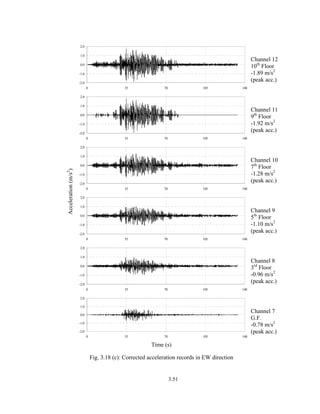
3.18 (c) Corrected Acceleration Records in EW Direction 3.51
3.18 (d) Corrected Acceleration Records in Vertical Direction 3.52
3.19 (a) Computed Velocity time histories by single integration of
Acceleration Records in NS Direction
3.53
3.19 (b) Computed Velocity time histories by single integration of
Acceleration Records in EW Direction
3.54
3.19 (c) Computed Velocity time histories by single integration of
Acceleration Records in Vertical Direction
3.55
3.20 (a) Computed Displacement time histories by double integration of
Acceleration Records in NS Direction
3.56
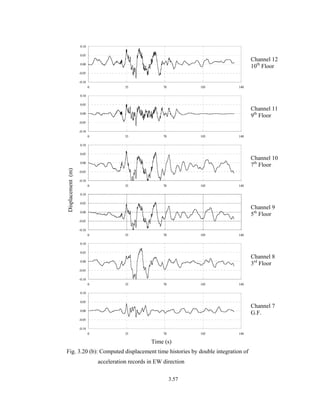
3.20 (b) Computed Displacement time histories by double integration of
Acceleration Records in EW Direction
3.57
3.20 (c) Computed Displacement time histories by double integration of
Acceleration Records in Vertical Direction
3.58
3.21 (a) Comparison of Computed Displacement time histories by double
integration of Acceleration Records in NS Direction with hipass
(—) and without hi pass (—) filtering
3.59
3.21 (b) Comparison of Computed Displacement time histories by double
integration of Acceleration Records in EW Direction with and
without hi pass filtering
3.60
3.21 (c) Comparison of Computed Displacement time histories by double
integration of Acceleration Records in vertical Direction with and
without hi pass filtering
3.61
3.22 (a) Drift index of floors in EW direction at different instant of time 3.62
xvii
Page no.
3.22 (b) Drift index of floors in NS direction at different instant of time 3.63
3.23 Bare frame model of the building 3.64
3.24 (a) Fourier spectrum of recorded motions in NS direction at various
floor levels of the building
3.64
3.24 (b) Fourier spectrum of recorded motions in EW direction at various
floor levels of the building
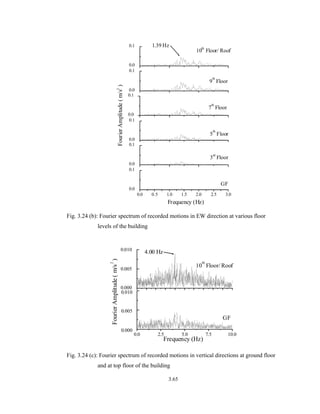
3.65
3.24 (c) Fourier spectrum of recorded motions in vertical directions at
ground floor and at top floor of the building
3.65
3.25 Transverse Functions between Ground Floor and Top floor in (a)
N-S component (b) E-W component
3.66
3.26 (a) Peaks in the FDD 3.67
3.26 (b) Model of the building 3.67
3.27 (a) Estimate of instantaneous frequency of NS rocking 3.68
3.27 (b) Estimate of instantaneous frequency of EW rocking 3.68
4.1 Position of three roving sensors connected to channel 2, 3 and 4 of
SSR, in the plan of building
4.11
4.2 Sensor setup at the roof of the building. At the roof one reference
sensor (channel no. 1) and two other sensors (channel no. 2 and 3)
have been place
4.11
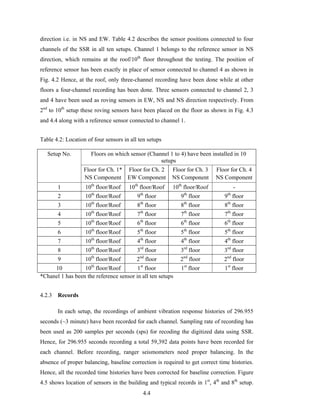
4.3 Channel no. 2 and 3 at a particular floor 4.12
4.4 Channel no. 4 at a particular floor 4.12
4.5 Locations in the building where vibrations have been measured in
10 setups (shown by arrows) and typical recorded velocity time
histories in setup no. 1, 4 and 8
4.13
4.6 (a) Corrected Velocity Records in 1st
setup at tenth floor/roof 4.14
4.6 (b) Corrected Velocity Records in 2nd
setup at ninth floor and
reference sensor at tenth floor
4.15
4.6 (c) Corrected Velocity Records in 3rd
setup at eighth floor and
reference sensor at tenth floor
4.16
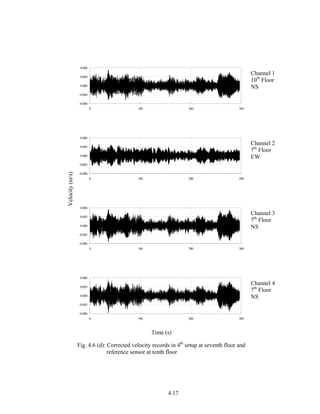
4.6 (d) Corrected Velocity Records in 4th
setup at seventh floor and
reference sensor at tenth floor
4.17
4.6 (e) Corrected Velocity Records in 5th
setup at sixth floor and reference
sensor at tenth floor
4.18
4.6 (f) Corrected Velocity Records in 6th
setup at fifth floor and reference
sensor at tenth floor
4.19
xviii
Page no.
4.6 (g) Corrected Velocity Records in 7th
setup at fourth floor and
reference sensor at tenth floor
4.20
4.6 (h) Corrected Velocity Records in 8th
setup at third floor and reference
sensor at tenth floor
4.21
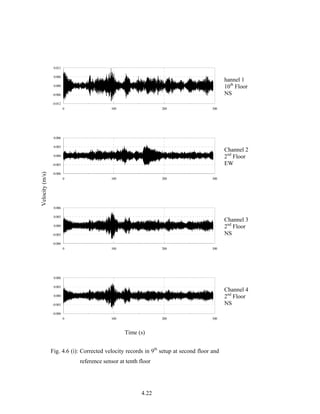
4.6 (i) Corrected Velocity Records in 9th
setup at second floor and
reference sensor at tenth floor
4.22
4.6 (j) Corrected Velocity Records in 10th
setup at first floor and
reference sensor at tenth floor
4.23
4.7 (a) Geometry of the building 4.24
4.7 (b) Movement of floor as rigid body motion of floor, measurement of
i, i+11 done in NS direction and i+33 node in EW direction where
i represents floor numbers
4.24
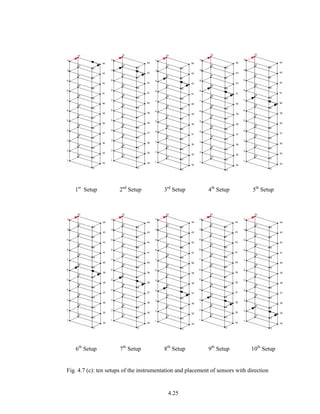
4.7 (c) Ten setups of the instrumentation and placement of sensors with
direction
4.25
4.8 (a) Singular values of the spectral density matrices 4.26
4.8 (b) Mode shapes in various modes of vibration 4.26
5.1 Location of soil testing site near building 5.14
5.2 Machine setup in progress for borehole digging 5.14
5.3 Digging of boreholes 5.15
5.4 Digging of borehole No. 1 5.15
5.5 Three boreholes after the completion of digging and lowering the
PVC casing. Annular space between the PVC casing and soil has
been filled with bentonite slurry
5.16
5.6 Cross borehole tests at the site 5.16
5.7 Schematic diagram of the cross borehole test setup 5.17
5.8 Seismograph for shear wave velocity measurement 5.17
5.9 Typical record of cross borehole test at 24 m depth showing
method of superposition of waveforms of opposite polarity
5.18
5.10 Typical waveforms from cross borehole tests at site without
superposition. The waveform 4E and 10E are of opposite polarity
5.19
5.11 Shear Wave Velocity at vertical points from cross borehole tests 5.19
5.12 Shear Wave Velocity adopted for the FEM analysis of building-
foundation-soil system
5.20
xix
Page no.
5.13 Mass density of soil adopted for the FEM analysis of building-
foundation-soil system
5.20
6.1 (a) FE models of the instrumented multi-storied reinforced concrete
building (G +9) considering bare frame – M1
6.15
6.1 (b) FE models of the instrumented multi-storied reinforced concrete
building (G +9) considering bare frame and floor slabs – M2
6.15
6.1 (c) FE models of the instrumented multi-storied reinforced concrete
building (G +9) considering bare frame and staircase – M3
6.15
6.1 (d) FE models of the instrumented multi-storied reinforced concrete
building (G +9) considering bare frame, staircase and floor slabs –
M4
6.15
6.1 (e) FE models of the instrumented multi-storied reinforced concrete
building (G +9) considering bare frame, staircase, floor slabs and
infill walls - M5
6.15
6.2 Mode shape of the (a)first mode (first translational mode in NS
direction) (b) third mode (first torsional mode) (c) third mode (first
translational mode in EW direction) (d) fourth mode (mixed
mode) and (e) fifth mode (mixed mode) of bare frame FE model
M1
6.16
6.3 Mode shape of the (a)first mode (first translational mode in NS
direction) (b) third mode (first torsional mode) (c) third mode (first
translational mode in EW direction) (d) fourth mode (mixed
mode) and (e) fifth mode (mixed mode) of FE model M5
6.17
6.4 (a) Fourier amplitude of input excitation in NS direction 6.18
6.4 (b) Fourier amplitude of input excitation in EW direction 6.18
6.4 (c) Fourier amplitude of input excitation in vertical direction 6.18
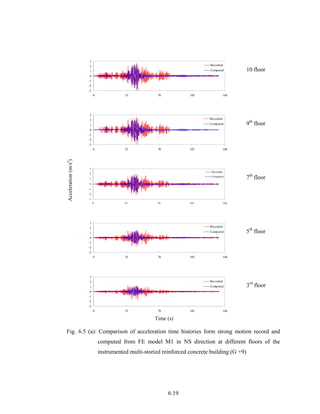
6.5 (a) Comparison of acceleration time histories form strong motion
record and computed from FE model M1 in NS direction at
different floors of the instrumented multi-storied reinforced
concrete building (G +9)
6.19
6.5 (b) Comparison of acceleration time histories form strong motion
record and computed from FE model M1 in EW direction at
different floors of the instrumented multi-storied reinforced
concrete building (G +9)
6.20
6.5 (c) Comparison of acceleration time histories form strong motion
record and computed from FE model M1 in vertical direction at
different floors of the instrumented multi-storied reinforced
concrete building (G +9)
6.20
xx
Page no.
6.6 (a) Comparison of acceleration time histories form strong motion
record and computed from FE model M5 in NS direction at
different floors of the instrumented multi-storied reinforced
concrete building (G +9)
6.21
6.6 (b) Comparison of acceleration time histories form strong motion
record and computed from FE model M5 in EW direction at
different floors of the instrumented multi-storied reinforced
concrete building (G +9)
6.22
6.6 (c) Comparison of acceleration time histories form strong motion
record and computed from FE model M5 in vertical direction at
different floors of the instrumented multi-storied reinforced
concrete building (G +9)
6.22
6.7 Comparison of peak acceleration of floors obtained from the
strong motion record and computed from the FE models M1 to M5
performing dynamic time history analysis
6.23
6.8 Typical floor spectra at 10th
floor and ground floor observed from
earthquake record (REC) and from FE model M5 as given in NS
and EW direction
6.24
7.1 Isometric view of model M5 used for the modeling of foundation
and soil to develop building-raft-soil model
7.30
7.2 (a) Isometric view of finite element model of building-raft-soil system 7.30
7.2 (b) Top view of finite element model of building-raft-soil system 7.31
7.2 (c) NS view of finite element model of building-raft-soil system 7.31
7.2 (d) EW view of finite element model of building-raft-soil system 7.32
7.2 (e) Sectional view of finite element model of building-raft-soil system 7.32
7.3 (a) COMBIN14 element applied at the vertical boundary of soil block 7.33
7.3 (b) Dampers applied at the vertical boundary of soil block 7.33
7.4 (a) Isometric view of layered soil 7.34
7.4 (b) Top view of layered soil 7.34
7.5 (a) White noise input and its (b) Fourier transform used to find
out transfer function between ground floor motion of building and
free field motion at top of soil surface
7.35
7.6 (a) Magnitude and (b) phase of transfer function between ground
floor of building (FEMBRS) and top of soil surface (FEMSOIL) in
NS direction
7.36
7.7 (a) Magnitude and (b) phase of transfer function between ground
floor of building (FEMBRS) and top of soil surface (FEMSOIL) in
EW direction
7.37
xxi
Page no.
7.8 Recorded motion at ground floor and calculated free filed motion
from transfer function in (a) NS and (b) E-W direction
7.38
7.9 (a) Magnitude and (b) phase of transfer function between top of
soil and base of soil block (FEMSOIL) for both NS and EW
direction
7.39
7.10 Free field motion and corresponding base motion obtained from
transfer function approach in (a) NS and (b) EW direction
7.40
7.11 Fourier amplitude of (a) recorded motion at ground floor of the
building, (b) free field motion obtained from transfer function
approach and (c) base motion obtained from free field using
transfer function in NS component
7.41
7.12 Fourier amplitude of (a) recorded motion at ground floor of the
building, (b) free field motion obtained from transfer function
approach and (c) base motion obtained from free field using
transfer function in EW component
7.42
7.13 Mode shapes of first five mode shapes 7.43
7.14 Variation of first five frequency at 0.6 times (Case B2), 0.8 times
(Case B1), 1.0 times (Case A), 1.4 times (Case C1) and 2.0 times
(Case C2) the actual shear wave velocity of soil layers of founded
soil of the building
7.44
7.15 Distribution of peak accelerations at different floors of the
building in (a) NS and (b) EW direction computed from Bhuj
earthquake input excitation at the base of soil block in building-
raft-soil finite element model
7.45
7.16 Distribution of peak displacements at different floors of the
building in (a) NS and (b) EW direction computed from Bhuj
earthquake input excitation at the base of soil block in building-
raft-soil finite element model
7.46
7.17 Distribution of peak accelerations at different floor level in (a) NS
and (b) EW direction from the recorded Bhuj earthquake and
computed from Bhuj earthquake from the FE models including
SSI (Case A) and under fixed base condition
7.47
7.18 Distribution of peak displacements at different floor level in (a)
NS and (b) EW direction from the recorded Bhuj earthquake and
computed from Bhuj earthquake in Case A in which shear wave
velocity is taken as Vs of soil layers
7.48
7.19 Scaled input excitation of El Centro earthquake applied in (a) NS
direction and (b) in EW direction adjusted to peak acceleration of
computed base motion of Bhuj earthquake in NS direction and EW
direction respectively
7.49
xxii
Page no.
7.20 Fourier transform of input excitation of (a) El Centro earthquake
and Bhuj earthquake applied in (b) NS direction and (c) in EW
direction
7.50
7.21 Distribution of peak accelerations at different floor level in (a) NS
and (b) EW direction from the recorded Bhuj earthquake,
computed from Bhuj earthquake in Case A in which shear wave
velocity is taken as Vs of soil layers and El Centro earthquake
input for the same shear wave velocity of soil layers as given in
Case A
7.51
7.22 Distribution of peak displacement at different floor level in (a) NS
and (b) EW direction from the recorded Bhuj earthquake,
computed from Bhuj earthquake in Case A in which shear wave
velocity is taken as Vs of soil layers and El Centro earthquake
input for the same shear wave velocity of soil layers as given in
Case A
7.52
xxiii
NOMENCLATURE
CHAPTER 3 - STRUCTURAL RESPONSE OF THE INSTRUMENTED
BUILDING FROM STRONG MOTION RECORD
EW East west direction
NS North south direction
Afloor Peak value of acceleration recorded at the concern floor level
AG Peak value of acceleration recorded at the ground floor level
NS1 First translational frequency in N-S direction
EW1 First translational frequency in E-W direction
T1 First torsional frequency
NS2 Second translational frequency in N-S direction
T2 Second torsional frequency
CHAPTER 4 - IDENTIFICATION OF MODAL PARAMETERS OF THE
INSTRUMENTED BUILDING FROM AMBIENT VIBRATION
RECORDS
t, τ Time
f Frequency
y(t) System response
,ϕ Mode shape, mode shape matrix
C Covariance matrix
G Spectral density matrix
u, U Singular vector, Matrix of singular vectors
[ ]is Diagonal matrix of singular values
CHAPTER 5- DETERMINATION OF INSITU SOIL PARAMETERS OF
FOUNDING SOIL OF THE INSTRUMENTED BUILDING
DS Disturbed soil sample
UDS Undisturbed soil sample
SPT Standard penetration test
SBC Safe bearing capacity
NP Non plastic
DST Direct shear test
LL Liquid limit
PL Plastic limit
PI Plasticity index
xxiv
* Remolded sample
Ref. Refusal
ML Sandy silt
SM Silty sand
CI Silty clay having medium plasticity
CL Silty clay with low plasticity
CHAPTER 6 - STRUCTURAL RESPONSE OF THE INSTRUMENTED
BUILDING UNDER FIXED BASE CONDITION
Ef elastic modulus of frame material
Em elastic modulus of masonry wall
t thickness of infill wall
h height of infill wall
l length of infill wall
Ic moment of inertia of columns
Ib moment of inertia of beams
CHAPTER 7 - SEISMIC RESPONSE OF THE INSTRUMENTED BUILDING
INCLUDING SOIL-STRUCTURE INTERACTION
FEBRS FE model of Building-Raft-Soil system
FESOIL FE model of soil layered system
1.1
1INTRODUCTION
1.1 INTRODUCTION
The rational computation of seismic response is vital for safe and economical
earthquake resistant design. The analytical and experimental studies of seismic behaviour
of buildings and its components in laboratory and case studies have immensely
contributed to the understanding of structural behaviour of multi-storied buildings in
earthquakes. In particular the study of post earthquake response of buildings has
significantly contributed to the practice of earthquake resistant design. The mathematical
models employed to compute seismic response often carry uncertainties associated with
regard to modeling of infill walls, modeling of floor slabs, modeling of non-structural
elements and Soil-Structure Interaction (SSI) effect. The analysis of structural response of
an instrumented multi-storied reinforced concrete building (G +9) under earthquake
motion provides best opportunity to have an insight into structural behaviour and throw
light on the modeling issues of infill walls, non-structural elements, SSI, etc. In addition,
the study of response of an instrumented multi-storied reinforced concrete building (G
+9) enables validation of mathematical models and updating of current codal practice of
design. The present study of seismic response of an instrumented multi-storied reinforced
concrete building (G +9) was undertaken with the above background.
The structural response of a building during an earthquake primarily depends
upon modal parameters. Moreover, the modal characterization is also important for the
dynamic behavior prediction, Finite Element (FE) model updating, detecting and locating
the possible damage in structures, structural health monitoring, safety evaluation and
retrofitting of structures. An advancement in computer and software technology has
made modeling and analysis of multi-storied buildings not only an easy task but also
helps to predict the actual behavior as accurately as possible after considering the effect
of each structural and non-structural element by appropriate modeling techniques. To
1.2
narrow down the gap between the analytical and the observed behaviour, accurate
predictions of modal parameters are necessary so that one can update FE model until the
computed response would be close enough to the real one. This updated model provides a
better analytical representation of the dynamic response of the building and serves as a
calibrated tool for the prediction of seismic response.
In the proposed study the structural response parameters of an instrumented multi-
storied reinforced concrete building (G +9) have been estimated from the strong motion
records of Bhuj earthquake, 2001, India and ambient vibration records of the same
building. These parameters are compared to the 3D FE modeling of buildings by
considering the effects of number of structural and non-structural elements including SSI
effect.
1.2 OBJECTIVE AND SCOPE
The objective of the research presented here is to find the seismic response of an
instrumented multi-storied reinforced concrete building (G +9) under seismic excitations.
This study focuses on the following area: (1) Analysis of full scale test records of the
buildings; (2) Linear FE analysis of three dimensional building models including
structural, non-structural, foundation, soil block and viscous boundary condition to
compute seismic response. Simulations of the FE building models, are prepared using
January 26, 2001 Bhuj earthquake.
This investigation has the following specific objectives:
Identification of modal and structural parameters of an instrumented multi-storied
reinforced concrete building (G +9) situated in Ahmedabad using strong motion
records of Bhuj Earthquake Jan 26, 2001 and ambient vibration records of the
same building
A comparison of identified parameters from strong motion records and ambient
vibration records with the parameters obtained from the FE model of building by
considering number of structural and non-structural elements under fixed base
condition.
1.3
A comparison of measured response from strong motion records of Bhuj
earthquake, 2001 with computed response from 3D FE model of the instrumented
multi-storied reinforced concrete building (G +9) by considering the SSI effect in
a 3D layered soil – foundation - building system
1.3 ORGANIZATION OF THE THESIS
The thesis consists of two parts. Part I (Chapters 3, 4 and 5) deals with the full-
scale testing and soil investigations for an instrumented multi-storied reinforced concrete
building (G +9). In Part II (Chapters 6 to 7) the free vibration analysis and dynamic time
history analysis of different FE models of the same building are studied. The brief
introduction to each chapter is given below.
Chapter 2 Literature review is presented in the form of case histories. The buildings
in which strong motion recording in earthquake are included, and the type of studied
performance with recorded data and with FE model are also described.
Chapter 3 Instrumentation of a multi-storied reinforced concrete building for strong
motion recording is described. The record of Bhuj earthquake in the building is given in
the form of acceleration time histories of different floors. In addition, data from Structural
Response Recorder (SRR) are given at different places in Gujrat during Bhuj earthquake
and estimated peak ground acceleration from the SRR data. Structural details of the
instrumented multi-storied reinforced concrete building (G +9) are given including details
of columns, beams, floor slabs, foundation etc.. Data processing of recorded motion of
different floors of the instrumented multi-storied reinforced concrete building (G +9) is
given and finally the analysis of recorded motion is presented through Fourier transform,
transfer function, frequency domain decomposition, moving window analysis, peak
surface strain.
Chapter 4 Additional dynamic characteristics are obtained from full scale testing of
the instrumented multi-storied reinforced concrete building (G +9) in very low level of
vibrations through ambient vibration testing of the building after the earthquake. Records
of ambient vibration testing, experimental setup to record velocity time histories at the
different floors and technique applied to obtain modal parameters from the recorded
velocity time histories of ambient vibrations are also mentioned.
1.4
Chapter 5 In-situ and laboratory testing of the founding soil close to the instrumented
multi-storied reinforced concrete building (G +9). Cross borehole testing procedure and
shear wave velocity profile obtained upto 30 m depth below the ground level. The soil
properties used in the SSI analysis from FE model of the building are given for different
soil layers of founding soil.
Chapter 6 Different fixed base FE models of the instrumented multi-storied
reinforced concrete building (G +9) are created in order to find out the effect of structural
and non-structural elements on seismic response of the instrumented multi-storied
reinforced concrete building (G +9). Dynamic time history analysis is performed in all the
FE models to find out structural response in terms of acceleration, displacements and
storey drifts. Modal frequencies and modal pattern of the different FE models are
compared.
Chapter 7 Soil and foundation along with structural and non-structural elements of
building are modeled to develop a three-dimensional building-raft-soil system with
viscous boundary condition. Using this three-dimensional system the dynamic time
history analysis is performed to find out structural response of the instrumented multi-
storied reinforced concrete building (G +9). Free field motion is computed from the
recorded motion at the ground floor of the building with the help of transfer function
technique. Using the same technique, the input excitation at the base of soil block is
computed which is used in the dynamic time history analysis of the complete building-
raft-soil FE model.
Chapter 8 The thesis is concluded with a summary and discussion of the methods and
analyses is presented. The main results achieved after the study are pointed out.
1.4 USEFUL ASPECTS OF THE RESEARCH
Some particularly useful aspects experienced during the work, which deserves to
be mentioned, are listed as follows:
Detailed study of records of structural response of a recently constructed 10-storey
reinforced concrete building in an earthquake using all the structural drawings of
this building (Chapters 3 and 4).
1.5
Use of direct measurements of shear wave velocity of the founding soil for SSI
studies. For this, cross borehole tests were conducted close to building using three
boreholes. Laboratory testing was also conducted to find out the in-situ density
and classification of soil (Chapter 5).
Determination of a technique to determine free field motion from ground floor
record of a building using soil properties.
Development of a complete three-dimensional FE model of the building based on
actual structural drawings and soil properties in which all elements of the building
is modeled i.e. columns, beams, floor slabs, infill walls, stair case, raft foundation
and founded soil. This complete FE model is used to perform linear dynamic time
history analysis at the base of soil block and results are compared with recorded
time history.
1.6
2.1
2REVIEW OF LITERATURE
2.1 PREAMBLE
A large number of studies have been carried out in countries like U.S., Japan,
Canada etc., during the past several years. However few such studies are found in India.
A few of the available studies may be considered which are as follows.
2.2 EARLIER STUDIES
Muria-Vila et al. (2004) studied the effects of SSI in two tall buildings using the
experimental data from the most significant and recent earthquakes recorded in the
buildings. Both system identification and analytical methods were used to calculate
stiffnesses and frequencies associated with SSI effects. The later include procedures from
the Mexico City building code as well as commercial software by mean of which piles
group effects are also considered. Comparisons suggest interesting conclusions about
analytical considerations and actual behavior of the buildings and theirs foundations.
From both the system and the fixed-base structure models, it was found that the dynamic
responses are very sensitive to the amplitude of the imposed ground motion, even for
small levels of excitation. Simple analytical models (Fig. 1) and simplified methods were
used for the estimation of SSI effects. Ambient vibration testing is not conducted to study
the dynamic characteristics in low level of vibrations.
Stewart, J.P. and Fenves, G.L. (1998) used parametric system identification to
evaluate seismic SSI effects in buildings. The input-output strong motion data pairs
needed for evaluation of flexible- and fixed-base fundamental mode parameters are
derived. Recording of lateral free-field, foundation, and roof motions, as well as
foundation rocking, are found to be necessary. For the common situation of missing free-
field or base rocking motions, procedures are developed for estimating the modal
parameters that cannot be directly evaluated. The accuracy of these estimation procedures
2.2
for fundamental mode vibration period and damping is verified for eleven sites with
complete instrumentation of the structure, foundation, and free field. Comparison of
estimated and known first mode parameters show that (1) fixed- and flexible-base
frequencies are reliably predicted by the parameter estimation procedures; (2) estimated
fixed-base damping ratios are fairly accurate; and (3) flexible-base damping is generally
well predicted when SSI effects are significant, but it can be overpredicted when SSI
effects are modest. The focus of this paper is on fundamental-mode vibration period only
for different cases of base fixity. System identification is done only with input and output
form in the frequency domain using transmissibility function and transfer function for the
complete linear system.
Nagarajaiah and Xiaohong (2000) studied the base-isolated University of
Southern California (USC) hospital building (Fig. 2) which experienced strong motion
during the 1994 Northridge earthquake. The objective of this study was to evaluate the
seismic performance of the base-isolated USC hospital building during the 1994
Northridge earthquake. A nonlinear analytical model of the USC hospital building was
developed and verified using system identification. The computed response, using the
presented analytical modeling techniques, was verified using recorded data. Structural
behavior during the Northridge earthquake was evaluated in detail. The base-isolated
USC hospital building performed well and reduced the response when compared to a
fixed-base structure. The free-field acceleration was 0.49g and peak foundation/ground
acceleration was 0.37g. The peak roof acceleration was reduced to 0.21g, nearly 50% of
the peak ground acceleration. The peak drift was <30% of the code specification. The
bearings yielded and dissipated energy (20%). The superstructure was elastic due to the
effectiveness of base isolation. The building is expected to perform well in future
earthquakes similar to those used in the original design. A detailed 3D model of the fixed-
base superstructure was developed with a rigid floor slab assumption. The superstructure
properties, such as beam, column, bracing, and floor slab details, used for analytical
modeling are computed from building drawings. Condensed model of only 24 DOF is
used for modeling the USC hospital building in a fixed-base condition. Detailed model is
developed for superstructure to study the fixed- base superstructure and SSI is not
considered because of base isolation.
Todorovska et al. (2004) studied fundamental vibration period of the instrumented
buildings. Studies for selected buildings in Los Angeles (Fig. 2.3) have shown that this
2.3
fundamental vibration period can vary significantly during earthquake shaking as function
of the level of shaking, reflecting changes in stiffness of the structure and of the soil, and
can be very different from the estimates using ambient vibration data. It was
recommended that for further refinement of the existing and development of new design
code procedures, it is important to understand these changes and estimate their range
during strong earthquake shaking, which is done best by analysis of actual earthquake
response data for a large number of buildings. In general, the trend indicated by these data
is decrease during the earthquakes that caused the largest levels of response (1994
Northridge main event, and the 1971 San Fernando earthquake), and recovery during the
shaking from the aftershocks. For one of the buildings, a significant change that occurred
during the San Fernando earthquake (30% reduction) appears to have been permanent.
For most buildings, the frequency changed up to 20%, but for two buildings, the change
was about 30%. A permanent reduction of the frequency is consistent with permanent loss
of stiffness, while a “recovery” to the initial or higher value is consistent with the
interpretation that the change was mainly due to changes in the soil (rather than in the
structure itself), or changes in the bond between the soil and the foundation. Other causes
of the temporary changes include contribution of the nonstructural elements to the total
stiffness resisting the seismic forces, and opening of existing cracks in the concrete
structures. The degree to which each of these causes contributed to the temporary changes
cannot be determined. Response of the building was not studied using the FE models of
the buildings.
Celebi, M. (1993) studied the dynamic characteristics of five tall buildings in the
San Francisco bay area (Fig. 2.4) during strong and low-amplitude motions. A
comparison was presented between dynamic characteristic of buildings determined from
recorded strong motion data during Loma Prieta earthquake and from low-amplitude
(ambient vibration data) tests conducted after Loma Prieta earthquake. The results show
that in all cases the fundamental periods and corresponding percentages of critical
damping determined from low-amplitude tests are appreciably lower than those
determined from strong motion response records. In each of the five buildings tested, the
first-mode periods associated with strong-motion records were longer than those
associated with ambient vibration records. The highest and lowest first-mode period ratios
are 1.47 and 1.40, respectively. The response was not computed from the FE models of
the buildings for the validation of FE models may be due to non-availability of blue prints
of structural drawings of the building.
2.4
Dunand et al. (2006) made comparisons of the dynamic parameters extracted from
weak, moderate and strong motion records in buildings and proposed ambient vibration
analysis as an alternative way to inspect buildings before or after an earthquake. This fast
and low-cost method is well-adapted to large-scale studies for which a large amount of
buildings has to be checked. One of the most common critiques usually done on the use
of ambient vibrations in structures is the very low level of vibrations. Because of the low
amplitude range of the ambient vibration (PGA<10-5g), dynamic characteristics obtained
from weak-motion are generally expected to be significantly different from those
obtained using strong-motion (PGA>0.1g). The objective of this paper is to present a
comparison of the structural dynamic characteristics deduced from strong, moderate and
weak motion recordings for a set of twelve Californian buildings and four European
buildings. Among the set of buildings, two were particularly analysed (Fig. 2.5).
Recommendation is made to have more information on the damping estimation errors,
and to compare buildings modal shape derived from ambient vibrations and earthquake
records. More data are needed to confirm these observations.
Calvi et al. (2006) presented the case for the significant elongation of the period
of vibration of reinforced concrete (RC) buildings during strong ground shaking due to
earthquakes by the results of experimental tests on RC structures and the strong ground-
motion measurements. A large increase in the period of vibration was observed during
ground shaking. The increase in the fundamental period is obviously dependent on the
level of shaking and the associated extent of non-linearity that is attained within the
structure and/or foundation; this behaviour has been more frequently observed in
experimental tests than in the field due to the lack of instrumented buildings that have
been subjected to large strong ground shaking. The studies indicate that for strong ground
shaking the period elongation can lead to periods of vibration of up to 1.8 to 2.5 times the
initial period. Only analytical models which replicate the results of the experimental tests
were introduced and additional studies on the elongation the period during seismic action
were presented.
Hayashi and Takahashi (2004) studied SSI effects on building response in recent
earthquakes. The SSI effects on the earthquake response of buildings are studied by
carrying out a simulation analysis of the buildings (Fig. 2.6) which suffered no structural
damage during the 1995 Hyogoken-Nanbu earthquake and parametric earthquake
response analyses using representative ground motion records of the recent domestic or
2.5
foreign big earthquakes. From these analyses, it was pointed out that the damage
reduction effects by soil-structure interaction greatly depend on the ground motion
characteristics, number of stories and horizontal capacity of earthquake resistance of
buildings. Consequently, they recommended that it is very important to consider soil-
structure while evaluating the earthquake damage of buildings properly. Only two-
dimensional analyses of the buildings were carried out to study the dynamic behaviour of
the buildings. Superstructure was modeled as lumped mass model. Effect of different
structural and non-structural elements on seismic behaviour of the building was not
studied in the analyses.
Karkee et al. (2004) studied dynamic SSI in lowrise buildings from seismic
records observation at two adjacent buildings (Fig. 2.7). Altogether 19 earthquake records
with maximum acceleration of over 10 cm/s2
were selected for the analyses. Effects of the
surface irregularity to the observed records were discussed based on the interrelation
between peak values of acceleration, velocity, spectral ordinate at 5% damping and
Fourier spectral amplitudes. Inertial and kinematic interaction effects were also discussed
based on the ratio of spectral amplitudes. Correlation analysis was subsequently carried
out by obtaining coherency function and phase spectra. Results from coherency, phase
lag, acceleration time history in limited frequency bands, and trends in particle motion
orbits indicate that the free field motion at filled ground close to the sloping ground is out
of phase building foundation (1F) motion at lower frequencies. SSI effects in a pair of
three-storey buildings have been evaluated based on the observed seismic records.
Response of the buildings was not computed from the finite element model of buildings.
Crouse and Ramirez (2003) studied SSI and site response of the two buildings in
Jensen filtration plant during the 1994 Northridge earthquake, California; mainshock and
aftershocks. Forced vibration tests conducted on the small one-storey generator building
and the larger three-storey administration building, both of which recorded the mainshock
and two aftershock sequences, revealed a prominent mode of vibration at 6.2 Hz in the
short (east–west) direction of the administration building. However, models of inertial
SSI, calibrated to the vibration test data, demonstrated that this phenomenon was of
secondary importance, even when adjusted for nonlinear behavior of the soil and
structure. Nonlinear site response and kinematic SSI were identified as the main reasons
for the differences observed in the three sets of building earthquake records, each with
clearly distinct amplitude and duration characteristics. Unfortunately, the absence of free-
2.6
field recordings at both buildings during the mainshock and first aftershock sequence
prevented a clearer determination of the relative roles of these two phenomena.
Fortunately, the installation of free-field instruments outside both buildings 4 yr later
revealed the significance of both effects, albeit at extremely small motion amplitudes.
This case study further emphasizes the need to carefully plan the siting of ground-motion
instrumentation so that the interpretations of any recorded data are not obscured by the
potential effects of SSI.
Ventura et al. (2003) studied dynamic characteristics of a base isolated building in
Takamatsu, Japan, from ambient vibration measurements and low level earthquake
shaking to determine the mode shapes and the associated natural frequencies and damping
ratios at very low levels of excitation. The latest developments in signal analysis for
modal decomposition are used to analyze the ambient response data. A finite element
model (Fig. 2.8) of the building and isolators was calibrated and refined using the
experimental results from the ambient vibration tests. This model was then used to
simulate the recorded response of the building under excitation from a small earthquake.
Recommendation was made that the finite element model, calibrated by ambient vibration
data and the low level of earthquake shaking, provides the starting point for modeling the
non-linear response of the building when subjected to strong shaking. The finite element
model base was assumed fixed because of the foundation therefore SSI effect was not
studied.
Celebi (2004) studied the response of a 14-storey Anchorage, Alaska, building in
2002 to two close earthquakes and two distant Denali fault earthquakes. Two earthquakes,
including the 3 November 2002 M7.9 Denali fault earthquake, with epicenters
approximately 275 km from the building, generated long trains of long period (.1 s)
surface waves. The other two smaller earthquakes occurred at subcrustal depths
practically beneath Anchorage and produced higher frequency motions. These two pairs
of earthquakes have different impacts on the response of the building. Higher modes were
more pronounced in the building response during the smaller nearby events. The building
responses indicate that the close-coupling of translational and torsional modes causes a
significant beating effect. It is also possible that there is some resonance occurring due to
the site frequency being close to the structural frequency. Recommended that
identification of dynamic characteristics and behavior of buildings can provide important
lessons for future earthquake-resistant designs and retrofit of existing buildings.
2.7
2.3 GAP AREAS
Based upon given case studies the following areas are pointed out:
Correlation of time period between observed and analytical models using
structural and non structural elements.
Effect of structural and non-structural parameters on building response during
earthquake
Correlation of analytical and experimentally observed seismic response.
Effect of SSI on building response
Correlation of time period and damping from strong motion and ambient vibration
testing
2.8
Fig. 2.1: Simplified SSI model
Fig. 2.2: Elevation, Plan, Sensor Locations of USC hospital building
2.9
Fig. 2.3: Locations of instrumented buildings in the Los Angeles at the time of the 1994
Northridge earthquake
Fig. 2.4: General location map of the five tall buildings relative to Loma Prieta
earthquake
2.10
Fig. 2.5: The Alhambra LA County Services building (left) and the Pasadena Milikan
library (right)
Fig. 2.6: Finite element model of SSI system
2.11
Fig. 2.7: Sectional elevation through the two adjacent buildings (building dimensions in
mm)
Fig. 2.8: Finite element model of Wakabaryo building
2.12
2.4 REFERENCES
1. Calvi, G. M., Pinho, R. and Crowley, H. (2006), “State-of-the-Knowledge on the
Period Elongation of RC Buildings during Strong Ground Shaking”, First
European Conference on Earthquake Engineering and Seismology, Geneva,
Switzerland, 3-8 September, Paper Number : 1535.
2. Celebi, M. (1993), “Dynamic Characteristics of Tall Buildings During Strong and
Low-Amplitude Motions”, The Structural Design of Tall Buildings, 2, 1-15.
3. Celebi, M. (2004), “Response of a 14-Storey Anchorage, Alaska, Building in 2002
to two close Earthquakes and two distant Denali Fault Earthquakes”, Earthquake
Spectra, 20, 693–706.
4. Crouse, C. B. and Ramirez, J. C. (2003), “Soil-Structure Interaction and Site
Response at the Jensen Filtration Plant during the 1994 Northridge, California,
Mainshock and Aftershocks”, Bulletin of the Seismological Society of America,
93, 546–556.
5. Dunand, F., Gueguen, P., Bard, P.-Y., Rodgers, J. and Celebi, M. (2006),
“Comparison of the Dynamic Parameters Extracted from Weak, Moderate and
Strong motion recorded in Buildings”, First European Conference on Earthquake
Engineering and Seismology, Geneva, Switzerland, 3-8 September 2006, Paper
Number: 1021.
6. Hayashi, Y. and Takahashi, I. (2004), “Soil-Structure Interaction Effects on
Building Response in Recent Earthquakes”, Proceedings Third UJNR Workshop
on Soil-Structure Interaction, March 29-30, Menlo Park, California, USA.
7. Karkee, M. B., Mitsuji, K. and Sugimura, Y. (2004), “Dynamic Soil-Structure
Interaction in Lowrise Buildings from Seismic Records”, Proceedings Third
UJNR Workshop on Soil-Structure Interaction, March 29-30, Menlo Park,
California, USA.
8. Muria-Vila, D. Taborda, R. and Zapata-Escobar, A. (2004), “Soil-Structure
Interaction Effects in two Instrumented Tall Buildings”, Proceedings of 13th
World Conference on Earthquake Engineering, Vancouver, B.C., Canada, August
1-6, CD-ROM, Paper No. 1911.
2.13
9. Nagarajaiah, S. and Xiaohong, S. (2000), “Response Of Base-Isolated USC
Hospital Building in Northridge Earthquake”, Journal of Structural Engineering,
126, 1177–1186.
10. Stewart, J.P. and Fenves, G.L. (1998), “System Identification for Evaluating Soil-
Structure Interaction Effects in Buildings from Strong Motion Recordings”,
Earthquake Engineering and Structural Dynamics, 27, 869-885.
11. Todorovska, M. I., Hao, T-Y. and Trifunac M. D. (2004), “Building Periods for
use in Earthquake Resistant Design Codes –Earthquake Response Data
Compilation and Analysis of Time and Amplitude Variations”, University of
Southern California, Los Angeles, California, Report CE 04-02.
12. Ventura, C.E., Finn, W.D.L., Lord, J.-F. and Fujita, N. (2003), “Dynamic
Characteristics of a Base Isolated Building from Ambient Vibration
Measurements and Low Level Earthquake Shaking”, Soil Dynamics and
Earthquake Engineering, 23, 313–322.
2.14
3.1
3STRUCTURAL RESPONSE OF THE
INSTRUMENTED BUILDING FROM
STRONG MOTION RECORD
3.1 BACKGROUND
The strong ground motions are characterized by those that can cause distress or
damage in the structures and these are of engineering interest. Without the knowledge of
strong ground motions and structural response, seismic behaviour of structures cannot be
compared with design criteria nor proper decisions concerning rational repair and
reconstruction could be made. There is an increasing need for establishing database of
strong ground motions in the various seismic regions. This data has made significant
contribution in establishing site dependent design response spectrum and overall activities
of seismic risk reduction and minimizing of damage of structures under disastrous
earthquakes. The installation of the instrumentation in the structures has received
considerable importance in last two decades in reference to study of performance of
structures and verification of design procedures.
The recording of response of structure in strong earthquake called seismic
monitoring of structure mainly refers to engineering aspects of the structure. The main
purpose of strong motion instrumentation is providing data on the dynamic behaviour of
structures under the effect of earthquakes. The strong motion instruments installed on the
structure enable obtaining basic data on its behaviour during an earthquake that is
essential for making decisions to check the efficacy of design criteria, validity of
mathematical modeling and need for repair and retrofitting. The study of structural
response is equally important both for theoretical and fundamental investigations in the
field of earthquake engineering and for updating seismic design criteria for safe and
3.2
economical design of structures. In recent years, Structural dynamic parameters (modal
frequency, modal damping and mode shape) has become subject of intense research
subject (Zaslavsky and Shapira 1997) and these parameters can be deduced from the
measured response of the structure.
For the described reasons, Department of Earthquake Engineering, Indian Institute
of Technology, Roorkee has instrumented several multistoried buildings in India from the
funds obtained from World Bank through Department of Science and Technology. Under
this project, multistoried buildings are instrumented at Mumbai, Hyderabad, Bangalore,
Pune, Goa, Ahmedabad, Delhi and Roorkee. Brief details of this instrumentation are
given in Table 3.1. These buildings are instrumented with about 15 to 20 channels of
acceleration sensors (Force Balance Accelerometers) located on different floors. These
sensors are cabled to a common recorder (resolution of 16 bits), which is generally
located in the ground floor of the building. In addition to usual hardware like power
supply, interface for sensors, signal conditioning at analog stage, AD converters and other
required circuitry, recorders are also equipped with a GPS to synchronise the real time
clock and a modem to establish remote connection through telephone line. The data is
recorded on PCMCIA flash memory card of 4 megabyte (for a 3 channel module), which
is sufficient to have records of 90 minutes duration at 200 SPS for each channel. The
entire instrumentation is powered by 12 volt 65 AH battery which is charged through
mains as well as through solar cells. The operational features of the instrumentation are
similar to that of any other digital strong motion accelerographs and parameters like pre
event time, post event time, trigger threshold and end of event threshold for each channel
can be set through menu driven communication software which also has other facilities
like viewing the list of recorded files, downloading and/or graphic display of the selected
file, status of battery, status of synchronization through GPS, diagnostics through
different tests etc. The digital recorder has modular setup and a recorder can be
configured for number of channels, which are multiple of three with a maximum limit of
21 channels in one recorder.
One of the instrumented buildings that recorded the building response to Bhuj
earthquake was a ten-storey residential building, located ~250 km east from epicenter.
This ten storey residential building at Ahmedabad was instrumented two days before 26
January 2001 Bhuj earthquake. This RC building, 20.36×17.79 m in plan and supported
3.3
by 1.58 m thick raft below 1.67 m from the ground level. The site geology is alluvium,
consisting of alternate layers silty sand and clayey silt. It is noticeable that the building
did not suffer any visible structural and nonstructural damage by the Bhuj earthquake and
its early aftershocks. The peak accelerations recorded at the base of the building were
0.08g (EW), 0.11g (NS) and 0.07g (V). Figure 3.1 shows the location of the site relative
to the epicentre of the Bhuj earthquake.
Table 3.1: Details of Buildings Instrumented Under World Bank Project
S.No. Name of building No. of
floors
No. of
instrumentation
channels
1 New CGO Complex, Mumbai G+18 17
2 MTNL Building, Prabhadevi, Mumbai G+11 15
3 Audit Bhawan, Bandra Kurla Complex, Mumbai G+8 15
4 Rail Nilayam Building, Hyderabad G+7 15
5 Kendriya Sadan, Bangalore G+7 15
6 Office Building for Nirman Bhawan, Pune G+5 15
7 Paryawaran Bhawan, Lodhi Road, New Delhi G+13 18
8 Passport Building, Ahemedabad G+9 14
9 Electronic Tower, Roorkee G+12 15
10 Bikrikar Bhawan, ITO, New Delhi G+12 18
11 Sewa Bhawan, RK Puram, New Delhi G+9 18
12 S.R.O. Building, Goa G+5 15
3.2 BHUJ EARTHQUAKE
When India was celebrating the 51st
Republic Day on the morning of 26th
January
2001, the fury of nature in the form of a high magnitude (ML = 6.9 on Richter scale, Mb
=7.0, MS = 7.6 and MW = 7.7) earthquake struck eastern part of India at 08:46:42.9 hours
IST (Indian Meteorological Department (IMD), New Delhi). The epicenter of this
earthquake was located near Bhachau (latitude 23.40°N and longitude 70.28°E), focal
depth 25 km with radius of fault area as 23 km. As per USGS NEIC the source
parameters are latitude 23.41°N and longitude 70.23°E, MW = 7.7 and focal depth 16 km.
Behaviour of buildings during the earthquake are reported in Sinvhal et al. (2001) and
Murty et al. (2002). Along with human lives, this earthquake destroyed public as well as
3.4
private properties worth several hundred millions rupees. Almost all human loses were
due to collapse of buildings.
Unfortunately, time history of strong ground motion could not be recorded at any
place for the main shock (except one at the ground floor of instrumented building at
Ahmedabad) since strong motion accelerographs were not installed in this region.
However, in Gujarat region, a network of seventeen structural response recorders (SRRs)
were deployed by the Department of Earthquake Engineering, IITR, Roorkee in different
cities of Gujarat (Fig. 3.2) under the strong motion project (INSMIN) sponsored by
Department of Science of Technology (DST), Govt. of India, New Delhi. SRRs have six
pendulums having period 1.25s, 0.75s and 0.40s with 5 and 10 percent damping and
records are obtained on smoked glass placed on top of pendulum (Krishna and Sekaran,
1962). Using the calibration data, which was archived in the laboratory for each
pendulum of each station, the maximum scratch length on the smoked glass of pendulums
of SRR were converted into pseudo spectral acceleration values (Chandra et al., 2002).
Table 3.2 gives values of spectral accelerations as calculated from the records of SRRs at
different locations (for 5% and 10% damping, spectral acceleration is almost equal to
pseudo spectral acceleration). The record of SRR during this earthquake at Ahmedabad
near the building is given in Fig. 3.3 in which computed spectral acceleration values in
cm/s2
are given for three time periods at 5% and 10% damping. The record given in Fig.
3.3 is an important record specially for the building, because it is near to the building.
3.2.1 Structural Response Recorder (SRR)
It consist a pendulum, which can oscillate about a point in its axis and record the
horizontal component of the ground motion in all directions (Krishna and Sekaran, 1962).
This is done by having a conical frame suspended as shown in Fig. 3.4 The period of
vibration can be regulated by the weights of the discs W1, W2 and W3 along with the
distances a, b and c. In addition to three discs, two permanent magnets N and S of
uniform strength are present at the two sides of disc W3. Movement of disc W3 between
magnets N and S provides the damping in the SRR and the damping can be adjusted by
inter-magnet distance between N and S. Therefore, the period and damping of SRR can
be adjusted according to the requirement. Distance between top disc (W1) and middle disc
(W2) controls the sensitivity of the instrument while between middle disc (W2) and
3.5
bottom disc (W3) is kept such that the pendulum can move freely over the entire working
range. Design concept of the pendulum has been taken from the work of Hudson (1958).
Table 3.2: Spectral acceleration from SRR Data
Spectral Acceleration in cm/sec2
At 5% damping for three
time periods
At 10% damping for three
of time periods
S.No. Location
0.4 s 0.75 s 1.25 s 0.4 sec 0.75 s 1.25 s
1. Anjar 1584.86 691.76 414.62 894.11 674.57 395.93
2. Kandla 846.22 560.33 * 639.53 524.12 *
3. Niruna 795.31 637.37 294.27 743.39 540.59 163.06
4. Naliya 706.25 211.8 * 684.85 210.45 *
5. Cambay 478.39 40.1 * 284.8 36.93 *
6. Ahmedabad 282 225.6 215.06 237.79 185.83 159.7
7. Jamjodhpur 215.4 149.31 70.85 134.52 54.56 48.06
8. Dwarka 206.63 * 56.73 177.12 107.86 53.21
9. Porbandar 187.29 243.3 52.74 151.28 208.14 28.27
10. Junagarh 183.44 61.93 22.24 94.46 50.66 20.55
11. Khambhaliya 177.33 63.95 47.71 85.61 41.02 33.04
12. Anand 141.69 60.31 43.9 117.71 47.23 25.24
13. Amreli 94.46 65.06 27.55 63.95 52.82 20.73
*Record could not be obtained due to mechanical problem with stylus
In the SRRs from which records have been obtained, three type of combination of
period viz. 0.4, 0.75 and 1.25 sec at the damping value of 5% and 10% each. This set of
period is chosen on the basis that the maximum response in the spectrum curve
corresponds to a period of 0.25 to 1.25 sec in most of the past earthquakes. Further, the
damping of the SRR is on the basis of damping of various structures like steel structure,
brick structures and concrete structures. The instruments are calibrated for an amplitude
of ½ inch on glass (which is about mid-amplitude).
3.2.2 Estimation of Peak Ground Acceleration (PGA) from SRR Records
Strong motion information has been taken in the past using SRR record (Chandra et
al., 1994) (Roshan et al., 2003). The Peak Ground Acceleration (PGA) estimated from
SRR record at Anjar, closest to the epicenter, was 0.547g. It is expected that the
3.6
acceleration in the epicentral region, near Bhachau, was larger. The estimated peak
ground accelerations (PGA) values at other places are given in Table 3.3 (Kumar et al.,
2001). A lithological map of the region was used to classify the sites of recording station
approximately. Accordingly, six sites are classified as rocky sites and rests of them are
classified as alluvium. These values are estimated from the SRR records of 0.75s period
and 5% damping. As per Table 3.3 the PGA (g) value recorded in Ahmedabad city is
0.134g or 1.31 m/s2
.
Table 3.3: Estimated PGA from SRR Data
S. No. Location Site Class Epicentral
Distance (km)
Estimated
PGA (g)
1. Anjar Rock 43.80 0.547
2. Naliya Rock 147.1 0.168
3. Khambhaliya Rock 150.2 0.050
4. Jamjodhpur Rock 166.0 0.118
5. Junagarh Rock 216.0 0.049
6. Amreli Rock 225.4 0.051
7. Kandla Alluvium 53.20 0.333
8. Niruna Alluvium 97.00 0.379
9. Dwarka Alluvium 187.8 0.029
10. Porbandar Alluvium 206.8 0.144
11. Ahmedabad Alluvium 238.0 0.134
12. Cambay Alluvium 266.0 0.024
13. Anand Alluvium 288.0 0.036
3.3 DESCRIPTION OF THE BUILDING
The 10-storey / G+9 floors building described in earlier is located near the L.D.
College of Engineering hostel gate in the city of Ahmedabad in India. Figure 3.5 shows a
isometric view of the building. All storey of the building is above ground so there is no
basement of the building. This building is situated in zone III out of four zones i.e. Zone
II to Zone V (IS 1893: 2002). The construction of regional passport office staff quarters
building started in 1996 and got completed in 2000. Total height of the building is 30 m
above ground in which each storey height is 3.0 m. This building is formed by two blocks
and these blocks are connected by lift well and staircase, which are exactly at the centre
3.7
of two blocks. The total floor area is about 250 square metres upto fifth floor level, about
208 square metres between sixth and ninth floor level and it reduced to 167 square metres
at roof / tenth floor level. It serves as a residential building for the Passport office staff.
As this building is a ten floor building (G+9 floors) so for the lift, a lift well is present in
between two blocks. Figure 3.6 (a) and 3.6 (b) show the elevation of the building in East
side and North side respectively.
3.3.1 Structural Framing
The structure is constructed of reinforced concrete. The structural system of the
building is moment resisting frame type, which is formed by columns and beams with
rectangular sections. Maximum size of the column used in the building is 1000×300 mm,
which is designed at the periphery of the building. Figure 3.7 (a), 3.7 (b) and 3.7 (c) show
the plan of the building upto 5th
floor level, from 6th
floor to 9th
floor level and 10th
floor
level respectively.
Floor Plan
This building does not have equal floor area at all floors. From ground floor to
fifth floor level there is no reduction in floor area but above fifth floor and ninth floor
some of floor area is reduced upto tenth floor level or roof. This reduction above fifth
floor level is about 17 percent because four portions C1-C2-D2-D1-C1, G1-G2-H2-H1-
G1, C9-C10-D10-D9-C9 and G9-G10-H10-H9-G9 of floor area as shown in Fig. 3.7 (a)
are not present after fifth floor level as shown in Fig. 3.7 (b). This reduction in floor area
is about 17 percent of total floor area. Similarly, portions A1-A2-C2-C1-A1, H1-H2-J2-
J1-H1, A9-A10-C10-C9-A9 and H9-H10-J10-J9-H9 as shown in Fig. 3.7 (a) are only
upto ninth floor level as shown in Fig. 3.7 (c). Hence, 34 percent is total reduction in floor
area at the roof or tenth floor level.
Columns
Based on the size, overall six types of columns are used in the building
construction, which are of 1000×300 mm, 600×300 mm, 835×300 mm, 755×230 mm and
780×230 mm sizes. Diameters of main reinforcement bars used in the columns are 25mm,
20mm and 16mm while binder for main reinforcement is of 8 mm diameter bar (Fig. 3.8).
In general ten bars of deformed steel bars as main reinforcement have been used in the
3.8
columns except the columns which goes above the roof of the building for water tank and
machine room (E3, F3, E5, F5, E7, F7, E9 and F9). 14, 12 and 20 number bars are used in
these extended columns The strong axis of the columns lies in the EW direction, while
weak axis in the NS direction accept four columns of the staircase box, which have the
strong axis in the NS direction. Two type of concrete mix 1:2:4 and 1:1.5:3 have been
used in the construction of columns. As the floor plan of the building is not same at all
floors so some of the columns are reduced in height. In these reduced columns, D1, G1,
D10 and G10 are upto 5th
floor level whereas columns A1, C1, H1, J1, A10, C10, H10
and J10 will be upto 9th
floor level. Further, for the machine room and water tank at above
the roof, some columns are upto machine room floor level / roof level and some columns
upto upper water tank. In these columns, E7 and F7 are upto machine room floor level
while E3, F3, E7 and F7 will be upto machine room roof level. In addition to that,
columns E9 and F9 are upto upper water tank.
Beams
Various beam sizes of rectangular cross section have been used to transfer the
dead load, live load and self-weight of structural and non-structural elements to the
columns of the building. Overall, fourteen types of rectangular cross sections have been
used and the variation of width of the beam is taken in between 230 mm and 660 mm
while the variation in depth between 300 mm and 700 mm. Cement concrete cover
provided on reinforcement is 25 mm. In these beams diameter of main reinforcing bars
used are 12, 16, 20, 25 and 28 mm (Fig. 3.9). In a beam either one of the described
diameter or a combination of the two different diameter bars are used. Tie bars of 8 mm
diameter are used at spacing 100 mm c/c or 200 mm c/c. All beams have been constructed
using 1:2:4 concrete mix.
Floor Slabs
Thickness of the floor slabs used are 100 mm and 110 mm. Thickness of floor slab
towards the north end and south end is 110 mm. Floor slab between the stair case and lift
well is also 110 mm. Rest of the floor slab at a particular floor is 100 mm thick (Fig.
3.10). 15 mm cover of cement concrete is provided on the reinforcement. All slabs have
been constructed using 1:2:4 concrete mix.
3.9
Lift Well and Machine Room for Lift
A lift well has been constructed in the rectangular block E3-E5-F5-F3-E3 of size
3.46×2.265m between the two identical sections of the building. This rectangular block is
further divided into two blocks by a steel channel ISMC150 to provide space for two
electric passenger lift in the building (Fig. 3.11 (a). The panels between floor slabs and
columns are 230mm brick masonry in the lift well. The pit floor is at a depth of 1.6m
from ground floor level for the lift well in the building. Clear lift well height is 34.10m,
which is from machine room floor level to pit floor. The machine position of the lifts is
directly above the lift well at the floor level of machine room (Fig. 3.11 (b)). Two control
board of two speed governors are presents in the machine room. The floor level of
machine room is 4.8m and roof is 7.55m high from roof/terrace of the building. Thickness
of floor slab of machine room is 150mm. Approximate load in the machine room for each
lift is in the form of two reactions (R1 and R2) equal to R1=4500 and R2=2100kg. Slabs
and beams of machine room floor and roof were cast in RCC mix 1:2:4. The machine
room walls are 155mm brick masonry in cement mortar 1:4 with 20mm plaster in cement
mortar 1:3 in both sides.
Staircase
In front of lift well, staircase is provided for the residents along with the two lifts.
In the staircase twenty flights were constructed so that each flight covers a height of 1.5m
between two consecutive floor levels. Thickness of the waist slab for each flight is
180mm on which 166.76mm riser and 270mm tread are provided whereas diagonal size
of flight is 2.16×1.58m. In the waist slab, longitudinal reinforcement is provided as
12mmΦ @ 140mm c/c while in transverse direction 8mmΦ @ 200mm c/c (Fig. 3.12). For
the construction of staircase 1:2:4 design concrete mix is used. Between two floors, a
landing slab of size 1.23×3.35m is provided which connects the two flights between two
consecutive floors.
Water Tank
One overhead water tank was constructed at a height of three metre on the
terrace/roof. This water tank was divided into two parts one for fire demand of the
building and another for the drinking water. The overall size of water tank is
3.10
3.39×3.35×3.15m in which a partition wall divides the 3.39m length into 1.2 and 2.19m.
Hence, two sections of water tank are of sizes 1.2×3.35×3.15m and 2.19×3.35×3.15m for
fire demand and drinking water respectively and the free board of 0.15m is provided for
the sections. Individual capacity of these two sections are 12.06m3
(1.2×3.35×3.0m) and
22.01m3
(2.19×3.35×3.0m). Thickness of bottom floor is 280mm, four side wall &
partition wall is 220mm of the water tank. Steel bars of sizes 8, 12, 16 and 20mm are used
as reinforcement at a spacing 150, 150, 110 and 100mm c/c respectively. Figures 3.13 (a)
and 3.13 (b) show sectional plan and sectional elevation of the water tank. Concrete cover
on main reinforcement of walls and slab floor is 15mm whereas in the beams, it is 25mm.
Floor slab, walls and beams of water tank were cast in cement concrete mix 1:1.5:3 with a
proper water resistant material.
3.3.2 Foundation System
The foundation system consists of a reinforced concrete raft slab of plan size
25×23 meters whereas the thickness of the raft slab is 1.58 meter. This raft slab is
founded at a level called foundation level, which is 3.25 meters deep from the ground
floor/ground level. Hence, bottom horizontal plane of raft slab is 3.25 m deep while the
top horizontal plane 1.67 m deep from ground floor / ground level. Fifty-two columns of
various sizes of the building emerge from the top horizontal plane of the raft slab. Clear
distance between the column and raft slab edge in the EW direction is 2.32m at both ends
whereas in NS direction this distance is 2.605m at both ends. Hence some part of the raft
slab at all the four edge, will act like cantilever slab because of the soil pressure beneath
the raft. For the raft, the net safe bearing capacity of soil at the foundation level is
recommended as 17 ton/m2
based on shear criterion and settlement criterion according to
soil investigation work. The permissible value of total settlement, differential settlement
and tilt (angular distortion) are 75mm, 0.0025L and 1/400 respectively for the raft
foundation on sand and hard clay (IS: 1904 - 1986), where L is the horizontal dimension
of the raft slab.
To fulfill the settlement criteria, the raft slab has been reinforced with 25mmΦ and
12mmΦ deformed steel bars having compressive strength of 415 N/mm2
(IS: 1786 -
1976). At the upper and lower horizontal part of raft slab, 2 deformed steel bars of
25mmΦ at a distance of 160mm centre to centre have been provided in both horizontal
3.11
direction. Further, 25mmΦ@160mm c/c and 12mmΦ@150mm c/c is the reinforcement
provided at the four edge of the raft slab. Figures 3.14 (a) and 3.14 (b) show top view and
sectional view respectively of raft foundation. Clear cover of cement concrete on
reinforcement is 75mm at the bottom while on the top and four vertical edges is 50mm.
The bottom of raft consist of 80mm thick layer of 1:5:10 P.C.C..
Type of Embedment of Foundation Slab
For surface and shallowly embedded foundations, embedment to foundation
radius ratio ( 5.0re < ) should be less than 0.5. Equivalent radius (r) of foundation is
( ) π×2325 m, where 25 and 23m are the foundation dimensions and embedment as
given before is 3.25 m. Hence, the ratio re is 0.24 for the foundation, where e is equal to
3.25m. The ratio re is coming out to be less than 0.5 therefore this is a shallow
foundation.
3.3.3 Material Specifications
Main reinforcement used in columns are high yield strength steel bars as per
specification of IS: 1786 - 1976 having 415 N/mm2
yield strength and confining steel
properties is as per IS 13920-1993. Two type of cement concrete mix 1:2:4 and 1:1.5:3
used in the construction of columns as given in Table 3.4.
Table 3.4: Material properties of the elements of the building
S.No. Elements Material used Material Properties
1:2:4 concrete mix M151. Columns
1:1.5:3 concrete mix M20
2. Beams 1:2:4 concrete mix M15
3. Floor Slabs 1:2:4 concrete mix M15
4. Staircase 1:2:4 concrete mix M15
5. Water Tank 1:1.5:3 concrete mix M20
6. Raft slab 1:2:4 concrete mix M15
3.12
According to IS 456: 2000 minimum M20 grade of concrete must be used for the
reinforced concrete. Further, for M20 concrete specified characteristic compressive
strength (fck) of 150mm cube at 28 days is given as 20 N/mm2
. For this compressive
strength, modulus of elasticity of the concrete can be calculated by the empirical formula
ckfE 5000= N/mm2
(3.2)
From the above equation modulus of elasticity for M15 and M20 grade concrete are
19.365×10³
and 22.361×10³
N/mm2
respectively.
3.4 INSTRUMENTATION OF THE BUILDING
It has long been recognized that an earthquake occurrence can be viewed as a full-
scale, large-amplitude experiment on a structure, and that if the structural motion is
recorded, it offers an opportunity to make a quantitative study of the behaviour of the
structure due to dynamic force and deflection levels directly relevant to earthquake-
resistant design. However, the time and location of a strong motion earthquake can not be
predicted with confidence so the acquisition of such data requires an extensive
deployment of dedicated instrumentation, which must be capable of remaining
operational over long periods of time. For these reasons, response data of good quality
were not readily available until recently, so there was little motivation to develop
systematic techniques for structural identification from earthquake records.
An instrumentation program should provide enough information to reconstruct the
response of the structure in enough detail to compare with the response predicted by
mathematical models and those observed in laboratories, the goal being to improve the
models. In addition, the data should make it possible to explain the reasons for any
damage to the structure. The nearby free-field and ground-level time history should be
known in order to quantify the interaction of soil and structure. More specifically, a well-
instrumented structure for which a complete set of recordings has been obtained should
provide useful information to (i) check the appropriateness of the dynamic model (both
lumped-mass and finite element) in the elastic range, (ii) determine the importance of
nonlinear behavior on the overall and local response of the structure, (iii) follow the
spreading nonlinear behavior throughout the structure as the response increases and
determine the effect of this nonlinear behavior on the frequency and damping, (iv)
3.13
correlate the damage with inelastic behavior, (v) determine the ground-motion parameters
that correlate well with building response damage, and (vi) make recommendations
eventually to improve seismic codes and facilitate decisions to retrofit/strengthen the
structural system as well as securing the contents within the structures.
3.4.1 Instrumentation Scheme
The building was instrumented with 14 channels of force balance accelerometers
as shown in Fig. 3.15. A view of the recorder room is shown in Fig. 3.16. One orthogonal
tri-axial sensor was at the ground floor as shown in Fig. 3.17 (a) and one in the top floor.
Two uniaxial sensors in two horizontal directions were located at 3rd
, 5th
, 7th
and 9th
floors. Uniaxial sensors were installed near beam – column joint below the slab in each
floor as shown in Fig. 3.17 (b) whereas triaxial sensors (ground and top floor) were
installed on top of the floor slab.
Force-Balance Accelerometers
In conventional accelerometers, the inertia force produced by a seismic ground
motion deflects the mass from its equilibrium position, and the displacement or velocity
of the mass is then converted into an electric signal. In force balance accelerometer,
inertial force is compensated (or balanced) with an electrically generated force so that the
seismic mass moves as little as possible; off course some small motion is still required
otherwise the inertial force could not be observed. The feedback force is generated with
an electromagnetic force transducer or ‘forcer’. The feedback current becomes measure of
acceleration.
3.4.2 Recording System
A central recorder is placed in the recording room at the ground, which is adjacent
to the building. All force balance accelerometers (transducers) are connected to this
central recorder. Specifications of central recording system are given in Table 3.5. The
central recording system is connected to a Global Positioning System (GPS) placed at the
roof of the building open to sky. The function of the GPS is to measure the latitude and
longitude of the building as well as to synchronize the real time clock of the recorder with
UTC timing to an accuracy of about 5 millisecond. The central recorder receives power
3.14
from a battery which in turn remain charged through a battery charger connected with 220
volt single phase mains as well as through a solar cell in the event of power failure. The
solar cell is placed at the roof of the building open to sun. Overall arrangement of the
power supply is such that at any instance power should be continuous without any
interruption. Further, the central recorder has a modem facility, which is used for data
retrieval and to change the parameters of the recorder through a telephone line. Prevent
time and postevent time 5 and 10 seconds was set up respectively in case the instrument
detects an event. After triggering the recording is being done simultaneously on all the
channels.
Table 3.5 Recording system specifications
Item Description
Model CR-1, SIGSA
Sensor FBA
Number of Channels 14
Frequency Range DC to 50 Hz
Acceleration Range ± 2G
A/D Converter 24-bits Delta-Sigma
Dynamic Range 96 dB
Recording Medium Removable memory card compatible PCMCIA JEIDA 4
Triggering Logic Threshold triggering
3.4.3 Processing of Recorded Acceleration Time Histories
It has been experienced that the acceleration records from earthquake are often
plagued by baseline offsets in the form of small steps or distortions in the reference level
of motions (Iwan et al., 1985, Chiu, 1997, Boore, 1999, 2001). Strong motion records of
multistoried buildings may be high in acceleration at the roof of building where
amplification is expected during the earthquake and this record is expected to have all
modal frequencies of the building. If a small offset is present in such type of acceleration
record then these offset can produce completely unrealistic displacement time history
calculated from the accelerogram by double integration. These offsets can creep in due to
hysteresis in the sensor, static buildup in the A/D converter or tilting of the sensor. For
these reasons, there is no straightforward or universally accepted scheme that can be
3.15
applied to the accelerogram. In addition, processing of records, generally takes long time
when dealing with multi-channel record of a building. In such cases, a combination of
baseline correction and low / high pass or band pass filtering are used to correct records
and make them accurate representations of the true structural motions at frequencies of
interest.
In the present study it has been observed that the records of all the channels of the
main shock had some in built noise therefore it was essential to de-noise these records
(Chandra et al., 2002). Thus, the processing was of the uncorrected acceleration histories
were required to be a done in a non-conventional manner. Starting with processing of
data, first, time at which event started is located by using short time versus long time
ratio. Least start time of the three orthogonal components was taken as start time of all
the three orthogonal components of accelerogram. After that at the second step, the
accelerogram was analysed using symlet wavelets (Daubechies, 1992) of eighth order.
The accelerogram was decomposed in five levels. Soft manual thresholding is used to
obtain denoised accelerogram. In third step, the denoised accelerogram was zero baseline
(Trifunac, 1971) and instrument corrected. The instrument correction is implemented in
frequency domain. A tenth order Butterworth low pass prototype is used to obtain band
pass filter by frequency transformation. The lower pass band cutoff is greater of the 0.07
Hz or 2.0/T, where T is the duration of accelerogram in second. While the higher pass
band cutoff of 27.0 Hz was used in the correction. Note that a zero phase frequency
domain filtering of accelerogram was performed.
3.5 STRONG MOTION RECORD
3.5.1 Recorded acceleration time histories
Acceleration time history records of 133.53 sec duration at 200 samples per
second (sps) were obtained from all the 14 channels installed in the building. Figure 3.18
(a) shows all the records in the building. Figures 3.18 (b), 3.18 (c) and 3.18 (d) show
detailed view of recorded motions in NS, EW and vertical directions respectively. The
peak values of recorded accelerations of the building in East-West (EW) and North-South
(NS) directions at various floor levels were obtained from processed accelerograms and
are summarized in Table 3.6. The time of occurrence of the peak acceleration and the
peak amplification ratio are also included.
3.16
3.5.2 Observations from Strong Motion Record
From Table 3.6, it is clear that the responses in the two directions are different in
two aspects. First, the peak acceleration in EW direction occurred at the ninth floor of the
building instead, at the top of the building. Second, peak acceleration in NS direction (-
3.17 m/s2
) is greater than EW direction (-1.89 m/s2
). In general, the earthquake ground
shaking and the building response recorded in the NS direction were markedly stronger
than the corresponding values recorded in the EW direction. The absolute maximum floor
acceleration recorded in NS component at the roof -3.17m/s2
is about 1.7 times the
maximum in EW component, which is at the ninth floor of the building. If we consider
translational mode as the first mode in both the horizontal direction and presuming that
maximum deflection at the top would have been occurred in first translational mode in
both direction than it can be said that NS translational mode was having about 1.7 higher
energy than EW translation first mode.
Table 3.6 Recorded peak accelerations, time of occurrence of peak acceleration and
amplification factor of accelerations at various floors
Ch.
No.
Floor
No.
Component Peak
Acceleration
(m/s2
)
Time of occurrence
of peak acceleration
(s)
Amplification
factor
(Afloor/AG)
6 10/Roof NS -3.17 47.105 3.04
5 9 NS -3.09 47.105 2.97
4 7 NS -2.24 45.530 2.15
3 5 NS -1.78 47.195 1.71
2 3 NS -1.80 47.190 1.73
1 GF/GL NS -1.04 46.940 1.00
12 10/Roof EW -1.89 41.675 2.42
11 9 EW -1.92 41.675 2.46
10 7 EW -1.28 35.140 1.64
9 5 EW -1.10 50.980 1.41
8 3 EW -0.96 41.595 1.23
7 GF/GL EW -0.78 34.945 1.00
14 10/Roof Vertical -0.88 38.740 1.29
13 GF/GL Vertical 0.69 44.060 1.00
AG – Recorded peak acceleration at the ground floor
Afloor – Recorded peak acceleration at the described floor
3.17
Recorded peak values of vertical accelerations are 0.69 m/s2
and 0.88 m/s2
at
ground floor and top floor respectively. It has been observed that in vertical direction
acceleration amplified by a factor of 1.29. Further the peak value of vertical ground
acceleration was about 32 times of the peak value in horizontal direction, while at the
top floor this ratio is about 41 .
Further, it is noticeable from the building response, that the beating effect present
in the acceleration data recorded in NS component at each floor except ground floor (Fig.
3.18 (b)). Repetitively stored potential energy during the coupled translational and
torsional deformations turns into repetitive vibrational energy. Thus periodic, repeating
and resonating motions ensue as depicted in Fig. 3.18 (b). The beating period cannot be
computed because only one sensor is placed in NS direction at roof.
3.5.3 Velocity and Displacement Computed from Acceleration Time Histories
The recorded accelerograms have been evaluated to study the peak velocity and
displacement in the building that occurred during Bhuj earthquake. In order to find out
information regarding velocity and displacement of instrumented floor, each
accelerogram has been integrated once (Eq. 3.3) and twice (Eq. 3.4) respectively to get
velocity and displacement time history. From these integrated time histories, the peak or
maximum value as well as time information of the occurrence has been find out.
( ) ( ) ττ dXtX
t
0
∫= &&& (3.3)
( ) ( ) ττ dXtX
t
0
∫= & (3.4)
From Eq. 3.3 and 3.4, the integrated time histories represent the absolute response of the
instrumented floor during the earthquake. This building is founded on raft foundation, so
it is expected that the building response have the effect of soil structure interaction. To
find out the relative response of the floors with respect to ground floor, relative
acceleration, velocity and displacement time histories have been computed (Kojic et al.,
1984). For this, the recorded acceleration time histories at various floors, which are above
ground floors (Ch. No. 2 to 6 in NS component, Ch. No. 8 to 12 in EW component and
Ch. No. 14 vertical component), ground floor acceleration time history has been
subtracted. For NS component Ch. 1 acceleration time history has been subtracted from
3.18
Ch. 2 to Ch. 6 (Eq. 3.5) while for EW component Ch. 7 acceleration time history been
subtracted from Ch. 8 to Ch. 12 acceleration time histories (Eq. 3.6). Ch. 11 has been
subtracted from Ch. 12 for vertical component (Eq. 3.7).
( ) ( ) ( )tXtXtX irelativei 1
&&&&&& −= (3.5)
( ) ( ) ( )tXtXtX jrelativej 7
&&&&&& −= (3.6)
( ) ( ) ( )tXtXtX 1314relative14
&&&&&& −= (3.7)
where X&& is the translation acceleration at a given floor; i represents channel no. 2, 3, 4, 5
and 6 in which NS acceleration component recorded; whereas j represents channel no. 8,
9, 10, 11 and 12 in which EW acceleration component recorded. Note that in vertical
direction only two channel recording is done i.e. one at ground floor (Ch. no. 13) and
second at top floor (Ch. no. 14).
From the relative acceleration, relative velocity as in Eq. 3.8 and relative
displacement as in Eq. 3.9 has been computed by once and twice integration the
acceleration.
( ) ( )∫=
t
0
relative14jirelative dXtX ττ ,,
&&& (3.8)
( ) ( ) ττ dXtX
t
0
relativerelative ∫= & (3.9)
Initial condition was assumed zero for the integration, which means at the start of
prevent time that was set as five second the velocity and displacement is assumed zero.
Above equations can be conveniently expressed in the discrete form as given in Eq. 3.10
and in 3.11.
( ) ( ) ( )( ) τ∆sX1sX
2
1
tX
N
1s
relative
&&&&& +−= ∑=
(3.10)
( ) ( ) ( )( ) τ∆sX1sX
2
1
tX
N
1s
relative
&& +−= ∑=
(3.11)
Where N is the number of sampling/data points in the acceleration time history, τ∆ is the
integral time step.
3.19
It has been experienced in the past that direct integration of acceleration records
often causes unrealistic drifts in velocities and displacements. Cause of the drift can be
mechanical or electrical hysteresis in the sensor or the accumulation of the random noise
in the accelerations or from both of the reason. In the present study, it has been noticed by
visualizing the acceleration time histories that accumulation of random noise might be the
strongest reason for the drifts. These integrated time histories can affect SSI analysis in
two ways; one, if these drifted time histories being used as input motions for SSI analysis
in the building model than results of this analysis will not be realistic (Yang et al., 2006).
Secondly, if these integrated time histories are instrumented floor time histories than it
will give unrealistic drift ratio or drift index of the floors. For these reasons various
correction scheme have been proposed to sort out the described problem. Trifunac (1971)
proposed a processing scheme in which multiple baseline correction and high-pass
filtering of the acceleration and velocity time histories was recommended and the scheme
is independent of the record length.
In the present study processing scheme proposed by Trifunac (1971) have been
followed and it has been seen that hi pass filtering of 0.02 Hz frequency has almost
negated the effect of unrealistic drifts in the velocity and displacement time histories. This
has been done along with the baseline correction at each step. Computed velocity time
histories are given in Fig. 3.19 (a), 3.19 (b) and 3.19 (c) in NS, EW and vertical direction
respectively. Similarly computed displacement time histories are given in Fig. 3.20 (a),
3.20 (b) and 3.20 (c) in NS, EW and vertical direction respectively The effect of drift can
bee seen in Fig. 3.20 (a), 3.20 (b) and 3.20 (c) in which due to drift, the displacements are
not exactly on both side of x-axis. Figure 3.21 (a), 3.21 (b) and 3.21 (c) show the
comparison of the displacement time histories between the corrected and uncorrected
time histories in three perpendicular directions.
In the Table 3.7, peak values of velocities of instrumented floors at the various
channels have been given. Note that velocity time histories at the instrumented floors
have been computed by integrating the acceleration time histories once. The channel
numbers in tables are given as they are placed in the building starting from roof to ground
floor in either component from NS, EW and vertical direction. From the Table 3.7, it can
be said that due to earthquake, ground/soil imparted velocities 0.1089, 0.1240 and
0.0404m/s in NS, EW and vertical direction respectively to the building.
3.20
Table 3.7: Absolute and relative velocity computed from the absolute recorded
acceleration in the building during Bhuj earthquake January 26, 2001
Peak absolute velocity
and time of occurrence
Peak relative velocity
and time of occurrence
Ch. No. Floor
Level
Component
Velocity
(m/s)
Time
(s)
Velocity
(m/s)
Time
(s)
6 10/Roof NS 0.3432 45.650 0.3682 45.650
5 9 NS -0.3421 45.650 -0.3671 45.650
4 7 NS -0.2829 40.965 -0.2740 45.685
3 5 NS -0.2224 40.880 -0.1789 45.650
2 3 NS -0.1808 47.285 0.1163 53.775
1 GF/GL NS -0.1089 42.490 - -
12 10/Roof EW -0.2273 40.600 0.2217 44.635
11 9 EW -0.2204 40.600 0.1955 44.630
10 7 EW -0.1608 38.705 0.1800 44.630
9 5 EW -0.1480 38.705 0.1461 44.630
8 3 EW -0.1287 43.400 0.1341 44.630
7 GF/GL EW -0.1240 43.335 - -
14 10/Roof Vertical -0.0635 36.830 0.0637 36.830
13 GF/GL Vertical -0.0404 47.150 - -
Table 3.8 give peaks of absolute and relative displacements of all channels and
time of occurrence of peaks computed by twice integration of recorded accelerations.
Peak relative displacement of the top floor has been found larger than the absolute peak
displacements in both the components. Movement of the ground floor at the time of peaks
may be in other direction, which further added the displacement while calculating the
relative displacements. Peak relative displacements of top floor in NS and EW component
have been found as 0.11961m and 0.10216m respectively.
3.21
Table 3.8: Absolute and Relative displacement computed from the absolute recorded
acceleration in the building during Bhuj earthquake January 26, 2001
Peak absolute displacement
and time of occurrence from
corrected absolute velocity
(high pass filtered)
Peak relative displacement
and time of occurrence
Ch.
No.
Floor
Level
Component
Displacement
(m)
Time
(s)
Displacement
(m)
Time
(s)
6 10/Roof NS -0.1087 47.095 -0.11961 45.485
5 9 NS -0.1162 50.345 0.11555 45.485
4 7 NS 0.1088 35.460 0.12201 35.575
3 5 NS 0.0784 36.625 -0.07395 71.295
2 3 NS -0.0811 36.620 -0.07572 51.020
1 GF/GL NS -0.0787 36.570 - -
12 10/Roof EW 0.0910 46.695 0.10216 46.705
11 9 EW -0.0710 43.670 0.05042 36.720
10 7 EW 0.1064 34.665 0.09959 61.660
9 5 EW 0.0838 61.680 0.08572 46.715
8 3 EW 0.0969 48.805 0.09829 47.455
7 GF/GL EW 0.0448 34.945 - -
14 10/Roof Vertical 0.0589 35.535 0.05372 35.490
13 GF/GL Vertical 0.0303 46.020 - -
3.5.4 Storey Drifts
The relative lateral displacement between two adjacent floors is known as inter-
storey drift (∆) while inter-storey drift divided by vertical height between those two floors
is known as inter-storey drift index (δ). The relative lateral displacement of buildings is
sometimes measured by an overall drift ratio or index, which is the ratio of maximum
lateral displacement to the height of the building. The drift criteria is an important factor
for design of tall buildings and it can become a governing factor in selection of the proper
structural system. Ideally if data is available from all the floors than we can have inter-
storey drifts in all stories. Since, buildings are typically instrumented at a limited number
of floors, the motion of non-instrumented floors must be deduced from the floors which
are instrumented.
3.22
h
i1i ∆∆
δ
−
=
+
(3.12)
where ∆i+1 and ∆i are the drift of i+1 and ith
floors of the building and h is the storey
height between the floors.
In the previous section maximum displacement of instrumented floors with
respect to ground floor have been computed as given in Table 3.8. From Table 3.8, it can
be seen that the peak or maximum value of all floors did not occur at the same time
instant for NS and EW component. However, to find out drift and drift index, the relative
displacement of floors should be at same time instant that in turn will reflect real picture.
Hence, relative displacements have been found out at those time instants where peak
values of relative displacements been occurred. In the present study, out of eleven floors
six floors have been instrumented that leaves only five floors which have no sensors.
Using the maximum floor displacements of instrumented floors the displacements of non-
instrumented floors have been found out using linear interpolation. Here the time histories
of the non-instrumented floors have not been deduced from the recorded time histories
from the instrumented floors that would have give the displacements at each time instant
throughout the duration of earthquake.
Drift (∆) and drift index (δ) as described earlier have been calculated using
relative displacements of instrumented floors. Using the relative displacements of
instrumented floors, the relative displacements of non-instrumented floors have been
calculated using linear interpolation. In Tables, 3.9 and 3.10, relative displacement of
instrumented floors has been given for channel nos. 1 to 12. Whereas, relative
displacement of non-instrumented floors have been given without any channel no.
Relative displacements of floors have been given for the time instants, where peaks of
acceleration have been obtained at the instrumented floors as given in Table 3.8. The
maximum overall drift, which is the maximum relative displacement of top floor have
been calculated as 0.11961 m and 0.10216 m for NS and EW component respectively.
Hence, overall drift index, which is overall drift divided by building height, is equal to
0.11961/30 = 0.003987 and 0.10216/30 = 0.003405 in NS and EW component
respectively.
3.23
Table 3.9: Relative displacement of floors in the NS direction at the time instants when
peak values of relative displacements have been found at those floors in the NS direction
Relative displacements of floors (m)Ch.
No.
Floor
Level Disp. at time
instant 45.485s
Disp. at time
instant 35.575s
Disp. at time
instant 71.295s
Disp. at time
instant 51.020s
6 10/Roof -0.11961 -0.04975 0.04203 0.08205
5 9 0.11555 0.02893 -0.04987 -0.08992
- 8 0.10855 0.07547 -0.04919 -0.07953
4 7 0.10156 0.12201 -0.04850 -0.06914
- 6 0.05921 0.08242 -0.06123 -0.04715
3 5 0.01686 0.04283 -0.07395 -0.02515
- 4 0.04212 0.04388 -0.04958 -0.05044
2 3 0.06738 0.04494 -0.02521 -0.07572
- 2 0.04492 0.0300 -0.01681 -0.05048
- 1 0.02246 0.0150 -0.00840 -0.02524
Table 3.10: Relative displacement of floors in the EW direction at the time instants when
peak values of relative displacements have been found at those floors in the EW direction
Relative displacements of floors (m)Ch.
No.
Floor
Level Disp. at
time instant
46.705s
Disp. at
time instant
36.720s
Disp. at
time instant
61.660s
Disp. at
time instant
46.715s
Disp. at
time instant
47.455s
12 10/Roof 0.10216 0.06728 0.06726 0.10211 0.08179
11 9 0.04948 0.05042 0.03303 0.04933 0.02448
- 8 0.0692 0.05315 0.06631 0.06913 0.04929
10 7 0.08892 0.05588 0.09959 0.08892 0.07410
- 6 0.08731 0.05709 0.08915 0.08732 0.07265
9 5 0.08571 0.05830 0.07870 0.08572 0.07119
- 4 0.08724 0.06452 0.05869 0.08738 0.08474
8 3 0.08876 0.07074 0.03867 0.08903 0.09829
- 2 0.05917 0.04716 0.02578 0.05935 0.06553
- 1 0.02959 0.02358 0.01289 0.02968 0.03276
3.24
After finding out the relative displacements of floors as given in Tables 3.9 and
3.10, inter-storey drift and inter-storey drift index have been calculated. In Table 3.11
drift and drift index have been given for the four time instants for NS component and in
Table 3.12, for five time instants for EW component. Figures 3.22 (a) and 3.22 (b) show
the drift index along the floors in NS and EW direction respectively. The maximum inter-
storey drift index have been found to be 0.014 between 7th
& 6th
floor and 6th
& 5th
floor
for NS component. While for EW component this value has been found to be 0.019
between 10th
and 9th
floor. It has been observed from the accelerograms of Ch. 5 and Ch.
11 that of the acceleration data points are missing over the whole duration and because of
that relative displacement of 9th
floor in EW component (Ch. 11) is very low in
comparison to 10th
floor (Ch. 12) and 7th
floor (Ch. 10). So if we ignore the Interstorey
drift between 10th
& 9th
floor, which is as large as 0.019, rest of inter-storey drift for EW
component are quite low as given in Table 3.12.
According to Naeim (second edition), when δ = 0.001, nonstructural damage is
probable and when δ = 0.015, nonstructural damage is certain and structural damage is
likely. In view of the described limits, only major concern is the inter-storey drift index
between 7th
and 6th
floor and 6th
& 5th
floor which is close to 0.015 for NS component as
given in Table 3.11. Though, the inter-storey drift is close to 0.015 but no damage is seen
in the building after earthquake.
Table 3.11: Drift (∆) and Drift index (δ) in NS component
Floor levels for
Interstorey drift
Inter-storey drift (∆) and inter-storey drift index (δ)
at time instant
45.485s
at time instant
35.575s
at time instant
71.295s
at time instant
51.020s
Upper
floor
(i+1)
Lower
floor
(i) ∆ δ ∆ δ ∆ δ ∆ δ
10/Roof 9 0.0041 0.001 0.0208 0.007 0.0078 0.003 0.0079 0.003
9 8 0.0070 0.002 -0.0465 -0.016 -0.0007 0.001 -0.0104 -0.003
8 7 0.0070 0.002 -0.0465 -0.016 -0.0007 0.001 -0.0104 -0.003
7 6 0.0424 0.014 0.0396 0.013 0.0127 0.004 -0.0220 -0.007
6 5 0.0424 0.014 0.0396 0.013 0.0127 0.004 -0.0220 -0.007
5 4 -0.0253 -0.008 -0.0011 0.001 -0.0244 -0.008 0.0253 0.008
4 3 -0.0253 -0.008 -0.0011 0.001 -0.0244 -0.008 0.0253 0.008
3 2 0.0225 0.007 0.0149 0.005 -0.0084 -0.003 -0.0252 -0.008
2 1 0.0225 0.007 0.0150 0.005 -0.0084 -0.003 -0.0252 -0.008
1 GF 0.0225 0.007 0.0150 0.005 -0.0084 -0.003 -0.0252 -0.008
3.25
Table 3.12: Drift (∆) and Drift index (δ) in EW component
Floor levels for
Interstorey drift
Inter-storey drift (∆) and inter-storey drift index (δ)
at time
instant
46.705s
at time
instant
36.720s
at time
instant
61.660s
at time
instant
46.715s
at time
instant
47.455s
Upper
floor
(i+1)
Lower
floor
(i)
∆ δ ∆ δ ∆ δ ∆ δ ∆ δ
10/Roof 9 0.0527 0.018 0.0169 0.006 0.0342 0.011 0.0528 0.018 0.0573 0.019
9 8 -0.0197 -0.007 -0.0027 -0.001 -0.0333 -0.011 -0.0198 -0.007 -0.0248 -0.008
8 7 -0.0197 -0.007 -0.0027 -0.001 -0.0333 -0.011 -0.0198 -0.007 -0.0248 -0.008
7 6 0.0016 0.001 -0.0012 0.001 0.0104 0.003 0.0016 0.001 0.0014 0.001
6 5 0.0016 0.001 -0.0012 0.001 0.0105 0.003 0.0016 0.001 0.0015 0.001
5 4 -0.0015 -0.001 -0.0062 -0.002 0.0200 0.007 -0.0017 -0.001 -0.0136 -0.005
4 3 -0.0015 -0.001 -0.0062 -0.002 0.0200 0.007 -0.0017 -0.001 -0.0136 -0.005
3 2 0.0296 0.010 0.0236 0.008 0.0129 0.004 0.0297 0.010 0.0328 0.011
2 1 0.0296 0.010 0.0236 0.008 0.0129 0.004 0.0297 0.010 0.0328 0.011
1 GF 0.0296 0.010 0.0236 0.008 0.0129 0.004 0.0297 0.010 0.0328 0.011
3.5.5 Peak Surface Strain at the ground floor of the building during Bhuj
earthquake
The soil below the building is alluvial type and to know how much deformation of
top surface of soil strata occurred during the Bhuj earthquake, surface strain can be
computed using the integrated velocity time histories of ground floor. It is assumed that
the ground floor moved with the ground and no separation occurred between the ground
and building during the earthquake. According to Lee (Lee, 1990) and Trifunac (Trifunac
et al., 1996) the peak horizontal strain of soil surface can be approximated as given in Eq.
(3.13).
β
ε
XA &
= (3.13)
where X& is the peak particle velocity, which can be computed from the recorded
accelerogram, β is the shear wave velocity in the upper soil medium, which can be
obtained from soil testing and A is empirical scaling function. The value of A for the
horizontal shear strain is given as ~A 0.22. From the Table 3.7 the peak values of
3.26
velocities in two direction are 0.1089 and 0.1240 m/s in NS and EW direction
respectively. While the average shear wave velocity for upper 30m soil layer has been
obtained from cross borehole testing as given in Chapter-5 as 335 m/s. Hence, the
horizontal strain in the two directions will be 0.715×10⁻⁶
and 0.814×10⁻⁶
. This shear strain
is approximately equal to 1×10⁻⁴
percent. At this strain level soil remains elastic and
nonlinearity does not come into picture.
3.6 EARTHQUAKE RESPONSE ANALYSIS FROM BUILDING MODEL
Instrumentation of structures, with an objective to record their earthquake
response is one of the most effective way of getting the feedback on performance of
structures during earthquake. As some very precious records in different floors of the
passport office buildings were recorded during the main shock of the Bhuj earthquake, it
has given an opportunity to compare analytical tools with the recorded response of the
building. With this in view, time history analysis of the passport building has been
performed with a view to compare the recorded and analytically obtained acceleration
characteristics at those locations of the building where sensors were installed.
3.6.1 Finite Element (FE) Model of the Building
For earthquake response analysis, a 3-D bare frame model of the building has
been modeled (Fig. 3.23). Shape, size and material properties of beams and columns have
been taken from the structural drawings of the building. The 3-D bare frame FE model, of
the building is the starting model for determining the earthquake response. In such a
model, beams and columns are represented as 3D beam element. The degrees of freedom
considered are 3 translations and 3 rotations at each joint of these elements. The stiffness
of infill walls is ignored and only its mass is lumped at the relevant nodes appropriately.
The dead load of floor slabs, staircase, water tank, machine room etc. are modeled as
mass elements and lumped at appropriate nodes in the model with all 6 DOFs. The live
load on various floors is considered to be 25% of design live load. There are 1711 frame
elements and 4866 DOF in this model. The modulus of elasticity and Poisson ratio of
concrete considered in analysis are 2x 10¹⁰
N/m2
and 0.15 respectively. The free vibration
analysis of FEM model indicates that the first mode (Table 3.13) is predominant in
longitudinal direction (NS) and has the natural frequency of 0.909 Hz as given in table
3.27
3.13 whereas second mode is a torsional having natural frequency of 1.031 Hz. Detailed
study of different FE models of the building and their response to Bhuj earthquake have
been studied in Chapter 6 and 7.
Table 3.13: Modal frequencies of bare frame model
Mode M1 (Hz)
1 0.909 First translational mode in NS direction
2 1.031 First torsional mode
3 1.084 First translational mode in EW direction
4 1.582 Mixed mode
5 1.841 Mixed mode
3.7 ANALYSIS OF TIME HISTORIES FOR BUILDING RESPONSE, RESULT
AND DISCUSSION
3.7.1 Fourier Spectrum
A Fourier spectrum is a plot where Fourier amplitude (response of the linear
system) is extracted from the recorded signal, plotted against the frequencies of
excitation. Linear transforms, especially Fourier is widely used in solving problems in
science and engineering, which provides a link between the time domain and the
frequency domain of the signal. The Fourier transform is used in linear systems analysis
(Brigham, 1988). Although measurement data are usually available as samples of the
input and output time signals, it is very useful to look at the frequency-domain
representation of these signals. Many interesting signal’s features are revealed in
frequency domain. For instance, the Eigen frequencies of a structure emerge immediately
as the peaks in a frequency-domain plot of a measurement signal.
The mathematical tool to convert a time signal to the frequency domain is the
Fourier transform. Fourier transform of the accelerogram )(tx&& is given by Eq. (3.14).
∫
∞
∞−
ω−
=ω dtetxX ti
)()( && (3.14)
Assuming ground acceleration is non-zero in ],0( Tt ∈ the Eq. (3.14) can be written as
3.28
∫∫ ωω−ωω=ω
TT
dttxidttxX
00
)(sin)()(cos)()( &&&& (3.15)
Fourier amplitude of strong motion is defined using Eq. (3.15) as
2
0
2
0
)(sin)()(cos)()( ⎥
⎦
⎤
⎢
⎣
⎡
ω+⎥
⎦
⎤
⎢
⎣
⎡
ω=ω ∫∫
TT
ttxttxX &&&& (3.16)
Phase spectrum can also be obtained from the accelerogram but it is considered relatively
of less importance than amplitude spectrum. Although both amplitude and phase spectra
are required for unique definition of ground acceleration. Since a few decades, a very
efficient algorithm exists that implements the Fourier transform, known as the Fast
Fourier Transform (FFT) algorithm.
Fourier transform of recorded motions measured at different levels, from ground
floor to the top of building, in both horizontal direction has been shown in Fig. 3.24 (a)
and 3.24 (b). Figure 3.24 (c) shows the Fourier transform of the recorded motion in
vertical direction at ground floor and top of the building. The frequency of 1.29 Hz
dominates at different instrumented floors of the building in NS direction (Fig. 3.24 (a)),
indicating the fundamental frequency of the building in this direction. In EW direction,
this dominating frequency is 1.39 Hz as shown in Fig. 3.24 (b). For the vertical direction,
dominating frequency is 4.00 Hz as shown in Fig. 3.24 (c).
Preliminary identification of natural frequencies has been observed from the
Fourier spectra of recorded motion of building. The Fourier amplitude spectra of recorded
motion at roof shows that different modes of the building are excited at different
amplitudes. Maximum spectral amplitudes for the building are concentrated between 0.4
to 3 Hz in horizontal direction whereas in vertical direction it is between 0.25 to 10 Hz.
According to Fig. 3.24 fundamental frequencies in North-South and East-West directions
are 1.29 and 1.39 Hz respectively. Along with fundamental frequencies, other frequencies
are also observed in the figure in the two horizontal directions. The first frequency of the
building is in the North-South direction so the Fourier amplitude is larger in comparison
to East-West direction at roof of the building. In the vertical direction, 4.0 Hz is dominant
frequency according to Fourier spectra.
3.29
North South Frequency
According to the structural drawings of the building, most of the columns have
major axis in the East-West horizontal direction. This makes the structural system stiffer
in EW direction. Further, there is no shear wall in the structural system, which can adjust
the stiffness in both the horizontal direction. Hence, it was expected that the building
should have its first fundamental frequency in the NS direction. The Fourier transform of
the accelerogram of the top floor of the building as shown in the Fig. 3.24 (a) also shows
the first peak at the frequency 1.29Hz in the NS direction.
East West Frequency
As described earlier most of the columns major axis oriented in the EW direction,
which makes the building stiffer in this direction in comparison to NS direction. Second
mode of the building and first mode in the EW direction has been found in this direction
from the FFT of accelerogram of top floor in the EW direction. Fig. 3.24 (b) shows that
the peak of FFT is at 1.39Hz. Hence, building has its second mode in the EW direction at
the frequency of 1.39 Hz.
3.7.2 Transfer Function /Amplification Spectra
The transfer functions reflect the amplifications between input and output signal is
also termed as the amplification spectra. Transfer functions are computed by dividing the
Fourier amplitude spectrum of acceleration recorded at an upper floor of the building by
that recorded at basement. In this way, the structural motion is isolated from the whole
soil-structure system and the transfer function presents, theoretically, the dynamic
characteristics of the structure alone. Using transfer functions, modal damping, modal
periods and mode shapes of a structure can be identified.
This is a widely used method in which frequency domain approach being used to
estimate modal parameters, specifically the system frequency of the initial modes, using
the properties of dominant peaks in the transfer function. In this method, a plot has been
prepared between the system frequency (on X-axis) versus amplification (on Y-axis) of
signal on various frequencies. Considering the fact that when resonance occurs the system
response is maximum on that particular frequency, using this fundamental, the peaks of
3.30
this amplification have been noticed from the plot and considered as the system
frequencies. Assuming linear behaviour of the structure, the ratio of Fourier transform of
two time histories is what transfer function technique requires. Out of two time histories,
one is the response or output and another is applied or input motion of the structure
considering the structure as a filter. By this technique, information regarding frequency
content modification in the response with respect to input can be obtained. Transfer
function ( )ωH of the structure can be defined as
( ) ( ) ( )ωω=ω XYH (3.18)
where ( )ωY and ( )ωX are the Fourier transforms of the output and input motion
respectively in the complex form. In Eqn. 3.18, ( )ωH is in complex form and for
determining the structural parameters only the amplitude part of the above equation is
required, which can be calculated as:
( )
bia
bia
bia
dic
H
−
−
×
+
+
=ω (3.19)
( ) 2222
ba
cbda
i
ba
dbca
H
+
−
+
+
+
=ω (3.20)
Hence, the amplitude of the above equation can be given as
( )
2
22
2
22
ˆ
⎟⎟
⎠
⎞
⎜⎜
⎝
⎛
+
−
+⎟⎟
⎠
⎞
⎜⎜
⎝
⎛
+
+
=ω
ba
cbda
ba
dbca
H (3.21)
Where bia + and dic + are the Fourier transform of the input and output signal
respectively.
In the present study the Fourier transform were carried out in discrete form using
FFT algorithm. Figures, 3.25 (a) and 3.25 (b) show the transfer function of strong motion
record in NS and EW direction respectively at different floors. The natural frequencies of
the building are obtained from the frequencies at which the peak values of the transfer
function occur. Primarily it can be seen from the Figs. 3.25 (a) and 3.25 (b) that the
frequency content that transfers from ground floor to top floor is of very short band and it
3.31
lies between 0.5 to 3 Hz and 0.5 to 3.5 Hz for NS and EW component respectively. First
peak noticed in these two transfer function are 1.29 and 1.39 Hz in NS and EW
component respectively. Further, it is noticeable that transfer function amplitude is
approximately double in the NS component where the first fundamental frequency has
been noticed of the building during earthquake.
3.7.3 Frequency Domain Decomposition (FDD)
FDD technique has been used to perform the modal identification of the
structures. This technique is an extension of the classical frequency-domain approach.
The classical frequency-domain approach is based on signal processing using the Fourier
Transform. In the FDD technique, the modal parameters are identified by singular-value
decomposition for each frequency line in the FFT (Brickner et al., 2000). The singular
values are estimates of the spectral density of the SDOF systems, and the singular vectors
are estimates of the mode shapes. The peaks in the FDD of response measurements for
different data sets, taken from various locations on the structures have been used to
estimate natural frequencies (Fig. 3.26 (a)). The relative amplitude of transfer functions
between the reference sensors and all other locations are used to estimate the
corresponding mode shapes. The spectral densities and FDD of the measurements have
been calculated to obtain the modal parameters. Using FDD, a single plot is obtained in
which most significant frequencies are present in a series of in all measurements. The
singular values are estimates of the spectral density of the SDOF systems, and the
singular vectors are estimates of the mode shapes.
This technique has been used for identification of modal parameters of
instrumented building from strong motion records. Building geometry has been created as
per the available drawing and information gathered at the site as shown in Fig. 3.26 (b).
There are 696 nodes, 1586 lines and 1822 surfaces used in this model. The geometry of
the building will be very helpful in deciding the real modes of building, which will lead to
a better understanding of the dynamic behaviour of the building.
To find out the response of structure, the relative response have been obtained for
the floors From the Ch. 6 to Ch.2 time histories, GF component of Ch.1 have been
deducted to obtain acceleration record in NS direction. In the same way EW direction
3.32
record is obtained for the Ch.12 to Ch.8 by deducting the GF component of Ch.6. For
vertical component, Ch.14 is obtained by deducting Ch.13 from it.
The relative acceleration time histories obtained as described earlier have been
used as input for modal parameter extraction. Acceleration time history of the remaining
floors where there is no instrumental data is linearly interpolated. All floors are assumed
as rigid diaphragms and nodes where acceleration time histories are measured have been
considered as master nodes. The equations of other floor nodes have been obtained using
master nodes movement. To minimize the effect of noise in records, 200 SPS data is
decimated by a factor of two to have ultimate data of 100 SPS or having nyquist
frequency of 50Hz. Table 3.14 gives modal parameters of the instrumented building
based on strong motion records of Bhuj earthquake.
Table 3.14. Modal parameters estimated from strong motion data
Mode Frequency (Hz) Period (s) Damping Ratio (%)
1 1.26NS1
0.79 5.0
2 1.47EW1
0.68 2.9
3 2.34T1
0.43 2.7
4 3.91NS2
0.26 2.4
5 4.98T2
0.20 1.4
3.7.4 Short Time Fourier Transform (STFT)
In order to identify variation in the first two fundamental system frequencies over
the whole duration of earthquake, instantaneous system frequency was evaluated by
STFT as described in Trifunac et al. (2001). Apparent building rocking responses for the
EW and NS were evaluated as:
[ ] 30/)t(a)t(a)t( 712WE
..
−=θ − (3.22)
[ ] 30/)t(a)t(a)t( 16SN
..
−=θ − (3.23)
Where ai indicates the accelerations of sensor i and 30 is the building height in metre (see
Fig. 3.15 for sensor locations).
3.33
To see the variation of low frequency modes, the acceleration response data was
band-pass filtered between 0.1 and 2 Hz for both NS and EW motions. The width of
window is taken as 4 s. Instantaneous estimate of frequency were evaluated by sliding the
time window at steps equal to half of window length i.e. 2 s. However, the actual time
resolution of the estimate is equal to 4 s. Note that for each window, the length of the
record was extended by adding zeros to obtain good resolution in the spectra.
Instantaneous system frequency in a time window can be determined from the peaks of
Fourier amplitude along frequency axis. Figures 3.27 (a) and 3.27 (b) show instantaneous
frequencies for NS and EW motions respectively. The STFT estimate of instantaneous
frequency starts late and finish early by 2 s, equal to ½ the window length.
From the Fig. 3.27 it is observed that the rocking frequency of system was higher
at the beginning of earthquake. In the mid part of earthquake system frequency was
lowest and at the end of earthquake, it was on lower side as compared to initial
frequencies. Table 3.15 gives some of the observed results of rocking frequency of
system:
Table 3.15: Variation of rocking frequency (f) of system during earthquake
Frequency-Hz (T-sec)Mode
Mode fbeg. (Hz) fmin. (Hz) fend (Hz)
1st
NS translational 1.76 (0.57) 1.17 (0.85) 1.56 (0.64) 1.26 (0.79)
1st
EW translational 1.95 (0.51) 1.37 (0.73) 1.56 (0.64) 1.47 (0.68)
It is noticeable that at the end of earthquake both translational frequencies were
same but when an ambient vibration was conducted (see chapter 4) well after earthquake
both frequency approaches to its original values i.e. which was at the beginning of
earthquake. Due to dynamic settlement and compaction of soil supporting the building,
during many aftershocks, system frequency increases because of increase in overall
stiffness of system.
3.34
3.7.5 Fundamental Natural Period from Empirical Expressions
According to section 7.6.2 of IS: 1893 (2002) time period (T) of a RC moment
resisting frame building with brick infill panel may be estimated by the empirical
expression:
d
h09.0
T = sec. (3.24)
where h is the building height, in m, and d is the base dimension of the building at the
plinth level, in m, along the considered direction of the lateral force. For the two
horizontal direction Here in NS and EW directions, base widhts are 20.36 and 17.79 m
respectively. Therefore the time periods in two directions are 0.60 s (1.67 Hz) and 0.64 s
(1.56 Hz) in NS and EW directions respectively.
According to section 3.3.1.2.2 of FEMA 356/ November 2000 the fundamental
period (T) may be estimated by the empirical expression:
β
= nt hCT sec. (3.25)
Where Ct = 0.018 for concrete moment-resisting frame system, hn = 98.43 feet as building
height and β = 0.90 for concrete moment-resisting frame. From expression 3.4,
fundamental period of the building is estimated as 1.12 s (0.89 Hz).
3.8 CONCLUSIONS
This study of the building is expected to continue for future earthquakes in the area to
gather more complete set of records corresponding to wider range of earthquake
intensities, and to obtain a more complete picture of the evolution of the dynamic
properties of the building. At this stage, conclusions based on the study are summarized
below.
It is observed that amplification of acceleration on the building top in horizontal
direction is 3.04 times, while in vertical direction amplification is 1.29 times in
comparison to base acceleration.
3.35
The peak ground acceleration from SRR is estimated as 1.31 m/s2
, which is close
to the peak ground floor acceleration 1.07 m/s2
of the building estimated from the
acceleration time histories recorded in NS and EW component.
The study shows the importance of high pass filter of 0.02Hz, which has been,
applied to the recorded acceleration time histories, which gives displacement time
histories without any permanent tilt.
Peak relative displacement and velocity of the top of building with respect to base
are computed as 0.12 m and 0.37 m/s.
Maximum inter-storey drift index has been found to be 0.014 between fifth &
sixth and sixth & seventh floor level, but no damage seen in the building after
earthquake. This larger inter-storey drift index may be due to change in stiffness
due to absence of four columns and eight infill walls above fifth floor level. It may
be noted that IS code has specified a limiting value of 0.004 as drift value for
multistorey building.
Maximum shear strain in top soil layer is computed to 1×10⁻⁴
percent assuming no
separation of building and soil during strong shaking. This strain level in soil
suggests an elastic behaviour of soil during earthquake.
Fourier transform of ground floor acceleration time history shows that maximum
spectral amplitude of acceleration in horizontal direction lies in narrow band
between 0 to 3 Hz while in vertical direction it lies in comparatively wide band
between 0 to 7 Hz. It may be noted out that building fundamental natural
frequency also lies in this range.
From the frequency domain decomposition technique, the modal dampings have
been calculated in the first two modes of the building as 5.0 and 2.9 percent for
first and second mode respectively.
Short Time Fourier Transform (STFT) of 4 s window over whole duration 133.53
s, shows that at the beginning of earthquake, both the translational frequencies in
NS and EW directions are 1.76 Hz and 1.95 Hz respectively which are very close
to the frequencies observed from ambient vibration testing conducted after the
3.36
earthquake i.e. 1.725 Hz and 1.907 Hz. This indicates that the effect of soil-
structure interaction was very low in the range. Further, this also reflects that no
structural damage has occurred during earthquake as the modal parameters from
ambient vibration testing has obtained well after earthquake, which is justified by
the fact that no damage is seen in the building after earthquake.
3.37
Figure 3.1 Location of the residential building
Fig. 3.2: Locations of structural response recorders in the region
3.38
Fig. 3.3: Records of SRR and computed spectral acceleration at Ahmedabad
Fig. 3.4: Schematic diagram of the structural response recorder (SRR)
3.39
Fig. 3.5: Isometric view of the residential building
3.40
Fig. 3.6 (a) Typical transverse section (East side)
Fig. 3.6 (b) Typical longitudinal section (North side)
3.41
Fig. 3.7 (a): Floor framing plan upto 5th
floor level
Fig. 3.7 (b): Floor framing plan from 6th
floor level to 9th
floor level
Fig. 3.7 (c): Floor framing plan of 10th
floor level
3.42
Fig. 3.8: Details of columns
3.43
Fig.3.9:Typicalcrosssectionofbeam
Fig.3.10:Typicalcrosssectionofslab
3.44
Fig. 3.11 (a) Lift well plan
Fig. 3.11 (b) Machine room plan
3.45
Fig. 3.12: Sectional elevation of staircase
Fig. 3.13 (a) Sectional Plan of water tank at
the roof
Fig. 3.13 (b) Sectional elevation of water
tank at the roof
3.46
Fig. 3.14 (a): Top view of raft foundation
Fig. 3.14 (b): Sectional views of raft foundation
3.47
Fig. 3.15 Locations of sensors at various floors (Floor Nos.) and channel numbers (Ch.
Nos.) in the buildings
Fig. 3.16: Recorder room of the building
3.48
Fig. 3.17(a): Triaxial force balance accelerometer in ground floor
Fig. 3.17 (b): Uniaxial force balance accelerometers in different floors
3.49
Fig. 3.18 (a): Corrected acceleration time histories and the peak value of accelerations at
various floors
3.50
-3.0
-1.5
0.0
1.5
3.0
0 35 70 105 140
Channel 6
10th
Floor
3.17 m/s2
(peak acc.)
-3.0
-1.5
0.0
1.5
3.0
0 35 70 105 140
Channel 5
9th
Floor
-3.09 m/s2
(peak acc.)
-3.0
-1.5
0.0
1.5
3.0
0 35 70 105 140
Channel 4
7th
Floor
-2.24 m/s2
(peak acc.)
-3.0
-1.5
0.0
1.5
3.0
0 35 70 105 140
Channel 3
5th
Floor
-1.78 m/s2
(peak acc.)
-3.0
-1.5
0.0
1.5
3.0
0 35 70 105 140
Channel 2
3rd
Floor
-1.80 m/s2
(peak acc.)
Acceleration(m/s2
)
-3.0
-1.5
0.0
1.5
3.0
0 35 70 105 140
Channel 1
G.F.
-1.04 m/s2
(peak acc.)
Time (s)
Fig. 3.18 (b): Corrected acceleration records in NS direction
3.51
-2.0
-1.0
0.0
1.0
2.0
0 35 70 105 140
Channel 12
10th
Floor
-1.89 m/s2
(peak acc.)
-2.0
-1.0
0.0
1.0
2.0
0 35 70 105 140
Channel 11
9th
Floor
-1.92 m/s2
(peak acc.)
-2.0
-1.0
0.0
1.0
2.0
0 35 70 105 140
Channel 10
7th
Floor
-1.28 m/s2
(peak acc.)
-2.0
-1.0
0.0
1.0
2.0
0 35 70 105 140
Channel 9
5th
Floor
-1.10 m/s2
(peak acc.)
-2.0
-1.0
0.0
1.0
2.0
0 35 70 105 140
Channel 8
3rd
Floor
-0.96 m/s2
(peak acc.)
Acceleration(m/s2
)
-2.0
-1.0
0.0
1.0
2.0
0 35 70 105 140
Channel 7
G.F.
-0.78 m/s2
(peak acc.)
Time (s)
Fig. 3.18 (c): Corrected acceleration records in EW direction
3.52
-1.0
-0.5
0.0
0.5
1.0
0 35 70 105 140
Channel 14
10th
Floor
-0.88 m/s2
(peak acc.)
-1.0
-0.5
0.0
0.5
1.0
0 35 70 105 140
Channel 13
9th
Floor
-0.69 m/s2
(peak acc.)
Time (s)
Acceleration(m/s2
)
Fig. 3.18 (d): Corrected acceleration records in vertical direction
3.53
-0.40
-0.20
0.00
0.20
0.40
0 35 70 105 140
Channel 6
10th
Floor
-0.40
-0.20
0.00
0.20
0.40
0 35 70 105 140
Channel 5
9th
Floor
-0.40
-0.20
0.00
0.20
0.40
0 35 70 105 140
Channel 4
7th
Floor
-0.40
-0.20
0.00
0.20
0.40
0 35 70 105 140
Channel 3
5th
Floor
-0.40
-0.20
0.00
0.20
0.40
0 35 70 105 140
Channel 2
3rd
Floor
Velocity(m/s)
-0.40
-0.20
0.00
0.20
0.40
0 35 70 105 140
Channel 1
G.F.
Time (s)
Fig. 3.19 (a): Computed velocity time histories by single integration of acceleration
records in NS direction
3.54
-0.30
-0.15
0.00
0.15
0.30
0 35 70 105 140
Channel 12
10th
Floor
-0.30
-0.15
0.00
0.15
0.30
0 35 70 105 140
Channel 11
9th
Floor
-0.30
-0.15
0.00
0.15
0.30
0 35 70 105 140
Channel 10
7th
Floor
-0.30
-0.15
0.00
0.15
0.30
0 35 70 105 140
Channel 9
5th
Floor
-0.30
-0.15
0.00
0.15
0.30
0 35 70 105 140
Channel 8
3rd
Floor
Velocity(m/s)
-0.30
-0.15
0.00
0.15
0.30
0 35 70 105 140
Channel 7
G.F.
Time (s)
Fig. 3.19 (b): Computed velocity time histories by single integration of acceleration
records in EW direction
3.55
-0.10
-0.05
0.00
0.05
0.10
0 35 70 105 140
Channel 14
10th
Floor
-0.10
-0.05
0.00
0.05
0.10
0 35 70 105 140
Channel 13
9th
Floor
Velocity(m/s)
Time (s)
Fig. 3.19 (c): Computed velocity time histories by single integration of acceleration
records in vertical direction
3.56
-0.15
-0.10
-0.05
0.00
0.05
0.10
0.15
0 35 70 105 140
Channel 6
10th
Floor
-0.15
-0.10
-0.05
0.00
0.05
0.10
0.15
0 35 70 105 140
Channel 5
9th
Floor
-0.15
-0.10
-0.05
0.00
0.05
0.10
0.15
0 35 70 105 140
Channel 4
7th
Floor
-0.15
-0.10
-0.05
0.00
0.05
0.10
0.15
0 35 70 105 140
Channel 3
5th
Floor
-0.15
-0.10
-0.05
0.00
0.05
0.10
0.15
0 35 70 105 140
Channel 2
3rd
Floor
Displacement(m)
-0.15
-0.10
-0.05
0.00
0.05
0.10
0.15
0 35 70 105 140
Channel 1
G.F.
Time (s)
Fig. 3.20 (a): Computed displacement time histories by double integration of
acceleration records in NS direction
3.57
-0.10
-0.05
0.00
0.05
0.10
0 35 70 105 140
Channel 12
10th
Floor
-0.10
-0.05
0.00
0.05
0.10
0 35 70 105 140
Channel 11
9th
Floor
-0.10
-0.05
0.00
0.05
0.10
0 35 70 105 140
Channel 10
7th
Floor
-0.10
-0.05
0.00
0.05
0.10
0 35 70 105 140
Channel 9
5th
Floor
-0.10
-0.05
0.00
0.05
0.10
0 35 70 105 140
Channel 8
3rd
Floor
Displacement(m)
-0.10
-0.05
0.00
0.05
0.10
0 35 70 105 140
Channel 7
G.F.
Time (s)
Fig. 3.20 (b): Computed displacement time histories by double integration of
acceleration records in EW direction
3.58
-0.10
-0.05
0.00
0.05
0.10
0 35 70 105 140
Channel 14
10th
Floor
-0.10
-0.05
0.00
0.05
0.10
0 35 70 105 140
Channel 13
9th
Floor
Displacement(m)
Time (s)
Fig. 3.20 (c): Computed displacement time histories by double integration of
acceleration records in vertical direction
3.59
-0.15
-0.10
-0.05
0.00
0.05
0.10
0.15
0 35 70 105 140
Channel 6
10th
Floor
—Hi Pass
-0.15
-0.10
-0.05
0.00
0.05
0.10
0.15
0 35 70 105 140
Channel 5
9th
Floor
—Hi Pass
-0.15
-0.10
-0.05
0.00
0.05
0.10
0.15
0 35 70 105 140
Channel 4
7th
Floor
—Hi Pass
-0.15
-0.10
-0.05
0.00
0.05
0.10
0.15
0 35 70 105 140
Channel 3
5th
Floor
—Hi Pass
-0.15
-0.10
-0.05
0.00
0.05
0.10
0.15
0 35 70 105 140
Channel 2
3rd
Floor
—Hi Pass
Displacement(m)
-0.15
-0.10
-0.05
0.00
0.05
0.10
0.15
0 35 70 105 140
Channel 1
G.F.
—Hi Pass
Time (s)
Fig. 3.21 (a): Comparison of computed displacement time histories by double integration
of acceleration records in NS direction with hi pass and without hi pass
filtering
3.60
-0.15
-0.10
-0.05
0.00
0.05
0.10
0.15
0 35 70 105 140
Channel 12
10th
Floor
—Hi Pass
-0.15
-0.10
-0.05
0.00
0.05
0.10
0.15
0 35 70 105 140
Channel 11
9th
Floor
—Hi Pass
-0.15
-0.10
-0.05
0.00
0.05
0.10
0.15
0 35 70 105 140
Channel 10
7th
Floor
—Hi Pass
-0.15
-0.10
-0.05
0.00
0.05
0.10
0.15
0 35 70 105 140
Channel 9
5th
Floor
—Hi Pass
-0.15
-0.10
-0.05
0.00
0.05
0.10
0.15
0 35 70 105 140
Channel 8
3rd
Floor
—Hi Pass
Displacement(m)
-0.15
-0.10
-0.05
0.00
0.05
0.10
0.15
0 35 70 105 140
Channel 7
G.F.
—Hi Pass
Time (s)
Fig. 3.21 (b): Comparison of computed displacement time histories by double integration
of acceleration records in EW direction with and without hi pass filtering
3.61
-0.10
-0.05
0.00
0.05
0.10
0 35 70 105 140
Channel 14
10th
Floor
—Hi Pass
-0.10
-0.05
0.00
0.05
0.10
0 35 70 105 140
Channel 13
9th
Floor
—Hi Pass
Displacement(m)
Time (s)
Fig. 3.21(c): Comparison of computed displacement time histories by double integration
of acceleration records in vertical direction with and without hi pass filtering
3.62
0
1
2
3
4
5
6
7
8
9
10
-0.02 0 0.02
FloorLevel
0
1
2
3
4
5
6
7
8
9
10
-0.02 0 0.02
FloorLevel
At 35.575s time instant At 45.485s time instant
0
1
2
3
4
5
6
7
8
9
10
-0.02 0 0.02
FloorLevel
0
1
2
3
4
5
6
7
8
9
10
-0.02 0 0.02
FloorLevel
At 51.020s time instant At 71.295s time instant
Fig. 3.22 (a): Drift index of floors in NS direction at different instant of time
3.63
0
1
2
3
4
5
6
7
8
9
10
-0.02 0 0.02
FloorLevel
0
1
2
3
4
5
6
7
8
9
10
-0.02 0 0.02
FloorLevel
At 36.720s instant At 46.705s instant
0
1
2
3
4
5
6
7
8
9
10
-0.02 0 0.02
FloorLevel
0
1
2
3
4
5
6
7
8
9
10
-0.02 0 0.02
FloorLevel
At 47.455s instant At 61.660s instant
Fig. 3.22 (b): Drift index of floors in EW direction at different instant of time
3.64
Fig. 3.23: Bare frame model of the building
0.0 0.5 1.0 1.5 2.0 2.5 3.0
0.0
0.1
GF
FourierAmplitude(m/s2
)
Frequency (Hz)
0.0
0.1
3
rd
Floor
0.0
0.1
5
th
Floor
0.0
0.1
7
th
Floor
0.0
0.1
9
th
Floor
0.0
0.1
1.29Hz
10
th
Floor/ Roof
Fig. 3.24 (a): Fourier spectrum of recorded motions in NS direction at various floor levels
of the building
3.65
0.0 0.5 1.0 1.5 2.0 2.5 3.0
0.0
0.1
GF
FourierAmplitude(m/s2
)
Frequency (Hz)
0.0
0.1
3
rd
Floor
0.0
0.1
5
th
Floor
0.0
0.1
7
th
Floor
0.0
0.1
9
th
Floor
0.0
0.1 1.39 Hz
10
th
Floor/ Roof
Fig. 3.24 (b): Fourier spectrum of recorded motions in EW direction at various floor
levels of the building
0.0 2.5 5.0 7.5 10.0
0.000
0.005
0.010
GF
FourierAmplitude(m/s
2
)
Frequency (Hz)
0.000
0.005
0.010
4.00 Hz
10
th
Floor/Roof
Fig. 3.24 (c): Fourier spectrum of recorded motions in vertical directions at ground floor
and at top floor of the building
3.66
0
500
1000
1500
2000
2500
0 1 2 3 4 5
Fig 3.25 (a): Transfer functions between ground floor and top floor in NS component
0
200
400
600
800
1000
1200
1400
0 1 2 3 4 5
Fig 3.25 (b): Transfer functions between ground floor and top floor in EW component
3.67
Fig. 3.26 (a): Peaks in the FDD
Fig. 3.26 (b): Model of the building
3.68
1.0
1.2
1.4
1.6
1.8
2.0
0 20 40 60 80 100 120 140
Time (s)
Frequency(Hz)
Fig. 3.27: (a) Estimate of instantaneous frequency of NS rocking
1.0
1.2
1.4
1.6
1.8
2.0
0 20 40 60 80 100 120 140
Time (s)
Frequency(Hz)
Fig. 3.27 (b) : Estimate of instantaneous frequency of EW rocking
3.69
3.9 REFERENCES
1. Boore, D.M. (1999), “Effect of Baseline Corrections on Response Spectra for two
Recordings of the 1999 Chi-Chi, Taiwan, Earthquake”, U.S. Geological Survey,
Open-File report 99-545, 37 pp.
2. Boore, D.M. (2001), “Effect of Baseline Corrections on Displacements and
Response Spectra for Several Recordings of the 1999 Chi-Chi, Taiwan,
Earthquake”, Bulletin of the Seismological Society of America, 91, 1199-1211.
3. Brincker, R., Zhang, L. and Andersen, P. (2000), “Modal Identification from
Ambient Responses using Frequency Domain Decomposition”, Proceedings of the
18th International Modal Analysis conference (IMAC), San Antonio, Texas.
4. Brigham, E. Oren (1988), “The Fast Fourier Transform and Its Applications”,
Englewood Cliffs, NJ: Prentice-Hall, Inc., 448.
5. Chandra, B., Kumar, Ashok, Basu, S. and Bansal, M.K. (1994), “Strong Motion
Information from Structural Response Recorders during Uttarkashi Earthquake”,
Proceedings Tenth Symposium on Earthquake Engineering, University of Roorkee,
Roorkee, 1, 93-104.
6. Chandra B. Thakkar, S.K., Basu S., Kumar A., Shrikhande M., Das J., Agrawal P.,
and Bansal M.K. (2002), “Strong Motion Records”, Supplement of Earthquake
Spectra 2001 Bhuj India Earthquake Reconaissance Report, Section 2, 18, 53-56.
7. Chiu, H.-C. (1997), “Stable Baseline Correction of Digital Strong Motion Data”,
Bulletin of the Seismological Society of America, 87, 932-944.
8. Daubechies, I. (1992), “Ten Lectures on Wavelets”, SIAM.
9. FEMA 356 / November (2000), “Prestandard and Commentary for the Seismic
Rehabilitation of Buildings”, Federal Emergency Management Agency,
Washington, D.C., USA.
10. Hudson, D.E., (1958), “The Wilmot Survey type Strong-Motion Earthquake
Recorder”, Earthquake Engineering Research Laboratory”, California Institute of
Technology.
3.70
11. IS: 456 – 2000, “Plain and Reinforced Concrete: Code of Practice”, Bureau of
Indian Standards, Manak Bhawan, 9 Bahadur Shah Zafar Marg, New Delhi, India.
12. IS: 1786 – 1985, “High Strength Deformed Steel Bars and Wires for Concrete
Reinforcement”, Bureau of Indian Standards, Manak Bhawan, 9 Bahadur Shah
Zafar Marg, New Delhi, India.
13. IS: 1893 – 2002, “Indian Standard Criteria for Earthquake Resistant Design of
Structures”, Bureau of Indian Standards, Manak Bhawan, 9 Bahadur Shah Zafar
Marg, New Delhi, India.
14. IS: 1904 – 1986, “Code of Practice for Design and Construction of Foundations in
soils: General Requirements”, Bureau of Indian Standards, Manak Bhawan, 9
Bahadur Shah Zafar Marg, New Delhi, India.
15. Iwan, W.D., M.A. Moser and C.-Y. Peng (1985), “Some Observation on Strong-
Motion Earthquake Measurement Using Digital Accelerographs”, Bulletin of the
Seismological Society of America, 75, 1225-1246.
16. Kojic, S., Trifunac, M.D. and Anderson, J.C. (1984), “A Post Earthquake Response
Analysis of the Imperial County Services Building”, Report No. 84-02, Dept. of
Civil Engrg., Univ. of Southern California.
17. Krishna, J. and Sekaran, A.R.C. (1962), “Design of Structural Response
Recorders”, Proceedings of the second Symposium on Earthquake Engineering,
University of Roorkee, India, 241-254.
18. Kumar, A., Basu, S., Thakkar, S.K., Shrikhande, M., Agarwal, P., Das, J., and Paul,
D.K. (2001), “Strong Motion Records of Bhuj Earthquake”, International
Conference on Seisemic Hazard with Particular Reference to Bhuj Earthquake,
IMD New Delhi, Oct. 3-5.
19. Lee, V.W. (1990), “Surface strains associated with strong earthquake shaking”,
Proc. JSCE, 422, 14, 187-194.
20. Murty, C. V. R., Goel, R.K. and Goyal, A. (2002), “Reinforced Concrete
Structures”, Bhuj, India Earthquake of January 26, 2001, Reconnaissance Report,
Earthquake spectra, Supplement A to Volume 18, 149-185.
3.71
21. Naeim, F. “The Seismic Design Handbook”, 2nd
Edition, Kluwer Academic
Publihers.
22. Roshan, A.D., Jain, S.K. and Basu, P.C. (2003), “Analysis of Data from Structural
Response Recorders in North and North East Indian Earthquakes” Transactions of
the 17th International Conference on Structural Mechanics in Reactor Technology
(SMiRT 17) Prague, Czech Republic, August 17 –22, Paper No. K03-3.
23. Sinvhal, A., Bose, P.R., Bose, A. and Prakash, V. (2001), “Destruction of Multi-
Storied Buildings in Kutch Earthquake of January 26, 2001”, Workshop on Recent
of Chamoli and Bhoj, Roorkee, Vol. II.
24. Trifunac, M.D. (1971), “Zero Baseline Correction of Strong Motion
Accelerograms”, Bull. Seismol. Soc. Am., 61, 1201-1211.
25. Trifunac, M.D., Ivanovic, S.S., and Todorovska, M.I. (2001). “Apperent Periods of
a Building. II: Time-Frequency Analysis”, J. Struct. Engrgr., ASCE, 127(5), 527-
537.
26. Trifunac, M.D., Todorovska, M.I. and Ivanovic, S.S. (1996), “Peak Velocities and
Peak Surface Strains During Northridge, California, Earthquake of 17 January
1994”, Soil Dynamics and Earthquake Engineering, 15, 301-310.
27. Yang, J., Li, J.B. and Lin, G. (2006), “A Simple Approach to Integration of
Acceleration Data for Dynamic Soil–Structure Interaction Analysis”, Soil
Dynamics and Earthquake Engineering, 26, 725–734.
28. Zaslavsky, Y. and Shapira, A. (1997), “Empirical Estimates of Modal Parameters of
Full Scale Structures”, European Earthquake Engineering, 1, 26-36.
3.72
4.1
4IDENTIFICATION OF MODAL
PARAMETERS OF THE INSTRUMENTED
BUILDING FROM AMBIENT VIBRATION
RECORDS
4.1 PREAMBLE
Modal parameters (natural time period, mode shape and damping) of structures
are the most valuable quantity on which the dynamic response of the system depends.
Moreover, the modal characterization is also important for the dynamic behavior
prediction, finite element modal updating, detecting and locating the possible damage in
structures, structural health monitoring, safety evaluation and retrofitting of structures.
This updated model provides a better analytical representation of the dynamic response of
the building and serves a calibrated tool for the prediction of seismic response (Ventura et
al., 2002).
The objective of ambient vibration testing of the instrumented multi-storied
reinforced concrete building (G +9) is two fold. First, it will give additional information
of dynamic properties of the building and secondly, because of very low level of vibration
it is expected that participation of soil in the modal parameters of the building will be
minimum. This additional information plays an important role for the development of
finite element model and throws light on the difference of dynamic behaviour in the low
level of ambient vibration and strong motion.
The sources of ambient vibrations are traffic around the building, wind, human
activity in the building. The type of vibrations picked up in this testing was due to traffic
on road close the building, wind and daily operation in the building itself. Three-
dimensional response of tall buildings from wind forces only can also be obtained (Bose
4.2
and Datta, 1994). Ambient vibration testing is an alternative way to study behaviour of
building before or after an earthquake. Ambient vibrations are of very low amplitude
vibrations (PGA<10-5
g) in comparison to strong motion (PGA<0.1g) and are very useful
to assess the modal parameters of the structure. Dynamic behaviour of any structure is
based upon the modal parameters, so these can be used for validation and to update the
finite element model. Different aspects of ambient vibration testing are described below.
Although it is possible to obtain a satisfactory understanding of a structure's
expected dynamic behavior by preliminary analytical studies, when feasible and
necessary, an ambient-vibration and/or a forced vibration test on an existing structure can
be performed to identify mode shapes and frequencies. Ambient vibration tests can be
performed efficiently using portable recorders at three to five locations that are expected
(from analytical studies or other information) to have maximum amplitudes during the
first three to four vibrational modes. Thus, elastic properties of the structure can be
determined. If the subject structure experiences nonlinear behavior during a strong
shaking, it will be much easier to evaluate the nonlinear behavior once linear behavior is
determined from ambient vibration testing.
Compared to ambient-vibration test, a forced-vibration test is more difficult to
perform. The required equipment (vibration generator with control consoles, weights,
recorders, accelerometers, and cables) is heavier, and the test takes longer than the
ambient-vibration test. Furthermore, state-of-the-art vibration generators do not
necessarily have the capability to excite to resonance all significant modes of all
structures (Çelebi et al., 1987).
4.2 INSTRUMENTATION AND RECORDS
The SS-1 ranger seismometer has been used for ambient vibration testing (AVT)
of the building. The SS-1 ranger seismometer has been frequently used specially for the
ambient vibration measurements of civil engineering structures (Ivanovic et al., 2000)
hence for the building it has been used for AVT. Ranger seismometers are very sensitive,
therefore very useful to measure time histories of low-level excitations.
Data acquisition system comprised four SS-1 ranger seismometer, one Solid State
Recorder (SSR) as central recording unit, connecting cables and a laptop computer. In the
whole setup three sensors were used as roving sensors (except top floor) and one sensor
4.3
as reference sensor in each setup. Connection of sensors with central recorder was done
with the connecting cables.
4.2.1 SS-1 Ranger Seismometer
It is a ‘moving coil’ type velocity transducer consisting a permanent magnetic
mass at the centre of sensor assembly. Two springs at both annular ends decides the
movement of mass. Although it is a moving coil type, but the coil is stationary and
permanent magnet moves as the seismic inertial mass in response to vibration.
Table 4.1: Specifications of ranger seismometers
Parameter Value
Natural Period 1.0 second
Weight of Mass 1.45 kg
Mass Travel +/-1 mm
External Resistance for 70% of
critical damping
Approximately equal to coil resistance
Calibration Coil Resistance 100 ohm
Calibration Coil Motor Constant 0.4 newtons per ampere nominal
Transducer Coil - 5000 ohms nominal
Approximate Generator Constant V/(m/s) - 345
Transducer Coil Options
Approximate CDR at 1 second - 6530
Size 305 mm x 140 mm diameter (12" x 5.5")
Weight 5.0 kg (10.9 Ibs)
4.2.2 Recording Setup
Four channel recoding has been done to record the response of whole building,
using four ranger seismometers. Recording was done at each floor (except ground floor).
The signals at the first floor and second floor are very weak. Two of three sensors have
been placed in the north direction and one in east direction. These three sensors were at
three extreme corners of the available space on the floors as shown in the Fig. 4.1. This is
a residential building and the residents of the buildings occupy the shaded portion in the
figure. So extreme corners are not really the extreme corners of buildings but are the
extreme corners of the available space. Using four sensors, a total ten setups of sensors at
different floors have been used to record the response of building in both horizontal
4.4
direction i.e. in NS and EW. Table 4.2 describes the sensor positions connected to four
channels of the SSR in all ten setups. Channel 1 belongs to the reference sensor in NS
direction, which remains at the roof/10th
floor throughout the testing. The position of
reference sensor has been exactly in place of sensor connected to channel 4 as shown in
Fig. 4.2 Hence, at the roof, only three-channel recording have been done while at other
floors a four-channel recording has been done. Three sensors connected to channel 2, 3
and 4 have been used as roving sensors in EW, NS and NS direction respectively. From
2nd
to 10th
setup these roving sensors have been placed on the floor as shown in Fig. 4.3
and 4.4 along with a reference sensor connected to channel 1.
Table 4.2: Location of four sensors in all ten setups
Floors on which sensor (Channel 1 to 4) have been installed in 10
setups
Setup No.
Floor for Ch. 1*
NS Component
Floor for Ch. 2
EW Component
Floor for Ch. 3
NS Component
Floor for Ch. 4
NS Component
1 10th
floor/Roof 10th
floor/Roof 10th
floor/Roof -
2 10th
floor/Roof 9th
floor 9th
floor 9th
floor
3 10th
floor/Roof 8th
floor 8th
floor 8th
floor
4 10th
floor/Roof 7th
floor 7th
floor 7th
floor
5 10th
floor/Roof 6th
floor 6th
floor 6th
floor
6 10th
floor/Roof 5th
floor 5th
floor 5th
floor
7 10th
floor/Roof 4th
floor 4th
floor 4th
floor
8 10th
floor/Roof 3rd
floor 3rd
floor 3rd
floor
9 10th
floor/Roof 2nd
floor 2nd
floor 2nd
floor
10 10th
floor/Roof 1st
floor 1st
floor 1st
floor
*Chanel 1 has been the reference sensor in all ten setups
4.2.3 Records
In each setup, the recordings of ambient vibration response histories of 296.955
seconds (~3 minute) have been recorded for each channel. Sampling rate of recording has
been used as 200 samples per seconds (sps) for recoding the digitized data using SSR.
Hence, for 296.955 seconds recording a total 59,392 data points have been recorded for
each channel. Before recording, ranger seismometers need proper balancing. In the
absence of proper balancing, baseline correction is required to get correct time histories.
Hence, all the recorded time histories have been corrected for baseline correction. Figure
4.5 shows location of sensors in the building and typical records in 1st
, 4th
and 8th
setup.
4.5
Figures 4.6 (a) to 4.6 (j) shows the corrected time histories for all ten setups starting from
1st
and upto 10th
respectively.
Figure 4.6 (a) shows three time histories, recorded at the roof of the building
connected to channel 1, 2 and 3 of SSR. The level of excitation in the channel 1 and 3 are
of the same level as can be seen from the Fig. 4.6 (a) which is around at 275 second of the
record in NS direction. Figures 4.6 (b) to (j), show the time histories recorded at floor
level 9 to floor level 1 along with reference sensor record in the setup number 2 to 10
respectively.
4.3 ANALYSIS OF AMBIENT VIBRATION DATA AND ASSUMPTIONS
The sources of ambient vibrations are traffic around the building, wind, human
activity in the building, which is in general hard to measure. Hence, in the analysis of
ambient vibration data, the fundamental assumption that the system has been driven by
the white noise in the frequency range of interest to cause motion used for the unknown
input forces. White noise has the characteristics of equal amplitude at each frequency in
spectra in the frequency range of interest. This type of input to the system does not drive
the system at any particular frequency and therefore any identified frequency having
strong response of the system has been treated as structural frequency. However, in true
sense, some of the ambient responses include the effect of a certain frequency of a nearby
machine. The machine operating at a particular frequency may drive the structure at that
frequency. The mode of the structure at this particular frequency is known as operational
mode. The method of analysis of ambient vibration data should have the capability to
distinguish the structural modes from any imposed operational modes.
Advance techniques for modal decomposition using ARTeMIS Extractor
(ARTeMIS) have been used to analyze the recorded ambient response data. Well-
established technique Frequency Domain Decomposition (FDD) (Brickner et al., 2000)
has been applied to measured response in order to find out modal parameters of the
passport building. The FDD technique instantly gives the modal frequencies and peak
responses of structural and operational modes. However, the operational mode shapes can
be eliminated by using animated mode shapes.
4.6
4.3.1 Frequency Domain Decomposition (FDD) Technique
Frequency domain techniques are popular to extract in formations from the signals
in time domain. Frequency domain techniques for the operational modal analysis are
based on spectral density functions. The indication of presence of modes can be
determined by using spectral density functions, which has been popular and is still used.
Use of spectral density functions have two limitations, first it involves large amount of
data for simultaneous solution, secondly, this method is useful only when well separated
modes are present. These two problems can be sorted by using the Frequency Domain
Decomposition technique (Brincker et al., 2000 and 2001 ). The technique simplifies the
amount of data because the user has only to consider one frequency domain function - the
singular value plot of the spectral density matrix. This plot concentrates information from
all spectral density functions. Further, if some simple assumptions are fulfilled, the
technique directly provides a modal decomposition of the vibration information, and the
modal information for each mode – even in the case of closely spaced modes and noise –
can be extracted easily and accurately.
The principle in the Frequency domain Decomposition (FDD) techniques is
easiest illustrated by realizing that any response can by written in modal co-ordinates:
( ) ( ) ( ) ( )ttqtqty =++= ...2211 ϕϕ (4.1)
Now obtaining the covariance matrix of the responses
( ) ( ){ ( ) }T
yy tytyE ττ +=C (4.2)
and using equation (4.1) leads to
( ) ( ){ ( ) }TT
yy ttE ττ +=C
( ) T
qq τC= (4.3)
Then by taking the Fourier transform
( ) ( ) T
qqyy fGf ΦΦG = (4.4)
4.7
Thus if the modal co-ordinates are un-correlated, the power spectral density matrix
( )fqqS of the modal co-ordinates is diagonal, and thus, if the mode shapes are orthogonal,
then Eq. (4.4) is a singular value decomposition (SVD) of the response spectral matrix.
Therefore, FDD is based on taking the SVD of the spectral density matrix
( ) ( )[ ] ( )T
iyy tsff UUG = (4.5)
The matrix [ ]...,u,uU 21= is a matrix of singular vectors and the matrix [ ]is is a diagonal
matrix of singular values. As it appears from this explanation, plotting the singular values
of the spectral density matrix will provide an overlaid plot of the auto spectral densities of
the modal coordinates. Note here that the singular matrix [ ]...,u,uU 21= is a function of
frequency because of the sorting process that is taking place as a part of the SVD
algorithm. A mode is identified by looking at where the first singular value has a peak, let
us say at the frequency 0f . This defines in the simplest form of the FDD technique - the
peak picking version of FDD - the modal frequency. The corresponding mode shape is
obtained as the corresponding first singular vector 1u in U .
( )01u f=ϕ (4.6)
For modal damping, enhanced FDD technique is used as described in Brincker et al.
(2000).
The modal damping is estimated using Enhanced FDD (EFDD) technique, which
is an extension to the FDD technique. In EFDD, the SDOF Power Spectral Density
function, identified around a resonance peak, is taken back to the time domain using the
Inverse Discrete Fourier Transform (IDFT). The damping is obtained by determining the
logarithmic decrement of the corresponding SDOF normalized auto correlation function.
4.8
4.3.2 Analysis of Recorded Ambient Vibration Data
Geometry of the instrumented floor area of the building has been created and used
to extract modal parameters of the building as shown in Fig. 4.7 (a). Total 44 nodes, 84
lines and 11 surfaces used to develop the geometry of the portion. The nodes where the
measurements have been done are considered as master nodes and the motion of other
nodes at the floors are obtained through the slave node equation of motion w.r.t. master
nodes. While defining the equations the floor slab are considered as rigid floors.
Simulation of mode shapes is being done assuming the rigid body motion of the floor
slabs of the building. This assumption is used to find out the equation of motion of those
points in the floor where recording have not been made.
As shown in the Fig. 4.7 (a), the numbers of the four corner nodes of the floor area
have been defined as i, i+11, i+33, i+22 starting from left bottom and numbering in
anticlockwise direction. at ground floor i is equal to 1, at first floor i is equal 2 and so on.
Hence the variation of i has been from 1 to 11, where 1 is at ground floor and 11 is at top
floor/roof. From the node numbers given earlier in the paragraph, the nodes of the roof
are 11, 22, 44, 33 and of the ground floor 1, 12, 34 and 23.
Recording have been done at three nodes i, i+11 and i+33 in NS, NS and EW
direction respectively (Fig. 4.7 b) for floors one to tenth. Further, for a floor, there are
total fours nodes and assuming only horizontal motion of nodes, there are in total eight
degree of freedom of a floor considering two DOF per node. As discussed earlier there
have been recording for only three DOF and for rest of the DOF considering the floor slab
as rigid plate, other DOF have been calculated from the following equations.
EWiEWi uu ,33,22 ++ = (4.7)
NSiNSi uu ,,22 =+ (4.8)
NSiNSi uu ,11,33 ++ = (4.9)
EWiEWi uu ,22, += (4.10)
( ) ( )
b
uu
a
uu EWiEWiNSiNSi ,11,33,,11
tan
+++ −
=
−
=φ
4.9
( )NSiNSiEWiEWi uu
a
b
uu ,,11,33,11 −−= +++
( )NSiNSiEWiEWi uuuu ,,11,33,11 465.0 −−= +++ (4.11)
Equation 4.1 to 4.5 defines the motion a linear combination of those nodes and direction
where motion have not been recorded and the recorded nodes and direction.
For all ten data sets as described in section 4.2.3 as shown in Fig. 4.7 (c), the
normalized singular values have been calculated and have been averaged to obtain the
displayed curves as shown in Fig. 4.8 (a). Singular values have been normalized with
respect to the area under the first singular value curve (the top curve). For ten data sets
each with four transducers (except one), and in order to obtain the four curves as shown
in Fig. 4.8 (a) the following procedure have been performed, (i) The 3x3 and 4x4
dimensional spectral density matrices of data set 1 and 2 to 10 have been estimated
respectively, (ii) for ten data sets all the spectral density matrices have been decomposed
using the singular value decomposition, which results in 3 singular values and 3 singular
vector for first of the spectral density matrices and 4 singular values and 4 singular vector
for rest of the data sets spectral density matrices. The singular values and the singular
vectors are ordered in singular value descending order for each of the spectral density
matrices, i.e. the first singular value is the largest. (iii) For each data set the singular
values are normalized. The normalization factor corresponds to the area under the first
singular value curve. This normalization prevents week modes only appearing in one or
few data sets disappear and (iv) Finally, the first singular value curve of both data sets are
averaged frequency by frequency. This operation is repeated for the second, third, fourth
etc. singular value curves. Since this normalized and averaged curve is constructed from
several transducers and several data sets the dB reference value of this display has been
chosen as 1.
4.4 EXPERIMENTAL RESULTS
Due to the low level of ambient vibrations induced due to traffic, wind and human
activity in the building, the use of the velocity responses in the passport building provided
better mode shapes estimates, especially for the lower vibration modes. A total of five
vibration modes were identified from ambient vibration data in the frequency range of 0–7 Hz.
4.10
Figure 4.5(a) displays the spectral density matrices and the peaks represent the
structural or operational modes. Frequencies of the building are estimated as described in
the previous section. The values of the obtained frequencies and damping are given in
Table 4.3. The structural mode shapes and frequencies have also been estimated using
SSI technique. The first five structural modes of the building have been well defined in
the N-S direction, E-W direction and torsional directions. First five mode shapes are
shown in Fig. 4.8 (b).
The damping ratios as given in Table 4.3 represent the amount of damping in the
building for the displacement generated by each mode, hence the small damping value.
Generally, the level of shaking associated with ambient vibration is low, therefore the
strain of different structural element is rather low.
Table 4.3: First five frequency and damping associated with frequencies
Mode Frequency
(Hz)
Damping
Ratio (%)
Mode Description
1 1.725 1.092 First translational mode in NS direction
2 1.907 1.225 First translational mode in EW direction
3 2.198 0.853 First torsional mode
4 5.068 1.475 Second translational mode in NS direction
5 6.207 1.323 Second torsional mode
4.5 CONCLUSIONS
Experimental dynamic investigation of the G+9 storey passport building described in the
study. The following conclusions can be drawn from the study:
Within the frequency range 0–7.0 Hz, five vibration modes were clearly
identified.
The fundamental mode of building, with a natural frequency of about 1.725 Hz,
involves dominant bending in the NS direction.
Maximum damping ratio is 1.475 percent of critical damping in the fourth mode
of the building. The low level of damping is due to low level of vibrations of the
ambient vibrations.
Comparison of modal parameters found using AVT with strong motion and with
different FE models are given in chapters 6 and 7.
4.11
Fig. 4.1: Position of three roving sensors connected to channel 2, 3 and 4 of SSR, in the
plan of building
Fig. 4.2: Sensor setup at the roof of the building. At the roof one reference sensor
(channel no. 1) and two other sensors (channel no. 2 and 3) have been placed
4.12
Fig. 4.3: Channel no. 2 and 3 at a particular floor
Fig. 4.4: Channel no. 4 at a particular floor
4.13
Fig. 4.5: Locations in the building where vibrations have been measured in 10 setups
(shown by arrows) and typical recorded velocity time histories in setup no. 1, 4
and 8.
4.14
-0.010
-0.005
0.000
0.005
0.010
0 100 200 300
Channel 1
10th
Floor
NS
direction
reference
sensor
-0.010
-0.005
0.000
0.005
0.010
0 100 200 300
Channel 2
10th
Floor
EW
direction
Velocity(m/s)
-0.010
-0.005
0.000
0.005
0.010
0 100 200 300
Channel 3
10th
Floor
NS
direction
Time (s)
Fig. 4.6 (a): Corrected velocity records in 1st
setup at tenth floor/roof
4.15
-0.010
-0.005
0.000
0.005
0.010
0 100 200 300
Channel 1
10th
Floor
NS
-0.010
-0.005
0.000
0.005
0.010
0 100 200 300
Channel 2
9th
Floor
EW
-0.010
-0.005
0.000
0.005
0.010
0 100 200 300
Channel 3
9th
Floor
NS
Velocity(m/s)
-0.010
-0.005
0.000
0.005
0.010
0 100 200 300
Channel 4
9th
Floor
NS
Time (s)
Fig. 4.6 (b): Corrected velocity records in 2nd
setup at ninth floor and
reference sensor at tenth floor
4.16
-0.010
-0.005
0.000
0.005
0.010
0 100 200 300
Channel 1
10th
Floor
NS
-0.008
-0.004
0.000
0.004
0.008
0 100 200 300
Channel 2
8th
Floor
EW
-0.008
-0.004
0.000
0.004
0.008
0 100 200 300
Channel 3
8th
Floor
NS
Velocity(m/s)
-0.008
-0.004
0.000
0.004
0.008
0 100 200 300
Channel 4
8th
Floor
NS
Time (s)
Fig. 4.6 (c): Corrected velocity records in 3rd
setup at eighth floor and
reference sensor at tenth floor
4.17
-0.008
-0.004
0.000
0.004
0.008
0 100 200 300
Channel 1
10th
Floor
NS
-0.006
-0.003
0.000
0.003
0.006
0 100 200 300
Channel 2
7th
Floor
EW
-0.006
-0.003
0.000
0.003
0.006
0 100 200 300
Channel 3
7th
Floor
NS
Velocity(m/s)
-0.006
-0.003
0.000
0.003
0.006
0 100 200 300
Channel 4
7th
Floor
NS
Time (s)
Fig. 4.6 (d): Corrected velocity records in 4th
setup at seventh floor and
reference sensor at tenth floor
4.18
-0.008
-0.004
0.000
0.004
0.008
0 100 200 300
Channel 1
10th
Floor
NS
-0.006
-0.003
0.000
0.003
0.006
0 100 200 300
Channel 2
6th
Floor
EW
-0.006
-0.003
0.000
0.003
0.006
0 100 200 300
Channel 3
6th
Floor
NS
Velocity(m/s)
-0.006
-0.003
0.000
0.003
0.006
0 100 200 300
Channel 4
6th
Floor
NS
Time (s)
Fig. 4.6 (e): Corrected velocity records in 5th
setup at sixth floor and
reference sensor at tenth floor
4.19
-0.010
-0.005
0.000
0.005
0.010
0 100 200 300
Channel 1
10th
Floor
NS
-0.006
-0.003
0.000
0.003
0.006
0 100 200 300
Channel 2
5th
Floor
EW
-0.006
-0.003
0.000
0.003
0.006
0 100 200 300
Channel 3
5th
Floor
NS
Velocity(m/s)
-0.006
-0.003
0.000
0.003
0.006
0 100 200 300
Channel 4
5th
Floor
NS
Time (s)
Fig. 4.6 (f): Corrected velocity records in 6th
setup at fifth floor and
reference sensor at tenth floor
4.20
-0.010
-0.005
0.000
0.005
0.010
0 100 200 300
Channel 1
10th
Floor
NS
-0.006
-0.003
0.000
0.003
0.006
0 100 200 300
Channel 2
4th
Floor
EW
-0.006
-0.003
0.000
0.003
0.006
0 100 200 300
Channel 3
4th
Floor
NS
Velocity(m/s)
-0.006
-0.003
0.000
0.003
0.006
0 100 200 300
Channel 4
4th
Floor
NS
Time (s)
Fig. 4.6 (g): Corrected velocity records in 7th
setup at fourth floor and
reference sensor at tenth floor
4.21
-0.010
-0.005
0.000
0.005
0.010
0 100 200 300
Channel 1
10th
Floor
NS
-0.006
-0.003
0.000
0.003
0.006
0 100 200 300
Channel 2
3rd
Floor
EW
-0.006
-0.003
0.000
0.003
0.006
0 100 200 300
Channel 3
3rd
Floor
NS
Velocity(m/s)
-0.006
-0.003
0.000
0.003
0.006
0 100 200 300
Channel 4
3rd
Floor
NS
Time (s)
Fig. 4.6 (h): Corrected Velocity Records in 8th
setup at third floor and
reference sensor at tenth floor
4.22
-0.012
-0.006
0.000
0.006
0.012
0 100 200 300
hannel 1
10th
Floor
NS
-0.006
-0.003
0.000
0.003
0.006
0 100 200 300
Channel 2
2nd
Floor
EW
-0.006
-0.003
0.000
0.003
0.006
0 100 200 300
Channel 3
2nd
Floor
NS
Velocity(m/s)
-0.006
-0.003
0.000
0.003
0.006
0 100 200 300
Channel 4
2nd
Floor
NS
Time (s)
Fig. 4.6 (i): Corrected velocity records in 9th
setup at second floor and
reference sensor at tenth floor
4.23
-0.012
-0.006
0.000
0.006
0.012
0 100 200 300
Channel 1
10th
Floor
NS
-0.006
-0.003
0.000
0.003
0.006
0 100 200 300
Channel 2
1st
Floor
EW
-0.006
-0.003
0.000
0.003
0.006
0 100 200 300
Channel 3
1st
Floor
NS
Velocity(m/s)
-0.006
-0.003
0.000
0.003
0.006
0 100 200 300
Channel 4
1st
Floor
NS
Time (s)
Fig. 4.6 (j): Corrected velocity records in 10th
setup at first floor and
reference sensor at tenth floor
4.24
Fig. 4.7 (a): Geometry of the building
i i + 11
i + 22 i + 33
NS
EW
NS
Fig. 4.7 (b): Movement of floor as rigid body motion of floor, measurement of i, i+11
done in NS direction and i+33 node in EW direction where i represents floor
numbers
4.25
1st
Setup 2nd
Setup 3rd
Setup 4th
Setup 5th
Setup
6th
Setup 7th
Setup 8th
Setup 9th
Setup 10th
Setup
Fig. 4.7 (c): ten setups of the instrumentation and placement of sensors with direction
4.26
Fig. 4.8 (a): Singular values of the spectral density matrices
Mode 1 Mode 2 Mode 3
Mode 4 Mode 5
Fig. 4.8 (b): Mode shapes in various modes of vibration
4.27
4.6 REFERENCES
1. Bose, P.R. and Datta, T.K. (1994), “Lateral – Torsional Motion of Tall Buildings to
Along Wind Forces”, Computers and Structures, 53, 897-905.
2. Brincker, R., Zhang, L. and Andersen, P. (2000), “Modal Identification from
Ambient Responses using Frequency Domain Decomposition”, Proceedings of the
18th International Modal Analysis conference (IMAC), San Antonio, Texas.
3. Brincker, R., Zhang, L. and Andersen, P., (2001), “Modal Identification of Output-
only Systems using Frequency Domain Decomposition”, Smart Materials and
Structures, 10(3), 441-445.
4. Çelebi, M., Safak, E., Brady, G., Maley, R., and Sotoudeh, V., (1987), “Integrated
Instrumentation Plan for Assessing the Seismic Response of Structures--A Review of
the Current USGS Program”, USGS Circular 947.
5. Ivanovic SS et al. (2000), “Ambient Vibration Tests of a Seven-Storey Reinforced
Concrete Building in Van Nuys, California, Damaged by the 1994 Northridge
Earthquake”, Soil Dynamics and Earthquake Engineering, 19, 391-411.
6. Structural Vibration Solutions ApS. ARTeMIS®
Extractor, Release 3.0.User’s
Manual, Alboorg, Denmark; 2001.
7. Ventura, C.E., Lord, J.F. and Simpson, R.D. (2002) “Effective use of ambient
vibration measurements for modal updating of a 48 storey building in Vancouver”,
Proc. of the third International Conference on Structural Dynamics Modeling, Test,
Analysis, Correlation and Validation, Madeira Island, Portugal.
4.28
5.1
5DETERMINATION OF INSITU SOIL
PARAMETERS OF FOUNDING SOIL OF
THE INSTRUMENTED BUILDING
5.1 PREAMBLE
The seismic analysis of buildings is strongly dependent on the dynamic soil
properties of the soil on which the building is founded. Through soil amplification and
soil-structure interaction, the characteristics of the earthquake motion at the base of
building are affected by the properties of underlying soil. Hence, proper evaluation of soil
parameters is an essential requirement. The dynamic soil properties for a site are
determined from a combination of geotechnical investigations, which include laboratory
tests and insitu measurements. These investigations consisted of cross borehole testing,
plus selective sampling at free field site.
Shear modulus/Young’s modulus, bulk density, Poisson’s ratio and material
damping are the required soil parameters for SSI analysis. Shear modulus of soil strata
depends on number of parameters such as, effective confining pressure, strain level,
relative density, type of structure of soil and the effects due to ageing of the soil deposit.
But these parameters differ in the different methods used for determination of shear
modulus. Hence, shear modulus obtained from the different methods have different
values.
5.2 EXISTING METHODS
Although sophisticated techniques such as freezing (Yoshimi et al., 1989) are
available but these techniques are still rare and expensive to be used in routine practice.
Usually, there are significant variations of soil properties from one spatial location to
another and this can only be captured by insitu soil tests.
5.2
Most common insitu soil testing techniques (e.g. standard penetration test) can
provide information on parameters related to soil strength and deformability.
Supplementary data, coming from laboratory soil tests, are usually required to identify
stratigraphy, grain size distribution, damping properties, etc.
For a site, downhole arrays are used to record earthquake at different depth of soil
below ground level. This recorded downhole accelerations can also used to evaluate shear
wave propagation characteristics, variation of shear wave velocity with depth for the site
(Elgamal et al., 2001). In the absence of downhole arrays, the insitu geophysical methods
can be used to find out shear wave velocity because, to design foundation incorporating
ground-spectral earthquake response, measurement of the shear wave velocity is an
important requirement. Shear wave velocity measurements are carried out to evaluate the
shear modulus / elastic modulus measurements of the soil. They are more reliable than P-
wave velocity measurements, particularly where the subsoil is saturated. The shear wave
velocity is not dependent on the degree of saturation whereas the P-wave velocity is
affected by the degree of saturation.
The cross borehole test is one of the most popular and reliable methods for
determining the shear wave velocity between two points in the subsurface strata. The
variation of shear wave velocity with depth can also be obtained from this test. The
reliability of the shear wave velocity measurement is greatly enhanced by using the
technique of reverse polarity, stacking and superposition of records. However, the cross
borehole test is invasive in nature and hence both expensive and time consuming.
5.2.1 Laboratory Methods
A number of laboratory tests are available to determine the shear modulus of the
soil samples. Popular laboratory tests such as cyclic torsional shear test, cyclic triaxial
compression test and cyclic simple shear test have been used but these tests are not
capable of accurately measuring the shear modulus at strains less than about 0.01 percent.
Resonant column test and ultrasonic pulse test have been developed to measure the shear
modulus at strains less than about 0.01 percent. Presently a combined resonant column
and torsional shear apparatus has been developed (Stokoe et al., 1994a).
It has been found, that shear strength of soils has been underestimated in the
laboratory tests (Seed and Alba, 1986 and Yoshimi et al., 1989). Soil property estimation
5.3
using laboratory measurements have following disadvantages that there is disturbance of
sampling, the effects of fabric and aging on measured properties are not preserved and
testing in natural stress state is hard to maintain. Hence, Care must be taken to minimize
the effects of sample disturbance during sampling, handling and sample preparation and
also to account for the effects of reconsolidation stress history and time effects like ageing
on the soil fabric or structure. In general, some disturbance of the samples is inevitable
even with the most careful techniques of sampling, handling and preparation of samples
for the test. According to Anderson and Stokoe (1978), the shear modulus in clays is
influenced by the time the sample is allowed to consolidate even after primary
consolidation is complete. Therefore, some testing over extended times is essential if the
full effects of geological stress history are to be taken into account.
5.2.2 Insitu Methods
It has been found, that shear strength and liquefaction resistance of soils has been
underestimated in the laboratory tests (Seed and Alba, 1986 and Yoshimi et al., 1989).
Soil property estimation using insitu measurements have advantages (Campanella, 1994)
as the sampling is not required. Also, there is a significant variation of soil properties
from one spatial location to another and this can only be captured by insitu soil tests.
Among the insitu methods, geophysical methods using wave velocities have
gained wide acceptance. In geophysical methods, measurement of velocity being done of
waves propagating through the soil to dynamic excitations. Body waves and surface
waves can be propagated in soils. Body waves consist of compression waves (P-waves)
and shear waves (S-waves) while the surface waves consist of Rayleigh waves (R-waves)
and the Love waves (L-waves). To determine elastic wave velocity, thickness and dip
angle for shallow soil layers seismic refraction surveys have been used assuming wave
velocity increases in each succeedingly deeper layer. When low velocity layers trapped
between high velocity layers, this method does not hold good.
The measurements of P-wave velocity is correct as long as there is no water in the
soil layer, but when a soil is saturated then the P-wave velocity is the compression wave
in the water rather than soil. In such cases S-wave measurements should be used. This has
the added advantage that the shear modulus is determined directly. In most dynamic soil
problems this is the most important elastic property and it is preferable to obtain it
directly rather than from the Young’s modulus and some assumed value of Poisson’s
ratio.
5.4
Measurements of S-wave by seismic crosshole surveys are considered by many
engineers to be the most reliable method for determining the shear modulus of soil
(Stokoe and Woods, 1972). In this study, this method has been used to measure the S-
wave velocity which will be used to determine the shear modulus and thereby the elastic
modulus of each of the soil layer below building. In this test one has to ensure good
coupling of the soil with the borehole casing, this is done by filling the void spaces with a
weak cement grout slurry. Also PVC casings should preferably be used as its elastic
modulus is closer to that of the soil. The spacing between the boreholes is dependent upon
the time resolution characteristics of the signal recording equipment. A large spacing can
lead to difficulties with refracted waves arriving before the direct waves. Site
investigation data is used to fix borehole spacing and observation depths. The borehole
hammer used in current testing procedures are capable of generating repeatable waves of
predominantly one type, shear waves, with a facility to reverse the direction of impulse.
The shear wave resolution can be improved greatly by reversing the polarity of the
impulse. Since the polarity of the compression wave is not reversed, subtracting the
reversed record from the original record will diminish the compression wave amplitudes
while enhancing the shear wave amplitude. Wave arrivals can also be enhanced by adding
or stacking records from multiple impulses as the random noise portions of the record
tend to cancel each other while the actual waves are reinforced. As a variation of this
method, seismic downhole surveys and seismic uphole surveys have also been used. In
these methods only one borehole is needed with the seismic source being either on the
ground surface or in the borehole itself.
Surface wave techniques such as SASW and MASW using a hammer /
mechanical oscillator to generate steady state Rayleigh waves on the surface have also
been used. These are preferable only when shallow depths are being investigated. If
deeper layers are to be investigated then larger power generating equipment which can
operate at low frequencies, is needed. Resonant footing or block vibration tests have been
suggested some investigators, (Barkan, 1962). In these tests, the coefficient of elastic
uniform compression is determined and from this the value of shear modulus obtained. As
a variation, torsional resonant footing tests have also been used. In this case one has to
ensure that there is no slip between the footing and the underlying soil. The Lissajous
Figure test using a similar setup has been used by some investigators. The cyclic plate
load test could be used to determine the value of the coefficient of elastic uniform
compression, but this is applicable only for shallow depths. Spectral analysis of surface
5.5
waves, (Stokoe et al., 1994b) wherein the dispersive characteristics of the Rayleigh waves
are used to obtain a shear wave profile of the subsoil, is used at some sites because the
test is noninvasive and nondestructive and can be performed on the ground surface.
The insitu shear wave velocities have also determined by penetration tests and
from these the values of shear modulus are computed. The Standard Penetration Test,
with its split-spoon sampler, has been used as a source for generating shear waves at
depths within the borehole. These waves are monitored through velocity transducers
placed either in adjacent parallel boreholes or on the ground surface. Investigators
(Campanella and Roberston, 1984 and Lunne et al., 1997) have used the seismic cone
penetration test to determine the wave velocity and then the shear modulus. A seismic
cone penetrometer consists of a conventional cone penetrometer with a geophone
mounted just above the friction sleeve. At different stages of the cone penetration test,
penetration is stopped long enough to generate impulses at the ground surface. This test
does not require a borehole to be made. The suspension logging test, (Kitsunezaki, 1980
and Toksoz and Cheng, 1991), which is commonly used in the petroleum industry, has
also been used by some investigators. In this test a probe is lowered into an uncased
borehole filled with water or drilling fluid. A horizontal reversible-polarity solenoid
located near the base of the probe produces a sharp impulsive pressure wave in the
drilling fluid. Upon reaching the borehole wall, the pressure wave produces both P and S
waves in the surrounding soil. However in this test the frequencies of the waves are much
higher than those of interest in geotechnical engineering.
5.3 INVESTIGATION PROGRAMME
The building under consideration in this study is situated in Ahmedabad city of
Gujarat state where alluvial soil is supposed to be present. In order to find out the soil
properties below the building, a site has been chosen at distance approximately equal to
50m close to building as shown in Fig. 5.1. Obtaining representative soil samples for
conducting a laboratory testing programme to determine the values of shear modulus
would be very difficult, particularly for sandy soils where undisturbed soil sample
collection is very tough. Keeping this in mind, a testing programme based on Insitu tests
has been planed, the seismic cross borehole method seemed to be most appropriate as it
provides greater measurement accuracy using horizontally traveling shear waves, which
can be generated and received at specific depths. It can also take care of the problems of
site isotropy.
5.6
To perform cross borehole tests, a set of three boreholes have been prepared by a
local government approved soil consultant. Three numbers of boreholes were drilled with
rotary calyx type mud circulatory drilling method (Figs. 5.2, 5.3 and 5.4) upto 30.0m
depth below ground level. These three boreholes have been drilled along a straight line
(Fig. 5.5). During the digging of boreholes, disturbed and undisturbed soil samples have
been collected at various depths from two separate boreholes. Standard penetration test
have been conducted at various depths in one borehole and the soil samples collected by
this test have been kept as disturbed samples. These disturbed and undisturbed soil
samples have been tested in laboratory for routine soil test.
5.4 CROSS BOREHOLE TEST
Seismic cross borehole tests are considered the most reliable method for
determining the shear modulus of the soil (Stokoe and Woods, 1972). In the test one has
to ensure good coupling of the soil with the borehole casing, this is done by filling the
void space between the casing and the surrounding soil with weak cement grout slurry.
Also PVC casings should preferably be used as its elastic modulus is closer to that of the
soil. The spacing between the boreholes is dependent upon the time resolution
characteristics of the signal-processing seismograph and the type of soil. A large spacing
can lead to difficulties with refracted waves arriving before the direct waves. Site
investigation data is used to determine borehole spacing and observation depths. The
borehole hammer used in current testing procedures are capable of generating repeatable
waves of predominantly one type, shear waves, with a facility to reverse the direction of
impulse. The shear wave resolution can be improved greatly by reversing the polarity of
the impulse. Since the polarity of the compression wave is not reversed, subtracting the
reversed record from the original record will diminish the compression wave amplitudes
while enhancing the shear wave amplitude. Wave arrivals can also be enhanced by
stacking records from multiple impulses as the random noise portions of the record tend
to cancel each other while the actual waves are reinforced. As a variation of this method,
seismic downhole surveys and seismic uphole surveys have also been adopted. In these
methods only one borehole is needed with the seismic source being either on the ground
surface or in the borehole itself.
5.7
5.4.1 Test Procedure
The boreholes, for conducting the cross borehole tests, had an internal diameter of
80 mm. and were made upto a depth of 30m below the natural ground level. These
boreholes were cased with PVC casing pipes and plugged at the bottom. PVC pipes
should withstand pressure upto 10kg/cm2
(IS: 4985 - 2000). The water inside the
boreholes was pumped out before conducting the test. Holes in alluvium soil close in
soon after digging and to prevent collapse or washouts, boreholes are normally cased with
plastic PVC pipe. The annular space between the casing and the surrounding soil has been
filled with 10 gallons of water per bag of cement, diluted with 5 to 10% bentonite by
volume [C., Doug, (2002)] to ensure a proper coupling of the soil with the borehole
casing.
A set of three boreholes laid out along a straight line, was used for conducting the
test as shown in Fig. 5.6. The spacing, centre to centre, between the first and second
boreholes was 4.88m and between the second and third boreholes it was 4.93m.
A schematic diagram of the cross borehole test setup is given in Fig.5.7. A Bison
borehole hammer was now lowered into the first borehole (borehole No. 1). This is a
special type of hammer with hydraulically operated shoes that can be extended or
retracted within the borehole as desired. At a predetermined depth, say 3.0m, the hammer
shoes were hydraulically extended to grip the borehole walls and lock the hammer in
place. Now two geophones were lowered into the other two boreholes (boreholes No. 2
and 3). These geophones with specially fitted rubber bladders, which can be inflated
pneumatically, can be locked in the borehole at any desired depth, 3.0m in this case. The
electrical signals from the borehole hammer and the geophones were fed into a Bison
seismograph (Fig. 5.8).
Having locked the borehole hammer and the geophones at the same desired depth,
3.0m in this case, the seismograph was switched on. A shear wave was now generated in
the first borehole by operating the hammer. This activated a timer switch in the
seismograph and the shear wave waveform arrivals at the borehole geophones were
displayed on the video screen of the seismograph. Figure 5.9 shows a typical record
obtained from the cross borehole test using superposition of waveforms and Fig. 5.10 shows
5.8
a typical waveform without superposition of wave forms. The shear wave travel time for
the borehole locations and depth 3.0m in this case, was recorded.
The hydraulically operated hammer shoes were now retracted and the hammer
was lowered to its next depth, 6m, and again locked in position by extending the shoes.
Similarly, the borehole geophones were now lowered and locked at the same new depth
of 6m by deflating and then again inflating the rubber bladder. Shear waves were now
generated by operating the borehole hammer and the arrival time was computed as
described earlier for the 3.0m depth case. This process was repeated for depths 9.0, 12.0,
15.0, 18.0, 21.0, 24.0 and 27.0m to obtain a shear wave profile for the location under
consideration.
5.4.2 Results and Analysis
The records obtained from the cross borehole tests were analysed to obtain the
time taken by the shear wave to travel the known distance between the boreholes (Barkan,
1962). This was determined with the help of the Bison digitizer. While calculating the
travel time of the shear waves, only the first arrivals were considered. In this case, the
spacing between the boreholes was 4.88m and 4.93m centre to centre. Having obtained
the shear wave travel time, Ts, for the known distance between the boreholes, S, the shear
wave velocity, Vs, at a particular depth was computed;
s
s
T
S
V = (1)
Shear wave velocity computed at different depths along the borehole are reported in
Table 5.1.
5.5 ROUTINE SOIL CLASSIFICATION TESTS PERFORMED
5.5.1 Collection of Samples
Undisturbed soil samples were collected in the thin walled sampling tubes in
accordance with IS: 2132-1986 for finding shear parameters, field density, moisture
content etc. of soil. To collect undisturbed samples (UDS), 0.1016 m (4 inch) diameter
sampler used has been used which cutter, sampler with sharp edge. However, disturb soil
5.9
samples were collected during drilling for finding index properties of the soil. Interval
this sampling was done in BH-2 location.
Table 5.1: Shear Wave Velocity obtained from cross borehole tests at the site close to
building
Depth
(m)
T1
(s)
T2
(s)
Shear Wave Velocity
(m/s)
3.0 15.50×10⁻³
31.16×10⁻³
314.84
6.0 15.75×10⁻³
31.66×10⁻³
309.84
9.0 17.75×10⁻³
35.68×10⁻³
274.93
12.0 17.55×10⁻³
35.28×10⁻³
278.06
15.0 21.55×10⁻³
43.32×10⁻³
226.45
18.0 14.55×10⁻³
29.25×10⁻³
335.40
21.0 12.15×10⁻³
24.42×10⁻³
401.65
24.0 11.55×10⁻³
23.22×10⁻³
422.51
27.0 10.16×10⁻³
20.43×10⁻³
480.25
5.6 SOIL STRATIFICATIONS
From the bore logs of Ahmedabad city it is known that the site under
consideration consists of alluvial deposit. The distinct characteristics of alluvial deposit
are the existence of alternating layers of sand, silt and clay. The thickness of each layer
depends upon the local terrain and the nature of floods in the river causing deposition. For
the purpose of cross borehole testing as described earlier, three boreholes were prepared.
From one borehole samples were used for the soil classification. The following are the
observations from the soil classification of first borehole.
5.6.1 Borehole No. 1 (BH 1)
BH 1 was tested for finding only index properties based on these results, the strata
for whole zone has to be considered as same as described below. BH 2 was drilled with
collecting only undisturbed samples and only shear tests were conducted on these
samples.
0.0 to 14.0m
This layer from 0.0m to 14.0m (thickness 14.0m) is observed to consist of brown
colored very loose to dense silty sands and gravels. The percentage of silt and clay varies
5.10
from 8 to 42. The percentage of gravel is nil to 34. The grain size analysis and
consistency limit indicate the layer as SM (silty sand).
14.0 to 18.0m
This layer from 14.0m to 18.0m (thickness 4.0m) is observed to consist of
yellowish brown colored very hard silty clay having medium plasticity. The percentage of
silt and clay is 84. The percentage of sand is 16. The percentage of gravel is nil. The
percentage of liquid limit varies from 36 to 40. The plasticity index varies from 17 to 19.
18.0 to 22.0m
The layer from 18.0m to 22.0m (thickness 4.0m) is observed to consist of
yellowish brown colored dense sandy silt. The percentage of silt and clay varies from 58
to 70. The percentage of sand varies from 30 to 42. The percentage of gravel is nil. The
grain size analysis and consistency limit indicate the layer as ML (inorganic silt with none
to low plasticity).
22.0 to 25.5m
This layer from 22.0m to 25.50m (thickness 35.0m) is observed to consist of
yellowish brown colored silty clay having medium plasticity. The percentage of silt and
clay varies from 80 to 84. The percentage of sand varies from 16 to….. The percentage of
gravel is nil to 4. The percentage of liquid limit varies from 36 to 38. The plasticity index
varies from 17 to 18. The grain size analysis and consistency limit indicate the layer as CI
(inorganic clays with medium plasticity).
25.5 to 27.0m
This layer from 25.50m to 27.0m (thickness 1.50m) is observed to consist of
yellowish brown very dense silty sand. The percentage of silt and clay is 32. The
percentage of sand is 68. The percentage of gravel is nil. The grain size analysis and
consistency limit indicate the layer as SM (silty sand).
5.11
27.0 to 29.0m
This layer from 27.0m to 29.0m (thickness 2.0m) is observed to consist of
yellowish brown very hard silt clay of low plasticity. The percentage of silt and clay is 64.
The percentage of sand is 36. The percentage of gravel is nil. The liquid limit is 31. The
plasticity is 13. The grain size analysis and consistency limit indicate the layer as CL
(inorganic clays with low plasticity).
29.0 to 30.0m
This layer from 29.0m to the investigated depth 30m depth (thickness 1.0m) is
observed to consist of very dense silty sand. The percentage of silt and clay is 16. The
percentage of sand is 82. The percentage of gravel is 2. The grain size analysis and
consistency limit indicate the layer as SM (silty sand).
Table 5.2: Soil characteristics for borehole no. 1
Grain Size Analysis Atterberg Limits
(percentage)
Soil
group
S.
No.
Depth
m
N
value
Gravel Sand Silt and clay LL PL PI
1. 0.5 5 - 48 52 24 22 2 ML
2. 2.0 18 6 86 8 - NP - ML
3. 4.0 20 - 74 26 - NP - SM
4. 6.0 26 - 70 30 - NP - SM
5. 8.0 51 34 48 16 - NP - SM
6. 10.0 * 2 76 22 - NP - SM
7. 13.0 ** 2 62 36 - NP - SM
8. 15.0 48 - 16 84 H (63) (21) 40 23 17 CI
9. 17.0 54 - 16 84 H (64) (20) 36 17 19 CI
10. 19.0 43 - 42 58 H (55) (63) - NP - ML
11. 21.0 33 - 30 70 H (62) (8) - NP - ML
12. 23.0 50 - 16 80 H (67) (13) 36 19 17 CI
13. 25.0 10 - 16 84 H (63) (21) 38 20 18 CI
14. 26.0 54 - 68 32 - NP - SM
15. 28.0 Ref. - 36 64 H (57) (7) 31 18 13 CL
16. 30.0 Ref. 2 82 16 - NP - SM
*1cm 8 blows **3cm 30 blows NP-non
5.12
Table 5.3: Soil characteristics for borehole no. 2
Mass Density Shear parametersS. No. Depth
m
Soil
group ρ
(kg/m3
)
ρd
(kg/m3
)
Water
content
(%)
Test C
(kg/m2
)
Φ
(degree)
1. 0.5 - 1610 1280 25.2 - - -
2. 2.0 SM 1580 1440 9.52 DST 0 26.5
3. 4.0 SM 1870 1610 15.6 DST 0 30.0
4. 6.5 SM 1760 1550 13.12 DST 1000 32.0
5. 8.0 SM 1520 1360 10.4 DST 0 32.5
6. 10.0 SM 1890 1660 13.4 DST 0 34.0
7. 12.0 SM 1800 1580 13.5 DST 0 34.5
8. 14.0 SM 1830 1480 23.5 DST 0 32.5
9. 16.0 CL 1770 1550 14.02 DST 1200 26.0
10. 18.0 - 2050 1840 11.23 TUU 9400 2.0
11. 20.0 - - - - - - -
12. 22.0 CL 1930 1770 9.17 DST 2600 32.0
13. 24.0 - 1960 1830 7.06 TUU 12200 4.0
14. 26.0 - 1920 1850 3.95 TUU 12000 2.0
15. 28.0 - 2010 1930 4.05 TUU 12800 4.0
16. 30.0 - 2000 1840 3.45 TUU 13000 5.0
ρ, ρd –bulk mass density/bulk density/density and dry mass density
Φ-angle of internal friction
5.7 SOIL PARAMETERS ADOPTED FOR FEM STRESS ANALYSIS
Soil layers in the analysis have been adopted based on shear wave velocity
measurement depths. As given earlier, shear wave velocity has been measured at the
interval of 3.0m upto 27.0m depth (Fig. 5.11) while disturbed and undisturbed soil
samples have been collected at the interval of 2m in borehole no. 1 and 2. The same shear
wave velocity has been assumed for 1.5m below and 1.5m above the measuring point
except for the top measurement (Fig. 5.12). For the top measurement at 3.0m, the shear
wave velocity has been assumed same for zero to 4.5m depth. Table 5.4 gives the
engineering properties of the soil strata. The same are used for the soil-structure analysis
of the complete building-foundation-soil system. The mass density profile is shown in
Fig. 5.13.
5.13
Table 5.4: Soil parameters adopted for FE analysis
Layer
No.
Depth
(m)
Vs
(m/s)
ρ
(kg/m3
)
G
(N/m2
)
ν
1 0.0-4.5 314.84 1525 1.51E+08 0.30
2 4.5-7.5 309.84 1550 1.49E+08 0.30
3 7.5-10.5 274.93 1510 1.14E+08 0.30
4 10.5-13.5 278.06 1580 1.22E+08 0.30
5 13.5-16.5 226.45 1515 7.77E+07 0.34
6 16.5-19.5 335.40 1840 2.07E+08 0.34
7 19.5-22.5 401.65 1788 2.88E+08 0.34
8 22.5-25.5 422.51 1830 3.27E+08 0.30
9 25.5-30.0 480.25 1890 4.36E+08 0.30
In the chapter 6, the depth of soil block measured from ground surface is taken as 30m in
the FEM analysis of the building-foundation-soil system. The “engineering bedrock” can
be considered at a soil layer of the shear wave velocity around or larger than 400m/s
(Takewaki, 2005). In the present study, the shear wave velocity at 27m depth has been
obtained from the corss borehole test as 480.25m/s and upto 30.0 m depth the same
velocity has been taken for the soil. The “engineering bedrock” has been considered at
30.0 m depth from the soil surface for the FEM analysis in Chapter 7.
5.8 CONCLUSIONS
The stiffness characteristics of soil layers are decided primarily on the basis of
shear wave velocity obtained from the insitu cross borehole test. The mass density
corresponding to each soil layer is calculated based on soil properties; while Poisson's
ratio is assumed from soil classifications determined for founding soil by in-situ and
laboratory testing. These properties have been used in finite element model to determine
the effect of soil-structure interaction on the building.
5.14
Fig. 5.1: Location of soil testing site near building
Fig. 5.2: Machine setup in progress for borehole digging
5.15
Fig. 5.3: Digging of boreholes
Fig. 5.4: Digging of borehole No. 1
5.16
Fig. 5.5: Three boreholes after the completion of digging and lowering the PVC casing.
Annular space between the PVC casing and soil has been filled with bentonite
slurry.
Fig. 5.6: Cross borehole tests at the site
5.17
Fig. 5.7: Schematic diagram of the cross borehole test setup
Fig. 5.8: Seismograph for shear wave velocity measurement
5.18
Fig. 5.9: Typical record of cross borehole test at 24 m depth showing method of
superposition of waveforms of opposite polarity
5.19
Fig. 5.10: Typical waveforms from cross borehole tests at site without superposition. The
waveform 4E and 10E are of opposite polarity
0
6
12
18
24
30
200 250 300 350 400 450
Shear Wave Velocity (m/s)
DepthofSoil(m)...
Fig. 5.11: Shear Wave Velocity at vertical points from cross borehole tests
5.20
0
6
12
18
24
30
36
200 250 300 350 400 450 500
Shear wave velocity (m/s)
Soildepth(m)sjsa
Fig. 5.12: Shear Wave Velocity adopted for the FEM analysis of building-foundation-soil
system
0
6
12
18
24
30
36
1650 1700 1750 1800 1850 1900 1950 2000 2050
Bulk density (kg/m*m*m)
Soildepth(m)a
Fig. 5.13: Mass density of soil adopted for the FEM analysis of building-foundation-soil
system
5.21
5.9 REFERENCES
1. Anderson, D.G. and Stokoe, K.H. (1978), “Shear Modulus: A Time Dependent
Material Property”, Symposium on Dynamic Geotechnical Testing, ASTM, STP 654.
2. Barkan, D.D. (1962), “Dynamics of Bases and Foundations”, McGraw-Hill, New
York, U.S.A.
3. Campanella, R.G. (1994), “Field Methods for Dynamic Geotechnical Testing: An
Overview of Capabilities and Needs”, In Proc. Symp. on Dynamic Geotechnical
Testing II, 3-23, San Francisco, CA.
4. Campanella, R.G. and Roberston, P.K. (1984), “A Seismic Cone Penetrometer to
Measure Engineering Properties of Soil”, Proceedings of the Fifty-Forth Annual
Meeting of the Society of Exploration Geophysicists, Atlanta, Georgia. USA.
5. C., Doug, (2002), “Borehole Shear-Wave Surveys for Engineering Site
Investigations”, Geostuff, 19623 Via Escuela Drive, Saratoga, CA, USA. website:
http://www.georadar.com/geostuff.
6. Elgamal, A., Lai, T., Yang, Z. and He, L. (2001), "Dynamic Soil Properties,
Seismic Downhole Arrays and Applications in Practice," State-of-the-art paper, Proc.
4th Intl. Conf. on Recent Advances in Geotechnical Earthquake Engineering and Soil
Dynamics, San Diego, CA, March 26-31, S. Prakash, (Ed.).
7. IS: 2132 – 1986, “Code of Practice for Thin Walled Tube Sampling of Soils”, Bureau
of Indian Standards, Manak Bhawan, 9 Bahadur Shah Zafar Marg, New Delhi, India.
8. IS: 4985 – 2000, “Unplasticized PVC Pipes for Potable Water Supplies -
Specification”, Bureau of Indian Standards, Manak Bhawan, 9 Bahadur Shah Zafar
Marg, New Delhi, India.
9. Kitsunezaki, C. (1980), “A New Method for Shear Wave Logging”, Geophysics, 45.
10. Lunne, T., Robertson, P.K. and Powell, J.M. (1997), “Cone Penetrometer Testing in
Geotechnical Practice”, Blackie Academic & Professional Press, London.
11. Seed, H.B. and Alba, P.D. (1986), “Use of SPT and CPT Tests for Evaluating the
Liquefaction Resistance of Sands”, In S.P. Clemence, editor, Use of In-Situ Tests in
Geotechnical Engineering, ASCE, New York, 281-302.
12. Stokoe, K.H. and Woods, R.D. (1972), “Insitu Shear Wave Velocity by Crosshole
Method”, Journal Soil Mech. and Found. Division, ASCE, 98 (SM5), 443-460.
5.22
13. Stokoe, K.H. II., Hwang, S.K., Lee, J.N.K. and Andrus, R.D. (1994a), “Effects of
Various Parameters on the Stiffness and Damping of Soils at Small to Medium
Strains”, Proceedings, International Symposium on Prefailure Deformation
Characteristics of Geomaterials, 2, Japanese Society of Soil Mechanics and
Foundation Engineering, Sapporo, Japan.
14. Stokoe, K.H. II., Wright, S.G., Bay, J.A. and Roesset, J.M. (1994b),
“Characterization of Geotechnical Sites by SASW Method”, Geophysical
Characterization of Sites, Technical Committee 10 for XIII ISMFE, A.A Balkema,
Rotterdam, Netherlands.
15. Takewaki, Izuru (2005), “Frequency-Domain Analysis of Earthquake Input Energy
to Structure–Pile Systems”, Engineering structures, 27, 549-563.
16. Toksoz, M.N. and Cheng, C.H. (1991), “Wave Propagation in a Borehole”, J.M.
Hovem, M.D. Richardson and R.D. Stoll (eds.), Shear Waves in Marine Sediments,
Kluwer Academic Publishers, The Netherlands.
17. Yoshimi, Y., K. Tokimatsu, and Y. Hosaka. (1989), “Evaluation of Liquefaction
Resistance of Clean Sands Based on High-Quality Undisturbed Samples”, Soils and
Foundations, 29(1), 3-104.
6.1
6STRUCTURAL RESPONSE OF THE
INSTRUMENTED BUILDING UNDER
FIXED BASE CONDITION
6.1 PREAMBLE
The issue of estimating the seismic behaviour on the basis of FE modeling has
always remained challenging since it involves innumerable structural and non-structural
elements. It has always been an open question as to, which elements have to be
considered in FE modeling; what can be ignored and how much is its effect on basic
characteristics of structures in comparison to observed behaviour.
Therefore effect of structural and non-structural parameters on the seismic
behaviour of the instrumented multi-storied reinforced concrete building (G +9) is studied
in this chapter. The whole analysis is carried out under fixed base condition to predict the
behaviour of the building because these types of FE models are frequently used for design
of the buildings. The different structural and non-structural elements considered are -
columns, beams, floor slabs and masonry infill walls. The predicted behaviour is
compared to observed behaviour of the building in strong motion and ambient vibration.
6.2 FE MODELS OF THE BUILDING
Finite element model of a structure is the idealization of its stiffness, mass
distribution and energy dissipation so that its response to earthquake could be predicted
with sufficient accuracy. The principal issues in mathematical modeling of a building
system are modeling of beams, columns, floor diaphragms, shear walls, infill walls,
staircases, foundation etc alongwith effect of soil flexibility and the assumption involved.
In order to study the effect of structural and non-structural members on the seismic
behaviour of the building, five finite element models have been generated. These FE
6.2
models are generated using the material properties and section properties of the members
of the building which are given in the structural drawings as described in Chapter 3, using
a general-purpose finite element program COSMOS/M version 2.0. In this part of the
study the effect of soil and foundation is not considered, which is studied in Chapter 7.
The gravity loads considered in the analysis are: dead loads for beams, columns,
slabs (with finishes), masonry infill walls (exterior and interior), machine room of the lift,
water tank and balcony of the building and the balcony moment if also considered with
the gravity load at the appropriate nodes. The gravity loads are same for all the FE models
and the change in stiffness are accounted in FE models.
Bare Frame Model – M1
The three-dimensional bare frame FE model M1, Fig. 6.1(a) of the building is the
starting model for determining the modal parameters. In such a model, beams and
columns are represented as 3D beam element. The degrees of freedom considered are 3
translations and 3 rotations at each joint of these elements. The stiffness of infill walls is
ignored and only its mass is lumped at the relevant nodes appropriately. The dead load of
floor slabs, staircase, water tank, machine room etc. are modeled as mass elements and
lumped at appropriate nodes in the model with all 6 DOFs. The live load on various floors
is considered to be 25% of design live load. There are 1711 frame elements and 4866
DOF in this model. The modulus of elasticity and Poisson ratio of concrete considered in
analysis are 2x 10¹⁰
N/m2
and 0.15 respectively.
Bare Frame and Floor Slabs – M2
There are different ways of the modeling of slabs at different floor levels. One of
the starting methods of the modeling of slabs is by considering it as grillage model
(Whittle 1985, Hambly 1976). But use of plate or shell element gives more detailed
accuracy than grillage models (Macleod, 1990). In the present study the slabs are
considered as plate element with the defined thickness. In the recent studies slabs have
been modeled as a plate element. In the second FE model M2, Fig. 6.1 (b), the effect of
slab has been an additional feature, which has been considered in the analysis. A four
noded plate element of thickness 0.10 m has been used to model the floor slabs of the
building. Total numbers of shell elements are 386 alongwith 1711 frame elements as in
FE model M1.
6.3
Bare Frame and Staircase – M3
In the third FE model M3, Fig. 6.1 (c) the effect of staircase has the additional
feature in comparison to FE model M1. The staircase is modeled as 4-noded shell
element of thickness 18cm as per actual drawings of the building. Total number of shell
elements is 50 alongwith 1711 frame elements as in FE model M1.
Bare Frame, Staircase and Floor Slabs – M4
In the fourth FE model M4, Fig. 6. 1 (d), a combined effect of the staircase and
floor slabs has been considered by combining the shell elements for staircase and floor
slabs.
Bare Frame, Staircase, Floor Slabs and Infill Walls - M5
Various studies have been reported on the scaled models to find out the response
of the building with infill walls (Garevski et al. 2004) to study the lateral forces due to
infill walls own inertia due to earthquake. This type of lateral deformation demands
elongation in one diagonal length and compression in another diagonal length. If the
frames are filled with infill walls which happen generally in the buildings than the infill
walls try to act against these actions. Due to resistance offered by the infill walls in the
diagonal lengths the brick infill within the panel can be modeled as strut elements in the
two diagonal lengths. In the present study the effect of infill walls on building response is
studied by modeling the infill walls in the fifth FE model M5, Fig. 6.1 (e). A combined
effect of all structural elements in the building i.e. floor slab, staircase and infill walls
have been considered in this model. The floor slab as well as staircase has been modeled
as plate element as in case of FE model M4 and the external and internal masonry infill
panels are modelled using a pair of diagonal frame elements for each panel represented as
truss 3D element. Thicknesses of exterior and interior infill walls are taken as 9 inches
(0.2286m) and 4.5 inches (0.1143m) respectively and modulus of elasticity and Poisson
ratio of infill considered in analysis are 1.2x 10¹⁰
N/m2
and 0.15 respectively. The
equivalent area of strut element is calculated as:
tWelementstrutofArea ×= (6.1)
22
2
1
lhW αα += (6.2)
6.4
Where
4/1
2sin22
⎥
⎦
⎤
⎢
⎣
⎡
=
θ
π
α
tE
hIE
m
cf
h (6.3)
4/1
2sin
⎥
⎦
⎤
⎢
⎣
⎡
=
θ
πα
tE
hIE
m
bf
l (6.4)
l
h1
tan−
=θ (6.5)
where W is width of strut, Ef elastic modulus of frame material, Em elastic modulus of
masonry wall, t thickness of infill wall, h height of infill wall, l length of infill wall, Ic
moment of inertia of columns and Ib moment of inertia of beams.
6.3 MODAL PARAMETERS OF FE MODELS
The free vibration analysis of FE model M1 to M5 is carried out and the first five
frequencies are given in Table 6.1 (a). The mode shapes for first modes for model M1 and
M5 are shown in Figs. 6.2 and 6.3. From the natural frequencies of FE models it is found
that the frequencies of bare frame model M1 are lowest while the frequencies of model
M5 are highest which is expected due to addition of stiffness of other building elements.
The frequency range of first five frequencies of bare frame model M1 is small from 0.91
Hz to 1.84 Hz. This range of frequency keeps on increasing after the inclusion of stiffness
of floors slabs, stair case and infill walls and the effect on frequencies of fourth and fifth
mode is higher. The maximum increment 265.3 percent is found for the fourth modal
frequency of model M5. From the Table 6.1 (a) it is seen that the maximum increment in
frequencies is found after adding stiffness of infill walls.
Table 6.1 (a): Modal frequencies of first five modes of FE models M1 to M5 and
percentage variation with respect to the bare frame model M1
Mode M1
(Hz)
M2
(Hz)
⎟
⎠
⎞
⎜
⎝
⎛
M1
M1-M2
(%)
M3
(Hz)
⎟
⎠
⎞
⎜
⎝
⎛
M1
M1-M3
(%)
M4
(Hz)
⎟
⎠
⎞
⎜
⎝
⎛
M1
M1-M4
(%)
M5
(Hz)
⎟
⎠
⎞
⎜
⎝
⎛
M1
M1-M5
(%)
1 0.91 0.94 2.8 0.93 2.3 0.97 6.4 1.98 118.3
2 1.03 1.10 7.1 1.04 1.2 1.11 8.0 2.22 115.0
3 1.08 1.12 3.6 1.12 2.9 1.15 5.6 2.29 110.8
4 1.58 2.75 185.4 1.59 0.6 2.85 80.2 5.78 265.3
5 1.84 3.15 241.7 1.87 1.7 3.21 74.1 6.20 236.9
6.5
For model M1 to M4, only first three modes are clear modes in the form of
translational and torsional mode while other modes are mixed modes. Model M5 shows a
different modal pattern in comparison to other models except first mode which is
translational mode that is in NS direction in all the models M1 to M5. In model M5 it is
found that first five modes are clear modes while three are translational and two are
torsional. A comparison has been given in Table 6.1 (b) to observe the effect of structural
and non-structural components on the modal pattern of five FE models M1 to M5.
Table 6.1 (b): Modal pattern of first five modes of FE models M1 to M5
Mode Model M1 Model M2 Model M3 Model M4 Model M5
1 NS1 NS1 NS1 NS1 NS1
2 T1 T1 T1 T1 EW1
3 EW1 EW1 EW1 EW1 T1
4 M M M M NS2
5 M M M M T2
NS1 first translational mode in North-South direction
EW1 first translational mode in East-west direction
T1 first torsion mode
NS2 second translational mode in North-South direction
T2 second torsion mode
M mixed mode
6.4 TYPE OF ANALYSIS FOR SEISMIC RESPONSE
Seismic response of all FE models (M1 to M5) of the instrumented multi-storied
reinforced concrete building (G +9) is carried out by performing linear dynamic time
history analysis. This building did not suffer any seen damage from the Bhuj earthquake
therefore it is considered that this building behaved linearly during the earthquake.
Therefore dynamic analysis of all FE models is performed considering the linear
behaviour of all elements of the FE models. Dynamic analysis is performed for whole
duration of the strong motion record 133.525 s and the sampling interval for the analysis
is taken as 0.005 s for which the strong motion data is available. As described earlier, all
FE models are fixed at the ground floor level; therefore the input excitation is applied at
the fixed base of FE models which is at ground floor.
6.6
6.4.1 Input excitation
Strong motion record at the ground floor in NS, EW and vertical directions of the
building is used as input excitation at the base of FE models for the dynamic time history
analysis. The frequency contents of input excitation in three perpendicular directions are
shown in Figs. 6.4 (a), 6.4 (b) and 6.4 (c). The characteristics of input excitation in three
perpendicular directions are given in Table 6.2.
Table 6.2: Characteristics of input excitation
Direction Peak acceleration
(m/s2
)
Time of occurrence of peak
acceleration (s)
NS 1.038 46.940
EW 0.782 34.945
Vertical 0.686 44.060
6.4.2 Material damping
The material damping of the reinforced concrete structure of the instrumented
multi-storied reinforced concrete building (G +9) is incorporated as Raleigh damping:
[ ] [ ] [ ]KMC β+α= (6.6)
Where α and β are Raleigh damping coefficients. The damping matrix [ ]C is orthogonal
with respect to system eigenvectors, and the modal damping coefficients Ci for the ith
mode may be calculated:
2
iiii 2C ωβ+α=ωξ= (6.7)
above equation (2) can be written in terms of modal critical ratio:
( ) 2/2/ iii ωβωαξ += (6.8)
The value of α and β are computed by using the first and second modal frequencies (i = 1,
2) with equation (3).
In the instrumented multi-storied reinforced concrete building (G +9) five percent
modal damping is observed in the first mode of the building in the earthquake from the
response of building to earthquake as described in Chapter 3. Therefore for the dynamic
time history analysis in the present study, five percent modal damping is considered for
the first two modes of the building to calculate values of α and β coefficients to
6.7
incorporate the Raleigh damping in the building. Material damping is assumed to be
constant throughout the entire seismic event.
6.5 RESULTS OF DYNAMIC ANALYSIS
The dynamic time history analysis of FE models M1 to M5 is performed using
strong motion record of ground floor as input excitation at the fixed base of the FE
models as described earlier and the peak accelerations are given from the results of
analysis. Peak accelerations and time of occurrence of peak accelerations at the different
floors in NS and EW directions are given in Table 6.3 (a) and 6.4 (a) respectively. The
percentage changes in the peak accelerations of floors in NS and EW direction are given
in Table 6.3 (b) and 6.4 (b) respectively. In the Table 6.3 (a), 6.3 (b), 6.4 (a) and 6.4 (b)
the peak acceleration and percentage changes are given for instrumented floors only
because the same parameters are available from the strong motion record of the building.
Peak accelerations of ground floor are also not given because the same is used as input
excitation for analysis.
Peak accelerations computed for bare frame FE model M1 are lowest in both NS
and EW horizontal directions because of lowest stiffness in lateral direction. The peak
accelerations of FE models M2 and M3, which include floor slabs and staircase
respectively give the same peak accelerations at the floors which reflect that the lateral
stiffness due to floor slabs and stair case is the same for the present analysis. The
increment of peak acceleration of floors of FE models M2 and M3 with respect to bare
frame FE model M1 is higher in EW direction, Table 6.4 (a), than during the first mode in
the NS direction. The peak acceleration increases from 1.60 m/s2
to 1.81 m/s2
in EW
direction (Table 6.4 (a)), and 2.64 m/s2
to 2.66 m/s2
in NS direction (Table 6.3 (a)),
suggests the data after adding floor slabs or staircase in the bare frame model. Also the
increment of FE model M2 and M3 is higher for lower floors of the building. When floor
slabs and staircase are taken into consideration with bare frame model, FE model M4
peak acceleration does not change much in both NS and EW direction. But when the
stiffness due to masonry infill is added the increment of peak acceleration is noticeable.
The maximum increment of peak acceleration is 51.30 percent, Table 6.4 (b) at the roof in
EW direction. It reflects that the inclusion of infill walls in the FE model gives noticeable
rise in the floor accelerations in the building.
6.8
Table 6.3 (a): Peak accelerations and time of occurrence of peak accelerations of
instrumented floors in NS direction computed from FE model M1 to M5 from the
dynamic time history analysis
Peak accelerations and time of occurrence of peak accelerations of FE models
M1 M2 M3 M4 M5
Floor
no.
Accl.
(m/s2
)
Time
(s)
Accl.
(m/s2
)
Time
(s)
Accl.
(m/s2
)
Time
(s)
Accl.
(m/s2
)
Time
(s)
Accl.
(m/s2
)
Time
(s)
10 2.64 46.640 2.66 46.655 2.66 46.655 2.36 41.040 3.27 47.095
9 2.34 43.420 2.67 46.660 2.67 46.660 2.40 41.035 3.28 47.095
7 1.77 43.870 2.26 43.825 2.26 43.825 2.06 41.550 2.25 42.760
5 1.44 46.040 2.12 46.020 2.12 46.020 2.15 46.50 1.61 47.325
3 1.15 44.995 1.62 44.995 1.62 44.995 1.66 45.975 1.42 47.205
Accl. – Peak Acceleration
Table 6.3 (b): Percentage changes in peak acceleration of floors in NS direction of FE
models M2 to M4 with respect to the peak acceleration of floors computed from FE
model M1
Peak accelerations and percentage change of Peak accelerations of FE models
M1 M2 M3 M4 M5
Floor
no.
Accl.
(m/s2
)
Accl.
(m/s2
)
percent
change
to M1
Accl.
(m/s2
)
percent
change
to M1
Accl.
(m/s2
)
percent
change
to M1
Accl.
(m/s2
)
percent
change
to M1
10 2.64 2.66 0.8 2.66 0.8 2.36 -10.6 3.27 23.9
9 2.34 2.67 14.1 2.67 14.1 2.40 2.6 3.28 40.2
7 1.77 2.26 27.7 2.26 27.7 2.06 16.4 2.25 27.1
5 1.44 2.12 47.2 2.12 47.2 2.15 49.3 1.61 11.8
3 1.15 1.62 40.9 1.62 40.9 1.66 44.3 1.42 23.5
Accl. – Peak Acceleration
6.9
Table 6.4 (a): Peak accelerations and time of occurrence of peak accelerations of
instrumented floors in EW direction of FE model M1 to M5 computed from the dynamic
time history analysis
Peak accelerations and time of occurrence of peak accelerations of FE models
M1 M2 M3 M4 M5
Floor
no.
Accl.
(m/s2
)
Time
(s)
Accl.
(m/s2
)
Time
(s)
Accl.
(m/s2
)
Time
(s)
Accl.
(m/s2
)
Time
(s)
Accl.
(m/s2
)
Time
(s)
10 1.60 40.940 1.81 38.555 1.81 38.555 1.88 38.530 2.42 40.690
9 1.60 40.935 1.82 38.560 1.82 38.560 1.88 38.530 2.39 40.690
7 1.32 40.935 1.53 40.885 1.53 40.885 1.40 36.905 1.76 40.680
5 0.96 40.925 1.45 40.885 1.45 40.885 1.43 40.860 1.30 43.635
3 0.79 39.080 1.10 41.915 1.10 41.915 1.14 41.905 1.16 43.480
Accl. – Peak Acceleration
Table 6.4 (b): Percentage changes in peak acceleration of floors in EW direction of FE
models M2 to M4 with respect to the peak acceleration of floors computed from FE
model M1
Peak accelerations and percentage change of Peak accelerations of FE models
M1 M2 M3 M4 M5
Floor
no.
Accl.
(m/s2
)
Accl.
(m/s2
)
percent
change
to M1
Accl.
(m/s2
)
percent
change
to M1
Accl.
(m/s2
)
percent
change
to M1
Accl.
(m/s2
)
percent
change
to M1
10 1.60 1.81 13.1 1.81 13.1 1.88 17.5 2.42 51.3
9 1.60 1.82 13.8 1.82 13.8 1.88 17.5 2.39 49.4
7 1.32 1.53 15.9 1.53 15.9 1.40 6.1 1.76 33.3
5 0.96 1.45 51.0 1.45 51.0 1.43 49.0 1.30 35.4
3 0.79 1.10 39.2 1.10 39.2 1.14 44.3 1.16 46.8
Accl. – Peak Acceleration
6.10
6.6 COMPARISON OF RESULTS
Parameters computed from the analysis performed earlier using model M1 to M5
are compared to the same parameters obtained from the strong motion record and ambient
vibration testing record. Computed and recorded time histories are compared in Figs. 6.5 (a),
6.5 (b) and 6.5 (c) for NS, EW and vertical directions respectively for model M1. The
same are plotted for model M5 in Figs. 6.6(a), 6.6 (b) and 6.6 (c) for NS, EW and vertical
directions respectively.
6.6.1 Modal Parameters
As described in Chapter 3, the modal parameters of the instrumented multi-storied
reinforced concrete building (G +9) are carried out by strong motion record and modal
parameters of the first five modes are extracted. The same are also carried out using
ambient vibration test records of the same building well after earthquake and many
aftershock dealt in Chapter 4. A comparison of Modal frequencies and modal pattern
from strong motion record, ambient vibration testing and from five FE models are given
in Table 6.5 (a).
Table 6.5 (a): Comparison of modal frequencies and modal pattern for first five modes
obtained from strong motion record and parameters from FEM Models of buildings
Mode SM (Hz) Model
M1
(Hz)
Model
M2
(Hz)
Model
M3
(Hz)
Model
M4
(Hz)
Model
M5
(Hz)
AVT
(Hz)
1 1.26NS1
0.909NS1
0.940NS1
0.930NS1
0.967NS1
1.984NS1
1.709NS1
2 1.47EW1
1.031T1
1.100T1
1.043T1
1.113T1
2.217EW1
1.893EW1
3 2.34T1
1.084EW1
1.117EW1
1.115EW1
1.145EW1
2.285T1
2.173T1
4 3.91NS2
1.582M
2.752M
1.592M
2.851M
5.779NS2
5.007NS2
5 4.98T2
1.841M
3.154M
1.872M
3.205M
6.202T2
6.207T2
SM strong motion
AVT ambient vibration testing
NS1 first translational mode in North-South direction
EW1 first translational mode in East-west direction
T1 first torsion mode
NS2 second translational mode in North-South direction
T2 second torsion mode
M mixed mode
6.11
The modal parameters from FE model M5 of building which include the effect of
staircase, floor slabs and infill walls are reasonably close to ambient vibration testing
especially after the inclusion of infill walls as seen in Table 6.5 (b). Maximum difference
in modal frequencies of FE model M5 w.r.t. strong motion record and ambient vibration
testing are 57.46 percent and 17.12 percent respectively. For the first mode this difference
is 57.046 percent and 16.09 percent respectively.
This is also manifested from the second modes of FE models M1 to M4 which
changes from torsional to translational mode (E-W direction) after adding the stiffness of
infill, as identified from ambient vibration and strong motion studies. Further, it is found
that the modal pattern of first five frequencies of model M5 is the same as observed from
strong motion records and ambient vibration test records. Therefore, it may reasonably be
justified that the infill walls play a significant effect on the modal parameters of the
building and it is desirable that these should be modeled in order to get a good correlation
between the experimental and analytical results. By modeling infill walls the higher
modes are identical with the observed modes and in the design of multistorey buildings
higher mode effects can be considered (Humar and Rahgozar, 2000).
Table 6.5 (b): Percentage difference of modal frequencies computed from FE model M5
w.r.t. the modal frequencies obtained from strong motion record and from ambient
vibration testing
FE Model M5Mode Frequencies
from SM
(Hz)
Difference
w.r.t. SM
Frequencies
(Hz)
Difference
w.r.t. AVT
Frequencies
from AVT
(Hz)
1 1.26 57.46 % 1.984 16.09 % 1.709
2 1.47 50.82 % 2.217 17.12 % 1.893
3 2.34 -2.35 % 2.285 5.15 % 2.173
4 3.91 47.80 % 5.779 15.42 % 5.007
5 4.98 24.54 % 6.202 -0.08 % 6.207
SM strong motion
AVT ambient vibration testing
6.6.2 Peak Acceleration of Instrumented Floors
Peak floor accelerations computed by dynamic time history analysis using FE
models of the building of instrumented floors are compared with the recorded peak
6.12
acceleration, Table 6.6 (a) and 6.6 (b) in NS and EW direction respectively. The same are
plotted in Fig. 6.7 (a) and 6.7 (b) in NS and EW direction respectively.
Table 6.6 (a): Peak floor accelerations in NS direction obtained from strong motion
record and computed using FE models M1 to M5 by dynamic time history analysis
Peak floor acceleration computed from FE models
M1 M2 M3 M4 M5
From strong
motion record
Floor
No.
(m/s2
) (m/s2
) (m/s2
) (m/s2
) (m/s2
) (m/s2
)
10 2.64 2.66 2.66 2.36 3.27 3.17
9 2.34 2.67 2.67 2.40 3.28 3.09
7 1.77 2.26 2.26 2.06 2.25 2.24
5 1.44 2.12 2.12 2.15 1.61 1.78
3 1.15 1.62 1.62 1.66 1.42 1.80
Table 6.6 (b): Peak floor accelerations in EW direction obtained from strong motion
record and computed using FE models M1 to M5 by dynamic time history analysis
Peak floor acceleration computed from FE modelsFloor
No.
M1
(m/s2
)
M2
(m/s2
)
M3
(m/s2
)
M4
(m/s2
)
M5
(m/s2
)
From strong
motion record
(m/s2
)
10 1.60 1.81 1.81 1.88 2.42 1.89
9 1.60 1.82 1.82 1.88 2.39 1.92
7 1.32 1.53 1.53 1.40 1.76 1.28
5 0.96 1.45 1.45 1.43 1.30 1.10
3 0.79 1.10 1.10 1.14 1.16 0.96
In NS direction peak acceleration from model M1 is lower at all floors and the
difference is higher at the upper part of the building, Fig. 6.7 (a). Trend of Model M2 and
M3 is the same which shows the values are lower from eighth floor onwards while the
values are higher for floors four to six but the value at the seventh floor is close to the
recoded one. Model M4 is also shows similar trend as shown by Model M2 and M3 but in
model M4 at seventh floor value is not close which is sifted lower than the value shown
by Model M2 and M3. Model M5 show similar trend of peak acceleration along the
height of the building but the values are lower below seventh floor and higher above
seventh floor while the value at the seventh floor is close to recorded one. Hence in NS
direction the model M5 shows the trend of peak acceleration of floors close to recorded
one in comparison to other four models.
6.13
In EW direction Model M1 shows the same trend as shown in NS direction except
at the seventh floor where the value is close to recorded one. Model M2 and M3 show
higher values except ninth and tenth floor where the values are slightly lower. Model M4
shows similar trend as shown by Model M2 and M3. Model M5 shows similar pattern but
the values are higher than the recorded one. Hence, in EW direction model M5 gives the
higher values while shows close pattern as obtained from record.
6.6.3 Floor Spectra
Floor level spectra are considered to be one of the most significant measures of
the vibration characteristics of a building in its seismic design. Based on this
understanding, the floor response spectra of the building is calculated from the recorded
acceleration time histories and from the above mentioned results of dynamic time history
analysis with FE model M5. Figure 6.8 (a) and 6.8 (b) show the floor response spectra of
10th
floor from recorded time history while computed with FE model M5 as in Table 6.7
gives the details of floor response spectra at different floors of the building. It has been
observed that the ground response acceleration shown in Fig. 6.8 (a) is 3.966 m/sec2
at a
period of about 0.26 sec, while the response spectra at top floor in NS direction indicates
a peak response of 16.0525 m/sec2
at a period of about 0.8 sec. This magnification of 4 is
in NS direction. Similarly in EW direction the magnification is also the same. However
the value of magnification factors from FE model M5 are 3.8 and 4.95 in NS and EW
direction.
Table 6.7: A comparison between recorded and analytically observed values of Zero
Period Acceleration (ZPA) and Peak Response Acceleration (PRA) along the height of
building in N-S and E-W directions.
N-S direction E-W directionFloor
No. ZPA
(m/s2
)
PRA
(m/s2
)
Amplification
(PRAfloor/
PRAGF)
ZPA
(m/s2
)
PRA
(m/s2
)
Amplification
(PRAfloor/
PRAGF)
Recorded 3.17 16.05 4.05 1.890 9.180 3.9010
Model M5 3.06 15.15 3.82 2.348 11.667 4.96
Recorded 3.1 16.03 4.04 1.916 9.259 3.939
Model M5 3.06 15.05 3.79 2.310 11.642 4.95
Recorded 2.24 12.94 3.26 1.278 7.455 3.177
Model M5 2.46 11.73 2.96 1.767 8.871 3.77
Recorded 1.78 9.61 2.42 1.103 5.749 2.445
Model M5 2.19 9.04 2.30 1.889 6.600 2.80
Recorded 1.80 6.59 1.66 0.955 3.586 1.523
Model M5 2.30 8.45 2.13 1.838 6.662 2.83
GF Recorded 1.04 3.97 1.00 0.782 2.354 1.00
6.14
6.7 CONCLUSIONS
The modal frequencies computed from FE model (M5), which include the effect
of staircase, floor slabs and infill walls with fixed base are reasonably close to
ambient vibration testing. The difference in modal frequency of first mode of FE
model M5 w.r.t. strong motion record is about 57 percent and w.r.t. ambient
vibration testing is about 16 percent,
This is also manifested from the second modes of FE models M1 to M4 which
changes from torsional to translational mode (EW direction) after adding the
stiffness of infill, as identified from ambient vibration and strong motion studies.
Therefore, it may reasonably be justified that the infill walls play a significant
effect on the modal parameters of the building and it is desirable that these should
be modeled in order to get a good correlation between the experimental and
analytical results.
The results of dynamic time history analysis show higher peak acceleration of
floors for FE model M5 in both NS and EW direction in comparison to other FE
models. The maximum difference found to be about 40 percent and 51 percent in
NS and EW direction respectively.
It has been found that inclusion of stiffness of infill walls (FE model M5) gives
fairly close agreement with recorded peak accelerations at the instrumented floors
in comparison to the computed peak accelerations from other four FE models M1
to M5.
It was found that the peak accelerations computed from FE model M5 are higher
than the recorded peak accelerations. The observed difference in the recorded and
measured response may be due to approximation in modeling of infills with
openings as well as soil structure interaction effect that prolongs time period of
the building.
6.15
(a) (b)
(c) (d)
(e)
Fig. 6.1: FE models of the instrumented multi-storied reinforced concrete building (G +9)
considering (a) bare frame – M1, (b) bare frame and floor slabs – M2, (C) bare
frame and staircase – M3, (d) bare frame, staircase and floor slabs – M4 and (e)
bare frame, staircase, floor slabs and infill walls - M5
6.16
(a) 1st
mode (b) 2nd
mode
(c) 3rd
mode (d) 4th
mode
(e) 5th
mode
Fig. 6.2 : Mode shape of the (a)first mode (first translational mode in NS direction) (b)
third mode (first torsional mode) (c) third mode (first translational mode in EW
direction) (d) fourth mode (mixed mode) and (e) fifth mode (mixed mode) of
bare frame FE model M1
6.17
plan elevation
(a) 1st
mode
plan elevation
(b) 2nd
mode
(c) 3rd
mode (d) 4th
mode
elevation plan
(e) 5th
mode
Fig. 6.3 : Mode shape of the (a)first mode (first translational mode in NS direction) (b)
third mode (first torsional mode) (c) third mode (first translational mode in EW
direction) (d) fourth mode (mixed mode) and (e) fifth mode (mixed mode) of
FE model M5
6.18
0.000
0.001
0.002
0.003
0.004
0.005
0.006
0.007
0.008
0 2 4 6 8 10 12 14 16 18 20
Frequency (Hz)
Fourieramplitude
Fig. 6.4 (a): Fourier amplitude of input excitation in NS direction
0.000
0.001
0.002
0.003
0.004
0.005
0.006
0.007
0.008
0 2 4 6 8 10 12 14 16 18 20
Frequency (Hz)
Fourieramplitude
Fig. 6.4 (b): Fourier amplitude of input excitation in EW direction
0.000
0.001
0.002
0.003
0.004
0.005
0.006
0.007
0.008
0 2 4 6 8 10 12 14 16 18 20
Frequency (Hz)
Fourieramplitude
Fig. 6.4 (c): Fourier amplitude of input excitation in vertical direction
6.19
-3
-2
-1
0
1
2
3
0 35 70 105 140
Recorded
Computed 10 floor
-3
-2
-1
0
1
2
3
0 35 70 105 140
Recorded
Computed 9th
floor
-3
-2
-1
0
1
2
3
0 35 70 105 140
Recorded
Computed
7th
floor
-3
-2
-1
0
1
2
3
0 35 70 105 140
Recorded
Computed 5th
floor
Acceleration(m/s2
)
-3
-2
-1
0
1
2
3
0 35 70 105 140
Recorded
Computed 3rd
floor
Time (s)
Fig. 6.5 (a): Comparison of acceleration time histories form strong motion record and
computed from FE model M1 in NS direction at different floors of the
instrumented multi-storied reinforced concrete building (G +9)
6.20
-3
-2
-1
0
1
2
3
0 35 70 105 140
Recorded
Computed
10 floor
-3
-2
-1
0
1
2
3
0 35 70 105 140
Recorded
Computed
9th
floor
-3
-2
-1
0
1
2
3
0 35 70 105 140
Recorded
Computed
7th
floor
-3
-2
-1
0
1
2
3
0 35 70 105 140
Recorded
Computed
5th
floor
Acceleration(m/s2
)
-3
-2
-1
0
1
2
3
0 35 70 105 140
Recorded
Computed
3rd
floor
Time (s)
Fig. 6.5 (b) : Comparison of acceleration time histories form strong motion record and
computed from FE model M1 in EW direction at different floors of the
instrumented multi-storied reinforced concrete
Acceleration(m/s2
)
-3
-2
-1
0
1
2
3
0 35 70 105 140
Recorded
Computed
10th
floor
Time (s)
Fig. 6.5 (c): Comparison of acceleration time histories form strong motion record and
computed from FE model M1 in vertical direction at different floors of the
instrumented multi-storied reinforced concrete building (G +9)
6.21
-3
-2
-1
0
1
2
3
0 35 70 105 140
Recorded
Computed
10 floor
-3
-2
-1
0
1
2
3
0 35 70 105 140
Recorded
Computed
9th
floor
-3
-2
-1
0
1
2
3
0 35 70 105 140
Recorded
Computed
7th
floor
-3
-2
-1
0
1
2
3
0 35 70 105 140
Recorded
Computed
5th
floor
Acceleration(m/s2
)
-3
-2
-1
0
1
2
3
0 35 70 105 140
Recorded
Computed
3rd
floor
Time (s)
Fig. 6.6 (a): Comparison of acceleration time histories form strong motion record and
computed from FE model M5 in NS direction at different floors of the
instrumented multi-storied reinforced concrete building (G +9)
6.22
-3
-2
-1
0
1
2
3
0 35 70 105 140
Recorded
Computed
10 floor
-3
-2
-1
0
1
2
3
0 35 70 105 140
Recorded
Computed
c
9th
floor
-3
-2
-1
0
1
2
3
0 35 70 105 140
Recorded
Computed
7th
floor
-3
-2
-1
0
1
2
3
0 35 70 105 140
Recorded
Computed
5th
floor
Acceleration(m/s2
)
-3
-2
-1
0
1
2
3
0 35 70 105 140
Recorded
Computed
3rd
floor
Time (s)
Fig. 6.6 (b):Comparison of acceleration time histories form strong motion record and
computed from FE model M5 in EW direction at different floors of the
instrumented multi-storied reinforced concrete building (G +9)
Acceleration(m/s2
)
-3
-2
-1
0
1
2
3
0 35 70 105 140
Recorded
Computed
10th
floor
Time (s)
Fig. 6.6 (c): Comparison of acceleration time histories form strong motion record and
computed from FE model M5 in vertical direction at different floors of the
instrumented multi-storied reinforced concrete building (G +9)
6.23
3
4
5
6
7
8
9
10
1.00 2.25 3.50
Peak Acceleration (m/s*s)
FloorLevel Recorded Peaks
FE model M1
FE model M2
FE model M3
FE model M4
FE model M5
(a) NS direction
3
4
5
6
7
8
9
10
0.50 1.50 2.50
Peak Acceleration (m/s*s)
FloorLevel
Recorded Peaks
FE model M1
FE model M2
FE model M3
FE model M4
FE model M5
(b) EW direction
Fig. 6.7: Comparison of peak acceleration of floors obtained from the strong motion
record and computed from the FE models M1 to M5 performing dynamic time
history analysis
6.24
0
2
4
6
8
10
12
14
16
18
0 0.5 1 1.5 2 2.5 3 3.5 4
Period (s)
Acceleration(m/s*s)a
GFNS_REC
10NS_REC
10NS_FE
(a) 10th
floor N-S direction
0
2
4
6
8
10
12
14
0 0.5 1 1.5 2 2.5 3 3.5 4
Period (s)
Acceleration(m/s*s)a
GFEW_REC
10EW_REC
10EW_FE
(b) 10th
floor E-W direction
Fig. 6.8. Typical floor spectra at 10th
floor and ground floor observed from earthquake
record (REC) and from FE model M5 as given in NS and EW direction
6.25
6.8 REFERENCES
1. Bendat, J.S. and Piersol, A.G., (1993), “Engineering Applications of Correlation
and Spectral Analysis”, 2nd
edition, John Wiley & Sons, New York, NY.
2. Bendat, J.S. and A.G. Piersol, (1986), “Random Data - Analysis and Measurement
Procedures”, John Wiley & Sons, New York, ISBN 0-471-04000-2.
3. Ewins DJ., (1984), “Modal Testing: Theory and Practice”, England: Research
Studies Press Ltd.
4. Garevski, M., Hristovski, V., Talaganov, K. and Stojmanovska, M (2004),
“Experimental Investigations of 1/3-Scale R/C Frame with Infill Walls Building
Structures”, 13th
World Conference on Earthquake Engineering, Vancouver, B.C.,
Canada, August 1-6, Paper No. 772.
5. Hambly, E.C., (1971), “Bridge Deck Behaviour”, Chapman & Hal.
6. Humar, J.L. and Rahgozar, M.A. (2000), “Application of Uniform Hazard Spectra
in Seismic Design of Multistorey Buildings”, Canadian Journal of Civil
Engineering, 27, 563-580.
7. Ivanovic A. SS et al., (2000), “Ambient Vibration Tests of a Seven-Story
Reinforced Concrete Building in Van Nuys, California, Damaged by the 1994
Northridge Earthquake”, Soil Dynamics and Earthquake Engineering, 19, 391-
411.
8. Juang JN, (1994), “Applied System Identification”, Englewood Cliffs (NJ):
Prentice-Hall Inc.
9. MacLeod, I.A., (1990), “Analytical Modeling of Structural Systems, An Entirely
New Approach with Emphasis on the Behaviour of the Building Structures”, Ellis
horwood series in civil engineering.
10. Maia NMM, Silva JMM, (1997), “Theoretical and Experimental Modal Analysis”,
England: Research Studies Press Ltd.
11. Pandit, S.M., (1991), “Modal and Spectrum Analysis: Data Dependent Systems in
State Space”, John Wiley & Sons, New York, ISBN 0-471-63705-X.
12. Pandit, S.M. and Y.X. Yao, (1991), “Improved Frequency Response Function
Estimation by Data Dependent Systems”, Proceedings of the 9th Modal Analysis
Conference, Florence, Italy, 651-656.
6.26
13. Peeters B and De Roeck G, (1999), “Reference-Based Stochastic Subspace
Identification for Output-Only Modal Analysis”, Mech. Syst. Signal Proc., 13,
855–78.
14. Peeters B, De Roeck G., (2000), “Reference Based Stochastic Subspace
Identification in Civil Engineering”, Inverse Problems in Engineering, 8(1), 47–
74.
15. R. Brincker, L. Zhang and P. Andersen, (2000), “Modal Identification from
Ambient Responses using Frequency Domain Decomposition”, Proceedings of the
18th International Modal Analysis conference (IMAC), San Antonio, Texas.
16. Smith, B.S., (1967), “Methods for Predicting the Lateral Stiffness and Strength of
Infilled Frames”, Building Science, 2, 247-57.
17. Smith, S. and Riddinigton, J.R., (1978), “The Design of Masonry Infilled Steel
Frames for Bracing Structures”, The Structural Engineer, 56B(1), 1-7,
18. Van Overschee P, De Moor B., (1996), “Subspace Identification for Linear
Systems: Theory, Implementation and Applications”, Dordrecht (Netherlands):
Kluwer Academic Publishers.
19. Whittle, R.T., (1985), “Design of Reinforced Concrete Flat Slabs to BS:8110”,
CIRIA report 110.
20. Zong ZH, Jaishi B, Ge JP, Ren WX, (2005), “Dynamic Analysis of a Half-
Through Concrete-Filled Steel Tubular Arch Bridge”, Engineering Structures,
27(1), 3–15.
7.1
7SEISMIC RESPONSE OF THE
INSTRUMENTED BUILDING INCLUDING
SOIL-STRUCTURE INTERACTION
7.1 PREAMBLE
Study of dynamic Soil-Structure Interaction (SSI) includes soil dynamics,
structural dynamics and wave mechanics. Investigation of dynamic SSI is being done
through experimental and analysis research. The analysis methods are generally divided
into analytical method and numerical simulation method. Analytical method is generally
used for the simple problems while the use of numerical simulation method is widely
used for detailed study on SSI. Numerical simulation can be done by three methods, such
as Substructure Method (Wolf, 1985), Finite Element (FE) Method and Hybrid Method
(Yazdchi et al., 1999).
Structural response of the instrumented multi-storied reinforced concrete building
(G +9) has been obtained from Bhuj earthquake (2001) as mentioned in Chapter 3. Based
on recorded data, available structural drawings of building (as mentioned in Chapter 3)
and soil tests conducted at the site combined with general purpose finite element program
ANSYS (ANSYS 2006), a three-dimensional finite element analysis on dynamic soil-
structure interaction has been carried out which is useful in the analysis of complex
structure (Unjoh and Nishioka, 2002) (Wu and Finn 1997). The raft foundation and
layered soil below the said building has been considered in the three-dimensional FE
modeling. A three dimensional building-raft-soil FE model of the building have been
developed using FE model M5 given in Chapter 6 and soil layers obtained in soil testing
close to building given in Chapter 5. This comprehensive FE model of the building
includes columns, beams, floor slabs, staircase, infill walls, appropriated dead loads and
raft slab below the building as foundation and soil surrounding raft slab. Recorded motion
at ground floor of the building has been used to find out missing free field motion and
7.2
then calculated free field motion is used to find out base motion at the hard stratum. This
base motion has been applied to the comprehensive building-raft-soil system to find out
the response of the building in three different cases. Comparison of various structural
response of the building has been made in these different cases.
Based upon the above idealization, three-dimensional finite element analysis of a
practical engineering problem is carried out considering SSI. In the computer simulation
of SSI system, the linear behaviour of the layered soil is simulated and viscous boundary
is adopted as boundary of soil.
7.2 ASSUMPTION AND RESTRICTIONS
The FE model described above is used in the dynamic time history analysis. The
dynamic load was applied below the soil layer having shear wave velocity 480.25 m/s
which is assumed as rigid underlying bed rock. The dynamic load was applied as 2D
horizontal acceleration in both horizontal directions (X direction and Z direction in the FE
model) and only horizontal response was measured. Vertical accelerations were ignored
because the margins of safety against static vertical forces usually provide adequate
resistance to dynamic forces induced by vertical accelerations. Wu and Finn, 1997, using
a 3D elastic model, found that deformations in the vertical direction and normal to the
direction of shaking are negligible compared to those in the direction of horizontal
shaking.
The FE analysis used in this study considers linear behaviour of the system. Soil
properties are taken at a very low strain level because it was found that strain level at the
soil surface at the ground floor during the Bhuj earthquake was about 1×10⁻⁴
percent as
given in Chapter 3. At this strain level, it is assumed that the soil remained elastic.
7.3 FE MODEL OF BUILDING (SUPER STRUCTURE) CONSIDERED FOR
THE COMPREHENSIVE BUILDING-RAFT-SOIL SYSTEM
In chapter 6, five FE models have been considered for the fixed base analysis of
the building. Later on it has been found that modal parameters of the fifth FE model (M5)
was close to the modal parameters obtained from ambient vibration testing as given in
Chapter 4. Hence, the fifth FE model (M5) (Fig. 7.1), in which a combined effect of all
structural elements in the building namely floor slab, staircase and infill walls had been
considered, the floor slab as well as staircase had been modeled as plate element and infill
7.3
was modeled by equivalent diagonal strut represented as truss 3d element. Thicknesses of
exterior and interior infill walls are taken as 9 inches (0.2286m) and 4.5 inches (0.1143m)
respectively and modulus of elasticity and Poisson ratio of infill considered in analysis
are 1.2x 10¹⁰
N/m2
and 0.15 respectively. The free vibration analysis of FE model (M5)
indicates that the first mode is predominant in longitudinal direction (N-S) and has the
natural frequency of 1.984 Hz whereas the second mode is in translational direction (E-
W) having natural frequency of 2.217 Hz.
7.4 FE MODELING OF LAYERED SOIL (SUB STRUCTURE) AND
FOUNDATION
The building has been analysed by constraining all the degrees of freedom at
ground floor nodes as mentioned in FE models M1 to M5 given in Chapter 6. In other
words the effect of building foundation, columns between ground floor and raft
foundation, surrounding soil have not been taken into account during the analysis. In
order to develop an FE model which represents the realistic behaviour close to real, the
raft foundation and soil have been modeled below the ground floor level by FE model
M5. This building is founded on raft foundation of size 25×23×1.58 m. The foundation
level is 3.25 m below the ground floor or ground level of the building. As mentioned in
Chapter 3, this foundation and embedment can be categorized as shallow foundation.
The connections of ground floor columns of model M5 as mentioned in Chapter 6,
are done from raft top using three dimensional beam elements. All columns of the
building start from the top of raft foundation, which is 1.67 m (3.25 m -1.58 m) going
below the ground floor level. Size and material properties of the columns have been taken
from the structural drawings as mentioned in Chapter 3.
The raft foundation is embedded below soil surface or ground floor level as
described earlier (Figs. 7.2 (a) to 7.2 (e)). Hence in the FE model of the building, soil has
been modeled below the ground floor level, using the soil parameters obtained from the
soil testing as given in Chapter 5. Soil below the building has been modeled in layers as
obtained from the soil testing.
The raft foundation and soil have been discretised as eight-noded solid elements
(SOLID45). These elements have proved to be very successful in predicting the
behaviour of soil-structure interaction (Ottaviani, 1975). Twenty noded solid elements
7.4
were also considered but it has been found that space requirement and analysis time were
very high while the difference in result was not much.
7.4.1 Size of Soil Block
In the horizontal direction, the width of the soil block have been considered as
three times of the size of raft foundation in that direction. The size of the raft foundation
is 25×23 m as given in Chapter 3. Hence, the size of the soil block has been taken as
75×69 m. The height of the soil block in vertical direction has been taken as 30 m below
the foundation level, which is equal to the building height. Total vertical height of the soil
block is 33.5 m below the ground floor or ground level.
7.4.2 Size of Soil Element
The size of the element in vertical direction i.e. height (h) is very important in
case of the shear wave transmitted vertically and according to a study by Gupta et al.,
1982, the height of the element (hmax) can be taken as follows:
maxmax
8
1
~
5
1
fVh s⎟
⎠
⎞
⎜
⎝
⎛
= (7.1)
where, Vs denotes the velocity of shear wave and fmax denotes the highest wave frequency
intercepted. In the present study, the minimum shear wave velocity is taken as 181.16 m/s
for the fifth soil layer in Case B as given in this chapter. Keeping in view of the building
frequency range and the size of the problem, highest wave frequency intercepted is taken
as 10 Hz. Therefore by using the above given equation the maximum size of the soil
element can be taken as 3.62~2.26 m. In the present study the maximum size of the soil
element has been taken as 3.0 m which fulfills the above requirement.
In the horizontal direction, the limitation of the size of soil element is not as strict
as in the vertical direction and the maximum size of the element can be taken as three to
five times the maximum size of the soil element (Lu et al., 2005). In the present study, the
building is founded on raft foundation and the stress concentration around the raft is
expected to be high. Hence, the finer element has been taken close to raft foundation
while at the soil boundary the size of the soil element is kept coarser.
7.5 DIFFERENT SOIL PROPERTIES CONSIDERED FOR ANALYSIS
In order to find out the structural response in the varying soil conditions, five
cases i.e. Case A, Case B1, Case B2, Case C1 and Case C2, are considered for the
dynamic time history analysis using the three-dimensional FE building-raft-soil system.
7.5
For this, only shear wave velocity of soil layers has been changed, keeping all other
parameters of soil unchanged, i.e. density (ρ), Poisson’s ratio (ν) and material damping.
Hence only shear modulus ( )2
sVG ρ= of the soil layers is different while other
parameters remain unchanged. In the increasing order of shear wave velocity all cases are
arranged as; Case B2, Case B1, Case A, Case C1 and Case C2, where in Case B2 the
shear wave velocity is minimum while in Case C2 the shear wave velocity is maximum.
Further, the same input excitation has been used for the dynamic time history analysis as
described in the previous section to find out the effect of varying soil conditions on
structural response.
7.5.1 Case A: Actual shear wave velocity of soil layers
Shear wave velocity obtained from cross borehole testing at the soil site, as given
in Chapter 5, has been taken for soil layers. Hence in this case FE model has been
analyzed for the actual values of shear wave velocities (Vs) as given in Table 7.1, which
has been obtained from the site. The shear wave velocity of each layer, has been used to
find out shear modulus of the soil layer.
7.5.2 Case B1: Low shear wave velocity of soil layers
Shear wave velocity of each layer has been reduced by twenty percent in
comparison to the shear wave velocity obtained from the cross bore testing at the soil site,
to find out the effect of low shear wave velocity in the building-raft-soil system. In Table
7.1 twenty percent reduced velocities are given under the column Case B1, which are
taken for the analysis. Suppose the equivalent dynamic shear modulus ( )2
sVG ρ= of the
soil taken in Case A is G, than in the present case i.e. in Case B the equivalent dynamic
shear modulus will be 0.64 G.
7.5.3 Case B2: Low shear wave velocity of soil layers
Forty percent reduction in shear wave velocity of each layer is taken in the
analysis in comparison to the shear wave velocity obtained from the cross bore testing at
the soil site as given in Case A. In Table 7.1 forty percent reduced velocity is given under
the column Case B2, which is taken for the analysis. Suppose the equivalent dynamic
shear modulus ( )2
sVG ρ= of the soil taken in Case A is G, than in the present case i.e. in
Case B2 the equivalent dynamic shear modulus will be 0.36 G.
7.6
Table 7.1: Shear wave velocity of soil layers in five cases
Vs of soil
layers
Low shear wave
velocity cases
High shear wave
velocity casesSoil
Layer
Depth of soil
layer (m)
Case A
Vs
(m/s)
Case B1
0.8Vs
(m/s)
Case B2
0.6Vs
(m/s)
Case C1
1.4Vs
(m/s)
Case C2
2.0Vs
(m/s)
1 0.0 to 4.5 314.84 251.87 188.90 440.78 629.68
2 4.5 to 7.5 309.84 247.87 185.90 433.78 619.68
3 7.5 to 10.5 274.93 219.94 164.96 384.90 549.86
4 10.5 to 13.5 278.06 222.45 166.84 389.28 556.12
5 13.5 to 16.5 226.45 181.16 135.87 317.03 452.90
6 16.5 to 19.5 335.4 268.32 201.24 469.56 670.80
7 19.5 to 22.5 401.65 321.32 240.99 562.31 803.30
8 22.5 to 25.5 422.51 338.01 253.51 591.51 845.02
9 25.5 to 30.0 480.25 384.20 288.15 672.35 960.50
7.5.4 Case C1: High shear wave velocity of soil layers
Forty percent higher shear wave velocity with respect to the shear wave velocity
of Case A of each soil layer has been considered for the analysis and the shear velocity
are given in Table 7.1 under the column Case C1. In the present case, the equivalent
dynamic shear modulus ( )2
sVG ρ= of the soil considered will be 1.96 G.
7.5.5 Case C2: High shear wave velocity of soil layers
In the last case, hundred percent higher shear wave velocity with respect to the
shear wave velocity of Case A as given in Table 7.1 under the column Case C2. In the
present case, the equivalent dynamic shear modulus ( )2
sVG ρ= of the soil considered
will be 4.0 G.
7.6 BOUNDARY CONDITION OF THREE-DIMENSIONAL SOIL-RAFT-
BUILDING SYSTEM
For SSI study using finite element method, infinite medium is converted into
finite region. Infinite medium is truncated along certain boundaries at finite distance
which are known as artificial boundaries. Using these artificial boundaries infinite
7.7
medium is reduced to a finite region, known as near field. In order to get desired results,
the artificial boundaries, which are not present in the field, should be made able to pass
the wave from near filed to far field. If it is not possible, at least the reflection of waves
back into near field should be minimized.
Viscous boundary, superposition boundary, paraxial boundary, extrapolation
boundary and so on (Lysmer et al., 1969) (Lysmer et al., 1972) (White et al., 1977) are
known as artificial boundaries. Amongst the above artificial boundaries, viscous
boundary is the most frequently used boundary condition. Viscous boundary has a simple
form which is suitable for finite element formulation and transient analysis (dynamic time
history analysis). In the present analysis viscous boundary is used at four vertical faces of
the soil block. All nodes are fixed at the bottom of the soil block which is assumed as
bedrock level.
7.6.1 Setting Viscous Boundary by ANSYS Program
Viscous boundary condition is simulated on artificial boundary nodes by setting a
series of frequency independent viscous damping element in order to absorb the wave
energy. The viscous normal stress (σ) and shear stress (τ) on boundary are given as:
wVa &pρσ = (7.2a)
uVb &sρτ = (7.2b)
where, w& and u& are the vertical and tangential velocity of particle motion, respectively;
Vp and Vs are the propagation velocity of P wave and S wave, respectively; ρ is the mass
density of soil; a and b are undetermined coefficients. For the absorption of reflection
energy, according to reflection and refraction theory of wave a and b are equal to 1.0. For
the boundary nodes at the extreme of X-axis, nodal forces from the viscous boundary are
as follows:
AwVF nxpx
&ρ= (7.3a)
AuVF nysy
&ρ= (7.3b)
AuVF nzsz
&ρ= (7.3c)
where, xF , yF and zF are the nodal forces along X, Y and Z axis, respectively; ρ is the
mass density of soil around node; nxw& , nyu& and nzu& are node velocities along X, Y and Z
axis respectively; A is the effective area that node governs.
7.8
In this study COMBIN14 spring-damper element is used for the viscous boundary
condition (Figs. 7.3 (a) and 7.3(b)). Damping coefficients are calculated using P wave
velocity and S wave velocity of the soil. In this study, three dimensional soil block
consists of nine soil layers of different shear wave velocities. Therefore, each layer has
different damping coefficients for the viscous boundary nodes. For the five cases
(described in the section 7.8 in this Chapter) shear wave velocities of layers are different,
hence in each case damping coefficients are different. For the nodes between two layers,
average shear wave velocity is used to calculate damping coefficients. Tables 7.1 (a), 7.1
(b), 7.1 (c), 7.1 (d) and 7.1 (e) give the vertical damping coefficient and tangential
damping coefficient for the cases Case A, Case B1, Case B2, Case C1 and Case C2
respectively.
Table 7.2 (a): Damping coefficients of the viscous boundaries in Case A
Layer No. Mass density of
soil ρ
(kg/m3
)
Shear Wave
velocity Vs
(m/s)
Vertical
damping
coefficient
(ρ.Vp)
Tangential
damping
coefficient
(ρ.Vs)
1 1525 314.84 8.98E+05 4.80E+05
2 1550 309.84 8.98E+05 4.80E+05
3 1510 274.93 7.77E+05 4.15E+05
4 1580 278.06 8.22E+05 4.39E+05
5 1515 226.45 6.97E+05 3.43E+05
6 1840 335.40 1.25E+06 6.17E+05
7 1788 401.65 1.46E+06 7.18E+05
8 1830 422.51 1.45E+06 7.73E+05
9 1890 480.25 1.70E+06 9.08E+05
Table 7.2 (b): Damping coefficients of the viscous boundaries in Case B1
Layer No. Mass density of
soil ρ
(kg/m3
)
Shear Wave
velocity Vs
(m/s)
Vertical
damping
coefficient
(ρ.Vp)
Tangential
damping
coefficient
(ρ.Vs)
1 1525 251.87 7.19E+05 3.84E+05
2 1550 247.87 7.19E+05 3.84E+05
3 1510 219.94 6.21E+05 3.32E+05
4 1580 222.45 6.58E+05 3.51E+05
5 1515 181.16 5.57E+05 2.74E+05
6 1840 268.32 1.00E+06 4.94E+05
7 1788 321.32 1.17E+06 5.75E+05
8 1830 338.01 1.16E+06 6.19E+05
9 1890 384.20 1.36E+06 7.26E+05
7.9
Table 7.2 (c): Damping coefficients of the viscous boundaries in Case B2
Layer No. Mass density of
soil ρ
(kg/m3
)
Shear Wave
velocity Vs
(m/s)
Vertical
damping
coefficient
(ρ.Vp)
Tangential
damping
coefficient
(ρ.Vs)
1 1525 188.90 5.39E+05 2.88E+05
2 1550 185.90 5.39E+05 2.88E+05
3 1510 164.96 4.66E+05 2.49E+05
4 1580 166.84 4.93E+05 2.64E+05
5 1515 135.87 4.18E+05 2.06E+05
6 1840 201.24 7.52E+05 3.70E+05
7 1788 240.99 8.75E+05 4.31E+05
8 1830 253.51 8.68E+05 4.64E+05
9 1890 288.15 1.02E+06 5.45E+05
Table 7.2 (d): Damping coefficients of the viscous boundaries in Case C1
Layer No. Mass density of
soil ρ
(kg/m3
)
Shear Wave
velocity Vs
(m/s)
Vertical
damping
coefficient
(ρ.Vp)
Tangential
damping
coefficient
(ρ.Vs)
1 1525 440.78 1.26E+06 6.72E+05
2 1550 433.78 1.26E+06 6.72E+05
3 1510 384.90 1.09E+06 5.81E+05
4 1580 389.28 1.15E+06 6.15E+05
5 1515 317.03 9.75E+05 4.80E+05
6 1840 469.56 1.75E+06 8.64E+05
7 1788 562.31 2.04E+06 1.01E+06
8 1830 591.51 2.03E+06 1.08E+06
9 1890 672.35 2.38E+06 1.27E+06
Table 7.2 (e): Damping coefficients of the viscous boundaries in Case C2
Layer No. Mass density of
soil ρ
(kg/m3
)
Shear Wave
velocity Vs
(m/s)
Vertical
damping
coefficient
(ρ.Vp)
Tangential
damping
coefficient
(ρ.Vs)
1 1525 629.68 1.80E+06 9.60E+05
2 1550 619.68 1.80E+06 9.61E+05
3 1510 549.86 1.55E+06 8.30E+05
4 1580 556.12 1.64E+06 8.79E+05
5 1515 452.90 1.39E+06 6.86E+05
6 1840 670.80 2.51E+06 1.23E+06
7 1788 803.30 2.92E+06 1.44E+06
8 1830 845.02 2.89E+06 1.55E+06
9 1890 960.50 3.40E+06 1.82E+06
7.10
7.7 MATERIAL DAMPING
The damping in the raft-soil-structure system includes material damping and the
radiation damping. The material damping has been incorporated as Raleigh damping:
[ ] [ ] [ ]KMC β+α= (5.1)
Where α and β are Raleigh damping coefficients. The damping matrix [ ]C is orthogonal
with respect to system eigenvectors, and the modal damping coefficients for the ith
mode
Ci may be calculated:
2
iiii 2C ωβ+α=ωξ= (5.2)
above equation (2) can be written in terms of modal critical ratio:
( ) 2/2/ iii ωβωαξ += (5.3)
The value of α and β are computed by using the first and second modal frequencies (i = 1,
2) with equation (3).
In the instrumented multi-storied reinforced concrete building (G +9) five percent
modal damping is observed in the first mode of the building during Bhuj earthquake as
mentioned in Chapter 3. Therefore for the dynamic time history analysis of building-raft-
soil system, five percent modal damping is considered for the first two modes to calculate
values of α and β coefficients to incorporate the Raleigh damping in the building-raft-soil
system. Material damping is assumed to be constant throughout the entire seismic event,
although the damping ratio varies with the strain level.
7.8 TYPE OF ANALYSIS PERFORMED ON THREE-DIMENSIONAL SOIL-
RAFT-BUILDING SYSTEM
Dynamic time history analysis has been performed using the comprehensive
building-raft-soil system. Input base excitation described in the next section, has been
applied at the bottom of the soil block in the FE model of the building for the whole
duration of the recorded Bhuj earthquake (133.525 s).
7.11
7.9 CALCULATION OF BASE MOTION FROM RECORDED GROUND
FLOOR MOTION DURING BHUJ EARTHQUAKE (2001)
In the earlier studies strong motion recordings and free-filed accelerographs are
use to evaluate variations between foundation-level and free-field ground motions (Kim
and Stewart, 2003). The effects are quantified by transfer functions (i.e., the ratio of the
foundation input to the free-field motion). In this study the recorded acceleration time
history of Bhuj earthquake at the ground floor of the building has been used to compute
base motion for the time history analysis. This has been done in two steps. In the first
step, the free field motion has been computed in two horizontal directions and in the
second step this free field motion has been deconvolved to compute base motion. In the
present analysis, only two horizontal motions have been considered and vertical motion
has been ignored. In the following two steps the base motion has been computed as
described below:
7.9.1 Step 1: Free Field Motion from Recorded Motion at Ground Floor
A transfer function approach has been applied to find out the free field motion by
using the recorded motion at ground floor. If a transfer function is known between the
recorded motion at ground floor of the building and at a point at which there is no effect
of building called free field, then free field motion can be calculated by multiplying this
transfer function to recorded motion at the ground floor. To find out the transfer function,
two FE models have been used:
(1) FE model of Building-Raft-Soil system (FEBRS) as described earlier and shown in
Fig. 7.3 (b)
(2) FE model of soil layered system (FESOIL), i.e. the above building-raft-soil system
in the absence of building and raft foundation on the layered system shown in
Figs. 7.4 (a) and 7.4 (b)
In both of the above described FEBRS and FESOIL systems a white noise time
history (Fig. 7.5 (a)) has been applied at the bottom for the same duration of recorded
Bhuj earthquake motion at the ground floor, i.e. for 133.525s to analyse the system using
dynamic time history analysis. Figure 7.5 (b) shows the Fourier transform of white noise
7.12
which indicates equal magnitude for all frequencies. For the FEBRS system the response
has been calculated at the same point at ground floor where the Bhuj earthquake has been
recorded and for the FESOIL system the response at the top of soil has been calculated.
Now, from the dynamic time history analysis there are two responses of the building i.e.
from FEBRS and another without building i.e. from FESOIL at the top of soil surface. From
the two calculated responses a transfer function has been calculated as:
)(
)(
buildingofGFatFEfromresponsesignalInputofFFT
soiloftopatFEfromresponsesignalOutputofFFT
FunctionTransfer
BRS
SOIL
=
Let x(t) and y(t) be input and output signals for the above mentioned transfer function.
Therefore a transfer function can be computed as the ratio of Fourier transform of y(t) to
that of x(t), i.e.
( ) ( )
( ) ( )tyitx
tyity
FunctionTransfer
21
21
+
+
=
The magnitude and phase of transfer function computed above is shown in
Figs. 7.6 (a) and 7.6 (b) for NS direction and Figs. 7.7 (a) and 7.7 (b) for EW direction.
From this transfer function, free filed motion has been computed as:
Free field motion = transfer function × recorded motion at ground floor
Free field computed from the above described method is compared with the recorded
strong motion at the base of building as shown in Figs. 7.8 (a) and 7.8 (b) for NS and EW
direction respectively.
7.9.2 Step 2: Base Motion as Seismic Input from Free Field Motion
Above described FESOIL system in which only soil layers have been taken without
raft foundation and building, used to find out base motion as input to the building-raft-soil
system. For this, a transfer function has been computed between base of soil block and
top of soil block. In this case, the results of dynamic time history analysis of the FESOIL
system in step 1, have been used. For this, the white noise input and response of the
system at top of soil surface have been used to compute transfer function as follows:
7.13
)(
)(
soiloftopatresponsesignalInputofFFT
inputnoisewhitesignalOutputofFFT
FunctionTransfer =
The computed transfer function is shown in Figs. 7.9 (a) and 7.9 (b) which shows
magnitude and phase of transfer function respectively. Above transfer function and
computed free field response in step 1, have been used to compute base motion to the soil
block as follows:
Base motion = transfer function × computed free field response in step 1
This computed base motion is used as seismic input to the building-raft-soil system to
find out the structural response from five cases described in the section 7.8. Figures 7.10
(a) and 7.10 (b) show the comparison of free field motion and base rock motion computed
from the above described method.
7.9.3 Characteristics of Input Excitation at Base of Building-Raft-Soil FE Model
The base motion computed in step 2, from computed free field motion in step 1, is
adopted as input excitation at the base of building-raft-soil FE system. Frequency content
of input motion, free field motion and recorded motion at the ground floor of the building
in NS and EW direction is shown in Figs. 7.11 and 7.12 respectively for the sake of
comparison and to show the frequency content of input excitation. The characteristics of
the input excitation are given in Table 7.2.
Table 7.3: Characteristics of input excitation at base of building-raft-soil FE model
Direction Max. acceleration (m/s2) Time of occurrence (s)
NS 0.736 40.77
EW 0.592 38.41
7.14
7.10 VERIFICATION OF THE BUILDING-RAFT-SOIL SYSTEM
Comparison has been made between the frequencies and modal pattern of the
computational model with that of obtained from recorded acceleration time histories
during Bhuj earthquake. The first two frequencies of the FE model are 1.355 Hz and
1.521 Hz. These frequencies are close to 1.26 Hz and 1.47 Hz of first two modal
frequencies derived from strong motion record of Bhuj earthquake. Further, the modal
pattern of the above two modes are same in both the cases. From this comparison it can
be said that the computational model is rational and appropriate for further studies of the
SSI effects.
7.11 SEISMIC RESPONSE OF STRUCTURE FROM DIFFERENT SOIL
PROPERTIES
7.11.1 Natural Frequency
Table 7.4 shows the natural frequency of building-raft-soil system of different soil
properties. It shows that natural frequency increases along the increase of the shear wave
velocity (Vs) of the layered soil. The mode shapes of first five modal frequencies are
shown in Fig. 7.13 for Case A. The natural frequency of building-raft-soil system is
lower than that of building supported on rigid ground, that is to say, the natural frequency
of the structure system decreases and period increases under consideration of SSI. The
percentage changes in first five frequencies of the building-raft-soil system which are also
given in Table 7.4 and the variation of frequencies with respect to the shear wave
velocities of soil layers is shown in Fig. 7.14. The fundamental frequency of system in
Case B1 and Case B2 is lower by 3.69 percent and 11.29 percent respectively and in Case
C1 and C2 is higher by 5.17 percent and 9.82 percent respectively. When the shear wave
velocity of the soil layers is increased by 40 percent (Case C1) the maximum increment
of higher frequencies of the building-raft-soil system is about 39 percent while when
shear wave velocity is reduced by 20 percent the maximum reduction in higher frequency
is only about 9 percent. From the described result it can be said that increment of shear
wave velocity of soil layer below the building increases the frequency band of the
building-raft-soil system.
7.15
Table 7.4: Natural frequency of building-raft-soil system of different soil properties
Mode No.Case
1 2 3 4 5
Case A Frequency (Hz) 1.355 1.521 1.612 2.174 2.205
Frequency (Hz) 1.305 1.466 1.589 1.982 2.01Case B1
Error to Case A (%) -3.69 -3.616 -1.427 -8.832 -8.844
Frequency (Hz) 1.202 1.278 1.411 1.433 1.511Case B2
Error to Case A (%) -11.29 -15.98 -12.47 -34.08 -31.47
Frequency (Hz) 1.425 1.593 1.651 3.022 3.061Case C1
Error to Case A (%) 5.17 4.73 2.42 39.01 38.82
Frequency (Hz) 1.488 1.651 1.699 4.219 4.337Case C2
Error to Case A (%) 9.82 8.55 5.40 94.07 96.69
7.11.2 Effect of SSI on acceleration peak value of building supported by different
soils
Table 7.5 (a) to 7.5 (e) show the acceleration peak value of the building, time
instants of occurrence of peak values and amplification factor of the peak accelerations of
the floors with respect to ground floor. Figure 7.15 (a) and 7.15 (b) show the variation
peak floor accelerations in described five cases in NS and EW directions respectively.
The maximum peak acceleration at the top of building is 3.438 m/s2
in Case B2 where the
shear wave velocity is minimum (0.6 times the actual shear wave velocity of soil layers as
in Case A) while minimum peak acceleration is 1.567 m/s2
in Case C2 where the shear
wave velocity of soil layers is maximum (2 times the actual shear wave velocity of soil
layers as in Case A). Hence it can be stated that the acceleration peak value of building
increases along the decrease in shear wave velocity while it reduces with increase in shear
wave velocity of the layered soil for the same input excitation in all cases at the base of
soil block in building-raft-soil system. In other words acceleration peak value of the
floors of the building decreases along with increase in dynamic shear modulus of soil.
The time instants of peak responses of top floor of the building in NS direction are
46.95 s, 46.97 s, 43.45 s, 46.94 s and 46.94 in Case A, Case B1, Case B2, Case C1 and in
Case C2 respectively as shown in table 7.5 (a), 7.5 (b), 7.5 (c), 7.5 (d) and 7.5 (e)
respectively. This indicates that as the soil becomes softer, the time instants at which
these peak responses occur at the top floor of the building, is delayed in NS direction
except in Case B2. In Case B2 the instant of peak acceleration at the top of building is
reduced to 43.45 s. Similar trend is also seen in the time instants of peak responses of top
floor of the building in EW direction.
7.16
The amplification factor is calculated in the NS and EW directions for all the three
different soil properties cases Case A, Case B1, Case B2, Case C1 and Case C2 as given
in Tables 7.5 (a) to 7.5 (e) respectively. The amplification factor of a floor (Afloor/AG), is
obtained as the ratio of peak acceleration of the floor (Afloor) to the peak acceleration of
the ground floor (AG) of the building. The maximum value of amplification factor is
computed as 2.09, which is at the top floor of the building in NS direction. The
amplification factors in NS direction at the top floor of the building are 2.07, 2.04 and
2.09 in Case A, Case B and Case C respectively. From these values of amplification
factors it can be said that the amplification factor is increasing slightly with the increase
in the shear wave velocity. While this trend is reverse in EW direction as the
amplification factor values are 1.90, 1.91 and 1.85 in Case A, Case B and Case C
respectively. This shows that the amplification factor is reducing with the increase in
shear wave velocity in EW direction.
Table 7.5 (a): Peak value of acceleration of floors of building in Case A
NS direction EW direction
Floor No.
Peak acceleration
(m/s2
)
Amplification
factor (Afloor/AG)
Peak acceleration
(m/s2
)
Amplification
factor (Afloor/AG)
10/roof 2.158 2.07 1.467 1.90
9 2.086 2.00 1.411 1.83
8 2.001 1.92 1.349 1.75
7 1.906 1.83 1.281 1.66
6 1.800 1.73 1.208 1.56
5 1.687 1.62 1.134 1.47
4 1.572 1.51 1.058 1.37
3 1.450 1.39 0.981 1.27
2 1.323 1.27 0.904 1.17
1 1.198 1.15 -0.841 1.09
GF 1.043 1.00 -0.772 1.00
Table 7.5 (b): Peak value of acceleration of floors of building in Case B1
NS direction EW direction
Floor No.
Peak acceleration
(m/s2
)
Amplification
factor (Afloor/AG)
Peak acceleration
(m/s2
)
Amplification
factor (Afloor/AG)
10/roof 2.354 2.04 1.613 1.91
9 2.271 1.97 1.551 1.84
8 2.178 1.89 1.483 1.76
7 2.077 1.80 1.410 1.67
6 1.964 1.70 1.331 1.58
5 1.842 1.60 1.249 1.48
4 1.714 1.49 1.165 1.38
3 1.585 1.37 1.081 1.28
2 1.452 1.26 0.998 1.18
1 1.321 1.14 0.916 1.08
GF 1.154 1.00 -0.845 1.00
7.17
Table 7.5 (c): Peak value of acceleration of floors of building in Case B2
NS direction EW direction
Floor No.
Peak acceleration
(m/s2
)
Amplification
factor (Afloor/AG)
Peak acceleration
(m/s2
)
Amplification
factor (Afloor/AG)
10/roof 3.438 2.01 1.942 1.60
9 3.130 1.83 1.881 1.55
8 3.172 1.85 1.819 1.50
7 3.015 1.76 1.751 1.44
6 2.843 1.66 1.679 1.38
5 2.659 1.55 1.603 1.32
4 2.471 1.45 1.526 1.26
3 2.276 1.33 1.453 1.20
2 2.078 1.22 1.380 1.14
1 1.888 1.10 1.306 1.08
GF -1.710 1.00 1.214 1.00
Table 7.5 (d): Peak value of acceleration of floors of building in Case C1
NS direction EW direction
Floor No.
Peak acceleration
(m/s2
)
Amplification
factor (Afloor/AG)
Peak acceleration
(m/s2
)
Amplification
factor (Afloor/AG)
10/roof 1.796 2.09 1.186 1.85
9 1.733 2.01 1.140 1.78
8 1.659 1.93 1.090 1.70
7 1.575 1.83 1.034 1.62
6 1.480 1.72 0.975 1.52
5 1.376 1.60 0.912 1.43
4 1.268 1.47 0.849 1.33
3 1.154 1.34 0.785 1.23
2 1.037 1.20 0.728 1.14
1 0.925 1.07 0.689 1.08
GF 0.861 1.00 0.640 1.00
Table 7.5 (e): Peak value of acceleration of floors of building in Case C2
NS direction EW direction
Floor No.
Peak acceleration
(m/s2
)
Amplification
factor (Afloor/AG)
Peak acceleration
(m/s2
)
Amplification
factor (Afloor/AG)
10/roof -1.567 1.98 -1.067 1.70
9 -1.507 1.90 -1.021 1.63
8 -1.436 1.81 -0.971 1.55
7 -1.356 1.71 -0.915 1.46
6 -1.266 1.60 -0.855 1.36
5 -1.168 1.47 -0.791 1.26
4 -1.069 1.35 -0.743 1.19
3 -0.967 1.22 -0.696 1.11
2 -0.865 1.09 -0.651 1.04
1 -0.773 0.98 -0.607 0.97
GF -0.792 1.00 0.627 1.00
7.18
Comparisons of peak responses are given in Table 7.6 (a) and 7.6 (b) in NS and
EW directions respectively. The peak accelerations of floor slabs of the building in Case
C are lower than that of Case A while the peak accelerations in Case B are higher than the
Case A. In NS direction, SSI has more effect on acceleration peak value at bottom floors
of the building where the differences in peak acceleration are 10.64 and -22.79 percent in
Case B and Case C respectively with respect to the peak accelerations in Case A at
ground floor and first floor of the building respectively. The pattern of peak acceleration
of floors of the building in Case B and in Case C with respect to Case A is different in
EW direction. In the EW direction, SSI has more effect on mid floors of the building
where the difference in peak accelerations with respect to Case A, are 10.40 percent and -
19.98 percent in Case B and Case C respectively at second and third floor of the building.
Table 7.6 (a): Comparison of peak acceleration of floors of the building in NS direction
supported by different soil
Peak Acceleration in NS direction
Case A Case B1 Case B2 Case C1 Case C2
Floor
No.
Peak
acceleration
(m/s2
)
Peak
acceleration
(m/s2
)
Error to
Case A
(%)
Peak
acceleration
(m/s2
)
Error to
Case A
(%)
Peak
acceleration
(m/s2
)
Error to
Case A
(%)
Peak
acceleration
(m/s2
)
Error to
Case A
(%)
10 2.158 2.354 9.08 3.438 59.31 1.796 -16.77 1.567 -27.39
9 2.086 2.271 8.87 3.130 50.05 1.733 -16.92 1.507 -27.76
8 2.001 2.178 8.85 3.172 58.52 1.659 -17.09 1.436 -28.24
7 1.906 2.077 8.97 3.015 58.18 1.575 -17.37 1.356 -28.86
6 1.8 1.964 9.11 2.843 57.94 1.48 -17.78 1.266 -29.67
5 1.687 1.842 9.19 2.659 57.62 1.376 -18.44 1.168 -30.76
4 1.572 1.714 9.03 2.471 57.19 1.268 -19.34 1.069 -32.00
3 1.45 1.585 9.31 2.276 56.97 1.154 -20.41 0.967 -33.31
2 1.323 1.452 9.75 2.078 57.07 1.037 -21.62 0.865 -34.62
1 1.198 1.321 10.27 1.888 57.60 0.925 -22.79 0.773 -35.48
GF 1.043 1.154 10.64 1.710 63.95 0.861 -17.45 0.792 -24.07
Table 7.6 (b): Comparison of peak acceleration of floors of the building in EW direction
supported by different soil
Peak Acceleration in EW direction
Case A Case B1 Case B2 Case C1 Case C2
Floor
No.
Peak
acceleration
(m/s2
)
Peak
acceleration
(m/s2
)
Error to
Case A
(%)
Peak
acceleration
(m/s2
)
Error to
Case A
(%)
Peak
acceleration
(m/s2
)
Error to
Case A
(%)
Peak
acceleration
(m/s2
)
Error to
Case A
(%)
10 1.467 1.613 9.95 1.942 32.38 1.186 -19.15 1.067 -27.27
9 1.411 1.551 9.92 1.881 33.31 1.14 -19.21 1.021 -27.64
8 1.349 1.483 9.93 1.819 34.84 1.09 -19.20 0.971 -28.02
7 1.281 1.41 10.07 1.751 36.69 1.034 -19.28 0.915 -28.57
6 1.208 1.331 10.18 1.679 38.99 0.975 -19.29 0.855 -29.22
5 1.134 1.249 10.14 1.603 41.36 0.912 -19.58 0.791 -30.25
4 1.058 1.165 10.11 1.526 44.23 0.849 -19.75 0.743 -29.77
3 0.981 1.081 10.19 1.453 48.11 0.785 -19.98 0.696 -29.05
2 0.904 0.998 10.40 1.380 52.65 0.728 -19.47 0.651 -27.99
1 0.841 0.916 8.92 1.306 55.29 0.689 -18.07 0.607 -27.82
GF 0.772 0.845 9.46 1.214 57.25 0.64 -17.10 0.627 -18.78
7.19
7.11.3 Effect of SSI on displacement peak value of building supported by different soil
Table 7.7 (a) to 7.7 (e) give the effect of SSI on displacement peak value of the
building supported by layered soil having different properties. Figure 7.16 (a) and 7.16 (b)
show the variation peak floor displacements in described five cases in NS and EW
directions respectively. It shows that the displacement peak value of building increases
along the decrease in shear wave velocity while it reduces with increase in shear wave
velocity of the layered soil. In other words displacement peak value of building decreases
along with increase in dynamic shear modulus of soil.
Table 7.7 (a): Peak value of displacement of floors of the building in Case A
NS direction EW directionFloor No.
Displacement (m) Displacement (m)
10/roof 0.07963 -0.05851
9 0.07947 -0.05818
8 0.07927 -0.05780
7 0.07903 -0.05738
6 0.07877 -0.05694
5 0.07850 -0.05648
4 0.07821 -0.05603
3 0.07796 -0.05560
2 0.07771 -0.05520
1 0.07748 -0.05483
GF 0.07723 -0.05443
Table 7.7 (b): Peak value of displacement of floors of building in Case B1
NS direction EW directionFloor No.
Displacement (m) Displacement (m)
10/roof 0.08074 -0.05984
9 0.08050 -0.05943
8 0.08022 -0.05896
7 0.07989 -0.05846
6 0.07954 -0.05792
5 0.07916 -0.05736
4 0.07879 -0.05681
3 0.07840 -0.05627
2 0.07803 -0.05575
1 0.07769 -0.05526
GF 0.07732 -0.05468
7.20
Table 7.7 (c): Peak value of displacement of floors of building in Case B2
NS direction EW directionFloor No.
Displacement (m) Displacement (m)
10/roof -0.0974 -0.0632
9 -0.0950 -0.0627
8 -0.0923 -0.0621
7 -0.0894 -0.0615
6 -0.0861 -0.0609
5 0.0832 -0.0603
4 0.0818 -0.0597
3 0.0806 -0.0591
2 0.0799 -0.0585
1 0.0792 -0.0579
GF 0.0784 -0.0572
Table 7.7 (d): Peak value of displacement of floors of building in Case C1
NS direction EW directionFloor No.
Displacement (m) Displacement (m)
10/roof 0.07833 -0.05631
9 0.07829 -0.05620
8 0.07820 -0.05599
7 0.07809 -0.05577
6 0.07796 -0.05556
5 0.07781 -0.05540
4 0.07770 -0.05520
3 0.07758 -0.05510
2 0.07748 -0.05505
1 0.07736 -0.05512
GF 0.07729 -0.05495
7.21
Table 7.7 (e): Peak value of displacement of floors of building in Case C2
NS direction EW directionFloor No.
Displacement (m) Displacement (m)
10/roof 0.07765 -0.05530
9 0.07784 -0.05574
8 0.07796 -0.05573
7 0.07788 -0.05573
6 0.07778 -0.05589
5 0.07767 -0.05618
4 0.07768 -0.05622
3 0.07764 -0.05659
2 0.07764 -0.05703
1 0.07752 -0.05765
GF 0.07752 -0.05699
7.12 COMPARISON OF SEISMIC RESPONSE OF BUILDING
As described earlier the shear wave velocity of soil layers are taken as obtained
from the field testing of the soil close to building. Therefore the structural response of the
building is expected to represent the actual behaviour of the building from the dynamic
time history analysis by applying the input excitation at base of soil block of building-
raft-soil FE system.
Table 7.8: Comparison of first five frequencies of the building obtained from building
response in earthquake and from the modal analysis of building-raft-soil system in Case A
Building response in earthquake Building response in Case AMode No.
Frequency (Hz) Period (s) Frequency (Hz) Period (s)
1 1.26 0.79 1.355 0.74
2 1.47 0.68 1.521 0.66
3 2.34 0.43 1.612 0.62
4 3.91 0.26 2.174 0.46
5 4.98 0.20 2.205 0.45
7.12.1 Natural Frequency
First two modal frequencies of the building-raft-soil system and the recorded
earthquake response of the building are close to each other (Table 7.8). The difference in
7.22
the frequencies of higher modes is on the higher side. It has been seen that after applying
viscous boundaries at the vertical boundaries of the soil block in the building-raft-soil
system, the higher modal frequencies decreased while when the roller support is used in
place of viscous boundaries the higher modal frequencies are higher. But as described
earlier to include radiation damping in the FE system, viscous boundaries are used.
7.12.2 Peak Accelerations of the Instrumented Floors of the Building
The values of peak accelerations of instrumented floors obtained from the strong
motion record and computed from the FE models with and without SSI are given in Table
7.9 (a) and 7.9 (b). Peak accelerations are also presented in Figs. 7.17 (a) and 7.17 (b) in
NS and EW direction respectively for the comparison.
The computed response in NS direction including SSI is lower to the recorded one
and in FE model under fixed base condition the computed response is lower upto 6th
floor
level after which the response is higher for upper floors. The maximum difference in the
peak acceleration is 31.92 percent from FE model including SSI at the top floor in NS
direction as given in Table 7.9 (a). For the FE model under fixed base condition the
maximum difference is 21.11 percent at the 3rd
floor level. The difference for FE model
including SSI is less in EW direction in comparison to NS direction, where the maximum
difference is 26.51 percent at the ninth floor of the building as given in Table 7.9 (b). The
difference in peak accelerations is more at top part of the building in both NS and EW
direction.
Table 7.9 (a): Comparison of peak acceleration of instrumented floors in NS direction
From dynamic time history
analysis of FE model
including SSI (Case A)
From strong
motion
record
From dynamic time history
analysis of FE model M5
under fixed base condition
Floor No.
Peak
acceleration
(m/s2
)
Error to
strong
motion
record (%)
Peak
acceleration
(m/s2
)
Peak
acceleration
(m/s2
)
Error to
strong
motion
record (%)
10/roof 2.16 -31.92 3.17 3.27 3.15
9 2.09 -32.49 3.09 3.28 6.15
7 1.91 -14.91 2.24 2.25 0.45
5 1.69 -5.22 1.78 1.61 -9.55
3 1.45 -19.44 1.80 1.42 -21.11
GF 1.04 0.00 1.04 1.04 0.00
7.23
Table 7.9 (b): Comparison peak acceleration of instrumented floors in EW direction
From dynamic time history
analysis of FE model
including SSI (Case A)
From strong
motion
record
From dynamic time history
analysis of FE model M5
under fixed base condition
Floor No.
Peak
acceleration
(m/s2
)
Error to
strong
motion
record (%)
Peak
acceleration
(m/s2
)
Peak
acceleration
(m/s2
)
Error to
strong
motion
record (%)
10/roof 1.467 -22.38 1.89 2.42 28.04
9 1.411 -26.51 1.92 2.39 24.48
7 1.281 0.08 1.28 1.76 37.50
5 1.134 3.09 1.10 1.3 18.18
3 0.981 2.19 0.96 1.16 20.83
GF 0.772 -1.03 0.78 0.78 0.00
7.12.3 Peak displacements of the floors of the building
The values of peak displacements of instrumented floors obtained from the strong
motion record and computed from the FE models including SSI are given in Table 7.10 (a)
and 7.10 (b). Peak displacements are also presented in Figs. 7.18 (a) and 7.18 (b) in NS
and EW direction respectively for the comparison. It shows that in NS direction computed
peak displacement of floors is close to that obtained from strong motion and for the upper
part of the building the displacements derived from the strong motion record are higher
than the computed displacements. In EW direction the displacements derived from the
strong motion record are higher for all floors of the building with respect to the computed
displacements.
Table 7.10 (a): Comparison of peak displacements of instrumented floors in NS direction
From earthquake
response
From dynamic time history analysis
of Case AFloor No. Floor Height (m)
Peak
displacement
(m)
Peak
displacement
(m)
Error to
earthquake
response (%)
10/roof 30 0.1087 0.07963 -26.7433
9 27 0.1162 0.07947 -31.6093
7 21 0.1088 0.07903 -27.3621
5 15 0.0784 0.07850 0.127551
3 9 0.0811 0.07796 -3.87176
GF 0 0.0787 0.07723 -1.86785
7.24
Table 7.10 (b): Comparison peak displacements of instrumented floors in EW direction
From earthquake
response
From dynamic time history analysis
of Case AFloor No. Floor Height (m)
Peak
displacement
(m)
Peak
displacement
(m)
Error to
earthquake
response (%)
10/roof 30 0.0910 0.05851 -35.7033
9 27 0.0710 0.05818 -18.0563
7 21 0.1064 0.05738 -46.0714
5 15 0.0838 0.05648 -32.6014
3 9 0.0969 0.05560 -42.6213
GF 0 0.0448 0.05443 21.49554
7.13 SESISMIC RESPONSE OF STRUCTURE UNDER DIFFERENT
EXCITATION
The El Centro earthquake is used as input excitation at base of soil block of
building-raft-soil system described earlier, in NS and EW horizontal directions to perform
dynamic time history analysis. The building-raft-soil model defined earlier is used and the
soil properties of the founded soil are taken as given in Case A, which is obtained from
the field and laboratory tests i.e. actual properties of soil layers. The dynamic time history
analysis is done to compute the seismic response of the instrumented multi-storied
reinforced concrete building (G +9) under El Centro excitation. The acceleration peak
values of El Centro earthquake (Figs. 7.19 (a) and 7.19 (b)) are adjusted to 0.736 m/s2
and
0.592 m/s2
in NS direction and EW direction respectively. These described peak values
are of the base excitation calculated in section 7.8 from the recorded acceleration time
histories at the ground floor of the building. The frequency content of base rock motion of
El Centro earthquake motion and Bhuj earthquake motion are shown in Fig. 7.20 which
shows that El Centro has a wider range of frequency content in comparison to the Bhuj
earthquake.
7.13.1 Peak accelerations of the floors of the building
Table 7.11 gives the peak acceleration values and amplification factors of the peak
accelerations with respect to ground floor peak acceleration value for the different floors
of the building in NS and EW direction. For NS direction the maximum acceleration is
3.011 m/s2
and for EW direction 2.326 m/s2
at the top of building.
7.25
Table 7.11: Peak value of acceleration of floors of building in Case A
NS direction EW directionFloor No.
Peak
acceleration
(m/s2
)
Amplification
factor
(Afloor/AG)
Peak
acceleration
(m/s2
)
Amplification
factor
(Afloor/AG)
10/roof 3.011 1.65 2.326 1.67
9 2.908 1.59 2.228 1.60
8 2.790 1.52 2.120 1.53
7 2.658 1.45 2.001 1.44
6 2.511 1.37 1.875 1.35
5 2.350 1.28 1.742 1.25
4 2.182 1.19 1.608 1.16
3 2.005 1.10 1.471 1.06
2 1.822 1.00 1.335 0.96
1 1.701 0.93 1.277 0.92
GF 1.830 1.00 1.389 1.00
7.13.2 Peak displacements of the floors of the building
Peak displacements and time of occurrence of peak displacements of different
floors of the building in NS direction and EW direction are given in Table 7.12 under El
Centro input excitation at base of soil block. Maximum displacement 0.0611 m and
0.0455 m is computed on the top floor in NS direction and in EW direction respectively.
Table 7.12: Peak value of displacement of floors of the building in Case A
NS direction EW directionFloor No.
10/roof -0.0611 -0.0455
9 -0.0602 -0.0448
8 -0.0592 -0.0440
7 -0.0580 -0.0432
6 -0.0568 -0.0422
5 -0.0554 -0.0413
4 -0.0540 -0.0403
3 -0.0526 -0.0394
2 -0.0512 -0.0393
1 -0.0514 -0.0395
GF -0.0521 -0.0399
7.26
7.13.3 Comparison of responses
The response under the El Centro earthquake excitation as given earlier is
compared to the computed results of Case A under Bhuj earthquake and the recorded
response of the building in Bhuj earthquake.
Peak Accelerations
Table 7.13 (a) and 7.13 (b) give the details of recorded peak acceleration during
Bhuj earthquake and computed peak acceleration in Bhuj earthquake (Case A) and El
Centro earthquake in NS and EW direction. Figure 7.21 (a) and 7.21 (b) show the
variation of peak accelerations of floors in NS and EW directions respectively. The peak
acceleration at the ground floor of the building due to El Centro earthquake input is about
76 % higher in comparison to Bhuj earthquake. This reflects the dependency of frequency
content of input excitation. Figure 7.20 shows the comparison of frequency content of
Bhuj earthquake and El Centro earthquake input at the base of soil block.
Table 7.13 (a): Comparison of computed peak acceleration at different floors of the
building in NS direction from Bhuj earthquake and El Centro earthquake to the recorded
response in Bhuj earthquake
Recorded
response
Computed response under
Bhuj earthquake
Computed response under
El centro earthquake
Floor No.
Peak
acceleration
(m/s2
)
Peak
acceleration
(m/s2
)
Error to
recorded
response (%)
Peak
acceleration
(m/s2
)
Error to
recorded
response (%)
10/roof 3.17 2.158 -31.92 3.011 -5.02
9 3.09 2.086 -32.49 2.908 -5.89
8 * 2.001 * 2.790 *
7 2.24 1.906 -14.91 2.658 18.66
6 * 1.800 * 2.511 *
5 1.78 1.687 -5.22 2.350 32.02
4 * 1.572 * 2.182 *
3 1.80 1.45 -19.44 2.005 11.39
2 * 1.323 * 1.822 *
1 * 1.198 * 1.701 *
GF 1.04 1.043 0.29 1.830 75.96
* the floor was not instrumented
7.27
Table 7.13 (b): Comparison of computed peak acceleration at different floors of the
building in EW direction from Bhuj earthquake and El Centro earthquake to the recorded
acceleration in Bhuj earthquake
Recorded
response
Computed response under
Bhuj earthquake
Computed response under
El centro earthquake
Floor No.
Peak
acceleration
(m/s2
)
Peak
acceleration
(m/s2
)
Error to
recorded
response (%)
Peak
acceleration
(m/s2
)
Error to
recorded
response (%)
10/roof 1.89 1.467 -22.38 2.326 23.07
9 1.92 1.411 -26.51 2.228 16.04
8 * 1.349 * 2.120 *
7 1.28 1.281 0.08 2.001 56.33
6 * 1.208 * 1.875 *
5 1.10 1.134 3.09 1.742 58.36
4 * 1.058 * 1.608 *
3 0.96 0.981 2.19 1.471 53.23
2 * 0.904 * 1.335 *
1 * 0.841 * 1.277 *
GF 0.78 0.772 -1.03 1.389 78.08
* the floor was not instrumented
Peak Displacements
Peak displacements and time of occurrence of peak displacements computed
under Bhuj and El Centro earthquake motion and derived from strong motion record of
Bhuj earthquake are given in Tables 7.14 (a) and 7.14 (b). Figures 7.22 (a) and 7.22 (b)
show the variation of peak displacements of floors in NS and EW directions respectively.
It shows that peak displacements depends on the duration of strong motion and because
the duration of El Centro earthquake motion is smaller than Bhuj earthquake, the
computed displacements of floors are lowest in comparison to the computed
displacements and derived displacements from Bhuj earthquake in both NS and EW
direction.
7.28
Table 7.14 (a): Comparison of computed peak displacement at different floors of the
building in NS direction from Bhuj earthquake and El Centro earthquake to the recorded
displacements in Bhuj earthquake
Recorded
response
Computed response under
Bhuj earthquake
Computed response under
El centro earthquake
Floor No.
Peak
displacement
(m)
Peak
displacement
(m)
Error to
recorded
response (%)
Peak
displacement
(m)
Error to
recorded
response (%)
10/roof 0.1087 0.07963 -26.7433 -0.0611 -43.79
9 0.1162 0.07947 -31.6093 -0.0602 -48.19
8 * 0.07927 * -0.0592 *
7 0.1088 0.07903 -27.3621 -0.0580 -46.69
6 * 0.07877 * -0.0568 *
5 0.0784 0.07850 0.127551 -0.0554 -29.34
4 * 0.07821 * -0.0540 *
3 0.0811 0.07796 -3.87176 -0.0526 -35.14
2 * 0.07771 * -0.0512 *
1 * 0.07748 * -0.0514 *
GF 0.0787 0.07723 -1.86785 -0.0521 -33.80
* the floor was not instrumented
Table 7.14 (b): Comparison of computed peak displacement at different floors of the
building in EW direction from Bhuj earthquake and El Centro earthquake to the recorded
displacements in Bhuj earthquake
Recorded
response
Computed response under
Bhuj earthquake
Computed response under
El centro earthquake
Floor No.
Peak
displacement
(m)
Peak
displacement
(m)
Error to
recorded
response (%)
Peak
displacement
(m)
Error to
recorded
response (%)
10/roof 0.0910 0.05851 -35.7033 -0.0455 -50.00
9 0.0710 0.05818 -18.0563 -0.0448 -36.90
8 * 0.05780 * -0.0440 *
7 0.1064 0.05738 -46.0714 -0.0432 -59.40
6 * 0.05694 * -0.0422 *
5 0.0838 0.05648 -32.6014 -0.0413 -50.72
4 * 0.05603 * -0.0403 *
3 0.0969 0.05560 -42.6213 -0.0394 -59.34
2 * 0.05520 * -0.0393 *
1 * 0.05483 * -0.0395 *
GF 0.0448 0.05443 21.49554 -0.0399 -10.94
* the floor was not instrumented
7.29
7.14 CONCLUSIONS
Conclusions drawn from this study are as follows:
7.1 Free field and base motion are computed by using the transfer function approach.
Recording of free field is a problem due to lack of free open space. Using the given
procedure the common problem of missing free field can be resolved and the
procedure of computation of free field motion from the recorded motion in the
building is given in the study.
7.2 Natural frequency of the building-raft-soil system increases alongwith the increase
of shear wave velocity. Increment of frequency of lower mode (first three modes) is
less (5.16 percent) while for higher modes (fourth and fifth mode) the increment is
high (39.00 percent).
7.3 Acceleration peak value increases from 1.567 m/s2
to 3.438 m/s2
and displacement
peak value increases from 0.0765 m to 0.09735 m at the top floor of the building
with decrease in shear wave velocity from 2Vs to 0.6Vs of the founded soil i.e.
dynamic shear modulus of soil for the same input excitation. This is because of
more amplification in the soft soil.
7.4 Peak accelerations and peak displacements obtained from the earthquake record at
the instrumented floors of the building are on the higher side in comparison to the
values obtained from the dynamic time history analysis using the Case A building-
raft-soil FE system. The maximum difference in the peak acceleration is computed
as 31.92 percent at top floor in NS direction and the maximum difference in the
peak displacement is found to be 35.7 percent at top floor in EW direction.
7.5 Amplification factor in acceleration at the top floor of the building is 3.05 observed
in earthquake record which is on the higher side in comparison to computed
amplification factor 2.07 in Case A. This may be because of lower damping than
five percent in the reinforced concrete and masonry elements of the building. In the
present study the overall five percent damping is considered which may be higher
in the soil and lower in reinforced concrete elements of the buildings.
7.30
Fig. 7.1: Isometric view of model M5 used for the modeling of foundation and soil to
develop building-raft-soil model
Fig. 7.2 (a): Isometric view of finite element model of building-raft-soil system
7.31
Fig. 7.2 (b): Top view of finite element model of building-raft-soil system
Fig. 7.2 (c): NS view of finite element model of building-raft-soil system
7.32
Fig. 7.2 (d): EW view of finite element model of building-raft-soil system
Fig. 7.2 (e): Sectional view of finite element model of building-raft-soil system
7.33
(a)
(b)
Fig. 7.3: (a) COMBIN14 element and (b) dampers applied at the vertical boundary of soil
block
7.34
Fig. 7.4 (a): Isometric view of layered soil
Fig. 7.4 (b): Top view of layered soil
7.35
-5.00
-4.00
-3.00
-2.00
-1.00
0.00
1.00
2.00
3.00
4.00
5.00
0 35 70 105 140
Time (s)
Acceleration(m/s*s)
(a)
0.000
0.002
0.004
0.006
0.008
0.010
0.012
0 10 20 30 40 50
Frequency (Hz)
FourierAmplitude
(b)
Fig. 7.5 (a) White noise input and its (b) Fourier transform used to find out transfer
function between ground floor motion of building and free field motion at top of
soil surface
7.36
0.6
0.7
0.8
0.9
1
1.1
1.2
1.3
0 5 10 15 20 25 30
Frequency (Hz)
MagnitudeofTransferFunction
N-S
(a)
-0.5
-0.4
-0.3
-0.2
-0.1
0
0.1
0.2
0.3
0 5 10 15 20 25 30
Frequency (Hz)
PhaseofTransferFunction
N-S
(b)
Fig. 7.6 (a) Magnitude and (b) phase of transfer function between ground floor of
building (FEMBRS) and top of soil surface (FEMSOIL) in NS direction
7.37
0.6
0.7
0.8
0.9
1
1.1
1.2
1.3
0 5 10 15 20 25 30
Frequency (Hz)
MagnitudeofTransferFunction E-W
(a)
-0.5
-0.4
-0.3
-0.2
-0.1
0
0.1
0.2
0.3
0 5 10 15 20 25 30
Frequency (Hz)
PhaseofTransferFunction
E-W
(b)
Fig. 7.7(a) Magnitude and (b) phase of transfer function between ground floor of building
(FEMBRS) and top of soil surface (FEMSOIL) in EW direction
7.38
-1.2
-0.8
-0.4
0
0.4
0.8
1.2
0 35 70 105 140
Time (s)
Acceleration(m/s*s)adb
Recorded N-S component
during Bhuj earthquake
Free-field from transfer
function N-S component
(a)
-1.2
-0.8
-0.4
0
0.4
0.8
1.2
0 35 70 105 140
Time (s)
Acceleration(m/s*s)a
Recorded E-W component
during Bhuj earthquake
Free-field from transfer
function E-W component
(b)
Fig. 7.8: Recorded motion at ground floor and calculated free filed motion from transfer
function in (a) NS and (b) E-W direction
7.39
0
0.2
0.4
0.6
0.8
1
1.2
1.4
0 5 10 15 20 25 30
Frequency (Hz)
MagnitudeofTransferFunction
NS
(a)
-0.8
-0.7
-0.6
-0.5
-0.4
-0.3
-0.2
-0.1
0
0.1
0 5 10 15 20 25 30
Frequency (Hz)
PhaseofTransferFunction
NS
(b)
Fig. 7.9 (a) Magnitude and (b) phase of transfer function between top of soil and base of
soil block (FEMSOIL) for both NS and EW direction
7.40
-1.0
-0.8
-0.6
-0.4
-0.2
0.0
0.2
0.4
0.6
0.8
1.0
0 35 70 105 140
Time (s)
Acceleration(m/s*s)
Free Field NS
Base Motion NS
(a)
-1.0
-0.8
-0.6
-0.4
-0.2
0.0
0.2
0.4
0.6
0.8
1.0
0 35 70 105 140
Time (s)
Acceleration(m/s*s)
Free Field EW
Base Motion EW
(b)
Fig. 7.10: Free field motion and corresponding base motion obtained from transfer
function approach in (a) NS and (b) EW direction
7.41
0
0.001
0.002
0.003
0.004
0.005
0.006
0.007
0.008
0 2 4 6 8 10 12 14 16 18 20
Frequency (Hz)
FourierAmplitude
Recorded at GF NS
(a)
0
0.001
0.002
0.003
0.004
0.005
0.006
0.007
0.008
0 2 4 6 8 10 12 14 16 18 20
Frequency (Hz)
FourierAmplitude
Free Field NS
(b)
0.000
0.002
0.004
0.006
0.008
0.010
0 2 4 6 8 10 12 14 16 18 20
Frequency (Hz)
FourierAmplitude
Base Motion NS direction
(c)
Fig. 7.11: Fourier amplitude of (a) recorded motion at ground floor of the building, (b)
free field motion obtained from transfer function approach and (c) base motion
obtained from free field using transfer function in NS component
7.42
0
0.001
0.002
0.003
0.004
0.005
0.006
0.007
0 2 4 6 8 10 12 14 16 18 20
Frequency (Hz)
FourierAmplitude
Recorded at GF EW
(a)
0
0.001
0.002
0.003
0.004
0.005
0.006
0.007
0 2 4 6 8 10 12 14 16 18 20
Frequency (Hz)
FourierAmplitude
Free Field EW
(b)
0.000
0.001
0.002
0.003
0.004
0.005
0.006
0.007
0 2 4 6 8 10 12 14 16 18 20
Frequency (Hz)
FourierAmplitude
Base Motion EW direction
(c)
Fig.7.12: Fourier amplitude of (a) recorded motion at ground floor of the building, (b)
free field motion obtained from transfer function approach and (c) base motion
obtained from free field using transfer function in EW component
7.43
Mode 1 (frequency 1.355 Hz) Mode 2 (frequency 1.521 Hz)
Mode 3 (frequency 1.612 Hz) Mode 4 (frequency 2.174 Hz)
Mode 5 (frequency 2.205 Hz)
Fig. 7.13: Mode shapes of first five mode shapes
7.44
1.0
1.5
2.0
2.5
3.0
3.5
4.0
4.5
0.6 0.8 1 1.2 1.4 1.6 1.8 2
Factor of shear wave velocity of soil layers
Modalfrequency(Hz
Mode 1 Mode 2 Mode 3 Mode 4 Mode 5
Fig. 7.14: Variation of first five frequency at 0.6 times (Case B2), 0.8 times (Case B1),
1.0 times (Case A), 1.4 times (Case C1) and 2.0 times (Case C2) the actual
shear wave velocity of soil layers of founded soil of the building
7.45
0
2
4
6
8
10
0.5 1.0 1.5 2.0 2.5 3.0 3.5
Peak Acceleration (m/s*s)
FloorNumber
Case B2
Case B1
Case A
Case C1
Case C2
(a)
0
2
4
6
8
10
0.50 0.75 1.00 1.25 1.50 1.75 2.00
Peak Acceleration (m/s*s)
FloorNumber
Case B2
Case B1
Case A
Case C1
Case C2
(b)
Fig. 7.15: Distribution of peak accelerations at different floors of the building in (a) NS
and (b) EW direction computed from Bhuj earthquake input excitation at the
base of soil block in building-raft-soil finite element model
7.46
0
2
4
6
8
10
0.075 0.080 0.085 0.090 0.095 0.100
Peak Displacement (m)
FloorNumber
Case B2
Case B1
Case A
Case C1
Case C2
(a)
0
2
4
6
8
10
0.054 0.056 0.058 0.060 0.062 0.064
Peak Displacement (m)
FloorNumber
Case B2
Case B1
Case A
Case C1
Case C2
(b)
Fig. 7.16: Distribution of peak displacements at different floors of the building in (a) NS
and (b) EW direction computed from Bhuj earthquake input excitation at the
base of soil block in building-raft-soil finite element model
7.47
0
2
4
6
8
10
1.0 1.5 2.0 2.5 3.0 3.5
Peak Acceleration (m/s*s)
FloorNumber
Recorded
Computed from SSI
model
Computed from fixed
base model
(a)
0
2
4
6
8
10
0.5 1 1.5 2 2.5 3
Peak Acceleration (m/s*s)
FloorNumber
Recorded
Computed from SSI
model
Computed from fixed
base model
(b)
Fig. 7.17: Distribution of peak accelerations at different floor level in (a) NS and (b) EW
direction from the recorded Bhuj earthquake and computed from Bhuj
earthquake from the FE models including SSI (Case A) and under fixed base
condition
7.48
0
2
4
6
8
10
0.07 0.08 0.09 0.10 0.11 0.12
Peak Displacement (m)
FloorNumber
Recorded
Computed
(a)
0
2
4
6
8
10
0.04 0.05 0.06 0.07 0.08 0.09 0.10 0.11
Peak Acceleration (m/s*s)
FloorNumber
Recorded
Computed
(b)
Fig. 7.18: Distribution of peak displacements at different floor level in (a) NS and (b) EW
direction from the recorded Bhuj earthquake and computed from Bhuj
earthquake in Case A in which shear wave velocity is taken as Vs of soil layers
7.49
-1.0
-0.8
-0.6
-0.4
-0.2
0.0
0.2
0.4
0.6
0.8
1.0
0 5 10 15 20 25 30 35
Time (s)
Acceleration(m/s*s)
El Centro wave input in
NS direction
(a)
-1.0
-0.8
-0.6
-0.4
-0.2
0.0
0.2
0.4
0.6
0.8
1.0
0 5 10 15 20 25 30 35
Time (s)
Acceleration(m/s*s)
El Centro wave input in
EW direction
(b)
Fig.7.19: Scaled input excitation of El Centro earthquake applied in (a) NS direction and
(b) in EW direction adjusted to peak acceleration of computed base motion of
Bhuj earthquake in NS direction and EW direction respectively
7.50
0
0.1
0.2
0.3
0.4
0.5
0.6
0.7
0 2 4 6 8 10
Frequency (Hz)
Fourieramplitude
El Centro
(a)
0.0
0.2
0.4
0.6
0.8
1.0
1.2
1.4
0 2 4 6 8 10
Frequency (Hz)
Fourieramplitude
Bhuj earthquake NS
direction
(b)
0.0
0.2
0.4
0.6
0.8
1.0
1.2
1.4
0 2 4 6 8 10
Frequency (Hz)
Fourieramplitude
Bhuj earthquake EW
direction
(c)
Fig. 7.20: Fourier transform of input excitation of (a) El Centro earthquake and Bhuj
earthquake applied in (b) NS direction and (c) in EW direction
7.51
0
2
4
6
8
10
1.0 1.5 2.0 2.5 3.0 3.5
Peak Acceleration (m/s*s)
FloorNumber
Recorded in Bhuj
earthquake
Computed fromBhuj
input
Computed fromEl
Centro input
(a)
0
2
4
6
8
10
0.7 1.2 1.7 2.2 2.7
Peak Acceleration (m/s*s)
FloorNumber
Recorded in Bhuj
earthquake
Computed fromBhuj
input
Computed fromEl Centro
input
(b)
Fig. 7.21: Distribution of peak accelerations at different floor level in (a) NS and (b) EW
direction from the recorded Bhuj earthquake, computed from Bhuj earthquake
in Case A in which shear wave velocity is taken as Vs of soil layers and El
Centro earthquake input for the same shear wave velocity of soil layers as
given in Case A
7.52
0
2
4
6
8
10
0.05 0.06 0.07 0.08 0.09 0.10 0.11 0.12
Peak Displacement (m)
FloorNumber
Recorded in Bhuj earthquake
Computed fromBhuj
earthquake input
Computed fromEl Centro
earthquake input
(a)
0
2
4
6
8
10
0.03 0.04 0.05 0.06 0.07 0.08 0.09 0.10 0.11 0.12
Peak Displacement (m)
FloorNumber
Recorded in
Bhuj
earthquake
Computed
fromBhuj
input
Computed
fromEl
Centro input
(b)
Fig. 7.22: Distribution of peak displacement at different floor level in (a) NS and (b) EW
direction from the recorded Bhuj earthquake, computed from Bhuj earthquake
in Case A in which shear wave velocity is taken as Vs of soil layers and El
Centro earthquake input for the same shear wave velocity of soil layers as
given in Case A
7.53
7.15 REFERENCES
1. ANSYS Inc. (2006), “General Finite Element Analysis Program”, Version 10.0
ANSYS, Inc. Canonsburg, Pa.
2. Gupta, S., Penzien, J., Lin, T.W. and Yeh, C.S. (1982), “Three Dimensional
Hybrid Modeling of Soil-Structure Interaction”, Earthquake Engineering and
Structural Dynamics, 10, 69-87.
3. Kim, S. and Stewart, J.P. (2003), “Kinematic Soil-Structure Interaction from
Strong Motion Recordings”, Journal of Geotechnical and Geoenvironment
Engineering, 129, 323-335.
4. Lu, X., Li, P., Chen, B. and Chen, Y., (2005), “Computer Simulation of the
Dynamic Layered Soil-Pile-Structure Interaction System”, Canadian Geotechnical
Journal, 42, 742-751.
5. Lysmer, J. and Kulemeyer, R.L. (1969), “Finite Dynamic Model for Infinite
Media”, Journal of Engineering Mechanics Division, ASCE, 95, 759-877.
6. Lysmer, J. and Wass, G. (1972), “Shear Waves in Plane Infinite Structure”,
Journal of Engineering Mechanics Division, ASCE, 98, 85-105.
7. Ottaviani, M., (1975), “Three-Dimensional Finite Element Analysis of Vertically
Loaded Pile Groups”, Geotechnique, 25(2), 159-174.
8. Unjoh, S. and Nishioka, T. (2002), “A Simplified Seismic Design Method for
Underground Structures Based on the Shear Strain Transmitting Characteristics”,
Proceedings of SEWC Structural Engineers World Congress, CD-ROM Paper
No.T2-4-a-2, Oct.
9. White, W., Valliappan, S. and Lee, I.K. (1977), “Unified Boundary for Finite Dynamic
Models”, Journal of Engineering Mechanics Division, ASCE, 103, 949-964.
10. Wolf, J.P. (1985), “Dynamic Soil-Structure Interaction”, Englewood Cliffs,
Prentice Hall.
11. Wu, G. and Finn, W.D.L. (1997), “Dynamic Nonlinear Analysis of Pile
Foundations Using Finite Element Method in the Time Domain”, Canadian
Geotechnical Journal, 34, 44-52.
12. Yazdchi, M., Khalili, N. and Valliappan, S., (1999), “Dynamic Soil–Structure
Interaction Analysis via Coupled Finite-Element–Boundary-Element Method”,
Soil Dynamics and Earthquake Engineering, 18 (7), 499-517.
7.54
8.1
8SUMMARY AND CONCLUSIONS
8.1 PREAMBLE
In the proposed study the dynamic characteristics and structural parameters of an
instrumented multi-storied reinforced concrete building (G +9) has been estimated from
the strong motion records of Bhuj earthquake, 2001, India. The modal parameters are also
obtained from ambient vibration testing of the same building. The response is estimated
by different FE models considering structural elements, non-structural elements,
foundation and layered soil below it. Soil properties of the founding soil were obtained by
a combination of in-situ and laboratory test of the soil close to the building.
8.2 SUMMARY
Modal parameters of the instrumented multi-storied reinforced concrete building
(G +9) has been identified from the strong motion records of Bhuj earthquake, 2001 using
Frequency Domain Decomposition (FDD) technique. The analysis of strong motion data
includes determination of amplification factor of accelerations at various floors; velocity
time history, displacement time histories; drift index ; transfer function / amplification
spectra of acceleration time histories between top floor and base of the building; Short
Time Fourier Transform (STFT) / window analysis has been carried out to obtain
variation of building rocking motion in two horizontal directions over the whole duration
of strong motion record and floor spectra of instrumented floors.
The Ambient Vibration Testing (AVT) has also been conducted well after
earthquake to measure the modal parameters of the instrumented multi-storied reinforced
concrete building (G +9) under ambient environmental forces. The study has been
conducted by a set of three roaming ranger seismometer as well as one seismometer used
as reference sensor. Reference sensor remained at the roof of the building throughout the
testing. Keeping one reference sensor at roof and three sensors at each floor velocity time
8.2
histories of 10 setups have been recorded at 5-minute duration with 200 SPS. Baseline
corrections have been applied to velocity time histories obtained by the testing and modal
parameters of first five modes are obtained using FDD technique.
In order to study the effect of structural and non-structural members on the
seismic response of the building a series of five FE models of the building have been
created by considering the number of structural and non-structural components consisting
of the specific geometry, material properties and section properties. The details of FE
models are as follows (a) Bare Frame Model – M1 (b) Bare Frame and Floor Slabs – M2
(c) Bare Frame and Staircase – M3 (d) Bare Frame, Staircase and Floor Slabs – M4 (e)
Bare Frame, Staircase, Floor Slabs and Infill Walls - M5.
The fixed base FE model M5 with modal parameters close to ambient vibration
test is considered to model foundation and layered soil below the building. Soil properties
are determined at different depths of soil by a combination of in-situ and laboratory tests
of founded soil. The shear wave velocity of founding soil at different depths upto 30 m
below the ground level is measured directly by cross borehole tests using three boreholes
at a distance of 50 m from the building. In the FE model viscous boundary condition is
applied using COMBIN14 element in the general purpose finite element package
ANSYS. The finite element model developed by using soil properties obtained from soil
tests is used to compute seismic response of the building in Bhuj earthquake by applying
the input excitation at the base of the soil block. The excitation at the base of soil block is
computed from the strong motion record at the ground floor of the building using the
transfer function approach. Linear dynamic time history analysis is performed by
applying computed base rock motion at the base of soil block in finite element model.
Seismic response of the building is computed of the SSI FE model. The seismic response
of the building is also carried out varying soil properties of the soil layers to consider
variation in properties. The shear wave velocity for varying soil properties are 0.6, 0.8,
1.4 and 2.0 times of the actual shear wave velocities of the soil as obtained from the field
test. The reduction and increment in the shear wave velocity is done for each soil layer of
the founding soil to compute the seismic response. The seismic response of the building is
also computed by applying El Centro earthquake motion which is scaled down to the
same peak acceleration as computed for the Bhuj earthquake at the base rock motion.
8.3
8.3 CONCLUSIONS
This thesis discussed seismic response of an instrumented multi-storied reinforced
concrete building (G +9) including soil-structure interaction. The work did not only
consist of the full scale testing of the building, but also features the analysis of different
type of finite element models to compute seismic response. The main conclusions of this
thesis are the following.
Maximum inter-story drift index in the building during strong ground motion has
been found to be higher than the limiting value given in IS code, but no damage
was seen in the building after earthquake.
Short Time Fourier Transform (STFT) of strong motion record of top floor of
building shows that during less intense portion of earthquake in the beginning, both
the translational frequencies in N-S and E-W directions are very close to the
frequencies observed from ambient vibration testing conducted after the earthquake.
The observed natural frequencies during strong motion are smaller than the ambient
vibration testing. The difference in the frequencies may be caused by several factors
including possible soil structure interaction and interaction of structural and non-
structural elements.
The data set collected during this study is a useful contribution to the data base of
dynamic characteristics of engineered structures and reconfirms the differences
between the dynamic characteristic identified from the strong-motion records and
from low-amplitude ambient vibration tests.
The modal damping observed during strong ground motion is greater than the
ambient vibration because in the strong motion the amplitude of vibration of
structure is high and dissipate more energy than the ambient testing in which
structural response remains primarily within the elastic range.
The modal pattern of first five modes obtained from strong motion records, ambient
vibration records and finite element model M5 including floor slabs, staircase and
stiffness due to infill wall are identical.
The modal parameters of FE model M5 of building which include the effect of
staircase, floor slabs and infill walls with fixed base are reasonably close to ambient
8.4
vibration testing. Therefore, it may reasonably be justified that the infill walls play
a significant effect on the modal parameters of the building and it is desirable that
these should be modeled in order to get a good correlation between the
experimental and analytical results.
It has been found that inclusion of stiffness of infill walls (FE model M5) gives
fairly close agreement with recorded peak accelerations at the instrumented floors
in comparison to the computed peak accelerations from other four FE models M1 to
M5. The effect of floor slabs (FE model M2), stair case (FE model M3) and also the
combined effect of both (FE model M4) This again shows the significance of infill
walls in the FE modeling.
Modal frequencies of the first two modes of the FE model including SSI effect are
close to as obtained from the strong motion record.
Five FE models have been generated for comparison of analytical response by time
history analysis taking into account the stiffness of structural and non-structural
elements. It has been found that inclusion of stiffness of infill walls gives fairly
close agreement with recorded peak accelerations at the instrumented floors. This is
also manifested from the second modes of FE models M1 to M4 which changes
from torsional to translational mode (EW direction) after adding the stiffness of
infill, as identified from ambient vibration and strong motion studies.
Peak accelerations of different floors of the building computed from the FE model
M5 of the building with fixed base are on higher side as compared to recorded
parameters obtained from strong motion records of Bhuj earthquakes.
Peak acceleration values obtained from FE model of instrumented building after
including the effect of SSI are closer to as values obtained from strong motion
records. The SSI effect is thus seen in the response due to strong ground motion.
The problem of non availability of free field motion has been tackled. A technique
is given to find out free field motion from the strong motion record in the building
with the help of FE models using transfer function approach which can be applied
to find out free filed response if it is not recorded.
8.5
8.4 SCOPE FOR FUTURE RESEARCH
In view of the limitations of the present study, the following areas have been
identified as the potential areas for further research:
In the present analysis the material damping of the whole system is taken as five
percent for all the materials in the FE system. This behaviour may be more
realistically represented by taking different material damping for different materials
of the FE system such as for concrete the lower damping ratio and for soil higher
damping ratio.
The nonlinear dynamic analysis by scaling up the input excitation level with
nonlinear dynamic soil models and nonlinear concrete models may be undertaken to
understand more comprehensively the dynamic behaviour of the building.
In the presented analysis the results about dynamic behaviour of raft slab at the
foundation level are not presented. This behaviour may be studied to understand the
dynamic behaviour of the raft floor.
The nonlinear analysis may be extended to incorporate friction elements below the
raft foundation and its effects on seismic response.
To study the SSI effect on the seismic response of the building from future
earthquakes, the building should be instrumented to record free field motion and to
record amplification in the soil.
8.6

Complete Thesis

  • 1.
    SSEEIISSMMIICC RREESSPPOONNSSEE OOFFAANN IINNSSTTRRUUMMEENNTTEEDD BBUUIILLDDIINNGG IINNCCLLUUDDIINNGG SSOOIILL--SSTTRRUUCCTTUURREE IINNTTEERRAACCTTIIOONN PPhh..DD.. tthheessiiss by JJIITTEENNDDRRAA PPRRAATTAAPP SSIINNGGHH Under the Supervision of DDrr.. AAsshhookk KKuummaarr,, AAssssoocciiaattee PPrrooffeessssoorr DDrr.. PPaannkkaajj AAggaarrwwaall AAssssiissttaanntt PPrrooffeessssoorr DDrr.. SS..KK.. TThhaakkkkaarr EExx.. PPrrooffeessssoorr DDeeppaarrttmmeenntt ooff EEaarrtthhqquuaakkee EEnnggiinneeeerriinngg IInnddiiaann IInnssttiittuuttee ooff TTeecchhnnoollooggyy RRoooorrkkeeee RRoooorrkkeeee--224477666677 ((IINNDDIIAA)) AAuugguusstt 22000088
  • 4.
    © INDIAN INSTITUTEOF TECHNOLOGY ROORKEE, ROORKEE, 2008 ALL RIGHTS RESERVED
  • 5.
    INDIAN INSTITUTE OFTECHNOLOGY ROORKEE ROORKEE CANDIDATE’S DECLARATION I hereby certify that the work which is being presented in the thesis entitled SEISMIC RESPONSE OF AN INSTRUMENTED BUILDING INCLUDING SOIL- STRUCTURE INTERACTION in partial fulfilment of the requirements for the award of the Degree of Doctor of Philosophy and submitted in the Department of Earthquake Engineering of the Indian Institute of Technology Roorkee, Roorkee is an authentic record of my own work carried out during a period from January, 2003 to September, 2007 under the supervision of Dr. Ashok Kumar, Associate Professor, Dr. Pankaj Agarwal, Assistant Professor and Dr. S.K. Thakkar, Ex. Professor, Department of Earthquake Engineering, Indian Institute of Technology Roorkee, Roorkee. The matter presented in this thesis has not been submitted by me for the award of any other degree of this or any other Institute. (JITENDRA PRATAP SINGH) This is to certify that the above statement made by the candidate is correct to the best of our knowledge. Date: August, 2008 (S.K.Thakkar) Supervisor (Pankaj Agarwal) Supervisor (Ashok kumar) Supervisor The Ph.D. Viva-Voce Examination of Mr. Jitendra Pratap Singh, Research Scholar, has been held on……………………….. Signature of Supervisors Signature of External Examiner
  • 7.
    i ABSTRACT In this workseismic response of the instrumented multi-storied reinforced concrete building (G +9) has been studied using strong motion records of Bhuj earthquake, 2001. The analysis includes determination of modal parameters, amplification factor of accelerations at various floors; velocity time history, displacement time histories; drift index ; transfer function / amplification spectra of acceleration time histories between top floor and base of the building; Short Time Fourier Transform (STFT) / window analysis to obtain variation of building rocking motion in two horizontal directions over the whole duration of strong motion record and floor spectra of instrumented floors. The Ambient Vibration Testing (AVT) has also been conducted to measure the modal parameters of the building under ambient environmental forces. Using velocity time histories obtained by AVT, modal parameters of first five modes are obtained using FDD technique. In order to study the effect of structural and non-structural members on the seismic response of the building, a series of five three-dimensional finite element (FE) models of the building have been created by considering the number of structural and non-structural components consisting of the specific geometry, material properties and section properties. The fixed base FE model consisting of columns, beams, floors slabs, stair case and infill with modal parameters close to ambient vibration test is considered to model foundation and layered soil below the building. Soil properties are determined at different depths of soil by a combination of in-situ and laboratory tests of founded soil. The shear wave velocity of founding soil at different depths upto 30 m below the ground level is measured directly by cross borehole tests using three boreholes at a distance of 50 m from the building. In the FE model viscous boundary condition is applied using COMBIN14 element in the general purpose finite element package ANSYS. The FE model developed by using soil properties obtained from soil tests is used to compute seismic response of the building in Bhuj earthquake by applying the input excitation at the base of the soil block. The excitation at the base of soil block is computed from the strong motion record at the ground floor of the building using the transfer function approach. Linear dynamic time history analysis is performed by applying computed base rock motion at the base of soil block in FE model. Thus, seismic response of the building is computed using soil structure interaction FE model. The seismic response of the building is also carried out by varying soil properties of the soil layers to consider
  • 8.
    ii variation in properties.The shear wave velocity for varying soil properties are 0.6, 0.8, 1.4 and 2.0 times of the actual shear wave velocities of the soil as obtained from the field test. The reduction and increment in the shear wave velocity is done for each soil layer of the founding soil to compute the seismic response. The seismic response of the building is also computed by applying El Centro earthquake motion which is scaled down to the same peak acceleration as computed for the Bhuj earthquake at the base rock motion. The observed natural frequencies during strong motion are smaller than the ambient vibration testing. The difference in the frequencies may be caused by several factors including possible soil structure interaction and interaction of structural and non- structural elements. Also, the modal pattern of first five modes obtained from strong motion records, ambient vibration records and finite element model including floor slabs, staircase and stiffness due to infill wall are identical. Seismic response of the Modal frequencies of the first two modes of the FE model including SSI effect are close to as obtained from the strong motion record.
  • 9.
    iii ACKNOWLEDGEMENT This dissertation representsthe hard work of many individuals to whom I feel a dearth of words to express the extent of my gratitude. My wife, Ritu has shown remarkable patience during the preparation of this document. My wife in particular has had to carry more than her fair share of the duties in raising our daughter Dishita. I would like to express sincere gratitude and appreciation to my supervisors Dr. Ashok Kumar, Dr. Pankaj Agarwal and Dr. S.K. Thakkar for their generous support and benevolent guidance throughout the duration of my research. In particular, their encouragement, useful suggestions, help and advice have been invaluable and their assistance in obtaining the required funds for the experiments has made this research work possible. Other faculty members have also provided guidance and encouragement whenever needed. My special thanks are due to Dr. S. Mukerjee for his help in finding out the shear wave velocity of the founding soil close to the building and for his invaluable suggestions throughout my work. Let me not omit to mention the names of my friends Mr. Ashish Srivastava, Mr. Sunil Tiwari, Mr. Rajeev Kumar, Mr. Rakesh Kumar Gautam, Mr. Vikas N. Pathak and Mr. Rajib Sarkar for extending their help in tough time of my life. Mr. S.P. Singh always encouraged me and supported me in many phases of my life. My B.Tech. friends Mr. Gyan Ratan, Mr. T.K. Sharma and Mr. Nikhil Jain gave me moral support. I would like to thank various members of the staff of Department of Earthquake Engineering, including Sri Babu Ram, Sri Amit Shrivastav and Sri Anil Agarwal for relieving me from much of my duties as Fellow ‘A’ so that I could focus on completing this dissertation. I gratefully acknowledge the financial support extended through World Bank aided DST project for strong motion instrumentation of multi-storied buildings in India. Support received from CPWD, Ahmedabad for the instrumentation of Regional passport building and Principal, L.D. College of Engineering for giving me the permission for borehole testing in the campus is acknowledged. Jitendra Pratap Singh
  • 10.
  • 11.
    v CONTENTS Page no. CANDIDATE’S DECLARATION ABSTRACTi ACKNOWLEDGEMENT iii LIST OF TABLES xi LIST OF FIGURES xv NOMENCLATURE xxiii 1 INTRODUCTION 1.1 INTRODUCTION 1.1 1.2 OBJECTIVE AND SCOPE 1.2 1.3 ORGANIZATION OF THE THESIS 1.3 1.4 USEFUL ASPECTS OF THE RESEARCH 1.4 2 REVIEW OF LITERATURE 2.1 PREAMBLE 2.1 2.2 EARLIER STUDIES 2.1 2.3 GAP AREAS 2.7 2.4 REFERENCES 2.12 3 STRUCTURAL RESPONSE OF THE INSTRUMENTED BUILDING FROM STRONG MOTION RECORD 3.1 BACKGROUND 3.1 3.2 BHUJ EARTHQUAKE 3.3 3.2.1 Structural Response Recorder (SRR) 3.4 3.2.2 Estimation of Peak Ground Acceleration (PGA) from SRR Records 3.5 3.3 DESCRIPTION OF BUILDING 3.6 3.3.1 Structural Framing 3.7 3.3.2 Foundation System 3.10 3.3.3 Material Specification 3.11 3.4 INSTRUMENTATION OF THE BUILDING 3.12 3.4.1 Instrumentation Scheme 3.13 3.4.2 Recording System 3.13 3.4.3 Processing of Recorded Acceleration Time Histories 3.14
  • 12.
    vi Page no. 3.5 STRONGMOTION RECORD 3.15 3.5.1 Recorded acceleration time histories 3.15 3.5.2 Observations from Strong Motion Record 3.16 3.5.3 Velocity and Displacement Computed from Acceleration Time Histories 3.17 3.5.4 Storey Drifts 3.21 3.5.5 Peak Surface Strain at the ground floor of the building during Bhuj earthquake 3.25 3.6 EARTHQUAKE RESPONSE ANALYSIS FROM BUILDING MODEL 3.26 3.6.1 Finite Element (FE) Model of the Building 3.26 3.7 ANALYSIS OF TIME HISTORIES FOR BUILDING RESPONSE, RESULT AND DISCUSSION 3.27 3.7.1 Fourier Spectrum 3.27 3.7.2 Transfer function /Amplification Spectra 3.29 3.7.3 Frequency Domain Decomposition 3.31 3.7.4 Short Time Fourier Transform 3.32 3.7.5 Fundamental Natural Period from Empirical Expressions 3.34 3.8 CONCLUSIONS 3.34 3.9 REFERENCES 3.69 4 IDENTIFICATION OF MODAL PARAMETERS OF THE INSTRUMENTED BUILDING FROM AMBIENT VIBRATION RECORDS 4.1 PREAMBLE 4.1 4.2 INSTRUMENTATION AND RECORDS 4.2 4.2.1 SS-1 Ranger Seismometer 4.3 4.2.2 Recording Setup 4.3 4.2.3 Records 4.4 4.3 ANALYSIS OF AMBIENT VIBRATION DATA AND ASSUMPTIONS 4.5 4.3.1 Frequency Domain Decomposition (FDD) Technique 4.6 4.3.2 Analysis of Recorded Ambient Vibration Data 4.8 4.4 EXPERIMENTAL RESULTS 4.9
  • 13.
    vii Page no. 4.5 CONCLUSIONS4.10 4.6 REFERENCES 4.27 5 DETERMINATION OF INSITU SOIL PARAMETERS OF FOUNDING SOIL OF THE INSTRUMENTED BUILDING 5.1 PREAMBLE 5.1 5.2 EXISTING METHODS 5.1 5.2.1 Laboratory Methods 5.2 5.2.2 Insitu Methods 5.3 5.3 INVESTIGATION PROGRAMME 5.5 5.4 CROSS BOREHOLE TEST 5.6 5.4.1 Test Procedure 5.7 5.4.2 Results and Analysis 5.8 5.5 ROUTINE SOIL CLASSIFICATION TESTS PERFORMED 5.8 5.5.1 Collection of Samples 5.8 5.6 SOIL STRATIFICATIONS 5.9 5.6.1 Borehole No. 1 (BH 1) 5.9 5.7 SOIL PARAMETERS ADOPTED FOR FEM ANALYSIS 5.12 5.8 CONCLUSIONS 5.13 5.9 REFERENCES 5.21 6 STRUCTURAL RESPONSE OF THE INSTRUMENTED BUILDING UNDER FIXED BASE CONDITION 6.1 PREAMBLE 6.1 6.2 FE MODELS OF THE BUILDING 6.1 6.3 MODAL PARAMETERS OF FE MODELS 6.4 6.4 TYPE OF ANALYSIS FOR SEISMIC RESPONSE 6.5 6.4.1 Input excitation 6.6 6.4.2 Material damping 6.6 6.5 RESULTS OF DYNAMIC ANALYSIS 6.7 6.6 COMPARISON OF RESULTS 6.10 6.6.1 Modal Parameters 6.10 6.6.2 Peak Acceleration of Instrumented Floors 6.11
  • 14.
    viii Page no. 6.6.3 FloorSpectra 6.13 6.7 CONCLUSIONS 6.14 6.8 REFERENCES 6.25 7 SEISMIC RESPONSE OF THE INSTRUMENTED BUILDING INCLUDING SOIL-STRUCTURE INTERACTION 7.1 PREAMBLE 7.1 7.2 ASSUMPTION AND RESTRICTIONS 7.2 7.3 FE MODEL OF BUILDING (SUPER STRUCTURE) CONSIDERED FOR THE COMPREHENSIVE BUILDING- RAFT-SOIL SYSTEM 7.2 7.4 FE MODELING OF LAYERED SOIL (SUB STRUCTURE) AND FOUNDATION 7.3 7.4.1 Size of Soil Block 7.4 7.4.2 Size of Soil Element 7.4 7.5 DIFFERENT SOIL PROPERTIES CONSIDERED FOR ANALYSIS 7.4 7.5.1 Case A: Actual shear wave velocity of soil layers 7.5 7.5.2 Case B1: Low shear wave velocity of soil layers 7.5 7.5.3 Case B2: Low shear wave velocity of soil layers 7.5 7.5.4 Case C1: High shear wave velocity of soil layers 7.6 7.5.5 Case C2: High shear wave velocity of soil layers 7.6 7.6 BOUNDARY CONDITION OF THREE-DIMENSIONAL SOIL-RAFT-BUILDING SYSTEM 7.6 7.6.1 Setting Viscous Boundary by ANSYS Program 7.7 7.7 MATERIAL DAMPING 7.10 7.8 TYPE OF ANALYSIS PERFORMED ON THREE- DIMENSIONAL SOIL-RAFT-BUILDING SYSTEM 7.10 7.9 CALCULATION OF BASE MOTION FROM RECORDED GROUND FLOOR MOTION DURING BHUJ EARTHQUAKE (2001) 7.11 7.9.1 Step 1: Free Field Motion from Recorded Motion at Ground Floor 7.11 7.9.2 Step 2: Base Motion as Seismic Input from Free Field Motion 7.12
  • 15.
    ix Page no. 7.9.3 Characteristicsof Input Excitation at Base of Building-Raft-Soil FE Model 7.13 7.10 VERIFICATION OF THE BUILDING-RAFT-SOIL SYSTEM 7.14 7.11 SEISMIC RESPONSE OF STRUCTURE FROM DIFFERENT SOIL PROPERTIES 7.14 7.11.1 Natural Frequency 7.14 7.11.2 Effect of SSI on acceleration peak value of building supported by different soils 7.15 7.11.3 Effect of SSI on displacement peak value of building supported by different soils 7.19 7.12 COMPARISON OF SEISMIC RESPONSE OF BUILDING 7.21 7.12.1 Natural Frequency 7.21 7.12.2 Peak Accelerations of the Instrumented Floors of the Building 7.22 7.12.3 Peak displacements of the floors of the building 7.23 7.13 SESISMIC RESPONSE OF STRUCTURE UNDER DIFFERENT EXCITATION 7.24 7.13.1 Peak accelerations of the floors of the building 7.24 7.13.2 Peak displacements of the floors of the building 7.25 7.13.3 Comparison of responses 7.26 7.14 CONCLUSIONS 7.29 7.15 REFERENCES 7.53 8 SUMMARY AND CONCLUSIONS 8.1 PREAMBLE 8.1 8.2 SUMMARY 8.1 8.3 CONCLUSIONS 8.3 8.4 SCOPE FOR FUTURE RESEARCH 8.5
  • 16.
  • 17.
    xi LIST OF TABLES Pageno. 3.1 Details of Buildings Instrumented Under World Bank Project 3.3 3.2 Spectral acceleration from SRR Data 3.5 3.3 Estimated PGA from SRR Data 3.6 3.4 Material properties of the elements of the building 3.11 3.5 Recording system specifications 3.14 3.6 Recorded peak accelerations, time of occurrence of peak acceleration and amplification factor of accelerations at various floors 3.16 3.7 Absolute and relative velocity computed from the absolute recorded acceleration in the building during Bhuj earthquake January 26, 2001 3.20 3.8 Absolute and relative displacement computed from the absolute recorded acceleration in the building during Bhuj earthquake January 26, 2001 3.21 3.9 Relative displacement of floors in the NS direction at the time instants when peak values of relative displacements have been found at those floors in the NS direction 3.23 3.10 Relative displacement of floors in the EW direction at the time instants when peak values of relative displacements have been found at those floors in the EW direction 3.23 3.11 Drift (∆) and drift index (δ) in NS component 3.24 3.12 Drift (∆) and drift index (δ) in EW component 3.25 3.13 Modal frequencies of bare frame model 3.27 3.14 Modal parameters estimated from strong motion data 3.32 3.15 Variation of rocking frequency (f) of system during earthquake 3.33 4.1 Specifications of ranger seismometers 4.3 4.2 Location of four sensors in all ten setups 4.4 4.3 First five frequency and damping associated with frequencies 4.10 5.1 Shear wave velocity obtained from cross borehole tests at the site close to building 5.9 5.2 Soil characteristics for borehole no. 1 5.11 5.3 Soil characteristics for borehole no. 2 5.12
  • 18.
    xii Page no. 5.4 Soilparameters adopted for FE analysis 5.13 6.1 (a) Modal frequencies of first five modes of FE models M1 to M5 and percentage variation with respect to the bare frame model M1 6.4 6.1 (b) Modal pattern of first five modes of FE models M1 to M5 6.5 6.2 Characteristics of input excitation 6.6 6.3 (a) Peak accelerations and time of occurrence of peak accelerations of instrumented floors in NS direction computed from FE model M1 to M5 from the dynamic time history analysis 6.8 6.3 (b) Percentage changes in peak acceleration of floors in NS direction of FE models M2 to M4 with respect to the peak acceleration of floors computed from FE model M1 6.8 6.4 (a) Peak accelerations and time of occurrence of peak accelerations of instrumented floors in EW direction of FE model M1 to M5 computed from the dynamic time history analysis 6.9 6.4 (b) Percentage changes in peak acceleration of floors in EW direction of FE models M2 to M4 with respect to the peak acceleration of floors computed from FE model M1 6.9 6.5 (a) Comparison of modal frequencies and modal pattern for first five modes obtained from strong motion record and parameters from FEM Models of buildings 6.10 6.5 (b) Percentage difference of modal frequencies computed from FE model M5 w.r.t. the modal frequencies obtained from strong motion record and from ambient vibration testing 6.11 6.6 (a) Peak floor accelerations in NS direction obtained from strong motion record and computed using FE models M1 to M5 by dynamic time history analysis 6.12 6.6 (b) Peak floor accelerations in EW direction obtained from strong motion record and computed using FE models M1 to M5 by dynamic time history analysis 6.12 6.7 A comparison between recorded and analytically observed values of zero period acceleration (ZPA) and peak response acceleration (PRA) along the height of building in N-S and E-W directions. 6.13 7.1 Shear wave velocity of soil layers in five cases 7.6 7.2 (a) Damping coefficients of the viscous boundaries in Case A 7.8 7.2 (b) Damping coefficients of the viscous boundaries in Case B1 7.8 7.2 (c) Damping coefficients of the viscous boundaries in Case B2 7.9 7.2 (d) Damping coefficients of the viscous boundaries in Case C1 7.9
  • 19.
    xiii Page no. 7.2 (e)Damping coefficients of the viscous boundaries in Case C2 7.9 7.3 Characteristics of input excitation at base of building-raft-soil FE model 7.13 7.4 Natural frequency of building-raft-soil system of different soil properties 7.15 7.5 (a) Peak value of acceleration of floors of building in Case A 7.16 7.5 (b) Peak value of acceleration of floors of building in Case B1 7.16 7.5 (c) Peak value of acceleration of floors of building in Case B2 7.17 7.5 (d) Peak value of acceleration of floors of building in Case C1 7.17 7.5 (e) Peak value of acceleration of floors of building in Case C2 7.17 7.6 (a) Comparison of peak acceleration of floors of the building in NS direction supported by different soil 7.18 7.6 (b) Comparison of peak acceleration of floors of the building in EW direction supported by different soil 7.18 7.7 (a) Peak value of displacement of floors of the building in Case A 7.19 7.7 (b) Peak value of displacement of floors of building in Case B1 7.19 7.7 (c) Peak value of displacement of floors of building in Case B2 7.20 7.7 (d) Peak value of displacement of floors of building in Case C1 7.20 7.7 (e) Peak value of displacement of floors of building in Case C2 7.21 7.8 Comparison of first five frequencies of the building obtained from building response in earthquake and from the modal analysis of building-raft-soil system in Case A 7.21 7.9 (a) Comparison of peak acceleration of instrumented floors in NS direction 7.22 7.9 (b) Comparison peak acceleration of instrumented floors in EW direction 7.23 7.10 (a) Comparison of peak displacements of instrumented floors in NS direction 7.23 7.10 (b) Comparison peak displacements of instrumented floors in EW direction 7.24 7.11 Peak value of acceleration of floors of building in Case A 7.25 7.12 Peak value of displacement of floors of the building in Case A 7.25
  • 20.
    xiv Page no. 7.13 (a)Comparison of computed peak acceleration at different floors of the building in NS direction from Bhuj earthquake and El Centro earthquake to the recorded response in Bhuj earthquake 7.26 7.13 (b) Comparison of computed peak acceleration at different floors of the building in EW direction from Bhuj earthquake and El Centro earthquake to the recorded acceleration in Bhuj earthquake 7.27 7.14 (a) Comparison of computed peak displacement at different floors of the building in NS direction from Bhuj earthquake and El Centro earthquake to the recorded displacements in Bhuj earthquake 7.28 7.14 (b) Comparison of computed peak displacement at different floors of the building in EW direction from Bhuj earthquake and El Centro earthquake to the recorded displacements in Bhuj earthquake 7.28
  • 21.
    xv LIST OF FIGURES Pageno. 2.1 Simplified SSI model 2.8 2.2 Elevation, Plan, Sensor Locations of USC hospital building 2.8 2.3 Locations of instrumented buildings in the Los Angeles at the time of the 1994 Northridge earthquake 2.9 2.4 General location map of the five tall buildings relative to Loma Prieta earthquake 2.9 2.5 The Alhambra LA County Services building (left) and the Pasadena Milikan library (right) 2.10 2.6 Finite element model of SSI system 2.10 2.7 Sectional elevation through the two adjacent buildings (building dimensions in mm) 2.11 2.8 Finite element model of Wakabaryo building 2.11 3.1 Location of the residential building 3.37 3.2 Locations of Structural Response Recorders in the Region 3.37 3.3 Records of SRR and computed spectral acceleration at Ahmedabad 3.38 3.4 Schematic diagram of the structural response recorder (SRR) 3.38 3.5 Isometric view of the residential building 3.39 3.6 (a) Typical transverse section (East side) 3.40 3.6 (b) Typical longitudinal section (North side) 3.40 3.7 (a) Floor framing plan upto 5th floor level 3.41 3.7 (b) Floor framing plan from 6th floor level to 9th floor level 3.41 3.7 (c) Floor framing plan of 10th floor level 3.41 3.8 Details of columns 3.42 3.9 Typical cross section of beam 3.43 3.10 Typical cross section of slab 3.43 3.11 (a) Lift well plan 3.44 3.11 (b) machine room plan 3.44 3.12 Sectional elevation of staircase 3.45 3.13 (a) Sectional Plan of water tank at the roof 3.45
  • 22.
    xvi Page no. 3.13 (b)Sectional elevation of water tank at the roof 3.45 3.14 (a) Top view of raft foundation 3.46 3.14 (b) Sectional views raft foundation 3.46 3.15 Locations of sensors at various floors (Floor Nos.) and channel numbers (Ch. Nos.) in the buildings 3.47 3.16 Recorder room of the building 3.47 3.17 (a) Triaxial Force Balance Accelerometer in Ground Floor 3.48 3.17 (b) Uniaxial Force Balance Accelerometers in Different Floors 3.48 3.18 (a) Corrected acceleration time histories and the peak value of accelerations at various floors 3.49 3.18 (b) Corrected Acceleration Records in NS Direction 3.50 3.18 (c) Corrected Acceleration Records in EW Direction 3.51 3.18 (d) Corrected Acceleration Records in Vertical Direction 3.52 3.19 (a) Computed Velocity time histories by single integration of Acceleration Records in NS Direction 3.53 3.19 (b) Computed Velocity time histories by single integration of Acceleration Records in EW Direction 3.54 3.19 (c) Computed Velocity time histories by single integration of Acceleration Records in Vertical Direction 3.55 3.20 (a) Computed Displacement time histories by double integration of Acceleration Records in NS Direction 3.56 3.20 (b) Computed Displacement time histories by double integration of Acceleration Records in EW Direction 3.57 3.20 (c) Computed Displacement time histories by double integration of Acceleration Records in Vertical Direction 3.58 3.21 (a) Comparison of Computed Displacement time histories by double integration of Acceleration Records in NS Direction with hipass (—) and without hi pass (—) filtering 3.59 3.21 (b) Comparison of Computed Displacement time histories by double integration of Acceleration Records in EW Direction with and without hi pass filtering 3.60 3.21 (c) Comparison of Computed Displacement time histories by double integration of Acceleration Records in vertical Direction with and without hi pass filtering 3.61 3.22 (a) Drift index of floors in EW direction at different instant of time 3.62
  • 23.
    xvii Page no. 3.22 (b)Drift index of floors in NS direction at different instant of time 3.63 3.23 Bare frame model of the building 3.64 3.24 (a) Fourier spectrum of recorded motions in NS direction at various floor levels of the building 3.64 3.24 (b) Fourier spectrum of recorded motions in EW direction at various floor levels of the building 3.65 3.24 (c) Fourier spectrum of recorded motions in vertical directions at ground floor and at top floor of the building 3.65 3.25 Transverse Functions between Ground Floor and Top floor in (a) N-S component (b) E-W component 3.66 3.26 (a) Peaks in the FDD 3.67 3.26 (b) Model of the building 3.67 3.27 (a) Estimate of instantaneous frequency of NS rocking 3.68 3.27 (b) Estimate of instantaneous frequency of EW rocking 3.68 4.1 Position of three roving sensors connected to channel 2, 3 and 4 of SSR, in the plan of building 4.11 4.2 Sensor setup at the roof of the building. At the roof one reference sensor (channel no. 1) and two other sensors (channel no. 2 and 3) have been place 4.11 4.3 Channel no. 2 and 3 at a particular floor 4.12 4.4 Channel no. 4 at a particular floor 4.12 4.5 Locations in the building where vibrations have been measured in 10 setups (shown by arrows) and typical recorded velocity time histories in setup no. 1, 4 and 8 4.13 4.6 (a) Corrected Velocity Records in 1st setup at tenth floor/roof 4.14 4.6 (b) Corrected Velocity Records in 2nd setup at ninth floor and reference sensor at tenth floor 4.15 4.6 (c) Corrected Velocity Records in 3rd setup at eighth floor and reference sensor at tenth floor 4.16 4.6 (d) Corrected Velocity Records in 4th setup at seventh floor and reference sensor at tenth floor 4.17 4.6 (e) Corrected Velocity Records in 5th setup at sixth floor and reference sensor at tenth floor 4.18 4.6 (f) Corrected Velocity Records in 6th setup at fifth floor and reference sensor at tenth floor 4.19
  • 24.
    xviii Page no. 4.6 (g)Corrected Velocity Records in 7th setup at fourth floor and reference sensor at tenth floor 4.20 4.6 (h) Corrected Velocity Records in 8th setup at third floor and reference sensor at tenth floor 4.21 4.6 (i) Corrected Velocity Records in 9th setup at second floor and reference sensor at tenth floor 4.22 4.6 (j) Corrected Velocity Records in 10th setup at first floor and reference sensor at tenth floor 4.23 4.7 (a) Geometry of the building 4.24 4.7 (b) Movement of floor as rigid body motion of floor, measurement of i, i+11 done in NS direction and i+33 node in EW direction where i represents floor numbers 4.24 4.7 (c) Ten setups of the instrumentation and placement of sensors with direction 4.25 4.8 (a) Singular values of the spectral density matrices 4.26 4.8 (b) Mode shapes in various modes of vibration 4.26 5.1 Location of soil testing site near building 5.14 5.2 Machine setup in progress for borehole digging 5.14 5.3 Digging of boreholes 5.15 5.4 Digging of borehole No. 1 5.15 5.5 Three boreholes after the completion of digging and lowering the PVC casing. Annular space between the PVC casing and soil has been filled with bentonite slurry 5.16 5.6 Cross borehole tests at the site 5.16 5.7 Schematic diagram of the cross borehole test setup 5.17 5.8 Seismograph for shear wave velocity measurement 5.17 5.9 Typical record of cross borehole test at 24 m depth showing method of superposition of waveforms of opposite polarity 5.18 5.10 Typical waveforms from cross borehole tests at site without superposition. The waveform 4E and 10E are of opposite polarity 5.19 5.11 Shear Wave Velocity at vertical points from cross borehole tests 5.19 5.12 Shear Wave Velocity adopted for the FEM analysis of building- foundation-soil system 5.20
  • 25.
    xix Page no. 5.13 Massdensity of soil adopted for the FEM analysis of building- foundation-soil system 5.20 6.1 (a) FE models of the instrumented multi-storied reinforced concrete building (G +9) considering bare frame – M1 6.15 6.1 (b) FE models of the instrumented multi-storied reinforced concrete building (G +9) considering bare frame and floor slabs – M2 6.15 6.1 (c) FE models of the instrumented multi-storied reinforced concrete building (G +9) considering bare frame and staircase – M3 6.15 6.1 (d) FE models of the instrumented multi-storied reinforced concrete building (G +9) considering bare frame, staircase and floor slabs – M4 6.15 6.1 (e) FE models of the instrumented multi-storied reinforced concrete building (G +9) considering bare frame, staircase, floor slabs and infill walls - M5 6.15 6.2 Mode shape of the (a)first mode (first translational mode in NS direction) (b) third mode (first torsional mode) (c) third mode (first translational mode in EW direction) (d) fourth mode (mixed mode) and (e) fifth mode (mixed mode) of bare frame FE model M1 6.16 6.3 Mode shape of the (a)first mode (first translational mode in NS direction) (b) third mode (first torsional mode) (c) third mode (first translational mode in EW direction) (d) fourth mode (mixed mode) and (e) fifth mode (mixed mode) of FE model M5 6.17 6.4 (a) Fourier amplitude of input excitation in NS direction 6.18 6.4 (b) Fourier amplitude of input excitation in EW direction 6.18 6.4 (c) Fourier amplitude of input excitation in vertical direction 6.18 6.5 (a) Comparison of acceleration time histories form strong motion record and computed from FE model M1 in NS direction at different floors of the instrumented multi-storied reinforced concrete building (G +9) 6.19 6.5 (b) Comparison of acceleration time histories form strong motion record and computed from FE model M1 in EW direction at different floors of the instrumented multi-storied reinforced concrete building (G +9) 6.20 6.5 (c) Comparison of acceleration time histories form strong motion record and computed from FE model M1 in vertical direction at different floors of the instrumented multi-storied reinforced concrete building (G +9) 6.20
  • 26.
    xx Page no. 6.6 (a)Comparison of acceleration time histories form strong motion record and computed from FE model M5 in NS direction at different floors of the instrumented multi-storied reinforced concrete building (G +9) 6.21 6.6 (b) Comparison of acceleration time histories form strong motion record and computed from FE model M5 in EW direction at different floors of the instrumented multi-storied reinforced concrete building (G +9) 6.22 6.6 (c) Comparison of acceleration time histories form strong motion record and computed from FE model M5 in vertical direction at different floors of the instrumented multi-storied reinforced concrete building (G +9) 6.22 6.7 Comparison of peak acceleration of floors obtained from the strong motion record and computed from the FE models M1 to M5 performing dynamic time history analysis 6.23 6.8 Typical floor spectra at 10th floor and ground floor observed from earthquake record (REC) and from FE model M5 as given in NS and EW direction 6.24 7.1 Isometric view of model M5 used for the modeling of foundation and soil to develop building-raft-soil model 7.30 7.2 (a) Isometric view of finite element model of building-raft-soil system 7.30 7.2 (b) Top view of finite element model of building-raft-soil system 7.31 7.2 (c) NS view of finite element model of building-raft-soil system 7.31 7.2 (d) EW view of finite element model of building-raft-soil system 7.32 7.2 (e) Sectional view of finite element model of building-raft-soil system 7.32 7.3 (a) COMBIN14 element applied at the vertical boundary of soil block 7.33 7.3 (b) Dampers applied at the vertical boundary of soil block 7.33 7.4 (a) Isometric view of layered soil 7.34 7.4 (b) Top view of layered soil 7.34 7.5 (a) White noise input and its (b) Fourier transform used to find out transfer function between ground floor motion of building and free field motion at top of soil surface 7.35 7.6 (a) Magnitude and (b) phase of transfer function between ground floor of building (FEMBRS) and top of soil surface (FEMSOIL) in NS direction 7.36 7.7 (a) Magnitude and (b) phase of transfer function between ground floor of building (FEMBRS) and top of soil surface (FEMSOIL) in EW direction 7.37
  • 27.
    xxi Page no. 7.8 Recordedmotion at ground floor and calculated free filed motion from transfer function in (a) NS and (b) E-W direction 7.38 7.9 (a) Magnitude and (b) phase of transfer function between top of soil and base of soil block (FEMSOIL) for both NS and EW direction 7.39 7.10 Free field motion and corresponding base motion obtained from transfer function approach in (a) NS and (b) EW direction 7.40 7.11 Fourier amplitude of (a) recorded motion at ground floor of the building, (b) free field motion obtained from transfer function approach and (c) base motion obtained from free field using transfer function in NS component 7.41 7.12 Fourier amplitude of (a) recorded motion at ground floor of the building, (b) free field motion obtained from transfer function approach and (c) base motion obtained from free field using transfer function in EW component 7.42 7.13 Mode shapes of first five mode shapes 7.43 7.14 Variation of first five frequency at 0.6 times (Case B2), 0.8 times (Case B1), 1.0 times (Case A), 1.4 times (Case C1) and 2.0 times (Case C2) the actual shear wave velocity of soil layers of founded soil of the building 7.44 7.15 Distribution of peak accelerations at different floors of the building in (a) NS and (b) EW direction computed from Bhuj earthquake input excitation at the base of soil block in building- raft-soil finite element model 7.45 7.16 Distribution of peak displacements at different floors of the building in (a) NS and (b) EW direction computed from Bhuj earthquake input excitation at the base of soil block in building- raft-soil finite element model 7.46 7.17 Distribution of peak accelerations at different floor level in (a) NS and (b) EW direction from the recorded Bhuj earthquake and computed from Bhuj earthquake from the FE models including SSI (Case A) and under fixed base condition 7.47 7.18 Distribution of peak displacements at different floor level in (a) NS and (b) EW direction from the recorded Bhuj earthquake and computed from Bhuj earthquake in Case A in which shear wave velocity is taken as Vs of soil layers 7.48 7.19 Scaled input excitation of El Centro earthquake applied in (a) NS direction and (b) in EW direction adjusted to peak acceleration of computed base motion of Bhuj earthquake in NS direction and EW direction respectively 7.49
  • 28.
    xxii Page no. 7.20 Fouriertransform of input excitation of (a) El Centro earthquake and Bhuj earthquake applied in (b) NS direction and (c) in EW direction 7.50 7.21 Distribution of peak accelerations at different floor level in (a) NS and (b) EW direction from the recorded Bhuj earthquake, computed from Bhuj earthquake in Case A in which shear wave velocity is taken as Vs of soil layers and El Centro earthquake input for the same shear wave velocity of soil layers as given in Case A 7.51 7.22 Distribution of peak displacement at different floor level in (a) NS and (b) EW direction from the recorded Bhuj earthquake, computed from Bhuj earthquake in Case A in which shear wave velocity is taken as Vs of soil layers and El Centro earthquake input for the same shear wave velocity of soil layers as given in Case A 7.52
  • 29.
    xxiii NOMENCLATURE CHAPTER 3 -STRUCTURAL RESPONSE OF THE INSTRUMENTED BUILDING FROM STRONG MOTION RECORD EW East west direction NS North south direction Afloor Peak value of acceleration recorded at the concern floor level AG Peak value of acceleration recorded at the ground floor level NS1 First translational frequency in N-S direction EW1 First translational frequency in E-W direction T1 First torsional frequency NS2 Second translational frequency in N-S direction T2 Second torsional frequency CHAPTER 4 - IDENTIFICATION OF MODAL PARAMETERS OF THE INSTRUMENTED BUILDING FROM AMBIENT VIBRATION RECORDS t, τ Time f Frequency y(t) System response ,ϕ Mode shape, mode shape matrix C Covariance matrix G Spectral density matrix u, U Singular vector, Matrix of singular vectors [ ]is Diagonal matrix of singular values CHAPTER 5- DETERMINATION OF INSITU SOIL PARAMETERS OF FOUNDING SOIL OF THE INSTRUMENTED BUILDING DS Disturbed soil sample UDS Undisturbed soil sample SPT Standard penetration test SBC Safe bearing capacity NP Non plastic DST Direct shear test LL Liquid limit PL Plastic limit PI Plasticity index
  • 30.
    xxiv * Remolded sample Ref.Refusal ML Sandy silt SM Silty sand CI Silty clay having medium plasticity CL Silty clay with low plasticity CHAPTER 6 - STRUCTURAL RESPONSE OF THE INSTRUMENTED BUILDING UNDER FIXED BASE CONDITION Ef elastic modulus of frame material Em elastic modulus of masonry wall t thickness of infill wall h height of infill wall l length of infill wall Ic moment of inertia of columns Ib moment of inertia of beams CHAPTER 7 - SEISMIC RESPONSE OF THE INSTRUMENTED BUILDING INCLUDING SOIL-STRUCTURE INTERACTION FEBRS FE model of Building-Raft-Soil system FESOIL FE model of soil layered system
  • 31.
    1.1 1INTRODUCTION 1.1 INTRODUCTION The rationalcomputation of seismic response is vital for safe and economical earthquake resistant design. The analytical and experimental studies of seismic behaviour of buildings and its components in laboratory and case studies have immensely contributed to the understanding of structural behaviour of multi-storied buildings in earthquakes. In particular the study of post earthquake response of buildings has significantly contributed to the practice of earthquake resistant design. The mathematical models employed to compute seismic response often carry uncertainties associated with regard to modeling of infill walls, modeling of floor slabs, modeling of non-structural elements and Soil-Structure Interaction (SSI) effect. The analysis of structural response of an instrumented multi-storied reinforced concrete building (G +9) under earthquake motion provides best opportunity to have an insight into structural behaviour and throw light on the modeling issues of infill walls, non-structural elements, SSI, etc. In addition, the study of response of an instrumented multi-storied reinforced concrete building (G +9) enables validation of mathematical models and updating of current codal practice of design. The present study of seismic response of an instrumented multi-storied reinforced concrete building (G +9) was undertaken with the above background. The structural response of a building during an earthquake primarily depends upon modal parameters. Moreover, the modal characterization is also important for the dynamic behavior prediction, Finite Element (FE) model updating, detecting and locating the possible damage in structures, structural health monitoring, safety evaluation and retrofitting of structures. An advancement in computer and software technology has made modeling and analysis of multi-storied buildings not only an easy task but also helps to predict the actual behavior as accurately as possible after considering the effect of each structural and non-structural element by appropriate modeling techniques. To
  • 32.
    1.2 narrow down thegap between the analytical and the observed behaviour, accurate predictions of modal parameters are necessary so that one can update FE model until the computed response would be close enough to the real one. This updated model provides a better analytical representation of the dynamic response of the building and serves as a calibrated tool for the prediction of seismic response. In the proposed study the structural response parameters of an instrumented multi- storied reinforced concrete building (G +9) have been estimated from the strong motion records of Bhuj earthquake, 2001, India and ambient vibration records of the same building. These parameters are compared to the 3D FE modeling of buildings by considering the effects of number of structural and non-structural elements including SSI effect. 1.2 OBJECTIVE AND SCOPE The objective of the research presented here is to find the seismic response of an instrumented multi-storied reinforced concrete building (G +9) under seismic excitations. This study focuses on the following area: (1) Analysis of full scale test records of the buildings; (2) Linear FE analysis of three dimensional building models including structural, non-structural, foundation, soil block and viscous boundary condition to compute seismic response. Simulations of the FE building models, are prepared using January 26, 2001 Bhuj earthquake. This investigation has the following specific objectives: Identification of modal and structural parameters of an instrumented multi-storied reinforced concrete building (G +9) situated in Ahmedabad using strong motion records of Bhuj Earthquake Jan 26, 2001 and ambient vibration records of the same building A comparison of identified parameters from strong motion records and ambient vibration records with the parameters obtained from the FE model of building by considering number of structural and non-structural elements under fixed base condition.
  • 33.
    1.3 A comparison ofmeasured response from strong motion records of Bhuj earthquake, 2001 with computed response from 3D FE model of the instrumented multi-storied reinforced concrete building (G +9) by considering the SSI effect in a 3D layered soil – foundation - building system 1.3 ORGANIZATION OF THE THESIS The thesis consists of two parts. Part I (Chapters 3, 4 and 5) deals with the full- scale testing and soil investigations for an instrumented multi-storied reinforced concrete building (G +9). In Part II (Chapters 6 to 7) the free vibration analysis and dynamic time history analysis of different FE models of the same building are studied. The brief introduction to each chapter is given below. Chapter 2 Literature review is presented in the form of case histories. The buildings in which strong motion recording in earthquake are included, and the type of studied performance with recorded data and with FE model are also described. Chapter 3 Instrumentation of a multi-storied reinforced concrete building for strong motion recording is described. The record of Bhuj earthquake in the building is given in the form of acceleration time histories of different floors. In addition, data from Structural Response Recorder (SRR) are given at different places in Gujrat during Bhuj earthquake and estimated peak ground acceleration from the SRR data. Structural details of the instrumented multi-storied reinforced concrete building (G +9) are given including details of columns, beams, floor slabs, foundation etc.. Data processing of recorded motion of different floors of the instrumented multi-storied reinforced concrete building (G +9) is given and finally the analysis of recorded motion is presented through Fourier transform, transfer function, frequency domain decomposition, moving window analysis, peak surface strain. Chapter 4 Additional dynamic characteristics are obtained from full scale testing of the instrumented multi-storied reinforced concrete building (G +9) in very low level of vibrations through ambient vibration testing of the building after the earthquake. Records of ambient vibration testing, experimental setup to record velocity time histories at the different floors and technique applied to obtain modal parameters from the recorded velocity time histories of ambient vibrations are also mentioned.
  • 34.
    1.4 Chapter 5 In-situand laboratory testing of the founding soil close to the instrumented multi-storied reinforced concrete building (G +9). Cross borehole testing procedure and shear wave velocity profile obtained upto 30 m depth below the ground level. The soil properties used in the SSI analysis from FE model of the building are given for different soil layers of founding soil. Chapter 6 Different fixed base FE models of the instrumented multi-storied reinforced concrete building (G +9) are created in order to find out the effect of structural and non-structural elements on seismic response of the instrumented multi-storied reinforced concrete building (G +9). Dynamic time history analysis is performed in all the FE models to find out structural response in terms of acceleration, displacements and storey drifts. Modal frequencies and modal pattern of the different FE models are compared. Chapter 7 Soil and foundation along with structural and non-structural elements of building are modeled to develop a three-dimensional building-raft-soil system with viscous boundary condition. Using this three-dimensional system the dynamic time history analysis is performed to find out structural response of the instrumented multi- storied reinforced concrete building (G +9). Free field motion is computed from the recorded motion at the ground floor of the building with the help of transfer function technique. Using the same technique, the input excitation at the base of soil block is computed which is used in the dynamic time history analysis of the complete building- raft-soil FE model. Chapter 8 The thesis is concluded with a summary and discussion of the methods and analyses is presented. The main results achieved after the study are pointed out. 1.4 USEFUL ASPECTS OF THE RESEARCH Some particularly useful aspects experienced during the work, which deserves to be mentioned, are listed as follows: Detailed study of records of structural response of a recently constructed 10-storey reinforced concrete building in an earthquake using all the structural drawings of this building (Chapters 3 and 4).
  • 35.
    1.5 Use of directmeasurements of shear wave velocity of the founding soil for SSI studies. For this, cross borehole tests were conducted close to building using three boreholes. Laboratory testing was also conducted to find out the in-situ density and classification of soil (Chapter 5). Determination of a technique to determine free field motion from ground floor record of a building using soil properties. Development of a complete three-dimensional FE model of the building based on actual structural drawings and soil properties in which all elements of the building is modeled i.e. columns, beams, floor slabs, infill walls, stair case, raft foundation and founded soil. This complete FE model is used to perform linear dynamic time history analysis at the base of soil block and results are compared with recorded time history.
  • 36.
  • 37.
    2.1 2REVIEW OF LITERATURE 2.1PREAMBLE A large number of studies have been carried out in countries like U.S., Japan, Canada etc., during the past several years. However few such studies are found in India. A few of the available studies may be considered which are as follows. 2.2 EARLIER STUDIES Muria-Vila et al. (2004) studied the effects of SSI in two tall buildings using the experimental data from the most significant and recent earthquakes recorded in the buildings. Both system identification and analytical methods were used to calculate stiffnesses and frequencies associated with SSI effects. The later include procedures from the Mexico City building code as well as commercial software by mean of which piles group effects are also considered. Comparisons suggest interesting conclusions about analytical considerations and actual behavior of the buildings and theirs foundations. From both the system and the fixed-base structure models, it was found that the dynamic responses are very sensitive to the amplitude of the imposed ground motion, even for small levels of excitation. Simple analytical models (Fig. 1) and simplified methods were used for the estimation of SSI effects. Ambient vibration testing is not conducted to study the dynamic characteristics in low level of vibrations. Stewart, J.P. and Fenves, G.L. (1998) used parametric system identification to evaluate seismic SSI effects in buildings. The input-output strong motion data pairs needed for evaluation of flexible- and fixed-base fundamental mode parameters are derived. Recording of lateral free-field, foundation, and roof motions, as well as foundation rocking, are found to be necessary. For the common situation of missing free- field or base rocking motions, procedures are developed for estimating the modal parameters that cannot be directly evaluated. The accuracy of these estimation procedures
  • 38.
    2.2 for fundamental modevibration period and damping is verified for eleven sites with complete instrumentation of the structure, foundation, and free field. Comparison of estimated and known first mode parameters show that (1) fixed- and flexible-base frequencies are reliably predicted by the parameter estimation procedures; (2) estimated fixed-base damping ratios are fairly accurate; and (3) flexible-base damping is generally well predicted when SSI effects are significant, but it can be overpredicted when SSI effects are modest. The focus of this paper is on fundamental-mode vibration period only for different cases of base fixity. System identification is done only with input and output form in the frequency domain using transmissibility function and transfer function for the complete linear system. Nagarajaiah and Xiaohong (2000) studied the base-isolated University of Southern California (USC) hospital building (Fig. 2) which experienced strong motion during the 1994 Northridge earthquake. The objective of this study was to evaluate the seismic performance of the base-isolated USC hospital building during the 1994 Northridge earthquake. A nonlinear analytical model of the USC hospital building was developed and verified using system identification. The computed response, using the presented analytical modeling techniques, was verified using recorded data. Structural behavior during the Northridge earthquake was evaluated in detail. The base-isolated USC hospital building performed well and reduced the response when compared to a fixed-base structure. The free-field acceleration was 0.49g and peak foundation/ground acceleration was 0.37g. The peak roof acceleration was reduced to 0.21g, nearly 50% of the peak ground acceleration. The peak drift was <30% of the code specification. The bearings yielded and dissipated energy (20%). The superstructure was elastic due to the effectiveness of base isolation. The building is expected to perform well in future earthquakes similar to those used in the original design. A detailed 3D model of the fixed- base superstructure was developed with a rigid floor slab assumption. The superstructure properties, such as beam, column, bracing, and floor slab details, used for analytical modeling are computed from building drawings. Condensed model of only 24 DOF is used for modeling the USC hospital building in a fixed-base condition. Detailed model is developed for superstructure to study the fixed- base superstructure and SSI is not considered because of base isolation. Todorovska et al. (2004) studied fundamental vibration period of the instrumented buildings. Studies for selected buildings in Los Angeles (Fig. 2.3) have shown that this
  • 39.
    2.3 fundamental vibration periodcan vary significantly during earthquake shaking as function of the level of shaking, reflecting changes in stiffness of the structure and of the soil, and can be very different from the estimates using ambient vibration data. It was recommended that for further refinement of the existing and development of new design code procedures, it is important to understand these changes and estimate their range during strong earthquake shaking, which is done best by analysis of actual earthquake response data for a large number of buildings. In general, the trend indicated by these data is decrease during the earthquakes that caused the largest levels of response (1994 Northridge main event, and the 1971 San Fernando earthquake), and recovery during the shaking from the aftershocks. For one of the buildings, a significant change that occurred during the San Fernando earthquake (30% reduction) appears to have been permanent. For most buildings, the frequency changed up to 20%, but for two buildings, the change was about 30%. A permanent reduction of the frequency is consistent with permanent loss of stiffness, while a “recovery” to the initial or higher value is consistent with the interpretation that the change was mainly due to changes in the soil (rather than in the structure itself), or changes in the bond between the soil and the foundation. Other causes of the temporary changes include contribution of the nonstructural elements to the total stiffness resisting the seismic forces, and opening of existing cracks in the concrete structures. The degree to which each of these causes contributed to the temporary changes cannot be determined. Response of the building was not studied using the FE models of the buildings. Celebi, M. (1993) studied the dynamic characteristics of five tall buildings in the San Francisco bay area (Fig. 2.4) during strong and low-amplitude motions. A comparison was presented between dynamic characteristic of buildings determined from recorded strong motion data during Loma Prieta earthquake and from low-amplitude (ambient vibration data) tests conducted after Loma Prieta earthquake. The results show that in all cases the fundamental periods and corresponding percentages of critical damping determined from low-amplitude tests are appreciably lower than those determined from strong motion response records. In each of the five buildings tested, the first-mode periods associated with strong-motion records were longer than those associated with ambient vibration records. The highest and lowest first-mode period ratios are 1.47 and 1.40, respectively. The response was not computed from the FE models of the buildings for the validation of FE models may be due to non-availability of blue prints of structural drawings of the building.
  • 40.
    2.4 Dunand et al.(2006) made comparisons of the dynamic parameters extracted from weak, moderate and strong motion records in buildings and proposed ambient vibration analysis as an alternative way to inspect buildings before or after an earthquake. This fast and low-cost method is well-adapted to large-scale studies for which a large amount of buildings has to be checked. One of the most common critiques usually done on the use of ambient vibrations in structures is the very low level of vibrations. Because of the low amplitude range of the ambient vibration (PGA<10-5g), dynamic characteristics obtained from weak-motion are generally expected to be significantly different from those obtained using strong-motion (PGA>0.1g). The objective of this paper is to present a comparison of the structural dynamic characteristics deduced from strong, moderate and weak motion recordings for a set of twelve Californian buildings and four European buildings. Among the set of buildings, two were particularly analysed (Fig. 2.5). Recommendation is made to have more information on the damping estimation errors, and to compare buildings modal shape derived from ambient vibrations and earthquake records. More data are needed to confirm these observations. Calvi et al. (2006) presented the case for the significant elongation of the period of vibration of reinforced concrete (RC) buildings during strong ground shaking due to earthquakes by the results of experimental tests on RC structures and the strong ground- motion measurements. A large increase in the period of vibration was observed during ground shaking. The increase in the fundamental period is obviously dependent on the level of shaking and the associated extent of non-linearity that is attained within the structure and/or foundation; this behaviour has been more frequently observed in experimental tests than in the field due to the lack of instrumented buildings that have been subjected to large strong ground shaking. The studies indicate that for strong ground shaking the period elongation can lead to periods of vibration of up to 1.8 to 2.5 times the initial period. Only analytical models which replicate the results of the experimental tests were introduced and additional studies on the elongation the period during seismic action were presented. Hayashi and Takahashi (2004) studied SSI effects on building response in recent earthquakes. The SSI effects on the earthquake response of buildings are studied by carrying out a simulation analysis of the buildings (Fig. 2.6) which suffered no structural damage during the 1995 Hyogoken-Nanbu earthquake and parametric earthquake response analyses using representative ground motion records of the recent domestic or
  • 41.
    2.5 foreign big earthquakes.From these analyses, it was pointed out that the damage reduction effects by soil-structure interaction greatly depend on the ground motion characteristics, number of stories and horizontal capacity of earthquake resistance of buildings. Consequently, they recommended that it is very important to consider soil- structure while evaluating the earthquake damage of buildings properly. Only two- dimensional analyses of the buildings were carried out to study the dynamic behaviour of the buildings. Superstructure was modeled as lumped mass model. Effect of different structural and non-structural elements on seismic behaviour of the building was not studied in the analyses. Karkee et al. (2004) studied dynamic SSI in lowrise buildings from seismic records observation at two adjacent buildings (Fig. 2.7). Altogether 19 earthquake records with maximum acceleration of over 10 cm/s2 were selected for the analyses. Effects of the surface irregularity to the observed records were discussed based on the interrelation between peak values of acceleration, velocity, spectral ordinate at 5% damping and Fourier spectral amplitudes. Inertial and kinematic interaction effects were also discussed based on the ratio of spectral amplitudes. Correlation analysis was subsequently carried out by obtaining coherency function and phase spectra. Results from coherency, phase lag, acceleration time history in limited frequency bands, and trends in particle motion orbits indicate that the free field motion at filled ground close to the sloping ground is out of phase building foundation (1F) motion at lower frequencies. SSI effects in a pair of three-storey buildings have been evaluated based on the observed seismic records. Response of the buildings was not computed from the finite element model of buildings. Crouse and Ramirez (2003) studied SSI and site response of the two buildings in Jensen filtration plant during the 1994 Northridge earthquake, California; mainshock and aftershocks. Forced vibration tests conducted on the small one-storey generator building and the larger three-storey administration building, both of which recorded the mainshock and two aftershock sequences, revealed a prominent mode of vibration at 6.2 Hz in the short (east–west) direction of the administration building. However, models of inertial SSI, calibrated to the vibration test data, demonstrated that this phenomenon was of secondary importance, even when adjusted for nonlinear behavior of the soil and structure. Nonlinear site response and kinematic SSI were identified as the main reasons for the differences observed in the three sets of building earthquake records, each with clearly distinct amplitude and duration characteristics. Unfortunately, the absence of free-
  • 42.
    2.6 field recordings atboth buildings during the mainshock and first aftershock sequence prevented a clearer determination of the relative roles of these two phenomena. Fortunately, the installation of free-field instruments outside both buildings 4 yr later revealed the significance of both effects, albeit at extremely small motion amplitudes. This case study further emphasizes the need to carefully plan the siting of ground-motion instrumentation so that the interpretations of any recorded data are not obscured by the potential effects of SSI. Ventura et al. (2003) studied dynamic characteristics of a base isolated building in Takamatsu, Japan, from ambient vibration measurements and low level earthquake shaking to determine the mode shapes and the associated natural frequencies and damping ratios at very low levels of excitation. The latest developments in signal analysis for modal decomposition are used to analyze the ambient response data. A finite element model (Fig. 2.8) of the building and isolators was calibrated and refined using the experimental results from the ambient vibration tests. This model was then used to simulate the recorded response of the building under excitation from a small earthquake. Recommendation was made that the finite element model, calibrated by ambient vibration data and the low level of earthquake shaking, provides the starting point for modeling the non-linear response of the building when subjected to strong shaking. The finite element model base was assumed fixed because of the foundation therefore SSI effect was not studied. Celebi (2004) studied the response of a 14-storey Anchorage, Alaska, building in 2002 to two close earthquakes and two distant Denali fault earthquakes. Two earthquakes, including the 3 November 2002 M7.9 Denali fault earthquake, with epicenters approximately 275 km from the building, generated long trains of long period (.1 s) surface waves. The other two smaller earthquakes occurred at subcrustal depths practically beneath Anchorage and produced higher frequency motions. These two pairs of earthquakes have different impacts on the response of the building. Higher modes were more pronounced in the building response during the smaller nearby events. The building responses indicate that the close-coupling of translational and torsional modes causes a significant beating effect. It is also possible that there is some resonance occurring due to the site frequency being close to the structural frequency. Recommended that identification of dynamic characteristics and behavior of buildings can provide important lessons for future earthquake-resistant designs and retrofit of existing buildings.
  • 43.
    2.7 2.3 GAP AREAS Basedupon given case studies the following areas are pointed out: Correlation of time period between observed and analytical models using structural and non structural elements. Effect of structural and non-structural parameters on building response during earthquake Correlation of analytical and experimentally observed seismic response. Effect of SSI on building response Correlation of time period and damping from strong motion and ambient vibration testing
  • 44.
    2.8 Fig. 2.1: SimplifiedSSI model Fig. 2.2: Elevation, Plan, Sensor Locations of USC hospital building
  • 45.
    2.9 Fig. 2.3: Locationsof instrumented buildings in the Los Angeles at the time of the 1994 Northridge earthquake Fig. 2.4: General location map of the five tall buildings relative to Loma Prieta earthquake
  • 46.
    2.10 Fig. 2.5: TheAlhambra LA County Services building (left) and the Pasadena Milikan library (right) Fig. 2.6: Finite element model of SSI system
  • 47.
    2.11 Fig. 2.7: Sectionalelevation through the two adjacent buildings (building dimensions in mm) Fig. 2.8: Finite element model of Wakabaryo building
  • 48.
    2.12 2.4 REFERENCES 1. Calvi,G. M., Pinho, R. and Crowley, H. (2006), “State-of-the-Knowledge on the Period Elongation of RC Buildings during Strong Ground Shaking”, First European Conference on Earthquake Engineering and Seismology, Geneva, Switzerland, 3-8 September, Paper Number : 1535. 2. Celebi, M. (1993), “Dynamic Characteristics of Tall Buildings During Strong and Low-Amplitude Motions”, The Structural Design of Tall Buildings, 2, 1-15. 3. Celebi, M. (2004), “Response of a 14-Storey Anchorage, Alaska, Building in 2002 to two close Earthquakes and two distant Denali Fault Earthquakes”, Earthquake Spectra, 20, 693–706. 4. Crouse, C. B. and Ramirez, J. C. (2003), “Soil-Structure Interaction and Site Response at the Jensen Filtration Plant during the 1994 Northridge, California, Mainshock and Aftershocks”, Bulletin of the Seismological Society of America, 93, 546–556. 5. Dunand, F., Gueguen, P., Bard, P.-Y., Rodgers, J. and Celebi, M. (2006), “Comparison of the Dynamic Parameters Extracted from Weak, Moderate and Strong motion recorded in Buildings”, First European Conference on Earthquake Engineering and Seismology, Geneva, Switzerland, 3-8 September 2006, Paper Number: 1021. 6. Hayashi, Y. and Takahashi, I. (2004), “Soil-Structure Interaction Effects on Building Response in Recent Earthquakes”, Proceedings Third UJNR Workshop on Soil-Structure Interaction, March 29-30, Menlo Park, California, USA. 7. Karkee, M. B., Mitsuji, K. and Sugimura, Y. (2004), “Dynamic Soil-Structure Interaction in Lowrise Buildings from Seismic Records”, Proceedings Third UJNR Workshop on Soil-Structure Interaction, March 29-30, Menlo Park, California, USA. 8. Muria-Vila, D. Taborda, R. and Zapata-Escobar, A. (2004), “Soil-Structure Interaction Effects in two Instrumented Tall Buildings”, Proceedings of 13th World Conference on Earthquake Engineering, Vancouver, B.C., Canada, August 1-6, CD-ROM, Paper No. 1911.
  • 49.
    2.13 9. Nagarajaiah, S.and Xiaohong, S. (2000), “Response Of Base-Isolated USC Hospital Building in Northridge Earthquake”, Journal of Structural Engineering, 126, 1177–1186. 10. Stewart, J.P. and Fenves, G.L. (1998), “System Identification for Evaluating Soil- Structure Interaction Effects in Buildings from Strong Motion Recordings”, Earthquake Engineering and Structural Dynamics, 27, 869-885. 11. Todorovska, M. I., Hao, T-Y. and Trifunac M. D. (2004), “Building Periods for use in Earthquake Resistant Design Codes –Earthquake Response Data Compilation and Analysis of Time and Amplitude Variations”, University of Southern California, Los Angeles, California, Report CE 04-02. 12. Ventura, C.E., Finn, W.D.L., Lord, J.-F. and Fujita, N. (2003), “Dynamic Characteristics of a Base Isolated Building from Ambient Vibration Measurements and Low Level Earthquake Shaking”, Soil Dynamics and Earthquake Engineering, 23, 313–322.
  • 50.
  • 51.
    3.1 3STRUCTURAL RESPONSE OFTHE INSTRUMENTED BUILDING FROM STRONG MOTION RECORD 3.1 BACKGROUND The strong ground motions are characterized by those that can cause distress or damage in the structures and these are of engineering interest. Without the knowledge of strong ground motions and structural response, seismic behaviour of structures cannot be compared with design criteria nor proper decisions concerning rational repair and reconstruction could be made. There is an increasing need for establishing database of strong ground motions in the various seismic regions. This data has made significant contribution in establishing site dependent design response spectrum and overall activities of seismic risk reduction and minimizing of damage of structures under disastrous earthquakes. The installation of the instrumentation in the structures has received considerable importance in last two decades in reference to study of performance of structures and verification of design procedures. The recording of response of structure in strong earthquake called seismic monitoring of structure mainly refers to engineering aspects of the structure. The main purpose of strong motion instrumentation is providing data on the dynamic behaviour of structures under the effect of earthquakes. The strong motion instruments installed on the structure enable obtaining basic data on its behaviour during an earthquake that is essential for making decisions to check the efficacy of design criteria, validity of mathematical modeling and need for repair and retrofitting. The study of structural response is equally important both for theoretical and fundamental investigations in the field of earthquake engineering and for updating seismic design criteria for safe and
  • 52.
    3.2 economical design ofstructures. In recent years, Structural dynamic parameters (modal frequency, modal damping and mode shape) has become subject of intense research subject (Zaslavsky and Shapira 1997) and these parameters can be deduced from the measured response of the structure. For the described reasons, Department of Earthquake Engineering, Indian Institute of Technology, Roorkee has instrumented several multistoried buildings in India from the funds obtained from World Bank through Department of Science and Technology. Under this project, multistoried buildings are instrumented at Mumbai, Hyderabad, Bangalore, Pune, Goa, Ahmedabad, Delhi and Roorkee. Brief details of this instrumentation are given in Table 3.1. These buildings are instrumented with about 15 to 20 channels of acceleration sensors (Force Balance Accelerometers) located on different floors. These sensors are cabled to a common recorder (resolution of 16 bits), which is generally located in the ground floor of the building. In addition to usual hardware like power supply, interface for sensors, signal conditioning at analog stage, AD converters and other required circuitry, recorders are also equipped with a GPS to synchronise the real time clock and a modem to establish remote connection through telephone line. The data is recorded on PCMCIA flash memory card of 4 megabyte (for a 3 channel module), which is sufficient to have records of 90 minutes duration at 200 SPS for each channel. The entire instrumentation is powered by 12 volt 65 AH battery which is charged through mains as well as through solar cells. The operational features of the instrumentation are similar to that of any other digital strong motion accelerographs and parameters like pre event time, post event time, trigger threshold and end of event threshold for each channel can be set through menu driven communication software which also has other facilities like viewing the list of recorded files, downloading and/or graphic display of the selected file, status of battery, status of synchronization through GPS, diagnostics through different tests etc. The digital recorder has modular setup and a recorder can be configured for number of channels, which are multiple of three with a maximum limit of 21 channels in one recorder. One of the instrumented buildings that recorded the building response to Bhuj earthquake was a ten-storey residential building, located ~250 km east from epicenter. This ten storey residential building at Ahmedabad was instrumented two days before 26 January 2001 Bhuj earthquake. This RC building, 20.36×17.79 m in plan and supported
  • 53.
    3.3 by 1.58 mthick raft below 1.67 m from the ground level. The site geology is alluvium, consisting of alternate layers silty sand and clayey silt. It is noticeable that the building did not suffer any visible structural and nonstructural damage by the Bhuj earthquake and its early aftershocks. The peak accelerations recorded at the base of the building were 0.08g (EW), 0.11g (NS) and 0.07g (V). Figure 3.1 shows the location of the site relative to the epicentre of the Bhuj earthquake. Table 3.1: Details of Buildings Instrumented Under World Bank Project S.No. Name of building No. of floors No. of instrumentation channels 1 New CGO Complex, Mumbai G+18 17 2 MTNL Building, Prabhadevi, Mumbai G+11 15 3 Audit Bhawan, Bandra Kurla Complex, Mumbai G+8 15 4 Rail Nilayam Building, Hyderabad G+7 15 5 Kendriya Sadan, Bangalore G+7 15 6 Office Building for Nirman Bhawan, Pune G+5 15 7 Paryawaran Bhawan, Lodhi Road, New Delhi G+13 18 8 Passport Building, Ahemedabad G+9 14 9 Electronic Tower, Roorkee G+12 15 10 Bikrikar Bhawan, ITO, New Delhi G+12 18 11 Sewa Bhawan, RK Puram, New Delhi G+9 18 12 S.R.O. Building, Goa G+5 15 3.2 BHUJ EARTHQUAKE When India was celebrating the 51st Republic Day on the morning of 26th January 2001, the fury of nature in the form of a high magnitude (ML = 6.9 on Richter scale, Mb =7.0, MS = 7.6 and MW = 7.7) earthquake struck eastern part of India at 08:46:42.9 hours IST (Indian Meteorological Department (IMD), New Delhi). The epicenter of this earthquake was located near Bhachau (latitude 23.40°N and longitude 70.28°E), focal depth 25 km with radius of fault area as 23 km. As per USGS NEIC the source parameters are latitude 23.41°N and longitude 70.23°E, MW = 7.7 and focal depth 16 km. Behaviour of buildings during the earthquake are reported in Sinvhal et al. (2001) and Murty et al. (2002). Along with human lives, this earthquake destroyed public as well as
  • 54.
    3.4 private properties worthseveral hundred millions rupees. Almost all human loses were due to collapse of buildings. Unfortunately, time history of strong ground motion could not be recorded at any place for the main shock (except one at the ground floor of instrumented building at Ahmedabad) since strong motion accelerographs were not installed in this region. However, in Gujarat region, a network of seventeen structural response recorders (SRRs) were deployed by the Department of Earthquake Engineering, IITR, Roorkee in different cities of Gujarat (Fig. 3.2) under the strong motion project (INSMIN) sponsored by Department of Science of Technology (DST), Govt. of India, New Delhi. SRRs have six pendulums having period 1.25s, 0.75s and 0.40s with 5 and 10 percent damping and records are obtained on smoked glass placed on top of pendulum (Krishna and Sekaran, 1962). Using the calibration data, which was archived in the laboratory for each pendulum of each station, the maximum scratch length on the smoked glass of pendulums of SRR were converted into pseudo spectral acceleration values (Chandra et al., 2002). Table 3.2 gives values of spectral accelerations as calculated from the records of SRRs at different locations (for 5% and 10% damping, spectral acceleration is almost equal to pseudo spectral acceleration). The record of SRR during this earthquake at Ahmedabad near the building is given in Fig. 3.3 in which computed spectral acceleration values in cm/s2 are given for three time periods at 5% and 10% damping. The record given in Fig. 3.3 is an important record specially for the building, because it is near to the building. 3.2.1 Structural Response Recorder (SRR) It consist a pendulum, which can oscillate about a point in its axis and record the horizontal component of the ground motion in all directions (Krishna and Sekaran, 1962). This is done by having a conical frame suspended as shown in Fig. 3.4 The period of vibration can be regulated by the weights of the discs W1, W2 and W3 along with the distances a, b and c. In addition to three discs, two permanent magnets N and S of uniform strength are present at the two sides of disc W3. Movement of disc W3 between magnets N and S provides the damping in the SRR and the damping can be adjusted by inter-magnet distance between N and S. Therefore, the period and damping of SRR can be adjusted according to the requirement. Distance between top disc (W1) and middle disc (W2) controls the sensitivity of the instrument while between middle disc (W2) and
  • 55.
    3.5 bottom disc (W3)is kept such that the pendulum can move freely over the entire working range. Design concept of the pendulum has been taken from the work of Hudson (1958). Table 3.2: Spectral acceleration from SRR Data Spectral Acceleration in cm/sec2 At 5% damping for three time periods At 10% damping for three of time periods S.No. Location 0.4 s 0.75 s 1.25 s 0.4 sec 0.75 s 1.25 s 1. Anjar 1584.86 691.76 414.62 894.11 674.57 395.93 2. Kandla 846.22 560.33 * 639.53 524.12 * 3. Niruna 795.31 637.37 294.27 743.39 540.59 163.06 4. Naliya 706.25 211.8 * 684.85 210.45 * 5. Cambay 478.39 40.1 * 284.8 36.93 * 6. Ahmedabad 282 225.6 215.06 237.79 185.83 159.7 7. Jamjodhpur 215.4 149.31 70.85 134.52 54.56 48.06 8. Dwarka 206.63 * 56.73 177.12 107.86 53.21 9. Porbandar 187.29 243.3 52.74 151.28 208.14 28.27 10. Junagarh 183.44 61.93 22.24 94.46 50.66 20.55 11. Khambhaliya 177.33 63.95 47.71 85.61 41.02 33.04 12. Anand 141.69 60.31 43.9 117.71 47.23 25.24 13. Amreli 94.46 65.06 27.55 63.95 52.82 20.73 *Record could not be obtained due to mechanical problem with stylus In the SRRs from which records have been obtained, three type of combination of period viz. 0.4, 0.75 and 1.25 sec at the damping value of 5% and 10% each. This set of period is chosen on the basis that the maximum response in the spectrum curve corresponds to a period of 0.25 to 1.25 sec in most of the past earthquakes. Further, the damping of the SRR is on the basis of damping of various structures like steel structure, brick structures and concrete structures. The instruments are calibrated for an amplitude of ½ inch on glass (which is about mid-amplitude). 3.2.2 Estimation of Peak Ground Acceleration (PGA) from SRR Records Strong motion information has been taken in the past using SRR record (Chandra et al., 1994) (Roshan et al., 2003). The Peak Ground Acceleration (PGA) estimated from SRR record at Anjar, closest to the epicenter, was 0.547g. It is expected that the
  • 56.
    3.6 acceleration in theepicentral region, near Bhachau, was larger. The estimated peak ground accelerations (PGA) values at other places are given in Table 3.3 (Kumar et al., 2001). A lithological map of the region was used to classify the sites of recording station approximately. Accordingly, six sites are classified as rocky sites and rests of them are classified as alluvium. These values are estimated from the SRR records of 0.75s period and 5% damping. As per Table 3.3 the PGA (g) value recorded in Ahmedabad city is 0.134g or 1.31 m/s2 . Table 3.3: Estimated PGA from SRR Data S. No. Location Site Class Epicentral Distance (km) Estimated PGA (g) 1. Anjar Rock 43.80 0.547 2. Naliya Rock 147.1 0.168 3. Khambhaliya Rock 150.2 0.050 4. Jamjodhpur Rock 166.0 0.118 5. Junagarh Rock 216.0 0.049 6. Amreli Rock 225.4 0.051 7. Kandla Alluvium 53.20 0.333 8. Niruna Alluvium 97.00 0.379 9. Dwarka Alluvium 187.8 0.029 10. Porbandar Alluvium 206.8 0.144 11. Ahmedabad Alluvium 238.0 0.134 12. Cambay Alluvium 266.0 0.024 13. Anand Alluvium 288.0 0.036 3.3 DESCRIPTION OF THE BUILDING The 10-storey / G+9 floors building described in earlier is located near the L.D. College of Engineering hostel gate in the city of Ahmedabad in India. Figure 3.5 shows a isometric view of the building. All storey of the building is above ground so there is no basement of the building. This building is situated in zone III out of four zones i.e. Zone II to Zone V (IS 1893: 2002). The construction of regional passport office staff quarters building started in 1996 and got completed in 2000. Total height of the building is 30 m above ground in which each storey height is 3.0 m. This building is formed by two blocks and these blocks are connected by lift well and staircase, which are exactly at the centre
  • 57.
    3.7 of two blocks.The total floor area is about 250 square metres upto fifth floor level, about 208 square metres between sixth and ninth floor level and it reduced to 167 square metres at roof / tenth floor level. It serves as a residential building for the Passport office staff. As this building is a ten floor building (G+9 floors) so for the lift, a lift well is present in between two blocks. Figure 3.6 (a) and 3.6 (b) show the elevation of the building in East side and North side respectively. 3.3.1 Structural Framing The structure is constructed of reinforced concrete. The structural system of the building is moment resisting frame type, which is formed by columns and beams with rectangular sections. Maximum size of the column used in the building is 1000×300 mm, which is designed at the periphery of the building. Figure 3.7 (a), 3.7 (b) and 3.7 (c) show the plan of the building upto 5th floor level, from 6th floor to 9th floor level and 10th floor level respectively. Floor Plan This building does not have equal floor area at all floors. From ground floor to fifth floor level there is no reduction in floor area but above fifth floor and ninth floor some of floor area is reduced upto tenth floor level or roof. This reduction above fifth floor level is about 17 percent because four portions C1-C2-D2-D1-C1, G1-G2-H2-H1- G1, C9-C10-D10-D9-C9 and G9-G10-H10-H9-G9 of floor area as shown in Fig. 3.7 (a) are not present after fifth floor level as shown in Fig. 3.7 (b). This reduction in floor area is about 17 percent of total floor area. Similarly, portions A1-A2-C2-C1-A1, H1-H2-J2- J1-H1, A9-A10-C10-C9-A9 and H9-H10-J10-J9-H9 as shown in Fig. 3.7 (a) are only upto ninth floor level as shown in Fig. 3.7 (c). Hence, 34 percent is total reduction in floor area at the roof or tenth floor level. Columns Based on the size, overall six types of columns are used in the building construction, which are of 1000×300 mm, 600×300 mm, 835×300 mm, 755×230 mm and 780×230 mm sizes. Diameters of main reinforcement bars used in the columns are 25mm, 20mm and 16mm while binder for main reinforcement is of 8 mm diameter bar (Fig. 3.8). In general ten bars of deformed steel bars as main reinforcement have been used in the
  • 58.
    3.8 columns except thecolumns which goes above the roof of the building for water tank and machine room (E3, F3, E5, F5, E7, F7, E9 and F9). 14, 12 and 20 number bars are used in these extended columns The strong axis of the columns lies in the EW direction, while weak axis in the NS direction accept four columns of the staircase box, which have the strong axis in the NS direction. Two type of concrete mix 1:2:4 and 1:1.5:3 have been used in the construction of columns. As the floor plan of the building is not same at all floors so some of the columns are reduced in height. In these reduced columns, D1, G1, D10 and G10 are upto 5th floor level whereas columns A1, C1, H1, J1, A10, C10, H10 and J10 will be upto 9th floor level. Further, for the machine room and water tank at above the roof, some columns are upto machine room floor level / roof level and some columns upto upper water tank. In these columns, E7 and F7 are upto machine room floor level while E3, F3, E7 and F7 will be upto machine room roof level. In addition to that, columns E9 and F9 are upto upper water tank. Beams Various beam sizes of rectangular cross section have been used to transfer the dead load, live load and self-weight of structural and non-structural elements to the columns of the building. Overall, fourteen types of rectangular cross sections have been used and the variation of width of the beam is taken in between 230 mm and 660 mm while the variation in depth between 300 mm and 700 mm. Cement concrete cover provided on reinforcement is 25 mm. In these beams diameter of main reinforcing bars used are 12, 16, 20, 25 and 28 mm (Fig. 3.9). In a beam either one of the described diameter or a combination of the two different diameter bars are used. Tie bars of 8 mm diameter are used at spacing 100 mm c/c or 200 mm c/c. All beams have been constructed using 1:2:4 concrete mix. Floor Slabs Thickness of the floor slabs used are 100 mm and 110 mm. Thickness of floor slab towards the north end and south end is 110 mm. Floor slab between the stair case and lift well is also 110 mm. Rest of the floor slab at a particular floor is 100 mm thick (Fig. 3.10). 15 mm cover of cement concrete is provided on the reinforcement. All slabs have been constructed using 1:2:4 concrete mix.
  • 59.
    3.9 Lift Well andMachine Room for Lift A lift well has been constructed in the rectangular block E3-E5-F5-F3-E3 of size 3.46×2.265m between the two identical sections of the building. This rectangular block is further divided into two blocks by a steel channel ISMC150 to provide space for two electric passenger lift in the building (Fig. 3.11 (a). The panels between floor slabs and columns are 230mm brick masonry in the lift well. The pit floor is at a depth of 1.6m from ground floor level for the lift well in the building. Clear lift well height is 34.10m, which is from machine room floor level to pit floor. The machine position of the lifts is directly above the lift well at the floor level of machine room (Fig. 3.11 (b)). Two control board of two speed governors are presents in the machine room. The floor level of machine room is 4.8m and roof is 7.55m high from roof/terrace of the building. Thickness of floor slab of machine room is 150mm. Approximate load in the machine room for each lift is in the form of two reactions (R1 and R2) equal to R1=4500 and R2=2100kg. Slabs and beams of machine room floor and roof were cast in RCC mix 1:2:4. The machine room walls are 155mm brick masonry in cement mortar 1:4 with 20mm plaster in cement mortar 1:3 in both sides. Staircase In front of lift well, staircase is provided for the residents along with the two lifts. In the staircase twenty flights were constructed so that each flight covers a height of 1.5m between two consecutive floor levels. Thickness of the waist slab for each flight is 180mm on which 166.76mm riser and 270mm tread are provided whereas diagonal size of flight is 2.16×1.58m. In the waist slab, longitudinal reinforcement is provided as 12mmΦ @ 140mm c/c while in transverse direction 8mmΦ @ 200mm c/c (Fig. 3.12). For the construction of staircase 1:2:4 design concrete mix is used. Between two floors, a landing slab of size 1.23×3.35m is provided which connects the two flights between two consecutive floors. Water Tank One overhead water tank was constructed at a height of three metre on the terrace/roof. This water tank was divided into two parts one for fire demand of the building and another for the drinking water. The overall size of water tank is
  • 60.
    3.10 3.39×3.35×3.15m in whicha partition wall divides the 3.39m length into 1.2 and 2.19m. Hence, two sections of water tank are of sizes 1.2×3.35×3.15m and 2.19×3.35×3.15m for fire demand and drinking water respectively and the free board of 0.15m is provided for the sections. Individual capacity of these two sections are 12.06m3 (1.2×3.35×3.0m) and 22.01m3 (2.19×3.35×3.0m). Thickness of bottom floor is 280mm, four side wall & partition wall is 220mm of the water tank. Steel bars of sizes 8, 12, 16 and 20mm are used as reinforcement at a spacing 150, 150, 110 and 100mm c/c respectively. Figures 3.13 (a) and 3.13 (b) show sectional plan and sectional elevation of the water tank. Concrete cover on main reinforcement of walls and slab floor is 15mm whereas in the beams, it is 25mm. Floor slab, walls and beams of water tank were cast in cement concrete mix 1:1.5:3 with a proper water resistant material. 3.3.2 Foundation System The foundation system consists of a reinforced concrete raft slab of plan size 25×23 meters whereas the thickness of the raft slab is 1.58 meter. This raft slab is founded at a level called foundation level, which is 3.25 meters deep from the ground floor/ground level. Hence, bottom horizontal plane of raft slab is 3.25 m deep while the top horizontal plane 1.67 m deep from ground floor / ground level. Fifty-two columns of various sizes of the building emerge from the top horizontal plane of the raft slab. Clear distance between the column and raft slab edge in the EW direction is 2.32m at both ends whereas in NS direction this distance is 2.605m at both ends. Hence some part of the raft slab at all the four edge, will act like cantilever slab because of the soil pressure beneath the raft. For the raft, the net safe bearing capacity of soil at the foundation level is recommended as 17 ton/m2 based on shear criterion and settlement criterion according to soil investigation work. The permissible value of total settlement, differential settlement and tilt (angular distortion) are 75mm, 0.0025L and 1/400 respectively for the raft foundation on sand and hard clay (IS: 1904 - 1986), where L is the horizontal dimension of the raft slab. To fulfill the settlement criteria, the raft slab has been reinforced with 25mmΦ and 12mmΦ deformed steel bars having compressive strength of 415 N/mm2 (IS: 1786 - 1976). At the upper and lower horizontal part of raft slab, 2 deformed steel bars of 25mmΦ at a distance of 160mm centre to centre have been provided in both horizontal
  • 61.
    3.11 direction. Further, 25mmΦ@160mmc/c and 12mmΦ@150mm c/c is the reinforcement provided at the four edge of the raft slab. Figures 3.14 (a) and 3.14 (b) show top view and sectional view respectively of raft foundation. Clear cover of cement concrete on reinforcement is 75mm at the bottom while on the top and four vertical edges is 50mm. The bottom of raft consist of 80mm thick layer of 1:5:10 P.C.C.. Type of Embedment of Foundation Slab For surface and shallowly embedded foundations, embedment to foundation radius ratio ( 5.0re < ) should be less than 0.5. Equivalent radius (r) of foundation is ( ) π×2325 m, where 25 and 23m are the foundation dimensions and embedment as given before is 3.25 m. Hence, the ratio re is 0.24 for the foundation, where e is equal to 3.25m. The ratio re is coming out to be less than 0.5 therefore this is a shallow foundation. 3.3.3 Material Specifications Main reinforcement used in columns are high yield strength steel bars as per specification of IS: 1786 - 1976 having 415 N/mm2 yield strength and confining steel properties is as per IS 13920-1993. Two type of cement concrete mix 1:2:4 and 1:1.5:3 used in the construction of columns as given in Table 3.4. Table 3.4: Material properties of the elements of the building S.No. Elements Material used Material Properties 1:2:4 concrete mix M151. Columns 1:1.5:3 concrete mix M20 2. Beams 1:2:4 concrete mix M15 3. Floor Slabs 1:2:4 concrete mix M15 4. Staircase 1:2:4 concrete mix M15 5. Water Tank 1:1.5:3 concrete mix M20 6. Raft slab 1:2:4 concrete mix M15
  • 62.
    3.12 According to IS456: 2000 minimum M20 grade of concrete must be used for the reinforced concrete. Further, for M20 concrete specified characteristic compressive strength (fck) of 150mm cube at 28 days is given as 20 N/mm2 . For this compressive strength, modulus of elasticity of the concrete can be calculated by the empirical formula ckfE 5000= N/mm2 (3.2) From the above equation modulus of elasticity for M15 and M20 grade concrete are 19.365×10³ and 22.361×10³ N/mm2 respectively. 3.4 INSTRUMENTATION OF THE BUILDING It has long been recognized that an earthquake occurrence can be viewed as a full- scale, large-amplitude experiment on a structure, and that if the structural motion is recorded, it offers an opportunity to make a quantitative study of the behaviour of the structure due to dynamic force and deflection levels directly relevant to earthquake- resistant design. However, the time and location of a strong motion earthquake can not be predicted with confidence so the acquisition of such data requires an extensive deployment of dedicated instrumentation, which must be capable of remaining operational over long periods of time. For these reasons, response data of good quality were not readily available until recently, so there was little motivation to develop systematic techniques for structural identification from earthquake records. An instrumentation program should provide enough information to reconstruct the response of the structure in enough detail to compare with the response predicted by mathematical models and those observed in laboratories, the goal being to improve the models. In addition, the data should make it possible to explain the reasons for any damage to the structure. The nearby free-field and ground-level time history should be known in order to quantify the interaction of soil and structure. More specifically, a well- instrumented structure for which a complete set of recordings has been obtained should provide useful information to (i) check the appropriateness of the dynamic model (both lumped-mass and finite element) in the elastic range, (ii) determine the importance of nonlinear behavior on the overall and local response of the structure, (iii) follow the spreading nonlinear behavior throughout the structure as the response increases and determine the effect of this nonlinear behavior on the frequency and damping, (iv)
  • 63.
    3.13 correlate the damagewith inelastic behavior, (v) determine the ground-motion parameters that correlate well with building response damage, and (vi) make recommendations eventually to improve seismic codes and facilitate decisions to retrofit/strengthen the structural system as well as securing the contents within the structures. 3.4.1 Instrumentation Scheme The building was instrumented with 14 channels of force balance accelerometers as shown in Fig. 3.15. A view of the recorder room is shown in Fig. 3.16. One orthogonal tri-axial sensor was at the ground floor as shown in Fig. 3.17 (a) and one in the top floor. Two uniaxial sensors in two horizontal directions were located at 3rd , 5th , 7th and 9th floors. Uniaxial sensors were installed near beam – column joint below the slab in each floor as shown in Fig. 3.17 (b) whereas triaxial sensors (ground and top floor) were installed on top of the floor slab. Force-Balance Accelerometers In conventional accelerometers, the inertia force produced by a seismic ground motion deflects the mass from its equilibrium position, and the displacement or velocity of the mass is then converted into an electric signal. In force balance accelerometer, inertial force is compensated (or balanced) with an electrically generated force so that the seismic mass moves as little as possible; off course some small motion is still required otherwise the inertial force could not be observed. The feedback force is generated with an electromagnetic force transducer or ‘forcer’. The feedback current becomes measure of acceleration. 3.4.2 Recording System A central recorder is placed in the recording room at the ground, which is adjacent to the building. All force balance accelerometers (transducers) are connected to this central recorder. Specifications of central recording system are given in Table 3.5. The central recording system is connected to a Global Positioning System (GPS) placed at the roof of the building open to sky. The function of the GPS is to measure the latitude and longitude of the building as well as to synchronize the real time clock of the recorder with UTC timing to an accuracy of about 5 millisecond. The central recorder receives power
  • 64.
    3.14 from a batterywhich in turn remain charged through a battery charger connected with 220 volt single phase mains as well as through a solar cell in the event of power failure. The solar cell is placed at the roof of the building open to sun. Overall arrangement of the power supply is such that at any instance power should be continuous without any interruption. Further, the central recorder has a modem facility, which is used for data retrieval and to change the parameters of the recorder through a telephone line. Prevent time and postevent time 5 and 10 seconds was set up respectively in case the instrument detects an event. After triggering the recording is being done simultaneously on all the channels. Table 3.5 Recording system specifications Item Description Model CR-1, SIGSA Sensor FBA Number of Channels 14 Frequency Range DC to 50 Hz Acceleration Range ± 2G A/D Converter 24-bits Delta-Sigma Dynamic Range 96 dB Recording Medium Removable memory card compatible PCMCIA JEIDA 4 Triggering Logic Threshold triggering 3.4.3 Processing of Recorded Acceleration Time Histories It has been experienced that the acceleration records from earthquake are often plagued by baseline offsets in the form of small steps or distortions in the reference level of motions (Iwan et al., 1985, Chiu, 1997, Boore, 1999, 2001). Strong motion records of multistoried buildings may be high in acceleration at the roof of building where amplification is expected during the earthquake and this record is expected to have all modal frequencies of the building. If a small offset is present in such type of acceleration record then these offset can produce completely unrealistic displacement time history calculated from the accelerogram by double integration. These offsets can creep in due to hysteresis in the sensor, static buildup in the A/D converter or tilting of the sensor. For these reasons, there is no straightforward or universally accepted scheme that can be
  • 65.
    3.15 applied to theaccelerogram. In addition, processing of records, generally takes long time when dealing with multi-channel record of a building. In such cases, a combination of baseline correction and low / high pass or band pass filtering are used to correct records and make them accurate representations of the true structural motions at frequencies of interest. In the present study it has been observed that the records of all the channels of the main shock had some in built noise therefore it was essential to de-noise these records (Chandra et al., 2002). Thus, the processing was of the uncorrected acceleration histories were required to be a done in a non-conventional manner. Starting with processing of data, first, time at which event started is located by using short time versus long time ratio. Least start time of the three orthogonal components was taken as start time of all the three orthogonal components of accelerogram. After that at the second step, the accelerogram was analysed using symlet wavelets (Daubechies, 1992) of eighth order. The accelerogram was decomposed in five levels. Soft manual thresholding is used to obtain denoised accelerogram. In third step, the denoised accelerogram was zero baseline (Trifunac, 1971) and instrument corrected. The instrument correction is implemented in frequency domain. A tenth order Butterworth low pass prototype is used to obtain band pass filter by frequency transformation. The lower pass band cutoff is greater of the 0.07 Hz or 2.0/T, where T is the duration of accelerogram in second. While the higher pass band cutoff of 27.0 Hz was used in the correction. Note that a zero phase frequency domain filtering of accelerogram was performed. 3.5 STRONG MOTION RECORD 3.5.1 Recorded acceleration time histories Acceleration time history records of 133.53 sec duration at 200 samples per second (sps) were obtained from all the 14 channels installed in the building. Figure 3.18 (a) shows all the records in the building. Figures 3.18 (b), 3.18 (c) and 3.18 (d) show detailed view of recorded motions in NS, EW and vertical directions respectively. The peak values of recorded accelerations of the building in East-West (EW) and North-South (NS) directions at various floor levels were obtained from processed accelerograms and are summarized in Table 3.6. The time of occurrence of the peak acceleration and the peak amplification ratio are also included.
  • 66.
    3.16 3.5.2 Observations fromStrong Motion Record From Table 3.6, it is clear that the responses in the two directions are different in two aspects. First, the peak acceleration in EW direction occurred at the ninth floor of the building instead, at the top of the building. Second, peak acceleration in NS direction (- 3.17 m/s2 ) is greater than EW direction (-1.89 m/s2 ). In general, the earthquake ground shaking and the building response recorded in the NS direction were markedly stronger than the corresponding values recorded in the EW direction. The absolute maximum floor acceleration recorded in NS component at the roof -3.17m/s2 is about 1.7 times the maximum in EW component, which is at the ninth floor of the building. If we consider translational mode as the first mode in both the horizontal direction and presuming that maximum deflection at the top would have been occurred in first translational mode in both direction than it can be said that NS translational mode was having about 1.7 higher energy than EW translation first mode. Table 3.6 Recorded peak accelerations, time of occurrence of peak acceleration and amplification factor of accelerations at various floors Ch. No. Floor No. Component Peak Acceleration (m/s2 ) Time of occurrence of peak acceleration (s) Amplification factor (Afloor/AG) 6 10/Roof NS -3.17 47.105 3.04 5 9 NS -3.09 47.105 2.97 4 7 NS -2.24 45.530 2.15 3 5 NS -1.78 47.195 1.71 2 3 NS -1.80 47.190 1.73 1 GF/GL NS -1.04 46.940 1.00 12 10/Roof EW -1.89 41.675 2.42 11 9 EW -1.92 41.675 2.46 10 7 EW -1.28 35.140 1.64 9 5 EW -1.10 50.980 1.41 8 3 EW -0.96 41.595 1.23 7 GF/GL EW -0.78 34.945 1.00 14 10/Roof Vertical -0.88 38.740 1.29 13 GF/GL Vertical 0.69 44.060 1.00 AG – Recorded peak acceleration at the ground floor Afloor – Recorded peak acceleration at the described floor
  • 67.
    3.17 Recorded peak valuesof vertical accelerations are 0.69 m/s2 and 0.88 m/s2 at ground floor and top floor respectively. It has been observed that in vertical direction acceleration amplified by a factor of 1.29. Further the peak value of vertical ground acceleration was about 32 times of the peak value in horizontal direction, while at the top floor this ratio is about 41 . Further, it is noticeable from the building response, that the beating effect present in the acceleration data recorded in NS component at each floor except ground floor (Fig. 3.18 (b)). Repetitively stored potential energy during the coupled translational and torsional deformations turns into repetitive vibrational energy. Thus periodic, repeating and resonating motions ensue as depicted in Fig. 3.18 (b). The beating period cannot be computed because only one sensor is placed in NS direction at roof. 3.5.3 Velocity and Displacement Computed from Acceleration Time Histories The recorded accelerograms have been evaluated to study the peak velocity and displacement in the building that occurred during Bhuj earthquake. In order to find out information regarding velocity and displacement of instrumented floor, each accelerogram has been integrated once (Eq. 3.3) and twice (Eq. 3.4) respectively to get velocity and displacement time history. From these integrated time histories, the peak or maximum value as well as time information of the occurrence has been find out. ( ) ( ) ττ dXtX t 0 ∫= &&& (3.3) ( ) ( ) ττ dXtX t 0 ∫= & (3.4) From Eq. 3.3 and 3.4, the integrated time histories represent the absolute response of the instrumented floor during the earthquake. This building is founded on raft foundation, so it is expected that the building response have the effect of soil structure interaction. To find out the relative response of the floors with respect to ground floor, relative acceleration, velocity and displacement time histories have been computed (Kojic et al., 1984). For this, the recorded acceleration time histories at various floors, which are above ground floors (Ch. No. 2 to 6 in NS component, Ch. No. 8 to 12 in EW component and Ch. No. 14 vertical component), ground floor acceleration time history has been subtracted. For NS component Ch. 1 acceleration time history has been subtracted from
  • 68.
    3.18 Ch. 2 toCh. 6 (Eq. 3.5) while for EW component Ch. 7 acceleration time history been subtracted from Ch. 8 to Ch. 12 acceleration time histories (Eq. 3.6). Ch. 11 has been subtracted from Ch. 12 for vertical component (Eq. 3.7). ( ) ( ) ( )tXtXtX irelativei 1 &&&&&& −= (3.5) ( ) ( ) ( )tXtXtX jrelativej 7 &&&&&& −= (3.6) ( ) ( ) ( )tXtXtX 1314relative14 &&&&&& −= (3.7) where X&& is the translation acceleration at a given floor; i represents channel no. 2, 3, 4, 5 and 6 in which NS acceleration component recorded; whereas j represents channel no. 8, 9, 10, 11 and 12 in which EW acceleration component recorded. Note that in vertical direction only two channel recording is done i.e. one at ground floor (Ch. no. 13) and second at top floor (Ch. no. 14). From the relative acceleration, relative velocity as in Eq. 3.8 and relative displacement as in Eq. 3.9 has been computed by once and twice integration the acceleration. ( ) ( )∫= t 0 relative14jirelative dXtX ττ ,, &&& (3.8) ( ) ( ) ττ dXtX t 0 relativerelative ∫= & (3.9) Initial condition was assumed zero for the integration, which means at the start of prevent time that was set as five second the velocity and displacement is assumed zero. Above equations can be conveniently expressed in the discrete form as given in Eq. 3.10 and in 3.11. ( ) ( ) ( )( ) τ∆sX1sX 2 1 tX N 1s relative &&&&& +−= ∑= (3.10) ( ) ( ) ( )( ) τ∆sX1sX 2 1 tX N 1s relative && +−= ∑= (3.11) Where N is the number of sampling/data points in the acceleration time history, τ∆ is the integral time step.
  • 69.
    3.19 It has beenexperienced in the past that direct integration of acceleration records often causes unrealistic drifts in velocities and displacements. Cause of the drift can be mechanical or electrical hysteresis in the sensor or the accumulation of the random noise in the accelerations or from both of the reason. In the present study, it has been noticed by visualizing the acceleration time histories that accumulation of random noise might be the strongest reason for the drifts. These integrated time histories can affect SSI analysis in two ways; one, if these drifted time histories being used as input motions for SSI analysis in the building model than results of this analysis will not be realistic (Yang et al., 2006). Secondly, if these integrated time histories are instrumented floor time histories than it will give unrealistic drift ratio or drift index of the floors. For these reasons various correction scheme have been proposed to sort out the described problem. Trifunac (1971) proposed a processing scheme in which multiple baseline correction and high-pass filtering of the acceleration and velocity time histories was recommended and the scheme is independent of the record length. In the present study processing scheme proposed by Trifunac (1971) have been followed and it has been seen that hi pass filtering of 0.02 Hz frequency has almost negated the effect of unrealistic drifts in the velocity and displacement time histories. This has been done along with the baseline correction at each step. Computed velocity time histories are given in Fig. 3.19 (a), 3.19 (b) and 3.19 (c) in NS, EW and vertical direction respectively. Similarly computed displacement time histories are given in Fig. 3.20 (a), 3.20 (b) and 3.20 (c) in NS, EW and vertical direction respectively The effect of drift can bee seen in Fig. 3.20 (a), 3.20 (b) and 3.20 (c) in which due to drift, the displacements are not exactly on both side of x-axis. Figure 3.21 (a), 3.21 (b) and 3.21 (c) show the comparison of the displacement time histories between the corrected and uncorrected time histories in three perpendicular directions. In the Table 3.7, peak values of velocities of instrumented floors at the various channels have been given. Note that velocity time histories at the instrumented floors have been computed by integrating the acceleration time histories once. The channel numbers in tables are given as they are placed in the building starting from roof to ground floor in either component from NS, EW and vertical direction. From the Table 3.7, it can be said that due to earthquake, ground/soil imparted velocities 0.1089, 0.1240 and 0.0404m/s in NS, EW and vertical direction respectively to the building.
  • 70.
    3.20 Table 3.7: Absoluteand relative velocity computed from the absolute recorded acceleration in the building during Bhuj earthquake January 26, 2001 Peak absolute velocity and time of occurrence Peak relative velocity and time of occurrence Ch. No. Floor Level Component Velocity (m/s) Time (s) Velocity (m/s) Time (s) 6 10/Roof NS 0.3432 45.650 0.3682 45.650 5 9 NS -0.3421 45.650 -0.3671 45.650 4 7 NS -0.2829 40.965 -0.2740 45.685 3 5 NS -0.2224 40.880 -0.1789 45.650 2 3 NS -0.1808 47.285 0.1163 53.775 1 GF/GL NS -0.1089 42.490 - - 12 10/Roof EW -0.2273 40.600 0.2217 44.635 11 9 EW -0.2204 40.600 0.1955 44.630 10 7 EW -0.1608 38.705 0.1800 44.630 9 5 EW -0.1480 38.705 0.1461 44.630 8 3 EW -0.1287 43.400 0.1341 44.630 7 GF/GL EW -0.1240 43.335 - - 14 10/Roof Vertical -0.0635 36.830 0.0637 36.830 13 GF/GL Vertical -0.0404 47.150 - - Table 3.8 give peaks of absolute and relative displacements of all channels and time of occurrence of peaks computed by twice integration of recorded accelerations. Peak relative displacement of the top floor has been found larger than the absolute peak displacements in both the components. Movement of the ground floor at the time of peaks may be in other direction, which further added the displacement while calculating the relative displacements. Peak relative displacements of top floor in NS and EW component have been found as 0.11961m and 0.10216m respectively.
  • 71.
    3.21 Table 3.8: Absoluteand Relative displacement computed from the absolute recorded acceleration in the building during Bhuj earthquake January 26, 2001 Peak absolute displacement and time of occurrence from corrected absolute velocity (high pass filtered) Peak relative displacement and time of occurrence Ch. No. Floor Level Component Displacement (m) Time (s) Displacement (m) Time (s) 6 10/Roof NS -0.1087 47.095 -0.11961 45.485 5 9 NS -0.1162 50.345 0.11555 45.485 4 7 NS 0.1088 35.460 0.12201 35.575 3 5 NS 0.0784 36.625 -0.07395 71.295 2 3 NS -0.0811 36.620 -0.07572 51.020 1 GF/GL NS -0.0787 36.570 - - 12 10/Roof EW 0.0910 46.695 0.10216 46.705 11 9 EW -0.0710 43.670 0.05042 36.720 10 7 EW 0.1064 34.665 0.09959 61.660 9 5 EW 0.0838 61.680 0.08572 46.715 8 3 EW 0.0969 48.805 0.09829 47.455 7 GF/GL EW 0.0448 34.945 - - 14 10/Roof Vertical 0.0589 35.535 0.05372 35.490 13 GF/GL Vertical 0.0303 46.020 - - 3.5.4 Storey Drifts The relative lateral displacement between two adjacent floors is known as inter- storey drift (∆) while inter-storey drift divided by vertical height between those two floors is known as inter-storey drift index (δ). The relative lateral displacement of buildings is sometimes measured by an overall drift ratio or index, which is the ratio of maximum lateral displacement to the height of the building. The drift criteria is an important factor for design of tall buildings and it can become a governing factor in selection of the proper structural system. Ideally if data is available from all the floors than we can have inter- storey drifts in all stories. Since, buildings are typically instrumented at a limited number of floors, the motion of non-instrumented floors must be deduced from the floors which are instrumented.
  • 72.
    3.22 h i1i ∆∆ δ − = + (3.12) where ∆i+1and ∆i are the drift of i+1 and ith floors of the building and h is the storey height between the floors. In the previous section maximum displacement of instrumented floors with respect to ground floor have been computed as given in Table 3.8. From Table 3.8, it can be seen that the peak or maximum value of all floors did not occur at the same time instant for NS and EW component. However, to find out drift and drift index, the relative displacement of floors should be at same time instant that in turn will reflect real picture. Hence, relative displacements have been found out at those time instants where peak values of relative displacements been occurred. In the present study, out of eleven floors six floors have been instrumented that leaves only five floors which have no sensors. Using the maximum floor displacements of instrumented floors the displacements of non- instrumented floors have been found out using linear interpolation. Here the time histories of the non-instrumented floors have not been deduced from the recorded time histories from the instrumented floors that would have give the displacements at each time instant throughout the duration of earthquake. Drift (∆) and drift index (δ) as described earlier have been calculated using relative displacements of instrumented floors. Using the relative displacements of instrumented floors, the relative displacements of non-instrumented floors have been calculated using linear interpolation. In Tables, 3.9 and 3.10, relative displacement of instrumented floors has been given for channel nos. 1 to 12. Whereas, relative displacement of non-instrumented floors have been given without any channel no. Relative displacements of floors have been given for the time instants, where peaks of acceleration have been obtained at the instrumented floors as given in Table 3.8. The maximum overall drift, which is the maximum relative displacement of top floor have been calculated as 0.11961 m and 0.10216 m for NS and EW component respectively. Hence, overall drift index, which is overall drift divided by building height, is equal to 0.11961/30 = 0.003987 and 0.10216/30 = 0.003405 in NS and EW component respectively.
  • 73.
    3.23 Table 3.9: Relativedisplacement of floors in the NS direction at the time instants when peak values of relative displacements have been found at those floors in the NS direction Relative displacements of floors (m)Ch. No. Floor Level Disp. at time instant 45.485s Disp. at time instant 35.575s Disp. at time instant 71.295s Disp. at time instant 51.020s 6 10/Roof -0.11961 -0.04975 0.04203 0.08205 5 9 0.11555 0.02893 -0.04987 -0.08992 - 8 0.10855 0.07547 -0.04919 -0.07953 4 7 0.10156 0.12201 -0.04850 -0.06914 - 6 0.05921 0.08242 -0.06123 -0.04715 3 5 0.01686 0.04283 -0.07395 -0.02515 - 4 0.04212 0.04388 -0.04958 -0.05044 2 3 0.06738 0.04494 -0.02521 -0.07572 - 2 0.04492 0.0300 -0.01681 -0.05048 - 1 0.02246 0.0150 -0.00840 -0.02524 Table 3.10: Relative displacement of floors in the EW direction at the time instants when peak values of relative displacements have been found at those floors in the EW direction Relative displacements of floors (m)Ch. No. Floor Level Disp. at time instant 46.705s Disp. at time instant 36.720s Disp. at time instant 61.660s Disp. at time instant 46.715s Disp. at time instant 47.455s 12 10/Roof 0.10216 0.06728 0.06726 0.10211 0.08179 11 9 0.04948 0.05042 0.03303 0.04933 0.02448 - 8 0.0692 0.05315 0.06631 0.06913 0.04929 10 7 0.08892 0.05588 0.09959 0.08892 0.07410 - 6 0.08731 0.05709 0.08915 0.08732 0.07265 9 5 0.08571 0.05830 0.07870 0.08572 0.07119 - 4 0.08724 0.06452 0.05869 0.08738 0.08474 8 3 0.08876 0.07074 0.03867 0.08903 0.09829 - 2 0.05917 0.04716 0.02578 0.05935 0.06553 - 1 0.02959 0.02358 0.01289 0.02968 0.03276
  • 74.
    3.24 After finding outthe relative displacements of floors as given in Tables 3.9 and 3.10, inter-storey drift and inter-storey drift index have been calculated. In Table 3.11 drift and drift index have been given for the four time instants for NS component and in Table 3.12, for five time instants for EW component. Figures 3.22 (a) and 3.22 (b) show the drift index along the floors in NS and EW direction respectively. The maximum inter- storey drift index have been found to be 0.014 between 7th & 6th floor and 6th & 5th floor for NS component. While for EW component this value has been found to be 0.019 between 10th and 9th floor. It has been observed from the accelerograms of Ch. 5 and Ch. 11 that of the acceleration data points are missing over the whole duration and because of that relative displacement of 9th floor in EW component (Ch. 11) is very low in comparison to 10th floor (Ch. 12) and 7th floor (Ch. 10). So if we ignore the Interstorey drift between 10th & 9th floor, which is as large as 0.019, rest of inter-storey drift for EW component are quite low as given in Table 3.12. According to Naeim (second edition), when δ = 0.001, nonstructural damage is probable and when δ = 0.015, nonstructural damage is certain and structural damage is likely. In view of the described limits, only major concern is the inter-storey drift index between 7th and 6th floor and 6th & 5th floor which is close to 0.015 for NS component as given in Table 3.11. Though, the inter-storey drift is close to 0.015 but no damage is seen in the building after earthquake. Table 3.11: Drift (∆) and Drift index (δ) in NS component Floor levels for Interstorey drift Inter-storey drift (∆) and inter-storey drift index (δ) at time instant 45.485s at time instant 35.575s at time instant 71.295s at time instant 51.020s Upper floor (i+1) Lower floor (i) ∆ δ ∆ δ ∆ δ ∆ δ 10/Roof 9 0.0041 0.001 0.0208 0.007 0.0078 0.003 0.0079 0.003 9 8 0.0070 0.002 -0.0465 -0.016 -0.0007 0.001 -0.0104 -0.003 8 7 0.0070 0.002 -0.0465 -0.016 -0.0007 0.001 -0.0104 -0.003 7 6 0.0424 0.014 0.0396 0.013 0.0127 0.004 -0.0220 -0.007 6 5 0.0424 0.014 0.0396 0.013 0.0127 0.004 -0.0220 -0.007 5 4 -0.0253 -0.008 -0.0011 0.001 -0.0244 -0.008 0.0253 0.008 4 3 -0.0253 -0.008 -0.0011 0.001 -0.0244 -0.008 0.0253 0.008 3 2 0.0225 0.007 0.0149 0.005 -0.0084 -0.003 -0.0252 -0.008 2 1 0.0225 0.007 0.0150 0.005 -0.0084 -0.003 -0.0252 -0.008 1 GF 0.0225 0.007 0.0150 0.005 -0.0084 -0.003 -0.0252 -0.008
  • 75.
    3.25 Table 3.12: Drift(∆) and Drift index (δ) in EW component Floor levels for Interstorey drift Inter-storey drift (∆) and inter-storey drift index (δ) at time instant 46.705s at time instant 36.720s at time instant 61.660s at time instant 46.715s at time instant 47.455s Upper floor (i+1) Lower floor (i) ∆ δ ∆ δ ∆ δ ∆ δ ∆ δ 10/Roof 9 0.0527 0.018 0.0169 0.006 0.0342 0.011 0.0528 0.018 0.0573 0.019 9 8 -0.0197 -0.007 -0.0027 -0.001 -0.0333 -0.011 -0.0198 -0.007 -0.0248 -0.008 8 7 -0.0197 -0.007 -0.0027 -0.001 -0.0333 -0.011 -0.0198 -0.007 -0.0248 -0.008 7 6 0.0016 0.001 -0.0012 0.001 0.0104 0.003 0.0016 0.001 0.0014 0.001 6 5 0.0016 0.001 -0.0012 0.001 0.0105 0.003 0.0016 0.001 0.0015 0.001 5 4 -0.0015 -0.001 -0.0062 -0.002 0.0200 0.007 -0.0017 -0.001 -0.0136 -0.005 4 3 -0.0015 -0.001 -0.0062 -0.002 0.0200 0.007 -0.0017 -0.001 -0.0136 -0.005 3 2 0.0296 0.010 0.0236 0.008 0.0129 0.004 0.0297 0.010 0.0328 0.011 2 1 0.0296 0.010 0.0236 0.008 0.0129 0.004 0.0297 0.010 0.0328 0.011 1 GF 0.0296 0.010 0.0236 0.008 0.0129 0.004 0.0297 0.010 0.0328 0.011 3.5.5 Peak Surface Strain at the ground floor of the building during Bhuj earthquake The soil below the building is alluvial type and to know how much deformation of top surface of soil strata occurred during the Bhuj earthquake, surface strain can be computed using the integrated velocity time histories of ground floor. It is assumed that the ground floor moved with the ground and no separation occurred between the ground and building during the earthquake. According to Lee (Lee, 1990) and Trifunac (Trifunac et al., 1996) the peak horizontal strain of soil surface can be approximated as given in Eq. (3.13). β ε XA & = (3.13) where X& is the peak particle velocity, which can be computed from the recorded accelerogram, β is the shear wave velocity in the upper soil medium, which can be obtained from soil testing and A is empirical scaling function. The value of A for the horizontal shear strain is given as ~A 0.22. From the Table 3.7 the peak values of
  • 76.
    3.26 velocities in twodirection are 0.1089 and 0.1240 m/s in NS and EW direction respectively. While the average shear wave velocity for upper 30m soil layer has been obtained from cross borehole testing as given in Chapter-5 as 335 m/s. Hence, the horizontal strain in the two directions will be 0.715×10⁻⁶ and 0.814×10⁻⁶ . This shear strain is approximately equal to 1×10⁻⁴ percent. At this strain level soil remains elastic and nonlinearity does not come into picture. 3.6 EARTHQUAKE RESPONSE ANALYSIS FROM BUILDING MODEL Instrumentation of structures, with an objective to record their earthquake response is one of the most effective way of getting the feedback on performance of structures during earthquake. As some very precious records in different floors of the passport office buildings were recorded during the main shock of the Bhuj earthquake, it has given an opportunity to compare analytical tools with the recorded response of the building. With this in view, time history analysis of the passport building has been performed with a view to compare the recorded and analytically obtained acceleration characteristics at those locations of the building where sensors were installed. 3.6.1 Finite Element (FE) Model of the Building For earthquake response analysis, a 3-D bare frame model of the building has been modeled (Fig. 3.23). Shape, size and material properties of beams and columns have been taken from the structural drawings of the building. The 3-D bare frame FE model, of the building is the starting model for determining the earthquake response. In such a model, beams and columns are represented as 3D beam element. The degrees of freedom considered are 3 translations and 3 rotations at each joint of these elements. The stiffness of infill walls is ignored and only its mass is lumped at the relevant nodes appropriately. The dead load of floor slabs, staircase, water tank, machine room etc. are modeled as mass elements and lumped at appropriate nodes in the model with all 6 DOFs. The live load on various floors is considered to be 25% of design live load. There are 1711 frame elements and 4866 DOF in this model. The modulus of elasticity and Poisson ratio of concrete considered in analysis are 2x 10¹⁰ N/m2 and 0.15 respectively. The free vibration analysis of FEM model indicates that the first mode (Table 3.13) is predominant in longitudinal direction (NS) and has the natural frequency of 0.909 Hz as given in table
  • 77.
    3.27 3.13 whereas secondmode is a torsional having natural frequency of 1.031 Hz. Detailed study of different FE models of the building and their response to Bhuj earthquake have been studied in Chapter 6 and 7. Table 3.13: Modal frequencies of bare frame model Mode M1 (Hz) 1 0.909 First translational mode in NS direction 2 1.031 First torsional mode 3 1.084 First translational mode in EW direction 4 1.582 Mixed mode 5 1.841 Mixed mode 3.7 ANALYSIS OF TIME HISTORIES FOR BUILDING RESPONSE, RESULT AND DISCUSSION 3.7.1 Fourier Spectrum A Fourier spectrum is a plot where Fourier amplitude (response of the linear system) is extracted from the recorded signal, plotted against the frequencies of excitation. Linear transforms, especially Fourier is widely used in solving problems in science and engineering, which provides a link between the time domain and the frequency domain of the signal. The Fourier transform is used in linear systems analysis (Brigham, 1988). Although measurement data are usually available as samples of the input and output time signals, it is very useful to look at the frequency-domain representation of these signals. Many interesting signal’s features are revealed in frequency domain. For instance, the Eigen frequencies of a structure emerge immediately as the peaks in a frequency-domain plot of a measurement signal. The mathematical tool to convert a time signal to the frequency domain is the Fourier transform. Fourier transform of the accelerogram )(tx&& is given by Eq. (3.14). ∫ ∞ ∞− ω− =ω dtetxX ti )()( && (3.14) Assuming ground acceleration is non-zero in ],0( Tt ∈ the Eq. (3.14) can be written as
  • 78.
    3.28 ∫∫ ωω−ωω=ω TT dttxidttxX 00 )(sin)()(cos)()( &&&&(3.15) Fourier amplitude of strong motion is defined using Eq. (3.15) as 2 0 2 0 )(sin)()(cos)()( ⎥ ⎦ ⎤ ⎢ ⎣ ⎡ ω+⎥ ⎦ ⎤ ⎢ ⎣ ⎡ ω=ω ∫∫ TT ttxttxX &&&& (3.16) Phase spectrum can also be obtained from the accelerogram but it is considered relatively of less importance than amplitude spectrum. Although both amplitude and phase spectra are required for unique definition of ground acceleration. Since a few decades, a very efficient algorithm exists that implements the Fourier transform, known as the Fast Fourier Transform (FFT) algorithm. Fourier transform of recorded motions measured at different levels, from ground floor to the top of building, in both horizontal direction has been shown in Fig. 3.24 (a) and 3.24 (b). Figure 3.24 (c) shows the Fourier transform of the recorded motion in vertical direction at ground floor and top of the building. The frequency of 1.29 Hz dominates at different instrumented floors of the building in NS direction (Fig. 3.24 (a)), indicating the fundamental frequency of the building in this direction. In EW direction, this dominating frequency is 1.39 Hz as shown in Fig. 3.24 (b). For the vertical direction, dominating frequency is 4.00 Hz as shown in Fig. 3.24 (c). Preliminary identification of natural frequencies has been observed from the Fourier spectra of recorded motion of building. The Fourier amplitude spectra of recorded motion at roof shows that different modes of the building are excited at different amplitudes. Maximum spectral amplitudes for the building are concentrated between 0.4 to 3 Hz in horizontal direction whereas in vertical direction it is between 0.25 to 10 Hz. According to Fig. 3.24 fundamental frequencies in North-South and East-West directions are 1.29 and 1.39 Hz respectively. Along with fundamental frequencies, other frequencies are also observed in the figure in the two horizontal directions. The first frequency of the building is in the North-South direction so the Fourier amplitude is larger in comparison to East-West direction at roof of the building. In the vertical direction, 4.0 Hz is dominant frequency according to Fourier spectra.
  • 79.
    3.29 North South Frequency Accordingto the structural drawings of the building, most of the columns have major axis in the East-West horizontal direction. This makes the structural system stiffer in EW direction. Further, there is no shear wall in the structural system, which can adjust the stiffness in both the horizontal direction. Hence, it was expected that the building should have its first fundamental frequency in the NS direction. The Fourier transform of the accelerogram of the top floor of the building as shown in the Fig. 3.24 (a) also shows the first peak at the frequency 1.29Hz in the NS direction. East West Frequency As described earlier most of the columns major axis oriented in the EW direction, which makes the building stiffer in this direction in comparison to NS direction. Second mode of the building and first mode in the EW direction has been found in this direction from the FFT of accelerogram of top floor in the EW direction. Fig. 3.24 (b) shows that the peak of FFT is at 1.39Hz. Hence, building has its second mode in the EW direction at the frequency of 1.39 Hz. 3.7.2 Transfer Function /Amplification Spectra The transfer functions reflect the amplifications between input and output signal is also termed as the amplification spectra. Transfer functions are computed by dividing the Fourier amplitude spectrum of acceleration recorded at an upper floor of the building by that recorded at basement. In this way, the structural motion is isolated from the whole soil-structure system and the transfer function presents, theoretically, the dynamic characteristics of the structure alone. Using transfer functions, modal damping, modal periods and mode shapes of a structure can be identified. This is a widely used method in which frequency domain approach being used to estimate modal parameters, specifically the system frequency of the initial modes, using the properties of dominant peaks in the transfer function. In this method, a plot has been prepared between the system frequency (on X-axis) versus amplification (on Y-axis) of signal on various frequencies. Considering the fact that when resonance occurs the system response is maximum on that particular frequency, using this fundamental, the peaks of
  • 80.
    3.30 this amplification havebeen noticed from the plot and considered as the system frequencies. Assuming linear behaviour of the structure, the ratio of Fourier transform of two time histories is what transfer function technique requires. Out of two time histories, one is the response or output and another is applied or input motion of the structure considering the structure as a filter. By this technique, information regarding frequency content modification in the response with respect to input can be obtained. Transfer function ( )ωH of the structure can be defined as ( ) ( ) ( )ωω=ω XYH (3.18) where ( )ωY and ( )ωX are the Fourier transforms of the output and input motion respectively in the complex form. In Eqn. 3.18, ( )ωH is in complex form and for determining the structural parameters only the amplitude part of the above equation is required, which can be calculated as: ( ) bia bia bia dic H − − × + + =ω (3.19) ( ) 2222 ba cbda i ba dbca H + − + + + =ω (3.20) Hence, the amplitude of the above equation can be given as ( ) 2 22 2 22 ˆ ⎟⎟ ⎠ ⎞ ⎜⎜ ⎝ ⎛ + − +⎟⎟ ⎠ ⎞ ⎜⎜ ⎝ ⎛ + + =ω ba cbda ba dbca H (3.21) Where bia + and dic + are the Fourier transform of the input and output signal respectively. In the present study the Fourier transform were carried out in discrete form using FFT algorithm. Figures, 3.25 (a) and 3.25 (b) show the transfer function of strong motion record in NS and EW direction respectively at different floors. The natural frequencies of the building are obtained from the frequencies at which the peak values of the transfer function occur. Primarily it can be seen from the Figs. 3.25 (a) and 3.25 (b) that the frequency content that transfers from ground floor to top floor is of very short band and it
  • 81.
    3.31 lies between 0.5to 3 Hz and 0.5 to 3.5 Hz for NS and EW component respectively. First peak noticed in these two transfer function are 1.29 and 1.39 Hz in NS and EW component respectively. Further, it is noticeable that transfer function amplitude is approximately double in the NS component where the first fundamental frequency has been noticed of the building during earthquake. 3.7.3 Frequency Domain Decomposition (FDD) FDD technique has been used to perform the modal identification of the structures. This technique is an extension of the classical frequency-domain approach. The classical frequency-domain approach is based on signal processing using the Fourier Transform. In the FDD technique, the modal parameters are identified by singular-value decomposition for each frequency line in the FFT (Brickner et al., 2000). The singular values are estimates of the spectral density of the SDOF systems, and the singular vectors are estimates of the mode shapes. The peaks in the FDD of response measurements for different data sets, taken from various locations on the structures have been used to estimate natural frequencies (Fig. 3.26 (a)). The relative amplitude of transfer functions between the reference sensors and all other locations are used to estimate the corresponding mode shapes. The spectral densities and FDD of the measurements have been calculated to obtain the modal parameters. Using FDD, a single plot is obtained in which most significant frequencies are present in a series of in all measurements. The singular values are estimates of the spectral density of the SDOF systems, and the singular vectors are estimates of the mode shapes. This technique has been used for identification of modal parameters of instrumented building from strong motion records. Building geometry has been created as per the available drawing and information gathered at the site as shown in Fig. 3.26 (b). There are 696 nodes, 1586 lines and 1822 surfaces used in this model. The geometry of the building will be very helpful in deciding the real modes of building, which will lead to a better understanding of the dynamic behaviour of the building. To find out the response of structure, the relative response have been obtained for the floors From the Ch. 6 to Ch.2 time histories, GF component of Ch.1 have been deducted to obtain acceleration record in NS direction. In the same way EW direction
  • 82.
    3.32 record is obtainedfor the Ch.12 to Ch.8 by deducting the GF component of Ch.6. For vertical component, Ch.14 is obtained by deducting Ch.13 from it. The relative acceleration time histories obtained as described earlier have been used as input for modal parameter extraction. Acceleration time history of the remaining floors where there is no instrumental data is linearly interpolated. All floors are assumed as rigid diaphragms and nodes where acceleration time histories are measured have been considered as master nodes. The equations of other floor nodes have been obtained using master nodes movement. To minimize the effect of noise in records, 200 SPS data is decimated by a factor of two to have ultimate data of 100 SPS or having nyquist frequency of 50Hz. Table 3.14 gives modal parameters of the instrumented building based on strong motion records of Bhuj earthquake. Table 3.14. Modal parameters estimated from strong motion data Mode Frequency (Hz) Period (s) Damping Ratio (%) 1 1.26NS1 0.79 5.0 2 1.47EW1 0.68 2.9 3 2.34T1 0.43 2.7 4 3.91NS2 0.26 2.4 5 4.98T2 0.20 1.4 3.7.4 Short Time Fourier Transform (STFT) In order to identify variation in the first two fundamental system frequencies over the whole duration of earthquake, instantaneous system frequency was evaluated by STFT as described in Trifunac et al. (2001). Apparent building rocking responses for the EW and NS were evaluated as: [ ] 30/)t(a)t(a)t( 712WE .. −=θ − (3.22) [ ] 30/)t(a)t(a)t( 16SN .. −=θ − (3.23) Where ai indicates the accelerations of sensor i and 30 is the building height in metre (see Fig. 3.15 for sensor locations).
  • 83.
    3.33 To see thevariation of low frequency modes, the acceleration response data was band-pass filtered between 0.1 and 2 Hz for both NS and EW motions. The width of window is taken as 4 s. Instantaneous estimate of frequency were evaluated by sliding the time window at steps equal to half of window length i.e. 2 s. However, the actual time resolution of the estimate is equal to 4 s. Note that for each window, the length of the record was extended by adding zeros to obtain good resolution in the spectra. Instantaneous system frequency in a time window can be determined from the peaks of Fourier amplitude along frequency axis. Figures 3.27 (a) and 3.27 (b) show instantaneous frequencies for NS and EW motions respectively. The STFT estimate of instantaneous frequency starts late and finish early by 2 s, equal to ½ the window length. From the Fig. 3.27 it is observed that the rocking frequency of system was higher at the beginning of earthquake. In the mid part of earthquake system frequency was lowest and at the end of earthquake, it was on lower side as compared to initial frequencies. Table 3.15 gives some of the observed results of rocking frequency of system: Table 3.15: Variation of rocking frequency (f) of system during earthquake Frequency-Hz (T-sec)Mode Mode fbeg. (Hz) fmin. (Hz) fend (Hz) 1st NS translational 1.76 (0.57) 1.17 (0.85) 1.56 (0.64) 1.26 (0.79) 1st EW translational 1.95 (0.51) 1.37 (0.73) 1.56 (0.64) 1.47 (0.68) It is noticeable that at the end of earthquake both translational frequencies were same but when an ambient vibration was conducted (see chapter 4) well after earthquake both frequency approaches to its original values i.e. which was at the beginning of earthquake. Due to dynamic settlement and compaction of soil supporting the building, during many aftershocks, system frequency increases because of increase in overall stiffness of system.
  • 84.
    3.34 3.7.5 Fundamental NaturalPeriod from Empirical Expressions According to section 7.6.2 of IS: 1893 (2002) time period (T) of a RC moment resisting frame building with brick infill panel may be estimated by the empirical expression: d h09.0 T = sec. (3.24) where h is the building height, in m, and d is the base dimension of the building at the plinth level, in m, along the considered direction of the lateral force. For the two horizontal direction Here in NS and EW directions, base widhts are 20.36 and 17.79 m respectively. Therefore the time periods in two directions are 0.60 s (1.67 Hz) and 0.64 s (1.56 Hz) in NS and EW directions respectively. According to section 3.3.1.2.2 of FEMA 356/ November 2000 the fundamental period (T) may be estimated by the empirical expression: β = nt hCT sec. (3.25) Where Ct = 0.018 for concrete moment-resisting frame system, hn = 98.43 feet as building height and β = 0.90 for concrete moment-resisting frame. From expression 3.4, fundamental period of the building is estimated as 1.12 s (0.89 Hz). 3.8 CONCLUSIONS This study of the building is expected to continue for future earthquakes in the area to gather more complete set of records corresponding to wider range of earthquake intensities, and to obtain a more complete picture of the evolution of the dynamic properties of the building. At this stage, conclusions based on the study are summarized below. It is observed that amplification of acceleration on the building top in horizontal direction is 3.04 times, while in vertical direction amplification is 1.29 times in comparison to base acceleration.
  • 85.
    3.35 The peak groundacceleration from SRR is estimated as 1.31 m/s2 , which is close to the peak ground floor acceleration 1.07 m/s2 of the building estimated from the acceleration time histories recorded in NS and EW component. The study shows the importance of high pass filter of 0.02Hz, which has been, applied to the recorded acceleration time histories, which gives displacement time histories without any permanent tilt. Peak relative displacement and velocity of the top of building with respect to base are computed as 0.12 m and 0.37 m/s. Maximum inter-storey drift index has been found to be 0.014 between fifth & sixth and sixth & seventh floor level, but no damage seen in the building after earthquake. This larger inter-storey drift index may be due to change in stiffness due to absence of four columns and eight infill walls above fifth floor level. It may be noted that IS code has specified a limiting value of 0.004 as drift value for multistorey building. Maximum shear strain in top soil layer is computed to 1×10⁻⁴ percent assuming no separation of building and soil during strong shaking. This strain level in soil suggests an elastic behaviour of soil during earthquake. Fourier transform of ground floor acceleration time history shows that maximum spectral amplitude of acceleration in horizontal direction lies in narrow band between 0 to 3 Hz while in vertical direction it lies in comparatively wide band between 0 to 7 Hz. It may be noted out that building fundamental natural frequency also lies in this range. From the frequency domain decomposition technique, the modal dampings have been calculated in the first two modes of the building as 5.0 and 2.9 percent for first and second mode respectively. Short Time Fourier Transform (STFT) of 4 s window over whole duration 133.53 s, shows that at the beginning of earthquake, both the translational frequencies in NS and EW directions are 1.76 Hz and 1.95 Hz respectively which are very close to the frequencies observed from ambient vibration testing conducted after the
  • 86.
    3.36 earthquake i.e. 1.725Hz and 1.907 Hz. This indicates that the effect of soil- structure interaction was very low in the range. Further, this also reflects that no structural damage has occurred during earthquake as the modal parameters from ambient vibration testing has obtained well after earthquake, which is justified by the fact that no damage is seen in the building after earthquake.
  • 87.
    3.37 Figure 3.1 Locationof the residential building Fig. 3.2: Locations of structural response recorders in the region
  • 88.
    3.38 Fig. 3.3: Recordsof SRR and computed spectral acceleration at Ahmedabad Fig. 3.4: Schematic diagram of the structural response recorder (SRR)
  • 89.
    3.39 Fig. 3.5: Isometricview of the residential building
  • 90.
    3.40 Fig. 3.6 (a)Typical transverse section (East side) Fig. 3.6 (b) Typical longitudinal section (North side)
  • 91.
    3.41 Fig. 3.7 (a):Floor framing plan upto 5th floor level Fig. 3.7 (b): Floor framing plan from 6th floor level to 9th floor level Fig. 3.7 (c): Floor framing plan of 10th floor level
  • 92.
  • 93.
  • 94.
    3.44 Fig. 3.11 (a)Lift well plan Fig. 3.11 (b) Machine room plan
  • 95.
    3.45 Fig. 3.12: Sectionalelevation of staircase Fig. 3.13 (a) Sectional Plan of water tank at the roof Fig. 3.13 (b) Sectional elevation of water tank at the roof
  • 96.
    3.46 Fig. 3.14 (a):Top view of raft foundation Fig. 3.14 (b): Sectional views of raft foundation
  • 97.
    3.47 Fig. 3.15 Locationsof sensors at various floors (Floor Nos.) and channel numbers (Ch. Nos.) in the buildings Fig. 3.16: Recorder room of the building
  • 98.
    3.48 Fig. 3.17(a): Triaxialforce balance accelerometer in ground floor Fig. 3.17 (b): Uniaxial force balance accelerometers in different floors
  • 99.
    3.49 Fig. 3.18 (a):Corrected acceleration time histories and the peak value of accelerations at various floors
  • 100.
    3.50 -3.0 -1.5 0.0 1.5 3.0 0 35 70105 140 Channel 6 10th Floor 3.17 m/s2 (peak acc.) -3.0 -1.5 0.0 1.5 3.0 0 35 70 105 140 Channel 5 9th Floor -3.09 m/s2 (peak acc.) -3.0 -1.5 0.0 1.5 3.0 0 35 70 105 140 Channel 4 7th Floor -2.24 m/s2 (peak acc.) -3.0 -1.5 0.0 1.5 3.0 0 35 70 105 140 Channel 3 5th Floor -1.78 m/s2 (peak acc.) -3.0 -1.5 0.0 1.5 3.0 0 35 70 105 140 Channel 2 3rd Floor -1.80 m/s2 (peak acc.) Acceleration(m/s2 ) -3.0 -1.5 0.0 1.5 3.0 0 35 70 105 140 Channel 1 G.F. -1.04 m/s2 (peak acc.) Time (s) Fig. 3.18 (b): Corrected acceleration records in NS direction
  • 101.
    3.51 -2.0 -1.0 0.0 1.0 2.0 0 35 70105 140 Channel 12 10th Floor -1.89 m/s2 (peak acc.) -2.0 -1.0 0.0 1.0 2.0 0 35 70 105 140 Channel 11 9th Floor -1.92 m/s2 (peak acc.) -2.0 -1.0 0.0 1.0 2.0 0 35 70 105 140 Channel 10 7th Floor -1.28 m/s2 (peak acc.) -2.0 -1.0 0.0 1.0 2.0 0 35 70 105 140 Channel 9 5th Floor -1.10 m/s2 (peak acc.) -2.0 -1.0 0.0 1.0 2.0 0 35 70 105 140 Channel 8 3rd Floor -0.96 m/s2 (peak acc.) Acceleration(m/s2 ) -2.0 -1.0 0.0 1.0 2.0 0 35 70 105 140 Channel 7 G.F. -0.78 m/s2 (peak acc.) Time (s) Fig. 3.18 (c): Corrected acceleration records in EW direction
  • 102.
    3.52 -1.0 -0.5 0.0 0.5 1.0 0 35 70105 140 Channel 14 10th Floor -0.88 m/s2 (peak acc.) -1.0 -0.5 0.0 0.5 1.0 0 35 70 105 140 Channel 13 9th Floor -0.69 m/s2 (peak acc.) Time (s) Acceleration(m/s2 ) Fig. 3.18 (d): Corrected acceleration records in vertical direction
  • 103.
    3.53 -0.40 -0.20 0.00 0.20 0.40 0 35 70105 140 Channel 6 10th Floor -0.40 -0.20 0.00 0.20 0.40 0 35 70 105 140 Channel 5 9th Floor -0.40 -0.20 0.00 0.20 0.40 0 35 70 105 140 Channel 4 7th Floor -0.40 -0.20 0.00 0.20 0.40 0 35 70 105 140 Channel 3 5th Floor -0.40 -0.20 0.00 0.20 0.40 0 35 70 105 140 Channel 2 3rd Floor Velocity(m/s) -0.40 -0.20 0.00 0.20 0.40 0 35 70 105 140 Channel 1 G.F. Time (s) Fig. 3.19 (a): Computed velocity time histories by single integration of acceleration records in NS direction
  • 104.
    3.54 -0.30 -0.15 0.00 0.15 0.30 0 35 70105 140 Channel 12 10th Floor -0.30 -0.15 0.00 0.15 0.30 0 35 70 105 140 Channel 11 9th Floor -0.30 -0.15 0.00 0.15 0.30 0 35 70 105 140 Channel 10 7th Floor -0.30 -0.15 0.00 0.15 0.30 0 35 70 105 140 Channel 9 5th Floor -0.30 -0.15 0.00 0.15 0.30 0 35 70 105 140 Channel 8 3rd Floor Velocity(m/s) -0.30 -0.15 0.00 0.15 0.30 0 35 70 105 140 Channel 7 G.F. Time (s) Fig. 3.19 (b): Computed velocity time histories by single integration of acceleration records in EW direction
  • 105.
    3.55 -0.10 -0.05 0.00 0.05 0.10 0 35 70105 140 Channel 14 10th Floor -0.10 -0.05 0.00 0.05 0.10 0 35 70 105 140 Channel 13 9th Floor Velocity(m/s) Time (s) Fig. 3.19 (c): Computed velocity time histories by single integration of acceleration records in vertical direction
  • 106.
    3.56 -0.15 -0.10 -0.05 0.00 0.05 0.10 0.15 0 35 70105 140 Channel 6 10th Floor -0.15 -0.10 -0.05 0.00 0.05 0.10 0.15 0 35 70 105 140 Channel 5 9th Floor -0.15 -0.10 -0.05 0.00 0.05 0.10 0.15 0 35 70 105 140 Channel 4 7th Floor -0.15 -0.10 -0.05 0.00 0.05 0.10 0.15 0 35 70 105 140 Channel 3 5th Floor -0.15 -0.10 -0.05 0.00 0.05 0.10 0.15 0 35 70 105 140 Channel 2 3rd Floor Displacement(m) -0.15 -0.10 -0.05 0.00 0.05 0.10 0.15 0 35 70 105 140 Channel 1 G.F. Time (s) Fig. 3.20 (a): Computed displacement time histories by double integration of acceleration records in NS direction
  • 107.
    3.57 -0.10 -0.05 0.00 0.05 0.10 0 35 70105 140 Channel 12 10th Floor -0.10 -0.05 0.00 0.05 0.10 0 35 70 105 140 Channel 11 9th Floor -0.10 -0.05 0.00 0.05 0.10 0 35 70 105 140 Channel 10 7th Floor -0.10 -0.05 0.00 0.05 0.10 0 35 70 105 140 Channel 9 5th Floor -0.10 -0.05 0.00 0.05 0.10 0 35 70 105 140 Channel 8 3rd Floor Displacement(m) -0.10 -0.05 0.00 0.05 0.10 0 35 70 105 140 Channel 7 G.F. Time (s) Fig. 3.20 (b): Computed displacement time histories by double integration of acceleration records in EW direction
  • 108.
    3.58 -0.10 -0.05 0.00 0.05 0.10 0 35 70105 140 Channel 14 10th Floor -0.10 -0.05 0.00 0.05 0.10 0 35 70 105 140 Channel 13 9th Floor Displacement(m) Time (s) Fig. 3.20 (c): Computed displacement time histories by double integration of acceleration records in vertical direction
  • 109.
    3.59 -0.15 -0.10 -0.05 0.00 0.05 0.10 0.15 0 35 70105 140 Channel 6 10th Floor —Hi Pass -0.15 -0.10 -0.05 0.00 0.05 0.10 0.15 0 35 70 105 140 Channel 5 9th Floor —Hi Pass -0.15 -0.10 -0.05 0.00 0.05 0.10 0.15 0 35 70 105 140 Channel 4 7th Floor —Hi Pass -0.15 -0.10 -0.05 0.00 0.05 0.10 0.15 0 35 70 105 140 Channel 3 5th Floor —Hi Pass -0.15 -0.10 -0.05 0.00 0.05 0.10 0.15 0 35 70 105 140 Channel 2 3rd Floor —Hi Pass Displacement(m) -0.15 -0.10 -0.05 0.00 0.05 0.10 0.15 0 35 70 105 140 Channel 1 G.F. —Hi Pass Time (s) Fig. 3.21 (a): Comparison of computed displacement time histories by double integration of acceleration records in NS direction with hi pass and without hi pass filtering
  • 110.
    3.60 -0.15 -0.10 -0.05 0.00 0.05 0.10 0.15 0 35 70105 140 Channel 12 10th Floor —Hi Pass -0.15 -0.10 -0.05 0.00 0.05 0.10 0.15 0 35 70 105 140 Channel 11 9th Floor —Hi Pass -0.15 -0.10 -0.05 0.00 0.05 0.10 0.15 0 35 70 105 140 Channel 10 7th Floor —Hi Pass -0.15 -0.10 -0.05 0.00 0.05 0.10 0.15 0 35 70 105 140 Channel 9 5th Floor —Hi Pass -0.15 -0.10 -0.05 0.00 0.05 0.10 0.15 0 35 70 105 140 Channel 8 3rd Floor —Hi Pass Displacement(m) -0.15 -0.10 -0.05 0.00 0.05 0.10 0.15 0 35 70 105 140 Channel 7 G.F. —Hi Pass Time (s) Fig. 3.21 (b): Comparison of computed displacement time histories by double integration of acceleration records in EW direction with and without hi pass filtering
  • 111.
    3.61 -0.10 -0.05 0.00 0.05 0.10 0 35 70105 140 Channel 14 10th Floor —Hi Pass -0.10 -0.05 0.00 0.05 0.10 0 35 70 105 140 Channel 13 9th Floor —Hi Pass Displacement(m) Time (s) Fig. 3.21(c): Comparison of computed displacement time histories by double integration of acceleration records in vertical direction with and without hi pass filtering
  • 112.
    3.62 0 1 2 3 4 5 6 7 8 9 10 -0.02 0 0.02 FloorLevel 0 1 2 3 4 5 6 7 8 9 10 -0.020 0.02 FloorLevel At 35.575s time instant At 45.485s time instant 0 1 2 3 4 5 6 7 8 9 10 -0.02 0 0.02 FloorLevel 0 1 2 3 4 5 6 7 8 9 10 -0.02 0 0.02 FloorLevel At 51.020s time instant At 71.295s time instant Fig. 3.22 (a): Drift index of floors in NS direction at different instant of time
  • 113.
    3.63 0 1 2 3 4 5 6 7 8 9 10 -0.02 0 0.02 FloorLevel 0 1 2 3 4 5 6 7 8 9 10 -0.020 0.02 FloorLevel At 36.720s instant At 46.705s instant 0 1 2 3 4 5 6 7 8 9 10 -0.02 0 0.02 FloorLevel 0 1 2 3 4 5 6 7 8 9 10 -0.02 0 0.02 FloorLevel At 47.455s instant At 61.660s instant Fig. 3.22 (b): Drift index of floors in EW direction at different instant of time
  • 114.
    3.64 Fig. 3.23: Bareframe model of the building 0.0 0.5 1.0 1.5 2.0 2.5 3.0 0.0 0.1 GF FourierAmplitude(m/s2 ) Frequency (Hz) 0.0 0.1 3 rd Floor 0.0 0.1 5 th Floor 0.0 0.1 7 th Floor 0.0 0.1 9 th Floor 0.0 0.1 1.29Hz 10 th Floor/ Roof Fig. 3.24 (a): Fourier spectrum of recorded motions in NS direction at various floor levels of the building
  • 115.
    3.65 0.0 0.5 1.01.5 2.0 2.5 3.0 0.0 0.1 GF FourierAmplitude(m/s2 ) Frequency (Hz) 0.0 0.1 3 rd Floor 0.0 0.1 5 th Floor 0.0 0.1 7 th Floor 0.0 0.1 9 th Floor 0.0 0.1 1.39 Hz 10 th Floor/ Roof Fig. 3.24 (b): Fourier spectrum of recorded motions in EW direction at various floor levels of the building 0.0 2.5 5.0 7.5 10.0 0.000 0.005 0.010 GF FourierAmplitude(m/s 2 ) Frequency (Hz) 0.000 0.005 0.010 4.00 Hz 10 th Floor/Roof Fig. 3.24 (c): Fourier spectrum of recorded motions in vertical directions at ground floor and at top floor of the building
  • 116.
    3.66 0 500 1000 1500 2000 2500 0 1 23 4 5 Fig 3.25 (a): Transfer functions between ground floor and top floor in NS component 0 200 400 600 800 1000 1200 1400 0 1 2 3 4 5 Fig 3.25 (b): Transfer functions between ground floor and top floor in EW component
  • 117.
    3.67 Fig. 3.26 (a):Peaks in the FDD Fig. 3.26 (b): Model of the building
  • 118.
    3.68 1.0 1.2 1.4 1.6 1.8 2.0 0 20 4060 80 100 120 140 Time (s) Frequency(Hz) Fig. 3.27: (a) Estimate of instantaneous frequency of NS rocking 1.0 1.2 1.4 1.6 1.8 2.0 0 20 40 60 80 100 120 140 Time (s) Frequency(Hz) Fig. 3.27 (b) : Estimate of instantaneous frequency of EW rocking
  • 119.
    3.69 3.9 REFERENCES 1. Boore,D.M. (1999), “Effect of Baseline Corrections on Response Spectra for two Recordings of the 1999 Chi-Chi, Taiwan, Earthquake”, U.S. Geological Survey, Open-File report 99-545, 37 pp. 2. Boore, D.M. (2001), “Effect of Baseline Corrections on Displacements and Response Spectra for Several Recordings of the 1999 Chi-Chi, Taiwan, Earthquake”, Bulletin of the Seismological Society of America, 91, 1199-1211. 3. Brincker, R., Zhang, L. and Andersen, P. (2000), “Modal Identification from Ambient Responses using Frequency Domain Decomposition”, Proceedings of the 18th International Modal Analysis conference (IMAC), San Antonio, Texas. 4. Brigham, E. Oren (1988), “The Fast Fourier Transform and Its Applications”, Englewood Cliffs, NJ: Prentice-Hall, Inc., 448. 5. Chandra, B., Kumar, Ashok, Basu, S. and Bansal, M.K. (1994), “Strong Motion Information from Structural Response Recorders during Uttarkashi Earthquake”, Proceedings Tenth Symposium on Earthquake Engineering, University of Roorkee, Roorkee, 1, 93-104. 6. Chandra B. Thakkar, S.K., Basu S., Kumar A., Shrikhande M., Das J., Agrawal P., and Bansal M.K. (2002), “Strong Motion Records”, Supplement of Earthquake Spectra 2001 Bhuj India Earthquake Reconaissance Report, Section 2, 18, 53-56. 7. Chiu, H.-C. (1997), “Stable Baseline Correction of Digital Strong Motion Data”, Bulletin of the Seismological Society of America, 87, 932-944. 8. Daubechies, I. (1992), “Ten Lectures on Wavelets”, SIAM. 9. FEMA 356 / November (2000), “Prestandard and Commentary for the Seismic Rehabilitation of Buildings”, Federal Emergency Management Agency, Washington, D.C., USA. 10. Hudson, D.E., (1958), “The Wilmot Survey type Strong-Motion Earthquake Recorder”, Earthquake Engineering Research Laboratory”, California Institute of Technology.
  • 120.
    3.70 11. IS: 456– 2000, “Plain and Reinforced Concrete: Code of Practice”, Bureau of Indian Standards, Manak Bhawan, 9 Bahadur Shah Zafar Marg, New Delhi, India. 12. IS: 1786 – 1985, “High Strength Deformed Steel Bars and Wires for Concrete Reinforcement”, Bureau of Indian Standards, Manak Bhawan, 9 Bahadur Shah Zafar Marg, New Delhi, India. 13. IS: 1893 – 2002, “Indian Standard Criteria for Earthquake Resistant Design of Structures”, Bureau of Indian Standards, Manak Bhawan, 9 Bahadur Shah Zafar Marg, New Delhi, India. 14. IS: 1904 – 1986, “Code of Practice for Design and Construction of Foundations in soils: General Requirements”, Bureau of Indian Standards, Manak Bhawan, 9 Bahadur Shah Zafar Marg, New Delhi, India. 15. Iwan, W.D., M.A. Moser and C.-Y. Peng (1985), “Some Observation on Strong- Motion Earthquake Measurement Using Digital Accelerographs”, Bulletin of the Seismological Society of America, 75, 1225-1246. 16. Kojic, S., Trifunac, M.D. and Anderson, J.C. (1984), “A Post Earthquake Response Analysis of the Imperial County Services Building”, Report No. 84-02, Dept. of Civil Engrg., Univ. of Southern California. 17. Krishna, J. and Sekaran, A.R.C. (1962), “Design of Structural Response Recorders”, Proceedings of the second Symposium on Earthquake Engineering, University of Roorkee, India, 241-254. 18. Kumar, A., Basu, S., Thakkar, S.K., Shrikhande, M., Agarwal, P., Das, J., and Paul, D.K. (2001), “Strong Motion Records of Bhuj Earthquake”, International Conference on Seisemic Hazard with Particular Reference to Bhuj Earthquake, IMD New Delhi, Oct. 3-5. 19. Lee, V.W. (1990), “Surface strains associated with strong earthquake shaking”, Proc. JSCE, 422, 14, 187-194. 20. Murty, C. V. R., Goel, R.K. and Goyal, A. (2002), “Reinforced Concrete Structures”, Bhuj, India Earthquake of January 26, 2001, Reconnaissance Report, Earthquake spectra, Supplement A to Volume 18, 149-185.
  • 121.
    3.71 21. Naeim, F.“The Seismic Design Handbook”, 2nd Edition, Kluwer Academic Publihers. 22. Roshan, A.D., Jain, S.K. and Basu, P.C. (2003), “Analysis of Data from Structural Response Recorders in North and North East Indian Earthquakes” Transactions of the 17th International Conference on Structural Mechanics in Reactor Technology (SMiRT 17) Prague, Czech Republic, August 17 –22, Paper No. K03-3. 23. Sinvhal, A., Bose, P.R., Bose, A. and Prakash, V. (2001), “Destruction of Multi- Storied Buildings in Kutch Earthquake of January 26, 2001”, Workshop on Recent of Chamoli and Bhoj, Roorkee, Vol. II. 24. Trifunac, M.D. (1971), “Zero Baseline Correction of Strong Motion Accelerograms”, Bull. Seismol. Soc. Am., 61, 1201-1211. 25. Trifunac, M.D., Ivanovic, S.S., and Todorovska, M.I. (2001). “Apperent Periods of a Building. II: Time-Frequency Analysis”, J. Struct. Engrgr., ASCE, 127(5), 527- 537. 26. Trifunac, M.D., Todorovska, M.I. and Ivanovic, S.S. (1996), “Peak Velocities and Peak Surface Strains During Northridge, California, Earthquake of 17 January 1994”, Soil Dynamics and Earthquake Engineering, 15, 301-310. 27. Yang, J., Li, J.B. and Lin, G. (2006), “A Simple Approach to Integration of Acceleration Data for Dynamic Soil–Structure Interaction Analysis”, Soil Dynamics and Earthquake Engineering, 26, 725–734. 28. Zaslavsky, Y. and Shapira, A. (1997), “Empirical Estimates of Modal Parameters of Full Scale Structures”, European Earthquake Engineering, 1, 26-36.
  • 122.
  • 123.
    4.1 4IDENTIFICATION OF MODAL PARAMETERSOF THE INSTRUMENTED BUILDING FROM AMBIENT VIBRATION RECORDS 4.1 PREAMBLE Modal parameters (natural time period, mode shape and damping) of structures are the most valuable quantity on which the dynamic response of the system depends. Moreover, the modal characterization is also important for the dynamic behavior prediction, finite element modal updating, detecting and locating the possible damage in structures, structural health monitoring, safety evaluation and retrofitting of structures. This updated model provides a better analytical representation of the dynamic response of the building and serves a calibrated tool for the prediction of seismic response (Ventura et al., 2002). The objective of ambient vibration testing of the instrumented multi-storied reinforced concrete building (G +9) is two fold. First, it will give additional information of dynamic properties of the building and secondly, because of very low level of vibration it is expected that participation of soil in the modal parameters of the building will be minimum. This additional information plays an important role for the development of finite element model and throws light on the difference of dynamic behaviour in the low level of ambient vibration and strong motion. The sources of ambient vibrations are traffic around the building, wind, human activity in the building. The type of vibrations picked up in this testing was due to traffic on road close the building, wind and daily operation in the building itself. Three- dimensional response of tall buildings from wind forces only can also be obtained (Bose
  • 124.
    4.2 and Datta, 1994).Ambient vibration testing is an alternative way to study behaviour of building before or after an earthquake. Ambient vibrations are of very low amplitude vibrations (PGA<10-5 g) in comparison to strong motion (PGA<0.1g) and are very useful to assess the modal parameters of the structure. Dynamic behaviour of any structure is based upon the modal parameters, so these can be used for validation and to update the finite element model. Different aspects of ambient vibration testing are described below. Although it is possible to obtain a satisfactory understanding of a structure's expected dynamic behavior by preliminary analytical studies, when feasible and necessary, an ambient-vibration and/or a forced vibration test on an existing structure can be performed to identify mode shapes and frequencies. Ambient vibration tests can be performed efficiently using portable recorders at three to five locations that are expected (from analytical studies or other information) to have maximum amplitudes during the first three to four vibrational modes. Thus, elastic properties of the structure can be determined. If the subject structure experiences nonlinear behavior during a strong shaking, it will be much easier to evaluate the nonlinear behavior once linear behavior is determined from ambient vibration testing. Compared to ambient-vibration test, a forced-vibration test is more difficult to perform. The required equipment (vibration generator with control consoles, weights, recorders, accelerometers, and cables) is heavier, and the test takes longer than the ambient-vibration test. Furthermore, state-of-the-art vibration generators do not necessarily have the capability to excite to resonance all significant modes of all structures (Çelebi et al., 1987). 4.2 INSTRUMENTATION AND RECORDS The SS-1 ranger seismometer has been used for ambient vibration testing (AVT) of the building. The SS-1 ranger seismometer has been frequently used specially for the ambient vibration measurements of civil engineering structures (Ivanovic et al., 2000) hence for the building it has been used for AVT. Ranger seismometers are very sensitive, therefore very useful to measure time histories of low-level excitations. Data acquisition system comprised four SS-1 ranger seismometer, one Solid State Recorder (SSR) as central recording unit, connecting cables and a laptop computer. In the whole setup three sensors were used as roving sensors (except top floor) and one sensor
  • 125.
    4.3 as reference sensorin each setup. Connection of sensors with central recorder was done with the connecting cables. 4.2.1 SS-1 Ranger Seismometer It is a ‘moving coil’ type velocity transducer consisting a permanent magnetic mass at the centre of sensor assembly. Two springs at both annular ends decides the movement of mass. Although it is a moving coil type, but the coil is stationary and permanent magnet moves as the seismic inertial mass in response to vibration. Table 4.1: Specifications of ranger seismometers Parameter Value Natural Period 1.0 second Weight of Mass 1.45 kg Mass Travel +/-1 mm External Resistance for 70% of critical damping Approximately equal to coil resistance Calibration Coil Resistance 100 ohm Calibration Coil Motor Constant 0.4 newtons per ampere nominal Transducer Coil - 5000 ohms nominal Approximate Generator Constant V/(m/s) - 345 Transducer Coil Options Approximate CDR at 1 second - 6530 Size 305 mm x 140 mm diameter (12" x 5.5") Weight 5.0 kg (10.9 Ibs) 4.2.2 Recording Setup Four channel recoding has been done to record the response of whole building, using four ranger seismometers. Recording was done at each floor (except ground floor). The signals at the first floor and second floor are very weak. Two of three sensors have been placed in the north direction and one in east direction. These three sensors were at three extreme corners of the available space on the floors as shown in the Fig. 4.1. This is a residential building and the residents of the buildings occupy the shaded portion in the figure. So extreme corners are not really the extreme corners of buildings but are the extreme corners of the available space. Using four sensors, a total ten setups of sensors at different floors have been used to record the response of building in both horizontal
  • 126.
    4.4 direction i.e. inNS and EW. Table 4.2 describes the sensor positions connected to four channels of the SSR in all ten setups. Channel 1 belongs to the reference sensor in NS direction, which remains at the roof/10th floor throughout the testing. The position of reference sensor has been exactly in place of sensor connected to channel 4 as shown in Fig. 4.2 Hence, at the roof, only three-channel recording have been done while at other floors a four-channel recording has been done. Three sensors connected to channel 2, 3 and 4 have been used as roving sensors in EW, NS and NS direction respectively. From 2nd to 10th setup these roving sensors have been placed on the floor as shown in Fig. 4.3 and 4.4 along with a reference sensor connected to channel 1. Table 4.2: Location of four sensors in all ten setups Floors on which sensor (Channel 1 to 4) have been installed in 10 setups Setup No. Floor for Ch. 1* NS Component Floor for Ch. 2 EW Component Floor for Ch. 3 NS Component Floor for Ch. 4 NS Component 1 10th floor/Roof 10th floor/Roof 10th floor/Roof - 2 10th floor/Roof 9th floor 9th floor 9th floor 3 10th floor/Roof 8th floor 8th floor 8th floor 4 10th floor/Roof 7th floor 7th floor 7th floor 5 10th floor/Roof 6th floor 6th floor 6th floor 6 10th floor/Roof 5th floor 5th floor 5th floor 7 10th floor/Roof 4th floor 4th floor 4th floor 8 10th floor/Roof 3rd floor 3rd floor 3rd floor 9 10th floor/Roof 2nd floor 2nd floor 2nd floor 10 10th floor/Roof 1st floor 1st floor 1st floor *Chanel 1 has been the reference sensor in all ten setups 4.2.3 Records In each setup, the recordings of ambient vibration response histories of 296.955 seconds (~3 minute) have been recorded for each channel. Sampling rate of recording has been used as 200 samples per seconds (sps) for recoding the digitized data using SSR. Hence, for 296.955 seconds recording a total 59,392 data points have been recorded for each channel. Before recording, ranger seismometers need proper balancing. In the absence of proper balancing, baseline correction is required to get correct time histories. Hence, all the recorded time histories have been corrected for baseline correction. Figure 4.5 shows location of sensors in the building and typical records in 1st , 4th and 8th setup.
  • 127.
    4.5 Figures 4.6 (a)to 4.6 (j) shows the corrected time histories for all ten setups starting from 1st and upto 10th respectively. Figure 4.6 (a) shows three time histories, recorded at the roof of the building connected to channel 1, 2 and 3 of SSR. The level of excitation in the channel 1 and 3 are of the same level as can be seen from the Fig. 4.6 (a) which is around at 275 second of the record in NS direction. Figures 4.6 (b) to (j), show the time histories recorded at floor level 9 to floor level 1 along with reference sensor record in the setup number 2 to 10 respectively. 4.3 ANALYSIS OF AMBIENT VIBRATION DATA AND ASSUMPTIONS The sources of ambient vibrations are traffic around the building, wind, human activity in the building, which is in general hard to measure. Hence, in the analysis of ambient vibration data, the fundamental assumption that the system has been driven by the white noise in the frequency range of interest to cause motion used for the unknown input forces. White noise has the characteristics of equal amplitude at each frequency in spectra in the frequency range of interest. This type of input to the system does not drive the system at any particular frequency and therefore any identified frequency having strong response of the system has been treated as structural frequency. However, in true sense, some of the ambient responses include the effect of a certain frequency of a nearby machine. The machine operating at a particular frequency may drive the structure at that frequency. The mode of the structure at this particular frequency is known as operational mode. The method of analysis of ambient vibration data should have the capability to distinguish the structural modes from any imposed operational modes. Advance techniques for modal decomposition using ARTeMIS Extractor (ARTeMIS) have been used to analyze the recorded ambient response data. Well- established technique Frequency Domain Decomposition (FDD) (Brickner et al., 2000) has been applied to measured response in order to find out modal parameters of the passport building. The FDD technique instantly gives the modal frequencies and peak responses of structural and operational modes. However, the operational mode shapes can be eliminated by using animated mode shapes.
  • 128.
    4.6 4.3.1 Frequency DomainDecomposition (FDD) Technique Frequency domain techniques are popular to extract in formations from the signals in time domain. Frequency domain techniques for the operational modal analysis are based on spectral density functions. The indication of presence of modes can be determined by using spectral density functions, which has been popular and is still used. Use of spectral density functions have two limitations, first it involves large amount of data for simultaneous solution, secondly, this method is useful only when well separated modes are present. These two problems can be sorted by using the Frequency Domain Decomposition technique (Brincker et al., 2000 and 2001 ). The technique simplifies the amount of data because the user has only to consider one frequency domain function - the singular value plot of the spectral density matrix. This plot concentrates information from all spectral density functions. Further, if some simple assumptions are fulfilled, the technique directly provides a modal decomposition of the vibration information, and the modal information for each mode – even in the case of closely spaced modes and noise – can be extracted easily and accurately. The principle in the Frequency domain Decomposition (FDD) techniques is easiest illustrated by realizing that any response can by written in modal co-ordinates: ( ) ( ) ( ) ( )ttqtqty =++= ...2211 ϕϕ (4.1) Now obtaining the covariance matrix of the responses ( ) ( ){ ( ) }T yy tytyE ττ +=C (4.2) and using equation (4.1) leads to ( ) ( ){ ( ) }TT yy ttE ττ +=C ( ) T qq τC= (4.3) Then by taking the Fourier transform ( ) ( ) T qqyy fGf ΦΦG = (4.4)
  • 129.
    4.7 Thus if themodal co-ordinates are un-correlated, the power spectral density matrix ( )fqqS of the modal co-ordinates is diagonal, and thus, if the mode shapes are orthogonal, then Eq. (4.4) is a singular value decomposition (SVD) of the response spectral matrix. Therefore, FDD is based on taking the SVD of the spectral density matrix ( ) ( )[ ] ( )T iyy tsff UUG = (4.5) The matrix [ ]...,u,uU 21= is a matrix of singular vectors and the matrix [ ]is is a diagonal matrix of singular values. As it appears from this explanation, plotting the singular values of the spectral density matrix will provide an overlaid plot of the auto spectral densities of the modal coordinates. Note here that the singular matrix [ ]...,u,uU 21= is a function of frequency because of the sorting process that is taking place as a part of the SVD algorithm. A mode is identified by looking at where the first singular value has a peak, let us say at the frequency 0f . This defines in the simplest form of the FDD technique - the peak picking version of FDD - the modal frequency. The corresponding mode shape is obtained as the corresponding first singular vector 1u in U . ( )01u f=ϕ (4.6) For modal damping, enhanced FDD technique is used as described in Brincker et al. (2000). The modal damping is estimated using Enhanced FDD (EFDD) technique, which is an extension to the FDD technique. In EFDD, the SDOF Power Spectral Density function, identified around a resonance peak, is taken back to the time domain using the Inverse Discrete Fourier Transform (IDFT). The damping is obtained by determining the logarithmic decrement of the corresponding SDOF normalized auto correlation function.
  • 130.
    4.8 4.3.2 Analysis ofRecorded Ambient Vibration Data Geometry of the instrumented floor area of the building has been created and used to extract modal parameters of the building as shown in Fig. 4.7 (a). Total 44 nodes, 84 lines and 11 surfaces used to develop the geometry of the portion. The nodes where the measurements have been done are considered as master nodes and the motion of other nodes at the floors are obtained through the slave node equation of motion w.r.t. master nodes. While defining the equations the floor slab are considered as rigid floors. Simulation of mode shapes is being done assuming the rigid body motion of the floor slabs of the building. This assumption is used to find out the equation of motion of those points in the floor where recording have not been made. As shown in the Fig. 4.7 (a), the numbers of the four corner nodes of the floor area have been defined as i, i+11, i+33, i+22 starting from left bottom and numbering in anticlockwise direction. at ground floor i is equal to 1, at first floor i is equal 2 and so on. Hence the variation of i has been from 1 to 11, where 1 is at ground floor and 11 is at top floor/roof. From the node numbers given earlier in the paragraph, the nodes of the roof are 11, 22, 44, 33 and of the ground floor 1, 12, 34 and 23. Recording have been done at three nodes i, i+11 and i+33 in NS, NS and EW direction respectively (Fig. 4.7 b) for floors one to tenth. Further, for a floor, there are total fours nodes and assuming only horizontal motion of nodes, there are in total eight degree of freedom of a floor considering two DOF per node. As discussed earlier there have been recording for only three DOF and for rest of the DOF considering the floor slab as rigid plate, other DOF have been calculated from the following equations. EWiEWi uu ,33,22 ++ = (4.7) NSiNSi uu ,,22 =+ (4.8) NSiNSi uu ,11,33 ++ = (4.9) EWiEWi uu ,22, += (4.10) ( ) ( ) b uu a uu EWiEWiNSiNSi ,11,33,,11 tan +++ − = − =φ
  • 131.
    4.9 ( )NSiNSiEWiEWi uu a b uu,,11,33,11 −−= +++ ( )NSiNSiEWiEWi uuuu ,,11,33,11 465.0 −−= +++ (4.11) Equation 4.1 to 4.5 defines the motion a linear combination of those nodes and direction where motion have not been recorded and the recorded nodes and direction. For all ten data sets as described in section 4.2.3 as shown in Fig. 4.7 (c), the normalized singular values have been calculated and have been averaged to obtain the displayed curves as shown in Fig. 4.8 (a). Singular values have been normalized with respect to the area under the first singular value curve (the top curve). For ten data sets each with four transducers (except one), and in order to obtain the four curves as shown in Fig. 4.8 (a) the following procedure have been performed, (i) The 3x3 and 4x4 dimensional spectral density matrices of data set 1 and 2 to 10 have been estimated respectively, (ii) for ten data sets all the spectral density matrices have been decomposed using the singular value decomposition, which results in 3 singular values and 3 singular vector for first of the spectral density matrices and 4 singular values and 4 singular vector for rest of the data sets spectral density matrices. The singular values and the singular vectors are ordered in singular value descending order for each of the spectral density matrices, i.e. the first singular value is the largest. (iii) For each data set the singular values are normalized. The normalization factor corresponds to the area under the first singular value curve. This normalization prevents week modes only appearing in one or few data sets disappear and (iv) Finally, the first singular value curve of both data sets are averaged frequency by frequency. This operation is repeated for the second, third, fourth etc. singular value curves. Since this normalized and averaged curve is constructed from several transducers and several data sets the dB reference value of this display has been chosen as 1. 4.4 EXPERIMENTAL RESULTS Due to the low level of ambient vibrations induced due to traffic, wind and human activity in the building, the use of the velocity responses in the passport building provided better mode shapes estimates, especially for the lower vibration modes. A total of five vibration modes were identified from ambient vibration data in the frequency range of 0–7 Hz.
  • 132.
    4.10 Figure 4.5(a) displaysthe spectral density matrices and the peaks represent the structural or operational modes. Frequencies of the building are estimated as described in the previous section. The values of the obtained frequencies and damping are given in Table 4.3. The structural mode shapes and frequencies have also been estimated using SSI technique. The first five structural modes of the building have been well defined in the N-S direction, E-W direction and torsional directions. First five mode shapes are shown in Fig. 4.8 (b). The damping ratios as given in Table 4.3 represent the amount of damping in the building for the displacement generated by each mode, hence the small damping value. Generally, the level of shaking associated with ambient vibration is low, therefore the strain of different structural element is rather low. Table 4.3: First five frequency and damping associated with frequencies Mode Frequency (Hz) Damping Ratio (%) Mode Description 1 1.725 1.092 First translational mode in NS direction 2 1.907 1.225 First translational mode in EW direction 3 2.198 0.853 First torsional mode 4 5.068 1.475 Second translational mode in NS direction 5 6.207 1.323 Second torsional mode 4.5 CONCLUSIONS Experimental dynamic investigation of the G+9 storey passport building described in the study. The following conclusions can be drawn from the study: Within the frequency range 0–7.0 Hz, five vibration modes were clearly identified. The fundamental mode of building, with a natural frequency of about 1.725 Hz, involves dominant bending in the NS direction. Maximum damping ratio is 1.475 percent of critical damping in the fourth mode of the building. The low level of damping is due to low level of vibrations of the ambient vibrations. Comparison of modal parameters found using AVT with strong motion and with different FE models are given in chapters 6 and 7.
  • 133.
    4.11 Fig. 4.1: Positionof three roving sensors connected to channel 2, 3 and 4 of SSR, in the plan of building Fig. 4.2: Sensor setup at the roof of the building. At the roof one reference sensor (channel no. 1) and two other sensors (channel no. 2 and 3) have been placed
  • 134.
    4.12 Fig. 4.3: Channelno. 2 and 3 at a particular floor Fig. 4.4: Channel no. 4 at a particular floor
  • 135.
    4.13 Fig. 4.5: Locationsin the building where vibrations have been measured in 10 setups (shown by arrows) and typical recorded velocity time histories in setup no. 1, 4 and 8.
  • 136.
    4.14 -0.010 -0.005 0.000 0.005 0.010 0 100 200300 Channel 1 10th Floor NS direction reference sensor -0.010 -0.005 0.000 0.005 0.010 0 100 200 300 Channel 2 10th Floor EW direction Velocity(m/s) -0.010 -0.005 0.000 0.005 0.010 0 100 200 300 Channel 3 10th Floor NS direction Time (s) Fig. 4.6 (a): Corrected velocity records in 1st setup at tenth floor/roof
  • 137.
    4.15 -0.010 -0.005 0.000 0.005 0.010 0 100 200300 Channel 1 10th Floor NS -0.010 -0.005 0.000 0.005 0.010 0 100 200 300 Channel 2 9th Floor EW -0.010 -0.005 0.000 0.005 0.010 0 100 200 300 Channel 3 9th Floor NS Velocity(m/s) -0.010 -0.005 0.000 0.005 0.010 0 100 200 300 Channel 4 9th Floor NS Time (s) Fig. 4.6 (b): Corrected velocity records in 2nd setup at ninth floor and reference sensor at tenth floor
  • 138.
    4.16 -0.010 -0.005 0.000 0.005 0.010 0 100 200300 Channel 1 10th Floor NS -0.008 -0.004 0.000 0.004 0.008 0 100 200 300 Channel 2 8th Floor EW -0.008 -0.004 0.000 0.004 0.008 0 100 200 300 Channel 3 8th Floor NS Velocity(m/s) -0.008 -0.004 0.000 0.004 0.008 0 100 200 300 Channel 4 8th Floor NS Time (s) Fig. 4.6 (c): Corrected velocity records in 3rd setup at eighth floor and reference sensor at tenth floor
  • 139.
    4.17 -0.008 -0.004 0.000 0.004 0.008 0 100 200300 Channel 1 10th Floor NS -0.006 -0.003 0.000 0.003 0.006 0 100 200 300 Channel 2 7th Floor EW -0.006 -0.003 0.000 0.003 0.006 0 100 200 300 Channel 3 7th Floor NS Velocity(m/s) -0.006 -0.003 0.000 0.003 0.006 0 100 200 300 Channel 4 7th Floor NS Time (s) Fig. 4.6 (d): Corrected velocity records in 4th setup at seventh floor and reference sensor at tenth floor
  • 140.
    4.18 -0.008 -0.004 0.000 0.004 0.008 0 100 200300 Channel 1 10th Floor NS -0.006 -0.003 0.000 0.003 0.006 0 100 200 300 Channel 2 6th Floor EW -0.006 -0.003 0.000 0.003 0.006 0 100 200 300 Channel 3 6th Floor NS Velocity(m/s) -0.006 -0.003 0.000 0.003 0.006 0 100 200 300 Channel 4 6th Floor NS Time (s) Fig. 4.6 (e): Corrected velocity records in 5th setup at sixth floor and reference sensor at tenth floor
  • 141.
    4.19 -0.010 -0.005 0.000 0.005 0.010 0 100 200300 Channel 1 10th Floor NS -0.006 -0.003 0.000 0.003 0.006 0 100 200 300 Channel 2 5th Floor EW -0.006 -0.003 0.000 0.003 0.006 0 100 200 300 Channel 3 5th Floor NS Velocity(m/s) -0.006 -0.003 0.000 0.003 0.006 0 100 200 300 Channel 4 5th Floor NS Time (s) Fig. 4.6 (f): Corrected velocity records in 6th setup at fifth floor and reference sensor at tenth floor
  • 142.
    4.20 -0.010 -0.005 0.000 0.005 0.010 0 100 200300 Channel 1 10th Floor NS -0.006 -0.003 0.000 0.003 0.006 0 100 200 300 Channel 2 4th Floor EW -0.006 -0.003 0.000 0.003 0.006 0 100 200 300 Channel 3 4th Floor NS Velocity(m/s) -0.006 -0.003 0.000 0.003 0.006 0 100 200 300 Channel 4 4th Floor NS Time (s) Fig. 4.6 (g): Corrected velocity records in 7th setup at fourth floor and reference sensor at tenth floor
  • 143.
    4.21 -0.010 -0.005 0.000 0.005 0.010 0 100 200300 Channel 1 10th Floor NS -0.006 -0.003 0.000 0.003 0.006 0 100 200 300 Channel 2 3rd Floor EW -0.006 -0.003 0.000 0.003 0.006 0 100 200 300 Channel 3 3rd Floor NS Velocity(m/s) -0.006 -0.003 0.000 0.003 0.006 0 100 200 300 Channel 4 3rd Floor NS Time (s) Fig. 4.6 (h): Corrected Velocity Records in 8th setup at third floor and reference sensor at tenth floor
  • 144.
    4.22 -0.012 -0.006 0.000 0.006 0.012 0 100 200300 hannel 1 10th Floor NS -0.006 -0.003 0.000 0.003 0.006 0 100 200 300 Channel 2 2nd Floor EW -0.006 -0.003 0.000 0.003 0.006 0 100 200 300 Channel 3 2nd Floor NS Velocity(m/s) -0.006 -0.003 0.000 0.003 0.006 0 100 200 300 Channel 4 2nd Floor NS Time (s) Fig. 4.6 (i): Corrected velocity records in 9th setup at second floor and reference sensor at tenth floor
  • 145.
    4.23 -0.012 -0.006 0.000 0.006 0.012 0 100 200300 Channel 1 10th Floor NS -0.006 -0.003 0.000 0.003 0.006 0 100 200 300 Channel 2 1st Floor EW -0.006 -0.003 0.000 0.003 0.006 0 100 200 300 Channel 3 1st Floor NS Velocity(m/s) -0.006 -0.003 0.000 0.003 0.006 0 100 200 300 Channel 4 1st Floor NS Time (s) Fig. 4.6 (j): Corrected velocity records in 10th setup at first floor and reference sensor at tenth floor
  • 146.
    4.24 Fig. 4.7 (a):Geometry of the building i i + 11 i + 22 i + 33 NS EW NS Fig. 4.7 (b): Movement of floor as rigid body motion of floor, measurement of i, i+11 done in NS direction and i+33 node in EW direction where i represents floor numbers
  • 147.
    4.25 1st Setup 2nd Setup 3rd Setup4th Setup 5th Setup 6th Setup 7th Setup 8th Setup 9th Setup 10th Setup Fig. 4.7 (c): ten setups of the instrumentation and placement of sensors with direction
  • 148.
    4.26 Fig. 4.8 (a):Singular values of the spectral density matrices Mode 1 Mode 2 Mode 3 Mode 4 Mode 5 Fig. 4.8 (b): Mode shapes in various modes of vibration
  • 149.
    4.27 4.6 REFERENCES 1. Bose,P.R. and Datta, T.K. (1994), “Lateral – Torsional Motion of Tall Buildings to Along Wind Forces”, Computers and Structures, 53, 897-905. 2. Brincker, R., Zhang, L. and Andersen, P. (2000), “Modal Identification from Ambient Responses using Frequency Domain Decomposition”, Proceedings of the 18th International Modal Analysis conference (IMAC), San Antonio, Texas. 3. Brincker, R., Zhang, L. and Andersen, P., (2001), “Modal Identification of Output- only Systems using Frequency Domain Decomposition”, Smart Materials and Structures, 10(3), 441-445. 4. Çelebi, M., Safak, E., Brady, G., Maley, R., and Sotoudeh, V., (1987), “Integrated Instrumentation Plan for Assessing the Seismic Response of Structures--A Review of the Current USGS Program”, USGS Circular 947. 5. Ivanovic SS et al. (2000), “Ambient Vibration Tests of a Seven-Storey Reinforced Concrete Building in Van Nuys, California, Damaged by the 1994 Northridge Earthquake”, Soil Dynamics and Earthquake Engineering, 19, 391-411. 6. Structural Vibration Solutions ApS. ARTeMIS® Extractor, Release 3.0.User’s Manual, Alboorg, Denmark; 2001. 7. Ventura, C.E., Lord, J.F. and Simpson, R.D. (2002) “Effective use of ambient vibration measurements for modal updating of a 48 storey building in Vancouver”, Proc. of the third International Conference on Structural Dynamics Modeling, Test, Analysis, Correlation and Validation, Madeira Island, Portugal.
  • 150.
  • 151.
    5.1 5DETERMINATION OF INSITUSOIL PARAMETERS OF FOUNDING SOIL OF THE INSTRUMENTED BUILDING 5.1 PREAMBLE The seismic analysis of buildings is strongly dependent on the dynamic soil properties of the soil on which the building is founded. Through soil amplification and soil-structure interaction, the characteristics of the earthquake motion at the base of building are affected by the properties of underlying soil. Hence, proper evaluation of soil parameters is an essential requirement. The dynamic soil properties for a site are determined from a combination of geotechnical investigations, which include laboratory tests and insitu measurements. These investigations consisted of cross borehole testing, plus selective sampling at free field site. Shear modulus/Young’s modulus, bulk density, Poisson’s ratio and material damping are the required soil parameters for SSI analysis. Shear modulus of soil strata depends on number of parameters such as, effective confining pressure, strain level, relative density, type of structure of soil and the effects due to ageing of the soil deposit. But these parameters differ in the different methods used for determination of shear modulus. Hence, shear modulus obtained from the different methods have different values. 5.2 EXISTING METHODS Although sophisticated techniques such as freezing (Yoshimi et al., 1989) are available but these techniques are still rare and expensive to be used in routine practice. Usually, there are significant variations of soil properties from one spatial location to another and this can only be captured by insitu soil tests.
  • 152.
    5.2 Most common insitusoil testing techniques (e.g. standard penetration test) can provide information on parameters related to soil strength and deformability. Supplementary data, coming from laboratory soil tests, are usually required to identify stratigraphy, grain size distribution, damping properties, etc. For a site, downhole arrays are used to record earthquake at different depth of soil below ground level. This recorded downhole accelerations can also used to evaluate shear wave propagation characteristics, variation of shear wave velocity with depth for the site (Elgamal et al., 2001). In the absence of downhole arrays, the insitu geophysical methods can be used to find out shear wave velocity because, to design foundation incorporating ground-spectral earthquake response, measurement of the shear wave velocity is an important requirement. Shear wave velocity measurements are carried out to evaluate the shear modulus / elastic modulus measurements of the soil. They are more reliable than P- wave velocity measurements, particularly where the subsoil is saturated. The shear wave velocity is not dependent on the degree of saturation whereas the P-wave velocity is affected by the degree of saturation. The cross borehole test is one of the most popular and reliable methods for determining the shear wave velocity between two points in the subsurface strata. The variation of shear wave velocity with depth can also be obtained from this test. The reliability of the shear wave velocity measurement is greatly enhanced by using the technique of reverse polarity, stacking and superposition of records. However, the cross borehole test is invasive in nature and hence both expensive and time consuming. 5.2.1 Laboratory Methods A number of laboratory tests are available to determine the shear modulus of the soil samples. Popular laboratory tests such as cyclic torsional shear test, cyclic triaxial compression test and cyclic simple shear test have been used but these tests are not capable of accurately measuring the shear modulus at strains less than about 0.01 percent. Resonant column test and ultrasonic pulse test have been developed to measure the shear modulus at strains less than about 0.01 percent. Presently a combined resonant column and torsional shear apparatus has been developed (Stokoe et al., 1994a). It has been found, that shear strength of soils has been underestimated in the laboratory tests (Seed and Alba, 1986 and Yoshimi et al., 1989). Soil property estimation
  • 153.
    5.3 using laboratory measurementshave following disadvantages that there is disturbance of sampling, the effects of fabric and aging on measured properties are not preserved and testing in natural stress state is hard to maintain. Hence, Care must be taken to minimize the effects of sample disturbance during sampling, handling and sample preparation and also to account for the effects of reconsolidation stress history and time effects like ageing on the soil fabric or structure. In general, some disturbance of the samples is inevitable even with the most careful techniques of sampling, handling and preparation of samples for the test. According to Anderson and Stokoe (1978), the shear modulus in clays is influenced by the time the sample is allowed to consolidate even after primary consolidation is complete. Therefore, some testing over extended times is essential if the full effects of geological stress history are to be taken into account. 5.2.2 Insitu Methods It has been found, that shear strength and liquefaction resistance of soils has been underestimated in the laboratory tests (Seed and Alba, 1986 and Yoshimi et al., 1989). Soil property estimation using insitu measurements have advantages (Campanella, 1994) as the sampling is not required. Also, there is a significant variation of soil properties from one spatial location to another and this can only be captured by insitu soil tests. Among the insitu methods, geophysical methods using wave velocities have gained wide acceptance. In geophysical methods, measurement of velocity being done of waves propagating through the soil to dynamic excitations. Body waves and surface waves can be propagated in soils. Body waves consist of compression waves (P-waves) and shear waves (S-waves) while the surface waves consist of Rayleigh waves (R-waves) and the Love waves (L-waves). To determine elastic wave velocity, thickness and dip angle for shallow soil layers seismic refraction surveys have been used assuming wave velocity increases in each succeedingly deeper layer. When low velocity layers trapped between high velocity layers, this method does not hold good. The measurements of P-wave velocity is correct as long as there is no water in the soil layer, but when a soil is saturated then the P-wave velocity is the compression wave in the water rather than soil. In such cases S-wave measurements should be used. This has the added advantage that the shear modulus is determined directly. In most dynamic soil problems this is the most important elastic property and it is preferable to obtain it directly rather than from the Young’s modulus and some assumed value of Poisson’s ratio.
  • 154.
    5.4 Measurements of S-waveby seismic crosshole surveys are considered by many engineers to be the most reliable method for determining the shear modulus of soil (Stokoe and Woods, 1972). In this study, this method has been used to measure the S- wave velocity which will be used to determine the shear modulus and thereby the elastic modulus of each of the soil layer below building. In this test one has to ensure good coupling of the soil with the borehole casing, this is done by filling the void spaces with a weak cement grout slurry. Also PVC casings should preferably be used as its elastic modulus is closer to that of the soil. The spacing between the boreholes is dependent upon the time resolution characteristics of the signal recording equipment. A large spacing can lead to difficulties with refracted waves arriving before the direct waves. Site investigation data is used to fix borehole spacing and observation depths. The borehole hammer used in current testing procedures are capable of generating repeatable waves of predominantly one type, shear waves, with a facility to reverse the direction of impulse. The shear wave resolution can be improved greatly by reversing the polarity of the impulse. Since the polarity of the compression wave is not reversed, subtracting the reversed record from the original record will diminish the compression wave amplitudes while enhancing the shear wave amplitude. Wave arrivals can also be enhanced by adding or stacking records from multiple impulses as the random noise portions of the record tend to cancel each other while the actual waves are reinforced. As a variation of this method, seismic downhole surveys and seismic uphole surveys have also been used. In these methods only one borehole is needed with the seismic source being either on the ground surface or in the borehole itself. Surface wave techniques such as SASW and MASW using a hammer / mechanical oscillator to generate steady state Rayleigh waves on the surface have also been used. These are preferable only when shallow depths are being investigated. If deeper layers are to be investigated then larger power generating equipment which can operate at low frequencies, is needed. Resonant footing or block vibration tests have been suggested some investigators, (Barkan, 1962). In these tests, the coefficient of elastic uniform compression is determined and from this the value of shear modulus obtained. As a variation, torsional resonant footing tests have also been used. In this case one has to ensure that there is no slip between the footing and the underlying soil. The Lissajous Figure test using a similar setup has been used by some investigators. The cyclic plate load test could be used to determine the value of the coefficient of elastic uniform compression, but this is applicable only for shallow depths. Spectral analysis of surface
  • 155.
    5.5 waves, (Stokoe etal., 1994b) wherein the dispersive characteristics of the Rayleigh waves are used to obtain a shear wave profile of the subsoil, is used at some sites because the test is noninvasive and nondestructive and can be performed on the ground surface. The insitu shear wave velocities have also determined by penetration tests and from these the values of shear modulus are computed. The Standard Penetration Test, with its split-spoon sampler, has been used as a source for generating shear waves at depths within the borehole. These waves are monitored through velocity transducers placed either in adjacent parallel boreholes or on the ground surface. Investigators (Campanella and Roberston, 1984 and Lunne et al., 1997) have used the seismic cone penetration test to determine the wave velocity and then the shear modulus. A seismic cone penetrometer consists of a conventional cone penetrometer with a geophone mounted just above the friction sleeve. At different stages of the cone penetration test, penetration is stopped long enough to generate impulses at the ground surface. This test does not require a borehole to be made. The suspension logging test, (Kitsunezaki, 1980 and Toksoz and Cheng, 1991), which is commonly used in the petroleum industry, has also been used by some investigators. In this test a probe is lowered into an uncased borehole filled with water or drilling fluid. A horizontal reversible-polarity solenoid located near the base of the probe produces a sharp impulsive pressure wave in the drilling fluid. Upon reaching the borehole wall, the pressure wave produces both P and S waves in the surrounding soil. However in this test the frequencies of the waves are much higher than those of interest in geotechnical engineering. 5.3 INVESTIGATION PROGRAMME The building under consideration in this study is situated in Ahmedabad city of Gujarat state where alluvial soil is supposed to be present. In order to find out the soil properties below the building, a site has been chosen at distance approximately equal to 50m close to building as shown in Fig. 5.1. Obtaining representative soil samples for conducting a laboratory testing programme to determine the values of shear modulus would be very difficult, particularly for sandy soils where undisturbed soil sample collection is very tough. Keeping this in mind, a testing programme based on Insitu tests has been planed, the seismic cross borehole method seemed to be most appropriate as it provides greater measurement accuracy using horizontally traveling shear waves, which can be generated and received at specific depths. It can also take care of the problems of site isotropy.
  • 156.
    5.6 To perform crossborehole tests, a set of three boreholes have been prepared by a local government approved soil consultant. Three numbers of boreholes were drilled with rotary calyx type mud circulatory drilling method (Figs. 5.2, 5.3 and 5.4) upto 30.0m depth below ground level. These three boreholes have been drilled along a straight line (Fig. 5.5). During the digging of boreholes, disturbed and undisturbed soil samples have been collected at various depths from two separate boreholes. Standard penetration test have been conducted at various depths in one borehole and the soil samples collected by this test have been kept as disturbed samples. These disturbed and undisturbed soil samples have been tested in laboratory for routine soil test. 5.4 CROSS BOREHOLE TEST Seismic cross borehole tests are considered the most reliable method for determining the shear modulus of the soil (Stokoe and Woods, 1972). In the test one has to ensure good coupling of the soil with the borehole casing, this is done by filling the void space between the casing and the surrounding soil with weak cement grout slurry. Also PVC casings should preferably be used as its elastic modulus is closer to that of the soil. The spacing between the boreholes is dependent upon the time resolution characteristics of the signal-processing seismograph and the type of soil. A large spacing can lead to difficulties with refracted waves arriving before the direct waves. Site investigation data is used to determine borehole spacing and observation depths. The borehole hammer used in current testing procedures are capable of generating repeatable waves of predominantly one type, shear waves, with a facility to reverse the direction of impulse. The shear wave resolution can be improved greatly by reversing the polarity of the impulse. Since the polarity of the compression wave is not reversed, subtracting the reversed record from the original record will diminish the compression wave amplitudes while enhancing the shear wave amplitude. Wave arrivals can also be enhanced by stacking records from multiple impulses as the random noise portions of the record tend to cancel each other while the actual waves are reinforced. As a variation of this method, seismic downhole surveys and seismic uphole surveys have also been adopted. In these methods only one borehole is needed with the seismic source being either on the ground surface or in the borehole itself.
  • 157.
    5.7 5.4.1 Test Procedure Theboreholes, for conducting the cross borehole tests, had an internal diameter of 80 mm. and were made upto a depth of 30m below the natural ground level. These boreholes were cased with PVC casing pipes and plugged at the bottom. PVC pipes should withstand pressure upto 10kg/cm2 (IS: 4985 - 2000). The water inside the boreholes was pumped out before conducting the test. Holes in alluvium soil close in soon after digging and to prevent collapse or washouts, boreholes are normally cased with plastic PVC pipe. The annular space between the casing and the surrounding soil has been filled with 10 gallons of water per bag of cement, diluted with 5 to 10% bentonite by volume [C., Doug, (2002)] to ensure a proper coupling of the soil with the borehole casing. A set of three boreholes laid out along a straight line, was used for conducting the test as shown in Fig. 5.6. The spacing, centre to centre, between the first and second boreholes was 4.88m and between the second and third boreholes it was 4.93m. A schematic diagram of the cross borehole test setup is given in Fig.5.7. A Bison borehole hammer was now lowered into the first borehole (borehole No. 1). This is a special type of hammer with hydraulically operated shoes that can be extended or retracted within the borehole as desired. At a predetermined depth, say 3.0m, the hammer shoes were hydraulically extended to grip the borehole walls and lock the hammer in place. Now two geophones were lowered into the other two boreholes (boreholes No. 2 and 3). These geophones with specially fitted rubber bladders, which can be inflated pneumatically, can be locked in the borehole at any desired depth, 3.0m in this case. The electrical signals from the borehole hammer and the geophones were fed into a Bison seismograph (Fig. 5.8). Having locked the borehole hammer and the geophones at the same desired depth, 3.0m in this case, the seismograph was switched on. A shear wave was now generated in the first borehole by operating the hammer. This activated a timer switch in the seismograph and the shear wave waveform arrivals at the borehole geophones were displayed on the video screen of the seismograph. Figure 5.9 shows a typical record obtained from the cross borehole test using superposition of waveforms and Fig. 5.10 shows
  • 158.
    5.8 a typical waveformwithout superposition of wave forms. The shear wave travel time for the borehole locations and depth 3.0m in this case, was recorded. The hydraulically operated hammer shoes were now retracted and the hammer was lowered to its next depth, 6m, and again locked in position by extending the shoes. Similarly, the borehole geophones were now lowered and locked at the same new depth of 6m by deflating and then again inflating the rubber bladder. Shear waves were now generated by operating the borehole hammer and the arrival time was computed as described earlier for the 3.0m depth case. This process was repeated for depths 9.0, 12.0, 15.0, 18.0, 21.0, 24.0 and 27.0m to obtain a shear wave profile for the location under consideration. 5.4.2 Results and Analysis The records obtained from the cross borehole tests were analysed to obtain the time taken by the shear wave to travel the known distance between the boreholes (Barkan, 1962). This was determined with the help of the Bison digitizer. While calculating the travel time of the shear waves, only the first arrivals were considered. In this case, the spacing between the boreholes was 4.88m and 4.93m centre to centre. Having obtained the shear wave travel time, Ts, for the known distance between the boreholes, S, the shear wave velocity, Vs, at a particular depth was computed; s s T S V = (1) Shear wave velocity computed at different depths along the borehole are reported in Table 5.1. 5.5 ROUTINE SOIL CLASSIFICATION TESTS PERFORMED 5.5.1 Collection of Samples Undisturbed soil samples were collected in the thin walled sampling tubes in accordance with IS: 2132-1986 for finding shear parameters, field density, moisture content etc. of soil. To collect undisturbed samples (UDS), 0.1016 m (4 inch) diameter sampler used has been used which cutter, sampler with sharp edge. However, disturb soil
  • 159.
    5.9 samples were collectedduring drilling for finding index properties of the soil. Interval this sampling was done in BH-2 location. Table 5.1: Shear Wave Velocity obtained from cross borehole tests at the site close to building Depth (m) T1 (s) T2 (s) Shear Wave Velocity (m/s) 3.0 15.50×10⁻³ 31.16×10⁻³ 314.84 6.0 15.75×10⁻³ 31.66×10⁻³ 309.84 9.0 17.75×10⁻³ 35.68×10⁻³ 274.93 12.0 17.55×10⁻³ 35.28×10⁻³ 278.06 15.0 21.55×10⁻³ 43.32×10⁻³ 226.45 18.0 14.55×10⁻³ 29.25×10⁻³ 335.40 21.0 12.15×10⁻³ 24.42×10⁻³ 401.65 24.0 11.55×10⁻³ 23.22×10⁻³ 422.51 27.0 10.16×10⁻³ 20.43×10⁻³ 480.25 5.6 SOIL STRATIFICATIONS From the bore logs of Ahmedabad city it is known that the site under consideration consists of alluvial deposit. The distinct characteristics of alluvial deposit are the existence of alternating layers of sand, silt and clay. The thickness of each layer depends upon the local terrain and the nature of floods in the river causing deposition. For the purpose of cross borehole testing as described earlier, three boreholes were prepared. From one borehole samples were used for the soil classification. The following are the observations from the soil classification of first borehole. 5.6.1 Borehole No. 1 (BH 1) BH 1 was tested for finding only index properties based on these results, the strata for whole zone has to be considered as same as described below. BH 2 was drilled with collecting only undisturbed samples and only shear tests were conducted on these samples. 0.0 to 14.0m This layer from 0.0m to 14.0m (thickness 14.0m) is observed to consist of brown colored very loose to dense silty sands and gravels. The percentage of silt and clay varies
  • 160.
    5.10 from 8 to42. The percentage of gravel is nil to 34. The grain size analysis and consistency limit indicate the layer as SM (silty sand). 14.0 to 18.0m This layer from 14.0m to 18.0m (thickness 4.0m) is observed to consist of yellowish brown colored very hard silty clay having medium plasticity. The percentage of silt and clay is 84. The percentage of sand is 16. The percentage of gravel is nil. The percentage of liquid limit varies from 36 to 40. The plasticity index varies from 17 to 19. 18.0 to 22.0m The layer from 18.0m to 22.0m (thickness 4.0m) is observed to consist of yellowish brown colored dense sandy silt. The percentage of silt and clay varies from 58 to 70. The percentage of sand varies from 30 to 42. The percentage of gravel is nil. The grain size analysis and consistency limit indicate the layer as ML (inorganic silt with none to low plasticity). 22.0 to 25.5m This layer from 22.0m to 25.50m (thickness 35.0m) is observed to consist of yellowish brown colored silty clay having medium plasticity. The percentage of silt and clay varies from 80 to 84. The percentage of sand varies from 16 to….. The percentage of gravel is nil to 4. The percentage of liquid limit varies from 36 to 38. The plasticity index varies from 17 to 18. The grain size analysis and consistency limit indicate the layer as CI (inorganic clays with medium plasticity). 25.5 to 27.0m This layer from 25.50m to 27.0m (thickness 1.50m) is observed to consist of yellowish brown very dense silty sand. The percentage of silt and clay is 32. The percentage of sand is 68. The percentage of gravel is nil. The grain size analysis and consistency limit indicate the layer as SM (silty sand).
  • 161.
    5.11 27.0 to 29.0m Thislayer from 27.0m to 29.0m (thickness 2.0m) is observed to consist of yellowish brown very hard silt clay of low plasticity. The percentage of silt and clay is 64. The percentage of sand is 36. The percentage of gravel is nil. The liquid limit is 31. The plasticity is 13. The grain size analysis and consistency limit indicate the layer as CL (inorganic clays with low plasticity). 29.0 to 30.0m This layer from 29.0m to the investigated depth 30m depth (thickness 1.0m) is observed to consist of very dense silty sand. The percentage of silt and clay is 16. The percentage of sand is 82. The percentage of gravel is 2. The grain size analysis and consistency limit indicate the layer as SM (silty sand). Table 5.2: Soil characteristics for borehole no. 1 Grain Size Analysis Atterberg Limits (percentage) Soil group S. No. Depth m N value Gravel Sand Silt and clay LL PL PI 1. 0.5 5 - 48 52 24 22 2 ML 2. 2.0 18 6 86 8 - NP - ML 3. 4.0 20 - 74 26 - NP - SM 4. 6.0 26 - 70 30 - NP - SM 5. 8.0 51 34 48 16 - NP - SM 6. 10.0 * 2 76 22 - NP - SM 7. 13.0 ** 2 62 36 - NP - SM 8. 15.0 48 - 16 84 H (63) (21) 40 23 17 CI 9. 17.0 54 - 16 84 H (64) (20) 36 17 19 CI 10. 19.0 43 - 42 58 H (55) (63) - NP - ML 11. 21.0 33 - 30 70 H (62) (8) - NP - ML 12. 23.0 50 - 16 80 H (67) (13) 36 19 17 CI 13. 25.0 10 - 16 84 H (63) (21) 38 20 18 CI 14. 26.0 54 - 68 32 - NP - SM 15. 28.0 Ref. - 36 64 H (57) (7) 31 18 13 CL 16. 30.0 Ref. 2 82 16 - NP - SM *1cm 8 blows **3cm 30 blows NP-non
  • 162.
    5.12 Table 5.3: Soilcharacteristics for borehole no. 2 Mass Density Shear parametersS. No. Depth m Soil group ρ (kg/m3 ) ρd (kg/m3 ) Water content (%) Test C (kg/m2 ) Φ (degree) 1. 0.5 - 1610 1280 25.2 - - - 2. 2.0 SM 1580 1440 9.52 DST 0 26.5 3. 4.0 SM 1870 1610 15.6 DST 0 30.0 4. 6.5 SM 1760 1550 13.12 DST 1000 32.0 5. 8.0 SM 1520 1360 10.4 DST 0 32.5 6. 10.0 SM 1890 1660 13.4 DST 0 34.0 7. 12.0 SM 1800 1580 13.5 DST 0 34.5 8. 14.0 SM 1830 1480 23.5 DST 0 32.5 9. 16.0 CL 1770 1550 14.02 DST 1200 26.0 10. 18.0 - 2050 1840 11.23 TUU 9400 2.0 11. 20.0 - - - - - - - 12. 22.0 CL 1930 1770 9.17 DST 2600 32.0 13. 24.0 - 1960 1830 7.06 TUU 12200 4.0 14. 26.0 - 1920 1850 3.95 TUU 12000 2.0 15. 28.0 - 2010 1930 4.05 TUU 12800 4.0 16. 30.0 - 2000 1840 3.45 TUU 13000 5.0 ρ, ρd –bulk mass density/bulk density/density and dry mass density Φ-angle of internal friction 5.7 SOIL PARAMETERS ADOPTED FOR FEM STRESS ANALYSIS Soil layers in the analysis have been adopted based on shear wave velocity measurement depths. As given earlier, shear wave velocity has been measured at the interval of 3.0m upto 27.0m depth (Fig. 5.11) while disturbed and undisturbed soil samples have been collected at the interval of 2m in borehole no. 1 and 2. The same shear wave velocity has been assumed for 1.5m below and 1.5m above the measuring point except for the top measurement (Fig. 5.12). For the top measurement at 3.0m, the shear wave velocity has been assumed same for zero to 4.5m depth. Table 5.4 gives the engineering properties of the soil strata. The same are used for the soil-structure analysis of the complete building-foundation-soil system. The mass density profile is shown in Fig. 5.13.
  • 163.
    5.13 Table 5.4: Soilparameters adopted for FE analysis Layer No. Depth (m) Vs (m/s) ρ (kg/m3 ) G (N/m2 ) ν 1 0.0-4.5 314.84 1525 1.51E+08 0.30 2 4.5-7.5 309.84 1550 1.49E+08 0.30 3 7.5-10.5 274.93 1510 1.14E+08 0.30 4 10.5-13.5 278.06 1580 1.22E+08 0.30 5 13.5-16.5 226.45 1515 7.77E+07 0.34 6 16.5-19.5 335.40 1840 2.07E+08 0.34 7 19.5-22.5 401.65 1788 2.88E+08 0.34 8 22.5-25.5 422.51 1830 3.27E+08 0.30 9 25.5-30.0 480.25 1890 4.36E+08 0.30 In the chapter 6, the depth of soil block measured from ground surface is taken as 30m in the FEM analysis of the building-foundation-soil system. The “engineering bedrock” can be considered at a soil layer of the shear wave velocity around or larger than 400m/s (Takewaki, 2005). In the present study, the shear wave velocity at 27m depth has been obtained from the corss borehole test as 480.25m/s and upto 30.0 m depth the same velocity has been taken for the soil. The “engineering bedrock” has been considered at 30.0 m depth from the soil surface for the FEM analysis in Chapter 7. 5.8 CONCLUSIONS The stiffness characteristics of soil layers are decided primarily on the basis of shear wave velocity obtained from the insitu cross borehole test. The mass density corresponding to each soil layer is calculated based on soil properties; while Poisson's ratio is assumed from soil classifications determined for founding soil by in-situ and laboratory testing. These properties have been used in finite element model to determine the effect of soil-structure interaction on the building.
  • 164.
    5.14 Fig. 5.1: Locationof soil testing site near building Fig. 5.2: Machine setup in progress for borehole digging
  • 165.
    5.15 Fig. 5.3: Diggingof boreholes Fig. 5.4: Digging of borehole No. 1
  • 166.
    5.16 Fig. 5.5: Threeboreholes after the completion of digging and lowering the PVC casing. Annular space between the PVC casing and soil has been filled with bentonite slurry. Fig. 5.6: Cross borehole tests at the site
  • 167.
    5.17 Fig. 5.7: Schematicdiagram of the cross borehole test setup Fig. 5.8: Seismograph for shear wave velocity measurement
  • 168.
    5.18 Fig. 5.9: Typicalrecord of cross borehole test at 24 m depth showing method of superposition of waveforms of opposite polarity
  • 169.
    5.19 Fig. 5.10: Typicalwaveforms from cross borehole tests at site without superposition. The waveform 4E and 10E are of opposite polarity 0 6 12 18 24 30 200 250 300 350 400 450 Shear Wave Velocity (m/s) DepthofSoil(m)... Fig. 5.11: Shear Wave Velocity at vertical points from cross borehole tests
  • 170.
    5.20 0 6 12 18 24 30 36 200 250 300350 400 450 500 Shear wave velocity (m/s) Soildepth(m)sjsa Fig. 5.12: Shear Wave Velocity adopted for the FEM analysis of building-foundation-soil system 0 6 12 18 24 30 36 1650 1700 1750 1800 1850 1900 1950 2000 2050 Bulk density (kg/m*m*m) Soildepth(m)a Fig. 5.13: Mass density of soil adopted for the FEM analysis of building-foundation-soil system
  • 171.
    5.21 5.9 REFERENCES 1. Anderson,D.G. and Stokoe, K.H. (1978), “Shear Modulus: A Time Dependent Material Property”, Symposium on Dynamic Geotechnical Testing, ASTM, STP 654. 2. Barkan, D.D. (1962), “Dynamics of Bases and Foundations”, McGraw-Hill, New York, U.S.A. 3. Campanella, R.G. (1994), “Field Methods for Dynamic Geotechnical Testing: An Overview of Capabilities and Needs”, In Proc. Symp. on Dynamic Geotechnical Testing II, 3-23, San Francisco, CA. 4. Campanella, R.G. and Roberston, P.K. (1984), “A Seismic Cone Penetrometer to Measure Engineering Properties of Soil”, Proceedings of the Fifty-Forth Annual Meeting of the Society of Exploration Geophysicists, Atlanta, Georgia. USA. 5. C., Doug, (2002), “Borehole Shear-Wave Surveys for Engineering Site Investigations”, Geostuff, 19623 Via Escuela Drive, Saratoga, CA, USA. website: http://www.georadar.com/geostuff. 6. Elgamal, A., Lai, T., Yang, Z. and He, L. (2001), "Dynamic Soil Properties, Seismic Downhole Arrays and Applications in Practice," State-of-the-art paper, Proc. 4th Intl. Conf. on Recent Advances in Geotechnical Earthquake Engineering and Soil Dynamics, San Diego, CA, March 26-31, S. Prakash, (Ed.). 7. IS: 2132 – 1986, “Code of Practice for Thin Walled Tube Sampling of Soils”, Bureau of Indian Standards, Manak Bhawan, 9 Bahadur Shah Zafar Marg, New Delhi, India. 8. IS: 4985 – 2000, “Unplasticized PVC Pipes for Potable Water Supplies - Specification”, Bureau of Indian Standards, Manak Bhawan, 9 Bahadur Shah Zafar Marg, New Delhi, India. 9. Kitsunezaki, C. (1980), “A New Method for Shear Wave Logging”, Geophysics, 45. 10. Lunne, T., Robertson, P.K. and Powell, J.M. (1997), “Cone Penetrometer Testing in Geotechnical Practice”, Blackie Academic & Professional Press, London. 11. Seed, H.B. and Alba, P.D. (1986), “Use of SPT and CPT Tests for Evaluating the Liquefaction Resistance of Sands”, In S.P. Clemence, editor, Use of In-Situ Tests in Geotechnical Engineering, ASCE, New York, 281-302. 12. Stokoe, K.H. and Woods, R.D. (1972), “Insitu Shear Wave Velocity by Crosshole Method”, Journal Soil Mech. and Found. Division, ASCE, 98 (SM5), 443-460.
  • 172.
    5.22 13. Stokoe, K.H.II., Hwang, S.K., Lee, J.N.K. and Andrus, R.D. (1994a), “Effects of Various Parameters on the Stiffness and Damping of Soils at Small to Medium Strains”, Proceedings, International Symposium on Prefailure Deformation Characteristics of Geomaterials, 2, Japanese Society of Soil Mechanics and Foundation Engineering, Sapporo, Japan. 14. Stokoe, K.H. II., Wright, S.G., Bay, J.A. and Roesset, J.M. (1994b), “Characterization of Geotechnical Sites by SASW Method”, Geophysical Characterization of Sites, Technical Committee 10 for XIII ISMFE, A.A Balkema, Rotterdam, Netherlands. 15. Takewaki, Izuru (2005), “Frequency-Domain Analysis of Earthquake Input Energy to Structure–Pile Systems”, Engineering structures, 27, 549-563. 16. Toksoz, M.N. and Cheng, C.H. (1991), “Wave Propagation in a Borehole”, J.M. Hovem, M.D. Richardson and R.D. Stoll (eds.), Shear Waves in Marine Sediments, Kluwer Academic Publishers, The Netherlands. 17. Yoshimi, Y., K. Tokimatsu, and Y. Hosaka. (1989), “Evaluation of Liquefaction Resistance of Clean Sands Based on High-Quality Undisturbed Samples”, Soils and Foundations, 29(1), 3-104.
  • 173.
    6.1 6STRUCTURAL RESPONSE OFTHE INSTRUMENTED BUILDING UNDER FIXED BASE CONDITION 6.1 PREAMBLE The issue of estimating the seismic behaviour on the basis of FE modeling has always remained challenging since it involves innumerable structural and non-structural elements. It has always been an open question as to, which elements have to be considered in FE modeling; what can be ignored and how much is its effect on basic characteristics of structures in comparison to observed behaviour. Therefore effect of structural and non-structural parameters on the seismic behaviour of the instrumented multi-storied reinforced concrete building (G +9) is studied in this chapter. The whole analysis is carried out under fixed base condition to predict the behaviour of the building because these types of FE models are frequently used for design of the buildings. The different structural and non-structural elements considered are - columns, beams, floor slabs and masonry infill walls. The predicted behaviour is compared to observed behaviour of the building in strong motion and ambient vibration. 6.2 FE MODELS OF THE BUILDING Finite element model of a structure is the idealization of its stiffness, mass distribution and energy dissipation so that its response to earthquake could be predicted with sufficient accuracy. The principal issues in mathematical modeling of a building system are modeling of beams, columns, floor diaphragms, shear walls, infill walls, staircases, foundation etc alongwith effect of soil flexibility and the assumption involved. In order to study the effect of structural and non-structural members on the seismic behaviour of the building, five finite element models have been generated. These FE
  • 174.
    6.2 models are generatedusing the material properties and section properties of the members of the building which are given in the structural drawings as described in Chapter 3, using a general-purpose finite element program COSMOS/M version 2.0. In this part of the study the effect of soil and foundation is not considered, which is studied in Chapter 7. The gravity loads considered in the analysis are: dead loads for beams, columns, slabs (with finishes), masonry infill walls (exterior and interior), machine room of the lift, water tank and balcony of the building and the balcony moment if also considered with the gravity load at the appropriate nodes. The gravity loads are same for all the FE models and the change in stiffness are accounted in FE models. Bare Frame Model – M1 The three-dimensional bare frame FE model M1, Fig. 6.1(a) of the building is the starting model for determining the modal parameters. In such a model, beams and columns are represented as 3D beam element. The degrees of freedom considered are 3 translations and 3 rotations at each joint of these elements. The stiffness of infill walls is ignored and only its mass is lumped at the relevant nodes appropriately. The dead load of floor slabs, staircase, water tank, machine room etc. are modeled as mass elements and lumped at appropriate nodes in the model with all 6 DOFs. The live load on various floors is considered to be 25% of design live load. There are 1711 frame elements and 4866 DOF in this model. The modulus of elasticity and Poisson ratio of concrete considered in analysis are 2x 10¹⁰ N/m2 and 0.15 respectively. Bare Frame and Floor Slabs – M2 There are different ways of the modeling of slabs at different floor levels. One of the starting methods of the modeling of slabs is by considering it as grillage model (Whittle 1985, Hambly 1976). But use of plate or shell element gives more detailed accuracy than grillage models (Macleod, 1990). In the present study the slabs are considered as plate element with the defined thickness. In the recent studies slabs have been modeled as a plate element. In the second FE model M2, Fig. 6.1 (b), the effect of slab has been an additional feature, which has been considered in the analysis. A four noded plate element of thickness 0.10 m has been used to model the floor slabs of the building. Total numbers of shell elements are 386 alongwith 1711 frame elements as in FE model M1.
  • 175.
    6.3 Bare Frame andStaircase – M3 In the third FE model M3, Fig. 6.1 (c) the effect of staircase has the additional feature in comparison to FE model M1. The staircase is modeled as 4-noded shell element of thickness 18cm as per actual drawings of the building. Total number of shell elements is 50 alongwith 1711 frame elements as in FE model M1. Bare Frame, Staircase and Floor Slabs – M4 In the fourth FE model M4, Fig. 6. 1 (d), a combined effect of the staircase and floor slabs has been considered by combining the shell elements for staircase and floor slabs. Bare Frame, Staircase, Floor Slabs and Infill Walls - M5 Various studies have been reported on the scaled models to find out the response of the building with infill walls (Garevski et al. 2004) to study the lateral forces due to infill walls own inertia due to earthquake. This type of lateral deformation demands elongation in one diagonal length and compression in another diagonal length. If the frames are filled with infill walls which happen generally in the buildings than the infill walls try to act against these actions. Due to resistance offered by the infill walls in the diagonal lengths the brick infill within the panel can be modeled as strut elements in the two diagonal lengths. In the present study the effect of infill walls on building response is studied by modeling the infill walls in the fifth FE model M5, Fig. 6.1 (e). A combined effect of all structural elements in the building i.e. floor slab, staircase and infill walls have been considered in this model. The floor slab as well as staircase has been modeled as plate element as in case of FE model M4 and the external and internal masonry infill panels are modelled using a pair of diagonal frame elements for each panel represented as truss 3D element. Thicknesses of exterior and interior infill walls are taken as 9 inches (0.2286m) and 4.5 inches (0.1143m) respectively and modulus of elasticity and Poisson ratio of infill considered in analysis are 1.2x 10¹⁰ N/m2 and 0.15 respectively. The equivalent area of strut element is calculated as: tWelementstrutofArea ×= (6.1) 22 2 1 lhW αα += (6.2)
  • 176.
    6.4 Where 4/1 2sin22 ⎥ ⎦ ⎤ ⎢ ⎣ ⎡ = θ π α tE hIE m cf h (6.3) 4/1 2sin ⎥ ⎦ ⎤ ⎢ ⎣ ⎡ = θ πα tE hIE m bf l (6.4) l h1 tan− =θ(6.5) where W is width of strut, Ef elastic modulus of frame material, Em elastic modulus of masonry wall, t thickness of infill wall, h height of infill wall, l length of infill wall, Ic moment of inertia of columns and Ib moment of inertia of beams. 6.3 MODAL PARAMETERS OF FE MODELS The free vibration analysis of FE model M1 to M5 is carried out and the first five frequencies are given in Table 6.1 (a). The mode shapes for first modes for model M1 and M5 are shown in Figs. 6.2 and 6.3. From the natural frequencies of FE models it is found that the frequencies of bare frame model M1 are lowest while the frequencies of model M5 are highest which is expected due to addition of stiffness of other building elements. The frequency range of first five frequencies of bare frame model M1 is small from 0.91 Hz to 1.84 Hz. This range of frequency keeps on increasing after the inclusion of stiffness of floors slabs, stair case and infill walls and the effect on frequencies of fourth and fifth mode is higher. The maximum increment 265.3 percent is found for the fourth modal frequency of model M5. From the Table 6.1 (a) it is seen that the maximum increment in frequencies is found after adding stiffness of infill walls. Table 6.1 (a): Modal frequencies of first five modes of FE models M1 to M5 and percentage variation with respect to the bare frame model M1 Mode M1 (Hz) M2 (Hz) ⎟ ⎠ ⎞ ⎜ ⎝ ⎛ M1 M1-M2 (%) M3 (Hz) ⎟ ⎠ ⎞ ⎜ ⎝ ⎛ M1 M1-M3 (%) M4 (Hz) ⎟ ⎠ ⎞ ⎜ ⎝ ⎛ M1 M1-M4 (%) M5 (Hz) ⎟ ⎠ ⎞ ⎜ ⎝ ⎛ M1 M1-M5 (%) 1 0.91 0.94 2.8 0.93 2.3 0.97 6.4 1.98 118.3 2 1.03 1.10 7.1 1.04 1.2 1.11 8.0 2.22 115.0 3 1.08 1.12 3.6 1.12 2.9 1.15 5.6 2.29 110.8 4 1.58 2.75 185.4 1.59 0.6 2.85 80.2 5.78 265.3 5 1.84 3.15 241.7 1.87 1.7 3.21 74.1 6.20 236.9
  • 177.
    6.5 For model M1to M4, only first three modes are clear modes in the form of translational and torsional mode while other modes are mixed modes. Model M5 shows a different modal pattern in comparison to other models except first mode which is translational mode that is in NS direction in all the models M1 to M5. In model M5 it is found that first five modes are clear modes while three are translational and two are torsional. A comparison has been given in Table 6.1 (b) to observe the effect of structural and non-structural components on the modal pattern of five FE models M1 to M5. Table 6.1 (b): Modal pattern of first five modes of FE models M1 to M5 Mode Model M1 Model M2 Model M3 Model M4 Model M5 1 NS1 NS1 NS1 NS1 NS1 2 T1 T1 T1 T1 EW1 3 EW1 EW1 EW1 EW1 T1 4 M M M M NS2 5 M M M M T2 NS1 first translational mode in North-South direction EW1 first translational mode in East-west direction T1 first torsion mode NS2 second translational mode in North-South direction T2 second torsion mode M mixed mode 6.4 TYPE OF ANALYSIS FOR SEISMIC RESPONSE Seismic response of all FE models (M1 to M5) of the instrumented multi-storied reinforced concrete building (G +9) is carried out by performing linear dynamic time history analysis. This building did not suffer any seen damage from the Bhuj earthquake therefore it is considered that this building behaved linearly during the earthquake. Therefore dynamic analysis of all FE models is performed considering the linear behaviour of all elements of the FE models. Dynamic analysis is performed for whole duration of the strong motion record 133.525 s and the sampling interval for the analysis is taken as 0.005 s for which the strong motion data is available. As described earlier, all FE models are fixed at the ground floor level; therefore the input excitation is applied at the fixed base of FE models which is at ground floor.
  • 178.
    6.6 6.4.1 Input excitation Strongmotion record at the ground floor in NS, EW and vertical directions of the building is used as input excitation at the base of FE models for the dynamic time history analysis. The frequency contents of input excitation in three perpendicular directions are shown in Figs. 6.4 (a), 6.4 (b) and 6.4 (c). The characteristics of input excitation in three perpendicular directions are given in Table 6.2. Table 6.2: Characteristics of input excitation Direction Peak acceleration (m/s2 ) Time of occurrence of peak acceleration (s) NS 1.038 46.940 EW 0.782 34.945 Vertical 0.686 44.060 6.4.2 Material damping The material damping of the reinforced concrete structure of the instrumented multi-storied reinforced concrete building (G +9) is incorporated as Raleigh damping: [ ] [ ] [ ]KMC β+α= (6.6) Where α and β are Raleigh damping coefficients. The damping matrix [ ]C is orthogonal with respect to system eigenvectors, and the modal damping coefficients Ci for the ith mode may be calculated: 2 iiii 2C ωβ+α=ωξ= (6.7) above equation (2) can be written in terms of modal critical ratio: ( ) 2/2/ iii ωβωαξ += (6.8) The value of α and β are computed by using the first and second modal frequencies (i = 1, 2) with equation (3). In the instrumented multi-storied reinforced concrete building (G +9) five percent modal damping is observed in the first mode of the building in the earthquake from the response of building to earthquake as described in Chapter 3. Therefore for the dynamic time history analysis in the present study, five percent modal damping is considered for the first two modes of the building to calculate values of α and β coefficients to
  • 179.
    6.7 incorporate the Raleighdamping in the building. Material damping is assumed to be constant throughout the entire seismic event. 6.5 RESULTS OF DYNAMIC ANALYSIS The dynamic time history analysis of FE models M1 to M5 is performed using strong motion record of ground floor as input excitation at the fixed base of the FE models as described earlier and the peak accelerations are given from the results of analysis. Peak accelerations and time of occurrence of peak accelerations at the different floors in NS and EW directions are given in Table 6.3 (a) and 6.4 (a) respectively. The percentage changes in the peak accelerations of floors in NS and EW direction are given in Table 6.3 (b) and 6.4 (b) respectively. In the Table 6.3 (a), 6.3 (b), 6.4 (a) and 6.4 (b) the peak acceleration and percentage changes are given for instrumented floors only because the same parameters are available from the strong motion record of the building. Peak accelerations of ground floor are also not given because the same is used as input excitation for analysis. Peak accelerations computed for bare frame FE model M1 are lowest in both NS and EW horizontal directions because of lowest stiffness in lateral direction. The peak accelerations of FE models M2 and M3, which include floor slabs and staircase respectively give the same peak accelerations at the floors which reflect that the lateral stiffness due to floor slabs and stair case is the same for the present analysis. The increment of peak acceleration of floors of FE models M2 and M3 with respect to bare frame FE model M1 is higher in EW direction, Table 6.4 (a), than during the first mode in the NS direction. The peak acceleration increases from 1.60 m/s2 to 1.81 m/s2 in EW direction (Table 6.4 (a)), and 2.64 m/s2 to 2.66 m/s2 in NS direction (Table 6.3 (a)), suggests the data after adding floor slabs or staircase in the bare frame model. Also the increment of FE model M2 and M3 is higher for lower floors of the building. When floor slabs and staircase are taken into consideration with bare frame model, FE model M4 peak acceleration does not change much in both NS and EW direction. But when the stiffness due to masonry infill is added the increment of peak acceleration is noticeable. The maximum increment of peak acceleration is 51.30 percent, Table 6.4 (b) at the roof in EW direction. It reflects that the inclusion of infill walls in the FE model gives noticeable rise in the floor accelerations in the building.
  • 180.
    6.8 Table 6.3 (a):Peak accelerations and time of occurrence of peak accelerations of instrumented floors in NS direction computed from FE model M1 to M5 from the dynamic time history analysis Peak accelerations and time of occurrence of peak accelerations of FE models M1 M2 M3 M4 M5 Floor no. Accl. (m/s2 ) Time (s) Accl. (m/s2 ) Time (s) Accl. (m/s2 ) Time (s) Accl. (m/s2 ) Time (s) Accl. (m/s2 ) Time (s) 10 2.64 46.640 2.66 46.655 2.66 46.655 2.36 41.040 3.27 47.095 9 2.34 43.420 2.67 46.660 2.67 46.660 2.40 41.035 3.28 47.095 7 1.77 43.870 2.26 43.825 2.26 43.825 2.06 41.550 2.25 42.760 5 1.44 46.040 2.12 46.020 2.12 46.020 2.15 46.50 1.61 47.325 3 1.15 44.995 1.62 44.995 1.62 44.995 1.66 45.975 1.42 47.205 Accl. – Peak Acceleration Table 6.3 (b): Percentage changes in peak acceleration of floors in NS direction of FE models M2 to M4 with respect to the peak acceleration of floors computed from FE model M1 Peak accelerations and percentage change of Peak accelerations of FE models M1 M2 M3 M4 M5 Floor no. Accl. (m/s2 ) Accl. (m/s2 ) percent change to M1 Accl. (m/s2 ) percent change to M1 Accl. (m/s2 ) percent change to M1 Accl. (m/s2 ) percent change to M1 10 2.64 2.66 0.8 2.66 0.8 2.36 -10.6 3.27 23.9 9 2.34 2.67 14.1 2.67 14.1 2.40 2.6 3.28 40.2 7 1.77 2.26 27.7 2.26 27.7 2.06 16.4 2.25 27.1 5 1.44 2.12 47.2 2.12 47.2 2.15 49.3 1.61 11.8 3 1.15 1.62 40.9 1.62 40.9 1.66 44.3 1.42 23.5 Accl. – Peak Acceleration
  • 181.
    6.9 Table 6.4 (a):Peak accelerations and time of occurrence of peak accelerations of instrumented floors in EW direction of FE model M1 to M5 computed from the dynamic time history analysis Peak accelerations and time of occurrence of peak accelerations of FE models M1 M2 M3 M4 M5 Floor no. Accl. (m/s2 ) Time (s) Accl. (m/s2 ) Time (s) Accl. (m/s2 ) Time (s) Accl. (m/s2 ) Time (s) Accl. (m/s2 ) Time (s) 10 1.60 40.940 1.81 38.555 1.81 38.555 1.88 38.530 2.42 40.690 9 1.60 40.935 1.82 38.560 1.82 38.560 1.88 38.530 2.39 40.690 7 1.32 40.935 1.53 40.885 1.53 40.885 1.40 36.905 1.76 40.680 5 0.96 40.925 1.45 40.885 1.45 40.885 1.43 40.860 1.30 43.635 3 0.79 39.080 1.10 41.915 1.10 41.915 1.14 41.905 1.16 43.480 Accl. – Peak Acceleration Table 6.4 (b): Percentage changes in peak acceleration of floors in EW direction of FE models M2 to M4 with respect to the peak acceleration of floors computed from FE model M1 Peak accelerations and percentage change of Peak accelerations of FE models M1 M2 M3 M4 M5 Floor no. Accl. (m/s2 ) Accl. (m/s2 ) percent change to M1 Accl. (m/s2 ) percent change to M1 Accl. (m/s2 ) percent change to M1 Accl. (m/s2 ) percent change to M1 10 1.60 1.81 13.1 1.81 13.1 1.88 17.5 2.42 51.3 9 1.60 1.82 13.8 1.82 13.8 1.88 17.5 2.39 49.4 7 1.32 1.53 15.9 1.53 15.9 1.40 6.1 1.76 33.3 5 0.96 1.45 51.0 1.45 51.0 1.43 49.0 1.30 35.4 3 0.79 1.10 39.2 1.10 39.2 1.14 44.3 1.16 46.8 Accl. – Peak Acceleration
  • 182.
    6.10 6.6 COMPARISON OFRESULTS Parameters computed from the analysis performed earlier using model M1 to M5 are compared to the same parameters obtained from the strong motion record and ambient vibration testing record. Computed and recorded time histories are compared in Figs. 6.5 (a), 6.5 (b) and 6.5 (c) for NS, EW and vertical directions respectively for model M1. The same are plotted for model M5 in Figs. 6.6(a), 6.6 (b) and 6.6 (c) for NS, EW and vertical directions respectively. 6.6.1 Modal Parameters As described in Chapter 3, the modal parameters of the instrumented multi-storied reinforced concrete building (G +9) are carried out by strong motion record and modal parameters of the first five modes are extracted. The same are also carried out using ambient vibration test records of the same building well after earthquake and many aftershock dealt in Chapter 4. A comparison of Modal frequencies and modal pattern from strong motion record, ambient vibration testing and from five FE models are given in Table 6.5 (a). Table 6.5 (a): Comparison of modal frequencies and modal pattern for first five modes obtained from strong motion record and parameters from FEM Models of buildings Mode SM (Hz) Model M1 (Hz) Model M2 (Hz) Model M3 (Hz) Model M4 (Hz) Model M5 (Hz) AVT (Hz) 1 1.26NS1 0.909NS1 0.940NS1 0.930NS1 0.967NS1 1.984NS1 1.709NS1 2 1.47EW1 1.031T1 1.100T1 1.043T1 1.113T1 2.217EW1 1.893EW1 3 2.34T1 1.084EW1 1.117EW1 1.115EW1 1.145EW1 2.285T1 2.173T1 4 3.91NS2 1.582M 2.752M 1.592M 2.851M 5.779NS2 5.007NS2 5 4.98T2 1.841M 3.154M 1.872M 3.205M 6.202T2 6.207T2 SM strong motion AVT ambient vibration testing NS1 first translational mode in North-South direction EW1 first translational mode in East-west direction T1 first torsion mode NS2 second translational mode in North-South direction T2 second torsion mode M mixed mode
  • 183.
    6.11 The modal parametersfrom FE model M5 of building which include the effect of staircase, floor slabs and infill walls are reasonably close to ambient vibration testing especially after the inclusion of infill walls as seen in Table 6.5 (b). Maximum difference in modal frequencies of FE model M5 w.r.t. strong motion record and ambient vibration testing are 57.46 percent and 17.12 percent respectively. For the first mode this difference is 57.046 percent and 16.09 percent respectively. This is also manifested from the second modes of FE models M1 to M4 which changes from torsional to translational mode (E-W direction) after adding the stiffness of infill, as identified from ambient vibration and strong motion studies. Further, it is found that the modal pattern of first five frequencies of model M5 is the same as observed from strong motion records and ambient vibration test records. Therefore, it may reasonably be justified that the infill walls play a significant effect on the modal parameters of the building and it is desirable that these should be modeled in order to get a good correlation between the experimental and analytical results. By modeling infill walls the higher modes are identical with the observed modes and in the design of multistorey buildings higher mode effects can be considered (Humar and Rahgozar, 2000). Table 6.5 (b): Percentage difference of modal frequencies computed from FE model M5 w.r.t. the modal frequencies obtained from strong motion record and from ambient vibration testing FE Model M5Mode Frequencies from SM (Hz) Difference w.r.t. SM Frequencies (Hz) Difference w.r.t. AVT Frequencies from AVT (Hz) 1 1.26 57.46 % 1.984 16.09 % 1.709 2 1.47 50.82 % 2.217 17.12 % 1.893 3 2.34 -2.35 % 2.285 5.15 % 2.173 4 3.91 47.80 % 5.779 15.42 % 5.007 5 4.98 24.54 % 6.202 -0.08 % 6.207 SM strong motion AVT ambient vibration testing 6.6.2 Peak Acceleration of Instrumented Floors Peak floor accelerations computed by dynamic time history analysis using FE models of the building of instrumented floors are compared with the recorded peak
  • 184.
    6.12 acceleration, Table 6.6(a) and 6.6 (b) in NS and EW direction respectively. The same are plotted in Fig. 6.7 (a) and 6.7 (b) in NS and EW direction respectively. Table 6.6 (a): Peak floor accelerations in NS direction obtained from strong motion record and computed using FE models M1 to M5 by dynamic time history analysis Peak floor acceleration computed from FE models M1 M2 M3 M4 M5 From strong motion record Floor No. (m/s2 ) (m/s2 ) (m/s2 ) (m/s2 ) (m/s2 ) (m/s2 ) 10 2.64 2.66 2.66 2.36 3.27 3.17 9 2.34 2.67 2.67 2.40 3.28 3.09 7 1.77 2.26 2.26 2.06 2.25 2.24 5 1.44 2.12 2.12 2.15 1.61 1.78 3 1.15 1.62 1.62 1.66 1.42 1.80 Table 6.6 (b): Peak floor accelerations in EW direction obtained from strong motion record and computed using FE models M1 to M5 by dynamic time history analysis Peak floor acceleration computed from FE modelsFloor No. M1 (m/s2 ) M2 (m/s2 ) M3 (m/s2 ) M4 (m/s2 ) M5 (m/s2 ) From strong motion record (m/s2 ) 10 1.60 1.81 1.81 1.88 2.42 1.89 9 1.60 1.82 1.82 1.88 2.39 1.92 7 1.32 1.53 1.53 1.40 1.76 1.28 5 0.96 1.45 1.45 1.43 1.30 1.10 3 0.79 1.10 1.10 1.14 1.16 0.96 In NS direction peak acceleration from model M1 is lower at all floors and the difference is higher at the upper part of the building, Fig. 6.7 (a). Trend of Model M2 and M3 is the same which shows the values are lower from eighth floor onwards while the values are higher for floors four to six but the value at the seventh floor is close to the recoded one. Model M4 is also shows similar trend as shown by Model M2 and M3 but in model M4 at seventh floor value is not close which is sifted lower than the value shown by Model M2 and M3. Model M5 show similar trend of peak acceleration along the height of the building but the values are lower below seventh floor and higher above seventh floor while the value at the seventh floor is close to recorded one. Hence in NS direction the model M5 shows the trend of peak acceleration of floors close to recorded one in comparison to other four models.
  • 185.
    6.13 In EW directionModel M1 shows the same trend as shown in NS direction except at the seventh floor where the value is close to recorded one. Model M2 and M3 show higher values except ninth and tenth floor where the values are slightly lower. Model M4 shows similar trend as shown by Model M2 and M3. Model M5 shows similar pattern but the values are higher than the recorded one. Hence, in EW direction model M5 gives the higher values while shows close pattern as obtained from record. 6.6.3 Floor Spectra Floor level spectra are considered to be one of the most significant measures of the vibration characteristics of a building in its seismic design. Based on this understanding, the floor response spectra of the building is calculated from the recorded acceleration time histories and from the above mentioned results of dynamic time history analysis with FE model M5. Figure 6.8 (a) and 6.8 (b) show the floor response spectra of 10th floor from recorded time history while computed with FE model M5 as in Table 6.7 gives the details of floor response spectra at different floors of the building. It has been observed that the ground response acceleration shown in Fig. 6.8 (a) is 3.966 m/sec2 at a period of about 0.26 sec, while the response spectra at top floor in NS direction indicates a peak response of 16.0525 m/sec2 at a period of about 0.8 sec. This magnification of 4 is in NS direction. Similarly in EW direction the magnification is also the same. However the value of magnification factors from FE model M5 are 3.8 and 4.95 in NS and EW direction. Table 6.7: A comparison between recorded and analytically observed values of Zero Period Acceleration (ZPA) and Peak Response Acceleration (PRA) along the height of building in N-S and E-W directions. N-S direction E-W directionFloor No. ZPA (m/s2 ) PRA (m/s2 ) Amplification (PRAfloor/ PRAGF) ZPA (m/s2 ) PRA (m/s2 ) Amplification (PRAfloor/ PRAGF) Recorded 3.17 16.05 4.05 1.890 9.180 3.9010 Model M5 3.06 15.15 3.82 2.348 11.667 4.96 Recorded 3.1 16.03 4.04 1.916 9.259 3.939 Model M5 3.06 15.05 3.79 2.310 11.642 4.95 Recorded 2.24 12.94 3.26 1.278 7.455 3.177 Model M5 2.46 11.73 2.96 1.767 8.871 3.77 Recorded 1.78 9.61 2.42 1.103 5.749 2.445 Model M5 2.19 9.04 2.30 1.889 6.600 2.80 Recorded 1.80 6.59 1.66 0.955 3.586 1.523 Model M5 2.30 8.45 2.13 1.838 6.662 2.83 GF Recorded 1.04 3.97 1.00 0.782 2.354 1.00
  • 186.
    6.14 6.7 CONCLUSIONS The modalfrequencies computed from FE model (M5), which include the effect of staircase, floor slabs and infill walls with fixed base are reasonably close to ambient vibration testing. The difference in modal frequency of first mode of FE model M5 w.r.t. strong motion record is about 57 percent and w.r.t. ambient vibration testing is about 16 percent, This is also manifested from the second modes of FE models M1 to M4 which changes from torsional to translational mode (EW direction) after adding the stiffness of infill, as identified from ambient vibration and strong motion studies. Therefore, it may reasonably be justified that the infill walls play a significant effect on the modal parameters of the building and it is desirable that these should be modeled in order to get a good correlation between the experimental and analytical results. The results of dynamic time history analysis show higher peak acceleration of floors for FE model M5 in both NS and EW direction in comparison to other FE models. The maximum difference found to be about 40 percent and 51 percent in NS and EW direction respectively. It has been found that inclusion of stiffness of infill walls (FE model M5) gives fairly close agreement with recorded peak accelerations at the instrumented floors in comparison to the computed peak accelerations from other four FE models M1 to M5. It was found that the peak accelerations computed from FE model M5 are higher than the recorded peak accelerations. The observed difference in the recorded and measured response may be due to approximation in modeling of infills with openings as well as soil structure interaction effect that prolongs time period of the building.
  • 187.
    6.15 (a) (b) (c) (d) (e) Fig.6.1: FE models of the instrumented multi-storied reinforced concrete building (G +9) considering (a) bare frame – M1, (b) bare frame and floor slabs – M2, (C) bare frame and staircase – M3, (d) bare frame, staircase and floor slabs – M4 and (e) bare frame, staircase, floor slabs and infill walls - M5
  • 188.
    6.16 (a) 1st mode (b)2nd mode (c) 3rd mode (d) 4th mode (e) 5th mode Fig. 6.2 : Mode shape of the (a)first mode (first translational mode in NS direction) (b) third mode (first torsional mode) (c) third mode (first translational mode in EW direction) (d) fourth mode (mixed mode) and (e) fifth mode (mixed mode) of bare frame FE model M1
  • 189.
    6.17 plan elevation (a) 1st mode planelevation (b) 2nd mode (c) 3rd mode (d) 4th mode elevation plan (e) 5th mode Fig. 6.3 : Mode shape of the (a)first mode (first translational mode in NS direction) (b) third mode (first torsional mode) (c) third mode (first translational mode in EW direction) (d) fourth mode (mixed mode) and (e) fifth mode (mixed mode) of FE model M5
  • 190.
    6.18 0.000 0.001 0.002 0.003 0.004 0.005 0.006 0.007 0.008 0 2 46 8 10 12 14 16 18 20 Frequency (Hz) Fourieramplitude Fig. 6.4 (a): Fourier amplitude of input excitation in NS direction 0.000 0.001 0.002 0.003 0.004 0.005 0.006 0.007 0.008 0 2 4 6 8 10 12 14 16 18 20 Frequency (Hz) Fourieramplitude Fig. 6.4 (b): Fourier amplitude of input excitation in EW direction 0.000 0.001 0.002 0.003 0.004 0.005 0.006 0.007 0.008 0 2 4 6 8 10 12 14 16 18 20 Frequency (Hz) Fourieramplitude Fig. 6.4 (c): Fourier amplitude of input excitation in vertical direction
  • 191.
    6.19 -3 -2 -1 0 1 2 3 0 35 70105 140 Recorded Computed 10 floor -3 -2 -1 0 1 2 3 0 35 70 105 140 Recorded Computed 9th floor -3 -2 -1 0 1 2 3 0 35 70 105 140 Recorded Computed 7th floor -3 -2 -1 0 1 2 3 0 35 70 105 140 Recorded Computed 5th floor Acceleration(m/s2 ) -3 -2 -1 0 1 2 3 0 35 70 105 140 Recorded Computed 3rd floor Time (s) Fig. 6.5 (a): Comparison of acceleration time histories form strong motion record and computed from FE model M1 in NS direction at different floors of the instrumented multi-storied reinforced concrete building (G +9)
  • 192.
    6.20 -3 -2 -1 0 1 2 3 0 35 70105 140 Recorded Computed 10 floor -3 -2 -1 0 1 2 3 0 35 70 105 140 Recorded Computed 9th floor -3 -2 -1 0 1 2 3 0 35 70 105 140 Recorded Computed 7th floor -3 -2 -1 0 1 2 3 0 35 70 105 140 Recorded Computed 5th floor Acceleration(m/s2 ) -3 -2 -1 0 1 2 3 0 35 70 105 140 Recorded Computed 3rd floor Time (s) Fig. 6.5 (b) : Comparison of acceleration time histories form strong motion record and computed from FE model M1 in EW direction at different floors of the instrumented multi-storied reinforced concrete Acceleration(m/s2 ) -3 -2 -1 0 1 2 3 0 35 70 105 140 Recorded Computed 10th floor Time (s) Fig. 6.5 (c): Comparison of acceleration time histories form strong motion record and computed from FE model M1 in vertical direction at different floors of the instrumented multi-storied reinforced concrete building (G +9)
  • 193.
    6.21 -3 -2 -1 0 1 2 3 0 35 70105 140 Recorded Computed 10 floor -3 -2 -1 0 1 2 3 0 35 70 105 140 Recorded Computed 9th floor -3 -2 -1 0 1 2 3 0 35 70 105 140 Recorded Computed 7th floor -3 -2 -1 0 1 2 3 0 35 70 105 140 Recorded Computed 5th floor Acceleration(m/s2 ) -3 -2 -1 0 1 2 3 0 35 70 105 140 Recorded Computed 3rd floor Time (s) Fig. 6.6 (a): Comparison of acceleration time histories form strong motion record and computed from FE model M5 in NS direction at different floors of the instrumented multi-storied reinforced concrete building (G +9)
  • 194.
    6.22 -3 -2 -1 0 1 2 3 0 35 70105 140 Recorded Computed 10 floor -3 -2 -1 0 1 2 3 0 35 70 105 140 Recorded Computed c 9th floor -3 -2 -1 0 1 2 3 0 35 70 105 140 Recorded Computed 7th floor -3 -2 -1 0 1 2 3 0 35 70 105 140 Recorded Computed 5th floor Acceleration(m/s2 ) -3 -2 -1 0 1 2 3 0 35 70 105 140 Recorded Computed 3rd floor Time (s) Fig. 6.6 (b):Comparison of acceleration time histories form strong motion record and computed from FE model M5 in EW direction at different floors of the instrumented multi-storied reinforced concrete building (G +9) Acceleration(m/s2 ) -3 -2 -1 0 1 2 3 0 35 70 105 140 Recorded Computed 10th floor Time (s) Fig. 6.6 (c): Comparison of acceleration time histories form strong motion record and computed from FE model M5 in vertical direction at different floors of the instrumented multi-storied reinforced concrete building (G +9)
  • 195.
    6.23 3 4 5 6 7 8 9 10 1.00 2.25 3.50 PeakAcceleration (m/s*s) FloorLevel Recorded Peaks FE model M1 FE model M2 FE model M3 FE model M4 FE model M5 (a) NS direction 3 4 5 6 7 8 9 10 0.50 1.50 2.50 Peak Acceleration (m/s*s) FloorLevel Recorded Peaks FE model M1 FE model M2 FE model M3 FE model M4 FE model M5 (b) EW direction Fig. 6.7: Comparison of peak acceleration of floors obtained from the strong motion record and computed from the FE models M1 to M5 performing dynamic time history analysis
  • 196.
    6.24 0 2 4 6 8 10 12 14 16 18 0 0.5 11.5 2 2.5 3 3.5 4 Period (s) Acceleration(m/s*s)a GFNS_REC 10NS_REC 10NS_FE (a) 10th floor N-S direction 0 2 4 6 8 10 12 14 0 0.5 1 1.5 2 2.5 3 3.5 4 Period (s) Acceleration(m/s*s)a GFEW_REC 10EW_REC 10EW_FE (b) 10th floor E-W direction Fig. 6.8. Typical floor spectra at 10th floor and ground floor observed from earthquake record (REC) and from FE model M5 as given in NS and EW direction
  • 197.
    6.25 6.8 REFERENCES 1. Bendat,J.S. and Piersol, A.G., (1993), “Engineering Applications of Correlation and Spectral Analysis”, 2nd edition, John Wiley & Sons, New York, NY. 2. Bendat, J.S. and A.G. Piersol, (1986), “Random Data - Analysis and Measurement Procedures”, John Wiley & Sons, New York, ISBN 0-471-04000-2. 3. Ewins DJ., (1984), “Modal Testing: Theory and Practice”, England: Research Studies Press Ltd. 4. Garevski, M., Hristovski, V., Talaganov, K. and Stojmanovska, M (2004), “Experimental Investigations of 1/3-Scale R/C Frame with Infill Walls Building Structures”, 13th World Conference on Earthquake Engineering, Vancouver, B.C., Canada, August 1-6, Paper No. 772. 5. Hambly, E.C., (1971), “Bridge Deck Behaviour”, Chapman & Hal. 6. Humar, J.L. and Rahgozar, M.A. (2000), “Application of Uniform Hazard Spectra in Seismic Design of Multistorey Buildings”, Canadian Journal of Civil Engineering, 27, 563-580. 7. Ivanovic A. SS et al., (2000), “Ambient Vibration Tests of a Seven-Story Reinforced Concrete Building in Van Nuys, California, Damaged by the 1994 Northridge Earthquake”, Soil Dynamics and Earthquake Engineering, 19, 391- 411. 8. Juang JN, (1994), “Applied System Identification”, Englewood Cliffs (NJ): Prentice-Hall Inc. 9. MacLeod, I.A., (1990), “Analytical Modeling of Structural Systems, An Entirely New Approach with Emphasis on the Behaviour of the Building Structures”, Ellis horwood series in civil engineering. 10. Maia NMM, Silva JMM, (1997), “Theoretical and Experimental Modal Analysis”, England: Research Studies Press Ltd. 11. Pandit, S.M., (1991), “Modal and Spectrum Analysis: Data Dependent Systems in State Space”, John Wiley & Sons, New York, ISBN 0-471-63705-X. 12. Pandit, S.M. and Y.X. Yao, (1991), “Improved Frequency Response Function Estimation by Data Dependent Systems”, Proceedings of the 9th Modal Analysis Conference, Florence, Italy, 651-656.
  • 198.
    6.26 13. Peeters Band De Roeck G, (1999), “Reference-Based Stochastic Subspace Identification for Output-Only Modal Analysis”, Mech. Syst. Signal Proc., 13, 855–78. 14. Peeters B, De Roeck G., (2000), “Reference Based Stochastic Subspace Identification in Civil Engineering”, Inverse Problems in Engineering, 8(1), 47– 74. 15. R. Brincker, L. Zhang and P. Andersen, (2000), “Modal Identification from Ambient Responses using Frequency Domain Decomposition”, Proceedings of the 18th International Modal Analysis conference (IMAC), San Antonio, Texas. 16. Smith, B.S., (1967), “Methods for Predicting the Lateral Stiffness and Strength of Infilled Frames”, Building Science, 2, 247-57. 17. Smith, S. and Riddinigton, J.R., (1978), “The Design of Masonry Infilled Steel Frames for Bracing Structures”, The Structural Engineer, 56B(1), 1-7, 18. Van Overschee P, De Moor B., (1996), “Subspace Identification for Linear Systems: Theory, Implementation and Applications”, Dordrecht (Netherlands): Kluwer Academic Publishers. 19. Whittle, R.T., (1985), “Design of Reinforced Concrete Flat Slabs to BS:8110”, CIRIA report 110. 20. Zong ZH, Jaishi B, Ge JP, Ren WX, (2005), “Dynamic Analysis of a Half- Through Concrete-Filled Steel Tubular Arch Bridge”, Engineering Structures, 27(1), 3–15.
  • 199.
    7.1 7SEISMIC RESPONSE OFTHE INSTRUMENTED BUILDING INCLUDING SOIL-STRUCTURE INTERACTION 7.1 PREAMBLE Study of dynamic Soil-Structure Interaction (SSI) includes soil dynamics, structural dynamics and wave mechanics. Investigation of dynamic SSI is being done through experimental and analysis research. The analysis methods are generally divided into analytical method and numerical simulation method. Analytical method is generally used for the simple problems while the use of numerical simulation method is widely used for detailed study on SSI. Numerical simulation can be done by three methods, such as Substructure Method (Wolf, 1985), Finite Element (FE) Method and Hybrid Method (Yazdchi et al., 1999). Structural response of the instrumented multi-storied reinforced concrete building (G +9) has been obtained from Bhuj earthquake (2001) as mentioned in Chapter 3. Based on recorded data, available structural drawings of building (as mentioned in Chapter 3) and soil tests conducted at the site combined with general purpose finite element program ANSYS (ANSYS 2006), a three-dimensional finite element analysis on dynamic soil- structure interaction has been carried out which is useful in the analysis of complex structure (Unjoh and Nishioka, 2002) (Wu and Finn 1997). The raft foundation and layered soil below the said building has been considered in the three-dimensional FE modeling. A three dimensional building-raft-soil FE model of the building have been developed using FE model M5 given in Chapter 6 and soil layers obtained in soil testing close to building given in Chapter 5. This comprehensive FE model of the building includes columns, beams, floor slabs, staircase, infill walls, appropriated dead loads and raft slab below the building as foundation and soil surrounding raft slab. Recorded motion at ground floor of the building has been used to find out missing free field motion and
  • 200.
    7.2 then calculated freefield motion is used to find out base motion at the hard stratum. This base motion has been applied to the comprehensive building-raft-soil system to find out the response of the building in three different cases. Comparison of various structural response of the building has been made in these different cases. Based upon the above idealization, three-dimensional finite element analysis of a practical engineering problem is carried out considering SSI. In the computer simulation of SSI system, the linear behaviour of the layered soil is simulated and viscous boundary is adopted as boundary of soil. 7.2 ASSUMPTION AND RESTRICTIONS The FE model described above is used in the dynamic time history analysis. The dynamic load was applied below the soil layer having shear wave velocity 480.25 m/s which is assumed as rigid underlying bed rock. The dynamic load was applied as 2D horizontal acceleration in both horizontal directions (X direction and Z direction in the FE model) and only horizontal response was measured. Vertical accelerations were ignored because the margins of safety against static vertical forces usually provide adequate resistance to dynamic forces induced by vertical accelerations. Wu and Finn, 1997, using a 3D elastic model, found that deformations in the vertical direction and normal to the direction of shaking are negligible compared to those in the direction of horizontal shaking. The FE analysis used in this study considers linear behaviour of the system. Soil properties are taken at a very low strain level because it was found that strain level at the soil surface at the ground floor during the Bhuj earthquake was about 1×10⁻⁴ percent as given in Chapter 3. At this strain level, it is assumed that the soil remained elastic. 7.3 FE MODEL OF BUILDING (SUPER STRUCTURE) CONSIDERED FOR THE COMPREHENSIVE BUILDING-RAFT-SOIL SYSTEM In chapter 6, five FE models have been considered for the fixed base analysis of the building. Later on it has been found that modal parameters of the fifth FE model (M5) was close to the modal parameters obtained from ambient vibration testing as given in Chapter 4. Hence, the fifth FE model (M5) (Fig. 7.1), in which a combined effect of all structural elements in the building namely floor slab, staircase and infill walls had been considered, the floor slab as well as staircase had been modeled as plate element and infill
  • 201.
    7.3 was modeled byequivalent diagonal strut represented as truss 3d element. Thicknesses of exterior and interior infill walls are taken as 9 inches (0.2286m) and 4.5 inches (0.1143m) respectively and modulus of elasticity and Poisson ratio of infill considered in analysis are 1.2x 10¹⁰ N/m2 and 0.15 respectively. The free vibration analysis of FE model (M5) indicates that the first mode is predominant in longitudinal direction (N-S) and has the natural frequency of 1.984 Hz whereas the second mode is in translational direction (E- W) having natural frequency of 2.217 Hz. 7.4 FE MODELING OF LAYERED SOIL (SUB STRUCTURE) AND FOUNDATION The building has been analysed by constraining all the degrees of freedom at ground floor nodes as mentioned in FE models M1 to M5 given in Chapter 6. In other words the effect of building foundation, columns between ground floor and raft foundation, surrounding soil have not been taken into account during the analysis. In order to develop an FE model which represents the realistic behaviour close to real, the raft foundation and soil have been modeled below the ground floor level by FE model M5. This building is founded on raft foundation of size 25×23×1.58 m. The foundation level is 3.25 m below the ground floor or ground level of the building. As mentioned in Chapter 3, this foundation and embedment can be categorized as shallow foundation. The connections of ground floor columns of model M5 as mentioned in Chapter 6, are done from raft top using three dimensional beam elements. All columns of the building start from the top of raft foundation, which is 1.67 m (3.25 m -1.58 m) going below the ground floor level. Size and material properties of the columns have been taken from the structural drawings as mentioned in Chapter 3. The raft foundation is embedded below soil surface or ground floor level as described earlier (Figs. 7.2 (a) to 7.2 (e)). Hence in the FE model of the building, soil has been modeled below the ground floor level, using the soil parameters obtained from the soil testing as given in Chapter 5. Soil below the building has been modeled in layers as obtained from the soil testing. The raft foundation and soil have been discretised as eight-noded solid elements (SOLID45). These elements have proved to be very successful in predicting the behaviour of soil-structure interaction (Ottaviani, 1975). Twenty noded solid elements
  • 202.
    7.4 were also consideredbut it has been found that space requirement and analysis time were very high while the difference in result was not much. 7.4.1 Size of Soil Block In the horizontal direction, the width of the soil block have been considered as three times of the size of raft foundation in that direction. The size of the raft foundation is 25×23 m as given in Chapter 3. Hence, the size of the soil block has been taken as 75×69 m. The height of the soil block in vertical direction has been taken as 30 m below the foundation level, which is equal to the building height. Total vertical height of the soil block is 33.5 m below the ground floor or ground level. 7.4.2 Size of Soil Element The size of the element in vertical direction i.e. height (h) is very important in case of the shear wave transmitted vertically and according to a study by Gupta et al., 1982, the height of the element (hmax) can be taken as follows: maxmax 8 1 ~ 5 1 fVh s⎟ ⎠ ⎞ ⎜ ⎝ ⎛ = (7.1) where, Vs denotes the velocity of shear wave and fmax denotes the highest wave frequency intercepted. In the present study, the minimum shear wave velocity is taken as 181.16 m/s for the fifth soil layer in Case B as given in this chapter. Keeping in view of the building frequency range and the size of the problem, highest wave frequency intercepted is taken as 10 Hz. Therefore by using the above given equation the maximum size of the soil element can be taken as 3.62~2.26 m. In the present study the maximum size of the soil element has been taken as 3.0 m which fulfills the above requirement. In the horizontal direction, the limitation of the size of soil element is not as strict as in the vertical direction and the maximum size of the element can be taken as three to five times the maximum size of the soil element (Lu et al., 2005). In the present study, the building is founded on raft foundation and the stress concentration around the raft is expected to be high. Hence, the finer element has been taken close to raft foundation while at the soil boundary the size of the soil element is kept coarser. 7.5 DIFFERENT SOIL PROPERTIES CONSIDERED FOR ANALYSIS In order to find out the structural response in the varying soil conditions, five cases i.e. Case A, Case B1, Case B2, Case C1 and Case C2, are considered for the dynamic time history analysis using the three-dimensional FE building-raft-soil system.
  • 203.
    7.5 For this, onlyshear wave velocity of soil layers has been changed, keeping all other parameters of soil unchanged, i.e. density (ρ), Poisson’s ratio (ν) and material damping. Hence only shear modulus ( )2 sVG ρ= of the soil layers is different while other parameters remain unchanged. In the increasing order of shear wave velocity all cases are arranged as; Case B2, Case B1, Case A, Case C1 and Case C2, where in Case B2 the shear wave velocity is minimum while in Case C2 the shear wave velocity is maximum. Further, the same input excitation has been used for the dynamic time history analysis as described in the previous section to find out the effect of varying soil conditions on structural response. 7.5.1 Case A: Actual shear wave velocity of soil layers Shear wave velocity obtained from cross borehole testing at the soil site, as given in Chapter 5, has been taken for soil layers. Hence in this case FE model has been analyzed for the actual values of shear wave velocities (Vs) as given in Table 7.1, which has been obtained from the site. The shear wave velocity of each layer, has been used to find out shear modulus of the soil layer. 7.5.2 Case B1: Low shear wave velocity of soil layers Shear wave velocity of each layer has been reduced by twenty percent in comparison to the shear wave velocity obtained from the cross bore testing at the soil site, to find out the effect of low shear wave velocity in the building-raft-soil system. In Table 7.1 twenty percent reduced velocities are given under the column Case B1, which are taken for the analysis. Suppose the equivalent dynamic shear modulus ( )2 sVG ρ= of the soil taken in Case A is G, than in the present case i.e. in Case B the equivalent dynamic shear modulus will be 0.64 G. 7.5.3 Case B2: Low shear wave velocity of soil layers Forty percent reduction in shear wave velocity of each layer is taken in the analysis in comparison to the shear wave velocity obtained from the cross bore testing at the soil site as given in Case A. In Table 7.1 forty percent reduced velocity is given under the column Case B2, which is taken for the analysis. Suppose the equivalent dynamic shear modulus ( )2 sVG ρ= of the soil taken in Case A is G, than in the present case i.e. in Case B2 the equivalent dynamic shear modulus will be 0.36 G.
  • 204.
    7.6 Table 7.1: Shearwave velocity of soil layers in five cases Vs of soil layers Low shear wave velocity cases High shear wave velocity casesSoil Layer Depth of soil layer (m) Case A Vs (m/s) Case B1 0.8Vs (m/s) Case B2 0.6Vs (m/s) Case C1 1.4Vs (m/s) Case C2 2.0Vs (m/s) 1 0.0 to 4.5 314.84 251.87 188.90 440.78 629.68 2 4.5 to 7.5 309.84 247.87 185.90 433.78 619.68 3 7.5 to 10.5 274.93 219.94 164.96 384.90 549.86 4 10.5 to 13.5 278.06 222.45 166.84 389.28 556.12 5 13.5 to 16.5 226.45 181.16 135.87 317.03 452.90 6 16.5 to 19.5 335.4 268.32 201.24 469.56 670.80 7 19.5 to 22.5 401.65 321.32 240.99 562.31 803.30 8 22.5 to 25.5 422.51 338.01 253.51 591.51 845.02 9 25.5 to 30.0 480.25 384.20 288.15 672.35 960.50 7.5.4 Case C1: High shear wave velocity of soil layers Forty percent higher shear wave velocity with respect to the shear wave velocity of Case A of each soil layer has been considered for the analysis and the shear velocity are given in Table 7.1 under the column Case C1. In the present case, the equivalent dynamic shear modulus ( )2 sVG ρ= of the soil considered will be 1.96 G. 7.5.5 Case C2: High shear wave velocity of soil layers In the last case, hundred percent higher shear wave velocity with respect to the shear wave velocity of Case A as given in Table 7.1 under the column Case C2. In the present case, the equivalent dynamic shear modulus ( )2 sVG ρ= of the soil considered will be 4.0 G. 7.6 BOUNDARY CONDITION OF THREE-DIMENSIONAL SOIL-RAFT- BUILDING SYSTEM For SSI study using finite element method, infinite medium is converted into finite region. Infinite medium is truncated along certain boundaries at finite distance which are known as artificial boundaries. Using these artificial boundaries infinite
  • 205.
    7.7 medium is reducedto a finite region, known as near field. In order to get desired results, the artificial boundaries, which are not present in the field, should be made able to pass the wave from near filed to far field. If it is not possible, at least the reflection of waves back into near field should be minimized. Viscous boundary, superposition boundary, paraxial boundary, extrapolation boundary and so on (Lysmer et al., 1969) (Lysmer et al., 1972) (White et al., 1977) are known as artificial boundaries. Amongst the above artificial boundaries, viscous boundary is the most frequently used boundary condition. Viscous boundary has a simple form which is suitable for finite element formulation and transient analysis (dynamic time history analysis). In the present analysis viscous boundary is used at four vertical faces of the soil block. All nodes are fixed at the bottom of the soil block which is assumed as bedrock level. 7.6.1 Setting Viscous Boundary by ANSYS Program Viscous boundary condition is simulated on artificial boundary nodes by setting a series of frequency independent viscous damping element in order to absorb the wave energy. The viscous normal stress (σ) and shear stress (τ) on boundary are given as: wVa &pρσ = (7.2a) uVb &sρτ = (7.2b) where, w& and u& are the vertical and tangential velocity of particle motion, respectively; Vp and Vs are the propagation velocity of P wave and S wave, respectively; ρ is the mass density of soil; a and b are undetermined coefficients. For the absorption of reflection energy, according to reflection and refraction theory of wave a and b are equal to 1.0. For the boundary nodes at the extreme of X-axis, nodal forces from the viscous boundary are as follows: AwVF nxpx &ρ= (7.3a) AuVF nysy &ρ= (7.3b) AuVF nzsz &ρ= (7.3c) where, xF , yF and zF are the nodal forces along X, Y and Z axis, respectively; ρ is the mass density of soil around node; nxw& , nyu& and nzu& are node velocities along X, Y and Z axis respectively; A is the effective area that node governs.
  • 206.
    7.8 In this studyCOMBIN14 spring-damper element is used for the viscous boundary condition (Figs. 7.3 (a) and 7.3(b)). Damping coefficients are calculated using P wave velocity and S wave velocity of the soil. In this study, three dimensional soil block consists of nine soil layers of different shear wave velocities. Therefore, each layer has different damping coefficients for the viscous boundary nodes. For the five cases (described in the section 7.8 in this Chapter) shear wave velocities of layers are different, hence in each case damping coefficients are different. For the nodes between two layers, average shear wave velocity is used to calculate damping coefficients. Tables 7.1 (a), 7.1 (b), 7.1 (c), 7.1 (d) and 7.1 (e) give the vertical damping coefficient and tangential damping coefficient for the cases Case A, Case B1, Case B2, Case C1 and Case C2 respectively. Table 7.2 (a): Damping coefficients of the viscous boundaries in Case A Layer No. Mass density of soil ρ (kg/m3 ) Shear Wave velocity Vs (m/s) Vertical damping coefficient (ρ.Vp) Tangential damping coefficient (ρ.Vs) 1 1525 314.84 8.98E+05 4.80E+05 2 1550 309.84 8.98E+05 4.80E+05 3 1510 274.93 7.77E+05 4.15E+05 4 1580 278.06 8.22E+05 4.39E+05 5 1515 226.45 6.97E+05 3.43E+05 6 1840 335.40 1.25E+06 6.17E+05 7 1788 401.65 1.46E+06 7.18E+05 8 1830 422.51 1.45E+06 7.73E+05 9 1890 480.25 1.70E+06 9.08E+05 Table 7.2 (b): Damping coefficients of the viscous boundaries in Case B1 Layer No. Mass density of soil ρ (kg/m3 ) Shear Wave velocity Vs (m/s) Vertical damping coefficient (ρ.Vp) Tangential damping coefficient (ρ.Vs) 1 1525 251.87 7.19E+05 3.84E+05 2 1550 247.87 7.19E+05 3.84E+05 3 1510 219.94 6.21E+05 3.32E+05 4 1580 222.45 6.58E+05 3.51E+05 5 1515 181.16 5.57E+05 2.74E+05 6 1840 268.32 1.00E+06 4.94E+05 7 1788 321.32 1.17E+06 5.75E+05 8 1830 338.01 1.16E+06 6.19E+05 9 1890 384.20 1.36E+06 7.26E+05
  • 207.
    7.9 Table 7.2 (c):Damping coefficients of the viscous boundaries in Case B2 Layer No. Mass density of soil ρ (kg/m3 ) Shear Wave velocity Vs (m/s) Vertical damping coefficient (ρ.Vp) Tangential damping coefficient (ρ.Vs) 1 1525 188.90 5.39E+05 2.88E+05 2 1550 185.90 5.39E+05 2.88E+05 3 1510 164.96 4.66E+05 2.49E+05 4 1580 166.84 4.93E+05 2.64E+05 5 1515 135.87 4.18E+05 2.06E+05 6 1840 201.24 7.52E+05 3.70E+05 7 1788 240.99 8.75E+05 4.31E+05 8 1830 253.51 8.68E+05 4.64E+05 9 1890 288.15 1.02E+06 5.45E+05 Table 7.2 (d): Damping coefficients of the viscous boundaries in Case C1 Layer No. Mass density of soil ρ (kg/m3 ) Shear Wave velocity Vs (m/s) Vertical damping coefficient (ρ.Vp) Tangential damping coefficient (ρ.Vs) 1 1525 440.78 1.26E+06 6.72E+05 2 1550 433.78 1.26E+06 6.72E+05 3 1510 384.90 1.09E+06 5.81E+05 4 1580 389.28 1.15E+06 6.15E+05 5 1515 317.03 9.75E+05 4.80E+05 6 1840 469.56 1.75E+06 8.64E+05 7 1788 562.31 2.04E+06 1.01E+06 8 1830 591.51 2.03E+06 1.08E+06 9 1890 672.35 2.38E+06 1.27E+06 Table 7.2 (e): Damping coefficients of the viscous boundaries in Case C2 Layer No. Mass density of soil ρ (kg/m3 ) Shear Wave velocity Vs (m/s) Vertical damping coefficient (ρ.Vp) Tangential damping coefficient (ρ.Vs) 1 1525 629.68 1.80E+06 9.60E+05 2 1550 619.68 1.80E+06 9.61E+05 3 1510 549.86 1.55E+06 8.30E+05 4 1580 556.12 1.64E+06 8.79E+05 5 1515 452.90 1.39E+06 6.86E+05 6 1840 670.80 2.51E+06 1.23E+06 7 1788 803.30 2.92E+06 1.44E+06 8 1830 845.02 2.89E+06 1.55E+06 9 1890 960.50 3.40E+06 1.82E+06
  • 208.
    7.10 7.7 MATERIAL DAMPING Thedamping in the raft-soil-structure system includes material damping and the radiation damping. The material damping has been incorporated as Raleigh damping: [ ] [ ] [ ]KMC β+α= (5.1) Where α and β are Raleigh damping coefficients. The damping matrix [ ]C is orthogonal with respect to system eigenvectors, and the modal damping coefficients for the ith mode Ci may be calculated: 2 iiii 2C ωβ+α=ωξ= (5.2) above equation (2) can be written in terms of modal critical ratio: ( ) 2/2/ iii ωβωαξ += (5.3) The value of α and β are computed by using the first and second modal frequencies (i = 1, 2) with equation (3). In the instrumented multi-storied reinforced concrete building (G +9) five percent modal damping is observed in the first mode of the building during Bhuj earthquake as mentioned in Chapter 3. Therefore for the dynamic time history analysis of building-raft- soil system, five percent modal damping is considered for the first two modes to calculate values of α and β coefficients to incorporate the Raleigh damping in the building-raft-soil system. Material damping is assumed to be constant throughout the entire seismic event, although the damping ratio varies with the strain level. 7.8 TYPE OF ANALYSIS PERFORMED ON THREE-DIMENSIONAL SOIL- RAFT-BUILDING SYSTEM Dynamic time history analysis has been performed using the comprehensive building-raft-soil system. Input base excitation described in the next section, has been applied at the bottom of the soil block in the FE model of the building for the whole duration of the recorded Bhuj earthquake (133.525 s).
  • 209.
    7.11 7.9 CALCULATION OFBASE MOTION FROM RECORDED GROUND FLOOR MOTION DURING BHUJ EARTHQUAKE (2001) In the earlier studies strong motion recordings and free-filed accelerographs are use to evaluate variations between foundation-level and free-field ground motions (Kim and Stewart, 2003). The effects are quantified by transfer functions (i.e., the ratio of the foundation input to the free-field motion). In this study the recorded acceleration time history of Bhuj earthquake at the ground floor of the building has been used to compute base motion for the time history analysis. This has been done in two steps. In the first step, the free field motion has been computed in two horizontal directions and in the second step this free field motion has been deconvolved to compute base motion. In the present analysis, only two horizontal motions have been considered and vertical motion has been ignored. In the following two steps the base motion has been computed as described below: 7.9.1 Step 1: Free Field Motion from Recorded Motion at Ground Floor A transfer function approach has been applied to find out the free field motion by using the recorded motion at ground floor. If a transfer function is known between the recorded motion at ground floor of the building and at a point at which there is no effect of building called free field, then free field motion can be calculated by multiplying this transfer function to recorded motion at the ground floor. To find out the transfer function, two FE models have been used: (1) FE model of Building-Raft-Soil system (FEBRS) as described earlier and shown in Fig. 7.3 (b) (2) FE model of soil layered system (FESOIL), i.e. the above building-raft-soil system in the absence of building and raft foundation on the layered system shown in Figs. 7.4 (a) and 7.4 (b) In both of the above described FEBRS and FESOIL systems a white noise time history (Fig. 7.5 (a)) has been applied at the bottom for the same duration of recorded Bhuj earthquake motion at the ground floor, i.e. for 133.525s to analyse the system using dynamic time history analysis. Figure 7.5 (b) shows the Fourier transform of white noise
  • 210.
    7.12 which indicates equalmagnitude for all frequencies. For the FEBRS system the response has been calculated at the same point at ground floor where the Bhuj earthquake has been recorded and for the FESOIL system the response at the top of soil has been calculated. Now, from the dynamic time history analysis there are two responses of the building i.e. from FEBRS and another without building i.e. from FESOIL at the top of soil surface. From the two calculated responses a transfer function has been calculated as: )( )( buildingofGFatFEfromresponsesignalInputofFFT soiloftopatFEfromresponsesignalOutputofFFT FunctionTransfer BRS SOIL = Let x(t) and y(t) be input and output signals for the above mentioned transfer function. Therefore a transfer function can be computed as the ratio of Fourier transform of y(t) to that of x(t), i.e. ( ) ( ) ( ) ( )tyitx tyity FunctionTransfer 21 21 + + = The magnitude and phase of transfer function computed above is shown in Figs. 7.6 (a) and 7.6 (b) for NS direction and Figs. 7.7 (a) and 7.7 (b) for EW direction. From this transfer function, free filed motion has been computed as: Free field motion = transfer function × recorded motion at ground floor Free field computed from the above described method is compared with the recorded strong motion at the base of building as shown in Figs. 7.8 (a) and 7.8 (b) for NS and EW direction respectively. 7.9.2 Step 2: Base Motion as Seismic Input from Free Field Motion Above described FESOIL system in which only soil layers have been taken without raft foundation and building, used to find out base motion as input to the building-raft-soil system. For this, a transfer function has been computed between base of soil block and top of soil block. In this case, the results of dynamic time history analysis of the FESOIL system in step 1, have been used. For this, the white noise input and response of the system at top of soil surface have been used to compute transfer function as follows:
  • 211.
    7.13 )( )( soiloftopatresponsesignalInputofFFT inputnoisewhitesignalOutputofFFT FunctionTransfer = The computedtransfer function is shown in Figs. 7.9 (a) and 7.9 (b) which shows magnitude and phase of transfer function respectively. Above transfer function and computed free field response in step 1, have been used to compute base motion to the soil block as follows: Base motion = transfer function × computed free field response in step 1 This computed base motion is used as seismic input to the building-raft-soil system to find out the structural response from five cases described in the section 7.8. Figures 7.10 (a) and 7.10 (b) show the comparison of free field motion and base rock motion computed from the above described method. 7.9.3 Characteristics of Input Excitation at Base of Building-Raft-Soil FE Model The base motion computed in step 2, from computed free field motion in step 1, is adopted as input excitation at the base of building-raft-soil FE system. Frequency content of input motion, free field motion and recorded motion at the ground floor of the building in NS and EW direction is shown in Figs. 7.11 and 7.12 respectively for the sake of comparison and to show the frequency content of input excitation. The characteristics of the input excitation are given in Table 7.2. Table 7.3: Characteristics of input excitation at base of building-raft-soil FE model Direction Max. acceleration (m/s2) Time of occurrence (s) NS 0.736 40.77 EW 0.592 38.41
  • 212.
    7.14 7.10 VERIFICATION OFTHE BUILDING-RAFT-SOIL SYSTEM Comparison has been made between the frequencies and modal pattern of the computational model with that of obtained from recorded acceleration time histories during Bhuj earthquake. The first two frequencies of the FE model are 1.355 Hz and 1.521 Hz. These frequencies are close to 1.26 Hz and 1.47 Hz of first two modal frequencies derived from strong motion record of Bhuj earthquake. Further, the modal pattern of the above two modes are same in both the cases. From this comparison it can be said that the computational model is rational and appropriate for further studies of the SSI effects. 7.11 SEISMIC RESPONSE OF STRUCTURE FROM DIFFERENT SOIL PROPERTIES 7.11.1 Natural Frequency Table 7.4 shows the natural frequency of building-raft-soil system of different soil properties. It shows that natural frequency increases along the increase of the shear wave velocity (Vs) of the layered soil. The mode shapes of first five modal frequencies are shown in Fig. 7.13 for Case A. The natural frequency of building-raft-soil system is lower than that of building supported on rigid ground, that is to say, the natural frequency of the structure system decreases and period increases under consideration of SSI. The percentage changes in first five frequencies of the building-raft-soil system which are also given in Table 7.4 and the variation of frequencies with respect to the shear wave velocities of soil layers is shown in Fig. 7.14. The fundamental frequency of system in Case B1 and Case B2 is lower by 3.69 percent and 11.29 percent respectively and in Case C1 and C2 is higher by 5.17 percent and 9.82 percent respectively. When the shear wave velocity of the soil layers is increased by 40 percent (Case C1) the maximum increment of higher frequencies of the building-raft-soil system is about 39 percent while when shear wave velocity is reduced by 20 percent the maximum reduction in higher frequency is only about 9 percent. From the described result it can be said that increment of shear wave velocity of soil layer below the building increases the frequency band of the building-raft-soil system.
  • 213.
    7.15 Table 7.4: Naturalfrequency of building-raft-soil system of different soil properties Mode No.Case 1 2 3 4 5 Case A Frequency (Hz) 1.355 1.521 1.612 2.174 2.205 Frequency (Hz) 1.305 1.466 1.589 1.982 2.01Case B1 Error to Case A (%) -3.69 -3.616 -1.427 -8.832 -8.844 Frequency (Hz) 1.202 1.278 1.411 1.433 1.511Case B2 Error to Case A (%) -11.29 -15.98 -12.47 -34.08 -31.47 Frequency (Hz) 1.425 1.593 1.651 3.022 3.061Case C1 Error to Case A (%) 5.17 4.73 2.42 39.01 38.82 Frequency (Hz) 1.488 1.651 1.699 4.219 4.337Case C2 Error to Case A (%) 9.82 8.55 5.40 94.07 96.69 7.11.2 Effect of SSI on acceleration peak value of building supported by different soils Table 7.5 (a) to 7.5 (e) show the acceleration peak value of the building, time instants of occurrence of peak values and amplification factor of the peak accelerations of the floors with respect to ground floor. Figure 7.15 (a) and 7.15 (b) show the variation peak floor accelerations in described five cases in NS and EW directions respectively. The maximum peak acceleration at the top of building is 3.438 m/s2 in Case B2 where the shear wave velocity is minimum (0.6 times the actual shear wave velocity of soil layers as in Case A) while minimum peak acceleration is 1.567 m/s2 in Case C2 where the shear wave velocity of soil layers is maximum (2 times the actual shear wave velocity of soil layers as in Case A). Hence it can be stated that the acceleration peak value of building increases along the decrease in shear wave velocity while it reduces with increase in shear wave velocity of the layered soil for the same input excitation in all cases at the base of soil block in building-raft-soil system. In other words acceleration peak value of the floors of the building decreases along with increase in dynamic shear modulus of soil. The time instants of peak responses of top floor of the building in NS direction are 46.95 s, 46.97 s, 43.45 s, 46.94 s and 46.94 in Case A, Case B1, Case B2, Case C1 and in Case C2 respectively as shown in table 7.5 (a), 7.5 (b), 7.5 (c), 7.5 (d) and 7.5 (e) respectively. This indicates that as the soil becomes softer, the time instants at which these peak responses occur at the top floor of the building, is delayed in NS direction except in Case B2. In Case B2 the instant of peak acceleration at the top of building is reduced to 43.45 s. Similar trend is also seen in the time instants of peak responses of top floor of the building in EW direction.
  • 214.
    7.16 The amplification factoris calculated in the NS and EW directions for all the three different soil properties cases Case A, Case B1, Case B2, Case C1 and Case C2 as given in Tables 7.5 (a) to 7.5 (e) respectively. The amplification factor of a floor (Afloor/AG), is obtained as the ratio of peak acceleration of the floor (Afloor) to the peak acceleration of the ground floor (AG) of the building. The maximum value of amplification factor is computed as 2.09, which is at the top floor of the building in NS direction. The amplification factors in NS direction at the top floor of the building are 2.07, 2.04 and 2.09 in Case A, Case B and Case C respectively. From these values of amplification factors it can be said that the amplification factor is increasing slightly with the increase in the shear wave velocity. While this trend is reverse in EW direction as the amplification factor values are 1.90, 1.91 and 1.85 in Case A, Case B and Case C respectively. This shows that the amplification factor is reducing with the increase in shear wave velocity in EW direction. Table 7.5 (a): Peak value of acceleration of floors of building in Case A NS direction EW direction Floor No. Peak acceleration (m/s2 ) Amplification factor (Afloor/AG) Peak acceleration (m/s2 ) Amplification factor (Afloor/AG) 10/roof 2.158 2.07 1.467 1.90 9 2.086 2.00 1.411 1.83 8 2.001 1.92 1.349 1.75 7 1.906 1.83 1.281 1.66 6 1.800 1.73 1.208 1.56 5 1.687 1.62 1.134 1.47 4 1.572 1.51 1.058 1.37 3 1.450 1.39 0.981 1.27 2 1.323 1.27 0.904 1.17 1 1.198 1.15 -0.841 1.09 GF 1.043 1.00 -0.772 1.00 Table 7.5 (b): Peak value of acceleration of floors of building in Case B1 NS direction EW direction Floor No. Peak acceleration (m/s2 ) Amplification factor (Afloor/AG) Peak acceleration (m/s2 ) Amplification factor (Afloor/AG) 10/roof 2.354 2.04 1.613 1.91 9 2.271 1.97 1.551 1.84 8 2.178 1.89 1.483 1.76 7 2.077 1.80 1.410 1.67 6 1.964 1.70 1.331 1.58 5 1.842 1.60 1.249 1.48 4 1.714 1.49 1.165 1.38 3 1.585 1.37 1.081 1.28 2 1.452 1.26 0.998 1.18 1 1.321 1.14 0.916 1.08 GF 1.154 1.00 -0.845 1.00
  • 215.
    7.17 Table 7.5 (c):Peak value of acceleration of floors of building in Case B2 NS direction EW direction Floor No. Peak acceleration (m/s2 ) Amplification factor (Afloor/AG) Peak acceleration (m/s2 ) Amplification factor (Afloor/AG) 10/roof 3.438 2.01 1.942 1.60 9 3.130 1.83 1.881 1.55 8 3.172 1.85 1.819 1.50 7 3.015 1.76 1.751 1.44 6 2.843 1.66 1.679 1.38 5 2.659 1.55 1.603 1.32 4 2.471 1.45 1.526 1.26 3 2.276 1.33 1.453 1.20 2 2.078 1.22 1.380 1.14 1 1.888 1.10 1.306 1.08 GF -1.710 1.00 1.214 1.00 Table 7.5 (d): Peak value of acceleration of floors of building in Case C1 NS direction EW direction Floor No. Peak acceleration (m/s2 ) Amplification factor (Afloor/AG) Peak acceleration (m/s2 ) Amplification factor (Afloor/AG) 10/roof 1.796 2.09 1.186 1.85 9 1.733 2.01 1.140 1.78 8 1.659 1.93 1.090 1.70 7 1.575 1.83 1.034 1.62 6 1.480 1.72 0.975 1.52 5 1.376 1.60 0.912 1.43 4 1.268 1.47 0.849 1.33 3 1.154 1.34 0.785 1.23 2 1.037 1.20 0.728 1.14 1 0.925 1.07 0.689 1.08 GF 0.861 1.00 0.640 1.00 Table 7.5 (e): Peak value of acceleration of floors of building in Case C2 NS direction EW direction Floor No. Peak acceleration (m/s2 ) Amplification factor (Afloor/AG) Peak acceleration (m/s2 ) Amplification factor (Afloor/AG) 10/roof -1.567 1.98 -1.067 1.70 9 -1.507 1.90 -1.021 1.63 8 -1.436 1.81 -0.971 1.55 7 -1.356 1.71 -0.915 1.46 6 -1.266 1.60 -0.855 1.36 5 -1.168 1.47 -0.791 1.26 4 -1.069 1.35 -0.743 1.19 3 -0.967 1.22 -0.696 1.11 2 -0.865 1.09 -0.651 1.04 1 -0.773 0.98 -0.607 0.97 GF -0.792 1.00 0.627 1.00
  • 216.
    7.18 Comparisons of peakresponses are given in Table 7.6 (a) and 7.6 (b) in NS and EW directions respectively. The peak accelerations of floor slabs of the building in Case C are lower than that of Case A while the peak accelerations in Case B are higher than the Case A. In NS direction, SSI has more effect on acceleration peak value at bottom floors of the building where the differences in peak acceleration are 10.64 and -22.79 percent in Case B and Case C respectively with respect to the peak accelerations in Case A at ground floor and first floor of the building respectively. The pattern of peak acceleration of floors of the building in Case B and in Case C with respect to Case A is different in EW direction. In the EW direction, SSI has more effect on mid floors of the building where the difference in peak accelerations with respect to Case A, are 10.40 percent and - 19.98 percent in Case B and Case C respectively at second and third floor of the building. Table 7.6 (a): Comparison of peak acceleration of floors of the building in NS direction supported by different soil Peak Acceleration in NS direction Case A Case B1 Case B2 Case C1 Case C2 Floor No. Peak acceleration (m/s2 ) Peak acceleration (m/s2 ) Error to Case A (%) Peak acceleration (m/s2 ) Error to Case A (%) Peak acceleration (m/s2 ) Error to Case A (%) Peak acceleration (m/s2 ) Error to Case A (%) 10 2.158 2.354 9.08 3.438 59.31 1.796 -16.77 1.567 -27.39 9 2.086 2.271 8.87 3.130 50.05 1.733 -16.92 1.507 -27.76 8 2.001 2.178 8.85 3.172 58.52 1.659 -17.09 1.436 -28.24 7 1.906 2.077 8.97 3.015 58.18 1.575 -17.37 1.356 -28.86 6 1.8 1.964 9.11 2.843 57.94 1.48 -17.78 1.266 -29.67 5 1.687 1.842 9.19 2.659 57.62 1.376 -18.44 1.168 -30.76 4 1.572 1.714 9.03 2.471 57.19 1.268 -19.34 1.069 -32.00 3 1.45 1.585 9.31 2.276 56.97 1.154 -20.41 0.967 -33.31 2 1.323 1.452 9.75 2.078 57.07 1.037 -21.62 0.865 -34.62 1 1.198 1.321 10.27 1.888 57.60 0.925 -22.79 0.773 -35.48 GF 1.043 1.154 10.64 1.710 63.95 0.861 -17.45 0.792 -24.07 Table 7.6 (b): Comparison of peak acceleration of floors of the building in EW direction supported by different soil Peak Acceleration in EW direction Case A Case B1 Case B2 Case C1 Case C2 Floor No. Peak acceleration (m/s2 ) Peak acceleration (m/s2 ) Error to Case A (%) Peak acceleration (m/s2 ) Error to Case A (%) Peak acceleration (m/s2 ) Error to Case A (%) Peak acceleration (m/s2 ) Error to Case A (%) 10 1.467 1.613 9.95 1.942 32.38 1.186 -19.15 1.067 -27.27 9 1.411 1.551 9.92 1.881 33.31 1.14 -19.21 1.021 -27.64 8 1.349 1.483 9.93 1.819 34.84 1.09 -19.20 0.971 -28.02 7 1.281 1.41 10.07 1.751 36.69 1.034 -19.28 0.915 -28.57 6 1.208 1.331 10.18 1.679 38.99 0.975 -19.29 0.855 -29.22 5 1.134 1.249 10.14 1.603 41.36 0.912 -19.58 0.791 -30.25 4 1.058 1.165 10.11 1.526 44.23 0.849 -19.75 0.743 -29.77 3 0.981 1.081 10.19 1.453 48.11 0.785 -19.98 0.696 -29.05 2 0.904 0.998 10.40 1.380 52.65 0.728 -19.47 0.651 -27.99 1 0.841 0.916 8.92 1.306 55.29 0.689 -18.07 0.607 -27.82 GF 0.772 0.845 9.46 1.214 57.25 0.64 -17.10 0.627 -18.78
  • 217.
    7.19 7.11.3 Effect ofSSI on displacement peak value of building supported by different soil Table 7.7 (a) to 7.7 (e) give the effect of SSI on displacement peak value of the building supported by layered soil having different properties. Figure 7.16 (a) and 7.16 (b) show the variation peak floor displacements in described five cases in NS and EW directions respectively. It shows that the displacement peak value of building increases along the decrease in shear wave velocity while it reduces with increase in shear wave velocity of the layered soil. In other words displacement peak value of building decreases along with increase in dynamic shear modulus of soil. Table 7.7 (a): Peak value of displacement of floors of the building in Case A NS direction EW directionFloor No. Displacement (m) Displacement (m) 10/roof 0.07963 -0.05851 9 0.07947 -0.05818 8 0.07927 -0.05780 7 0.07903 -0.05738 6 0.07877 -0.05694 5 0.07850 -0.05648 4 0.07821 -0.05603 3 0.07796 -0.05560 2 0.07771 -0.05520 1 0.07748 -0.05483 GF 0.07723 -0.05443 Table 7.7 (b): Peak value of displacement of floors of building in Case B1 NS direction EW directionFloor No. Displacement (m) Displacement (m) 10/roof 0.08074 -0.05984 9 0.08050 -0.05943 8 0.08022 -0.05896 7 0.07989 -0.05846 6 0.07954 -0.05792 5 0.07916 -0.05736 4 0.07879 -0.05681 3 0.07840 -0.05627 2 0.07803 -0.05575 1 0.07769 -0.05526 GF 0.07732 -0.05468
  • 218.
    7.20 Table 7.7 (c):Peak value of displacement of floors of building in Case B2 NS direction EW directionFloor No. Displacement (m) Displacement (m) 10/roof -0.0974 -0.0632 9 -0.0950 -0.0627 8 -0.0923 -0.0621 7 -0.0894 -0.0615 6 -0.0861 -0.0609 5 0.0832 -0.0603 4 0.0818 -0.0597 3 0.0806 -0.0591 2 0.0799 -0.0585 1 0.0792 -0.0579 GF 0.0784 -0.0572 Table 7.7 (d): Peak value of displacement of floors of building in Case C1 NS direction EW directionFloor No. Displacement (m) Displacement (m) 10/roof 0.07833 -0.05631 9 0.07829 -0.05620 8 0.07820 -0.05599 7 0.07809 -0.05577 6 0.07796 -0.05556 5 0.07781 -0.05540 4 0.07770 -0.05520 3 0.07758 -0.05510 2 0.07748 -0.05505 1 0.07736 -0.05512 GF 0.07729 -0.05495
  • 219.
    7.21 Table 7.7 (e):Peak value of displacement of floors of building in Case C2 NS direction EW directionFloor No. Displacement (m) Displacement (m) 10/roof 0.07765 -0.05530 9 0.07784 -0.05574 8 0.07796 -0.05573 7 0.07788 -0.05573 6 0.07778 -0.05589 5 0.07767 -0.05618 4 0.07768 -0.05622 3 0.07764 -0.05659 2 0.07764 -0.05703 1 0.07752 -0.05765 GF 0.07752 -0.05699 7.12 COMPARISON OF SEISMIC RESPONSE OF BUILDING As described earlier the shear wave velocity of soil layers are taken as obtained from the field testing of the soil close to building. Therefore the structural response of the building is expected to represent the actual behaviour of the building from the dynamic time history analysis by applying the input excitation at base of soil block of building- raft-soil FE system. Table 7.8: Comparison of first five frequencies of the building obtained from building response in earthquake and from the modal analysis of building-raft-soil system in Case A Building response in earthquake Building response in Case AMode No. Frequency (Hz) Period (s) Frequency (Hz) Period (s) 1 1.26 0.79 1.355 0.74 2 1.47 0.68 1.521 0.66 3 2.34 0.43 1.612 0.62 4 3.91 0.26 2.174 0.46 5 4.98 0.20 2.205 0.45 7.12.1 Natural Frequency First two modal frequencies of the building-raft-soil system and the recorded earthquake response of the building are close to each other (Table 7.8). The difference in
  • 220.
    7.22 the frequencies ofhigher modes is on the higher side. It has been seen that after applying viscous boundaries at the vertical boundaries of the soil block in the building-raft-soil system, the higher modal frequencies decreased while when the roller support is used in place of viscous boundaries the higher modal frequencies are higher. But as described earlier to include radiation damping in the FE system, viscous boundaries are used. 7.12.2 Peak Accelerations of the Instrumented Floors of the Building The values of peak accelerations of instrumented floors obtained from the strong motion record and computed from the FE models with and without SSI are given in Table 7.9 (a) and 7.9 (b). Peak accelerations are also presented in Figs. 7.17 (a) and 7.17 (b) in NS and EW direction respectively for the comparison. The computed response in NS direction including SSI is lower to the recorded one and in FE model under fixed base condition the computed response is lower upto 6th floor level after which the response is higher for upper floors. The maximum difference in the peak acceleration is 31.92 percent from FE model including SSI at the top floor in NS direction as given in Table 7.9 (a). For the FE model under fixed base condition the maximum difference is 21.11 percent at the 3rd floor level. The difference for FE model including SSI is less in EW direction in comparison to NS direction, where the maximum difference is 26.51 percent at the ninth floor of the building as given in Table 7.9 (b). The difference in peak accelerations is more at top part of the building in both NS and EW direction. Table 7.9 (a): Comparison of peak acceleration of instrumented floors in NS direction From dynamic time history analysis of FE model including SSI (Case A) From strong motion record From dynamic time history analysis of FE model M5 under fixed base condition Floor No. Peak acceleration (m/s2 ) Error to strong motion record (%) Peak acceleration (m/s2 ) Peak acceleration (m/s2 ) Error to strong motion record (%) 10/roof 2.16 -31.92 3.17 3.27 3.15 9 2.09 -32.49 3.09 3.28 6.15 7 1.91 -14.91 2.24 2.25 0.45 5 1.69 -5.22 1.78 1.61 -9.55 3 1.45 -19.44 1.80 1.42 -21.11 GF 1.04 0.00 1.04 1.04 0.00
  • 221.
    7.23 Table 7.9 (b):Comparison peak acceleration of instrumented floors in EW direction From dynamic time history analysis of FE model including SSI (Case A) From strong motion record From dynamic time history analysis of FE model M5 under fixed base condition Floor No. Peak acceleration (m/s2 ) Error to strong motion record (%) Peak acceleration (m/s2 ) Peak acceleration (m/s2 ) Error to strong motion record (%) 10/roof 1.467 -22.38 1.89 2.42 28.04 9 1.411 -26.51 1.92 2.39 24.48 7 1.281 0.08 1.28 1.76 37.50 5 1.134 3.09 1.10 1.3 18.18 3 0.981 2.19 0.96 1.16 20.83 GF 0.772 -1.03 0.78 0.78 0.00 7.12.3 Peak displacements of the floors of the building The values of peak displacements of instrumented floors obtained from the strong motion record and computed from the FE models including SSI are given in Table 7.10 (a) and 7.10 (b). Peak displacements are also presented in Figs. 7.18 (a) and 7.18 (b) in NS and EW direction respectively for the comparison. It shows that in NS direction computed peak displacement of floors is close to that obtained from strong motion and for the upper part of the building the displacements derived from the strong motion record are higher than the computed displacements. In EW direction the displacements derived from the strong motion record are higher for all floors of the building with respect to the computed displacements. Table 7.10 (a): Comparison of peak displacements of instrumented floors in NS direction From earthquake response From dynamic time history analysis of Case AFloor No. Floor Height (m) Peak displacement (m) Peak displacement (m) Error to earthquake response (%) 10/roof 30 0.1087 0.07963 -26.7433 9 27 0.1162 0.07947 -31.6093 7 21 0.1088 0.07903 -27.3621 5 15 0.0784 0.07850 0.127551 3 9 0.0811 0.07796 -3.87176 GF 0 0.0787 0.07723 -1.86785
  • 222.
    7.24 Table 7.10 (b):Comparison peak displacements of instrumented floors in EW direction From earthquake response From dynamic time history analysis of Case AFloor No. Floor Height (m) Peak displacement (m) Peak displacement (m) Error to earthquake response (%) 10/roof 30 0.0910 0.05851 -35.7033 9 27 0.0710 0.05818 -18.0563 7 21 0.1064 0.05738 -46.0714 5 15 0.0838 0.05648 -32.6014 3 9 0.0969 0.05560 -42.6213 GF 0 0.0448 0.05443 21.49554 7.13 SESISMIC RESPONSE OF STRUCTURE UNDER DIFFERENT EXCITATION The El Centro earthquake is used as input excitation at base of soil block of building-raft-soil system described earlier, in NS and EW horizontal directions to perform dynamic time history analysis. The building-raft-soil model defined earlier is used and the soil properties of the founded soil are taken as given in Case A, which is obtained from the field and laboratory tests i.e. actual properties of soil layers. The dynamic time history analysis is done to compute the seismic response of the instrumented multi-storied reinforced concrete building (G +9) under El Centro excitation. The acceleration peak values of El Centro earthquake (Figs. 7.19 (a) and 7.19 (b)) are adjusted to 0.736 m/s2 and 0.592 m/s2 in NS direction and EW direction respectively. These described peak values are of the base excitation calculated in section 7.8 from the recorded acceleration time histories at the ground floor of the building. The frequency content of base rock motion of El Centro earthquake motion and Bhuj earthquake motion are shown in Fig. 7.20 which shows that El Centro has a wider range of frequency content in comparison to the Bhuj earthquake. 7.13.1 Peak accelerations of the floors of the building Table 7.11 gives the peak acceleration values and amplification factors of the peak accelerations with respect to ground floor peak acceleration value for the different floors of the building in NS and EW direction. For NS direction the maximum acceleration is 3.011 m/s2 and for EW direction 2.326 m/s2 at the top of building.
  • 223.
    7.25 Table 7.11: Peakvalue of acceleration of floors of building in Case A NS direction EW directionFloor No. Peak acceleration (m/s2 ) Amplification factor (Afloor/AG) Peak acceleration (m/s2 ) Amplification factor (Afloor/AG) 10/roof 3.011 1.65 2.326 1.67 9 2.908 1.59 2.228 1.60 8 2.790 1.52 2.120 1.53 7 2.658 1.45 2.001 1.44 6 2.511 1.37 1.875 1.35 5 2.350 1.28 1.742 1.25 4 2.182 1.19 1.608 1.16 3 2.005 1.10 1.471 1.06 2 1.822 1.00 1.335 0.96 1 1.701 0.93 1.277 0.92 GF 1.830 1.00 1.389 1.00 7.13.2 Peak displacements of the floors of the building Peak displacements and time of occurrence of peak displacements of different floors of the building in NS direction and EW direction are given in Table 7.12 under El Centro input excitation at base of soil block. Maximum displacement 0.0611 m and 0.0455 m is computed on the top floor in NS direction and in EW direction respectively. Table 7.12: Peak value of displacement of floors of the building in Case A NS direction EW directionFloor No. 10/roof -0.0611 -0.0455 9 -0.0602 -0.0448 8 -0.0592 -0.0440 7 -0.0580 -0.0432 6 -0.0568 -0.0422 5 -0.0554 -0.0413 4 -0.0540 -0.0403 3 -0.0526 -0.0394 2 -0.0512 -0.0393 1 -0.0514 -0.0395 GF -0.0521 -0.0399
  • 224.
    7.26 7.13.3 Comparison ofresponses The response under the El Centro earthquake excitation as given earlier is compared to the computed results of Case A under Bhuj earthquake and the recorded response of the building in Bhuj earthquake. Peak Accelerations Table 7.13 (a) and 7.13 (b) give the details of recorded peak acceleration during Bhuj earthquake and computed peak acceleration in Bhuj earthquake (Case A) and El Centro earthquake in NS and EW direction. Figure 7.21 (a) and 7.21 (b) show the variation of peak accelerations of floors in NS and EW directions respectively. The peak acceleration at the ground floor of the building due to El Centro earthquake input is about 76 % higher in comparison to Bhuj earthquake. This reflects the dependency of frequency content of input excitation. Figure 7.20 shows the comparison of frequency content of Bhuj earthquake and El Centro earthquake input at the base of soil block. Table 7.13 (a): Comparison of computed peak acceleration at different floors of the building in NS direction from Bhuj earthquake and El Centro earthquake to the recorded response in Bhuj earthquake Recorded response Computed response under Bhuj earthquake Computed response under El centro earthquake Floor No. Peak acceleration (m/s2 ) Peak acceleration (m/s2 ) Error to recorded response (%) Peak acceleration (m/s2 ) Error to recorded response (%) 10/roof 3.17 2.158 -31.92 3.011 -5.02 9 3.09 2.086 -32.49 2.908 -5.89 8 * 2.001 * 2.790 * 7 2.24 1.906 -14.91 2.658 18.66 6 * 1.800 * 2.511 * 5 1.78 1.687 -5.22 2.350 32.02 4 * 1.572 * 2.182 * 3 1.80 1.45 -19.44 2.005 11.39 2 * 1.323 * 1.822 * 1 * 1.198 * 1.701 * GF 1.04 1.043 0.29 1.830 75.96 * the floor was not instrumented
  • 225.
    7.27 Table 7.13 (b):Comparison of computed peak acceleration at different floors of the building in EW direction from Bhuj earthquake and El Centro earthquake to the recorded acceleration in Bhuj earthquake Recorded response Computed response under Bhuj earthquake Computed response under El centro earthquake Floor No. Peak acceleration (m/s2 ) Peak acceleration (m/s2 ) Error to recorded response (%) Peak acceleration (m/s2 ) Error to recorded response (%) 10/roof 1.89 1.467 -22.38 2.326 23.07 9 1.92 1.411 -26.51 2.228 16.04 8 * 1.349 * 2.120 * 7 1.28 1.281 0.08 2.001 56.33 6 * 1.208 * 1.875 * 5 1.10 1.134 3.09 1.742 58.36 4 * 1.058 * 1.608 * 3 0.96 0.981 2.19 1.471 53.23 2 * 0.904 * 1.335 * 1 * 0.841 * 1.277 * GF 0.78 0.772 -1.03 1.389 78.08 * the floor was not instrumented Peak Displacements Peak displacements and time of occurrence of peak displacements computed under Bhuj and El Centro earthquake motion and derived from strong motion record of Bhuj earthquake are given in Tables 7.14 (a) and 7.14 (b). Figures 7.22 (a) and 7.22 (b) show the variation of peak displacements of floors in NS and EW directions respectively. It shows that peak displacements depends on the duration of strong motion and because the duration of El Centro earthquake motion is smaller than Bhuj earthquake, the computed displacements of floors are lowest in comparison to the computed displacements and derived displacements from Bhuj earthquake in both NS and EW direction.
  • 226.
    7.28 Table 7.14 (a):Comparison of computed peak displacement at different floors of the building in NS direction from Bhuj earthquake and El Centro earthquake to the recorded displacements in Bhuj earthquake Recorded response Computed response under Bhuj earthquake Computed response under El centro earthquake Floor No. Peak displacement (m) Peak displacement (m) Error to recorded response (%) Peak displacement (m) Error to recorded response (%) 10/roof 0.1087 0.07963 -26.7433 -0.0611 -43.79 9 0.1162 0.07947 -31.6093 -0.0602 -48.19 8 * 0.07927 * -0.0592 * 7 0.1088 0.07903 -27.3621 -0.0580 -46.69 6 * 0.07877 * -0.0568 * 5 0.0784 0.07850 0.127551 -0.0554 -29.34 4 * 0.07821 * -0.0540 * 3 0.0811 0.07796 -3.87176 -0.0526 -35.14 2 * 0.07771 * -0.0512 * 1 * 0.07748 * -0.0514 * GF 0.0787 0.07723 -1.86785 -0.0521 -33.80 * the floor was not instrumented Table 7.14 (b): Comparison of computed peak displacement at different floors of the building in EW direction from Bhuj earthquake and El Centro earthquake to the recorded displacements in Bhuj earthquake Recorded response Computed response under Bhuj earthquake Computed response under El centro earthquake Floor No. Peak displacement (m) Peak displacement (m) Error to recorded response (%) Peak displacement (m) Error to recorded response (%) 10/roof 0.0910 0.05851 -35.7033 -0.0455 -50.00 9 0.0710 0.05818 -18.0563 -0.0448 -36.90 8 * 0.05780 * -0.0440 * 7 0.1064 0.05738 -46.0714 -0.0432 -59.40 6 * 0.05694 * -0.0422 * 5 0.0838 0.05648 -32.6014 -0.0413 -50.72 4 * 0.05603 * -0.0403 * 3 0.0969 0.05560 -42.6213 -0.0394 -59.34 2 * 0.05520 * -0.0393 * 1 * 0.05483 * -0.0395 * GF 0.0448 0.05443 21.49554 -0.0399 -10.94 * the floor was not instrumented
  • 227.
    7.29 7.14 CONCLUSIONS Conclusions drawnfrom this study are as follows: 7.1 Free field and base motion are computed by using the transfer function approach. Recording of free field is a problem due to lack of free open space. Using the given procedure the common problem of missing free field can be resolved and the procedure of computation of free field motion from the recorded motion in the building is given in the study. 7.2 Natural frequency of the building-raft-soil system increases alongwith the increase of shear wave velocity. Increment of frequency of lower mode (first three modes) is less (5.16 percent) while for higher modes (fourth and fifth mode) the increment is high (39.00 percent). 7.3 Acceleration peak value increases from 1.567 m/s2 to 3.438 m/s2 and displacement peak value increases from 0.0765 m to 0.09735 m at the top floor of the building with decrease in shear wave velocity from 2Vs to 0.6Vs of the founded soil i.e. dynamic shear modulus of soil for the same input excitation. This is because of more amplification in the soft soil. 7.4 Peak accelerations and peak displacements obtained from the earthquake record at the instrumented floors of the building are on the higher side in comparison to the values obtained from the dynamic time history analysis using the Case A building- raft-soil FE system. The maximum difference in the peak acceleration is computed as 31.92 percent at top floor in NS direction and the maximum difference in the peak displacement is found to be 35.7 percent at top floor in EW direction. 7.5 Amplification factor in acceleration at the top floor of the building is 3.05 observed in earthquake record which is on the higher side in comparison to computed amplification factor 2.07 in Case A. This may be because of lower damping than five percent in the reinforced concrete and masonry elements of the building. In the present study the overall five percent damping is considered which may be higher in the soil and lower in reinforced concrete elements of the buildings.
  • 228.
    7.30 Fig. 7.1: Isometricview of model M5 used for the modeling of foundation and soil to develop building-raft-soil model Fig. 7.2 (a): Isometric view of finite element model of building-raft-soil system
  • 229.
    7.31 Fig. 7.2 (b):Top view of finite element model of building-raft-soil system Fig. 7.2 (c): NS view of finite element model of building-raft-soil system
  • 230.
    7.32 Fig. 7.2 (d):EW view of finite element model of building-raft-soil system Fig. 7.2 (e): Sectional view of finite element model of building-raft-soil system
  • 231.
    7.33 (a) (b) Fig. 7.3: (a)COMBIN14 element and (b) dampers applied at the vertical boundary of soil block
  • 232.
    7.34 Fig. 7.4 (a):Isometric view of layered soil Fig. 7.4 (b): Top view of layered soil
  • 233.
    7.35 -5.00 -4.00 -3.00 -2.00 -1.00 0.00 1.00 2.00 3.00 4.00 5.00 0 35 70105 140 Time (s) Acceleration(m/s*s) (a) 0.000 0.002 0.004 0.006 0.008 0.010 0.012 0 10 20 30 40 50 Frequency (Hz) FourierAmplitude (b) Fig. 7.5 (a) White noise input and its (b) Fourier transform used to find out transfer function between ground floor motion of building and free field motion at top of soil surface
  • 234.
    7.36 0.6 0.7 0.8 0.9 1 1.1 1.2 1.3 0 5 1015 20 25 30 Frequency (Hz) MagnitudeofTransferFunction N-S (a) -0.5 -0.4 -0.3 -0.2 -0.1 0 0.1 0.2 0.3 0 5 10 15 20 25 30 Frequency (Hz) PhaseofTransferFunction N-S (b) Fig. 7.6 (a) Magnitude and (b) phase of transfer function between ground floor of building (FEMBRS) and top of soil surface (FEMSOIL) in NS direction
  • 235.
    7.37 0.6 0.7 0.8 0.9 1 1.1 1.2 1.3 0 5 1015 20 25 30 Frequency (Hz) MagnitudeofTransferFunction E-W (a) -0.5 -0.4 -0.3 -0.2 -0.1 0 0.1 0.2 0.3 0 5 10 15 20 25 30 Frequency (Hz) PhaseofTransferFunction E-W (b) Fig. 7.7(a) Magnitude and (b) phase of transfer function between ground floor of building (FEMBRS) and top of soil surface (FEMSOIL) in EW direction
  • 236.
    7.38 -1.2 -0.8 -0.4 0 0.4 0.8 1.2 0 35 70105 140 Time (s) Acceleration(m/s*s)adb Recorded N-S component during Bhuj earthquake Free-field from transfer function N-S component (a) -1.2 -0.8 -0.4 0 0.4 0.8 1.2 0 35 70 105 140 Time (s) Acceleration(m/s*s)a Recorded E-W component during Bhuj earthquake Free-field from transfer function E-W component (b) Fig. 7.8: Recorded motion at ground floor and calculated free filed motion from transfer function in (a) NS and (b) E-W direction
  • 237.
    7.39 0 0.2 0.4 0.6 0.8 1 1.2 1.4 0 5 1015 20 25 30 Frequency (Hz) MagnitudeofTransferFunction NS (a) -0.8 -0.7 -0.6 -0.5 -0.4 -0.3 -0.2 -0.1 0 0.1 0 5 10 15 20 25 30 Frequency (Hz) PhaseofTransferFunction NS (b) Fig. 7.9 (a) Magnitude and (b) phase of transfer function between top of soil and base of soil block (FEMSOIL) for both NS and EW direction
  • 238.
    7.40 -1.0 -0.8 -0.6 -0.4 -0.2 0.0 0.2 0.4 0.6 0.8 1.0 0 35 70105 140 Time (s) Acceleration(m/s*s) Free Field NS Base Motion NS (a) -1.0 -0.8 -0.6 -0.4 -0.2 0.0 0.2 0.4 0.6 0.8 1.0 0 35 70 105 140 Time (s) Acceleration(m/s*s) Free Field EW Base Motion EW (b) Fig. 7.10: Free field motion and corresponding base motion obtained from transfer function approach in (a) NS and (b) EW direction
  • 239.
    7.41 0 0.001 0.002 0.003 0.004 0.005 0.006 0.007 0.008 0 2 46 8 10 12 14 16 18 20 Frequency (Hz) FourierAmplitude Recorded at GF NS (a) 0 0.001 0.002 0.003 0.004 0.005 0.006 0.007 0.008 0 2 4 6 8 10 12 14 16 18 20 Frequency (Hz) FourierAmplitude Free Field NS (b) 0.000 0.002 0.004 0.006 0.008 0.010 0 2 4 6 8 10 12 14 16 18 20 Frequency (Hz) FourierAmplitude Base Motion NS direction (c) Fig. 7.11: Fourier amplitude of (a) recorded motion at ground floor of the building, (b) free field motion obtained from transfer function approach and (c) base motion obtained from free field using transfer function in NS component
  • 240.
    7.42 0 0.001 0.002 0.003 0.004 0.005 0.006 0.007 0 2 46 8 10 12 14 16 18 20 Frequency (Hz) FourierAmplitude Recorded at GF EW (a) 0 0.001 0.002 0.003 0.004 0.005 0.006 0.007 0 2 4 6 8 10 12 14 16 18 20 Frequency (Hz) FourierAmplitude Free Field EW (b) 0.000 0.001 0.002 0.003 0.004 0.005 0.006 0.007 0 2 4 6 8 10 12 14 16 18 20 Frequency (Hz) FourierAmplitude Base Motion EW direction (c) Fig.7.12: Fourier amplitude of (a) recorded motion at ground floor of the building, (b) free field motion obtained from transfer function approach and (c) base motion obtained from free field using transfer function in EW component
  • 241.
    7.43 Mode 1 (frequency1.355 Hz) Mode 2 (frequency 1.521 Hz) Mode 3 (frequency 1.612 Hz) Mode 4 (frequency 2.174 Hz) Mode 5 (frequency 2.205 Hz) Fig. 7.13: Mode shapes of first five mode shapes
  • 242.
    7.44 1.0 1.5 2.0 2.5 3.0 3.5 4.0 4.5 0.6 0.8 11.2 1.4 1.6 1.8 2 Factor of shear wave velocity of soil layers Modalfrequency(Hz Mode 1 Mode 2 Mode 3 Mode 4 Mode 5 Fig. 7.14: Variation of first five frequency at 0.6 times (Case B2), 0.8 times (Case B1), 1.0 times (Case A), 1.4 times (Case C1) and 2.0 times (Case C2) the actual shear wave velocity of soil layers of founded soil of the building
  • 243.
    7.45 0 2 4 6 8 10 0.5 1.0 1.52.0 2.5 3.0 3.5 Peak Acceleration (m/s*s) FloorNumber Case B2 Case B1 Case A Case C1 Case C2 (a) 0 2 4 6 8 10 0.50 0.75 1.00 1.25 1.50 1.75 2.00 Peak Acceleration (m/s*s) FloorNumber Case B2 Case B1 Case A Case C1 Case C2 (b) Fig. 7.15: Distribution of peak accelerations at different floors of the building in (a) NS and (b) EW direction computed from Bhuj earthquake input excitation at the base of soil block in building-raft-soil finite element model
  • 244.
    7.46 0 2 4 6 8 10 0.075 0.080 0.0850.090 0.095 0.100 Peak Displacement (m) FloorNumber Case B2 Case B1 Case A Case C1 Case C2 (a) 0 2 4 6 8 10 0.054 0.056 0.058 0.060 0.062 0.064 Peak Displacement (m) FloorNumber Case B2 Case B1 Case A Case C1 Case C2 (b) Fig. 7.16: Distribution of peak displacements at different floors of the building in (a) NS and (b) EW direction computed from Bhuj earthquake input excitation at the base of soil block in building-raft-soil finite element model
  • 245.
    7.47 0 2 4 6 8 10 1.0 1.5 2.02.5 3.0 3.5 Peak Acceleration (m/s*s) FloorNumber Recorded Computed from SSI model Computed from fixed base model (a) 0 2 4 6 8 10 0.5 1 1.5 2 2.5 3 Peak Acceleration (m/s*s) FloorNumber Recorded Computed from SSI model Computed from fixed base model (b) Fig. 7.17: Distribution of peak accelerations at different floor level in (a) NS and (b) EW direction from the recorded Bhuj earthquake and computed from Bhuj earthquake from the FE models including SSI (Case A) and under fixed base condition
  • 246.
    7.48 0 2 4 6 8 10 0.07 0.08 0.090.10 0.11 0.12 Peak Displacement (m) FloorNumber Recorded Computed (a) 0 2 4 6 8 10 0.04 0.05 0.06 0.07 0.08 0.09 0.10 0.11 Peak Acceleration (m/s*s) FloorNumber Recorded Computed (b) Fig. 7.18: Distribution of peak displacements at different floor level in (a) NS and (b) EW direction from the recorded Bhuj earthquake and computed from Bhuj earthquake in Case A in which shear wave velocity is taken as Vs of soil layers
  • 247.
    7.49 -1.0 -0.8 -0.6 -0.4 -0.2 0.0 0.2 0.4 0.6 0.8 1.0 0 5 1015 20 25 30 35 Time (s) Acceleration(m/s*s) El Centro wave input in NS direction (a) -1.0 -0.8 -0.6 -0.4 -0.2 0.0 0.2 0.4 0.6 0.8 1.0 0 5 10 15 20 25 30 35 Time (s) Acceleration(m/s*s) El Centro wave input in EW direction (b) Fig.7.19: Scaled input excitation of El Centro earthquake applied in (a) NS direction and (b) in EW direction adjusted to peak acceleration of computed base motion of Bhuj earthquake in NS direction and EW direction respectively
  • 248.
    7.50 0 0.1 0.2 0.3 0.4 0.5 0.6 0.7 0 2 46 8 10 Frequency (Hz) Fourieramplitude El Centro (a) 0.0 0.2 0.4 0.6 0.8 1.0 1.2 1.4 0 2 4 6 8 10 Frequency (Hz) Fourieramplitude Bhuj earthquake NS direction (b) 0.0 0.2 0.4 0.6 0.8 1.0 1.2 1.4 0 2 4 6 8 10 Frequency (Hz) Fourieramplitude Bhuj earthquake EW direction (c) Fig. 7.20: Fourier transform of input excitation of (a) El Centro earthquake and Bhuj earthquake applied in (b) NS direction and (c) in EW direction
  • 249.
    7.51 0 2 4 6 8 10 1.0 1.5 2.02.5 3.0 3.5 Peak Acceleration (m/s*s) FloorNumber Recorded in Bhuj earthquake Computed fromBhuj input Computed fromEl Centro input (a) 0 2 4 6 8 10 0.7 1.2 1.7 2.2 2.7 Peak Acceleration (m/s*s) FloorNumber Recorded in Bhuj earthquake Computed fromBhuj input Computed fromEl Centro input (b) Fig. 7.21: Distribution of peak accelerations at different floor level in (a) NS and (b) EW direction from the recorded Bhuj earthquake, computed from Bhuj earthquake in Case A in which shear wave velocity is taken as Vs of soil layers and El Centro earthquake input for the same shear wave velocity of soil layers as given in Case A
  • 250.
    7.52 0 2 4 6 8 10 0.05 0.06 0.070.08 0.09 0.10 0.11 0.12 Peak Displacement (m) FloorNumber Recorded in Bhuj earthquake Computed fromBhuj earthquake input Computed fromEl Centro earthquake input (a) 0 2 4 6 8 10 0.03 0.04 0.05 0.06 0.07 0.08 0.09 0.10 0.11 0.12 Peak Displacement (m) FloorNumber Recorded in Bhuj earthquake Computed fromBhuj input Computed fromEl Centro input (b) Fig. 7.22: Distribution of peak displacement at different floor level in (a) NS and (b) EW direction from the recorded Bhuj earthquake, computed from Bhuj earthquake in Case A in which shear wave velocity is taken as Vs of soil layers and El Centro earthquake input for the same shear wave velocity of soil layers as given in Case A
  • 251.
    7.53 7.15 REFERENCES 1. ANSYSInc. (2006), “General Finite Element Analysis Program”, Version 10.0 ANSYS, Inc. Canonsburg, Pa. 2. Gupta, S., Penzien, J., Lin, T.W. and Yeh, C.S. (1982), “Three Dimensional Hybrid Modeling of Soil-Structure Interaction”, Earthquake Engineering and Structural Dynamics, 10, 69-87. 3. Kim, S. and Stewart, J.P. (2003), “Kinematic Soil-Structure Interaction from Strong Motion Recordings”, Journal of Geotechnical and Geoenvironment Engineering, 129, 323-335. 4. Lu, X., Li, P., Chen, B. and Chen, Y., (2005), “Computer Simulation of the Dynamic Layered Soil-Pile-Structure Interaction System”, Canadian Geotechnical Journal, 42, 742-751. 5. Lysmer, J. and Kulemeyer, R.L. (1969), “Finite Dynamic Model for Infinite Media”, Journal of Engineering Mechanics Division, ASCE, 95, 759-877. 6. Lysmer, J. and Wass, G. (1972), “Shear Waves in Plane Infinite Structure”, Journal of Engineering Mechanics Division, ASCE, 98, 85-105. 7. Ottaviani, M., (1975), “Three-Dimensional Finite Element Analysis of Vertically Loaded Pile Groups”, Geotechnique, 25(2), 159-174. 8. Unjoh, S. and Nishioka, T. (2002), “A Simplified Seismic Design Method for Underground Structures Based on the Shear Strain Transmitting Characteristics”, Proceedings of SEWC Structural Engineers World Congress, CD-ROM Paper No.T2-4-a-2, Oct. 9. White, W., Valliappan, S. and Lee, I.K. (1977), “Unified Boundary for Finite Dynamic Models”, Journal of Engineering Mechanics Division, ASCE, 103, 949-964. 10. Wolf, J.P. (1985), “Dynamic Soil-Structure Interaction”, Englewood Cliffs, Prentice Hall. 11. Wu, G. and Finn, W.D.L. (1997), “Dynamic Nonlinear Analysis of Pile Foundations Using Finite Element Method in the Time Domain”, Canadian Geotechnical Journal, 34, 44-52. 12. Yazdchi, M., Khalili, N. and Valliappan, S., (1999), “Dynamic Soil–Structure Interaction Analysis via Coupled Finite-Element–Boundary-Element Method”, Soil Dynamics and Earthquake Engineering, 18 (7), 499-517.
  • 252.
  • 253.
    8.1 8SUMMARY AND CONCLUSIONS 8.1PREAMBLE In the proposed study the dynamic characteristics and structural parameters of an instrumented multi-storied reinforced concrete building (G +9) has been estimated from the strong motion records of Bhuj earthquake, 2001, India. The modal parameters are also obtained from ambient vibration testing of the same building. The response is estimated by different FE models considering structural elements, non-structural elements, foundation and layered soil below it. Soil properties of the founding soil were obtained by a combination of in-situ and laboratory test of the soil close to the building. 8.2 SUMMARY Modal parameters of the instrumented multi-storied reinforced concrete building (G +9) has been identified from the strong motion records of Bhuj earthquake, 2001 using Frequency Domain Decomposition (FDD) technique. The analysis of strong motion data includes determination of amplification factor of accelerations at various floors; velocity time history, displacement time histories; drift index ; transfer function / amplification spectra of acceleration time histories between top floor and base of the building; Short Time Fourier Transform (STFT) / window analysis has been carried out to obtain variation of building rocking motion in two horizontal directions over the whole duration of strong motion record and floor spectra of instrumented floors. The Ambient Vibration Testing (AVT) has also been conducted well after earthquake to measure the modal parameters of the instrumented multi-storied reinforced concrete building (G +9) under ambient environmental forces. The study has been conducted by a set of three roaming ranger seismometer as well as one seismometer used as reference sensor. Reference sensor remained at the roof of the building throughout the testing. Keeping one reference sensor at roof and three sensors at each floor velocity time
  • 254.
    8.2 histories of 10setups have been recorded at 5-minute duration with 200 SPS. Baseline corrections have been applied to velocity time histories obtained by the testing and modal parameters of first five modes are obtained using FDD technique. In order to study the effect of structural and non-structural members on the seismic response of the building a series of five FE models of the building have been created by considering the number of structural and non-structural components consisting of the specific geometry, material properties and section properties. The details of FE models are as follows (a) Bare Frame Model – M1 (b) Bare Frame and Floor Slabs – M2 (c) Bare Frame and Staircase – M3 (d) Bare Frame, Staircase and Floor Slabs – M4 (e) Bare Frame, Staircase, Floor Slabs and Infill Walls - M5. The fixed base FE model M5 with modal parameters close to ambient vibration test is considered to model foundation and layered soil below the building. Soil properties are determined at different depths of soil by a combination of in-situ and laboratory tests of founded soil. The shear wave velocity of founding soil at different depths upto 30 m below the ground level is measured directly by cross borehole tests using three boreholes at a distance of 50 m from the building. In the FE model viscous boundary condition is applied using COMBIN14 element in the general purpose finite element package ANSYS. The finite element model developed by using soil properties obtained from soil tests is used to compute seismic response of the building in Bhuj earthquake by applying the input excitation at the base of the soil block. The excitation at the base of soil block is computed from the strong motion record at the ground floor of the building using the transfer function approach. Linear dynamic time history analysis is performed by applying computed base rock motion at the base of soil block in finite element model. Seismic response of the building is computed of the SSI FE model. The seismic response of the building is also carried out varying soil properties of the soil layers to consider variation in properties. The shear wave velocity for varying soil properties are 0.6, 0.8, 1.4 and 2.0 times of the actual shear wave velocities of the soil as obtained from the field test. The reduction and increment in the shear wave velocity is done for each soil layer of the founding soil to compute the seismic response. The seismic response of the building is also computed by applying El Centro earthquake motion which is scaled down to the same peak acceleration as computed for the Bhuj earthquake at the base rock motion.
  • 255.
    8.3 8.3 CONCLUSIONS This thesisdiscussed seismic response of an instrumented multi-storied reinforced concrete building (G +9) including soil-structure interaction. The work did not only consist of the full scale testing of the building, but also features the analysis of different type of finite element models to compute seismic response. The main conclusions of this thesis are the following. Maximum inter-story drift index in the building during strong ground motion has been found to be higher than the limiting value given in IS code, but no damage was seen in the building after earthquake. Short Time Fourier Transform (STFT) of strong motion record of top floor of building shows that during less intense portion of earthquake in the beginning, both the translational frequencies in N-S and E-W directions are very close to the frequencies observed from ambient vibration testing conducted after the earthquake. The observed natural frequencies during strong motion are smaller than the ambient vibration testing. The difference in the frequencies may be caused by several factors including possible soil structure interaction and interaction of structural and non- structural elements. The data set collected during this study is a useful contribution to the data base of dynamic characteristics of engineered structures and reconfirms the differences between the dynamic characteristic identified from the strong-motion records and from low-amplitude ambient vibration tests. The modal damping observed during strong ground motion is greater than the ambient vibration because in the strong motion the amplitude of vibration of structure is high and dissipate more energy than the ambient testing in which structural response remains primarily within the elastic range. The modal pattern of first five modes obtained from strong motion records, ambient vibration records and finite element model M5 including floor slabs, staircase and stiffness due to infill wall are identical. The modal parameters of FE model M5 of building which include the effect of staircase, floor slabs and infill walls with fixed base are reasonably close to ambient
  • 256.
    8.4 vibration testing. Therefore,it may reasonably be justified that the infill walls play a significant effect on the modal parameters of the building and it is desirable that these should be modeled in order to get a good correlation between the experimental and analytical results. It has been found that inclusion of stiffness of infill walls (FE model M5) gives fairly close agreement with recorded peak accelerations at the instrumented floors in comparison to the computed peak accelerations from other four FE models M1 to M5. The effect of floor slabs (FE model M2), stair case (FE model M3) and also the combined effect of both (FE model M4) This again shows the significance of infill walls in the FE modeling. Modal frequencies of the first two modes of the FE model including SSI effect are close to as obtained from the strong motion record. Five FE models have been generated for comparison of analytical response by time history analysis taking into account the stiffness of structural and non-structural elements. It has been found that inclusion of stiffness of infill walls gives fairly close agreement with recorded peak accelerations at the instrumented floors. This is also manifested from the second modes of FE models M1 to M4 which changes from torsional to translational mode (EW direction) after adding the stiffness of infill, as identified from ambient vibration and strong motion studies. Peak accelerations of different floors of the building computed from the FE model M5 of the building with fixed base are on higher side as compared to recorded parameters obtained from strong motion records of Bhuj earthquakes. Peak acceleration values obtained from FE model of instrumented building after including the effect of SSI are closer to as values obtained from strong motion records. The SSI effect is thus seen in the response due to strong ground motion. The problem of non availability of free field motion has been tackled. A technique is given to find out free field motion from the strong motion record in the building with the help of FE models using transfer function approach which can be applied to find out free filed response if it is not recorded.
  • 257.
    8.5 8.4 SCOPE FORFUTURE RESEARCH In view of the limitations of the present study, the following areas have been identified as the potential areas for further research: In the present analysis the material damping of the whole system is taken as five percent for all the materials in the FE system. This behaviour may be more realistically represented by taking different material damping for different materials of the FE system such as for concrete the lower damping ratio and for soil higher damping ratio. The nonlinear dynamic analysis by scaling up the input excitation level with nonlinear dynamic soil models and nonlinear concrete models may be undertaken to understand more comprehensively the dynamic behaviour of the building. In the presented analysis the results about dynamic behaviour of raft slab at the foundation level are not presented. This behaviour may be studied to understand the dynamic behaviour of the raft floor. The nonlinear analysis may be extended to incorporate friction elements below the raft foundation and its effects on seismic response. To study the SSI effect on the seismic response of the building from future earthquakes, the building should be instrumented to record free field motion and to record amplification in the soil.
  • 258.