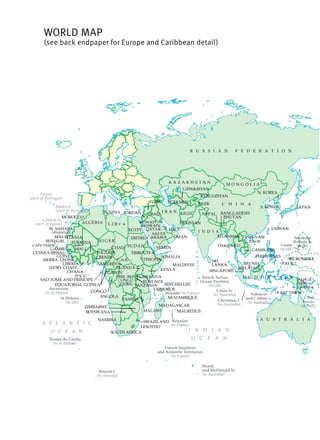
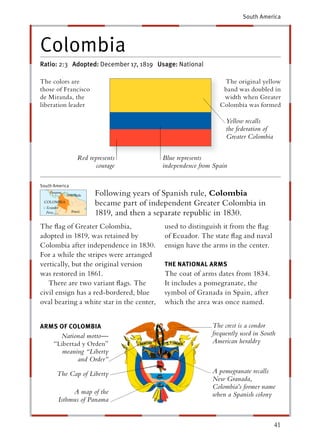
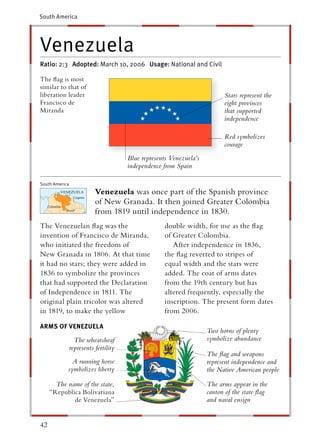
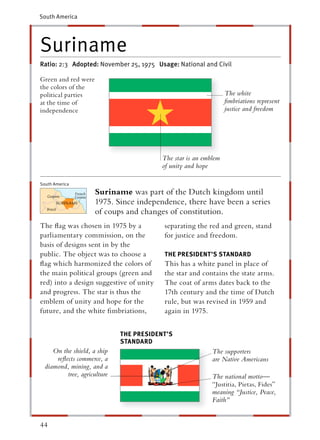
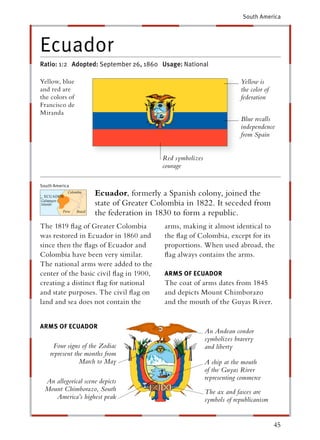
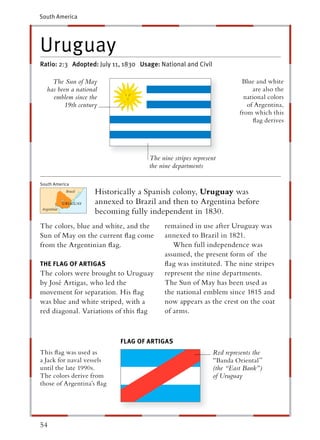
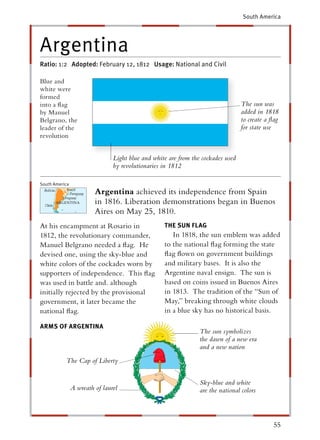
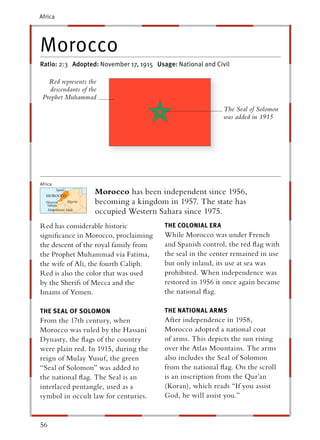
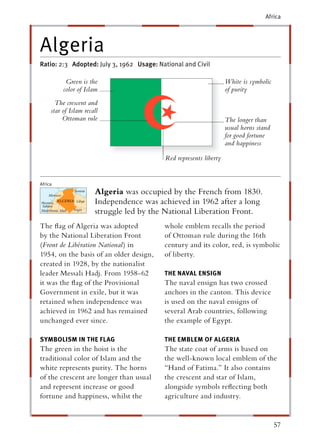
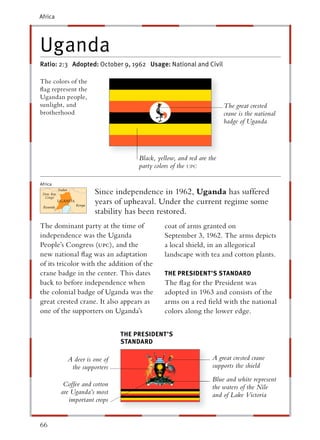
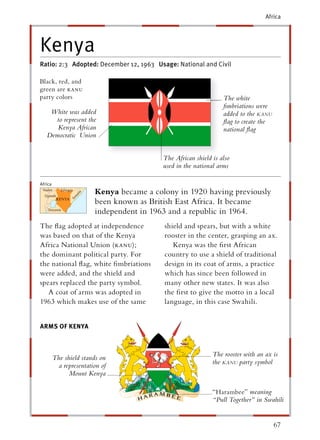
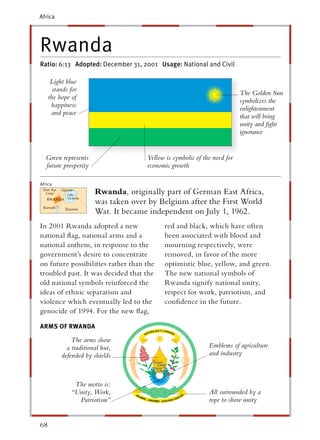
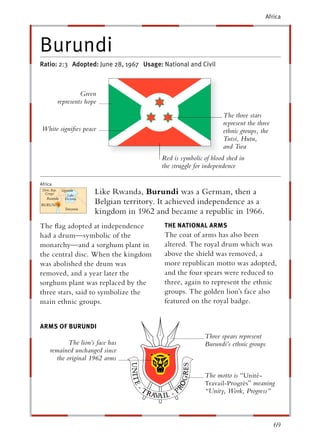
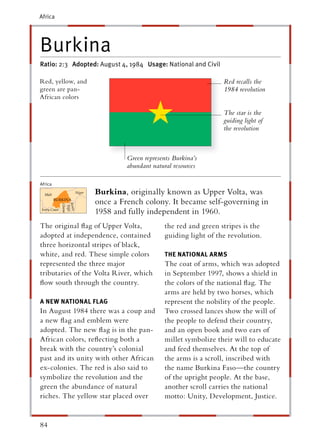
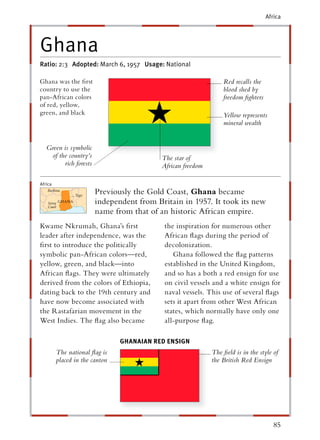
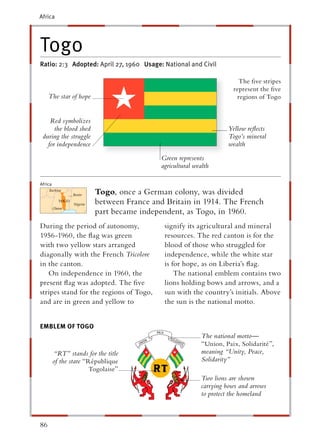
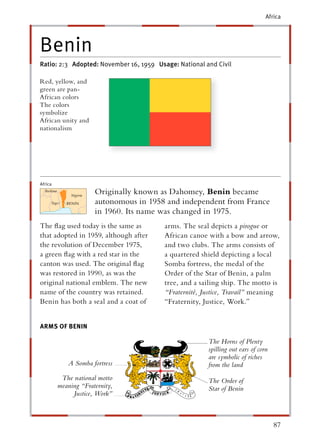
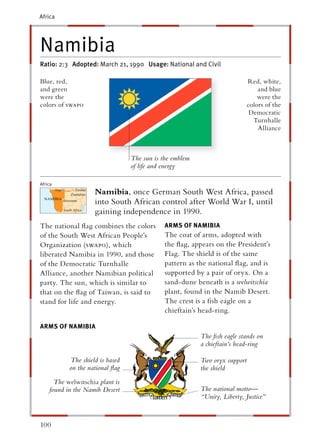
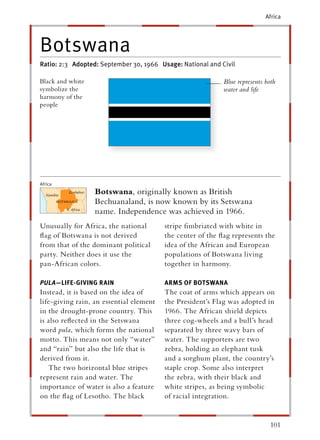
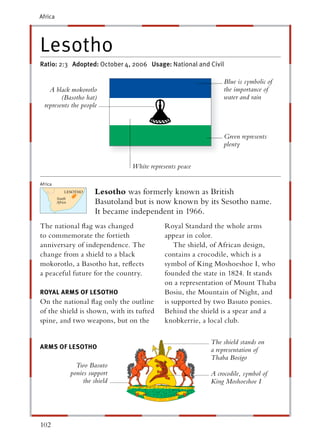
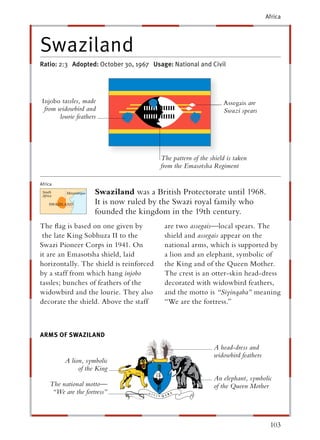
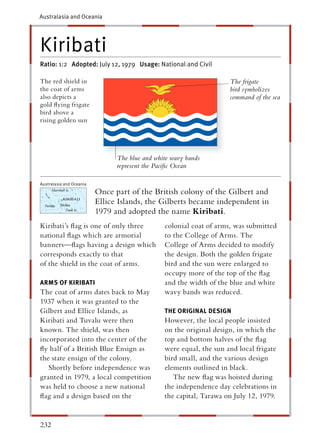
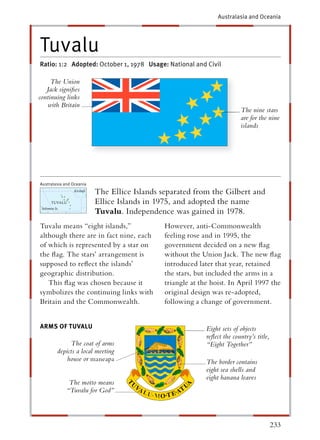
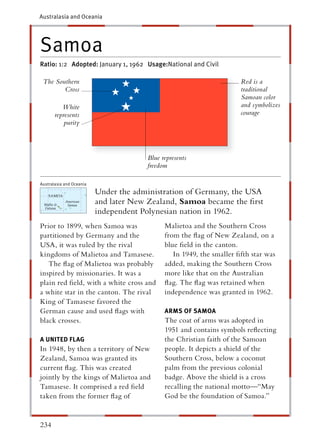
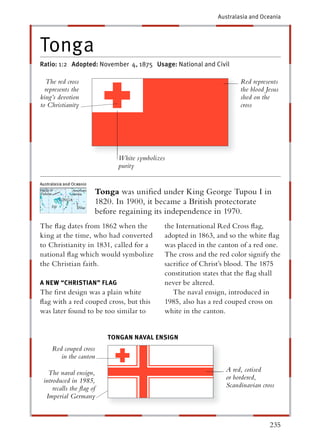
WORLD MAP
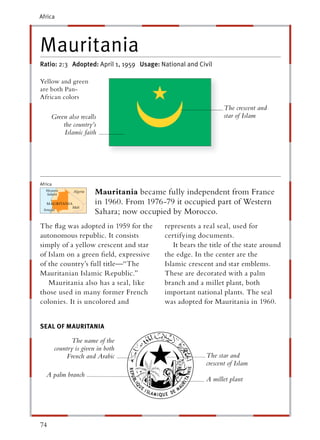
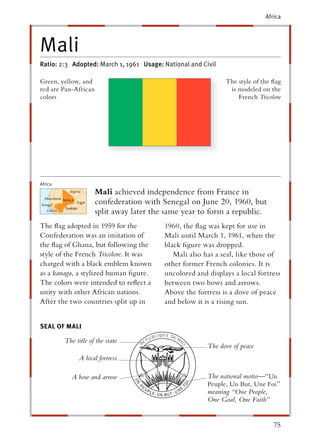
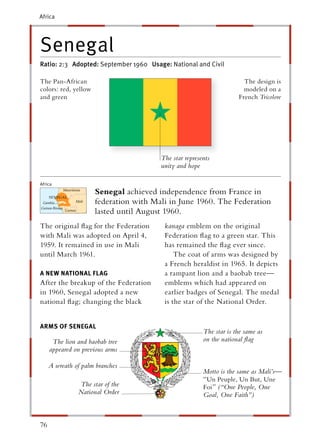
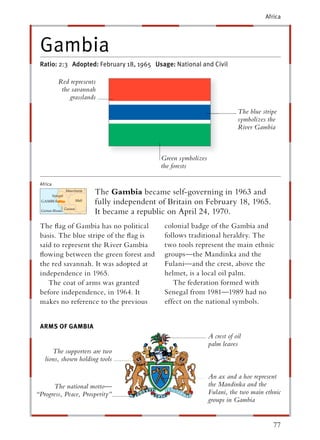
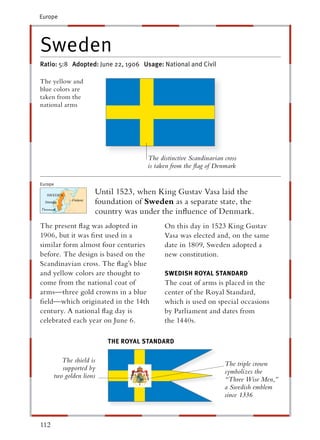
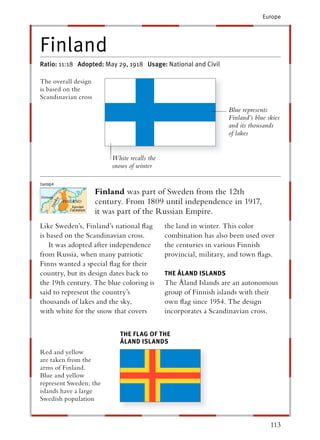
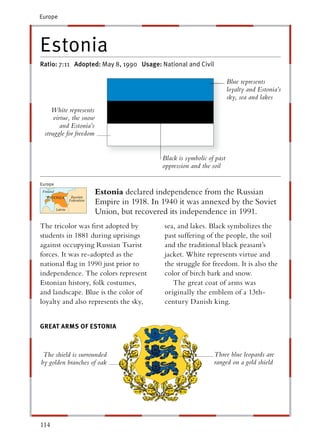
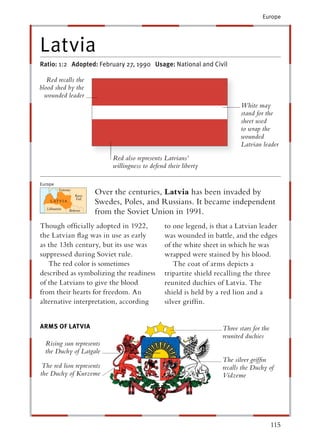
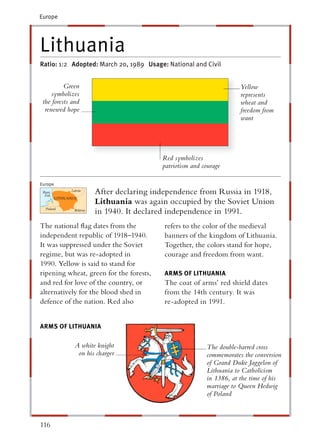
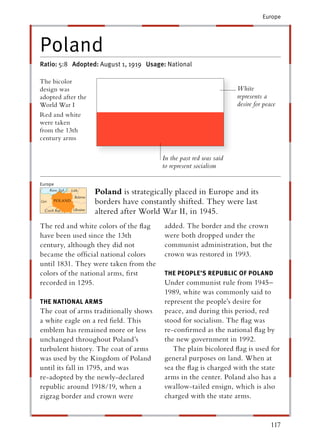
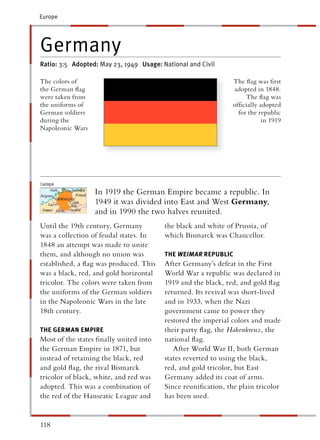
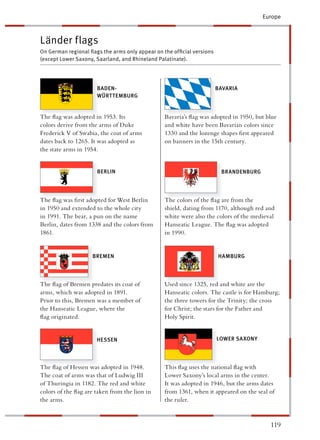
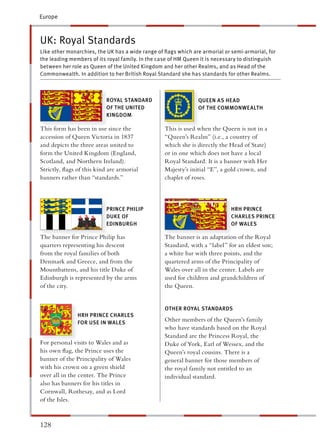
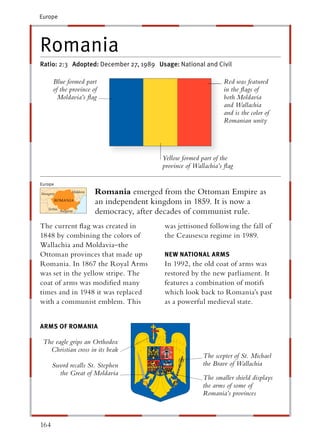
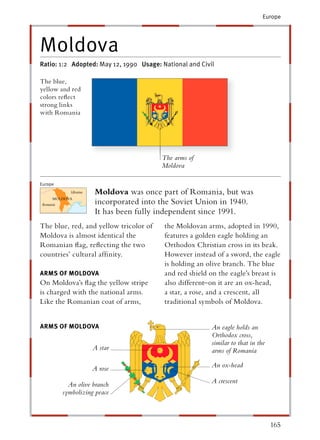
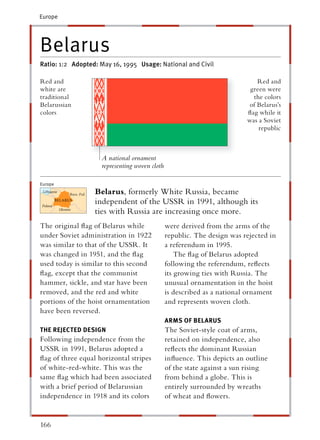
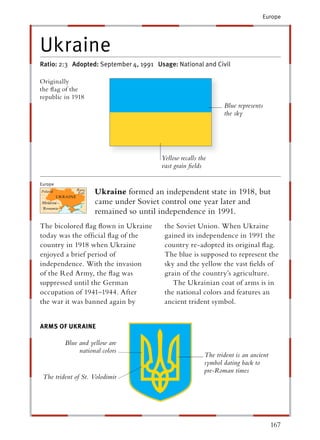
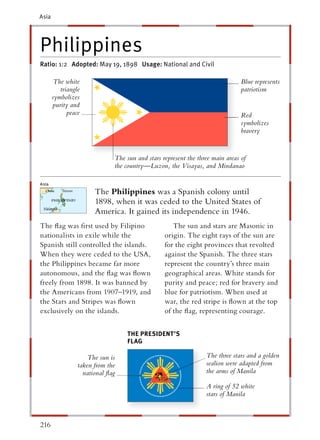
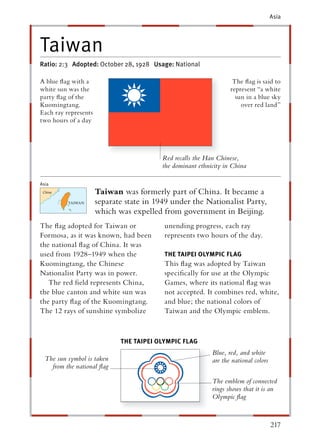
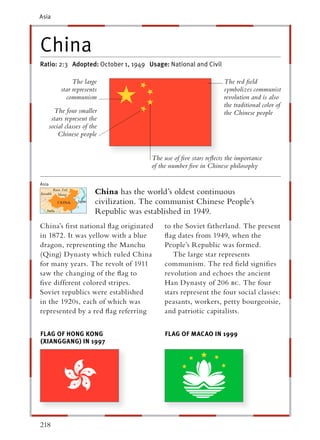
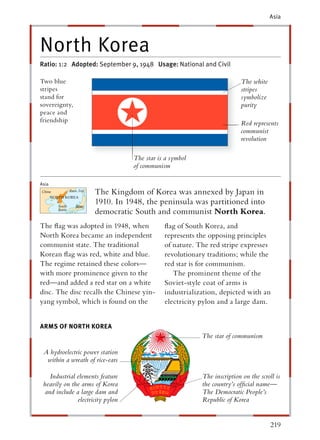
(see back endpaper for Europe and Caribbean detail)
This page intentionally left blank
COMPLETE
FLAGS
OF THE WORLD
LONDON, NEW YORK, MELBOURNE
MUNICH, AND DELHI

This book was produced in association with The Flag Institute, UK.
We would like to dedicate this book to the late Dr. William G. Crampton,
Director of the Flag Institute, without whom it would not have been possible.

Vexillology artwork and consultants Graham Bartram, Michael Faul
Editorial Contributors Roger Bullen, Debra Clapson, Wim Jenkins, Simon Mumford
US Editor Charles Wills
        r
Designers Tony Cutting, Carol Ann Davis, Yahya El Droubie, Karen Gregory, Nicki Liddiard
Systems Coordinator Philip Rowles
                  r
Managing Editor David Roberts
              r
Managing Art Editor Karen Self
                  r
Art Director Bryn Walls
Publisher Jonathan Metcalf
        r
Production Controller Rita Sinha
                    r


First published in the United States in 1997 as The Ultimate Pocket Flags of the World
by DK Publishing, 375 Hudson Street, New York, New York 10014

08 09 10 11 10 9 8 7 6 5 4 3 2 1
CD278 - November/2008
Reprinted with Revisions 1998. Second Edition 1999. Third Edition 2002. Fourth Edition 2005.
Reprinted with Revisions 2006. Fifth Edition 2008.

Copyright © 1997, 1998, 1999, 2002, 2005, 2006, 2008 Dorling Kindersley Limited. All rights reserved.
Without limiting the rights under copyright reserved above, no part of this publication may be
reproduced, stored in or introduced into a retrieval system, or transmitted, in any form, or by any means
(electronic, mechanical, photocopying, recording, or otherwise), without the prior written permission
of both the copyright owner and the above publisher of this book.
Published in Great Britain by Dorling Kindersley Limited.
A catalog record for this book is available from the Library of Congress.

ISBN-13: 978-0-7566-4115-3
DK books are available at special discounts when purchased in bulk for sales promotions, premiums,
fund-raising, or educational use. For details, contact: DK Publishing Special Markets, 375 Hudson
Street, New York, New York 10014 or SpecialSales@dk.com.
Color reproduction by Altaimage Ltd., London, UK
Printed and bound in China by L.Rex Printing Co., Ltd.

Discover more at
www.dk.com
Contents
Introduction ............................................................... 5           AFRICA
Types of flags/Parts of the flag ................ 6–7                                      Morocco/Algeria ........................................ 56–57
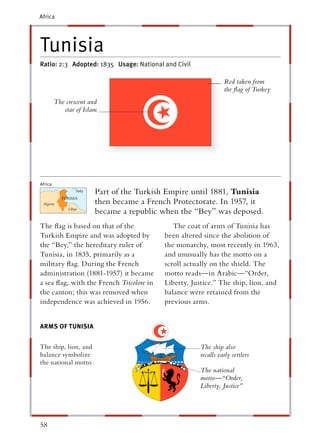
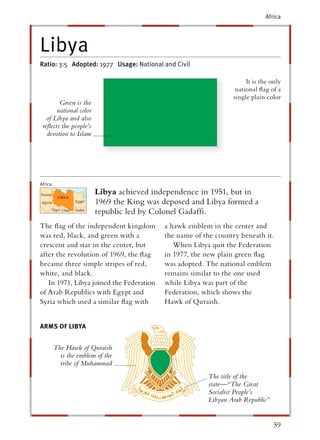
                                                                                         Tunisia/Libya ................................................ 58–59
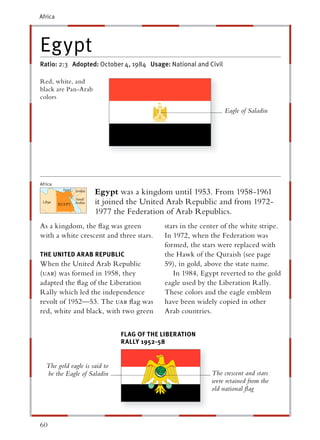
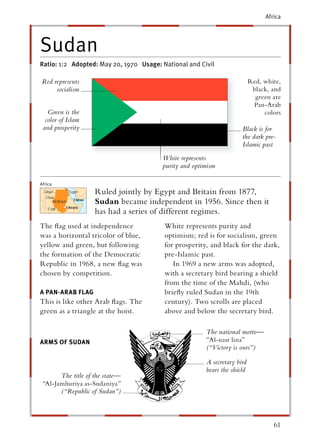
                                                                                         Egypt/Sudan ................................................ 60–61
                                                                                         Eritrea/Djibouti ......................................... 62–63
                                                                                         Ethiopia/Somalia ...................................... 64–65
NORTH & CENTRAL AMERICA                                                                  Uganda/Kenya ............................................ 66–67
Canada                                                                                   Rwanda/Burundi ...................................... 68–69
  National and subnational flags ............... 8–10                                     Central African Republic .............................. 70
United States of America                                                                 Dem. Rep. Congo .............................................. 71
  National and subnational flags ............. 11–19                                      Niger/Chad .................................................... 72–73
Mexico/Guatemala ................................... 20–21                               Mauritania/Mali .......................................... 74–75
Belize/El Salvador ..................................... 22–23                           Senegal/Gambia .......................................... 76–77
Honduras/Nicaragua ............................... 24–25                                 Cape Verde/Guinea-Bissau ................. 78–79
Costa Rica/Panama ................................. 26–27                                Guinea/Sierra Leone .............................. 80–81
Jamaica/Cuba ............................................... 28–29                       Liberia/Ivory Coast ................................. 82–83
Bahamas/Haiti .............................................. 30–31                       Burkina/Ghana ........................................... 84–85
Dominican Republic ........................................ 32                           Togo/Benin .................................................. 86–87
St. Kitts & Nevis .................................................. 33                  Nigeria/Cameroon .................................. 88–89
Antigua & Barbuda/Dominica ......... 34–35                                               Equatorial Guinea .............................................. 90
St. Lucia ..................................................................... 36       São Tomé & Príncipe ........................................ 91
St. Vincent & the Grenadines ..................... 37                                    Gabon/Congo ............................................. 92–93
Barbados/Grenada .................................... 38–39                              Angola/Zambia .......................................... 94–95
Trinidad & Tobago ............................................ 40                        Tanzania/Malawi ...................................... 96–97
                                                                                         Zimbabwe/Mozambique ..................... 98–99
                                                                                         Namibia/Botswana .............................. 100–101
                                                                                         Lesotho/Swaziland ............................... 102–103
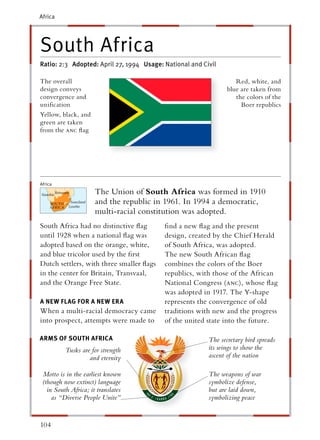
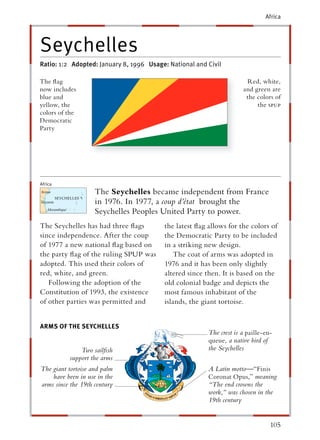
                                                                                         South Africa/Seychelles .................... 104–105
SOUTH AMERICA
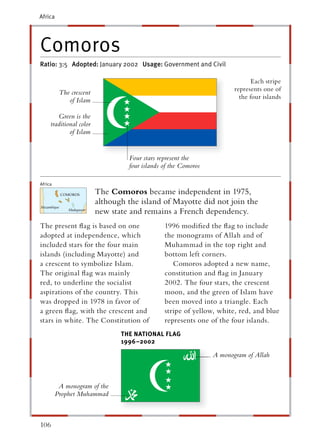
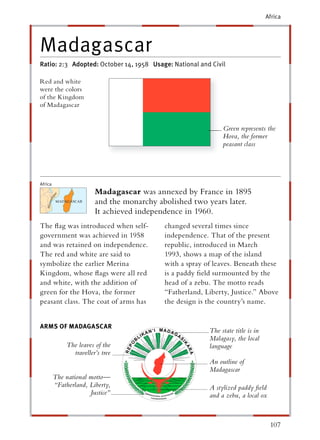
                                                                                         Comoros/Madagascar ....................... 106–107
Colombia .................................................................. 41
                                                                                         Mauritius ................................................................ 108
Venezuela/Guyana .................................... 42–43
Suriname/Ecuador .................................... 44–45
Peru .............................................................................. 46
Brazil
 National and subnational flags ............ 47–50                                        EUROPE
Chile ............................................................................. 51   Iceland ..................................................................... 109
Bolivia/Paraguay ........................................ 52–53                          Norway/Denmark ................................. 110–111
Uruguay/Argentina .................................. 54–55                               Sweden/Finland ...................................... 112–113
Estonia/Latvia .......................................... 114–115                        Jordan/Saudi Arabia ............................ 180–181
Lithuania/Poland ................................... 116–117                             Yemen/Oman ......................................... 182–183
Germany                                                                                  United Arab Emirates/Qatar ........ 184–185
  National and subnational flags ....... 118–120                                          Bahrain/Kuwait .................................... 186–187
The Netherlands                                                                          Iraq/Iran ..................................................... 188–189
  National and subnational flags ....... 121–123                                          Turkmenistan/Uzbekistan .............. 190–191
Belgium/Ireland .................................... 124–125                             Kazakhstan/Mongolia ....................... 192–193
United Kingdom                                                                           Kyrgyzstan/Tajikistan ........................ 194–195
  National and subnational flags ...... 126–130                                           Afghanistan/Pakistan ......................... 196–197
France ........................................................................ 131      Nepal/Bhutan ......................................... 198–199
Luxembourg/Monaco ........................ 132–133                                       India/Maldives ...................................... 200–201
Andorra/Portugal ................................. 134–135                               Sri Lanka/Bangladesh ...................... 202–203
Spain                                                                                    Myanmar/Thailand ............................ 204–205
  National and subnational flags ....... 136–138
                                                                                         Laos/Cambodia .................................... 206–207
Italy ............................................................................ 139
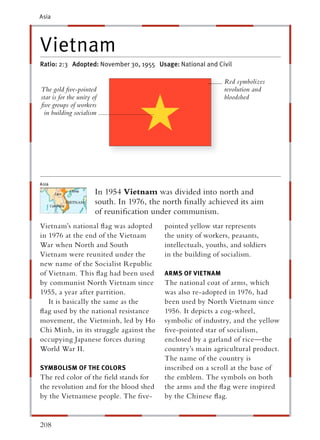
                                                                                         Vietnam ................................................................. 208
Malta/Vatican City .............................. 140–141
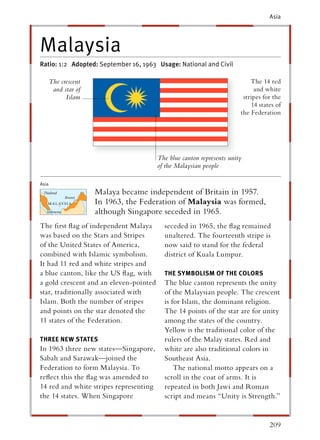
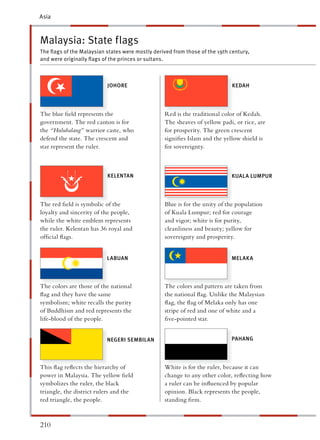
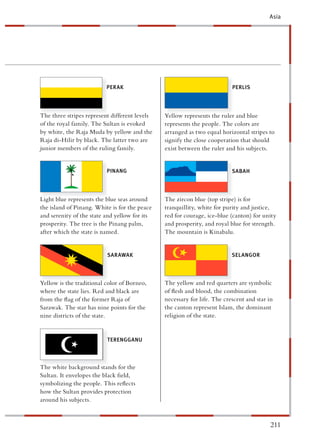
                                                                                         Malaysia
San Marino ........................................................... 142                 National and subnational flags ...... 209–211
Switzerland                                                                              Indonesia/East Timor ........................ 212–213
  National and subnational flags ....... 143–147
                                                                                         Singapore/Brunei ................................. 214–215
Liechtenstein ....................................................... 148
                                                                                         Philippines/Taiwan ............................. 216–217
Austria
                                                                                         China/North Korea ........................... 218–219
  National and subnational flags ....... 149–150
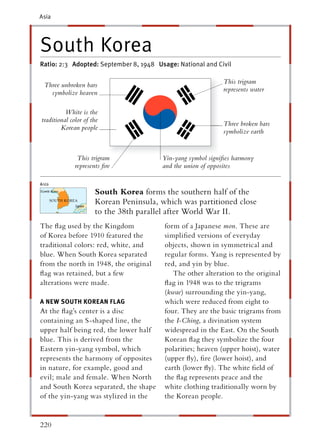
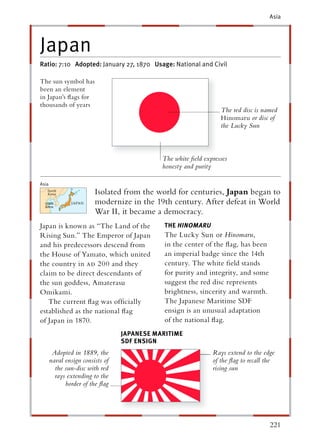
                                                                                         South Korea/Japan .............................. 220–221
Hungary .................................................................. 151
Czech Republic/Slovakia ................ 152–153
Slovenia/Croatia ..................................... 154–155
Bosnia & Herzegovina ................................... 156
Montenegro .......................................................... 157                AUSTRALASIA & OCEANIA
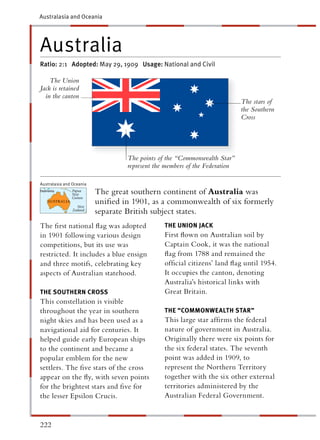
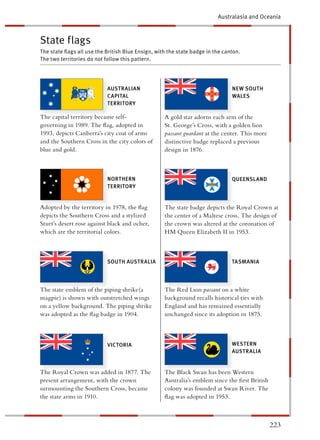
Serbia/Kosovo ......................................... 158–159                          Australia
Albania/Macedonia ............................. 160–161                                   National and subnational flags ...... 222–223
Bulgaria/Greece ..................................... 162–163                            Vanuatu/Fiji ............................................. 224–225
Romania/Moldova .............................. 164–165                                   Papua New Guinea/
Belarus/Ukraine .................................... 166–167                              Solomon Islands ................................ 226–227
Russian Federation                                                                       Palau/Micronesia ................................ 228–229
  National and subnational flags ....... 168–171                                          Marshall Islands/Nauru ................... 230–231
                                                                                         Kiribati/Tuvalu ..................................... 232–233
                                                                                         Samoa/Tonga .......................................... 234–235
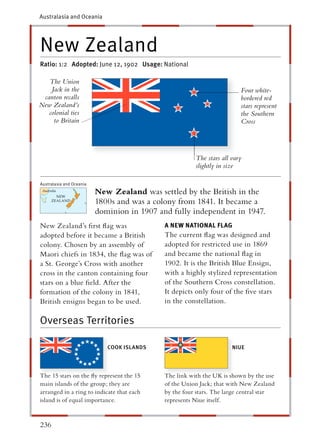
                                                                                         New Zealand ....................................................... 236

ASIA
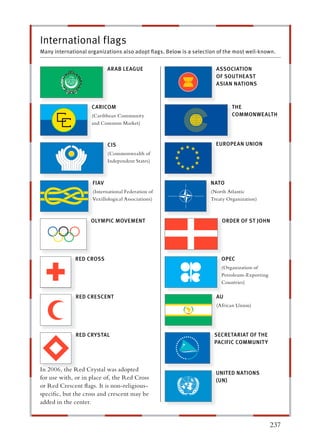
                                                                                         International flags                      ................................   237–238
Azerbaijan/Armenia ............................ 172–173
Turkey/Georgia ...................................... 174–175
                                                                                         Index      ............................................................    239–240
Lebanon/Syria ......................................... 176–177
Cyprus/Israel ........................................... 178–179
Introduction
Flags are part of everyday life.        more important in politics. Many
They are used by countries,             newly-independent states choose
provinces, cities, international        flags based on those of the political
bodies, organizations, and              parties which secured independence.
companies.                              Revolutionary movements usually
                                        have their own flags, and private
EARLY FLAGS                             and professional organizations are
The earliest known flags were used       increasingly adopting flags.
in China, to indicate different parts      This book deals with national,
of the army. In Europe flags began       international and subnational flags,
with the Roman vexillum, a square       and national coats of arms, and is
flag used by Roman cavalry, from         arranged continent by continent.
which the term “vexillology”—the        Among national flags are the state
study of flags—originated. In the        ensign and flag, for government use
Middle Ages, heraldry became            only on sea and land; the civil
important as a means of identifying     ensign and flag, for private and
kings and lords. The distinctive        commercial use; and the naval
coats of arms which developed           ensign, flown by warships.
were used as flags, and some still       Subnational flags may be
exist today.                            of states (USA), provinces (Canada),
                                        cantons (Switzerland), overseas
FLAGS FOR IDENTIFICATION                territories, or other such areas.
The most significant development of
flags was for use at sea. Ships flew      KEY FLAGS IN WORLD HISTORY
flags for identification at a distance,   Throughout history certain flags
and many of the rules of flag-use        have become the inspiration of
developed at sea. Some well-known       others, starting with the Stars and
flags were designed specifically for      Stripes in 1777 (see pages 11–12) ;
naval use, including the Dutch and      which has inspired more flags than
Spanish flags (see pages 121 & 136)      any other. The same degree of
and the International code flags (see    influence has been exercised by
page 238), which were used by ships     the French Tricolore from 1794,
to communicate with each other.         (see page 131), the Dutch Tricolor
                                        (see page 121) and its major derivative
POLITICAL FLAGS                         the Russian Tricolor (see page 168)
With the growth of independent          which gave rise to most of the flags
nation states, flags have become         of eastern Europe.

                                                                             5
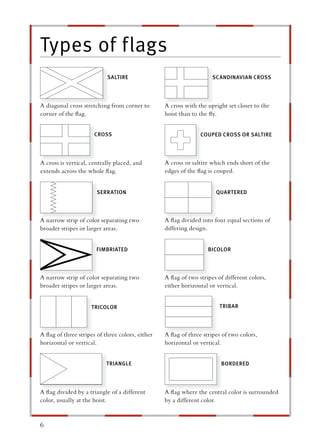
Types of flags
                           SALTIRE                                  SCANDINAVIAN CROSS


A diagonal cross stretching from corner to       A cross with the upright set closer to the
corner of the flag.                               hoist than to the fly.


                      CROSS                                    COUPED CROSS OR SALTIRE


A cross is vertical, centrally placed, and       A cross or saltire which ends short of the
extends across the whole flag.                    edges of the flag is couped.


                       SERRATION                                     QUARTERED


A narrow strip of color separating two           A flag divided into four equal sections of
broader stripes or larger areas.                 differing design.


                       FIMBRIATED                                 BICOLOR


A narrow strip of color separating two           A flag of two stripes of different colors,
broader stripes or larger areas.                 either horizontal or vertical.


                     TRICOLOR                                          TRIBAR


A flag of three stripes of three colors, either   A flag of three stripes of two colors,
horizontal or vertical.                          horizontal or vertical.


                           TRIANGLE                                    BORDERED


A flag divided by a triangle of a different       A flag where the central color is surrounded
color, usually at the hoist.                     by a different color.


6
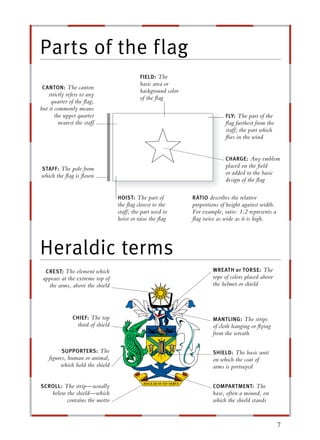
Parts of the flag
                                              FIELD: The
                                              basic area or
CANTON: The canton
                                              background color
    strictly refers to any
                                              of the flag
     quarter of the flag,
but it commonly means
       the upper quarter                                                       FLY: The part of the
         nearest the staff                                                     flag furthest from the
                                                                               staff; the part which
                                                                               flies in the wind


                                                                               CHARGE: Any emblem
STAFF: The pole from
                                                                               placed on the field
which the flag is flown                                                          or added to the basic
                                                                               design of the flag

                                    HOIST: The part of           RATIO describes the relative
                                    the flag closest to the       proportions of height against width.
                                    staff; the part used to      For example, ratio: 1:2 represents a
                                    hoist or raise the flag       flag twice as wide as it is high.


Heraldic terms
  CREST: The element which                                               WREATH or TORSE: The
 appears at the extreme top of                                           rope of colors placed above
   the arms, above the shield                                            the helmet or shield


               CHIEF: The top                                            MANTLING: The strips
                  third of shield                                        of cloth hanging or flying
                                                                         from the wreath

         SUPPORTERS: The                                                 SHIELD: The basic unit
    figures, human or animal,                                             on which the coat of
        which hold the shield                                            arms is portrayed


SCROLL: The strip—usually                                                COMPARTMENT: The
      below the shield—which                                             base, often a mound, on
            contains the motto                                           which the shield stands


                                                                                                        7
North America


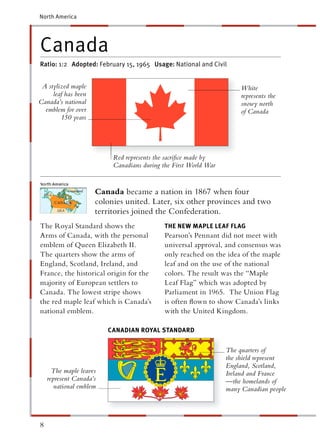
Canada
Ratio: 1:2 Adopted: February 15, 1965 Usage: National and Civil


 A stylized maple                                                     White
     leaf has been                                                    represents the
Canada’s national                                                     snowy north
  emblem for over                                                     of Canada
        150 years


                          Red represents the sacrifice made by
                          Canadians during the First World War


                     Canada became a nation in 1867 when four
                     colonies united. Later, six other provinces and two
                     territories joined the Confederation.
The Royal Standard shows the                THE NEW MAPLE LEAF FLAG
Arms of Canada, with the personal           Pearson’s Pennant did not meet with
emblem of Queen Elizabeth II.               universal approval, and consensus was
The quarters show the arms of               only reached on the idea of the maple
England, Scotland, Ireland, and             leaf and on the use of the national
France, the historical origin for the       colors. The result was the “Maple
majority of European settlers to            Leaf Flag” which was adopted by
Canada. The lowest stripe shows             Parliament in 1965. The Union Flag
the red maple leaf which is Canada’s        is often flown to show Canada’s links
national emblem.                            with the United Kingdom.

                         CANADIAN ROYAL STANDA RD
                                         T


                                                                 The quarters of
                                                                 the shield represent
                                                                 England, Scotland,
      The maple leaves                                           Ireland and France
    represent Canada’s                                           —the homelands of
       national emblem                                           many Canadian people


8
North America


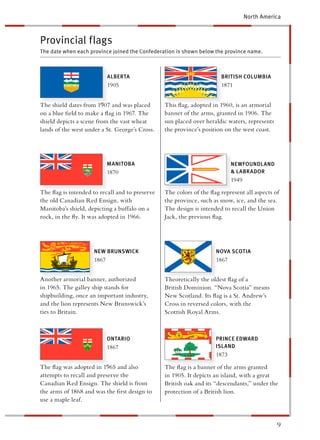
Provincial flags
The date when each province joined the Confederation is shown below the province name.


                            ALBERTA
                                 T                                    BRITISH COLUMBIA
                            1905                                      1871


The shield dates from 1907 and was placed       This flag, adopted in 1960, is an armorial
on a blue field to make a flag in 1967. The        anner of the arms, granted in 1906. The
shield depicts a scene from the vast wheat      un placed over heraldic waters, represents
lands of the west under a St. George’s Cross.   he province’s position on the west coast.


                            MANITOBA                                       NEWFOUNDLAND
                            1870                                           & LABRADOR
                                                                           1949

The flag is intended to recall and to preserve   The colors of the flag represent all aspects of
the old Canadian Red Ensign, with               he province, such as snow, ice, and the sea.
Manitoba’s shield, depicting a buffalo on a     The design is intended to recall the Union
rock, in the fly. It was adopted in 1966.        ack, the previous flag.


                     NEW BRUNSWICK                                  NOVA SCOTIA
                     1867                                           1867


Another armorial banner, authorized             Theoretically the oldest flag of a
in 1965. The galley ship stands for              ritish Dominion. “Nova Scotia” means
shipbuilding, once an important industry,       New Scotland. Its flag is a St. Andrew’s
and the lion represents New Brunswick’s         Cross in reversed colors, with the
ties to Britain.                                 cottish Royal Arms.


                            ONTA RIO
                              T                                     PRINCE EDWARD
                            1867                                    ISLAND
                                                                    1873

The flag was adopted in 1965 and also            The flag is a banner of the arms granted
attempts to recall and preserve the             n 1905. It depicts an island, with a great
Canadian Red Ensign. The shield is from          ritish oak and its “descendants,” under the
the arms of 1868 and was the first design to      rotection of a British lion.
use a maple leaf.


                                                                                             9
North America


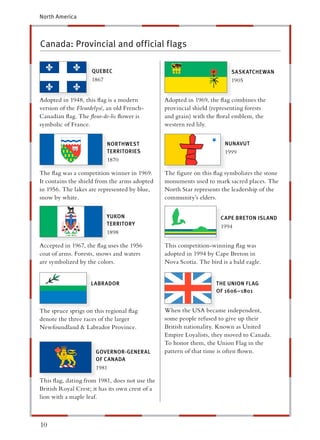
Canada: Provincial and official flags

                     QUEBEC                                                SASK ATCHEWAN
                     1867                                                  1905


Adopted in 1948, this flag is a modern            Adopted in 1969, the flag combines the
version of the Fleurdelysé, an old French-        rovincial shield (representing forests
Canadian flag. The fleur-de-lis flower is            nd grain) with the floral emblem, the
symbolic of France.                              western red lily.


                            NORTHWEST                                   NUNAVUT
                            TERRITORIES                                 1999
                            1870

The flag was a competition winner in 1969.        The figure on this flag symbolizes the stone
It contains the shield from the arms adopted     monuments used to mark sacred places. The
in 1956. The lakes are represented by blue,      North Star represents the leadership of the
snow by white.                                    ommunity’s elders.

                            YUKON                                      CAPE BRETON ISLAND
                            TERRITORY                                  1994
                            1898

Accepted in 1967, the flag uses the 1956          This competition-winning flag was
coat of arms. Forests, snows and waters           dopted in 1994 by Cape Breton in
are symbolized by the colors.                    Nova Scotia. The bird is a bald eagle.


                    LABRADOR                                         THE UNION FLAG
                                                                     OF 1606–1801


The spruce sprigs on this regional flag           When the USA became independent,
denote the three races of the larger              ome people refused to give up their
Newfoundland & Labrador Province.                British nationality. Known as United
                                                   mpire Loyalists, they moved to Canada.
                                                 To honor them, the Union Flag in the
                      GOVERNOR-GENERAL            attern of that time is often flown.
                      OF CANADA
                      1981

This flag, dating from 1981, does not use the
British Royal Crest; it has its own crest of a
lion with a maple leaf.


10
North America


United States of America
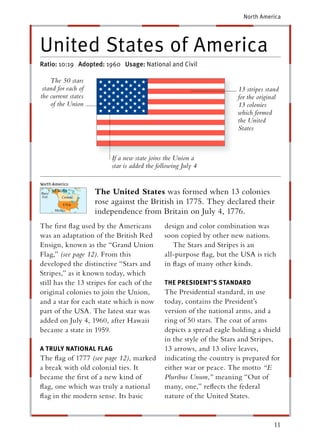
Ratio: 10:19 Adopted: 1960 Usage: National and Civil

    The 50 stars
 stand for each of                                                    13 stripes stand
the current states                                                    for the original
    of the Union                                                      13 colonies
                                                                      which formed
                                                                      the United
                                                                      States


                         If a new state joins the Union a
                         star is added the following July 4


                     The United States was formed when 13 colonies
                     rose against the British in 1775. They declared their
                     independence from Britain on July 4, 1776.
The first flag used by the Americans            design and color combination was
was an adaptation of the British Red          soon copied by other new nations.
Ensign, known as the “Grand Union                The Stars and Stripes is an
Flag,” (see page 12). From this               all-purpose flag, but the USA is rich
developed the distinctive “Stars and          in flags of many other kinds.
Stripes,” as it known today, which
still has the 13 stripes for each of the      THE PRESIDENT’S STA NDARD
                                                               T
original colonies to join the Union,          The Presidential standard, in use
and a star for each state which is now        today, contains the President’s
part of the USA. The latest star was          version of the national arms, and a
added on July 4, 1960, after Hawaii           ring of 50 stars. The coat of arms
became a state in 1959.                       depicts a spread eagle holding a shield
                                              in the style of the Stars and Stripes,
A TRULY NATIONAL FLAG                         13 arrows, and 13 olive leaves,
The flag of 1777 (see page 12), marked         indicating the country is prepared for
a break with old colonial ties. It            either war or peace. The motto “E
became the first of a new kind of              Pluribus Unum,” meaning “Out of
flag, one which was truly a national           many, one,” reflects the federal
flag in the modern sense. Its basic            nature of the United States.


                                                                                    11
North America


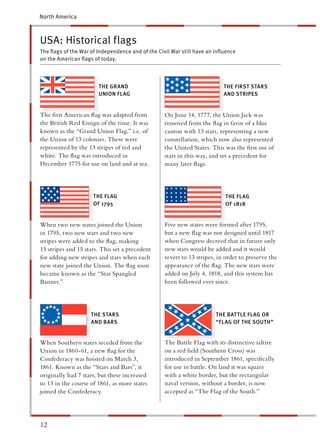
USA: Historical flags
The flags of the War of Independence and of the Civil War still have an influence
on the American flags of today.


                       THE GRAND                                          THE FIRST STARS
                                                                                     T
                       UNION FLAG                                         AND STRIPES


The first American flag was adapted from            On June 14, 1777, the Union Jack was
the British Red Ensign of the time. It was        emoved from the flag in favor of a blue
known as the “Grand Union Flag,” i.e. of           anton with 13 stars, representing a new
the Union of 13 colonies. These were               onstellation, which now also represented
represented by the 13 stripes of red and          he United States. This was the first use of
white. The flag was introduced in                  tars in this way, and set a precedent for
December 1775 for use on land and at sea.         many later flags.


                     THE FLAG                                             THE FLAG
                     OF 1795                                              OF 1818


When two new states joined the Union               ive new states were formed after 1795,
in 1795, two new stars and two new                 ut a new flag was not designed until 1817
stripes were added to the flag, making             when Congress decreed that in future only
15 stripes and 15 stars. This set a precedent      ew stars would be added and it would
for adding new stripes and stars when each        evert to 13 stripes, in order to preserve the
new state joined the Union. The flag soon           ppearance of the flag. The new stars were
became known as the “Star Spangled                 dded on July 4, 1818, and this system has
Banner.”                                           een followed ever since.


                    THE STARS
                         T                                             THE BATTLE FLAG OR
                    AND BARS                                           “FLAG OF THE SOUTH”


When Southern states seceded from the             The Battle Flag with its distinctive saltire
Union in 1860-61, a new flag for the                n a red field (Southern Cross) was
Confederacy was hoisted on March 3,               ntroduced in September 1861, specifically
1861. Known as the “Stars and Bars”, it           or use in battle. On land it was square
originally had 7 stars, but these increased       with a white border, but the rectangular
to 13 in the course of 1861, as more states        aval version, without a border, is now
joined the Confederacy.                            ccepted as “The Flag of the South.”


12
North America


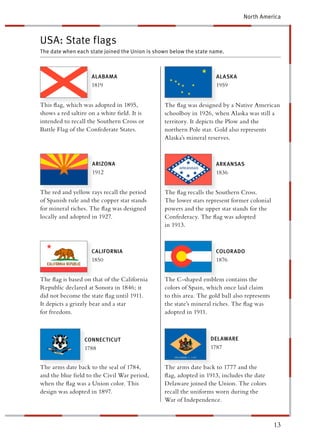
USA: State flags
The date when each state joined the Union is shown below the state name.


                    ALABAMA                                         ALASK A
                    1819                                            1959


This flag, which was adopted in 1895,            The flag was designed by a Native American
shows a red saltire on a white field. It is      choolboy in 1926, when Alaska was still a
intended to recall the Southern Cross or        erritory. It depicts the Plow and the
Battle Flag of the Confederate States.           orthern Pole star. Gold also represents
                                                Alaska’s mineral reserves.


                     ARIZONA                                        ARK ANSAS
                     1912                                           1836


The red and yellow rays recall the period       The flag recalls the Southern Cross.
of Spanish rule and the copper star stands      The lower stars represent former colonial
for mineral riches. The flag was designed         owers and the upper star stands for the
locally and adopted in 1927.                    Confederacy. The flag was adopted
                                                n 1913.


                    CALIFORNIA                                      COLORADO
                    1850                                            1876


The flag is based on that of the California      The C-shaped emblem contains the
Republic declared at Sonora in 1846; it          olors of Spain, which once laid claim
did not become the state flag until 1911.        o this area. The gold ball also represents
It depicts a grizzly bear and a star            he state’s mineral riches. The flag was
for freedom.                                     dopted in 1911.


                 CONNECTICUT                                      DELAWARE
                 1788                                             1787


The arms date back to the seal of 1784,         The arms date back to 1777 and the
and the blue field to the Civil War period,       ag, adopted in 1913, includes the date
when the flag was a Union color. This            Delaware joined the Union. The colors
design was adopted in 1897.                     ecall the uniforms worn during the
                                                War of Independence.


                                                                                             13
North America


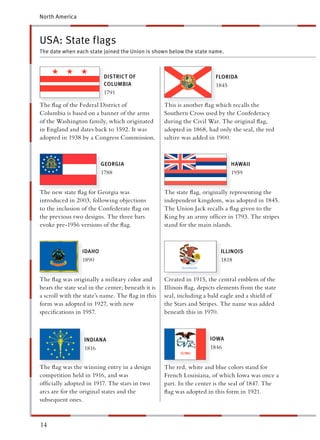
USA: State flags
The date when each state joined the Union is shown below the state name.


                          DISTRICT OF                                   FLORIDA
                          COLUMBIA                                      1845
                          1791

The flag of the Federal District of                  This is another flag which recalls the
Columbia is based on a banner of the arms            outhern Cross used by the Confederacy
of the Washington family, which originated           uring the Civil War. The original flag,
in England and dates back to 1592. It was            dopted in 1868, had only the seal, the red
adopted in 1938 by a Congress Commission.           altire was added in 1900.


                         GEORGIA                                               HAWAII
                         1788                                                  1959


The new state flag for Georgia was                   The state flag, originally representing the
introduced in 2003, following objections            ndependent kingdom, was adopted in 1845.
to the inclusion of the Confederate flag on          The Union Jack recalls a flag given to the
the previous two designs. The three bars            King by an army officer in 1793. The stripes
evoke pre-1956 versions of the flag.                  and for the main islands.


                 IDAHO                                                       LLINOIS
                 1890                                                     1818


The flag was originally a military color and         Created in 1915, the central emblem of the
bears the state seal in the center; beneath it is    linois flag, depicts elements from the state
a scroll with the state’s name. The flag in this     eal, including a bald eagle and a shield of
form was adopted in 1927, with new                  he Stars and Stripes. The name was added
specifications in 1957.                               eneath this in 1970.


                   NDIANA                                             OWA
                  1816                                                1846


The flag was the winning entry in a design           The red, white and blue colors stand for
competition held in 1916, and was                    rench Louisiana, of which Iowa was once a
officially adopted in 1917. The stars in two          art. In the center is the seal of 1847. The
arcs are for the original states and the             ag was adopted in this form in 1921.
subsequent ones.


14
North America


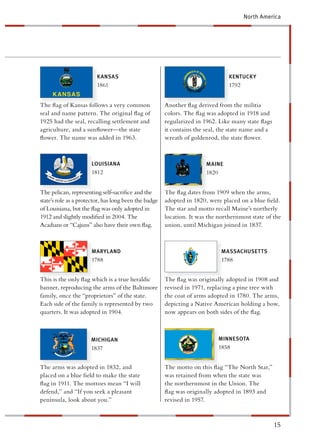
                         K ANSAS                                                 KENTUCK Y
                         1861                                                    1792


The flag of Kansas follows a very common                Another flag derived from the militia
seal and name pattern. The original flag of              olors. The flag was adopted in 1918 and
1925 had the seal, recalling settlement and            egularized in 1962. Like many state flags
agriculture, and a sunflower—the state                    contains the seal, the state name and a
flower. The name was added in 1963.                     wreath of goldenrod, the state flower.


                      LOUISIANA                                        MAINE
                      1812                                             1820


The pelican, representing self-sacrifice and the        The flag dates from 1909 when the arms,
state’s role as a protector, has long been the badge    dopted in 1820, were placed on a blue field.
of Louisiana, but the flag was only adopted in          The star and motto recall Maine’s northerly
1912 and slightly modified in 2004. The                 ocation. It was the northernmost state of the
Acadians or “Cajuns” also have their own flag.           nion, until Michigan joined in 1837.


                      MARYLAND                                                MASSACHUSETTS
                      1788                                                    1788


This is the only flag which is a true heraldic          The flag was originally adopted in 1908 and
banner, reproducing the arms of the Baltimore          evised in 1971, replacing a pine tree with
family, once the “proprietors” of the state.           he coat of arms adopted in 1780. The arms,
Each side of the family is represented by two           epicting a Native American holding a bow,
quarters. It was adopted in 1904.                       ow appears on both sides of the flag.


                      MICHIGAN                                                MINNESOTA
                      1837                                                    1858


The arms was adopted in 1832, and                      The motto on this flag “The North Star,”
placed on a blue field to make the state                was retained from when the state was
flag in 1911. The mottoes mean “I will                  he northernmost in the Union. The
defend,” and “If you seek a pleasant                    ag was originally adopted in 1893 and
peninsula, look about you.”                            evised in 1957.


                                                                                                   15
North America


USA: State flags
The date when each state joined the Union is shown below the state name.


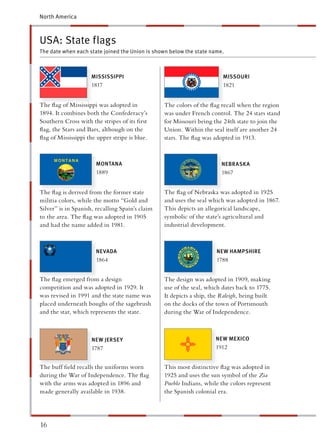
                     MISSISSIPPI                                        MISSOURI
                     1817                                               1821


The flag of Mississippi was adopted in            The colors of the flag recall when the region
1894. It combines both the Confederacy’s         was under French control. The 24 stars stand
Southern Cross with the stripes of its first      or Missouri being the 24th state to join the
flag, the Stars and Bars, although on the         Union. Within the seal itself are another 24
flag of Mississippi the upper stripe is blue.      ars. The flag was adopted in 1913.


                       MONTANA                                         NEBRASK A
                       1889                                            1867


The flag is derived from the former state         The flag of Nebraska was adopted in 1925
militia colors, while the motto “Gold and         nd uses the seal which was adopted in 1867.
Silver” is in Spanish, recalling Spain’s claim   This depicts an allegorical landscape,
to the area. The flag was adopted in 1905         ymbolic of the state’s agricultural and
and had the name added in 1981.                  ndustrial development.


                       NEVADA                                        NEW HAMPSHIRE
                       1864                                          1788


The flag emerged from a design                    The design was adopted in 1909, making
competition and was adopted in 1929. It           se of the seal, which dates back to 1775.
was revised in 1991 and the state name was         depicts a ship, the Raleigh, being built
placed underneath boughs of the sagebrush         n the docks of the town of Portsmouth
and the star, which represents the state.         uring the War of Independence.


                     NEW JERSEY                                      NEW MEXICO
                     1787                                            1912


The buff field recalls the uniforms worn          This most distinctive flag was adopted in
during the War of Independence. The flag           925 and uses the sun symbol of the Zia
with the arms was adopted in 1896 and             ueblo Indians, while the colors represent
made generally available in 1938.                he Spanish colonial era.


16
North America


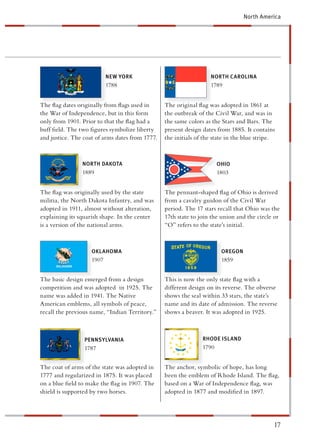
                           NEW YORK                                NORTH CAROLINA
                           1788                                    1789


The flag dates originally from flags used in       The original flag was adopted in 1861 at
the War of Independence, but in this form        he outbreak of the Civil War, and was in
only from 1901. Prior to that the flag had a      he same colors as the Stars and Bars. The
buff field. The two figures symbolize liberty       resent design dates from 1885. It contains
and justice. The coat of arms dates from 1777.   he initials of the state in the blue stripe.


                NORTH DAKOTA                                           OHIO
                1889                                                   1803


The flag was originally used by the state         The pennant-shaped flag of Ohio is derived
militia, the North Dakota Infantry, and was      rom a cavalry guidon of the Civil War
adopted in 1911, almost without alteration,       eriod. The 17 stars recall that Ohio was the
explaining its squarish shape. In the center      7th state to join the union and the circle or
is a version of the national arms.                O” refers to the state’s initial.


                    OKLAHOMA                                            OREGON
                    1907                                                1859


The basic design emerged from a design           This is now the only state flag with a
competition and was adopted in 1925. The          ifferent design on its reverse. The obverse
name was added in 1941. The Native               hows the seal within 33 stars, the state’s
American emblems, all symbols of peace,           ame and its date of admission. The reverse
recall the previous name, “Indian Territory.”    hows a beaver. It was adopted in 1925.


                 PENNSYLVANIA                                   RHODE ISLAND
                 1787                                           1790


The coat of arms of the state was adopted in     The anchor, symbolic of hope, has long
1777 and regularized in 1875. It was placed       een the emblem of Rhode Island. The flag,
on a blue field to make the flag in 1907. The       ased on a War of Independence flag, was
shield is supported by two horses.                dopted in 1877 and modified in 1897.


                                                                                            17
North America


USA: State flags
The date when each state joined the Union is shown below the state name.


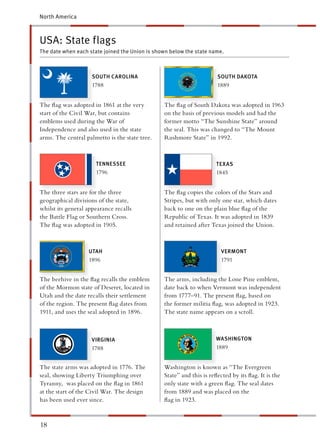
                     SOUTH CAROLINA                                   SOUTH DAKOTA
                     1788                                             1889


The flag was adopted in 1861 at the very         The flag of South Dakota was adopted in 1963
start of the Civil War, but contains             n the basis of previous models and had the
emblems used during the War of                  ormer motto “The Sunshine State” around
Independence and also used in the state         he seal. This was changed to “The Mount
arms. The central palmetto is the state tree.   Rushmore State” in 1992.


                      TENNESSEE                                       TEX AS
                      1796                                            1845


The three stars are for the three               The flag copies the colors of the Stars and
geographical divisions of the state,             tripes, but with only one star, which dates
whilst its general appearance recalls            ack to one on the plain blue flag of the
the Battle Flag or Southern Cross.              Republic of Texas. It was adopted in 1839
The flag was adopted in 1905.                     nd retained after Texas joined the Union.


                   UTAH                                                 VERMONT
                   1896                                                 1791


The beehive in the flag recalls the emblem       The arms, including the Lone Pine emblem,
of the Mormon state of Deseret, located in       ate back to when Vermont was independent
Utah and the date recalls their settlement      rom 1777–91. The present flag, based on
of the region. The present flag dates from       he former militia flag, was adopted in 1923.
1911, and uses the seal adopted in 1896.        The state name appears on a scroll.


                    VIRGINIA                                         WASHINGTON
                    1788                                             1889


The state arms was adopted in 1776. The         Washington is known as “The Evergreen
seal, showing Liberty Triumphing over            tate” and this is reflected by its flag. It is the
Tyranny, was placed on the flag in 1861           nly state with a green flag. The seal dates
at the start of the Civil War. The design       rom 1889 and was placed on the
has been used ever since.                        ag in 1923.


18
North America


USA: State and overseas territory flags
The date when each state joined the Union is shown below the state name.


                             WEST VIRGINIA                                 WISCONSIN
                             1863                                          1848


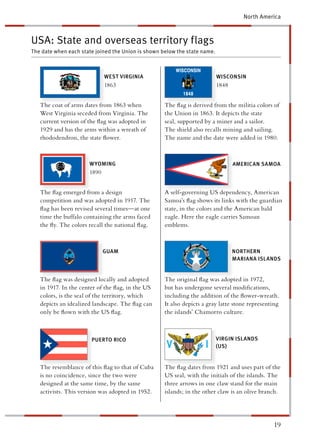
   The coat of arms dates from 1863 when            The flag is derived from the militia colors of
   West Virginia seceded from Virginia. The         he Union in 1863. It depicts the state
   current version of the flag was adopted in        eal, supported by a miner and a sailor.
   1929 and has the arms within a wreath of         The shield also recalls mining and sailing.
   rhododendron, the state flower.                   The name and the date were added in 1980.


                      W YOMING                                                     MERICAN SAMOA
                      1890


   The flag emerged from a design                    A self-governing US dependency, American
   competition and was adopted in 1917. The          amoa’s flag shows its links with the guardian
   flag has been revised several times—at one         ate, in the colors and the American bald
   time the buffalo containing the arms faced        agle. Here the eagle carries Samoan
   the fly. The colors recall the national flag.       mblems.


                             GUAM                                                 NORTHERN
                                                                                  MARIANA ISLANDS


   The flag was designed locally and adopted         The original flag was adopted in 1972,
   in 1917. In the center of the flag, in the US      ut has undergone several modifications,
   colors, is the seal of the territory, which      ncluding the addition of the flower-wreath.
   depicts an idealized landscape. The flag can      t also depicts a gray latte stone representing
   only be flown with the US flag.                    he islands’ Chamorro culture.


                       PUERTO RICO                                         VIRGIN ISLANDS
                                                                           (US)


   The resemblance of this flag to that of Cuba      The flag dates from 1921 and uses part of the
   is no coincidence, since the two were            US seal, with the initials of the islands. The
   designed at the same time, by the same           hree arrows in one claw stand for the main
   activists. This version was adopted in 1952.      lands; in the other claw is an olive branch.


                                                                                               19
North America


Mexico
Ratio: 4:7 Adopted: November 2, 1821 Usage: National and Civil

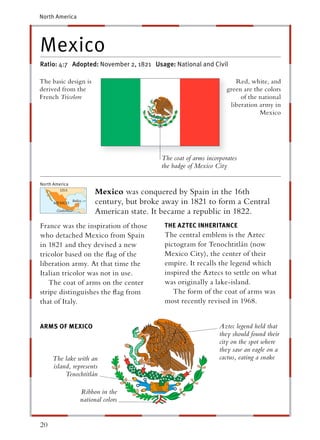
The basic design is                                                 Red, white, and
derived from the                                                 green are the colors
French Tricolore                                                      of the national
                                                                  liberation army in
                                                                             Mexico


                                        The coat of arms incorporates
                                        the badge of Mexico City

North America
                      Mexico was conquered by Spain in the 16th
                      century, but broke away in 1821 to form a Central
                      American state. It became a republic in 1822.
France was the inspiration of those      THE AZTEC INHERITANCE
who detached Mexico from Spain           The central emblem is the Aztec
in 1821 and they devised a new           pictogram for Tenochtitlán (now
tricolor based on the flag of the         Mexico City), the center of their
liberation army. At that time the        empire. It recalls the legend which
Italian tricolor was not in use.         inspired the Aztecs to settle on what
   The coat of arms on the center        was originally a lake-island.
stripe distinguishes the flag from           The form of the coat of arms was
that of Italy.                           most recently revised in 1968.


ARMS OF MEXICO                                                Aztec legend held that
                                                              they should found their
                                                              city on the spot where
                                                              they saw an eagle on a
     The lake with an                                         cactus, eating a snake
     island, represents
          Tenochtitlán

                Ribbon in the
                national colors


20
North America


Guatemala
Ratio: 5:8 Adopted: August 17, 1871 Usage: National and State

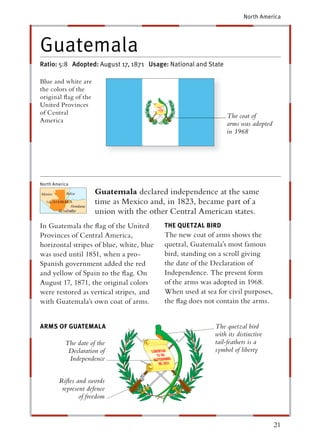
Blue and white are
the colors of the
original flag of the
United Provinces
of Central
                                                                The coat of
America
                                                                arms was adopted
                                                                in 1968


North America
                      Guatemala declared independence at the same
                      time as Mexico and, in 1823, became part of a
                      union with the other Central American states.
In Guatemala the flag of the United        THE QUETZAL BIRD
Provinces of Central America,             The new coat of arms shows the
horizontal stripes of blue, white, blue   quetzal, Guatemala’s most famous
was used until 1851, when a pro-          bird, standing on a scroll giving
Spanish government added the red          the date of the Declaration of
and yellow of Spain to the flag. On        Independence. The present form
August 17, 1871, the original colors      of the arms was adopted in 1968.
were restored as vertical stripes, and    When used at sea for civil purposes,
with Guatemala’s own coat of arms.        the flag does not contain the arms.


ARMS OF GUATEMALA                                         The quetzal bird
                                                          with its distinctive
           The date of the                                tail-feathers is a
            Declaration of                                symbol of liberty
            Independence


        Rifles and swords
         represent defence
                of freedom


                                                                                   21
North America


Belize
Ratio: 3:5 Adopted: September 21, 1981 Usage: National and Civil

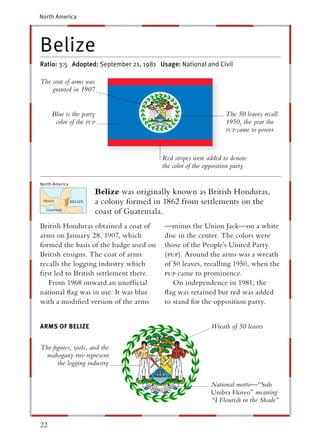
The coat of arms was
    granted in 1907


     Blue is the party                                          The 50 leaves recall
      color of the PUP                                          1950, the year the
                                                                PUP came to power
                                                                  P


                                        Red stripes were added to denote
                                        the color of the opposition party

North America
                     Belize was originally known as British Honduras,
                     a colony formed in 1862 from settlements on the
                     coast of Guatemala.
British Honduras obtained a coat of      —minus the Union Jack—on a white
arms on January 28, 1907, which          disc in the center. The colors were
formed the basis of the badge used on    those of the People’s United Party
British ensigns. The coat of arms        (pup). Around the arms was a wreath
recalls the logging industry which       of 50 leaves, recalling 1950, when the
first led to British settlement there.    pup came to prominence.
   From 1968 onward an unofficial            On independence in 1981, the
national flag was in use. It was blue     flag was retained but red was added
with a modified version of the arms       to stand for the opposition party.


ARMS OF BELIZE                                             Wreath of 50 leaves

The figures, tools, and the
  mahogany tree represent
     the logging industry


                                                           National motto—“ Sub
                                                           Umbra Floreo” meaning
                                                           “I Flourish in the Shade”


22
North America


El Salvador
Ratio: 1:2 Adopted: May 17, 1912 Usage: National and State

The flag is
modeled on the
flag of the United                                                          The title of the
Provinces of                                                               state while it was
Central America                                                            part of the United
                                                                           Provinces of
                                                                           Central America
                                                                           surrounds the
                                                                           emblem

                     The emblem is surrounded by five flags, recalling the
                      original five United Provinces of Central America

North America
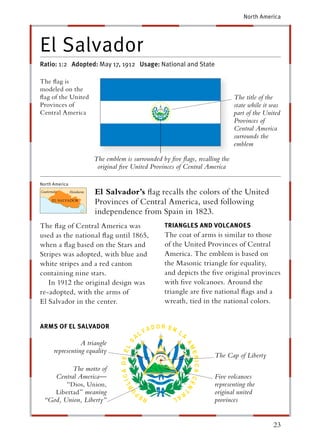
                      El Salvador’s flag recalls the colors of the United
                      Provinces of Central America, used following
                      independence from Spain in 1823.
The flag of Central America was                 TRIANGLES AND VOLCANOES
used as the national flag until 1865,           The coat of arms is similar to those
when a flag based on the Stars and              of the United Provinces of Central
Stripes was adopted, with blue and             America. The emblem is based on
white stripes and a red canton                 the Masonic triangle for equality,
containing nine stars.                         and depicts the five original provinces
   In 1912 the original design was             with five volcanoes. Around the
re-adopted, with the arms of                   triangle are five national flags and a
El Salvador in the center.                     wreath, tied in the national colors.


ARMS OF EL SALVADOR

                 A triangle
      representing equality
                                                                  The Cap of Liberty
          The motto of
    Central America—                                              Five volcanoes
        “Dios, Union,                                             representing the
    Libertad ” meaning                                            original united
 “God, Union, Liberty”                                            provinces


                                                                                          23
North America


Honduras
Ratio: 1:2 Adopted: February 16, 1866 Usage: National and Civil

The colors and
pattern are the
same as the flag
of the United
Provinces
of Central
America


                                     Five stars recall the five original members of
                                     the United Provinces of Central America


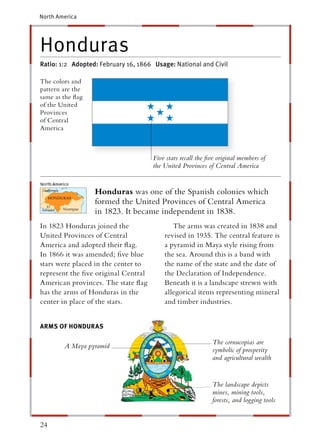
                  Honduras was one of the Spanish colonies which
                  formed the United Provinces of Central America
                  in 1823. It became independent in 1838.
In 1823 Honduras joined the                 The arms was created in 1838 and
United Provinces of Central              revised in 1935. The central feature is
America and adopted their flag.           a pyramid in Maya style rising from
In 1866 it was amended; five blue         the sea. Around this is a band with
stars were placed in the center to       the name of the state and the date of
represent the five original Central       the Declaration of Independence.
American provinces. The state flag        Beneath it is a landscape strewn with
has the arms of Honduras in the          allegorical items representing mineral
center in place of the stars.            and timber industries.


ARMS OF HONDURAS

                                                            The cornucopias are
        A Maya pyramid
                                                            symbolic of prosperity
                                                            and agricultural wealth


                                                            The landscape depicts
                                                            mines, mining tools,
                                                            forests, and logging tools


24
North America


Nicaragua
Ratio: 3:5 Adopted: September 4, 1908 Usage: National and Civil

Apart from the
text around the
arms, the flag is
identical to that                                                  Arms of Nicaragua
of the United
Provinces of
Central America


                                         “America Central ” recalls the United
                                         Provinces of Central America

North America
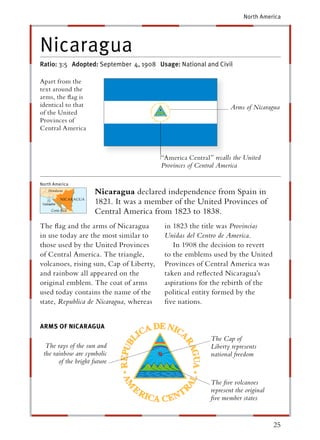
                      Nicaragua declared independence from Spain in
                      1821. It was a member of the United Provinces of
                      Central America from 1823 to 1838.
The flag and the arms of Nicaragua         in 1823 the title was Provincias
in use today are the most similar to      Unidas del Centro de America.
those used by the United Provinces           In 1908 the decision to revert
of Central America. The triangle,         to the emblems used by the United
volcanoes, rising sun, Cap of Liberty,    Provinces of Central America was
and rainbow all appeared on the           taken and reflected Nicaragua’s
original emblem. The coat of arms         aspirations for the rebirth of the
used today contains the name of the       political entity formed by the
state, Republica de Nicaragua, whereas    five nations.


ARMS OF NICARAGUA
                                                           The Cap of
  The rays of the sun and                                  Liberty represents
 the rainbow are symbolic                                  national freedom
       of the bright future


                                                           The five volcanoes
                                                           represent the original
                                                           five member states


                                                                                    25
North America


Costa Rica
Ratio: 3:5 Adopted: September 29, 1848 Usage: National and State

Blue and white                                                     Red, white, and
were the colors                                                      blue recall the
of the original                                                        colors of the
flag of the United                                                   French Tricolore
Provinces of
Central America


North America
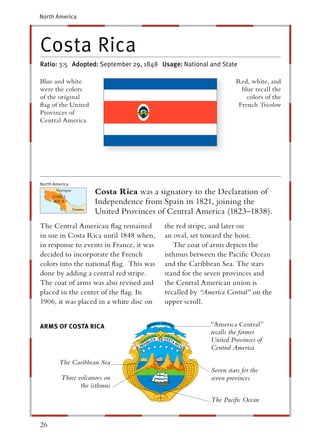
                     Costa Rica was a signatory to the Declaration of
                     Independence from Spain in 1821, joining the
                     United Provinces of Central America (1823–1838).
The Central American flag remained         the red stripe, and later on
in use in Costa Rica until 1848 when,     an oval, set toward the hoist.
in response to events in France, it was      The coat of arms depicts the
decided to incorporate the French         isthmus between the Pacific Ocean
colors into the national flag. This was    and the Caribbean Sea. The stars
done by adding a central red stripe.      stand for the seven provinces and
The coat of arms was also revised and     the Central American union is
placed in the center of the flag. In       recalled by “America Central” on the
1906, it was placed in a white disc on    upper scroll.


ARMS OF COSTA RICA
           T                                             “America Central ”
                                                         recalls the former
                                                         United Provinces of
                                                         Central America

        The Caribbean Sea
                                                         Seven stars for the
         Three volcanoes on                              seven provinces
                the isthmus

                                                         The Pacific Ocean


26
North America


Panama
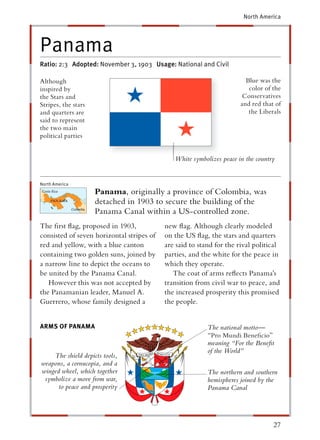
Ratio: 2:3 Adopted: November 3, 1903 Usage: National and Civil

Although                                                                Blue was the
inspired by                                                              color of the
the Stars and                                                          Conservatives
Stripes, the stars                                                    and red that of
and quarters are                                                         the Liberals
said to represent
the two main
political parties


                                              White symbolizes peace in the country


North America
                     Panama, originally a province of Colombia, was
                     detached in 1903 to secure the building of the
                     Panama Canal within a US-controlled zone.
The first flag, proposed in 1903,            new flag. Although clearly modeled
consisted of seven horizontal stripes of   on the US flag, the stars and quarters
red and yellow, with a blue canton         are said to stand for the rival political
containing two golden suns, joined by      parties, and the white for the peace in
a narrow line to depict the oceans to      which they operate.
be united by the Panama Canal.                The coat of arms reflects Panama’s
   However this was not accepted by        transition from civil war to peace, and
the Panamanian leader, Manuel A.           the increased prosperity this promised
Guerrero, whose family designed a          the people.


ARMS OF PANAMA                                            The national motto—
                                                          “Pro Mundi Beneficio”
                                                          meaning “For the Benefit
                                                          of the World”
    The shield depicts tools,
weapons, a cornucopia, and a
winged wheel, which together                              The northern and southern
 symbolize a move from war,                               hemispheres joined by the
      to peace and prosperity                             Panama Canal


                                                                                  27
North America


Jamaica
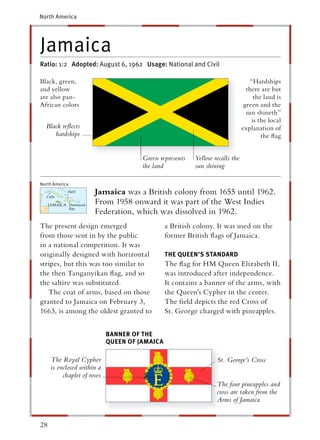
Ratio: 1:2 Adopted: August 6, 1962 Usage: National and Civil

Black, green,                                                                      “Hardships
and yellow                                                                       there are but
are also pan-                                                                       the land is
African colors                                                                  green and the
                                                                                 sun shineth”
                                                                                   is the local
  Black reflects                                                                explanation of
     hardships                                                                         the flag


                                       Green represents   Yellow recalls the
                                       the land           sun shining

North America
                       Jamaica was a British colony from 1655 until 1962.
                       From 1958 onward it was part of the West Indies
                       Federation, which was dissolved in 1962.
The present design emerged                      a British colony. It was used on the
from those sent in by the public                former British flags of Jamaica.
in a national competition. It was
originally designed with horizontal             THE QUEEN’S STANDARD
                                                             T
stripes, but this was too similar to            The flag for HM Queen Elizabeth II,
the then Tanganyikan flag, and so                was introduced after independence.
the saltire was substituted.                    It contains a banner of the arms, with
   The coat of arms, based on those             the Queen’s Cypher in the center.
granted to Jamaica on February 3,               The field depicts the red Cross of
1663, is among the oldest granted to            St. George charged with pineapples.


                             BANNER OF THE
                             QUEEN OF JAMAICA

     The Royal Cypher                                             St. George’s Cross
     is enclosed within a
          chaplet of roses
                                                                  The four pineapples and
                                                                  ross are taken from the
                                                                  Arms of Jamaica


28
North America


Cuba
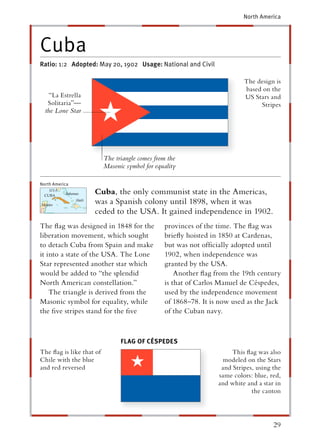
Ratio: 1:2 Adopted: May 20, 1902 Usage: National and Civil

                                                                          The design is
                                                                          based on the
   “La Estrella                                                           US Stars and
   Solitaria”—                                                                 Stripes
  the Lone Star


                          The triangle comes from the
                          Masonic symbol for equality

North America
                    Cuba, the only communist state in the Americas,
                    was a Spanish colony until 1898, when it was
                    ceded to the USA. It gained independence in 1902.
The flag was designed in 1848 for the            provinces of the time. The flag was
liberation movement, which sought               briefly hoisted in 1850 at Cardenas,
to detach Cuba from Spain and make              but was not officially adopted until
it into a state of the USA. The Lone            1902, when independence was
Star represented another star which             granted by the USA.
would be added to “the splendid                     Another flag from the 19th century
North American constellation.”                  is that of Carlos Manuel de Céspedes,
    The triangle is derived from the            used by the independence movement
Masonic symbol for equality, while              of 1868–78. It is now used as the Jack
the five stripes stand for the five               of the Cuban navy.


                                FLAG OF CÉSPEDES
The flag is like that of                                               This flag was also
Chile with the blue                                               modeled on the Stars
and red reversed                                                  and Stripes, using the
                                                                 same colors: blue, red,
                                                                 and white and a star in
                                                                             the canton


                                                                                     29
North America


Bahamas
Ratio: 1:2 Adopted: July 10, 1973 Usage: National


         Black                                                             Blue
     represents                                                            recalls the
  the strength                                                             Caribbean
 of the people                                                             Sea


                                           Yellow reflects the
                                           islands’ sandy beaches


                     Originally a pirate base, the Bahamas became a
                     formal British colony in 1783. It did not achieve
                     independence until July 10, 1973.
The colors of the flag are intended to    seen, since many ships are registered
represent the aquamarine seas around     in the Bahamas. The flag is based on
the islands and their golden sands.      the British Red Ensign—red with
The flag is based on designs by the        a Bahamian national flag in the
Bahamian people. Many of those           canton—but is distinguished by the
submitted also included the idea of      white cross, like the Cross of
sunrise, which has been incorporated     St. George, across the red field.
into the coat of arms.                      The Bahamas has many other
   The Bahamas Civil Ensign              flags including one for the specific
(flown by merchant ships) is often        use of the Prime Minister.


                         BAHAMAS CIVIL ENSIGN
  The national flag is
  placed in the canton                                              The civil ensign is
                                                                    distinguished from
                                                                    government and
                                                                    naval ensigns by
                                                                    its red field


30
North America


Haiti
Ratio: 3:5 Adopted: May 18, 1803 Usage: National and Civil

For official and                                                      Blue and red
state purposes the                                                 are taken from
flag is charged                                                         the French
with the national                                                         Tricolore
arms on a central
white rectangle


North America
                     Haiti became a French colony in 1697, but in 1803
                     a rebellion broke out. Independence was granted on
                     January 1, 1804.
The blue and red of the flag were         period from 1964–86, during the
retained after a French Tricolore was    regime of the Duvalier family.
torn up by the rebel Jean-Jacques           Since 1843 the flag for official
Dessalines in 1803. The two parts        and state use has had the arms on a
were stitched together horizontally      white panel in the center. The coat of
to make a new flag.                       arms depicts a trophy of weapons
   However a rival flag of vertical       ready to defend freedom, and a royal
black and red panels was also used at    palm topped with a Cap of Liberty
various times, most recently in the      for the country’s independence.

                                                  The Cap of Liberty
ARMS OF HAITI

                                                          The royal palm
                                                          symbolizes
  Weapons reflect the                                      independence
people’s willingness to
   defend their liberty
                                                             The national motto—
                                                             “L’Union Fait La
                                                             Force” meaning
                                                             “Union is Strength”


                                                                                 31
North America


Dominican Republic
Ratio: 2:3 Adopted: November 6, 1844 Usage: National and State

Blue and red
are taken from
the flag of Haiti,
which once
controlled the                                                      The coat of arms
Dominican                                                           only appears on the
Republic                                                            flag for national and
                                                                    state use


                                          The cross of the Trinitarian
                                          independence movement

North America
                        A Spanish colony, briefly occupied by Haiti (1820–44),
                        the Trinitarian movement was formed to free the
                        country. Dominican Republic was liberated in 1844.
The flag was designed by the leader         in 1844, was placed on the state flag.
of the Trinitarians. He altered the        The civil flag, on both land and sea,
layout of the blue and red of the          does not carry the arms.
Haitian flag, placing a large white            The arms depicts a Bible open at
cross over it to symbolize faith.          the first chapter of St. John’s Gospel.
                                           This is placed on a trophy of national
A DISTINCTIVE NATIONAL FLAG                flags, on a shield of the same design.
To create distinct flags for state and      The Trinitarian motto is above this
civil use, the coat of arms, adopted       and the name of the state below.


ARMS OF HAITI                                                 The password of the
                                                              Trinitarian movement—
                                                              “Dios, Patria, Libertad ”
     Gospel of St. John, a                                    (“God, Country,
      Trinitarian emblem                                      Freedom”)


           The lower scroll
     contains the state title


32
North America


St. Kitts & Nevis
Ratio: 2:3 Adopted: September 19, 1983 Usage: National and Civil

 Green is symbolic of
      the fertile land
                                                                     Two stars for
                                                                     hope and liberty


       Black recalls St.                                             Red recalls the
         Kitts’ African                                              struggle for freedom
                heritage
                                           Yellow reflects the
                                           country’s sunny climate


                      A British colony in the Leeward Islands since 1873,
Rico ST. KITTS
     & NEVIS          the islands of St. Kitts and Nevis gained
         Dominica
                      independence together in 1983.
The flag was the winning entry in a            liberty, not for the islands of
local competition which attracted             St. Kitts and Nevis.
258 entries, and was the work of a
student, Edrice Lewis. It was she             THE FLAG OF NEVIS
who gave what is now the official              The island of Nevis has a flag of its
interpretation of the flag—that its            own, which is bright yellow, with a
colors stand for the fertile land, year-      stylized image of Nevis Peak. The
round sunshine, the struggle for              national flag is in the canton.
freedom, and the African heritage.               St. Kitts also has an ensign for the
The two stars stand for hope and              Coast Guard.


                            THE FLAG OF NEVIS
 National flag in canton


                                                                 A graphic representation
     Yellow for year-long                                        of Nevis Peak, a cone-
                sunshine                                         shaped mountain in the
                                                                 center of the island


                                                                                            33
North America


Antigua & Barbuda
Ratio: 2:3 Adopted: February 27, 1967 Usage: National and Civil

     Black recalls the
     islands’ African
              heritage                                          The V-shape is the
                                                                symbol of victory

              White
     symbolizes hope
                                                                The rising sun
                                                                represents a new era

                                          Blue represents the
                                          Caribbean Sea


                     From 1632 until formal independence was granted in
                     1981, Antigua and its neighbor Barbuda were
                     British colonies.
The flag dates from the achievement        Barbuda, does not have a separate
of self-government in 1967 and was        flag, although there is one for
the winning design in a competition       Redonda, an uninhabited island
which over 600 local people entered.      whose “throne” is claimed by several
                                          rival “monarchs.”
THE SYMBOLISM OF THE FLAG
The designer, Reginald Samuel,            THE NAT IONAL ARMS
                                               A
interpreted it as representing the sun    The coat of arms was granted in 1977
rising against the background of the      and depicts a shield with a sugar mill,
peoples’ African heritage in a new        once the primary industry, on a
era. The overall V-shape stands for       background of white and blue waves.
victory. It is on a red background        Above this is a sun on a black
which symbolizes the dynamism of          background. The shield stands on a
the population. Blue is for the sea and   sea island. The crest is a pineapple
white is for hope.                        from the arms of the former colony
                                          of the Leeward Islands, of which
THE NEW NAT IONAL FLAG
         A                                Antigua was once a part. Beneath
The flag was retained unchanged            is a scroll with the national motto—
when Antigua became independent.          “Each endeavouring, all achieving.”


34
North America


Dominica
Ratio: 1:2 Adopted: November 3, 1978 Usage: National and Civil

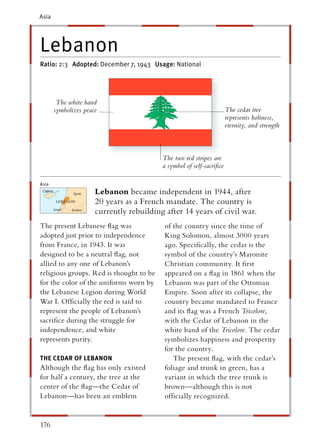
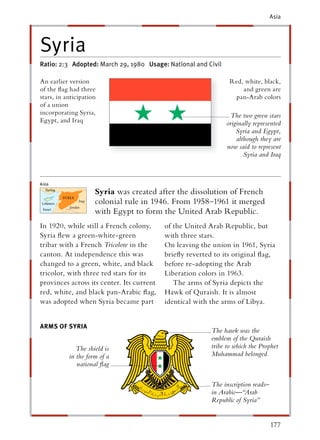
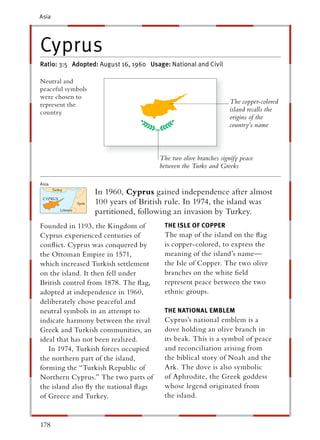
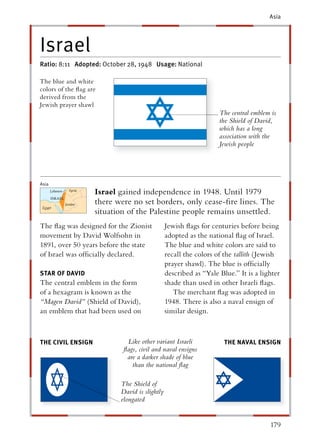
                                                                       White
  Yellow recalls                                                       symbolizes the
   the original                                                        region’s pure
    inhabitants                                                        water
Black is for the                                                       The sisserou
     fertile soil                                                      parrot—unique
                                                                       to Dominica


                                         The stars represent the
                                         ten parishes


                     First colonized by the French, Dominica came
                     under British control in 1759. It became a British
                     Associated State in 1967 and independent in 1978.
The flag adopted in 1978 features         Christian faith and its three colors
the national bird emblem, the            recall the native Indians, the fertile
sisserou parrot, which also appears on   soil, and the pure water. The ten
the coat of arms granted July 21,        stars stand for the ten parishes and
1961. This parrot is unique to           the red disc for social justice.
Dominica. It is an endangered               The flag of the President has a
species; only a few pairs remain.        dark green field with the coat of arms
    The green field represents the        in the center, crowned with a British
lush vegetation of the island. The       lion. It depicts palm trees, an
cross represents the Trinity and the     indigenous frog and the sea.


                            THE PRESIDENT’S FLAG

The national motto is in
Creole—“Aprés Bondie
 C’est La Ter” meaning                                        The supporters are
   “After the good Lord                                       two sisserou parrots
      (we love) the soil”


                                                                                     35
North America


St. Lucia
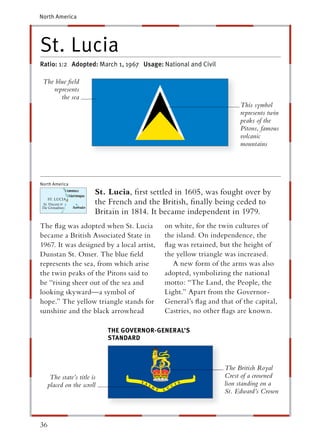
Ratio: 1:2 Adopted: March 1, 1967 Usage: National and Civil

 The blue field
    represents
       the sea
                                                                    This symbol
                                                                    represents twin
                                                                    peaks of the
                                                                    Pitons, famous
                                                                    volcanic
                                                                    mountains


North America
                       St. Lucia, first settled in 1605, was fought over by
     ST. LUCIA
 St. Vincent &         the French and the British, finally being ceded to
The Grenadines
                       Britain in 1814. It became independent in 1979.
The flag was adopted when St. Lucia         on white, for the twin cultures of
became a British Associated State in       the island. On independence, the
1967. It was designed by a local artist,   flag was retained, but the height of
Dunstan St. Omer. The blue field            the yellow triangle was increased.
represents the sea, from which arise          A new form of the arms was also
the twin peaks of the Pitons said to       adopted, symbolizing the national
be “rising sheer out of the sea and        motto: “The Land, the People, the
looking skyward—a symbol of                Light.” Apart from the Governor-
hope.” The yellow triangle stands for      General’s flag and that of the capital,
sunshine and the black arrowhead           Castries, no other flags are known.

                           THE GOVERNOR-GENERAL’S
                           STANDARD
                            T


                                                               The British Royal
    The state’s title is                                       Crest of a crowned
   placed on the scroll                                        lion standing on a
                                                               St. Edward’s Crown


36
North America


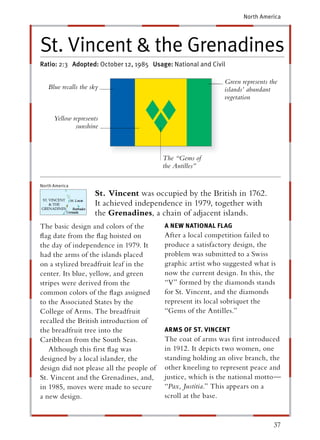
St. Vincent & the Grenadines
Ratio: 2:3 Adopted: October 12, 1985 Usage: National and Civil

                                                             Green represents the
   Blue recalls the sky                                      islands’ abundant
                                                             vegetation


      Yellow represents
              sunshine


                                          The “Gems of
                                          the Antilles”

North America
                     St. Vincent was occupied by the British in 1762.
ST. VINCENT
    & THE            It achieved independence in 1979, together with
GRENADINES
                     the Grenadines, a chain of adjacent islands.
The basic design and colors of the        A NEW NATIONAL FLAG
flag date from the flag hoisted on          After a local competition failed to
the day of independence in 1979. It       produce a satisfactory design, the
had the arms of the islands placed        problem was submitted to a Swiss
on a stylized breadfruit leaf in the      graphic artist who suggested what is
center. Its blue, yellow, and green       now the current design. In this, the
stripes were derived from the             “V” formed by the diamonds stands
common colors of the flags assigned        for St. Vincent, and the diamonds
to the Associated States by the           represent its local sobriquet the
College of Arms. The breadfruit           “Gems of the Antilles.”
recalled the British introduction of
the breadfruit tree into the              ARMS OF ST. VINCENT
Caribbean from the South Seas.            The coat of arms was first introduced
   Although this first flag was             in 1912. It depicts two women, one
designed by a local islander, the         standing holding an olive branch, the
design did not please all the people of   other kneeling to represent peace and
St. Vincent and the Grenadines, and,      justice, which is the national motto—
in 1985, moves were made to secure        “Pax, Justitia.” This appears on a
a new design.                             scroll at the base.


                                                                               37
North America


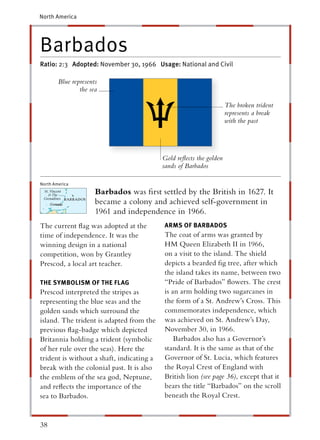
Barbados
Ratio: 2:3 Adopted: November 30, 1966 Usage: National and Civil

          Blue represents
                  the sea

                                                                     The broken trident
                                                                     represents a break
                                                                     with the past


                                           Gold reflects the golden
                                           sands of Barbados

North America
 St. Vincent
    & The
                        Barbados was first settled by the British in 1627. It
 Grenadines
                        became a colony and achieved self-government in
                        1961 and independence in 1966.
The current flag was adopted at the          ARMS OF BARBADOS
time of independence. It was the            The coat of arms was granted by
winning design in a national                HM Queen Elizabeth II in 1966,
competition, won by Grantley                on a visit to the island. The shield
Prescod, a local art teacher.               depicts a bearded fig tree, after which
                                            the island takes its name, between two
THE SYMBOLISM OF THE FLAG                   “Pride of Barbados” flowers. The crest
Prescod interpreted the stripes as          is an arm holding two sugarcanes in
representing the blue seas and the          the form of a St. Andrew’s Cross. This
golden sands which surround the             commemorates independence, which
island. The trident is adapted from the     was achieved on St. Andrew’s Day,
previous flag-badge which depicted           November 30, in 1966.
Britannia holding a trident (symbolic           Barbados also has a Governor’s
of her rule over the seas). Here the        standard. It is the same as that of the
trident is without a shaft, indicating a    Governor of St. Lucia, which features
break with the colonial past. It is also    the Royal Crest of England with
the emblem of the sea god, Neptune,         British lion (see page 36), except that it
and reflects the importance of the           bears the title “Barbados” on the scroll
sea to Barbados.                            beneath the Royal Crest.


38
North America


Grenada
Ratio: 3:5 Adopted: February 7, 1974 Usage: National and Civil


           A nutmeg,
       Grenada’s most
       famous product                                                  The central star
                                                                       and disc represent
                                                                       the capital
                                                                       St. George’s


                                           The six outer stars stand
                                           for the six parishes

North America
 St. Vincent &
The Grenadines          First settled by France, Grenada was invaded by
                        Britain in 1762. It became an Associated State in
                        1967 and fully independent in 1974.
The flag used prior to independence          agriculture. When the flag is used
in 1967 also featured a nutmeg,             at sea its proportions are altered from
since Grenada is a major world              3:5 to a longer form (1:2).
supplier of this commodity, and is
known as the “Spice Island.”                THE NATIONAL ARMS
   Other features of the flag derive         The coat of arms depicts the
from the coat of arms granted on            Santa Maria, Columbus’ ship,
December 6, 1973, including the             a lion representing national liberty,
red, yellow, and green colors.              and a lily emblem symbolizing
                                            the Virgin Mary. The shield is
SYMBOLISM OF THE FLAG                       supported by two characteristic local
The yellow star on a red disc stands        creatures, an armadillo and a ramier
for the Borough of St. George’s,            pigeon. Beneath the shield is a
Grenada’s capital, and the other six        representation of the Grand Etang
stars for the remaining six parishes.       lake, and, on a scroll at the base,
   In the official interpretation the        what must be one of the world’s
red stands for courage and vitality,        longest national mottos: “Ever
the yellow for wisdom and warmth,           conscious of God we aspire, build
and the green for vegetation and            and advance as one people.”


                                                                                        39
North America


Trinidad & Tobago
Ratio: 3:5 Adopted: August 31, 1962 Usage: National and Civil

     White represents
              the sea

                                                                  Black symbolizes
                                                                  the strength of
                                                                  the people


                                            Red stands for
                                            the people

North America
                        Trinidad and Tobago were separate British
                        colonies, which united in 1889. They became
                        independent in 1962 and a republic in 1976.
The flag adopted at independence             of arms depicts the three ships of
was chosen from among designs sent          Columbus who landed here in 1498.
in by the public. The same colors are       Above the ships are two golden
used in the arms.                           hummingbirds. The supporters of the
   A flag for HM Queen Elizabeth II          coat of arms are also local birds and
was adopted after independence,             the whole shield stands on a scene
but it became obsolete following the        depicting waves breaking against
formation of the republic.                  the rocky coasts of the islands.
   The President has a flag of blue             Trinidad also has flags for the
with the arms in the center. The coat       Prime Minister and other ministers.


                               THE PRESIDENT’S FLAG
            The top of the                                   The cocrico —
         shield depicts two                                  a local bird
            hummingbirds
                                                             In 1498 Columbus
     The scarlet ibis is one
                                                             discovered Trinidad
       of many local birds
                                                             and his ships appear
                                                             on the shield


40
South America


Colombia
Ratio: 2:3 Adopted: December 17, 1819 Usage: National

The colors are                                                  The original yellow
those of Francisco                                              band was doubled in
de Miranda, the                                                 width when Greater
liberation leader                                              Colombia was formed

                                                                 Yellow recalls
                                                                 the federation of
                                                                 Greater Colombia


                Red represents             Blue represents
                       courage             independence from Spain

South America
                      Following years of Spanish rule, Colombia
                      became part of independent Greater Colombia in
                      1819, and then a separate republic in 1830.
The flag of Greater Colombia,               used to distinguish it from the flag
adopted in 1819, was retained by           of Ecuador. The state flag and naval
Colombia after independence in 1830.       ensign have the arms in the center.
For a while the stripes were arranged
vertically, but the original version       THE NATIONAL ARMS
was restored in 1861.                      The coat of arms dates from 1834.
   There are two variant flags. The         It includes a pomegranate, the
civil ensign has a red-bordered, blue      symbol of Granada in Spain, after
oval bearing a white star in the center,   which the area was once named.


ARMS OF COLOMBIA                                            The crest is a condor
        National motto—                                     frequently used in South
      “Libertad y Orden”                                    American heraldry
         meaning “Liberty
              and Order”

       The Cap of Liberty                                   A pomegranate recalls
                                                            New Granada,
                                                            Colombia’s former name
             A map of the                                   when a Spanish colony
        Isthmus of Panama


                                                                                     41
South America


Venezuela
Ratio: 2:3 Adopted: March 10, 2006 Usage: National and Civil

The flag is most
similar to that of
liberation leader                                                          Stars represent the
Francisco de                                                               eight provinces
Miranda                                                                    that supported
                                                                           independence

                                                                           Red symbolizes
                                                                           courage
                                       Blue represents Venezuela’s
                                       independence from Spain

South America
                           Venezuela was once part of the Spanish province
                           of New Granada. It then joined Greater Colombia
                           from 1819 until independence in 1830.
The Venezuelan flag was the                           double width, for use as the flag
invention of Francisco de Miranda,                   of Greater Colombia.
who initiated the freedom of                            After independence in 1836,
New Granada in 1806. At that time                    the flag reverted to stripes of
it had no stars; they were added in                  equal width and the stars were
1836 to symbolize the provinces                      added. The coat of arms dates
that had supported the Declaration                   from the 19th century but has
of Independence in 1811. The                         altered frequently, especially the
original plain tricolor was altered                  inscription. The present form dates
in 1819, to make the yellow                          from 2006.

ARMS OF VENEZUELA
                                                                     Two horns of plenty
                  The wheatsheaf                                     symbolize abundance
                represents fertility
                                                                     The flag and weapons
              A running horse                                        represent independence and
            symbolizes liberty                                       the Native American people

       The name of the state,                                        The arms appear in the
     “Republica Bolivariana                                          canton of the state flag
             de Venezuela”                                           and naval ensign


42
South America


Guyana
Ratio: 3:5 Adopted: May 20, 1966 Usage: National and Civil

     Red recalls the                                                 Green recalls
 people’s dynamism                                                   the vast forests
 and zeal for reform                                                 and fields
                                                                     The “Golden
 Yellow is symbolic                                                  Arrow” represents
  of mineral wealth                                                  a bright future


                                            The white and black fimbriations
                                            were added by the College of Arms

South America
Venezuela               Guyana was acquired by the UK in 1814. It
      GUYANA
        UYANA
           NAA
           S
           Suriname
                am      became independent in 1966 and a republic within
   Brazil
                        the Commonwealth in 1970.
The flag is known as the “Golden              “zeal and dynamism [of the
Arrow” because of the arrow-head             inhabitants] in building the nation.”
that flies across the green field. The
original design had a red field, but          THE PRESIDENT’S STANDARD
                                                              T
this was altered by the College of           Adopted in 1970, it is a banner of the
Arms in 1966, which also added the           arms granted in 1966. It depicts a green
black and white fimbriations.                 shield in the center charged with an
   The green and yellow stand for            Native American crown in gold, a
natural resources and the red for the        Victoria lily and a native pheasant.


                                     THE PRESIDENT’S
                                     STANDARD
                                      T
The President’s flag
was adopted in 1970,                                     A Victoria Regia
it is a square banner                                    water lily, growing from
of the arms                                              stylized heraldic water

            Crown of a cacique, or
             Native American chief                       A native canje pheasant


                                                                                        43
South America


Suriname
Ratio: 2:3 Adopted: November 25, 1975 Usage: National and Civil

Green and red were
the colors of the
political parties                                                 The white
at the time of                                                    fimbriations represent
independence                                                      justice and freedom


                                          The star is an emblem
                                          of unity and hope

South America
                     Suriname was part of the Dutch kingdom until
                     1975. Since independence, there have been a series
                     of coups and changes of constitution.
The flag was chosen in 1975 by a           separating the red and green, stand
parliamentary commission, on the          for justice and freedom.
basis of designs sent in by the
public. The object was to choose a        THE PRESIDENT’S STANDARD
                                                           T
flag which harmonized the colors of        This has a white panel in place of
the main political groups (green and      the star and contains the state arms.
red) into a design suggestive of unity    The coat of arms dates back to the
and progress. The star is thus the        17th century and the time of Dutch
emblem of unity and hope for the          rule, but was revised in 1959 and
future, and the white fimbriations,        again in 1975.


                              THE PRESIDENT’S
                              STANDARD
                               T
     On the shield, a ship                                  The supporters
      reflects commerce, a                                   are Native Americans
  diamond, mining, and a
          tree, agriculture                                 The national motto—
                                                            “Justitia, Pietas, Fides”
                                                            meaning “Justice, Peace,
                                                            Faith”


44
South America


Ecuador
Ratio: 1:2 Adopted: September 26, 1860 Usage: National

Yellow, blue                                                           Yellow is
and red are                                                            the color of
the colors of                                                          federation
Francisco de
Miranda
                                                                       Blue recalls
                                                                       independence
                                                                       from Spain


                                         Red symbolizes
                                         courage

South America
                     Ecuador, formerly a Spanish colony, joined the
                     state of Greater Colombia in 1822. It seceded from
                     the federation in 1830 to form a republic.
The 1819 flag of Greater Colombia         arms, making it almost identical to
was restored in Ecuador in 1860 and      the flag of Colombia, except for its
since then the flags of Ecuador and       proportions. When used abroad, the
Colombia have been very similar.         flag always contains the arms.
The national arms were added to the
center of the basic civil flag in 1900,   ARMS OF ECUADOR
creating a distinct flag for national     The coat of arms dates from 1845
and state purposes. The civil flag on     and depicts Mount Chimborazo
land and sea does not contain the        and the mouth of the Guyas River.


ARMS OF ECUADOR
                                                          An Andean condor
                                                          symbolizes bravery
      Four signs of the Zodiac                            and liberty
    represent the months from
                March to May                              A ship at the mouth
                                                          of the Guyas River
                                                          representing commerce
  An allegorical scene depicts
  Mount Chimborazo, South                                 The ax and fasces are
     America’s highest peak                               symbols of republicanism


                                                                                      45
South America


Peru
Ratio: 2:3 Adopted: February 25, 1825 Usage: National and Civil

Red and white are                                                    The colors also
the colors chosen by                                              recall those of the
San Martín,                                                        Incas, who ruled
“El Liberador”                                                        much of Peru
(the Liberator)                                                      until European
                                                                        colonization


South America
                     Peru was freed from Spanish rule in 1819 by an
                     army led by José de San Martín. Since 1824 it has
                     been an independent unitary republic.
The colors chosen by San Martín for      Spanish colonies, the official flag,
the Peruvian Legion were red and         used by the government and the
white, said to be the colors of the      armed forces, has the coat of arms in
Inca Empire, and the rising sun, also    the center.
dating back to the Incas. The flag           The coat of arms dates from 1825
assumed its present form, dropping       and depicts a cornucopia, a chichona
the sun in 1825, at the behest of        tree, and a llama, surrounded by state
Simón Bolívar, another famous            flags. The flags do not appear on the
liberator. As is usual in former         arms placed on the official flag.

ARMS OF PERU

   On the coat of arms, the
    wreaths are substituted                             A llama
          for national flags
                                                        A chichona tree
              A cornucopia                              This is how the coat
     symbolizing prosperity                             of arms appears in the
                                                        center of the official
                                                        flag and ensign


46
South America


Brazil
Ratio: 7:10 Adopted: November 15, 1889 Usage: National and Civil

        The national                                           Green recalls
     motto meaning,                                            the Brazilian
“Order and Progress”                                           rain forest

                                                               Each star represents a
       The most recent                                         state in the Federation
    stars were added to
      the Canis Major
           constellation
                                        Yellow represents the
                                        country’s mineral resources

South America
                      Brazil belonged to Portugal until 1822 when it
                      became an independent kingdom, and later an
                      empire. It formed a federal republic in 1889.
The green field and yellow lozenge        with stars of varying sizes, although
were part of the flag adopted in          the size of star does not reflect the
1822 when independence was first          importance of the state. In 1992,
achieved and the empire was              new stars were added to the
declared. In 1889, the imperial          constellation of Canis Major in the
                                                                      r
arms were replaced by a view of          lower left section of the sky. The
the night sky as it appeared over        country’s national motto, “Ordem
Rio de Janeiro when the republic         e Progresso” meaning, “Order and
was formed. Each of the stars in         Progress” appears on a band across
the constellation represents a state     the center of the night sky.
of the Federation, including the
Federal District. These have been        THE NATIONAL CAPITAL
                                                          T
altered from time to time, most          In Brasília, the capital city since
recently in 1992 when the number         1960, stands one of the world’s
of stars increased to 27.                tallest flagpoles, on which flies an
                                         enormous national flag.
THE CONSTELLATIONS                          Brazil also has flags for the
The constellations on the flag are        President, the Ministry of Marine,
represented in a realistic manner,       and a naval Jack.


                                                                                   47
South America


Brazil: State flags
Many of the flags recall historical events, or the formation of the federal republic.
The date of accession is given below the state name.


                   THE FEDERAL DISTRICT                                        ACRE
                   1960                                                        1962


The flag of the Federal District dates from          Adopted by the republic declared in 1899,
1969. The green rectangle contains four             when Acre was still part of Bolivia, the flag
arrows representing the balance of                  was retained by the state and the star was
centralization and devolution in Brazil.             dded to recall its joining the Federation.


                          ALAGOAS                                       AMAPÁ
                          1889                                          1989


Based on the flag of 1894, this new                  The flag was adopted in 1984 for the
version was instituted in 1963. In the              erritory and retained for the state. It
center is the arms, also originally dating           ses all the national colors, together
back to 1894. It recalls various aspects of         with an outline of the fortress of
the state’s industry.                               Macapá, the state capital.


                    AMAZONAS                                            BAHIA
                    1889                                                1889


The flag dates from the local uprising of            The flag dates back to the uprisings of
1897. The stars stand for the 25                     789 and 1798, which are recalled by
municipalities, with the large one for              he white triangle. The flag in this form
Manaus, the state capital. The flag was              was first adopted in 1889, when Bahia
regularized in 1982.                                oined the Federation.


                    CEARÁ                                               ESPÍRITO SANTO
                    1889                                                1889


The flag was instituted in 1922 and is               The flag was created in 1947. The
very similar to the national flag. The                ortuguese motto meaning—“Work
arms depicts an allegorical landscape                nd Trust”—is that of the Jesuits, and
surrounded by stars. It dates from 1897             he pink and blue represent the local
and was revised in 1967.                             vening sky.


48
South America


                   GOIÁS                                          MARANHÃO
                   1889                                           1889


The flag is based on those promoted for        The flag, adopted in 1889, features
the republic in 1889. This version has        he star, which represents the state
five stars for the Southern Cross similar       n the national flag, while the stripes
to those in the national arms.                 and for its ethnic mix.


                   MATO GROSSO                                   MATO GROSSO DO SUL
                   1889                                          1977


The flag is based on the national flag,         The design emerged from a
but with local interpretations of the          ompetition held in 1978, after the
color arrangement and one star for             ew state was formed. The flag was
the state. It was adopted in 1890.            nstituted in 1979.


                   MINAS GERAIS                                  PARÁ
                   1889                                          1889


The flag contains a Masonic triangle            ased on a republican flag, it dates
of the Inconfidência Mineira (miners revolt)   rom 1898. The star is taken from the
of 1789, standing for equality.                ne for Pará on the national flag.


                   PARAÍBA                                        PARANÁ
                   1889                                           1889


The flag recalls Vargas’ revolution in         The flag contains an emblem like
1930. Nego (“I deny it”) refers to the        he national flag, bearing the Southern
assassination of the state president.         Cross and name of the state.


                   PERNAMBUCO                                    PIAUÍ
                   1889                                          1889


This is the flag of the Pernambuco              ased on the colors of the national
revolution of 1817, which later became the     ag, in this instance it only has one
flag of the state when the events of 1817       ar representing the state of Piauí.
were celebrated.                              t was adopted in 1922.


                                                                                       49
South America


Brazil: State flags

                    RIO DE JANEIRO                                   RIO GRANDE DO NORTE
                    1975                                             1889


The state was reconstituted in 1975             Dating from 1957, the flag uses the
to include the state of Guanabara.               rms granted in 1909, thus making it
The new state took over the emblems              ne of the newest flags of the
of the former state of Rio de Janeiro.           riginal states.


                   RIO GRANDE DO SUL                                RONDÔNIA
                   1889                                             1981


The flag dates from the revolution of            Rondônia’s flag uses the four
1836, which created the Republic of Rio          ational colors and a single star
Grande do Sul. It was re-adopted in 1889,       ymbol. It was adopted in 1981
the arms were added in 1891.                     fter a design competition.


                    RORAIMA                                       SANTA CATARINA
                    1989                                          1889


The flag, adopted when the territory             The red and white flag precedes
became a federal state, uses the national       he republic. It was most recently
colors and star, with a red line representing   egularized in 1953, when the arms
the Equator.                                    were placed in the center.


                   SÃO PAULO                                         SERGIPE
                   1889                                              1889


The flag was created in 1888 at the              The flag was created in the late
start of the republican revolution,              9th century and adopted in 1920.
and revived in 1932, with 13 stripes.            n 1951 the stars were repositioned.


                    TOCANTINS
                    1989


After achieving statehood, a flag and
arms were adopted, using blue and
white from the national colors.


50
South America


Chile
Ratio: 2:3 Adopted: October 18, 1817 Usage: National and Civil

The flag is modeled
on the US Stars and                                              White symbolizes the
Stripes                                                          snow of the Andes


   Blue represents the
   clear Andean skies


                                          Red is for the blood
                                          shed for freedom

South America
                     Chile was freed from Spanish rule in 1818, largely
                     through the efforts of José de San Martín, leader of
                     the Army of the Andes.
Adopted in 1817, after San Martín’s       THE PRESIDENT’S STANDARD
                                                           T
victory at Chacabuco, the national        The flag of the President is the
flag of Chile was preceded by at least     same as the national flag, with the
two other versions during the early       national arms in the center. The coat
years of separatism. The current flag      of arms dates from 1834. It is
was based on the Stars and Stripes.       supported by an huemal deer and a
   The white star was reserved for        condor. The crest is formed from
use only on the official flag until         the feathers of the rhea bird. The
1864, when the starred flag was            motto—“Por La Razon o La Fuerza”
made official for all purposes.            means “By reason or by force.”


                              THE PRESIDENT’S
                              STANDARD
                               T

                                                             A crest of feathers
          An huemal deer,                                    from the rhea bird
          of the high Andes
                                                             The condor is a common
                                                             symbol on South
                                                             American arms


                                                                                   51
South America


Bolivia
Ratio: 2:3 Adopted: November 30, 1851 Usage: National and Civil

The order of the
stripes was changed                                             Red recalls valor
to red, yellow,
green in 1851.
                                                                Yellow reflects
Red and green were
                                                                Bolivia’s mineral
retained from the
                                                                reserves
flag of 1825


                                         Green symbolizes
                                         fertility

South America
                       Bolivia, originally known as Upper Peru, was
                       named after Simón Bolívar who supervised its
                       secession from Spain in 1825.
The flag of 1825 had three stripes of      last altered in 1851, when the order
green-red-green, with five gold stars      of the stripes was changed to red,
within laurel wreaths. These stood        yellow, green.
for the original five departments.            The official flag still has the arms
                                          in the center. It was regulated in
A NEW TRICOLOR                            1888 and depicts Mount Potosí, an
In 1826, the flag was altered to three     alpaca, a wheatsheaf, and a breadfruit
equal stripes of yellow, green and red    tree. The oval ring contains nine
with the arms in the center. It was       stars for the nine departments.


ARMS OF BOLIVIA                                             As on many South
                                                            American arms, the
               The flags and                                 crest is a condor
      weapons represent the
      people’s willingness to
            defend the state
       The allegorical scene
                                                            The nine stars represent
     on the shield represents
                                                            Bolivia’s nine departments
       Bolivia’s agricultural
      and industrial wealth


52
South America


Paraguay
Ratio: 1:2 Adopted: November 25, 1842 Usage: National and Civil

The colors                                                            On the reverse,
were influenced                                                        the flag is
by the French                                                         charged with
Tricolore, which                                                      the Treasury
had become                                                            Seal
a symbol of
liberation


                                          The Star of May is used as a symbol of
                                          freedom on many South American flags

South America
                      Paraguay declared its independence from
                      Spain in 1811 and has remained an independent
                      republic ever since.
The colors of the flag and the              power from 1814–40. During his
Star of May emblem date from               regime one side of the flag carried
the Declaration of Independence.           the arms of Spain and the other the
A number of variant designs existed        arms of Asunción.
prior to the current design, which           The current emblems, adopted in
was regularized in 1842. The               1821, but not officially sanctioned
current flag has a separate emblem          until 1842, are the national arms on
on each side, a practice dating from       the front (obverse) and the Treasury
the time of José de Francia, in            Seal on the back (reverse).

STATE ARMS ON THE OBVERSE                  TREASURY SEAL ON THE REVERSE

    The Star of May                       The motto,“Paz y             The Cap of
    recalls the date of                   Justicia” (“Peace            Liberty guarded
        independence                      and Justice”)                by a lion


                              Name of
                              the state


                                                                                   53
South America


Uruguay
Ratio: 2:3 Adopted: July 11, 1830 Usage: National and Civil

     The Sun of May                                                     Blue and white
   has been a national                                                      are also the
     emblem since the                                                    national colors
         19th century                                                     of Argentina,
                                                                       from which this
                                                                            flag derives


                                     The nine stripes represent
                                     the nine departments

South America
                     Historically a Spanish colony, Uruguay was
                     annexed to Brazil and then to Argentina before
                     becoming fully independent in 1830.
The colors, blue and white, and the        remained in use after Uruguay was
Sun of May on the current flag come         annexed to Brazil in 1821.
from the Argentinian flag.                     When full independence was
                                           assumed, the present form of the
THE FLAG OF ARTIGAS                        flag was instituted. The nine stripes
The colors were brought to Uruguay         represent the nine departments.
by José Artigas, who led the               The Sun of May has been used as
movement for separation. His flag           the national emblem since 1815 and
was blue and white striped, with a         now appears as the crest on the coat
red diagonal. Variations of this flag       of arms.


                            FLAG OF ARTIGAS
This flag was used as                                          Red represents the
a Jack for naval vessels                                      “Banda Oriental ”
until the late 1990s.                                         (the “East Bank”)
The colors derive from                                        of Uruguay
those of Argentina’s flag


54
South America


Argentina
Ratio: 1:2 Adopted: February 12, 1812 Usage: National and Civil

Blue and
white were
formed
into a flag                                                                        The sun was
by Manuel                                                                         added in 1818
Belgrano, the                                                                     to create a flag
leader of the                                                                     for state use
revolution


                                Light blue and white are from the cockades used
                                by revolutionaries in 1812

South America
                         Argentina achieved its independence from Spain
                         in 1816. Liberation demonstrations began in Buenos
                         Aires on May 25, 1810.
At his encampment at Rosario in                    THE SUN FLAG
1812, the revolutionary commander,                    In 1818, the sun emblem was added
Manuel Belgrano needed a flag. He                   to the national flag forming the state
devised one, using the sky-blue and                flag flown on government buildings
white colors of the cockades worn by               and military bases. It is also the
supporters of independence. This flag               Argentine naval ensign. The sun is
was used in battle and. although                   based on coins issued in Buenos Aires
initially rejected by the provisional              in 1813. The tradition of the “Sun of
government, it later became the                    May,” breaking through white clouds
national flag.                                      in a blue sky has no historical basis.

ARMS OF ARGENTINA
                                                                 The sun symbolizes
                                                                 the dawn of a new era
                                                                 and a new nation
           The Cap of Liberty


                                                                 Sky-blue and white
                A wreath of laurel                               are the national colors


                                                                                               55
Africa


Morocco
Ratio: 2:3 Adopted: November 17, 1915 Usage: National and Civil

   Red represents the
    descendants of the
 Prophet Muhammad
                                                              The Seal of Solomon
                                                              was added in 1915


Africa
         Spain
   MOROCC
       CC
       CCO
                         Morocco has been independent since 1956,
   Western
        rn
   Sahara
        ra
               Algeria   becoming a kingdom in 1957. The state has
    Mauritania Mali
       urit
       uri
       u         li
                  i
                         occupied Western Sahara since 1975.
Red has considerable historic              THE COLONIAL ERA
significance in Morocco, proclaiming        While Morocco was under French
the descent of the royal family from       and Spanish control, the red flag with
the Prophet Muhammad via Fatima,           the seal in the center remained in use
the wife of Ali, the fourth Caliph.        but only inland, its use at sea was
Red is also the color that was used        prohibited. When independence was
by the Sherifs of Mecca and the            restored in 1956 it once again became
Imams of Yemen.                            the national flag.

THE SEAL OF SOLOMON                        THE NATIONAL ARMS
From the 17th century, when                After independence in 1958,
Morocco was ruled by the Hassani           Morocco adopted a national coat
Dynasty, the flags of the country           of arms. This depicts the sun rising
were plain red. In 1915, during the        over the Atlas Mountains. The arms
reign of Mulay Yusuf, the green            also includes the Seal of Solomon
“Seal of Solomon” was added to             from the national flag. On the scroll
the national flag. The Seal is an           is an inscription from the Qur’an
interlaced pentangle, used as a            (Koran), which reads “If you assist
symbol in occult law for centuries.        God, he will assist you.”


56
Africa


Algeria
Ratio: 2:3 Adopted: July 3, 1962 Usage: National and Civil

           Green is the                                            White is symbolic
          color of Islam                                           of purity
       The crescent and
     star of Islam recall
          Ottoman rule                                             The longer than
                                                                   usual horns stand
                                                                   for good fortune
                                                                   and happiness

                                          Red represents liberty


Africa
                       Algeria was occupied by the French from 1830.
                       Independence was achieved in 1962 after a long
                       struggle led by the National Liberation Front.
The flag of Algeria was adopted            whole emblem recalls the period
by the National Liberation Front          of Ottoman rule during the 16th
(Front de Libération National) in         century and its color, red, is symbolic
1954, on the basis of an older design,    of liberty.
created in 1928, by the nationalist
leader Messali Hadj. From 1958-62         THE NAVAL ENSIGN
it was the flag of the Provisional         The naval ensign has two crossed
Government in exile, but it was           anchors in the canton. This device
retained when independence was            is used on the naval ensigns of
achieved in 1962 and has remained         several Arab countries, following
unchanged ever since.                     the example of Egypt.

SYMBOLISM IN THE FLAG                     THE EMBLEM OF ALGERIA
The green in the hoist is the             The state coat of arms is based on
traditional color of Islam and the        the well-known local emblem of the
white represents purity. The horns        “Hand of Fatima.” It also contains
of the crescent are longer than usual     the crescent and star of Islam,
and represent increase or good            alongside symbols reflecting both
fortune and happiness, whilst the         agriculture and industry.


                                                                                       57
Africa


Tunisia
Ratio: 2:3 Adopted: 1835 Usage: National and Civil

                                                                  Red taken from
                                                                  the flag of Turkey
         The crescent and
            star of Islam


Africa
                  I
                  Italy
                          Part of the Turkish Empire until 1881, Tunisia
           TUN
            UN
            UNISIA
             N
 Algeria                  then became a French Protectorate. In 1957, it
              Libya
                          became a republic when the “Bey” was deposed.
The flag is based on that of the                 The coat of arms of Tunisia has
Turkish Empire and was adopted by            been altered since the abolition of
the “Bey,” the hereditary ruler of           the monarchy, most recently in 1963,
Tunisia, in 1835, primarily as a             and unusually has the motto on a
military flag. During the French              scroll actually on the shield. The
administration (1881-1957) it became         motto reads—in Arabic—“Order,
a sea flag, with the French Tricolore in      Liberty, Justice.” The ship, lion, and
the canton; this was removed when            balance were retained from the
independence was achieved in 1956.           previous arms.


ARMS OF TUNISIA


The ship, lion, and                                     The ship also
balance symbolize                                       recalls early settlers
the national motto
                                                        The national
                                                        motto—“Order,
                                                        Liberty, Justice”


58
Africa


Libya
Ratio: 3:5 Adopted: 1977 Usage: National and Civil

                                                                     It is the only
                                                                 national flag of a
                                                                single plain color
        Green is the
       national color
   of Libya and also
 reflects the people’s
   devotion to Islam


Africa
                        Libya achieved independence in 1951, but in
                        1969 the King was deposed and Libya formed a
                        republic led by Colonel Gadaffi.
The flag of the independent kingdom        a hawk emblem in the center and
was red, black, and green with a          the name of the country beneath it.
crescent and star in the center, but         When Libya quit the Federation
after the revolution of 1969, the flag     in 1977, the new plain green flag
became three simple stripes of red,       was adopted. The national emblem
white, and black.                         remains similar to the one used
   In 1971, Libya joined the Federation   while Libya was part of the
of Arab Republics with Egypt and          Federation, which shows the
Syria which used a similar flag with       Hawk of Quraish.


ARMS OF LIBYA
           Y


         The Hawk of Quraish
           is the emblem of the
           tribe of Muhammad
                                                       The title of the
                                                       state—“The Great
                                                       Socialist People’s
                                                       Libyan Arab Republic”


                                                                                59
Africa


Egypt
Ratio: 2:3 Adopted: October 4, 1984 Usage: National and Civil

Red, white, and
black are Pan-Arab
colors

                                                                   Eagle of Saladin


Africa
          Israel
            r      Jordan
                     rda
                            Egypt was a kingdom until 1953. From 1958-1961
                   Saudi
 Libya
         EGYPT     Arabia   it joined the United Arab Republic and from 1972-
                            1977 the Federation of Arab Republics.
As a kingdom, the flag was green                stars in the center of the white stripe.
with a white crescent and three stars.         In 1972, when the Federation was
                                               formed, the stars were replaced with
THE UNITED ARAB REPUBLIC                       the Hawk of the Quraish (see page
When the United Arab Republic                  59), in gold, above the state name.
(uar) was formed in 1958, they                    In 1984, Egypt reverted to the gold
adapted the flag of the Liberation              eagle used by the Liberation Rally.
Rally which led the independence               These colors and the eagle emblem
revolt of 1952—53. The uar flag was             have been widely copied in other
red, white and black, with two green           Arab countries.


                                   FLAG OF THE LIBERATION
                                   RALLY 1952-58


   The gold eagle is said to
   be the Eagle of Saladin                                     The crescent and stars
                                                               were retained from the
                                                               old national flag


60
Africa


Sudan
Ratio: 1:2 Adopted: May 20, 1970 Usage: National and Civil

Red represents                                                            Red, white,
     socialism                                                             black, and
                                                                            green are
                                                                           Pan-Arab
   Green is the                                                                colors
  color of Islam
 and prosperity                                                      Black is for
                                                                     the dark pre-
                                                                     Islamic past
                                        White represents
                                        purity and optimism

Africa
  Libya
     ya    Egypt
             yp
             y     Ruled jointly by Egypt and Britain from 1877,
   Chad
      d
                   Sudan became independent in 1956. Since then it
                   has had a series of different regimes.
The flag used at independence             White represents purity and
was a horizontal tricolor of blue,       optimism; red is for socialism, green
yellow and green, but following          for prosperity, and black for the dark,
the formation of the Democratic          pre-Islamic past.
Republic in 1968, a new flag was             In 1969 a new arms was adopted,
chosen by competition.                   with a secretary bird bearing a shield
                                         from the time of the Mahdi, (who
A PAN-ARAB FLAG                          briefly ruled Sudan in the 19th
This is like other Arab flags. The        century). Two scrolls are placed
green as a triangle at the hoist.        above and below the secretary bird.

                                                       The national motto—
ARMS OF SUDAN                                          “Al-nasr lina”
                                                       (“Victory is ours”)

                                                       A secretary bird
                                                       bears the shield
      The title of the state—
“Al-Jamhuriya as-Sudaniya”
      (“Republic of Sudan”)


                                                                                  61
Africa


Eritrea
Ratio: 2:3 Adopted: May 24, 1993 Usage: National and Civil

                                                                          Green, blue,
      An olive branch                                                 and red are the
      is encircled by a                                                   colors of the
   wreath representing                                               Eritrean People’s
   Eritrean autonomy                                                 Liberation Front


Africa
                Saudi
 Sudan          Arabia
                Ar         Eritrea was federated to Ethiopia in 1952 and fully
         ERIT
            T
            TREA
                   Yemen
                           integrated in 1962. From 1972, a long war of
         Ethiopia
                           secession led to independence in 1993.
The flag of the Eritrean People’s              olive leaves. Originally this emblem
Liberation Front (eplf), which                was green on a blue flag, but it is now
campaigned for independence, is               yellow.
green and blue with a red triangle
bearing a gold star. The flag adopted          THE PRESIDENT’S FLAG
on independence retained the colors           The President’s flag contains the
and pattern, but replaced the star            national arms, which depicts a
with the emblem used previously for           camel in a desert, with the name
autonomous Eritrea. This is an olive          of the state underneath in English,
branch surrounded by a wreath of              Tigrinya, and Arabic.


                              THE PRESIDENT’S FLAG
 The arms of Eritrea                                              The colors of the
                                                                  national flag are used

             The arms is
         surrounded by a
         wreath of leaves


62
Africa


Djibouti
Ratio: 21:38 Adopted: June 27, 1977 Usage: National and Civil

White, green,                                                            Light blue
and light blue                                                           represents the
are the colors of                                                        Issa people
the lpai

                                                                         Green represents
                                                                         the Afar people,
                                                                         with their land
                                                                         and links to Islam

                                 The star represents
                                 the unity of the state

Africa
   Eritrea
        ea
             Yemen       Once known as French Somaliland, and from 1967
             DJIBOUTI
                         as the Territory of the Afars and Issas, Djibouti
  Ethiopia     Somalia
                         gained independence in 1977.
The national flag adopted in 1977                  position, and the proportions of the
was an adaptation of the flag of                   flag were lengthened. The colors
the Ligue Populaire Africaine pour                stand for the Issas and the Afars,
l’Indépendance (lpai) which led                   the two peoples of Djibouti at
Djibouti to independence. The lpai                independence, and the red star
flag had a red triangle with a white               for the unity of the diverse state.
star. For the national flag, adopted                  The coat of arms is centered
at independence, the star was placed              around a Somali shield and spear,
in an upright, rather than a slanted              bordered by two hunting knives.


ARMS OF DJIBOUTI
                                                                The red star is a
                                                                traditional symbol of unity
          A Somali shield and
         weapons; two hunting
            knives and a spear                                  The coat of arms
                                                                contains a local shield


                                                                                             63
Africa


Ethiopia
Ratio: 1:2 Adopted: February 6, 1996 Usage: National and Civil

The colors                                                                    Green recalls
date back                                                                     the land and
to the 19th                                                                   hope for the
century                                                                       future

           Red is                                                             Yellow is the
      symbolic of                                                             color of peace
         strength                                                             and love


                                                  The emblem represents
                                                  diversity and unity

Africa

     Sudan
              Eri
               rit
               ritrea
                    Djibout
                    Djibouti
                               Ethiopia was recognized as an empire in the
          ETHIOPIA             19th century. It was occupied by Italy from 1936–41.
                        lia
                      ma


      Kenya
                               The Emperor was overthrown in 1974.
                    So


The three traditional colors: green,              ETHIOPIA AND THE RASTAFARI
yellow, and red date back to the                  In the 1930s the Ethiopian colors
Emperor Menelik (1889–1913) and                   became popular with black activists
were first used in a flag in 1895.                  in Jamaica who looked to Ethiopia
   The current flag and emblem                     for political and spiritual guidance.
were adopted after the defeat of the              Since then, these colors (along with
Marxist Mengistu regime, in power                 black from the flag of Marcus
from 1974–1991. The emblem is                     Garvey) have become linked with
intended to represent both the                    the Rastafarian movement, and have
diversity and unity of the country.               spread to other African countries.

EMBLEM OF ETHIOPIA

                                                                   Blue represents
                                                                   peace
             The star represents
             diversity and unity
                                                                   The sun’s rays
                                                                   symbolize prosperity


64
Africa


Somalia
Ratio: 2:3 Adopted: October 12, 1954 Usage: National and Civil

The five-pointed                                                         The blue is the same
star represents the                                                     as that used by the
branches of the                                                         United Nations
Somali race; in
Ethiopia, Kenya,
Djibouti, and the
former British and
Italian colonies


                                               The star of unity


Africa
 Djibouti
   ib
      Ethiopia
                            Modern Somalia is a combination of the former
                 SO
                 SOMALIA    Italian territory and British Somaliland. Since 1991
                            it has been in a state of civil war.
The flag was adopted by the Italian              including those living in Ethiopia,
Trusteeship Territory in 1954 on                Djibouti, and Kenya.
the basis of the blue and white flag
of the United Nations, which was                ARMS OF SOMALIA
supervising the territory at the                The coat of arms was adopted in
time. It was retained when Somalia              1956. The leopards which support
became independent in 1960. The                 the shield and the white star were
five-pointed star is said to stand for           also found on the arms used during
the five branches of the Somali race             the Italian administration.


ARMS OF SOMALIA

                    The shield is
                    based on the
                    national flag                                   The supporters are
                                                                   leopards; a leopard also
                                                                   featured on the shield
         Below the shield are
                                                                   of the colonial arms
          two palm branches
              and two spears


                                                                                              65
Africa


Uganda
Ratio: 2:3 Adopted: October 9, 1962 Usage: National and Civil

The colors of the
flag represent the
Ugandan people,
sunlight, and                                                       The great crested
brotherhood                                                         crane is the national
                                                                    badge of Uganda


                                   Black, yellow, and red are the
                                   party colors of the UPC

Africa
                     Since independence in 1962, Uganda has suffered
                     years of upheaval. Under the current regime some
                     stability has been restored.
The dominant party at the time of           coat of arms granted on
independence was the Uganda                 September 3, 1962. The arms depicts
People’s Congress (upc), and the            a local shield, in an allegorical
new national flag was an adaptation          landscape with tea and cotton plants.
of its tricolor with the addition of the
crane badge in the center. This dates        THE PRESIDENT’S STANDARD
                                                              T
back to before independence when             The flag for the President was
the colonial badge of Uganda was the         adopted in 1963 and consists of the
great crested crane. It also appears as      arms on a red field with the national
one of the supporters on Uganda’s            colors along the lower edge.


                              THE PRESIDENT’S
                              STANDARD
                               T

           A deer is one of                                    A great crested crane
            the supporters                                     supports the shield
                                                               Blue and white represent
          Coffee and cotton                                    the waters of the Nile
         are Uganda’s most                                     and of Lake Victoria
            important crops


66
Africa


Kenya
Ratio: 2:3 Adopted: December 12, 1963 Usage: National and Civil

Black, red, and
green are kanu
party colors                                                            The white
                                                                        fimbriations were
    White was added                                                     added to the KANU
     to represent the                                                   flag to create the
      Kenya African                                                     national flag
   Democratic Union


                                                 The African shield is also
                                                 used in the national arms

Africa
 Sud
 Su
 Sudan      Ethiopia
                               Kenya became a colony in 1920 having previously
                           a
                        ali


  Uga
   ga
   ganda
                       m


           KENYA       So
                               been known as British East Africa. It became
    Tanzania
                               independent in 1963 and a republic in 1964.
The flag adopted at independence                  shield and spears, but with a white
was based on that of the Kenya                   rooster in the center, grasping an ax.
Africa National Union (kanu);                       Kenya was the first African
the dominant political party. For                country to use a shield of traditional
the national flag, white fimbriations              design in its coat of arms, a practice
were added, and the shield and                   which has since been followed in
spears replaced the party symbol.                many other new states. It was also
   A coat of arms was adopted in                 the first to give the motto in a local
1963 which makes use of the same                 language, in this case Swahili.


ARMS OF KENYA
           Y


                                                                    The rooster with an ax is
         The shield stands on
                                                                    the KANU party symbol
                                                                           U
           a representation of
               Mount Kenya

                                                                    “Harambee” meaning
                                                                    “Pull Together” in Swahili


                                                                                            67
Africa


Rwanda
Ratio: 6:13 Adopted: December 31, 2001 Usage: National and Civil

      Light blue
       stands for
                                                                          The Golden Sun
     the hope of
                                                                          symbolizes the
      happiness
                                                                          enlightenment
      and peace
                                                                          that will bring
                                                                          unity and fight
                                                                          ignorance


  Green represents                   Yellow is symbolic of the need for
  future prosperity                  economic growth

Africa
                       Rwanda, originally part of German East Africa,
                       was taken over by Belgium after the First World
                       War. It became independent on July 1, 1962.
In 2001 Rwanda adopted a new               red and black, which have often
national flag, national arms and a          been associated with blood and
national anthem, in response to the        mourning respectively, were
government’s desire to concentrate         removed, in favor of the more
on future possibilities rather than the    optimistic blue, yellow, and green.
troubled past. It was decided that the     The new national symbols of
old national symbols reinforced the        Rwanda signify national unity,
ideas of ethnic separatism and             respect for work, patriotism, and
violence which eventually led to the       confidence in the future.
genocide of 1994. For the new flag,

ARMS OF RWANDA

              The arms show
            a traditional hut,                               Emblems of agriculture
          defended by shields                                and industry


               The motto is:
              “Unity, Work,                                  All surrounded by a
                Patriotism”                                  rope to show unity


68
Africa


Burundi
Ratio: 2:3 Adopted: June 28, 1967 Usage: National and Civil


                  Green
         represents hope
                                                                The three stars
                                                                represent the three
White signifies peace                                            ethnic groups, the
                                                                Tutsi, Hutu,
                                                                and Twa
                                         Red is symbolic of blood shed in
                                         the struggle for independence

Africa
                       Like Rwanda, Burundi was a German, then a
                       Belgian territory. It achieved independence as a
                       kingdom in 1962 and became a republic in 1966.
The flag adopted at independence           THE NATIONAL ARMS
had a drum—symbolic of the                The coat of arms has also been
monarchy—and a sorghum plant in           altered. The royal drum which was
the central disc. When the kingdom        above the shield was removed, a
was abolished the drum was                more republican motto was adopted,
removed, and a year later the             and the four spears were reduced to
sorghum plant was replaced by the         three, again to represent the ethnic
three stars, said to symbolize the        groups. The golden lion’s face also
main ethnic groups.                       featured on the royal badge.


ARMS OF BURUNDI
                                                         Three spears represent
            The lion’s face has                          Burundi’s ethnic groups
     remained unchanged since
       the original 1962 arms

                                                         The motto is “Unité-
                                                         Travail-Progrè s” meaning
                                                         “Unity, Work, Progress”


                                                                                      69
Africa


 Central African Republic
 Ratio: 2:3 Adopted: December 1, 1958 Usage: National and Civil

 Red, yellow, and                                                          Red, white, and
 green are Pan-                                                              blue are taken
 African colors                                                            from the French
                                                                                   Tricolore

  The star represents
    hope of a union
       under France


                                                The vertical stripe represents
                                                unity and the blood of humanity

 Africa
            Chad
                       Sudan   Previously known as Ubangui-Shari, the Central
          CENTRAL
          CE
      AFRICAN REPUBL
       FRICAN REPUBLIC         African Republic was formed as an autonomous
 Cameroon          Dem. Rep.
                    Congo
                               state in 1958 under French protection.
 The flag is unique in that it combines           under the Emperor Bokassa from
 the Pan-African colors with those of            1976-79, but no change was made to
 France, the former colonial power.              the national symbols.
 This was done in the hope that                     The coat of arms is intended to
 neighboring states would join a                 symbolize both the Central African
 federation under French protection,             Republic and its important position in
 but this never materialized; the star           the center of Africa. The upper scroll
 represents the hope of achieving this           bears the motto of the former ruling
 goal. The state became an empire                party; it means “A Man is a Man.”


 ARMS OF THE CENTRAL
 AFRICAN REPUBLIC                                              The central feature is a gold
                                                               star on a map of Africa,
                     An elephant and                           symbolizing the position of
                        a baobab tree                          the Central African Republic

                                                               The hand was the party
The national motto—“Unité,                                     emblem of the dominant
  Dignité, Travail ” meaning                                   party in 1963, when the
    “Unity, Dignity, Work”                                     arms was adopted


 70
Africa


Dem. Rep. Congo
Ratio: 2:3 Adopted: February 18, 2006 Usage: National and Civil

                                                                A blue flag with a
The gold fimbriations                                           yellow star was the
     suggest hope in                                            flag of the Congo
          the future                                               Free State from
                                                                        1877-1908
     The red diagonal
  represents the blood
    shed in civil wars.


Africa
CAR
         DEM. REP.
              REP
                      The Democratic Republic of Congo was originally
          CONGOO
Congo
   go
    o
                      the Congo Free State (1880). In 1908 it became the
   Angola
    n        Zam
             Zambia
                      Belgian Congo and gained independence in 1960.
The flag of the Dem. Rep. of Congo        provinces. In 1964 the design
is like the design used 1964-1971.       changed to one like the present flag.
The flag of the Congo Free State             In 1971, the name of the country
was blue, with a central gold star.      changed to Zaïre, and the flag was
Under Belgian rule this flag              based on that of the ruling party.
remained, beside the Belgian flag. At     In 1997 the 1960 flag was restored,
independence in 1960, six stars were     but replaced by the present design
added down the hoist for the then six    in 2006.


           FLAG OF CONGO                      FLAG OF ZAï RE
                                                       A
           1960—1964 AND 1997—                1971—1997


                                                                               71
Africa


Niger
Ratio: 2:3 Adopted: November 23, 1959 Usage: National and Civil

Orange represents the
 savannah grasslands

                                                                       White represents
                                                                       the River Niger

  Green represents the
  country’s rain forests

                                                The orange disc is
                                                symbolic of the sun

Africa
       Algeria        Lib
                      Libya
                              Niger was originally a province of French West
Mali
           NIGER
                     Chad
                              Africa. In 1958 it joined the Sahel-Benin Union,
 B kina
 Burkina   Ni i
           Nigeria
                              achieving full independence in 1960.
The flag was designed in 1958 with                rain forest, whilst the white strip
that of the Ivory Coast, with which              stands for the Niger River, and the
Niger was in alliance, along with                orange disc for the sun. The flag was
Chad and Dahomey (modern Benin).                 retained on independence and has
This alliance came to nothing, but               remained unchanged ever since.
flags were adopted which indicated                   Four flags appear on the arms of
their common interest. In the case of            Niger, surrounding a green shield.
Niger, the orange is said to stand for           On the shield are weapons, the sun,
the savannah and the green for the               a corncob, and a buffalo’s head.


ARMS OF NIGER


     Weapons represent
  military achievements                                               Corn represents the
                                                                      country’s agriculture

                                                                      The buffalo’s head
          The title of the
                                                                      reflects pastoral farming
   state—in French—is
      placed on the scroll


72
Africa


Chad
Ratio: 2:3 Adopted: November 6, 1959 Usage: National and Civil

The flag combines                                                 Red recalls the blood
two Pan-African                                                  shed for independence
colors—red and
yellow, with two
colors from the
French Tricolore—
blue and red
                                                                 Yellow symbolizes
                                                                 the sun and deserts

                                   Blue symbolizes the sky
                                   and waters of the south

Africa
                         Chad became an autonomous republic in 1958 and
                         for two years joined with Niger, Ivory Coast and
                         Dahomey in the informal Sahel-Benin Union.
The flag is a combination of the               THE NATIONAL ARMS
Pan-African colors popularized by             The coat of arms dates from 1970,
Ghana, and those of the French                although Chad also has a seal (like
Tricolore, on which it is closely             many former French colonies),
modeled. It was adopted for the               adopted in 1959. The arms is in the
autonomous republic and retained on           colors of the national flag and is
independence in 1960. Despite many            supported by a lion and a wild goat.
upheavals since independence the flag          The medal below the shield is the
has not been changed.                         badge of the National Order of Chad.


ARMS OF CHAD
                                                             The wavy bars
                                                             symbolize Lake Chad
         The red symbol is for
           salt, the country’s                               The lion is symbolic of
                main mineral                                 the south of the country
             A mountain goat                                 The national motto—
                represents the                               “Unité, Travail,
               north of Chad                                 Progrès” (“Unity,
                                                             Work, Progress”)


                                                                                       73
Africa


Mauritania
Ratio: 2:3 Adopted: April 1, 1959 Usage: National and Civil

Yellow and green
are both Pan-
African colors
                                                                 The crescent and
     Green also recalls                                          star of Islam
         the country’s
          Islamic faith


Africa
                         Mauritania became fully independent from France
                         in 1960. From 1976-79 it occupied part of Western
                         Sahara; now occupied by Morocco.
The flag was adopted in 1959 for the         represents a real seal, used for
autonomous republic. It consists            certifying documents.
simply of a yellow crescent and star           It bears the title of the state around
of Islam on a green field, expressive        the edge. In the center are the
of the country’s full title—“The            Islamic crescent and star emblems.
Mauritanian Islamic Republic.”              These are decorated with a palm
   Mauritania also has a seal, like         branch and a millet plant, both
those used in many former French            important national plants. The seal
colonies. It is uncolored and               was adopted for Mauritania in 1960.


SEAL OF MAURITANIA

               The name of the
         country is given in both
             French and Arabic                            The star and
                                                          crescent of Islam
   A palm branch
                                                          A millet plant


74
Africa


Mali
Ratio: 2:3 Adopted: March 1, 1961 Usage: National and Civil

Green, yellow, and                                            The style of the flag
red are Pan-African                                            is modeled on the
colors                                                            French Tricolore


Africa
                      Mali achieved independence from France in
                      confederation with Senegal on June 20, 1960, but
                      split away later the same year to form a republic.
The flag adopted in 1959 for the           1960, the flag was kept for use in
Confederation was an imitation of         Mali until March 1, 1961, when the
the flag of Ghana, but following the       black figure was dropped.
style of the French Tricolore. It was        Mali also has a seal, like those of
charged with a black emblem known         other former French colonies. It is
as a kanaga, a stylized human figure.      uncolored and displays a local fortress
The colors were intended to reflect a      between two bows and arrows.
unity with other African nations.         Above the fortress is a dove of peace
After the two countries split up in       and below it is a rising sun.


SEAL OF MALI

         The title of the state
                                                        The dove of peace
               A local fortress

            A bow and arrow                             The national motto—“Un
                                                        Peuple, Un But, Une Foi ”
                                                        meaning “One People,
                                                        One Goal, One Faith”


                                                                               75
Africa


Senegal
Ratio: 2:3 Adopted: September 1960 Usage: National and Civil

The Pan-African                                                        The design is
colors: red, yellow                                                    modeled on a
and green                                                            French Tricolore


                                        The star represents
                                        unity and hope

Africa
                      Senegal achieved independence from France in
                      federation with Mali in June 1960. The Federation
                      lasted until August 1960.
The original flag for the Federation      kanaga emblem on the original
with Mali was adopted on April 4,        Federation flag to a green star. This
1959. It remained in use in Mali         has remained the flag ever since.
until March 1961.                            The coat of arms was designed by
                                         a French heraldist in 1965. It depicts
A NEW NATIONAL FLAG                      a rampant lion and a baobab tree—
After the breakup of the Federation      emblems which had appeared on
in 1960, Senegal adopted a new           earlier badges of Senegal. The medal
national flag; changing the black         is the star of the National Order.


ARMS OF SENEGAL
                                                        The star is the same as
      The lion and baobab tree                          on the national flag
     appeared on previous arms

     A wreath of palm branches
                                                        Motto is the same as Mali’s—
                                                        “Un Peuple, Un But, Une
               The star of the                          Foi ” (“One People, One
               National Order                           Goal, One Faith”)


76
Africa


 Gambia
 Ratio: 2:3 Adopted: February 18, 1965 Usage: National and Civil

          Red represents
           the savannah
              grasslands

                                                                        The blue stripe
                                                                        symbolizes the
                                                                        River Gambia


                                         Green symbolizes
                                         the forests

 Africa
                       The Gambia became self-governing in 1963 and
                       fully independent of Britain on February 18, 1965.
                       It became a republic on April 24, 1970.
 The flag of Gambia has no political       colonial badge of the Gambia and
 basis. The blue stripe of the flag is     follows traditional heraldry. The
 said to represent the River Gambia       two tools represent the main ethnic
 flowing between the green forest and      groups—the Mandinka and the
 the red savannah. It was adopted at      Fulani—and the crest, above the
 independence in 1965.                    helmet, is a local oil palm.
    The coat of arms was granted             The federation formed with
 before independence, in 1964. It         Senegal from 1981—1989 had no
 makes no reference to the previous       effect on the national symbols.


 ARMS OF GAMBIA
                                                            A crest of oil
                                                            palm leaves
      The supporters are two
   lions, shown holding tools

                                                            An ax and a hoe represent
      The national motto—                                   the Mandinka and the
“Progress, Peace, Prosperity”                               Fulani, the two main ethnic
                                                            groups in Gambia


                                                                                     77
Africa


Cape Verde
Ratio: 10:17 Adopted: February 25, 1992 Usage: National and Civil


The ten stars stand
 for the ten islands
     of Cape Verde
                                                                          The red stripe
                                                                          between the white
                                                                          represents the
                                                                          road to progress

                              Blue represents the
                              Atlantic Ocean


                       Cape Verde was originally an overseas province
                       of Portugal. It obtained independence in 1975. In
                       1992 a multiparty constitution was adopted.
The flag adopted in 1975 was very                    the road to progress. The stars may
similar to that of Guinea-Bissau,                   be derived from the arms of Praia,
both were based on the flag of the                   the capital.
same dominant political party.                         The national arms depicts a torch
   The current flag adopted by the                   on a triangle, symbolizing unity and
new government in 1992, depicts                     freedom. It also includes the ring of
the ocean in blue, with the islands                 stars and a plumb-bob signifying
as a ring of stars on a line of red                 rectitude and virtue, which are the
fimbriated in white, representing                    “keystones” of the Constitution.


ARMS OF CAPE VERDE
                                                                 The plumb-bob is symbolic
                                                                 of rectitude and virtue
         The title of the state

     The stars represent the                                     The torch and triangle
 main islands of Cape Verde                                      represent unity and freedom


78
Africa


Guinea-Bissau
Ratio: 1:2 Adopted: September 24, 1973 Usage: National and Civil


                                                                           Yellow stands
The black star                                                             for the sun
 represents the
unity of Africa
                                                                           Green
                                                                           represents hope


                          Red stands for the blood shed during
                          the struggle for independence

Africa
                    Guinea-Bissau is so-called to distinguish it from
                    the former French Guinea. Formerly a territory of
                    Portugal, it achieved self-government in 1973.
Like the former flag of Cape Verde,           pan-African combination of red,
the flag is based on that of the Partido      yellow, green, and black in 1957.
Africano para a Independencia da Guiné       In the Ghanaian view, the black star
e Cabo Verde (paigc), still the              stands for the unity of Africa. The
dominant party in Guinea-Bissau.             colors are now said to stand for the
                                             blood shed for independence, hope,
THE GHANAIAN INFLUENCE                       and the sun, as the source of life.
The party flag was derived from                  The coat of arms is the paigc
that of Ghana, which first used the           badge, a black star and a scallop shell.


ARMS OF GUINEA-BISSAU

          A star symbolizing                                 As the PAIGC badge, the
                                                                         C
               African unity                                 palm leaves represented
                                                             Guinea-Bissau
          The PAIGC motto
                    C
        —“Unidade, Luta,
       Progresso” meaning                                    The scallop shell
 “Unity, Struggle, Progress”                                 originally recalled the
                                                             Cape Verde islands


                                                                                          79
Africa


Guinea
Ratio: 2:3 Adopted: November 10, 1958 Usage: National and Civil

The flag is modeled                                              Green represents the
on the French                                                   country’s vegetation
Tricolore, but in
Pan-African colors


   Red symbolizes the
     people’s sacrifice

                                       Yellow represents the sun
                                       and the riches of the earth

Africa
                     In 1958, Guinea became the first territory in
                     former French West Africa to gain independence
                     without first becoming an autonomous republic.
The colors of the f lag were adapted    associate of Kwame Nkrumah, the
from those of the Rassemblement         former dictator of Ghana.
Démocratique Africaine, the dominant
movement at the time of                 ARMS OF GUINEA
independence. Their colors were in      The coat of arms has been altered
turn derived from those of Ghana,       since the fall of Sekou Touré. The
which had f irst adopted them in        elephant’s head was dropped and it
1957. Sekou Touré, the f irst           now portrays a dove above an olive
President of Guinea, was a close        branch and crossed weapons.


ARMS OF GUINEA                                            The dove is a
                                                          symbol of peace
         The weapons recall
             periods of war

           The olive branch
           symbolizes peace                               The national motto
                                                          “Travail, Justice,
                                                          Solidarité,” meaning
                                                          “Work, Justice, Solidarity”


80
Africa


Sierra Leone
Ratio: 2:3 Adopted: April 27, 1961 Usage: National and Civil


                                                                          Green represents
                                                                          the agricultural and
          White stands                                                    natural resources of
            for justice                                                   the country


                                  Blue recalls the natural harbor
                                  at Freetown, the capital

Africa
                       Sierra Leone was founded as a home for freed
                       slaves in 1787, but became a British colony in 1808.
                       It achieved independence in 1961.
The arms and flag of Sierra Leone                base are wavy bars depicting the sea.
were devised by the College of Arms             The supporters are lions, similar to
and granted in 1960.                            those on the colonial badge.
                                                   The three main colors from the
ARMS OF SIERRA LEONE
             A                                  shield—green, white and blue—were
The shield depicts a lion beneath               used to form the flag. They represent
a zigzag border, representing the Lion          agricultural and natural resources in
Mountains after which the territory             green, unity and justice in white, and
was named, and three torches. At the            blue for the harbor at Freetown.


ARMS OF SIERRA LEONE                                                The lions holding oil-palms
                                                                    are taken from the old
                                                                    colonial badge
         The torches symbolize
         education and progress
                                                                    The border represents
                                                                    the Lion Mountains
   National motto—“Unity,
          Freedom, Justice”                                         The wavy bars
                                                                    depict the sea


                                                                                                 81
Africa


Liberia
Ratio: 10:19 Adopted: July 26, 1847 Usage: National and Civil

       The star                                                                        The flag is
      represents                                                                   modeled on the
African freedom                                                                      US Stars and
                                                                                          Stripes


                                 Eleven stripes represent the eleven men that
                                 signed the Liberian Declaration of Independence

Africa
                          Liberia was founded in 1816 by the American
                          Colonization Society as a home for freed slaves from
                          the USA. It became independent in 1847.
The flag of Liberia is clearly based                    All the counties of Liberia have
on that of the USA, with one white                  local flags, but the extent of their
star in a blue canton standing for                  use is unclear.
the freedom it was intended should
shine forth in the so-called “Dark                  THE PRESIDENT’S FLAG
Continent.” The canton itself                       There is also a flag for the President,
represents Africa. The eleven stripes               using a shield in the form of the
are said to stand, in this case, for the            national flag. Whether this is actually
signatories of Liberia’s Declaration of             in use is in doubt, in view of the civil
Independence.                                       war in Liberia since 1990.


                                         THE PRESIDENT’S
                                         FLAG

                                                                 Four stars
               Shield is derived from                            representing
         features of the national flag                            the Supreme
                                                                 Commander


82
Africa


Ivory Coast
Ratio: 2:3 Adopted: December 3, 1959 Usage: National and Civil

The design is
modeled on the                                                   Green recalls their
French Tricolore                                                 coastal forests


Orange represents the
 savannah grasslands


                                          White represents
                                          the country’s rivers

Africa
                    Ivory Coast was originally part of French
                    West Africa. It became independent in its own
                    right on August 7, 1960.
After independence, Ivory Coast            interpretation is that they symbolize
formed a loose alliance of West            progress, hope, and national unity.
African states. The flags of these          The flag was adopted in 1959, just
states were influenced both by the          prior to independence.
pan-African colors first used by
Ghana, and also by the model of the        THE NATIONAL ARMS
French Tricolore, the flag of the           The coat of arms, which has a green
former colonial power.                     shield charged with an elephant’s
                                           head, is based on the emblem of the
ALLIANCE OF WEST AFRICAN STATES
                          T                Rassemblement Démocratique Africaine,
The colors chosen for Ivory Coast’s        the dominant political party at the
flag were also used by Niger, with          time of independence. Originally the
which Ivory Coast had an alliance          elephant’s head was on a blue shield,
(the resemblance to the colors of          but this was altered in 1964 to green,
Ireland is coincidental). They were        to match the national flag. The shield
intended to symbolize the following:       is supported by two palm trees.
orange represents the savannah             Behind is a rising sun. On a scroll at
grasslands, white the rivers, and green    the base of the arms is the title of the
the coastal forests. Another               state, “Republique de Côte d’Ivoire.”


                                                                                       83
Africa


Burkina
Ratio: 2:3 Adopted: August 4, 1984 Usage: National and Civil

Red, yellow, and                                               Red recalls the
green are pan-                                                 1984 revolution
African colors

                                                               The star is the
                                                               guiding light of
                                                               the revolution


                            Green represents Burkina’s
                            abundant natural resources

Africa
                   Burkina, originally known as Upper Volta, was
                   once a French colony. It became self-governing in
                   1958 and fully independent in 1960.
The original flag of Upper Volta,          the red and green stripes is the
adopted at independence, contained        guiding light of the revolution.
three horizontal stripes of black,
white, and red. These simple colors       THE NATIONAL ARMS
represented the three major               The coat of arms, which was adopted
tributaries of the Volta River, which     in September 1997, shows a shield in
flow south through the country.            the colors of the national flag. The
                                          arms are held by two horses, which
A NEW NATIONAL FLAG                       represent the nobility of the people.
In August 1984 there was a coup and       Two crossed lances show the will of
a new flag and emblem were                 the people to defend their country,
adopted. The new flag is in the pan-       and an open book and two ears of
African colors, reflecting both a          millet symbolize their will to educate
break with the country’s colonial         and feed themselves. At the top of
past and its unity with other African     the arms is a scroll, inscribed with
ex-colonies. The red is also said to      the name Burkina Faso—the country
symbolize the revolution and the          of the upright people. At the base,
green the abundance of natural            another scroll carries the national
riches. The yellow star placed over       motto: Unity, Development, Justice.


84
Africa


Ghana
Ratio: 2:3 Adopted: March 6, 1957 Usage: National

Ghana was the first                                               Red recalls the
country to use the                                               blood shed by
pan-African colors                                               freedom fighters
of red, yellow,
green, and black                                                 Yellow represents
                                                                 mineral wealth


   Green is symbolic
    of the country’s                       The star of
         rich forests                      African freedom

Africa
                        Previously the Gold Coast, Ghana became
                        independent from Britain in 1957. It took its new
                        name from that of an historic African empire.
Kwame Nkrumah, Ghana’s first                 the inspiration for numerous other
leader after independence, was the          African flags during the period of
first to introduce the politically           decolonization.
symbolic pan-African colors—red,               Ghana followed the flag patterns
yellow, green, and black—into               established in the United Kingdom,
African flags. They were ultimately          and so has a both a red ensign for use
derived from the colors of Ethiopia,        on civil vessels and a white ensign for
dating back to the 19th century and         naval vessels. This use of several flags
have now become associated with             sets it apart from other West African
the Rastafarian movement in the             states, which normally have only one
West Indies. The flag also became            all-purpose flag.

                                GHANAIAN RED ENSIGN
         The national flag is                                 The field is in the style of
         placed in the canton                                the British Red Ensign


                                                                                      85
Africa


Togo
Ratio: 2:3 Adopted: April 27, 1960 Usage: National and Civil

                                                                         The five stripes
                                                                      represent the five
     The star of hope                                                   regions of Togo


    Red symbolizes
      the blood shed                                                 Yellow reflects
 during the struggle                                                 Togo’s mineral
   for independence                                                  wealth
                                           Green represents
                                           agricultural wealth

Africa
                         Togo, once a German colony, was divided
                         between France and Britain in 1914. The French
                         part became independent, as Togo, in 1960.
During the period of autonomy,              signify its agricultural and mineral
1956-1960, the flag was green                resources. The red canton is for the
with two yellow stars arranged              blood of those who struggled for
diagonally with the French Tricolore        independence, while the white star
in the canton.                              is for hope, as on Liberia’s flag.
   On independence in 1960, the                 The national emblem contains two
present flag was adopted. The five            lions holding bows and arrows, and a
stripes stand for the regions of Togo,      sun with the country’s initials. Above
and are in green and yellow to              the sun is the national motto.


EMBLEM OF TOGO
                                                           The national motto—
                                                           “Union, Paix, Solidarité ”,
         “RT” stands for the title                         meaning “Unity, Peace,
         of the state “République                          Solidarity”
                        Togolaise”
                                                           Two lions are shown
                                                           carrying bows and arrows
                                                           to protect the homeland


86
Africa


Benin
Ratio: 2:3 Adopted: November 16, 1959 Usage: National and Civil

Red, yellow, and
green are pan-
African colors
The colors
symbolize
African unity and
nationalism


Africa
                      Originally known as Dahomey, Benin became
                      autonomous in 1958 and independent from France
                      in 1960. Its name was changed in 1975.
The flag used today is the same as        arms. The seal depicts a pirogue or
that adopted in 1959, although after     African canoe with a bow and arrow,
the revolution of December 1975,         and two clubs. The arms consists of
a green flag with a red star in the       a quartered shield depicting a local
canton was used. The original flag        Somba fortress, the medal of the
was restored in 1990, as was the         Order of the Star of Benin, a palm
original national emblem. The new        tree, and a sailing ship. The motto is
name of the country was retained.        “Fraternité, Justice, Travail” meaning
Benin has both a seal and a coat of      “Fraternity, Justice, Work.”


ARMS OF BENIN

                                                       The Horns of Plenty
                                                       spilling out ears of corn
                                                       are symbolic of riches
            A Somba fortress                           from the land
          The national motto                           The Order of
         meaning “Fraternity,                          Star of Benin
              Justice, Work”


                                                                                   87
Africa


Nigeria
Ratio: 1:2 Adopted: October 1, 1960 Usage: National

         White
     symbolizes
      peace and
          unity


                                                                     Green recalls
                                                                     the land


Africa
                         Nigeria was formed in 1914 from several British
                         colonies and protectorates. In 1954 it became a
                         federation and in 1960 achieved independence.
The national flag is an adaptation of        one time the states also had flags.
the winning entry in a competition             The coat of arms was granted in
held in 1959. The original had a red        1960, but the motto has been altered
sun with streaming rays placed at           since then to include the words
the top of the white stripe. This was       “Peace and Progress.” The shield
removed by the judges and the flag           represents the confluence of two
has not been altered since.                 rivers and the crest is a red eagle.
   Like Ghana, Nigeria has special          It all stands on a green base strewn
flags for civil and naval vessels and at     with the Coctus spectabilis flower.


ARMS OF NIGERIA                                               The red eagle
                                                              symbolizing strength
                                                              is the national badge
           The confluence
          of the Niger and                                    The two white
               Benuë rivers                                   horses symbolize
                                                              dignity
              The Coctus
         spectabilis is the                                   The national motto—
            national flower                                    “Unity and Faith,
                                                              Peace and Progress”


88
Africa


Cameroon
Ratio: 2:3 Adopted: May 20, 1975 Usage: National and Civil

The pattern of the                                                    Red, yellow, and
flag reflects the                                                           green are the
French Tricolore                                                     pan-African colors


                                                                   Yellow symbolizes
    The star of unity                                              prosperity


                                                              The red stripe
                              Green represents hope           represents unity

Africa
                        Cameroon was originally a German colony,
                        which was partitioned by the French and the British
                        after World War I.
The French area became                         single star in the center of the flag
autonomous on January 1, 1959 and              to symbolize the new unity of
independent a year later. A national           the state.
flag was adopted during the period
of French control and was the first             THE NATIONAL ARMS
West African flag after that of Ghana           The coat of arms, like the flag,
to use the red, yellow, and green              has been altered to reflect the
colors. The actual design is based on          changes in the constitution. The
the French Tricolore. The original             date of independence of French
design of 1959 did not have a star.            Cameroon has been removed,
                                               leaving just the name of the state on
A NEW UNITED FLAG                              the scroll and there is now only one
In 1961, the southern part of                  yellow star in the green on the
British Cameroon joined the                    shield. The main features of the
former French colony forming                   current arms are a map of the
the current state of Cameroon.                 country, a balance, and two crossed
To mark this, two yellow stars were            fasces or local axes. The shield is
placed in the upper hoist. In 1975,            divided in the colors of the national
the two stars were replaced by a               flag; green, red, and yellow.


                                                                                       89
Africa


Equatorial Guinea
Ratio: 2:3 Adopted: October 12, 1968 Usage: National and Civil

         The blue triangle                                            Green reflects
         represents the sea                                           the country’s
                                                                      agricultural lands
             White stands                                             The national arms
                for peace                                             have always appeared
                                                                      on the flag


                                             Red symbolizes the
                                             country’s independence

Africa
                          Equatorial Guinea includes the former Spanish
                          colonies of Río Muni, the island of Fernando Po
                          (Bioko), and other islands in the Gulf of Guinea.
The flag was first shown on the day             ARMS OF EQUATORIAL GUINEA
of independence, October 12, 1968,            The arms consists of a silver shield
and has always contained the national         charged with a silk-cotton tree,
emblem in the center, although from           which was derived from the arms
1972, during the regime of Francisco          of Río Muni. Above the shield is an
Nguema, a different national emblem           arc of six, six-pointed stars, which
appeared on the flag. The original             represent Río Muni and the offshore
coat of arms was restored after he            islands. Beneath the shield is a scroll
was deposed in August 1979.                   with the national motto.


ARMS OF EQUATORIAL
GUINEA                                                      The six stars stand for
                                                            the six parts of the state
                A silk-cotton tree
                                                            A silver shield
        The national motto—
      “Unidad, Paz, Justicia”
     (“Unity, Peace, Justice”)


90
Africa


São Tomé & Príncipe
Ratio: 1:2 Adopted: November 5, 1975 Usage: National and Civil

        The red                                                              Green, red,
 triangle recalls                                                            yellow, and
the struggle for                                                          black are pan-
 independence,                                                            African colors
 as on the flags
      of Ghana
      and Togo


                                          The two stars stand
                                          for the two islands

Africa
                        São Tomé & Príncipe are a pair of islands in the
                        Gulf of Guinea that formerly belonged to Portugal.
                        They became independent in 1975.
The flag is based on the party flag of          The shield within the national
the Movement for the Liberation of         arms is in the form of a cocoa pod,
São Tomé & Príncipe (mlstp). It was        on which is depicted a cocoa palm,
retained even after the party lost its     the country’s main export. Above
monopoly of power in 1990.                 this is a star representing freedom.
   The combination of red, yellow,         The supporters are two pigeons
and green with black stars, is clearly     standing on a scroll with the national
based on the flag of Ghana, with the        motto—“Unidade, Disciplina, Trabajo”
stars standing for the two islands.        (“Unity, Discipline, Work”).


ARMS OF SÃO TOMÉ
& PRÍNCIPE                                                      The upper scroll bears
                                                                the title of the state
    The crest, a blue star,
       stands for African
                   freedom
                                                                The national motto—
         The shield is in the                                   “Unidade, Disciplina,
         form of a cocoa pod                                    Trabajo” (“Unity,
                                                                Discipline, Work”)


                                                                                         91
Africa


Gabon
Ratio: 3:4 Adopted: August 9, 1960 Usage: National and Civil

Yellow and green
represent natural
resources


                                                                           Blue represents
                                                                           the sea


Africa

Equatorial
         l
             Cameroon
                    n
                                    Gabon was once a province of French Equatorial
 Guinea           Congo
                  C
      GA BON
       A
                        D
                        Dem. Rep.
                                    Africa. It became independent in 1960 under the
                          Congo
                                    leadership of the Gabon Democratic Party.
The original flag was adopted in                        resources, especially its timber.
1959 and was similar to the present                       The coat of arms is of European
one, but with stripes of unequal                       style and is in the colors of the flag.
width and the French Tricolore in the                  The shield is supported by two
canton. The Tricolore was dropped at                   black panthers and an okoumé tree,
                                                                                      é
independence. The flag’s unusual                        symbolic of the timber trade. The
proportions are laid down by law and                   coat of arms is unusual in having a
the colors are said to stand for the                   Latin motto—“Uniti Progrediamur,”
sea, and for the country’s natural                     beneath the branches of the tree.

ARMS OF GABON

     A Latin motto—“Unite                                           The okoumé tree is
     Progrediamur” meaning                                          symbolic of the timber trade
   “We go forward in Unity”
                                                                    Two black panthers
                                                                    support the shield
          A second motto means
         “Union, Work, Justice”                                     The ship represents
                                                                    Gabon moving toward
                                                                    a brighter future


92
Africa


Congo
Ratio: 2:3 Adopted: November 20, 1959 Usage: National and Civil

The Pan-African                                                     The distinctive
colors of red,                                                     diagonal pattern
yellow, and green                                                       sets it apart
                                                                        from other
                                                                  Pan-African flags


Africa
                    Congo was a French colony until independence as
                    Congo-Brazzaville in 1960. After a coup in 1964, it
                    became the People’s Republic (1970-91).
The current flag was originally          regime which had taken power.
adopted for the autonomous republic,
established on August 18, 1959. It is   AN OLD FLAG FOR A NEW ERA
in the pan-African colors used by       At the National Conference for the
many other West African flags. It was    restoration of democracy in 1991,
retained without change when full       which restored a multiparty
independence was achieved in 1960.      democracy, it was decided to re-
                                        adopt the original flag, arms and
THE PEOPLE’S REPUBLIC 1970—91           national anthem. This decision was
Following the Marxist revolution        made official on June 4, 1991.
in 1964, no new national flag was
officially adopted until the People’s    ARMS OF CONGO
Republic was formed in 1970.            The coat of arms was originally
This flag was red and contained          adopted in 1963 and was designed
the national emblem in the canton.      by the European heraldist Louis
The emblem depicted a wreath            Mühlemann, who also designed
containing a crossed hoe and            the arms of Gabon. It follows a
hammer, and a gold star. This           traditional European heraldic style.
represented the communist


                                                                                  93
Africa


Angola
Ratio: 2:3 Adopted: November 11, 1975 Usage: National and Civil

The design is based
on flag of the mpla
The emblems
are similar to                                                   The cog-wheel and
the Soviet-style                                                 machete are emblems
hammer and sickle                                                of agriculture and
                                                                 of industry


Africa
Congo          Dem. Rep.
                C
                Congo
                      p.
                      p
                           Originally a Portuguese colony, Angola was
        AN
         N
         NGOLA
             A
                           eventually liberated by the People’s Liberation
     Namibia
      am
      a                    Movement of Angola in 1975.
The flag of the People’s Liberation             cog-wheel, star, and machete, but
Movement of Angola (mpla) is like              includes a hoe. These symbols are on
the present national flag but with a            a background which, like the
yellow star. The half cog-wheel and            emblem on the flag, is similar to the
machete on the national flag were               devices used in Soviet designs. The
added, to create an emblem                     cog-wheel is balanced by a wreath of
reminiscent of the hammer and sickle           cotton, coffee, and corn, and an open
on the Soviet flag.                             book. On the scroll is “Republic of
   The national arms also features the         Angola,” the state name.


ARMS OF ANGOLA

              These are emblems of
         agriculture and of industry                           The Soviet-style
                                                               emblem is still in use

     The book is symbolic of the                               The state name,
        importance of education                                in Portuguese—
                                                               República de
                                                               Angola—


94
Africa


Zambia
Ratio: 2:3 Adopted: October 24, 1964 Usage: National and Civil

       The green field
  represents Zambia’s                                                    The eagle is taken
            agriculture                                                  from the national
                                                                         arms
                                                                         Yellow represents the
                                                                         country’s copper


                                  Red recalls the struggle    Black stands for
                                        for independence      the people

Africa
                  Ta
                  Tanzania
     D
     Dem. Rep.
       Congo                 Zambia was formerly the British colony of
Angola
         ZAMBIA Malawi
            B     M
                  Ma
              Mo ambi
              Mozambique
                   b
                             Northern Rhodesia. It was granted full
            Z
            Zimbabwe
                  w          independence in 1964.
Although the United National                            In the arms, the eagle, which
Independence Party is no longer                      once appeared in the upper part of
dominant in Zambia, the party’s                      the shield, forms the crest, above a
colors remain in the bottom left                     crossed pickax and hoe. White and
of the flag, designed by graphic                      black bars on the shield represent
artists just prior to independence.                  the famous Victoria Falls. The
The eagle is taken from the national                 supporters are an African man and
arms, which are based on those of                    woman and the motto on the base
the former Northern Rhodesia.                        reads “One Zambia, One Nation.”


ARMS OF ZAMBIA                                                    The eagle of liberty

                                                                  The pickax and hoe are
                                                                  emblems of agriculture
                                                                  and industry

         The shield stands on an                                  The shield represents the
            allegorical landscape                                 white waters of the Zambezi
                                                                  River flowing over black rock
                                                                  at the Victoria Falls
Africa


Tanzania
Ratio: 2:3 Adopted: June 30, 1964 Usage: National and Civil

Green and black,
taken from the old
Tanganyikan flag,
represent the land
and the people

                                                                     Blue, taken from the
                                                                     flag of Zanzibar,
                                                                     represents the sea
                                       Yellow symbolizes
                                       mineral wealth

Africa
Rwanda        Kenya
Burundi
                            The British Trusteeship Territory of Tanganyika
D
Dem. Rep.
  Congo
      o
        p.                  became independent in 1961. In 1964, it merged
     Za
     Zambia
          a    Moza
                 za
                 z
                 zambique
                            with the Republic of Zanzibar, to form Tanzania.
The original flag of independent                  white stripe along the hoist.
Tanganyika was derived from that
of the Tanganyika African National               A NEW UNITED FLAG
Union, the dominant party at the                 When the two countries united to
time. This was horizontal stripes of             form Tanzania, a new national flag
green-black-green. For the national              was created which combined the
flag, yellow fimbriations were placed              colors of Tanganyika and Zanzibar.
between the green and the black.                 The country’s coat of arms was also
   Derived from the Afro-Shirazi                 altered to include the new national
Party, the flag of Zanzibar is green,             flag in the shield, again to reflect the
black, and blue stripes, with a vertical         new union of the two countries.

                                  FLAG OF ZANZIBAR
The national flag was                                             These are the colors of
added as a canton to the                                         the Afro-Shirazi Party,
revolutionary flag of 1964                                        who overthrew the ruling
                                                                 Sultan in 1964
Africa


Malawi
Ratio: 2:3 Adopted: July 6, 1964 Usage: National and Civil

These are                                                         Black is symbolic
the colors                                                        of Malawi’s
of the Malawi                                                     African heritage
Congress Party

                                                                  Red represents
         Green represents                                         the blood shed
                 the land                                         for freedom


                                          The rising sun
                                          symbolizes a new dawn

Africa
                        As Nyasaland, Malawi formed part of British
                        Rhodesia and Nyasaland from 1953-63. It became
                        fully independent in 1964.
The colors of the flag are the same as      The kwacha also appeared on the
those of Malawi Congress Party             colonial coat of arms adopted in
(mcp) which led the country to             1914. It was retained on the current
independence in 1964. The mcp              arms granted with the flag in 1964.
flag was derived from the flag
popularized by Marcus Garvey at the        THE PRESIDENT’S FLAG
time of World War I, as the flag of         The flag of the President has a
Africa or “Ethiopia,” symbolizing an       bright red field. It uses the lion
African renaissance. For Malawi’s          passant found in the center of
national flag the rising sun or kwacha      the coat of arms, with the
was added in red.                          name “Malawi.”

                              THE PRESIDENT’S FLAG


                                                             The lion passant is taken
                                                             from the coat of arms
     The name of the state


                                                                                      97
Africa


Zimbabwe
Ratio: 1:2 Adopted: April 18, 1980 Usage: National and Civil

                                                                                            Green,
The national                                                                           yellow, red,
bird of                                                                               and black are
Zimbabwe                                                                                 the colors
                                                                                           of zanu
                                                                                          and pan-
                                                                                        Africanism


                                  Black represents the new leaders,
                                  and white, their desire for peace

Africa
                         ue
 Zambia
                      biq     Zimbabwe, the name of an ancient African city,
                  m


     ZIMBABWE
                 a
              oz


                              is now applied to the whole country, which was
             M


Botswana        Sou
                  u
                  uth
                Afri
                   i
                   ica
                              formerly known as Rhodesia.
The Zimbabwe African National                          triangle with a black edge,
Union (zanu) led the struggle for                      symbolizing new leaders and their
self-determination in the 1970s,                       desire for peace. Within this is the
and its flag was used as the basis for                  Zimbabwe bird on a red star.
the new national flag. The zanu
flag is composed of concentric                          THE ZIMBABWE BIRD
panels of green, yellow, red, with                     The bird is representative of birds
a central black panel; the colors of                   found in the ruins of the ancient
pan-Africanism. The national flag                       city of Zimbabwe and has been a
has these colors simply arranged                       local symbol since 1924. The star
in stripes. Toward the hoist is a white                stands for an international outlook.

EMBLEM OF ZIMBABWE


                                                                      The star represents the
           The Zimbabwe bird                                          country’s international
                                                                      outlook

                                                                      A representation of the
                                                                      ancient city of Zimbabwe


98
Africa


Mozambique
Ratio: 2:3 Adopted: May 1, 1983 Usage: National and Civil

         Red recalls the                                             Green symbolizes
            struggle for                                             the riches of the land
          independence
                                                                     Black recalls the
                                                                     African continent


                                    Yellow symbolizes the   The white fimbriations
                                    country’s minerals      represent peace

Africa
  M
  Malaw
  Malawi
 Z
 Zambia
      a
              Tanzania
                  an
                   n       Mozambique was a Portuguese colony before
           MOZ
           MO
           M O Z MBI
           MOZAMBIQUE
             Madagascar
               daga
                           becoming independent under the single-party rule of
                           frelimo in 1975.
The original flag of the Frente da                Africa. On independence the colors
Libertação da Moçambique (frelimo),
                        e                        were re-arranged to form the national
the leading political party in                   flag, in rays emanating from the upper
Mozambique, also had green, black                hoist. Over this was a white cog-
and yellow horizontal stripes                    wheel containing the hoe, rifle, book,
separated by white fimbriations.                  and star which appear on the present
In the hoist was a red triangle.                 flag. The flag was altered in 1983; the
The black, green, and yellow were                colors were arranged in horizontal
derived from the flag of the African              stripes, and the star of Marxism was
National Congress, used in South                 made larger.


EMBLEM OF MOZAMBIQUE

     The hoe represents the                                    The rifle stands for
      country’s agriculture                                    defense and vigilance

           The star symbolizes                                 The open book
                 Marxism and                                   symbolizes the
              internationalism                                 importance of education


                                                                                          99
Africa


Namibia
Ratio: 2:3 Adopted: March 21, 1990 Usage: National and Civil

Blue, red,                                                                  Red, white,
and green                                                                       and blue
were the                                                                        were the
colors of swapo                                                             colors of the
                                                                             Democratic
                                                                              Turnhalle
                                                                                Alliance


                                 The sun is the emblem
                                 of life and energy

Africa
                    Namibia, once German South West Africa, passed
                    into South African control after World War I, until
                    gaining independence in 1990.
The national flag combines the colors         ARMS OF NAMIBIA
of the South West African People’s           The coat of arms, adopted with
Organization (swapo), which                  the flag, appears on the President’s
liberated Namibia in 1990, and those         Flag. The shield is of the same
of the Democratic Turnhalle                  pattern as the national flag, and is
Alliance, another Namibian political         supported by a pair of oryx. On a
party. The sun, which is similar to          sand-dune beneath is a welwitschia
that on the flag of Taiwan, is said to        plant, found in the Namib Desert.
stand for life and energy.                   The crest is a fish eagle on a
                                             chieftain’s head-ring.

ARMS OF NAMIBIA
                                                         The fish eagle stands on
                                                         a chieftain’s head-ring

           The shield is based                           Two oryx support
           on the national flag                           the shield
      The welwitschia plant is
    found in the Namib Desert                            The national motto—
                                                         “Unity, Liberty, Justice”


100
Africa


Botswana
Ratio: 2:3 Adopted: September 30, 1966 Usage: National and Civil

Black and white                                             Blue represents both
symbolize the                                               water and life
harmony of the
people


Africa
                  Botswana, originally known as British
                  Bechuanaland, is now known by its Setswana
                  name. Independence was achieved in 1966.
Unusually for Africa, the national       stripe fimbriated with white in
flag of Botswana is not derived           the center of the flag represents the
from that of the dominant political      idea of the African and European
party. Neither does it use the           populations of Botswana living
pan-African colors.                      together in harmony.

PULA—LIFE-GIVING RAIN                    ARMS OF BOTSWANA
Instead, it is based on the idea of      The coat of arms which appears on
life-giving rain, an essential element   the President’s Flag was adopted in
in the drought-prone country. This       1966. The African shield depicts
is also reflected in the Setswana         three cog-wheels and a bull’s head
word pula, which forms the national      separated by three wavy bars of
motto. This means not only “water”       water. The supporters are two
and “rain” but also the life that is     zebra, holding an elephant tusk
derived from it.                         and a sorghum plant, the country’s
   The two horizontal blue stripes       staple crop. Some also interpret
represent rain and water. The            the zebra, with their black and
importance of water is also a feature    white stripes, as being symbolic
on the flag of Lesotho. The black         of racial integration.


                                                                              101
Africa


Lesotho
Ratio: 2:3 Adopted: October 4, 2006 Usage: National and Civil

                                                               Blue is symbolic of
    A black mokorotlo                                          the importance of
         (Basotho hat)                                         water and rain
  represents the people


                                                               Green represents
                                                               plenty


                                White represents peace

Africa
                      Lesotho was formerly known as British
                      Basutoland but is now known by its Sesotho name.
                      It became independent in 1966.
The national flag was changed                Royal Standard the whole arms
to commemorate the fortieth                 appear in color.
anniversary of independence. The                The shield, of African design,
change from a shield to a black             contains a crocodile, which is a
mokorotlo, a Basotho hat, reflects           symbol of King Moshoeshoe I, who
a peaceful future for the country.          founded the state in 1824. It stands
                                            on a representation of Mount Thaba
ROYAL ARMS OF LESOTHO                       Bosiu, the Mountain of Night, and
On the national flag only the outline        is supported by two Basuto ponies.
of the shield is shown, with its tufted     Behind the shield is a spear and a
spine, and two weapons, but on the          knobkerrie, a local club.

                                                          The shield stands on
ARMS OF LESOTHO                                           a representation of
                                                          Thaba Bosigo
              Two Basuto
            ponies support                                A crocodile, symbol of
                 the shield                               King Moshoeshoe I


102
Africa


Swaziland
Ratio: 2:3 Adopted: October 30, 1967 Usage: National and Civil


 Injobo tassles, made                                            Assegais are
  from widowbird and                                             Swazi spears
        lourie feathers


                                         The pattern of the shield is taken
                                         from the Emasotsha Regiment

Africa
                      Swaziland was a British Protectorate until 1968.
                      It is now ruled by the Swazi royal family who
                      founded the kingdom in the 19th century.
The flag is based on one given by          are two assegais—local spears. The
 the late King Sobhuza II to the          shield and assegais appear on the
Swazi Pioneer Corps in 1941. On           national arms, which is supported by
it are an Emasotsha shield, laid          a lion and an elephant, symbolic of
horizontally. The shield is reinforced    the King and of the Queen Mother.
by a staff from which hang injobo         The crest is an otter-skin head-dress
tassles; bunches of feathers of the       decorated with widowbird feathers,
widowbird and the lourie. They also       and the motto is “Siyinqaba” meaning
decorate the shield. Above the staff      “We are the fortress.”


ARMS OF SWAZILAND
                                                              A head-dress and
                                                              widowbird feathers
          A lion, symbolic
               of the King
                                                              An elephant, symbolic
     The national motto—                                      of the Queen Mother
      “We are the fortress”


                                                                                    103
Africa


South Africa
Ratio: 2:3 Adopted: April 27, 1994 Usage: National and Civil

The overall                                                        Red, white, and
design conveys                                                  blue are taken from
convergence and                                                    the colors of the
unification                                                           Boer republics
Yellow, black, and
green are taken
from the anc flag


Africa
                      The Union of South Africa was formed in 1910
                      and the republic in 1961. In 1994 a democratic,
                      multi-racial constitution was adopted.
South Africa had no distinctive flag       find a new flag and the present
until 1928 when a national flag was        design, created by the Chief Herald
adopted based on the orange, white,       of South Africa, was adopted.
and blue tricolor used by the first        The new South African flag
Dutch settlers, with three smaller flags   combines the colors of the Boer
in the center for Britain, Transvaal,     republics, with those of the African
and the Orange Free State.                National Congress (anc), whose flag
                                          was adopted in 1917. The Y-shape
A NEW FLAG FOR A NEW ERA                  represents the convergence of old
When a multi-racial democracy came        traditions with new and the progress
into prospect, attempts were made to      of the united state into the future.

ARMS OF SOUTH AFRICA                                     The secretary bird spreads
          Tusks are for strength                         its wings to show the
                   and eternity                          ascent of the nation

 Motto is in the earliest known                          The weapons of war
 (though now extinct) language                           symbolize defense,
   in South Africa; it translates                        but are laid down,
     as “Diverse People Unite”                           symbolizing peace


104
Africa


Seychelles
Ratio: 1:2 Adopted: January 8, 1996 Usage: National and Civil

The flag                                                               Red, white,
now includes                                                         and green are
blue and                                                              the colors of
yellow, the                                                               the spup
colors of the
Democratic
Party


Africa
                    The Seychelles became independent from France
                    in 1976. In 1977, a coup d’état brought the
                                                  t
                    Seychelles Peoples United Party to power.
The Seychelles has had three flags        the latest flag allows for the colors of
since independence. After the coup       the Democratic Party to be included
of 1977 a new national flag based on      in a striking new design.
the party flag of the ruling SPUP was         The coat of arms was adopted in
adopted. This used their colors of       1976 and it has been only slightly
red, white, and green.                   altered since then. It is based on the
   Following the adoption of the         old colonial badge and depicts the
Constitution of 1993, the existence      most famous inhabitant of the
of other parties was permitted and       islands, the giant tortoise.


ARMS OF THE SEYCHELLES
                                                        The crest is a paille-en-
                                                        queue, a native bird of
              Two sailfish                               the Seychelles
          support the arms
The giant tortoise and palm                             A Latin motto—“Finis
    have been in use in the                             Coronat Opus,” meaning
arms since the 19th century                             “The end crowns the
                                                        work,” was chosen in the
                                                        19th century


                                                                                105
Africa


Comoros
Ratio: 3:5 Adopted: January 2002 Usage: Government and Civil

                                                                              Each stripe
                                                                       represents one of
          The crescent
                                                                         the four islands
             of Islam

        Green is the
     traditional color
             of Islam


                                  Four stars represent the
                                  four islands of the Comoros

Africa
                         The Comoros became independent in 1975,
                         although the island of Mayotte did not join the
                         new state and remains a French dependency.
The present flag is based on one                1996 modified the flag to include
adopted at independence, which                 the monograms of Allah and of
included stars for the four main               Muhammad in the top right and
islands (including Mayotte) and                bottom left corners.
a crescent to symbolize Islam.                    Comoros adopted a new name,
The original flag was mainly                    constitution and flag in January
red, to underline the socialist                2002. The four stars, the crescent
aspirations of the country. This               moon, and the green of Islam have
was dropped in 1978 in favor of                been moved into a triangle. Each
a green flag, with the crescent and             stripe of yellow, white, red, and blue
stars in white. The Constitution of            represents one of the four islands.
                                THE NATIONAL FLAG
                                1996–2002

                                                                A monogram of Allah


          A monogram of the
         Prophet Muhammad


106
Africa


Madagascar
Ratio: 2:3 Adopted: October 14, 1958 Usage: National and Civil

Red and white
were the colors
of the Kingdom
of Madagascar


                                                                                 Green represents the
                                                                                 Hova, the former
                                                                                 peasant class


Africa
                        Madagascar was annexed by France in 1895
                        and the monarchy abolished two years later.
                        It achieved independence in 1960.
The flag was introduced when self-                          changed several times since
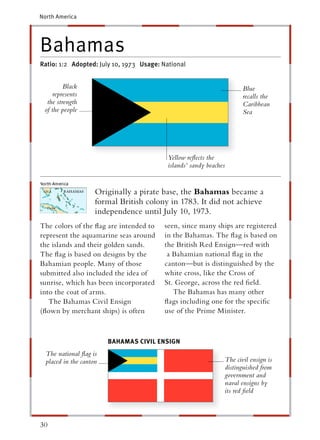
government was achieved in 1958                            independence. That of the present
and was retained on independence.                          republic, introduced in March
The red and white are said to                              1993, shows a map of the island
symbolize the earlier Merina                               with a spray of leaves. Beneath these
Kingdom, whose flags were all red                           is a paddy field surmounted by the
and white, with the addition of                            head of a zebu. The motto reads
green for the Hova, the former                             “Fatherland, Liberty, Justice.” Above
peasant class. The coat of arms has                        the design is the country’s name.


ARMS OF MADAGASCAR
                                                      N’I MADAG             The state title is in
                                                 KA               AS
                                            LI                              Malagasy, the local
                                        B
                                                                   IK
                                   PO


             The leaves of the                                              language
                                                                       AR
                                  RE


               traveller’s tree
                                                                        A


                                                                            An outline of
                                                                            Madagascar
         The national motto—
         “Fatherland, Liberty,                                              A stylized paddy field
                      Justice”                                              and a zebu, a local ox


                                                                                                     107
Africa


Mauritius
Ratio: 2:3 Adopted: January 9, 1968 Usage: National

              Red reflects
            independence
                                                                      Blue is the color of
                                                                      the Indian Ocean
    Yellow symbolizes
        a bright future


                                      Green recalls the lush
                                      vegetation of the island

Africa
                        Mauritius was taken over by Britain from France
                        in 1810. The colony achieved independence in
                        1968 and became a republic in 1992.
The flag was designed by the                  attributes of the island. In the
College of Arms in Britain prior             lower right quarter is a key and on
to independence, and is a simple             the left-hand side is a white star,
statement of the colors found in the         which are referred to in the Latin
coat of arms.                                motto, “Stella Clavisque Maris Indici”
                                             (“The star and the key of the Indian
MAURITIUS’S COAT OF ARMS                     Ocean”). The supporters are a dodo
The coat of arms was granted on              and a deer each holding a sugar
August 25, 1906, and depicts various         cane, the island’s staple crop.


ARMS OF MAURITIUS

         A dodo, extinct since
             the 18th century                                    A deer
          A ship symbolizing                                     Palm trees represent the
                 colonization                                    country’s tropical vegetation
       The star and key are                                      The national motto—“The
     referred to in the motto                                    star and the key of the
                                                                 Indian Ocean”


108
Europe


Iceland
Ratio: 18:25 Adopted: June 19, 1915 Usage: National and Civil


       White recalls the                                       Deep blue represents
    ice and snow which                                         the Atlantic Ocean
          covers Iceland


                                    Red represents the fire produced
                                    by the island’s volcanoes

Europe
                      Ruled by the Danes from the 14th century, Iceland
                      became a realm within the kingdom
                      of Denmark in 1918, and a republic in 1944.
Iceland’s first national flag               in 1918 and became the national
was a white cross on a deep blue          flag when Iceland gained
background. It was first paraded           independence from Denmark
in 1897. The modern flag dates             in 1944.
from 1915, when a red cross was              The naval ensign is swallow-
inserted into the white cross of          tailed, as are the naval ensigns of
the original flag. It was adopted          all the Scandinavian countries.

NAVAL ENSIGN                            THE PRESIDENT’S FLAG
The swallow-tail form is                The shield is supported by a bull,
common in Scandinavia                   an eagle, a dragon, and a giant, the
for government flags.                    mythical defenders of the island.


                                                                                  109
Europe


Norway
Ratio: 8:11 Adopted: July 17, 1821 Usage: National and Civil

The red, white, and
blue colors were
influenced by the
French Tricolore—a
symbol of liberty—
and by the flags of                                             Off-centered white
the UK and USA                                                 cross on a red field
                                                               is taken from the
                                                               Danish flag


Europe
                   Ruled by Denmark from 1397, Norway passed to
                   Sweden in 1814. It gained independence in 1905,
                   when its union with Sweden was dissolved.
Until 1814, the Norwegian flag              Tricolore, a symbol of revolution and
bore the Danish red and white              liberty. They were also the colors of
cross. The current flag was born            the flags of the United States of
in 1821, during the period when            America and the United Kingdom,
Norway was united with Sweden.             two other countries that were not
The flag combines two influences;            ruled by an absolute monarch.
its red and white coloring was taken          The Royal Standard consists of
from the Danish flag, and a blue cross      a banner of the Royal Arms, dating
was added overall. These three colors      back to the Middle Ages. It depicts a
were chosen in honor of the French         lion rampant on a red field.


                            THE ROYAL STANDA RD
                                       T
The standard dates back
to the Middle Ages
                                                          A tall, slender lion bearing
                                                          the ax of St. Olav


110
Europe


Denmark
Ratio: 28:37 Adopted: 1625 Usage: National and Civil

According to
legend, a red flag
with a white cross
“appeared as a sign
from heaven”                                                   The off-centered
                                                               cross is the basis for
                                                               other Scandinavian
                                                               countries’ flags


Europe
                      Denmark is Europe’s oldest kingdom, dating back
                      to the 10th century. The present queen rules under a
                      constitution granted in 1953.
Besides being the oldest monarchy         reality, the flag may have been a gift
in Europe, Denmark also has the           from the Pope during the Crusades.
oldest flag, known as the Dannebrog,
or Danish cloth. Legend says that         THE SCANDINAVIAN CROSS
a blood-red flag with a white cross        The flag was originally square, but its
appeared as a sign from heaven to         design was elongated and the arm of
King Valdemar II during the               the cross in the fly was extended. It
conquest of Estonia in 1219. In           has become a model for other flags.

Overseas Territories

                  FAEROE ISLANDS                              GREENLAND


The Faeroe Islands are a self-governing   Greenland’s flag was designed by a
territory of Denmark. The flag has         local artist and adopted in 1985. In the
the Norwegian colors in a new             Danish colors, white represents the
arrangement. This recalls that they       ice which covers most of the island
were once part of Norway.                 and red is for the Sun.


                                                                                        111
Europe


Sweden
Ratio: 5:8 Adopted: June 22, 1906 Usage: National and Civil

The yellow and
blue colors are
taken from the
national arms


                                    The distinctive Scandinavian cross
                                    is taken from the flag of Denmark

Europe
                     Until 1523, when King Gustav Vasa laid the
                     foundation of Sweden as a separate state, the
                     country was under the influence of Denmark.
The present flag was adopted in            On this day in 1523 King Gustav
1906, but it was first used in a           Vasa was elected and, on the same
similar form almost four centuries        date in 1809, Sweden adopted a
before. The design is based on the        new constitution.
Scandinavian cross. The flag’s blue
and yellow colors are thought to          SWEDISH ROYAL STANDARD
come from the national coat of            The coat of arms is placed in the
arms—three gold crowns in a blue          center of the Royal Standard,
field—which originated in the 14th         which is used on special occasions
century. A national flag day is            by Parliament and dates from
celebrated each year on June 6.           the 1440s.

                         THE ROYAL STANDARD

         The shield is                                           The triple crown
         supported by                                            symbolizes the
      two golden lions                                           “Three Wise Men,”
                                                                 a Swedish emblem
                                                                 since 1336


112
Europe


Finland
Ratio: 11:18 Adopted: May 29, 1918 Usage: National and Civil

The overall design
is based on the
Scandinavian cross
                                                                 Blue represents
                                                                 Finland’s blue skies
                                                                 and its thousands
                                                                 of lakes


                         White recalls the
                         snows of winter


                     Finland was part of Sweden from the 12th
                     century. From 1809 until independence in 1917,
                     it was part of the Russian Empire.
Like Sweden’s, Finland’s national flag        the land in winter. This color
is based on the Scandinavian cross.          combination has also been used over
    It was adopted after independence        the centuries in various Finnish
from Russia, when many patriotic             provincial, military, and town flags.
Finns wanted a special flag for their
country, but its design dates back to        THE ÅLAND ISLANDS
the 19th century. The blue coloring is       The Åland Islands are an autonomous
said to represent the country’s              group of Finnish islands with their
thousands of lakes and the sky,              own flag since 1954. The design
with white for the snow that covers          incorporates a Scandinavian cross.


                            THE FLAG OF THE
                            ÅLAND ISLANDS
Red and yellow
are taken from the
arms of Finland.
Blue and yellow
represent Sweden; the
islands have a large
Swedish population


                                                                                 113
Europe


Estonia
Ratio: 7:11 Adopted: May 8, 1990 Usage: National and Civil

                                                                       Blue represents
                                                                       loyalty and Estonia’s
                                                                       sky, sea and lakes
    White represents
     virtue, the snow
        and Estonia’s
 struggle for freedom


                                           Black is symbolic of past
                                           oppression and the soil

Europe
                        Estonia declared independence from the Russian
                        Empire in 1918. In 1940 it was annexed by the Soviet
                        Union, but recovered its independence in 1991.
The tricolor was first adopted by           sea, and lakes. Black symbolizes the
students in 1881 during uprisings          past suffering of the people, the soil
against occupying Russian Tsarist          and the traditional black peasant’s
forces. It was re-adopted as the           jacket. White represents virtue and
national flag in 1990 just prior to         the struggle for freedom. It is also the
independence. The colors represent         color of birch bark and snow.
Estonian history, folk costumes,              The great coat of arms was
and landscape. Blue is the color of        originally the emblem of a 13th-
loyalty and also represents the sky,       century Danish king.


GREAT ARMS OF ESTONIA


 The shield is surrounded                                      Three blue leopards are
by golden branches of oak                                      ranged on a gold shield


114
Europe


Latvia
Ratio: 1:2 Adopted: February 27, 1990 Usage: National and Civil

   Red recalls the
blood shed by the
  wounded leader
                                                                           White may
                                                                           stand for the
                                                                           sheet used
                                                                           to wrap the
                                                                           wounded
                                                                           Latvian leader
                           Red also represents Latvians’
                           willingness to defend their liberty

Europe
                     Over the centuries, Latvia has been invaded by
                     Swedes, Poles, and Russians. It became independent
                     from the Soviet Union in 1991.
Though officially adopted in 1922,               to one legend, is that a Latvian leader
the Latvian flag was in use as early             was wounded in battle, and the edges
as the 13th century, but its use was            of the white sheet in which he was
suppressed during Soviet rule.                  wrapped were stained by his blood.
   The red color is sometimes                      The coat of arms depicts a
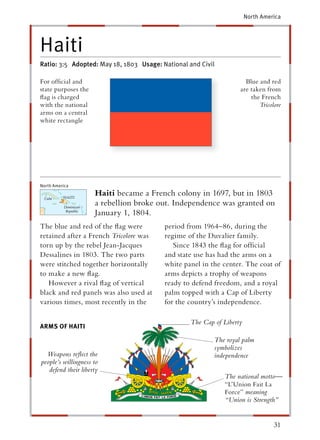
described as symbolizing the readiness          tripartite shield recalling the three
of the Latvians to give the blood               reunited duchies of Latvia. The
from their hearts for freedom. An               shield is held by a red lion and a
alternative interpretation, according           silver griffin.


ARMS OF LATVIA                                                      Three stars for the
                                                                    reunited duchies
  Rising sun represents
  the Duchy of Latgale
                                                                    The silver griffin
 The red lion represents                                            recalls the Duchy of
the Duchy of Kurzeme                                                Vidzeme


                                                                                          115
Europe


Lithuania
Ratio: 1:2 Adopted: March 20, 1989 Usage: National and Civil


          Green                                                      Yellow
     symbolizes                                                      represents
 the forests and                                                     wheat and
  renewed hope                                                       freedom from
                                                                     want


                                         Red symbolizes
                                         patriotism and courage

Europe
                     After declaring independence from Russia in 1918,
                     Lithuania was again occupied by the Soviet Union
                     in 1940. It declared independence in 1991.
The national flag dates from the          refers to the color of the medieval
independent republic of 1918–1940.       banners of the kingdom of Lithuania.
It was suppressed under the Soviet       Together, the colors stand for hope,
regime, but was re-adopted in            courage and freedom from want.
1990. Yellow is said to stand for
ripening wheat, green for the forests,   ARMS OF LITHUANIA
and red for love of the country, or      The coat of arms’ red shield dates
alternatively for the blood shed in      from the 14th century. It was
defence of the nation. Red also          re-adopted in 1991.


ARMS OF LITHUANIA

              A white knight                             The double-barred cross
               on his charger                            commemorates the conversion
                                                         of Grand Duke Jaggelon of
                                                         Lithuania to Catholicism
                                                         in 1386, at the time of his
                                                         marriage to Queen Hedwig
                                                         of Poland


116
Europe


Poland
Ratio: 5:8 Adopted: August 1, 1919 Usage: National

The bicolor
design was                                                         White
adopted after the                                                  represents a
World War I                                                        desire for peace
Red and white
were taken
from the 13th
century arms


                                        In the past red was said
                                        to represent socialism

Europe
                    Poland is strategically placed in Europe and its
                    borders have constantly shifted. They were last
                    altered after World War II, in 1945.
The red and white colors of the flag      added. The border and the crown
have been used since the 13th            were both dropped under the
century, although they did not           communist administration, but the
became the official national colors       crown was restored in 1993.
until 1831. They were taken from the
colors of the national arms, first        THE PEOPLE’S REPUBLIC OF POLAND
recorded in 1295.                        Under communist rule from 1945–
                                         1989, white was commonly said to
THE NATIONAL ARMS                        represent the people’s desire for
The coat of arms traditionally shows     peace, and during this period, red
a white eagle on a red field. This        stood for socialism. The flag was
emblem has remained more or less         re-confirmed as the national flag by
unchanged throughout Poland’s            the new government in 1992.
turbulent history. The coat of arms         The plain bicolored flag is used for
was used by the Kingdom of Poland        general purposes on land. When at
until its fall in 1795, and was          sea the flag is charged with the state
re-adopted by the newly-declared         arms in the center. Poland also has a
republic around 1918/19, when a          swallow-tailed ensign, which is also
zigzag border and crown were             charged with the state arms.


                                                                                 117
Europe


Germany
Ratio: 3:5 Adopted: May 23, 1949 Usage: National and Civil

The colors of                                                  The flag was first
the German flag                                                 adopted in 1848.
were taken from                                                     The flag was
the uniforms of                                                officially adopted
German soldiers                                                  for the republic
during the                                                                in 1919
Napoleonic Wars


                  In 1919 the German Empire became a republic. In
                  1949 it was divided into East and West Germany,
                  and in 1990 the two halves reunited.
Until the 19th century, Germany          the black and white of Prussia, of
was a collection of feudal states. In    which Bismarck was Chancellor.
1848 an attempt was made to unite
them, and although no union was          THE WEIMAR REPUBLIC
established, a flag was produced. This    After Germany’s defeat in the First
was a black, red, and gold horizontal    World War a republic was declared in
tricolor. The colors were taken from     1919 and the black, red, and gold flag
the uniforms of the German soldiers      returned. Its revival was short-lived
in the Napoleonic Wars in the late       and in 1933, when the Nazi
18th century.                            government came to power they
                                         restored the imperial colors and made
THE GERMAN EMPIRE                        their party flag, the Hakenkreuz, the
Most of the states finally united into    national flag.
the German Empire in 1871, but              After World War II, both German
instead of retaining the black, red      states reverted to using the black,
and gold flag, the rival Bismarck         red, and gold tricolor, but East
tricolor of black, white, and red was    Germany added its coat of arms.
adopted. This was a combination of       Since reunification, the plain tricolor
the red of the Hanseatic League and      has been used.


118
Europe


Länder flags
On German regional flags the arms only appear on the official versions
(except Lower Saxony, Saarland, and Rhineland Palatinate).


                      BADEN-                                           BAVARIA
                      WÜRTTEMBURG


The flag was adopted in 1953. Its                 avaria’s flag was adopted in 1950, but blue
colors derive from the arms of Duke              nd white have been Bavarian colors since
Frederick V of Swabia, the coat of arms          330 and the lozenge shapes first appeared
dates back to 1265. It was adopted as            n banners in the 15th century.
the state arms in 1954.


                      BERLIN                                            BRANDENBURG


The flag was first adopted for West Berlin        The colors of the flag are from the
in 1950 and extended to the whole city          hield, dating from 1170, although red and
in 1991. The bear, a pun on the name            white were also the colors of the medieval
Berlin, dates from 1338 and the colors from     Hanseatic League. The flag was adopted
1861.                                           n 1990.


                    BREMEN                                             HAMBURG


The flag of Bremen predates its coat of          Used since 1325, red and white are the
arms, which was adopted in 1891.                Hanseatic colors. The castle is for Hamburg;
Prior to this, Bremen was a member of           he three towers for the Trinity; the cross
the Hanseatic League, where the                 or Christ; the stars for the Father and
flag originated.                                 Holy Spirit.


                      HESSEN                                           LOWER SA XONY


The flag of Hessen was adopted in 1948.          This flag uses the national flag with
The coat of arms was that of Ludwig III          ower Saxony’s local arms in the center.
of Thuringia in 1182. The red and white         t was adopted in 1946, but the arms dates
colors of the flag are taken from the lion in    rom 1361, when it appeared on the seal of
the arms.                                       he ruler.


                                                                                         119
Europe


Germany: Länder flags

                     MECKLENBURG-                                       NORTH-RHINE-
                     VORPOMMERN                                         WESTPHALIA


This flag, adopted in 1991, combines blue        The coat of arms depicts the River Rhine of
and white of Pomerania with blue, yellow,       he Rhineland, the horse of Westphalia, and
and red of Mecklenburg. The bull and the        he rose of Lippe; the three territories which
gryphon are also local emblems. Red and          nited to form the state. The colors of the
white recall the Hanseatic League.               ag are from the arms.


                     RHINELAND-PALATINATE                               SAARLAND


The flag was adopted in 1948 when the            Adopted in 1957, the flag of Saarland
arms were placed on the national flag.            ecalls the different parts of the state.
The coat of arms depicts the lion of the        Depicted on the shield is the lion of
Palatinate dating from 1229, the cross of        aarbrücken, the cross of Trier, the
Trier from 1273, and the wheel of Mainz          agles of Lorraine and the lion of
from 1335.                                        falz-Zweibrücken.


                       SA XONY                                          SA XONY-ANHALT


The flag was adopted in 1991, but the coat       This flag was the same as Baden-
of arms is the traditional arms of the rulers   Württemberg until 1991, when the colors
of Saxony; black and yellow bands and the       were reversed. The eagle recalls Prussia, the
green crown of rue. The white and green          icolored bands and rue crown, Saxony, and
flag dates from the 19th century.                he bear and wall are the arms of Anhalt.


                       SCHLESWIG-HOLSTEIN                               THURINGIA


The shield depicts two lions from arms of       Another flag whose colors are based on the
Schleswig and a nettle-leaf from those of       tate arms. It was adopted in 1991. The red
Holstein. The colors of the flag, adopted in      nd white lion was the arms of the Counts
1957, are taken from the arms.                   f Thuringia in the 12th century.


120
Europe


The Netherlands
Ratio: 2:3 Adopted: February 19, 1937 Usage: National and Civil

Blue and white                                               In the mid-17th
originally                                                   century, red, rather
represented                                                  than orange, was
faith in God                                                 made the official color


Europe
                   Independent from Spain in the 16th century, the
                   Netherlands was a republic until the Napoleonic
                   Wars and became a kingdom in 1814.
The first Stadtholder, or ruler, of the
                    r                     by Royal Decree in 1937. As the
Dutch Republic was William of             first revolutionary flag, it has had
Orange, who joined with Dutch             a seminal influence throughout
nationalists and led the struggle for     the world, particularly on the
independence from Spain.                  Pan-Slavic colors of Russia.
                                             Until about 1800, in the case of
THE PRINSVLAG                             both the orange- and red-striped
Partly out of respect for him, the first   versions, the number of stripes and
flag adopted by the Dutch, was a           their order frequently varied.
horizontal tricolor of orange, white,
and blue (see page 6). It became          ARMS OF THE NETHERLANDS
known as the Prinsenvlag and was
                          g               The Dutch coat of arms depicts a
based on the livery of William of         golden lion on a blue shield, holding
Orange. The orange dye was                a sword and a sheaf of arrows. It is
particularly unstable and tended to       a combination of the coat of arms
turn red after a while, so in the         of the Dutch Republic and that of
mid-17th century, red was made the        the House of Orange. The seven
official color. The flag has flown           arrows represent the seven original
since then, but was only confirmed         provinces in the Netherlands.


                                                                               121
Europe


The Netherlands: Provincial flags
Except for South Holland and North Brabant, all the Dutch provincial flags are modern creations.


                    DRENTHE                                           FLEVOLAND


White and red are the colors of the              Blue is for the Lake Ijssel from which the
Archbishops of Utrecht, former rulers             rovince was reclaimed. Green is for
of Drenthe. The black castle and stars            egetation and yellow for the cornfields.
recall the uprising of Coevorden against         The lily recalls Lely, the engineer of the
the archbishop.                                   eclamation project.


                    FRIESLAND                                         GELDERLAND


The flag is based on that of the 15th             n 1371, the dukedoms of Gelre and
century kings of Friesland. The                  Gulik were united and combined their
colors are those of the Dutch flag.                rms. The new arms was blue, yellow,
The stripes and flowers represent the              nd black, the colors which appear in
seven districts of Friesland.                    he flag, hoisted in 1953.


                    GRONINGEN                                         LIMBURG


The flag, adopted in 1950, combines               The red lion is from the arms of
green and white from the town of                  imburg. White and yellow are from
Groningen, surrounded by red, white,             ocal coats of arms, while the narrow
and blue of Ommeland, reflecting the               lue stripe is for the Maas River which
town’s position.                                  rosses the province.


                      NORTH BRABANT                                   NORTH HOLLAND


The design, adopted in 1959,                     Adopted in 1958, this flag unites the
originated in Antwerp where red                   olors of Holland; yellow and red, with
and white checked coats of arms                   lue and yellow of West Friesland.
were popular. It was associated with             Yellow, the common color, is placed
the area from the 17th century.                   t the top.


122
Europe


Netherlands: Provincial /Overseas Territory flags


                     OVERIJSSEL                                        SOUTH HOLLAND


The yellow and red stripes recall the              The flag is a banner of the arms of Holland
ancient association of the province with            nd was adopted in this form in 1986,
Holland. The wavy blue stripe running              eplacing the previous simple triband of
across the center is for the Ijssel River, after    ellow-red-yellow, which was also based on
which the province is named.                       he colors of the arms .


                     UTRECHT                                           ZEELAND


The Archbishop of Utrecht used a red               The flag of Zeeland, adopted in 1949,
flag with a white cross from 1528. The              hows its full coat of arms. The wavy
Archbishop’s flag remains in the canton              lue and white stripes are for the sea
of the modern flag, adopted in 1952.                 nd the constant struggle to control
The field is in the traditional colors of             . From the water, the Dutch lion
the province.                                       ises in triumph.


                     ARUBA                                             NETHERLANDS ANTILLES


The flag of Aruba was adopted                       Originally adopted in 1959, the flag
in 1976 when it was still administered             ncorporated the Dutch colors with six stars
as part of the Netherlands Antilles. The            n the blue stripe, for the island groups.
flag was retained when Aruba became                 These were reduced to five in 1986 when
autonomous in 1986.                                Aruba left the Netherlands Antilles.


                                                                                              123
Europe


Belgium
Ratio: 13:15 Adopted: January 23, 1831 Usage: National and Civil

The vertical layout                                                   Red is adapted from the
is derived from the                                                   lions claws and tongue
French Tricolore


             Black is taken
            from the shield
                of the arms

                                                  Gold is the color of
                                                  the lion in the arms

Europe
                      Following centuries of foreign domination,
                      Belgium finally gained international recognition
                      as an independent kingdom in 1830.
The Belgian colors black, yellow and              stripes, appeared in 1792 in a revolt
red derive from the arms of Brabant,              against Austrian rule. On
a black shield with a gold lion having            independence in 1831, they were
red tongue and claws. The first flag                changed to vertical in imitation of
in these colors, but with horizontal              the French Tricolore.

Belgian Regional flags

                     BRUSSELS                                            FLANDERS


Adopted in 1991, the lily was widespread           Adopted in 1985, it is based on the arms, and
in the area which later became Brussels.           the colors are taken from the national flag.


              GERMAN REGION                                              WALLONIA


Adopted in 1990, the lion recalls former owner,    The cockerel is derived from the Gallic rooster,
Limburg; 9 roses are for the 9 communes.           recalling the cultural links with France.


124
Europe


Ireland
Ratio: 1:2 Adopted: January 21, 1919 Usage: National and Civil

        Green                                                         Orange is for
     represents                                                       the Protestant
  the Catholic                                                        people
        people


                                         White is for the union between
                                         Catholics and Protestants


                    After centuries of British rule, Ireland was split
                    in 1921, becoming the Free State (The Republic
                    of Ireland) and the northern Six Counties.
The Irish flag is modeled on that of       represents the Catholic majority;
the French Tricolore. It was first flown    orange is for the Protestant minority
by nationalists during their struggle     (originally supporters of William of
for freedom from Britain in 1848,         Orange) and white is for peace
a year of Europe-wide revolution.         between the two faiths.
However, it was not until the Easter
Rising of 1916 that it came to be         THE PRESIDENT’S STANDARD
                                                           T
regarded as the national flag. It was      The flag of the President was
officially confirmed in 1919 and was        introduced in 1945 and is based on
written into the Constitution in          the ancient “Green Flag,” a traditional
1937. The green coloring on the flag       symbol of Irish nationalism.

                        THE PRESIDENT’S STANDARD
                                         T
                                                                  The flag is similar
    The harp is said                                                to the quartering
    to be the harp of                                              for Ireland on the
Brian Boru, an 11th                                               Royal Arms of the
        century ruler                                              United Kingdom


                                                                                 125
Europe


United Kingdom
Ratio: 1:2 Adopted: January 1, 1801 Usage: National and Civil

                                                                       The saltire of
                                                                       St. Patrick has
                                                                       been counter-
The white saltire                                                      changed with the
  on a blue field                                                       white saltire of
       was taken                                                       St. Andrew
    from the St.
 Andrew’s Cross

                                         The central red cross, fimbriated with white
                                         was adapted from the St. George’s Cross


                    The United Kingdom was formed in 1707, uniting
                    England, Scotland, and Wales. In 1801 Ireland
                    joined, but in 1921 the south broke away.
The Union Flag is probably one            known as the Union Jack, be flown
of the world’s best known flags,           on British ships, combining the
partially due to its unusual design,      English Cross of St. George with
but more importantly, because             the Scottish Cross of St. Andrew.
of the importance of the British
Empire in World history.                  A NEW UNION FLAG
                                          In 1801, when Ireland joined the
THE FIRST UNION FLAG                      Union, the so-called Cross of
When King James of Scotland               St. Patrick was added to form the
became King of England in 1603,           present flag, but was counterchanged
both countries retained their own         with the Cross of St. Andrew.
flags. Even today, the St. George’s
Cross and St. Andrew’s Cross              A ROYAL FLAG
remain the flags of England and            The Union Flag was established
Scotland respectively. In 1606 King       as a maritime flag and it remains a
James considered it necessary to have     royal flag, not officially a national
a flag reflecting the new union of          flag. In 1915, King George V gave
Scotland and England and ordered          permission for British citizens to
that a Union Flag, more commonly          use the flag on land.


126
Europe


Subnational flags
Most regional flags are older than the Union Flag, except those
based on the St. George’s Cross, which date from the 20th century.


                       ENGLAND                                           WALES


Originally used in 1191, the flag of                Approved in 1959 as the Welsh national
St. George became the flag of England                ag, the Red Dragon is an ancient
after 1277. The white flag has a red                 mblem of Wales. For a time it appeared
upright cross throughout. At sea it is              n a green hill, but the horizontal
the flag of an Admiral.                              ivision is traditional.


                       SCOTLAND                                          SCOTLAND
                       (THE STANDARD)                                    (NATIONAL FLAG)


The red lion on gold is the traditional            n use since 1512, the Scottish flag is
royal flag of Scotland. The fleur-de-lis             he Cross of St. Andrew. As James was
on the border recall the “auld alliance”           King of Scotland before he was King
with France. Its exact date of adoption             f England, this flag formed the basis
is not known.                                       f the Union Flag.


                       ISLE OF MAN                                       GUERNSEY


Again this is a traditional design. It             Guernsey formerly used only the
was adopted in 1968. The Trinacria,                Cross of St. George. In 1985 a gold cross
three legs of Man, has been used for               aken from the flag of William the
several centuries in varying forms, but            Conqueror at the Battle of Hastings
its origin is uncertain.                           was added to the flag.


                       JERSEY


Prior to the adoption of its current flag,
Jersey used a red diagonal cross on white,
which is the same as the saltire of St. Patrick.
The arms were added in 1981.


                                                                                               127
Europe


UK: Royal Standards
Like other monarchies, the UK has a wide range of flags which are armorial or semi-armorial, for
the leading members of its royal family. In the case of HM Queen it is necessary to distinguish
between her role as Queen of the United Kingdom and her other Realms, and as Head of the
Commonwealth. In addition to her British Royal Standard she has standards for other Realms.


                           ROYAL STANDARD                      QUEEN AS HEAD
                           OF THE UNITED                       OF THE COMMONWEALTH
                           KINGDOM

This form has been in use since the               This is used when the Queen is not in a
accession of Queen Victoria in 1837                Queen’s Realm” (i.e., a country of
and depicts the three areas united to             which she is directly the Head of State)
form the United Kingdom (England,                  r in one which does not have a local
Scotland, and Northern Ireland).                  Royal Standard. It is a banner with Her
Strictly, flags of this kind are armorial          Majesty’s initial “E”, a gold crown, and
banners rather than “standards.”                   haplet of roses.


                           PRINCE PHILIP                                     HRH PRINCE
                           DUKE OF                                           CHARLES PRINCE
                           EDINBURGH                                         OF WALES

The banner for Prince Philip has                  The banner is an adaptation of the Royal
quarters representing his descent                  tandard, with a “label” for an eldest son;
from the royal families of both                     white bar with three points, and the
Denmark and Greece, and from the                   uartered arms of the Principality of
Mountbattens, and his title Duke of               Wales over all in the center. Labels are
Edinburgh is represented by the arms               sed for children and grandchildren of
of the city.                                      he Queen.


                                                  OTHER ROYAL STANDARDS
               HRH PRINCE CHARLES
               FOR USE IN WALES
                                                  Other members of the Queen’s family
                                                  who have standards based on the Royal
                                                   tandard are the Princess Royal, the
For personal visits to Wales and as               Duke of York, Earl of Wessex, and the
his own flag, the Prince uses the                  Queen’s royal cousins. There is a
banner of the Principality of Wales                eneral banner for those members of
with his crown on a green shield                  he royal family not entitled to an
over all in the center. The Prince                ndividual standard.
also has banners for his titles in
Cornwall, Rothesay, and as Lord
of the Isles.


128
Europe


Overseas Territories
Official flags for British Overseas Territories are generally based on the British blue
or government ensign with a local badge in the fly.


                           ANGUILLA                                            ANGUILLA
                                                                               (UNOFFICIAL)


The flag of Anguilla was adopted in                 Adopted in 1967, when the island
1990. It is a blue ensign with the                 eparated from St. Kitts and Nevis. The
badge of the island. This derives                  urquoise stripe represents the sea, and
from the unofficial flag used locally                he three dolphins are for friendship,
on land only.                                      wisdom, and strength.


                            BERMUDA                                            BRITISH VIRGIN
                                                                               SLANDS


Unusually, Bermuda uses a red ensign.              The badge dates from 1909, the flag
The badge shows a lion holding a shield            rom 1956. It shows St. Ursula, the
on which appears the 1609 wreck of                  amesake of the islands, with a lamp.
a ship, which struck a reef, not a cliff            he was martyred with 11,000 virgins,
as is shown.                                       epresented by 11 lamps.


                           BRITISH                                             BRITISH INDIAN
                           ANTA RCTIC
                             T                                                 OCEAN TERRITORY
                           TERRITORY

The white field of the new flag,                     The flag was adopted in 1990. Blue
approved in 1998, symbolizes the snow               nd white wavy lines represent the
which covers the Antarctic continent.               cean and the palm recalls the natural
It is used by research stations within              egetation of the islands. The crown
the territory.                                     hows British possession.


                           CAYM AN ISLANDS
                            A                                                  FALKLAND
                                                                                SLANDS


Blue and white lines recall the sea and the        The badge shows a ram for the sheep
three stars, the three main islands. The           ndustry of the islands. The ship is the
lion of England appears above and the              Desire, the ship of John Davies who
crest is a turtle and a pineapple for the           iscovered the islands in 1592. The flag
fauna and flora.                                    was hoisted in 1948.


                                                                                              129
Europe


United Kingdom: Overseas Territories

                          GIBRALTAR                                  GIBRALTAR (CIT Y)
                          (ENSIGN)


The blue ensign of Gibraltar was           The local flag of Gibraltar City is a
officially adopted in 1895. The badge        anner of the arms officially granted
is based on the arms of Gibraltar          n 1926. It is based on the original
granted by Ferdinand, the King of           rms granted by Spain in 1502. The
Spain in 1502. The castle and key           anner was granted for use
recall that Gibraltar is both a fortress    xclusively on land in 1983. Like the
and, because of its position on one side    adge it depicts a red fortress with a
of a narrow strait, also the key to the     old key. The red and white field is
Mediterranean Sea.                          erived from the arms.


                          MONTSERRAT                                  PITCAIRN ISLANDS


The coat of arms dates from 1909,          Adopted for the Pitcairn Islands in
although its origin is unknown. It          984, the badge commemorates the
shows a woman in green holding a           sland’s earliest settlers, the infamous
cross and a harp. The cross is for          rew of HMS Bounty, who mutinied
Christianity and the woman and harp        n 1790. The badge is blue to
recall Irish immigrants who settled         epresent the Pacific Ocean, with a
on the island in 1632. The arms were        reen triangle symbolizing the island.
re-adopted in 1962 when the West           The shield is charged with the Bible
Indies Federation was dissolved.            nd the anchor of HMS Bounty.


                          ST. HELENA                                  TURKS AND
                                                                      CAICOS ISLANDS


The current badge was made into a coat     The blue ensign was granted in 1968,
of arms in 1984. It depicts a ship flying   hree years after the arms. The shield
the Cross of St. George sailing between    rom the arms shows a conch-shell and a
two cliffs. Above is a wire-bird            rayfish representing fishing, the islands’
representing the local fauna. The flag is   main industry, and a cactus for their
also flown in the Ascension Islands and      ora. The Turks and Caicos became a
Tristan da Cunha, dependencies             eparate colony after the Bahamas
administered by St. Helena.                 chieved independence.


130
Europe


France
Ratio: 2:3 Adopted: February 15, 1794 Usage: National and Civil

Red, white, and                                                        Blue and red are the
blue have come to                                                            colors of Paris
represent liberty,
equality, and
fraternity—the
ideals of the French
Revolution


                                           White is the color of the
                                           House of Bourbon


                       France was a monarchy until the the Revolution
                       of 1789. A republic was created in 1792, following
                       the abolition of the monarchy.
The traditional emblem of France            Other nations have also adopted
was the fleur-de-lis, or lily, which         the design. Because France has
first appeared on the arms in the            no arms, the Tricolore is also the
12th century.                               national emblem.
                                               The colors are probably derived
A REVOLUTIONARY FLAG                        from those of Paris, combined with
The Tricolore was used during the           those of the Bourbon Dynasty,
Revolution and has since become a           though they are usually associated
symbol of liberty around the world.         with liberty, equality, and fraternity.

Overseas Territories

                     ST. PIERRE &                               FRENCH POLYNESIA
                     MIQUELON


These islands lie just south of Canada’s    Red and white are local colors. The
Newfoundland. The flag features the          emblem depicts a pirogue—a local
emblems of the Basques, Bretons, and        canoe—below a rising sun. The five
Normans who settled the islands.            crew recall the five island groups.


                                                                                        131
Europe


Luxembourg
Ratio: 3:5 Adopted: 1848 Usage: National

The colors date
back to the 13th
century


                                                                The blue stripe is
                                                                paler than that of
                                                                the Netherlands


Europe
                    For most of the 19th century Luxembourg was
                    part of the Netherlands. It gained independence in
                    1890 and is Europe’s last independent duchy.
Luxembourg had no flag until 1830,          coloring was derived from the Grand
when patriots were urged to display        Duke’s coat of arms, which dates
the national colors. The flag was           from the 13th century.
defined as a horizontal tricolor of red,
white and blue in 1848, but it was not     THE CIVIL ENSIGN
officially adopted until 1972. The          Since 1972 a banner of the Grand
tricolor flag is almost identical to that   Duke’s arms has been used as a civil
of the Netherlands, except that it is      ensign for use at sea. This is a blue
longer and its blue stripe is a lighter    and white-striped field with a lion
shade. The red, white, and blue            rampant in the center.


                            LUXEMBOURG
                            CIVIL ENSIGN
Red, white, and blue
coloring gave rise to
colors of national flag
                                                         A crowned two-tailed
                                                         lion rampant


132
Europe


Monaco
Ratio: 4:5 Adopted: April 4, 1881 Usage: National and Civil

The bicolor design                                             Red and white are the
is common on other                                              heraldic colors of the
national flags, for                                                   Grimaldi family
example San Marino.
It is often used as
a background for
heraldic livery


Europe
                   The Grimaldis, a Genoese family, have ruled
                   Monaco since the 13th century. Until 1860, the
                   principality was considered part of Italy.
The present bicolor design was            and consists of a shield supported
adopted in 1881 under Prince              by two monks bearing swords.
Charles III. It is identical to the far   The device alludes to the legend
younger Indonesian national flag           of 1297, in which the Grimaldis
except in its statutory proportions       conquered Monaco after entering
which are 4:5, compared to 2:3.           the city with soldiers disguised as
   The Grimaldi coat of arms, which       monks. Earlier Monegasque flags
appears on the state flag, is the          incorporated the Grimaldi shield
traditional one of the princely family    and crown on a white field.


ARMS OF GRIMALDIS                                             A princely crown


 The Grimaldi motto—
                                                              The collar of the
          Deo Juvante
                                                              Order of St. Charles
   (“With God’s Help”)
                                                              surrounds a shield of
                                                              red and white (or silver)


                                                                                    133
Europe


Andorra
Ratio: 2:3 Adopted: July 10, 1996 Usage: National and Civil

The colors                                                          Red and yellow
reflect Andorra’s                                                 are taken from the
dependence upon                                                      colors of Spain
France and Spain
Blue and red are
taken from the
colors of France


                                         Andorran
                                         coat of arms

Europe
                      The Principality of Andorra is an independent
                      republic in the Pyrenees, between France and Spain.
                      It is one of the world’s oldest states.
The principality of Andorra has           ARMS OF ANDORRA
been under Franco-Spanish                 Like the colors of the flag, the
protection since 1278, governed by        coat of arms also depicts the areas on
the Counts of Foix and the Bishops        which Andorra has been dependent.
of Urgel. The colors of its national      The quartered shield represents
flag reflect both France: blue and          Urgel by the crozier and mitre,
red; and Spain: yellow and red. The       Foix by the three vertical red stripes,
Andorran coat of arms is placed in        Catalonia by the four vertical red
the middle of the yellow stripe.          stripes and Béarn by the two cows.


ARMS OF ANDORRA

            The crozier and                              The three red stripes
         mitre symbolize the                             recall the Counts of Foix
           Bishops of Urgel
                                                         The two cows are taken
         The four red stripes                            from the arms of Béarn
          are taken from the
          arms of Catalonia                              The motto is, “Virtus
                                                         Unita Fortior”—“Strength
                                                         united is stronger”


134
Europe


Portugal
Ratio: 2:3 Adopted: June 30, 1911 Usage: National and Civil


        The armillary                                            Red represents
     sphere—an early                                             revolution
     navigational tool


                                Green represents a Portuguese
                                explorer; King Henry the Navigator

Europe
                      During the 15th and 16th centuries, Portugal
                      played a leading role in discovering the world
                      beyond Europe. It formed a republic in 1910.
The present flag with red for                shield was first used by King Sancho
revolution and green for Portuguese         I. The five blue shields recall the
exploration dates from 1910. The            victory of King Afonso Henriques
central emblem is an armillary              over five Muslim princes. The red
sphere, an early navigational               edge and castles are from the
instrument, on which is the former          marriage of King Alfonso III to a
royal arms of Portugal. The white           Spanish princess in 1252.


EMBLEM OF PORTUGAL
                                                             This armillary sphere
                                                             and shields appear in the
    Five blue shields recall                                 center of the Portuguese
       the victory of King                                   coat of arms
        Afonso Henriques

       Gold castles on red                                   The armillary sphere
     recall the marriage of                                  recalls the importance of
     King Alfonso III to a                                   Portuguese exploration
         Spanish Princess                                    of the globe


                                                                                    135
Europe


Spain
Ratio: 2:3 Adopted: July 19, 1927 Usage: National and Civil

Red and yellow                                                     The first red and
are the colors of                                               yellow flag of Spain
the arms of both                                                     was adopted in
Castille and Aragón                                                the 18th century
                                                                       for use at sea


                                                                The present layout
                                                               was adopted in 1927


Europe
                  Spain was united in the 15th century and rapidly
                  became an imperial power. It lost most of its
                  colonies during the 19th century.
Early Spanish flags were mostly            THE SPANISH REPUBLIC
heraldic; some, like the flag of           When Spain became a republic in
Castilla y León (see page 138)            1931, an equal horizontal tricolor in
survive today.                            red, yellow, and purple became the
   In 1785 the King of Spain              new flag. Purple was from the arms
adopted red and yellow, a                 of León. At the end of the Spanish
combination of colors then used by        Civil War (1936-1939) the original
no other country, to distinguish          flag was restored.
Spanish ships. The present pattern           The state flag has the national
was finally established in 1927.           arms set toward the hoist.

ARMS OF SPAIN


                                                                 The arms show the
                                                               regions of Spain. The
                                                               shield is supported by
                                                              the Pillars of Hercules
                                                                 and has the Spanish
                                                                 royal crown above.


136
Europe


Regional flags
Although most of the flags were adopted recently, all are based on older models,
or traditional arms, displaying continuity with the past.


                    ANDALUSIA                                         ARAGÓN


Adopted in 1918, but not confirmed until          The stripes of Aragón date from the 14th
1983, the colors were those used during the       entury. Tradition states that a King of
Napoleonic Wars. The coat of arms depicts        Aragón drew bloodstained fingers over a
the Pillars of Hercules and the lions             old shield. The flag was adopted in 1981.
of Cadiz.


                    ASTURIAS                                          BALEARES


Blue is the color of the Virgin Mary. The        The field is the same as the flag of Aragón,
cross is the Cross of Victory, a traditional     o which the islands belonged in medieval
Asturian emblem. From it hang Greek               mes. The canton is the emblem of Palma
letters, symbolizing Christ, the Beginning,       e Majorca, the islands’ capital.
and the End.


                    THE BASQUE COUNTRY                               CANARY ISLANDS
                    (PAÍS VASCO)                                     (ISLAS CANARIAS)


This flag was first adopted in 1931 and            The colors symbolize those of the Virgin
re-adopted in 1979. It is based on the           Mary and the Papacy. They are also
Union Jack. Red recalls bloodshed, white         hought to evoke the blue sea, the white
the Catholic faith, and green the Oak             eaches, and the golden sun. It was adopted
of Guérnica.                                     n 1989.


                    CANTAB RIA
                       T                                                    CASTILLA-LA
                                                                            MANCHA


White and red are the traditional colors of      Adopted in 1989, the deep red stripe
the area. The arms allude to the seafaring        nd the castle are the emblem of
customs of the people and include an ancient     Castile. The white panel is intended to
seal. The flag was adopted in 1981.                ecall the surcoats worn by the soldiers
                                                 n the Crusades.


                                                                                            137
Europe


Spain: Regional flags


                    CASTILLA Y LEÓN                                 CATALONIA
                                                                    (CATALUNYA)


This flag has been used by Castilla y León       The flag, adopted in 1932, has been used
since 1248. It depicts the union of Castilla     nce the 13th century and has the same
(castle) and León (lion). It was adopted for     rigin as that of Aragón. It was outlawed
the region in 1989.                             rom 1939 to 1975.


                    EXTREMADURA                                         GALICIA


This flag was adopted in 1985, but the           Based on a traditional Galician design,
colors are traditional regional colors. Green   white and blue are the colors of the
is for fidelity, white for truth, and black      Virgin Mary. The arms reflects loyalty
for courage.                                    o the Catholic Church.


                    LA RIOJA                                        MADRID


The upper red stripe was originally to          The flag, adopted in 1983, is in the
be in the color of Rioja wine, but is           raditional color of Castilla. The seven white
now simply red. The colors are taken            tars, from the arms, are for the seven
from the arms.                                   istricts of the region.


                    MURCIA                                          NAVARRE


The four castles recall Murcia’s links with     The red field and golden chains of Navarre
Castilla and the seven crowns, the seven         ate from the 14th century. The current
regions of the province.                         ag was adopted in 1982.


                    VALENCIA


The stripes recall Valencia’s links with
Catalonia and the stylized crown, its
period of independence.


138
Europe


Italy
Ratio: 2:3 Adopted: June 18, 1946 Usage: National

      Green was said                                              The first vertical
     to be Napoleon’s                                             tricolor was used
         favorite color                                           until 1814. It was
                                                                 readopted in 1861


Europe
                      Italy was a collection of city states, dukedoms, and
                      monarchies before it became a unified nation in
                      1861. Italy became a republic in 1946.
The Italian tricolor comes from           1861. When the monarchy ended in
the standard designed by Napoleon         1946, the coat of arms of the House
during the Italian campaign of            of Savoy was removed from the flag.
1796. The coloring was influenced          The present flag was officially
by the French Tricolore, at first          adopted in 1946.
appearing in horizontal bands. The
vertical tricolor was introduced in       ITALIAN CIVIL ENSIGN
1798, but was only used until 1814.       The most famous seafaring states of
It was re-introduced when the new         ancient Italy are commemorated in
Kingdom of Italy was formed in            the quarters of the civil ensign.


                             ITALIAN CIVIL ENSIGN

       The winged lion of                                The Cross of St. George
St. Mark represents Venice                               represents Genoa
                                                         The Pisan cross
         The Maltese cross                               stands for Pisa
            recalls Amalfi


                                                                               139
Europe


Malta
Ratio: 2:3 Adopted: September 21, 1964 Usage: National

 The George Cross is                                               Red and white
  fimbriated with red                                            were adapted from
                                                                  the badge of the
                                                                 Knights of Malta


Europe
                       Malta was ruled successively by the Knights of
                       St.John of Jerusalem, by Napoleon, and by Britain.
                       It became independent in 1964.
A key stronghold during the                medal was added to the shield in
Crusades, much of the heraldry of          1943. It was awarded to the islanders
Malta is influenced by the colors and       by King George VI of Britain for
devices of the Knights of Malta.           heroism in World War II. In 1964,
Their badge was the characteristic         the blue canton on which the cross
Maltese cross and their arms was a         was originally placed was replaced by
white cross on a red field. From these      a red fimbriation.
colors came the red and white                 The President’s flag, introduced in
shield that was used during the            1988, has the shield on a blue field,
colonial period. The George Cross          with a Maltese cross in each corner.


                               THE PRESIDENT’S FLAG
         The wreath of olive                              A gold mural crown
          and palm branches                               with a sally port and
            represents peace                              eight turrets represents
                                                          fortifications of Valetta

          The Maltese cross                               The Shield of Malta


140
Europe


Vatican City
Ratio: 1:1 Adopted: June 7, 1929 Usage: Civil

Yellow (gold) and white
(iron) are the colours of
St Peter’s keys
                                                       The emblem features
                                                       St. Peter’s keys supporting
                                                       the papal crown
Yellow and white were
adopted as the papal
colours in 1808


Europe
                      Vatican City, the Holy See of the Roman
                      Catholic Church, is the smallest independent state
                      in the world.
The modern Vatican colors were first       the flag as yellow and white, are the
adopted as the papal colors in 1808.      colors of the keys of St. Peter, which
The flag was used until 1870 when          have accompanied papal arms since
the Papal States were incorporated        the Middle Ages. The flag’s white
into a new unified Italy. In 1929, the     stripe bears an emblem used since the
Papal States were granted                 13th century to represent the
independent status, but their             Vatican’s role as the headquarters of
authority was confined to Vatican          the Roman Catholic Church.
City. Gold and iron, represented in


EMBLEM OF VATICAN CIT Y
                                                       The triple crown signifies
            The crossed keys                           the three types of temporal
           represent the keys                          power—legislative,
          to the Kingdom of                            executive, and judicial—
         Heaven bestowed by                            vested in the Pope
         Christ on St. Peter


                                                        A red rope binds the keys


                                                                                141
Europe


San Marino
Ratio: 4:5 Adopted: April 6, 1862 Usage: National and Civil

The colors are taken                                           White represents the
from the traditional                                           snow on Mt. Titano
arms, which is placed                                          and the clouds above it
at the center of
the flag for official
purposes only


                                          Blue recalls
                                          the sky

Europe
                       Founded in the 4th century, the Republic of
                       San Marino is one of the smallest and oldest in the
                       world. It lies on the slopes of Mt. Titano in Italy.
The flag of San Marino dates back              The traditional coat of arms is
to 1797 and was recognized by              placed in the center of the flag for
Napoleon as that of an independent         official purposes only. It depicts
state in 1799. The colors were taken       three white towers crowned with
from the coat of arms and were             ostrich plumes, representing three
introduced in the 18th century. Blue       citadels resting on the peak of Mt.
is said to represent the sky over San      Titano, which was once vaned with
Marino and white the clouds and            ostrich feathers. They symbolize the
snow on Mt. Titano.                        state’s ability to defend itself.

ARMS OF SAN MARINO

         A wreath of laurel
   The motto “Libertas,”
       meaning “Liberty,”                                     A wreath of oak
     also dates back to the
    4th century, when the                                     The towers represent the
   state was established as                                   three citadels, Guaita,
  a refuge for those fleeing                                   Cesta, and Montale,
       religious persecution                                  situated on Mt. Titano


142
Europe


Switzerland
Ratio: 1:1 Adopted: December 12, 1889 Usage:National and Civil

The red field with                                              The Swiss and Vatican
a white cross was                                                   flags are the only
adapted from the flag                                            square national flags
of Schwyz, one of the
original three cantons


                                        A white couped cross


Europe
                   In 1291, a small confederation was formed to resist
                   Austrian rule, beginning modern Switzerland.
                   More cantons joined up to 1815.
The flag of Switzerland is one of the    distinguish the soldiers of the
most typical European flags. In          Confederation from other soldiers,
medieval times many European            and became the accepted flag of the
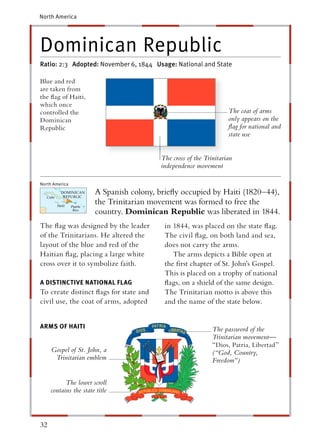
states used a plain flag with a cross.   Confederation in 1480. It was not
                                        officially confirmed as the flag of
A FLAG FOR THE CONFEDERATION            Switzerland until 1848 and it was last
For many years, the separate cantons    regulated in 1889.
of Switzerland had no one common           Apart from that of the Vatican, the
flag, but were each represented by       Swiss flag is the only totally square
their own flags. The present flag of      national flag. However, when used
Switzerland, a white couped cross on    on the Swiss lakes it has the ratio of
a red field, was based on that of        2:3; a practice adopted in 1941.
Schwyz, one of the three original
provinces which united into a           THE NATIONAL ARMS
confederation against the Holy          The coat of arms is simply a shield in
Roman Empire in 1291. It became         the form of the flag. It was officially
accepted as the common badge of the     adopted in 1889. Every town or
Confederation in 1339 at the Battle     commune in Switzerland has its own
of Laupen, when it was used to          flag and coat of arms.


                                                                                 143
Europe


Switzerland: Canton flags
In every case the flags are based on the arms of the canton,
some of which predate the canton’s joining the Swiss Confederation.


              AARGAU                                           APPENZELL AUSSER-RHODEN


Adopted in 1803, the white waves on              Adopted in 1597 when the canton
black represent the River Aare, and the          eparated from the Inner-Rhoden, the
white stars on blue, the districts of             ag retained the bear, but added the
Baden, the Free Areas, and Fricktal,             nitials VR (for Ussroden). The bear
which came together to form the                   ates back to medieval banners. It
canton. In 1963 it was decreed that the          was used from 1403 in battles against
stars should be arranged 2 and 1.                eudal landlords.


              APPENZELL INNER-RHODEN                           BASEL-LAND


This is the original form of the flag             Basel-Land separated from the City
before the partition from Appenzell              n 1832. The arms and flag were
Ausser-Rhoden in 1597. The bear                   dopted in 1834 based on the form of
emblem was widely used locally in the             rozier used in Liestal, with the crook
Middle Ages, and was taken by the                 urned to the right and decorated
Appenzellers from the arms of the abbey          with small spheres. This was made
of Sankt Gallen.                                  fficial in 1947.


              BASEL-STA DT
                     T                                         BERN


The emblem of Basel-Stadt is the                 The coat of arms dates back to the
headpiece of a bishop’s crozier. The              2th century. Soon after which the
emblem dates back to the earliest                 rms, which depict a bear on a red
days of heraldry. Since the 15th                  eld with a yellow diagonal, became
century it has been depicted as                  he canton’s banner. There have,
black on white. It was kept in this               owever, been many variant forms
form when the canton was divided                 hrough the ages. The bear represents
in 1832.                                         he name of the canton.


144
Europe


              FRIBOURG                                        GENEVA


The original colors of Fribourg, black and       The eagle recalls the former Holy Roman
white, were re-adopted when it joined the         mpire. The key is the Key of St. Peter, and
Confederation in 1831, but date back to          hows Geneva as the key to western
1410 and are related to the coat of arms.         witzerland. The flag was adopted in 1815.


              GLARUS                                          GRAUBUNDEN


The flag of Glarus depicts the figure              The flag includes symbols for the three
of St. Fridolin, the patron saint of the          riginal parts of the canton which united in
canton, on a red field. The flag was               he 15th century: Graubunden,
adopted when the canton joined the               Zehgerichtenbund, and the Gotteshausbund.
Confederation in 1352.


               URA                                            LUCERNE


This flag was adopted 1978, when                   ucerne was the first canton, after the
Jura became a separate canton. It was            riginal three, to join the Confederation
formerly part of Basel-Land—recalled             n 1332. Its flag has the colors of
by the crozier—and Bern. The stripes              s shield arranged horizontally instead
are from the arms of Jura.                       f vertically.


              NEUCHÂTEL                                       NIDWALDEN


The tricolor adopted in 1848 is in traditional   The key with two wards is the emblem
colors. The white cross was added to show         f St. Peter, and was used in the 15th
the canton’s association with Switzerland.        entury. It was retained when the canton
                                                  ivided in 1815.


                                                                                            145
Europe


Switzerland: Canton flags


             OBWALDEN                                      SANKT GALLEN


The red and white flag was used in             The emblems of Sankt Gallen—an ax
Obwalden from the 13th century and it          nd a fasces—were adopted in 1803
was adopted when the separate canton was      when the canton was formed under
formed in 1815. Further to this, a key was     rench influence. They are both
added in 1816.                                ymbols of republicanism.


              SCHAFFHAUSEN                                 SCHW YZ


The emblem has been in use since the          chwyz was one of the first three
14th century. It depicts a ram (the “sheep”   antons, and the one from which the
of the town’s name) on a yellow field.         ountry takes its name. Its arms
The flag’s existence was first recorded as      xisted before the Confederation was
early as 1386.                                ormed in 1291.


             SOLOTHURN                                     THURGAU


The coat of arms dates back to 1394 and has   The flag of Thurgau, adopted in
colors derived from those of the               803, depicts two gold lions
Confederation. The flag was originally red      rranged diagonally. They are taken
with a white cross, but was simplified into    rom the coat of arms which dates
its current form.                             rom medieval times.


             TICINO                                        URI


The colors of Ticino’s flag may be             The emblem is an auroch’s head
derived from the French Tricolore, or         linked to the canton’s name). It
from the main colors of the arms of the        ates from the 13th century, but the
united townships.                              ose-ring was added later.


146
Europe


             VALAIS                                      VAUD


The modern flag of Valais is derived from    The colors date from 1798 when the
that of the original republic, which had     éman Republic was formed, and stand
seven stars for its component townships.    or freedom. They were retained when
These were increased to 12 in 1802 and      he state entered the Confederation in
retained when the state joined the           803. The motto is “Liberté et Patrie”
Confederation in 1814.                       “Freedom and Fatherland”).


              ZUG                                        ZÜRICH


Zug joined the Confederation in 1352        The flag in this case preceded the arms
and again in 1364, after a brief return      nd dates back to the 13th century. It
to Habsburg rule. The colors of the         was adopted in 1351 when Zürich
flag were originally red-white-red of        oined the Confederation. However
Austria, but were altered to the blue and    nce 1957 it has been compulsory to
white from the arms of the Counts of         epict the flag in the same format as
Lenzburg in 1352.                           he shield.


                                                                                     147
Europe


Liechtenstein
Ratio: 3:5 Adopted: June 24, 1937 Usage: National and Civil

  The yellow crown                                                     Red and royal
    was introduced                                                    blue have been
     to distinguish                                                 used to represent
   Liechtenstein as                                                      the country
     a principality                                                  of Liechtenstein
                                                                            since the
                                                                        18th century


Europe
                      The Principality of Liechtenstein was created in
                      1719 as part of the Holy Roman Empire. It gained
                      full independence in 1806.
The red and blue of Liechtenstein’s       vertically or horizontally, but the
flag date from 1921. There was             crown always remains upright.
confusion at the 1936 Olympic
Games in Berlin because the flag           THE PRINCE’S FLAG
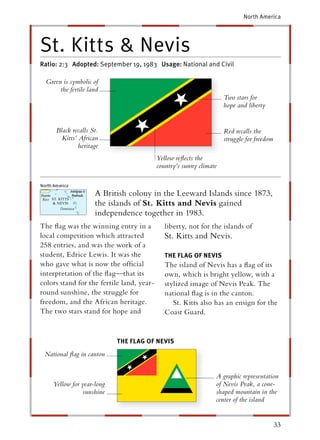
was very similar to that of Haiti. In     The arms of Silesia, Künringen,
1937 the crown was introduced to          Troppau, and East Friesland and
the flag of Liechtenstein to establish     Rietburg make up the four quarters
the country’s status as a principality    of the shield of the Prince’s arms, in
and to distinguish it from the            the center of his flag. They represent
Haitian flag. The flag can be hung          the noble ancestors of the prince.

                            THE FLAG OF PRINCE
                            OF LIECHTENSTEIN
                                                              Red and yellow are
                                                              the Prince’s colors
        The inner shield
   represents the ancient
          princely family                                     The four arms within
                                                              the Prince’s Arms
                                                              represent his noble
                                                              ancestors


148
Europe


Austria
Ratio: 2:3 Adopted: May 1, 1945 Usage: National and Civil

According to                                                     The traditional
legend, the red                                               flag, retained after
and white flag                                                      the fall of the
was modeled on                                                Habsburgs in 1918
the blood-stained
surcoat of a Duke
wounded in battle


Europe
                    Austria once ruled much of central Europe, but
                    lost most of its territory in 1919. Between 1938 and
                    1945 Austria was annexed to Germany.
Tradition states that a Duke of          During World War II, the Austrian
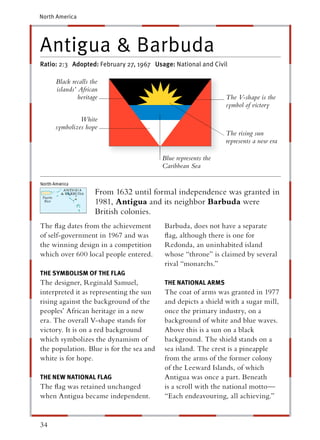
Austria once fought so fiercely in        flag and arms were banned, they
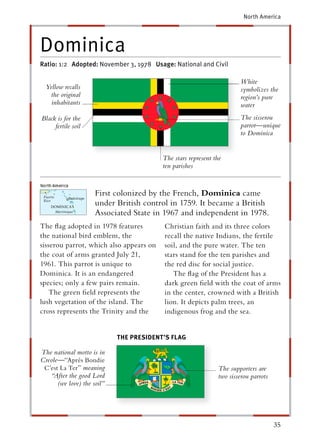
battle that the white surcoat he wore    were restored in 1945.
was soaked in blood, except for the
part covered by his sword-belt. So he    ARMS OF AUSTRIA
adopted red with a white band across     The coat of arms depicts an imperial
the center as his colors.                black eagle, an emblem used by the
                                         Habsburgs. It originally had two
ONE OF THE WORLD’S OLDEST FLAGS          heads, but they were changed to
The story is probably apocryphal,        one when the Habsburg Empire
but stripes of red-white-red have        disintegrated. On the eagle’s chest
been an emblem of Austria for over       is a shield in the national colors.
800 years. Their use on a flag was        The eagle holds a hammer and sickle
recorded in 1191, making the             recalling agricultural and industrial
Austrian flag one of the world’s          workers. Its crown, with three
oldest flags. It was officially adopted    turrets, also represents agriculture,
as the national flag after the fall of    industry, and commerce. The broken
the Habsburg Dynasty, and the            chains on the eagle’s feet symbolize
formation of a republic in 1918.         the restoration of freedom.


                                                                             149
Europe


Austria: State flags
Most provincial flags in Austria are based on the local arms.
In many cases they existed before their official adoption.


                    BURGENLAND                                        CARINTHIA


The colors of the flag, officially hoisted          Adopted in 1946, the colors are derived
in 1971, are based on the red eagle and           rom those of Austria and the yellow
yellow shield of the arms.                        tate shield.


                    LOWER AUSTRIA                                     SALZBURG


Adopted in 1954, the colors are based             The flag, adopted in 1921, uses the
on the arms which contain a blue shield           raditional colors of the state, based
and five gold eagles.                               n the national colors.


                    ST YRIA                                           T YROL


The coat of arms of Styria is a green shield      The bicolored flag is derived from
bearing a white lion. The flag, adopted in         he arms which depicts a red eagle on
1960, uses these colors.                           white disc. It was adopted in 1945.


                    UPPER AUSTRIA                                     VIENNA


Upper Austria’s flag, adopted in 1949,             The flag dates from 1946. It is based on the
is derived from the national colors                ity’s arms, but is identical to the flags of
and the arms of the province.                      alzburg and Vorarlberg.


                    VORARLBERG


Like the flags of Salzburg and Vienna,
Vorarlberg’s bicolor flag is based on
the provincial arms.


150
Europe


Hungary
Ratio: 2:3 Adopted: October 1, 1957 Usage: National and Civil

         Red symbolizes
               strength


                                                                White represents
                                                                faithfulness


                                         Green is symbolic
                                         of hope

Europe
                      Part of Austria-Hungary until 1918,
                      Hungary became part of the communist
                      bloc from 1945–1989.
The current flag was first used in          national flag. During Hungary’s
the 1848–49 uprising. Its pattern         brief period as a republic from
was derived from the French               1945–1949 the royal crown was
Tricolore used during the French          replaced by the “Kossuth” coat of
Revolution. The colors: red, white,       arms. When the Communists
and green date back to the 9th            took power, they added a Soviet-
century. They were first used in           style emblem to the flag. In 1990,
1608 during the reign of King             the arms of the kingdom were
Matthias II. Until 1945, the royal        re-adopted but they were not
crown featured in the center of the       replaced on the flag.

ARMS OF HUNGARY

                                                   The crown of St.Stephen,
                                                   the first king of Hungary
          The red and white stripes
 probably originated from Spain in
the late 12th or early 13th century                The patriarchal cross was
                                                   added to the Hungarian
                                                   arms about 800 years ago


                                                                                   151
Europe


Czech Republic
Ratio: 2:3 Adopted: March 30, 1920 Usage: National and Civil

      The blue triangle
          was added to                                                   White and red are
    distinguish the flag                                                  the heraldic colors
   from that of Poland                                                   of Bohemia (any
                                                                         similarity to the
                                                                         pan-Slavic colors
                                                                         is coincidental)


                                    Blue represents the
                                    state of Moravia

Europe
                        The Czech Republic was part of Austria until
                        1919, when it merged with Slovakia to form
                        Czechoslovakia. The states separated in 1993.
The first flag of Czechoslovakia was                   THE NEW CZECH REPUBLIC
based on the arms, and was white                     When the Czech Republic and
over red. This was identical to the                  Slovakia separated in 1993, the
flag of Poland, so a blue triangle was                Czechs decided to keep their
added at the hoist. The flag was                      existing flag, recalling the two
banned by the Nazis in 1938 and a                    principal parts of the country.
horizontal tricolor of white, red, and                  The greater coat of arms depicts
blue was enforced. The original flag                  a quartered shield reflecting the
was restored in 1949.                                regions of the Czech Republic.

GREATER ARMS OF
THE CZECH REPUBLIC
                                                                 The red and white eagle
         The white lion on a red                                 on a blue field is from
          field is the traditional                                the arms of Moravia
            emblem of Bohemia

           The black eagle on a
                                                                 The Bohemian arms are
      yellow field is taken from
                                                                 repeated to fill the shield
             the arms of Silesia


152
Europe


Slovakia
Ratio: 2:3 Adopted: September 1, 1992 Usage: National and Civil

A version of this                                                         White, blue and
flag was first used                                                           red are pan-
in the 19th century                                                         Slavic colors


                                             The arms of
                                             Slovakia

Europe
                         Under Hungarian rule until 1919, Slovakia then
                         formed part of Czechoslovakia with the Czech
                         Republic. The two states separated in 1993.
The first Slovak flags, used during                ARMS OF SLOVA KIA
                                                            V
the 19th century, were like the                  The arms uses colors of the early
contemporary Russian flag, to whom                flags, a white patriarchal cross rising
they looked for aid in gaining                   from blue mountains on a red shield.
independence. As Czechoslovakia,                    At independence in 1993, the red,
a red and white flag with a blue                  white and blue tricolor was retained
triangle was used. During World War              as the national flag, but the arms was
II, Slovakia re-adopted the white,               placed toward the hoist.
blue, and red tricolor, with the arms               The President’s flag has the arms,
in the center.                                   bordered by the national colors.


                                        THE PRESIDENT’S
                                        FLAG
             The flag is bordered by                         A patriarchal cross
              stripes in the national
         colors; white, blue and red


                                                            A stylized image of
                                                            Slovakia’s mountains


                                                                                     153
Europe


Slovenia
Ratio: 1:2 Adopted: June 24, 1991 Usage: National and Civil

White, blue,                                                                 The order of
and red are                                                                    the tricolor
pan-Slavic                                                                  is the same as
colors,                                                                         the flag for
popularized                                                               Slovenia, when
in the 19th                                                                  it was part of
century                                                                         Yugoslavia


                               The coat of arms was added in 1991
                               when Slovenia became independent

Europe
                    Historically under Austrian rule, Slovenia
                    formed part of Yugoslavia in 1919. It declared
                    independence on June 26, 1991.
Like Slovakia, Slovenia looked to             the order of the stripes (white, blue,
Russia in the 19th century for                red). At independence Slovenia
assistance in gaining independence.           placed its arms in the upper hoist of
For the same reason, the pan-Slavic           this tricolor, to create a distinct
tricolor of blue, white, and red was          national flag.
adopted for Yugoslavia, with a gold              The arms depicts mountain peaks,
fimbriated red star added by Tito in           above wavy blue lines symbolizing
1946. Slovenia also had its own flag           the sea coast. The stars are from the
within Yugoslavia, distinguished by           arms of the Duchy of Selje.

ARMS OF SLOVENIA
                                                             The three stars are from
                                                             the arms of the former
                                                             Duchy of Selje

                                                             The three mountain
   The wavy lines symbolize                                  peaks represent the
        Slovenia’s sea coast                                 Triglav, part of the Alps


154
Europe


Croatia
Ratio: 1:2 Adopted: December 22, 1990 Usage: National and Civil

Red, white,                                                           The tricolor
and blue are                                                         charged with
traditional                                                             the coat of
Croatian                                                             arms was first
colors                                                                 used during
                                                                     World War II


                                        Arms of Croatia


        Hungary
          ngary
    CROATIA
                    For much of its existence, Croatia was under
                    Austrian rule. It joined Yugoslavia in 1919, but
                    declared independence on June 25, 1991.
While part of Yugoslavia, Croatia’s     Croatia retained its tricolor but a
flag was designed in the pan-Slavic      gold-edged red star was placed in the
colors, red, white, and blue. These     center by Tito. Before gaining
are also traditional Croatian colors    independence, the present flag was
used in the 19th century.               adopted, based on the one used
   During World War II Croatia          during the war.
became a semi-independent state and        The shield is in the red and white
added the arms of Croatia to the        checks of Croatia. Above is a row of
center of its flag. Following the war,   shields of its various territories.

ARMS OF CROATIA

                                                     The small shields at the
                                                     top are taken from the
                                                     arms of Croatia’s regions.
                                                     From left to right the
                                                     ancient arms of Croatia,
  The red and white checks are
                                                     Dubrovnik, Dalmatia,
traditional emblems of Croatia
                                                     Istria, and Slavonia


                                                                                  155
Europe


Bosnia & Herzegovina
Ratio: 1:2 Adopted: February 4, 1998 Usage:National and Civil

The dark                                                                 The flag was
blue and                                                               imposed by the
yellow, and                                                        international High
the stars,                                                             Representative
refer to
the flag of
Europe


                                        The geographical shape
                                        of Bosnia is a triangle

Europe
                   Bosnia-Herzegovina was under Turkish rule
                   until it was ceded to Austria in 1878. From 1945
                   to 1992 it formed part of Yugoslavia.
After Bosnia-Herzegovina had broken        Croats and Serbs.
away from Yugoslavia in 1992, a               In February 1998, the international
neutral plain white flag was adopted        High Representative, who safeguards
by parliament. The country’s               the peace in Bosnia-Herzegovina,
independence triggered a civil war         imposed a new flag. However, it was
between the three ethnic groups—           designed by a committee with
Muslims, Croats, and Serbs. After the      members from all three ethnic groups.
Dayton, Ohio, peace agreement was             The country is now divided
signed in 1995, the “neutral” Bosnian      into two parts: the Bosnian-Croat
flag became unacceptable to the             Federation and the Serb Republic.


                       BOSNIA-CROAT FEDERATION FLAG


   Red and white are                                              Green is the color
     Croatian colors                                              of Islam

                                                                  The ten stars are for
                                                                  the ten cantons in
                                                                  the Federation


156
Europe


Montenegro
Ratio: 1:2 Adopted: 2004 Usage: National and Civil

The flag is
based on
one used in
the 1880s
and 1890s                                                        The modern
                                                                 coat of arms of
                                                                 Montenegro


Europe
                  Montenegro united with Serbia and other states
                  in 1919, to form Yugoslavia. In 2006, Montenegro
                  declared independence from Serbia.
Long an independent kingdom,             In the communist state
Montenegro, like the other Yugoslav      (1946-1991), the monogram was
states had used the Pan-Slav colors.     replaced by a gold-edged red star.
Montenegro, like Serbia, inverted        With the end of communist rule,
the Russian flag into a horizontal        the star was removed. To distinguish
tricolor of red, blue, and white. In     the flag from that of Serbia, the
1914 it was accepted that the royal      blue was made lighter. In 2004 the
monogram of King Nikola should be        present, and completely different,
added to the flag.                        flag was adopted.


FLAG ACCEPTED AS THE                     POST-COMMUNIST FLAG
NATIONAL FLAG IN 1914


                                                                            157
Europe


Serbia
Ratio: 1:2 Adopted: June 5, 2006 Usage: National and Civil

                                                               Citizens usually
                                                                    use the flag
          Coat of arms                                        without the arms
         appears on the
              state flag


Europe
                      Serbia was a kingdom, until conquered by the
                      Turks. It regained independence in the 19th century,
                      Yugoslavia united in 1919, but separated 1991-2006.
Like the other southern Slav states,      of them. Under the communist state
Serbia used the Pan-Slav colors by        (1946-1991), a gold-edged red star
inverting the Russian flag. This           was added to the national flag and
example was followed by                   to the state flags. After 1991 the
Montenegro. When Yugoslavia               star disappeared and the flag often
was formed, a flag was chosen of           bore the Serbian coat of arms.
horizontal stripes of blue, white and     This form became official after
red. This used the colors of the          the final separation of Serbia and
states, in a different pattern from any   Montenegro in 2006.


FLAG OF YUGOSLAVIA                        FLAG OF SERBIA IN COMMUNIST
(1919-2006)                               YUGOSLAVIA (1946-1992)


158
Europe


Kosovo
Ratio: 2:3 Adopted: February 18, 2008 Usage: National and Civil

Blue and yellow
are from the                                                              Six stars are
European Union                                                            for the six
Flag. White is                                                            communities
for peace                                                                 in Kosovo


                                                 Golden map of county
                                                 outline on a blue field

Europe
  C
  Croatia
       ia
      Bos.
                  Romania      Formerly part of Yugoslavia and then Serbia, Kosovo
    & Herz. Serbia

       Mon.n
                KOSOVO
                  SO           came under United Nations administration in 1999.
                    Bulgaria
      Albani
          nia   Mac.
                  c            Kosovo declared independence in February, 2008.
In 1459, the Ottoman Turks destroyed              would unite with Albania. Serbia
the first Serbian kingdom in a battle in           opposed this idea. In 1999, violence
modern Kosovo. Although the country               flared between Kosovars and Serbs.
was ceded to Serbia in 1913, the                  NATO forces intervened to stop
majority of Kosovars are Albanian in              Serbian attacks. In the uneasy peace
language and culture, but the site of the         which followed, there were negotiations
battle is sacred to the Serbs.                    under the United Nations. These failed
     When Yugoslavia broke apart in the           and in 2008 Kosovo controversially
1990s, many Kosovans hoped that they              declared its independence.

ARMS OF KOSOVO

The arms is a shield
in the same design
as the flag


                                                                                          159
Europe


Albania
Ratio: 5:7 Adopted: April 7, 1992 Usage: National

Albanians call their                                                   The traditional
country Shqipëria,                                                   heraldic Albanian
meaning “land of                                                          flag first used
the eagle”                                                               in 1912 when
                                                                         independence
                                                                           was restored


Europe
               Kosovo
                   v
 Montenegr
      negr
      negro
       eg
                            Once part of the Byzantine Empire, Albania
                Macedonia
                       ia
                        a
   ALBAN I
       N IA
 Italy
                            became a kingdom in 1912. From 1944 to 1991
                   Greece
                            it was a strict communist state.
The black eagle first appeared on the          were included on the flag after the
Albanian flag in the 15th century              invasion of 1939, but the original flag
when Albania became part of the               was restored in 1942.
Byzantine Empire. According to                   In 1946, the flag changed again,
legend, the Albanians are the                 to incorporate a gold-edged red star
descendants of the eagle. The red             above the eagle, representing the
flag, with the eagle in the center, was        communist regime. The star was
adopted in 1912, when independence            removed in 1991, by order of the
was restored. Parts of the Italian arms       new multiparty government.


ARMS OF ALBANIA


         The black eagle has been                           The two-headed eagle first
           an emblem of Albania                             appeared on flags used
           since the 15th century                           during the struggle against
                                                            Turkish occupation


160
Europe


Macedonia
Ratio: 1:2 Adopted: October 5, 1995 Usage: National and Civil


   Red was the                                                     The radiant sun
     traditional                                                   was added in
    color of the                                                   1995 to replace
Macedonian flag                                                     the controversial
                                                                   “Star of
                                                                   Vergina”


Europe
                    Macedonia was under Turkish rule for centuries.
                    It united with Serbia in 1913 and became part of
                    Yugoslavia. It declared independence in 1992.
As part of Yugoslavia, Macedonia was     changed to the Star of Vergina, an
the only region not to use the pan-      ancient Macedonian emblem from
Slavic colors. Its flag was red with a    the tomb of Philip of Macedon,
gold-edged red star in the canton.       father of Alexander the Great. Greece
                                         objected to this, claiming the star as a
A CONTROVERSIAL NEW FLAG                 Greek emblem. In 1995 the star was
At independence in 1992, Macedonia       replaced by a radiant sun.
retained the red flag but added a gold       Macedonia’s arms is similar in
star in a gold sun. This was soon        design to former Soviet emblems.


ARMS OF MACEDONIA
                                                       The star of socialism

                 Symmetrical
             wreaths of wheat
                                                       A radiant sun, also used
                                                       on the national flag


                                                                                  161
Europe


Bulgaria
Ratio: 3:5 Adopted: November 22, 1990 Usage: National and Civil

Red and white                                                  Before 1990 the
were taken                                                     white stripe contained
from the                                                       the Bulgarian coat of
pan-Slavic                                                     arms
colors

Red is for the valor
of the Bulgarian army

                                       The green stripe replaced the
                                       blue of the Russian tricolor

Europe
                    Bulgaria became independent in 1908 after
                    500 years of Ottoman rule. In 1990, the communist
                    regime, in power since 1946, collapsed.
While under Turkish rule, Bulgaria      of arms was added in the white
had no national flag. When it            stripe near the hoist. This depicted a
became a principality in 1878, a        rampant lion, a red star representing
slight variation of the pan-Slavic      communism, and later a cog-wheel
colors, widely used during the          symbolizing industrialization.
independence movements of the           The coat of arms was removed
late 19th century, was adopted.         from the flag in 1990 because of its
The horizontal arrangement of the       communist connotations. No arms
tricolor was based on the Russian       now appear on the flag.
flag at the time, but for Bulgaria’s
national flag the central blue stripe    THE SYMBOLISM OF THE COLORS
was substituted by green.               Although based on the pan-Slavic
                                        colors, the white band is said to
THE PEOPLE’S REPUBLIC                   represent a love of peace, and red,
No change was made to the flag           the valor of the people. The green
during Bulgaria’s period as an          stripe, substituted for the traditional
independent kingdom 1908–1946,          pan-Slavic blue in 1878, was
but with the formation of the           intended to represent the
People’s Republic in 1947, a coat       youthfulness of the emerging nation.


162
Europe


Greece
Ratio: 2:3 Adopted: 1822 Usage: National and Civil

     The cross in the                                                  The nine stripes
    canton represents                                                represent the nine
 Greek religious faith                                                  syllables in the
                                                                         cry “Freedom
                                                                             or Death,”
  Blue represents the                                                   uttered during
         sea and sky                                                  the Greek war of
                                                                         independence


                                          White reflects the purity of the
                                          Greek independence struggle


                     Once part of the Ottoman Empire, Greece has seen
                     periodic unrest since World War II. In 1974 it
                     became a multiparty democracy.
The flag flown by Greece is in the           preserved in the President’s flag and
same colors as the one which was           in the canton of the blue and white
raised following independence from         striped national flag.
the Ottoman Empire in the early               The shade of blue of the flag has
19th century. At times Greece has          also varied. Today it is the original
used a plain white cross on blue as its    light blue color of 1822. It was altered
land flag, and the striped flag at sea.      in the 1970s and the blue was changed
Today the plain Cross Flag is              to a much darker, navy shade.


                               THE PRESIDENT’S FLAG

   The original white cross
  on a blue field is retained
     in the President’s flag                                 The Cross Flag is
     and the national arms                                  surrounded by a
                                                            wreath of laurels


                                                                                   163
Europe


Romania
Ratio: 2:3 Adopted: December 27, 1989 Usage: National and Civil

      Blue formed part                                         Red was featured
      of the province of                                       in the flags of
        Moldavia’s flag                                         both Moldavia
                                                               and Wallachia
                                                               and is the color of
                                                               Romanian unity


                                        Yellow formed part of the
                                        province of Wallachia’s flag

Europe
                       Romania emerged from the Ottoman Empire as
                       an independent kingdom in 1859. It is now a
                       democracy, after decades of communist rule.
The current flag was created in          was jettisoned following the fall of
1848 by combining the colors of         the Ceausescu regime in 1989.
Wallachia and Moldavia–the
Ottoman provinces that made up          NEW NATIONAL ARMS
Romania. In 1867 the Royal Arms         In 1992, the old coat of arms was
was set in the yellow stripe. The       restored by the new parliament. It
coat of arms was modified many           features a combination of motifs
times and in 1948 it was replaced       which look back to Romania’s past
with a communist emblem. This           as a powerful medieval state.


ARMS OF ROMANIA

 The eagle grips an Orthodox
   Christian cross in its beak
                                                       The scepter of St. Michael
      Sword recalls St. Stephen                        the Brave of Wallachia
        the Great of Moldavia
                                                       The smaller shield displays
                                                       the arms of some of
                                                       Romania’s provinces


164
Europe


Moldova
Ratio: 1:2 Adopted: May 12, 1990 Usage: National and Civil

The blue,
yellow and red
colors reflect
strong links
with Romania


                                        The arms of
                                        Moldova

Europe
                    Moldova was once part of Romania, but was
                    incorporated into the Soviet Union in 1940.
                    It has been fully independent since 1991.
The blue, red, and yellow tricolor of    the Moldovan arms, adopted in 1990,
Moldova is almost identical the          features a golden eagle holding an
Romanian flag, reflecting the two          Orthodox Christian cross in its beak.
countries’ cultural affinity.             However instead of a sword, the eagle
                                         is holding an olive branch. The blue
ARMS OF MOLDOVA
             V                           and red shield on the eagle’s breast is
On Moldova’s flag the yellow stripe       also different–on it are an ox-head,
is charged with the national arms.       a star, a rose, and a crescent, all
Like the Romanian coat of arms,          traditional symbols of Moldova.


ARMS OF MOLDOVA
             V                                           An eagle holds an
                                                         Orthodox cross,
                                                         similar to that in the
                    A star                               arms of Romania

                    A rose                               An ox-head

           An olive branch                               A crescent
         symbolizing peace


                                                                                  165
Europe


Belarus
Ratio: 1:2 Adopted: May 16, 1995 Usage: National and Civil

Red and                                                                     Red and
white are                                                                 green were
traditional                                                                the colors
Belarussian                                                              of Belarus’s
colors                                                                   flag while it
                                                                         was a Soviet
                                                                             republic


                    A national ornament
                    representing woven cloth

Europe
                  Belarus, formerly White Russia, became
                  independent of the USSR in 1991, although its
                  ties with Russia are increasing once more.
The original flag of Belarus while              were derived from the arms of the
under Soviet administration in 1922            republic. The design was rejected in
was similar to that of the USSR. It            a referendum in 1995.
was changed in 1951, and the flag                   The flag of Belarus adopted
used today is similar to this second           following the referendum, reflects
flag, except that the communist                 its growing ties with Russia. The
hammer, sickle, and star have been             unusual ornamentation in the hoist
removed, and the red and white                 is described as a national ornament
portions of the hoist ornamentation            and represents woven cloth.
have been reversed.
                                               ARMS OF BELARUS
THE REJECTED DESIGN                            The Soviet-style coat of arms,
Following independence from the                retained on independence, also
USSR in 1991, Belarus adopted a                reflects the dominant Russian
flag of three equal horizontal stripes          influence. This depicts an outline
of white-red-white. This was the               of the state against a sun rising
same flag which had been associated             from behind a globe. This is
with a brief period of Belarussian             entirely surrounded by wreaths
independence in 1918 and its colors            of wheat and flowers.


166
Europe


Ukraine
Ratio: 2:3 Adopted: September 4, 1991 Usage: National and Civil

Originally
the flag of the
republic in 1918
                                                                Blue represents
                                                                the sky


                                        Yellow recalls the
                                        vast grain fields

Europe
                    Ukraine formed an independent state in 1918, but
                    came under Soviet control one year later and
                    remained so until independence in 1991.
The bicolored flag flown in Ukraine        the Soviet Union. When Ukraine
today was the official flag of the         gained its independence in 1991 the
country in 1918 when Ukraine             country re-adopted its original flag.
enjoyed a brief period of                The blue is supposed to represent the
independence. With the invasion          sky and the yellow the vast fields of
of the Red Army, the flag was             grain of the country’s agriculture.
suppressed until the German                 The Ukrainian coat of arms is in
occupation of 1941–1944. After           the national colors and features an
the war it was banned again by           ancient trident symbol.


ARMS OF UKRAINE

         Blue and yellow are
              national colors
                                                         The trident is an ancient
                                                         symbol dating back to
                                                         pre-Roman times
 The trident of St. Volodimir


                                                                                     167
Europe


Russian Federation
Ratio: 2:3 Adopted: August 22, 1991 Usage: National and Civil

The colors of the                                                 Since its official
flag were orginally                                              adoption in 1799,
the colors of                                                         the Russian
Moscow. White,                                                  tricolor has had a
blue, and red are                                                 major influence
Pan-Slavic colors                                                    on other east
                                                                   European flags


                     Russia was formed in the 15th century. The USSR was
                     established in 1922 and included much of Asia. The USSR
                     collapsed in 1991 and produced the Russian Federation.
At the end of the 17th century, Tsar      them from foreign domination. They
Peter the Great of Russia visited         have since become known as the Pan-
western Europe. Following this            Slavic colors.
visit he decided to adopt a variation
of the Dutch flag as a civil ensign        THE HAMMER, SICKLE, AND STAR
                                                                   T
for Russian ships. This was a             After the Russian Revolution of 1917,
horizontal tricolor of white, blue,       the Communists abolished all former
and red. It was only officially            flags and instead adopted the Red
recognized in 1799. Peter the Great       Flag as the flag of the Soviet Union.
also adopted a flag for the Russian        This contained a gold hammer and
navy, which was white with the blue       sickle, symbols of the proletariat and
diagonal Cross of St. Andrew.             the peasants, under a gold-edged red
                                          star, to represent unity. As a Soviet
THE PAN-SLAVIC COLORS                     republic, Russia used this flag with
Both the color and tricolor design of     a vertical blue bar at the hoist.
this first flag had a major influence on        When the Soviet Union collapsed
many of the flags of Eastern European      in 1991, the former flags of Russia,
nations during the 19th century, who      including the white, blue, and red
looked to Russia for help in liberating   tricolor were restored.


168
Europe


Republic flags
Unlike most other countries, the flags of the Russian republics are all new, adopted since 1991.


                           ADYGEYA
                                Y                                            ALTAY
                                                                               TA


Designed by a British traveler who                 lue represents the cleanliness of the sky,
helped resist annexation of the                   mountains, rivers, and lakes of Altay.
republic by Russia, the arrows are for            White is for eternity, and to encourage
resistance. Green is for agriculture              he revival of love and harmony between
and gold is for freedom.                          he Altay people.


                        BASHKORTOSTA N
                                  T                                           BURYATIYA
                                                                                 Y Y


Blue is for charity and virtue; white               lue is for the sky and water; white for
for openness and willingness; green                urity; yellow for freedom and
for freedom and eternal life. The                  rosperity. The Soembo—the moon,
kurai flower represents the seven races
     i                                             un and hearth—recall reconciliation,
of the Bashkir people.                             amily life, and hospitality.


                    CHECHENIA                                           CHUVASHIA


Green is for Islam. Red is for the blood          The red base is the Chuvash land, from
shed for freedom. White is the road               which grows the “Tree of Life.” The three
leading to the future and the gold is             uns are an ancient Chuvash emblem. Gold
the national ornament.                             for the future and prosperity.


                           DAGHESTA N
                                 T                                            NGUSHETIA


The upper green stripe is for                     The stripe is for the pure intentions
agriculture and hope. The blue                     nd actions of the people and green is
stripe is for the Caspian Sea which               or nature, fertility and Islam. The “sun”
borders the republic. Red represents              epresents peace and creativity and its color
fidelity and courage.                              he people’s struggles.


                                                                                              169
Europe


Russian Federation: Republic flags


                           K ABARDINO-                                      K ALMYKIA
                           BALK ARIA


The flag’s colors evoke the blue sky, the         The vibrant yellow is symbolic of the faith
white snow-capped mountains, and the              f the people of Kalmykia and also
green prairies of Kabardino-Balkaria. In         epresents the sun warming their land.
the center is a stylized representation of       The blue circle signifies the eternal road
the Elbrus Mountains.                            o the sacred lotus in the center.


                           K ARACHAY-                                K ARELIA
                           CHERKESSIA


Blue symbolizes peace, kind motives, and         The many lakes of Karelia are recalled by
quiet. Green represents nature, fertility, and   he central blue stripe and its vast pine
wealth. Red is for the warmth and unity of       orests by green. The red stripe symbolizes
the people. The mountains in the center          warmth, unity and continuing cooperation
recall the scenery of the republic.               etween the peoples of Karelia.


                           KHAK ASSIA                                       KOMI


The horizontal white, blue, and red stripes      The three colors of the flag recall the
are taken from the Russian national flag.         epublic’s northerly location in blue, its
The vertical green stripe is for eternal life    orests in green, and its snows in white.
and is charged with an ancient Khakassian        They are also symbolic of virtues such
solar symbol.                                     s cleanliness, unity, and purity.


                    MARIY EL                                                MORDVINIA


The colors are adapted from the Russian          The flag of Mordvinia was adopted in 1995,
national flag, with altered shades to              nd has the same colors as the Russian flag.
make them distinctive. The central                n the center is the sun emblem also found
stylised representation of the sun is the         n the flags of Mariy El and Udmurtia.
national emblem.


170
Europe


                          NORTH OSSETIA                                  T
                                                                         TATARSTA N


White symbolizes spirituality and              The upper green stripe of the flag represents
cleanliness of intentions. Yellow represents    he majority Muslim Tatar population of
the region’s farming. The red stripe recalls   Tatarstan. The lower red stripe is for the
both the Aryan people and their militant       Russian minority. The white fimbriation
spirit in pursuit of freedom.                   epresents the peace that unites them.


                          TUVA                                           UDMURTIA


The original Tuvan flag adopted in 1918         The eight-pointed solar sign in the center of
was also blue, yellow, and white. Today,       he flag is said to guard the people from
the colors are said to represent courage       misfortune. The earth and stability are
and strength in blue, prosperity in            ymbolized in black, morality and the
yellow, and purity in white.                    osmos in white, and life and the sun in red.


                          YAKUTIA


The flag recalls the blue sky and
shining sun. Beneath is a white stripe
recalling the snow. Red is for courage
and constancy; green is for the forests
of Yakutia.


                                                                                        171
Asia


Azerbaijan
Ratio: 1:2 Adopted: February 5, 1991 Usage: National and Civil

The colors                                                                      Blue is often
represent the                                                                   associated with
Azerbaijani                                                                     the Turkic
motto to                                                                        people
“Turkify,
Islamisize, and                                                                 Red recalls
Europeanize”                                                                    European
                                                                                influence


                         Green is the traditional           Each point of the star
                         color of Islam                     represents a Turkic people

Asia
                      Azerbaijan has been under consecutive Persian,
                      Ottoman, and Russian influence. It was part of the
                      USSR from 1920, until independence in 1991.
The flag dates back to the brief                     flag’s star stand for the eight groups of
period of Azerbaijani independence                  Turkic-speaking peoples—the Azeris,
between 1918–1920 and replaces the                  Ottomans, Jagatais, Tatars, Kipchaks,
one used in the Soviet era. The white               Seljuks and Turkomans.
crescent and eight-pointed star were
intentionally similar to the emblem                 THE NATIONAL ARMS
on the Turkish flag, as Turkey has                   The coat of arms, adopted in 1993,
traditionally been an ally of the                   is set on a round shield in the colors
country. The eight points on the                    of the flag.


ARMS OF AZERBAIJAN
                                                                   The star has eight points,
              The flame at                                          each representing one of
            the star’s center                                      the eight Turkic peoples
       symbolizes a new era

                                                                   The golden ear of corn reflects
    The shield is in the color                                     Azerbaijan’s agriculture
   of the national flag; blue,
               red, and green


172
Asia


Armenia
Ratio: 1:2 Adopted: August 24, 1990 Usage: National and Civil

                                                                       Red recalls
    Blue is for                                                        Armenian
  hope and the                                                         blood spilled
    Armenian                                                           during the
         skies                                                         struggle for
                                                                       independence


                                          Orange represents the
                                          blessings of hard work

Asia
                        Armenia became a Soviet republic in 1922. In
                        1991 it gained independence from the USSR and
                        in 1995 held its first parliamentary elections.
Armenia was independent from              ARMS OF ARMENIA
1920–1921, and the flag used today         In 1991, the arms of 1920 replaced
comes from this era. Its origin is in     the Soviet coat of arms. The four
a design from the Armenian                emblems within the shield each
Institute in Venice of 1885, although     represent an Armenian royal dynasty.
this flag used the colors red-green-       In the center is a stylized image of
blue. After independence from             Mount Ararat. The shield
Russia in 1991, the Soviet flag was        is supported by an eagle and a
replaced by the 1920 tricolor of red-     lion, common symbols in
blue-orange.                              Armenian heraldry.

ARMS OF ARMENIA

            Mount Ararat, the                                Four quarters of the
       supposed resting place of                             shield represent former
         Noah’s Ark, is in the                               Armenian royal dynasties
             center of the arms
                                                             Below the shield lie a
                                                             broken leaf, a sheaf of
                                                             wheat, a pen and a sword


                                                                                  173
Asia


Turkey
Ratio: 2:3 Adopted: June 5, 1936 Usage: National and Civil

The star and                                                                The emblems
crescent are both                                                       are always placed
common symbols                                                            slightly toward
of the Islamic                                                                   the hoist
religion


                                          One star point touches the invisible line that
                                          joins the two horns of the crescent moon


                    Following Turkey’s defeat in the World War I,
                    Mustafa Kemal Atatürk deposed the Sultan in
                    1922, and declared the country a republic in 1923.
Turkey’s flag dates from 1844,               the early 19th century it usually had
although similar red flags were              the five seen today. In 1936, the
used as early as the 17th century           national flag and all the other flags
within the Ottoman Empire. From             used in Turkey today were fully
1920–1923, when Turkey became               defined and specified.
a republic, all the emblems of the
Sultan were abolished and the flag           A PAN-ISLAMIC SYMBOL
became the main emblem.                     The crescent and star has become an
                                            emblem of the pan-Islamic movement
THE CRESCENT AND STAR
                  T                         sponsored by Turkey in the late 19th
Using the crescent and star emblems         century and these symbols are now
together is a relatively recent device,     widely used on the flags and national
but the crescent on its own dates           arms of Muslim countries.
back to the Middle Ages. It is a               Turkey does not have a coat
symbol associated with Islam and            of arms, but there are individual
also with Osman, the founder of             flags for the President and senior
the Ottoman Empire. The star                members of the Turkish navy.
first appeared on the flag in 1793.           These also contain the traditional
Initially it had eight points, but by       crescent and star.


174
Asia


Georgia
Ratio: 3:5 Adopted: January 14, 2004 Usage:National and Civil


                                                                Smaller crosses,
  Red cross, typical of                                         possibly based on the
St. George, Georgia’s                                           “Jerusalem” cross
          patron saint


Asia
                      Georgia was absorbed into the Russian Empire in
                      1801 and became part of the Soviet Union in 1921.
                      It regained independence in 1991.
During the “Rose Revolution” of          St. George is the patron saint of
2003, the Georgian flag achieved          Georgia, perhaps explaining the
prominence as the symbol of the          basic red cross on a white field.
opposition National Movement.
On taking power in 2004 the party        THE SOVIET ERA
adopted it as the new national flag.      While part of the USSR, Georgia
                                         flew a variant of the Red Flag,
OBSCURE ORIGINS                          adopted in 1951. It had a red field,
The historical background of the flag     with a thin blue stripe close to the
is uncertain. References are made in     top. The canton contained the
a 14th-century text to a similar flag     traditional hammer, sickle, and star
from Sivas, in modern Turkey.            emblems, unusually in red, on a blue
Georgians may have adopted it after      disc from which emanated 24 rays.
invading the territory.                     Following independence from the
   Another theory suggests Georgian      USSR in 1991, Georgia officially
links with the Holy Land saw the         re-adopted a flag used during its brief
addition of the four small crosses.      independence between 1918 and
These were based on the “Jerusalem”      1921. The field was deep red, with
cross. However, it is true that          black and white stripes in the canton.


                                                                                  175
Asia


Lebanon
Ratio: 2:3 Adopted: December 7, 1943 Usage: National


        The white band
       symbolizes peace                                               The cedar tree
                                                                      represents holiness,
                                                                      eternity, and strength


                                          The two red stripes are
                                          a symbol of self-sacrifice


                      Lebanon became independent in 1944, after
                      20 years as a French mandate. The country is
                      currently rebuilding after 14 years of civil war.
The present Lebanese flag was               of the country since the time of
adopted just prior to independence         King Solomon, almost 3000 years
from France, in 1943. It was               ago. Specifically, the cedar is the
designed to be a neutral flag, not          symbol of the country’s Maronite
allied to any one of Lebanon’s             Christian community. It first
religious groups. Red is thought to be     appeared on a flag in 1861 when the
for the color of the uniforms worn by      Lebanon was part of the Ottoman
the Lebanese Legion during World           Empire. Soon after its collapse, the
War I. Officially the red is said to        country became mandated to France
represent the people of Lebanon’s          and its flag was a French Tricolore,
sacrifice during the struggle for           with the Cedar of Lebanon in the
independence, and white                    white band of the Tricolore. The cedar
represents purity.                         symbolizes happiness and prosperity
                                           for the country.
THE CEDAR OF LEBANON                          The present flag, with the cedar’s
Although the flag has only existed          foliage and trunk in green, has a
for half a century, the tree at the        variant in which the tree trunk is
center of the flag—the Cedar of             brown—although this is not
Lebanon—has been an emblem                 officially recognized.


176
Asia


Syria
Ratio: 2:3 Adopted: March 29, 1980 Usage: National and Civil

An earlier version                                               Red, white, black,
of the flag had three                                                 and green are
stars, in anticipation                                             pan-Arab colors
of a union
incorporating Syria,                                            The two green stars
Egypt, and Iraq                                                originally represented
                                                                   Syria and Egypt,
                                                                   although they are
                                                               now said to represent
                                                                      Syria and Iraq


                     Syria was created after the dissolution of French
                     colonial rule in 1946. From 1958–1961 it merged
                     with Egypt to form the United Arab Republic.
In 1920, while still a French colony,      of the United Arab Republic, but
Syria flew a green-white-green              with three stars.
tribar with a French Tricolore in the      On leaving the union in 1961, Syria
canton. At independence this was           briefly reverted to its original flag,
changed to a green, white, and black       before re-adopting the Arab
tricolor, with three red stars for its     Liberation colors in 1963.
provinces across its center. Its current      The arms of Syria depicts the
red, white, and black pan-Arabic flag,      Hawk of Quraish. It is almost
was adopted when Syria became part         identical with the arms of Libya.


ARMS OF SYRIA
                                                          The hawk was the
                                                          emblem of the Quraish
              The shield is                               tribe to which the Prophet
           in the form of a                               Muhammad belonged
              national flag

                                                          The inscription reads–
                                                          in Arabic—“Arab
                                                          Republic of Syria”


                                                                                   177
Asia


Cyprus
Ratio: 3:5 Adopted: August 16, 1960 Usage: National and Civil

Neutral and
peaceful symbols
were chosen to
represent the                                                     The copper-colored
country                                                           island recalls the
                                                                  origins of the
                                                                  country’s name


                                       The two olive branches signify peace
                                       between the Turks and Greeks

Asia
                   In 1960, Cyprus gained independence after almost
                   100 years of British rule. In 1974, the island was
                   partitioned, following an invasion by Turkey.
Founded in 1193, the Kingdom of          THE ISLE OF COPPER
Cyprus experienced centuries of          The map of the island on the flag
conflict. Cyprus was conquered by         is copper-colored, to express the
the Ottoman Empire in 1571,              meaning of the island’s name—
which increased Turkish settlement       the Isle of Copper. The two olive
on the island. It then fell under        branches on the white field
British control from 1878. The flag,      represent peace between the two
adopted at independence in 1960,         ethnic groups.
deliberately chose peaceful and
neutral symbols in an attempt to         THE NATIONAL EMBLEM
indicate harmony between the rival       Cyprus’s national emblem is a
Greek and Turkish communities, an        dove holding an olive branch in
ideal that has not been realized.        its beak. This is a symbol of peace
   In 1974, Turkish forces occupied      and reconciliation arising from
the northern part of the island,         the biblical story of Noah and the
forming the “Turkish Republic of         Ark. The dove is also symbolic
Northern Cyprus.” The two parts of       of Aphrodite, the Greek goddess
the island also fly the national flags     whose legend originated from
of Greece and Turkey.                    the island.


178
Asia


Israel
Ratio: 8:11 Adopted: October 28, 1948 Usage: National

The blue and white
colors of the flag are
derived from the
Jewish prayer shawl
                                                                  The central emblem is
                                                                  the Shield of David,
                                                                  which has a long
                                                                  association with the
                                                                  Jewish people


Asia
                    Israel gained independence in 1948. Until 1979
                    there were no set borders, only cease-fire lines. The
                    situation of the Palestine people remains unsettled.
The flag was designed for the Zionist           Jewish flags for centuries before being
movement by David Wolfsohn in                  adopted as the national flag of Israel.
1891, over 50 years before the state           The blue and white colors are said to
of Israel was officially declared.              recall the colors of the tallith ( Jewish
                                               prayer shawl). The blue is officially
STAR OF DAVID                                  described as “Yale Blue.” It is a lighter
The central emblem in the form                 shade than used in other Israeli flags.
of a hexagram is known as the                     The merchant flag was adopted in
“Magen David” (Shield of David),               1948. There is also a naval ensign of
an emblem that had been used on                similar design.


THE CIVIL ENSIGN             Like other variant Israeli             THE NAVAL ENSIGN
                            flags, civil and naval ensigns
                             are a darker shade of blue
                               than the national flag

                           The Shield of
                           David is slightly
                           elongated


                                                                                    179
Asia


Jordan
Ratio: 1:2 Adopted: April 16, 1928 Usage: National and Civil

Red, black,
green, and
white are
pan-Arab
colors


                                The seven-pointed star represents the seven
                                verses of Islamic belief which open the Qur’an

Asia
                     Originally called Transjordan, as part of the
                     Ottoman Empire, Jordan was officially renamed
                     when independence was gained in 1946.
The colors of the Jordanian flag are               JORDAN’S COAT OF ARMS
those of the pan-Arab flag. They                   The coat of arms is similar to that
were first used in 1917 to represent               designed in 1949 for the King. The
“pan-Arabianism,” which sought                    crest is a crown in his honor. The
independence from the Ottoman                     current inscription on the scroll reads
Empire. The star at the hoist was                 “The King of the Hashemite
added in 1928, when Jordan gained                 Kingdom of Jordan, Abdullah bin al-
nominal independence. It represents               Hussein bin A’oun, Beseeches the
seven verses of Islamic belief.                   Almighty for Aid and Success.”


ARMS OF JORDAN                                                    The crown of His
         The current coat of                                      Majesty the King
        arms is very similar
         to that designed for                                     The black eagle
   King Abdullah I in 1949                                        symbolizes the banner
                                                                  of the Messenger of God
       An Arabic inscription
             asking for the
            Almighty’s aid                                        A shield and weapons


180
Asia


Saudi Arabia
Ratio: 2:3 Adopted: 1973 Usage: National and Civil

A number of
versions of the
green flag have
been used by the                                               The shahada,
Wahabi sect since                                              is the Muslim
the 19th century                                               Statement of Faith


                          Green was thought to be a favorite
                          color of the prophet Muhammad

Asia
                    The Kingdom of Saudi Arabia was unified under
                    King Abd-al Aziz (ibn Sa’ud) in 1932. The Sa’ud
                    family are the country’s absolutist rulers.
The flag of Saudi Arabia symbolizes         the flag in white letters, making
the Arab peoples of the desert.            it one of the few national flags to
Used in various forms since the            contain an inscription.
late 19th century, the green is                By law it must be able to be read
favored by the Wahabi sect and is          correctly—from right to left—on
believed to be the favorite color          both sides of the flag. The sword is
of the prophet Muhammad.                   the symbolic sword of Abd-al-Aziz,
                                           who conquered part of Arabia in the
FLAG INSCRIPTION                           early 20th century. It has appeared
In 1901, the shahada, the Muslim           in different forms in the past,
Statement of Faith, was added to           sometimes as two crossed swords.

THE SHAHADA                                                    The inscription
                                                               reads “There is no
                                                               god but Allah and
                                                               Muhammad is the
                                                               Prophet of Allah”
       This version of                                         The sword represents
        the sword was                                          that given to Abd-al-
       added in 1981                                           Aziz by his father


                                                                                181
Asia


Yemen
Ratio: 2:3 Adopted: May 22, 1990 Usage: National and Civil

Red, white and                                                    The flag adopted
black, are pan-Arab                                             for the united state
colors                                                            was based on the
                                                               common tricolor of
                                                             former flags of North
                                                                 and South Yemen


Asia
                      Yemen was originally two countries, the Kingdom
                      of Yemen, in the north, and the British Aden
                      Protectorate in the south. The two united in 1990.
The first flag of the Yemen, used           NORTH YEMEN
while the Imams were in power, was        The flag of the Yemen Arab
red, with a white sword placed            Republic, formally the Kingdom of
horizontally in the center and five        Yemen, was also modeled on the
white stars representing the five          Egyptian flag. It was a red, white,
duties of a devout Muslim. Yemen          and black tricolor, but it was simply
was originally two countries, each        charged with a single, five-pointed
having their own flag.                     green star in a central white band,
                                          representing Arab unity.
SOUTH YEMEN
Formally the British Aden                 A UNIFIED FLAG
Protectorate, the flag of the People’s     When Yemen unified, the stars and
Democratic Republic of Yemen was          the triangle were dropped, but the
modeled on the Egyptian pan-Arab          common elements of their flags—the
flag. It was a red, white, and black       pan-Arab red, white, and black
tricolor and it bore a blue triangle,     stripes—were preserved for the united
representing the Yemeni people in         flag. The new flag’s pattern suggests a
the hoist, while a red star represented   compromise between the officially
the Socialist ruling party.               secular south and the Islamic north.


182
Asia


Oman
Ratio: 1:2 Adopted: April 25, 1995 Usage: National and Civil

   The emblem                                                           White is for
   of the ruling                                                        the Imam of
        dynasty                                                         Oman and for
                                                                        peace
  The red field
 is common in
the flags of the
    Gulf states

                                         Green represents the
                                         mountains and fertility

Asia
                     From the mid-19th century, Oman was a British
                     protectorate. In 1970, it achieved independence as
                     the Sultanate of Oman.
Until 1970, Oman used the plain           THE SYMBOLISM OF THE COLORS
red banner of the indigenous people,      White has been associated
the Kharijite Muslims. In 1970, the       historically with the Imam, the
Sultan introduced a complete new set      religious leader of Oman and at times
of national flags. Bands of green and      the political rival to the ruling
white were added to the fly, and the       Sultan. It also symbolizes peace.
national emblem, the badge of the         Green is traditionally associated with
Abusaidi Dynasty, was placed in the       the Jebel al Akhdar or “Green
                                                             r
canton. This depicts crossed swords       Mountains,” which lie toward the
surmounted by a gambia, a traditional     north of the country. Red is a
curved dagger.                            common color in Gulf state flags.
THE NATIONAL EMBLEM
                                                            An ornate horse-bit
                                                            links the weapons
  The national emblem is
   said to date back to the
middle of the 18th century                                  A curved dagger is
                                                            fastened over a pair
                                                            of crossed swords


                                                                                   183
Asia


United Arab Emirates
Ratio: 1:2 Adopted: December 2, 1971 Usage: National and Civil

  Historically,                                                           Green is for
the flags of the                                                           trees and
 emirates were                                                            fertility
     plain red
                                                                          White
                                                                          symbolizes
                                                                          neutrality


                                          Black represents the oil
                                          wealth of the emirates

Asia
                      The United Arab Emirates is an amalgamation
                      of seven emirates, formerly known as the Trucial
                      States, that came together in 1971.
Following a General Treaty in 1820,       adopted in 1968, was also red and
the seven emirates that now form the      white, but with a green star.
United Arab Emirates came under
British protection. Red and white         THE PAN-ARAB COLORS
flags were taken up by all except the      On independence in 1971, a flag in
Emirate of Fujairah, a non-signatory      the pan-Arab colors—red, green,
to the treaty, which adopted a plain      white and black—was adopted to
red flag. With minor alterations, the      express Arab unity and nationalism.
flags are still retained for local use.    The red also recalls the color of the
The first flag of the federation,           flags of the member states.


                          FLAG OF DUBAI
    Like the other six                                               The flag colors
      emirates, Dubai                                                remain constant, but
 retains its individual                                              the proportions have
    red and white flag                                                changed in recent
                                                                     decades


184
Asia


Qatar
Ratio: 11:28 Adopted: c. 1949 Usage: National and Civil


         The maroon coloring and proportions      “Qatar maroon” derives from the
       distinguish the flag from Bahrain’s flag     action of sun on natural red dye

Asia
                     Formerly linked to Bahrain, Qatar was in a treaty
                     relationship with Britain from 1916 until 1971,
                     when it gained full independence.
Qatar’s flag was originally plain red,           zigzag, white interlock derives from a
like the flag of Bahrain, to which it            British request in the 1820s that all
was once linked. The peoples of                 friendly states around the Gulf add a
both countries are Kharijite                    white band to their flags, to
Muslims, whose traditional banner               distinguish them from pirate flags.
was red. The flag evolved in its                 During its earlier usage, before
present form around the middle of               Qatar’s independence, the flag also
the 19th century, and was officially             bore the name of the state in white
adopted when Qatar became                       lettering and red diamonds were
independent from Britain in 1971.               placed on the white band.

“QATAR MAROON”                                  THE EMBLEM OF QATAR
The flag’s maroon color is said to               The circular badge of Qatar uses both
have come about from the action of              the colors and serrated pattern of the
the desert sun’s heat on the red                flag, around its edge. In the center is a
vegetable dyes formerly used for its            local sailing boat, passing an island.
flags. This color, now known as                  This is set between two crossed
“Qatar maroon,” was officially                   swords. It is inscribed with the name
adopted in 1948. The nine-pointed,              of the state in Arabic.


                                                                                     185
Asia


Bahrain
Ratio: 3:5 Adopted: 2002 Usage: National and Civil

  The serrated edge                                                 Red and white
   was originally a                                              are the traditional
       straight line                                             colors of the Gulf
                                                                               states


Asia
                       Despite Iran’s claims of sovereignty, Bahrain,
                       an archipelago in the Gulf, has retained its
                       independence gained from Great Britain in 1971.
Bahrain was under British                 with differing white patterns on
protection from 1820 to 1971. By          them. A plain vertical white strip was
the terms of the General Maritime         added to Bahrain’s flag. In 1932 the
Treaty of 1820, all friendly states in    line was made serrated. In 2002,
the Gulf undertook to add white           Bahrain became a kingdom and the
borders to their red flags, so that        number of serrations was set at five.
they would not be taken for pirate           The national arms was adopted in
flags. The various states of the           1932. It is based on the colors and
“Pirate Coast” then developed flags        design of the national flag.


ARMS OF BAHRAIN
                                                        Until independence
                                                        in 1971, there was
      The coat of arms dates                            an oriental crown
 from 1932; it was designed                             above the shield
    by Sir Charles Belgrave,
 the Sheik’s political adviser
                                                        The shield contains the
                                                        characteristic serrated
                                                        division line, as on the
                                                        national flag


186
Asia


Kuwait
Ratio: 1:2 Adopted: September 7, 1961 Usage: National and Civil

           Black                                                       Green stands
  represents the                                                       for fertility
    defeat of the
          enemy
                                                                       White
                                                                       symbolizes
                                                                       purity


                                          Red symbolizes the
                                          blood of the enemy

Asia
                     The State of Kuwait traces its independence
                     to 1710, but it was under British rule from the late
                     18th century until 1961.
Before 1961, the flag of Kuwait, like      land. The idea for the flag’s distinctive
those of other Gulf states, was red and   design—a horizontal tricolor with a
white. The present flag is in the pan-     black trapezium in the hoist—may
Arab colors, but each color is also       have come from the flag used by Iraq
significant in its own right. Black        until the late 1950s.
symbolizes the defeat of the enemy,
while red is the color of blood on the    KUWAIT’S COAT OF ARMS
Kuwaiti swords. White symbolizes          The arms depicts a hawk containing
purity and green is for the fertile       an Arab dhow on stylized waves.
                                                     w


ARMS OF KUWAIT                                            The inscription is
                                                          the name of the state

                                                          An Arab dhow—a
                                                          traditional sailing boat
                A hawk with
           outstretched wings
                                                          A shield in the
                                                          national colors


                                                                                     187
Asia


Iraq
Ratio: 2:3 Adopted: February 19, 2008 Usage: National and Civil

          Red represents
                 courage

       White symbolizes
              generosity                                      Green is the
                                                              traditional color
                                                              of Islam


                                          Black recalls the
                                          triumphs of Islam

Asia
                       Iraq has been independent since 1932. The republic
                       was proclaimed in 1958. Period of instability since
                       2003, following the overthrow of Saddam Hussein.
The flags of Iraq have always              flag of Egypt (see page 60). In 1991,
included the pan-Arab colors of red,      the inscription was added. It was
white, black, and green. The colors       modified and the stars removed
represent the qualities of those who      in 2008.
follow Islam. Red represents
courage; white stands for generosity;     THE NATIONAL ARMS
black is for the triumphs of Islam,       Also in 1963 the golden Eagle of
and green is for Islam itself.            Saladin became the national arms.
   Three green stars were added to        It always shows the national flag on
the flag in 1963, based on the then        its chest.


ISLAMIC VERSE

         The Islamic verse was
           added to the flag in
         1991 and modified in                                   The takbir reads
                                                                        r
             2004 and 2008                                     “Allahu Akbar”
                                                               (“God is Great”)


188
Asia


Iran
Ratio: 4:7 Adopted: July 29, 1980 Usage: National and Civil

 The four crescents
    symbolize the                                                     The sword
     growth of the                                                    represents strength
     Muslim faith                                                     and fortitude

                                                                      Kufic script from
                                                                      the Qur’an


                                        The globe shape stands for the power
                                        of the world’s downtrodden people

Asia
                      Iran was a monarchy until 1979, when the
                      Ayatollah Khomeini deposed the Shah. An Islamic
                      republic was formed in 1980.
The traditional green, white, and red     A REVOLUTIONARY EMBLEM
of the Iranian flag date back to the       The emblem in the center of the flag
18th century, although there is no        is a highly stylized composite
agreed explanation of the colors. The     of various elements representing
colors were arranged in horizontal        different facets of Islamic life:
stripes in 1906. In 1980 a new flag        Allah, the Book, the Sword, the five
was introduced with the addition of       principles of Islam, balance, unity,
emblems expressive of the Islamic         neutrality, and the universal
Revolution.                               government of the downtrodden.


THE KUFIC SCRIPT
(ST YLIZED VERSION)                     A stylized version of Kufic
                                        script, used for the Qur’an

Along the edges of the
                                                                The script, repeated
 green and red stripes
                                                                22 times, is the date
   appears the phrase
                                                                in the Islamic calendar
    “Allahu Akbar”
                                                                on which Ayatollah
   (“God is Great”)
                                                                Khomeini returned
                                                                from exile in 1979


                                                                                     189
Asia


Turkmenistan
Ratio: 1:2 Adopted: February 19, 1997 Usage: National and Civil

   The wreath
 of olive leaves                                                                Each star
    is identical                                                                represents
    to those on                                                                 one of the
    the United                                                                  five Turkmen
 Nations flag,                                                                   regions
and was added
       in 1997


                             The ornamentation represents         Green is a color revered in
                             the five traditional carpet designs   Turkmenistan

Asia
                    Turkmenistan was originally one of the
                    15 federated states of the USSR. It broke away and
                    became an independent republic in 1991.
The original design of the flag was                 designs used by the tribes who
adopted on February 19, 1992,                      produced the country’s famous
following a competition, and is based              carpets. The wreath of olive leaves
on national traditions. In the official             was added in 1997 to “immortalize
interpretation, the five stars stand for            the policy of neutrality” declared by
the new regions established by the                 Turkmenistan in 1995.
constitution of 1992. The carpet                      The coat of arms recalls the
design contains five medallions or                  region’s important agricultural
guls, said to represent the traditional            products and famous horses.


ARMS OF TURKMENISTAN


        The five guls from
         the national flag
                                                                    An akheltikin horse,
                                                                    famed in Turkmenistan
    Cotton and wheat both
 featured on the emblem of
the former Soviet Republic                                          Cotton represents the
          of Turkmenistan                                           country’s most important
                                                                    agricultural product


190
Asia


Uzbekistan
Ratio: 1:2 Adopted: November 18, 1991 Usage: National and Civil

The new moon                                                                 Blue recalls
 represents the                                                              water and
  new republic                                                               the sky
There is a star
for each month                                                               White denotes
     of the year                                                             peace and
                                                                             purity


                       Green is symbolic of    Red represents the
                       nature and fertility    life-force in all people


                     Once part of the Mongol Empire, Uzbekistan fell
                     to Russia in the late 19th century. It became
                     independent from the USSR in 1991.
Uzbekistan was the first of the                Uzbek empire in the 14th century.
Central Asian republics to adopt              The white stripe is a sign of peace
its own non-communist national                and purity. Green is a Muslim
flag, although the new design                  symbol of nature and fertility.
is based on that of the former                Red is for the life-force found in
Soviet Uzbekistan.                            all people. The new moon suggests
    The blue stripe symbolizes water          the birth of the new republic,
and the sky. It is also the color of          while the 12 stars represent the
the flag of Timur, who ruled an                months of the Islamic calendar.


ARMS OF UZBEKISTA N
               T                                                 Islamic crescent and star
   The arms features a bird
   whose outstretched wings                                      Wheat represents the
   form a crescent framing a                                     country’s staple food crop
rising sun over a landscape
    of mountains and rivers

    Cotton is Uzbekistan’s
             chief cash crop                                     The ribbon bears the
                                                                 name of the state


                                                                                         191
Asia


Kazakhstan
Ratio: 1:2 Adopted: June 4, 1992 Usage: National and Civil

      The sky-
      blue field
symbolizes the
skies stretching
 over the many                                                                  A berkut, or
Kazakh people                                                                   steppe eagle,
                                                                                beneath a
                                                                                shining sun


                         The traditional “national ornamentation”
                         is placed close to the hoist

Asia
                      Part of Central Asia conquered by Russia in the
                      18th century, Kazakhstan was the largest republic
                      to secede from the USSR.
Kazakhstan’s post-communist flag                 steppe eagle. Together they
was adopted in 1992. Its sky-blue               represent love, freedom and the
background recalls the endless skies            aspirations of the Kazakh people.
over the Kazakh people. It also                 A pattern of what is described as
symbolizes well-being, tranquility,             “national ornamentation” forms a
peace, and unity. In the center of the          vertical stripe near the hoist.
flag, below a golden sun with 32                    The new coat of arms is also based
rays, soars a bird of the species               around a radiant sun. It depicts
known locally as the berkut, or                 traditional features of Kazakhstan.


ARMS OF KAZAKHSTA N
               T
                                                                    The sun’s rays spread out
                                                                    like a yurt’s supporting
 The center of the arms is                                          structure
   like the upper part of a
 yurt, the ancient felt tent
   of the Kazakh nomads
                                                                    Winged and horned
                                                                    horses represent historical
                                                                    traditions and beliefs


192
Asia


Mongolia
Ratio: 2:1 Adopted: 1992 Usage: Civil and State

 The soyonbo                                                           Originally
        device                                                         the color of
   combines a                                                          communism,
    number of                                                          today red
     Buddhist                                                          represents
      emblems                                                          progress


                                         Sky blue is the national
                                         color of Mongolia

Asia
                        Mongolia is a remote state that has been under
                        communist rule since 1924. The former Communist
                        Party was democratically re-elected in 1997.
The current national flag replaced         days of Genghis Khan. The flag
the Red flag of revolution in 1940.        bears a 17th-century Buddhist
The red field is retained at the fly and    emblem at hoist called the soyonbo.
hoist, although the color’s original      The soyonbo comprises various
socialist connotations have given way     ideograms representing different
to more general themes                    elements from the Buddhist view
of progress and prosperity. The           of the world. The communist star
sky-blue panel represents the people      which appeared above the soyonbo
of Mongolia and invokes the imperial      was removed in 1992.


THE SOYONBO                                          The tongues of the flame stand
                                                     for past, present, and future
       The sun and moon represent
            ancestors of the Moguls

                                                     The vertical columns illustrate the
                                                     Mongolian proverb “Two friends
       Horizontal bars indicate that
                                                     are stronger than stone”
       vigilance is required from the
       highest and lowest in society                 The fish stand for vigilance
                                                     because fish never sleep


                                                                                   193
Asia


Kyrgyzstan
Ratio: 3:5 Adopted: March 3, 1992 Usage: National and Civil

  Red is for Manas
    the Noble, the
     national hero
                                                                    The sun’s 40
                                                                    rays stand for the
                                                                    40 tribes and
                                                                    40 heroes of the
                                                                    Kyrgyz nation

                                          A stylized yurt, the traditional
                                          home of nomadic people

Asia
                     Conquered by Russia under the tsars, in 1991 the
                     Republic of Kyrgyzstan became the last of the
                     Soviet Union Republics to declare sovereignty.
Independent since 1991, a post-           people of the steppe. It symbolizes
communist flag was not adopted until       the unity of time and space, the
1992. The flag’s red background is         origin of life, hearth and home,
supposed to be the flag color used by      and the history of the nomads.
the national hero, Manas the Noble,
who welded 40 tribes together to          ARMS OF KYRGYZSTA N
                                                         T
form the Kyrgyz nation.                   Like the arms of its neighbor,
   In the center of the flag is a yellow   Kazakhstan, the coat of arms of
sun with 40 rays, representing the        Kyrgyzstan is round and does not
tribes and the legendary 40 heroes        contain a traditional shield. In the
of Manas. The sun’s rays run              center is a white eagle with spread
clockwise on the obverse of the flag       wings. Behind this are snow-capped
and counterclockwise on the reverse.      mountains, representing the mighty
                                          Tien Shan and a radiant, rising sun.
A TRADITIONAL YURT                        This scene is bordered by wreaths of
At the sun’s center is a stylized         cotton and wheat, both major
bird’s-eye view of the roof, or           agricultural products in Kyrgyzstan.
tunduk, of a Kyrgyz yurt, the             The name of the state is inscribed in
traditional tent used by the nomadic      Cyrillic script at the top.


194
Asia


Tajikistan
Ratio: 1:2 Adopted: November 24, 1992 Usage: National and Civil

The crown and
 stars stand for
   Tajikistan’s
           state
    sovereignty                                                        White is the
                                                                       color of cotton,
                                                                       Tajikistan’s
                                                                       main industry


                                          Green represents
                                          farm produce

Asia
                    A former member of the USSR, Tajikistan
                    proclaimed independence in 1991, but Russian
                    and communist influences remain strong.
In 1992, Tajikistan became the last of    SYMBOLS OF THE NEW STATE
the former USSR republics to adopt a      The center of the flag features a
new flag. The red, white, and green        gold crown and an arc of seven stars.
stripes are the same as those chosen in   These symbols refer to the state
1953 for the flag of the Tadzhik Soviet    sovereignty of Tajikistan, friendship
Socialist Republic. Red is the color of   between all nations and the
the flag of the USSR; white is for         “unbreakable union of workers,
cotton, Tajikistan’s main export and      peasants, and the intellectual classes”
green recalls other farm produce.         of the republic.


ARMS OF TAJIKI STAN
        T

          Red, white, and
            green ribbons                                    Crown and stars from
                                                             the national flag
 The mountains recall the                                    Wheat, a major crop,
   country’s many peaks                                      surrounds the arms


                                                                                    195
Asia


Afghanistan
Ratio: 1:2 Adopted: 2004 Usage: National

             Black recalls                                           Green
                 previous                                            represents
             flags used in                                            Islam
             Afghanistan


                                            The new arms
                                            of Afghanistan

Asia
                         Afghanistan has had a troubled history. This is
                         shown by the no less than 14 distinct national flags it
                         has used in the 20th and 21st centuries.
With the election of a democratic               The arms show the Muslim
government in 2004, the present flag          Mehrab, the niche which shows the
was adopted. Black, red, and green           direction to the Muslim Holy City of
have been traditional in most Afghan         Mecca, and Minbar, the pulpit from
flags. Black is from the first                 which sermons are preached. These
recognized Afghan flag; red is for            are shown within a traditional image
bravery, and green for Islam. The            of a mosque, flanked by two national
white emblem in the center is the            flags and surrounded by a wreath of
state coat of arms. This too is a            wheat and beneath a rising sun.
traditional design.                          Four inscriptions also appear.

ARMS OF AFGHANISTAN                                          The Arabic inscription
                                                             reads: “There is no god but
       The Arabic inscription                                Allah, and Muhammad is
            “God is Great”                                   the Prophet of Allah”

                                                             The date 1298 in the
                                                             Muslim calendar (AD 1919),
                                                             is the date Afghanistan was
The name of Afghanistan                                      internationally recognized
        in Arabic script                                     as independent.


196
Asia


Pakistan
Ratio: 2:3 Adopted: August 14, 1947 Usage: National

        The white strip
        represents non-
       Muslim and other
                                                                    Star symbolizes light
        minority groups
                                                                    and knowledge
            in Pakistan


                                              The crescent
                                              represents progress

Asia
                      Once a part of British India, Pakistan was created
                      in 1947 as an independent Muslim state. Today, it
                      is divided into four provinces.
The flag was designed by Muhammad           THE SYMBOLISM OF THE COLORS
Ali Jinnah, founder of the nation. It is   The green and white together stand
associated with the flag used by the        for peace and prosperity. The crescent
All-India Muslim League as an              symbolizes progress and the star
emblem of its aim of achieving an          represents light and knowledge.
independent Muslim state. Their flag           The flag of the President is similar
was green, with a central white star       to the national flag. The emblems are
and crescent. At independence, a           in gold and are enclosed within a
white stripe was added at the hoist to     wreath of laurel. Beneath is the name
represent the state’s minorities.          of the state in Urdu.


                              THE PRESIDENT’S FLAG
           The field of the                                   The crescent and star
   President’s flag is green                                  are symbols of Islam
       and white, like the
              national flag
                                                             The name of the state
                                                             is written in Urdu


                                                                                      197
Asia


Nepal
Ratio: 4:3 (plus border) Adopted: December 16, 1962 Usage: National and Civil

              The blue border
                denotes peace

                                                            The crescent moon
                                                            represents the royal house
        Red is the color of the
       rhododendron, Nepal’s
              national flower


                                       The sun represents
                                       the Rana family

Asia
                     From 1960 Nepal was ruled by an absolute
                     monarchy. This regime ended in 1991 when the
                     first multiparty elections were held.
The flag of Nepal is the only                 THE SUN AND THE MOON
national flag that is not rectangular         Until 1962, the flag’s emblems, the
or square. Originally, two separate          sun and the crescent moon, had
triangular pennants were flown one            human faces. They were removed to
above the other; these were then             modernize the flag. The sun retains
joined to form a single flag. Its             the face on the Royal Standard. The
crimson red is the color of the              crescent represents the royal house
rhododendron; the country’s                  and the sun denotes the Rana family,
national flower. Red is also the              who were hereditary prime ministers
sign of victory in war. The blue             until 1961.
border is the color of peace.

                                  THE ROYAL STANDA RD (1960–2008)
                                             T
 The Royal Standard shows                                    The sun has a face, as did
   a rampant lion holding a                                  the national flag until 1962
          lance with a flag


198
Asia


Bhutan
Ratio: 2:3 Adopted: c. 1965 Usage: National and Civil

         Saffron yellow
            denotes the
           authority of                                             The “Thunder
               the King                                             Dragon”

                                                                    White represents
                                                                    purity and loyalty


                                            Orange represents the Drukpa
                                            monasteries and religious practices

Asia

 Nepal
   pal
         China
                           Bhutan is a Buddhist state where power is shared
 India
            BHUTAN
                A
                           by the king and government. The country’s name in
                 M
                 Myanmar
                           the local dialect means “Land of the Dragon.”
In Bhutan, thunder is believed to be         TEMPORAL AND SPIRITUAL POWER
the voices of dragons roaring. In            The two colors of the flag, divided
about 1200, a monastery was set up           diagonally, represent spiritual and
called the Druk (the “Thunder                temporal power within Bhutan.
Dragon”), with a sect called the             The orange part of the flag
Drukpas named after it. The name             represents the Drukpa monasteries
and the emblem of the dragon have            and Buddhist religious practice,
been associated with Bhutan ever             while the saffron yellow field
since. The dragon on the flag is              denotes the secular authority of the
white to symbolize purity.                   royal dynasty of the Wangchuks.

EMBLEM OF BHUTAN
             T
                                                                 The snarling mouth
                                                                 expresses the strength
The dragon symbolizes                                            of the male and female
   Druk, the Tibetan
                                                                 deities protecting the
name for the Kingdom                                             country
            of Bhutan
                                                                 Jewels clasped in
                                                                 the dragon’s claws
                                                                 symbolize wealth


                                                                                      199
Asia


India
Ratio: 2:3 Adopted: July 22, 1947 Usage: National

   Orange represents
 courage and sacrifice

                                                                White symbolizes
                                                                peace and truth
   Green symbolizes
   faith and chivalry


                                          The Chakra, or
                                          Buddhist spinning wheel


                     Under British rule from 1763, the Indian
                     subcontinent divided into Pakistan and India in
                     1947 upon independence.
The national flag, adopted in 1947,        THE CHAKRA
                                                   A
is based on the flag of the Indian         The central motif is a Chakra, or
National Congress which was               Buddhist spinning wheel. The 24
established in 1885 to press for          spokes of the wheel correspond with
independence. The flag’s orange            the 24 hours of the day, implying
color symbolizes courage and              that there is life in movement and
sacrifice, white stands for peace and      death in stagnation.
truth, green is for faith and chivalry,      The naval ensign is adapted from
and blue represents the color of the      British practice. The gold National
sky and the ocean.                        Emblem was added in 2004.


                         INDIAN NAVAL ENSIGN
 The national flag is
 placed in the canton

                                                                    The design
  The gold National                                                 derives from
    Emblem of India                                                 British naval
 appears in the center                                              practice


200
Asia


Maldives
Ratio: 2:3 Adopted: July 26, 1965 Usage: National and Civil

 The panel of Islamic                                         Red was the
    green symbolizes                                          original color of the
 peace and prosperity                                         Maldives flag


                                         The crescent
                                         represents Islam

Asia
                    The archipelago of small islands that forms the
                    Maldives was once a British Protectorate. The
                    Maldives became fully independent in 1965.
Until the beginning of the 20th           added along the hoist. This was
century the flag of the Maldives was       dropped after independence from
plain red, reflecting the culture of       Britain in 1965. A modern
the Arab traders from the Persian         interpretation of the colors suggests
Gulf who operated among the               that red symbolizes the blood shed
islands. This flag remained in use         in the struggle for independence,
after the British Protectorate was set    while green stands for peace
up in 1887. The flag later acquired a      and progress.
white crescent facing the hoist—
another sign of Islamic influence.         THE NATIONAL ARMS
                                          The coat of arms of the Maldives
A NEW DESIGN                              contains the Islamic crescent and
The flag was redesigned in 1948 after      star emblem beneath a date palm.
the independence of Ceylon (now Sri       Below the crescent is a scroll with
Lanka) of which the islands had been      the inscription, in Dihevi, “State of
a dependency. The crescent was            a Thousand Islands,” which recalls
turned around and placed on an            the many islands—over 2000—that
Islamic green panel. A pattern of         make up the Maldives. The crescent
black and white diagonal stripes was      is f lanked by two national f lags.


                                                                                 201
Asia


Sri Lanka
Ratio: 1:2 Adopted: December 17, 1978 Usage: National and Civil

          Green
       represents                                                          The four
        Muslims                                                            pipul leaves
                                                                           are Buddhist
         Orange                                                            symbols
       represents
         Hindus


                                         The sword is a
                                         symbol of authority

Asia
                    The island of Ceylon was a British colony
                    until independence in 1948. It became a republic
                    under the name Sri Lanka in 1972.
The original flag of Sri Lanka             groups, so vertical bands of green,
featured just the lion and sword          for Muslims, and orange, for the
on a red field, recalling that the         Hindu Tamils, were added in 1951.
Sinhalese word for lion—“Sinhala”—           When the country’s name
is the basis of the island’s name. The    changed from Ceylon to Sri Lanka
flag’s yellow border symbolized the        in 1972, four leaves were added.
protection of the nation by               They denote the tree under which
Buddhism.                                 Siddhartha sat when he received
    The flag was derived from the flag      enlightenment and became the
of the Sinhalese kingdom of Kandy.        Buddha. This version of the flag
It proved unpopular with minority         was in official use from 1978.

                             FLAG OF KANDY
 The “Lion Flag” was the                                       The finials are derived
   national flag of Ceylon                                      from the spire on top of
     prior to 1815 when it                                     a Buddhist temple
   became a British colony


202
Asia


Bangladesh
Ratio: 3:5 Adopted: January 25, 1972 Usage: National

    Green represents
            the land

                                                                       The red disc
                                                                       symbolizes the
                                                                       struggle for
                                                                       independence


                                          The red circle is set
                                          slightly toward the hoist

Asia
                         Bangladesh was formerly the eastern province of
       BANGLADESH
         NGLADE H
 India
                         Pakistan. After a civil war with Pakistan, it became
               Myanmar
                         a separate country in 1971.
The flag was originally adopted in            ARMS OF BANGLADESH
March 1971, when the country                 The coat of arms was adopted in
gained independence, at which time           1972 and consists of the national
it had a yellow silhouette map of the        flower, a water lily, known locally
country in the red disc. This flag            as the shapla, growing from stylized
was used throughout the struggle             waves. Around it are ears of rice,
for independence, but when the               and above is a sprig of jute, with
state was formally established in            four golden stars. The arms appears
1971 the outline map was omitted             in the center of the President’s flag,
from the new national flag.                   set on a deep purple field.


                               THE PRESIDENT’S FLAG
             Wreath of rice                                       A sprig of jute, with four
                                                                  golden stars representing
    A shapla (winter lily)                                        nationalism, socialism,
        on stylized waves                                         democracy, and
                                                                  secularism
           The name of the
            state in Bangla


                                                                                        203
Asia


Myanmar (Burma)
Ratio: 2:3 Adopted: January 4, 1974 Usage: National and Civil

         The new                                                      Red symbolizes
     socialist-style                                                  courage
      emblem was
   added in 1974                                                      Blue represents
                                                                      peace


                                 White
                                 represents purity


 India MYANMAR
                        In 1886, Myanmar became a province of British
        YA NMAR
        YAN
                        India. It separated from India in 1937, and gained
       Thailand
            a
            an
                        independence from British colonial control in 1948.
The flag originated in the Burman               peoples. Red stands for the courage
Resistance, which adopted a red flag            of the people, blue is for peace, and
with a white star when fighting the             white is for purity.
occupying Japanese forces during                  The emblem was changed in
World War II. At independence, the             1974 to represent the new socialist
star was modified to a blue canton              ideology in the country. The five
with five small stars surrounding               stars were changed to 14, encircling
one large one, symbolizing the                 a cog-wheel, for industry and a rice
uniting of the country’s diverse               plant for agriculture.


EMBLEM OF MYANMAR

        On the new socialist
            emblem, the rice
                                                              14 stars represent the
       stands for agriculture,
                                                              unity and equality
         while the cog-wheel
                                                              between the 14 member
          represents industry
                                                              states of the Union


204
Asia


Thailand
Ratio: 2:3 Adopted: September 28, 1917 Usage: National and Civil

The blue and white
stripes were added
during World War I
                                                                  Blue represents
                                                                  the monarchy
       Red symbolizes
             life-blood

                                           White stands for the purity
                                           of the Buddhist faith

Asia
    Myanm
       nm
       nmar
In
India
                Laos
                         Formerly known as the Kingdom of Siam,
        THAILAND
         HA ILAN D
            A AN
               N
               ND
                         Thailand is the only Southeast Asian nation
              Ca
              Cambodia
                         never to have been colonized.
Thailand is also known as the               added to the middle of the flag in
“Land of the White Elephant,”               order to express solidarity with the
and this emblem appeared on its             Allies, whose flags were mostly red,
plain red flag in the 19th century.          white and blue. This flag is known
During World War I, horizontal              as the Trairanga (tricolor).
white stripes were added above and             The Royal Arms of Thailand
below the elephant.                         was introduced in 1910. The arms
   In 1917 the elephant was                 feature the garuda, a bird-man in
abandoned, and a blue stripe was            Hindu mythology.


ARMS OF THAILAND

    The garuda of Hindu                                      The red garuda is placed
 mythology is the enemy of                                   on a field of royal yellow
      all things poisonous                                   for the Royal Standard


                                                                                    205
Asia


Laos
Ratio: 2:3 Adopted: December 2, 1975 Usage: National and Civil


        Blue represents
                wealth
                                                                    The white disc
  Red symbolizes the                                                symbolizes unity
blood shed during the                                               under communism
  struggle for freedom


                                            The white disc on a blue stripe represents
                                            the full moon over the Mekong River

Asia

M
Myanmar
      r
              China       A French protectorate from the end of the 19th
      LAOS
               Vietnam
                          century, Laos gained full independence in 1953.
   Th
   Thailand
               Cambodia
                          It has been under communist rule since 1975.
The national flag of Laos was                 at the top and bottom. From
adopted in 1975, when the country            1973–1975, the Pathet Lao formed
became a people’s republic. It is one        part of the government coalition,
of the few communist flags that               before assuming power directly
does not use the five-pointed star as         and prompting the abdication of
an emblem. This flag replaced the             the king. Their flag was then adopted
original flag of Laos, which was              as the national flag.
red, with a triple-headed white                 In the center is a white disc
elephant on a pedestal beneath a             symbolizing the unity of the people
parasol. This expressed the ancient          under the leadership of the Lao
name of the country, “Land of a              People’s Revolutionary Party and
Million Elephants,” and dated from           the country’s bright future. The red
the 19th century.                            stripes stand for the blood shed by
                                             the people in their struggle for
A FLAG FOR THE REPUBLIC                      freedom, and the blue symbolizes
From 1953 onward, the royal                  their prosperity.
government waged war with the                   The white disc on a blue
Pathet Lao, whose flag was blue               background is also said to represent a
with a white disc and red borders            full moon against the Mekong River.


206
Asia


Cambodia
Ratio: 2:3 Adopted: June 29, 1993 Usage: National and Civil

Red and blue are
traditional colors


                                                              The famous temple
                                                              of Angkor Wat
                                                              has appeared in
                                                              various forms on
                                                              Cambodia’s flag


Asia
                       Cambodia was a French Protectorate until 1949
                       when it became nominally independent once more.
                       Full independence was achieved in 1953.
The flag used today is the same as        built by the Mahidharapura
that established in 1948, although       monarchs. It has five towers, but
since then five other designs have        these were not always all depicted in
been employed. These have almost         the stylized version used on flags.
all made use of the image of the         The temple also appears on the arms.
temple of Angkor Wat in one form         The monarchy was restored in
or another. This famous temple site,     September 1993, the 1948 flag having
dates from the 12th century, was         been re-adopted in June of that year.


ARMS OF CAMBODIA

          The glowing sun
 represents national rebirth
                                                         Angkor Wat is a
       The inscription is the                            symbol of the nation
        name of the country                              and its greatness


                                                                                207
Asia


Vietnam
Ratio: 2:3 Adopted: November 30, 1955 Usage: National and Civil

                                                               Red symbolizes
The gold five-pointed                                           revolution and
star is for the unity of                                       bloodshed
five groups of workers
 in building socialism


                       In 1954 Vietnam was divided into north and
                       south. In 1976, the north finally achieved its aim
                       of reunification under communism.
Vietnam’s national flag was adopted         pointed yellow star represents
in 1976 at the end of the Vietnam          the unity of workers, peasants,
War when North and South                   intellectuals, youths, and soldiers
Vietnam were reunited under the            in the building of socialism.
new name of the Socialist Republic
of Vietnam. This flag had been used         ARMS OF VIETNAM
by communist North Vietnam since           The national coat of arms, which
1955, a year after partition.              was also re-adopted in 1976, had
   It is basically the same as the         been used by North Vietnam since
flag used by the national resistance        1956. It depicts a cog-wheel,
movement, the Vietminh, led by Ho          symbolic of industry, and the yellow
Chi Minh, in its struggle against the      five-pointed star of socialism,
occupying Japanese forces during           enclosed by a garland of rice—the
World War II.                              country’s main agricultural product.
                                           The name of the country is
SYMBOLISM OF THE COLORS                    inscribed on a scroll at the base of
The red color of the field stands for       the emblem. The symbols on both
the revolution and for the blood shed      the arms and the flag were inspired
by the Vietnamese people. The five-         by the Chinese flag.


208
Asia


Malaysia
Ratio: 1:2 Adopted: September 16, 1963 Usage: National and Civil

       The crescent                                                        The 14 red
        and star of                                                         and white
             Islam                                                      stripes for the
                                                                           14 states of
                                                                       the Federation


                                        The blue canton represents unity
                                        of the Malaysian people

Asia
                      Malaya became independent of Britain in 1957.
                      In 1963, the Federation of Malaysia was formed,
                      although Singapore seceded in 1965.
The first flag of independent Malaya        seceded in 1965, the flag remained
was based on the Stars and Stripes        unaltered. The fourteenth stripe is
of the United States of America,          now said to stand for the federal
combined with Islamic symbolism.          district of Kuala Lumpur.
It had 11 red and white stripes and
a blue canton, like the US flag, with      THE SYMBOLISM OF THE COLORS
a gold crescent and an eleven-pointed     The blue canton represents the unity
star, traditionally associated with       of the Malaysian people. The crescent
Islam. Both the number of stripes         is for Islam, the dominant religion.
and points on the star denoted the        The 14 points of the star are for unity
11 states of the Federation.              among the states of the country.
                                          Yellow is the traditional color of the
THREE NEW STATES
           T                              rulers of the Malay states. Red and
In 1963 three new states—Singapore,       white are also traditional colors in
Sabah and Sarawak—joined the              Southeast Asia.
Federation to form Malaysia. To               The national motto appears on a
reflect this the flag was amended to        scroll in the coat of arms. It is
14 red and white stripes representing     repeated in both Jawi and Roman
the 14 states. When Singapore             script and means “Unity is Strength.”


                                                                                  209
Asia


Malaysia: State flags
The flags of the Malaysian states were mostly derived from those of the 19th century,
and were originally flags of the princes or sultans.


                           OHORE                                             KEDAH


The blue field represents the                      Red is the traditional color of Kedah.
government. The red canton is for                 The sheaves of yellow padi, or rice, are
the “Hulubalang” warrior caste, who               or prosperity. The green crescent
defend the state. The crescent and                ignifies Islam and the yellow shield is
star represent the ruler.                         or sovereignty.


                           KELENTAN                                         KUALA LUMPUR


The red field is symbolic of the                   Blue is for the unity of the population
loyalty and sincerity of the people,               f Kuala Lumpur; red for courage
while the white emblem represents                  nd vigor; white is for purity,
the ruler. Kelentan has 36 royal and               leanliness and beauty; yellow for
official flags.                                     overeignty and prosperity.


                          LABUAN                                            MELAK A


The colors are those of the national              The colors and pattern are taken from
flag and they have the same                        he national flag. Unlike the Malaysian
symbolism; white recalls the purity                ag, the flag of Melaka only has one
of Buddhism and red represents the                tripe of red and one of white and a
life-blood of the people.                          ve-pointed star.


                          NEGERI SEMBILAN                                   PAHANG


This flag reflects the hierarchy of                 White is for the ruler, because it can
power in Malaysia. The yellow field                hange to any other color, reflecting how
symbolizes the ruler, the black                    ruler can be influenced by popular
triangle, the district rulers and the              pinion. Black represents the people,
red triangle, the people.                         tanding firm.


210
Asia


                          PERAK                                           PERLIS


The three stripes represent different levels   Yellow represents the ruler and blue
of the royal family. The Sultan is evoked       epresents the people. The colors are
by white, the Raja Muda by yellow and the       rranged as two equal horizontal stripes to
Raja di-Hilir by black. The latter two are       gnify the close cooperation that should
junior members of the ruling family.            xist between the ruler and his subjects.


                          PINANG                                          SABAH


Light blue represents the blue seas around     The zircon blue (top stripe) is for
the island of Pinang. White is for the peace   ranquillity, white for purity and justice,
and serenity of the state and yellow for its   ed for courage, ice-blue (canton) for unity
prosperity. The tree is the Pinang palm,        nd prosperity, and royal blue for strength.
after which the state is named.                The mountain is Kinabalu.


                          SARAWAK                                         SELANGOR


Yellow is the traditional color of Borneo,     The yellow and red quarters are symbolic
where the state lies. Red and black are         f flesh and blood, the combination
from the flag of the former Raja of              ecessary for life. The crescent and star in
Sarawak. The star has nine points for the      he canton represent Islam, the dominant
nine districts of the state.                   eligion of the state.


                          TERENGGANU


The white background stands for the
Sultan. It envelopes the black field,
symbolizing the people. This reflects
how the Sultan provides protection
around his subjects.


                                                                                          211
Asia


Indonesia
Ratio: 2:3 Adopted: August 17, 1945 Usage: National and Civil

The flag is based                                                  Red represents
on the banner of                                                  the body
the 13th-century
Indonesian Empire


                                         White symbolizes
                                         the soul


                      A former Dutch colony, Indonesia gained
                      independence in 1949. Western New Guinea
                      (Irian Jaya) was ceded to Indonesia in 1963.
The flag is based on the banner            as the national flag of the republic in
of the 13th-century Empire of             1945 when the country declared its
Majahapit, red and white being the        independence. The red stripe is
holy colors of Indonesia at that time.    symbolic of physical life, while white
These colors were revived in the          represents spiritual life. Together
20th century as an expression of          they stand for the complete human
nationalism against the Dutch.            being, body and soul. Red and white
The first red and white flag flew            are also traditional colors of the
in Java in 1928 and was adopted           Southeast Asian nations.


ARMS OF INDONESIA
                                                            The shield depicts a buffalo
    The arms show a shield                                  head, a banyan tree, and
    supported by a mythical                                 sheaves of rice and cotton
      bird, the garuda. The
     17 wing-feathers and 8                                 The yellow star represents
tail-feathers refer to the day                              religious belief
 and month (August 17) on
    which independence was                                  The national motto means
            declared in 1945                                “Unity in Diversity”


212
Asia


East Timor
Ratio: 2:3 Adopted: May 20, 2002 Usage: National and Civil

 Black represents the                                         Red stands for the
oppression of the past                                        struggle for national
                                                              liberation
       The white star
     symbolizes hope


                                Yellow represents the
                                wealth of the country


                     East Timor voted for independence from
                     Indonesia in 1999. A UN administration was in place
                     until official independence on May 20, 2002.
At midnight on May 19, 2002, the          SYMBOLISM OF THE FLAG
UN flag was removed from outside           The black triangle represents the
the government offices in Dili, the        darkness of four centuries of colonial
capital. The new country, now             oppression under the Portuguese.
officially recognized as a national        The golden-yellow arrowhead recalls
state, has its own parliament, its own    the long struggle for independence,
president, and its own flag.               as well as the hope of the country’s
                                          future prosperity. The red field
NEW STATE, OLD FLAG                       reflects the blood shed by the
The flag illustrated above is actually     Timorese people on their journey
the flag designed by the Fretilin          toward autonomy—a symbol which
party for the “Democratic Republic        has taken on greater poignancy since
of Timor” in 1975, following the          the referendum for independence and
transition from Portuguese colony to      the massacre of thousands of East
independence. However, the infant         Timorese by pro-Indonesian militias
nation’s subsequent invasion and          in 1999. The white of the star
occupation by Indonesia led to the        symbolizes peace, while the star itself
adoption of that country’s flag for the    represents the guiding light which
last quarter of the twentieth century.    gives hope for the future.


                                                                                213
Asia


Singapore
Ratio: 2:3 Adopted: December 3, 1959 Usage: National and Civil

       The crescent is for                                          Red stands for
         the new nation                                             universal brotherhood
                                                                    and equality
        The five stars
   symbolize ideals of
    democracy, peace,
 progress, justice, and
               equality


                                             White represents the purity and
                                             virtue of the Singaporean people

Asia
                         Granted self-government by Britain in 1959,
                         Singapore became part of the Federation of
                         Malaysia in 1963, and fully independent in 1965.
The flag dates from when Singapore             brotherhood and equality, while
became a self-governing British               white symbolizes purity and virtue.
colony in 1959. It was preserved              The white crescent signifies the
when Singapore joined the                     new nation of Singapore, while the
Malaysian Federation and adopted              five stars next to it represent the
as the national flag when Singapore            ideals of democracy, peace,
became fully independent in 1965.             progress, justice and equality.
   The colors of red and white are               The President’s flag is a plain
those of the Malay people. Red is             red field with the crescent and star
supposed to represent universal               emblem in the center.


                                  THE PRESIDENT’S FLAG
          The President’s flag                                   Red and white represents
          simply enlarges and                                   the Malay people
       centers the crescent and
           stars motif from the
                  national flag
Asia


Brunei
Ratio: 1:2 Adopted: September 29, 1959 Usage: National and Civil

                                                                                 Black and
  The national                                                                 white stripes
   emblem was                                                                     represent
  placed in the                                                               Brunei’s chief
center in 1959                                                                    ministers


                               Yellow represents the
                               Sultan of Brunei

Asia
                       Brunei became a British Protectorate in 1888. It
                       gained full independence in 1984, and is now an
                       absolute monarchy under its Sultan.
A similar version of this flag, without             THE NATIONAL ARMS
the coat of arms, was first used in                 The coat of arms bears testament to
1906. The flag’s main color, yellow,                Brunei’s Muslim traditions with the
is associated with the Sultan, while               crescent, a traditional symbol of
the black and white stripes that cut               Islam, at its center. The Arabic motto
across it are the colors of the Brunei’s           on the crescent translates as, “Always
two chief ministers. The coat of                   render service by God’s guidance”;
arms in the center of the flag was                  below it, a scroll bears the inscription
added in 1959.                                     “Brunei Darussalam” (City of Peace).


ARMS OF BRUNEI
                                                                    The flag and umbrella
                                                                    are symbols of royalty
       The central mast is a                                        The upturned hands
        symbol of the state                                         signify the benevolence
                                                                    of the government
 The crescent is symbolic
     of the Islamic faith
                                                                    The inscription is the
                                                                    country’s official title
                                                                    “Brunei Darussalam”


                                                                                         215
Asia


Philippines
Ratio: 1:2 Adopted: May 19, 1898 Usage: National and Civil

        The white                                                              Blue represents
          triangle                                                             patriotism
       symbolizes
       purity and
             peace                                                             Red
                                                                               symbolizes
                                                                               bravery


                              The sun and stars represent the three main areas of
                              the country—Luzon, the Visayas, and Mindanao


                       The Philippines was a Spanish colony until
                       1898, when it was ceded to the United States of
                       America. It gained its independence in 1946.
The flag was first used by Filipino                   The sun and stars are Masonic in
nationalists in exile while the                  origin. The eight rays of the sun are
Spanish still controlled the islands.            for the eight provinces that revolted
When they were ceded to the USA,                 against the Spanish. The three stars
the Philippines became far more                  represent the country’s three main
autonomous, and the flag was flown                 geographical areas. White stands for
freely from 1898. It was banned by               purity and peace; red for bravery and
the Americans from 1907–1919, and                blue for patriotism. When used at
the Stars and Stripes was flown                   war, the red stripe is flown at the top
exclusively on the islands.                      of the flag, representing courage.


                                   THE PRESIDENT’S
                                   FLAG

                     The sun is                                  The three stars and a golden
                 taken from the                                  sealion were adapted from
                   national flag                                  the arms of Manila

                                                                 A ring of 52 white
                                                                 stars of Manila


216
Asia


Taiwan
Ratio: 2:3 Adopted: October 28, 1928 Usage: National

A blue flag with a                                                   The flag is said to
white sun was the                                                  represent “a white
party flag of the                                                     sun in a blue sky
Kuomingtang.                                                           over red land”
Each ray represents
two hours of a day


                                          Red recalls the Han Chinese,
                                          the dominant ethnicity in China

Asia
                      Taiwan was formerly part of China. It became a
                      separate state in 1949 under the Nationalist Party,
                      which was expelled from government in Beijing.
The flag adopted for Taiwan or             unending progress, each ray
Formosa, as it was known, had been        represents two hours of the day.
the national flag of China. It was
used from 1928–1949 when the              THE TAIPEI OLYMPIC FLAG
Kuomingtang, the Chinese                  This flag was adopted by Taiwan
Nationalist Party was in power.           specifically for use at the Olympic
   The red field represents China,         Games, where its national flag was
the blue canton and white sun was         not accepted. It combines red, white,
the party flag of the Kuomingtang.         and blue; the national colors of
The 12 rays of sunshine symbolize         Taiwan and the Olympic emblem.


                             THE TAIPEI OLYMPIC FLAG
                                                            Blue, red, and white
  The sun symbol is taken                                   are the national colors
    from the national flag

                                                            The emblem of connected
                                                            rings shows that it is an
                                                            Olympic flag


                                                                                      217
Asia


China
Ratio: 2:3 Adopted: October 1, 1949 Usage: National and Civil

                 The large                                            The red field
            star represents                                           symbolizes communist
              communism                                               revolution and is also
                                                                      the traditional color of
         The four smaller                                             the Chinese people
        stars represent the
       social classes of the
           Chinese people


                                          The use of five stars reflects the importance
                                          of the number five in Chinese philosophy

Asia
                           China has the world’s oldest continuous
                           civilization. The communist Chinese People’s
                           Republic was established in 1949.
China’s first national flag originated           to the Soviet fatherland. The present
in 1872. It was yellow with a blue             flag dates from 1949, when the
dragon, representing the Manchu                People’s Republic was formed.
(Qing) Dynasty which ruled China                  The large star represents
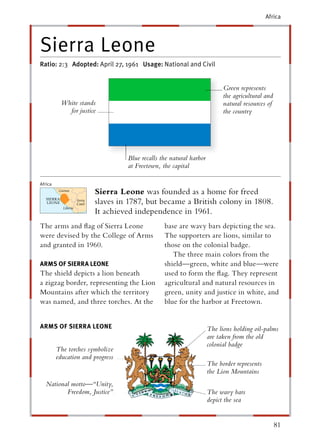
for many years. The revolt of 1911             communism. The red field signifies
saw the changing of the flag to                 revolution and echoes the ancient
five different colored stripes.                 Han Dynasty of 206 bc. The four
Soviet republics were established              stars represent the four social classes:
in the 1920s, each of which was                peasants, workers, petty bourgeoisie,
represented by a red flag referring             and patriotic capitalists.


FLAG OF HONG KONG                              FLAG OF MACAO IN 1999
(XIANGGANG) IN 1997
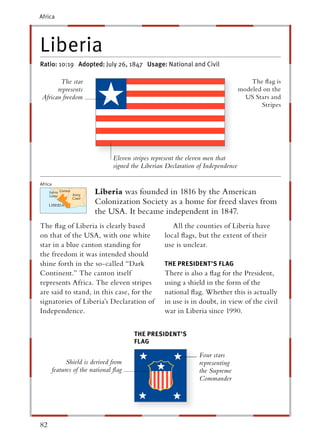


218
Asia


North Korea
Ratio: 1:2 Adopted: September 9, 1948 Usage: National and Civil

Two blue                                                                The white
stripes                                                                 stripes
stand for                                                               symbolize
sovereignty,                                                            purity
peace and
friendship                                                              Red represents
                                                                        communist
                                                                        revolution

                                  The star is a symbol
                                  of communism

Asia
                     The Kingdom of Korea was annexed by Japan in
                     1910. In 1948, the peninsula was partitioned into
                     democratic South and communist North Korea.
The flag was adopted in 1948, when            flag of South Korea, and
North Korea became an independent            represents the opposing principles
communist state. The traditional             of nature. The red stripe expresses
Korean flag was red, white and blue.          revolutionary traditions; while the
The regime retained these colors—            red star is for communism.
with more prominence given to the               The prominent theme of the
red—and added a red star on a white          Soviet-style coat of arms is
disc. The disc recalls the Chinese yin-      industrialization, depicted with an
yang symbol, which is found on the           electricity pylon and a large dam.


ARMS OF NORTH KOREA
                                                         The star of communism

 A hydroelectric power station
  within a wreath of rice-ears

   Industrial elements feature                           The inscription on the scroll is
 heavily on the arms of Korea                            the country’s official name—
 and include a large dam and                             The Democratic People’s
              electricity pylon                          Republic of Korea


                                                                                    219
Asia


South Korea
Ratio: 2:3 Adopted: September 8, 1948 Usage: National and Civil


 Three unbroken bars                                         This trigram
   symbolize heaven                                          represents water


          White is the
traditional color of the
                                                             Three broken bars
        Korean people
                                                             symbolize earth


               This trigram             Yin-yang symbol signifies harmony
              represents fire            and the union of opposites


                      South Korea forms the southern half of the
                      Korean Peninsula, which was partitioned close
                      to the 38th parallel after World War II.
The flag used by the Kingdom              form of a Japanese mon. These are
of Korea before 1910 featured the        simplified versions of everyday
traditional colors: red, white, and      objects, shown in symmetrical and
blue. When South Korea separated         regular forms. Yang is represented by
from the north in 1948, the original     red, and yin by blue.
flag was retained, but a few                 The other alteration to the original
alterations were made.                   flag in 1948 was to the trigrams
                                         (kwae) surrounding the yin-yang,
A NEW SOUTH KOREAN FLAG                  which were reduced from eight to
At the flag’s center is a disc            four. They are the basic trigrams from
containing an S-shaped line, the         the I-Ching, a divination system
upper half being red, the lower half     widespread in the East. On the South
blue. This is derived from the           Korean flag they symbolize the four
Eastern yin-yang symbol, which           polarities; heaven (upper hoist), water
represents the harmony of opposites      (upper fly), fire (lower hoist), and
in nature, for example, good and         earth (lower fly). The white field of
evil; male and female. When North        the flag represents peace and the
and South Korea separated, the shape     white clothing traditionally worn by
of the yin-yang was stylized in the      the Korean people.


220
Asia


Japan
Ratio: 7:10 Adopted: January 27, 1870 Usage: National and Civil

The sun symbol has
been an element
in Japan’s flags for
thousands of years
                                                                  The red disc is named
                                                                  Hinomaru or disc of
                                                                  the Lucky Sun


                                             The white field expresses
                                             honesty and purity

Asia
                         Isolated from the world for centuries, Japan began to
                         modernize in the 19th century. After defeat in World
                         War II, it became a democracy.
Japan is known as “The Land of the            THE HINOMARU
Rising Sun.” The Emperor of Japan             The Lucky Sun or Hinomaru,
and his predecessors descend from             in the center of the flag, has been
the House of Yamato, which united             an imperial badge since the 14th
the country in ad 200 and they                century. The white field stands
claim to be direct descendants of             for purity and integrity, and some
the sun goddess, Amaterasu                    suggest the red disc represents
Omikami.                                      brightness, sincerity and warmth.
   The current flag was officially              The Japanese Maritime SDF
established as the national flag               ensign is an unusual adaptation
of Japan in 1870.                             of the national flag.
                                  JAPANESE MARITIME
                                  SDF ENSIGN
        Adopted in 1889, the                                   Rays extend to the edge
       naval ensign consists of                                of the flag to recall the
         the sun-disc with red                                 rising sun
         rays extending to the
             border of the flag


                                                                                     221
Australasia and Oceania


Australia
Ratio: 2:1 Adopted: May 29, 1909 Usage: National and Civil

    The Union
Jack is retained
  in the canton
                                                                            The stars of
                                                                            the Southern
                                                                            Cross


                                  The points of the “Commonwealth Star”
                                  represent the members of the Federation

Australasia and Oceania

                          The great southern continent of Australia was
                          unified in 1901, as a commonwealth of six formerly
                          separate British subject states.
The first national flag was adopted              THE UNION JACK
in 1901 following various design               First flown on Australian soil by
competitions, but its use was                  Captain Cook, it was the national
restricted. It includes a blue ensign          flag from 1788 and remained the
and three motifs, celebrating key              official citizens’ land flag until 1954.
aspects of Australian statehood.               It occupies the canton, denoting
                                               Australia’s historical links with
THE SOUTHERN CROSS                             Great Britain.
This constellation is visible
throughout the year in southern                THE “COMMONWEALTH STAR”
                                                                  T
night skies and has been used as a             This large star affirms the federal
navigational aid for centuries. It             nature of government in Australia.
helped guide early European ships              Originally there were six points for
to the continent and became a                  the six federal states. The seventh
popular emblem for the new                     point was added in 1909, to
settlers. The five stars of the cross           represent the Northern Territory
appear on the fly, with seven points            together with the six other external
for the brightest stars and five for            territories administered by the
the lesser Epsilon Crucis.                     Australian Federal Government.


222
Australasia and Oceania


State flags
The state flags all use the British Blue Ensign, with the state badge in the canton.
The two territories do not follow this pattern.


                           AUSTRALIAN                                          NEW SOUTH
                           CAPITA L
                               T                                               WALES
                           TERRITORY

The capital territory became self-                 A gold star adorns each arm of the
governing in 1989. The flag, adopted in              t. George’s Cross, with a golden lion
1993, depicts Canberra’s city coat of arms          assant guardant at the center. This more
                                                                  t
and the Southern Cross in the city colors of        istinctive badge replaced a previous
blue and gold.                                      esign in 1876.


                           NORTHERN                                            QUEENSLAND
                           TERRITORY


Adopted by the territory in 1978, the flag          The state badge depicts the Royal Crown at
depicts the Southern Cross and a stylized          he center of a Maltese cross. The design of
Sturt’s desert rose against black and ocher,       he crown was altered at the coronation of
which are the territorial colors.                  HM Queen Elizabeth II in 1953.


                           SOUTH AUSTRALIA                                     TASMANIA


The state emblem of the piping shrike(a            The Red Lion passant on a white
                                                                        t
magpie) is shown with outstretched wings            ackground recalls historical ties with
on a yellow background. The piping shrike           ngland and has remained essentially
was adopted as the flag badge in 1904.               nchanged since its adoption in 1875.


                           VICTORIA                                            WESTERN
                                                                               AUSTRALIA


The Royal Crown was added in 1877. The             The Black Swan has been Western
present arrangement, with the crown                Australia’s emblem since the first British
surmounting the Southern Cross, became              olony was founded at Swan River. The
the state arms in 1910.                             ag was adopted in 1953.


                                                                                               223
Australasia and Oceania


Vanuatu
Ratio: 11:18 Adopted: February 18, 1980 Usage: National and Civil

                                                                    Red is symbolic
     The boar’s tusk                                                of blood
         symbolizes
          prosperity                                                The yellow Y-shape
    The fern leaves                                                 depicts the outline
  represent peaceful                                                of the Vanuatu
          intentions                                                archipelago and the
                                                                    color of sunshine

                                    Green recalls the richness
                                    of the islands

Australasia and Oceania

                          Vanuatu, formerly known as the New Hebrides,
                          was jointly administered by Britain and France
                          from 1906. In 1980, it gained its independence.
During its time as an Anglo-French              the black is for the Melanesian
condominium, the New Hebrides                   people. The Prime Minister
flew the French Tricolore side by side           requested the inclusion of the
with the Union Jack. After the                  yellow and black fimbriations to
anglophone Vanuaaku Party led the               give more prominence to the color
country to independence as Vanuatu              representing the people. The yellow
in 1980, the colors of the party flag –          Y-shape denotes the pattern of the
red, black, green, and yellow—were              islands in the Pacific Ocean.
adopted as the basis for the design of
a new national flag. The final design             THE BOAR’S TUSK
was chosen a few months before                  Between the arms of the “Y” lies
independence by a parliamentary                 the traditional emblem of a boar’s
committee from designs submitted                tusk—the symbol of prosperity,
by a local artist.                              worn as a pendant on the islands—
                                                crossed by two leaves of the local
THE SYMBOLISM OF THE COLORS                     namele fern. The leaves are a token
The yellow symbolizes sunshine;                 of peace, and their 39 fronds
the green, the richness of the islands.         represent the 39 members of
The red is symbolic of blood, and               Vanuatu’s legislative assembly.


224
Australasia and Oceania


Fiji
Ratio: 1:2 Adopted: October 10, 1970 Usage: National and Civil

    The Union                                                            The design is
   Jack denotes                                                              based on
  the historical                                                           the British
     links with                                                           Blue Ensign
 Great Britain


                                         The blue field represents
                                         the Pacific Ocean


                    Fiji became part of the British Empire in 1874, and
                    an independent nation with dominion status
                    within the Commonwealth in 1970.
The flag was adopted in 1970, when         ARMS OF FIJI
Fiji achieved independence. Its bright    The shield is derived from the
blue background symbolizes the            country’s official coat of arms, which
Pacific Ocean, which plays an              was originally granted by Royal
important part in the lives of the        Warrant in 1908. The images
islanders, both in terms of the fishing    depicted on the shield represent
industry, and the burgeoning tourist      agricultural activities on the islands,
trade. The Union Jack reflects the         and the historical associations with
country’s links with Great Britain.       Great Britain.


ARMS OF FIJI
                                                        On the chief, a British
       The first quarter shows                           lion holds a coconut
      sugar cane, the second a                          between its paws
       coconut palm, the third
      a dove of peace, and the                          The coat of arms was granted
    fourth a bunch of bananas                           in 1908. It is a white shield,
                                                        with a red cross and a red chief
                                                        (the upper third of a shield)


                                                                                   225
Australasia and Oceania


Papua New Guinea
Ratio: 3:4 Adopted: June 24, 1971 Usage: National and Civil

 The five stars represent                                         Red and black are the
     the Southern Cross,                                        predominant colors in
  but also refer to a local                                     the native art of Papua
 legend about five sisters                                                 New Guinea


                                                                 A golden bird
                                                                 of paradise


Australasia and Oceania

                          Papua New Guinea gained full independence
                          in 1975, following its status as a United Nations
                          Trusteeship under Australian administration.
The Australian administration                 THE COLORS OF NATIVE ART
attempted to introduce Papua New              The colors of the field—red and
Guinea’s first official national flag in         black—were chosen because of their
1970. Its choice was a vertically             widespread use in the native art of
divided flag: blue at the hoist, with          the country. The bird of paradise has
the stars of the Southern Cross as in         long been a local emblem, and its
the Australian flag, then white, then          feathers are used for traditional dress
green, with a golden bird of                  and in festivals and ceremonies.
paradise. The proposed design was
never popular with the local people.          THE SOUTHERN CROSS
                                              The flag is halved diagonally. The
A LOCAL DESIGN                                lower half features the Southern
The current flag of yellow and white           Cross constellation in white on
on black and red was designed by              black, as it would appear in the night
a 15-year-old art student, Susan              sky, over Papua New Guinea. This
Karike, and officially accepted in             signifies the link with Australia and
1971. When Papua New Guinea                   also recalls a local legend about five
became independent in 1975, it                sisters. The red upper half bears a
was retained as the national flag.             golden bird of paradise in flight.


226
Australasia and Oceania


Solomon Islands
Ratio: 5:9 Adopted: November 18, 1977 Usage: National and Civil

The five
stars represent
the five
main groups
of islands                                                                      Green
                                                                                represents
                                                                                the land


                              The yellow stripe
                              symbolizes sunshine

Australasia and Oceania

                          The Solomon Islands were a British colony
                          from 1883, until they became self-governing in 1976,
                          and subsequently independent in 1978.
Before the current flag was adopted                  water and the land. The five stars
in 1977, three different coats of                   were initially incorporated to
arms had represented the islands.                   represent the country’s five districts.
   The national flag, adopted in                     The islands were later divided into
1977, is divided diagonally by a                    seven districts and the symbolism of
stripe of yellow representing the                   the stars was modified to refer to
sunshine of the islands. The two                    the five main groups of islands.
triangles formed by the diagonal                       The coat of arms is also in the
stripe are blue and green, signifying               colors of the national flag.


ARMS OF THE                                                     A shark
SOLOMON ISLANDS
                                                                The shield depicts frigate
The crest is a traditional canoe                                birds, an eagle, two turtles,
(in section) and a shining sun                                  a shield and bow and arrow,
                                                                all representing districts of the
           A freshwater crocodile                               Solomon Islands

           The national motto –                                 The compartment is a
           “To lead is to serve”                                stylized frigate bird


                                                                                             227
Australasia and Oceania


Palau
Ratio: 5:8 Adopted: January 1, 1981 Usage: National and Civil

    The golden disc                                                  Blue symbolizes the
     depicts the full                                                freedom of self-rule
   moon, considered
  by Palauans to be
    the best time for
    celebrations and
          harvesting


                                         The full moon is set
                                         slightly toward the hoist


                        Under US control since 1945, Palau became a
                        republic in 1981. In 1994, it became independent
                        in association with the United States.
The current flag was introduced in           sits slightly off center toward the
1981 when Palau became a republic.          hoist, represents the full moon. The
Previously, the flag of the Trust            Palauans consider the full moon to be
Territory of the Pacific Islands was         the optimum time for human activity.
flown jointly with the United                This time of the month when
Nations and United States flags.             celebrations, harvesting and planting,
                                            fishing, tree-felling, and the carving
THE SYMBOLISM OF THE FLAG                   of traditional canoes are carried out.
The flag’s very simple design belies         The moon is a symbol of peace, love
the depth of meaning attributed to it.      and tranquility.
The explanation for the choice of
colors is rooted in the history and         THE SEAL OF PALAU
customs of the Palauan people.              Palau does not have a coat of arms,
The bright blue of the field, which          but has a seal, adopted in 1981, when
might be assumed to be symbolic             the country became a republic. The
of the Pacific Ocean, is in fact a           seal is not colored. It depicts a
representation of the transition            traditional Palauan triangular hut,
from foreign domination to self-            above the date of adoption. This is
government. The golden disc, which          surrounded by the title of the state.


228
Australasia and Oceania


Micronesia
Ratio: 10:19 Adopted: November 30, 1978 Usage: National and Civil

  The light blue                                                                        The colors are
  field recalls the                                                                    similar to those
   Pacific Ocean                                                                         of the un flag


                                                     The four stars each
                                                     represent an island group


                       Micronesia was part of the US-administered
                       United Nations Trust Territory of the Pacific
                       Islands, until it became independent in 1979.
The flag, adopted in 1978, is in the                  In an echo of US practice, the stars
colors of the un flag. The light blue                 are for the four islands, arranged
also represents the Pacific Ocean.                    like the points of the compass.

Micronesian States

                             CHUUK                                           KOSRAE


The white coconut palm shows that the people          The olive branches symbolize peace. The four
depend on coconut resources. The white stars          tars are for the islands’ four units. The fafa stone
represent the 38 municipal units in the territory.      traditionally used for grinding food.


                             POHNPEI                                               Y
                                                                                   YA P


The eleven stars are for the district’s eleven        The outer and inner rings show a rai, a traditional
municipalities. The half coconut shell represents     ymbol of unity. The white outrigger canoe
the sakau cup used in traditional ceremonies.         ymbolizes the desire to reach state goals.


                                                                                                   229
Australasia and Oceania


Marshall Islands
Ratio: 10:19 Adopted: May 1, 1979 Usage: National and Civil

   A 24-pointed                                                              The two
star, one for each                                                     stripes, orange
   of the districts                                                        over white,
   on the islands                                                        represent the
                                                                          two parallel
                                                                             chains of
                                                                         the Marshall
                                                                                Islands


                                            Blue field for the
                                            Pacific Ocean

Australasia and Oceania

                          The Marshall Islands were part of the US Trust
                          Territory of the Pacific Islands from 1945–1986.
                          They became fully independent in 1990.
The Marshall Islands became a self-          further than the others and stand
governing territory on May 1, 1979,          for the capital, Majuro, and the
and on that day a new national flag           administrative districts of Wotji,
was adopted. Designed by Emlain              Yaluit, and Kwajalein. They also
Kabua, wife of the president of              form a cross, signifying the Christian
the new government, it was the               faith of the Marshallese.
winning entry in a competition
that had attracted 50 designs.               SYMBOLS OF PROSPERIT Y
                                             The two parallel stripes extending
A FLAG FOR A PACIFIC ISLAND                  across the flag symbolize the two
The flag’s dark blue field represents          parallel chains of the Marshall Islands:
the vast area of the Pacific Ocean            the Ratak (Sunrise) Chain is white,
over which the islands are scattered.        the Ralik (Sunset) Chain is orange.
The star symbolizes the geographical         The stripes extend and widen
position of the islands, which lie a         upward. This is said to signify the
few degrees above the Equator. The           increase in growth and vitality of life
star has 24 points, representing the         on the islands. Orange also
24 municipalities of the Marshall            symbolizes courage and prosperity,
Islands. Four of its rays extend             while white represents peace.


230
Australasia and Oceania


Nauru
Ratio: 1:2 Adopted: January 31, 1968 Usage: National and Civil


 The blue field                                                                  The gold stripe
 represents the                                                                 represents the
   island’s blue                                                                Equator
  skies and the
 Pacific Ocean

                                   The 12-pointed star recalls the
                                   12 original tribes of Nauru

Australasia and Oceania

                          Nauru was jointly administered by Australia,
                          the UK and New Zealand from 1947 until
                          independence was granted in 1968.
The flag, chosen in a local design                point represents one of the 12
competition, was adopted on the day              indigenous tribes on the island.
of independence. It depicts Nauru’s
geographical position, one degree                ARMS OF NAURU
below the Equator. A gold horizontal             This is also a local design and
stripe representing the Equator runs             includes the chemical symbol for
across a blue field for the Pacific                phosphorus; phosphates are Nauru’s
Ocean. Nauru itself is symbolized by             main export. Beneath it are a frigate
a white twelve-pointed star. Each                bird and a sprig of tomano.


ARMS OF NAURU
                                                                     The 12-pointed star,
                The shield is                                        as featured on the flag,
      surrounded by coconut                                          representing the 12
       leaves for phosphorus                                         tribes of Nauru

        The chemical symbol                                          The feathers of
              for phosphorus                                         a frigate bird

                 A frigate bird                                      A sprig of tomano


                                                                                               231
Australasia and Oceania


Kiribati
Ratio: 1:2 Adopted: July 12, 1979 Usage: National and Civil

The red shield in                                                    The frigate
the coat of arms                                                     bird symbolizes
also depicts a                                                       command of the sea
gold flying frigate
bird above a
rising golden sun


                                The blue and white wavy bands
                                represent the Pacific Ocean

Australasia and Oceania

                          Once part of the British colony of the Gilbert and
                          Ellice Islands, the Gilberts became independent in
                          1979 and adopted the name Kiribati.
Kiribati’s flag is one of only three             colonial coat of arms, was submitted
national flags which are armorial                to the College of Arms. The
banners—flags having a design which              College of Arms decided to modify
corresponds exactly to that                     the design. Both the golden frigate
of the shield in the coat of arms.              bird and the sun were enlarged to
                                                occupy more of the top of the flag
ARMS OF KIRIBATI                                and the width of the blue and white
The coat of arms dates back to May              wavy bands was reduced.
1937 when it was granted to the
Gilbert and Ellice Islands, as                  THE ORIGINAL DESIGN
Kiribati and Tuvalu were then                   However, the local people insisted
known. The shield, was then                     on the original design, in which the
incorporated into the center of the             top and bottom halves of the flag
fly half of a British Blue Ensign as             were equal, the sun and local frigate
the state ensign of the colony.                 bird small, and the various design
   Shortly before independence was              elements outlined in black.
granted in 1979, a local competition               The new flag was hoisted during
was held to choose a new national               the independence day celebrations in
flag and a design based on the                   the capital, Tarawa on July 12, 1979.


232
Australasia and Oceania


Tuvalu
Ratio: 1:2 Adopted: October 1, 1978 Usage: National and Civil

     The Union
   Jack signifies
continuing links
   with Britain
                                                                          The nine stars
                                                                          are for the nine
                                                                          islands


Australasia and Oceania

                          The Ellice Islands separated from the Gilbert and
                          Ellice Islands in 1975, and adopted the name
                          Tuvalu. Independence was gained in 1978.
Tuvalu means “eight islands,”                 However, anti-Commonwealth
although there are in fact nine, each         feeling rose and in 1995, the
of which is represented by a star on          government decided on a new flag
the flag. The stars’ arrangement is            without the Union Jack. The new flag
supposed to reflect the islands’               introduced later that year, retained
geographic distribution.                      the stars, but included the arms in a
   This flag was chosen because it             triangle at the hoist. In April 1997 the
symbolizes the continuing links with          original design was re-adopted,
Britain and the Commonwealth.                 following a change of government.


ARMS OF TUVA LU
          V                                                 Eight sets of objects
                                                            reflect the country’s title,
             The coat of arms                               “Eight Together”
        depicts a local meeting
            house or maneapa                                The border contains
                                                            eight sea shells and
                                                            eight banana leaves
              The motto means
             “Tuvalu for God”


                                                                                          233
Australasia and Oceania


Samoa
Ratio: 1:2 Adopted: January 1, 1962 Usage:National and Civil

 The Southern                                                         Red is a
        Cross                                                         traditional
                                                                      Samoan color
          White                                                       and symbolizes
       represents                                                     courage
           purity


                                       Blue represents
                                       freedom

Australasia and Oceania

                          Under the administration of Germany, the USA
                          and later New Zealand, Samoa became the first
                          independent Polynesian nation in 1962.
Prior to 1899, when Samoa was                Malietoa and the Southern Cross
partitioned by Germany and the               from the flag of New Zealand, on a
USA, it was ruled by the rival               blue field in the canton.
kingdoms of Malietoa and Tamasese.              In 1949, the smaller fifth star was
   The flag of Malietoa was probably          added, making the Southern Cross
inspired by missionaries. It was a           more like that on the Australian
plain red field, with a white cross and       flag. The flag was retained when
a white star in the canton. The rival        independence was granted in 1962.
King of Tamasese favored the
German cause and used flags with              ARMS OF SAMOA
black crosses.                               The coat of arms was adopted in
                                             1951 and contains symbols reflecting
A UNITED FLAG                                the Christian faith of the Samoan
In 1948, by then a territory of New          people. It depicts a shield of the
Zealand, Samoa was granted its               Southern Cross, below a coconut
current flag. This was created                palm from the previous colonial
jointly by the kings of Malietoa and         badge. Above the shield is a cross
Tamasese. It comprised a red field            recalling the national motto—“May
taken from the former flag of                 God be the foundation of Samoa.”


234
Australasia and Oceania


Tonga
Ratio: 1:2 Adopted: November 4, 1875 Usage: National and Civil

  The red cross                                                      Red represents
  represents the                                                     the blood Jesus
king’s devotion                                                      shed on the
to Christianity                                                      cross


                             White symbolizes
                             purity


                      Tonga was unified under King George Tupou I in
                      1820. In 1900, it became a British protectorate
                      before regaining its independence in 1970.
The flag dates from 1862 when the            the International Red Cross flag,
king at the time, who had converted         adopted in 1863, and so the white flag
to Christianity in 1831, called for a       was placed in the canton of a red one.
national flag which would symbolize          The cross and the red color signify the
the Christian faith.                        sacrifice of Christ’s blood. The 1875
                                            constitution states that the flag shall
A NEW “CHRISTIAN” FLAG                      never be altered.
The first design was a plain white              The naval ensign, introduced in
flag with a red couped cross, but this       1985, also has a red couped cross on
was later found to be too similar to        white in the canton.


                          TONGAN NAVA L ENSIGN
                                  AV
    Red couped cross
       in the canton

   The naval ensign,                                            A red, cotised
 introduced in 1985,                                            or bordered,
     recalls the flag of                                         Scandinavian cross
  Imperial Germany


                                                                                235
Australasia and Oceania


New Zealand
Ratio: 1:2 Adopted: June 12, 1902 Usage: National

   The Union
    Jack in the                                                          Four white-
 canton recalls                                                          bordered red
New Zealand’s                                                            stars represent
   colonial ties                                                         the Southern
     to Britain                                                          Cross


                                                        The stars all vary
                                                        slightly in size

Australasia and Oceania

                          New Zealand was settled by the British in the
                          1800s and was a colony from 1841. It became a
                          dominion in 1907 and fully independent in 1947.
New Zealand’s first flag was                   A NEW NATIONAL FLAG
adopted before it became a British           The current flag was designed and
colony. Chosen by an assembly of             adopted for restricted use in 1869
Maori chiefs in 1834, the flag was of         and became the national flag in
a St. George’s Cross with another            1902. It is the British Blue Ensign,
cross in the canton containing four          with a highly stylized representation
stars on a blue field. After the              of the Southern Cross constellation.
formation of the colony in 1841,             It depicts only four of the five stars
British ensigns began to be used.            in the constellation.

Overseas Territories

                             COOK ISLANDS                             NIUE


The 15 stars on the fly represent the 15      The link with the UK is shown by the use
main islands of the group; they are          of the Union Jack; that with New Zealand
arranged in a ring to indicate that each     by the four stars. The large central star
island is of equal importance.               represents Niue itself.


236
International flags
Many international organizations also adopt flags. Below is a selection of the most well-known.


                           ARAB LEAGUE                                ASSOCIATION
                                                                      OF SOUTHEAST
                                                                      ASIAN NATIONS


                    CARICOM                                                  THE
                    (Caribbean Community                                     COMMONWEALTH
                    and Common Market)


                           CIS                                        EUROPEAN UNION
                           (Commonwealth of
                           Independent States)


                    FIAV                                            NATO
                    (International Federation of                    (North Atlantic
                    Vexillological Associations)                    Treaty Organization)


                    OLYMPIC MOVEMENT
                     L                                                  ORDER OF ST JOHN


              RED CROSS                                                 OPEC
                                                                        (Organization of
                                                                        Petroleum-Exporting
                                                                        Countries)

              RED CRESCENT                                            AU
                                                                      (African Union)


              RED CRYSTAL
                      T                                              SECRETA RIAT OF THE
                                                                           T
                                                                     PACIFIC COMMUNIT Y


In 2006, the Red Crystal was adopted
                                                                      UNITED NATIONS
for use with, or in place of, the Red Cross                           (UN)
or Red Crescent flags. It is non-religious-
specific, but the cross and crescent may be
added in the center.


                                                                                              237
Signal flags

Code           G   Q   0


1st Repeat     H   R   1


2nd Repeat     I   S   2


3rd Repeat     J   T   3


A              K   U   4


B              L   V   5


C              M   W   6


D              N   X   7


E              O   Y   8


F              P   Z   9


238
Index


                             British Antarctic Territory ❑    Estonia ❍ NE. Europe, 114
Index                           Antarctica, 129               Ethiopia ❍ E. Africa, 64
                             British Indian Ocean Territory   Falkland Islands ❑
                                ❑ Indian Ocean, 129              Atlantic Ocean, 129
KEY                          British Virgin Islands ❑         Faeroe Islands ❑
❍ Country                       W. Indies, 129                   Atlantic Ocean, 111
                             Brunei ❍ SE. Asia, 215           Fiji ❍ Pacific Ocean , 225
❑ Overseas territory
                             Bulgaria ❍ SE. Europe, 162       Finland ❍ N. Europe, 113
                             Burkina ❍ W. Africa, 84          France ❍ W. Europe, 131
Afghanistan ❍ C. Asia, 196
                             Burundi ❍ C. Africa, 69          French Polynesia ❑
Åland Islands ❑ N. Europe,
                             Cambodia ❍ SE. Asia, 207            Pacific Ocean, 131
   113
                             Cameroon ❍ C. Africa, 89         Gabon ❍ C. Africa, 92
Albania ❍ SE. Europe, 160
                             Canada ❍ N. America, 8           Gambia ❍ W. Africa, 77
Algeria ❍ N. Africa, 57
                                Provincial flags, 9–10         Georgia ❍ SW. Europe, 175
American Samoa ❑
                             Cape Verde ❍                     Germany ❍ N. Europe, 118
   Pacific Ocean, 19
                                Atlantic Ocean, 78               Länder flags, 119–120
Andorra ❍ SW. Europe, 134
                             Cayman Islands ❑                 Ghana ❍ W. Africa, 85
Angola ❍ S. Africa, 94
                                W. Indies, 129                Gibraltar ❑ S. Europe, 130
                                                                       r
Anguilla ❑ W. Indies, 129
                             Central African Republic ❍       Greece ❍ SE. Europe, 163
Antigua & Barbuda ❍
                                C. Africa, 70                 Greenland ❑
   W. Indies, 34
                             Chad ❍ C. Africa, 73                Atlantic Ocean, 111
Argentina ❍ S. America, 55
                             Chile ❍ S. America, 51           Grenada ❍ W. Indies, 39
Armenia ❍ SW. Europe, 173
                             China ❍ E. Asia, 218             Guam ❑ Pacific Ocean, 19
Aruba ❑ Pacific Ocean, 123
                             Colombia ❍ S. America, 41        Guatemala ❍ C. America, 21
Australia ❍ Pacific/Indian
                             Comoros ❍                        Guinea ❍ W. Africa, 80
   Ocean, 222
                                Indian Ocean, 106             Guinea-Bissau ❍
   State flags, 223
                             Congo ❍ C. Africa, 93               W. Africa, 79
Austria ❍ C. Europe, 149
                             Congo, Dem. Rep. ❍               Guyana ❍ S. America, 43
   State flags, 150
                                C. Africa, 71                 Haiti ❍ W. Indies, 31
Azerbaijan ❍
                             Cook Islands ❑                   Honduras ❍ C. America, 24
   SW. Europe, 172
                                Pacific Ocean, 236             Hong Kong (Xianggang) ,
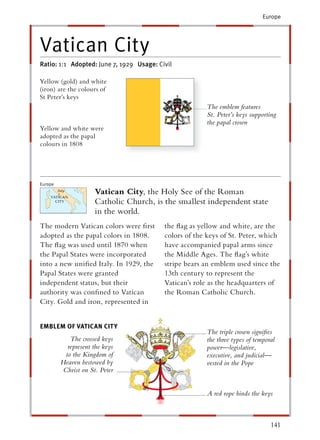
Bahamas ❍ W. Indies, 30
                             Corsica ❑ S. Europe, 131            see China, 218
                                                                   e
Bahrain ❍ SW. Asia, 186
                             Costa Rica ❍ C. America, 26      Hungary ❍ C. Europe, 151
Bangladesh ❍ S. Asia, 203
                             Croatia ❍ SE. Europe, 155        Iceland ❍ NW. Europe, 109
Barbados ❍ W. Indies, 38
                             Cuba ❍ W. Indies, 29             India ❍ S. Asia, 200
Belgium ❍
                             Cyprus ❍ SE. Europe, 178         Indonesia ❍ SE. Asia, 212
   NW. Europe, 124
                             Czech Republic ❍                 Iran ❍ SW. Asia, 189
   Regional flags, 124
                                C. Europe, 152                Iraq ❍ SW. Asia, 188
Belize ❍ C. America, 22
                             Denmark ❍ N. Europe, 111
                                      k                       Ireland ❍ NW. Europe, 125
Belarus ❍ E. Europe, 166
                             Djibouti ❍ E. Africa, 63         Israel ❍ SW. Asia, 179
Benin ❍ W. Africa, 87
                             Dominica ❍ W. Indies, 35         Italy ❍ S. Europe, 139
Bermuda ❑
                             Dominican Republic ❍             Ivory Coast ❍ W. Africa, 83
   Atlantic Ocean, 129
                                W. Indies, 32                 Jamaica ❍ W. Indies, 28
Bhutan ❍ SE. Asia, 199
                             East Timor ❍ SE. Asia, 213
                                        r                     Japan ❍ E. Asia, 221
Bolivia ❍ S. America, 52
                             Ecuador ❍ S. America, 45
                                     r                        Jordan ❍ SW. Asia, 180
Bosnia & Herzegovina ❍
                             Egypt ❍ N. Africa, 60            Kazakhstan ❍ C. Asia, 192
   SE. Europe, 156
                             El Salvador ❍ C. America, 23
                                         r                    Kenya ❍ E. Africa, 67
Botswana ❍ S. Africa, 101
                             Equatorial Guinea ❍              Kiribati ❍ Pacific Ocean, 232
Brazil ❍ S. America, 47
                                C. Africa, 90                 Kosovo ❍ C. Europe, 159
   State flags, 48–50
                             Eritrea ❍ E. Africa, 62          Kuwait ❍ SW. Asia, 187


                                                                                       239
Kyrgyzstan ❍ C. Asia, 194     Nicaragua ❍ C. America, 25      St Helena ❑
Laos ❍ SE. Asia, 206          Niger ❍ W. Africa, 72
                                   r                             Pacific Ocean, 130
Latvia ❍ NE. Asia, 115        Nigeria ❍ W. Africa, 88         St Kitts & Nevis ❍
Lebanon ❍ SW. Asia, 176       North Korea ❍ E. Asia, 219         W. Indies, 33
Lesotho ❍ S. Africa, 102      Northern Marianas Islands ❑     St Lucia ❍ W. Indies, 36
Liberia ❍ W. Africa, 82          Pacific Ocean, 19             St Vincent & the Grenadines ❍
Libya ❍ N. Africa, 59         Norway ❍ N. Europe, 110            W. Indies, 37
Liechtenstein ❍               Niue ❑ Pacific Ocean, 236        Sudan ❍ E. Africa, 61
   SE. Europe, 148            Oman ❍ SW. Asia, 183            Suriname ❍ S. America, 44
Lithuania ❍ NE. Europe, 116   Pakistan ❍ S. Asia, 197         Swaziland ❍ S. Africa, 103
Luxembourg ❍  g               Palau ❍ Pacific Ocean, 228       Sweden ❍ N. Europe, 112
   NE. Europe, 132            Panama ❍ C. America, 27         Switzerland ❍ C. Europe, 143
Macedonia ❍ SE. Europe, 161   Papua New Guinea ❍                 Canton Flags, 144–147
Macao, see China, 218
            e                    Indian/Pacific Ocean, 226     Syria ❍ SW. Asia, 177
Madagascar ❍  r               Paraguay ❍ S. America, 53       Taiwan ❍ SE. Asia, 217
   Indian Ocean, 107          Peru ❍ S. America, 46           Tajikistan ❍ C. Asia, 195
Malawi ❍ SE. Africa, 97       Philippines ❍ SW. Asia, 216     Tanzania ❍ E. Africa, 96
Malaysia ❍ SE. Asia, 209      Pitcairn Islands ❑              Thailand ❍ SE. Asia, 205
   State flags, 210–211           Pacific Ocean, 130            Togo ❍ W. Africa, 86
Maldives ❍                    Poland ❍ N. Europe, 117         Tonga ❍ Pacific Ocean, 235
   Indian Ocean, 201          Portugal ❍ SW. Europe, 135      Trinidad & Tobago ❍
Mali ❍ W. Africa, 75          Puerto Rico ❑ W. Indies, 19        W. Indies, 40
Malta ❍ S. Europe, 140        Qatar ❍ SW. Asia, 185
                                   r                          Tunisia ❍ N. Africa, 58
Marshall Islands ❍            Romania ❍ SE. Europe, 164       Turkey ❍ Asia/Europe, 174
   Pacific Ocean, 230          Russian Federation ❍            Turkmenistan ❍ C. Asia, 190
Mauritania ❍ W. Africa, 74       Europe/Asia, 168             Turks and Caicos Islands ❑
Mauritius ❍                      Republic flags, 169–171          Pacific Ocean, 130
   Indian Ocean, 108          Rwanda ❍ C. Africa, 68          Tuvalu ❍ Pacific Ocean, 233
Mexico ❍ C. America, 20       Samoa ❍ Pacific Ocean, 234       Uganda ❍ E. Africa, 66
Micronesia ❍                  San Marino ❍ S. Europe, 142     Ukraine ❍ E. Europe, 167
   Pacific Ocean, 229          Sao Tome & Principe ❍           United Arab Emirates ❍
   State flags, 229               W. Africa, 91                   SW. Asia, 184
Moldova ❍ SE. Europe, 165     Saudi Arabia ❍ SW. Asia, 181    United Kingdom ❍
Monaco ❍ S. Europe, 133       Senegal ❍ W. Africa, 76            NW. Europe, 126
Mongolia ❍ E. Asia, 193       Serbia ❍ C. Europe, 158            Regional flags, 127–130
Monserrat ❑ W. Indies, 130    Seychelles ❍                    United States of America ❍
Montenegro ❍ C. Europe, 157      Indian Ocean, 105               N. America, 11
Morocco ❍ N. Africa, 56       Sierra Leone ❍ W. Africa, 81      State flags, 13–19
Mozambique ❍ S. Africa, 99    Singapore ❍ SE. Asia, 214       Uruguay ❍ S. America, 54
Myanmar ❍ SE. Asia, 204
          r                   Slovakia ❍ C. Europe, 153       Uzbekistan ❍ C. Asia, 191
Namibia ❍ S. Africa, 100      Slovenia ❍ C. Europe, 154       Vanuatu ❍ Pacific Ocean, 224
Nauru ❍ Pacific Ocean, 231     Soloman Islands ❍               Vatican City ❍ S. Europe, 141
Nepal ❍ S. Asia, 198             Pacific Ocean, 227            Venezuela ❍ S. America, 42
Netherlands ❍                 Somalia ❍ E. Africa, 65         Vietnam ❍ SE. Asia, 208
   NW. Europe, 121            South Africa ❍ S. Africa, 104   Virgin Islands (US) ❑
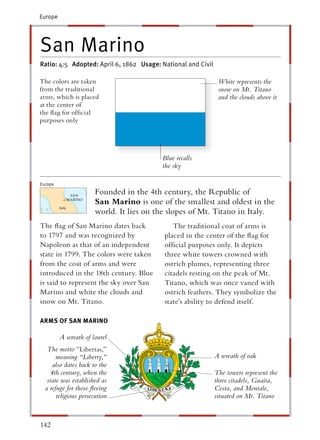
   Provincial flags, 122–123   South Korea ❍ E. Asia, 220         W. Indies, 19
Netherlands Antilles ❑        Spain ❍                         Yemen ❍ SW. Asia, 182
   W. Indies, 123                SE. Europe, 136              Zambia ❍ S. Africa, 95
New Zealand ❍                    Regional Flags, 137–138      Zimbabwe ❍ S. Africa, 98
   Pacific Ocean, 236          Sri Lanka ❍ S. Asia, 202
This page intentionally left blank
EUROPE (see front endpaper for World Map)
THE CARIBBEAN
smithsonian
             h a ndbook s


  Over 300 national, international, official, and provincial flags
from around the world, stunningly presented and fully explained
                                +
       Detailed information on the historic and symbolic
      significance and development of every national flag
                                +
      Includes flags of major international organizations


                          Discover more at
                          www.dk.com

Complete flags of the world

  • 2.
    WORLD MAP (see backendpaper for Europe and Caribbean detail)
  • 4.
  • 5.
  • 6.
    LONDON, NEW YORK,MELBOURNE MUNICH, AND DELHI This book was produced in association with The Flag Institute, UK. We would like to dedicate this book to the late Dr. William G. Crampton, Director of the Flag Institute, without whom it would not have been possible. Vexillology artwork and consultants Graham Bartram, Michael Faul Editorial Contributors Roger Bullen, Debra Clapson, Wim Jenkins, Simon Mumford US Editor Charles Wills r Designers Tony Cutting, Carol Ann Davis, Yahya El Droubie, Karen Gregory, Nicki Liddiard Systems Coordinator Philip Rowles r Managing Editor David Roberts r Managing Art Editor Karen Self r Art Director Bryn Walls Publisher Jonathan Metcalf r Production Controller Rita Sinha r First published in the United States in 1997 as The Ultimate Pocket Flags of the World by DK Publishing, 375 Hudson Street, New York, New York 10014 08 09 10 11 10 9 8 7 6 5 4 3 2 1 CD278 - November/2008 Reprinted with Revisions 1998. Second Edition 1999. Third Edition 2002. Fourth Edition 2005. Reprinted with Revisions 2006. Fifth Edition 2008. Copyright © 1997, 1998, 1999, 2002, 2005, 2006, 2008 Dorling Kindersley Limited. All rights reserved. Without limiting the rights under copyright reserved above, no part of this publication may be reproduced, stored in or introduced into a retrieval system, or transmitted, in any form, or by any means (electronic, mechanical, photocopying, recording, or otherwise), without the prior written permission of both the copyright owner and the above publisher of this book. Published in Great Britain by Dorling Kindersley Limited. A catalog record for this book is available from the Library of Congress. ISBN-13: 978-0-7566-4115-3 DK books are available at special discounts when purchased in bulk for sales promotions, premiums, fund-raising, or educational use. For details, contact: DK Publishing Special Markets, 375 Hudson Street, New York, New York 10014 or SpecialSales@dk.com. Color reproduction by Altaimage Ltd., London, UK Printed and bound in China by L.Rex Printing Co., Ltd. Discover more at www.dk.com
  • 7.
    Contents Introduction ............................................................... 5 AFRICA Types of flags/Parts of the flag ................ 6–7 Morocco/Algeria ........................................ 56–57 Tunisia/Libya ................................................ 58–59 Egypt/Sudan ................................................ 60–61 Eritrea/Djibouti ......................................... 62–63 Ethiopia/Somalia ...................................... 64–65 NORTH & CENTRAL AMERICA Uganda/Kenya ............................................ 66–67 Canada Rwanda/Burundi ...................................... 68–69 National and subnational flags ............... 8–10 Central African Republic .............................. 70 United States of America Dem. Rep. Congo .............................................. 71 National and subnational flags ............. 11–19 Niger/Chad .................................................... 72–73 Mexico/Guatemala ................................... 20–21 Mauritania/Mali .......................................... 74–75 Belize/El Salvador ..................................... 22–23 Senegal/Gambia .......................................... 76–77 Honduras/Nicaragua ............................... 24–25 Cape Verde/Guinea-Bissau ................. 78–79 Costa Rica/Panama ................................. 26–27 Guinea/Sierra Leone .............................. 80–81 Jamaica/Cuba ............................................... 28–29 Liberia/Ivory Coast ................................. 82–83 Bahamas/Haiti .............................................. 30–31 Burkina/Ghana ........................................... 84–85 Dominican Republic ........................................ 32 Togo/Benin .................................................. 86–87 St. Kitts & Nevis .................................................. 33 Nigeria/Cameroon .................................. 88–89 Antigua & Barbuda/Dominica ......... 34–35 Equatorial Guinea .............................................. 90 St. Lucia ..................................................................... 36 São Tomé & Príncipe ........................................ 91 St. Vincent & the Grenadines ..................... 37 Gabon/Congo ............................................. 92–93 Barbados/Grenada .................................... 38–39 Angola/Zambia .......................................... 94–95 Trinidad & Tobago ............................................ 40 Tanzania/Malawi ...................................... 96–97 Zimbabwe/Mozambique ..................... 98–99 Namibia/Botswana .............................. 100–101 Lesotho/Swaziland ............................... 102–103 South Africa/Seychelles .................... 104–105 SOUTH AMERICA Comoros/Madagascar ....................... 106–107 Colombia .................................................................. 41 Mauritius ................................................................ 108 Venezuela/Guyana .................................... 42–43 Suriname/Ecuador .................................... 44–45 Peru .............................................................................. 46 Brazil National and subnational flags ............ 47–50 EUROPE Chile ............................................................................. 51 Iceland ..................................................................... 109 Bolivia/Paraguay ........................................ 52–53 Norway/Denmark ................................. 110–111 Uruguay/Argentina .................................. 54–55 Sweden/Finland ...................................... 112–113
  • 8.
    Estonia/Latvia .......................................... 114–115 Jordan/Saudi Arabia ............................ 180–181 Lithuania/Poland ................................... 116–117 Yemen/Oman ......................................... 182–183 Germany United Arab Emirates/Qatar ........ 184–185 National and subnational flags ....... 118–120 Bahrain/Kuwait .................................... 186–187 The Netherlands Iraq/Iran ..................................................... 188–189 National and subnational flags ....... 121–123 Turkmenistan/Uzbekistan .............. 190–191 Belgium/Ireland .................................... 124–125 Kazakhstan/Mongolia ....................... 192–193 United Kingdom Kyrgyzstan/Tajikistan ........................ 194–195 National and subnational flags ...... 126–130 Afghanistan/Pakistan ......................... 196–197 France ........................................................................ 131 Nepal/Bhutan ......................................... 198–199 Luxembourg/Monaco ........................ 132–133 India/Maldives ...................................... 200–201 Andorra/Portugal ................................. 134–135 Sri Lanka/Bangladesh ...................... 202–203 Spain Myanmar/Thailand ............................ 204–205 National and subnational flags ....... 136–138 Laos/Cambodia .................................... 206–207 Italy ............................................................................ 139 Vietnam ................................................................. 208 Malta/Vatican City .............................. 140–141 Malaysia San Marino ........................................................... 142 National and subnational flags ...... 209–211 Switzerland Indonesia/East Timor ........................ 212–213 National and subnational flags ....... 143–147 Singapore/Brunei ................................. 214–215 Liechtenstein ....................................................... 148 Philippines/Taiwan ............................. 216–217 Austria China/North Korea ........................... 218–219 National and subnational flags ....... 149–150 South Korea/Japan .............................. 220–221 Hungary .................................................................. 151 Czech Republic/Slovakia ................ 152–153 Slovenia/Croatia ..................................... 154–155 Bosnia & Herzegovina ................................... 156 Montenegro .......................................................... 157 AUSTRALASIA & OCEANIA Serbia/Kosovo ......................................... 158–159 Australia Albania/Macedonia ............................. 160–161 National and subnational flags ...... 222–223 Bulgaria/Greece ..................................... 162–163 Vanuatu/Fiji ............................................. 224–225 Romania/Moldova .............................. 164–165 Papua New Guinea/ Belarus/Ukraine .................................... 166–167 Solomon Islands ................................ 226–227 Russian Federation Palau/Micronesia ................................ 228–229 National and subnational flags ....... 168–171 Marshall Islands/Nauru ................... 230–231 Kiribati/Tuvalu ..................................... 232–233 Samoa/Tonga .......................................... 234–235 New Zealand ....................................................... 236 ASIA International flags ................................ 237–238 Azerbaijan/Armenia ............................ 172–173 Turkey/Georgia ...................................... 174–175 Index ............................................................ 239–240 Lebanon/Syria ......................................... 176–177 Cyprus/Israel ........................................... 178–179
  • 9.
    Introduction Flags are partof everyday life. more important in politics. Many They are used by countries, newly-independent states choose provinces, cities, international flags based on those of the political bodies, organizations, and parties which secured independence. companies. Revolutionary movements usually have their own flags, and private EARLY FLAGS and professional organizations are The earliest known flags were used increasingly adopting flags. in China, to indicate different parts This book deals with national, of the army. In Europe flags began international and subnational flags, with the Roman vexillum, a square and national coats of arms, and is flag used by Roman cavalry, from arranged continent by continent. which the term “vexillology”—the Among national flags are the state study of flags—originated. In the ensign and flag, for government use Middle Ages, heraldry became only on sea and land; the civil important as a means of identifying ensign and flag, for private and kings and lords. The distinctive commercial use; and the naval coats of arms which developed ensign, flown by warships. were used as flags, and some still Subnational flags may be exist today. of states (USA), provinces (Canada), cantons (Switzerland), overseas FLAGS FOR IDENTIFICATION territories, or other such areas. The most significant development of flags was for use at sea. Ships flew KEY FLAGS IN WORLD HISTORY flags for identification at a distance, Throughout history certain flags and many of the rules of flag-use have become the inspiration of developed at sea. Some well-known others, starting with the Stars and flags were designed specifically for Stripes in 1777 (see pages 11–12) ; naval use, including the Dutch and which has inspired more flags than Spanish flags (see pages 121 & 136) any other. The same degree of and the International code flags (see influence has been exercised by page 238), which were used by ships the French Tricolore from 1794, to communicate with each other. (see page 131), the Dutch Tricolor (see page 121) and its major derivative POLITICAL FLAGS the Russian Tricolor (see page 168) With the growth of independent which gave rise to most of the flags nation states, flags have become of eastern Europe. 5
  • 10.
    Types of flags SALTIRE SCANDINAVIAN CROSS A diagonal cross stretching from corner to A cross with the upright set closer to the corner of the flag. hoist than to the fly. CROSS COUPED CROSS OR SALTIRE A cross is vertical, centrally placed, and A cross or saltire which ends short of the extends across the whole flag. edges of the flag is couped. SERRATION QUARTERED A narrow strip of color separating two A flag divided into four equal sections of broader stripes or larger areas. differing design. FIMBRIATED BICOLOR A narrow strip of color separating two A flag of two stripes of different colors, broader stripes or larger areas. either horizontal or vertical. TRICOLOR TRIBAR A flag of three stripes of three colors, either A flag of three stripes of two colors, horizontal or vertical. horizontal or vertical. TRIANGLE BORDERED A flag divided by a triangle of a different A flag where the central color is surrounded color, usually at the hoist. by a different color. 6
  • 11.
    Parts of theflag FIELD: The basic area or CANTON: The canton background color strictly refers to any of the flag quarter of the flag, but it commonly means the upper quarter FLY: The part of the nearest the staff flag furthest from the staff; the part which flies in the wind CHARGE: Any emblem STAFF: The pole from placed on the field which the flag is flown or added to the basic design of the flag HOIST: The part of RATIO describes the relative the flag closest to the proportions of height against width. staff; the part used to For example, ratio: 1:2 represents a hoist or raise the flag flag twice as wide as it is high. Heraldic terms CREST: The element which WREATH or TORSE: The appears at the extreme top of rope of colors placed above the arms, above the shield the helmet or shield CHIEF: The top MANTLING: The strips third of shield of cloth hanging or flying from the wreath SUPPORTERS: The SHIELD: The basic unit figures, human or animal, on which the coat of which hold the shield arms is portrayed SCROLL: The strip—usually COMPARTMENT: The below the shield—which base, often a mound, on contains the motto which the shield stands 7
  • 12.
    North America Canada Ratio: 1:2Adopted: February 15, 1965 Usage: National and Civil A stylized maple White leaf has been represents the Canada’s national snowy north emblem for over of Canada 150 years Red represents the sacrifice made by Canadians during the First World War Canada became a nation in 1867 when four colonies united. Later, six other provinces and two territories joined the Confederation. The Royal Standard shows the THE NEW MAPLE LEAF FLAG Arms of Canada, with the personal Pearson’s Pennant did not meet with emblem of Queen Elizabeth II. universal approval, and consensus was The quarters show the arms of only reached on the idea of the maple England, Scotland, Ireland, and leaf and on the use of the national France, the historical origin for the colors. The result was the “Maple majority of European settlers to Leaf Flag” which was adopted by Canada. The lowest stripe shows Parliament in 1965. The Union Flag the red maple leaf which is Canada’s is often flown to show Canada’s links national emblem. with the United Kingdom. CANADIAN ROYAL STANDA RD T The quarters of the shield represent England, Scotland, The maple leaves Ireland and France represent Canada’s —the homelands of national emblem many Canadian people 8
  • 13.
    North America Provincial flags Thedate when each province joined the Confederation is shown below the province name. ALBERTA T BRITISH COLUMBIA 1905 1871 The shield dates from 1907 and was placed This flag, adopted in 1960, is an armorial on a blue field to make a flag in 1967. The anner of the arms, granted in 1906. The shield depicts a scene from the vast wheat un placed over heraldic waters, represents lands of the west under a St. George’s Cross. he province’s position on the west coast. MANITOBA NEWFOUNDLAND 1870 & LABRADOR 1949 The flag is intended to recall and to preserve The colors of the flag represent all aspects of the old Canadian Red Ensign, with he province, such as snow, ice, and the sea. Manitoba’s shield, depicting a buffalo on a The design is intended to recall the Union rock, in the fly. It was adopted in 1966. ack, the previous flag. NEW BRUNSWICK NOVA SCOTIA 1867 1867 Another armorial banner, authorized Theoretically the oldest flag of a in 1965. The galley ship stands for ritish Dominion. “Nova Scotia” means shipbuilding, once an important industry, New Scotland. Its flag is a St. Andrew’s and the lion represents New Brunswick’s Cross in reversed colors, with the ties to Britain. cottish Royal Arms. ONTA RIO T PRINCE EDWARD 1867 ISLAND 1873 The flag was adopted in 1965 and also The flag is a banner of the arms granted attempts to recall and preserve the n 1905. It depicts an island, with a great Canadian Red Ensign. The shield is from ritish oak and its “descendants,” under the the arms of 1868 and was the first design to rotection of a British lion. use a maple leaf. 9
  • 14.
    North America Canada: Provincialand official flags QUEBEC SASK ATCHEWAN 1867 1905 Adopted in 1948, this flag is a modern Adopted in 1969, the flag combines the version of the Fleurdelysé, an old French- rovincial shield (representing forests Canadian flag. The fleur-de-lis flower is nd grain) with the floral emblem, the symbolic of France. western red lily. NORTHWEST NUNAVUT TERRITORIES 1999 1870 The flag was a competition winner in 1969. The figure on this flag symbolizes the stone It contains the shield from the arms adopted monuments used to mark sacred places. The in 1956. The lakes are represented by blue, North Star represents the leadership of the snow by white. ommunity’s elders. YUKON CAPE BRETON ISLAND TERRITORY 1994 1898 Accepted in 1967, the flag uses the 1956 This competition-winning flag was coat of arms. Forests, snows and waters dopted in 1994 by Cape Breton in are symbolized by the colors. Nova Scotia. The bird is a bald eagle. LABRADOR THE UNION FLAG OF 1606–1801 The spruce sprigs on this regional flag When the USA became independent, denote the three races of the larger ome people refused to give up their Newfoundland & Labrador Province. British nationality. Known as United mpire Loyalists, they moved to Canada. To honor them, the Union Flag in the GOVERNOR-GENERAL attern of that time is often flown. OF CANADA 1981 This flag, dating from 1981, does not use the British Royal Crest; it has its own crest of a lion with a maple leaf. 10
  • 15.
    North America United Statesof America Ratio: 10:19 Adopted: 1960 Usage: National and Civil The 50 stars stand for each of 13 stripes stand the current states for the original of the Union 13 colonies which formed the United States If a new state joins the Union a star is added the following July 4 The United States was formed when 13 colonies rose against the British in 1775. They declared their independence from Britain on July 4, 1776. The first flag used by the Americans design and color combination was was an adaptation of the British Red soon copied by other new nations. Ensign, known as the “Grand Union The Stars and Stripes is an Flag,” (see page 12). From this all-purpose flag, but the USA is rich developed the distinctive “Stars and in flags of many other kinds. Stripes,” as it known today, which still has the 13 stripes for each of the THE PRESIDENT’S STA NDARD T original colonies to join the Union, The Presidential standard, in use and a star for each state which is now today, contains the President’s part of the USA. The latest star was version of the national arms, and a added on July 4, 1960, after Hawaii ring of 50 stars. The coat of arms became a state in 1959. depicts a spread eagle holding a shield in the style of the Stars and Stripes, A TRULY NATIONAL FLAG 13 arrows, and 13 olive leaves, The flag of 1777 (see page 12), marked indicating the country is prepared for a break with old colonial ties. It either war or peace. The motto “E became the first of a new kind of Pluribus Unum,” meaning “Out of flag, one which was truly a national many, one,” reflects the federal flag in the modern sense. Its basic nature of the United States. 11
  • 16.
    North America USA: Historicalflags The flags of the War of Independence and of the Civil War still have an influence on the American flags of today. THE GRAND THE FIRST STARS T UNION FLAG AND STRIPES The first American flag was adapted from On June 14, 1777, the Union Jack was the British Red Ensign of the time. It was emoved from the flag in favor of a blue known as the “Grand Union Flag,” i.e. of anton with 13 stars, representing a new the Union of 13 colonies. These were onstellation, which now also represented represented by the 13 stripes of red and he United States. This was the first use of white. The flag was introduced in tars in this way, and set a precedent for December 1775 for use on land and at sea. many later flags. THE FLAG THE FLAG OF 1795 OF 1818 When two new states joined the Union ive new states were formed after 1795, in 1795, two new stars and two new ut a new flag was not designed until 1817 stripes were added to the flag, making when Congress decreed that in future only 15 stripes and 15 stars. This set a precedent ew stars would be added and it would for adding new stripes and stars when each evert to 13 stripes, in order to preserve the new state joined the Union. The flag soon ppearance of the flag. The new stars were became known as the “Star Spangled dded on July 4, 1818, and this system has Banner.” een followed ever since. THE STARS T THE BATTLE FLAG OR AND BARS “FLAG OF THE SOUTH” When Southern states seceded from the The Battle Flag with its distinctive saltire Union in 1860-61, a new flag for the n a red field (Southern Cross) was Confederacy was hoisted on March 3, ntroduced in September 1861, specifically 1861. Known as the “Stars and Bars”, it or use in battle. On land it was square originally had 7 stars, but these increased with a white border, but the rectangular to 13 in the course of 1861, as more states aval version, without a border, is now joined the Confederacy. ccepted as “The Flag of the South.” 12
  • 17.
    North America USA: Stateflags The date when each state joined the Union is shown below the state name. ALABAMA ALASK A 1819 1959 This flag, which was adopted in 1895, The flag was designed by a Native American shows a red saltire on a white field. It is choolboy in 1926, when Alaska was still a intended to recall the Southern Cross or erritory. It depicts the Plow and the Battle Flag of the Confederate States. orthern Pole star. Gold also represents Alaska’s mineral reserves. ARIZONA ARK ANSAS 1912 1836 The red and yellow rays recall the period The flag recalls the Southern Cross. of Spanish rule and the copper star stands The lower stars represent former colonial for mineral riches. The flag was designed owers and the upper star stands for the locally and adopted in 1927. Confederacy. The flag was adopted n 1913. CALIFORNIA COLORADO 1850 1876 The flag is based on that of the California The C-shaped emblem contains the Republic declared at Sonora in 1846; it olors of Spain, which once laid claim did not become the state flag until 1911. o this area. The gold ball also represents It depicts a grizzly bear and a star he state’s mineral riches. The flag was for freedom. dopted in 1911. CONNECTICUT DELAWARE 1788 1787 The arms date back to the seal of 1784, The arms date back to 1777 and the and the blue field to the Civil War period, ag, adopted in 1913, includes the date when the flag was a Union color. This Delaware joined the Union. The colors design was adopted in 1897. ecall the uniforms worn during the War of Independence. 13
  • 18.
    North America USA: Stateflags The date when each state joined the Union is shown below the state name. DISTRICT OF FLORIDA COLUMBIA 1845 1791 The flag of the Federal District of This is another flag which recalls the Columbia is based on a banner of the arms outhern Cross used by the Confederacy of the Washington family, which originated uring the Civil War. The original flag, in England and dates back to 1592. It was dopted in 1868, had only the seal, the red adopted in 1938 by a Congress Commission. altire was added in 1900. GEORGIA HAWAII 1788 1959 The new state flag for Georgia was The state flag, originally representing the introduced in 2003, following objections ndependent kingdom, was adopted in 1845. to the inclusion of the Confederate flag on The Union Jack recalls a flag given to the the previous two designs. The three bars King by an army officer in 1793. The stripes evoke pre-1956 versions of the flag. and for the main islands. IDAHO LLINOIS 1890 1818 The flag was originally a military color and Created in 1915, the central emblem of the bears the state seal in the center; beneath it is linois flag, depicts elements from the state a scroll with the state’s name. The flag in this eal, including a bald eagle and a shield of form was adopted in 1927, with new he Stars and Stripes. The name was added specifications in 1957. eneath this in 1970. NDIANA OWA 1816 1846 The flag was the winning entry in a design The red, white and blue colors stand for competition held in 1916, and was rench Louisiana, of which Iowa was once a officially adopted in 1917. The stars in two art. In the center is the seal of 1847. The arcs are for the original states and the ag was adopted in this form in 1921. subsequent ones. 14
  • 19.
    North America K ANSAS KENTUCK Y 1861 1792 The flag of Kansas follows a very common Another flag derived from the militia seal and name pattern. The original flag of olors. The flag was adopted in 1918 and 1925 had the seal, recalling settlement and egularized in 1962. Like many state flags agriculture, and a sunflower—the state contains the seal, the state name and a flower. The name was added in 1963. wreath of goldenrod, the state flower. LOUISIANA MAINE 1812 1820 The pelican, representing self-sacrifice and the The flag dates from 1909 when the arms, state’s role as a protector, has long been the badge dopted in 1820, were placed on a blue field. of Louisiana, but the flag was only adopted in The star and motto recall Maine’s northerly 1912 and slightly modified in 2004. The ocation. It was the northernmost state of the Acadians or “Cajuns” also have their own flag. nion, until Michigan joined in 1837. MARYLAND MASSACHUSETTS 1788 1788 This is the only flag which is a true heraldic The flag was originally adopted in 1908 and banner, reproducing the arms of the Baltimore evised in 1971, replacing a pine tree with family, once the “proprietors” of the state. he coat of arms adopted in 1780. The arms, Each side of the family is represented by two epicting a Native American holding a bow, quarters. It was adopted in 1904. ow appears on both sides of the flag. MICHIGAN MINNESOTA 1837 1858 The arms was adopted in 1832, and The motto on this flag “The North Star,” placed on a blue field to make the state was retained from when the state was flag in 1911. The mottoes mean “I will he northernmost in the Union. The defend,” and “If you seek a pleasant ag was originally adopted in 1893 and peninsula, look about you.” evised in 1957. 15
  • 20.
    North America USA: Stateflags The date when each state joined the Union is shown below the state name. MISSISSIPPI MISSOURI 1817 1821 The flag of Mississippi was adopted in The colors of the flag recall when the region 1894. It combines both the Confederacy’s was under French control. The 24 stars stand Southern Cross with the stripes of its first or Missouri being the 24th state to join the flag, the Stars and Bars, although on the Union. Within the seal itself are another 24 flag of Mississippi the upper stripe is blue. ars. The flag was adopted in 1913. MONTANA NEBRASK A 1889 1867 The flag is derived from the former state The flag of Nebraska was adopted in 1925 militia colors, while the motto “Gold and nd uses the seal which was adopted in 1867. Silver” is in Spanish, recalling Spain’s claim This depicts an allegorical landscape, to the area. The flag was adopted in 1905 ymbolic of the state’s agricultural and and had the name added in 1981. ndustrial development. NEVADA NEW HAMPSHIRE 1864 1788 The flag emerged from a design The design was adopted in 1909, making competition and was adopted in 1929. It se of the seal, which dates back to 1775. was revised in 1991 and the state name was depicts a ship, the Raleigh, being built placed underneath boughs of the sagebrush n the docks of the town of Portsmouth and the star, which represents the state. uring the War of Independence. NEW JERSEY NEW MEXICO 1787 1912 The buff field recalls the uniforms worn This most distinctive flag was adopted in during the War of Independence. The flag 925 and uses the sun symbol of the Zia with the arms was adopted in 1896 and ueblo Indians, while the colors represent made generally available in 1938. he Spanish colonial era. 16
  • 21.
    North America NEW YORK NORTH CAROLINA 1788 1789 The flag dates originally from flags used in The original flag was adopted in 1861 at the War of Independence, but in this form he outbreak of the Civil War, and was in only from 1901. Prior to that the flag had a he same colors as the Stars and Bars. The buff field. The two figures symbolize liberty resent design dates from 1885. It contains and justice. The coat of arms dates from 1777. he initials of the state in the blue stripe. NORTH DAKOTA OHIO 1889 1803 The flag was originally used by the state The pennant-shaped flag of Ohio is derived militia, the North Dakota Infantry, and was rom a cavalry guidon of the Civil War adopted in 1911, almost without alteration, eriod. The 17 stars recall that Ohio was the explaining its squarish shape. In the center 7th state to join the union and the circle or is a version of the national arms. O” refers to the state’s initial. OKLAHOMA OREGON 1907 1859 The basic design emerged from a design This is now the only state flag with a competition and was adopted in 1925. The ifferent design on its reverse. The obverse name was added in 1941. The Native hows the seal within 33 stars, the state’s American emblems, all symbols of peace, ame and its date of admission. The reverse recall the previous name, “Indian Territory.” hows a beaver. It was adopted in 1925. PENNSYLVANIA RHODE ISLAND 1787 1790 The coat of arms of the state was adopted in The anchor, symbolic of hope, has long 1777 and regularized in 1875. It was placed een the emblem of Rhode Island. The flag, on a blue field to make the flag in 1907. The ased on a War of Independence flag, was shield is supported by two horses. dopted in 1877 and modified in 1897. 17
  • 22.
    North America USA: Stateflags The date when each state joined the Union is shown below the state name. SOUTH CAROLINA SOUTH DAKOTA 1788 1889 The flag was adopted in 1861 at the very The flag of South Dakota was adopted in 1963 start of the Civil War, but contains n the basis of previous models and had the emblems used during the War of ormer motto “The Sunshine State” around Independence and also used in the state he seal. This was changed to “The Mount arms. The central palmetto is the state tree. Rushmore State” in 1992. TENNESSEE TEX AS 1796 1845 The three stars are for the three The flag copies the colors of the Stars and geographical divisions of the state, tripes, but with only one star, which dates whilst its general appearance recalls ack to one on the plain blue flag of the the Battle Flag or Southern Cross. Republic of Texas. It was adopted in 1839 The flag was adopted in 1905. nd retained after Texas joined the Union. UTAH VERMONT 1896 1791 The beehive in the flag recalls the emblem The arms, including the Lone Pine emblem, of the Mormon state of Deseret, located in ate back to when Vermont was independent Utah and the date recalls their settlement rom 1777–91. The present flag, based on of the region. The present flag dates from he former militia flag, was adopted in 1923. 1911, and uses the seal adopted in 1896. The state name appears on a scroll. VIRGINIA WASHINGTON 1788 1889 The state arms was adopted in 1776. The Washington is known as “The Evergreen seal, showing Liberty Triumphing over tate” and this is reflected by its flag. It is the Tyranny, was placed on the flag in 1861 nly state with a green flag. The seal dates at the start of the Civil War. The design rom 1889 and was placed on the has been used ever since. ag in 1923. 18
  • 23.
    North America USA: Stateand overseas territory flags The date when each state joined the Union is shown below the state name. WEST VIRGINIA WISCONSIN 1863 1848 The coat of arms dates from 1863 when The flag is derived from the militia colors of West Virginia seceded from Virginia. The he Union in 1863. It depicts the state current version of the flag was adopted in eal, supported by a miner and a sailor. 1929 and has the arms within a wreath of The shield also recalls mining and sailing. rhododendron, the state flower. The name and the date were added in 1980. W YOMING MERICAN SAMOA 1890 The flag emerged from a design A self-governing US dependency, American competition and was adopted in 1917. The amoa’s flag shows its links with the guardian flag has been revised several times—at one ate, in the colors and the American bald time the buffalo containing the arms faced agle. Here the eagle carries Samoan the fly. The colors recall the national flag. mblems. GUAM NORTHERN MARIANA ISLANDS The flag was designed locally and adopted The original flag was adopted in 1972, in 1917. In the center of the flag, in the US ut has undergone several modifications, colors, is the seal of the territory, which ncluding the addition of the flower-wreath. depicts an idealized landscape. The flag can t also depicts a gray latte stone representing only be flown with the US flag. he islands’ Chamorro culture. PUERTO RICO VIRGIN ISLANDS (US) The resemblance of this flag to that of Cuba The flag dates from 1921 and uses part of the is no coincidence, since the two were US seal, with the initials of the islands. The designed at the same time, by the same hree arrows in one claw stand for the main activists. This version was adopted in 1952. lands; in the other claw is an olive branch. 19
  • 24.
    North America Mexico Ratio: 4:7Adopted: November 2, 1821 Usage: National and Civil The basic design is Red, white, and derived from the green are the colors French Tricolore of the national liberation army in Mexico The coat of arms incorporates the badge of Mexico City North America Mexico was conquered by Spain in the 16th century, but broke away in 1821 to form a Central American state. It became a republic in 1822. France was the inspiration of those THE AZTEC INHERITANCE who detached Mexico from Spain The central emblem is the Aztec in 1821 and they devised a new pictogram for Tenochtitlán (now tricolor based on the flag of the Mexico City), the center of their liberation army. At that time the empire. It recalls the legend which Italian tricolor was not in use. inspired the Aztecs to settle on what The coat of arms on the center was originally a lake-island. stripe distinguishes the flag from The form of the coat of arms was that of Italy. most recently revised in 1968. ARMS OF MEXICO Aztec legend held that they should found their city on the spot where they saw an eagle on a The lake with an cactus, eating a snake island, represents Tenochtitlán Ribbon in the national colors 20
  • 25.
    North America Guatemala Ratio: 5:8Adopted: August 17, 1871 Usage: National and State Blue and white are the colors of the original flag of the United Provinces of Central The coat of America arms was adopted in 1968 North America Guatemala declared independence at the same time as Mexico and, in 1823, became part of a union with the other Central American states. In Guatemala the flag of the United THE QUETZAL BIRD Provinces of Central America, The new coat of arms shows the horizontal stripes of blue, white, blue quetzal, Guatemala’s most famous was used until 1851, when a pro- bird, standing on a scroll giving Spanish government added the red the date of the Declaration of and yellow of Spain to the flag. On Independence. The present form August 17, 1871, the original colors of the arms was adopted in 1968. were restored as vertical stripes, and When used at sea for civil purposes, with Guatemala’s own coat of arms. the flag does not contain the arms. ARMS OF GUATEMALA The quetzal bird with its distinctive The date of the tail-feathers is a Declaration of symbol of liberty Independence Rifles and swords represent defence of freedom 21
  • 26.
    North America Belize Ratio: 3:5Adopted: September 21, 1981 Usage: National and Civil The coat of arms was granted in 1907 Blue is the party The 50 leaves recall color of the PUP 1950, the year the PUP came to power P Red stripes were added to denote the color of the opposition party North America Belize was originally known as British Honduras, a colony formed in 1862 from settlements on the coast of Guatemala. British Honduras obtained a coat of —minus the Union Jack—on a white arms on January 28, 1907, which disc in the center. The colors were formed the basis of the badge used on those of the People’s United Party British ensigns. The coat of arms (pup). Around the arms was a wreath recalls the logging industry which of 50 leaves, recalling 1950, when the first led to British settlement there. pup came to prominence. From 1968 onward an unofficial On independence in 1981, the national flag was in use. It was blue flag was retained but red was added with a modified version of the arms to stand for the opposition party. ARMS OF BELIZE Wreath of 50 leaves The figures, tools, and the mahogany tree represent the logging industry National motto—“ Sub Umbra Floreo” meaning “I Flourish in the Shade” 22
  • 27.
    North America El Salvador Ratio:1:2 Adopted: May 17, 1912 Usage: National and State The flag is modeled on the flag of the United The title of the Provinces of state while it was Central America part of the United Provinces of Central America surrounds the emblem The emblem is surrounded by five flags, recalling the original five United Provinces of Central America North America El Salvador’s flag recalls the colors of the United Provinces of Central America, used following independence from Spain in 1823. The flag of Central America was TRIANGLES AND VOLCANOES used as the national flag until 1865, The coat of arms is similar to those when a flag based on the Stars and of the United Provinces of Central Stripes was adopted, with blue and America. The emblem is based on white stripes and a red canton the Masonic triangle for equality, containing nine stars. and depicts the five original provinces In 1912 the original design was with five volcanoes. Around the re-adopted, with the arms of triangle are five national flags and a El Salvador in the center. wreath, tied in the national colors. ARMS OF EL SALVADOR A triangle representing equality The Cap of Liberty The motto of Central America— Five volcanoes “Dios, Union, representing the Libertad ” meaning original united “God, Union, Liberty” provinces 23
  • 28.
    North America Honduras Ratio: 1:2Adopted: February 16, 1866 Usage: National and Civil The colors and pattern are the same as the flag of the United Provinces of Central America Five stars recall the five original members of the United Provinces of Central America Honduras was one of the Spanish colonies which formed the United Provinces of Central America in 1823. It became independent in 1838. In 1823 Honduras joined the The arms was created in 1838 and United Provinces of Central revised in 1935. The central feature is America and adopted their flag. a pyramid in Maya style rising from In 1866 it was amended; five blue the sea. Around this is a band with stars were placed in the center to the name of the state and the date of represent the five original Central the Declaration of Independence. American provinces. The state flag Beneath it is a landscape strewn with has the arms of Honduras in the allegorical items representing mineral center in place of the stars. and timber industries. ARMS OF HONDURAS The cornucopias are A Maya pyramid symbolic of prosperity and agricultural wealth The landscape depicts mines, mining tools, forests, and logging tools 24
  • 29.
    North America Nicaragua Ratio: 3:5Adopted: September 4, 1908 Usage: National and Civil Apart from the text around the arms, the flag is identical to that Arms of Nicaragua of the United Provinces of Central America “America Central ” recalls the United Provinces of Central America North America Nicaragua declared independence from Spain in 1821. It was a member of the United Provinces of Central America from 1823 to 1838. The flag and the arms of Nicaragua in 1823 the title was Provincias in use today are the most similar to Unidas del Centro de America. those used by the United Provinces In 1908 the decision to revert of Central America. The triangle, to the emblems used by the United volcanoes, rising sun, Cap of Liberty, Provinces of Central America was and rainbow all appeared on the taken and reflected Nicaragua’s original emblem. The coat of arms aspirations for the rebirth of the used today contains the name of the political entity formed by the state, Republica de Nicaragua, whereas five nations. ARMS OF NICARAGUA The Cap of The rays of the sun and Liberty represents the rainbow are symbolic national freedom of the bright future The five volcanoes represent the original five member states 25
  • 30.
    North America Costa Rica Ratio:3:5 Adopted: September 29, 1848 Usage: National and State Blue and white Red, white, and were the colors blue recall the of the original colors of the flag of the United French Tricolore Provinces of Central America North America Costa Rica was a signatory to the Declaration of Independence from Spain in 1821, joining the United Provinces of Central America (1823–1838). The Central American flag remained the red stripe, and later on in use in Costa Rica until 1848 when, an oval, set toward the hoist. in response to events in France, it was The coat of arms depicts the decided to incorporate the French isthmus between the Pacific Ocean colors into the national flag. This was and the Caribbean Sea. The stars done by adding a central red stripe. stand for the seven provinces and The coat of arms was also revised and the Central American union is placed in the center of the flag. In recalled by “America Central” on the 1906, it was placed in a white disc on upper scroll. ARMS OF COSTA RICA T “America Central ” recalls the former United Provinces of Central America The Caribbean Sea Seven stars for the Three volcanoes on seven provinces the isthmus The Pacific Ocean 26
  • 31.
    North America Panama Ratio: 2:3Adopted: November 3, 1903 Usage: National and Civil Although Blue was the inspired by color of the the Stars and Conservatives Stripes, the stars and red that of and quarters are the Liberals said to represent the two main political parties White symbolizes peace in the country North America Panama, originally a province of Colombia, was detached in 1903 to secure the building of the Panama Canal within a US-controlled zone. The first flag, proposed in 1903, new flag. Although clearly modeled consisted of seven horizontal stripes of on the US flag, the stars and quarters red and yellow, with a blue canton are said to stand for the rival political containing two golden suns, joined by parties, and the white for the peace in a narrow line to depict the oceans to which they operate. be united by the Panama Canal. The coat of arms reflects Panama’s However this was not accepted by transition from civil war to peace, and the Panamanian leader, Manuel A. the increased prosperity this promised Guerrero, whose family designed a the people. ARMS OF PANAMA The national motto— “Pro Mundi Beneficio” meaning “For the Benefit of the World” The shield depicts tools, weapons, a cornucopia, and a winged wheel, which together The northern and southern symbolize a move from war, hemispheres joined by the to peace and prosperity Panama Canal 27
  • 32.
    North America Jamaica Ratio: 1:2Adopted: August 6, 1962 Usage: National and Civil Black, green, “Hardships and yellow there are but are also pan- the land is African colors green and the sun shineth” is the local Black reflects explanation of hardships the flag Green represents Yellow recalls the the land sun shining North America Jamaica was a British colony from 1655 until 1962. From 1958 onward it was part of the West Indies Federation, which was dissolved in 1962. The present design emerged a British colony. It was used on the from those sent in by the public former British flags of Jamaica. in a national competition. It was originally designed with horizontal THE QUEEN’S STANDARD T stripes, but this was too similar to The flag for HM Queen Elizabeth II, the then Tanganyikan flag, and so was introduced after independence. the saltire was substituted. It contains a banner of the arms, with The coat of arms, based on those the Queen’s Cypher in the center. granted to Jamaica on February 3, The field depicts the red Cross of 1663, is among the oldest granted to St. George charged with pineapples. BANNER OF THE QUEEN OF JAMAICA The Royal Cypher St. George’s Cross is enclosed within a chaplet of roses The four pineapples and ross are taken from the Arms of Jamaica 28
  • 33.
    North America Cuba Ratio: 1:2Adopted: May 20, 1902 Usage: National and Civil The design is based on the “La Estrella US Stars and Solitaria”— Stripes the Lone Star The triangle comes from the Masonic symbol for equality North America Cuba, the only communist state in the Americas, was a Spanish colony until 1898, when it was ceded to the USA. It gained independence in 1902. The flag was designed in 1848 for the provinces of the time. The flag was liberation movement, which sought briefly hoisted in 1850 at Cardenas, to detach Cuba from Spain and make but was not officially adopted until it into a state of the USA. The Lone 1902, when independence was Star represented another star which granted by the USA. would be added to “the splendid Another flag from the 19th century North American constellation.” is that of Carlos Manuel de Céspedes, The triangle is derived from the used by the independence movement Masonic symbol for equality, while of 1868–78. It is now used as the Jack the five stripes stand for the five of the Cuban navy. FLAG OF CÉSPEDES The flag is like that of This flag was also Chile with the blue modeled on the Stars and red reversed and Stripes, using the same colors: blue, red, and white and a star in the canton 29
  • 34.
    North America Bahamas Ratio: 1:2Adopted: July 10, 1973 Usage: National Black Blue represents recalls the the strength Caribbean of the people Sea Yellow reflects the islands’ sandy beaches Originally a pirate base, the Bahamas became a formal British colony in 1783. It did not achieve independence until July 10, 1973. The colors of the flag are intended to seen, since many ships are registered represent the aquamarine seas around in the Bahamas. The flag is based on the islands and their golden sands. the British Red Ensign—red with The flag is based on designs by the a Bahamian national flag in the Bahamian people. Many of those canton—but is distinguished by the submitted also included the idea of white cross, like the Cross of sunrise, which has been incorporated St. George, across the red field. into the coat of arms. The Bahamas has many other The Bahamas Civil Ensign flags including one for the specific (flown by merchant ships) is often use of the Prime Minister. BAHAMAS CIVIL ENSIGN The national flag is placed in the canton The civil ensign is distinguished from government and naval ensigns by its red field 30
  • 35.
    North America Haiti Ratio: 3:5Adopted: May 18, 1803 Usage: National and Civil For official and Blue and red state purposes the are taken from flag is charged the French with the national Tricolore arms on a central white rectangle North America Haiti became a French colony in 1697, but in 1803 a rebellion broke out. Independence was granted on January 1, 1804. The blue and red of the flag were period from 1964–86, during the retained after a French Tricolore was regime of the Duvalier family. torn up by the rebel Jean-Jacques Since 1843 the flag for official Dessalines in 1803. The two parts and state use has had the arms on a were stitched together horizontally white panel in the center. The coat of to make a new flag. arms depicts a trophy of weapons However a rival flag of vertical ready to defend freedom, and a royal black and red panels was also used at palm topped with a Cap of Liberty various times, most recently in the for the country’s independence. The Cap of Liberty ARMS OF HAITI The royal palm symbolizes Weapons reflect the independence people’s willingness to defend their liberty The national motto— “L’Union Fait La Force” meaning “Union is Strength” 31
  • 36.
    North America Dominican Republic Ratio:2:3 Adopted: November 6, 1844 Usage: National and State Blue and red are taken from the flag of Haiti, which once controlled the The coat of arms Dominican only appears on the Republic flag for national and state use The cross of the Trinitarian independence movement North America A Spanish colony, briefly occupied by Haiti (1820–44), the Trinitarian movement was formed to free the country. Dominican Republic was liberated in 1844. The flag was designed by the leader in 1844, was placed on the state flag. of the Trinitarians. He altered the The civil flag, on both land and sea, layout of the blue and red of the does not carry the arms. Haitian flag, placing a large white The arms depicts a Bible open at cross over it to symbolize faith. the first chapter of St. John’s Gospel. This is placed on a trophy of national A DISTINCTIVE NATIONAL FLAG flags, on a shield of the same design. To create distinct flags for state and The Trinitarian motto is above this civil use, the coat of arms, adopted and the name of the state below. ARMS OF HAITI The password of the Trinitarian movement— “Dios, Patria, Libertad ” Gospel of St. John, a (“God, Country, Trinitarian emblem Freedom”) The lower scroll contains the state title 32
  • 37.
    North America St. Kitts& Nevis Ratio: 2:3 Adopted: September 19, 1983 Usage: National and Civil Green is symbolic of the fertile land Two stars for hope and liberty Black recalls St. Red recalls the Kitts’ African struggle for freedom heritage Yellow reflects the country’s sunny climate A British colony in the Leeward Islands since 1873, Rico ST. KITTS & NEVIS the islands of St. Kitts and Nevis gained Dominica independence together in 1983. The flag was the winning entry in a liberty, not for the islands of local competition which attracted St. Kitts and Nevis. 258 entries, and was the work of a student, Edrice Lewis. It was she THE FLAG OF NEVIS who gave what is now the official The island of Nevis has a flag of its interpretation of the flag—that its own, which is bright yellow, with a colors stand for the fertile land, year- stylized image of Nevis Peak. The round sunshine, the struggle for national flag is in the canton. freedom, and the African heritage. St. Kitts also has an ensign for the The two stars stand for hope and Coast Guard. THE FLAG OF NEVIS National flag in canton A graphic representation Yellow for year-long of Nevis Peak, a cone- sunshine shaped mountain in the center of the island 33
  • 38.
    North America Antigua &Barbuda Ratio: 2:3 Adopted: February 27, 1967 Usage: National and Civil Black recalls the islands’ African heritage The V-shape is the symbol of victory White symbolizes hope The rising sun represents a new era Blue represents the Caribbean Sea From 1632 until formal independence was granted in 1981, Antigua and its neighbor Barbuda were British colonies. The flag dates from the achievement Barbuda, does not have a separate of self-government in 1967 and was flag, although there is one for the winning design in a competition Redonda, an uninhabited island which over 600 local people entered. whose “throne” is claimed by several rival “monarchs.” THE SYMBOLISM OF THE FLAG The designer, Reginald Samuel, THE NAT IONAL ARMS A interpreted it as representing the sun The coat of arms was granted in 1977 rising against the background of the and depicts a shield with a sugar mill, peoples’ African heritage in a new once the primary industry, on a era. The overall V-shape stands for background of white and blue waves. victory. It is on a red background Above this is a sun on a black which symbolizes the dynamism of background. The shield stands on a the population. Blue is for the sea and sea island. The crest is a pineapple white is for hope. from the arms of the former colony of the Leeward Islands, of which THE NEW NAT IONAL FLAG A Antigua was once a part. Beneath The flag was retained unchanged is a scroll with the national motto— when Antigua became independent. “Each endeavouring, all achieving.” 34
  • 39.
    North America Dominica Ratio: 1:2Adopted: November 3, 1978 Usage: National and Civil White Yellow recalls symbolizes the the original region’s pure inhabitants water Black is for the The sisserou fertile soil parrot—unique to Dominica The stars represent the ten parishes First colonized by the French, Dominica came under British control in 1759. It became a British Associated State in 1967 and independent in 1978. The flag adopted in 1978 features Christian faith and its three colors the national bird emblem, the recall the native Indians, the fertile sisserou parrot, which also appears on soil, and the pure water. The ten the coat of arms granted July 21, stars stand for the ten parishes and 1961. This parrot is unique to the red disc for social justice. Dominica. It is an endangered The flag of the President has a species; only a few pairs remain. dark green field with the coat of arms The green field represents the in the center, crowned with a British lush vegetation of the island. The lion. It depicts palm trees, an cross represents the Trinity and the indigenous frog and the sea. THE PRESIDENT’S FLAG The national motto is in Creole—“Aprés Bondie C’est La Ter” meaning The supporters are “After the good Lord two sisserou parrots (we love) the soil” 35
  • 40.
    North America St. Lucia Ratio:1:2 Adopted: March 1, 1967 Usage: National and Civil The blue field represents the sea This symbol represents twin peaks of the Pitons, famous volcanic mountains North America St. Lucia, first settled in 1605, was fought over by ST. LUCIA St. Vincent & the French and the British, finally being ceded to The Grenadines Britain in 1814. It became independent in 1979. The flag was adopted when St. Lucia on white, for the twin cultures of became a British Associated State in the island. On independence, the 1967. It was designed by a local artist, flag was retained, but the height of Dunstan St. Omer. The blue field the yellow triangle was increased. represents the sea, from which arise A new form of the arms was also the twin peaks of the Pitons said to adopted, symbolizing the national be “rising sheer out of the sea and motto: “The Land, the People, the looking skyward—a symbol of Light.” Apart from the Governor- hope.” The yellow triangle stands for General’s flag and that of the capital, sunshine and the black arrowhead Castries, no other flags are known. THE GOVERNOR-GENERAL’S STANDARD T The British Royal The state’s title is Crest of a crowned placed on the scroll lion standing on a St. Edward’s Crown 36
  • 41.
    North America St. Vincent& the Grenadines Ratio: 2:3 Adopted: October 12, 1985 Usage: National and Civil Green represents the Blue recalls the sky islands’ abundant vegetation Yellow represents sunshine The “Gems of the Antilles” North America St. Vincent was occupied by the British in 1762. ST. VINCENT & THE It achieved independence in 1979, together with GRENADINES the Grenadines, a chain of adjacent islands. The basic design and colors of the A NEW NATIONAL FLAG flag date from the flag hoisted on After a local competition failed to the day of independence in 1979. It produce a satisfactory design, the had the arms of the islands placed problem was submitted to a Swiss on a stylized breadfruit leaf in the graphic artist who suggested what is center. Its blue, yellow, and green now the current design. In this, the stripes were derived from the “V” formed by the diamonds stands common colors of the flags assigned for St. Vincent, and the diamonds to the Associated States by the represent its local sobriquet the College of Arms. The breadfruit “Gems of the Antilles.” recalled the British introduction of the breadfruit tree into the ARMS OF ST. VINCENT Caribbean from the South Seas. The coat of arms was first introduced Although this first flag was in 1912. It depicts two women, one designed by a local islander, the standing holding an olive branch, the design did not please all the people of other kneeling to represent peace and St. Vincent and the Grenadines, and, justice, which is the national motto— in 1985, moves were made to secure “Pax, Justitia.” This appears on a a new design. scroll at the base. 37
  • 42.
    North America Barbados Ratio: 2:3Adopted: November 30, 1966 Usage: National and Civil Blue represents the sea The broken trident represents a break with the past Gold reflects the golden sands of Barbados North America St. Vincent & The Barbados was first settled by the British in 1627. It Grenadines became a colony and achieved self-government in 1961 and independence in 1966. The current flag was adopted at the ARMS OF BARBADOS time of independence. It was the The coat of arms was granted by winning design in a national HM Queen Elizabeth II in 1966, competition, won by Grantley on a visit to the island. The shield Prescod, a local art teacher. depicts a bearded fig tree, after which the island takes its name, between two THE SYMBOLISM OF THE FLAG “Pride of Barbados” flowers. The crest Prescod interpreted the stripes as is an arm holding two sugarcanes in representing the blue seas and the the form of a St. Andrew’s Cross. This golden sands which surround the commemorates independence, which island. The trident is adapted from the was achieved on St. Andrew’s Day, previous flag-badge which depicted November 30, in 1966. Britannia holding a trident (symbolic Barbados also has a Governor’s of her rule over the seas). Here the standard. It is the same as that of the trident is without a shaft, indicating a Governor of St. Lucia, which features break with the colonial past. It is also the Royal Crest of England with the emblem of the sea god, Neptune, British lion (see page 36), except that it and reflects the importance of the bears the title “Barbados” on the scroll sea to Barbados. beneath the Royal Crest. 38
  • 43.
    North America Grenada Ratio: 3:5Adopted: February 7, 1974 Usage: National and Civil A nutmeg, Grenada’s most famous product The central star and disc represent the capital St. George’s The six outer stars stand for the six parishes North America St. Vincent & The Grenadines First settled by France, Grenada was invaded by Britain in 1762. It became an Associated State in 1967 and fully independent in 1974. The flag used prior to independence agriculture. When the flag is used in 1967 also featured a nutmeg, at sea its proportions are altered from since Grenada is a major world 3:5 to a longer form (1:2). supplier of this commodity, and is known as the “Spice Island.” THE NATIONAL ARMS Other features of the flag derive The coat of arms depicts the from the coat of arms granted on Santa Maria, Columbus’ ship, December 6, 1973, including the a lion representing national liberty, red, yellow, and green colors. and a lily emblem symbolizing the Virgin Mary. The shield is SYMBOLISM OF THE FLAG supported by two characteristic local The yellow star on a red disc stands creatures, an armadillo and a ramier for the Borough of St. George’s, pigeon. Beneath the shield is a Grenada’s capital, and the other six representation of the Grand Etang stars for the remaining six parishes. lake, and, on a scroll at the base, In the official interpretation the what must be one of the world’s red stands for courage and vitality, longest national mottos: “Ever the yellow for wisdom and warmth, conscious of God we aspire, build and the green for vegetation and and advance as one people.” 39
  • 44.
    North America Trinidad &Tobago Ratio: 3:5 Adopted: August 31, 1962 Usage: National and Civil White represents the sea Black symbolizes the strength of the people Red stands for the people North America Trinidad and Tobago were separate British colonies, which united in 1889. They became independent in 1962 and a republic in 1976. The flag adopted at independence of arms depicts the three ships of was chosen from among designs sent Columbus who landed here in 1498. in by the public. The same colors are Above the ships are two golden used in the arms. hummingbirds. The supporters of the A flag for HM Queen Elizabeth II coat of arms are also local birds and was adopted after independence, the whole shield stands on a scene but it became obsolete following the depicting waves breaking against formation of the republic. the rocky coasts of the islands. The President has a flag of blue Trinidad also has flags for the with the arms in the center. The coat Prime Minister and other ministers. THE PRESIDENT’S FLAG The top of the The cocrico — shield depicts two a local bird hummingbirds In 1498 Columbus The scarlet ibis is one discovered Trinidad of many local birds and his ships appear on the shield 40
  • 45.
    South America Colombia Ratio: 2:3Adopted: December 17, 1819 Usage: National The colors are The original yellow those of Francisco band was doubled in de Miranda, the width when Greater liberation leader Colombia was formed Yellow recalls the federation of Greater Colombia Red represents Blue represents courage independence from Spain South America Following years of Spanish rule, Colombia became part of independent Greater Colombia in 1819, and then a separate republic in 1830. The flag of Greater Colombia, used to distinguish it from the flag adopted in 1819, was retained by of Ecuador. The state flag and naval Colombia after independence in 1830. ensign have the arms in the center. For a while the stripes were arranged vertically, but the original version THE NATIONAL ARMS was restored in 1861. The coat of arms dates from 1834. There are two variant flags. The It includes a pomegranate, the civil ensign has a red-bordered, blue symbol of Granada in Spain, after oval bearing a white star in the center, which the area was once named. ARMS OF COLOMBIA The crest is a condor National motto— frequently used in South “Libertad y Orden” American heraldry meaning “Liberty and Order” The Cap of Liberty A pomegranate recalls New Granada, Colombia’s former name A map of the when a Spanish colony Isthmus of Panama 41
  • 46.
    South America Venezuela Ratio: 2:3Adopted: March 10, 2006 Usage: National and Civil The flag is most similar to that of liberation leader Stars represent the Francisco de eight provinces Miranda that supported independence Red symbolizes courage Blue represents Venezuela’s independence from Spain South America Venezuela was once part of the Spanish province of New Granada. It then joined Greater Colombia from 1819 until independence in 1830. The Venezuelan flag was the double width, for use as the flag invention of Francisco de Miranda, of Greater Colombia. who initiated the freedom of After independence in 1836, New Granada in 1806. At that time the flag reverted to stripes of it had no stars; they were added in equal width and the stars were 1836 to symbolize the provinces added. The coat of arms dates that had supported the Declaration from the 19th century but has of Independence in 1811. The altered frequently, especially the original plain tricolor was altered inscription. The present form dates in 1819, to make the yellow from 2006. ARMS OF VENEZUELA Two horns of plenty The wheatsheaf symbolize abundance represents fertility The flag and weapons A running horse represent independence and symbolizes liberty the Native American people The name of the state, The arms appear in the “Republica Bolivariana canton of the state flag de Venezuela” and naval ensign 42
  • 47.
    South America Guyana Ratio: 3:5Adopted: May 20, 1966 Usage: National and Civil Red recalls the Green recalls people’s dynamism the vast forests and zeal for reform and fields The “Golden Yellow is symbolic Arrow” represents of mineral wealth a bright future The white and black fimbriations were added by the College of Arms South America Venezuela Guyana was acquired by the UK in 1814. It GUYANA UYANA NAA S Suriname am became independent in 1966 and a republic within Brazil the Commonwealth in 1970. The flag is known as the “Golden “zeal and dynamism [of the Arrow” because of the arrow-head inhabitants] in building the nation.” that flies across the green field. The original design had a red field, but THE PRESIDENT’S STANDARD T this was altered by the College of Adopted in 1970, it is a banner of the Arms in 1966, which also added the arms granted in 1966. It depicts a green black and white fimbriations. shield in the center charged with an The green and yellow stand for Native American crown in gold, a natural resources and the red for the Victoria lily and a native pheasant. THE PRESIDENT’S STANDARD T The President’s flag was adopted in 1970, A Victoria Regia it is a square banner water lily, growing from of the arms stylized heraldic water Crown of a cacique, or Native American chief A native canje pheasant 43
  • 48.
    South America Suriname Ratio: 2:3Adopted: November 25, 1975 Usage: National and Civil Green and red were the colors of the political parties The white at the time of fimbriations represent independence justice and freedom The star is an emblem of unity and hope South America Suriname was part of the Dutch kingdom until 1975. Since independence, there have been a series of coups and changes of constitution. The flag was chosen in 1975 by a separating the red and green, stand parliamentary commission, on the for justice and freedom. basis of designs sent in by the public. The object was to choose a THE PRESIDENT’S STANDARD T flag which harmonized the colors of This has a white panel in place of the main political groups (green and the star and contains the state arms. red) into a design suggestive of unity The coat of arms dates back to the and progress. The star is thus the 17th century and the time of Dutch emblem of unity and hope for the rule, but was revised in 1959 and future, and the white fimbriations, again in 1975. THE PRESIDENT’S STANDARD T On the shield, a ship The supporters reflects commerce, a are Native Americans diamond, mining, and a tree, agriculture The national motto— “Justitia, Pietas, Fides” meaning “Justice, Peace, Faith” 44
  • 49.
    South America Ecuador Ratio: 1:2Adopted: September 26, 1860 Usage: National Yellow, blue Yellow is and red are the color of the colors of federation Francisco de Miranda Blue recalls independence from Spain Red symbolizes courage South America Ecuador, formerly a Spanish colony, joined the state of Greater Colombia in 1822. It seceded from the federation in 1830 to form a republic. The 1819 flag of Greater Colombia arms, making it almost identical to was restored in Ecuador in 1860 and the flag of Colombia, except for its since then the flags of Ecuador and proportions. When used abroad, the Colombia have been very similar. flag always contains the arms. The national arms were added to the center of the basic civil flag in 1900, ARMS OF ECUADOR creating a distinct flag for national The coat of arms dates from 1845 and state purposes. The civil flag on and depicts Mount Chimborazo land and sea does not contain the and the mouth of the Guyas River. ARMS OF ECUADOR An Andean condor symbolizes bravery Four signs of the Zodiac and liberty represent the months from March to May A ship at the mouth of the Guyas River representing commerce An allegorical scene depicts Mount Chimborazo, South The ax and fasces are America’s highest peak symbols of republicanism 45
  • 50.
    South America Peru Ratio: 2:3Adopted: February 25, 1825 Usage: National and Civil Red and white are The colors also the colors chosen by recall those of the San Martín, Incas, who ruled “El Liberador” much of Peru (the Liberator) until European colonization South America Peru was freed from Spanish rule in 1819 by an army led by José de San Martín. Since 1824 it has been an independent unitary republic. The colors chosen by San Martín for Spanish colonies, the official flag, the Peruvian Legion were red and used by the government and the white, said to be the colors of the armed forces, has the coat of arms in Inca Empire, and the rising sun, also the center. dating back to the Incas. The flag The coat of arms dates from 1825 assumed its present form, dropping and depicts a cornucopia, a chichona the sun in 1825, at the behest of tree, and a llama, surrounded by state Simón Bolívar, another famous flags. The flags do not appear on the liberator. As is usual in former arms placed on the official flag. ARMS OF PERU On the coat of arms, the wreaths are substituted A llama for national flags A chichona tree A cornucopia This is how the coat symbolizing prosperity of arms appears in the center of the official flag and ensign 46
  • 51.
    South America Brazil Ratio: 7:10Adopted: November 15, 1889 Usage: National and Civil The national Green recalls motto meaning, the Brazilian “Order and Progress” rain forest Each star represents a The most recent state in the Federation stars were added to the Canis Major constellation Yellow represents the country’s mineral resources South America Brazil belonged to Portugal until 1822 when it became an independent kingdom, and later an empire. It formed a federal republic in 1889. The green field and yellow lozenge with stars of varying sizes, although were part of the flag adopted in the size of star does not reflect the 1822 when independence was first importance of the state. In 1992, achieved and the empire was new stars were added to the declared. In 1889, the imperial constellation of Canis Major in the r arms were replaced by a view of lower left section of the sky. The the night sky as it appeared over country’s national motto, “Ordem Rio de Janeiro when the republic e Progresso” meaning, “Order and was formed. Each of the stars in Progress” appears on a band across the constellation represents a state the center of the night sky. of the Federation, including the Federal District. These have been THE NATIONAL CAPITAL T altered from time to time, most In Brasília, the capital city since recently in 1992 when the number 1960, stands one of the world’s of stars increased to 27. tallest flagpoles, on which flies an enormous national flag. THE CONSTELLATIONS Brazil also has flags for the The constellations on the flag are President, the Ministry of Marine, represented in a realistic manner, and a naval Jack. 47
  • 52.
    South America Brazil: Stateflags Many of the flags recall historical events, or the formation of the federal republic. The date of accession is given below the state name. THE FEDERAL DISTRICT ACRE 1960 1962 The flag of the Federal District dates from Adopted by the republic declared in 1899, 1969. The green rectangle contains four when Acre was still part of Bolivia, the flag arrows representing the balance of was retained by the state and the star was centralization and devolution in Brazil. dded to recall its joining the Federation. ALAGOAS AMAPÁ 1889 1989 Based on the flag of 1894, this new The flag was adopted in 1984 for the version was instituted in 1963. In the erritory and retained for the state. It center is the arms, also originally dating ses all the national colors, together back to 1894. It recalls various aspects of with an outline of the fortress of the state’s industry. Macapá, the state capital. AMAZONAS BAHIA 1889 1889 The flag dates from the local uprising of The flag dates back to the uprisings of 1897. The stars stand for the 25 789 and 1798, which are recalled by municipalities, with the large one for he white triangle. The flag in this form Manaus, the state capital. The flag was was first adopted in 1889, when Bahia regularized in 1982. oined the Federation. CEARÁ ESPÍRITO SANTO 1889 1889 The flag was instituted in 1922 and is The flag was created in 1947. The very similar to the national flag. The ortuguese motto meaning—“Work arms depicts an allegorical landscape nd Trust”—is that of the Jesuits, and surrounded by stars. It dates from 1897 he pink and blue represent the local and was revised in 1967. vening sky. 48
  • 53.
    South America GOIÁS MARANHÃO 1889 1889 The flag is based on those promoted for The flag, adopted in 1889, features the republic in 1889. This version has he star, which represents the state five stars for the Southern Cross similar n the national flag, while the stripes to those in the national arms. and for its ethnic mix. MATO GROSSO MATO GROSSO DO SUL 1889 1977 The flag is based on the national flag, The design emerged from a but with local interpretations of the ompetition held in 1978, after the color arrangement and one star for ew state was formed. The flag was the state. It was adopted in 1890. nstituted in 1979. MINAS GERAIS PARÁ 1889 1889 The flag contains a Masonic triangle ased on a republican flag, it dates of the Inconfidência Mineira (miners revolt) rom 1898. The star is taken from the of 1789, standing for equality. ne for Pará on the national flag. PARAÍBA PARANÁ 1889 1889 The flag recalls Vargas’ revolution in The flag contains an emblem like 1930. Nego (“I deny it”) refers to the he national flag, bearing the Southern assassination of the state president. Cross and name of the state. PERNAMBUCO PIAUÍ 1889 1889 This is the flag of the Pernambuco ased on the colors of the national revolution of 1817, which later became the ag, in this instance it only has one flag of the state when the events of 1817 ar representing the state of Piauí. were celebrated. t was adopted in 1922. 49
  • 54.
    South America Brazil: Stateflags RIO DE JANEIRO RIO GRANDE DO NORTE 1975 1889 The state was reconstituted in 1975 Dating from 1957, the flag uses the to include the state of Guanabara. rms granted in 1909, thus making it The new state took over the emblems ne of the newest flags of the of the former state of Rio de Janeiro. riginal states. RIO GRANDE DO SUL RONDÔNIA 1889 1981 The flag dates from the revolution of Rondônia’s flag uses the four 1836, which created the Republic of Rio ational colors and a single star Grande do Sul. It was re-adopted in 1889, ymbol. It was adopted in 1981 the arms were added in 1891. fter a design competition. RORAIMA SANTA CATARINA 1989 1889 The flag, adopted when the territory The red and white flag precedes became a federal state, uses the national he republic. It was most recently colors and star, with a red line representing egularized in 1953, when the arms the Equator. were placed in the center. SÃO PAULO SERGIPE 1889 1889 The flag was created in 1888 at the The flag was created in the late start of the republican revolution, 9th century and adopted in 1920. and revived in 1932, with 13 stripes. n 1951 the stars were repositioned. TOCANTINS 1989 After achieving statehood, a flag and arms were adopted, using blue and white from the national colors. 50
  • 55.
    South America Chile Ratio: 2:3Adopted: October 18, 1817 Usage: National and Civil The flag is modeled on the US Stars and White symbolizes the Stripes snow of the Andes Blue represents the clear Andean skies Red is for the blood shed for freedom South America Chile was freed from Spanish rule in 1818, largely through the efforts of José de San Martín, leader of the Army of the Andes. Adopted in 1817, after San Martín’s THE PRESIDENT’S STANDARD T victory at Chacabuco, the national The flag of the President is the flag of Chile was preceded by at least same as the national flag, with the two other versions during the early national arms in the center. The coat years of separatism. The current flag of arms dates from 1834. It is was based on the Stars and Stripes. supported by an huemal deer and a The white star was reserved for condor. The crest is formed from use only on the official flag until the feathers of the rhea bird. The 1864, when the starred flag was motto—“Por La Razon o La Fuerza” made official for all purposes. means “By reason or by force.” THE PRESIDENT’S STANDARD T A crest of feathers An huemal deer, from the rhea bird of the high Andes The condor is a common symbol on South American arms 51
  • 56.
    South America Bolivia Ratio: 2:3Adopted: November 30, 1851 Usage: National and Civil The order of the stripes was changed Red recalls valor to red, yellow, green in 1851. Yellow reflects Red and green were Bolivia’s mineral retained from the reserves flag of 1825 Green symbolizes fertility South America Bolivia, originally known as Upper Peru, was named after Simón Bolívar who supervised its secession from Spain in 1825. The flag of 1825 had three stripes of last altered in 1851, when the order green-red-green, with five gold stars of the stripes was changed to red, within laurel wreaths. These stood yellow, green. for the original five departments. The official flag still has the arms in the center. It was regulated in A NEW TRICOLOR 1888 and depicts Mount Potosí, an In 1826, the flag was altered to three alpaca, a wheatsheaf, and a breadfruit equal stripes of yellow, green and red tree. The oval ring contains nine with the arms in the center. It was stars for the nine departments. ARMS OF BOLIVIA As on many South American arms, the The flags and crest is a condor weapons represent the people’s willingness to defend the state The allegorical scene The nine stars represent on the shield represents Bolivia’s nine departments Bolivia’s agricultural and industrial wealth 52
  • 57.
    South America Paraguay Ratio: 1:2Adopted: November 25, 1842 Usage: National and Civil The colors On the reverse, were influenced the flag is by the French charged with Tricolore, which the Treasury had become Seal a symbol of liberation The Star of May is used as a symbol of freedom on many South American flags South America Paraguay declared its independence from Spain in 1811 and has remained an independent republic ever since. The colors of the flag and the power from 1814–40. During his Star of May emblem date from regime one side of the flag carried the Declaration of Independence. the arms of Spain and the other the A number of variant designs existed arms of Asunción. prior to the current design, which The current emblems, adopted in was regularized in 1842. The 1821, but not officially sanctioned current flag has a separate emblem until 1842, are the national arms on on each side, a practice dating from the front (obverse) and the Treasury the time of José de Francia, in Seal on the back (reverse). STATE ARMS ON THE OBVERSE TREASURY SEAL ON THE REVERSE The Star of May The motto,“Paz y The Cap of recalls the date of Justicia” (“Peace Liberty guarded independence and Justice”) by a lion Name of the state 53
  • 58.
    South America Uruguay Ratio: 2:3Adopted: July 11, 1830 Usage: National and Civil The Sun of May Blue and white has been a national are also the emblem since the national colors 19th century of Argentina, from which this flag derives The nine stripes represent the nine departments South America Historically a Spanish colony, Uruguay was annexed to Brazil and then to Argentina before becoming fully independent in 1830. The colors, blue and white, and the remained in use after Uruguay was Sun of May on the current flag come annexed to Brazil in 1821. from the Argentinian flag. When full independence was assumed, the present form of the THE FLAG OF ARTIGAS flag was instituted. The nine stripes The colors were brought to Uruguay represent the nine departments. by José Artigas, who led the The Sun of May has been used as movement for separation. His flag the national emblem since 1815 and was blue and white striped, with a now appears as the crest on the coat red diagonal. Variations of this flag of arms. FLAG OF ARTIGAS This flag was used as Red represents the a Jack for naval vessels “Banda Oriental ” until the late 1990s. (the “East Bank”) The colors derive from of Uruguay those of Argentina’s flag 54
  • 59.
    South America Argentina Ratio: 1:2Adopted: February 12, 1812 Usage: National and Civil Blue and white were formed into a flag The sun was by Manuel added in 1818 Belgrano, the to create a flag leader of the for state use revolution Light blue and white are from the cockades used by revolutionaries in 1812 South America Argentina achieved its independence from Spain in 1816. Liberation demonstrations began in Buenos Aires on May 25, 1810. At his encampment at Rosario in THE SUN FLAG 1812, the revolutionary commander, In 1818, the sun emblem was added Manuel Belgrano needed a flag. He to the national flag forming the state devised one, using the sky-blue and flag flown on government buildings white colors of the cockades worn by and military bases. It is also the supporters of independence. This flag Argentine naval ensign. The sun is was used in battle and. although based on coins issued in Buenos Aires initially rejected by the provisional in 1813. The tradition of the “Sun of government, it later became the May,” breaking through white clouds national flag. in a blue sky has no historical basis. ARMS OF ARGENTINA The sun symbolizes the dawn of a new era and a new nation The Cap of Liberty Sky-blue and white A wreath of laurel are the national colors 55
  • 60.
    Africa Morocco Ratio: 2:3 Adopted:November 17, 1915 Usage: National and Civil Red represents the descendants of the Prophet Muhammad The Seal of Solomon was added in 1915 Africa Spain MOROCC CC CCO Morocco has been independent since 1956, Western rn Sahara ra Algeria becoming a kingdom in 1957. The state has Mauritania Mali urit uri u li i occupied Western Sahara since 1975. Red has considerable historic THE COLONIAL ERA significance in Morocco, proclaiming While Morocco was under French the descent of the royal family from and Spanish control, the red flag with the Prophet Muhammad via Fatima, the seal in the center remained in use the wife of Ali, the fourth Caliph. but only inland, its use at sea was Red is also the color that was used prohibited. When independence was by the Sherifs of Mecca and the restored in 1956 it once again became Imams of Yemen. the national flag. THE SEAL OF SOLOMON THE NATIONAL ARMS From the 17th century, when After independence in 1958, Morocco was ruled by the Hassani Morocco adopted a national coat Dynasty, the flags of the country of arms. This depicts the sun rising were plain red. In 1915, during the over the Atlas Mountains. The arms reign of Mulay Yusuf, the green also includes the Seal of Solomon “Seal of Solomon” was added to from the national flag. On the scroll the national flag. The Seal is an is an inscription from the Qur’an interlaced pentangle, used as a (Koran), which reads “If you assist symbol in occult law for centuries. God, he will assist you.” 56
  • 61.
    Africa Algeria Ratio: 2:3 Adopted:July 3, 1962 Usage: National and Civil Green is the White is symbolic color of Islam of purity The crescent and star of Islam recall Ottoman rule The longer than usual horns stand for good fortune and happiness Red represents liberty Africa Algeria was occupied by the French from 1830. Independence was achieved in 1962 after a long struggle led by the National Liberation Front. The flag of Algeria was adopted whole emblem recalls the period by the National Liberation Front of Ottoman rule during the 16th (Front de Libération National) in century and its color, red, is symbolic 1954, on the basis of an older design, of liberty. created in 1928, by the nationalist leader Messali Hadj. From 1958-62 THE NAVAL ENSIGN it was the flag of the Provisional The naval ensign has two crossed Government in exile, but it was anchors in the canton. This device retained when independence was is used on the naval ensigns of achieved in 1962 and has remained several Arab countries, following unchanged ever since. the example of Egypt. SYMBOLISM IN THE FLAG THE EMBLEM OF ALGERIA The green in the hoist is the The state coat of arms is based on traditional color of Islam and the the well-known local emblem of the white represents purity. The horns “Hand of Fatima.” It also contains of the crescent are longer than usual the crescent and star of Islam, and represent increase or good alongside symbols reflecting both fortune and happiness, whilst the agriculture and industry. 57
  • 62.
    Africa Tunisia Ratio: 2:3 Adopted:1835 Usage: National and Civil Red taken from the flag of Turkey The crescent and star of Islam Africa I Italy Part of the Turkish Empire until 1881, Tunisia TUN UN UNISIA N Algeria then became a French Protectorate. In 1957, it Libya became a republic when the “Bey” was deposed. The flag is based on that of the The coat of arms of Tunisia has Turkish Empire and was adopted by been altered since the abolition of the “Bey,” the hereditary ruler of the monarchy, most recently in 1963, Tunisia, in 1835, primarily as a and unusually has the motto on a military flag. During the French scroll actually on the shield. The administration (1881-1957) it became motto reads—in Arabic—“Order, a sea flag, with the French Tricolore in Liberty, Justice.” The ship, lion, and the canton; this was removed when balance were retained from the independence was achieved in 1956. previous arms. ARMS OF TUNISIA The ship, lion, and The ship also balance symbolize recalls early settlers the national motto The national motto—“Order, Liberty, Justice” 58
  • 63.
    Africa Libya Ratio: 3:5 Adopted:1977 Usage: National and Civil It is the only national flag of a single plain color Green is the national color of Libya and also reflects the people’s devotion to Islam Africa Libya achieved independence in 1951, but in 1969 the King was deposed and Libya formed a republic led by Colonel Gadaffi. The flag of the independent kingdom a hawk emblem in the center and was red, black, and green with a the name of the country beneath it. crescent and star in the center, but When Libya quit the Federation after the revolution of 1969, the flag in 1977, the new plain green flag became three simple stripes of red, was adopted. The national emblem white, and black. remains similar to the one used In 1971, Libya joined the Federation while Libya was part of the of Arab Republics with Egypt and Federation, which shows the Syria which used a similar flag with Hawk of Quraish. ARMS OF LIBYA Y The Hawk of Quraish is the emblem of the tribe of Muhammad The title of the state—“The Great Socialist People’s Libyan Arab Republic” 59
  • 64.
    Africa Egypt Ratio: 2:3 Adopted:October 4, 1984 Usage: National and Civil Red, white, and black are Pan-Arab colors Eagle of Saladin Africa Israel r Jordan rda Egypt was a kingdom until 1953. From 1958-1961 Saudi Libya EGYPT Arabia it joined the United Arab Republic and from 1972- 1977 the Federation of Arab Republics. As a kingdom, the flag was green stars in the center of the white stripe. with a white crescent and three stars. In 1972, when the Federation was formed, the stars were replaced with THE UNITED ARAB REPUBLIC the Hawk of the Quraish (see page When the United Arab Republic 59), in gold, above the state name. (uar) was formed in 1958, they In 1984, Egypt reverted to the gold adapted the flag of the Liberation eagle used by the Liberation Rally. Rally which led the independence These colors and the eagle emblem revolt of 1952—53. The uar flag was have been widely copied in other red, white and black, with two green Arab countries. FLAG OF THE LIBERATION RALLY 1952-58 The gold eagle is said to be the Eagle of Saladin The crescent and stars were retained from the old national flag 60
  • 65.
    Africa Sudan Ratio: 1:2 Adopted:May 20, 1970 Usage: National and Civil Red represents Red, white, socialism black, and green are Pan-Arab Green is the colors color of Islam and prosperity Black is for the dark pre- Islamic past White represents purity and optimism Africa Libya ya Egypt yp y Ruled jointly by Egypt and Britain from 1877, Chad d Sudan became independent in 1956. Since then it has had a series of different regimes. The flag used at independence White represents purity and was a horizontal tricolor of blue, optimism; red is for socialism, green yellow and green, but following for prosperity, and black for the dark, the formation of the Democratic pre-Islamic past. Republic in 1968, a new flag was In 1969 a new arms was adopted, chosen by competition. with a secretary bird bearing a shield from the time of the Mahdi, (who A PAN-ARAB FLAG briefly ruled Sudan in the 19th This is like other Arab flags. The century). Two scrolls are placed green as a triangle at the hoist. above and below the secretary bird. The national motto— ARMS OF SUDAN “Al-nasr lina” (“Victory is ours”) A secretary bird bears the shield The title of the state— “Al-Jamhuriya as-Sudaniya” (“Republic of Sudan”) 61
  • 66.
    Africa Eritrea Ratio: 2:3 Adopted:May 24, 1993 Usage: National and Civil Green, blue, An olive branch and red are the is encircled by a colors of the wreath representing Eritrean People’s Eritrean autonomy Liberation Front Africa Saudi Sudan Arabia Ar Eritrea was federated to Ethiopia in 1952 and fully ERIT T TREA Yemen integrated in 1962. From 1972, a long war of Ethiopia secession led to independence in 1993. The flag of the Eritrean People’s olive leaves. Originally this emblem Liberation Front (eplf), which was green on a blue flag, but it is now campaigned for independence, is yellow. green and blue with a red triangle bearing a gold star. The flag adopted THE PRESIDENT’S FLAG on independence retained the colors The President’s flag contains the and pattern, but replaced the star national arms, which depicts a with the emblem used previously for camel in a desert, with the name autonomous Eritrea. This is an olive of the state underneath in English, branch surrounded by a wreath of Tigrinya, and Arabic. THE PRESIDENT’S FLAG The arms of Eritrea The colors of the national flag are used The arms is surrounded by a wreath of leaves 62
  • 67.
    Africa Djibouti Ratio: 21:38 Adopted:June 27, 1977 Usage: National and Civil White, green, Light blue and light blue represents the are the colors of Issa people the lpai Green represents the Afar people, with their land and links to Islam The star represents the unity of the state Africa Eritrea ea Yemen Once known as French Somaliland, and from 1967 DJIBOUTI as the Territory of the Afars and Issas, Djibouti Ethiopia Somalia gained independence in 1977. The national flag adopted in 1977 position, and the proportions of the was an adaptation of the flag of flag were lengthened. The colors the Ligue Populaire Africaine pour stand for the Issas and the Afars, l’Indépendance (lpai) which led the two peoples of Djibouti at Djibouti to independence. The lpai independence, and the red star flag had a red triangle with a white for the unity of the diverse state. star. For the national flag, adopted The coat of arms is centered at independence, the star was placed around a Somali shield and spear, in an upright, rather than a slanted bordered by two hunting knives. ARMS OF DJIBOUTI The red star is a traditional symbol of unity A Somali shield and weapons; two hunting knives and a spear The coat of arms contains a local shield 63
  • 68.
    Africa Ethiopia Ratio: 1:2 Adopted:February 6, 1996 Usage: National and Civil The colors Green recalls date back the land and to the 19th hope for the century future Red is Yellow is the symbolic of color of peace strength and love The emblem represents diversity and unity Africa Sudan Eri rit ritrea Djibout Djibouti Ethiopia was recognized as an empire in the ETHIOPIA 19th century. It was occupied by Italy from 1936–41. lia ma Kenya The Emperor was overthrown in 1974. So The three traditional colors: green, ETHIOPIA AND THE RASTAFARI yellow, and red date back to the In the 1930s the Ethiopian colors Emperor Menelik (1889–1913) and became popular with black activists were first used in a flag in 1895. in Jamaica who looked to Ethiopia The current flag and emblem for political and spiritual guidance. were adopted after the defeat of the Since then, these colors (along with Marxist Mengistu regime, in power black from the flag of Marcus from 1974–1991. The emblem is Garvey) have become linked with intended to represent both the the Rastafarian movement, and have diversity and unity of the country. spread to other African countries. EMBLEM OF ETHIOPIA Blue represents peace The star represents diversity and unity The sun’s rays symbolize prosperity 64
  • 69.
    Africa Somalia Ratio: 2:3 Adopted:October 12, 1954 Usage: National and Civil The five-pointed The blue is the same star represents the as that used by the branches of the United Nations Somali race; in Ethiopia, Kenya, Djibouti, and the former British and Italian colonies The star of unity Africa Djibouti ib Ethiopia Modern Somalia is a combination of the former SO SOMALIA Italian territory and British Somaliland. Since 1991 it has been in a state of civil war. The flag was adopted by the Italian including those living in Ethiopia, Trusteeship Territory in 1954 on Djibouti, and Kenya. the basis of the blue and white flag of the United Nations, which was ARMS OF SOMALIA supervising the territory at the The coat of arms was adopted in time. It was retained when Somalia 1956. The leopards which support became independent in 1960. The the shield and the white star were five-pointed star is said to stand for also found on the arms used during the five branches of the Somali race the Italian administration. ARMS OF SOMALIA The shield is based on the national flag The supporters are leopards; a leopard also featured on the shield Below the shield are of the colonial arms two palm branches and two spears 65
  • 70.
    Africa Uganda Ratio: 2:3 Adopted:October 9, 1962 Usage: National and Civil The colors of the flag represent the Ugandan people, sunlight, and The great crested brotherhood crane is the national badge of Uganda Black, yellow, and red are the party colors of the UPC Africa Since independence in 1962, Uganda has suffered years of upheaval. Under the current regime some stability has been restored. The dominant party at the time of coat of arms granted on independence was the Uganda September 3, 1962. The arms depicts People’s Congress (upc), and the a local shield, in an allegorical new national flag was an adaptation landscape with tea and cotton plants. of its tricolor with the addition of the crane badge in the center. This dates THE PRESIDENT’S STANDARD T back to before independence when The flag for the President was the colonial badge of Uganda was the adopted in 1963 and consists of the great crested crane. It also appears as arms on a red field with the national one of the supporters on Uganda’s colors along the lower edge. THE PRESIDENT’S STANDARD T A deer is one of A great crested crane the supporters supports the shield Blue and white represent Coffee and cotton the waters of the Nile are Uganda’s most and of Lake Victoria important crops 66
  • 71.
    Africa Kenya Ratio: 2:3 Adopted:December 12, 1963 Usage: National and Civil Black, red, and green are kanu party colors The white fimbriations were White was added added to the KANU to represent the flag to create the Kenya African national flag Democratic Union The African shield is also used in the national arms Africa Sud Su Sudan Ethiopia Kenya became a colony in 1920 having previously a ali Uga ga ganda m KENYA So been known as British East Africa. It became Tanzania independent in 1963 and a republic in 1964. The flag adopted at independence shield and spears, but with a white was based on that of the Kenya rooster in the center, grasping an ax. Africa National Union (kanu); Kenya was the first African the dominant political party. For country to use a shield of traditional the national flag, white fimbriations design in its coat of arms, a practice were added, and the shield and which has since been followed in spears replaced the party symbol. many other new states. It was also A coat of arms was adopted in the first to give the motto in a local 1963 which makes use of the same language, in this case Swahili. ARMS OF KENYA Y The rooster with an ax is The shield stands on the KANU party symbol U a representation of Mount Kenya “Harambee” meaning “Pull Together” in Swahili 67
  • 72.
    Africa Rwanda Ratio: 6:13 Adopted:December 31, 2001 Usage: National and Civil Light blue stands for The Golden Sun the hope of symbolizes the happiness enlightenment and peace that will bring unity and fight ignorance Green represents Yellow is symbolic of the need for future prosperity economic growth Africa Rwanda, originally part of German East Africa, was taken over by Belgium after the First World War. It became independent on July 1, 1962. In 2001 Rwanda adopted a new red and black, which have often national flag, national arms and a been associated with blood and national anthem, in response to the mourning respectively, were government’s desire to concentrate removed, in favor of the more on future possibilities rather than the optimistic blue, yellow, and green. troubled past. It was decided that the The new national symbols of old national symbols reinforced the Rwanda signify national unity, ideas of ethnic separatism and respect for work, patriotism, and violence which eventually led to the confidence in the future. genocide of 1994. For the new flag, ARMS OF RWANDA The arms show a traditional hut, Emblems of agriculture defended by shields and industry The motto is: “Unity, Work, All surrounded by a Patriotism” rope to show unity 68
  • 73.
    Africa Burundi Ratio: 2:3 Adopted:June 28, 1967 Usage: National and Civil Green represents hope The three stars represent the three White signifies peace ethnic groups, the Tutsi, Hutu, and Twa Red is symbolic of blood shed in the struggle for independence Africa Like Rwanda, Burundi was a German, then a Belgian territory. It achieved independence as a kingdom in 1962 and became a republic in 1966. The flag adopted at independence THE NATIONAL ARMS had a drum—symbolic of the The coat of arms has also been monarchy—and a sorghum plant in altered. The royal drum which was the central disc. When the kingdom above the shield was removed, a was abolished the drum was more republican motto was adopted, removed, and a year later the and the four spears were reduced to sorghum plant was replaced by the three, again to represent the ethnic three stars, said to symbolize the groups. The golden lion’s face also main ethnic groups. featured on the royal badge. ARMS OF BURUNDI Three spears represent The lion’s face has Burundi’s ethnic groups remained unchanged since the original 1962 arms The motto is “Unité- Travail-Progrè s” meaning “Unity, Work, Progress” 69
  • 74.
    Africa Central AfricanRepublic Ratio: 2:3 Adopted: December 1, 1958 Usage: National and Civil Red, yellow, and Red, white, and green are Pan- blue are taken African colors from the French Tricolore The star represents hope of a union under France The vertical stripe represents unity and the blood of humanity Africa Chad Sudan Previously known as Ubangui-Shari, the Central CENTRAL CE AFRICAN REPUBL FRICAN REPUBLIC African Republic was formed as an autonomous Cameroon Dem. Rep. Congo state in 1958 under French protection. The flag is unique in that it combines under the Emperor Bokassa from the Pan-African colors with those of 1976-79, but no change was made to France, the former colonial power. the national symbols. This was done in the hope that The coat of arms is intended to neighboring states would join a symbolize both the Central African federation under French protection, Republic and its important position in but this never materialized; the star the center of Africa. The upper scroll represents the hope of achieving this bears the motto of the former ruling goal. The state became an empire party; it means “A Man is a Man.” ARMS OF THE CENTRAL AFRICAN REPUBLIC The central feature is a gold star on a map of Africa, An elephant and symbolizing the position of a baobab tree the Central African Republic The hand was the party The national motto—“Unité, emblem of the dominant Dignité, Travail ” meaning party in 1963, when the “Unity, Dignity, Work” arms was adopted 70
  • 75.
    Africa Dem. Rep. Congo Ratio:2:3 Adopted: February 18, 2006 Usage: National and Civil A blue flag with a The gold fimbriations yellow star was the suggest hope in flag of the Congo the future Free State from 1877-1908 The red diagonal represents the blood shed in civil wars. Africa CAR DEM. REP. REP The Democratic Republic of Congo was originally CONGOO Congo go o the Congo Free State (1880). In 1908 it became the Angola n Zam Zambia Belgian Congo and gained independence in 1960. The flag of the Dem. Rep. of Congo provinces. In 1964 the design is like the design used 1964-1971. changed to one like the present flag. The flag of the Congo Free State In 1971, the name of the country was blue, with a central gold star. changed to Zaïre, and the flag was Under Belgian rule this flag based on that of the ruling party. remained, beside the Belgian flag. At In 1997 the 1960 flag was restored, independence in 1960, six stars were but replaced by the present design added down the hoist for the then six in 2006. FLAG OF CONGO FLAG OF ZAï RE A 1960—1964 AND 1997— 1971—1997 71
  • 76.
    Africa Niger Ratio: 2:3 Adopted:November 23, 1959 Usage: National and Civil Orange represents the savannah grasslands White represents the River Niger Green represents the country’s rain forests The orange disc is symbolic of the sun Africa Algeria Lib Libya Niger was originally a province of French West Mali NIGER Chad Africa. In 1958 it joined the Sahel-Benin Union, B kina Burkina Ni i Nigeria achieving full independence in 1960. The flag was designed in 1958 with rain forest, whilst the white strip that of the Ivory Coast, with which stands for the Niger River, and the Niger was in alliance, along with orange disc for the sun. The flag was Chad and Dahomey (modern Benin). retained on independence and has This alliance came to nothing, but remained unchanged ever since. flags were adopted which indicated Four flags appear on the arms of their common interest. In the case of Niger, surrounding a green shield. Niger, the orange is said to stand for On the shield are weapons, the sun, the savannah and the green for the a corncob, and a buffalo’s head. ARMS OF NIGER Weapons represent military achievements Corn represents the country’s agriculture The buffalo’s head The title of the reflects pastoral farming state—in French—is placed on the scroll 72
  • 77.
    Africa Chad Ratio: 2:3 Adopted:November 6, 1959 Usage: National and Civil The flag combines Red recalls the blood two Pan-African shed for independence colors—red and yellow, with two colors from the French Tricolore— blue and red Yellow symbolizes the sun and deserts Blue symbolizes the sky and waters of the south Africa Chad became an autonomous republic in 1958 and for two years joined with Niger, Ivory Coast and Dahomey in the informal Sahel-Benin Union. The flag is a combination of the THE NATIONAL ARMS Pan-African colors popularized by The coat of arms dates from 1970, Ghana, and those of the French although Chad also has a seal (like Tricolore, on which it is closely many former French colonies), modeled. It was adopted for the adopted in 1959. The arms is in the autonomous republic and retained on colors of the national flag and is independence in 1960. Despite many supported by a lion and a wild goat. upheavals since independence the flag The medal below the shield is the has not been changed. badge of the National Order of Chad. ARMS OF CHAD The wavy bars symbolize Lake Chad The red symbol is for salt, the country’s The lion is symbolic of main mineral the south of the country A mountain goat The national motto— represents the “Unité, Travail, north of Chad Progrès” (“Unity, Work, Progress”) 73
  • 78.
    Africa Mauritania Ratio: 2:3 Adopted:April 1, 1959 Usage: National and Civil Yellow and green are both Pan- African colors The crescent and Green also recalls star of Islam the country’s Islamic faith Africa Mauritania became fully independent from France in 1960. From 1976-79 it occupied part of Western Sahara; now occupied by Morocco. The flag was adopted in 1959 for the represents a real seal, used for autonomous republic. It consists certifying documents. simply of a yellow crescent and star It bears the title of the state around of Islam on a green field, expressive the edge. In the center are the of the country’s full title—“The Islamic crescent and star emblems. Mauritanian Islamic Republic.” These are decorated with a palm Mauritania also has a seal, like branch and a millet plant, both those used in many former French important national plants. The seal colonies. It is uncolored and was adopted for Mauritania in 1960. SEAL OF MAURITANIA The name of the country is given in both French and Arabic The star and crescent of Islam A palm branch A millet plant 74
  • 79.
    Africa Mali Ratio: 2:3 Adopted:March 1, 1961 Usage: National and Civil Green, yellow, and The style of the flag red are Pan-African is modeled on the colors French Tricolore Africa Mali achieved independence from France in confederation with Senegal on June 20, 1960, but split away later the same year to form a republic. The flag adopted in 1959 for the 1960, the flag was kept for use in Confederation was an imitation of Mali until March 1, 1961, when the the flag of Ghana, but following the black figure was dropped. style of the French Tricolore. It was Mali also has a seal, like those of charged with a black emblem known other former French colonies. It is as a kanaga, a stylized human figure. uncolored and displays a local fortress The colors were intended to reflect a between two bows and arrows. unity with other African nations. Above the fortress is a dove of peace After the two countries split up in and below it is a rising sun. SEAL OF MALI The title of the state The dove of peace A local fortress A bow and arrow The national motto—“Un Peuple, Un But, Une Foi ” meaning “One People, One Goal, One Faith” 75
  • 80.
    Africa Senegal Ratio: 2:3 Adopted:September 1960 Usage: National and Civil The Pan-African The design is colors: red, yellow modeled on a and green French Tricolore The star represents unity and hope Africa Senegal achieved independence from France in federation with Mali in June 1960. The Federation lasted until August 1960. The original flag for the Federation kanaga emblem on the original with Mali was adopted on April 4, Federation flag to a green star. This 1959. It remained in use in Mali has remained the flag ever since. until March 1961. The coat of arms was designed by a French heraldist in 1965. It depicts A NEW NATIONAL FLAG a rampant lion and a baobab tree— After the breakup of the Federation emblems which had appeared on in 1960, Senegal adopted a new earlier badges of Senegal. The medal national flag; changing the black is the star of the National Order. ARMS OF SENEGAL The star is the same as The lion and baobab tree on the national flag appeared on previous arms A wreath of palm branches Motto is the same as Mali’s— “Un Peuple, Un But, Une The star of the Foi ” (“One People, One National Order Goal, One Faith”) 76
  • 81.
    Africa Gambia Ratio:2:3 Adopted: February 18, 1965 Usage: National and Civil Red represents the savannah grasslands The blue stripe symbolizes the River Gambia Green symbolizes the forests Africa The Gambia became self-governing in 1963 and fully independent of Britain on February 18, 1965. It became a republic on April 24, 1970. The flag of Gambia has no political colonial badge of the Gambia and basis. The blue stripe of the flag is follows traditional heraldry. The said to represent the River Gambia two tools represent the main ethnic flowing between the green forest and groups—the Mandinka and the the red savannah. It was adopted at Fulani—and the crest, above the independence in 1965. helmet, is a local oil palm. The coat of arms was granted The federation formed with before independence, in 1964. It Senegal from 1981—1989 had no makes no reference to the previous effect on the national symbols. ARMS OF GAMBIA A crest of oil palm leaves The supporters are two lions, shown holding tools An ax and a hoe represent The national motto— the Mandinka and the “Progress, Peace, Prosperity” Fulani, the two main ethnic groups in Gambia 77
  • 82.
    Africa Cape Verde Ratio: 10:17Adopted: February 25, 1992 Usage: National and Civil The ten stars stand for the ten islands of Cape Verde The red stripe between the white represents the road to progress Blue represents the Atlantic Ocean Cape Verde was originally an overseas province of Portugal. It obtained independence in 1975. In 1992 a multiparty constitution was adopted. The flag adopted in 1975 was very the road to progress. The stars may similar to that of Guinea-Bissau, be derived from the arms of Praia, both were based on the flag of the the capital. same dominant political party. The national arms depicts a torch The current flag adopted by the on a triangle, symbolizing unity and new government in 1992, depicts freedom. It also includes the ring of the ocean in blue, with the islands stars and a plumb-bob signifying as a ring of stars on a line of red rectitude and virtue, which are the fimbriated in white, representing “keystones” of the Constitution. ARMS OF CAPE VERDE The plumb-bob is symbolic of rectitude and virtue The title of the state The stars represent the The torch and triangle main islands of Cape Verde represent unity and freedom 78
  • 83.
    Africa Guinea-Bissau Ratio: 1:2 Adopted:September 24, 1973 Usage: National and Civil Yellow stands The black star for the sun represents the unity of Africa Green represents hope Red stands for the blood shed during the struggle for independence Africa Guinea-Bissau is so-called to distinguish it from the former French Guinea. Formerly a territory of Portugal, it achieved self-government in 1973. Like the former flag of Cape Verde, pan-African combination of red, the flag is based on that of the Partido yellow, green, and black in 1957. Africano para a Independencia da Guiné In the Ghanaian view, the black star e Cabo Verde (paigc), still the stands for the unity of Africa. The dominant party in Guinea-Bissau. colors are now said to stand for the blood shed for independence, hope, THE GHANAIAN INFLUENCE and the sun, as the source of life. The party flag was derived from The coat of arms is the paigc that of Ghana, which first used the badge, a black star and a scallop shell. ARMS OF GUINEA-BISSAU A star symbolizing As the PAIGC badge, the C African unity palm leaves represented Guinea-Bissau The PAIGC motto C —“Unidade, Luta, Progresso” meaning The scallop shell “Unity, Struggle, Progress” originally recalled the Cape Verde islands 79
  • 84.
    Africa Guinea Ratio: 2:3 Adopted:November 10, 1958 Usage: National and Civil The flag is modeled Green represents the on the French country’s vegetation Tricolore, but in Pan-African colors Red symbolizes the people’s sacrifice Yellow represents the sun and the riches of the earth Africa In 1958, Guinea became the first territory in former French West Africa to gain independence without first becoming an autonomous republic. The colors of the f lag were adapted associate of Kwame Nkrumah, the from those of the Rassemblement former dictator of Ghana. Démocratique Africaine, the dominant movement at the time of ARMS OF GUINEA independence. Their colors were in The coat of arms has been altered turn derived from those of Ghana, since the fall of Sekou Touré. The which had f irst adopted them in elephant’s head was dropped and it 1957. Sekou Touré, the f irst now portrays a dove above an olive President of Guinea, was a close branch and crossed weapons. ARMS OF GUINEA The dove is a symbol of peace The weapons recall periods of war The olive branch symbolizes peace The national motto “Travail, Justice, Solidarité,” meaning “Work, Justice, Solidarity” 80
  • 85.
    Africa Sierra Leone Ratio: 2:3Adopted: April 27, 1961 Usage: National and Civil Green represents the agricultural and White stands natural resources of for justice the country Blue recalls the natural harbor at Freetown, the capital Africa Sierra Leone was founded as a home for freed slaves in 1787, but became a British colony in 1808. It achieved independence in 1961. The arms and flag of Sierra Leone base are wavy bars depicting the sea. were devised by the College of Arms The supporters are lions, similar to and granted in 1960. those on the colonial badge. The three main colors from the ARMS OF SIERRA LEONE A shield—green, white and blue—were The shield depicts a lion beneath used to form the flag. They represent a zigzag border, representing the Lion agricultural and natural resources in Mountains after which the territory green, unity and justice in white, and was named, and three torches. At the blue for the harbor at Freetown. ARMS OF SIERRA LEONE The lions holding oil-palms are taken from the old colonial badge The torches symbolize education and progress The border represents the Lion Mountains National motto—“Unity, Freedom, Justice” The wavy bars depict the sea 81
  • 86.
    Africa Liberia Ratio: 10:19 Adopted:July 26, 1847 Usage: National and Civil The star The flag is represents modeled on the African freedom US Stars and Stripes Eleven stripes represent the eleven men that signed the Liberian Declaration of Independence Africa Liberia was founded in 1816 by the American Colonization Society as a home for freed slaves from the USA. It became independent in 1847. The flag of Liberia is clearly based All the counties of Liberia have on that of the USA, with one white local flags, but the extent of their star in a blue canton standing for use is unclear. the freedom it was intended should shine forth in the so-called “Dark THE PRESIDENT’S FLAG Continent.” The canton itself There is also a flag for the President, represents Africa. The eleven stripes using a shield in the form of the are said to stand, in this case, for the national flag. Whether this is actually signatories of Liberia’s Declaration of in use is in doubt, in view of the civil Independence. war in Liberia since 1990. THE PRESIDENT’S FLAG Four stars Shield is derived from representing features of the national flag the Supreme Commander 82
  • 87.
    Africa Ivory Coast Ratio: 2:3Adopted: December 3, 1959 Usage: National and Civil The design is modeled on the Green recalls their French Tricolore coastal forests Orange represents the savannah grasslands White represents the country’s rivers Africa Ivory Coast was originally part of French West Africa. It became independent in its own right on August 7, 1960. After independence, Ivory Coast interpretation is that they symbolize formed a loose alliance of West progress, hope, and national unity. African states. The flags of these The flag was adopted in 1959, just states were influenced both by the prior to independence. pan-African colors first used by Ghana, and also by the model of the THE NATIONAL ARMS French Tricolore, the flag of the The coat of arms, which has a green former colonial power. shield charged with an elephant’s head, is based on the emblem of the ALLIANCE OF WEST AFRICAN STATES T Rassemblement Démocratique Africaine, The colors chosen for Ivory Coast’s the dominant political party at the flag were also used by Niger, with time of independence. Originally the which Ivory Coast had an alliance elephant’s head was on a blue shield, (the resemblance to the colors of but this was altered in 1964 to green, Ireland is coincidental). They were to match the national flag. The shield intended to symbolize the following: is supported by two palm trees. orange represents the savannah Behind is a rising sun. On a scroll at grasslands, white the rivers, and green the base of the arms is the title of the the coastal forests. Another state, “Republique de Côte d’Ivoire.” 83
  • 88.
    Africa Burkina Ratio: 2:3 Adopted:August 4, 1984 Usage: National and Civil Red, yellow, and Red recalls the green are pan- 1984 revolution African colors The star is the guiding light of the revolution Green represents Burkina’s abundant natural resources Africa Burkina, originally known as Upper Volta, was once a French colony. It became self-governing in 1958 and fully independent in 1960. The original flag of Upper Volta, the red and green stripes is the adopted at independence, contained guiding light of the revolution. three horizontal stripes of black, white, and red. These simple colors THE NATIONAL ARMS represented the three major The coat of arms, which was adopted tributaries of the Volta River, which in September 1997, shows a shield in flow south through the country. the colors of the national flag. The arms are held by two horses, which A NEW NATIONAL FLAG represent the nobility of the people. In August 1984 there was a coup and Two crossed lances show the will of a new flag and emblem were the people to defend their country, adopted. The new flag is in the pan- and an open book and two ears of African colors, reflecting both a millet symbolize their will to educate break with the country’s colonial and feed themselves. At the top of past and its unity with other African the arms is a scroll, inscribed with ex-colonies. The red is also said to the name Burkina Faso—the country symbolize the revolution and the of the upright people. At the base, green the abundance of natural another scroll carries the national riches. The yellow star placed over motto: Unity, Development, Justice. 84
  • 89.
    Africa Ghana Ratio: 2:3 Adopted:March 6, 1957 Usage: National Ghana was the first Red recalls the country to use the blood shed by pan-African colors freedom fighters of red, yellow, green, and black Yellow represents mineral wealth Green is symbolic of the country’s The star of rich forests African freedom Africa Previously the Gold Coast, Ghana became independent from Britain in 1957. It took its new name from that of an historic African empire. Kwame Nkrumah, Ghana’s first the inspiration for numerous other leader after independence, was the African flags during the period of first to introduce the politically decolonization. symbolic pan-African colors—red, Ghana followed the flag patterns yellow, green, and black—into established in the United Kingdom, African flags. They were ultimately and so has a both a red ensign for use derived from the colors of Ethiopia, on civil vessels and a white ensign for dating back to the 19th century and naval vessels. This use of several flags have now become associated with sets it apart from other West African the Rastafarian movement in the states, which normally have only one West Indies. The flag also became all-purpose flag. GHANAIAN RED ENSIGN The national flag is The field is in the style of placed in the canton the British Red Ensign 85
  • 90.
    Africa Togo Ratio: 2:3 Adopted:April 27, 1960 Usage: National and Civil The five stripes represent the five The star of hope regions of Togo Red symbolizes the blood shed Yellow reflects during the struggle Togo’s mineral for independence wealth Green represents agricultural wealth Africa Togo, once a German colony, was divided between France and Britain in 1914. The French part became independent, as Togo, in 1960. During the period of autonomy, signify its agricultural and mineral 1956-1960, the flag was green resources. The red canton is for the with two yellow stars arranged blood of those who struggled for diagonally with the French Tricolore independence, while the white star in the canton. is for hope, as on Liberia’s flag. On independence in 1960, the The national emblem contains two present flag was adopted. The five lions holding bows and arrows, and a stripes stand for the regions of Togo, sun with the country’s initials. Above and are in green and yellow to the sun is the national motto. EMBLEM OF TOGO The national motto— “Union, Paix, Solidarité ”, “RT” stands for the title meaning “Unity, Peace, of the state “République Solidarity” Togolaise” Two lions are shown carrying bows and arrows to protect the homeland 86
  • 91.
    Africa Benin Ratio: 2:3 Adopted:November 16, 1959 Usage: National and Civil Red, yellow, and green are pan- African colors The colors symbolize African unity and nationalism Africa Originally known as Dahomey, Benin became autonomous in 1958 and independent from France in 1960. Its name was changed in 1975. The flag used today is the same as arms. The seal depicts a pirogue or that adopted in 1959, although after African canoe with a bow and arrow, the revolution of December 1975, and two clubs. The arms consists of a green flag with a red star in the a quartered shield depicting a local canton was used. The original flag Somba fortress, the medal of the was restored in 1990, as was the Order of the Star of Benin, a palm original national emblem. The new tree, and a sailing ship. The motto is name of the country was retained. “Fraternité, Justice, Travail” meaning Benin has both a seal and a coat of “Fraternity, Justice, Work.” ARMS OF BENIN The Horns of Plenty spilling out ears of corn are symbolic of riches A Somba fortress from the land The national motto The Order of meaning “Fraternity, Star of Benin Justice, Work” 87
  • 92.
    Africa Nigeria Ratio: 1:2 Adopted:October 1, 1960 Usage: National White symbolizes peace and unity Green recalls the land Africa Nigeria was formed in 1914 from several British colonies and protectorates. In 1954 it became a federation and in 1960 achieved independence. The national flag is an adaptation of one time the states also had flags. the winning entry in a competition The coat of arms was granted in held in 1959. The original had a red 1960, but the motto has been altered sun with streaming rays placed at since then to include the words the top of the white stripe. This was “Peace and Progress.” The shield removed by the judges and the flag represents the confluence of two has not been altered since. rivers and the crest is a red eagle. Like Ghana, Nigeria has special It all stands on a green base strewn flags for civil and naval vessels and at with the Coctus spectabilis flower. ARMS OF NIGERIA The red eagle symbolizing strength is the national badge The confluence of the Niger and The two white Benuë rivers horses symbolize dignity The Coctus spectabilis is the The national motto— national flower “Unity and Faith, Peace and Progress” 88
  • 93.
    Africa Cameroon Ratio: 2:3 Adopted:May 20, 1975 Usage: National and Civil The pattern of the Red, yellow, and flag reflects the green are the French Tricolore pan-African colors Yellow symbolizes The star of unity prosperity The red stripe Green represents hope represents unity Africa Cameroon was originally a German colony, which was partitioned by the French and the British after World War I. The French area became single star in the center of the flag autonomous on January 1, 1959 and to symbolize the new unity of independent a year later. A national the state. flag was adopted during the period of French control and was the first THE NATIONAL ARMS West African flag after that of Ghana The coat of arms, like the flag, to use the red, yellow, and green has been altered to reflect the colors. The actual design is based on changes in the constitution. The the French Tricolore. The original date of independence of French design of 1959 did not have a star. Cameroon has been removed, leaving just the name of the state on A NEW UNITED FLAG the scroll and there is now only one In 1961, the southern part of yellow star in the green on the British Cameroon joined the shield. The main features of the former French colony forming current arms are a map of the the current state of Cameroon. country, a balance, and two crossed To mark this, two yellow stars were fasces or local axes. The shield is placed in the upper hoist. In 1975, divided in the colors of the national the two stars were replaced by a flag; green, red, and yellow. 89
  • 94.
    Africa Equatorial Guinea Ratio: 2:3Adopted: October 12, 1968 Usage: National and Civil The blue triangle Green reflects represents the sea the country’s agricultural lands White stands The national arms for peace have always appeared on the flag Red symbolizes the country’s independence Africa Equatorial Guinea includes the former Spanish colonies of Río Muni, the island of Fernando Po (Bioko), and other islands in the Gulf of Guinea. The flag was first shown on the day ARMS OF EQUATORIAL GUINEA of independence, October 12, 1968, The arms consists of a silver shield and has always contained the national charged with a silk-cotton tree, emblem in the center, although from which was derived from the arms 1972, during the regime of Francisco of Río Muni. Above the shield is an Nguema, a different national emblem arc of six, six-pointed stars, which appeared on the flag. The original represent Río Muni and the offshore coat of arms was restored after he islands. Beneath the shield is a scroll was deposed in August 1979. with the national motto. ARMS OF EQUATORIAL GUINEA The six stars stand for the six parts of the state A silk-cotton tree A silver shield The national motto— “Unidad, Paz, Justicia” (“Unity, Peace, Justice”) 90
  • 95.
    Africa São Tomé &Príncipe Ratio: 1:2 Adopted: November 5, 1975 Usage: National and Civil The red Green, red, triangle recalls yellow, and the struggle for black are pan- independence, African colors as on the flags of Ghana and Togo The two stars stand for the two islands Africa São Tomé & Príncipe are a pair of islands in the Gulf of Guinea that formerly belonged to Portugal. They became independent in 1975. The flag is based on the party flag of The shield within the national the Movement for the Liberation of arms is in the form of a cocoa pod, São Tomé & Príncipe (mlstp). It was on which is depicted a cocoa palm, retained even after the party lost its the country’s main export. Above monopoly of power in 1990. this is a star representing freedom. The combination of red, yellow, The supporters are two pigeons and green with black stars, is clearly standing on a scroll with the national based on the flag of Ghana, with the motto—“Unidade, Disciplina, Trabajo” stars standing for the two islands. (“Unity, Discipline, Work”). ARMS OF SÃO TOMÉ & PRÍNCIPE The upper scroll bears the title of the state The crest, a blue star, stands for African freedom The national motto— The shield is in the “Unidade, Disciplina, form of a cocoa pod Trabajo” (“Unity, Discipline, Work”) 91
  • 96.
    Africa Gabon Ratio: 3:4 Adopted:August 9, 1960 Usage: National and Civil Yellow and green represent natural resources Blue represents the sea Africa Equatorial l Cameroon n Gabon was once a province of French Equatorial Guinea Congo C GA BON A D Dem. Rep. Africa. It became independent in 1960 under the Congo leadership of the Gabon Democratic Party. The original flag was adopted in resources, especially its timber. 1959 and was similar to the present The coat of arms is of European one, but with stripes of unequal style and is in the colors of the flag. width and the French Tricolore in the The shield is supported by two canton. The Tricolore was dropped at black panthers and an okoumé tree, é independence. The flag’s unusual symbolic of the timber trade. The proportions are laid down by law and coat of arms is unusual in having a the colors are said to stand for the Latin motto—“Uniti Progrediamur,” sea, and for the country’s natural beneath the branches of the tree. ARMS OF GABON A Latin motto—“Unite The okoumé tree is Progrediamur” meaning symbolic of the timber trade “We go forward in Unity” Two black panthers support the shield A second motto means “Union, Work, Justice” The ship represents Gabon moving toward a brighter future 92
  • 97.
    Africa Congo Ratio: 2:3 Adopted:November 20, 1959 Usage: National and Civil The Pan-African The distinctive colors of red, diagonal pattern yellow, and green sets it apart from other Pan-African flags Africa Congo was a French colony until independence as Congo-Brazzaville in 1960. After a coup in 1964, it became the People’s Republic (1970-91). The current flag was originally regime which had taken power. adopted for the autonomous republic, established on August 18, 1959. It is AN OLD FLAG FOR A NEW ERA in the pan-African colors used by At the National Conference for the many other West African flags. It was restoration of democracy in 1991, retained without change when full which restored a multiparty independence was achieved in 1960. democracy, it was decided to re- adopt the original flag, arms and THE PEOPLE’S REPUBLIC 1970—91 national anthem. This decision was Following the Marxist revolution made official on June 4, 1991. in 1964, no new national flag was officially adopted until the People’s ARMS OF CONGO Republic was formed in 1970. The coat of arms was originally This flag was red and contained adopted in 1963 and was designed the national emblem in the canton. by the European heraldist Louis The emblem depicted a wreath Mühlemann, who also designed containing a crossed hoe and the arms of Gabon. It follows a hammer, and a gold star. This traditional European heraldic style. represented the communist 93
  • 98.
    Africa Angola Ratio: 2:3 Adopted:November 11, 1975 Usage: National and Civil The design is based on flag of the mpla The emblems are similar to The cog-wheel and the Soviet-style machete are emblems hammer and sickle of agriculture and of industry Africa Congo Dem. Rep. C Congo p. p Originally a Portuguese colony, Angola was AN N NGOLA A eventually liberated by the People’s Liberation Namibia am a Movement of Angola in 1975. The flag of the People’s Liberation cog-wheel, star, and machete, but Movement of Angola (mpla) is like includes a hoe. These symbols are on the present national flag but with a a background which, like the yellow star. The half cog-wheel and emblem on the flag, is similar to the machete on the national flag were devices used in Soviet designs. The added, to create an emblem cog-wheel is balanced by a wreath of reminiscent of the hammer and sickle cotton, coffee, and corn, and an open on the Soviet flag. book. On the scroll is “Republic of The national arms also features the Angola,” the state name. ARMS OF ANGOLA These are emblems of agriculture and of industry The Soviet-style emblem is still in use The book is symbolic of the The state name, importance of education in Portuguese— República de Angola— 94
  • 99.
    Africa Zambia Ratio: 2:3 Adopted:October 24, 1964 Usage: National and Civil The green field represents Zambia’s The eagle is taken agriculture from the national arms Yellow represents the country’s copper Red recalls the struggle Black stands for for independence the people Africa Ta Tanzania D Dem. Rep. Congo Zambia was formerly the British colony of Angola ZAMBIA Malawi B M Ma Mo ambi Mozambique b Northern Rhodesia. It was granted full Z Zimbabwe w independence in 1964. Although the United National In the arms, the eagle, which Independence Party is no longer once appeared in the upper part of dominant in Zambia, the party’s the shield, forms the crest, above a colors remain in the bottom left crossed pickax and hoe. White and of the flag, designed by graphic black bars on the shield represent artists just prior to independence. the famous Victoria Falls. The The eagle is taken from the national supporters are an African man and arms, which are based on those of woman and the motto on the base the former Northern Rhodesia. reads “One Zambia, One Nation.” ARMS OF ZAMBIA The eagle of liberty The pickax and hoe are emblems of agriculture and industry The shield stands on an The shield represents the allegorical landscape white waters of the Zambezi River flowing over black rock at the Victoria Falls
  • 100.
    Africa Tanzania Ratio: 2:3 Adopted:June 30, 1964 Usage: National and Civil Green and black, taken from the old Tanganyikan flag, represent the land and the people Blue, taken from the flag of Zanzibar, represents the sea Yellow symbolizes mineral wealth Africa Rwanda Kenya Burundi The British Trusteeship Territory of Tanganyika D Dem. Rep. Congo o p. became independent in 1961. In 1964, it merged Za Zambia a Moza za z zambique with the Republic of Zanzibar, to form Tanzania. The original flag of independent white stripe along the hoist. Tanganyika was derived from that of the Tanganyika African National A NEW UNITED FLAG Union, the dominant party at the When the two countries united to time. This was horizontal stripes of form Tanzania, a new national flag green-black-green. For the national was created which combined the flag, yellow fimbriations were placed colors of Tanganyika and Zanzibar. between the green and the black. The country’s coat of arms was also Derived from the Afro-Shirazi altered to include the new national Party, the flag of Zanzibar is green, flag in the shield, again to reflect the black, and blue stripes, with a vertical new union of the two countries. FLAG OF ZANZIBAR The national flag was These are the colors of added as a canton to the the Afro-Shirazi Party, revolutionary flag of 1964 who overthrew the ruling Sultan in 1964
  • 101.
    Africa Malawi Ratio: 2:3 Adopted:July 6, 1964 Usage: National and Civil These are Black is symbolic the colors of Malawi’s of the Malawi African heritage Congress Party Red represents Green represents the blood shed the land for freedom The rising sun symbolizes a new dawn Africa As Nyasaland, Malawi formed part of British Rhodesia and Nyasaland from 1953-63. It became fully independent in 1964. The colors of the flag are the same as The kwacha also appeared on the those of Malawi Congress Party colonial coat of arms adopted in (mcp) which led the country to 1914. It was retained on the current independence in 1964. The mcp arms granted with the flag in 1964. flag was derived from the flag popularized by Marcus Garvey at the THE PRESIDENT’S FLAG time of World War I, as the flag of The flag of the President has a Africa or “Ethiopia,” symbolizing an bright red field. It uses the lion African renaissance. For Malawi’s passant found in the center of national flag the rising sun or kwacha the coat of arms, with the was added in red. name “Malawi.” THE PRESIDENT’S FLAG The lion passant is taken from the coat of arms The name of the state 97
  • 102.
    Africa Zimbabwe Ratio: 1:2 Adopted:April 18, 1980 Usage: National and Civil Green, The national yellow, red, bird of and black are Zimbabwe the colors of zanu and pan- Africanism Black represents the new leaders, and white, their desire for peace Africa ue Zambia biq Zimbabwe, the name of an ancient African city, m ZIMBABWE a oz is now applied to the whole country, which was M Botswana Sou u uth Afri i ica formerly known as Rhodesia. The Zimbabwe African National triangle with a black edge, Union (zanu) led the struggle for symbolizing new leaders and their self-determination in the 1970s, desire for peace. Within this is the and its flag was used as the basis for Zimbabwe bird on a red star. the new national flag. The zanu flag is composed of concentric THE ZIMBABWE BIRD panels of green, yellow, red, with The bird is representative of birds a central black panel; the colors of found in the ruins of the ancient pan-Africanism. The national flag city of Zimbabwe and has been a has these colors simply arranged local symbol since 1924. The star in stripes. Toward the hoist is a white stands for an international outlook. EMBLEM OF ZIMBABWE The star represents the The Zimbabwe bird country’s international outlook A representation of the ancient city of Zimbabwe 98
  • 103.
    Africa Mozambique Ratio: 2:3 Adopted:May 1, 1983 Usage: National and Civil Red recalls the Green symbolizes struggle for the riches of the land independence Black recalls the African continent Yellow symbolizes the The white fimbriations country’s minerals represent peace Africa M Malaw Malawi Z Zambia a Tanzania an n Mozambique was a Portuguese colony before MOZ MO M O Z MBI MOZAMBIQUE Madagascar daga becoming independent under the single-party rule of frelimo in 1975. The original flag of the Frente da Africa. On independence the colors Libertação da Moçambique (frelimo), e were re-arranged to form the national the leading political party in flag, in rays emanating from the upper Mozambique, also had green, black hoist. Over this was a white cog- and yellow horizontal stripes wheel containing the hoe, rifle, book, separated by white fimbriations. and star which appear on the present In the hoist was a red triangle. flag. The flag was altered in 1983; the The black, green, and yellow were colors were arranged in horizontal derived from the flag of the African stripes, and the star of Marxism was National Congress, used in South made larger. EMBLEM OF MOZAMBIQUE The hoe represents the The rifle stands for country’s agriculture defense and vigilance The star symbolizes The open book Marxism and symbolizes the internationalism importance of education 99
  • 104.
    Africa Namibia Ratio: 2:3 Adopted:March 21, 1990 Usage: National and Civil Blue, red, Red, white, and green and blue were the were the colors of swapo colors of the Democratic Turnhalle Alliance The sun is the emblem of life and energy Africa Namibia, once German South West Africa, passed into South African control after World War I, until gaining independence in 1990. The national flag combines the colors ARMS OF NAMIBIA of the South West African People’s The coat of arms, adopted with Organization (swapo), which the flag, appears on the President’s liberated Namibia in 1990, and those Flag. The shield is of the same of the Democratic Turnhalle pattern as the national flag, and is Alliance, another Namibian political supported by a pair of oryx. On a party. The sun, which is similar to sand-dune beneath is a welwitschia that on the flag of Taiwan, is said to plant, found in the Namib Desert. stand for life and energy. The crest is a fish eagle on a chieftain’s head-ring. ARMS OF NAMIBIA The fish eagle stands on a chieftain’s head-ring The shield is based Two oryx support on the national flag the shield The welwitschia plant is found in the Namib Desert The national motto— “Unity, Liberty, Justice” 100
  • 105.
    Africa Botswana Ratio: 2:3 Adopted:September 30, 1966 Usage: National and Civil Black and white Blue represents both symbolize the water and life harmony of the people Africa Botswana, originally known as British Bechuanaland, is now known by its Setswana name. Independence was achieved in 1966. Unusually for Africa, the national stripe fimbriated with white in flag of Botswana is not derived the center of the flag represents the from that of the dominant political idea of the African and European party. Neither does it use the populations of Botswana living pan-African colors. together in harmony. PULA—LIFE-GIVING RAIN ARMS OF BOTSWANA Instead, it is based on the idea of The coat of arms which appears on life-giving rain, an essential element the President’s Flag was adopted in in the drought-prone country. This 1966. The African shield depicts is also reflected in the Setswana three cog-wheels and a bull’s head word pula, which forms the national separated by three wavy bars of motto. This means not only “water” water. The supporters are two and “rain” but also the life that is zebra, holding an elephant tusk derived from it. and a sorghum plant, the country’s The two horizontal blue stripes staple crop. Some also interpret represent rain and water. The the zebra, with their black and importance of water is also a feature white stripes, as being symbolic on the flag of Lesotho. The black of racial integration. 101
  • 106.
    Africa Lesotho Ratio: 2:3 Adopted:October 4, 2006 Usage: National and Civil Blue is symbolic of A black mokorotlo the importance of (Basotho hat) water and rain represents the people Green represents plenty White represents peace Africa Lesotho was formerly known as British Basutoland but is now known by its Sesotho name. It became independent in 1966. The national flag was changed Royal Standard the whole arms to commemorate the fortieth appear in color. anniversary of independence. The The shield, of African design, change from a shield to a black contains a crocodile, which is a mokorotlo, a Basotho hat, reflects symbol of King Moshoeshoe I, who a peaceful future for the country. founded the state in 1824. It stands on a representation of Mount Thaba ROYAL ARMS OF LESOTHO Bosiu, the Mountain of Night, and On the national flag only the outline is supported by two Basuto ponies. of the shield is shown, with its tufted Behind the shield is a spear and a spine, and two weapons, but on the knobkerrie, a local club. The shield stands on ARMS OF LESOTHO a representation of Thaba Bosigo Two Basuto ponies support A crocodile, symbol of the shield King Moshoeshoe I 102
  • 107.
    Africa Swaziland Ratio: 2:3 Adopted:October 30, 1967 Usage: National and Civil Injobo tassles, made Assegais are from widowbird and Swazi spears lourie feathers The pattern of the shield is taken from the Emasotsha Regiment Africa Swaziland was a British Protectorate until 1968. It is now ruled by the Swazi royal family who founded the kingdom in the 19th century. The flag is based on one given by are two assegais—local spears. The the late King Sobhuza II to the shield and assegais appear on the Swazi Pioneer Corps in 1941. On national arms, which is supported by it are an Emasotsha shield, laid a lion and an elephant, symbolic of horizontally. The shield is reinforced the King and of the Queen Mother. by a staff from which hang injobo The crest is an otter-skin head-dress tassles; bunches of feathers of the decorated with widowbird feathers, widowbird and the lourie. They also and the motto is “Siyinqaba” meaning decorate the shield. Above the staff “We are the fortress.” ARMS OF SWAZILAND A head-dress and widowbird feathers A lion, symbolic of the King An elephant, symbolic The national motto— of the Queen Mother “We are the fortress” 103
  • 108.
    Africa South Africa Ratio: 2:3Adopted: April 27, 1994 Usage: National and Civil The overall Red, white, and design conveys blue are taken from convergence and the colors of the unification Boer republics Yellow, black, and green are taken from the anc flag Africa The Union of South Africa was formed in 1910 and the republic in 1961. In 1994 a democratic, multi-racial constitution was adopted. South Africa had no distinctive flag find a new flag and the present until 1928 when a national flag was design, created by the Chief Herald adopted based on the orange, white, of South Africa, was adopted. and blue tricolor used by the first The new South African flag Dutch settlers, with three smaller flags combines the colors of the Boer in the center for Britain, Transvaal, republics, with those of the African and the Orange Free State. National Congress (anc), whose flag was adopted in 1917. The Y-shape A NEW FLAG FOR A NEW ERA represents the convergence of old When a multi-racial democracy came traditions with new and the progress into prospect, attempts were made to of the united state into the future. ARMS OF SOUTH AFRICA The secretary bird spreads Tusks are for strength its wings to show the and eternity ascent of the nation Motto is in the earliest known The weapons of war (though now extinct) language symbolize defense, in South Africa; it translates but are laid down, as “Diverse People Unite” symbolizing peace 104
  • 109.
    Africa Seychelles Ratio: 1:2 Adopted:January 8, 1996 Usage: National and Civil The flag Red, white, now includes and green are blue and the colors of yellow, the the spup colors of the Democratic Party Africa The Seychelles became independent from France in 1976. In 1977, a coup d’état brought the t Seychelles Peoples United Party to power. The Seychelles has had three flags the latest flag allows for the colors of since independence. After the coup the Democratic Party to be included of 1977 a new national flag based on in a striking new design. the party flag of the ruling SPUP was The coat of arms was adopted in adopted. This used their colors of 1976 and it has been only slightly red, white, and green. altered since then. It is based on the Following the adoption of the old colonial badge and depicts the Constitution of 1993, the existence most famous inhabitant of the of other parties was permitted and islands, the giant tortoise. ARMS OF THE SEYCHELLES The crest is a paille-en- queue, a native bird of Two sailfish the Seychelles support the arms The giant tortoise and palm A Latin motto—“Finis have been in use in the Coronat Opus,” meaning arms since the 19th century “The end crowns the work,” was chosen in the 19th century 105
  • 110.
    Africa Comoros Ratio: 3:5 Adopted:January 2002 Usage: Government and Civil Each stripe represents one of The crescent the four islands of Islam Green is the traditional color of Islam Four stars represent the four islands of the Comoros Africa The Comoros became independent in 1975, although the island of Mayotte did not join the new state and remains a French dependency. The present flag is based on one 1996 modified the flag to include adopted at independence, which the monograms of Allah and of included stars for the four main Muhammad in the top right and islands (including Mayotte) and bottom left corners. a crescent to symbolize Islam. Comoros adopted a new name, The original flag was mainly constitution and flag in January red, to underline the socialist 2002. The four stars, the crescent aspirations of the country. This moon, and the green of Islam have was dropped in 1978 in favor of been moved into a triangle. Each a green flag, with the crescent and stripe of yellow, white, red, and blue stars in white. The Constitution of represents one of the four islands. THE NATIONAL FLAG 1996–2002 A monogram of Allah A monogram of the Prophet Muhammad 106
  • 111.
    Africa Madagascar Ratio: 2:3 Adopted:October 14, 1958 Usage: National and Civil Red and white were the colors of the Kingdom of Madagascar Green represents the Hova, the former peasant class Africa Madagascar was annexed by France in 1895 and the monarchy abolished two years later. It achieved independence in 1960. The flag was introduced when self- changed several times since government was achieved in 1958 independence. That of the present and was retained on independence. republic, introduced in March The red and white are said to 1993, shows a map of the island symbolize the earlier Merina with a spray of leaves. Beneath these Kingdom, whose flags were all red is a paddy field surmounted by the and white, with the addition of head of a zebu. The motto reads green for the Hova, the former “Fatherland, Liberty, Justice.” Above peasant class. The coat of arms has the design is the country’s name. ARMS OF MADAGASCAR N’I MADAG The state title is in KA AS LI Malagasy, the local B IK PO The leaves of the language AR RE traveller’s tree A An outline of Madagascar The national motto— “Fatherland, Liberty, A stylized paddy field Justice” and a zebu, a local ox 107
  • 112.
    Africa Mauritius Ratio: 2:3 Adopted:January 9, 1968 Usage: National Red reflects independence Blue is the color of the Indian Ocean Yellow symbolizes a bright future Green recalls the lush vegetation of the island Africa Mauritius was taken over by Britain from France in 1810. The colony achieved independence in 1968 and became a republic in 1992. The flag was designed by the attributes of the island. In the College of Arms in Britain prior lower right quarter is a key and on to independence, and is a simple the left-hand side is a white star, statement of the colors found in the which are referred to in the Latin coat of arms. motto, “Stella Clavisque Maris Indici” (“The star and the key of the Indian MAURITIUS’S COAT OF ARMS Ocean”). The supporters are a dodo The coat of arms was granted on and a deer each holding a sugar August 25, 1906, and depicts various cane, the island’s staple crop. ARMS OF MAURITIUS A dodo, extinct since the 18th century A deer A ship symbolizing Palm trees represent the colonization country’s tropical vegetation The star and key are The national motto—“The referred to in the motto star and the key of the Indian Ocean” 108
  • 113.
    Europe Iceland Ratio: 18:25 Adopted:June 19, 1915 Usage: National and Civil White recalls the Deep blue represents ice and snow which the Atlantic Ocean covers Iceland Red represents the fire produced by the island’s volcanoes Europe Ruled by the Danes from the 14th century, Iceland became a realm within the kingdom of Denmark in 1918, and a republic in 1944. Iceland’s first national flag in 1918 and became the national was a white cross on a deep blue flag when Iceland gained background. It was first paraded independence from Denmark in 1897. The modern flag dates in 1944. from 1915, when a red cross was The naval ensign is swallow- inserted into the white cross of tailed, as are the naval ensigns of the original flag. It was adopted all the Scandinavian countries. NAVAL ENSIGN THE PRESIDENT’S FLAG The swallow-tail form is The shield is supported by a bull, common in Scandinavia an eagle, a dragon, and a giant, the for government flags. mythical defenders of the island. 109
  • 114.
    Europe Norway Ratio: 8:11 Adopted:July 17, 1821 Usage: National and Civil The red, white, and blue colors were influenced by the French Tricolore—a symbol of liberty— and by the flags of Off-centered white the UK and USA cross on a red field is taken from the Danish flag Europe Ruled by Denmark from 1397, Norway passed to Sweden in 1814. It gained independence in 1905, when its union with Sweden was dissolved. Until 1814, the Norwegian flag Tricolore, a symbol of revolution and bore the Danish red and white liberty. They were also the colors of cross. The current flag was born the flags of the United States of in 1821, during the period when America and the United Kingdom, Norway was united with Sweden. two other countries that were not The flag combines two influences; ruled by an absolute monarch. its red and white coloring was taken The Royal Standard consists of from the Danish flag, and a blue cross a banner of the Royal Arms, dating was added overall. These three colors back to the Middle Ages. It depicts a were chosen in honor of the French lion rampant on a red field. THE ROYAL STANDA RD T The standard dates back to the Middle Ages A tall, slender lion bearing the ax of St. Olav 110
  • 115.
    Europe Denmark Ratio: 28:37 Adopted:1625 Usage: National and Civil According to legend, a red flag with a white cross “appeared as a sign from heaven” The off-centered cross is the basis for other Scandinavian countries’ flags Europe Denmark is Europe’s oldest kingdom, dating back to the 10th century. The present queen rules under a constitution granted in 1953. Besides being the oldest monarchy reality, the flag may have been a gift in Europe, Denmark also has the from the Pope during the Crusades. oldest flag, known as the Dannebrog, or Danish cloth. Legend says that THE SCANDINAVIAN CROSS a blood-red flag with a white cross The flag was originally square, but its appeared as a sign from heaven to design was elongated and the arm of King Valdemar II during the the cross in the fly was extended. It conquest of Estonia in 1219. In has become a model for other flags. Overseas Territories FAEROE ISLANDS GREENLAND The Faeroe Islands are a self-governing Greenland’s flag was designed by a territory of Denmark. The flag has local artist and adopted in 1985. In the the Norwegian colors in a new Danish colors, white represents the arrangement. This recalls that they ice which covers most of the island were once part of Norway. and red is for the Sun. 111
  • 116.
    Europe Sweden Ratio: 5:8 Adopted:June 22, 1906 Usage: National and Civil The yellow and blue colors are taken from the national arms The distinctive Scandinavian cross is taken from the flag of Denmark Europe Until 1523, when King Gustav Vasa laid the foundation of Sweden as a separate state, the country was under the influence of Denmark. The present flag was adopted in On this day in 1523 King Gustav 1906, but it was first used in a Vasa was elected and, on the same similar form almost four centuries date in 1809, Sweden adopted a before. The design is based on the new constitution. Scandinavian cross. The flag’s blue and yellow colors are thought to SWEDISH ROYAL STANDARD come from the national coat of The coat of arms is placed in the arms—three gold crowns in a blue center of the Royal Standard, field—which originated in the 14th which is used on special occasions century. A national flag day is by Parliament and dates from celebrated each year on June 6. the 1440s. THE ROYAL STANDARD The shield is The triple crown supported by symbolizes the two golden lions “Three Wise Men,” a Swedish emblem since 1336 112
  • 117.
    Europe Finland Ratio: 11:18 Adopted:May 29, 1918 Usage: National and Civil The overall design is based on the Scandinavian cross Blue represents Finland’s blue skies and its thousands of lakes White recalls the snows of winter Finland was part of Sweden from the 12th century. From 1809 until independence in 1917, it was part of the Russian Empire. Like Sweden’s, Finland’s national flag the land in winter. This color is based on the Scandinavian cross. combination has also been used over It was adopted after independence the centuries in various Finnish from Russia, when many patriotic provincial, military, and town flags. Finns wanted a special flag for their country, but its design dates back to THE ÅLAND ISLANDS the 19th century. The blue coloring is The Åland Islands are an autonomous said to represent the country’s group of Finnish islands with their thousands of lakes and the sky, own flag since 1954. The design with white for the snow that covers incorporates a Scandinavian cross. THE FLAG OF THE ÅLAND ISLANDS Red and yellow are taken from the arms of Finland. Blue and yellow represent Sweden; the islands have a large Swedish population 113
  • 118.
    Europe Estonia Ratio: 7:11 Adopted:May 8, 1990 Usage: National and Civil Blue represents loyalty and Estonia’s sky, sea and lakes White represents virtue, the snow and Estonia’s struggle for freedom Black is symbolic of past oppression and the soil Europe Estonia declared independence from the Russian Empire in 1918. In 1940 it was annexed by the Soviet Union, but recovered its independence in 1991. The tricolor was first adopted by sea, and lakes. Black symbolizes the students in 1881 during uprisings past suffering of the people, the soil against occupying Russian Tsarist and the traditional black peasant’s forces. It was re-adopted as the jacket. White represents virtue and national flag in 1990 just prior to the struggle for freedom. It is also the independence. The colors represent color of birch bark and snow. Estonian history, folk costumes, The great coat of arms was and landscape. Blue is the color of originally the emblem of a 13th- loyalty and also represents the sky, century Danish king. GREAT ARMS OF ESTONIA The shield is surrounded Three blue leopards are by golden branches of oak ranged on a gold shield 114
  • 119.
    Europe Latvia Ratio: 1:2 Adopted:February 27, 1990 Usage: National and Civil Red recalls the blood shed by the wounded leader White may stand for the sheet used to wrap the wounded Latvian leader Red also represents Latvians’ willingness to defend their liberty Europe Over the centuries, Latvia has been invaded by Swedes, Poles, and Russians. It became independent from the Soviet Union in 1991. Though officially adopted in 1922, to one legend, is that a Latvian leader the Latvian flag was in use as early was wounded in battle, and the edges as the 13th century, but its use was of the white sheet in which he was suppressed during Soviet rule. wrapped were stained by his blood. The red color is sometimes The coat of arms depicts a described as symbolizing the readiness tripartite shield recalling the three of the Latvians to give the blood reunited duchies of Latvia. The from their hearts for freedom. An shield is held by a red lion and a alternative interpretation, according silver griffin. ARMS OF LATVIA Three stars for the reunited duchies Rising sun represents the Duchy of Latgale The silver griffin The red lion represents recalls the Duchy of the Duchy of Kurzeme Vidzeme 115
  • 120.
    Europe Lithuania Ratio: 1:2 Adopted:March 20, 1989 Usage: National and Civil Green Yellow symbolizes represents the forests and wheat and renewed hope freedom from want Red symbolizes patriotism and courage Europe After declaring independence from Russia in 1918, Lithuania was again occupied by the Soviet Union in 1940. It declared independence in 1991. The national flag dates from the refers to the color of the medieval independent republic of 1918–1940. banners of the kingdom of Lithuania. It was suppressed under the Soviet Together, the colors stand for hope, regime, but was re-adopted in courage and freedom from want. 1990. Yellow is said to stand for ripening wheat, green for the forests, ARMS OF LITHUANIA and red for love of the country, or The coat of arms’ red shield dates alternatively for the blood shed in from the 14th century. It was defence of the nation. Red also re-adopted in 1991. ARMS OF LITHUANIA A white knight The double-barred cross on his charger commemorates the conversion of Grand Duke Jaggelon of Lithuania to Catholicism in 1386, at the time of his marriage to Queen Hedwig of Poland 116
  • 121.
    Europe Poland Ratio: 5:8 Adopted:August 1, 1919 Usage: National The bicolor design was White adopted after the represents a World War I desire for peace Red and white were taken from the 13th century arms In the past red was said to represent socialism Europe Poland is strategically placed in Europe and its borders have constantly shifted. They were last altered after World War II, in 1945. The red and white colors of the flag added. The border and the crown have been used since the 13th were both dropped under the century, although they did not communist administration, but the became the official national colors crown was restored in 1993. until 1831. They were taken from the colors of the national arms, first THE PEOPLE’S REPUBLIC OF POLAND recorded in 1295. Under communist rule from 1945– 1989, white was commonly said to THE NATIONAL ARMS represent the people’s desire for The coat of arms traditionally shows peace, and during this period, red a white eagle on a red field. This stood for socialism. The flag was emblem has remained more or less re-confirmed as the national flag by unchanged throughout Poland’s the new government in 1992. turbulent history. The coat of arms The plain bicolored flag is used for was used by the Kingdom of Poland general purposes on land. When at until its fall in 1795, and was sea the flag is charged with the state re-adopted by the newly-declared arms in the center. Poland also has a republic around 1918/19, when a swallow-tailed ensign, which is also zigzag border and crown were charged with the state arms. 117
  • 122.
    Europe Germany Ratio: 3:5 Adopted:May 23, 1949 Usage: National and Civil The colors of The flag was first the German flag adopted in 1848. were taken from The flag was the uniforms of officially adopted German soldiers for the republic during the in 1919 Napoleonic Wars In 1919 the German Empire became a republic. In 1949 it was divided into East and West Germany, and in 1990 the two halves reunited. Until the 19th century, Germany the black and white of Prussia, of was a collection of feudal states. In which Bismarck was Chancellor. 1848 an attempt was made to unite them, and although no union was THE WEIMAR REPUBLIC established, a flag was produced. This After Germany’s defeat in the First was a black, red, and gold horizontal World War a republic was declared in tricolor. The colors were taken from 1919 and the black, red, and gold flag the uniforms of the German soldiers returned. Its revival was short-lived in the Napoleonic Wars in the late and in 1933, when the Nazi 18th century. government came to power they restored the imperial colors and made THE GERMAN EMPIRE their party flag, the Hakenkreuz, the Most of the states finally united into national flag. the German Empire in 1871, but After World War II, both German instead of retaining the black, red states reverted to using the black, and gold flag, the rival Bismarck red, and gold tricolor, but East tricolor of black, white, and red was Germany added its coat of arms. adopted. This was a combination of Since reunification, the plain tricolor the red of the Hanseatic League and has been used. 118
  • 123.
    Europe Länder flags On Germanregional flags the arms only appear on the official versions (except Lower Saxony, Saarland, and Rhineland Palatinate). BADEN- BAVARIA WÜRTTEMBURG The flag was adopted in 1953. Its avaria’s flag was adopted in 1950, but blue colors derive from the arms of Duke nd white have been Bavarian colors since Frederick V of Swabia, the coat of arms 330 and the lozenge shapes first appeared dates back to 1265. It was adopted as n banners in the 15th century. the state arms in 1954. BERLIN BRANDENBURG The flag was first adopted for West Berlin The colors of the flag are from the in 1950 and extended to the whole city hield, dating from 1170, although red and in 1991. The bear, a pun on the name white were also the colors of the medieval Berlin, dates from 1338 and the colors from Hanseatic League. The flag was adopted 1861. n 1990. BREMEN HAMBURG The flag of Bremen predates its coat of Used since 1325, red and white are the arms, which was adopted in 1891. Hanseatic colors. The castle is for Hamburg; Prior to this, Bremen was a member of he three towers for the Trinity; the cross the Hanseatic League, where the or Christ; the stars for the Father and flag originated. Holy Spirit. HESSEN LOWER SA XONY The flag of Hessen was adopted in 1948. This flag uses the national flag with The coat of arms was that of Ludwig III ower Saxony’s local arms in the center. of Thuringia in 1182. The red and white t was adopted in 1946, but the arms dates colors of the flag are taken from the lion in rom 1361, when it appeared on the seal of the arms. he ruler. 119
  • 124.
    Europe Germany: Länder flags MECKLENBURG- NORTH-RHINE- VORPOMMERN WESTPHALIA This flag, adopted in 1991, combines blue The coat of arms depicts the River Rhine of and white of Pomerania with blue, yellow, he Rhineland, the horse of Westphalia, and and red of Mecklenburg. The bull and the he rose of Lippe; the three territories which gryphon are also local emblems. Red and nited to form the state. The colors of the white recall the Hanseatic League. ag are from the arms. RHINELAND-PALATINATE SAARLAND The flag was adopted in 1948 when the Adopted in 1957, the flag of Saarland arms were placed on the national flag. ecalls the different parts of the state. The coat of arms depicts the lion of the Depicted on the shield is the lion of Palatinate dating from 1229, the cross of aarbrücken, the cross of Trier, the Trier from 1273, and the wheel of Mainz agles of Lorraine and the lion of from 1335. falz-Zweibrücken. SA XONY SA XONY-ANHALT The flag was adopted in 1991, but the coat This flag was the same as Baden- of arms is the traditional arms of the rulers Württemberg until 1991, when the colors of Saxony; black and yellow bands and the were reversed. The eagle recalls Prussia, the green crown of rue. The white and green icolored bands and rue crown, Saxony, and flag dates from the 19th century. he bear and wall are the arms of Anhalt. SCHLESWIG-HOLSTEIN THURINGIA The shield depicts two lions from arms of Another flag whose colors are based on the Schleswig and a nettle-leaf from those of tate arms. It was adopted in 1991. The red Holstein. The colors of the flag, adopted in nd white lion was the arms of the Counts 1957, are taken from the arms. f Thuringia in the 12th century. 120
  • 125.
    Europe The Netherlands Ratio: 2:3Adopted: February 19, 1937 Usage: National and Civil Blue and white In the mid-17th originally century, red, rather represented than orange, was faith in God made the official color Europe Independent from Spain in the 16th century, the Netherlands was a republic until the Napoleonic Wars and became a kingdom in 1814. The first Stadtholder, or ruler, of the r by Royal Decree in 1937. As the Dutch Republic was William of first revolutionary flag, it has had Orange, who joined with Dutch a seminal influence throughout nationalists and led the struggle for the world, particularly on the independence from Spain. Pan-Slavic colors of Russia. Until about 1800, in the case of THE PRINSVLAG both the orange- and red-striped Partly out of respect for him, the first versions, the number of stripes and flag adopted by the Dutch, was a their order frequently varied. horizontal tricolor of orange, white, and blue (see page 6). It became ARMS OF THE NETHERLANDS known as the Prinsenvlag and was g The Dutch coat of arms depicts a based on the livery of William of golden lion on a blue shield, holding Orange. The orange dye was a sword and a sheaf of arrows. It is particularly unstable and tended to a combination of the coat of arms turn red after a while, so in the of the Dutch Republic and that of mid-17th century, red was made the the House of Orange. The seven official color. The flag has flown arrows represent the seven original since then, but was only confirmed provinces in the Netherlands. 121
  • 126.
    Europe The Netherlands: Provincialflags Except for South Holland and North Brabant, all the Dutch provincial flags are modern creations. DRENTHE FLEVOLAND White and red are the colors of the Blue is for the Lake Ijssel from which the Archbishops of Utrecht, former rulers rovince was reclaimed. Green is for of Drenthe. The black castle and stars egetation and yellow for the cornfields. recall the uprising of Coevorden against The lily recalls Lely, the engineer of the the archbishop. eclamation project. FRIESLAND GELDERLAND The flag is based on that of the 15th n 1371, the dukedoms of Gelre and century kings of Friesland. The Gulik were united and combined their colors are those of the Dutch flag. rms. The new arms was blue, yellow, The stripes and flowers represent the nd black, the colors which appear in seven districts of Friesland. he flag, hoisted in 1953. GRONINGEN LIMBURG The flag, adopted in 1950, combines The red lion is from the arms of green and white from the town of imburg. White and yellow are from Groningen, surrounded by red, white, ocal coats of arms, while the narrow and blue of Ommeland, reflecting the lue stripe is for the Maas River which town’s position. rosses the province. NORTH BRABANT NORTH HOLLAND The design, adopted in 1959, Adopted in 1958, this flag unites the originated in Antwerp where red olors of Holland; yellow and red, with and white checked coats of arms lue and yellow of West Friesland. were popular. It was associated with Yellow, the common color, is placed the area from the 17th century. t the top. 122
  • 127.
    Europe Netherlands: Provincial /OverseasTerritory flags OVERIJSSEL SOUTH HOLLAND The yellow and red stripes recall the The flag is a banner of the arms of Holland ancient association of the province with nd was adopted in this form in 1986, Holland. The wavy blue stripe running eplacing the previous simple triband of across the center is for the Ijssel River, after ellow-red-yellow, which was also based on which the province is named. he colors of the arms . UTRECHT ZEELAND The Archbishop of Utrecht used a red The flag of Zeeland, adopted in 1949, flag with a white cross from 1528. The hows its full coat of arms. The wavy Archbishop’s flag remains in the canton lue and white stripes are for the sea of the modern flag, adopted in 1952. nd the constant struggle to control The field is in the traditional colors of . From the water, the Dutch lion the province. ises in triumph. ARUBA NETHERLANDS ANTILLES The flag of Aruba was adopted Originally adopted in 1959, the flag in 1976 when it was still administered ncorporated the Dutch colors with six stars as part of the Netherlands Antilles. The n the blue stripe, for the island groups. flag was retained when Aruba became These were reduced to five in 1986 when autonomous in 1986. Aruba left the Netherlands Antilles. 123
  • 128.
    Europe Belgium Ratio: 13:15 Adopted:January 23, 1831 Usage: National and Civil The vertical layout Red is adapted from the is derived from the lions claws and tongue French Tricolore Black is taken from the shield of the arms Gold is the color of the lion in the arms Europe Following centuries of foreign domination, Belgium finally gained international recognition as an independent kingdom in 1830. The Belgian colors black, yellow and stripes, appeared in 1792 in a revolt red derive from the arms of Brabant, against Austrian rule. On a black shield with a gold lion having independence in 1831, they were red tongue and claws. The first flag changed to vertical in imitation of in these colors, but with horizontal the French Tricolore. Belgian Regional flags BRUSSELS FLANDERS Adopted in 1991, the lily was widespread Adopted in 1985, it is based on the arms, and in the area which later became Brussels. the colors are taken from the national flag. GERMAN REGION WALLONIA Adopted in 1990, the lion recalls former owner, The cockerel is derived from the Gallic rooster, Limburg; 9 roses are for the 9 communes. recalling the cultural links with France. 124
  • 129.
    Europe Ireland Ratio: 1:2 Adopted:January 21, 1919 Usage: National and Civil Green Orange is for represents the Protestant the Catholic people people White is for the union between Catholics and Protestants After centuries of British rule, Ireland was split in 1921, becoming the Free State (The Republic of Ireland) and the northern Six Counties. The Irish flag is modeled on that of represents the Catholic majority; the French Tricolore. It was first flown orange is for the Protestant minority by nationalists during their struggle (originally supporters of William of for freedom from Britain in 1848, Orange) and white is for peace a year of Europe-wide revolution. between the two faiths. However, it was not until the Easter Rising of 1916 that it came to be THE PRESIDENT’S STANDARD T regarded as the national flag. It was The flag of the President was officially confirmed in 1919 and was introduced in 1945 and is based on written into the Constitution in the ancient “Green Flag,” a traditional 1937. The green coloring on the flag symbol of Irish nationalism. THE PRESIDENT’S STANDARD T The flag is similar The harp is said to the quartering to be the harp of for Ireland on the Brian Boru, an 11th Royal Arms of the century ruler United Kingdom 125
  • 130.
    Europe United Kingdom Ratio: 1:2Adopted: January 1, 1801 Usage: National and Civil The saltire of St. Patrick has been counter- The white saltire changed with the on a blue field white saltire of was taken St. Andrew from the St. Andrew’s Cross The central red cross, fimbriated with white was adapted from the St. George’s Cross The United Kingdom was formed in 1707, uniting England, Scotland, and Wales. In 1801 Ireland joined, but in 1921 the south broke away. The Union Flag is probably one known as the Union Jack, be flown of the world’s best known flags, on British ships, combining the partially due to its unusual design, English Cross of St. George with but more importantly, because the Scottish Cross of St. Andrew. of the importance of the British Empire in World history. A NEW UNION FLAG In 1801, when Ireland joined the THE FIRST UNION FLAG Union, the so-called Cross of When King James of Scotland St. Patrick was added to form the became King of England in 1603, present flag, but was counterchanged both countries retained their own with the Cross of St. Andrew. flags. Even today, the St. George’s Cross and St. Andrew’s Cross A ROYAL FLAG remain the flags of England and The Union Flag was established Scotland respectively. In 1606 King as a maritime flag and it remains a James considered it necessary to have royal flag, not officially a national a flag reflecting the new union of flag. In 1915, King George V gave Scotland and England and ordered permission for British citizens to that a Union Flag, more commonly use the flag on land. 126
  • 131.
    Europe Subnational flags Most regionalflags are older than the Union Flag, except those based on the St. George’s Cross, which date from the 20th century. ENGLAND WALES Originally used in 1191, the flag of Approved in 1959 as the Welsh national St. George became the flag of England ag, the Red Dragon is an ancient after 1277. The white flag has a red mblem of Wales. For a time it appeared upright cross throughout. At sea it is n a green hill, but the horizontal the flag of an Admiral. ivision is traditional. SCOTLAND SCOTLAND (THE STANDARD) (NATIONAL FLAG) The red lion on gold is the traditional n use since 1512, the Scottish flag is royal flag of Scotland. The fleur-de-lis he Cross of St. Andrew. As James was on the border recall the “auld alliance” King of Scotland before he was King with France. Its exact date of adoption f England, this flag formed the basis is not known. f the Union Flag. ISLE OF MAN GUERNSEY Again this is a traditional design. It Guernsey formerly used only the was adopted in 1968. The Trinacria, Cross of St. George. In 1985 a gold cross three legs of Man, has been used for aken from the flag of William the several centuries in varying forms, but Conqueror at the Battle of Hastings its origin is uncertain. was added to the flag. JERSEY Prior to the adoption of its current flag, Jersey used a red diagonal cross on white, which is the same as the saltire of St. Patrick. The arms were added in 1981. 127
  • 132.
    Europe UK: Royal Standards Likeother monarchies, the UK has a wide range of flags which are armorial or semi-armorial, for the leading members of its royal family. In the case of HM Queen it is necessary to distinguish between her role as Queen of the United Kingdom and her other Realms, and as Head of the Commonwealth. In addition to her British Royal Standard she has standards for other Realms. ROYAL STANDARD QUEEN AS HEAD OF THE UNITED OF THE COMMONWEALTH KINGDOM This form has been in use since the This is used when the Queen is not in a accession of Queen Victoria in 1837 Queen’s Realm” (i.e., a country of and depicts the three areas united to which she is directly the Head of State) form the United Kingdom (England, r in one which does not have a local Scotland, and Northern Ireland). Royal Standard. It is a banner with Her Strictly, flags of this kind are armorial Majesty’s initial “E”, a gold crown, and banners rather than “standards.” haplet of roses. PRINCE PHILIP HRH PRINCE DUKE OF CHARLES PRINCE EDINBURGH OF WALES The banner for Prince Philip has The banner is an adaptation of the Royal quarters representing his descent tandard, with a “label” for an eldest son; from the royal families of both white bar with three points, and the Denmark and Greece, and from the uartered arms of the Principality of Mountbattens, and his title Duke of Wales over all in the center. Labels are Edinburgh is represented by the arms sed for children and grandchildren of of the city. he Queen. OTHER ROYAL STANDARDS HRH PRINCE CHARLES FOR USE IN WALES Other members of the Queen’s family who have standards based on the Royal tandard are the Princess Royal, the For personal visits to Wales and as Duke of York, Earl of Wessex, and the his own flag, the Prince uses the Queen’s royal cousins. There is a banner of the Principality of Wales eneral banner for those members of with his crown on a green shield he royal family not entitled to an over all in the center. The Prince ndividual standard. also has banners for his titles in Cornwall, Rothesay, and as Lord of the Isles. 128
  • 133.
    Europe Overseas Territories Official flagsfor British Overseas Territories are generally based on the British blue or government ensign with a local badge in the fly. ANGUILLA ANGUILLA (UNOFFICIAL) The flag of Anguilla was adopted in Adopted in 1967, when the island 1990. It is a blue ensign with the eparated from St. Kitts and Nevis. The badge of the island. This derives urquoise stripe represents the sea, and from the unofficial flag used locally he three dolphins are for friendship, on land only. wisdom, and strength. BERMUDA BRITISH VIRGIN SLANDS Unusually, Bermuda uses a red ensign. The badge dates from 1909, the flag The badge shows a lion holding a shield rom 1956. It shows St. Ursula, the on which appears the 1609 wreck of amesake of the islands, with a lamp. a ship, which struck a reef, not a cliff he was martyred with 11,000 virgins, as is shown. epresented by 11 lamps. BRITISH BRITISH INDIAN ANTA RCTIC T OCEAN TERRITORY TERRITORY The white field of the new flag, The flag was adopted in 1990. Blue approved in 1998, symbolizes the snow nd white wavy lines represent the which covers the Antarctic continent. cean and the palm recalls the natural It is used by research stations within egetation of the islands. The crown the territory. hows British possession. CAYM AN ISLANDS A FALKLAND SLANDS Blue and white lines recall the sea and the The badge shows a ram for the sheep three stars, the three main islands. The ndustry of the islands. The ship is the lion of England appears above and the Desire, the ship of John Davies who crest is a turtle and a pineapple for the iscovered the islands in 1592. The flag fauna and flora. was hoisted in 1948. 129
  • 134.
    Europe United Kingdom: OverseasTerritories GIBRALTAR GIBRALTAR (CIT Y) (ENSIGN) The blue ensign of Gibraltar was The local flag of Gibraltar City is a officially adopted in 1895. The badge anner of the arms officially granted is based on the arms of Gibraltar n 1926. It is based on the original granted by Ferdinand, the King of rms granted by Spain in 1502. The Spain in 1502. The castle and key anner was granted for use recall that Gibraltar is both a fortress xclusively on land in 1983. Like the and, because of its position on one side adge it depicts a red fortress with a of a narrow strait, also the key to the old key. The red and white field is Mediterranean Sea. erived from the arms. MONTSERRAT PITCAIRN ISLANDS The coat of arms dates from 1909, Adopted for the Pitcairn Islands in although its origin is unknown. It 984, the badge commemorates the shows a woman in green holding a sland’s earliest settlers, the infamous cross and a harp. The cross is for rew of HMS Bounty, who mutinied Christianity and the woman and harp n 1790. The badge is blue to recall Irish immigrants who settled epresent the Pacific Ocean, with a on the island in 1632. The arms were reen triangle symbolizing the island. re-adopted in 1962 when the West The shield is charged with the Bible Indies Federation was dissolved. nd the anchor of HMS Bounty. ST. HELENA TURKS AND CAICOS ISLANDS The current badge was made into a coat The blue ensign was granted in 1968, of arms in 1984. It depicts a ship flying hree years after the arms. The shield the Cross of St. George sailing between rom the arms shows a conch-shell and a two cliffs. Above is a wire-bird rayfish representing fishing, the islands’ representing the local fauna. The flag is main industry, and a cactus for their also flown in the Ascension Islands and ora. The Turks and Caicos became a Tristan da Cunha, dependencies eparate colony after the Bahamas administered by St. Helena. chieved independence. 130
  • 135.
    Europe France Ratio: 2:3 Adopted:February 15, 1794 Usage: National and Civil Red, white, and Blue and red are the blue have come to colors of Paris represent liberty, equality, and fraternity—the ideals of the French Revolution White is the color of the House of Bourbon France was a monarchy until the the Revolution of 1789. A republic was created in 1792, following the abolition of the monarchy. The traditional emblem of France Other nations have also adopted was the fleur-de-lis, or lily, which the design. Because France has first appeared on the arms in the no arms, the Tricolore is also the 12th century. national emblem. The colors are probably derived A REVOLUTIONARY FLAG from those of Paris, combined with The Tricolore was used during the those of the Bourbon Dynasty, Revolution and has since become a though they are usually associated symbol of liberty around the world. with liberty, equality, and fraternity. Overseas Territories ST. PIERRE & FRENCH POLYNESIA MIQUELON These islands lie just south of Canada’s Red and white are local colors. The Newfoundland. The flag features the emblem depicts a pirogue—a local emblems of the Basques, Bretons, and canoe—below a rising sun. The five Normans who settled the islands. crew recall the five island groups. 131
  • 136.
    Europe Luxembourg Ratio: 3:5 Adopted:1848 Usage: National The colors date back to the 13th century The blue stripe is paler than that of the Netherlands Europe For most of the 19th century Luxembourg was part of the Netherlands. It gained independence in 1890 and is Europe’s last independent duchy. Luxembourg had no flag until 1830, coloring was derived from the Grand when patriots were urged to display Duke’s coat of arms, which dates the national colors. The flag was from the 13th century. defined as a horizontal tricolor of red, white and blue in 1848, but it was not THE CIVIL ENSIGN officially adopted until 1972. The Since 1972 a banner of the Grand tricolor flag is almost identical to that Duke’s arms has been used as a civil of the Netherlands, except that it is ensign for use at sea. This is a blue longer and its blue stripe is a lighter and white-striped field with a lion shade. The red, white, and blue rampant in the center. LUXEMBOURG CIVIL ENSIGN Red, white, and blue coloring gave rise to colors of national flag A crowned two-tailed lion rampant 132
  • 137.
    Europe Monaco Ratio: 4:5 Adopted:April 4, 1881 Usage: National and Civil The bicolor design Red and white are the is common on other heraldic colors of the national flags, for Grimaldi family example San Marino. It is often used as a background for heraldic livery Europe The Grimaldis, a Genoese family, have ruled Monaco since the 13th century. Until 1860, the principality was considered part of Italy. The present bicolor design was and consists of a shield supported adopted in 1881 under Prince by two monks bearing swords. Charles III. It is identical to the far The device alludes to the legend younger Indonesian national flag of 1297, in which the Grimaldis except in its statutory proportions conquered Monaco after entering which are 4:5, compared to 2:3. the city with soldiers disguised as The Grimaldi coat of arms, which monks. Earlier Monegasque flags appears on the state flag, is the incorporated the Grimaldi shield traditional one of the princely family and crown on a white field. ARMS OF GRIMALDIS A princely crown The Grimaldi motto— The collar of the Deo Juvante Order of St. Charles (“With God’s Help”) surrounds a shield of red and white (or silver) 133
  • 138.
    Europe Andorra Ratio: 2:3 Adopted:July 10, 1996 Usage: National and Civil The colors Red and yellow reflect Andorra’s are taken from the dependence upon colors of Spain France and Spain Blue and red are taken from the colors of France Andorran coat of arms Europe The Principality of Andorra is an independent republic in the Pyrenees, between France and Spain. It is one of the world’s oldest states. The principality of Andorra has ARMS OF ANDORRA been under Franco-Spanish Like the colors of the flag, the protection since 1278, governed by coat of arms also depicts the areas on the Counts of Foix and the Bishops which Andorra has been dependent. of Urgel. The colors of its national The quartered shield represents flag reflect both France: blue and Urgel by the crozier and mitre, red; and Spain: yellow and red. The Foix by the three vertical red stripes, Andorran coat of arms is placed in Catalonia by the four vertical red the middle of the yellow stripe. stripes and Béarn by the two cows. ARMS OF ANDORRA The crozier and The three red stripes mitre symbolize the recall the Counts of Foix Bishops of Urgel The two cows are taken The four red stripes from the arms of Béarn are taken from the arms of Catalonia The motto is, “Virtus Unita Fortior”—“Strength united is stronger” 134
  • 139.
    Europe Portugal Ratio: 2:3 Adopted:June 30, 1911 Usage: National and Civil The armillary Red represents sphere—an early revolution navigational tool Green represents a Portuguese explorer; King Henry the Navigator Europe During the 15th and 16th centuries, Portugal played a leading role in discovering the world beyond Europe. It formed a republic in 1910. The present flag with red for shield was first used by King Sancho revolution and green for Portuguese I. The five blue shields recall the exploration dates from 1910. The victory of King Afonso Henriques central emblem is an armillary over five Muslim princes. The red sphere, an early navigational edge and castles are from the instrument, on which is the former marriage of King Alfonso III to a royal arms of Portugal. The white Spanish princess in 1252. EMBLEM OF PORTUGAL This armillary sphere and shields appear in the Five blue shields recall center of the Portuguese the victory of King coat of arms Afonso Henriques Gold castles on red The armillary sphere recall the marriage of recalls the importance of King Alfonso III to a Portuguese exploration Spanish Princess of the globe 135
  • 140.
    Europe Spain Ratio: 2:3 Adopted:July 19, 1927 Usage: National and Civil Red and yellow The first red and are the colors of yellow flag of Spain the arms of both was adopted in Castille and Aragón the 18th century for use at sea The present layout was adopted in 1927 Europe Spain was united in the 15th century and rapidly became an imperial power. It lost most of its colonies during the 19th century. Early Spanish flags were mostly THE SPANISH REPUBLIC heraldic; some, like the flag of When Spain became a republic in Castilla y León (see page 138) 1931, an equal horizontal tricolor in survive today. red, yellow, and purple became the In 1785 the King of Spain new flag. Purple was from the arms adopted red and yellow, a of León. At the end of the Spanish combination of colors then used by Civil War (1936-1939) the original no other country, to distinguish flag was restored. Spanish ships. The present pattern The state flag has the national was finally established in 1927. arms set toward the hoist. ARMS OF SPAIN The arms show the regions of Spain. The shield is supported by the Pillars of Hercules and has the Spanish royal crown above. 136
  • 141.
    Europe Regional flags Although mostof the flags were adopted recently, all are based on older models, or traditional arms, displaying continuity with the past. ANDALUSIA ARAGÓN Adopted in 1918, but not confirmed until The stripes of Aragón date from the 14th 1983, the colors were those used during the entury. Tradition states that a King of Napoleonic Wars. The coat of arms depicts Aragón drew bloodstained fingers over a the Pillars of Hercules and the lions old shield. The flag was adopted in 1981. of Cadiz. ASTURIAS BALEARES Blue is the color of the Virgin Mary. The The field is the same as the flag of Aragón, cross is the Cross of Victory, a traditional o which the islands belonged in medieval Asturian emblem. From it hang Greek mes. The canton is the emblem of Palma letters, symbolizing Christ, the Beginning, e Majorca, the islands’ capital. and the End. THE BASQUE COUNTRY CANARY ISLANDS (PAÍS VASCO) (ISLAS CANARIAS) This flag was first adopted in 1931 and The colors symbolize those of the Virgin re-adopted in 1979. It is based on the Mary and the Papacy. They are also Union Jack. Red recalls bloodshed, white hought to evoke the blue sea, the white the Catholic faith, and green the Oak eaches, and the golden sun. It was adopted of Guérnica. n 1989. CANTAB RIA T CASTILLA-LA MANCHA White and red are the traditional colors of Adopted in 1989, the deep red stripe the area. The arms allude to the seafaring nd the castle are the emblem of customs of the people and include an ancient Castile. The white panel is intended to seal. The flag was adopted in 1981. ecall the surcoats worn by the soldiers n the Crusades. 137
  • 142.
    Europe Spain: Regional flags CASTILLA Y LEÓN CATALONIA (CATALUNYA) This flag has been used by Castilla y León The flag, adopted in 1932, has been used since 1248. It depicts the union of Castilla nce the 13th century and has the same (castle) and León (lion). It was adopted for rigin as that of Aragón. It was outlawed the region in 1989. rom 1939 to 1975. EXTREMADURA GALICIA This flag was adopted in 1985, but the Based on a traditional Galician design, colors are traditional regional colors. Green white and blue are the colors of the is for fidelity, white for truth, and black Virgin Mary. The arms reflects loyalty for courage. o the Catholic Church. LA RIOJA MADRID The upper red stripe was originally to The flag, adopted in 1983, is in the be in the color of Rioja wine, but is raditional color of Castilla. The seven white now simply red. The colors are taken tars, from the arms, are for the seven from the arms. istricts of the region. MURCIA NAVARRE The four castles recall Murcia’s links with The red field and golden chains of Navarre Castilla and the seven crowns, the seven ate from the 14th century. The current regions of the province. ag was adopted in 1982. VALENCIA The stripes recall Valencia’s links with Catalonia and the stylized crown, its period of independence. 138
  • 143.
    Europe Italy Ratio: 2:3 Adopted:June 18, 1946 Usage: National Green was said The first vertical to be Napoleon’s tricolor was used favorite color until 1814. It was readopted in 1861 Europe Italy was a collection of city states, dukedoms, and monarchies before it became a unified nation in 1861. Italy became a republic in 1946. The Italian tricolor comes from 1861. When the monarchy ended in the standard designed by Napoleon 1946, the coat of arms of the House during the Italian campaign of of Savoy was removed from the flag. 1796. The coloring was influenced The present flag was officially by the French Tricolore, at first adopted in 1946. appearing in horizontal bands. The vertical tricolor was introduced in ITALIAN CIVIL ENSIGN 1798, but was only used until 1814. The most famous seafaring states of It was re-introduced when the new ancient Italy are commemorated in Kingdom of Italy was formed in the quarters of the civil ensign. ITALIAN CIVIL ENSIGN The winged lion of The Cross of St. George St. Mark represents Venice represents Genoa The Pisan cross The Maltese cross stands for Pisa recalls Amalfi 139
  • 144.
    Europe Malta Ratio: 2:3 Adopted:September 21, 1964 Usage: National The George Cross is Red and white fimbriated with red were adapted from the badge of the Knights of Malta Europe Malta was ruled successively by the Knights of St.John of Jerusalem, by Napoleon, and by Britain. It became independent in 1964. A key stronghold during the medal was added to the shield in Crusades, much of the heraldry of 1943. It was awarded to the islanders Malta is influenced by the colors and by King George VI of Britain for devices of the Knights of Malta. heroism in World War II. In 1964, Their badge was the characteristic the blue canton on which the cross Maltese cross and their arms was a was originally placed was replaced by white cross on a red field. From these a red fimbriation. colors came the red and white The President’s flag, introduced in shield that was used during the 1988, has the shield on a blue field, colonial period. The George Cross with a Maltese cross in each corner. THE PRESIDENT’S FLAG The wreath of olive A gold mural crown and palm branches with a sally port and represents peace eight turrets represents fortifications of Valetta The Maltese cross The Shield of Malta 140
  • 145.
    Europe Vatican City Ratio: 1:1Adopted: June 7, 1929 Usage: Civil Yellow (gold) and white (iron) are the colours of St Peter’s keys The emblem features St. Peter’s keys supporting the papal crown Yellow and white were adopted as the papal colours in 1808 Europe Vatican City, the Holy See of the Roman Catholic Church, is the smallest independent state in the world. The modern Vatican colors were first the flag as yellow and white, are the adopted as the papal colors in 1808. colors of the keys of St. Peter, which The flag was used until 1870 when have accompanied papal arms since the Papal States were incorporated the Middle Ages. The flag’s white into a new unified Italy. In 1929, the stripe bears an emblem used since the Papal States were granted 13th century to represent the independent status, but their Vatican’s role as the headquarters of authority was confined to Vatican the Roman Catholic Church. City. Gold and iron, represented in EMBLEM OF VATICAN CIT Y The triple crown signifies The crossed keys the three types of temporal represent the keys power—legislative, to the Kingdom of executive, and judicial— Heaven bestowed by vested in the Pope Christ on St. Peter A red rope binds the keys 141
  • 146.
    Europe San Marino Ratio: 4:5Adopted: April 6, 1862 Usage: National and Civil The colors are taken White represents the from the traditional snow on Mt. Titano arms, which is placed and the clouds above it at the center of the flag for official purposes only Blue recalls the sky Europe Founded in the 4th century, the Republic of San Marino is one of the smallest and oldest in the world. It lies on the slopes of Mt. Titano in Italy. The flag of San Marino dates back The traditional coat of arms is to 1797 and was recognized by placed in the center of the flag for Napoleon as that of an independent official purposes only. It depicts state in 1799. The colors were taken three white towers crowned with from the coat of arms and were ostrich plumes, representing three introduced in the 18th century. Blue citadels resting on the peak of Mt. is said to represent the sky over San Titano, which was once vaned with Marino and white the clouds and ostrich feathers. They symbolize the snow on Mt. Titano. state’s ability to defend itself. ARMS OF SAN MARINO A wreath of laurel The motto “Libertas,” meaning “Liberty,” A wreath of oak also dates back to the 4th century, when the The towers represent the state was established as three citadels, Guaita, a refuge for those fleeing Cesta, and Montale, religious persecution situated on Mt. Titano 142
  • 147.
    Europe Switzerland Ratio: 1:1 Adopted:December 12, 1889 Usage:National and Civil The red field with The Swiss and Vatican a white cross was flags are the only adapted from the flag square national flags of Schwyz, one of the original three cantons A white couped cross Europe In 1291, a small confederation was formed to resist Austrian rule, beginning modern Switzerland. More cantons joined up to 1815. The flag of Switzerland is one of the distinguish the soldiers of the most typical European flags. In Confederation from other soldiers, medieval times many European and became the accepted flag of the states used a plain flag with a cross. Confederation in 1480. It was not officially confirmed as the flag of A FLAG FOR THE CONFEDERATION Switzerland until 1848 and it was last For many years, the separate cantons regulated in 1889. of Switzerland had no one common Apart from that of the Vatican, the flag, but were each represented by Swiss flag is the only totally square their own flags. The present flag of national flag. However, when used Switzerland, a white couped cross on on the Swiss lakes it has the ratio of a red field, was based on that of 2:3; a practice adopted in 1941. Schwyz, one of the three original provinces which united into a THE NATIONAL ARMS confederation against the Holy The coat of arms is simply a shield in Roman Empire in 1291. It became the form of the flag. It was officially accepted as the common badge of the adopted in 1889. Every town or Confederation in 1339 at the Battle commune in Switzerland has its own of Laupen, when it was used to flag and coat of arms. 143
  • 148.
    Europe Switzerland: Canton flags Inevery case the flags are based on the arms of the canton, some of which predate the canton’s joining the Swiss Confederation. AARGAU APPENZELL AUSSER-RHODEN Adopted in 1803, the white waves on Adopted in 1597 when the canton black represent the River Aare, and the eparated from the Inner-Rhoden, the white stars on blue, the districts of ag retained the bear, but added the Baden, the Free Areas, and Fricktal, nitials VR (for Ussroden). The bear which came together to form the ates back to medieval banners. It canton. In 1963 it was decreed that the was used from 1403 in battles against stars should be arranged 2 and 1. eudal landlords. APPENZELL INNER-RHODEN BASEL-LAND This is the original form of the flag Basel-Land separated from the City before the partition from Appenzell n 1832. The arms and flag were Ausser-Rhoden in 1597. The bear dopted in 1834 based on the form of emblem was widely used locally in the rozier used in Liestal, with the crook Middle Ages, and was taken by the urned to the right and decorated Appenzellers from the arms of the abbey with small spheres. This was made of Sankt Gallen. fficial in 1947. BASEL-STA DT T BERN The emblem of Basel-Stadt is the The coat of arms dates back to the headpiece of a bishop’s crozier. The 2th century. Soon after which the emblem dates back to the earliest rms, which depict a bear on a red days of heraldry. Since the 15th eld with a yellow diagonal, became century it has been depicted as he canton’s banner. There have, black on white. It was kept in this owever, been many variant forms form when the canton was divided hrough the ages. The bear represents in 1832. he name of the canton. 144
  • 149.
    Europe FRIBOURG GENEVA The original colors of Fribourg, black and The eagle recalls the former Holy Roman white, were re-adopted when it joined the mpire. The key is the Key of St. Peter, and Confederation in 1831, but date back to hows Geneva as the key to western 1410 and are related to the coat of arms. witzerland. The flag was adopted in 1815. GLARUS GRAUBUNDEN The flag of Glarus depicts the figure The flag includes symbols for the three of St. Fridolin, the patron saint of the riginal parts of the canton which united in canton, on a red field. The flag was he 15th century: Graubunden, adopted when the canton joined the Zehgerichtenbund, and the Gotteshausbund. Confederation in 1352. URA LUCERNE This flag was adopted 1978, when ucerne was the first canton, after the Jura became a separate canton. It was riginal three, to join the Confederation formerly part of Basel-Land—recalled n 1332. Its flag has the colors of by the crozier—and Bern. The stripes s shield arranged horizontally instead are from the arms of Jura. f vertically. NEUCHÂTEL NIDWALDEN The tricolor adopted in 1848 is in traditional The key with two wards is the emblem colors. The white cross was added to show f St. Peter, and was used in the 15th the canton’s association with Switzerland. entury. It was retained when the canton ivided in 1815. 145
  • 150.
    Europe Switzerland: Canton flags OBWALDEN SANKT GALLEN The red and white flag was used in The emblems of Sankt Gallen—an ax Obwalden from the 13th century and it nd a fasces—were adopted in 1803 was adopted when the separate canton was when the canton was formed under formed in 1815. Further to this, a key was rench influence. They are both added in 1816. ymbols of republicanism. SCHAFFHAUSEN SCHW YZ The emblem has been in use since the chwyz was one of the first three 14th century. It depicts a ram (the “sheep” antons, and the one from which the of the town’s name) on a yellow field. ountry takes its name. Its arms The flag’s existence was first recorded as xisted before the Confederation was early as 1386. ormed in 1291. SOLOTHURN THURGAU The coat of arms dates back to 1394 and has The flag of Thurgau, adopted in colors derived from those of the 803, depicts two gold lions Confederation. The flag was originally red rranged diagonally. They are taken with a white cross, but was simplified into rom the coat of arms which dates its current form. rom medieval times. TICINO URI The colors of Ticino’s flag may be The emblem is an auroch’s head derived from the French Tricolore, or linked to the canton’s name). It from the main colors of the arms of the ates from the 13th century, but the united townships. ose-ring was added later. 146
  • 151.
    Europe VALAIS VAUD The modern flag of Valais is derived from The colors date from 1798 when the that of the original republic, which had éman Republic was formed, and stand seven stars for its component townships. or freedom. They were retained when These were increased to 12 in 1802 and he state entered the Confederation in retained when the state joined the 803. The motto is “Liberté et Patrie” Confederation in 1814. “Freedom and Fatherland”). ZUG ZÜRICH Zug joined the Confederation in 1352 The flag in this case preceded the arms and again in 1364, after a brief return nd dates back to the 13th century. It to Habsburg rule. The colors of the was adopted in 1351 when Zürich flag were originally red-white-red of oined the Confederation. However Austria, but were altered to the blue and nce 1957 it has been compulsory to white from the arms of the Counts of epict the flag in the same format as Lenzburg in 1352. he shield. 147
  • 152.
    Europe Liechtenstein Ratio: 3:5 Adopted:June 24, 1937 Usage: National and Civil The yellow crown Red and royal was introduced blue have been to distinguish used to represent Liechtenstein as the country a principality of Liechtenstein since the 18th century Europe The Principality of Liechtenstein was created in 1719 as part of the Holy Roman Empire. It gained full independence in 1806. The red and blue of Liechtenstein’s vertically or horizontally, but the flag date from 1921. There was crown always remains upright. confusion at the 1936 Olympic Games in Berlin because the flag THE PRINCE’S FLAG was very similar to that of Haiti. In The arms of Silesia, Künringen, 1937 the crown was introduced to Troppau, and East Friesland and the flag of Liechtenstein to establish Rietburg make up the four quarters the country’s status as a principality of the shield of the Prince’s arms, in and to distinguish it from the the center of his flag. They represent Haitian flag. The flag can be hung the noble ancestors of the prince. THE FLAG OF PRINCE OF LIECHTENSTEIN Red and yellow are the Prince’s colors The inner shield represents the ancient princely family The four arms within the Prince’s Arms represent his noble ancestors 148
  • 153.
    Europe Austria Ratio: 2:3 Adopted:May 1, 1945 Usage: National and Civil According to The traditional legend, the red flag, retained after and white flag the fall of the was modeled on Habsburgs in 1918 the blood-stained surcoat of a Duke wounded in battle Europe Austria once ruled much of central Europe, but lost most of its territory in 1919. Between 1938 and 1945 Austria was annexed to Germany. Tradition states that a Duke of During World War II, the Austrian Austria once fought so fiercely in flag and arms were banned, they battle that the white surcoat he wore were restored in 1945. was soaked in blood, except for the part covered by his sword-belt. So he ARMS OF AUSTRIA adopted red with a white band across The coat of arms depicts an imperial the center as his colors. black eagle, an emblem used by the Habsburgs. It originally had two ONE OF THE WORLD’S OLDEST FLAGS heads, but they were changed to The story is probably apocryphal, one when the Habsburg Empire but stripes of red-white-red have disintegrated. On the eagle’s chest been an emblem of Austria for over is a shield in the national colors. 800 years. Their use on a flag was The eagle holds a hammer and sickle recorded in 1191, making the recalling agricultural and industrial Austrian flag one of the world’s workers. Its crown, with three oldest flags. It was officially adopted turrets, also represents agriculture, as the national flag after the fall of industry, and commerce. The broken the Habsburg Dynasty, and the chains on the eagle’s feet symbolize formation of a republic in 1918. the restoration of freedom. 149
  • 154.
    Europe Austria: State flags Mostprovincial flags in Austria are based on the local arms. In many cases they existed before their official adoption. BURGENLAND CARINTHIA The colors of the flag, officially hoisted Adopted in 1946, the colors are derived in 1971, are based on the red eagle and rom those of Austria and the yellow yellow shield of the arms. tate shield. LOWER AUSTRIA SALZBURG Adopted in 1954, the colors are based The flag, adopted in 1921, uses the on the arms which contain a blue shield raditional colors of the state, based and five gold eagles. n the national colors. ST YRIA T YROL The coat of arms of Styria is a green shield The bicolored flag is derived from bearing a white lion. The flag, adopted in he arms which depicts a red eagle on 1960, uses these colors. white disc. It was adopted in 1945. UPPER AUSTRIA VIENNA Upper Austria’s flag, adopted in 1949, The flag dates from 1946. It is based on the is derived from the national colors ity’s arms, but is identical to the flags of and the arms of the province. alzburg and Vorarlberg. VORARLBERG Like the flags of Salzburg and Vienna, Vorarlberg’s bicolor flag is based on the provincial arms. 150
  • 155.
    Europe Hungary Ratio: 2:3 Adopted:October 1, 1957 Usage: National and Civil Red symbolizes strength White represents faithfulness Green is symbolic of hope Europe Part of Austria-Hungary until 1918, Hungary became part of the communist bloc from 1945–1989. The current flag was first used in national flag. During Hungary’s the 1848–49 uprising. Its pattern brief period as a republic from was derived from the French 1945–1949 the royal crown was Tricolore used during the French replaced by the “Kossuth” coat of Revolution. The colors: red, white, arms. When the Communists and green date back to the 9th took power, they added a Soviet- century. They were first used in style emblem to the flag. In 1990, 1608 during the reign of King the arms of the kingdom were Matthias II. Until 1945, the royal re-adopted but they were not crown featured in the center of the replaced on the flag. ARMS OF HUNGARY The crown of St.Stephen, the first king of Hungary The red and white stripes probably originated from Spain in the late 12th or early 13th century The patriarchal cross was added to the Hungarian arms about 800 years ago 151
  • 156.
    Europe Czech Republic Ratio: 2:3Adopted: March 30, 1920 Usage: National and Civil The blue triangle was added to White and red are distinguish the flag the heraldic colors from that of Poland of Bohemia (any similarity to the pan-Slavic colors is coincidental) Blue represents the state of Moravia Europe The Czech Republic was part of Austria until 1919, when it merged with Slovakia to form Czechoslovakia. The states separated in 1993. The first flag of Czechoslovakia was THE NEW CZECH REPUBLIC based on the arms, and was white When the Czech Republic and over red. This was identical to the Slovakia separated in 1993, the flag of Poland, so a blue triangle was Czechs decided to keep their added at the hoist. The flag was existing flag, recalling the two banned by the Nazis in 1938 and a principal parts of the country. horizontal tricolor of white, red, and The greater coat of arms depicts blue was enforced. The original flag a quartered shield reflecting the was restored in 1949. regions of the Czech Republic. GREATER ARMS OF THE CZECH REPUBLIC The red and white eagle The white lion on a red on a blue field is from field is the traditional the arms of Moravia emblem of Bohemia The black eagle on a The Bohemian arms are yellow field is taken from repeated to fill the shield the arms of Silesia 152
  • 157.
    Europe Slovakia Ratio: 2:3 Adopted:September 1, 1992 Usage: National and Civil A version of this White, blue and flag was first used red are pan- in the 19th century Slavic colors The arms of Slovakia Europe Under Hungarian rule until 1919, Slovakia then formed part of Czechoslovakia with the Czech Republic. The two states separated in 1993. The first Slovak flags, used during ARMS OF SLOVA KIA V the 19th century, were like the The arms uses colors of the early contemporary Russian flag, to whom flags, a white patriarchal cross rising they looked for aid in gaining from blue mountains on a red shield. independence. As Czechoslovakia, At independence in 1993, the red, a red and white flag with a blue white and blue tricolor was retained triangle was used. During World War as the national flag, but the arms was II, Slovakia re-adopted the white, placed toward the hoist. blue, and red tricolor, with the arms The President’s flag has the arms, in the center. bordered by the national colors. THE PRESIDENT’S FLAG The flag is bordered by A patriarchal cross stripes in the national colors; white, blue and red A stylized image of Slovakia’s mountains 153
  • 158.
    Europe Slovenia Ratio: 1:2 Adopted:June 24, 1991 Usage: National and Civil White, blue, The order of and red are the tricolor pan-Slavic is the same as colors, the flag for popularized Slovenia, when in the 19th it was part of century Yugoslavia The coat of arms was added in 1991 when Slovenia became independent Europe Historically under Austrian rule, Slovenia formed part of Yugoslavia in 1919. It declared independence on June 26, 1991. Like Slovakia, Slovenia looked to the order of the stripes (white, blue, Russia in the 19th century for red). At independence Slovenia assistance in gaining independence. placed its arms in the upper hoist of For the same reason, the pan-Slavic this tricolor, to create a distinct tricolor of blue, white, and red was national flag. adopted for Yugoslavia, with a gold The arms depicts mountain peaks, fimbriated red star added by Tito in above wavy blue lines symbolizing 1946. Slovenia also had its own flag the sea coast. The stars are from the within Yugoslavia, distinguished by arms of the Duchy of Selje. ARMS OF SLOVENIA The three stars are from the arms of the former Duchy of Selje The three mountain The wavy lines symbolize peaks represent the Slovenia’s sea coast Triglav, part of the Alps 154
  • 159.
    Europe Croatia Ratio: 1:2 Adopted:December 22, 1990 Usage: National and Civil Red, white, The tricolor and blue are charged with traditional the coat of Croatian arms was first colors used during World War II Arms of Croatia Hungary ngary CROATIA For much of its existence, Croatia was under Austrian rule. It joined Yugoslavia in 1919, but declared independence on June 25, 1991. While part of Yugoslavia, Croatia’s Croatia retained its tricolor but a flag was designed in the pan-Slavic gold-edged red star was placed in the colors, red, white, and blue. These center by Tito. Before gaining are also traditional Croatian colors independence, the present flag was used in the 19th century. adopted, based on the one used During World War II Croatia during the war. became a semi-independent state and The shield is in the red and white added the arms of Croatia to the checks of Croatia. Above is a row of center of its flag. Following the war, shields of its various territories. ARMS OF CROATIA The small shields at the top are taken from the arms of Croatia’s regions. From left to right the ancient arms of Croatia, The red and white checks are Dubrovnik, Dalmatia, traditional emblems of Croatia Istria, and Slavonia 155
  • 160.
    Europe Bosnia & Herzegovina Ratio:1:2 Adopted: February 4, 1998 Usage:National and Civil The dark The flag was blue and imposed by the yellow, and international High the stars, Representative refer to the flag of Europe The geographical shape of Bosnia is a triangle Europe Bosnia-Herzegovina was under Turkish rule until it was ceded to Austria in 1878. From 1945 to 1992 it formed part of Yugoslavia. After Bosnia-Herzegovina had broken Croats and Serbs. away from Yugoslavia in 1992, a In February 1998, the international neutral plain white flag was adopted High Representative, who safeguards by parliament. The country’s the peace in Bosnia-Herzegovina, independence triggered a civil war imposed a new flag. However, it was between the three ethnic groups— designed by a committee with Muslims, Croats, and Serbs. After the members from all three ethnic groups. Dayton, Ohio, peace agreement was The country is now divided signed in 1995, the “neutral” Bosnian into two parts: the Bosnian-Croat flag became unacceptable to the Federation and the Serb Republic. BOSNIA-CROAT FEDERATION FLAG Red and white are Green is the color Croatian colors of Islam The ten stars are for the ten cantons in the Federation 156
  • 161.
    Europe Montenegro Ratio: 1:2 Adopted:2004 Usage: National and Civil The flag is based on one used in the 1880s and 1890s The modern coat of arms of Montenegro Europe Montenegro united with Serbia and other states in 1919, to form Yugoslavia. In 2006, Montenegro declared independence from Serbia. Long an independent kingdom, In the communist state Montenegro, like the other Yugoslav (1946-1991), the monogram was states had used the Pan-Slav colors. replaced by a gold-edged red star. Montenegro, like Serbia, inverted With the end of communist rule, the Russian flag into a horizontal the star was removed. To distinguish tricolor of red, blue, and white. In the flag from that of Serbia, the 1914 it was accepted that the royal blue was made lighter. In 2004 the monogram of King Nikola should be present, and completely different, added to the flag. flag was adopted. FLAG ACCEPTED AS THE POST-COMMUNIST FLAG NATIONAL FLAG IN 1914 157
  • 162.
    Europe Serbia Ratio: 1:2 Adopted:June 5, 2006 Usage: National and Civil Citizens usually use the flag Coat of arms without the arms appears on the state flag Europe Serbia was a kingdom, until conquered by the Turks. It regained independence in the 19th century, Yugoslavia united in 1919, but separated 1991-2006. Like the other southern Slav states, of them. Under the communist state Serbia used the Pan-Slav colors by (1946-1991), a gold-edged red star inverting the Russian flag. This was added to the national flag and example was followed by to the state flags. After 1991 the Montenegro. When Yugoslavia star disappeared and the flag often was formed, a flag was chosen of bore the Serbian coat of arms. horizontal stripes of blue, white and This form became official after red. This used the colors of the the final separation of Serbia and states, in a different pattern from any Montenegro in 2006. FLAG OF YUGOSLAVIA FLAG OF SERBIA IN COMMUNIST (1919-2006) YUGOSLAVIA (1946-1992) 158
  • 163.
    Europe Kosovo Ratio: 2:3 Adopted:February 18, 2008 Usage: National and Civil Blue and yellow are from the Six stars are European Union for the six Flag. White is communities for peace in Kosovo Golden map of county outline on a blue field Europe C Croatia ia Bos. Romania Formerly part of Yugoslavia and then Serbia, Kosovo & Herz. Serbia Mon.n KOSOVO SO came under United Nations administration in 1999. Bulgaria Albani nia Mac. c Kosovo declared independence in February, 2008. In 1459, the Ottoman Turks destroyed would unite with Albania. Serbia the first Serbian kingdom in a battle in opposed this idea. In 1999, violence modern Kosovo. Although the country flared between Kosovars and Serbs. was ceded to Serbia in 1913, the NATO forces intervened to stop majority of Kosovars are Albanian in Serbian attacks. In the uneasy peace language and culture, but the site of the which followed, there were negotiations battle is sacred to the Serbs. under the United Nations. These failed When Yugoslavia broke apart in the and in 2008 Kosovo controversially 1990s, many Kosovans hoped that they declared its independence. ARMS OF KOSOVO The arms is a shield in the same design as the flag 159
  • 164.
    Europe Albania Ratio: 5:7 Adopted:April 7, 1992 Usage: National Albanians call their The traditional country Shqipëria, heraldic Albanian meaning “land of flag first used the eagle” in 1912 when independence was restored Europe Kosovo v Montenegr negr negro eg Once part of the Byzantine Empire, Albania Macedonia ia a ALBAN I N IA Italy became a kingdom in 1912. From 1944 to 1991 Greece it was a strict communist state. The black eagle first appeared on the were included on the flag after the Albanian flag in the 15th century invasion of 1939, but the original flag when Albania became part of the was restored in 1942. Byzantine Empire. According to In 1946, the flag changed again, legend, the Albanians are the to incorporate a gold-edged red star descendants of the eagle. The red above the eagle, representing the flag, with the eagle in the center, was communist regime. The star was adopted in 1912, when independence removed in 1991, by order of the was restored. Parts of the Italian arms new multiparty government. ARMS OF ALBANIA The black eagle has been The two-headed eagle first an emblem of Albania appeared on flags used since the 15th century during the struggle against Turkish occupation 160
  • 165.
    Europe Macedonia Ratio: 1:2 Adopted:October 5, 1995 Usage: National and Civil Red was the The radiant sun traditional was added in color of the 1995 to replace Macedonian flag the controversial “Star of Vergina” Europe Macedonia was under Turkish rule for centuries. It united with Serbia in 1913 and became part of Yugoslavia. It declared independence in 1992. As part of Yugoslavia, Macedonia was changed to the Star of Vergina, an the only region not to use the pan- ancient Macedonian emblem from Slavic colors. Its flag was red with a the tomb of Philip of Macedon, gold-edged red star in the canton. father of Alexander the Great. Greece objected to this, claiming the star as a A CONTROVERSIAL NEW FLAG Greek emblem. In 1995 the star was At independence in 1992, Macedonia replaced by a radiant sun. retained the red flag but added a gold Macedonia’s arms is similar in star in a gold sun. This was soon design to former Soviet emblems. ARMS OF MACEDONIA The star of socialism Symmetrical wreaths of wheat A radiant sun, also used on the national flag 161
  • 166.
    Europe Bulgaria Ratio: 3:5 Adopted:November 22, 1990 Usage: National and Civil Red and white Before 1990 the were taken white stripe contained from the the Bulgarian coat of pan-Slavic arms colors Red is for the valor of the Bulgarian army The green stripe replaced the blue of the Russian tricolor Europe Bulgaria became independent in 1908 after 500 years of Ottoman rule. In 1990, the communist regime, in power since 1946, collapsed. While under Turkish rule, Bulgaria of arms was added in the white had no national flag. When it stripe near the hoist. This depicted a became a principality in 1878, a rampant lion, a red star representing slight variation of the pan-Slavic communism, and later a cog-wheel colors, widely used during the symbolizing industrialization. independence movements of the The coat of arms was removed late 19th century, was adopted. from the flag in 1990 because of its The horizontal arrangement of the communist connotations. No arms tricolor was based on the Russian now appear on the flag. flag at the time, but for Bulgaria’s national flag the central blue stripe THE SYMBOLISM OF THE COLORS was substituted by green. Although based on the pan-Slavic colors, the white band is said to THE PEOPLE’S REPUBLIC represent a love of peace, and red, No change was made to the flag the valor of the people. The green during Bulgaria’s period as an stripe, substituted for the traditional independent kingdom 1908–1946, pan-Slavic blue in 1878, was but with the formation of the intended to represent the People’s Republic in 1947, a coat youthfulness of the emerging nation. 162
  • 167.
    Europe Greece Ratio: 2:3 Adopted:1822 Usage: National and Civil The cross in the The nine stripes canton represents represent the nine Greek religious faith syllables in the cry “Freedom or Death,” Blue represents the uttered during sea and sky the Greek war of independence White reflects the purity of the Greek independence struggle Once part of the Ottoman Empire, Greece has seen periodic unrest since World War II. In 1974 it became a multiparty democracy. The flag flown by Greece is in the preserved in the President’s flag and same colors as the one which was in the canton of the blue and white raised following independence from striped national flag. the Ottoman Empire in the early The shade of blue of the flag has 19th century. At times Greece has also varied. Today it is the original used a plain white cross on blue as its light blue color of 1822. It was altered land flag, and the striped flag at sea. in the 1970s and the blue was changed Today the plain Cross Flag is to a much darker, navy shade. THE PRESIDENT’S FLAG The original white cross on a blue field is retained in the President’s flag The Cross Flag is and the national arms surrounded by a wreath of laurels 163
  • 168.
    Europe Romania Ratio: 2:3 Adopted:December 27, 1989 Usage: National and Civil Blue formed part Red was featured of the province of in the flags of Moldavia’s flag both Moldavia and Wallachia and is the color of Romanian unity Yellow formed part of the province of Wallachia’s flag Europe Romania emerged from the Ottoman Empire as an independent kingdom in 1859. It is now a democracy, after decades of communist rule. The current flag was created in was jettisoned following the fall of 1848 by combining the colors of the Ceausescu regime in 1989. Wallachia and Moldavia–the Ottoman provinces that made up NEW NATIONAL ARMS Romania. In 1867 the Royal Arms In 1992, the old coat of arms was was set in the yellow stripe. The restored by the new parliament. It coat of arms was modified many features a combination of motifs times and in 1948 it was replaced which look back to Romania’s past with a communist emblem. This as a powerful medieval state. ARMS OF ROMANIA The eagle grips an Orthodox Christian cross in its beak The scepter of St. Michael Sword recalls St. Stephen the Brave of Wallachia the Great of Moldavia The smaller shield displays the arms of some of Romania’s provinces 164
  • 169.
    Europe Moldova Ratio: 1:2 Adopted:May 12, 1990 Usage: National and Civil The blue, yellow and red colors reflect strong links with Romania The arms of Moldova Europe Moldova was once part of Romania, but was incorporated into the Soviet Union in 1940. It has been fully independent since 1991. The blue, red, and yellow tricolor of the Moldovan arms, adopted in 1990, Moldova is almost identical the features a golden eagle holding an Romanian flag, reflecting the two Orthodox Christian cross in its beak. countries’ cultural affinity. However instead of a sword, the eagle is holding an olive branch. The blue ARMS OF MOLDOVA V and red shield on the eagle’s breast is On Moldova’s flag the yellow stripe also different–on it are an ox-head, is charged with the national arms. a star, a rose, and a crescent, all Like the Romanian coat of arms, traditional symbols of Moldova. ARMS OF MOLDOVA V An eagle holds an Orthodox cross, similar to that in the A star arms of Romania A rose An ox-head An olive branch A crescent symbolizing peace 165
  • 170.
    Europe Belarus Ratio: 1:2 Adopted:May 16, 1995 Usage: National and Civil Red and Red and white are green were traditional the colors Belarussian of Belarus’s colors flag while it was a Soviet republic A national ornament representing woven cloth Europe Belarus, formerly White Russia, became independent of the USSR in 1991, although its ties with Russia are increasing once more. The original flag of Belarus while were derived from the arms of the under Soviet administration in 1922 republic. The design was rejected in was similar to that of the USSR. It a referendum in 1995. was changed in 1951, and the flag The flag of Belarus adopted used today is similar to this second following the referendum, reflects flag, except that the communist its growing ties with Russia. The hammer, sickle, and star have been unusual ornamentation in the hoist removed, and the red and white is described as a national ornament portions of the hoist ornamentation and represents woven cloth. have been reversed. ARMS OF BELARUS THE REJECTED DESIGN The Soviet-style coat of arms, Following independence from the retained on independence, also USSR in 1991, Belarus adopted a reflects the dominant Russian flag of three equal horizontal stripes influence. This depicts an outline of white-red-white. This was the of the state against a sun rising same flag which had been associated from behind a globe. This is with a brief period of Belarussian entirely surrounded by wreaths independence in 1918 and its colors of wheat and flowers. 166
  • 171.
    Europe Ukraine Ratio: 2:3 Adopted:September 4, 1991 Usage: National and Civil Originally the flag of the republic in 1918 Blue represents the sky Yellow recalls the vast grain fields Europe Ukraine formed an independent state in 1918, but came under Soviet control one year later and remained so until independence in 1991. The bicolored flag flown in Ukraine the Soviet Union. When Ukraine today was the official flag of the gained its independence in 1991 the country in 1918 when Ukraine country re-adopted its original flag. enjoyed a brief period of The blue is supposed to represent the independence. With the invasion sky and the yellow the vast fields of of the Red Army, the flag was grain of the country’s agriculture. suppressed until the German The Ukrainian coat of arms is in occupation of 1941–1944. After the national colors and features an the war it was banned again by ancient trident symbol. ARMS OF UKRAINE Blue and yellow are national colors The trident is an ancient symbol dating back to pre-Roman times The trident of St. Volodimir 167
  • 172.
    Europe Russian Federation Ratio: 2:3Adopted: August 22, 1991 Usage: National and Civil The colors of the Since its official flag were orginally adoption in 1799, the colors of the Russian Moscow. White, tricolor has had a blue, and red are major influence Pan-Slavic colors on other east European flags Russia was formed in the 15th century. The USSR was established in 1922 and included much of Asia. The USSR collapsed in 1991 and produced the Russian Federation. At the end of the 17th century, Tsar them from foreign domination. They Peter the Great of Russia visited have since become known as the Pan- western Europe. Following this Slavic colors. visit he decided to adopt a variation of the Dutch flag as a civil ensign THE HAMMER, SICKLE, AND STAR T for Russian ships. This was a After the Russian Revolution of 1917, horizontal tricolor of white, blue, the Communists abolished all former and red. It was only officially flags and instead adopted the Red recognized in 1799. Peter the Great Flag as the flag of the Soviet Union. also adopted a flag for the Russian This contained a gold hammer and navy, which was white with the blue sickle, symbols of the proletariat and diagonal Cross of St. Andrew. the peasants, under a gold-edged red star, to represent unity. As a Soviet THE PAN-SLAVIC COLORS republic, Russia used this flag with Both the color and tricolor design of a vertical blue bar at the hoist. this first flag had a major influence on When the Soviet Union collapsed many of the flags of Eastern European in 1991, the former flags of Russia, nations during the 19th century, who including the white, blue, and red looked to Russia for help in liberating tricolor were restored. 168
  • 173.
    Europe Republic flags Unlike mostother countries, the flags of the Russian republics are all new, adopted since 1991. ADYGEYA Y ALTAY TA Designed by a British traveler who lue represents the cleanliness of the sky, helped resist annexation of the mountains, rivers, and lakes of Altay. republic by Russia, the arrows are for White is for eternity, and to encourage resistance. Green is for agriculture he revival of love and harmony between and gold is for freedom. he Altay people. BASHKORTOSTA N T BURYATIYA Y Y Blue is for charity and virtue; white lue is for the sky and water; white for for openness and willingness; green urity; yellow for freedom and for freedom and eternal life. The rosperity. The Soembo—the moon, kurai flower represents the seven races i un and hearth—recall reconciliation, of the Bashkir people. amily life, and hospitality. CHECHENIA CHUVASHIA Green is for Islam. Red is for the blood The red base is the Chuvash land, from shed for freedom. White is the road which grows the “Tree of Life.” The three leading to the future and the gold is uns are an ancient Chuvash emblem. Gold the national ornament. for the future and prosperity. DAGHESTA N T NGUSHETIA The upper green stripe is for The stripe is for the pure intentions agriculture and hope. The blue nd actions of the people and green is stripe is for the Caspian Sea which or nature, fertility and Islam. The “sun” borders the republic. Red represents epresents peace and creativity and its color fidelity and courage. he people’s struggles. 169
  • 174.
    Europe Russian Federation: Republicflags K ABARDINO- K ALMYKIA BALK ARIA The flag’s colors evoke the blue sky, the The vibrant yellow is symbolic of the faith white snow-capped mountains, and the f the people of Kalmykia and also green prairies of Kabardino-Balkaria. In epresents the sun warming their land. the center is a stylized representation of The blue circle signifies the eternal road the Elbrus Mountains. o the sacred lotus in the center. K ARACHAY- K ARELIA CHERKESSIA Blue symbolizes peace, kind motives, and The many lakes of Karelia are recalled by quiet. Green represents nature, fertility, and he central blue stripe and its vast pine wealth. Red is for the warmth and unity of orests by green. The red stripe symbolizes the people. The mountains in the center warmth, unity and continuing cooperation recall the scenery of the republic. etween the peoples of Karelia. KHAK ASSIA KOMI The horizontal white, blue, and red stripes The three colors of the flag recall the are taken from the Russian national flag. epublic’s northerly location in blue, its The vertical green stripe is for eternal life orests in green, and its snows in white. and is charged with an ancient Khakassian They are also symbolic of virtues such solar symbol. s cleanliness, unity, and purity. MARIY EL MORDVINIA The colors are adapted from the Russian The flag of Mordvinia was adopted in 1995, national flag, with altered shades to nd has the same colors as the Russian flag. make them distinctive. The central n the center is the sun emblem also found stylised representation of the sun is the n the flags of Mariy El and Udmurtia. national emblem. 170
  • 175.
    Europe NORTH OSSETIA T TATARSTA N White symbolizes spirituality and The upper green stripe of the flag represents cleanliness of intentions. Yellow represents he majority Muslim Tatar population of the region’s farming. The red stripe recalls Tatarstan. The lower red stripe is for the both the Aryan people and their militant Russian minority. The white fimbriation spirit in pursuit of freedom. epresents the peace that unites them. TUVA UDMURTIA The original Tuvan flag adopted in 1918 The eight-pointed solar sign in the center of was also blue, yellow, and white. Today, he flag is said to guard the people from the colors are said to represent courage misfortune. The earth and stability are and strength in blue, prosperity in ymbolized in black, morality and the yellow, and purity in white. osmos in white, and life and the sun in red. YAKUTIA The flag recalls the blue sky and shining sun. Beneath is a white stripe recalling the snow. Red is for courage and constancy; green is for the forests of Yakutia. 171
  • 176.
    Asia Azerbaijan Ratio: 1:2 Adopted:February 5, 1991 Usage: National and Civil The colors Blue is often represent the associated with Azerbaijani the Turkic motto to people “Turkify, Islamisize, and Red recalls Europeanize” European influence Green is the traditional Each point of the star color of Islam represents a Turkic people Asia Azerbaijan has been under consecutive Persian, Ottoman, and Russian influence. It was part of the USSR from 1920, until independence in 1991. The flag dates back to the brief flag’s star stand for the eight groups of period of Azerbaijani independence Turkic-speaking peoples—the Azeris, between 1918–1920 and replaces the Ottomans, Jagatais, Tatars, Kipchaks, one used in the Soviet era. The white Seljuks and Turkomans. crescent and eight-pointed star were intentionally similar to the emblem THE NATIONAL ARMS on the Turkish flag, as Turkey has The coat of arms, adopted in 1993, traditionally been an ally of the is set on a round shield in the colors country. The eight points on the of the flag. ARMS OF AZERBAIJAN The star has eight points, The flame at each representing one of the star’s center the eight Turkic peoples symbolizes a new era The golden ear of corn reflects The shield is in the color Azerbaijan’s agriculture of the national flag; blue, red, and green 172
  • 177.
    Asia Armenia Ratio: 1:2 Adopted:August 24, 1990 Usage: National and Civil Red recalls Blue is for Armenian hope and the blood spilled Armenian during the skies struggle for independence Orange represents the blessings of hard work Asia Armenia became a Soviet republic in 1922. In 1991 it gained independence from the USSR and in 1995 held its first parliamentary elections. Armenia was independent from ARMS OF ARMENIA 1920–1921, and the flag used today In 1991, the arms of 1920 replaced comes from this era. Its origin is in the Soviet coat of arms. The four a design from the Armenian emblems within the shield each Institute in Venice of 1885, although represent an Armenian royal dynasty. this flag used the colors red-green- In the center is a stylized image of blue. After independence from Mount Ararat. The shield Russia in 1991, the Soviet flag was is supported by an eagle and a replaced by the 1920 tricolor of red- lion, common symbols in blue-orange. Armenian heraldry. ARMS OF ARMENIA Mount Ararat, the Four quarters of the supposed resting place of shield represent former Noah’s Ark, is in the Armenian royal dynasties center of the arms Below the shield lie a broken leaf, a sheaf of wheat, a pen and a sword 173
  • 178.
    Asia Turkey Ratio: 2:3 Adopted:June 5, 1936 Usage: National and Civil The star and The emblems crescent are both are always placed common symbols slightly toward of the Islamic the hoist religion One star point touches the invisible line that joins the two horns of the crescent moon Following Turkey’s defeat in the World War I, Mustafa Kemal Atatürk deposed the Sultan in 1922, and declared the country a republic in 1923. Turkey’s flag dates from 1844, the early 19th century it usually had although similar red flags were the five seen today. In 1936, the used as early as the 17th century national flag and all the other flags within the Ottoman Empire. From used in Turkey today were fully 1920–1923, when Turkey became defined and specified. a republic, all the emblems of the Sultan were abolished and the flag A PAN-ISLAMIC SYMBOL became the main emblem. The crescent and star has become an emblem of the pan-Islamic movement THE CRESCENT AND STAR T sponsored by Turkey in the late 19th Using the crescent and star emblems century and these symbols are now together is a relatively recent device, widely used on the flags and national but the crescent on its own dates arms of Muslim countries. back to the Middle Ages. It is a Turkey does not have a coat symbol associated with Islam and of arms, but there are individual also with Osman, the founder of flags for the President and senior the Ottoman Empire. The star members of the Turkish navy. first appeared on the flag in 1793. These also contain the traditional Initially it had eight points, but by crescent and star. 174
  • 179.
    Asia Georgia Ratio: 3:5 Adopted:January 14, 2004 Usage:National and Civil Smaller crosses, Red cross, typical of possibly based on the St. George, Georgia’s “Jerusalem” cross patron saint Asia Georgia was absorbed into the Russian Empire in 1801 and became part of the Soviet Union in 1921. It regained independence in 1991. During the “Rose Revolution” of St. George is the patron saint of 2003, the Georgian flag achieved Georgia, perhaps explaining the prominence as the symbol of the basic red cross on a white field. opposition National Movement. On taking power in 2004 the party THE SOVIET ERA adopted it as the new national flag. While part of the USSR, Georgia flew a variant of the Red Flag, OBSCURE ORIGINS adopted in 1951. It had a red field, The historical background of the flag with a thin blue stripe close to the is uncertain. References are made in top. The canton contained the a 14th-century text to a similar flag traditional hammer, sickle, and star from Sivas, in modern Turkey. emblems, unusually in red, on a blue Georgians may have adopted it after disc from which emanated 24 rays. invading the territory. Following independence from the Another theory suggests Georgian USSR in 1991, Georgia officially links with the Holy Land saw the re-adopted a flag used during its brief addition of the four small crosses. independence between 1918 and These were based on the “Jerusalem” 1921. The field was deep red, with cross. However, it is true that black and white stripes in the canton. 175
  • 180.
    Asia Lebanon Ratio: 2:3 Adopted:December 7, 1943 Usage: National The white band symbolizes peace The cedar tree represents holiness, eternity, and strength The two red stripes are a symbol of self-sacrifice Lebanon became independent in 1944, after 20 years as a French mandate. The country is currently rebuilding after 14 years of civil war. The present Lebanese flag was of the country since the time of adopted just prior to independence King Solomon, almost 3000 years from France, in 1943. It was ago. Specifically, the cedar is the designed to be a neutral flag, not symbol of the country’s Maronite allied to any one of Lebanon’s Christian community. It first religious groups. Red is thought to be appeared on a flag in 1861 when the for the color of the uniforms worn by Lebanon was part of the Ottoman the Lebanese Legion during World Empire. Soon after its collapse, the War I. Officially the red is said to country became mandated to France represent the people of Lebanon’s and its flag was a French Tricolore, sacrifice during the struggle for with the Cedar of Lebanon in the independence, and white white band of the Tricolore. The cedar represents purity. symbolizes happiness and prosperity for the country. THE CEDAR OF LEBANON The present flag, with the cedar’s Although the flag has only existed foliage and trunk in green, has a for half a century, the tree at the variant in which the tree trunk is center of the flag—the Cedar of brown—although this is not Lebanon—has been an emblem officially recognized. 176
  • 181.
    Asia Syria Ratio: 2:3 Adopted:March 29, 1980 Usage: National and Civil An earlier version Red, white, black, of the flag had three and green are stars, in anticipation pan-Arab colors of a union incorporating Syria, The two green stars Egypt, and Iraq originally represented Syria and Egypt, although they are now said to represent Syria and Iraq Syria was created after the dissolution of French colonial rule in 1946. From 1958–1961 it merged with Egypt to form the United Arab Republic. In 1920, while still a French colony, of the United Arab Republic, but Syria flew a green-white-green with three stars. tribar with a French Tricolore in the On leaving the union in 1961, Syria canton. At independence this was briefly reverted to its original flag, changed to a green, white, and black before re-adopting the Arab tricolor, with three red stars for its Liberation colors in 1963. provinces across its center. Its current The arms of Syria depicts the red, white, and black pan-Arabic flag, Hawk of Quraish. It is almost was adopted when Syria became part identical with the arms of Libya. ARMS OF SYRIA The hawk was the emblem of the Quraish The shield is tribe to which the Prophet in the form of a Muhammad belonged national flag The inscription reads– in Arabic—“Arab Republic of Syria” 177
  • 182.
    Asia Cyprus Ratio: 3:5 Adopted:August 16, 1960 Usage: National and Civil Neutral and peaceful symbols were chosen to represent the The copper-colored country island recalls the origins of the country’s name The two olive branches signify peace between the Turks and Greeks Asia In 1960, Cyprus gained independence after almost 100 years of British rule. In 1974, the island was partitioned, following an invasion by Turkey. Founded in 1193, the Kingdom of THE ISLE OF COPPER Cyprus experienced centuries of The map of the island on the flag conflict. Cyprus was conquered by is copper-colored, to express the the Ottoman Empire in 1571, meaning of the island’s name— which increased Turkish settlement the Isle of Copper. The two olive on the island. It then fell under branches on the white field British control from 1878. The flag, represent peace between the two adopted at independence in 1960, ethnic groups. deliberately chose peaceful and neutral symbols in an attempt to THE NATIONAL EMBLEM indicate harmony between the rival Cyprus’s national emblem is a Greek and Turkish communities, an dove holding an olive branch in ideal that has not been realized. its beak. This is a symbol of peace In 1974, Turkish forces occupied and reconciliation arising from the northern part of the island, the biblical story of Noah and the forming the “Turkish Republic of Ark. The dove is also symbolic Northern Cyprus.” The two parts of of Aphrodite, the Greek goddess the island also fly the national flags whose legend originated from of Greece and Turkey. the island. 178
  • 183.
    Asia Israel Ratio: 8:11 Adopted:October 28, 1948 Usage: National The blue and white colors of the flag are derived from the Jewish prayer shawl The central emblem is the Shield of David, which has a long association with the Jewish people Asia Israel gained independence in 1948. Until 1979 there were no set borders, only cease-fire lines. The situation of the Palestine people remains unsettled. The flag was designed for the Zionist Jewish flags for centuries before being movement by David Wolfsohn in adopted as the national flag of Israel. 1891, over 50 years before the state The blue and white colors are said to of Israel was officially declared. recall the colors of the tallith ( Jewish prayer shawl). The blue is officially STAR OF DAVID described as “Yale Blue.” It is a lighter The central emblem in the form shade than used in other Israeli flags. of a hexagram is known as the The merchant flag was adopted in “Magen David” (Shield of David), 1948. There is also a naval ensign of an emblem that had been used on similar design. THE CIVIL ENSIGN Like other variant Israeli THE NAVAL ENSIGN flags, civil and naval ensigns are a darker shade of blue than the national flag The Shield of David is slightly elongated 179
  • 184.
    Asia Jordan Ratio: 1:2 Adopted:April 16, 1928 Usage: National and Civil Red, black, green, and white are pan-Arab colors The seven-pointed star represents the seven verses of Islamic belief which open the Qur’an Asia Originally called Transjordan, as part of the Ottoman Empire, Jordan was officially renamed when independence was gained in 1946. The colors of the Jordanian flag are JORDAN’S COAT OF ARMS those of the pan-Arab flag. They The coat of arms is similar to that were first used in 1917 to represent designed in 1949 for the King. The “pan-Arabianism,” which sought crest is a crown in his honor. The independence from the Ottoman current inscription on the scroll reads Empire. The star at the hoist was “The King of the Hashemite added in 1928, when Jordan gained Kingdom of Jordan, Abdullah bin al- nominal independence. It represents Hussein bin A’oun, Beseeches the seven verses of Islamic belief. Almighty for Aid and Success.” ARMS OF JORDAN The crown of His The current coat of Majesty the King arms is very similar to that designed for The black eagle King Abdullah I in 1949 symbolizes the banner of the Messenger of God An Arabic inscription asking for the Almighty’s aid A shield and weapons 180
  • 185.
    Asia Saudi Arabia Ratio: 2:3Adopted: 1973 Usage: National and Civil A number of versions of the green flag have been used by the The shahada, Wahabi sect since is the Muslim the 19th century Statement of Faith Green was thought to be a favorite color of the prophet Muhammad Asia The Kingdom of Saudi Arabia was unified under King Abd-al Aziz (ibn Sa’ud) in 1932. The Sa’ud family are the country’s absolutist rulers. The flag of Saudi Arabia symbolizes the flag in white letters, making the Arab peoples of the desert. it one of the few national flags to Used in various forms since the contain an inscription. late 19th century, the green is By law it must be able to be read favored by the Wahabi sect and is correctly—from right to left—on believed to be the favorite color both sides of the flag. The sword is of the prophet Muhammad. the symbolic sword of Abd-al-Aziz, who conquered part of Arabia in the FLAG INSCRIPTION early 20th century. It has appeared In 1901, the shahada, the Muslim in different forms in the past, Statement of Faith, was added to sometimes as two crossed swords. THE SHAHADA The inscription reads “There is no god but Allah and Muhammad is the Prophet of Allah” This version of The sword represents the sword was that given to Abd-al- added in 1981 Aziz by his father 181
  • 186.
    Asia Yemen Ratio: 2:3 Adopted:May 22, 1990 Usage: National and Civil Red, white and The flag adopted black, are pan-Arab for the united state colors was based on the common tricolor of former flags of North and South Yemen Asia Yemen was originally two countries, the Kingdom of Yemen, in the north, and the British Aden Protectorate in the south. The two united in 1990. The first flag of the Yemen, used NORTH YEMEN while the Imams were in power, was The flag of the Yemen Arab red, with a white sword placed Republic, formally the Kingdom of horizontally in the center and five Yemen, was also modeled on the white stars representing the five Egyptian flag. It was a red, white, duties of a devout Muslim. Yemen and black tricolor, but it was simply was originally two countries, each charged with a single, five-pointed having their own flag. green star in a central white band, representing Arab unity. SOUTH YEMEN Formally the British Aden A UNIFIED FLAG Protectorate, the flag of the People’s When Yemen unified, the stars and Democratic Republic of Yemen was the triangle were dropped, but the modeled on the Egyptian pan-Arab common elements of their flags—the flag. It was a red, white, and black pan-Arab red, white, and black tricolor and it bore a blue triangle, stripes—were preserved for the united representing the Yemeni people in flag. The new flag’s pattern suggests a the hoist, while a red star represented compromise between the officially the Socialist ruling party. secular south and the Islamic north. 182
  • 187.
    Asia Oman Ratio: 1:2 Adopted:April 25, 1995 Usage: National and Civil The emblem White is for of the ruling the Imam of dynasty Oman and for peace The red field is common in the flags of the Gulf states Green represents the mountains and fertility Asia From the mid-19th century, Oman was a British protectorate. In 1970, it achieved independence as the Sultanate of Oman. Until 1970, Oman used the plain THE SYMBOLISM OF THE COLORS red banner of the indigenous people, White has been associated the Kharijite Muslims. In 1970, the historically with the Imam, the Sultan introduced a complete new set religious leader of Oman and at times of national flags. Bands of green and the political rival to the ruling white were added to the fly, and the Sultan. It also symbolizes peace. national emblem, the badge of the Green is traditionally associated with Abusaidi Dynasty, was placed in the the Jebel al Akhdar or “Green r canton. This depicts crossed swords Mountains,” which lie toward the surmounted by a gambia, a traditional north of the country. Red is a curved dagger. common color in Gulf state flags. THE NATIONAL EMBLEM An ornate horse-bit links the weapons The national emblem is said to date back to the middle of the 18th century A curved dagger is fastened over a pair of crossed swords 183
  • 188.
    Asia United Arab Emirates Ratio:1:2 Adopted: December 2, 1971 Usage: National and Civil Historically, Green is for the flags of the trees and emirates were fertility plain red White symbolizes neutrality Black represents the oil wealth of the emirates Asia The United Arab Emirates is an amalgamation of seven emirates, formerly known as the Trucial States, that came together in 1971. Following a General Treaty in 1820, adopted in 1968, was also red and the seven emirates that now form the white, but with a green star. United Arab Emirates came under British protection. Red and white THE PAN-ARAB COLORS flags were taken up by all except the On independence in 1971, a flag in Emirate of Fujairah, a non-signatory the pan-Arab colors—red, green, to the treaty, which adopted a plain white and black—was adopted to red flag. With minor alterations, the express Arab unity and nationalism. flags are still retained for local use. The red also recalls the color of the The first flag of the federation, flags of the member states. FLAG OF DUBAI Like the other six The flag colors emirates, Dubai remain constant, but retains its individual the proportions have red and white flag changed in recent decades 184
  • 189.
    Asia Qatar Ratio: 11:28 Adopted:c. 1949 Usage: National and Civil The maroon coloring and proportions “Qatar maroon” derives from the distinguish the flag from Bahrain’s flag action of sun on natural red dye Asia Formerly linked to Bahrain, Qatar was in a treaty relationship with Britain from 1916 until 1971, when it gained full independence. Qatar’s flag was originally plain red, zigzag, white interlock derives from a like the flag of Bahrain, to which it British request in the 1820s that all was once linked. The peoples of friendly states around the Gulf add a both countries are Kharijite white band to their flags, to Muslims, whose traditional banner distinguish them from pirate flags. was red. The flag evolved in its During its earlier usage, before present form around the middle of Qatar’s independence, the flag also the 19th century, and was officially bore the name of the state in white adopted when Qatar became lettering and red diamonds were independent from Britain in 1971. placed on the white band. “QATAR MAROON” THE EMBLEM OF QATAR The flag’s maroon color is said to The circular badge of Qatar uses both have come about from the action of the colors and serrated pattern of the the desert sun’s heat on the red flag, around its edge. In the center is a vegetable dyes formerly used for its local sailing boat, passing an island. flags. This color, now known as This is set between two crossed “Qatar maroon,” was officially swords. It is inscribed with the name adopted in 1948. The nine-pointed, of the state in Arabic. 185
  • 190.
    Asia Bahrain Ratio: 3:5 Adopted:2002 Usage: National and Civil The serrated edge Red and white was originally a are the traditional straight line colors of the Gulf states Asia Despite Iran’s claims of sovereignty, Bahrain, an archipelago in the Gulf, has retained its independence gained from Great Britain in 1971. Bahrain was under British with differing white patterns on protection from 1820 to 1971. By them. A plain vertical white strip was the terms of the General Maritime added to Bahrain’s flag. In 1932 the Treaty of 1820, all friendly states in line was made serrated. In 2002, the Gulf undertook to add white Bahrain became a kingdom and the borders to their red flags, so that number of serrations was set at five. they would not be taken for pirate The national arms was adopted in flags. The various states of the 1932. It is based on the colors and “Pirate Coast” then developed flags design of the national flag. ARMS OF BAHRAIN Until independence in 1971, there was The coat of arms dates an oriental crown from 1932; it was designed above the shield by Sir Charles Belgrave, the Sheik’s political adviser The shield contains the characteristic serrated division line, as on the national flag 186
  • 191.
    Asia Kuwait Ratio: 1:2 Adopted:September 7, 1961 Usage: National and Civil Black Green stands represents the for fertility defeat of the enemy White symbolizes purity Red symbolizes the blood of the enemy Asia The State of Kuwait traces its independence to 1710, but it was under British rule from the late 18th century until 1961. Before 1961, the flag of Kuwait, like land. The idea for the flag’s distinctive those of other Gulf states, was red and design—a horizontal tricolor with a white. The present flag is in the pan- black trapezium in the hoist—may Arab colors, but each color is also have come from the flag used by Iraq significant in its own right. Black until the late 1950s. symbolizes the defeat of the enemy, while red is the color of blood on the KUWAIT’S COAT OF ARMS Kuwaiti swords. White symbolizes The arms depicts a hawk containing purity and green is for the fertile an Arab dhow on stylized waves. w ARMS OF KUWAIT The inscription is the name of the state An Arab dhow—a traditional sailing boat A hawk with outstretched wings A shield in the national colors 187
  • 192.
    Asia Iraq Ratio: 2:3 Adopted:February 19, 2008 Usage: National and Civil Red represents courage White symbolizes generosity Green is the traditional color of Islam Black recalls the triumphs of Islam Asia Iraq has been independent since 1932. The republic was proclaimed in 1958. Period of instability since 2003, following the overthrow of Saddam Hussein. The flags of Iraq have always flag of Egypt (see page 60). In 1991, included the pan-Arab colors of red, the inscription was added. It was white, black, and green. The colors modified and the stars removed represent the qualities of those who in 2008. follow Islam. Red represents courage; white stands for generosity; THE NATIONAL ARMS black is for the triumphs of Islam, Also in 1963 the golden Eagle of and green is for Islam itself. Saladin became the national arms. Three green stars were added to It always shows the national flag on the flag in 1963, based on the then its chest. ISLAMIC VERSE The Islamic verse was added to the flag in 1991 and modified in The takbir reads r 2004 and 2008 “Allahu Akbar” (“God is Great”) 188
  • 193.
    Asia Iran Ratio: 4:7 Adopted:July 29, 1980 Usage: National and Civil The four crescents symbolize the The sword growth of the represents strength Muslim faith and fortitude Kufic script from the Qur’an The globe shape stands for the power of the world’s downtrodden people Asia Iran was a monarchy until 1979, when the Ayatollah Khomeini deposed the Shah. An Islamic republic was formed in 1980. The traditional green, white, and red A REVOLUTIONARY EMBLEM of the Iranian flag date back to the The emblem in the center of the flag 18th century, although there is no is a highly stylized composite agreed explanation of the colors. The of various elements representing colors were arranged in horizontal different facets of Islamic life: stripes in 1906. In 1980 a new flag Allah, the Book, the Sword, the five was introduced with the addition of principles of Islam, balance, unity, emblems expressive of the Islamic neutrality, and the universal Revolution. government of the downtrodden. THE KUFIC SCRIPT (ST YLIZED VERSION) A stylized version of Kufic script, used for the Qur’an Along the edges of the The script, repeated green and red stripes 22 times, is the date appears the phrase in the Islamic calendar “Allahu Akbar” on which Ayatollah (“God is Great”) Khomeini returned from exile in 1979 189
  • 194.
    Asia Turkmenistan Ratio: 1:2 Adopted:February 19, 1997 Usage: National and Civil The wreath of olive leaves Each star is identical represents to those on one of the the United five Turkmen Nations flag, regions and was added in 1997 The ornamentation represents Green is a color revered in the five traditional carpet designs Turkmenistan Asia Turkmenistan was originally one of the 15 federated states of the USSR. It broke away and became an independent republic in 1991. The original design of the flag was designs used by the tribes who adopted on February 19, 1992, produced the country’s famous following a competition, and is based carpets. The wreath of olive leaves on national traditions. In the official was added in 1997 to “immortalize interpretation, the five stars stand for the policy of neutrality” declared by the new regions established by the Turkmenistan in 1995. constitution of 1992. The carpet The coat of arms recalls the design contains five medallions or region’s important agricultural guls, said to represent the traditional products and famous horses. ARMS OF TURKMENISTAN The five guls from the national flag An akheltikin horse, famed in Turkmenistan Cotton and wheat both featured on the emblem of the former Soviet Republic Cotton represents the of Turkmenistan country’s most important agricultural product 190
  • 195.
    Asia Uzbekistan Ratio: 1:2 Adopted:November 18, 1991 Usage: National and Civil The new moon Blue recalls represents the water and new republic the sky There is a star for each month White denotes of the year peace and purity Green is symbolic of Red represents the nature and fertility life-force in all people Once part of the Mongol Empire, Uzbekistan fell to Russia in the late 19th century. It became independent from the USSR in 1991. Uzbekistan was the first of the Uzbek empire in the 14th century. Central Asian republics to adopt The white stripe is a sign of peace its own non-communist national and purity. Green is a Muslim flag, although the new design symbol of nature and fertility. is based on that of the former Red is for the life-force found in Soviet Uzbekistan. all people. The new moon suggests The blue stripe symbolizes water the birth of the new republic, and the sky. It is also the color of while the 12 stars represent the the flag of Timur, who ruled an months of the Islamic calendar. ARMS OF UZBEKISTA N T Islamic crescent and star The arms features a bird whose outstretched wings Wheat represents the form a crescent framing a country’s staple food crop rising sun over a landscape of mountains and rivers Cotton is Uzbekistan’s chief cash crop The ribbon bears the name of the state 191
  • 196.
    Asia Kazakhstan Ratio: 1:2 Adopted:June 4, 1992 Usage: National and Civil The sky- blue field symbolizes the skies stretching over the many A berkut, or Kazakh people steppe eagle, beneath a shining sun The traditional “national ornamentation” is placed close to the hoist Asia Part of Central Asia conquered by Russia in the 18th century, Kazakhstan was the largest republic to secede from the USSR. Kazakhstan’s post-communist flag steppe eagle. Together they was adopted in 1992. Its sky-blue represent love, freedom and the background recalls the endless skies aspirations of the Kazakh people. over the Kazakh people. It also A pattern of what is described as symbolizes well-being, tranquility, “national ornamentation” forms a peace, and unity. In the center of the vertical stripe near the hoist. flag, below a golden sun with 32 The new coat of arms is also based rays, soars a bird of the species around a radiant sun. It depicts known locally as the berkut, or traditional features of Kazakhstan. ARMS OF KAZAKHSTA N T The sun’s rays spread out like a yurt’s supporting The center of the arms is structure like the upper part of a yurt, the ancient felt tent of the Kazakh nomads Winged and horned horses represent historical traditions and beliefs 192
  • 197.
    Asia Mongolia Ratio: 2:1 Adopted:1992 Usage: Civil and State The soyonbo Originally device the color of combines a communism, number of today red Buddhist represents emblems progress Sky blue is the national color of Mongolia Asia Mongolia is a remote state that has been under communist rule since 1924. The former Communist Party was democratically re-elected in 1997. The current national flag replaced days of Genghis Khan. The flag the Red flag of revolution in 1940. bears a 17th-century Buddhist The red field is retained at the fly and emblem at hoist called the soyonbo. hoist, although the color’s original The soyonbo comprises various socialist connotations have given way ideograms representing different to more general themes elements from the Buddhist view of progress and prosperity. The of the world. The communist star sky-blue panel represents the people which appeared above the soyonbo of Mongolia and invokes the imperial was removed in 1992. THE SOYONBO The tongues of the flame stand for past, present, and future The sun and moon represent ancestors of the Moguls The vertical columns illustrate the Mongolian proverb “Two friends Horizontal bars indicate that are stronger than stone” vigilance is required from the highest and lowest in society The fish stand for vigilance because fish never sleep 193
  • 198.
    Asia Kyrgyzstan Ratio: 3:5 Adopted:March 3, 1992 Usage: National and Civil Red is for Manas the Noble, the national hero The sun’s 40 rays stand for the 40 tribes and 40 heroes of the Kyrgyz nation A stylized yurt, the traditional home of nomadic people Asia Conquered by Russia under the tsars, in 1991 the Republic of Kyrgyzstan became the last of the Soviet Union Republics to declare sovereignty. Independent since 1991, a post- people of the steppe. It symbolizes communist flag was not adopted until the unity of time and space, the 1992. The flag’s red background is origin of life, hearth and home, supposed to be the flag color used by and the history of the nomads. the national hero, Manas the Noble, who welded 40 tribes together to ARMS OF KYRGYZSTA N T form the Kyrgyz nation. Like the arms of its neighbor, In the center of the flag is a yellow Kazakhstan, the coat of arms of sun with 40 rays, representing the Kyrgyzstan is round and does not tribes and the legendary 40 heroes contain a traditional shield. In the of Manas. The sun’s rays run center is a white eagle with spread clockwise on the obverse of the flag wings. Behind this are snow-capped and counterclockwise on the reverse. mountains, representing the mighty Tien Shan and a radiant, rising sun. A TRADITIONAL YURT This scene is bordered by wreaths of At the sun’s center is a stylized cotton and wheat, both major bird’s-eye view of the roof, or agricultural products in Kyrgyzstan. tunduk, of a Kyrgyz yurt, the The name of the state is inscribed in traditional tent used by the nomadic Cyrillic script at the top. 194
  • 199.
    Asia Tajikistan Ratio: 1:2 Adopted:November 24, 1992 Usage: National and Civil The crown and stars stand for Tajikistan’s state sovereignty White is the color of cotton, Tajikistan’s main industry Green represents farm produce Asia A former member of the USSR, Tajikistan proclaimed independence in 1991, but Russian and communist influences remain strong. In 1992, Tajikistan became the last of SYMBOLS OF THE NEW STATE the former USSR republics to adopt a The center of the flag features a new flag. The red, white, and green gold crown and an arc of seven stars. stripes are the same as those chosen in These symbols refer to the state 1953 for the flag of the Tadzhik Soviet sovereignty of Tajikistan, friendship Socialist Republic. Red is the color of between all nations and the the flag of the USSR; white is for “unbreakable union of workers, cotton, Tajikistan’s main export and peasants, and the intellectual classes” green recalls other farm produce. of the republic. ARMS OF TAJIKI STAN T Red, white, and green ribbons Crown and stars from the national flag The mountains recall the Wheat, a major crop, country’s many peaks surrounds the arms 195
  • 200.
    Asia Afghanistan Ratio: 1:2 Adopted:2004 Usage: National Black recalls Green previous represents flags used in Islam Afghanistan The new arms of Afghanistan Asia Afghanistan has had a troubled history. This is shown by the no less than 14 distinct national flags it has used in the 20th and 21st centuries. With the election of a democratic The arms show the Muslim government in 2004, the present flag Mehrab, the niche which shows the was adopted. Black, red, and green direction to the Muslim Holy City of have been traditional in most Afghan Mecca, and Minbar, the pulpit from flags. Black is from the first which sermons are preached. These recognized Afghan flag; red is for are shown within a traditional image bravery, and green for Islam. The of a mosque, flanked by two national white emblem in the center is the flags and surrounded by a wreath of state coat of arms. This too is a wheat and beneath a rising sun. traditional design. Four inscriptions also appear. ARMS OF AFGHANISTAN The Arabic inscription reads: “There is no god but The Arabic inscription Allah, and Muhammad is “God is Great” the Prophet of Allah” The date 1298 in the Muslim calendar (AD 1919), is the date Afghanistan was The name of Afghanistan internationally recognized in Arabic script as independent. 196
  • 201.
    Asia Pakistan Ratio: 2:3 Adopted:August 14, 1947 Usage: National The white strip represents non- Muslim and other Star symbolizes light minority groups and knowledge in Pakistan The crescent represents progress Asia Once a part of British India, Pakistan was created in 1947 as an independent Muslim state. Today, it is divided into four provinces. The flag was designed by Muhammad THE SYMBOLISM OF THE COLORS Ali Jinnah, founder of the nation. It is The green and white together stand associated with the flag used by the for peace and prosperity. The crescent All-India Muslim League as an symbolizes progress and the star emblem of its aim of achieving an represents light and knowledge. independent Muslim state. Their flag The flag of the President is similar was green, with a central white star to the national flag. The emblems are and crescent. At independence, a in gold and are enclosed within a white stripe was added at the hoist to wreath of laurel. Beneath is the name represent the state’s minorities. of the state in Urdu. THE PRESIDENT’S FLAG The field of the The crescent and star President’s flag is green are symbols of Islam and white, like the national flag The name of the state is written in Urdu 197
  • 202.
    Asia Nepal Ratio: 4:3 (plusborder) Adopted: December 16, 1962 Usage: National and Civil The blue border denotes peace The crescent moon represents the royal house Red is the color of the rhododendron, Nepal’s national flower The sun represents the Rana family Asia From 1960 Nepal was ruled by an absolute monarchy. This regime ended in 1991 when the first multiparty elections were held. The flag of Nepal is the only THE SUN AND THE MOON national flag that is not rectangular Until 1962, the flag’s emblems, the or square. Originally, two separate sun and the crescent moon, had triangular pennants were flown one human faces. They were removed to above the other; these were then modernize the flag. The sun retains joined to form a single flag. Its the face on the Royal Standard. The crimson red is the color of the crescent represents the royal house rhododendron; the country’s and the sun denotes the Rana family, national flower. Red is also the who were hereditary prime ministers sign of victory in war. The blue until 1961. border is the color of peace. THE ROYAL STANDA RD (1960–2008) T The Royal Standard shows The sun has a face, as did a rampant lion holding a the national flag until 1962 lance with a flag 198
  • 203.
    Asia Bhutan Ratio: 2:3 Adopted:c. 1965 Usage: National and Civil Saffron yellow denotes the authority of The “Thunder the King Dragon” White represents purity and loyalty Orange represents the Drukpa monasteries and religious practices Asia Nepal pal China Bhutan is a Buddhist state where power is shared India BHUTAN A by the king and government. The country’s name in M Myanmar the local dialect means “Land of the Dragon.” In Bhutan, thunder is believed to be TEMPORAL AND SPIRITUAL POWER the voices of dragons roaring. In The two colors of the flag, divided about 1200, a monastery was set up diagonally, represent spiritual and called the Druk (the “Thunder temporal power within Bhutan. Dragon”), with a sect called the The orange part of the flag Drukpas named after it. The name represents the Drukpa monasteries and the emblem of the dragon have and Buddhist religious practice, been associated with Bhutan ever while the saffron yellow field since. The dragon on the flag is denotes the secular authority of the white to symbolize purity. royal dynasty of the Wangchuks. EMBLEM OF BHUTAN T The snarling mouth expresses the strength The dragon symbolizes of the male and female Druk, the Tibetan deities protecting the name for the Kingdom country of Bhutan Jewels clasped in the dragon’s claws symbolize wealth 199
  • 204.
    Asia India Ratio: 2:3 Adopted:July 22, 1947 Usage: National Orange represents courage and sacrifice White symbolizes peace and truth Green symbolizes faith and chivalry The Chakra, or Buddhist spinning wheel Under British rule from 1763, the Indian subcontinent divided into Pakistan and India in 1947 upon independence. The national flag, adopted in 1947, THE CHAKRA A is based on the flag of the Indian The central motif is a Chakra, or National Congress which was Buddhist spinning wheel. The 24 established in 1885 to press for spokes of the wheel correspond with independence. The flag’s orange the 24 hours of the day, implying color symbolizes courage and that there is life in movement and sacrifice, white stands for peace and death in stagnation. truth, green is for faith and chivalry, The naval ensign is adapted from and blue represents the color of the British practice. The gold National sky and the ocean. Emblem was added in 2004. INDIAN NAVAL ENSIGN The national flag is placed in the canton The design The gold National derives from Emblem of India British naval appears in the center practice 200
  • 205.
    Asia Maldives Ratio: 2:3 Adopted:July 26, 1965 Usage: National and Civil The panel of Islamic Red was the green symbolizes original color of the peace and prosperity Maldives flag The crescent represents Islam Asia The archipelago of small islands that forms the Maldives was once a British Protectorate. The Maldives became fully independent in 1965. Until the beginning of the 20th added along the hoist. This was century the flag of the Maldives was dropped after independence from plain red, reflecting the culture of Britain in 1965. A modern the Arab traders from the Persian interpretation of the colors suggests Gulf who operated among the that red symbolizes the blood shed islands. This flag remained in use in the struggle for independence, after the British Protectorate was set while green stands for peace up in 1887. The flag later acquired a and progress. white crescent facing the hoist— another sign of Islamic influence. THE NATIONAL ARMS The coat of arms of the Maldives A NEW DESIGN contains the Islamic crescent and The flag was redesigned in 1948 after star emblem beneath a date palm. the independence of Ceylon (now Sri Below the crescent is a scroll with Lanka) of which the islands had been the inscription, in Dihevi, “State of a dependency. The crescent was a Thousand Islands,” which recalls turned around and placed on an the many islands—over 2000—that Islamic green panel. A pattern of make up the Maldives. The crescent black and white diagonal stripes was is f lanked by two national f lags. 201
  • 206.
    Asia Sri Lanka Ratio: 1:2Adopted: December 17, 1978 Usage: National and Civil Green represents The four Muslims pipul leaves are Buddhist Orange symbols represents Hindus The sword is a symbol of authority Asia The island of Ceylon was a British colony until independence in 1948. It became a republic under the name Sri Lanka in 1972. The original flag of Sri Lanka groups, so vertical bands of green, featured just the lion and sword for Muslims, and orange, for the on a red field, recalling that the Hindu Tamils, were added in 1951. Sinhalese word for lion—“Sinhala”— When the country’s name is the basis of the island’s name. The changed from Ceylon to Sri Lanka flag’s yellow border symbolized the in 1972, four leaves were added. protection of the nation by They denote the tree under which Buddhism. Siddhartha sat when he received The flag was derived from the flag enlightenment and became the of the Sinhalese kingdom of Kandy. Buddha. This version of the flag It proved unpopular with minority was in official use from 1978. FLAG OF KANDY The “Lion Flag” was the The finials are derived national flag of Ceylon from the spire on top of prior to 1815 when it a Buddhist temple became a British colony 202
  • 207.
    Asia Bangladesh Ratio: 3:5 Adopted:January 25, 1972 Usage: National Green represents the land The red disc symbolizes the struggle for independence The red circle is set slightly toward the hoist Asia Bangladesh was formerly the eastern province of BANGLADESH NGLADE H India Pakistan. After a civil war with Pakistan, it became Myanmar a separate country in 1971. The flag was originally adopted in ARMS OF BANGLADESH March 1971, when the country The coat of arms was adopted in gained independence, at which time 1972 and consists of the national it had a yellow silhouette map of the flower, a water lily, known locally country in the red disc. This flag as the shapla, growing from stylized was used throughout the struggle waves. Around it are ears of rice, for independence, but when the and above is a sprig of jute, with state was formally established in four golden stars. The arms appears 1971 the outline map was omitted in the center of the President’s flag, from the new national flag. set on a deep purple field. THE PRESIDENT’S FLAG Wreath of rice A sprig of jute, with four golden stars representing A shapla (winter lily) nationalism, socialism, on stylized waves democracy, and secularism The name of the state in Bangla 203
  • 208.
    Asia Myanmar (Burma) Ratio: 2:3Adopted: January 4, 1974 Usage: National and Civil The new Red symbolizes socialist-style courage emblem was added in 1974 Blue represents peace White represents purity India MYANMAR In 1886, Myanmar became a province of British YA NMAR YAN India. It separated from India in 1937, and gained Thailand a an independence from British colonial control in 1948. The flag originated in the Burman peoples. Red stands for the courage Resistance, which adopted a red flag of the people, blue is for peace, and with a white star when fighting the white is for purity. occupying Japanese forces during The emblem was changed in World War II. At independence, the 1974 to represent the new socialist star was modified to a blue canton ideology in the country. The five with five small stars surrounding stars were changed to 14, encircling one large one, symbolizing the a cog-wheel, for industry and a rice uniting of the country’s diverse plant for agriculture. EMBLEM OF MYANMAR On the new socialist emblem, the rice 14 stars represent the stands for agriculture, unity and equality while the cog-wheel between the 14 member represents industry states of the Union 204
  • 209.
    Asia Thailand Ratio: 2:3 Adopted:September 28, 1917 Usage: National and Civil The blue and white stripes were added during World War I Blue represents the monarchy Red symbolizes life-blood White stands for the purity of the Buddhist faith Asia Myanm nm nmar In India Laos Formerly known as the Kingdom of Siam, THAILAND HA ILAN D A AN N ND Thailand is the only Southeast Asian nation Ca Cambodia never to have been colonized. Thailand is also known as the added to the middle of the flag in “Land of the White Elephant,” order to express solidarity with the and this emblem appeared on its Allies, whose flags were mostly red, plain red flag in the 19th century. white and blue. This flag is known During World War I, horizontal as the Trairanga (tricolor). white stripes were added above and The Royal Arms of Thailand below the elephant. was introduced in 1910. The arms In 1917 the elephant was feature the garuda, a bird-man in abandoned, and a blue stripe was Hindu mythology. ARMS OF THAILAND The garuda of Hindu The red garuda is placed mythology is the enemy of on a field of royal yellow all things poisonous for the Royal Standard 205
  • 210.
    Asia Laos Ratio: 2:3 Adopted:December 2, 1975 Usage: National and Civil Blue represents wealth The white disc Red symbolizes the symbolizes unity blood shed during the under communism struggle for freedom The white disc on a blue stripe represents the full moon over the Mekong River Asia M Myanmar r China A French protectorate from the end of the 19th LAOS Vietnam century, Laos gained full independence in 1953. Th Thailand Cambodia It has been under communist rule since 1975. The national flag of Laos was at the top and bottom. From adopted in 1975, when the country 1973–1975, the Pathet Lao formed became a people’s republic. It is one part of the government coalition, of the few communist flags that before assuming power directly does not use the five-pointed star as and prompting the abdication of an emblem. This flag replaced the the king. Their flag was then adopted original flag of Laos, which was as the national flag. red, with a triple-headed white In the center is a white disc elephant on a pedestal beneath a symbolizing the unity of the people parasol. This expressed the ancient under the leadership of the Lao name of the country, “Land of a People’s Revolutionary Party and Million Elephants,” and dated from the country’s bright future. The red the 19th century. stripes stand for the blood shed by the people in their struggle for A FLAG FOR THE REPUBLIC freedom, and the blue symbolizes From 1953 onward, the royal their prosperity. government waged war with the The white disc on a blue Pathet Lao, whose flag was blue background is also said to represent a with a white disc and red borders full moon against the Mekong River. 206
  • 211.
    Asia Cambodia Ratio: 2:3 Adopted:June 29, 1993 Usage: National and Civil Red and blue are traditional colors The famous temple of Angkor Wat has appeared in various forms on Cambodia’s flag Asia Cambodia was a French Protectorate until 1949 when it became nominally independent once more. Full independence was achieved in 1953. The flag used today is the same as built by the Mahidharapura that established in 1948, although monarchs. It has five towers, but since then five other designs have these were not always all depicted in been employed. These have almost the stylized version used on flags. all made use of the image of the The temple also appears on the arms. temple of Angkor Wat in one form The monarchy was restored in or another. This famous temple site, September 1993, the 1948 flag having dates from the 12th century, was been re-adopted in June of that year. ARMS OF CAMBODIA The glowing sun represents national rebirth Angkor Wat is a The inscription is the symbol of the nation name of the country and its greatness 207
  • 212.
    Asia Vietnam Ratio: 2:3 Adopted:November 30, 1955 Usage: National and Civil Red symbolizes The gold five-pointed revolution and star is for the unity of bloodshed five groups of workers in building socialism In 1954 Vietnam was divided into north and south. In 1976, the north finally achieved its aim of reunification under communism. Vietnam’s national flag was adopted pointed yellow star represents in 1976 at the end of the Vietnam the unity of workers, peasants, War when North and South intellectuals, youths, and soldiers Vietnam were reunited under the in the building of socialism. new name of the Socialist Republic of Vietnam. This flag had been used ARMS OF VIETNAM by communist North Vietnam since The national coat of arms, which 1955, a year after partition. was also re-adopted in 1976, had It is basically the same as the been used by North Vietnam since flag used by the national resistance 1956. It depicts a cog-wheel, movement, the Vietminh, led by Ho symbolic of industry, and the yellow Chi Minh, in its struggle against the five-pointed star of socialism, occupying Japanese forces during enclosed by a garland of rice—the World War II. country’s main agricultural product. The name of the country is SYMBOLISM OF THE COLORS inscribed on a scroll at the base of The red color of the field stands for the emblem. The symbols on both the revolution and for the blood shed the arms and the flag were inspired by the Vietnamese people. The five- by the Chinese flag. 208
  • 213.
    Asia Malaysia Ratio: 1:2 Adopted:September 16, 1963 Usage: National and Civil The crescent The 14 red and star of and white Islam stripes for the 14 states of the Federation The blue canton represents unity of the Malaysian people Asia Malaya became independent of Britain in 1957. In 1963, the Federation of Malaysia was formed, although Singapore seceded in 1965. The first flag of independent Malaya seceded in 1965, the flag remained was based on the Stars and Stripes unaltered. The fourteenth stripe is of the United States of America, now said to stand for the federal combined with Islamic symbolism. district of Kuala Lumpur. It had 11 red and white stripes and a blue canton, like the US flag, with THE SYMBOLISM OF THE COLORS a gold crescent and an eleven-pointed The blue canton represents the unity star, traditionally associated with of the Malaysian people. The crescent Islam. Both the number of stripes is for Islam, the dominant religion. and points on the star denoted the The 14 points of the star are for unity 11 states of the Federation. among the states of the country. Yellow is the traditional color of the THREE NEW STATES T rulers of the Malay states. Red and In 1963 three new states—Singapore, white are also traditional colors in Sabah and Sarawak—joined the Southeast Asia. Federation to form Malaysia. To The national motto appears on a reflect this the flag was amended to scroll in the coat of arms. It is 14 red and white stripes representing repeated in both Jawi and Roman the 14 states. When Singapore script and means “Unity is Strength.” 209
  • 214.
    Asia Malaysia: State flags Theflags of the Malaysian states were mostly derived from those of the 19th century, and were originally flags of the princes or sultans. OHORE KEDAH The blue field represents the Red is the traditional color of Kedah. government. The red canton is for The sheaves of yellow padi, or rice, are the “Hulubalang” warrior caste, who or prosperity. The green crescent defend the state. The crescent and ignifies Islam and the yellow shield is star represent the ruler. or sovereignty. KELENTAN KUALA LUMPUR The red field is symbolic of the Blue is for the unity of the population loyalty and sincerity of the people, f Kuala Lumpur; red for courage while the white emblem represents nd vigor; white is for purity, the ruler. Kelentan has 36 royal and leanliness and beauty; yellow for official flags. overeignty and prosperity. LABUAN MELAK A The colors are those of the national The colors and pattern are taken from flag and they have the same he national flag. Unlike the Malaysian symbolism; white recalls the purity ag, the flag of Melaka only has one of Buddhism and red represents the tripe of red and one of white and a life-blood of the people. ve-pointed star. NEGERI SEMBILAN PAHANG This flag reflects the hierarchy of White is for the ruler, because it can power in Malaysia. The yellow field hange to any other color, reflecting how symbolizes the ruler, the black ruler can be influenced by popular triangle, the district rulers and the pinion. Black represents the people, red triangle, the people. tanding firm. 210
  • 215.
    Asia PERAK PERLIS The three stripes represent different levels Yellow represents the ruler and blue of the royal family. The Sultan is evoked epresents the people. The colors are by white, the Raja Muda by yellow and the rranged as two equal horizontal stripes to Raja di-Hilir by black. The latter two are gnify the close cooperation that should junior members of the ruling family. xist between the ruler and his subjects. PINANG SABAH Light blue represents the blue seas around The zircon blue (top stripe) is for the island of Pinang. White is for the peace ranquillity, white for purity and justice, and serenity of the state and yellow for its ed for courage, ice-blue (canton) for unity prosperity. The tree is the Pinang palm, nd prosperity, and royal blue for strength. after which the state is named. The mountain is Kinabalu. SARAWAK SELANGOR Yellow is the traditional color of Borneo, The yellow and red quarters are symbolic where the state lies. Red and black are f flesh and blood, the combination from the flag of the former Raja of ecessary for life. The crescent and star in Sarawak. The star has nine points for the he canton represent Islam, the dominant nine districts of the state. eligion of the state. TERENGGANU The white background stands for the Sultan. It envelopes the black field, symbolizing the people. This reflects how the Sultan provides protection around his subjects. 211
  • 216.
    Asia Indonesia Ratio: 2:3 Adopted:August 17, 1945 Usage: National and Civil The flag is based Red represents on the banner of the body the 13th-century Indonesian Empire White symbolizes the soul A former Dutch colony, Indonesia gained independence in 1949. Western New Guinea (Irian Jaya) was ceded to Indonesia in 1963. The flag is based on the banner as the national flag of the republic in of the 13th-century Empire of 1945 when the country declared its Majahapit, red and white being the independence. The red stripe is holy colors of Indonesia at that time. symbolic of physical life, while white These colors were revived in the represents spiritual life. Together 20th century as an expression of they stand for the complete human nationalism against the Dutch. being, body and soul. Red and white The first red and white flag flew are also traditional colors of the in Java in 1928 and was adopted Southeast Asian nations. ARMS OF INDONESIA The shield depicts a buffalo The arms show a shield head, a banyan tree, and supported by a mythical sheaves of rice and cotton bird, the garuda. The 17 wing-feathers and 8 The yellow star represents tail-feathers refer to the day religious belief and month (August 17) on which independence was The national motto means declared in 1945 “Unity in Diversity” 212
  • 217.
    Asia East Timor Ratio: 2:3Adopted: May 20, 2002 Usage: National and Civil Black represents the Red stands for the oppression of the past struggle for national liberation The white star symbolizes hope Yellow represents the wealth of the country East Timor voted for independence from Indonesia in 1999. A UN administration was in place until official independence on May 20, 2002. At midnight on May 19, 2002, the SYMBOLISM OF THE FLAG UN flag was removed from outside The black triangle represents the the government offices in Dili, the darkness of four centuries of colonial capital. The new country, now oppression under the Portuguese. officially recognized as a national The golden-yellow arrowhead recalls state, has its own parliament, its own the long struggle for independence, president, and its own flag. as well as the hope of the country’s future prosperity. The red field NEW STATE, OLD FLAG reflects the blood shed by the The flag illustrated above is actually Timorese people on their journey the flag designed by the Fretilin toward autonomy—a symbol which party for the “Democratic Republic has taken on greater poignancy since of Timor” in 1975, following the the referendum for independence and transition from Portuguese colony to the massacre of thousands of East independence. However, the infant Timorese by pro-Indonesian militias nation’s subsequent invasion and in 1999. The white of the star occupation by Indonesia led to the symbolizes peace, while the star itself adoption of that country’s flag for the represents the guiding light which last quarter of the twentieth century. gives hope for the future. 213
  • 218.
    Asia Singapore Ratio: 2:3 Adopted:December 3, 1959 Usage: National and Civil The crescent is for Red stands for the new nation universal brotherhood and equality The five stars symbolize ideals of democracy, peace, progress, justice, and equality White represents the purity and virtue of the Singaporean people Asia Granted self-government by Britain in 1959, Singapore became part of the Federation of Malaysia in 1963, and fully independent in 1965. The flag dates from when Singapore brotherhood and equality, while became a self-governing British white symbolizes purity and virtue. colony in 1959. It was preserved The white crescent signifies the when Singapore joined the new nation of Singapore, while the Malaysian Federation and adopted five stars next to it represent the as the national flag when Singapore ideals of democracy, peace, became fully independent in 1965. progress, justice and equality. The colors of red and white are The President’s flag is a plain those of the Malay people. Red is red field with the crescent and star supposed to represent universal emblem in the center. THE PRESIDENT’S FLAG The President’s flag Red and white represents simply enlarges and the Malay people centers the crescent and stars motif from the national flag
  • 219.
    Asia Brunei Ratio: 1:2 Adopted:September 29, 1959 Usage: National and Civil Black and The national white stripes emblem was represent placed in the Brunei’s chief center in 1959 ministers Yellow represents the Sultan of Brunei Asia Brunei became a British Protectorate in 1888. It gained full independence in 1984, and is now an absolute monarchy under its Sultan. A similar version of this flag, without THE NATIONAL ARMS the coat of arms, was first used in The coat of arms bears testament to 1906. The flag’s main color, yellow, Brunei’s Muslim traditions with the is associated with the Sultan, while crescent, a traditional symbol of the black and white stripes that cut Islam, at its center. The Arabic motto across it are the colors of the Brunei’s on the crescent translates as, “Always two chief ministers. The coat of render service by God’s guidance”; arms in the center of the flag was below it, a scroll bears the inscription added in 1959. “Brunei Darussalam” (City of Peace). ARMS OF BRUNEI The flag and umbrella are symbols of royalty The central mast is a The upturned hands symbol of the state signify the benevolence of the government The crescent is symbolic of the Islamic faith The inscription is the country’s official title “Brunei Darussalam” 215
  • 220.
    Asia Philippines Ratio: 1:2 Adopted:May 19, 1898 Usage: National and Civil The white Blue represents triangle patriotism symbolizes purity and peace Red symbolizes bravery The sun and stars represent the three main areas of the country—Luzon, the Visayas, and Mindanao The Philippines was a Spanish colony until 1898, when it was ceded to the United States of America. It gained its independence in 1946. The flag was first used by Filipino The sun and stars are Masonic in nationalists in exile while the origin. The eight rays of the sun are Spanish still controlled the islands. for the eight provinces that revolted When they were ceded to the USA, against the Spanish. The three stars the Philippines became far more represent the country’s three main autonomous, and the flag was flown geographical areas. White stands for freely from 1898. It was banned by purity and peace; red for bravery and the Americans from 1907–1919, and blue for patriotism. When used at the Stars and Stripes was flown war, the red stripe is flown at the top exclusively on the islands. of the flag, representing courage. THE PRESIDENT’S FLAG The sun is The three stars and a golden taken from the sealion were adapted from national flag the arms of Manila A ring of 52 white stars of Manila 216
  • 221.
    Asia Taiwan Ratio: 2:3 Adopted:October 28, 1928 Usage: National A blue flag with a The flag is said to white sun was the represent “a white party flag of the sun in a blue sky Kuomingtang. over red land” Each ray represents two hours of a day Red recalls the Han Chinese, the dominant ethnicity in China Asia Taiwan was formerly part of China. It became a separate state in 1949 under the Nationalist Party, which was expelled from government in Beijing. The flag adopted for Taiwan or unending progress, each ray Formosa, as it was known, had been represents two hours of the day. the national flag of China. It was used from 1928–1949 when the THE TAIPEI OLYMPIC FLAG Kuomingtang, the Chinese This flag was adopted by Taiwan Nationalist Party was in power. specifically for use at the Olympic The red field represents China, Games, where its national flag was the blue canton and white sun was not accepted. It combines red, white, the party flag of the Kuomingtang. and blue; the national colors of The 12 rays of sunshine symbolize Taiwan and the Olympic emblem. THE TAIPEI OLYMPIC FLAG Blue, red, and white The sun symbol is taken are the national colors from the national flag The emblem of connected rings shows that it is an Olympic flag 217
  • 222.
    Asia China Ratio: 2:3 Adopted:October 1, 1949 Usage: National and Civil The large The red field star represents symbolizes communist communism revolution and is also the traditional color of The four smaller the Chinese people stars represent the social classes of the Chinese people The use of five stars reflects the importance of the number five in Chinese philosophy Asia China has the world’s oldest continuous civilization. The communist Chinese People’s Republic was established in 1949. China’s first national flag originated to the Soviet fatherland. The present in 1872. It was yellow with a blue flag dates from 1949, when the dragon, representing the Manchu People’s Republic was formed. (Qing) Dynasty which ruled China The large star represents for many years. The revolt of 1911 communism. The red field signifies saw the changing of the flag to revolution and echoes the ancient five different colored stripes. Han Dynasty of 206 bc. The four Soviet republics were established stars represent the four social classes: in the 1920s, each of which was peasants, workers, petty bourgeoisie, represented by a red flag referring and patriotic capitalists. FLAG OF HONG KONG FLAG OF MACAO IN 1999 (XIANGGANG) IN 1997 218
  • 223.
    Asia North Korea Ratio: 1:2Adopted: September 9, 1948 Usage: National and Civil Two blue The white stripes stripes stand for symbolize sovereignty, purity peace and friendship Red represents communist revolution The star is a symbol of communism Asia The Kingdom of Korea was annexed by Japan in 1910. In 1948, the peninsula was partitioned into democratic South and communist North Korea. The flag was adopted in 1948, when flag of South Korea, and North Korea became an independent represents the opposing principles communist state. The traditional of nature. The red stripe expresses Korean flag was red, white and blue. revolutionary traditions; while the The regime retained these colors— red star is for communism. with more prominence given to the The prominent theme of the red—and added a red star on a white Soviet-style coat of arms is disc. The disc recalls the Chinese yin- industrialization, depicted with an yang symbol, which is found on the electricity pylon and a large dam. ARMS OF NORTH KOREA The star of communism A hydroelectric power station within a wreath of rice-ears Industrial elements feature The inscription on the scroll is heavily on the arms of Korea the country’s official name— and include a large dam and The Democratic People’s electricity pylon Republic of Korea 219
  • 224.
    Asia South Korea Ratio: 2:3Adopted: September 8, 1948 Usage: National and Civil Three unbroken bars This trigram symbolize heaven represents water White is the traditional color of the Three broken bars Korean people symbolize earth This trigram Yin-yang symbol signifies harmony represents fire and the union of opposites South Korea forms the southern half of the Korean Peninsula, which was partitioned close to the 38th parallel after World War II. The flag used by the Kingdom form of a Japanese mon. These are of Korea before 1910 featured the simplified versions of everyday traditional colors: red, white, and objects, shown in symmetrical and blue. When South Korea separated regular forms. Yang is represented by from the north in 1948, the original red, and yin by blue. flag was retained, but a few The other alteration to the original alterations were made. flag in 1948 was to the trigrams (kwae) surrounding the yin-yang, A NEW SOUTH KOREAN FLAG which were reduced from eight to At the flag’s center is a disc four. They are the basic trigrams from containing an S-shaped line, the the I-Ching, a divination system upper half being red, the lower half widespread in the East. On the South blue. This is derived from the Korean flag they symbolize the four Eastern yin-yang symbol, which polarities; heaven (upper hoist), water represents the harmony of opposites (upper fly), fire (lower hoist), and in nature, for example, good and earth (lower fly). The white field of evil; male and female. When North the flag represents peace and the and South Korea separated, the shape white clothing traditionally worn by of the yin-yang was stylized in the the Korean people. 220
  • 225.
    Asia Japan Ratio: 7:10 Adopted:January 27, 1870 Usage: National and Civil The sun symbol has been an element in Japan’s flags for thousands of years The red disc is named Hinomaru or disc of the Lucky Sun The white field expresses honesty and purity Asia Isolated from the world for centuries, Japan began to modernize in the 19th century. After defeat in World War II, it became a democracy. Japan is known as “The Land of the THE HINOMARU Rising Sun.” The Emperor of Japan The Lucky Sun or Hinomaru, and his predecessors descend from in the center of the flag, has been the House of Yamato, which united an imperial badge since the 14th the country in ad 200 and they century. The white field stands claim to be direct descendants of for purity and integrity, and some the sun goddess, Amaterasu suggest the red disc represents Omikami. brightness, sincerity and warmth. The current flag was officially The Japanese Maritime SDF established as the national flag ensign is an unusual adaptation of Japan in 1870. of the national flag. JAPANESE MARITIME SDF ENSIGN Adopted in 1889, the Rays extend to the edge naval ensign consists of of the flag to recall the the sun-disc with red rising sun rays extending to the border of the flag 221
  • 226.
    Australasia and Oceania Australia Ratio:2:1 Adopted: May 29, 1909 Usage: National and Civil The Union Jack is retained in the canton The stars of the Southern Cross The points of the “Commonwealth Star” represent the members of the Federation Australasia and Oceania The great southern continent of Australia was unified in 1901, as a commonwealth of six formerly separate British subject states. The first national flag was adopted THE UNION JACK in 1901 following various design First flown on Australian soil by competitions, but its use was Captain Cook, it was the national restricted. It includes a blue ensign flag from 1788 and remained the and three motifs, celebrating key official citizens’ land flag until 1954. aspects of Australian statehood. It occupies the canton, denoting Australia’s historical links with THE SOUTHERN CROSS Great Britain. This constellation is visible throughout the year in southern THE “COMMONWEALTH STAR” T night skies and has been used as a This large star affirms the federal navigational aid for centuries. It nature of government in Australia. helped guide early European ships Originally there were six points for to the continent and became a the six federal states. The seventh popular emblem for the new point was added in 1909, to settlers. The five stars of the cross represent the Northern Territory appear on the fly, with seven points together with the six other external for the brightest stars and five for territories administered by the the lesser Epsilon Crucis. Australian Federal Government. 222
  • 227.
    Australasia and Oceania Stateflags The state flags all use the British Blue Ensign, with the state badge in the canton. The two territories do not follow this pattern. AUSTRALIAN NEW SOUTH CAPITA L T WALES TERRITORY The capital territory became self- A gold star adorns each arm of the governing in 1989. The flag, adopted in t. George’s Cross, with a golden lion 1993, depicts Canberra’s city coat of arms assant guardant at the center. This more t and the Southern Cross in the city colors of istinctive badge replaced a previous blue and gold. esign in 1876. NORTHERN QUEENSLAND TERRITORY Adopted by the territory in 1978, the flag The state badge depicts the Royal Crown at depicts the Southern Cross and a stylized he center of a Maltese cross. The design of Sturt’s desert rose against black and ocher, he crown was altered at the coronation of which are the territorial colors. HM Queen Elizabeth II in 1953. SOUTH AUSTRALIA TASMANIA The state emblem of the piping shrike(a The Red Lion passant on a white t magpie) is shown with outstretched wings ackground recalls historical ties with on a yellow background. The piping shrike ngland and has remained essentially was adopted as the flag badge in 1904. nchanged since its adoption in 1875. VICTORIA WESTERN AUSTRALIA The Royal Crown was added in 1877. The The Black Swan has been Western present arrangement, with the crown Australia’s emblem since the first British surmounting the Southern Cross, became olony was founded at Swan River. The the state arms in 1910. ag was adopted in 1953. 223
  • 228.
    Australasia and Oceania Vanuatu Ratio:11:18 Adopted: February 18, 1980 Usage: National and Civil Red is symbolic The boar’s tusk of blood symbolizes prosperity The yellow Y-shape The fern leaves depicts the outline represent peaceful of the Vanuatu intentions archipelago and the color of sunshine Green recalls the richness of the islands Australasia and Oceania Vanuatu, formerly known as the New Hebrides, was jointly administered by Britain and France from 1906. In 1980, it gained its independence. During its time as an Anglo-French the black is for the Melanesian condominium, the New Hebrides people. The Prime Minister flew the French Tricolore side by side requested the inclusion of the with the Union Jack. After the yellow and black fimbriations to anglophone Vanuaaku Party led the give more prominence to the color country to independence as Vanuatu representing the people. The yellow in 1980, the colors of the party flag – Y-shape denotes the pattern of the red, black, green, and yellow—were islands in the Pacific Ocean. adopted as the basis for the design of a new national flag. The final design THE BOAR’S TUSK was chosen a few months before Between the arms of the “Y” lies independence by a parliamentary the traditional emblem of a boar’s committee from designs submitted tusk—the symbol of prosperity, by a local artist. worn as a pendant on the islands— crossed by two leaves of the local THE SYMBOLISM OF THE COLORS namele fern. The leaves are a token The yellow symbolizes sunshine; of peace, and their 39 fronds the green, the richness of the islands. represent the 39 members of The red is symbolic of blood, and Vanuatu’s legislative assembly. 224
  • 229.
    Australasia and Oceania Fiji Ratio:1:2 Adopted: October 10, 1970 Usage: National and Civil The Union The design is Jack denotes based on the historical the British links with Blue Ensign Great Britain The blue field represents the Pacific Ocean Fiji became part of the British Empire in 1874, and an independent nation with dominion status within the Commonwealth in 1970. The flag was adopted in 1970, when ARMS OF FIJI Fiji achieved independence. Its bright The shield is derived from the blue background symbolizes the country’s official coat of arms, which Pacific Ocean, which plays an was originally granted by Royal important part in the lives of the Warrant in 1908. The images islanders, both in terms of the fishing depicted on the shield represent industry, and the burgeoning tourist agricultural activities on the islands, trade. The Union Jack reflects the and the historical associations with country’s links with Great Britain. Great Britain. ARMS OF FIJI On the chief, a British The first quarter shows lion holds a coconut sugar cane, the second a between its paws coconut palm, the third a dove of peace, and the The coat of arms was granted fourth a bunch of bananas in 1908. It is a white shield, with a red cross and a red chief (the upper third of a shield) 225
  • 230.
    Australasia and Oceania PapuaNew Guinea Ratio: 3:4 Adopted: June 24, 1971 Usage: National and Civil The five stars represent Red and black are the the Southern Cross, predominant colors in but also refer to a local the native art of Papua legend about five sisters New Guinea A golden bird of paradise Australasia and Oceania Papua New Guinea gained full independence in 1975, following its status as a United Nations Trusteeship under Australian administration. The Australian administration THE COLORS OF NATIVE ART attempted to introduce Papua New The colors of the field—red and Guinea’s first official national flag in black—were chosen because of their 1970. Its choice was a vertically widespread use in the native art of divided flag: blue at the hoist, with the country. The bird of paradise has the stars of the Southern Cross as in long been a local emblem, and its the Australian flag, then white, then feathers are used for traditional dress green, with a golden bird of and in festivals and ceremonies. paradise. The proposed design was never popular with the local people. THE SOUTHERN CROSS The flag is halved diagonally. The A LOCAL DESIGN lower half features the Southern The current flag of yellow and white Cross constellation in white on on black and red was designed by black, as it would appear in the night a 15-year-old art student, Susan sky, over Papua New Guinea. This Karike, and officially accepted in signifies the link with Australia and 1971. When Papua New Guinea also recalls a local legend about five became independent in 1975, it sisters. The red upper half bears a was retained as the national flag. golden bird of paradise in flight. 226
  • 231.
    Australasia and Oceania SolomonIslands Ratio: 5:9 Adopted: November 18, 1977 Usage: National and Civil The five stars represent the five main groups of islands Green represents the land The yellow stripe symbolizes sunshine Australasia and Oceania The Solomon Islands were a British colony from 1883, until they became self-governing in 1976, and subsequently independent in 1978. Before the current flag was adopted water and the land. The five stars in 1977, three different coats of were initially incorporated to arms had represented the islands. represent the country’s five districts. The national flag, adopted in The islands were later divided into 1977, is divided diagonally by a seven districts and the symbolism of stripe of yellow representing the the stars was modified to refer to sunshine of the islands. The two the five main groups of islands. triangles formed by the diagonal The coat of arms is also in the stripe are blue and green, signifying colors of the national flag. ARMS OF THE A shark SOLOMON ISLANDS The shield depicts frigate The crest is a traditional canoe birds, an eagle, two turtles, (in section) and a shining sun a shield and bow and arrow, all representing districts of the A freshwater crocodile Solomon Islands The national motto – The compartment is a “To lead is to serve” stylized frigate bird 227
  • 232.
    Australasia and Oceania Palau Ratio:5:8 Adopted: January 1, 1981 Usage: National and Civil The golden disc Blue symbolizes the depicts the full freedom of self-rule moon, considered by Palauans to be the best time for celebrations and harvesting The full moon is set slightly toward the hoist Under US control since 1945, Palau became a republic in 1981. In 1994, it became independent in association with the United States. The current flag was introduced in sits slightly off center toward the 1981 when Palau became a republic. hoist, represents the full moon. The Previously, the flag of the Trust Palauans consider the full moon to be Territory of the Pacific Islands was the optimum time for human activity. flown jointly with the United This time of the month when Nations and United States flags. celebrations, harvesting and planting, fishing, tree-felling, and the carving THE SYMBOLISM OF THE FLAG of traditional canoes are carried out. The flag’s very simple design belies The moon is a symbol of peace, love the depth of meaning attributed to it. and tranquility. The explanation for the choice of colors is rooted in the history and THE SEAL OF PALAU customs of the Palauan people. Palau does not have a coat of arms, The bright blue of the field, which but has a seal, adopted in 1981, when might be assumed to be symbolic the country became a republic. The of the Pacific Ocean, is in fact a seal is not colored. It depicts a representation of the transition traditional Palauan triangular hut, from foreign domination to self- above the date of adoption. This is government. The golden disc, which surrounded by the title of the state. 228
  • 233.
    Australasia and Oceania Micronesia Ratio:10:19 Adopted: November 30, 1978 Usage: National and Civil The light blue The colors are field recalls the similar to those Pacific Ocean of the un flag The four stars each represent an island group Micronesia was part of the US-administered United Nations Trust Territory of the Pacific Islands, until it became independent in 1979. The flag, adopted in 1978, is in the In an echo of US practice, the stars colors of the un flag. The light blue are for the four islands, arranged also represents the Pacific Ocean. like the points of the compass. Micronesian States CHUUK KOSRAE The white coconut palm shows that the people The olive branches symbolize peace. The four depend on coconut resources. The white stars tars are for the islands’ four units. The fafa stone represent the 38 municipal units in the territory. traditionally used for grinding food. POHNPEI Y YA P The eleven stars are for the district’s eleven The outer and inner rings show a rai, a traditional municipalities. The half coconut shell represents ymbol of unity. The white outrigger canoe the sakau cup used in traditional ceremonies. ymbolizes the desire to reach state goals. 229
  • 234.
    Australasia and Oceania MarshallIslands Ratio: 10:19 Adopted: May 1, 1979 Usage: National and Civil A 24-pointed The two star, one for each stripes, orange of the districts over white, on the islands represent the two parallel chains of the Marshall Islands Blue field for the Pacific Ocean Australasia and Oceania The Marshall Islands were part of the US Trust Territory of the Pacific Islands from 1945–1986. They became fully independent in 1990. The Marshall Islands became a self- further than the others and stand governing territory on May 1, 1979, for the capital, Majuro, and the and on that day a new national flag administrative districts of Wotji, was adopted. Designed by Emlain Yaluit, and Kwajalein. They also Kabua, wife of the president of form a cross, signifying the Christian the new government, it was the faith of the Marshallese. winning entry in a competition that had attracted 50 designs. SYMBOLS OF PROSPERIT Y The two parallel stripes extending A FLAG FOR A PACIFIC ISLAND across the flag symbolize the two The flag’s dark blue field represents parallel chains of the Marshall Islands: the vast area of the Pacific Ocean the Ratak (Sunrise) Chain is white, over which the islands are scattered. the Ralik (Sunset) Chain is orange. The star symbolizes the geographical The stripes extend and widen position of the islands, which lie a upward. This is said to signify the few degrees above the Equator. The increase in growth and vitality of life star has 24 points, representing the on the islands. Orange also 24 municipalities of the Marshall symbolizes courage and prosperity, Islands. Four of its rays extend while white represents peace. 230
  • 235.
    Australasia and Oceania Nauru Ratio:1:2 Adopted: January 31, 1968 Usage: National and Civil The blue field The gold stripe represents the represents the island’s blue Equator skies and the Pacific Ocean The 12-pointed star recalls the 12 original tribes of Nauru Australasia and Oceania Nauru was jointly administered by Australia, the UK and New Zealand from 1947 until independence was granted in 1968. The flag, chosen in a local design point represents one of the 12 competition, was adopted on the day indigenous tribes on the island. of independence. It depicts Nauru’s geographical position, one degree ARMS OF NAURU below the Equator. A gold horizontal This is also a local design and stripe representing the Equator runs includes the chemical symbol for across a blue field for the Pacific phosphorus; phosphates are Nauru’s Ocean. Nauru itself is symbolized by main export. Beneath it are a frigate a white twelve-pointed star. Each bird and a sprig of tomano. ARMS OF NAURU The 12-pointed star, The shield is as featured on the flag, surrounded by coconut representing the 12 leaves for phosphorus tribes of Nauru The chemical symbol The feathers of for phosphorus a frigate bird A frigate bird A sprig of tomano 231
  • 236.
    Australasia and Oceania Kiribati Ratio:1:2 Adopted: July 12, 1979 Usage: National and Civil The red shield in The frigate the coat of arms bird symbolizes also depicts a command of the sea gold flying frigate bird above a rising golden sun The blue and white wavy bands represent the Pacific Ocean Australasia and Oceania Once part of the British colony of the Gilbert and Ellice Islands, the Gilberts became independent in 1979 and adopted the name Kiribati. Kiribati’s flag is one of only three colonial coat of arms, was submitted national flags which are armorial to the College of Arms. The banners—flags having a design which College of Arms decided to modify corresponds exactly to that the design. Both the golden frigate of the shield in the coat of arms. bird and the sun were enlarged to occupy more of the top of the flag ARMS OF KIRIBATI and the width of the blue and white The coat of arms dates back to May wavy bands was reduced. 1937 when it was granted to the Gilbert and Ellice Islands, as THE ORIGINAL DESIGN Kiribati and Tuvalu were then However, the local people insisted known. The shield, was then on the original design, in which the incorporated into the center of the top and bottom halves of the flag fly half of a British Blue Ensign as were equal, the sun and local frigate the state ensign of the colony. bird small, and the various design Shortly before independence was elements outlined in black. granted in 1979, a local competition The new flag was hoisted during was held to choose a new national the independence day celebrations in flag and a design based on the the capital, Tarawa on July 12, 1979. 232
  • 237.
    Australasia and Oceania Tuvalu Ratio:1:2 Adopted: October 1, 1978 Usage: National and Civil The Union Jack signifies continuing links with Britain The nine stars are for the nine islands Australasia and Oceania The Ellice Islands separated from the Gilbert and Ellice Islands in 1975, and adopted the name Tuvalu. Independence was gained in 1978. Tuvalu means “eight islands,” However, anti-Commonwealth although there are in fact nine, each feeling rose and in 1995, the of which is represented by a star on government decided on a new flag the flag. The stars’ arrangement is without the Union Jack. The new flag supposed to reflect the islands’ introduced later that year, retained geographic distribution. the stars, but included the arms in a This flag was chosen because it triangle at the hoist. In April 1997 the symbolizes the continuing links with original design was re-adopted, Britain and the Commonwealth. following a change of government. ARMS OF TUVA LU V Eight sets of objects reflect the country’s title, The coat of arms “Eight Together” depicts a local meeting house or maneapa The border contains eight sea shells and eight banana leaves The motto means “Tuvalu for God” 233
  • 238.
    Australasia and Oceania Samoa Ratio:1:2 Adopted: January 1, 1962 Usage:National and Civil The Southern Red is a Cross traditional Samoan color White and symbolizes represents courage purity Blue represents freedom Australasia and Oceania Under the administration of Germany, the USA and later New Zealand, Samoa became the first independent Polynesian nation in 1962. Prior to 1899, when Samoa was Malietoa and the Southern Cross partitioned by Germany and the from the flag of New Zealand, on a USA, it was ruled by the rival blue field in the canton. kingdoms of Malietoa and Tamasese. In 1949, the smaller fifth star was The flag of Malietoa was probably added, making the Southern Cross inspired by missionaries. It was a more like that on the Australian plain red field, with a white cross and flag. The flag was retained when a white star in the canton. The rival independence was granted in 1962. King of Tamasese favored the German cause and used flags with ARMS OF SAMOA black crosses. The coat of arms was adopted in 1951 and contains symbols reflecting A UNITED FLAG the Christian faith of the Samoan In 1948, by then a territory of New people. It depicts a shield of the Zealand, Samoa was granted its Southern Cross, below a coconut current flag. This was created palm from the previous colonial jointly by the kings of Malietoa and badge. Above the shield is a cross Tamasese. It comprised a red field recalling the national motto—“May taken from the former flag of God be the foundation of Samoa.” 234
  • 239.
    Australasia and Oceania Tonga Ratio:1:2 Adopted: November 4, 1875 Usage: National and Civil The red cross Red represents represents the the blood Jesus king’s devotion shed on the to Christianity cross White symbolizes purity Tonga was unified under King George Tupou I in 1820. In 1900, it became a British protectorate before regaining its independence in 1970. The flag dates from 1862 when the the International Red Cross flag, king at the time, who had converted adopted in 1863, and so the white flag to Christianity in 1831, called for a was placed in the canton of a red one. national flag which would symbolize The cross and the red color signify the the Christian faith. sacrifice of Christ’s blood. The 1875 constitution states that the flag shall A NEW “CHRISTIAN” FLAG never be altered. The first design was a plain white The naval ensign, introduced in flag with a red couped cross, but this 1985, also has a red couped cross on was later found to be too similar to white in the canton. TONGAN NAVA L ENSIGN AV Red couped cross in the canton The naval ensign, A red, cotised introduced in 1985, or bordered, recalls the flag of Scandinavian cross Imperial Germany 235
  • 240.
    Australasia and Oceania NewZealand Ratio: 1:2 Adopted: June 12, 1902 Usage: National The Union Jack in the Four white- canton recalls bordered red New Zealand’s stars represent colonial ties the Southern to Britain Cross The stars all vary slightly in size Australasia and Oceania New Zealand was settled by the British in the 1800s and was a colony from 1841. It became a dominion in 1907 and fully independent in 1947. New Zealand’s first flag was A NEW NATIONAL FLAG adopted before it became a British The current flag was designed and colony. Chosen by an assembly of adopted for restricted use in 1869 Maori chiefs in 1834, the flag was of and became the national flag in a St. George’s Cross with another 1902. It is the British Blue Ensign, cross in the canton containing four with a highly stylized representation stars on a blue field. After the of the Southern Cross constellation. formation of the colony in 1841, It depicts only four of the five stars British ensigns began to be used. in the constellation. Overseas Territories COOK ISLANDS NIUE The 15 stars on the fly represent the 15 The link with the UK is shown by the use main islands of the group; they are of the Union Jack; that with New Zealand arranged in a ring to indicate that each by the four stars. The large central star island is of equal importance. represents Niue itself. 236
  • 241.
    International flags Many internationalorganizations also adopt flags. Below is a selection of the most well-known. ARAB LEAGUE ASSOCIATION OF SOUTHEAST ASIAN NATIONS CARICOM THE (Caribbean Community COMMONWEALTH and Common Market) CIS EUROPEAN UNION (Commonwealth of Independent States) FIAV NATO (International Federation of (North Atlantic Vexillological Associations) Treaty Organization) OLYMPIC MOVEMENT L ORDER OF ST JOHN RED CROSS OPEC (Organization of Petroleum-Exporting Countries) RED CRESCENT AU (African Union) RED CRYSTAL T SECRETA RIAT OF THE T PACIFIC COMMUNIT Y In 2006, the Red Crystal was adopted UNITED NATIONS for use with, or in place of, the Red Cross (UN) or Red Crescent flags. It is non-religious- specific, but the cross and crescent may be added in the center. 237
  • 242.
    Signal flags Code G Q 0 1st Repeat H R 1 2nd Repeat I S 2 3rd Repeat J T 3 A K U 4 B L V 5 C M W 6 D N X 7 E O Y 8 F P Z 9 238
  • 243.
    Index British Antarctic Territory ❑ Estonia ❍ NE. Europe, 114 Index Antarctica, 129 Ethiopia ❍ E. Africa, 64 British Indian Ocean Territory Falkland Islands ❑ ❑ Indian Ocean, 129 Atlantic Ocean, 129 KEY British Virgin Islands ❑ Faeroe Islands ❑ ❍ Country W. Indies, 129 Atlantic Ocean, 111 Brunei ❍ SE. Asia, 215 Fiji ❍ Pacific Ocean , 225 ❑ Overseas territory Bulgaria ❍ SE. Europe, 162 Finland ❍ N. Europe, 113 Burkina ❍ W. Africa, 84 France ❍ W. Europe, 131 Afghanistan ❍ C. Asia, 196 Burundi ❍ C. Africa, 69 French Polynesia ❑ Åland Islands ❑ N. Europe, Cambodia ❍ SE. Asia, 207 Pacific Ocean, 131 113 Cameroon ❍ C. Africa, 89 Gabon ❍ C. Africa, 92 Albania ❍ SE. Europe, 160 Canada ❍ N. America, 8 Gambia ❍ W. Africa, 77 Algeria ❍ N. Africa, 57 Provincial flags, 9–10 Georgia ❍ SW. Europe, 175 American Samoa ❑ Cape Verde ❍ Germany ❍ N. Europe, 118 Pacific Ocean, 19 Atlantic Ocean, 78 Länder flags, 119–120 Andorra ❍ SW. Europe, 134 Cayman Islands ❑ Ghana ❍ W. Africa, 85 Angola ❍ S. Africa, 94 W. Indies, 129 Gibraltar ❑ S. Europe, 130 r Anguilla ❑ W. Indies, 129 Central African Republic ❍ Greece ❍ SE. Europe, 163 Antigua & Barbuda ❍ C. Africa, 70 Greenland ❑ W. Indies, 34 Chad ❍ C. Africa, 73 Atlantic Ocean, 111 Argentina ❍ S. America, 55 Chile ❍ S. America, 51 Grenada ❍ W. Indies, 39 Armenia ❍ SW. Europe, 173 China ❍ E. Asia, 218 Guam ❑ Pacific Ocean, 19 Aruba ❑ Pacific Ocean, 123 Colombia ❍ S. America, 41 Guatemala ❍ C. America, 21 Australia ❍ Pacific/Indian Comoros ❍ Guinea ❍ W. Africa, 80 Ocean, 222 Indian Ocean, 106 Guinea-Bissau ❍ State flags, 223 Congo ❍ C. Africa, 93 W. Africa, 79 Austria ❍ C. Europe, 149 Congo, Dem. Rep. ❍ Guyana ❍ S. America, 43 State flags, 150 C. Africa, 71 Haiti ❍ W. Indies, 31 Azerbaijan ❍ Cook Islands ❑ Honduras ❍ C. America, 24 SW. Europe, 172 Pacific Ocean, 236 Hong Kong (Xianggang) , Bahamas ❍ W. Indies, 30 Corsica ❑ S. Europe, 131 see China, 218 e Bahrain ❍ SW. Asia, 186 Costa Rica ❍ C. America, 26 Hungary ❍ C. Europe, 151 Bangladesh ❍ S. Asia, 203 Croatia ❍ SE. Europe, 155 Iceland ❍ NW. Europe, 109 Barbados ❍ W. Indies, 38 Cuba ❍ W. Indies, 29 India ❍ S. Asia, 200 Belgium ❍ Cyprus ❍ SE. Europe, 178 Indonesia ❍ SE. Asia, 212 NW. Europe, 124 Czech Republic ❍ Iran ❍ SW. Asia, 189 Regional flags, 124 C. Europe, 152 Iraq ❍ SW. Asia, 188 Belize ❍ C. America, 22 Denmark ❍ N. Europe, 111 k Ireland ❍ NW. Europe, 125 Belarus ❍ E. Europe, 166 Djibouti ❍ E. Africa, 63 Israel ❍ SW. Asia, 179 Benin ❍ W. Africa, 87 Dominica ❍ W. Indies, 35 Italy ❍ S. Europe, 139 Bermuda ❑ Dominican Republic ❍ Ivory Coast ❍ W. Africa, 83 Atlantic Ocean, 129 W. Indies, 32 Jamaica ❍ W. Indies, 28 Bhutan ❍ SE. Asia, 199 East Timor ❍ SE. Asia, 213 r Japan ❍ E. Asia, 221 Bolivia ❍ S. America, 52 Ecuador ❍ S. America, 45 r Jordan ❍ SW. Asia, 180 Bosnia & Herzegovina ❍ Egypt ❍ N. Africa, 60 Kazakhstan ❍ C. Asia, 192 SE. Europe, 156 El Salvador ❍ C. America, 23 r Kenya ❍ E. Africa, 67 Botswana ❍ S. Africa, 101 Equatorial Guinea ❍ Kiribati ❍ Pacific Ocean, 232 Brazil ❍ S. America, 47 C. Africa, 90 Kosovo ❍ C. Europe, 159 State flags, 48–50 Eritrea ❍ E. Africa, 62 Kuwait ❍ SW. Asia, 187 239
  • 244.
    Kyrgyzstan ❍ C.Asia, 194 Nicaragua ❍ C. America, 25 St Helena ❑ Laos ❍ SE. Asia, 206 Niger ❍ W. Africa, 72 r Pacific Ocean, 130 Latvia ❍ NE. Asia, 115 Nigeria ❍ W. Africa, 88 St Kitts & Nevis ❍ Lebanon ❍ SW. Asia, 176 North Korea ❍ E. Asia, 219 W. Indies, 33 Lesotho ❍ S. Africa, 102 Northern Marianas Islands ❑ St Lucia ❍ W. Indies, 36 Liberia ❍ W. Africa, 82 Pacific Ocean, 19 St Vincent & the Grenadines ❍ Libya ❍ N. Africa, 59 Norway ❍ N. Europe, 110 W. Indies, 37 Liechtenstein ❍ Niue ❑ Pacific Ocean, 236 Sudan ❍ E. Africa, 61 SE. Europe, 148 Oman ❍ SW. Asia, 183 Suriname ❍ S. America, 44 Lithuania ❍ NE. Europe, 116 Pakistan ❍ S. Asia, 197 Swaziland ❍ S. Africa, 103 Luxembourg ❍ g Palau ❍ Pacific Ocean, 228 Sweden ❍ N. Europe, 112 NE. Europe, 132 Panama ❍ C. America, 27 Switzerland ❍ C. Europe, 143 Macedonia ❍ SE. Europe, 161 Papua New Guinea ❍ Canton Flags, 144–147 Macao, see China, 218 e Indian/Pacific Ocean, 226 Syria ❍ SW. Asia, 177 Madagascar ❍ r Paraguay ❍ S. America, 53 Taiwan ❍ SE. Asia, 217 Indian Ocean, 107 Peru ❍ S. America, 46 Tajikistan ❍ C. Asia, 195 Malawi ❍ SE. Africa, 97 Philippines ❍ SW. Asia, 216 Tanzania ❍ E. Africa, 96 Malaysia ❍ SE. Asia, 209 Pitcairn Islands ❑ Thailand ❍ SE. Asia, 205 State flags, 210–211 Pacific Ocean, 130 Togo ❍ W. Africa, 86 Maldives ❍ Poland ❍ N. Europe, 117 Tonga ❍ Pacific Ocean, 235 Indian Ocean, 201 Portugal ❍ SW. Europe, 135 Trinidad & Tobago ❍ Mali ❍ W. Africa, 75 Puerto Rico ❑ W. Indies, 19 W. Indies, 40 Malta ❍ S. Europe, 140 Qatar ❍ SW. Asia, 185 r Tunisia ❍ N. Africa, 58 Marshall Islands ❍ Romania ❍ SE. Europe, 164 Turkey ❍ Asia/Europe, 174 Pacific Ocean, 230 Russian Federation ❍ Turkmenistan ❍ C. Asia, 190 Mauritania ❍ W. Africa, 74 Europe/Asia, 168 Turks and Caicos Islands ❑ Mauritius ❍ Republic flags, 169–171 Pacific Ocean, 130 Indian Ocean, 108 Rwanda ❍ C. Africa, 68 Tuvalu ❍ Pacific Ocean, 233 Mexico ❍ C. America, 20 Samoa ❍ Pacific Ocean, 234 Uganda ❍ E. Africa, 66 Micronesia ❍ San Marino ❍ S. Europe, 142 Ukraine ❍ E. Europe, 167 Pacific Ocean, 229 Sao Tome & Principe ❍ United Arab Emirates ❍ State flags, 229 W. Africa, 91 SW. Asia, 184 Moldova ❍ SE. Europe, 165 Saudi Arabia ❍ SW. Asia, 181 United Kingdom ❍ Monaco ❍ S. Europe, 133 Senegal ❍ W. Africa, 76 NW. Europe, 126 Mongolia ❍ E. Asia, 193 Serbia ❍ C. Europe, 158 Regional flags, 127–130 Monserrat ❑ W. Indies, 130 Seychelles ❍ United States of America ❍ Montenegro ❍ C. Europe, 157 Indian Ocean, 105 N. America, 11 Morocco ❍ N. Africa, 56 Sierra Leone ❍ W. Africa, 81 State flags, 13–19 Mozambique ❍ S. Africa, 99 Singapore ❍ SE. Asia, 214 Uruguay ❍ S. America, 54 Myanmar ❍ SE. Asia, 204 r Slovakia ❍ C. Europe, 153 Uzbekistan ❍ C. Asia, 191 Namibia ❍ S. Africa, 100 Slovenia ❍ C. Europe, 154 Vanuatu ❍ Pacific Ocean, 224 Nauru ❍ Pacific Ocean, 231 Soloman Islands ❍ Vatican City ❍ S. Europe, 141 Nepal ❍ S. Asia, 198 Pacific Ocean, 227 Venezuela ❍ S. America, 42 Netherlands ❍ Somalia ❍ E. Africa, 65 Vietnam ❍ SE. Asia, 208 NW. Europe, 121 South Africa ❍ S. Africa, 104 Virgin Islands (US) ❑ Provincial flags, 122–123 South Korea ❍ E. Asia, 220 W. Indies, 19 Netherlands Antilles ❑ Spain ❍ Yemen ❍ SW. Asia, 182 W. Indies, 123 SE. Europe, 136 Zambia ❍ S. Africa, 95 New Zealand ❍ Regional Flags, 137–138 Zimbabwe ❍ S. Africa, 98 Pacific Ocean, 236 Sri Lanka ❍ S. Asia, 202
  • 245.
  • 246.
    EUROPE (see frontendpaper for World Map)
  • 247.
  • 248.
    smithsonian h a ndbook s Over 300 national, international, official, and provincial flags from around the world, stunningly presented and fully explained + Detailed information on the historic and symbolic significance and development of every national flag + Includes flags of major international organizations Discover more at www.dk.com