Complete blood count
Poojalakshmi
111801089
Complete blood count
• CBC is a test that counts the
cells that make up your
blood
i. Red blood cells
ii. White blood cells
iii. Platelets
• Uses:
i. Detect any abnormalities in
the blood parameters
ii. Screening and Diagnosis of
various disorders
iii. Monitor the progress of
treatment
Components of CBC
• RBC
• Hemoglobin
• Hematocrit
• MCV
• MCH
• MCHC
• RDW
• Reticulocyte count
• WBC
• Neutrophils
• Lymphocytes
• Eosinophils
• Monocytes
• Basophils
• Platelets
Red blood cells
• Measures the number of red blood cells
• Decreased –anaemia
• Increased – polycythemia
• Normal Value:
• Male – 4.5 to 6.5 x10^12/l
• Females – 3.8-5.8x10^12/l
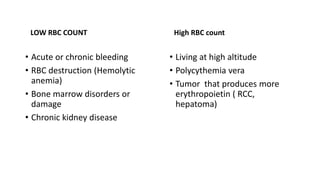
LOW RBC COUNT
• Acute or chronic bleeding
• RBC destruction (Hemolytic
anemia)
• Bone marrow disorders or
damage
• Chronic kidney disease
High RBC count
• Living at high altitude
• Polycythemia vera
• Tumor that produces more
erythropoietin ( RCC,
hepatoma)
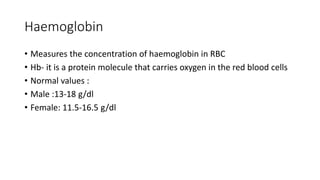
Haemoglobin
• Measures the concentration of haemoglobin in RBC
• Hb- it is a protein molecule that carries oxygen in the red blood cells
• Normal values :
• Male :13-18 g/dl
• Female: 11.5-16.5 g/dl
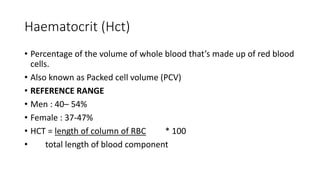
Haematocrit (Hct)
• Percentage of the volume of whole blood that’s made up of red blood
cells.
• Also known as Packed cell volume (PCV)
• REFERENCE RANGE
• Men : 40– 54%
• Female : 37-47%
• HCT = length of column of RBC * 100
• total length of blood component
Red blood cell indices
• MCV – denoted the size of RBCs
• MCH- mass of haemoglobin per RBC
• MCHC- concentration of haemoglobin in RBC
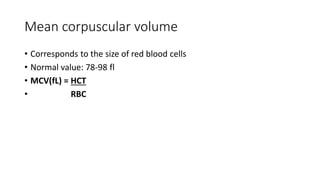
Mean corpuscular volume
• Corresponds to the size of red blood cells
• Normal value: 78-98 fl
• MCV(fL) = HCT
• RBC
LOW MCV(Microcytic)
• Iron deficiency anemia
• Thalassemias
• Lead poisoning
• Pyridoxine deficiency
• Anemia of chronic disease
HIGH MCV(Macrocytic)
• Vit B12 deficiency anemia
• Folate deficiency
• Intestinal malabsorption
syndrome
• Alcohol
Mean corpuscular haemoglobin
• Measures the mass of haemoglobin present in one RBC
• The weight of Hb is obtained dividing Hb by total blood count
• Reported in picogram.
• Reference range: 27-32 pg
• MCH = Hb
RBC
Mean corpuscular haemoglobin
concentration
• Measures the proportion of each cell taken up by haemoglobin
• It is the ratio of hemoglobin mass to the volume of red cells
• Haemoglobin divided by hematocrit and multiplied by 100
• Reference range : 33.4 – 35.5 g/dL
• MCHC(g/dL) : Hb(g/dl)
HCT
• MCHC is increased in spherocytosis .
• MCHC is decreased in iron deficiency anaemia and thalassemia .
Red cell distribution width (RDW)
• It measures variation in RBC size or RBC volume it is used in
conjunction with the MCV to determine if anaemia is due to mixed
cause as a single cause
• Reference range : 11.6 to 14.6 % adults
• Elevated RDW is seen in anisocytosis and poikilocytosis
• Normal RDW and normal MCV : acute blood loss, anaemia of renal
disease
•
• Normal RDW and low MCV: Beta thalassaemia trait
• Normal RDW and High MCV: aplastic anaemia
• High RDW and normal MCV :
• Early iron deficiency , vit b12 deficiency or folate deficiency
• Sickle cell disease
• Chronic liver disease
• High RDW and low MCV :
• Iron deficiency
• Sickle cell anaemia and beta thalassemia
• High RDW and High MCV :
• Vitamin b12 deficiency
• Myelodysplastic syndrome
Reticulocyte count
• It is the concentration of immature RBC in a volume of blood
• Reference range : 0.5% - 2.5% (25-85x 10^9/L)
• Reticulocyte count reflects RBC production
• High reticulocyte count:
• Haemolytic anaemia
• Following therapy in iron deficiency, B12 deficiency, folic acid
deficiency anaemia
• Low reticulocyte count
• Aplastic anaemia
• Pure red cell aphasia
• Aplastic crisis in parvo virus ( hereditary spherocytosis and sickle cell
disease )
WHITE BLOOD CELLS
• It is used to maintain a healthy state and to fight the infections or
other causes of injury
• White blood cell components
• Neutrophils
• Eosinophils
• Basophils
• Monocytes
• Lymphocytes
White blood cell count
• Reference range : 4-11 x 10^9/L
• Leucopenia : decreased WBC count
• Leucocytosis : increase WBC count
Low WBC count or leukopenia
• Radiation
• Cytotoxic drugs
• Hyper splenism
• Typhoid and paratyphoids
• Aplastic anaemia
• Megaloblastic anaemia
High WBC count or leukocytosis
• Bacterial, viral infections
• Leukemoid reaction
• Leukaemia
• Pregnancy
• Exercise
Differential leukocytic count
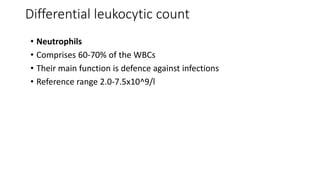
• Neutrophils
• Comprises 60-70% of the WBCs
• Their main function is defence against infections
• Reference range 2.0-7.5x10^9/l
LOW COUNT
Neutropenia
HIGH COUNT
Neutrophilia
Post chemotherapy , irradiation Acute bacterial infections
Autoimmune diseases like SLE
Acute Inflammation like acute appendicitis.
Protozoan infections like malaria , viral
infections like EBV, HIV .
Acute stress states like post surgery , post
haemorrhage
Drugs like chloramphenicol, cotrimoxizole ,
phenytoin , valproic acid
Corticosteroids
Differential leukocytic count
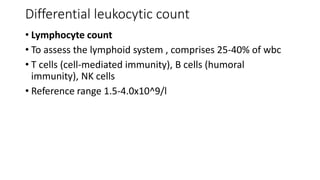
• Lymphocyte count
• To assess the lymphoid system , comprises 25-40% of wbc
• T cells (cell-mediated immunity), B cells (humoral
immunity), NK cells
• Reference range 1.5-4.0x10^9/l
LOW COUNT
Lymphocytopenia
HIGH COUNT
Lymphocytosis
Autoimmune disorders like rheumatoid arthritis,
SLE
Acute viral infections(chickenpox , CMV, EBV,
Herpes, rubella)
Corticosteroid, cytotoxic drugs, military TB . Chronic bacterial infections(pertussis, TB)
Bone marrow damage(chemotherapy ,radiation
therapy )
Chronic lymphocytic leukaemia, non Hodgkin’s
lymphoma
Differential leukocytic count
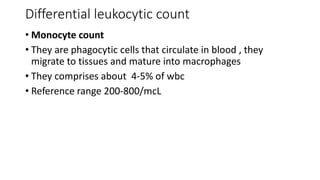
• Monocyte count
• They are phagocytic cells that circulate in blood , they
migrate to tissues and mature into macrophages
• They comprises about 4-5% of wbc
• Reference range 200-800/mcL
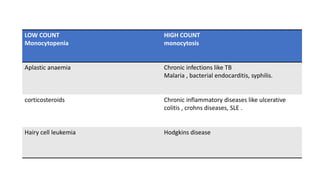
LOW COUNT
Monocytopenia
HIGH COUNT
monocytosis
Aplastic anaemia Chronic infections like TB
Malaria , bacterial endocarditis, syphilis.
corticosteroids Chronic inflammatory diseases like ulcerative
colitis , crohns diseases, SLE .
Hairy cell leukemia Hodgkins disease
Differential leukocytic count
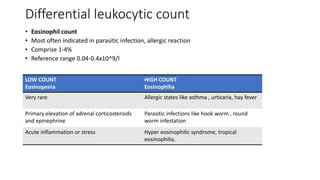
• Eosinophil count
• Most often indicated in parasitic infection, allergic reaction
• Comprise 1-4%
• Reference range 0.04-0.4x10^9/l
LOW COUNT
Eosinopenia
HIGH COUNT
Eosinophilia
Very rare Allergic states like asthma , urticaria, hay fever
Primary elevation of adrenal corticosteroids
and epinephrine
Parasitic infections like hook worm , round
worm infestation
Acute inflammation or stress Hyper eosinophilic syndrome, tropical
eosinophilia,
Differential leukocytic count
• Basophil count
• These involve mainly in immediate hypersensitivity reactions, release histamine and other
cytokines
• They comprise 0.3- 1% of wbc
• Reference range 0.01-0.1x10^9/l
LOW COUNT
Basopenia
HIGH COUNT
Basophilia
Very rare Food allergies
Chemotherapy, radiation Inflammations(rheumatoid arthritis,
ulcerative colitis)
Stress, prolonged corticosteroid therapy Ig E hypersensitivity
Platelet count
• Platelets play an important role in coagulation and thrombosis
• Low platelet count – increased risk of bleeding and bruising
• High platelet count – excessive clotting
• Reference range – 150-350x10^9/l
• Increased Platelet count = thrombocytopenia
• Decreased platelet count = thrombocytosis
Thrombocytopenia Thrombocytosis
Immunological- SLE , immune thrombocytopenic
purpura
Rheumatoid arthritis, IBD
Drugs (acetaminophen, quinidine) Iron deficiency anemia
Sequestration- Splenomegaly Hemolytic anemia
Decreased production- Leukemia, aplastic anaemia
.
Post surgery
Thank you !

Complete blood count copy.pptx

  • 1.
  • 2.
    Complete blood count •CBC is a test that counts the cells that make up your blood i. Red blood cells ii. White blood cells iii. Platelets • Uses: i. Detect any abnormalities in the blood parameters ii. Screening and Diagnosis of various disorders iii. Monitor the progress of treatment
  • 3.
    Components of CBC •RBC • Hemoglobin • Hematocrit • MCV • MCH • MCHC • RDW • Reticulocyte count • WBC • Neutrophils • Lymphocytes • Eosinophils • Monocytes • Basophils • Platelets
  • 5.
    Red blood cells •Measures the number of red blood cells • Decreased –anaemia • Increased – polycythemia • Normal Value: • Male – 4.5 to 6.5 x10^12/l • Females – 3.8-5.8x10^12/l
  • 6.
    LOW RBC COUNT •Acute or chronic bleeding • RBC destruction (Hemolytic anemia) • Bone marrow disorders or damage • Chronic kidney disease High RBC count • Living at high altitude • Polycythemia vera • Tumor that produces more erythropoietin ( RCC, hepatoma)
  • 7.
    Haemoglobin • Measures theconcentration of haemoglobin in RBC • Hb- it is a protein molecule that carries oxygen in the red blood cells • Normal values : • Male :13-18 g/dl • Female: 11.5-16.5 g/dl
  • 8.
    Haematocrit (Hct) • Percentageof the volume of whole blood that’s made up of red blood cells. • Also known as Packed cell volume (PCV) • REFERENCE RANGE • Men : 40– 54% • Female : 37-47% • HCT = length of column of RBC * 100 • total length of blood component
  • 10.
    Red blood cellindices • MCV – denoted the size of RBCs • MCH- mass of haemoglobin per RBC • MCHC- concentration of haemoglobin in RBC
  • 11.
    Mean corpuscular volume •Corresponds to the size of red blood cells • Normal value: 78-98 fl • MCV(fL) = HCT • RBC
  • 12.
    LOW MCV(Microcytic) • Irondeficiency anemia • Thalassemias • Lead poisoning • Pyridoxine deficiency • Anemia of chronic disease HIGH MCV(Macrocytic) • Vit B12 deficiency anemia • Folate deficiency • Intestinal malabsorption syndrome • Alcohol
  • 13.
    Mean corpuscular haemoglobin •Measures the mass of haemoglobin present in one RBC • The weight of Hb is obtained dividing Hb by total blood count • Reported in picogram. • Reference range: 27-32 pg • MCH = Hb RBC
  • 14.
    Mean corpuscular haemoglobin concentration •Measures the proportion of each cell taken up by haemoglobin • It is the ratio of hemoglobin mass to the volume of red cells • Haemoglobin divided by hematocrit and multiplied by 100 • Reference range : 33.4 – 35.5 g/dL • MCHC(g/dL) : Hb(g/dl) HCT • MCHC is increased in spherocytosis . • MCHC is decreased in iron deficiency anaemia and thalassemia .
  • 15.
    Red cell distributionwidth (RDW) • It measures variation in RBC size or RBC volume it is used in conjunction with the MCV to determine if anaemia is due to mixed cause as a single cause • Reference range : 11.6 to 14.6 % adults • Elevated RDW is seen in anisocytosis and poikilocytosis
  • 16.
    • Normal RDWand normal MCV : acute blood loss, anaemia of renal disease • • Normal RDW and low MCV: Beta thalassaemia trait • Normal RDW and High MCV: aplastic anaemia
  • 17.
    • High RDWand normal MCV : • Early iron deficiency , vit b12 deficiency or folate deficiency • Sickle cell disease • Chronic liver disease • High RDW and low MCV : • Iron deficiency • Sickle cell anaemia and beta thalassemia • High RDW and High MCV : • Vitamin b12 deficiency • Myelodysplastic syndrome
  • 18.
    Reticulocyte count • Itis the concentration of immature RBC in a volume of blood • Reference range : 0.5% - 2.5% (25-85x 10^9/L) • Reticulocyte count reflects RBC production
  • 19.
    • High reticulocytecount: • Haemolytic anaemia • Following therapy in iron deficiency, B12 deficiency, folic acid deficiency anaemia • Low reticulocyte count • Aplastic anaemia • Pure red cell aphasia • Aplastic crisis in parvo virus ( hereditary spherocytosis and sickle cell disease )
  • 20.
    WHITE BLOOD CELLS •It is used to maintain a healthy state and to fight the infections or other causes of injury • White blood cell components • Neutrophils • Eosinophils • Basophils • Monocytes • Lymphocytes
  • 21.
    White blood cellcount • Reference range : 4-11 x 10^9/L • Leucopenia : decreased WBC count • Leucocytosis : increase WBC count
  • 22.
    Low WBC countor leukopenia • Radiation • Cytotoxic drugs • Hyper splenism • Typhoid and paratyphoids • Aplastic anaemia • Megaloblastic anaemia High WBC count or leukocytosis • Bacterial, viral infections • Leukemoid reaction • Leukaemia • Pregnancy • Exercise
  • 23.
    Differential leukocytic count •Neutrophils • Comprises 60-70% of the WBCs • Their main function is defence against infections • Reference range 2.0-7.5x10^9/l
  • 24.
    LOW COUNT Neutropenia HIGH COUNT Neutrophilia Postchemotherapy , irradiation Acute bacterial infections Autoimmune diseases like SLE Acute Inflammation like acute appendicitis. Protozoan infections like malaria , viral infections like EBV, HIV . Acute stress states like post surgery , post haemorrhage Drugs like chloramphenicol, cotrimoxizole , phenytoin , valproic acid Corticosteroids
  • 25.
    Differential leukocytic count •Lymphocyte count • To assess the lymphoid system , comprises 25-40% of wbc • T cells (cell-mediated immunity), B cells (humoral immunity), NK cells • Reference range 1.5-4.0x10^9/l
  • 26.
    LOW COUNT Lymphocytopenia HIGH COUNT Lymphocytosis Autoimmunedisorders like rheumatoid arthritis, SLE Acute viral infections(chickenpox , CMV, EBV, Herpes, rubella) Corticosteroid, cytotoxic drugs, military TB . Chronic bacterial infections(pertussis, TB) Bone marrow damage(chemotherapy ,radiation therapy ) Chronic lymphocytic leukaemia, non Hodgkin’s lymphoma
  • 27.
    Differential leukocytic count •Monocyte count • They are phagocytic cells that circulate in blood , they migrate to tissues and mature into macrophages • They comprises about 4-5% of wbc • Reference range 200-800/mcL
  • 28.
    LOW COUNT Monocytopenia HIGH COUNT monocytosis Aplasticanaemia Chronic infections like TB Malaria , bacterial endocarditis, syphilis. corticosteroids Chronic inflammatory diseases like ulcerative colitis , crohns diseases, SLE . Hairy cell leukemia Hodgkins disease
  • 29.
    Differential leukocytic count •Eosinophil count • Most often indicated in parasitic infection, allergic reaction • Comprise 1-4% • Reference range 0.04-0.4x10^9/l LOW COUNT Eosinopenia HIGH COUNT Eosinophilia Very rare Allergic states like asthma , urticaria, hay fever Primary elevation of adrenal corticosteroids and epinephrine Parasitic infections like hook worm , round worm infestation Acute inflammation or stress Hyper eosinophilic syndrome, tropical eosinophilia,
  • 30.
    Differential leukocytic count •Basophil count • These involve mainly in immediate hypersensitivity reactions, release histamine and other cytokines • They comprise 0.3- 1% of wbc • Reference range 0.01-0.1x10^9/l LOW COUNT Basopenia HIGH COUNT Basophilia Very rare Food allergies Chemotherapy, radiation Inflammations(rheumatoid arthritis, ulcerative colitis) Stress, prolonged corticosteroid therapy Ig E hypersensitivity
  • 31.
    Platelet count • Plateletsplay an important role in coagulation and thrombosis • Low platelet count – increased risk of bleeding and bruising • High platelet count – excessive clotting • Reference range – 150-350x10^9/l • Increased Platelet count = thrombocytopenia • Decreased platelet count = thrombocytosis
  • 32.
    Thrombocytopenia Thrombocytosis Immunological- SLE, immune thrombocytopenic purpura Rheumatoid arthritis, IBD Drugs (acetaminophen, quinidine) Iron deficiency anemia Sequestration- Splenomegaly Hemolytic anemia Decreased production- Leukemia, aplastic anaemia . Post surgery
  • 33.