COMPLEMENT SYSTEM
COMPLEMENT SYSTEM
• Classical Pathway
• Alternative Pathway
• Lectin Pathway
NALI SOMASHEKAR SANTHOSH
COMPLEMENT
• Group of large thermolabile enzymatic proteins found in the serum and
body fluids
• It completes the antigen-antibody reaction, lysis and phagocytosis
• Represented as C
• Complement means helps
• Complement system formed about 30 different types of proteins(β –
globulins).Of these about 16 are biologically important.
FUNCTION
They act in the following ways:
 Complements kill opsonized pathogens.
 They include inflammatory responses.
 They enhance antibody response.
 They attack some pathogens directly.
BIOSYNTHESIS OF COMPLEMENTS
• Complement components are synthesized in various sites in the
body.
• Major site – Liver
• Minor site – Blood Monocytes, Tissue Macrophages, Epithelial Cell Of
GIT, Genito-urinary Tract
• C1 is synthesized in the intestinal epithelium.
• C2 and C4 are synthesized from macrophages.
• C3, C6 and C9 are synthesized in the liver.
• The site of synthesis of C7 is not known.
COMPLEMENT ACTIVATION
• Complement proteins inactive form blood plasma.
• Complement components activated by activating substances or
activating agents.
• antigen-antibody complexes, gram negative bacteria, animal
viruses, aggregated antibodies like IgG or IgA endotoxin, yeast , etc.
• One component is activated ,other components triggered in
sequence, in cascade pattern to bring biological activity lysis,
phagocytosis, etc.
When a component is activated,it acquires the following
unique properties:
• The activated complement binds on to the biological membrane such
as the membrane of a bacterium.
• It generates enzyme activity.
• It activates the next complement protein in order to participate in a
chain reaction.
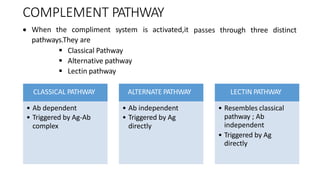
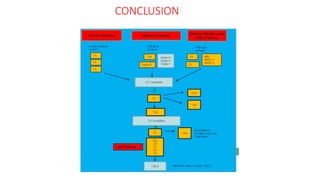
COMPLEMENT PATHWAY
CLASSICAL PATHWAY
• Ab dependent
• Triggered by Ag-Ab
complex
ALTERNATE PATHWAY
• Ab independent
• Triggered by Ag
directly
LECTIN PATHWAY
• Resembles classical
pathway ; Ab
independent
• Triggered by Ag
directly
passes through three distinct
 When the compliment system is activated,it
pathways.They are
 Classical Pathway
 Alternative pathway
 Lectin pathway
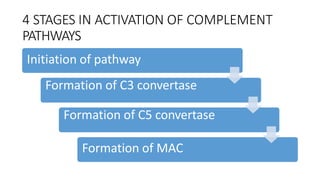
4 STAGES IN ACTIVATION OF COMPLEMENT
PATHWAYS
Initiation of pathway
Formation of C3 convertase
Formation of C5 convertase
Formation of MAC
CLASSICAL PATHWAY
• Simple stepwise immunological reaction of complements activated by
antigen-antibody complex.
• The 11 components react in the following sequence : C1q, C1r, C1s,
C4, C2, C3, C5, C6, C7, C8, C9
• Activated by antigen-antibody complex,produced in humoral immune
response.
• The antibody produced in response to a pathogen , binds to the
pathogen to form antigen-antibody complex.
• Antigen-antibody complex is recognized by C1 and it binds to the
complex.
• C1 activates C4 and C2 to form C3 convertase.
• C3 convertase activities C3 and other complements in a sequence to
form MACs (Membrane attack complex).
• The MACs are deposited on the pathogen and they make holes on the
pathogen.
• The holes make the lysis of the pathogen.
ALTERNATIVE PATHWAY
• Stepwise immunological reaction of complements activated by
properdin.
• Properdin (a normal serum protein) reacts with zymosan (a
polysaccharide from yeast cell wall) to form PZ complex.
• 6 complement components involved are C3,C5,C6,C7,C8 and C9.
• PZ complex cleaves the C3 into C3a and C3b.
• C3b is coated on the surface of microbe.
• The factor B binds with C3b to form C3bB complex and it is stabilized
and activated by the factors P and D to form C3 convertase.
• C3 convertase activates more C3 and other complements in a
sequence to form MACs (Membrane attack complex).
• The MACs are deposited on the pathogen and they make holes on the
pathogen.
• The holes make the lysis of the pathogen.
LECTIN PATHWAY
• Immunological reaction of complements activated by lectin
• 8 components involved C2,C4,C3,C5,C6,C7,C8,C9
• Lectin binds with mannose of pathogen
• This binding activates MASP-1 which activates MASP-2
• MASP-2 activates C4 and C2 to form C3 convertase
• C3 convertase activates C3 and other complements in a sequence to
form MAC
• MACs deposited on pathogen ; make holes lysis of pathogen
MAC
MEMBRANE ATTACK COMPLEX
• Complex of proteins; formed by the activation of complement system
• Deposited on the surface of pathogen to make holes
• holes lysis of pathogen
• End product of complement activation
• Effector protein of immune system
• Makes transmembrane channel on the plasma membrane of
pathogens
• Channels disrupt phospholipid bilayer of pathogen lysis
STRUCTURE
• Complex of 5 complement proteins
C5b, C6, C7, C8, C9
• C5b, C6, C7, C8 Bind outer surface of the plasma membrane
• C9 copies hook up together to form ring in the membrane
• Ring structure pores in the membrane
• Pores allows diffusion causing lysis
FUNCTION
• Cytolysin makes pores on pathogen
• Lysis of pathogen
FUNCTION
Opsonization • C3b & C1q; enhance phagocytosis
Chemotaxis • C5a and C5,6,7 complex ; attract neutrophils • C5a –
enhance adhesiveness of neutrophils to the endothelium
Anaphylatoxin (C3a, C4a, C5a) • Cause degranulation of mast cells •
Bind directly to smooth muscles of bronchioles ; bronchospasm
Opsonins are molecules that bind both to bacteria and phagocytes
Opsonization increases phagocytosis by 1,000 fold.
Disrupt the membrane & the entry of water and electrolytes into the
cell
Enhancement of antibody production • Binding of C3b to its
receptors on the surface of activated B cells ; enhanced antibody
production
CONCLUSION

Complement system.pptx

  • 1.
    COMPLEMENT SYSTEM COMPLEMENT SYSTEM •Classical Pathway • Alternative Pathway • Lectin Pathway NALI SOMASHEKAR SANTHOSH
  • 2.
    COMPLEMENT • Group oflarge thermolabile enzymatic proteins found in the serum and body fluids • It completes the antigen-antibody reaction, lysis and phagocytosis • Represented as C • Complement means helps • Complement system formed about 30 different types of proteins(β – globulins).Of these about 16 are biologically important.
  • 3.
    FUNCTION They act inthe following ways:  Complements kill opsonized pathogens.  They include inflammatory responses.  They enhance antibody response.  They attack some pathogens directly.
  • 4.
    BIOSYNTHESIS OF COMPLEMENTS •Complement components are synthesized in various sites in the body. • Major site – Liver • Minor site – Blood Monocytes, Tissue Macrophages, Epithelial Cell Of GIT, Genito-urinary Tract • C1 is synthesized in the intestinal epithelium. • C2 and C4 are synthesized from macrophages. • C3, C6 and C9 are synthesized in the liver. • The site of synthesis of C7 is not known.
  • 5.
    COMPLEMENT ACTIVATION • Complementproteins inactive form blood plasma. • Complement components activated by activating substances or activating agents. • antigen-antibody complexes, gram negative bacteria, animal viruses, aggregated antibodies like IgG or IgA endotoxin, yeast , etc. • One component is activated ,other components triggered in sequence, in cascade pattern to bring biological activity lysis, phagocytosis, etc.
  • 6.
    When a componentis activated,it acquires the following unique properties: • The activated complement binds on to the biological membrane such as the membrane of a bacterium. • It generates enzyme activity. • It activates the next complement protein in order to participate in a chain reaction.
  • 7.
    COMPLEMENT PATHWAY CLASSICAL PATHWAY •Ab dependent • Triggered by Ag-Ab complex ALTERNATE PATHWAY • Ab independent • Triggered by Ag directly LECTIN PATHWAY • Resembles classical pathway ; Ab independent • Triggered by Ag directly passes through three distinct  When the compliment system is activated,it pathways.They are  Classical Pathway  Alternative pathway  Lectin pathway
  • 8.
    4 STAGES INACTIVATION OF COMPLEMENT PATHWAYS Initiation of pathway Formation of C3 convertase Formation of C5 convertase Formation of MAC
  • 9.
    CLASSICAL PATHWAY • Simplestepwise immunological reaction of complements activated by antigen-antibody complex. • The 11 components react in the following sequence : C1q, C1r, C1s, C4, C2, C3, C5, C6, C7, C8, C9 • Activated by antigen-antibody complex,produced in humoral immune response. • The antibody produced in response to a pathogen , binds to the pathogen to form antigen-antibody complex.
  • 10.
    • Antigen-antibody complexis recognized by C1 and it binds to the complex. • C1 activates C4 and C2 to form C3 convertase. • C3 convertase activities C3 and other complements in a sequence to form MACs (Membrane attack complex). • The MACs are deposited on the pathogen and they make holes on the pathogen. • The holes make the lysis of the pathogen.
  • 11.
    ALTERNATIVE PATHWAY • Stepwiseimmunological reaction of complements activated by properdin. • Properdin (a normal serum protein) reacts with zymosan (a polysaccharide from yeast cell wall) to form PZ complex. • 6 complement components involved are C3,C5,C6,C7,C8 and C9. • PZ complex cleaves the C3 into C3a and C3b. • C3b is coated on the surface of microbe.
  • 12.
    • The factorB binds with C3b to form C3bB complex and it is stabilized and activated by the factors P and D to form C3 convertase. • C3 convertase activates more C3 and other complements in a sequence to form MACs (Membrane attack complex). • The MACs are deposited on the pathogen and they make holes on the pathogen. • The holes make the lysis of the pathogen.
  • 13.
    LECTIN PATHWAY • Immunologicalreaction of complements activated by lectin • 8 components involved C2,C4,C3,C5,C6,C7,C8,C9 • Lectin binds with mannose of pathogen • This binding activates MASP-1 which activates MASP-2 • MASP-2 activates C4 and C2 to form C3 convertase • C3 convertase activates C3 and other complements in a sequence to form MAC • MACs deposited on pathogen ; make holes lysis of pathogen
  • 14.
    MAC MEMBRANE ATTACK COMPLEX •Complex of proteins; formed by the activation of complement system • Deposited on the surface of pathogen to make holes • holes lysis of pathogen • End product of complement activation • Effector protein of immune system • Makes transmembrane channel on the plasma membrane of pathogens • Channels disrupt phospholipid bilayer of pathogen lysis
  • 15.
    STRUCTURE • Complex of5 complement proteins C5b, C6, C7, C8, C9 • C5b, C6, C7, C8 Bind outer surface of the plasma membrane • C9 copies hook up together to form ring in the membrane • Ring structure pores in the membrane • Pores allows diffusion causing lysis FUNCTION • Cytolysin makes pores on pathogen • Lysis of pathogen
  • 16.
    FUNCTION Opsonization • C3b& C1q; enhance phagocytosis Chemotaxis • C5a and C5,6,7 complex ; attract neutrophils • C5a – enhance adhesiveness of neutrophils to the endothelium Anaphylatoxin (C3a, C4a, C5a) • Cause degranulation of mast cells • Bind directly to smooth muscles of bronchioles ; bronchospasm Opsonins are molecules that bind both to bacteria and phagocytes Opsonization increases phagocytosis by 1,000 fold. Disrupt the membrane & the entry of water and electrolytes into the cell Enhancement of antibody production • Binding of C3b to its receptors on the surface of activated B cells ; enhanced antibody production
  • 17.