Lexical Analysis
By: Ayesha Tariq
📧:ayshatariq742@gmail.com
The Role of Lexical Analyzer
• The lexical analyzer is the first phase of a compiler. The
main task of lexical Analyzer(Scanner) is to read a stream
of characters as an input and produce a sequence of
tokens that the parser(Syntax Analyzer) uses for syntax
analysis.
The Role of Lexical Analyzer
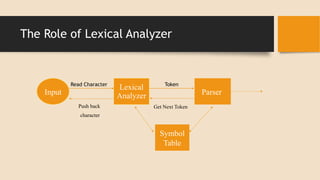
Input
Lexical
Analyzer
Read Character Token
Parser
Push back
character
Get Next Token
Symbol
Table
The Role of Lexical Analyzer
• A lexical analyzer must read ahead after it sees the
character >.If the next character is = ,then the character
sequence >= is the lexeme forming the token for the
“Greater than or equal to ” operator. Other wise > is the
lexeme forming “Greater than ” operator ,and the
lexical analyzer has read one character too many.
The Role of Lexical Analyzer
• The extra character has to be pushed back on to the
input, because it can be the beginning of the next
lexeme in the input. The lexical analyzer and parser
form a producer-Consumer pair. The lexical analyzer
produces tokens and the parser consumes them.
Produced tokens can be held in a token buffer until they
are consumed.
The Role of Lexical Analyzer
• The interaction b/w the two is constrained only by the
size of the buffer, because the lexical analyzer can not
proceed when the buffer is full and the parser can not
proceed when the buffer is empty. Commonly ,the buffer
holds just one token.
The Role of Lexical Analyzer
• Some times lexical analyzer are divided into two phases,
the first is called Scanning and the second is called
Lexical Analysis. The scanning is responsible for doing
simple tasks ,while the lexical analyzer does the more
complex operations.
Why we separate lexical analysis and parsing?
• Simplicity of design
• Compiler efficiency is improved
• Enhanced Compiler portability
Tokens
• The output of our lexical analysis phase is a streams of tokens.
• A token is a syntactic category.
• In English this would be types of words or punctuation, such as a
“noun”, “verb”, “adjective” or “end-mark”.
• In a program, this could be an “identifier”, a “floating-point
number”, a “math symbol”, a “keyword”, etc.…
Identifying Tokens
• A sub-string that represents an instance of a token is called a
lexeme.
• The class of all possible lexemes in a token is described by the use
of a pattern.
• For example, the pattern to describe an identifier (a variable) is a
string of letters, numbers, or underscores, beginning with a non-
number.
• Patterns are typically described using regular expressions.
Implementation
A lexical analyzer must be able to do three things:
1. Remove all whitespace and comments.
2. Identify tokens within a string.
3. Return the lexeme of a found token, as well as the line
number it was found on.
What exactly is lexing?
Consider the code:
if (i==j);
z=1;
else;
z=0;
endif;
Example
Line Token Lexeme
1 BLOCK_COMMAND if
1 OPEN_PAREN (
1 ID i
1 OP_RELATION ==
1 ID j1
2 CLOSE_PAREN )
1 ENDLINE ;
2 ID z
2 ASSIGN =
2 NUMBER 1
2 ENDLINE ;
3 BLOCK_COMMAND else
• Etc.…
if_(i==j);ntz=1;nelse;n
t z=0;nendif;
Look ahead
• Look ahead will typically be important to a lexical analyzer.
• Tokens are typically read in from left-to-right, recognized one at a
time from the input string.
• It is not always possible to instantly decide if a token is finished
without looking ahead at the next character. For example…
• Is “i” a variable, or the first character of “if”?
• Is “=” an assignment or the beginning of “==”?
Example of Token
As an example, consider the following line of code, which could be
part of a “ C ” program.
a [index] = 4 + 2
Example
a ID
[ Left bracket
index ID
] Right bracket
= Assign
4 Num
+ plus sign
2 Num

Compiler Construction ( lexical analyzer).pptx

  • 1.
    Lexical Analysis By: AyeshaTariq 📧:ayshatariq742@gmail.com
  • 2.
    The Role ofLexical Analyzer • The lexical analyzer is the first phase of a compiler. The main task of lexical Analyzer(Scanner) is to read a stream of characters as an input and produce a sequence of tokens that the parser(Syntax Analyzer) uses for syntax analysis.
  • 3.
    The Role ofLexical Analyzer Input Lexical Analyzer Read Character Token Parser Push back character Get Next Token Symbol Table
  • 4.
    The Role ofLexical Analyzer • A lexical analyzer must read ahead after it sees the character >.If the next character is = ,then the character sequence >= is the lexeme forming the token for the “Greater than or equal to ” operator. Other wise > is the lexeme forming “Greater than ” operator ,and the lexical analyzer has read one character too many.
  • 5.
    The Role ofLexical Analyzer • The extra character has to be pushed back on to the input, because it can be the beginning of the next lexeme in the input. The lexical analyzer and parser form a producer-Consumer pair. The lexical analyzer produces tokens and the parser consumes them. Produced tokens can be held in a token buffer until they are consumed.
  • 6.
    The Role ofLexical Analyzer • The interaction b/w the two is constrained only by the size of the buffer, because the lexical analyzer can not proceed when the buffer is full and the parser can not proceed when the buffer is empty. Commonly ,the buffer holds just one token.
  • 7.
    The Role ofLexical Analyzer • Some times lexical analyzer are divided into two phases, the first is called Scanning and the second is called Lexical Analysis. The scanning is responsible for doing simple tasks ,while the lexical analyzer does the more complex operations.
  • 8.
    Why we separatelexical analysis and parsing? • Simplicity of design • Compiler efficiency is improved • Enhanced Compiler portability
  • 9.
    Tokens • The outputof our lexical analysis phase is a streams of tokens. • A token is a syntactic category. • In English this would be types of words or punctuation, such as a “noun”, “verb”, “adjective” or “end-mark”. • In a program, this could be an “identifier”, a “floating-point number”, a “math symbol”, a “keyword”, etc.…
  • 10.
    Identifying Tokens • Asub-string that represents an instance of a token is called a lexeme. • The class of all possible lexemes in a token is described by the use of a pattern. • For example, the pattern to describe an identifier (a variable) is a string of letters, numbers, or underscores, beginning with a non- number. • Patterns are typically described using regular expressions.
  • 11.
    Implementation A lexical analyzermust be able to do three things: 1. Remove all whitespace and comments. 2. Identify tokens within a string. 3. Return the lexeme of a found token, as well as the line number it was found on.
  • 12.
    What exactly islexing? Consider the code: if (i==j); z=1; else; z=0; endif;
  • 13.
    Example Line Token Lexeme 1BLOCK_COMMAND if 1 OPEN_PAREN ( 1 ID i 1 OP_RELATION == 1 ID j1 2 CLOSE_PAREN ) 1 ENDLINE ; 2 ID z 2 ASSIGN = 2 NUMBER 1 2 ENDLINE ; 3 BLOCK_COMMAND else • Etc.… if_(i==j);ntz=1;nelse;n t z=0;nendif;
  • 14.
    Look ahead • Lookahead will typically be important to a lexical analyzer. • Tokens are typically read in from left-to-right, recognized one at a time from the input string. • It is not always possible to instantly decide if a token is finished without looking ahead at the next character. For example… • Is “i” a variable, or the first character of “if”? • Is “=” an assignment or the beginning of “==”?
  • 15.
    Example of Token Asan example, consider the following line of code, which could be part of a “ C ” program. a [index] = 4 + 2
  • 16.
    Example a ID [ Leftbracket index ID ] Right bracket = Assign 4 Num + plus sign 2 Num