Chapter 7
Strategy Formulation:
Functional Strategy and
Strategy Choice
Learning Objectives
7-1 Discuss the impact that the various types of functional strategies
have on the achievement of organizational goals and objectives
7-2 Explain which activities and functions are appropriate to
outsource/offshore in order to gain or strengthen competitive
advantage
7-3 List and explain the strategies to avoid
7-4 Construct corporate scenarios to evaluate
strategic options
Functional Strategy
• Functional strategy
– the approach a functional area takes to achieve corporate and
business unit objectives and strategies by maximizing resource
productivity
Marketing Strategy
• Marketing strategy
– deals with pricing, selling, and distributing a product
Marketing Strategy
• Market development strategy
– a company or business unit can:
 capture a larger share of an existing market for current products through market
saturation and market penetration
 develop new uses and/or markets for current products
Marketing Strategy
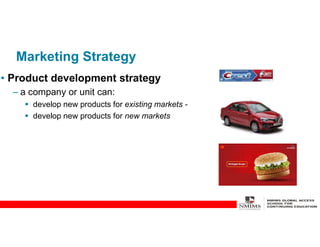
• Product development strategy
– a company or unit can:
 develop new products for existing markets -
 develop new products for new markets
Marketing Strategy
• Brand extension
– using a successful brand name to market other products
• Push strategy
– spending a large amount of money on trade promotion in order to gain
or hold shelf space in retail outlets
• Pull strategy
– advertising to “pull” products through the distribution channels
Marketing Strategy
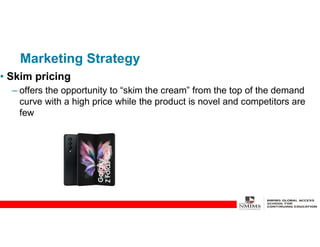
• Skim pricing
– offers the opportunity to “skim the cream” from the top of the demand
curve with a high price while the product is novel and competitors are
few
Marketing Strategy
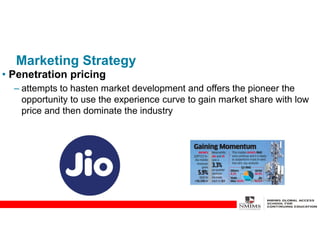
• Penetration pricing
– attempts to hasten market development and offers the pioneer the
opportunity to use the experience curve to gain market share with low
price and then dominate the industry
Financial Strategy
• Financial strategy
– examines the financial implications of corporate and business-level
strategic options and identifies the best financial course of action
• The management of dividends and stock price is an important part of
a corporation’s financial strategy.
Financial Strategy
• Leveraged buyout
– company is acquired in a transaction financed largely by debt usually
obtained from a third party
• Reverse stock split
– investor’s shares are split in half for the same total amount of money
Research and Development Strategy
• Research and development (R&D) strategy
– deals with product and process innovation and improvement
– also deals with the appropriate mix of different types of R&D and
question of how new technology should be accessed
Research and Development Strategy
• Technological leader
– pioneering an innovation
• Technological follower
– imitating the products of competitors
• Open innovation
– firm uses alliances and connections with corporate, government,
academic labs, and consumers to develop new products and
processes
Operations Strategy
• Operations strategy
– determines how and where a product or service is to be
manufactured, the level of vertical integration in the production
process, the deployment of physical resources, and relationships
with suppliers
Purchasing Strategy
• Purchasing strategy
– deals with obtaining raw materials, parts and supplies needed to
perform the operations function
– multiple, sole, and parallel sourcing
Purchasing Strategy
• Multiple sourcing
– the purchasing company orders a particular part from several
vendors
• Sole sourcing
– relies on only one supplier for a particular part
• Parallel sourcing
– two suppliers are the sole suppliers of two different parts, but they
are also backup suppliers for each other’s parts
Logistics Strategy
• Logistics strategy
– deals with the flow of products into and out of the manufacturing
process
• Trends include:
– centralization
– outsourcing
– Internet
Human Resource Management (HRM) Strategy
• HRM strategy
– addresses the issue of whether a company or business unit should
hire a large number of low-skilled employees who receive low pay,
perform repetitive jobs, and will most likely quit after a short time
(the fast-food restaurant strategy) or hire skilled employees who
receive relatively high pay and are cross-trained to participate in
self-managing work teams
Information Technology Strategy
• Follow-the-sun management
– project team members living in one country can pass their work to
team members in another country in which the work day is just
beginning
The Sourcing Decision: Location of Functions
• Outsourcing
– purchasing from someone else a product or service that had been
previously provided internally
– the reverse of vertical integration
• Offshoring
– the outsourcing of an activity or a function to a wholly owned company
or an independent provider in another country
Disadvantages of Outsourcing
• Customer complaints
• Locked into long-term contracts
• Lack of ability to learn new skills and develop new core competencies
• Lack of cost savings
• Poor product quality
Seven Errors in Outsourcing to Avoid
1. Outsourcing the wrong activities
2. Selecting the wrong vendor
3. Writing poor contracts
4. Overlooking personnel issues
5. Lack of control
6. Overlooking hidden costs
7. Lack of an exit strategy
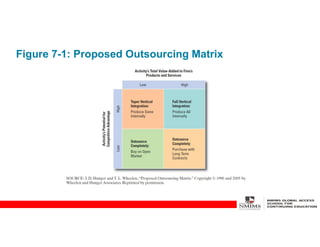
Figure 7-1: Proposed Outsourcing Matrix
Strategies to Avoid
• Follow the leader
• Hit another home run
• Arms race
• Do everything
• Losing hand
Constructing Corporate Scenarios
• Corporate scenarios
– pro forma (estimated future) balance sheets and income statements
that forecast the effect each alternative strategy and its various
programs will likely have on division and corporate return on
investment
Corporate Scenario Steps
1. Use industry scenarios to develop assumptions about the task
environment.
2. Develop common size financial statements for prior years.
3. Construct detailed pro forma financial statements for each
strategic alternative.
Management’s Attitude Toward Risk
• Risk
– composed not only of the probability that the strategy will be
effective but also of the amount of assets the corporation must
allocate to that strategy and the length of time the assets will be
unavailable for other uses
Management’s Attitude Toward Risk
• Real-options approach
– when the future is highly uncertain, it pays to have a broad range of
options open
• Net present value (NPV)
– calculates the value of a project by predicting its payouts, adjusting
them for risk, and subtracting the amount invested
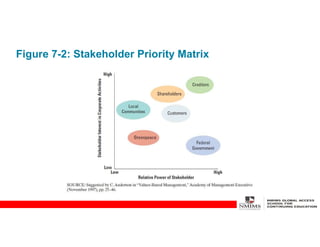
Figure 7-2: Stakeholder Priority Matrix
Questions to Assess Stakeholder Concerns
1. How will this decision affect each stakeholder?
2. How much of what stakeholders want are they likely to get under
the alternative?
3. What are the stakeholders likely to do if they don’t get what they
want?
4. What is the probability that they will do it?
Pressures from Stakeholders
• Political strategy
– plan to bring stakeholders into agreement with a corporation’s
actions
– constituency building, political action committee contributions,
advocacy advertising, lobbying, and coalition building
Pressures from the Corporate Culture
If there is little fit, management must decide if it should:
• Take a chance on ignoring the culture.
• Manage around the culture and change the implementation plan.
• Try to change the culture to fit the strategy.
• Change the strategy to fit the culture.
Process of Strategic Choice
• Strategic choice
– the evaluation of alternative strategies and selection of the best
alternative
• Failure almost always stems from the actions of the decision maker, not
from bad luck or situational limitations.
Process of Strategic Choice
Four criteria for evaluating alternatives:
1. Mutual exclusivity
2. Success
3. Completeness
4. Internal consistency
Avoiding the Consensus Trap
• Devil’s advocate
– assigned to identify potential pitfalls and problems with a proposed
alternative strategy in a formal presentation
– may be an individual or a group
• Dialectical inquiry
– requires that two proposals using different assumptions be
generated for each alternative strategy under consideration
Using Policies to Guide Strategic Choices
When crafted correctly, an effective policy accomplishes three
things:
1. It forces trade-offs between competing resource demands.
2. It tests the strategic soundness of a particular action.
3. It sets clear boundaries within which employees must operate
while granting them the freedom to experiment within those
constraints.
11. Strategy Formulation- Functional Strategy And Strategic Choice.pdf

  • 1.
    Chapter 7 Strategy Formulation: FunctionalStrategy and Strategy Choice
  • 2.
    Learning Objectives 7-1 Discussthe impact that the various types of functional strategies have on the achievement of organizational goals and objectives 7-2 Explain which activities and functions are appropriate to outsource/offshore in order to gain or strengthen competitive advantage 7-3 List and explain the strategies to avoid 7-4 Construct corporate scenarios to evaluate strategic options
  • 3.
    Functional Strategy • Functionalstrategy – the approach a functional area takes to achieve corporate and business unit objectives and strategies by maximizing resource productivity
  • 4.
    Marketing Strategy • Marketingstrategy – deals with pricing, selling, and distributing a product
  • 5.
    Marketing Strategy • Marketdevelopment strategy – a company or business unit can:  capture a larger share of an existing market for current products through market saturation and market penetration  develop new uses and/or markets for current products
  • 6.
    Marketing Strategy • Productdevelopment strategy – a company or unit can:  develop new products for existing markets -  develop new products for new markets
  • 7.
    Marketing Strategy • Brandextension – using a successful brand name to market other products • Push strategy – spending a large amount of money on trade promotion in order to gain or hold shelf space in retail outlets • Pull strategy – advertising to “pull” products through the distribution channels
  • 8.
    Marketing Strategy • Skimpricing – offers the opportunity to “skim the cream” from the top of the demand curve with a high price while the product is novel and competitors are few
  • 9.
    Marketing Strategy • Penetrationpricing – attempts to hasten market development and offers the pioneer the opportunity to use the experience curve to gain market share with low price and then dominate the industry
  • 10.
    Financial Strategy • Financialstrategy – examines the financial implications of corporate and business-level strategic options and identifies the best financial course of action • The management of dividends and stock price is an important part of a corporation’s financial strategy.
  • 11.
    Financial Strategy • Leveragedbuyout – company is acquired in a transaction financed largely by debt usually obtained from a third party • Reverse stock split – investor’s shares are split in half for the same total amount of money
  • 12.
    Research and DevelopmentStrategy • Research and development (R&D) strategy – deals with product and process innovation and improvement – also deals with the appropriate mix of different types of R&D and question of how new technology should be accessed
  • 13.
    Research and DevelopmentStrategy • Technological leader – pioneering an innovation • Technological follower – imitating the products of competitors • Open innovation – firm uses alliances and connections with corporate, government, academic labs, and consumers to develop new products and processes
  • 14.
    Operations Strategy • Operationsstrategy – determines how and where a product or service is to be manufactured, the level of vertical integration in the production process, the deployment of physical resources, and relationships with suppliers
  • 15.
    Purchasing Strategy • Purchasingstrategy – deals with obtaining raw materials, parts and supplies needed to perform the operations function – multiple, sole, and parallel sourcing
  • 16.
    Purchasing Strategy • Multiplesourcing – the purchasing company orders a particular part from several vendors • Sole sourcing – relies on only one supplier for a particular part • Parallel sourcing – two suppliers are the sole suppliers of two different parts, but they are also backup suppliers for each other’s parts
  • 17.
    Logistics Strategy • Logisticsstrategy – deals with the flow of products into and out of the manufacturing process • Trends include: – centralization – outsourcing – Internet
  • 18.
    Human Resource Management(HRM) Strategy • HRM strategy – addresses the issue of whether a company or business unit should hire a large number of low-skilled employees who receive low pay, perform repetitive jobs, and will most likely quit after a short time (the fast-food restaurant strategy) or hire skilled employees who receive relatively high pay and are cross-trained to participate in self-managing work teams
  • 19.
    Information Technology Strategy •Follow-the-sun management – project team members living in one country can pass their work to team members in another country in which the work day is just beginning
  • 20.
    The Sourcing Decision:Location of Functions • Outsourcing – purchasing from someone else a product or service that had been previously provided internally – the reverse of vertical integration • Offshoring – the outsourcing of an activity or a function to a wholly owned company or an independent provider in another country
  • 21.
    Disadvantages of Outsourcing •Customer complaints • Locked into long-term contracts • Lack of ability to learn new skills and develop new core competencies • Lack of cost savings • Poor product quality
  • 22.
    Seven Errors inOutsourcing to Avoid 1. Outsourcing the wrong activities 2. Selecting the wrong vendor 3. Writing poor contracts 4. Overlooking personnel issues 5. Lack of control 6. Overlooking hidden costs 7. Lack of an exit strategy
  • 23.
    Figure 7-1: ProposedOutsourcing Matrix
  • 24.
    Strategies to Avoid •Follow the leader • Hit another home run • Arms race • Do everything • Losing hand
  • 25.
    Constructing Corporate Scenarios •Corporate scenarios – pro forma (estimated future) balance sheets and income statements that forecast the effect each alternative strategy and its various programs will likely have on division and corporate return on investment
  • 26.
    Corporate Scenario Steps 1.Use industry scenarios to develop assumptions about the task environment. 2. Develop common size financial statements for prior years. 3. Construct detailed pro forma financial statements for each strategic alternative.
  • 27.
    Management’s Attitude TowardRisk • Risk – composed not only of the probability that the strategy will be effective but also of the amount of assets the corporation must allocate to that strategy and the length of time the assets will be unavailable for other uses
  • 28.
    Management’s Attitude TowardRisk • Real-options approach – when the future is highly uncertain, it pays to have a broad range of options open • Net present value (NPV) – calculates the value of a project by predicting its payouts, adjusting them for risk, and subtracting the amount invested
  • 29.
    Figure 7-2: StakeholderPriority Matrix
  • 30.
    Questions to AssessStakeholder Concerns 1. How will this decision affect each stakeholder? 2. How much of what stakeholders want are they likely to get under the alternative? 3. What are the stakeholders likely to do if they don’t get what they want? 4. What is the probability that they will do it?
  • 31.
    Pressures from Stakeholders •Political strategy – plan to bring stakeholders into agreement with a corporation’s actions – constituency building, political action committee contributions, advocacy advertising, lobbying, and coalition building
  • 32.
    Pressures from theCorporate Culture If there is little fit, management must decide if it should: • Take a chance on ignoring the culture. • Manage around the culture and change the implementation plan. • Try to change the culture to fit the strategy. • Change the strategy to fit the culture.
  • 33.
    Process of StrategicChoice • Strategic choice – the evaluation of alternative strategies and selection of the best alternative • Failure almost always stems from the actions of the decision maker, not from bad luck or situational limitations.
  • 34.
    Process of StrategicChoice Four criteria for evaluating alternatives: 1. Mutual exclusivity 2. Success 3. Completeness 4. Internal consistency
  • 35.
    Avoiding the ConsensusTrap • Devil’s advocate – assigned to identify potential pitfalls and problems with a proposed alternative strategy in a formal presentation – may be an individual or a group • Dialectical inquiry – requires that two proposals using different assumptions be generated for each alternative strategy under consideration
  • 36.
    Using Policies toGuide Strategic Choices When crafted correctly, an effective policy accomplishes three things: 1. It forces trade-offs between competing resource demands. 2. It tests the strategic soundness of a particular action. 3. It sets clear boundaries within which employees must operate while granting them the freedom to experiment within those constraints.