Comparative History Part2
The Great Depression (GD)
          Mark Brandon
  History 141 Fall 2011 Internet
           Dr. Arguello
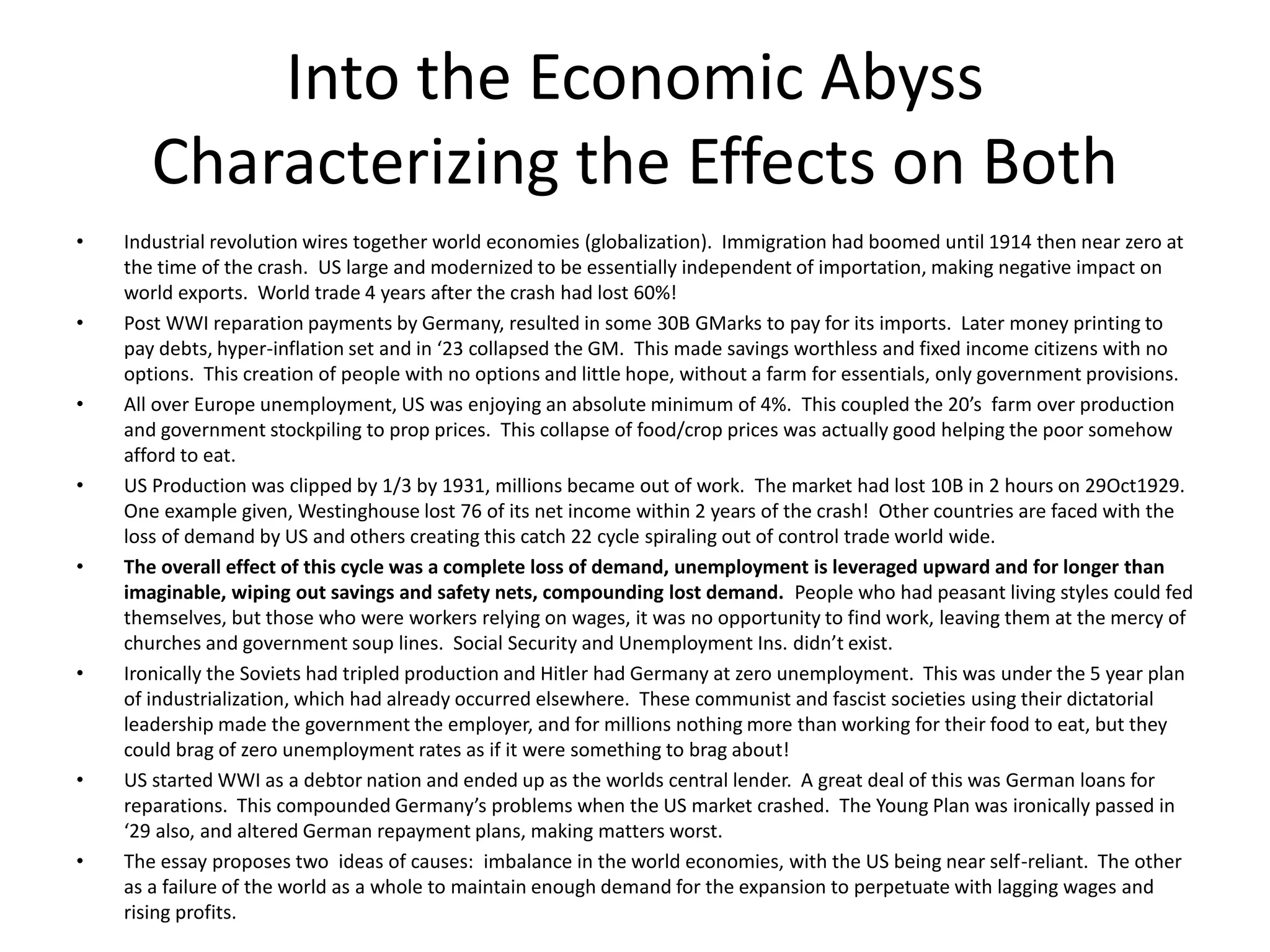
Into the Economic Abyss
       Characterizing the Effects on Both
•   Industrial revolution wires together world economies (globalization). Immigration had boomed until 1914 then near zero at
    the time of the crash. US large and modernized to be essentially independent of importation, making negative impact on
    world exports. World trade 4 years after the crash had lost 60%!
•   Post WWI reparation payments by Germany, resulted in some 30B GMarks to pay for its imports. Later money printing to
    pay debts, hyper-inflation set and in ‘23 collapsed the GM. This made savings worthless and fixed income citizens with no
    options. This creation of people with no options and little hope, without a farm for essentials, only government provisions.
•   All over Europe unemployment, US was enjoying an absolute minimum of 4%. This coupled the 20’s farm over production
    and government stockpiling to prop prices. This collapse of food/crop prices was actually good helping the poor somehow
    afford to eat.
•   US Production was clipped by 1/3 by 1931, millions became out of work. The market had lost 10B in 2 hours on 29Oct1929.
    One example given, Westinghouse lost 76 of its net income within 2 years of the crash! Other countries are faced with the
    loss of demand by US and others creating this catch 22 cycle spiraling out of control trade world wide.
•   The overall effect of this cycle was a complete loss of demand, unemployment is leveraged upward and for longer than
    imaginable, wiping out savings and safety nets, compounding lost demand. People who had peasant living styles could fed
    themselves, but those who were workers relying on wages, it was no opportunity to find work, leaving them at the mercy of
    churches and government soup lines. Social Security and Unemployment Ins. didn’t exist.
•   Ironically the Soviets had tripled production and Hitler had Germany at zero unemployment. This was under the 5 year plan
    of industrialization, which had already occurred elsewhere. These communist and fascist societies using their dictatorial
    leadership made the government the employer, and for millions nothing more than working for their food to eat, but they
    could brag of zero unemployment rates as if it were something to brag about!
•   US started WWI as a debtor nation and ended up as the worlds central lender. A great deal of this was German loans for
    reparations. This compounded Germany’s problems when the US market crashed. The Young Plan was ironically passed in
    ‘29 also, and altered German repayment plans, making matters worst.
•   The essay proposes two ideas of causes: imbalance in the world economies, with the US being near self-reliant. The other
    as a failure of the world as a whole to maintain enough demand for the expansion to perpetuate with lagging wages and
    rising profits.
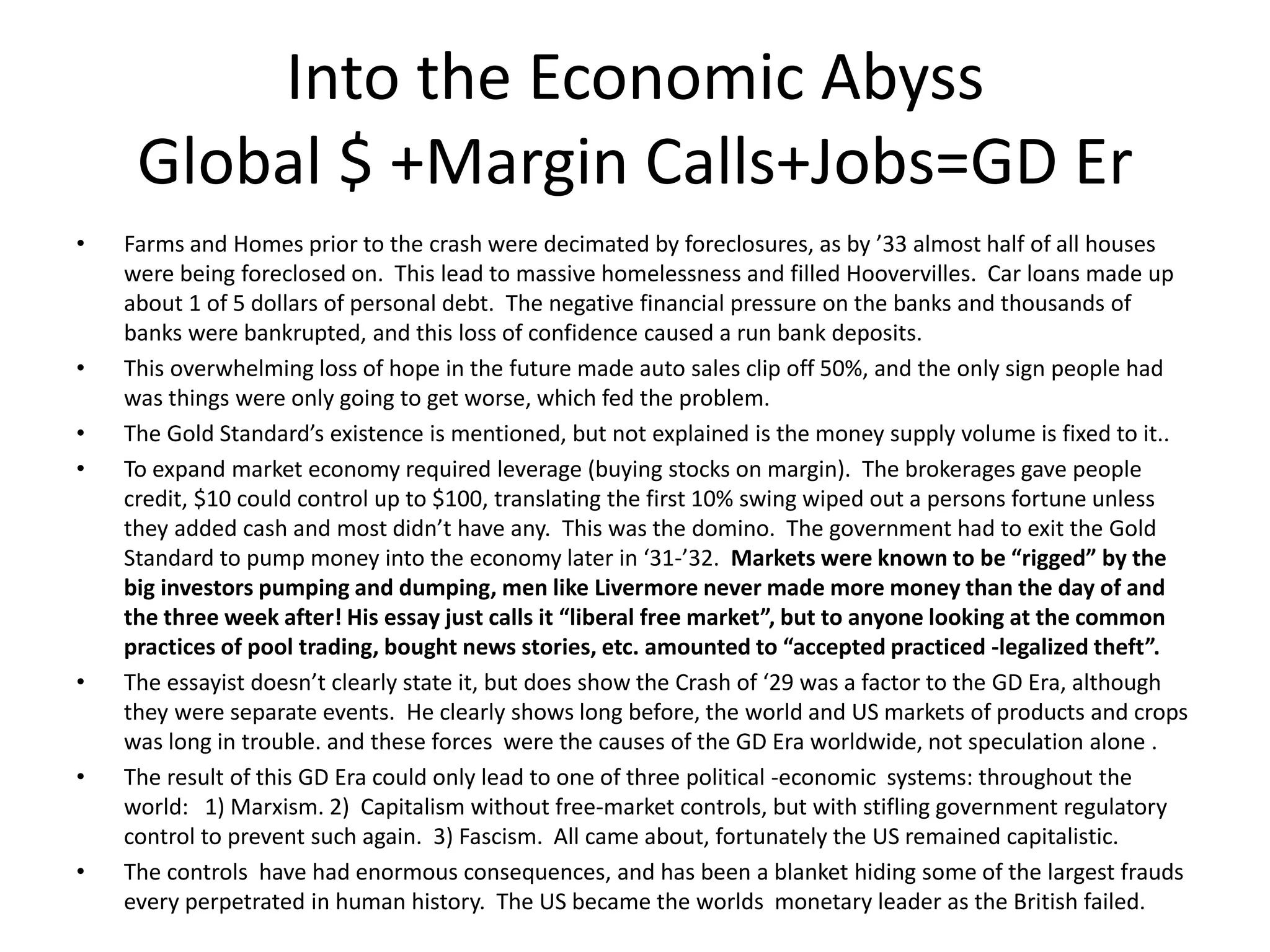
Into the Economic Abyss
     Global $ +Margin Calls+Jobs=GD Er
•   Farms and Homes prior to the crash were decimated by foreclosures, as by ’33 almost half of all houses
    were being foreclosed on. This lead to massive homelessness and filled Hoovervilles. Car loans made up
    about 1 of 5 dollars of personal debt. The negative financial pressure on the banks and thousands of
    banks were bankrupted, and this loss of confidence caused a run bank deposits.
•   This overwhelming loss of hope in the future made auto sales clip off 50%, and the only sign people had
    was things were only going to get worse, which fed the problem.
•   The Gold Standard’s existence is mentioned, but not explained is the money supply volume is fixed to it..
•   To expand market economy required leverage (buying stocks on margin). The brokerages gave people
    credit, $10 could control up to $100, translating the first 10% swing wiped out a persons fortune unless
    they added cash and most didn’t have any. This was the domino. The government had to exit the Gold
    Standard to pump money into the economy later in ‘31-’32. Markets were known to be “rigged” by the
    big investors pumping and dumping, men like Livermore never made more money than the day of and
    the three week after! His essay just calls it “liberal free market”, but to anyone looking at the common
    practices of pool trading, bought news stories, etc. amounted to “accepted practiced -legalized theft”.
•   The essayist doesn’t clearly state it, but does show the Crash of ‘29 was a factor to the GD Era, although
    they were separate events. He clearly shows long before, the world and US markets of products and crops
    was long in trouble. and these forces were the causes of the GD Era worldwide, not speculation alone .
•   The result of this GD Era could only lead to one of three political -economic systems: throughout the
    world: 1) Marxism. 2) Capitalism without free-market controls, but with stifling government regulatory
    control to prevent such again. 3) Fascism. All came about, fortunately the US remained capitalistic.
•   The controls have had enormous consequences, and has been a blanket hiding some of the largest frauds
    every perpetrated in human history. The US became the worlds monetary leader as the British failed.
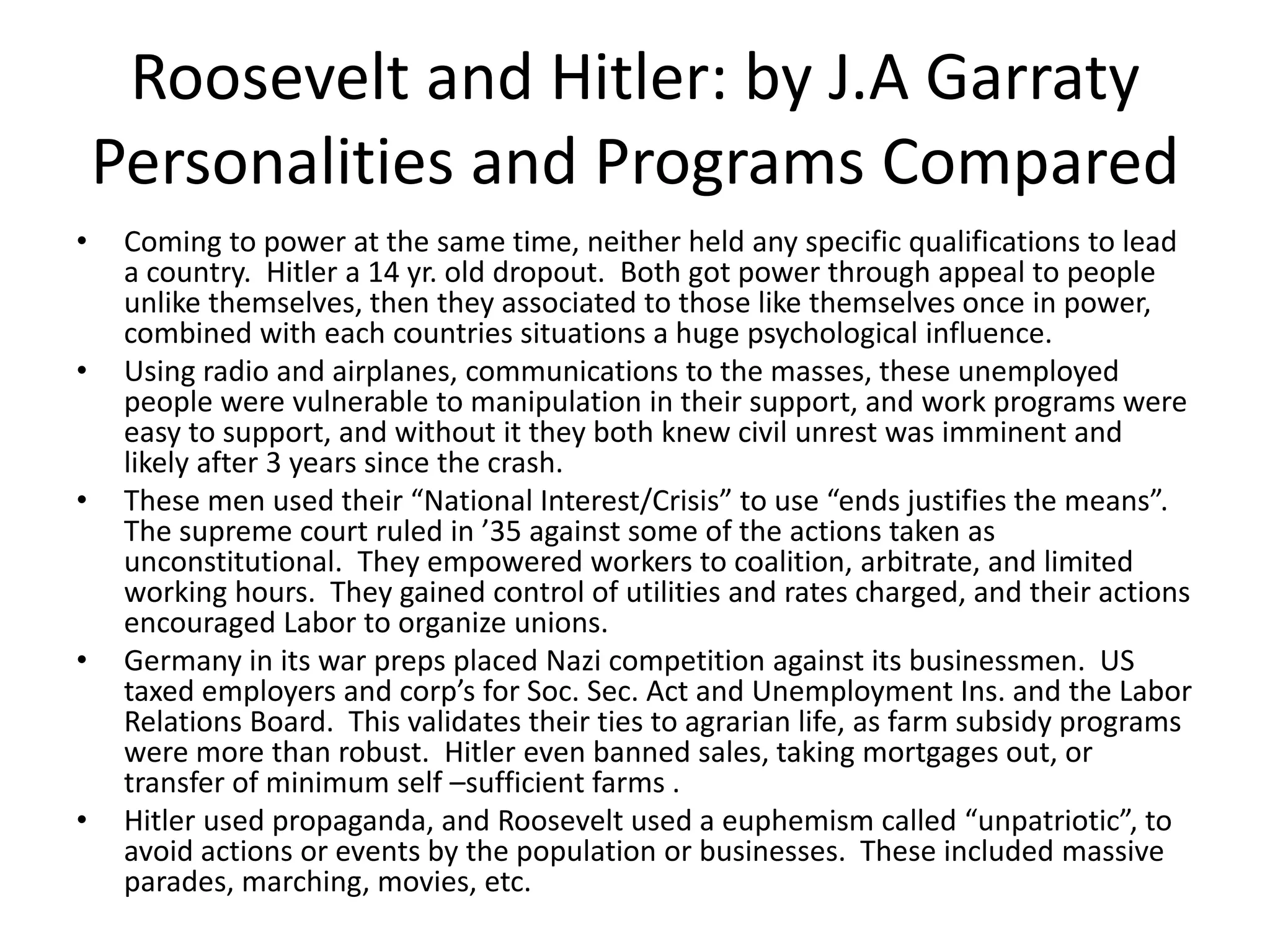
Roosevelt and Hitler: by J.A Garraty
    Personalities and Programs Compared
•    Coming to power at the same time, neither held any specific qualifications to lead
     a country. Hitler a 14 yr. old dropout. Both got power through appeal to people
     unlike themselves, then they associated to those like themselves once in power,
     combined with each countries situations a huge psychological influence.
•    Using radio and airplanes, communications to the masses, these unemployed
     people were vulnerable to manipulation in their support, and work programs were
     easy to support, and without it they both knew civil unrest was imminent and
     likely after 3 years since the crash.
•    These men used their “National Interest/Crisis” to use “ends justifies the means”.
     The supreme court ruled in ’35 against some of the actions taken as
     unconstitutional. They empowered workers to coalition, arbitrate, and limited
     working hours. They gained control of utilities and rates charged, and their actions
     encouraged Labor to organize unions.
•    Germany in its war preps placed Nazi competition against its businessmen. US
     taxed employers and corp’s for Soc. Sec. Act and Unemployment Ins. and the Labor
     Relations Board. This validates their ties to agrarian life, as farm subsidy programs
     were more than robust. Hitler even banned sales, taking mortgages out, or
     transfer of minimum self –sufficient farms .
•    Hitler used propaganda, and Roosevelt used a euphemism called “unpatriotic”, to
     avoid actions or events by the population or businesses. These included massive
     parades, marching, movies, etc.
Roosevelt and Hitler
   Hitler was plagiarizing Roosevelt?
• The best look into the mind of any president,
  especially Roosevelt is his inaugural address. He
  makes it clear “…broad executive powers..”
• During the pre-war years Hitler demonstrated
  even more impression with US methods, policies,
  even Roosevelt himself. His private diplomatic
  message congratulating him! I found no one
  who has ever heard this, this is extremely
  important to understand how much Hitler
  copied the US efforts, how much production he
  was able to make Germany the run up to WWI.
Roosevelt and Hitler
 Both Leaders With Only One Way Out
• These leaders relied on one common skill, the power of appearing to
  be in control and implementing will. Many policies and programs
  didn’t work but these didn’t stymie getting more in place without
  focusing on the failures.
• Germany in the post war years was piled on by the war reparations,
  then ‘33to’39 Hitler ran deficit spending to 4 times. This was the
  source of funds to expand his economy and production. Germany war
  efforts started long before the US which puts the uneven progress
  comparison somewhat inaccurate.
• In the final analysis, the US economy plodded along never actually
  getting better only consolidating and getting stronger against
  downward pressure. Germany was so overwhelmed for so much
  longer than the US with reparations before the crash, that Hitler’s
  options without going to war were the same as the US.
• There is nothing to show the US had any way to escape the sideways
  economy of ten years except wartime mobilization in ‘41.

Comparitive history part2

  • 1.
    Comparative History Part2 TheGreat Depression (GD) Mark Brandon History 141 Fall 2011 Internet Dr. Arguello
  • 2.
    Into the EconomicAbyss Characterizing the Effects on Both • Industrial revolution wires together world economies (globalization). Immigration had boomed until 1914 then near zero at the time of the crash. US large and modernized to be essentially independent of importation, making negative impact on world exports. World trade 4 years after the crash had lost 60%! • Post WWI reparation payments by Germany, resulted in some 30B GMarks to pay for its imports. Later money printing to pay debts, hyper-inflation set and in ‘23 collapsed the GM. This made savings worthless and fixed income citizens with no options. This creation of people with no options and little hope, without a farm for essentials, only government provisions. • All over Europe unemployment, US was enjoying an absolute minimum of 4%. This coupled the 20’s farm over production and government stockpiling to prop prices. This collapse of food/crop prices was actually good helping the poor somehow afford to eat. • US Production was clipped by 1/3 by 1931, millions became out of work. The market had lost 10B in 2 hours on 29Oct1929. One example given, Westinghouse lost 76 of its net income within 2 years of the crash! Other countries are faced with the loss of demand by US and others creating this catch 22 cycle spiraling out of control trade world wide. • The overall effect of this cycle was a complete loss of demand, unemployment is leveraged upward and for longer than imaginable, wiping out savings and safety nets, compounding lost demand. People who had peasant living styles could fed themselves, but those who were workers relying on wages, it was no opportunity to find work, leaving them at the mercy of churches and government soup lines. Social Security and Unemployment Ins. didn’t exist. • Ironically the Soviets had tripled production and Hitler had Germany at zero unemployment. This was under the 5 year plan of industrialization, which had already occurred elsewhere. These communist and fascist societies using their dictatorial leadership made the government the employer, and for millions nothing more than working for their food to eat, but they could brag of zero unemployment rates as if it were something to brag about! • US started WWI as a debtor nation and ended up as the worlds central lender. A great deal of this was German loans for reparations. This compounded Germany’s problems when the US market crashed. The Young Plan was ironically passed in ‘29 also, and altered German repayment plans, making matters worst. • The essay proposes two ideas of causes: imbalance in the world economies, with the US being near self-reliant. The other as a failure of the world as a whole to maintain enough demand for the expansion to perpetuate with lagging wages and rising profits.
  • 3.
    Into the EconomicAbyss Global $ +Margin Calls+Jobs=GD Er • Farms and Homes prior to the crash were decimated by foreclosures, as by ’33 almost half of all houses were being foreclosed on. This lead to massive homelessness and filled Hoovervilles. Car loans made up about 1 of 5 dollars of personal debt. The negative financial pressure on the banks and thousands of banks were bankrupted, and this loss of confidence caused a run bank deposits. • This overwhelming loss of hope in the future made auto sales clip off 50%, and the only sign people had was things were only going to get worse, which fed the problem. • The Gold Standard’s existence is mentioned, but not explained is the money supply volume is fixed to it.. • To expand market economy required leverage (buying stocks on margin). The brokerages gave people credit, $10 could control up to $100, translating the first 10% swing wiped out a persons fortune unless they added cash and most didn’t have any. This was the domino. The government had to exit the Gold Standard to pump money into the economy later in ‘31-’32. Markets were known to be “rigged” by the big investors pumping and dumping, men like Livermore never made more money than the day of and the three week after! His essay just calls it “liberal free market”, but to anyone looking at the common practices of pool trading, bought news stories, etc. amounted to “accepted practiced -legalized theft”. • The essayist doesn’t clearly state it, but does show the Crash of ‘29 was a factor to the GD Era, although they were separate events. He clearly shows long before, the world and US markets of products and crops was long in trouble. and these forces were the causes of the GD Era worldwide, not speculation alone . • The result of this GD Era could only lead to one of three political -economic systems: throughout the world: 1) Marxism. 2) Capitalism without free-market controls, but with stifling government regulatory control to prevent such again. 3) Fascism. All came about, fortunately the US remained capitalistic. • The controls have had enormous consequences, and has been a blanket hiding some of the largest frauds every perpetrated in human history. The US became the worlds monetary leader as the British failed.
  • 4.
    Roosevelt and Hitler:by J.A Garraty Personalities and Programs Compared • Coming to power at the same time, neither held any specific qualifications to lead a country. Hitler a 14 yr. old dropout. Both got power through appeal to people unlike themselves, then they associated to those like themselves once in power, combined with each countries situations a huge psychological influence. • Using radio and airplanes, communications to the masses, these unemployed people were vulnerable to manipulation in their support, and work programs were easy to support, and without it they both knew civil unrest was imminent and likely after 3 years since the crash. • These men used their “National Interest/Crisis” to use “ends justifies the means”. The supreme court ruled in ’35 against some of the actions taken as unconstitutional. They empowered workers to coalition, arbitrate, and limited working hours. They gained control of utilities and rates charged, and their actions encouraged Labor to organize unions. • Germany in its war preps placed Nazi competition against its businessmen. US taxed employers and corp’s for Soc. Sec. Act and Unemployment Ins. and the Labor Relations Board. This validates their ties to agrarian life, as farm subsidy programs were more than robust. Hitler even banned sales, taking mortgages out, or transfer of minimum self –sufficient farms . • Hitler used propaganda, and Roosevelt used a euphemism called “unpatriotic”, to avoid actions or events by the population or businesses. These included massive parades, marching, movies, etc.
  • 5.
    Roosevelt and Hitler Hitler was plagiarizing Roosevelt? • The best look into the mind of any president, especially Roosevelt is his inaugural address. He makes it clear “…broad executive powers..” • During the pre-war years Hitler demonstrated even more impression with US methods, policies, even Roosevelt himself. His private diplomatic message congratulating him! I found no one who has ever heard this, this is extremely important to understand how much Hitler copied the US efforts, how much production he was able to make Germany the run up to WWI.
  • 6.
    Roosevelt and Hitler Both Leaders With Only One Way Out • These leaders relied on one common skill, the power of appearing to be in control and implementing will. Many policies and programs didn’t work but these didn’t stymie getting more in place without focusing on the failures. • Germany in the post war years was piled on by the war reparations, then ‘33to’39 Hitler ran deficit spending to 4 times. This was the source of funds to expand his economy and production. Germany war efforts started long before the US which puts the uneven progress comparison somewhat inaccurate. • In the final analysis, the US economy plodded along never actually getting better only consolidating and getting stronger against downward pressure. Germany was so overwhelmed for so much longer than the US with reparations before the crash, that Hitler’s options without going to war were the same as the US. • There is nothing to show the US had any way to escape the sideways economy of ten years except wartime mobilization in ‘41.