Unit Five
Joining Sentences to Show Comparison and Contrast
In your college courses, and in your personal lives and professional careers as well, you will
frequently compare and contrast people, things, or ideas. Employers often must compare and
contrast two or more job applicants, college students may compare and contrast two historical
periods, and people often compare and contrast two products they are considering buying, or two
people they know. By joining ideas or information with coordinators and subordinators, you can
clearly show similarities and differences to your reader with longer mature sentences rather than
choppy short ones.
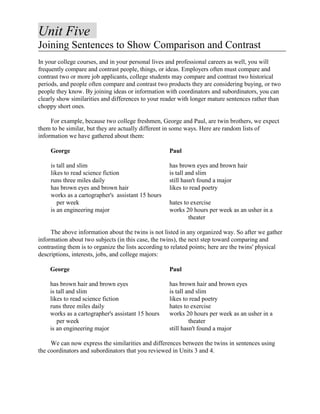
For example, because two college freshmen, George and Paul, are twin brothers, we expect
them to be similar, but they are actually different in some ways. Here are random lists of
information we have gathered about them:
George Paul
is tall and slim has brown eyes and brown hair
likes to read science fiction is tall and slim
runs three miles daily still hasn't found a major
has brown eyes and brown hair likes to read poetry
works as a cartographer's assistant 15 hours
per week hates to exercise
is an engineering major works 20 hours per week as an usher in a
theater
The above information about the twins is not listed in any organized way. So after we gather
information about two subjects (in this case, the twins), the next step toward comparing and
contrasting them is to organize the lists according to related points; here are the twins' physical
descriptions, interests, jobs, and college majors:
George Paul
has brown hair and brown eyes has brown hair and brown eyes
is tall and slim is tall and slim
likes to read science fiction likes to read poetry
runs three miles daily hates to exercise
works as a cartographer's assistant 15 hours works 20 hours per week as an usher in a
per week theater
is an engineering major still hasn't found a major
We can now express the similarities and differences between the twins in sentences using
the coordinators and subordinators that you reviewed in Units 3 and 4.
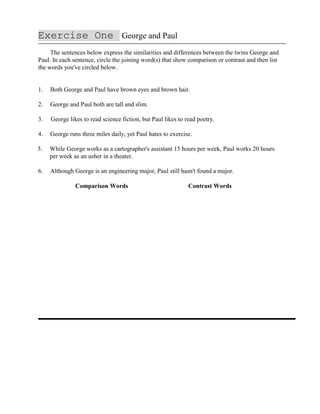
Exercise One George and Paul
The sentences below express the similarities and differences between the twins George and
Paul. In each sentence, circle the joining word(s) that show comparison or contrast and then list
the words you've circled below.
1. Both George and Paul have brown eyes and brown hair.
2. George and Paul both are tall and slim.
3. George likes to read science fiction, but Paul likes to read poetry.
4. George runs three miles daily, yet Paul hates to exercise.
5. While George works as a cartographer's assistant 15 hours per week, Paul works 20 hours
per week as an usher in a theater.
6. Although George is an engineering major, Paul still hasn't found a major.
Comparison Words Contrast Words
In addition to showing the similarities and differences between people, we often compare
and contrast behavior, cultures, theories, points of view on an issue, the positive and negative
features of something, or the past with the present. The exercises in this unit give you practice in
using coordinators and subordinators to compare and contrast activities, cultures, and a past and
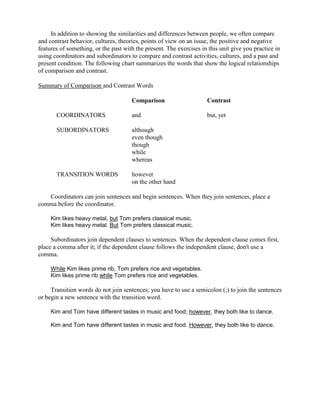
present condition. The following chart summarizes the words that show the logical relationships
of comparison and contrast.
Summary of Comparison and Contrast Words
Comparison Contrast
COORDINATORS and but, yet
SUBORDINATORS although
even though
though
while
whereas
TRANSITION WORDS however
on the other hand
Coordinators can join sentences and begin sentences. When they join sentences, place a
comma before the coordinator.
Kim likes heavy metal, but Tom prefers classical music.
Kim likes heavy metal. But Tom prefers classical music.
Subordinators join dependent clauses to sentences. When the dependent clause comes first,
place a comma after it; if the dependent clause follows the independent clause, don't use a
comma.
While Kim likes prime rib, Tom prefers rice and vegetables.
Kim likes prime rib while Tom prefers rice and vegetables.
Transition words do not join sentences; you have to use a semicolon (;) to join the sentences
or begin a new sentence with the transition word.
Kim and Tom have different tastes in music and food; however, they both like to dance.
Kim and Tom have different tastes in music and food. However, they both like to dance.
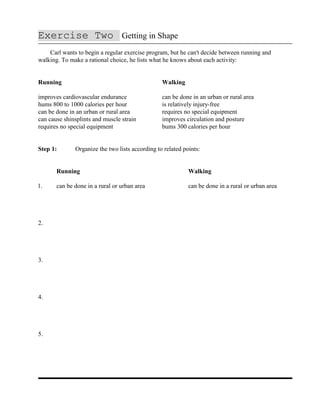
Exercise Two Getting in Shape
Carl wants to begin a regular exercise program, but he can't decide between running and
walking. To make a rational choice, he lists what he knows about each activity:
Running Walking
improves cardiovascular endurance can be done in an urban or rural area
hums 800 to 1000 calories per hour is relatively injury-free
can be done in an urban or rural area requires no special equipment
can cause shinsplints and muscle strain improves circulation and posture
requires no special equipment bums 300 calories per hour
Step 1: Organize the two lists according to related points:
Running Walking
1. can be done in a rural or urban area can be done in a rural or urban area
2.
3.
4.
5.
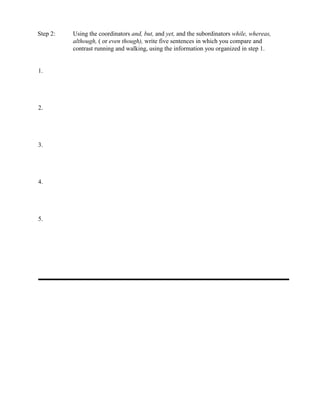
Step 2: Using the coordinators and, but, and yet, and the subordinators while, whereas,
although, ( or even though), write five sentences in which you compare and
contrast running and walking, using the information you organized in step 1.
1.
2.
3.
4.
5.
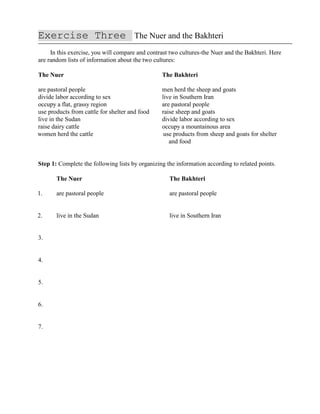
Exercise Three The Nuer and the Bakhteri
In this exercise, you will compare and contrast two cultures-the Nuer and the Bakhteri. Here
are random lists of information about the two cultures:
The Nuer The Bakhteri
are pastoral people men herd the sheep and goats
divide labor according to sex live in Southern Iran
occupy a flat, grassy region are pastoral people
use products from cattle for shelter and food raise sheep and goats
live in the Sudan divide labor according to sex
raise dairy cattle occupy a mountainous area
women herd the cattle use products from sheep and goats for shelter
and food
Step 1: Complete the following lists by organizing the information according to related points.
The Nuer The Bakhteri
1. are pastoral people are pastoral people
2. live in the Sudan live in Southern Iran
3.
4.
5.
6.
7.
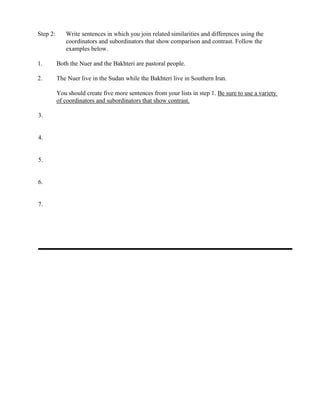
Step 2: Write sentences in which you join related similarities and differences using the
coordinators and subordinators that show comparison and contrast. Follow the
examples below.
1. Both the Nuer and the Bakhteri are pastoral people.
2. The Nuer live in the Sudan while the Bakhteri live in Southern Iran.
You should create five more sentences from your lists in step 1. Be sure to use a variety
of coordinators and subordinators that show contrast.
3.
4.
5.
6.
7.
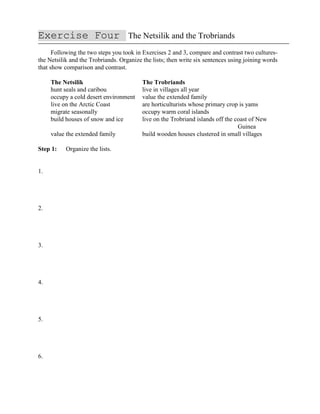
Exercise Four The Netsilik and the Trobriands
Following the two steps you took in Exercises 2 and 3, compare and contrast two cultures-
the Netsilik and the Trobriands. Organize the lists; then write six sentences using joining words
that show comparison and contrast.
The Netsilik The Trobriands
hunt seals and caribou live in villages all year
occupy a cold desert environment value the extended family
live on the Arctic Coast are horticulturists whose primary crop is yams
migrate seasonally occupy warm coral islands
build houses of snow and ice live on the Trobriand islands off the coast of New
Guinea
value the extended family build wooden houses clustered in small villages
Step 1: Organize the lists.
1.
2.
3.
4.
5.
6.
Step 2: Combine related points into sentences using coordinators and subordinators.
1.
2.
3.
4.
5.
6.
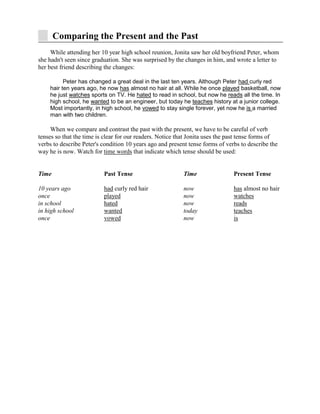
Comparing the Present and the Past
While attending her 10 year high school reunion, Jonita saw her old boyfriend Peter, whom
she hadn't seen since graduation. She was surprised by the changes in him, and wrote a letter to
her best friend describing the changes:
Peter has changed a great deal in the last ten years. Although Peter had curly red
hair ten years ago, he now has almost no hair at all. While he once played basketball, now
he just watches sports on TV. He hated to read in school, but now he reads all the time. In
high school, he wanted to be an engineer, but today he teaches history at a junior college.
Most importantly, in high school, he vowed to stay single forever, yet now he is a married
man with two children.
When we compare and contrast the past with the present, we have to be careful of verb
tenses so that the time is clear for our readers. Notice that Jonita uses the past tense forms of
verbs to describe Peter's condition 10 years ago and present tense forms of verbs to describe the
way he is now. Watch for time words that indicate which tense should be used:
Time Past Tense Time Present Tense
10 years ago had curly red hair now has almost no hair
once played now watches
in school hated now reads
in high school wanted today teaches
once vowed now is
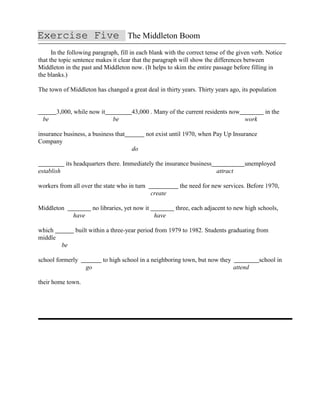
Exercise Five The Middleton Boom
In the following paragraph, fill in each blank with the correct tense of the given verb. Notice
that the topic sentence makes it clear that the paragraph will show the differences between
Middleton in the past and Middleton now. (It helps to skim the entire passage before filling in
the blanks.)
The town of Middleton has changed a great deal in thirty years. Thirty years ago, its population
3,000, while now it 43,000 . Many of the current residents now in the
be be work
insurance business, a business that not exist until 1970, when Pay Up Insurance
Company
do
its headquarters there. Immediately the insurance business unemployed
establish attract
workers from all over the state who in turn the need for new services. Before 1970,
create
Middleton no libraries, yet now it three, each adjacent to new high schools,
have have
which built within a three-year period from 1979 to 1982. Students graduating from
middle
be
school formerly to high school in a neighboring town, but now they school in
go attend
their home town.

COMPARE AND Contrast.doc

  • 1.
    Unit Five Joining Sentencesto Show Comparison and Contrast In your college courses, and in your personal lives and professional careers as well, you will frequently compare and contrast people, things, or ideas. Employers often must compare and contrast two or more job applicants, college students may compare and contrast two historical periods, and people often compare and contrast two products they are considering buying, or two people they know. By joining ideas or information with coordinators and subordinators, you can clearly show similarities and differences to your reader with longer mature sentences rather than choppy short ones. For example, because two college freshmen, George and Paul, are twin brothers, we expect them to be similar, but they are actually different in some ways. Here are random lists of information we have gathered about them: George Paul is tall and slim has brown eyes and brown hair likes to read science fiction is tall and slim runs three miles daily still hasn't found a major has brown eyes and brown hair likes to read poetry works as a cartographer's assistant 15 hours per week hates to exercise is an engineering major works 20 hours per week as an usher in a theater The above information about the twins is not listed in any organized way. So after we gather information about two subjects (in this case, the twins), the next step toward comparing and contrasting them is to organize the lists according to related points; here are the twins' physical descriptions, interests, jobs, and college majors: George Paul has brown hair and brown eyes has brown hair and brown eyes is tall and slim is tall and slim likes to read science fiction likes to read poetry runs three miles daily hates to exercise works as a cartographer's assistant 15 hours works 20 hours per week as an usher in a per week theater is an engineering major still hasn't found a major We can now express the similarities and differences between the twins in sentences using the coordinators and subordinators that you reviewed in Units 3 and 4.
  • 3.
    Exercise One Georgeand Paul The sentences below express the similarities and differences between the twins George and Paul. In each sentence, circle the joining word(s) that show comparison or contrast and then list the words you've circled below. 1. Both George and Paul have brown eyes and brown hair. 2. George and Paul both are tall and slim. 3. George likes to read science fiction, but Paul likes to read poetry. 4. George runs three miles daily, yet Paul hates to exercise. 5. While George works as a cartographer's assistant 15 hours per week, Paul works 20 hours per week as an usher in a theater. 6. Although George is an engineering major, Paul still hasn't found a major. Comparison Words Contrast Words
  • 4.
    In addition toshowing the similarities and differences between people, we often compare and contrast behavior, cultures, theories, points of view on an issue, the positive and negative features of something, or the past with the present. The exercises in this unit give you practice in using coordinators and subordinators to compare and contrast activities, cultures, and a past and present condition. The following chart summarizes the words that show the logical relationships of comparison and contrast. Summary of Comparison and Contrast Words Comparison Contrast COORDINATORS and but, yet SUBORDINATORS although even though though while whereas TRANSITION WORDS however on the other hand Coordinators can join sentences and begin sentences. When they join sentences, place a comma before the coordinator. Kim likes heavy metal, but Tom prefers classical music. Kim likes heavy metal. But Tom prefers classical music. Subordinators join dependent clauses to sentences. When the dependent clause comes first, place a comma after it; if the dependent clause follows the independent clause, don't use a comma. While Kim likes prime rib, Tom prefers rice and vegetables. Kim likes prime rib while Tom prefers rice and vegetables. Transition words do not join sentences; you have to use a semicolon (;) to join the sentences or begin a new sentence with the transition word. Kim and Tom have different tastes in music and food; however, they both like to dance. Kim and Tom have different tastes in music and food. However, they both like to dance.
  • 5.
    Exercise Two Gettingin Shape Carl wants to begin a regular exercise program, but he can't decide between running and walking. To make a rational choice, he lists what he knows about each activity: Running Walking improves cardiovascular endurance can be done in an urban or rural area hums 800 to 1000 calories per hour is relatively injury-free can be done in an urban or rural area requires no special equipment can cause shinsplints and muscle strain improves circulation and posture requires no special equipment bums 300 calories per hour Step 1: Organize the two lists according to related points: Running Walking 1. can be done in a rural or urban area can be done in a rural or urban area 2. 3. 4. 5.
  • 7.
    Step 2: Usingthe coordinators and, but, and yet, and the subordinators while, whereas, although, ( or even though), write five sentences in which you compare and contrast running and walking, using the information you organized in step 1. 1. 2. 3. 4. 5.
  • 8.
    Exercise Three TheNuer and the Bakhteri In this exercise, you will compare and contrast two cultures-the Nuer and the Bakhteri. Here are random lists of information about the two cultures: The Nuer The Bakhteri are pastoral people men herd the sheep and goats divide labor according to sex live in Southern Iran occupy a flat, grassy region are pastoral people use products from cattle for shelter and food raise sheep and goats live in the Sudan divide labor according to sex raise dairy cattle occupy a mountainous area women herd the cattle use products from sheep and goats for shelter and food Step 1: Complete the following lists by organizing the information according to related points. The Nuer The Bakhteri 1. are pastoral people are pastoral people 2. live in the Sudan live in Southern Iran 3. 4. 5. 6. 7.
  • 9.
    Step 2: Writesentences in which you join related similarities and differences using the coordinators and subordinators that show comparison and contrast. Follow the examples below. 1. Both the Nuer and the Bakhteri are pastoral people. 2. The Nuer live in the Sudan while the Bakhteri live in Southern Iran. You should create five more sentences from your lists in step 1. Be sure to use a variety of coordinators and subordinators that show contrast. 3. 4. 5. 6. 7.
  • 10.
    Exercise Four TheNetsilik and the Trobriands Following the two steps you took in Exercises 2 and 3, compare and contrast two cultures- the Netsilik and the Trobriands. Organize the lists; then write six sentences using joining words that show comparison and contrast. The Netsilik The Trobriands hunt seals and caribou live in villages all year occupy a cold desert environment value the extended family live on the Arctic Coast are horticulturists whose primary crop is yams migrate seasonally occupy warm coral islands build houses of snow and ice live on the Trobriand islands off the coast of New Guinea value the extended family build wooden houses clustered in small villages Step 1: Organize the lists. 1. 2. 3. 4. 5. 6.
  • 11.
    Step 2: Combinerelated points into sentences using coordinators and subordinators. 1. 2. 3. 4. 5. 6.
  • 12.
    Comparing the Presentand the Past While attending her 10 year high school reunion, Jonita saw her old boyfriend Peter, whom she hadn't seen since graduation. She was surprised by the changes in him, and wrote a letter to her best friend describing the changes: Peter has changed a great deal in the last ten years. Although Peter had curly red hair ten years ago, he now has almost no hair at all. While he once played basketball, now he just watches sports on TV. He hated to read in school, but now he reads all the time. In high school, he wanted to be an engineer, but today he teaches history at a junior college. Most importantly, in high school, he vowed to stay single forever, yet now he is a married man with two children. When we compare and contrast the past with the present, we have to be careful of verb tenses so that the time is clear for our readers. Notice that Jonita uses the past tense forms of verbs to describe Peter's condition 10 years ago and present tense forms of verbs to describe the way he is now. Watch for time words that indicate which tense should be used: Time Past Tense Time Present Tense 10 years ago had curly red hair now has almost no hair once played now watches in school hated now reads in high school wanted today teaches once vowed now is
  • 13.
    Exercise Five TheMiddleton Boom In the following paragraph, fill in each blank with the correct tense of the given verb. Notice that the topic sentence makes it clear that the paragraph will show the differences between Middleton in the past and Middleton now. (It helps to skim the entire passage before filling in the blanks.) The town of Middleton has changed a great deal in thirty years. Thirty years ago, its population 3,000, while now it 43,000 . Many of the current residents now in the be be work insurance business, a business that not exist until 1970, when Pay Up Insurance Company do its headquarters there. Immediately the insurance business unemployed establish attract workers from all over the state who in turn the need for new services. Before 1970, create Middleton no libraries, yet now it three, each adjacent to new high schools, have have which built within a three-year period from 1979 to 1982. Students graduating from middle be school formerly to high school in a neighboring town, but now they school in go attend their home town.