Comparative Genomics 1stEdition Philipp Pagel - PDF
Download (2025)
https://ebookultra.com/download/comparative-genomics-1st-edition-
philipp-pagel/
Visit ebookultra.com today to download the complete set of
ebooks or textbooks
2.
Here are somerecommended products for you. Click the link to
download, or explore more at ebookultra.com
Malaria Parasites Comparative Genomics Evolution and
Molecular Biology 1st Edition Jane M. Carlton
https://ebookultra.com/download/malaria-parasites-comparative-
genomics-evolution-and-molecular-biology-1st-edition-jane-m-carlton/
Dream science exploring the forms of consciousness 1st
Edition Pagel
https://ebookultra.com/download/dream-science-exploring-the-forms-of-
consciousness-1st-edition-pagel/
Karl Philipp Moritz Signaturen des Denkens Anthony Krupp
https://ebookultra.com/download/karl-philipp-moritz-signaturen-des-
denkens-anthony-krupp/
Dream Science Exploring the Forms of Consciousness 1st
Edition J. F. Pagel (Auth.)
https://ebookultra.com/download/dream-science-exploring-the-forms-of-
consciousness-1st-edition-j-f-pagel-auth/
3.
Mathematical Models ofInformation and Stochastic Systems
1st Edition Philipp Kornreich
https://ebookultra.com/download/mathematical-models-of-information-
and-stochastic-systems-1st-edition-philipp-kornreich/
EU State aid control law and economics 1st Edition Philipp
Werner
https://ebookultra.com/download/eu-state-aid-control-law-and-
economics-1st-edition-philipp-werner/
Marine Genomics 1st Edition Cinzia Verde
https://ebookultra.com/download/marine-genomics-1st-edition-cinzia-
verde/
Prokaryotic Genomics 1st Edition Colin Dale
https://ebookultra.com/download/prokaryotic-genomics-1st-edition-
colin-dale/
Gnuplot in Action Understanding Data with Graphs 1st
Edition Philipp K. Janert
https://ebookultra.com/download/gnuplot-in-action-understanding-data-
with-graphs-1st-edition-philipp-k-janert/
5.
Comparative Genomics 1stEdition Philipp Pagel Digital
Instant Download
Author(s): Philipp Pagel, Normann Strack, Matthias Oesterheld, Volker
Stümpflen, Dmitrij Frishman (auth.), Nicholas H. Bergman (eds.)
ISBN(s): 9781934115374, 1934115371
Edition: 1
File Details: PDF, 8.88 MB
Year: 2007
Language: english
4 Pagel etal.
physical interactions (PPI), and functional associations between proteins can
be represented in the form of large graphs.
In many cases, protein function and, specifically, interactions are carried
out by conserved domains, which are reused in different proteins throughout
an organism. This modular architecture has been a focus of interest for a
long time (1). The problem of formal description, biological annotation, and
classification of these domains has been addressed by several groups leading
to valuable resources such as SMART (2), BLOCKS (3), Pfam (4), and the
recent integration endeavor InterPro (5).
Because of their important role as biological modules carrying function
and/or mediating physical binding to other proteins the prediction of domain–
domain interactions (DDI) and interaction domains is an exciting challenge for
both experimental labs and computational biologists.
The availability of data on protein networks was greatly improved in
recent years. High-throughput PPI mapping, expression analysis and ChIP-
Chip experiments as well as large annotation efforts by PPI databases such
as DIP, BIND, HPRD, and MIPS (6–9) have contributed significantly to the
goal of creating a comprehensive picture of the interactome and regulome in
model organisms. Many methods such as phylogenetic profiling, coexpression
analysis, or genomic neighborhood studies have been developed and have
recently been integrated in the STRING resource (10). Nevertheless, computa-
tional prediction of physical binding and functional relations between proteins
remains a hot topic because our picture of biological networks is highly
incomplete.
In contrast to PPI, data on DDI is currently very sparse rendering in
silico predictions even more important. Individual publications often narrow
down interaction sites to some extent but little of this information has made
its way into the databases and no comprehensive large-scale experiments
addressing DDI have been published so far. The only large-scale data on
the topic is based on domain contacts derived from experimentally deter-
mined three-dimensional structures of proteins (PDB [11]): iPfam (12) and
3did (13) have generated such data using sligthly different methods. A variety
of approaches to the problem of identifying yet unknown domain interac-
tions (and interaction domains) have been developed by different groups
(14–18).
In this chapter, we will describe some of these approaches, assess their
performance, and demonstrate the benefits of integrating different methods and
data sources.
8.
Domain-Interaction Prediction 5
2.Data and Methods
2.1. Experimental Data
Narrowing down the region of a protein that contains an interaction site or
other functionally important feature is usually done by stepwise removal or
alteration of different sections of the protein chain followed by experimental
assessment of binding or other functional properties of the mutant protein. For
individual proteins or interactions this is done frequently in published articles
but no large-scale data has been published so far for any of the usual model
organisms. We expect this situation to change in the near future because many
groups have recognized this lack of data. Nevertheless, comprehensive coverage
will not be reached anytime soon. Even the available small-scale data has
not been collected systematically in the manually curated interaction databases
although efforts to change this situation are under way.
Recently, different groups have started to use protein structure data from the
PDB database (11) for the identification of domain–domain contacts: iPfam
is a novel resource well integrated into the Pfam domain database (12) at the
Sanger Center (http://www.sanger.ac.uk/Software/Pfam/iPfam/), whereas 3did
represents independent work done at EMBL (http://3did.embl.de) (13). Based
on the primary sequence of all proteins in the PDB dataset conserved domains
are located using standard tools (hmmer). Contacts between different sections
of the same protein chain (intraprotein contacts) and among different chains
(interprotein contacts, PPI) are identified using the three dimensional atom
coordinates contained in the database. Both datasets can be accessed through a
web interface and are available for download.
Except for rare crystallization artifacts this kind of data can be expected to be
of the highest quality, as the physical contact is directly observed by structure
determination. Differences among the two databases can be attributed to slightly
different thresholds used to define contacts. Because of its presumable reliability
domain interaction data available from the iPfam and 3did database play the
role of the gold-standard against which predictions should be measured.
Nevertheless one has to keep in mind that PDB-derived domain interaction
data have some intrinsic limitations. First, structural data are not as easy and
cheap to produce as gene and protein sequences. Accordingly, PDB covers
a much smaller fraction of the protein space than protein sequence resources
such as UniProt. Second, certain proteins are easier to crystallize than others
resulting in a significant bias in the data found in PDB. A good example
of this bias is represented by the class of transmembrane proteins, which
are known to be notoriously hard to crystallize and, thus, underrepresented.
9.
6 Pagel etal.
Sometimes, researchers circumvent this and other crystallization problems by
using fragments of the proteins that are easier to work with. Of course, this
does not solve the bias problem and may introduce additional problems if the
excluded sections were significant for forming contacts.
2.2. Domain Phylogenetic Profiling
The idea of phylogenetic profiling has been introduced as a method to predict
interactions and functional relations among proteins (19) and has since been
widely used for genome annotation. The underlying idea of the method is that
proteins (or other entities), which require each other for their function are only
useful to the organism if both are present. If one is lost during evolution the
other looses its function. Although this is an oversimplification of the actual
situation the approach appears to work well.
Building on this general idea, we have recently introduced the concept of
domain phylogenetic profiling (DPROF) as a means to identify domain–domain
relations. We have demonstrated the utility of the method to predict PPI by
mapping the predicted domain network onto a proteome of interest and found
the results to add significantly to the results of classic protein profiling (18).
When performing phylogenetic profiling the first step is the selection of
organisms to be analyzed. As the method uses correlated loss or gain of domains
it is important to only use genomes, which can be reasonable considered to
be completely sequenced. Otherwise the absence of certain domains from a
proteome can be easily caused by simple lack of coverage. Another issue
is the phylogenetic distribution of selected genomes. Very closely related
species (or strains of the same species) should not be used for phylogenetic
profiling, because this will give undue weight to loss or gain events occurring
in these organisms. For a general purpose application, it is best to use as many
organisms as possible from a wide phylogenetic range. Sometimes coverage
can be improved by running a profiling analysis on a number of different sets
of species and combining the results.
In contrast to protein phylogenetic profiling the domain centered method
does not require identification of orthologs by computationally expensive all
vs all sequence comparisons. Instead, for each proteome to be included in the
analysis all proteins are tested for the occurrence of known protein domains.
In our work, we use the Pfam collection of sequence domains represented
as hidden Markov models generated from high-quality sequence alignments.
The software to detect Pfam domains in genomic proteins (hmmer) is readily
available. Precomputed Pfam analyses are often available from the major
10.
Domain-Interaction Prediction 7
genome/proteomedatabases (e.g., ref. 20). Of course, other sources of sequence
domains can be used if desired.
Given the domain assignments for each of the proteomes we build a matrix
Mij with i domains and j organisms where Mij takes a value of “1” if
domain i was detected in at least one protein in species j and “0” otherwise. A
row Mi of the matrix is called phylogenetic profile of domain i.
Based on the assumption of correlated occurrence of related features a measure
of distance or similarity between profiles is required to predict related domains.
The naive approach simply uses the number of positions two profiles differ in
(Hamming distance d). Although many reasonable predictions can be made using
this measure, it also produces large quantities of false-positives. This is mostly
owing to the fact that profiles of domains which are found in almost all or only
very few organisms have similar profiles although they are hardly related. In
both cases, profiles differ in only a few positions and accordingly are treated as
similaralthoughtheonlyfeaturetheyshareistheextremelyhighorlowabundance
of the respective domains in the selected organism set. This situation can be
remedied by taking into account the information content or entropy H of the
profiles(H = −
1
k=0
pk logpk;wherepk istherelativefrequencyofsymbolkinthe
profile) of the profiles (entropy weighted bit difference: dw = d
min HX HY
) or using
the mutual information between profiles (IXY = HX+HY −HXY
where H is the entropy or joint entropy of a profile or pair of profiles X and
Y, respectively; HXY = −
1
X=0
Y=0
pXY · log pXY ). Figure 1 gives an
overview of the method.
2.3. Inferring DDI From PPI
Another approach to finding domain interactions uses protein–protein inter-
action data to infer domain pairs most likely to mediate the observed PPI
(PPI2DDI). This idea has been investigated by many different groups using
a variety of statistical methods (14–17) and gradually adding new ideas and
concepts to the basic theme.
Today, protein interaction databases cover large numbers of experimentally
verified interactions from individually published experiments as well as large-
scale surveys of the interactome of various model organisms. The idea of
PPI2DDI is that interaction domains, which serve as adapters will be overrep-
resented in the dataset compared to other domains whose frequencies will lie
well within expectation. Essentially, all proposed methods try to identify pairs
of domains ij which are most likely to be involved in the observed PPI xy.
11.
8 Pagel etal.
0 0 1 1 0 1 1 1 0 1 0 1
0 1 0 0 1 1 0 0 1 1 0 1
0 1 0 0 1 1 0 1 1 1 0 1
1 0 1 0 0 0 1 1 0 1 1 0
0 1 0 0 1 1 0 1 1 1 0 1
0 0 1 1 0 1 1 1 0 1 0 1
...
Dom 2
Dom 3
Dom 5
Dom 6
Dom 4
Dom 1
...
1 2 3 4 5 6 7 8 9 ...
Species Dom1 Dom3
Dom2 Dom5
Predictions
Data generation
1.) Select organisms
2.) Detect domains
Profiling
Fig. 1. Phylogenetic domain profiling. After species selection conserved domains
are detected in all proteomes. Using this data a domain occurrence matrix is built
where rows represent conserved domains and columns species. The rows are called
phylogenetic profiles of the respective domains. An element of the matrix is set to “1”
if the corresponding domain is present in at least one protein of the respective organism
and to “0” otherwise. Domains with similar profiles are called related (interacting
and/or functionally linked). In the example, profiles of domains one and three differ
only in one position and those of domains two and five are identical, whereas all other
combinations exhibit much larger differences.
An early method uses the ratio of observed over expected number of
domain-pairs: Sij =
Iij
Aij
, where Iij is the number of PPI where domains i and j
occur in the proteins and Aij is the total number of possible protein pairs
which contain i and j (17,21). Others have proposed a maximum likelihood
estimation approach to improve predictions using the expectation maximization
algorithm to maximize the likelihood of the observed interactions (15,16). In
a recent publication, Riley et al. added a modified likelihood ratio statistics
to the maximum likelihood estimation method by removing each domain pair
individually from the data and recomputing the likelihood by expectation
maximization. Through this technique they measure how much influence each
domain pair has on the likelihood estimate (14).
The latter method appears to represent the current state of the art in DDI
inference from PPI data.
2.4. Inferring DDI From Predicted PPI
Although large amounts of PPI data are available coverage is still far from
complete and focuses on a small set of model organisms. This limits the
PPI2DDI approach, which needs observed PPI for inference. Using predicted
PPI in addition to the experimental data is a promising way to improve coverage.
12.
Domain-Interaction Prediction 9
Themost comprehensive resource for PPI predictions is the STRING
database, which integrates a large number of different PPI prediction techniques
in a single resource (10). STRING combines predictions and data from gene
neighborhood analysis, gene-fusion events, cooccurrence of genes (phyloge-
netic profiling), RNA coexpression data, experimental evidence (PPI databases),
functional association data, and text mining results. The predicted PPI data from
STRING can then be used in the same way as the experimental data by the same
algorithms for inferring DDI. This can be done by either treating STRING2DDI
as a separate prediction method or by simply adding the STRING predictions
to the experimental data before analysis.
2.5. Availability
Although there is much literature on the topic, most authors merely provide
the results of their own analyses but do not make any software or online
resources available. Even more importantly, it would be highly desirable to
have a one-stop shopping resource that integrates the results of experimental
data and as many prediction methods as possible.
To fill this gap, we provide the Domain Interaction Map (DIMA) resource
(http://mips.gsf.de/genre/proj/dima) (22). Although the initial implementation
covered only experimental data (iPfam) and the domain phylogenetic profiling
method, the approaches previously described have recently been added to the
portfolio. Other prediction algorithms and experimental data will be added as
they become available.
The website features a simple yet powerful user interface allowing the
occasional user to quickly find information on domains of interest. Queries
can be performed by Pfam or Interpro IDs, domain descriptions or protein
sequences, whereby the latter are then analyzed for conserved domains. Domain
neighborhoods are returned as tables, which provide links to external resources
(e.g., domain databases), detailed views of individual predictions (if appli-
cable), and visualization of the neighborhood graph. Advanced users may be
interested in obtaining the entire domain network for offline analysis with their
own tools. As some methods cannot be precomputed for all possible parameter
combinations, generation of entire networks is offered as a offline service with
the results of a computation delivered by email upon completion.
3. Performance Comparison
3.1. Performance Measures
We use the following performance measures to assess quality and coverage of
predictions: true-positive rate (sensitivity, recall) tp
tp+fn
. Positive predictive value
13.
10 Pagel etal.
(precision) tp
tp+fp
. Enrichment observed hits
expected hits
. tp, fp, tn, fn stand for true-positives,
false-positives, true-negatives, and false-negatives, respectively.
3.2. Hit Enrichment in Top Scoring Pairs
A useful way to investigate the utility of prediction scores is to compute the
ratio of observed hits (number of correct predictions) divided by the number
of expected hits (number of iPfam pairs in a random sample of the same size).
In Fig. 2, this ratio (or hit-enrichment) is plotted against the cumulative rank
of the different scores. This avoids undue influence of threshold selection and
may even guide us in finding good cutoffs. Out of 8,872,578 possible domain
combinations (from 4212 Pfam domains) 2733 are found in the iPfam data. That
is, we would expect to find one iPfam hit by chance in approximately every
3246th pair. The plot shows that all three prediction algorithms are strongly
10 50 100 500 1000 5000 10000
0
500
1000
1500
2000
2500
cumulative rank
observed/expected
complexes
DPROF
PPI2DDI
STRING2DDI
Fig. 2. Hit enrichment of different methods. The y-axis shows the hit enrichment,
i.e., the ratio of observed over expected number of hits to iPfam reference data for each
method. The x-axis represents the cumulative rank of the different prediction scores
on a logarithmic scale. Domain phylogenetic profiling and PPI2DDI performance is
similar, especially for the top 100 scoring pairs. As expected STRING2DDI fairs much
lower than the other two because it operates on purely predicted data. Nevertheless,
enrichment over random expectation is still large.
14.
Domain-Interaction Prediction 11
enrichedin domain contacts. The performance of DPROF and PPI2DDI is
similar for approximately the top 100 scoring pairs (with the latter performing
slightly better). STRING2DDI fares significantly lower although even this
method produces enrichments in the range of 200 to 500.
3.3. Prediction Parameters
In the following analysis, we used empirical score thresholds for the
prediction methods which by no means represent the single best choice and we
encourage users to experiment with different values for their own applications.
For the domain profiling we included domain pairs with a mutual information
score of better than 0.4, which yielded a total of 5841 predicted domain pairs
which is a sample of less than 1% of all possible pairs. For the PPI2DDI method
a threshold of E≥ 30 (likelihood ratio) has been proposed by the authors of
the original publication. Our analysis was limited to the Pfam-A data (the most
reliable subset of Pfam) and we increased the score threshold to 5.0. 3264
domain interactions (i.e., 11.5% top scoring pairs) were predicted with this
value. For the STRING2DDI predictions a more strict threshold of 10.0 was
chosen to account for the more hypothetical nature of the input data which
represents all putative PPI with a combined STRING score of ≥0.9 (computed
without considering experimental data). Under these conditions STRING2DDI
produced 1169 predicted domain pairs.
3.4. Coverage and Overlap With iPfam
As no single method will be able to cover the entire domain space, we
will first look at the total number of predictions made by each method and
their mutual overlap as well as the agreement with the experimental reference
data. The results are shown in Fig. 3 and confirm the notion that the different
approaches produce complementary results thus improving total coverage. The
data also show that the majority of predictions is not found in iPfam, which is
not surprising given the low coverage of this database. At this point there is
no way to determine what fraction of these can be attributed to missing data in
the reference set and how many represent false-positives.
Four hundred-twenty-two out of 2733 iPfam interactions were predicted
by at least one of the three algorithms which translates to a sensitivity of
15%. Because iPfam does not cover functional relations and the input data for
predictions (Pfam models, species range, PPI data) are highly incomplete this
number is quite encouraging. At the same time, the figures clearly show the
advantage of applying more than one method to the problem.
15.
12 Pagel etal.
5619
(128)
3181
(208)
57
(22)
196
(13)
DPROF
PPI2DDI
STRING2DDI
10
(1)
16
(4)
900
(46)
Fig. 3. Prediction overlap. Numbers represent the count in each intersection of the
diagram. Values in parenthesis indicate how many of them are also found in iPfam.
Clearly, the three sets of predictions overlap comparatively little with each other and
the iPfam reference data.
3.5. Improved Prediction by Data Integration
As of today, domain contacts from known structural complexes (iPfam)
represent the only reliable source of DDI and, thus, serve as our standard of
truth for estimating the prediction performance in the following analysis. The
small overlap among predictions with each other and with the iPfam data poses
a major challenge for prediction assessment. Nevertheless, the numbers should
suffice to give an approximation of the actual situation.
Combining different data sources can potentially improve prediction in two
different ways, depending on the integration method. For better coverage, we
use the union of predictions (i.e., all predictions supported by at least one
method), whereas the intersection (i.e., all predictions supported by at least two
or three different methods) will allow better predictive power at the expense
of sensitivity. Table 1 gives sensitivity and precision values for both modes of
operation. Depending on the application both integration methods have their
merits. For example, for a broad target selection for subsequent lab-testing it
may be desirable to first search for possible targets in union-mode and then rank
16.
Domain-Interaction Prediction 13
Table1
Combining Predictions
union (∪) intersection (∩)
DPROF PPI2DDI STRING2DDI total in
iPfam
PPV
[%]
TPR
[%]
total in
iPfam
PPV
[%]
TPR
[%]
+ + + 9979 422 4.2 15.4 16 4 250 0.1
− + + 4360 294 6.7 10.8 73 26 356 1.0
+ − + 6798 214 3.1 7.8 212 17 80 0.6
+ + − 9079 376 4.1 13.8 26 5 192 0.2
− − + 1169 85 7.3 3.1 1169 85 73 3.1
− + − 3264 235 7.2 8.6 3263 235 72 8.6
+ − − 5841 146 2.5 5.3 5841 146 25 5.3
The table contains positive predictive value (PPV) and sensitivity (true-positive rate; TPR)
for union and intersection of different prediction data. The first three columns indicate which
datasets were included. These are combined by either intersection or union of the predicted pairs.
Numbers can be interpreted easily when comparing performance of the different datasets but
absolute values mean little because of the incomplete standard of truth.
the predictions by intersection. This way the maximum number of predictions
is recovered while the most promising targets are used for experimental work
first.
Clearly, performance of individual methods will depend on the choice
of thresholds but the data from the above survey already allows a rough
assessment. Both PPI2DDI and STRING2DDI showed a precision of ≈7%
under the chosen conditions, whereas the profiling method scores 2.5%. Sensi-
tivities range from 3.1% (STRING2DDI) to 8.6% (PPI2DDI) when measured
against iPfam. Of course, the absolute numbers should be interpreted with
caution because they were derived from a highly incomplete and probably
biased standard of truth and thus cannot be expected to be correct. Nevertheless
they can safely be used for comparison of results of different methods.
4. Notes
Several conclusions can be drawn on the results obtained by us and other groups
working on the problem of domain–domain interactions.
1. Overall, the PPI2DDI methods seems to produce the best results when measured
against iPfam and DPROF holds a close second place. The fairly small overlap
among them makes them valuable as complementary approaches.
17.
14 Pagel etal.
2. STRING2PPI works on much less reliable input data and accordingly its perfor-
mance is much less impressive than its counterpart PPI2DDI. Nevertheless, the
possibility to boost coverage by introducing predicted PPI data may be a valuable
endeavor in many cases.
3. No two methods we studied in this work showed much overlap. This gives strong
emphasis to the approach of pooling results produced by different algorithms and/or
datasets. Although the apparent precision of DDI predictions as evaluated using
iPfam seems relatively low, they represent a valuable tool for producing a dataset
strongly enriched in real interactions and one has to keep in mind that they were
measured against a highly incomplete standard of truth, i.e., the obtained precisions
represent lower bounds of the true values.
4. Even if a predicted domain pair may be found not to engage in physical binding in
experimental tests many of them may turn out to be linked by functional associations
such as binding a common target.
5. Researchers in bioinformatics may prefer to implement their own version of the
described approaches to fit their specific needs. The DIMA website allows quick
and easy access to these methods for a much wider audience.
Acknowledgments
This work was funded by a grant from the German Federal Ministry of
Education and Research (BMBF) within the BFAM framework (031U112C).
We would like to thank Robert Riley for helpful technical explanations
regarding his algorithm, Thorsten Schmidt for helpful discussions, and Lousie
Riley for careful reading of the manuscript.
References
1. Pawson, T. and Nash, P. (2003) Assembly of cell regulatory systems through
protein interaction domains. Science 300, 445–452.
2. Letunic, I., Goodstadt, L., Dickens, N. J., et al. (2002) Recent improvements to
the SMART domain-based sequence annotation resource. Nucleic Acids Res. 30,
242–244.
3. Henikoff, J. G., Henikoff, S., and Pietrokovski, S. (1999) New features of the
Blocks Database servers. Nucleic Acids Res. 27, 226–228.
4. Bateman, A., Coin, L., Durbin, R., et al. (2004) The Pfam protein families database.
Nucleic Acids Res. 32, D138–D141.
5. Mulder, N. J., Apweiler, R., Attwood T. K., et al. (2005) InterPro, progress and
status in 2005. Nucleic Acids Res. 33, D201–D205.
6. Xenarios, I., Salwínski, L., Duan, X. J., Higney, P., Kim, S. -M., and Eisenberg, D.
(2002) DIP, the Database of Interacting Proteins: a research tool for studying
cellular networks of protein interactions. Nucleic Acids Res. 30, 303–305.
7. Bader, G. D., Betel, D., and Hogue, C. W. V. (2003) BIND: the Biomolecular
Interaction Network Database. Nucleic Acids Res. 31, 248–250.
1
2
3
4
5
6
7
18.
Domain-Interaction Prediction 15
8.Peri, S., Navarro, J. D., Kristiansen, T. Z., et al. (2004) Human protein
reference database as a discovery resource for proteomics. Nucleic Acids Res. 32,
D497–D501.
9. Pagel, P., Kovac, S., Oesterheld, M., et al. (2005) The MIPS mammalian protein-
protein interaction database. Bioinformatics 21, 832–834.
10. von Mering, C., Jensen, L. J., Snel, B., et al. (2005) STRING: known and predicted
protein-protein associations, integrated and transferred across organisms. Nucleic
Acids Res. 33, D433–D437.
11. Berman, H. M., Westbrook, J., Feng, Z., et al. (2000) The Protein Data Bank.
Nucleic Acids Res. 28, 235–242.
12. Finn, R. D., Marshall, M., and Bateman, A. (2005) iPfam: visualization of protein-
protein interactions in PDB at domain and amino acid resolutions. Bioinformatics
21, 410–412.
13. Stein, A., Russell, R. B., and Aloy, P. (2005) 3did: interacting protein domains of
known three-dimensional structure. Nucleic Acids Res. 33, D413–D417.
14. Riley, R., Lee, C., Sabatti, C., and Eisenberg, D. (2005) Inferring protein domain
interactions from databases of interacting proteins. Genome Biol. 6, R89.
15. Deng, M., Mehta, S., Sun, F., and Chen, T. (2002) Inferring domain-domain
interactions from protein-protein interactions. Genome Res. 12, 1540–1548.
16. Huang, C., Kanaan, S. P., Wuchty, S., Chen, D. Z., and Izaguirre, J. A. (2004)
Predicting protein-protein interactions from protein domains using a set cover
approach. Submitted manuscript.
17. Kim, W. K., Park, J., and Suh, J. K. (2002) Large scale statistical prediction of
protein-protein interaction by potentially interacting domain (PID) pair. Genome
Inform. Ser. Workshop Genome Inform. 13, 42–50.
18. Pagel, P., Wong, P., and Frishman, D. (2004) A domain interaction map based on
phylogenetic profiling. J. Mol. Biol. 344, 1331–1346.
19. Pellegrini, M., Marcotte, E. M., Thompson, M. J., Eisenberg, D., and Yeates, T. O.
(1999) Assigning protein functions by comparative genome analysis: protein phylo-
genetic profiles. Proc. Natl. Acad. Sci. USA 96, 4285–4288.
20. Riley, M. L., Schmidt, T., Wagner, C., Mewes, H. -W., and Frishman, D. (2005)
The PEDANT genome database in 2005. Nucleic Acids Res. 33, D308–D310.
21. Sprinzak, E. and Margalit, H. (2001) Correlated sequence-signatures as markers
of protein-protein interaction. J. Mol. Biol. 311, 681–692.
22. Pagel, P., Oesterheld, M., Stümpflen, V., and Frishman, D. (2006) The DIMA web
resource: exploring the protein domain network. Bioinformatics 22, 997–998.
8
9
10
11
12
13
14
15
16
17
18
19
20
21
22
18 Pasek
rather thansynteny. Microsyntenies are mainly encountered among prokaryotic
genomes (operons are well known examples of microsyntenies in bacteria)
and lower eukaryota such as yeast. This conservation probably points out, in
many cases, to a selection pressure that tends to preserve the very proximity
of the genes (4). As a consequence the detection, across several genomes, of
these syntenic segments considerably helps the prediction of features of interest
such as the physical interaction of proteins or their participation in common
metabolic/regulatory networks (3,5–11). It also enables phylogenetic recon-
structions through the identification of some of the numerous rearrangement
events that can affect a genome: transpositions, deletions, insertions, inversions,
fusions, and fissions (12,13).
The search for syntenies is commonly integrated in many studies of compar-
ative genomics and a wide range of tools is available to search for microsyn-
tenies (1,2,14–18). Some of them allow the simultaneous treatment of many
species (1,2,16,17). Others perform both inter- and intraspecies comparisons but
impose the number of species to be restricted to two to be tractable (to achieve
polynomial time-complexity of their algorithm) (15). Our approach allows the
simultaneous detection of intraspecies and interspecies microsyntenies in a
number of species (18). Moreover the use of domains (instead of genes) as
atomic units of the syntenies relaxes the rigidity of the orthology criterion by
removing the constraint that each gene must have a unique occurrence in each
species, and thus allowing the analysis of genomes with extensive paralogs.
Therefore, the notion of synteny of domains allows (1) an extrasensitivity of
the detection of syntenies thanks to the identification of domain-homologous
genes (19) sometimes sharing a low level of sequence similarity, (2) the search
for duplicated syntenic segments, and (3) to take into account the rearrange-
ments of domains such as fusions (6,9,10,20–22) and circular permutations (23).
In this chapter, we describe the use of DomainTeam (18). We define chromo-
somal regions of conserved protein domains as domain teams or synteny of
domains. A chromosome is defined as an ordered sequence of genes where
a unique coding sequence is associated to the nucleic acid sequence of a
gene. Each gene is divided into one or more consecutive domains, using the
PfamA domains of the encoded proteins (24). Computation of the DomainTeam
software produces an output comprising all the syntenies of domains shared by
two or more (sometimes all) of the compared genomes. This output reports also
the fusions detected inside a domain team. Here, we describe the preparation
of the input file, the setup of the parameters, and the command-line of the
DomainTeam software. Finally, we explain how to retrieve information from
the output file.
22.
Domain Team 19
2.Materials
2.1. The Chromosome Tables
For all the compared chromosomes (see Note 1), the chromosomal ordered
lists (chromosome tables) of the genes under study and their products (together
with their protein identifiers) are required. They can be retrieved from the EBI
“proteome” site (http://www.ebi.ac.uk/integr8/EBI-Integr8-HomePage.do).
In the chromosome tables, the following information has to be extracted:
1. A unique gene name for each gene of a chromosome (see Note 2).
2. The orientation of the gene on the chromosome (forward or reverse, see Note 3).
3. The rank of the gene, that is, its order on the chromosome (see Note 4).
4. The physical position (bp) of the first base of the gene (optional, see Note 5).
5. The identifier or accession number of the protein encoded by the gene (see Note 6).
6. The size of the protein in amino acids (optional, see Note 7).
7. The annotation of the protein (optional, see Note 8).
2.2. The Domain Annotations
For all the proteins encoded by the genes mentioned in the chromosome
tables, it is required to provide the ordered suite of domains that belong to the
proteins (from the N- to the C-terminal extremities of the protein). Several domain
databases can be used for this purpose but we prefer to use the Pfam database
(see Note 9). The PfamA annotations pertaining to the compared proteomes
can be downloaded from ftp://ftp.sanger.ac.uk/pub/databases/Pfam/database-
files. Home-defined domains can also be used (for example, using HMMER,
http://hmmer.wustl.edu/). Whatever the domain database chosen, the following
information has to be extracted for each gene:
1. Identifiers of all the domains belonging to the protein encoded by the considered gene.
2. The rank of each domain, i.e., its ordered position in the amino-acids sequence of
the protein (see Note 10).
3. The domain annotation corresponding to each domain identifier (optional, see
Note 8).
3. Methods
3.1. Preparation of the Input File
An example of the input file format is given Fig. 1. Each entry begins
with “A” and corresponds to a domain in a specific position on a unique
chromosome.
Domain Team 21
Thefirst line (line 1 of the example) is formatted in the following way:
1. The accession number of the domain (e.g., PF00696).
2. The identifier of the chromosome on which it stands (beginning at 0, e.g., 0 for
Escherichia coli and 1 for Salmonella typhimurium).
3. The position of the domain (rank) on the chromosome (beginning also at 0, e.g., 1).
4. The annotation of the domain (e.g., AA_kinase).
The next two lines (lines 2 and 3 in this example) are devoted to the gene that
codes for the protein to which the domain belongs. The first line is composed of:
1. The gene identifier (e.g., b0002).
2. The protein identifier or accession number (e.g., AK1H_ECOLI) of the protein the
gene codes for.
3. The position of the domain in the protein, starting from the N-terminus (e.g., 0).
4. The total number of domains in the protein (e.g., 5).
5. The annotation of the protein (e.g., Bifunctional aspartokinase/homoserine dehydro-
genaseI).
The second line is composed of:
1. The physical position (bp) of the first base of the gene (e.g., 337).
2. The size of the protein in amino acids (e.g., 820).
3. Its orientation on the chromosome (F stands for forward, R for reverse).
One given gene may be associated to several domains (in this example, the
protein AK1H_ECOLI is associated to five domains).
Special domains, labeled XXX (see Fig. 1), indicate that the corresponding
protein is not annotated with any PfamA domain (e.g., Q7CP62, see Note 11).
3.2. Running DomainTeam
3.2.1. Some Precision Concerning the DomainTeam Source Code
The program is implemented with the C programming language. A compress
archive is downloadable at http://stat.genopole.cnrs.fr/domainteams. Uncom-
press and untar this archive. This will create the DomainTeam directory
containing the source files. In this directory, use gcc for the compilation of the
source code:
gcc ∗
.c –o domainteam
Fig. 1. Figure represents part of a DomainTeam input file. Several entries (beginning
withA)pertainingtothechromosomesof Escherichiacoliand Salmonellatyphimurium
are represented. A box at the top of the figure indicates the example given in
Subheading 3. The second box (bottom) indicates a protein devoid of domain annotation.
25.
22 Pasek
3.2.2. TheDomainTeam Command-Line
The DomainTeam command-line is the following:
domainteam -a input file -d delta -e ‘criterion’
The input parameters are the name of the previously described input file
(input file, option –a), the maximum distance delta (delta, option -d),
and the optional criterion to sort the output (option -e). The computation time
depends on the data under study (see Note 12).
3.2.3. Choice of the Delta Parameter
The distance between two domains on the same chromosome is the difference
between their positions where the position of a domain is defined using the
order in which the domain appears on the chromosome (see Note 13). Then
the delta value is the maximum distance allowed between two domains in a
run of DomainTeam. For example, if the delta value is three, it allows gaps of
two consecutive domains (see Note 14).
3.2.4. Using Sorting Criteria
The option –e allows to define a score that is used to sort the domain
teams by decreasing score. This score is the result of a user-defined rational
expression (comprising +−∗
/=,!) using global and local parameters
computed for each domain team. For example, -e ‘NBCHR’ will sort the
output as a function of the number of chromosomes the teams are found in
and -e ‘NBFUS’ will sort the output as a function of the number of fusions
that were found within the teams. Using -e ‘NBCHR * NBFUS’ will sort the
output as a function of the product of the number of chromosomes and the
number of fusions.
Global parameters are calculated from the information included in the input
file:
1. TOTALDOM, the total number of domains.
2. TOTALPROT, the total number of proteins.
3. TOTALCHR, the number of compared chromosomes.
4. DELTA, the input distance delta.
The local parameters (specific to a domain team) are the following:
1. NBFUS the number of fusions detected in the team.
2. NBCHR, the number of chromosomes among which the domain team was found.
3. NBOCC, the number of occurrences of the team (see Note 15).
4. NBDOM, the number of distinct domains in the team.
5. NBPROT, the total number of proteins that belong to the domain team.
have had respectto all the human race. Accordingly Christ is
called ‘The Lamb of God which taketh away the sin of the
world; and the Saviour of the world.’ The apostle John,
addressing Christians, says, ‘He is the propitiation for our sins,
and not for ours only, but also for the sins of the whole world.’
Here also Jesus Christ is declared to be the propitiation for the
sins of the whole world, in distinction from those of believers.
These, and other similar passages teach in the clearest
manner, that Christ has made an atonement for all mankind, or
for the whole world. It seems hardly possible for words to
express this sentiment more clearly than it is expressed in
these passages; and some of them will not admit of any other
sense, without a very forced, unnatural construction.
Should it be said, that such expressions as all men, the world,
c. must sometimes be understood in a limited or restricted
sense; it may be answered, that it is an established, invariable
rule, that all phrases, or passages of scripture are to be
understood in their most plain, easy, and literal import, unless
the connexion, the general analogy of faith, or some other
necessary considerations require a different sense. But in the
present case it does not appear, that any of these
considerations require, that these passages should be
understood in any other than their plain, natural meaning.—
That the atonement is sufficient for all mankind, is evident
from the consideration, that the calls, invitations and offers of
the gospel are addressed to all, without exception, in the most
extensive language. It is said, ‘Look unto me, and be ye saved,
all the ends of the earth. Whosoever will, let him take the
water of life freely. Ho, every one that thirsteth, come ye to the
waters, and he that hath no money: come ye, buy and eat,
yea, come, buy wine and milk without money, and without
price. Go, and preach the gospel to every creature.’ The
preachers of the gospel are directed to tell their hearers, that
all things are ready—that all may come, who will, and are to
invite and urge all, to come to the gospel feast and freely
28.
partake of theblessings of salvation. But how could the offer
of salvation be consistently thus made to all without any
limitation; if the atonement was sufficient but for a part or for
the elect only? On this supposition it could not with truth and
propriety be said to all, that all things are ready, plentiful
provisions are made for all, and whosoever will, may come.
Were a feast, sufficient but for fifty provided: could we
consistently send invitations to a thousand, and tell them that
a plentiful feast was prepared, and that all things were ready
for their entertainment, if they would but come? Would not
such an invitation appear like a deception? If so, then the offer
and invitation of the gospel could not have been made to all
without discrimination, as they are; if there was no atonement,
but for a part. As therefore the invitations of the gospel are
thus addressed to all, it is a proof that Christ has made an
atonement for all mankind.
Again, the scripture represents, that there is no difficulty in the
way of the salvation of the impenitent, but what arises from
their own opposition of heart or will. Thus the Lord Jesus says
to the unbelieving Jews, ‘Ye will not come unto, me, that ye
may have life. O Jerusalem, Jerusalem, how often would I
have gathered thy children—and ye would not.’ In the parable
of the marriage supper, it is represented, that there was no
difficulty in the way to prevent those who were invited, from
partaking of the feast, but their own unwillingness to come.
But if there was no atonement made but for those only who
are saved; then there would be an insurmountable difficulty in
the way of the salvation of all others, aside from the one
arising from their own opposition of heart. As therefore the
scripture teaches, that there is no difficulty in the way of the
salvation of any under the gospel, but what arises from their
own unwillingness, or wicked opposition of heart, it is manifest,
that there is an atonement for all.
The word of God teaches, that it is the duty of all, who are
acquainted with the gospel, to believe in the Lord Jesus, and
29.
trust in himas their Redeemer, and that they are very criminal
for neglecting to do this. It is therefore declared in the sacred
scriptures, that it is the command of God, ‘that we should
believe on the name of his Son Jesus Christ, and that those,
who believe not, are condemned already, because they have
not believed on the name of the only begotten Son of God.’
It is manifest from the various reasons which have been
suggested, that the atonement of Jesus Christ is infinitely full,
or sufficient for the salvation of all mankind, if they would but
cordially receive it, and that the want of such an atonement, is
not the reason, why all are not saved.——
It will no more follow, that all will be saved, because the
atonement is sufficient for all, than it would, that all would eat
of the marriage supper in the parable, because it was sufficient
for all, and all were invited. This parable was designed to
represent the gospel and its invitations.—As those, who
neglected the invitation, never tasted of the supper, although
the provisions were plentiful for all; so the scriptures teach,
that many will not comply with the terms and invitations of the
gospel, and partake of its blessings, although the atonement is
abundantly sufficient for all. For the Saviour declares, that
“many are called, but few are chosen, and strait is the gate
and narrow is the way which leadeth unto life, and few there
be that find it.”
Connecticut Evang. Mag.
Such interpretation of Scripture does not require the
admission that the atonement was absolutely indefinite.
Christ might know his sheep and die for them, and yet, by
the same covenant or purpose procure terms for others
which he knew they would reject.
190.
See Quest. LV.
30.
191.
See Quest. LXII,LXIII.
192.
See Quest. LXXVIII.
193.
See Page 257.
194.
Vid. Burnet. Tellur. Theor. Lib. iv.
195.
Justin Martyr seems to speak of it not only as his own opinion,
but as that which was generally held by the orthodox in his
day, joins the belief hereof with that of the resurrection of the
dead, and supposes it to be founded on the writings of some
of the prophets. Vid. Justin Martyr Dialog. cum. Tryph. Jud.
page 307. Εγω δε, και ει τινες εισιν ορθογνουμονες κατα παντα
Χρισιανοι, και σαρκος ανας ασιν γενησεθαι επισαμεθα, και χιλια
ελη εν Ιερουσαλημ οικοδομηθειση και κοσμηθειση και
πλατυνθειση, οι προθηται Ιεζεχιηλ, και Ησαιας, και οι αλλοι
ομολογουσιν. And Irenæus [Vid. advers. Hær. Lib. V. cap. 33.]
not only gives into this opinion, but intimates, that it was
brought into the church before his time, by one Papias,
cotemporary with Polycarp, and that he recieved it from those
who had it imparted to them by the apostle John: But
Eusebius, [Vid. Euseb. Hist. Eccles. Lib. III. cap. 33.] though
he speaks concerning this Papias, as one who was intimate
with Polycarp, notwithstanding represents him as a very weak
man; and therefore there is little credit to be given to his
account of this matter, as agreeable to the apostle’s sentiments
or writings; and Irenæus himself, in the place before
mentioned, cites a passage out of the same author, which, he
pretends, he received from those that had it from the apostle
John, concerning a certain time, in which there shall be vines,
31.
which shall produceten thousand branches, and each of these
as many smaller branches; and each of these smaller branches
have ten thousand twigs, and every twig shall bear ten
thousand clusters of grapes, and every cluster ten thousand
grapes; which shews that the man was ready to swallow any
fable he heard; and, if it was told him so, to father it upon the
apostle, which discovers how little credit was to be given to
what he says concerning this opinion, especially as he explains
it, as transmitted to the church by the apostle John. And
Tertullian is also mentioned, as giving some occasional hints,
which shew that he was of this opinion. And Lactantius, who,
in his Ciceronian style, describes the happy condition that the
church shall be in, (without having much regard to those
spiritual privileges that it shall enjoy, in which sense the
predictions of the prophets, concerning it, are principally to be
understood) takes his plan more especially from some things
that are said concerning it, in the Sybilline oracles. Vid.
Lanctant. de vita beat. Lib. VII. cap. 24. Epitom. cap. 11.
196.
Vid. Aug. de Civ. Dei. Lib. XX. cap. 7.
197. Vid. Mede Commet. min. in Apocal. cap. xix. and Dr. More, and
others, who are of the same opinion as to this matter.
198.
See Mede’s Works, Book IV. Epist. 17. Page 938-940.
199.
As for the story that Mede relates, to give countenance to this
opinion, concerning Christ’s appearing, in a glorious manner,
upon the Jews demanding such an extraordinary event, (after
a public disputation, held three days, between Gregentius, an
Arabian Bishop, and Herbanus, a Jew, a multitude of
spectators being present, both Jews and Christians) and
signifying that he was the same Person that their fathers had
32.
crucified; and theirbeing first struck blind, as Paul was, and
then, like him, converted and baptized, there are several
things, in this account, that seem fabulous and incredible;
though it is not improbable that there was a disputation held
between Gregentius and the Jews, about the truth of the
Christian religion, about the year of our Lord 470; or, as others
suppose, 570: yet it is much to be questioned, whether the
account we have of it be not spurious, written, by one who
calls himself by that name, in Greek, about three or four
hundred years since; and especially, because so extraordinary
a miracle, wrought in an age when miracles had, for so
considerable a time, ceased, is not taken notice of by other
writers, of more reputation in the age in which it is said to be
wrought, especially since it would have been one of the most
extraordinary proofs of the Christian religion that have been
given since our Saviour’s time. And it is very strange, that, as
the result hereof, five millions and a half of the Jews should be
converted at once, by this miracle, and yet this thing be passed
over in silence by other writers; and it is very much to be
questioned, whether there were such a multitude of Jews
gathered together in one kingdom, and, indeed, whether that
kingdom consisted of such a number of people; and, if there
were so many Jews, we must suppose that there was an equal
number of Christians present; but that so many should be
present at one disputation, seems incredible to a very great
degree. Vid. Gregen. disputat. cum Herban. fol. 192, 200.
Cave. Hist. lit. Tom. I. page 363.
200.
Moriar ut videam.
201.
Vid. Mede de Resurrec. prim. Lib. III. Page 710, 749, 750.
202.
Vid. Aug. de civ. Dei, Lib. xx. cap. 7.
33.
203.
See Ezek. xxxvii.21. and Jer. xxxvii. 7-13. alibi passim.
204.
So Irenæus styles it, Adv. Hær. Lib. V. cap. 29. Diluvium
superveniet Ignis.
205.
Vid. Aug. de Civ. Dei. Lib. XX. cap. 7.
206.
This is very agreeable to the scripture-mode of speaking;
nothing is more common than for the cardinal number to be
put for the ordinal; and so the meaning is, that this reign shall
continue to the thousandth year, or till the last 1000 years of
the world shall have an end, what part soever of his 1000
years it began in. Thus God tells Abraham, in Gen. xv. 13. that
his seed shall be a stranger in a land that is not theirs, to wit,
Egypt, and shall serve them, and they shall afflict them 400
years; whereas it is certain that his seed were not above 215
years in Egypt, and they were not slaves, or afflicted there 100
years; therefore the meaning is, q. d. that they shall afflict
them till 400 years are expired, from this time.
207. See Napier on the Revelation, prop. 33, 34. page 61, 62.
208.
Εαυτον εκενωσε.
209.
When we consider Christ as Mediator, from all eternity, we
include, in this idea, his human nature, as what was to be
assumed in time. There is a prolepsis in such a mode of
speaking; as, when he is said to be the Lamb slain from the
foundation of the world; in the same sense he might be said to
be man from the foundation of the world; and so we
34.
understand it, whenwe speak of him as God-man Mediator,
from all eternity.
210.
By Christ’s mediatorial acts, we mean every thing that he did
and suffered, in the whole course of his obedience, unto death.
This is not to be considered in a proleptic sense, as what he
did as Mediator, before his incarnation, may be said to be, as
he might then, in some respects, be said to execute his
prophetical or kingly offices, as Mediator, or as one who
designed in the fulness of time, to take our nature into union
with his divine Person.
211.
See Bellarm. Tom. I. Lib. IV. cap. 1. who pretends that it is
universally held by them, when he says, Catholicorum,
communis sententia fuit, Christi animam ab ipsa sua creatione
repletam scientia gratia; ita ut nihil postea didicerit quod
antea nesciret, nec ullam actionem fecerit aut facere potuerit
quæ emendatione eguerit. Ita docent cum magistro omnes
Theologi etiam omnes Patres. This he endeavours to
maintain by arguments, which I shall not enter into the
particular account of.
212.
This seems to be a better sense of the text, than what is given
by some, who suppose, that is was an accomplishment of what
is foretold, by the prophets, concerning his being נצר Netzar,
the Branch, in Isa. xi. 1. Jer. xiii. 5. Zech. vi. 12. for that refers
to his being of the seed of David, and not to the place of his
abode, so that he could not be called the Branch because he
dwelt in Nazareth. Others suppose, he is so called from נזיר
Nazir, which signifies, in its application, one that dwelt in
Nazareth, and, in its derivation, one that is separated, and that
either to God, as the Nazarites were of old, or from men, by
some peculiar marks of infamy, or reproach, cast upon him, as
35.
Joseph is saidto have been, in Gen. xlix. 26. separate from his
brethren. These do, in effect assert the same thing that we
have observed, viz. that it is the concurrent sense of all the
prophets, that he should be in a low and humble state, of
which his residing in Nazareth was a particular instance.
213.
Some ancient and modern writers have supposed, that our
Saviour provided for the necessities of his parents in a
miraculous way; but the argument, which they bring to prove
this, is not sufficiently conclusive, namely, that when he
wrought his first public miracle, in Cana of Galilee, mentioned
in John ii. his mother desired him to work a miracle to supply
them at the marriage-feast with wine, ver. 3. which, they
suppose, she would never have thought of, had he not, some
time before this, wrought miracles in private to supply her
necessities, or provide food for her family: but this does not
follow, from her desiring him to do it now, since she might
know, that, when he was entered on his public ministry, he
was to work miracles: and therefore desired him, on this
occasion, to put forth the first instance of his divine power
therein. Again, this is said to be the beginning of miracles
which he did in Cana of Galilee, ver. 11. and, probably, the first
miracle that he wrought in any place; and, indeed, his reply to
her, when she desired that he would work this miracle, seems
to imply, that he had never wrought miracles to provide for her
family, when he says, Woman, what have I to do with thee? q.
d. my working miracles is no part of that obedience Which I
owe to thee, nor art thou to expect any private advantage
thereby, for these are to be wrought with another view.
214.
This portion of scripture has been subjected to much
examination, which has resulted in a variety of opinions with
respect to the things contained in it. We suppose the major
part of Christians take the whole as a literal representation of
36.
the facts; suchseem to choose the safest side. There is
another opinion, which is entertained by many; that the whole
was a vision; the Saviour’s being in the wilderness; his fasting
for forty days; the several temptations; and the relief afforded
by the angels.
This latter interpretation is an assumption of unwarrantable
latitude in the interpretation of the word of God. All are
realities, even the presence and temptations of Satan, and the
resistance given him; but the temptations may have been
proposed to the Saviour, when exhausted with hunger, and
when sunk into some species of waking vision, little
distinguishable from a dream.
Satan has not the power of forcing men into sin; his
temptations are always disguised; for the knowledge that they
are such, is the strongest motive for resisting them; if
therefore Satan had discovered himself to Jesus in a visible
form, it would not only have been contrary to his usual course,
but must have ensured him a defeat.
The replies of Christ were in every instance by scriptures
recollected, which leads us to think that it was all before the
eye of his mind only; also one of Satan’s temptations was from
scripture; these things well accord with its having been in
vision.
The changes of place seem to have been too sudden, and also
impracticable. He was in the wilderness when the temptations
began, and when they ended; which agrees with the
supposition that his rapid transition to a pinnacle of the temple,
and from thence to a very high mountain, were only in idea.
It is very unaccountable that he should have been transported
to the battlements of the temple for a dangerous place, when
the country afforded precipices enough, and still more so, that
this could have taken place without publick observation; but
such flights of the imagination, when the body is fainting with
37.
hunger, would notbe extraordinary; nor would it excite any
wonder, if the person in such exigency should find Satan
occupied in giving a turn to his ideas. There is not a mountain
on earth from whence all the kingdoms are visible; here
therefore we are obliged to give up the literal sense, and may
discover an index to the interpretation of the other
temptations.
It is not called a vision; in like manner neither did Micaiah nor
Jacob denominate their visions. They represented what
appeared to them; and so we presume Jesus related these
things to his disciples just as they appeared to his mind.
Satan, though he can and does in various ways, by external
and internal means, through the medium of our bodies,
suggest thoughts, and thus take possession of our hearts in a
certain sense; yet he knows not our thoughts; it is the
attribute of God only to search the heart. Every thing acted by
Satan in this instance could have taken place without his
knowing the mind of Christ.[215]
If it had not been in vision,
then Jesus must have spoken audibly his respective answers;
Satan would have known them, and, we presume, in some
instance replied; but there is not one reply of Satan, which is
an additional proof that he suggested the temptations, and the
Saviour resisted them by mental answers, with which the
enemy was unacquainted. Adopting this general view, the
particular parts will be easily understood.
215.
It is highly probable that Satan did not know that this was the
Christ; he speaks doubtfully of his being the “Son of God;” this
he had heard, we suppose, at his baptism, a short time before.
Satan is not omnipresent, nor omniscient, and probably knew
less than the angels of these things which they desired to pry
into. Christ’s divinity was chiefly concealed thirty years, not
always shown in his life, nor at his death. It was the man only
38.
that could bethus humbled and tempted; God neither tempts
nor can be tempted by any.
216.
A piece of silver is the same which is elsewhere called a shekel,
which was valued at about half a crown, English money; so
that the whole price for which our Saviour was sold into their
hands, was no more than three pounds fifteen shillings.
217. Pilate is characterized, by various writers, as a man of inhuman
cruelty, insatiable avarice, and inflexible obstinacy. An instance
of his cruelty we have mentioned in Luke xiii. 1. in his mingling
the blood of the Galileans with their sacrifices, that is, as some
suppose he fell upon them without a fair trial, and murdered
them while they were engaged in a solemn act of religious
worship, offering sacrifice at Jerusalem, in one of the public
festivals; pretending, though without a fair trial, that they were
of the same mind, with Judas of Galilee, who had persuaded
many of the Galileans to refuse to give tribute to Cæsar. A
learned writer (Vid. Grot. in Luke xiii. 1.) supposes, not only
that this was the occasion of this inhuman action, which is not
improbable, (though Josephus makes no mention of it) but
also that this is one of those things which was reported to the
emperor, who did not approve of it. And afterwards there were
other instances of his oppression and mal-administration laid
before Tiberius, which, had not that emperor’s death
prevented, it would have occasioned his disgrace; and
afterwards he fell under the displeasure of his successor, and
was not only turned out of his procuratorship, but reduced to
such miserable circumstances, that he laid violent hands on
himself, (Vid. Phil. Jud. de Leg. ad Caj. Joseph. Antiq. Lib.
XVIII. cap. 5. Euseb. Hist. Eccles. Lib. II. cap. 7.) Therefore
we may well suppose, that though he had, in other respects no
regard to the Jews; yet, on this occasion, he feared, lest they
should report his vile actions to the emperor, and that they
would represent this to him with a malicious insinuation, that
39.
he was hisenemy, because he spared our Saviour: this
occasioned him to deliver him up to them, to do what they
would with him.
218.
Vid. Sozom. Hist. Eccl. Lib. I. cap. 8.
219.
It is frequently styled, by the Romans, Servile supplicium, (Vid.
Val. Max. Lib. II. de discipl. milit. § 12.) as being inflicted, by
them, on none but slaves; so one (Vid. Ter. Andr.) represents a
master speaking to his servant, Quid meritus es? To which he
replies, Crucem. Juv. in Satyr, 6. says, Pone Crucem servo.
Cicero inveighs, with so much earnestness, against this severe
and cruel punishment, that he signifies how glorious and
delightful a thing it would be for him to declaim against it, not
only at the expence of his strength, but of his very life:
Quorum ego de acerbissima morte, crudelissimoq; cruciatu
dicam, cum eum locum tractare cœpero; ita dicam, ut si me
in ea querimonia, quam sum habiturus de istius crudelitate,
de civium Rom, indignissima morte, non modo vires, verum
etiam vita deficiat, id mihi præclarum jucundum putem. And
elsewhere he intimates, that it was universally reckoned the
highest crime to crucify any one that was free of Rome, in a
beautiful climax, or gradation of expression: Facinus est, vinciri
civem Romanum; scelus verberari: prope parricidium necari:
quid dicam in crucem tollere? (Vid. Orat. in Verr. Lib. V.) And
elsewhere he says, Nomen ipsum crucis, absit non modo a
corpore civium Romanorum, sed etiam a cogitatione, oculis,
auribus. And he adds concerning it, together with other
cruelties that attended it, Harum enim omnium rerum non
solum eventus, atque perpessio, sed etiam conditio,
expectatio, mentio ipsa denique, indigna cive Romano, atque
homine libero est. (Vid. Orat. pro C. Rabir.) As for the cruelty of
this death, it was so great, that the greatest tortures that are
expressed by the word Cruciatus, are plainly derived from
40.
Crux: and someof the Roman emperors, who were of a more
merciful disposition than others, considering the inhumanity of
this kind of death, when they exposed some persons for their
crimes to public shame upon the cross, ordered them first to
be put to death by the sword.
220.
See Lowth in loc.
221.
Vid. Wits. in Symbol. Exercitat. 18. and Pearson on the Creed,
Article 5. and Parker de descensu Christi ad inferos.
222.
Vid. Institut. Lib. II. cap. 16. § 10.
223.
Vid. Pearson on the Creed, Artic. 5.
224.
Vid. History of the apostles Creed.
225.
The Creed called the Apostles’ is not offered by the first writers
in whom it is found, upon its own authority. They attempt to
prove it from the scriptures, and we can receive it in no other
way. The article “He descended into hell” did not originally
stand in the Eastern, nor in the Roman creed; it was first found
in the creed of Aquileia, which had nothing of Christ’s burial;
and no doubt as αδκσ is often put for the grave, this article
meant in it his burial. When inserted from thence into the two
other creeds, which mentioned his burial already, it was
understood of his human soul. Yet it stands incoherently, for
his body was crucified, dead, buried, arose, and was seen to
ascend: but this article, in the midst of those verbs, predicates
something of another subject, his soul. Yet if taken in the
sense of “Thou wilt not leave my soul in hell,” (Psa. xvi. Acts
41.
ii.) it istrue. But שאול and αδκσ are each taken for the
invisible world or separate state, of the good, as well as evil,
both in the old and new Testament, and this was thought by
Jews and Gentiles to be under the surface. Thus Abraham and
Lazarus were supposed there, and Samuel to have been called
up from thence. Christ asserting his divinity, must allege he
came from heaven, for that was the place of God. He also
returned thither, and is to come from thence; yet he has gone
to prepare a place, and his disciples expected by his promise to
be with him, and so all other Christians. His descent therefore
means that his soul, when separated from his body, was
immediately with the separate spirits, who are happy, and so
said to be in paradise. But whether above, or below the
surface, is unimportant. None but the Divine Spirit is
ubiquitary, but the transitions of others may be as quick as
thought. They have means of communication with each other,
and can receive what answers to our sense of light, without
bodily senses, and no doubt vastly more satisfactorily, than we
do in our most vivid dreams. The Divine Nature of Christ was,
and is, omnipresent; for he declared he was in heaven whilst
on earth, and it is not probable that his human soul was
separated from this after his death any more than during his
life.
226.
This they call Limbus Patrum.
227. See Vol. I. page 54, 55, and page 209, ante.
228.
1 Peter iii. 18. describes the sufferings, death, and resurrection
of Christ, as encouragement for the suffering saints. There are
no prepositions before σαρκς, and πνευματι (flesh and spirit:)
our translators have taken the former as the dative of the part
affected, the latter as the dative of the cause; and have
expressed the former by in, the latter by by. Some preposition,
42.
or prepositions mustbe inserted in the translation. It is said, to
preserve the antithesis, the same should be repeated, and so it
will be; “Was quickened in the Spirit,” which will refer to his
human soul. But his human soul was not dead, and could not
be quickened. And it is absurd to substitute the adjective
quick, (as Dr. Horseley has done) for this is to make, not
translate scripture. Nor could his human soul quicken his body;
it was the power of God, whether we understand by Spirit his
divine nature, the person of the Father, or of the Holy Spirit.
Now as the word Spirit here cannot mean his human soul, this
passage will not prove that it went to any place, or prison,
whatever.
By which, (ver. 19.) relates to the Divine Spirit: he, that is,
Christ, went (πορευθεις having gone,) preached (this is also
the indefinite past tense) to the spirits in prison. The omission
of the substantive verb makes the present tense; and the
spirits here spoken of were still in prison, at the time of the
writing this epistle, and therefore whether good or evil, they
had not been set at large by Christ from their imprisonment.
The word disobedient is also the indefinite participle. Went,
preached, and disobedient, are all the same tense; and,
coming together, evidently relate to the same time. Ποτε οτε
connect them with, and pin them down to the time of the verb
waited, which is the unfinished action, was waiting, the tense,
which is most definite, and in this case actually connected with
absolute time, to wit, “in the days of Noah.” The going forth,
the preaching, and the disobedience, were therefore all, as
well as the waiting of God, in the days of Noah, and not
between the death, and resurrection of Christ.
The reason that the Apostle fixes on the fearful example of
rejecting divine instructions in the days of Noah, was probably
that Noah had been called in scripture a preacher of
righteousness: the Lord had also said of that generation, that
his Spirit should not always strive with man, which implies, that
his Spirit did go forth with the preaching of that age; and their
43.
disobedience was provedby their destruction by the deluge;
and their death in impenitency was a proof of their everlasting
punishment.
229.
שאול and Αδης.
230.
This observation is of use for the explaining the sense of
several scriptures, which contain a seeming contradiction
between them: thus, in Luke ix. 28. it is said, About eight days
after these sayings, Jesus took Peter and John and James, and
went up into a mountain to pray; whereas Mark says, in chap.
ix. 2. that this was done after six days, Luke speaks of the
eight days, inclusive of the first and last. Mark speaks of eight
days, exclusive of them both, which is but six days.
231.
This they call νυχθημερον.
232.
Eph. i. 19, 20. υπερβαλλον μεγεθος της δυναμεως αυτου,
power that is great, even to an hyperbole.
233.
See Quest. IX, XI.
234.
See the notes on Rom. iv. 25.
235.
See Quest. LXX, LXXII.
236.
See Page 182, ante.
237. See Quest. LXXXVII.
44.
238.
See Vol. I.page 347.
239.
See Page 393.
240.
See Quest. lxii, lxiii.
241.
Christ did not intercede for his church before his incarnation
formally, inasmuch as it is inconsistent with his divine nature to
pray; prayer being an act of worship; but virtually, by which we
are to understand that all the blessings which the church then
enjoyed, were founded on the sacrifice, which, in the fulness of
time, he designed to offer; and this is, by a prolepsis,
represented as though it had been then done, in the same
sense as he is elsewhere said to be the Lamb slain, from the
foundation of the world. See page 397.
242.
See Page 235.
243.
As for the Jewish writers, they mention a tradition taken from
one Elias, which, some think, refers to a spurious writing, that
went under the name of the prophet Elijah: but this they leave
uncertain: neither do they signify whether it was a written or
an oral tradition; nor do they intimate when, or where, this
Elias lived. However, the tradition was received by many of
them. It is mentioned in the Talmud in Tract. Sanhedrim, cap.
xi. § 29. Edit. a Cocc. Traditio est domus Eliæ: Sex mille annos
durat mundus: bis mille annis inanitas vastitas. Bis mille
annis Lex. Denique bis mille annis dies Christi. At vero propter
peccata nostra plurima enormia, abierunt ex bis, qui
abierunt. And the same is mentioned in another Talmudic
45.
treatise, called, AvodaSara, (Vid. eund. edit. ab Edzard. cap.
1. page 65. cum. ejusd. annot. page 244, seq.) And
Manasseh Ben-Israel asserts the same thing, (Vid. ejusd. de
Creat. Probl. 25.) Other writers, among them, improve upon
this conjecture, and pretend, that as the sun was created the
fourth day, so the Messiah was to come, after 4000 years, by
which they appear to be self-condemned. However, as an
expedient to disembarrass themselves, they all pretend, that
Christ’s coming is deferred for their sins; which evasion is too
weak to ward off the evidence which we have for the truth of
Christianity. That several of the Fathers imbibed this notion,
concerning the world’s continuing 6000 years, according to the
number of the days of the creation, is evident. Lactantius
begins his Millennium then, and supposes, that the thousand
years, from thence to the end of time, answers to the seventh
day or Sabbath of rest. (Vid. Lactant. de Vit. Beat. § 14.)
Augustin, who does not give into the Millennium, supposes,
that time will end with the 6000 years, which answers to the
sixth day of the creation; and then, according to him, follows
an eternal sabbatism, (Vid. Aug. de Civ. Dei, Lib. XX. cap. 7.)
244.
Κελευσμα.
245.
See Quest. LXXXVIII.-XC.
246.
Thus divines generally say, Opera Trinitatis ad extra sunt
indivisa.
247. See Vol. I. page 291, 292.
248.
See page 185, 187, 322, 324.
46.
249.
See Quest. lxxii.
250.
SeeQuest. LXXXIX.
251.
It is a rule in logic, A quatenus ad omne valet consequentia.
252.
υπεριδων.
253.
το γνωστον του Θεου.
254.
See page 266-268.
255.
See I. Vol. 458, 459.
256.
Vid. Bez. in loc.
257. εκκλησια.
258.
The words επι το αυτο, when used elsewhere, cannot be
understood of the place where persons were met, but of the
unanimity of those who were engaged in the same action; and
therefore it is rendered Simul, in Acts iii. 1. and chap. iv. 26.
259.
See his works, Vol. I. Book II. Page 405, seq.
260.
Κατ οικον.
47.
261.
See page 432, seq.
262.
It may be observed, that though the learned author before-
mentioned gives sufficient evidence, from the Fathers, that
there were several places appropriated, and some erected, for
divine worship, during the three first Centuries; and he thinks,
that whether they were consecrated or no, there was a great
degree of reverence paid to them, even at such times, when
divine service was not performed in them: Yet he does not
produce any proof for this out of the writings of the Fathers, in
those Centuries; and it is impossible that he should, for from
Eusebius’s account of this matter, it appears that the
consecration of churches was first practised in the Fourth
Century, [Vid. ejusd. Hist. Eccl. Lib. X. cap. 3.] As for the
quotations that Mr. Mede brings from Chrysostom and
Ambrose, to prove that reverence was paid to the churches in
their times it must be observed, that they lived in the Fourth
Century, in which churches being not only appropriated, but
consecrated for public worship, it is no wonder to find the
Fathers of that age expressing a reverence for them.
Nevertheless, it is very evident, from the words of these
Fathers here cited, that they intend thereby nothing else but a
reverent behaviour, which ought to be expressed by those who
come into the church to perform any act of divine worship; and
this we are far from denying, whether the external rites of
consecration be used or no. As for his quotation taken from
Tertulian, who lived in the end of the Second Century it don’t
prove that he thought that reverence ought to be expressed to
the places of worship, but that the highest reverence ought to
be used in the acts of worship, and particularly in prayer, which
is an undoubted truth, whether we worship God in the church,
or any where else.
48.
263.
ערה.
264.
The word Churchis of Greek derivation. Κυριακον is used by
ancient authors for the place of public worship. The old word
Kyroike, contracted into Kirk, and softened into church, is a
compound of Κυριου οικος. It is of very extensive signification.
Church is used generally in our version of the New Testament,
for the Greek Εκκλησια.——
The words Εκκλησια in the New, and קהל in the Old
Testament, are synonymous. They both proceed from the
same root קל, the voice. The meaning of each is assembly—
any number of persons met, by previous appointment. The
verb, in each language, from which the noun immediately
proceeds, is, to call out, to call together, and the noun is that
which is so called.
It is, of course, no abuse of language to apply the word to any
assembly, great or small, which meets for social or judiciary
purposes. The character of the assembly is known from the
connexion in which the word is used, and not from the word
itself. In this latitude of application, the inspired writers of both
Testaments made use of the words קהל and Εκκλησια.
In the Old Testament, the former of these words is applied to a
number of idolatrous women—bands of soldiers—the
commonwealth of Israel—distinct worshipping congregations—
a representative assembly—a council, and, I may add, to other
assemblies of every description.
1. The word קהל is used in Jer. xliv. 15. It is applied to a great
number of idolatrous women, who, together with their
husbands, persisted in their opposition to the command of God
by the prophet Jeremiah. It is worthy of being remarked, that
the Septuagint, in this instance, renders the word by
Συναγωγη. Our translation renders it multitude.
49.
2. It signifiesbands of soldiers. Ezek. xxvi. 7. These marched
against Tyrus, under the direction of the tyrant
Nebuchadnezzar king of Babylon. The Septuagint renders it, as
above, synagogues, and the English translators, companies.
3. The word (which, for the sake of the English reader, I shall
write KEL,) is used for the whole commonwealth of Israel. That
people, called by God, were bound together by a sacred ritual,
and all were commanded to keep the passover. Exod. xii. 6.
Our translation renders it the whole assembly, and in the
Septuagint it is Παν το πληθος.
4. It signifies distinct worshipping societies. Ps. xxvi. 12. In this
verse, the Psalmist professes his resolution to honour the
institutions of social worship. He had rather accompany the
saints to the congregation, than sit in the society of the
wicked, ver. 5. In both cases the same Hebrew word is used;
the Septuagint use Εκκλησια, and the English translators,
congregation. KEL, and Ecclesia, are, with equal propriety,
applied to the hateful clubs of the wicked, and to the
worshipping assemblies of the saints.
5. The word is also applied to a representative assembly.——
—After the regular organization of the Israelitish
commonwealth, although Moses transacted all public business
with the chiefs, he is uniformly represented as speaking unto
all Israel. This form of speech was not to be misunderstood by
the Jews. They had not learned to deny that principle upon
which the represented identify with the representative. Deut.
xxix. 14, 15, 25. When Moses was about to give his last advice
to the Hebrews, he summoned the KEL before him. Deut. xxxi.
30. In this instance, the word unquestionably signifies a
representative body. My reasons for considering it so, are,
1. The obvious meaning of the passage. Ver. 29. “Gather unto
me all the elders of your tribes—that I may speak these words
in their ears.”—ver. 30. “And Moses spake in the ears of all the
50.
—קהלthe words ofthis song.” The KEL of Israel are the elders
and officers met together.
2. It is impossible it can be otherwise. Moses could not speak
in the ears of all Israel, except by representation. No human
voice can extend over two millions of men.
3. Upon the principle of representation Moses uniformly acted.
He instructed the elders, and the elders commanded the
people. Deut. xxvii. 1. “And Moses, with the elders of Israel,
commanded the people.” Without multiplying texts, I refer the
reader to Exod. xii. 3. “Speak unto all the congregation of
Israel”—verse 21. “Then Moses called for all the elders of
Israel.” Even in the most solemn acts of religion, the elders
represented the whole congregation. Their hands were placed
upon the head of the bullock which was offered to make
atonement for the whole congregation. Lev. iv. 15. And that
the reader may not be without an instance of the use of the
word KEL, in the most abstract form which can exist upon the
representative principle itself, I refer him to Gen. xxviii. 3. Here
it is applied to a single individual. Higher than this,
representation cannot be carried. Ver. 1. “Isaac called Jacob,
and blessed him”—ver. 3. “That thou mayest be a KEL.” Jacob
was a KEL, as the representative@ of a very numerous
posterity.
6. The word is used to signify a council—an assembly for
deliberation and judgment. Gen. xlix. 6. The patriarch speaks
of Simeon and Levi, these two are a KEL. It is, indeed, a
representative one. Verse 7. “I will divide them in Jacob, and
scatter them in Israel.” This could have been said of the two
sons of Jacob, only as including their posterity.
This KEL was however a council. They consulted and
determined to destroy the Schechemites. The assembly was a
conspiracy. The Septuagint renders the word by Συστασις.
51.
Welcome to ourwebsite – the ideal destination for book lovers and
knowledge seekers. With a mission to inspire endlessly, we offer a
vast collection of books, ranging from classic literary works to
specialized publications, self-development books, and children's
literature. Each book is a new journey of discovery, expanding
knowledge and enriching the soul of the reade
Our website is not just a platform for buying books, but a bridge
connecting readers to the timeless values of culture and wisdom. With
an elegant, user-friendly interface and an intelligent search system,
we are committed to providing a quick and convenient shopping
experience. Additionally, our special promotions and home delivery
services ensure that you save time and fully enjoy the joy of reading.
Let us accompany you on the journey of exploring knowledge and
personal growth!
ebookultra.com





![4 Pagel et al.
physical interactions (PPI), and functional associations between proteins can
be represented in the form of large graphs.
In many cases, protein function and, specifically, interactions are carried
out by conserved domains, which are reused in different proteins throughout
an organism. This modular architecture has been a focus of interest for a
long time (1). The problem of formal description, biological annotation, and
classification of these domains has been addressed by several groups leading
to valuable resources such as SMART (2), BLOCKS (3), Pfam (4), and the
recent integration endeavor InterPro (5).
Because of their important role as biological modules carrying function
and/or mediating physical binding to other proteins the prediction of domain–
domain interactions (DDI) and interaction domains is an exciting challenge for
both experimental labs and computational biologists.
The availability of data on protein networks was greatly improved in
recent years. High-throughput PPI mapping, expression analysis and ChIP-
Chip experiments as well as large annotation efforts by PPI databases such
as DIP, BIND, HPRD, and MIPS (6–9) have contributed significantly to the
goal of creating a comprehensive picture of the interactome and regulome in
model organisms. Many methods such as phylogenetic profiling, coexpression
analysis, or genomic neighborhood studies have been developed and have
recently been integrated in the STRING resource (10). Nevertheless, computa-
tional prediction of physical binding and functional relations between proteins
remains a hot topic because our picture of biological networks is highly
incomplete.
In contrast to PPI, data on DDI is currently very sparse rendering in
silico predictions even more important. Individual publications often narrow
down interaction sites to some extent but little of this information has made
its way into the databases and no comprehensive large-scale experiments
addressing DDI have been published so far. The only large-scale data on
the topic is based on domain contacts derived from experimentally deter-
mined three-dimensional structures of proteins (PDB [11]): iPfam (12) and
3did (13) have generated such data using sligthly different methods. A variety
of approaches to the problem of identifying yet unknown domain interac-
tions (and interaction domains) have been developed by different groups
(14–18).
In this chapter, we will describe some of these approaches, assess their
performance, and demonstrate the benefits of integrating different methods and
data sources.](https://image.slidesharecdn.com/102528-250719215728-9ee6bff4/85/Comparative-Genomics-1st-Edition-Philipp-Pagel-7-320.jpg)
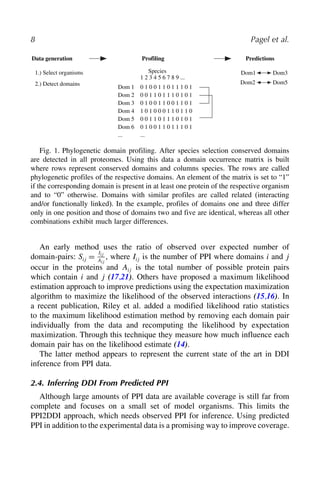
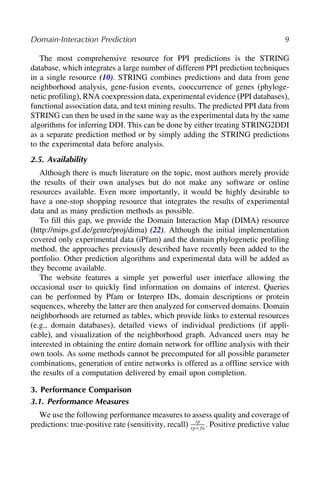
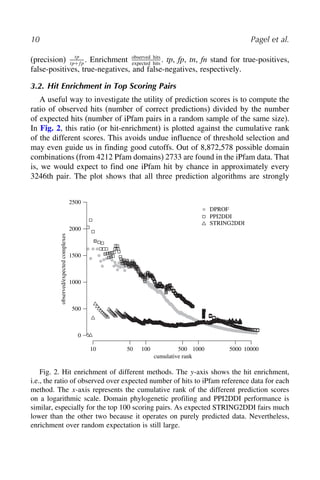
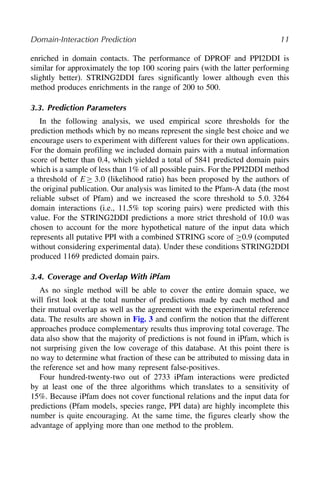
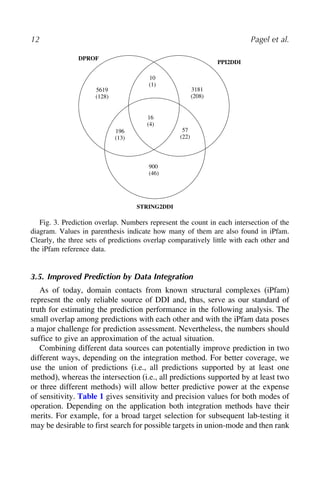
![Domain-Interaction Prediction 13
Table 1
Combining Predictions
union (∪) intersection (∩)
DPROF PPI2DDI STRING2DDI total in
iPfam
PPV
[%]
TPR
[%]
total in
iPfam
PPV
[%]
TPR
[%]
+ + + 9979 422 4.2 15.4 16 4 250 0.1
− + + 4360 294 6.7 10.8 73 26 356 1.0
+ − + 6798 214 3.1 7.8 212 17 80 0.6
+ + − 9079 376 4.1 13.8 26 5 192 0.2
− − + 1169 85 7.3 3.1 1169 85 73 3.1
− + − 3264 235 7.2 8.6 3263 235 72 8.6
+ − − 5841 146 2.5 5.3 5841 146 25 5.3
The table contains positive predictive value (PPV) and sensitivity (true-positive rate; TPR)
for union and intersection of different prediction data. The first three columns indicate which
datasets were included. These are combined by either intersection or union of the predicted pairs.
Numbers can be interpreted easily when comparing performance of the different datasets but
absolute values mean little because of the incomplete standard of truth.
the predictions by intersection. This way the maximum number of predictions
is recovered while the most promising targets are used for experimental work
first.
Clearly, performance of individual methods will depend on the choice
of thresholds but the data from the above survey already allows a rough
assessment. Both PPI2DDI and STRING2DDI showed a precision of ≈7%
under the chosen conditions, whereas the profiling method scores 2.5%. Sensi-
tivities range from 3.1% (STRING2DDI) to 8.6% (PPI2DDI) when measured
against iPfam. Of course, the absolute numbers should be interpreted with
caution because they were derived from a highly incomplete and probably
biased standard of truth and thus cannot be expected to be correct. Nevertheless
they can safely be used for comparison of results of different methods.
4. Notes
Several conclusions can be drawn on the results obtained by us and other groups
working on the problem of domain–domain interactions.
1. Overall, the PPI2DDI methods seems to produce the best results when measured
against iPfam and DPROF holds a close second place. The fairly small overlap
among them makes them valuable as complementary approaches.](https://image.slidesharecdn.com/102528-250719215728-9ee6bff4/85/Comparative-Genomics-1st-Edition-Philipp-Pagel-16-320.jpg)

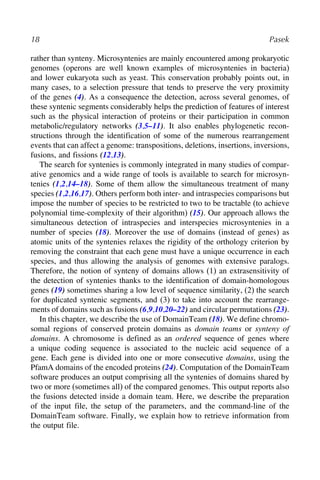
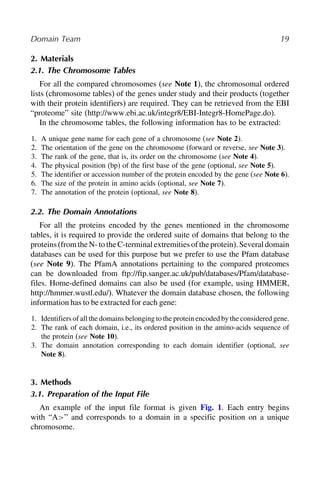
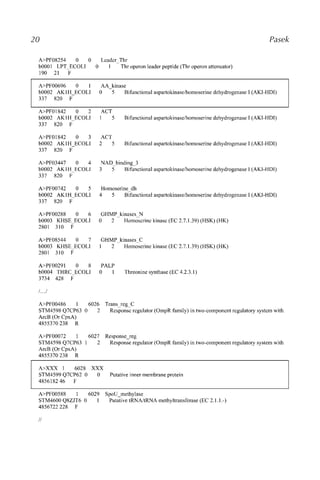
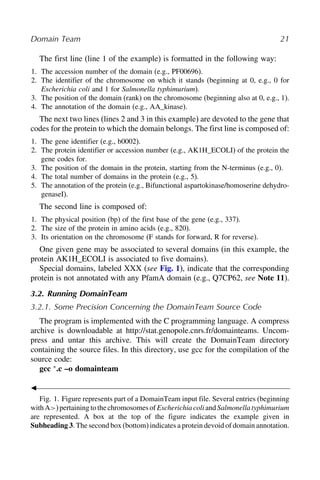
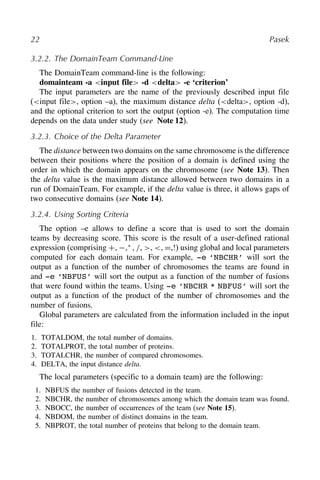

![191.
See Quest. LXII, LXIII.
192.
See Quest. LXXVIII.
193.
See Page 257.
194.
Vid. Burnet. Tellur. Theor. Lib. iv.
195.
Justin Martyr seems to speak of it not only as his own opinion,
but as that which was generally held by the orthodox in his
day, joins the belief hereof with that of the resurrection of the
dead, and supposes it to be founded on the writings of some
of the prophets. Vid. Justin Martyr Dialog. cum. Tryph. Jud.
page 307. Εγω δε, και ει τινες εισιν ορθογνουμονες κατα παντα
Χρισιανοι, και σαρκος ανας ασιν γενησεθαι επισαμεθα, και χιλια
ελη εν Ιερουσαλημ οικοδομηθειση και κοσμηθειση και
πλατυνθειση, οι προθηται Ιεζεχιηλ, και Ησαιας, και οι αλλοι
ομολογουσιν. And Irenæus [Vid. advers. Hær. Lib. V. cap. 33.]
not only gives into this opinion, but intimates, that it was
brought into the church before his time, by one Papias,
cotemporary with Polycarp, and that he recieved it from those
who had it imparted to them by the apostle John: But
Eusebius, [Vid. Euseb. Hist. Eccles. Lib. III. cap. 33.] though
he speaks concerning this Papias, as one who was intimate
with Polycarp, notwithstanding represents him as a very weak
man; and therefore there is little credit to be given to his
account of this matter, as agreeable to the apostle’s sentiments
or writings; and Irenæus himself, in the place before
mentioned, cites a passage out of the same author, which, he
pretends, he received from those that had it from the apostle
John, concerning a certain time, in which there shall be vines,](https://image.slidesharecdn.com/102528-250719215728-9ee6bff4/85/Comparative-Genomics-1st-Edition-Philipp-Pagel-30-320.jpg)
![hunger, would not be extraordinary; nor would it excite any
wonder, if the person in such exigency should find Satan
occupied in giving a turn to his ideas. There is not a mountain
on earth from whence all the kingdoms are visible; here
therefore we are obliged to give up the literal sense, and may
discover an index to the interpretation of the other
temptations.
It is not called a vision; in like manner neither did Micaiah nor
Jacob denominate their visions. They represented what
appeared to them; and so we presume Jesus related these
things to his disciples just as they appeared to his mind.
Satan, though he can and does in various ways, by external
and internal means, through the medium of our bodies,
suggest thoughts, and thus take possession of our hearts in a
certain sense; yet he knows not our thoughts; it is the
attribute of God only to search the heart. Every thing acted by
Satan in this instance could have taken place without his
knowing the mind of Christ.[215]
If it had not been in vision,
then Jesus must have spoken audibly his respective answers;
Satan would have known them, and, we presume, in some
instance replied; but there is not one reply of Satan, which is
an additional proof that he suggested the temptations, and the
Saviour resisted them by mental answers, with which the
enemy was unacquainted. Adopting this general view, the
particular parts will be easily understood.
215.
It is highly probable that Satan did not know that this was the
Christ; he speaks doubtfully of his being the “Son of God;” this
he had heard, we suppose, at his baptism, a short time before.
Satan is not omnipresent, nor omniscient, and probably knew
less than the angels of these things which they desired to pry
into. Christ’s divinity was chiefly concealed thirty years, not
always shown in his life, nor at his death. It was the man only](https://image.slidesharecdn.com/102528-250719215728-9ee6bff4/85/Comparative-Genomics-1st-Edition-Philipp-Pagel-37-320.jpg)
![261.
See page 432, seq.
262.
It may be observed, that though the learned author before-
mentioned gives sufficient evidence, from the Fathers, that
there were several places appropriated, and some erected, for
divine worship, during the three first Centuries; and he thinks,
that whether they were consecrated or no, there was a great
degree of reverence paid to them, even at such times, when
divine service was not performed in them: Yet he does not
produce any proof for this out of the writings of the Fathers, in
those Centuries; and it is impossible that he should, for from
Eusebius’s account of this matter, it appears that the
consecration of churches was first practised in the Fourth
Century, [Vid. ejusd. Hist. Eccl. Lib. X. cap. 3.] As for the
quotations that Mr. Mede brings from Chrysostom and
Ambrose, to prove that reverence was paid to the churches in
their times it must be observed, that they lived in the Fourth
Century, in which churches being not only appropriated, but
consecrated for public worship, it is no wonder to find the
Fathers of that age expressing a reverence for them.
Nevertheless, it is very evident, from the words of these
Fathers here cited, that they intend thereby nothing else but a
reverent behaviour, which ought to be expressed by those who
come into the church to perform any act of divine worship; and
this we are far from denying, whether the external rites of
consecration be used or no. As for his quotation taken from
Tertulian, who lived in the end of the Second Century it don’t
prove that he thought that reverence ought to be expressed to
the places of worship, but that the highest reverence ought to
be used in the acts of worship, and particularly in prayer, which
is an undoubted truth, whether we worship God in the church,
or any where else.](https://image.slidesharecdn.com/102528-250719215728-9ee6bff4/85/Comparative-Genomics-1st-Edition-Philipp-Pagel-47-320.jpg)