Comparative Analysis Of Air Core Inductors Across
Frequency Ranges
With their critical roles in energy storage, signal filtering, and impedance
matching, inductors are essential parts of electronic circuits. Since air core
inductors don’t have a ferromagnetic core, they stand out from other types of
inductors; and there are clear benefits and drawbacks to this core absence
across different frequency ranges. Air core inductors exhibit reduced losses and
consistent performance at lower frequencies, rendering them appropriate for a
variety of applications. On the other hand, at higher frequencies, their minimum
core material and dispersed winding reduce skin effect losses, guaranteeing high
Q factors and constant inductance values. Air core inductors function incredibly
well, yet they might not be appropriate for applications that need large
inductance values or those that operate in highly electromagnetically interfered
situations. To properly integrate air core inductors into electrical systems, one
must have a thorough understanding of their properties throughout a wide
frequency range. We’ll examine the performance traits of air core inductors at
various frequencies in this blog post and compare them with other inductors of
different kinds.
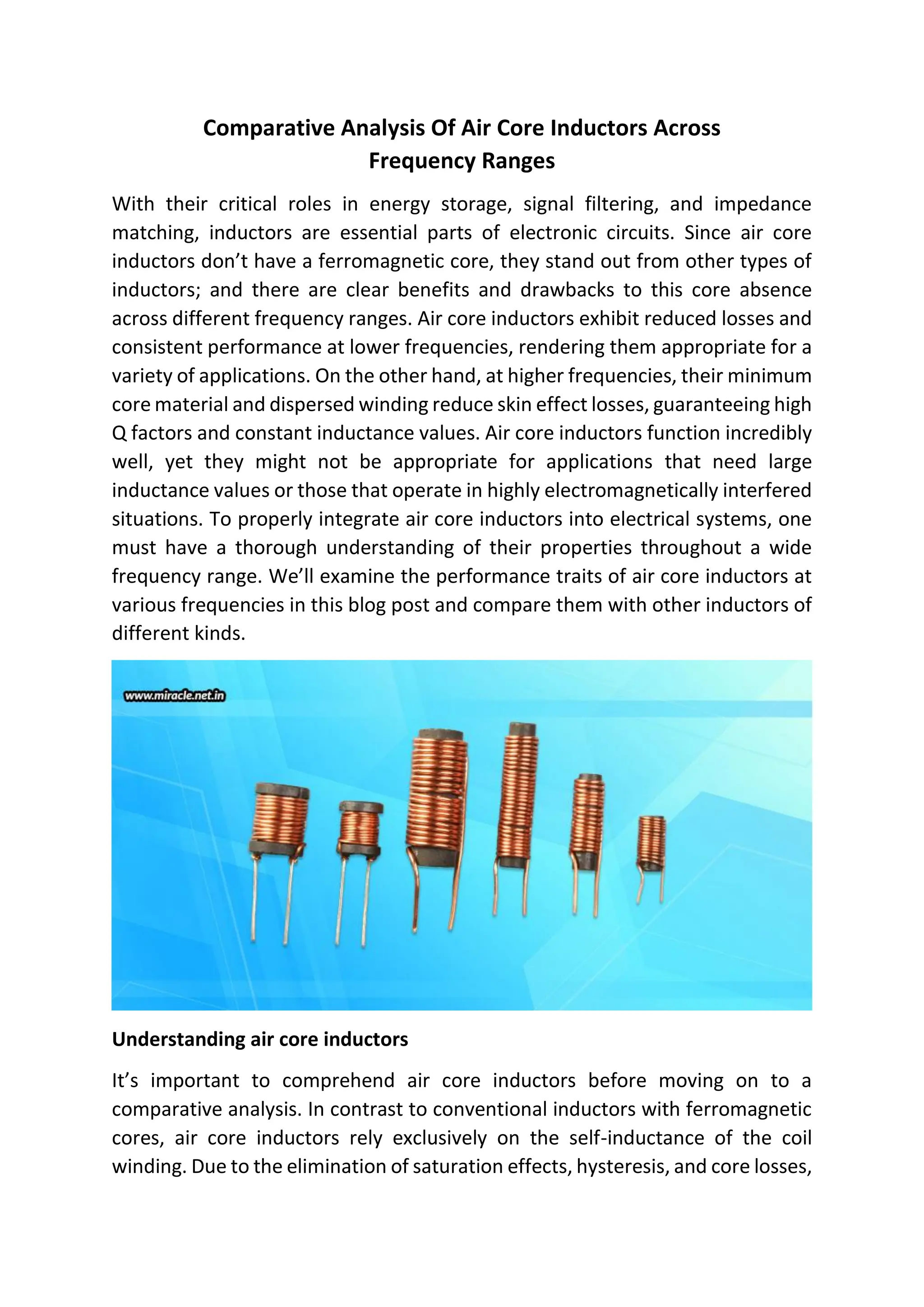
Understanding air core inductors
It’s important to comprehend air core inductors before moving on to a
comparative analysis. In contrast to conventional inductors with ferromagnetic
cores, air core inductors rely exclusively on the self-inductance of the coil
winding. Due to the elimination of saturation effects, hysteresis, and core losses,
air core inductors are the perfect choice for high-frequency applications. Their
specific control and stability across a broad frequency range are made possible
by their reliance on coil winding self-inductance, which makes them very useful
in radio frequency (RF) circuits, telecommunications systems, and other high-
frequency electronic equipment. Air core inductors are also well-suited for
applications requiring little energy loss and optimal performance because of
their low resistance and great efficiency. Gaining an appreciation for the distinct
benefits of air core inductors in diverse electronic circuit designs and
applications begins with comprehending these basic features.
Performance at low frequencies
Air core inductors function exceptionally well at lower frequencies, typically
below a few megahertz. Because they don’t have a magnetic core, they won’t
experience core saturation, guaranteeing constant inductance values across the
frequency range. Low losses are another benefit of air core inductors, which
enable effective energy transmission and storage in low-frequency circuits. This
beneficial characteristic makes them ideal for low-frequency communication
devices, power supply, audio systems, and other applications needing accurate
and consistent performance at lower frequencies. When little distortion and
great efficiency are critical, air core inductors are the favoured option due to
their ability to sustain dependable operation without the constraints imposed
by magnetic cores. Designers may efficiently utilize the advantages of air core
inductors in a variety of electronic circuit designs by being aware of these
features, optimizing performance and reliability across different frequency
ranges.
Performance at high frequencies
Because of their special qualities, air core inductors perform very well in high-
frequency applications. The skin effect gets stronger with frequency, focusing
current flow mostly in the vicinity of the conductor’s surface. On the other hand,
skin effect losses are significantly reduced by air core inductors, which have
minimum core material and scattered winding. They are able to sustain high
inductance values and quality (Q) factors even at high frequencies because of
this property. The capacity of air core inductors to offset skin effect losses
guarantees steady and effective operation in high-frequency circuits, which
makes them essential for uses in wireless technologies, radar systems, and radio
frequency (RF) communication. Engineers and designers can achieve improved
efficiency, dependability, and signal integrity by optimizing the performance of
electronic systems operating in high-frequency domains by comprehending and
utilizing these attributes.
Comparison with iron and ferrite core inductors
Due to their higher permeability and magnetic characteristics, ferrite core
inductors are used more often in low-frequency applications compared to air
core inductors. Their effectiveness in radio frequency (RF) circuits is, however,
limited by their vulnerability to saturation effects at higher frequencies. In the
high-frequency range, air core inductors outperform ferrite core inductors due
to their higher linearity and low losses. Similarly, increasing eddy current and
hysteresis losses in the core material cause significant losses and decreased
inductance values in iron core inductors, which are widely used in power
electronics and low-frequency applications, at higher frequencies. On the other
hand, air core inductors, which do not have magnetic cores, function better and
are more stable at high frequencies. These variations highlight how important
air core inductors are to RF circuits, telecommunications, and other applications
necessitating precision and efficiency across varying frequency ranges.
Frequency response and self-resonant frequency
The self-resonant frequency and frequency response of inductors are crucial
parameters for assessing their performance across a wide frequency range. In
general, air core inductors have a larger frequency response than their iron or
ferrite core equivalents. The parasitic effects that lead to self-resonant
frequency restrictions in conventional inductors are eliminated in the absence
of a magnetic core. As a result, air core inductors do not lose performance when
operating at higher frequencies. Due to their wider frequency response, air core
inductors are especially well-suited for high-frequency instrumentation,
wireless communication systems, radio frequency circuits, and other
applications that require precise and consistent performance across a large
frequency range. Designers may improve the efficiency, dependability, and
signal integrity of electronic systems by using their outstanding frequency
response properties across diverse frequency ranges.
To sum up, air core inductors provide unparalleled performance over a wide
range of frequencies, making them indispensable parts of radio frequency
circuits, telecommunications, and high-frequency applications. Because they do
not have a ferromagnetic core, they eliminate saturation effects and core losses,
guaranteeing constant inductance values and low losses even at very high
frequencies. Air core inductors become the preferred option for high-frequency
circuits requiring accuracy, efficiency, and dependability, while conventional
inductors with ferrite or iron cores find their place in low-frequency and power
applications. These inductors are sure to continue to prove essential in
determining how electronic systems and the infrastructure supporting
telecommunications will develop in the future. And, as electronic systems
evolve and telecommunications infrastructure advances, the demand for such
high-performance components like air core inductors becomes increasingly
critical. If you’re in search of such reliable and high-quality air core inductors too,
look no further than Miracle Electronics, recognized as one of the best air core
inductor manufacturers in India. Here, their unwavering commitment to
precision and ingenuity remains consistent, fuelled by the essential design
considerations involved in crafting air core inductors with meticulous attention
to detail, each time they embark on such a design endeavour.
Follow us on: Facebook & LinkedIn

Comparative Analysis Of Air Core Inductors Across Frequency Ranges.pdf

  • 1.
    Comparative Analysis OfAir Core Inductors Across Frequency Ranges With their critical roles in energy storage, signal filtering, and impedance matching, inductors are essential parts of electronic circuits. Since air core inductors don’t have a ferromagnetic core, they stand out from other types of inductors; and there are clear benefits and drawbacks to this core absence across different frequency ranges. Air core inductors exhibit reduced losses and consistent performance at lower frequencies, rendering them appropriate for a variety of applications. On the other hand, at higher frequencies, their minimum core material and dispersed winding reduce skin effect losses, guaranteeing high Q factors and constant inductance values. Air core inductors function incredibly well, yet they might not be appropriate for applications that need large inductance values or those that operate in highly electromagnetically interfered situations. To properly integrate air core inductors into electrical systems, one must have a thorough understanding of their properties throughout a wide frequency range. We’ll examine the performance traits of air core inductors at various frequencies in this blog post and compare them with other inductors of different kinds. Understanding air core inductors It’s important to comprehend air core inductors before moving on to a comparative analysis. In contrast to conventional inductors with ferromagnetic cores, air core inductors rely exclusively on the self-inductance of the coil winding. Due to the elimination of saturation effects, hysteresis, and core losses,
  • 2.
    air core inductorsare the perfect choice for high-frequency applications. Their specific control and stability across a broad frequency range are made possible by their reliance on coil winding self-inductance, which makes them very useful in radio frequency (RF) circuits, telecommunications systems, and other high- frequency electronic equipment. Air core inductors are also well-suited for applications requiring little energy loss and optimal performance because of their low resistance and great efficiency. Gaining an appreciation for the distinct benefits of air core inductors in diverse electronic circuit designs and applications begins with comprehending these basic features. Performance at low frequencies Air core inductors function exceptionally well at lower frequencies, typically below a few megahertz. Because they don’t have a magnetic core, they won’t experience core saturation, guaranteeing constant inductance values across the frequency range. Low losses are another benefit of air core inductors, which enable effective energy transmission and storage in low-frequency circuits. This beneficial characteristic makes them ideal for low-frequency communication devices, power supply, audio systems, and other applications needing accurate and consistent performance at lower frequencies. When little distortion and great efficiency are critical, air core inductors are the favoured option due to their ability to sustain dependable operation without the constraints imposed by magnetic cores. Designers may efficiently utilize the advantages of air core inductors in a variety of electronic circuit designs by being aware of these features, optimizing performance and reliability across different frequency ranges. Performance at high frequencies Because of their special qualities, air core inductors perform very well in high- frequency applications. The skin effect gets stronger with frequency, focusing current flow mostly in the vicinity of the conductor’s surface. On the other hand, skin effect losses are significantly reduced by air core inductors, which have minimum core material and scattered winding. They are able to sustain high inductance values and quality (Q) factors even at high frequencies because of this property. The capacity of air core inductors to offset skin effect losses guarantees steady and effective operation in high-frequency circuits, which makes them essential for uses in wireless technologies, radar systems, and radio frequency (RF) communication. Engineers and designers can achieve improved efficiency, dependability, and signal integrity by optimizing the performance of
  • 3.
    electronic systems operatingin high-frequency domains by comprehending and utilizing these attributes. Comparison with iron and ferrite core inductors Due to their higher permeability and magnetic characteristics, ferrite core inductors are used more often in low-frequency applications compared to air core inductors. Their effectiveness in radio frequency (RF) circuits is, however, limited by their vulnerability to saturation effects at higher frequencies. In the high-frequency range, air core inductors outperform ferrite core inductors due to their higher linearity and low losses. Similarly, increasing eddy current and hysteresis losses in the core material cause significant losses and decreased inductance values in iron core inductors, which are widely used in power electronics and low-frequency applications, at higher frequencies. On the other hand, air core inductors, which do not have magnetic cores, function better and are more stable at high frequencies. These variations highlight how important air core inductors are to RF circuits, telecommunications, and other applications necessitating precision and efficiency across varying frequency ranges. Frequency response and self-resonant frequency The self-resonant frequency and frequency response of inductors are crucial parameters for assessing their performance across a wide frequency range. In general, air core inductors have a larger frequency response than their iron or ferrite core equivalents. The parasitic effects that lead to self-resonant frequency restrictions in conventional inductors are eliminated in the absence of a magnetic core. As a result, air core inductors do not lose performance when operating at higher frequencies. Due to their wider frequency response, air core inductors are especially well-suited for high-frequency instrumentation, wireless communication systems, radio frequency circuits, and other applications that require precise and consistent performance across a large frequency range. Designers may improve the efficiency, dependability, and signal integrity of electronic systems by using their outstanding frequency response properties across diverse frequency ranges. To sum up, air core inductors provide unparalleled performance over a wide range of frequencies, making them indispensable parts of radio frequency circuits, telecommunications, and high-frequency applications. Because they do not have a ferromagnetic core, they eliminate saturation effects and core losses, guaranteeing constant inductance values and low losses even at very high
  • 4.
    frequencies. Air coreinductors become the preferred option for high-frequency circuits requiring accuracy, efficiency, and dependability, while conventional inductors with ferrite or iron cores find their place in low-frequency and power applications. These inductors are sure to continue to prove essential in determining how electronic systems and the infrastructure supporting telecommunications will develop in the future. And, as electronic systems evolve and telecommunications infrastructure advances, the demand for such high-performance components like air core inductors becomes increasingly critical. If you’re in search of such reliable and high-quality air core inductors too, look no further than Miracle Electronics, recognized as one of the best air core inductor manufacturers in India. Here, their unwavering commitment to precision and ingenuity remains consistent, fuelled by the essential design considerations involved in crafting air core inductors with meticulous attention to detail, each time they embark on such a design endeavour. Follow us on: Facebook & LinkedIn