COMPARABILITY ANALYSIS
USING ROYALTY RATES
The content of these slides is not for public distribution and may not be copied or distributed without the Author’s permission. All Copyrights Reserved.
Marcia Coutinho
mcoutinho@royaltystat.com
Ilona Aigro
iaigro@royaltystat.com
TP Minds International – 16th March, 2016 - London
1) included or not in the definition of intangibles.
The content of these slides is not for public distribution and may not be copied or distributed without the Author’s permission. All Copyrights Reserved.
Comparability Standard
1)  “To be comparable means that none of the differences (if any) between the situations
being compared could materially affect the condition being examined in the methodology
(e.g. price or margin), or that reasonably accurate adjustments can be made to eliminate the
effect of any such differences.” (OECD 2010, ¶ 1.33).
2)  In the case of intangible property, it is important to consider characteristics like the form
of transaction (e.g. licensing or sale), the type of property (e.g. patent, trademark, or know-
how), the duration and degree of protection, and the anticipated benefits from the use of
the property. (OECD 2010, ¶ 1.39).
1) included or not in the definition of intangibles.
The content of these slides is not for public distribution and may not be copied or distributed without the Author’s permission. All Copyrights Reserved.
Analysis of Contractual Terms
Several factors conveyed in license agreements may affect comparability and royalty rates.
Among the most common are:
•  Exclusivity
•  Duration
•  Territory
•  License rights
•  Additional payments (upfront fees, milestones, etc.)
•  Tiered or not tiered royalty rates
1) included or not in the definition of intangibles.
The content of these slides is not for public distribution and may not be copied or distributed without the Author’s permission. All Copyrights Reserved.
Royalty Rate Models
Royalty arrangements in intangible licenses may be simple or complex.
1)  A simple model is when a royalty rate is the only license payment:
License Payment = Royalty Rate * Revenue
2)  A complex model may include tiered royalty rates, upfront fees, milestone
payments, and debt, warrants or equity investments by the licensee in the
licensor’s business:
License Payment = (Royalty Rate * Revenue) + Additional Payments
1) included or not in the definition of intangibles.
The content of these slides is not for public distribution and may not be copied or distributed without the Author’s permission. All Copyrights Reserved.
Challenges in Finding Comparables for Intangibles
1)  Restrictive disclosure rules. To our knowledge, the U.S. is the only country that requires
“material contracts” (e.g., license agreements) to be disclosed to the public.
2)  Large companies may not disclose intangible license agreements, because they may be
immaterial to the business.
3)  Confidential treatment. Most license agreements are granted confidential treatment by
the SEC under which the royalty rate is not disclosed.
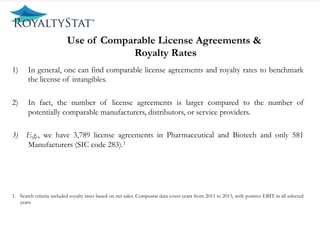
Use of Comparable License Agreements &
Royalty Rates
1)  In general, one can find comparable license agreements and royalty rates to benchmark
the license of intangibles.
2)  In fact, the number of license agreements is larger compared to the number of
potentially comparable manufacturers, distributors, or service providers.
3)  E.g., we have 3,789 license agreements in Pharmaceutical and Biotech and only 581
Manufacturers (SIC code 283).1
1.  Search criteria included royalty rates based on net sales. Compustat data cover years from 2011 to 2013, with positive EBIT in all selected
years.
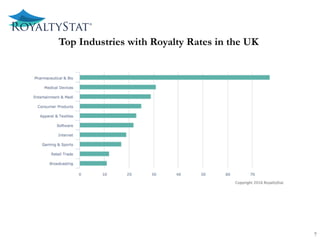
Top Industries with Royalty Rates in the UK
7
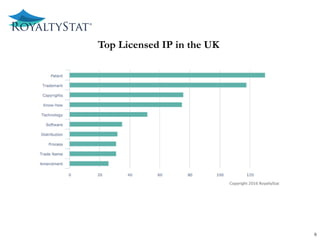
Top Licensed IP in the UK
8
1) included or not in the definition of intangibles.
The content of these slides is not for public distribution and may not be copied or distributed without the Author’s permission. All Copyrights Reserved.
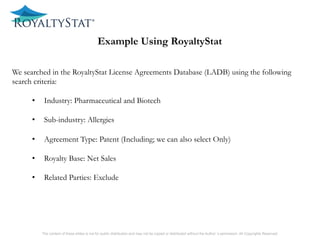
Example Using RoyaltyStat
We searched in the RoyaltyStat License Agreements Database (LADB) using the following
search criteria:
•  Industry: Pharmaceutical and Biotech
•  Sub-industry: Allergies
•  Agreement Type: Patent (Including; we can also select Only)
•  Royalty Base: Net Sales
•  Related Parties: Exclude
1) included or not in the definition of intangibles.
The content of these slides is not for public distribution and may not be copied or distributed without the Author’s permission. All Copyrights Reserved.
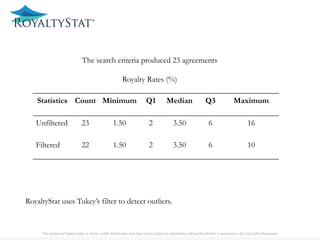
The search criteria produced 23 agreements
Royalty Rates (%)
Statistics Count Minimum Q1 Median Q3 Maximum
Unfiltered 23 1.50 2 3.50 6 16
Filtered 22 1.50 2 3.50 6 10
RoyaltyStat uses Tukey’s filter to detect outliers.
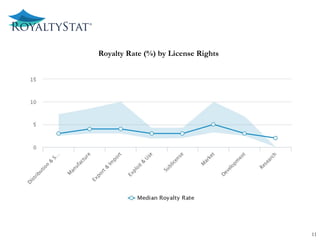
Royalty Rate (%) by License Rights
11
1) included or not in the definition of intangibles.
The content of these slides is not for public distribution and may not be copied or distributed without the Author’s permission. All Copyrights Reserved.
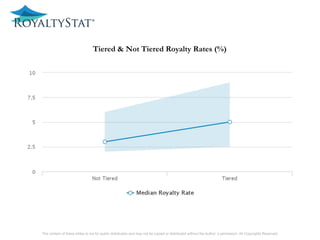
Tiered & Not Tiered Royalty Rates (%)
1) included or not in the definition of intangibles.
The content of these slides is not for public distribution and may not be copied or distributed without the Author’s permission. All Copyrights Reserved.
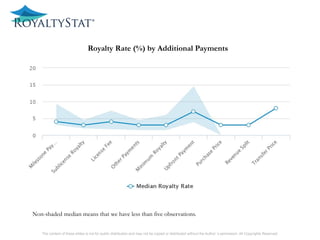
Royalty Rate (%) by Additional Payments
Non-shaded median means that we have less than five observations.
Conclusion
•  We have a large number of license agreements available for the comparability
analysis of contractual terms.
•  Over 17,000 unique and unredacted license agreements covering many industries,
type of intangibles (patent, know-how, software, trademark), countries, and years.
In the example used:
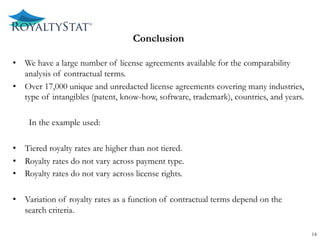
•  Tiered royalty rates are higher than not tiered.
•  Royalty rates do not vary across payment type.
•  Royalty rates do not vary across license rights.
•  Variation of royalty rates as a function of contractual terms depend on the
search criteria.
14
COMPARABILITY ANALYSIS
USING ROYALTY RATES
Thank you!
The content of these slides is not for public distribution and may not be copied or distributed without the Author’s permission. All Copyrights Reserved.
Marcia Coutinho
+1202-468-3103
mcoutinho@royaltystat.com
Ilona Aigro
+1202-558-2356
iaigro@royaltystat.com

Comparability analysis using royalty rates

  • 1.
    COMPARABILITY ANALYSIS USING ROYALTYRATES The content of these slides is not for public distribution and may not be copied or distributed without the Author’s permission. All Copyrights Reserved. Marcia Coutinho mcoutinho@royaltystat.com Ilona Aigro iaigro@royaltystat.com TP Minds International – 16th March, 2016 - London
  • 2.
    1) included or notin the definition of intangibles. The content of these slides is not for public distribution and may not be copied or distributed without the Author’s permission. All Copyrights Reserved. Comparability Standard 1)  “To be comparable means that none of the differences (if any) between the situations being compared could materially affect the condition being examined in the methodology (e.g. price or margin), or that reasonably accurate adjustments can be made to eliminate the effect of any such differences.” (OECD 2010, ¶ 1.33). 2)  In the case of intangible property, it is important to consider characteristics like the form of transaction (e.g. licensing or sale), the type of property (e.g. patent, trademark, or know- how), the duration and degree of protection, and the anticipated benefits from the use of the property. (OECD 2010, ¶ 1.39).
  • 3.
    1) included or notin the definition of intangibles. The content of these slides is not for public distribution and may not be copied or distributed without the Author’s permission. All Copyrights Reserved. Analysis of Contractual Terms Several factors conveyed in license agreements may affect comparability and royalty rates. Among the most common are: •  Exclusivity •  Duration •  Territory •  License rights •  Additional payments (upfront fees, milestones, etc.) •  Tiered or not tiered royalty rates
  • 4.
    1) included or notin the definition of intangibles. The content of these slides is not for public distribution and may not be copied or distributed without the Author’s permission. All Copyrights Reserved. Royalty Rate Models Royalty arrangements in intangible licenses may be simple or complex. 1)  A simple model is when a royalty rate is the only license payment: License Payment = Royalty Rate * Revenue 2)  A complex model may include tiered royalty rates, upfront fees, milestone payments, and debt, warrants or equity investments by the licensee in the licensor’s business: License Payment = (Royalty Rate * Revenue) + Additional Payments
  • 5.
    1) included or notin the definition of intangibles. The content of these slides is not for public distribution and may not be copied or distributed without the Author’s permission. All Copyrights Reserved. Challenges in Finding Comparables for Intangibles 1)  Restrictive disclosure rules. To our knowledge, the U.S. is the only country that requires “material contracts” (e.g., license agreements) to be disclosed to the public. 2)  Large companies may not disclose intangible license agreements, because they may be immaterial to the business. 3)  Confidential treatment. Most license agreements are granted confidential treatment by the SEC under which the royalty rate is not disclosed.
  • 6.
    Use of ComparableLicense Agreements & Royalty Rates 1)  In general, one can find comparable license agreements and royalty rates to benchmark the license of intangibles. 2)  In fact, the number of license agreements is larger compared to the number of potentially comparable manufacturers, distributors, or service providers. 3)  E.g., we have 3,789 license agreements in Pharmaceutical and Biotech and only 581 Manufacturers (SIC code 283).1 1.  Search criteria included royalty rates based on net sales. Compustat data cover years from 2011 to 2013, with positive EBIT in all selected years.
  • 7.
    Top Industries withRoyalty Rates in the UK 7
  • 8.
    Top Licensed IPin the UK 8
  • 9.
    1) included or notin the definition of intangibles. The content of these slides is not for public distribution and may not be copied or distributed without the Author’s permission. All Copyrights Reserved. Example Using RoyaltyStat We searched in the RoyaltyStat License Agreements Database (LADB) using the following search criteria: •  Industry: Pharmaceutical and Biotech •  Sub-industry: Allergies •  Agreement Type: Patent (Including; we can also select Only) •  Royalty Base: Net Sales •  Related Parties: Exclude
  • 10.
    1) included or notin the definition of intangibles. The content of these slides is not for public distribution and may not be copied or distributed without the Author’s permission. All Copyrights Reserved. The search criteria produced 23 agreements Royalty Rates (%) Statistics Count Minimum Q1 Median Q3 Maximum Unfiltered 23 1.50 2 3.50 6 16 Filtered 22 1.50 2 3.50 6 10 RoyaltyStat uses Tukey’s filter to detect outliers.
  • 11.
    Royalty Rate (%)by License Rights 11
  • 12.
    1) included or notin the definition of intangibles. The content of these slides is not for public distribution and may not be copied or distributed without the Author’s permission. All Copyrights Reserved. Tiered & Not Tiered Royalty Rates (%)
  • 13.
    1) included or notin the definition of intangibles. The content of these slides is not for public distribution and may not be copied or distributed without the Author’s permission. All Copyrights Reserved. Royalty Rate (%) by Additional Payments Non-shaded median means that we have less than five observations.
  • 14.
    Conclusion •  We havea large number of license agreements available for the comparability analysis of contractual terms. •  Over 17,000 unique and unredacted license agreements covering many industries, type of intangibles (patent, know-how, software, trademark), countries, and years. In the example used: •  Tiered royalty rates are higher than not tiered. •  Royalty rates do not vary across payment type. •  Royalty rates do not vary across license rights. •  Variation of royalty rates as a function of contractual terms depend on the search criteria. 14
  • 15.
    COMPARABILITY ANALYSIS USING ROYALTYRATES Thank you! The content of these slides is not for public distribution and may not be copied or distributed without the Author’s permission. All Copyrights Reserved. Marcia Coutinho +1202-468-3103 mcoutinho@royaltystat.com Ilona Aigro +1202-558-2356 iaigro@royaltystat.com