SOCIAL MEDIA
Group Members:
Aleena-14324
Amna-14314
Aqib-10856
Faiza-14326
Riffat-14203
Sana-12877
Term Presentation Computer
Applications
Course Code: MIS 401
Semester: Fall 2012
Faculty: Syed Farhan Mazhar
1
INTRODUCTION TO SOCIAL MEDIA
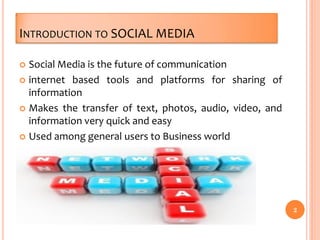
 Social Media is the future of communication
 internet based tools and platforms for sharing of
information
 Makes the transfer of text, photos, audio, video, and
information very quick and easy
 Used among general users to Business world
2
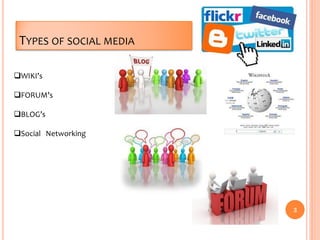
TYPES OF SOCIAL MEDIA
WIKI’s
FORUM’s
BLOG’s
Social Networking
3
WIKI’S
 Developed in mid-1990s
 To provide collaborative discussions
 Allows the user to add in or to erase something via a web
browser
 It does not welcome casual visitors
 It works on the phenomenon of “multiple collaborations
 It promotes democratic use of a website
4
ESSENTIAL’S OF WIKI’S
 Unique Feature  its multiple contributors
 A wiki web page may be authored and edited by a
number of people.
 Not only may an individual contributor edit their own
work, but also edit the work of others.
 Wiki pages are always in the process of being edited.
5
APPLICATIONS OF WIKI’S
 A wiki can be a great way to plan and manage a project,
from conception to completion.
 In the early 2000s, wikis was increasingly adopted in
enterprise as collaborative software
 Common uses included project communication, intranets,
and documentation, initially for technical users
6
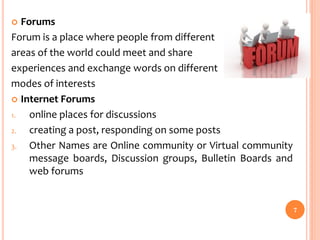
 Forums
Forum is a place where people from different
areas of the world could meet and share
experiences and exchange words on different
modes of interests
 Internet Forums
1. online places for discussions
2. creating a post, responding on some posts
3. Other Names are Online community or Virtual community
message boards, Discussion groups, Bulletin Boards and
web forums
7
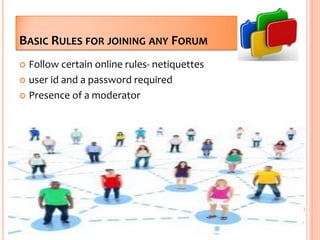
BASIC RULES FOR JOINING ANY FORUM
 Follow certain online rules- netiquettes
 user id and a password required
 Presence of a moderator
8
ADVANTAGES & DISADVANTAGES OF FORUMS
 Text-based
 No physical cues
 Information overload
 Threads
 Time lag
 Inefficient
• Flexibility
• Leveling
• Documented
• Encourages reflection
• Relevance
9
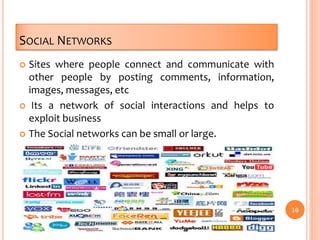
SOCIAL NETWORKS
 Sites where people connect and communicate with
other people by posting comments, information,
images, messages, etc
 Its a network of social interactions and helps to
exploit business
 The Social networks can be small or large.
10
7 MAJOR CATEGORIES OF SOCIAL NETWORKING
 1. Social Connections
 2. Multimedia Sharing
 3. Professional
 4. Informational
 5. Educational
 6. Hobbies
 7. Academic
11
SIGNIFICANT ADVANTAGES OF SOCIAL MEDIA
 In business it creates cost effective strategies
and campaigns
 It has a power to attract people to your website, blog,
articles, etc
 It enables people to meet at a single point global wise
and share their views
 Social media marketing could always be a fun and
creative method of doing business
12
 Mag-nify our existing social
behav-iors.
 Social media users tend to have
larger social cir-cles and more
close social ties than non-​users
Research
 The research sug-gests that
social media can cat-alyze close,
sup-portive, civi-cally engaged
relationships.
 Negative impacts on Students
 Negative impacts on Common
People
Positives Negatives
EFFECTS OF SOCIAL MEDIA ON SOCIETY
13
CONCLUSION
1. Social media is very fast growing medium in all over the
world got a huge attention of individuals & businesses.
2. In near future further evolution of how to produce and
consume marketing messages Is expected to be seen
3. People are more focused towards social media & giving less
time to mass media
4. Becoming the best place for customer services
5. Portable devices are also increasing the integration of mass &
social media
6. Have room to grow and rectify along with rectifying negative
impacts to make a it a more useful tool
14

Comp apps final presentation

  • 1.
    SOCIAL MEDIA Group Members: Aleena-14324 Amna-14314 Aqib-10856 Faiza-14326 Riffat-14203 Sana-12877 TermPresentation Computer Applications Course Code: MIS 401 Semester: Fall 2012 Faculty: Syed Farhan Mazhar 1
  • 2.
    INTRODUCTION TO SOCIALMEDIA  Social Media is the future of communication  internet based tools and platforms for sharing of information  Makes the transfer of text, photos, audio, video, and information very quick and easy  Used among general users to Business world 2
  • 3.
    TYPES OF SOCIALMEDIA WIKI’s FORUM’s BLOG’s Social Networking 3
  • 4.
    WIKI’S  Developed inmid-1990s  To provide collaborative discussions  Allows the user to add in or to erase something via a web browser  It does not welcome casual visitors  It works on the phenomenon of “multiple collaborations  It promotes democratic use of a website 4
  • 5.
    ESSENTIAL’S OF WIKI’S Unique Feature  its multiple contributors  A wiki web page may be authored and edited by a number of people.  Not only may an individual contributor edit their own work, but also edit the work of others.  Wiki pages are always in the process of being edited. 5
  • 6.
    APPLICATIONS OF WIKI’S A wiki can be a great way to plan and manage a project, from conception to completion.  In the early 2000s, wikis was increasingly adopted in enterprise as collaborative software  Common uses included project communication, intranets, and documentation, initially for technical users 6
  • 7.
     Forums Forum isa place where people from different areas of the world could meet and share experiences and exchange words on different modes of interests  Internet Forums 1. online places for discussions 2. creating a post, responding on some posts 3. Other Names are Online community or Virtual community message boards, Discussion groups, Bulletin Boards and web forums 7
  • 8.
    BASIC RULES FORJOINING ANY FORUM  Follow certain online rules- netiquettes  user id and a password required  Presence of a moderator 8
  • 9.
    ADVANTAGES & DISADVANTAGESOF FORUMS  Text-based  No physical cues  Information overload  Threads  Time lag  Inefficient • Flexibility • Leveling • Documented • Encourages reflection • Relevance 9
  • 10.
    SOCIAL NETWORKS  Siteswhere people connect and communicate with other people by posting comments, information, images, messages, etc  Its a network of social interactions and helps to exploit business  The Social networks can be small or large. 10
  • 11.
    7 MAJOR CATEGORIESOF SOCIAL NETWORKING  1. Social Connections  2. Multimedia Sharing  3. Professional  4. Informational  5. Educational  6. Hobbies  7. Academic 11
  • 12.
    SIGNIFICANT ADVANTAGES OFSOCIAL MEDIA  In business it creates cost effective strategies and campaigns  It has a power to attract people to your website, blog, articles, etc  It enables people to meet at a single point global wise and share their views  Social media marketing could always be a fun and creative method of doing business 12
  • 13.
     Mag-nify ourexisting social behav-iors.  Social media users tend to have larger social cir-cles and more close social ties than non-​users Research  The research sug-gests that social media can cat-alyze close, sup-portive, civi-cally engaged relationships.  Negative impacts on Students  Negative impacts on Common People Positives Negatives EFFECTS OF SOCIAL MEDIA ON SOCIETY 13
  • 14.
    CONCLUSION 1. Social mediais very fast growing medium in all over the world got a huge attention of individuals & businesses. 2. In near future further evolution of how to produce and consume marketing messages Is expected to be seen 3. People are more focused towards social media & giving less time to mass media 4. Becoming the best place for customer services 5. Portable devices are also increasing the integration of mass & social media 6. Have room to grow and rectify along with rectifying negative impacts to make a it a more useful tool 14