Input Devices
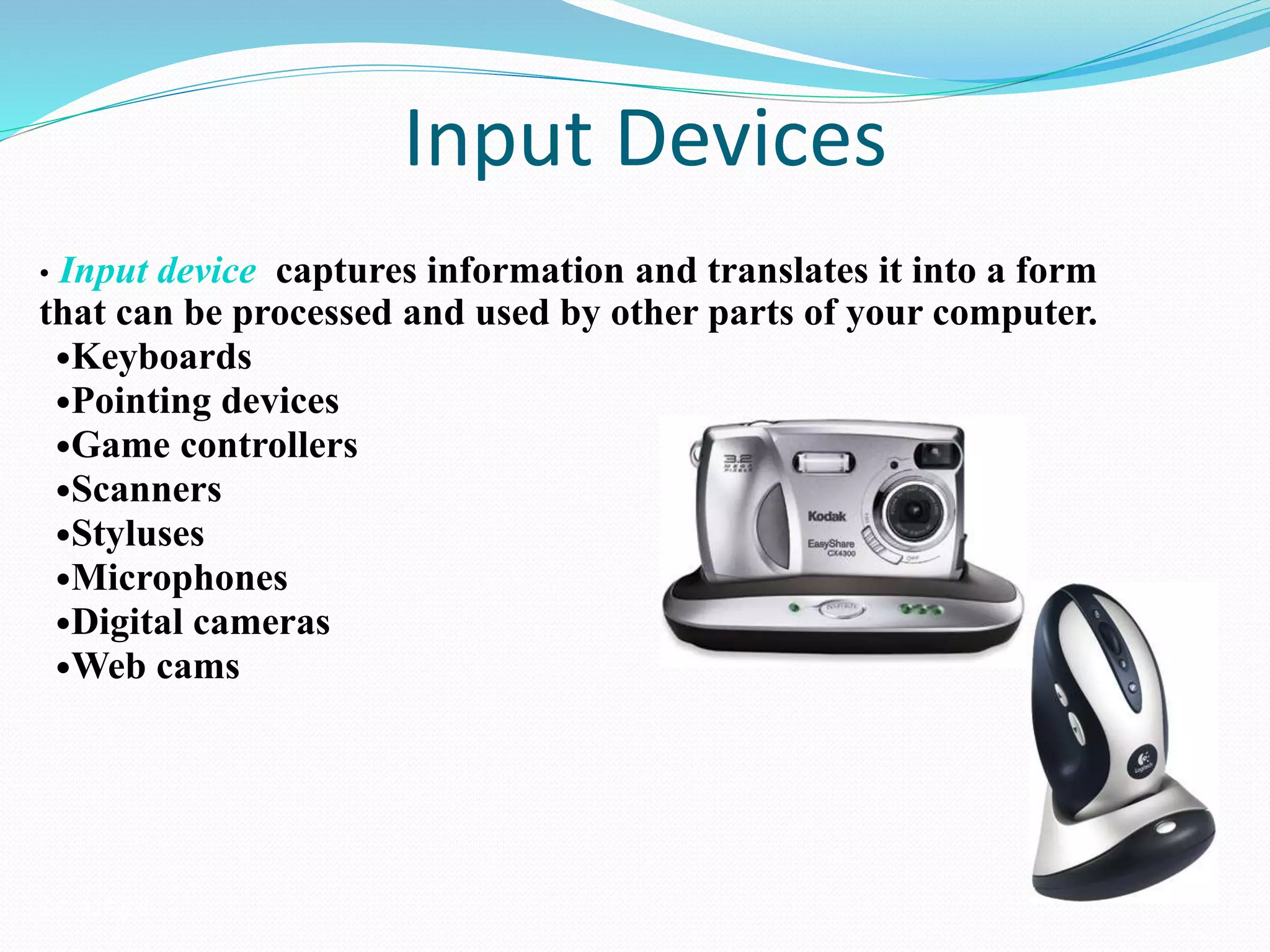
• Input device captures information and translates it into a form
that can be processed and used by other parts of your computer.
Keyboards
Pointing devices
Game controllers
Scanners
Styluses
Microphones
Digital cameras
Web cams
p. 5.130 Fig. 5-1
Trackball
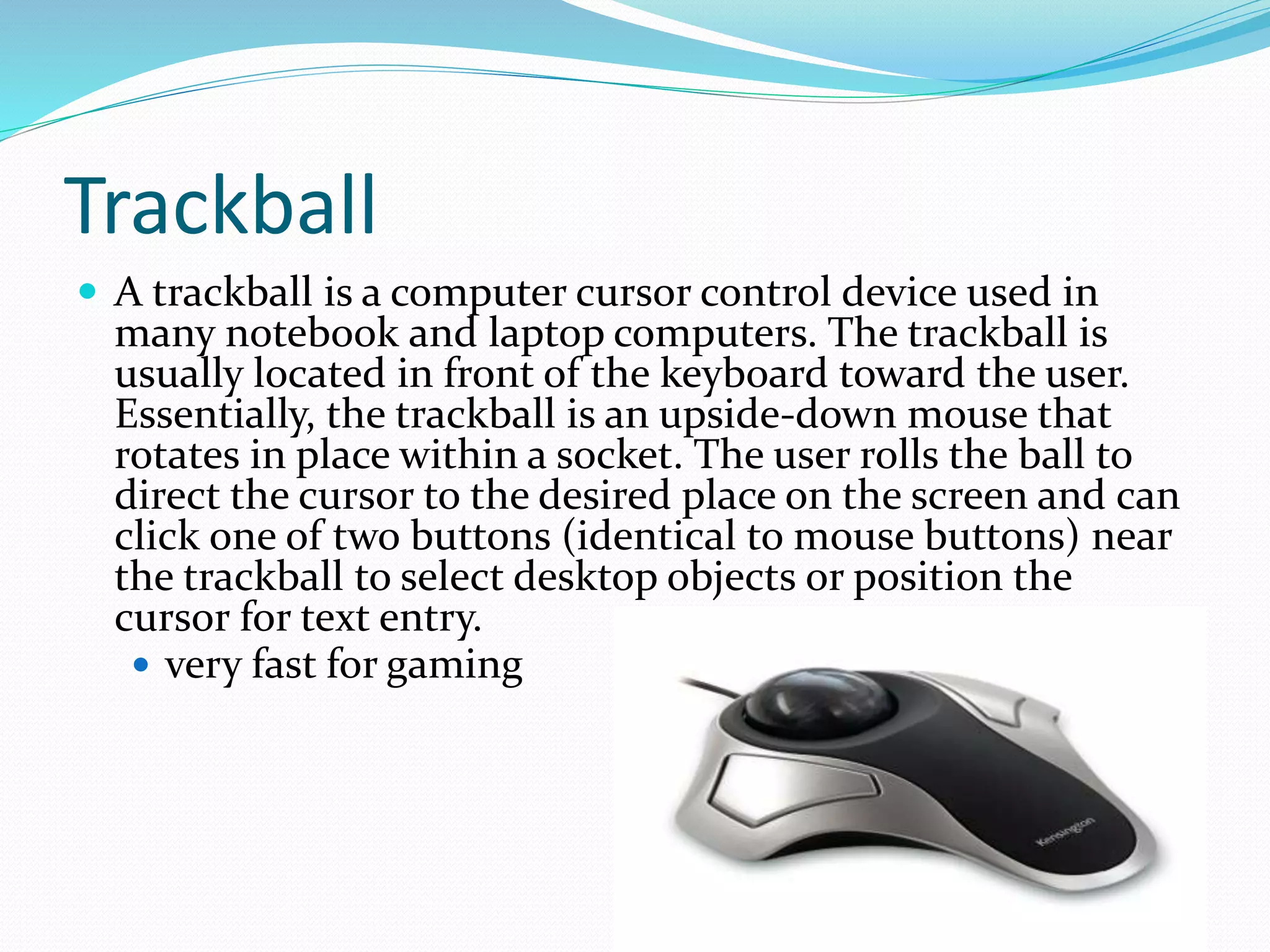
 A trackball is a computer cursor control device used in
many notebook and laptop computers. The trackball is
usually located in front of the keyboard toward the user.
Essentially, the trackball is an upside-down mouse that
rotates in place within a socket. The user rolls the ball to
direct the cursor to the desired place on the screen and can
click one of two buttons (identical to mouse buttons) near
the trackball to select desktop objects or position the
cursor for text entry.
 very fast for gaming
Trackball
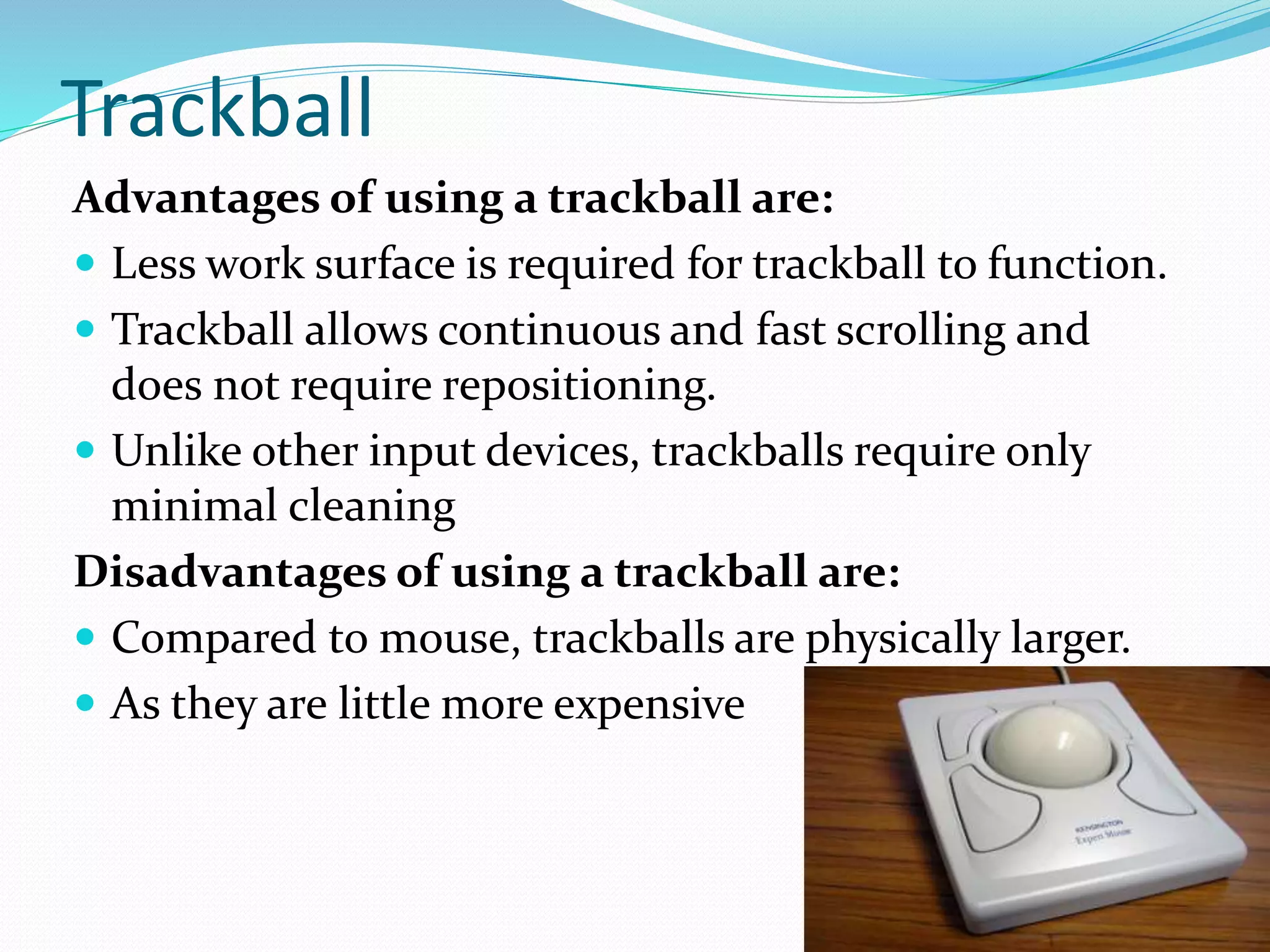
Advantages of using a trackball are:
 Less work surface is required for trackball to function.
 Trackball allows continuous and fast scrolling and
does not require repositioning.
 Unlike other input devices, trackballs require only
minimal cleaning
Disadvantages of using a trackball are:
 Compared to mouse, trackballs are physically larger.
 As they are little more expensive
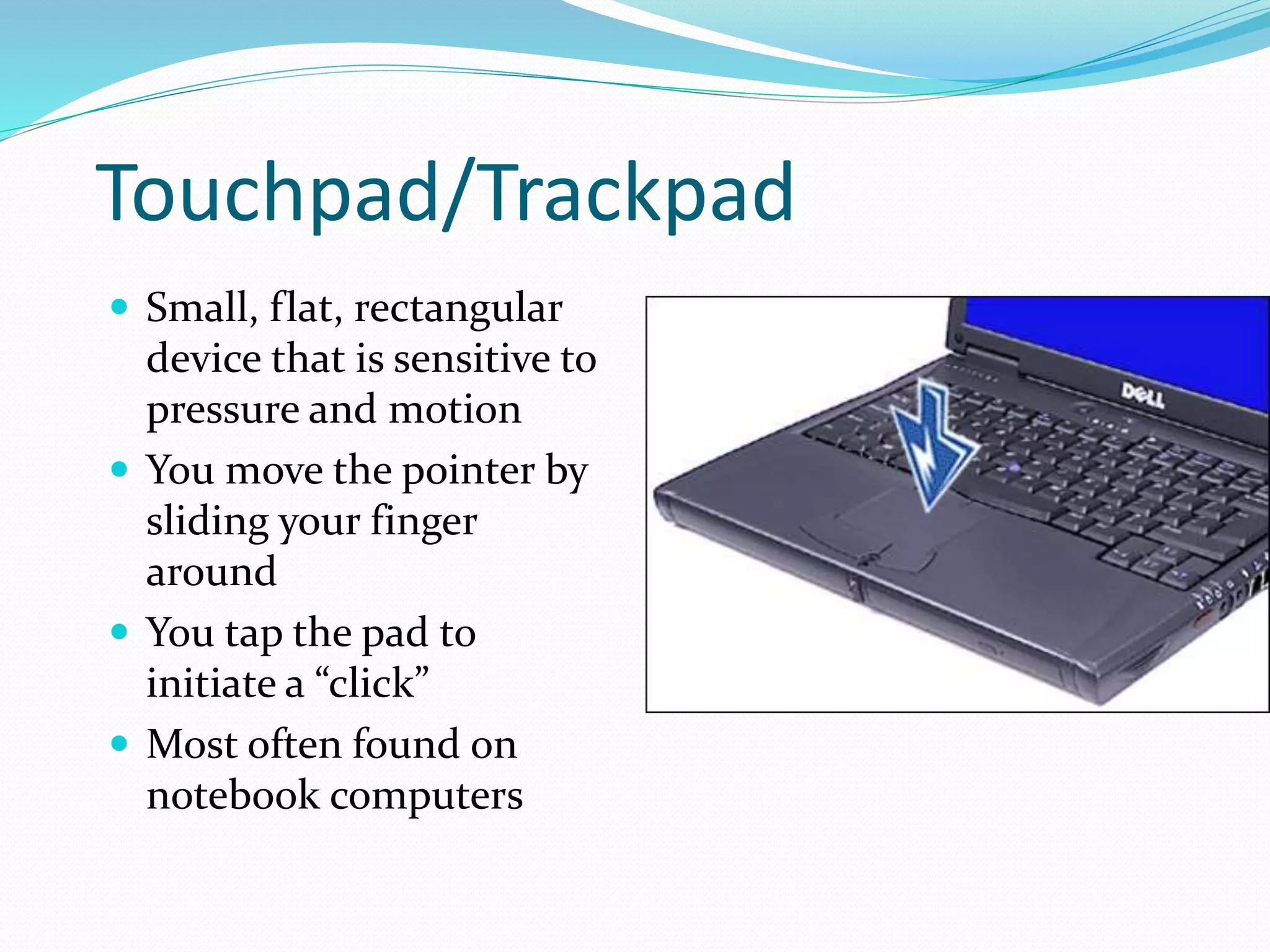
Touchpad/Trackpad
 Small, flat, rectangular
device that is sensitive to
pressure and motion
 You move the pointer by
sliding your finger
around
 You tap the pad to
initiate a “click”
 Most often found on
notebook computers
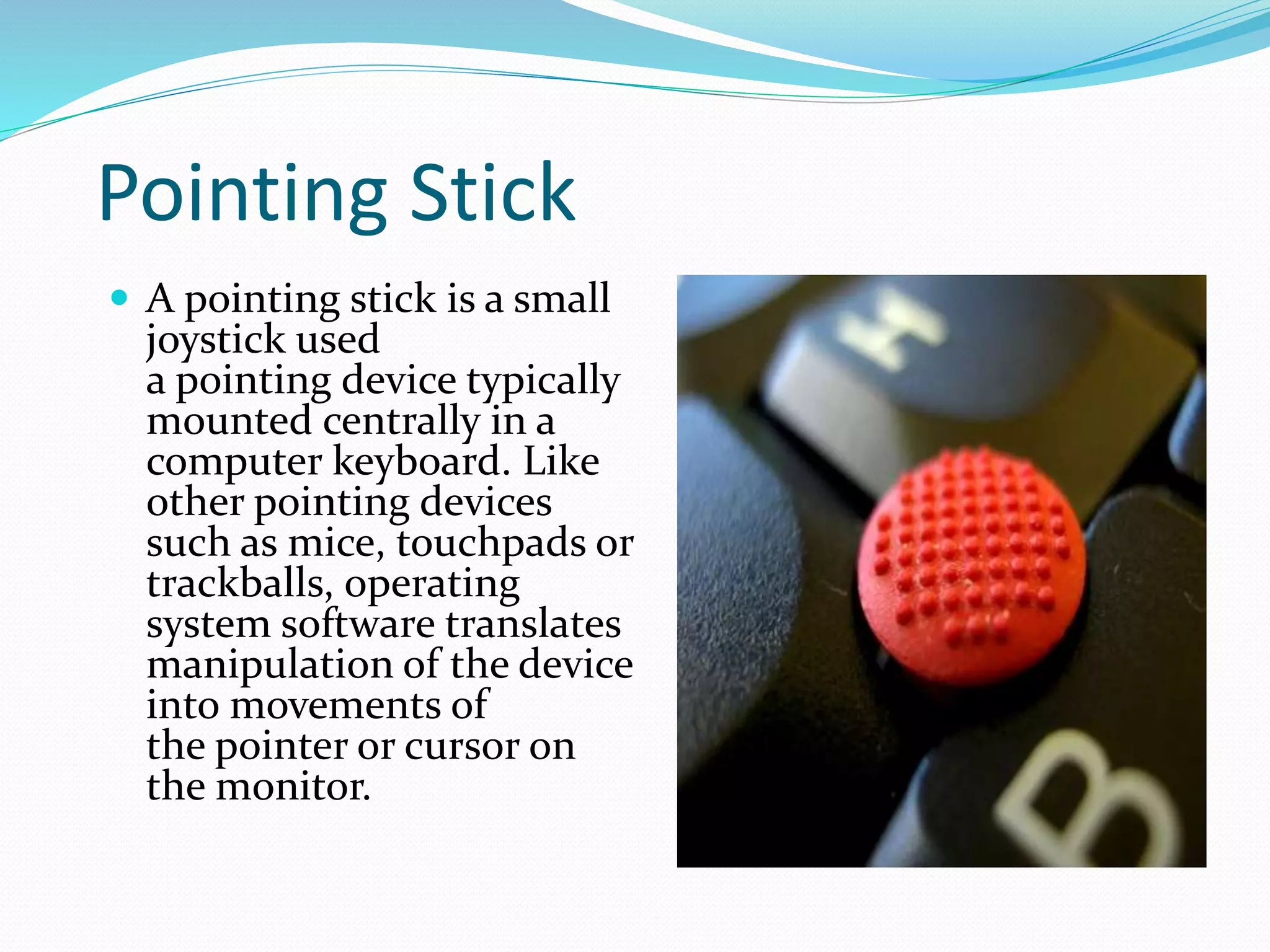
Pointing Stick
 A pointing stick is a small
joystick used
a pointing device typically
mounted centrally in a
computer keyboard. Like
other pointing devices
such as mice, touchpads or
trackballs, operating
system software translates
manipulation of the device
into movements of
the pointer or cursor on
the monitor.
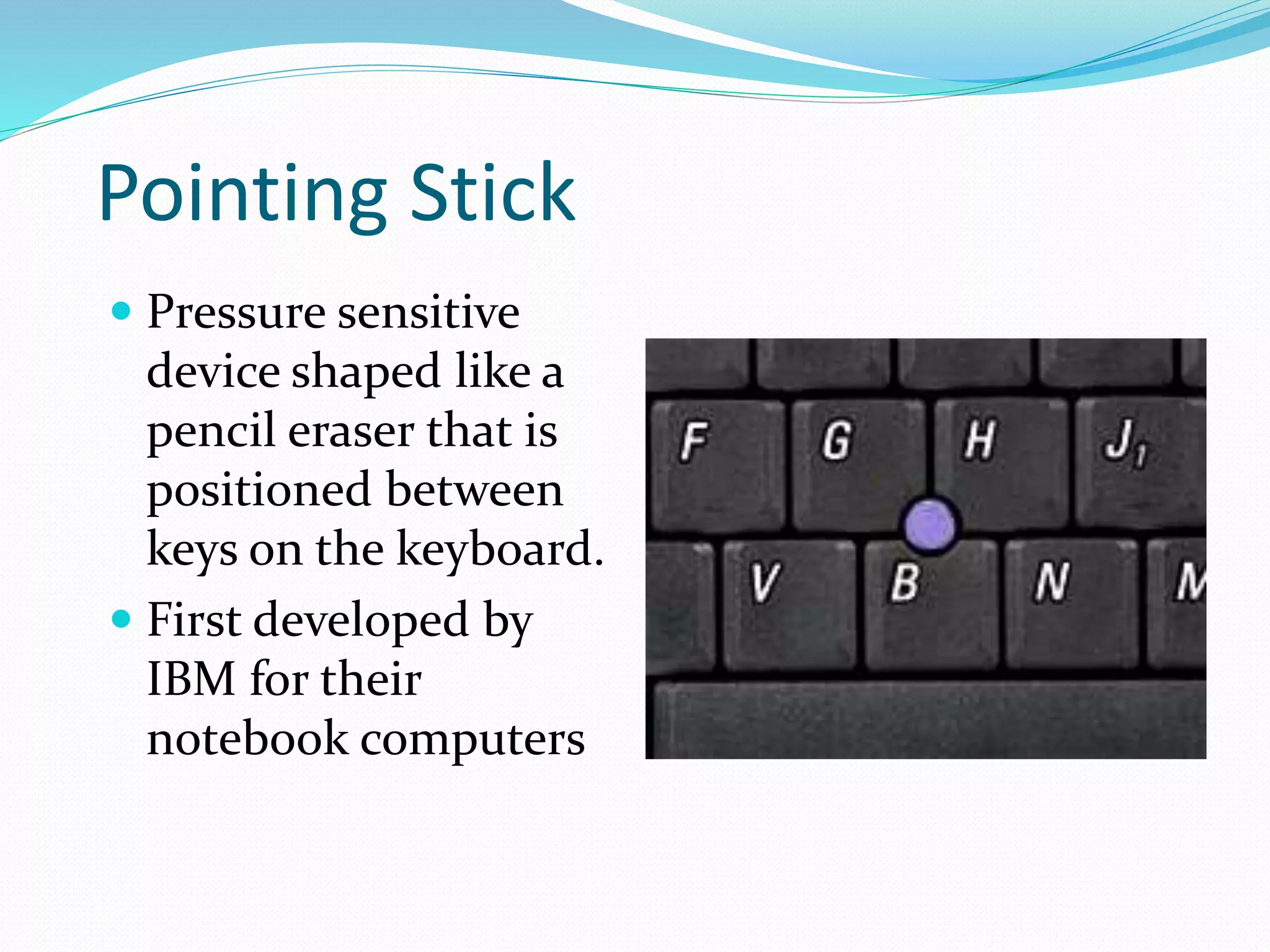
Pointing Stick
 Pressure sensitive
device shaped like a
pencil eraser that is
positioned between
keys on the keyboard.
 First developed by
IBM for their
notebook computers
Joystick & Wheel
 These devices are used
for game software or
flight and driving
software.
 The name joystick comes
from early history in
aircraft control.
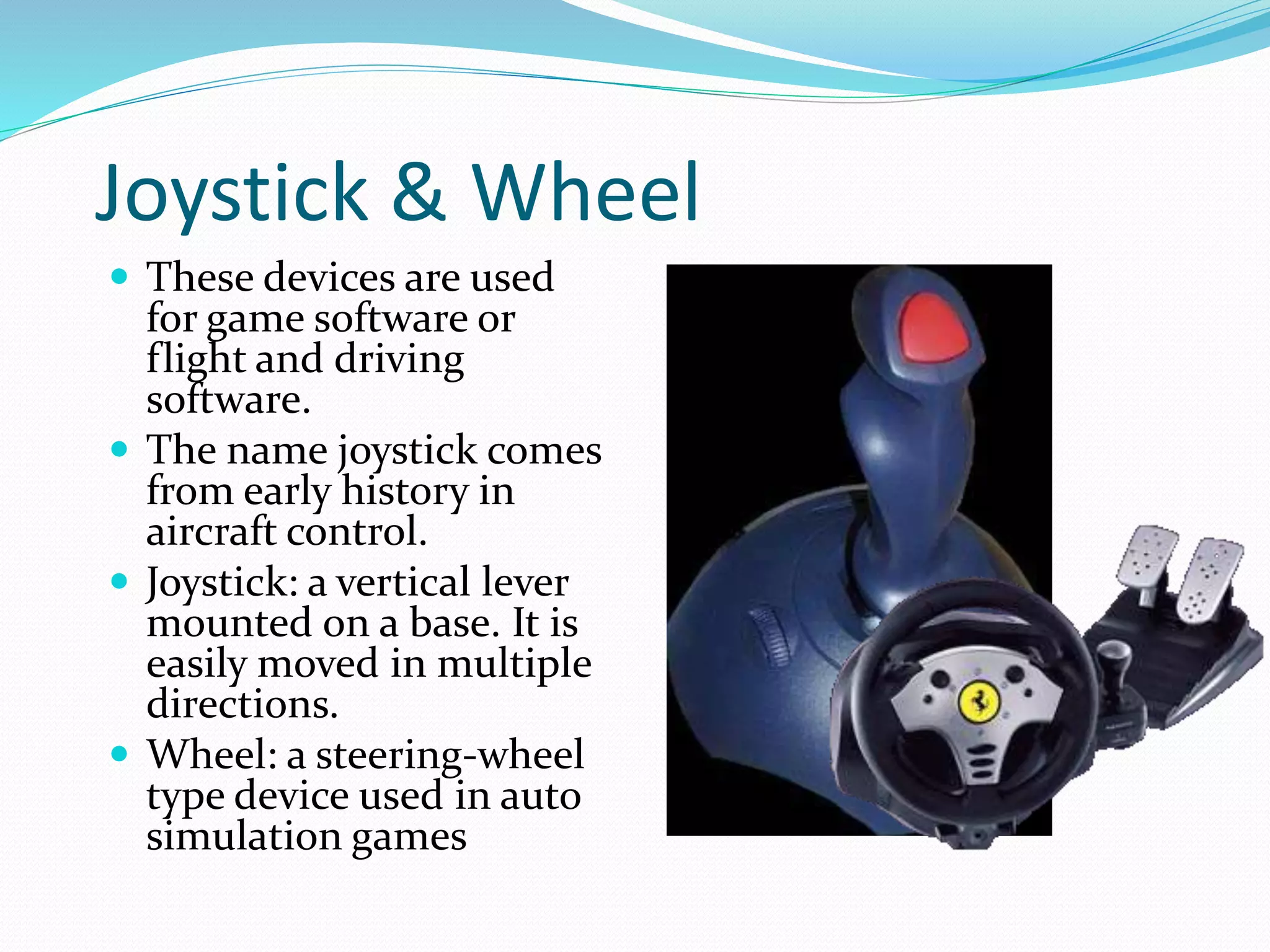
 Joystick: a vertical lever
mounted on a base. It is
easily moved in multiple
directions.
 Wheel: a steering-wheel
type device used in auto
simulation games
Light Pen
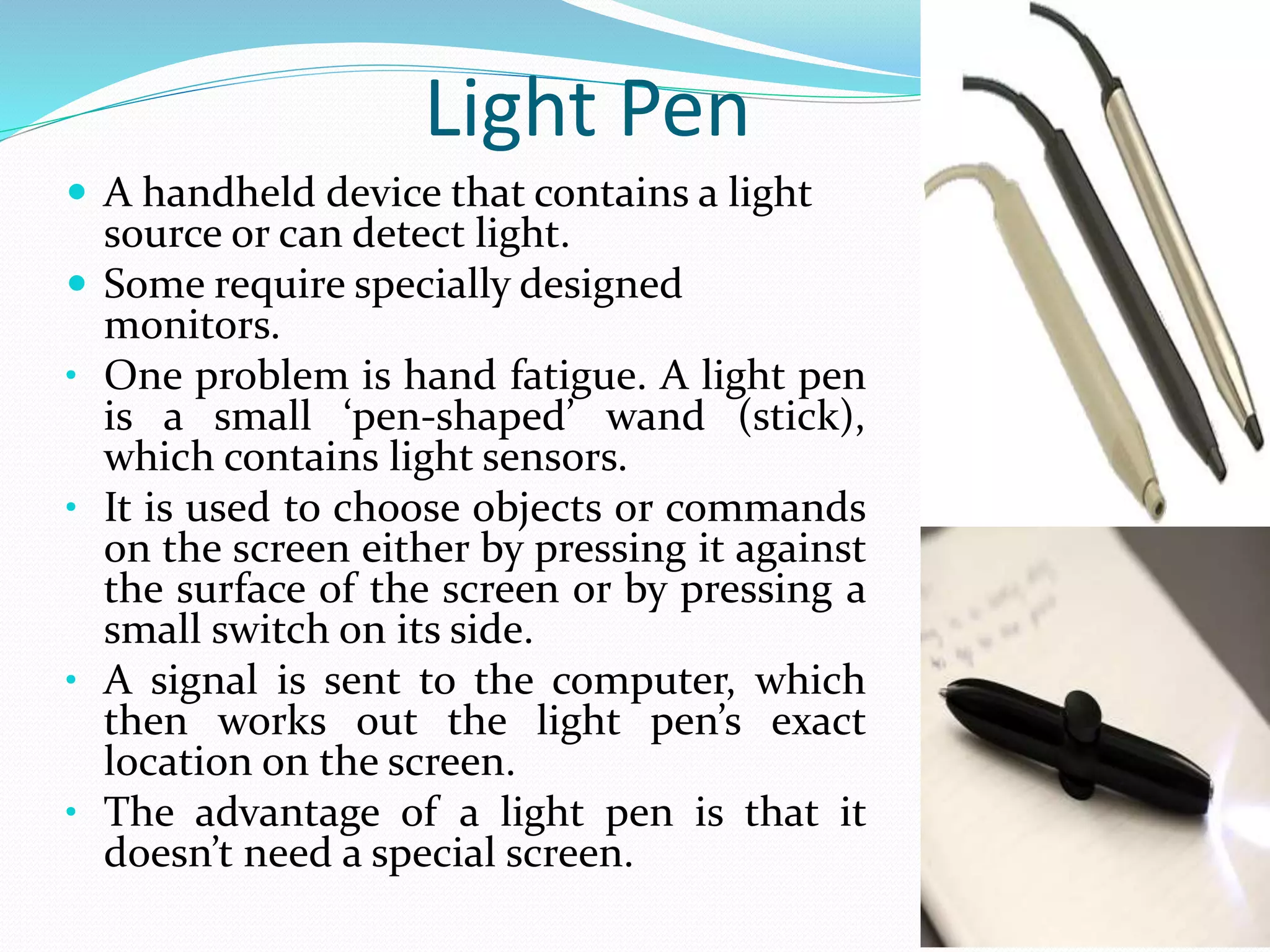
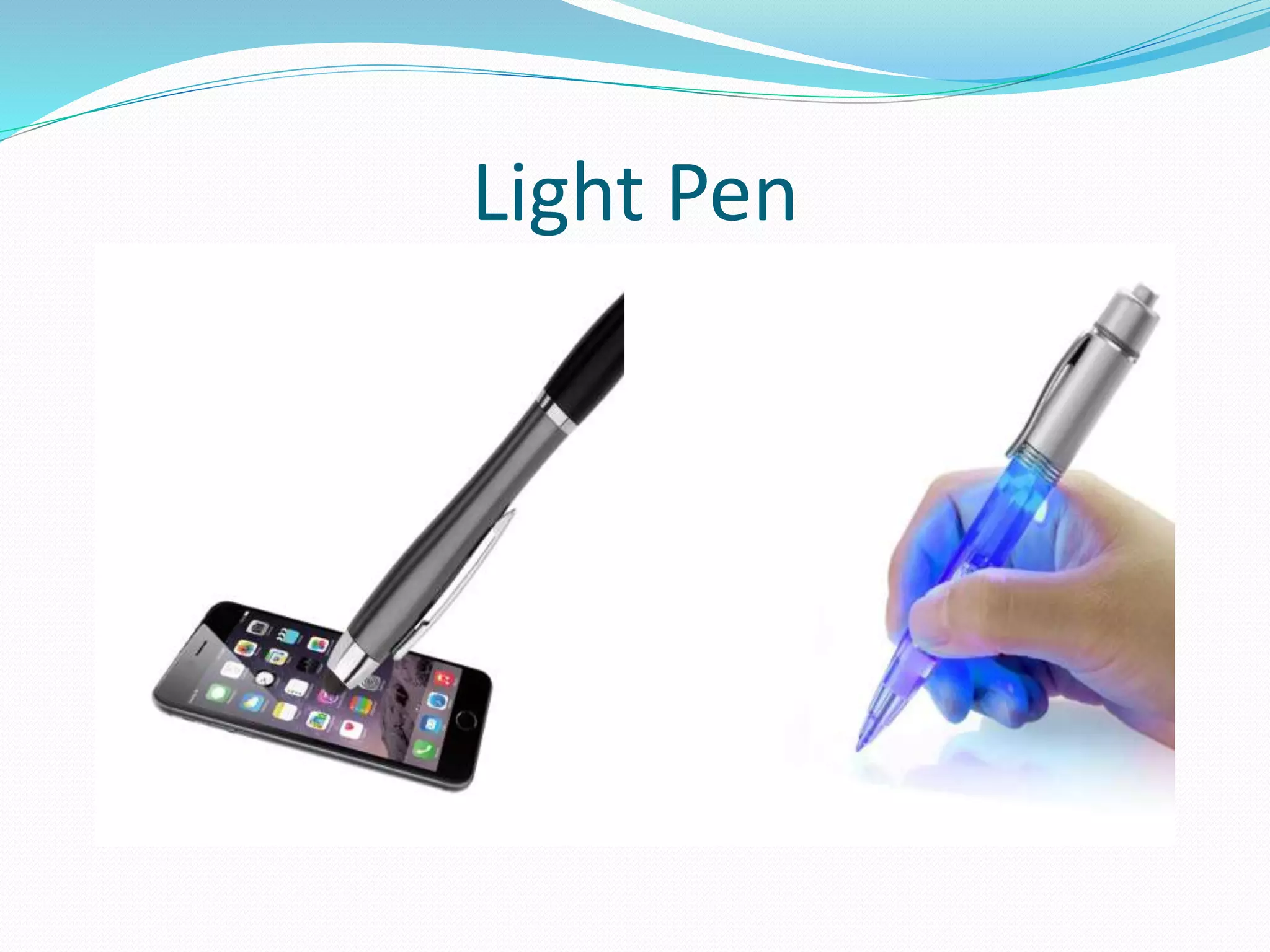
 A handheld device that contains a light
source or can detect light.
 Some require specially designed
monitors.
• One problem is hand fatigue. A light pen
is a small ‘pen-shaped’ wand (stick),
which contains light sensors.
• It is used to choose objects or commands
on the screen either by pressing it against
the surface of the screen or by pressing a
small switch on its side.
• A signal is sent to the computer, which
then works out the light pen’s exact
location on the screen.
• The advantage of a light pen is that it
doesn’t need a special screen.
Light Pen
Touch Screen
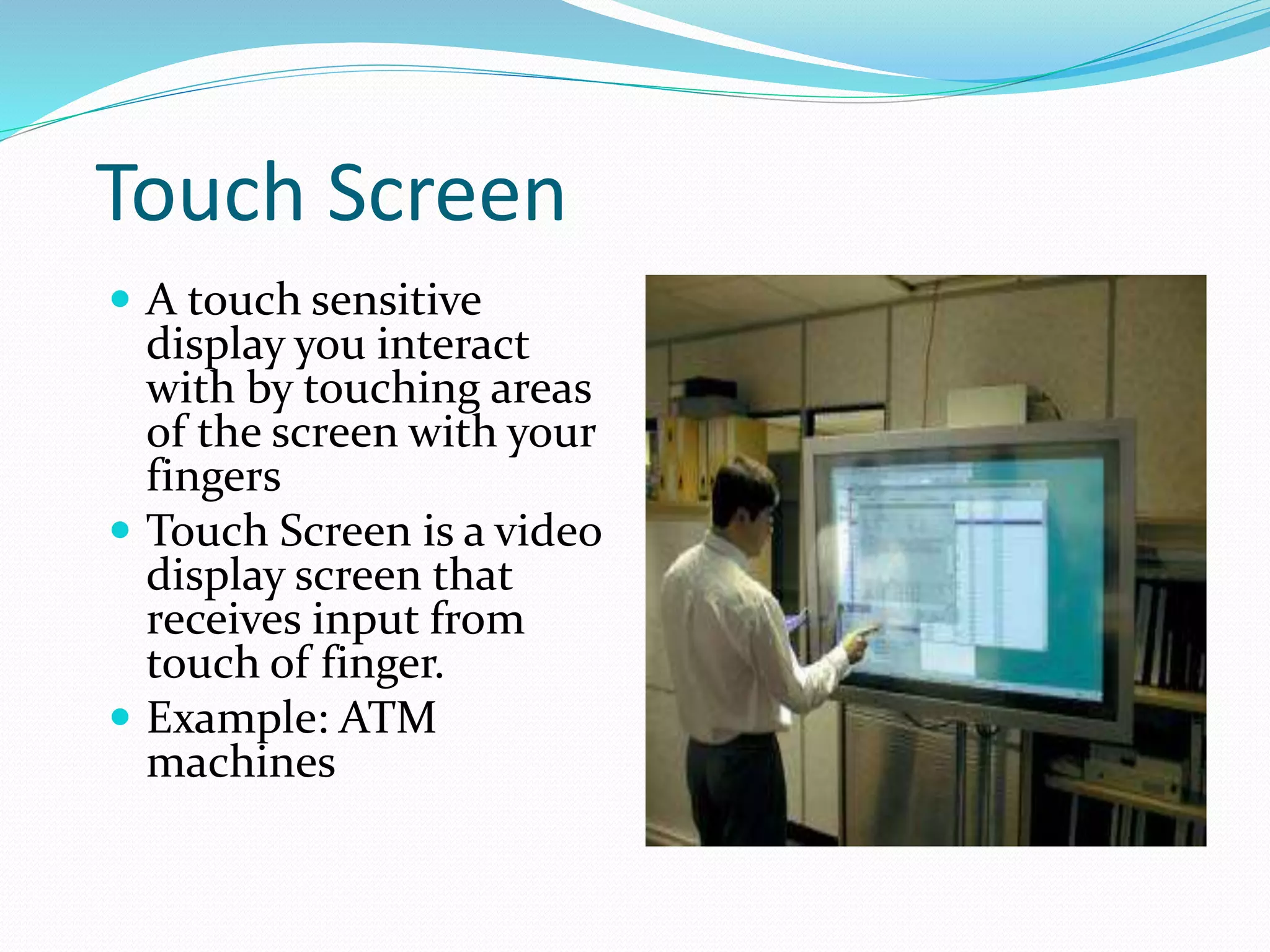
 A touch sensitive
display you interact
with by touching areas
of the screen with your
fingers
 Touch Screen is a video
display screen that
receives input from
touch of finger.
 Example: ATM
machines
Touch Screens
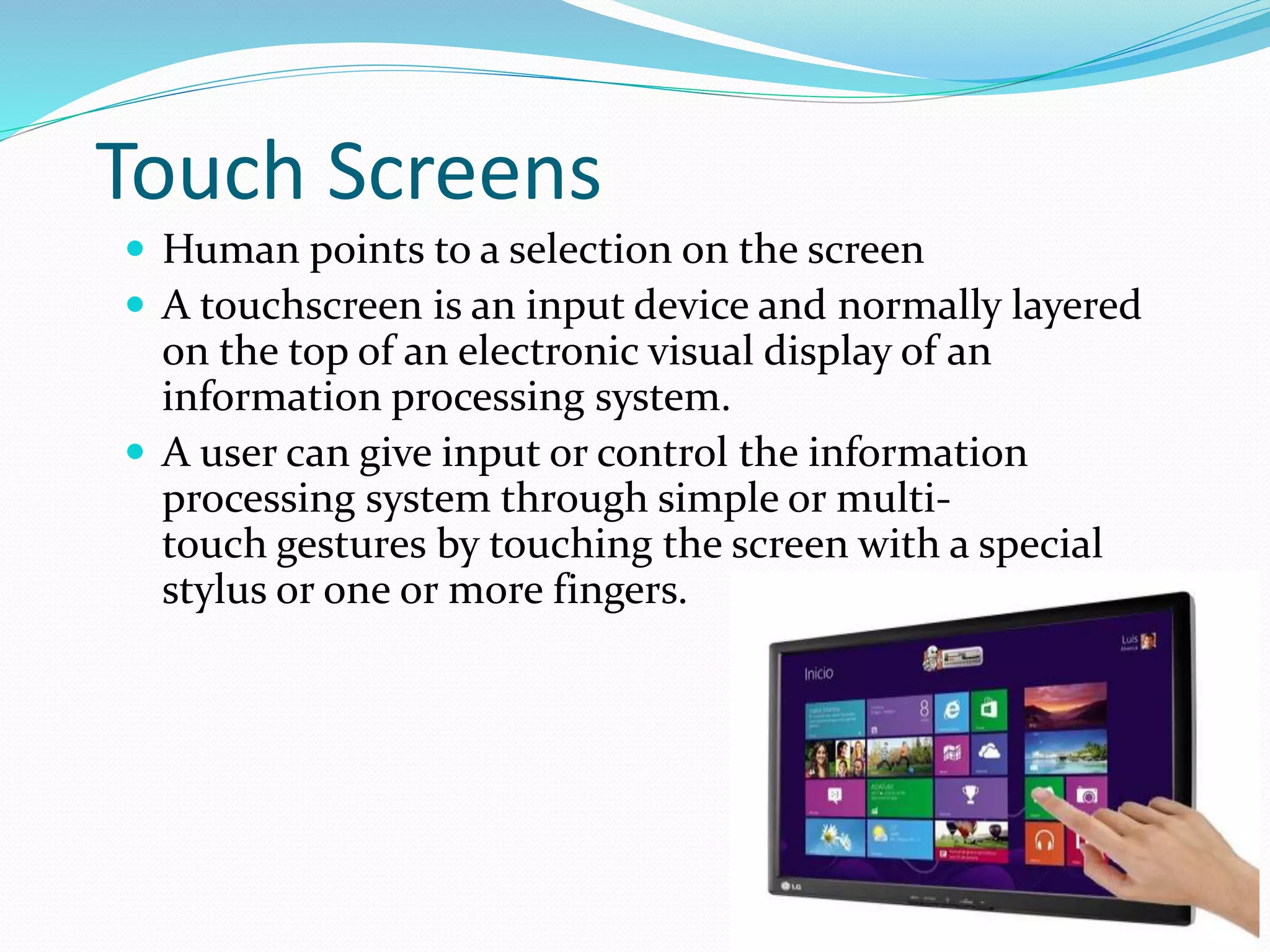
 Human points to a selection on the screen
 A touchscreen is an input device and normally layered
on the top of an electronic visual display of an
information processing system.
 A user can give input or control the information
processing system through simple or multi-
touch gestures by touching the screen with a special
stylus or one or more fingers.
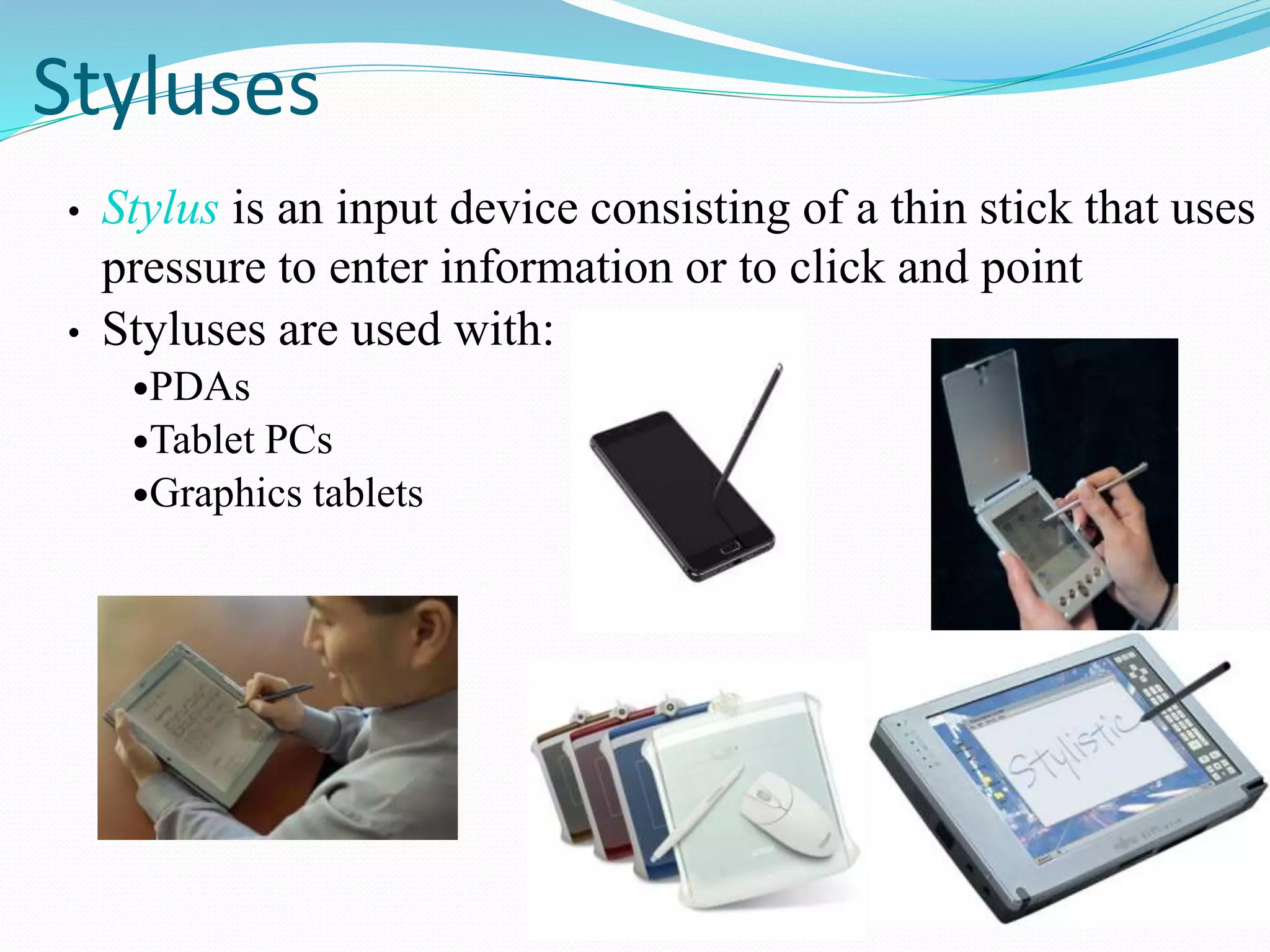
Styluses
• Stylus is an input device consisting of a thin stick that uses
pressure to enter information or to click and point
• Styluses are used with:
PDAs
Tablet PCs
Graphics tablets
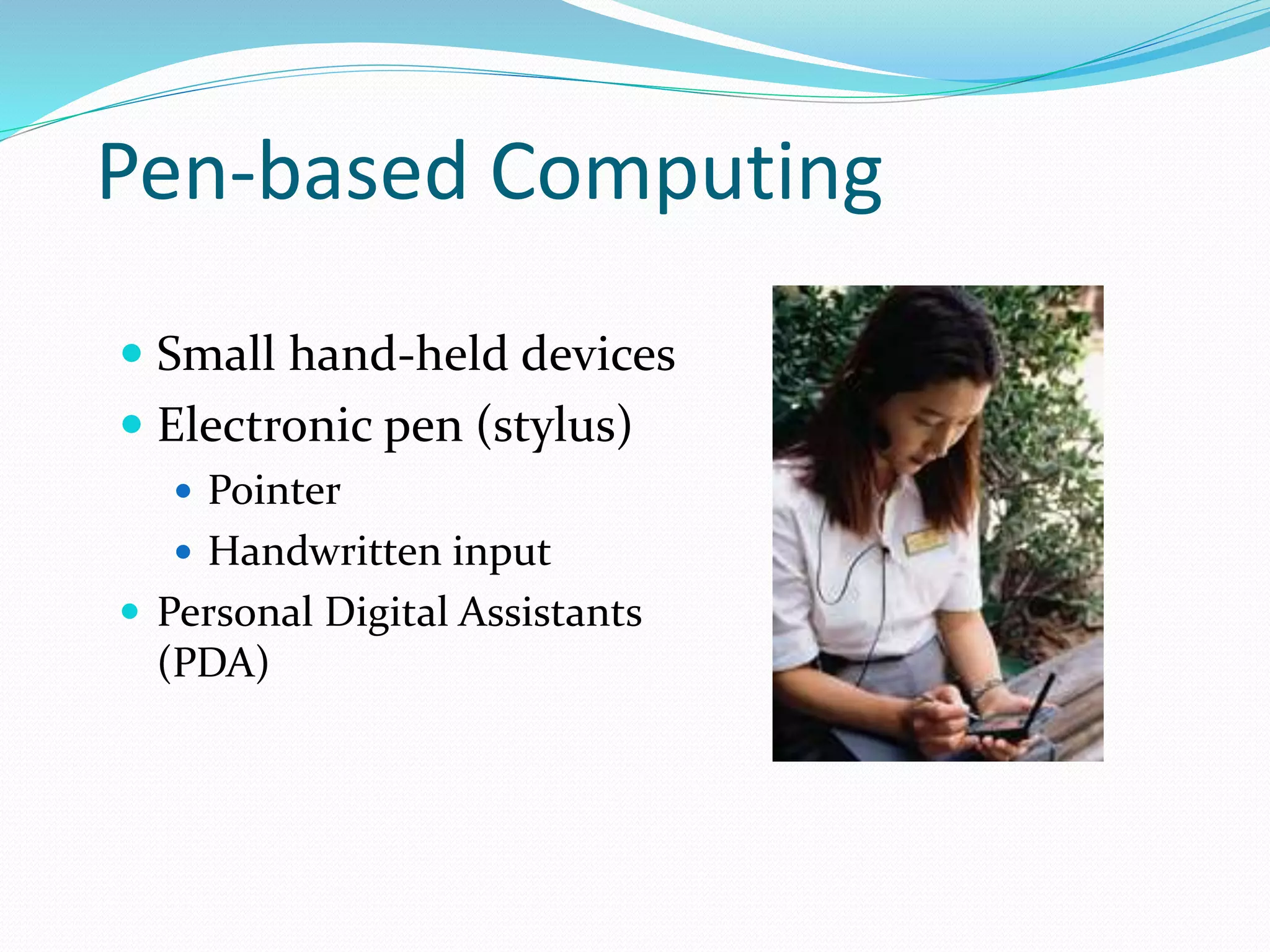
Pen-based Computing
 Small hand-held devices
 Electronic pen (stylus)
 Pointer
 Handwritten input
 Personal Digital Assistants
(PDA)
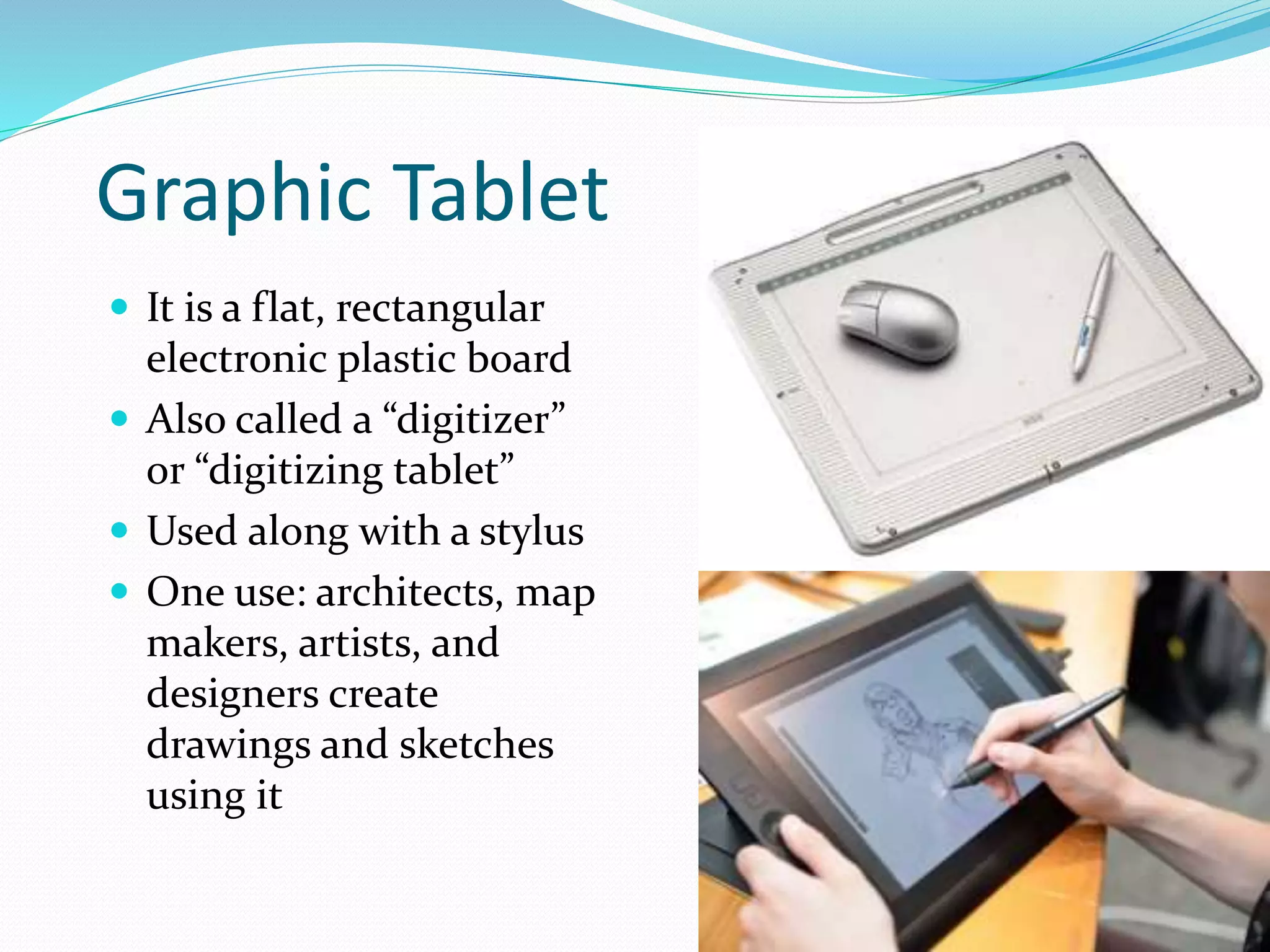
Graphic Tablet
 It is a flat, rectangular
electronic plastic board
 Also called a “digitizer”
or “digitizing tablet”
 Used along with a stylus
 One use: architects, map
makers, artists, and
designers create
drawings and sketches
using it
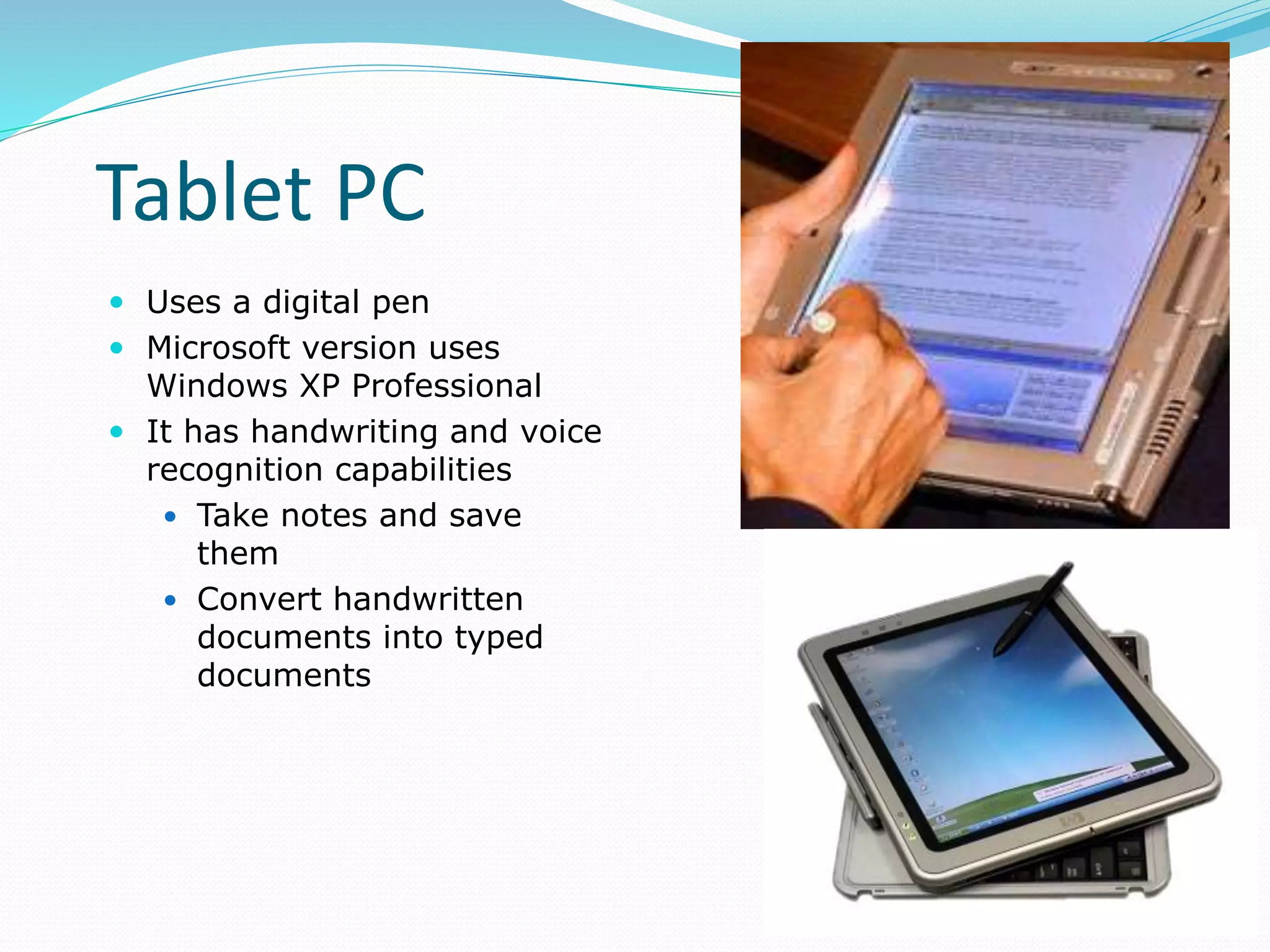
Tablet PC
 Uses a digital pen
 Microsoft version uses
Windows XP Professional
 It has handwriting and voice
recognition capabilities
 Take notes and save
them
 Convert handwritten
documents into typed
documents
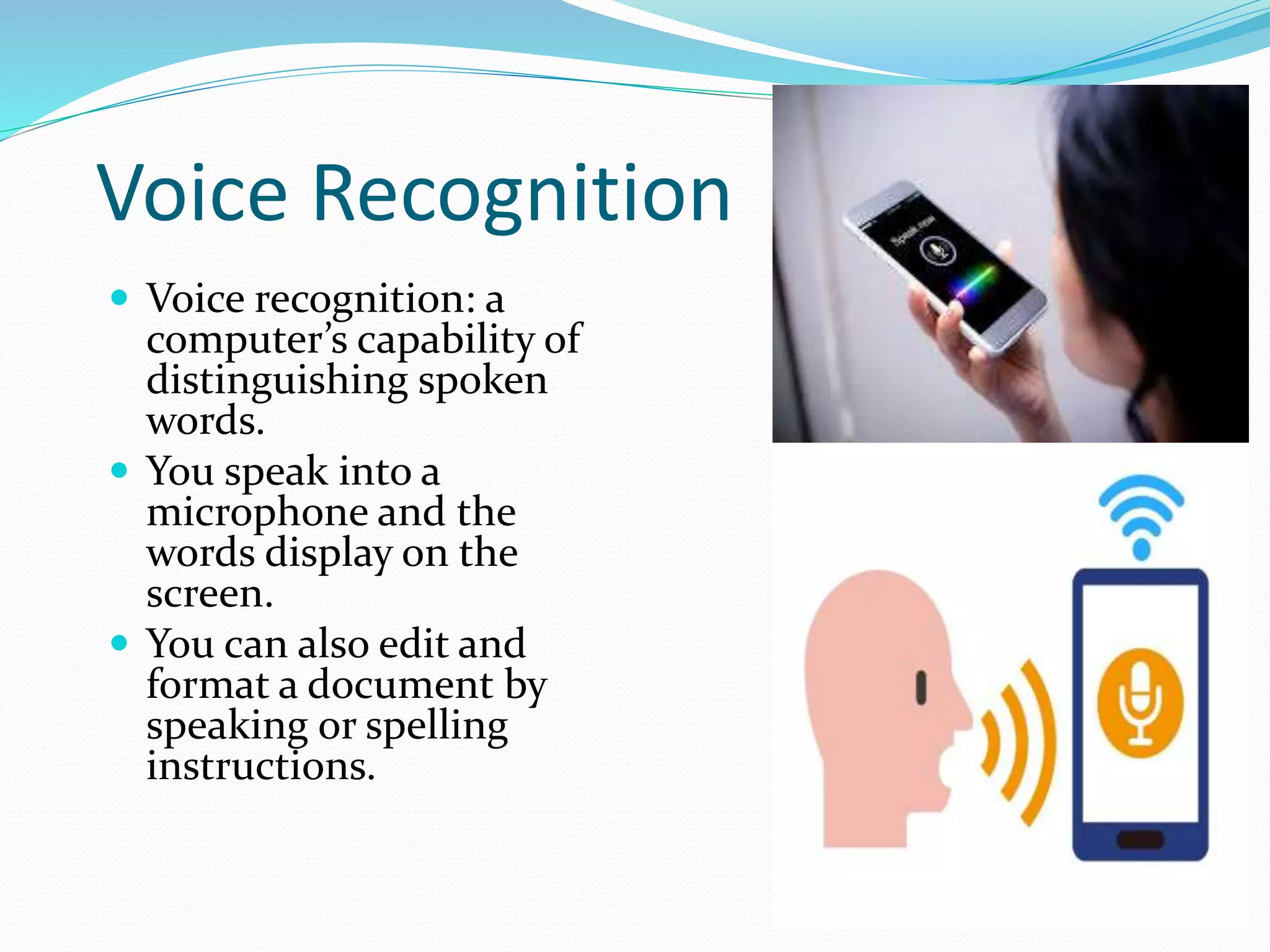
Voice Recognition
 Voice recognition: a
computer’s capability of
distinguishing spoken
words.
 You speak into a
microphone and the
words display on the
screen.
 You can also edit and
format a document by
speaking or spelling
instructions.
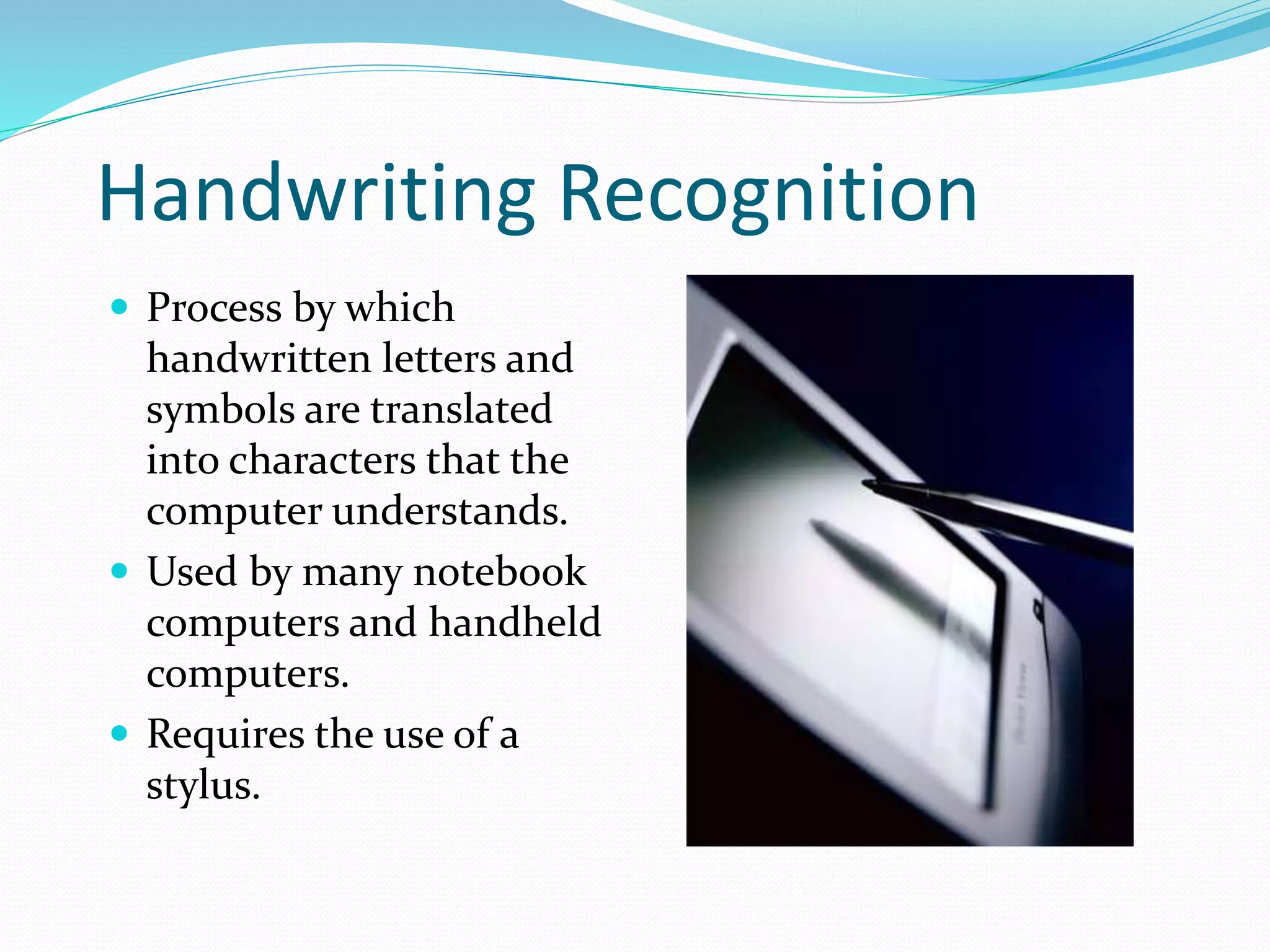
Handwriting Recognition
 Process by which
handwritten letters and
symbols are translated
into characters that the
computer understands.
 Used by many notebook
computers and handheld
computers.
 Requires the use of a
stylus.
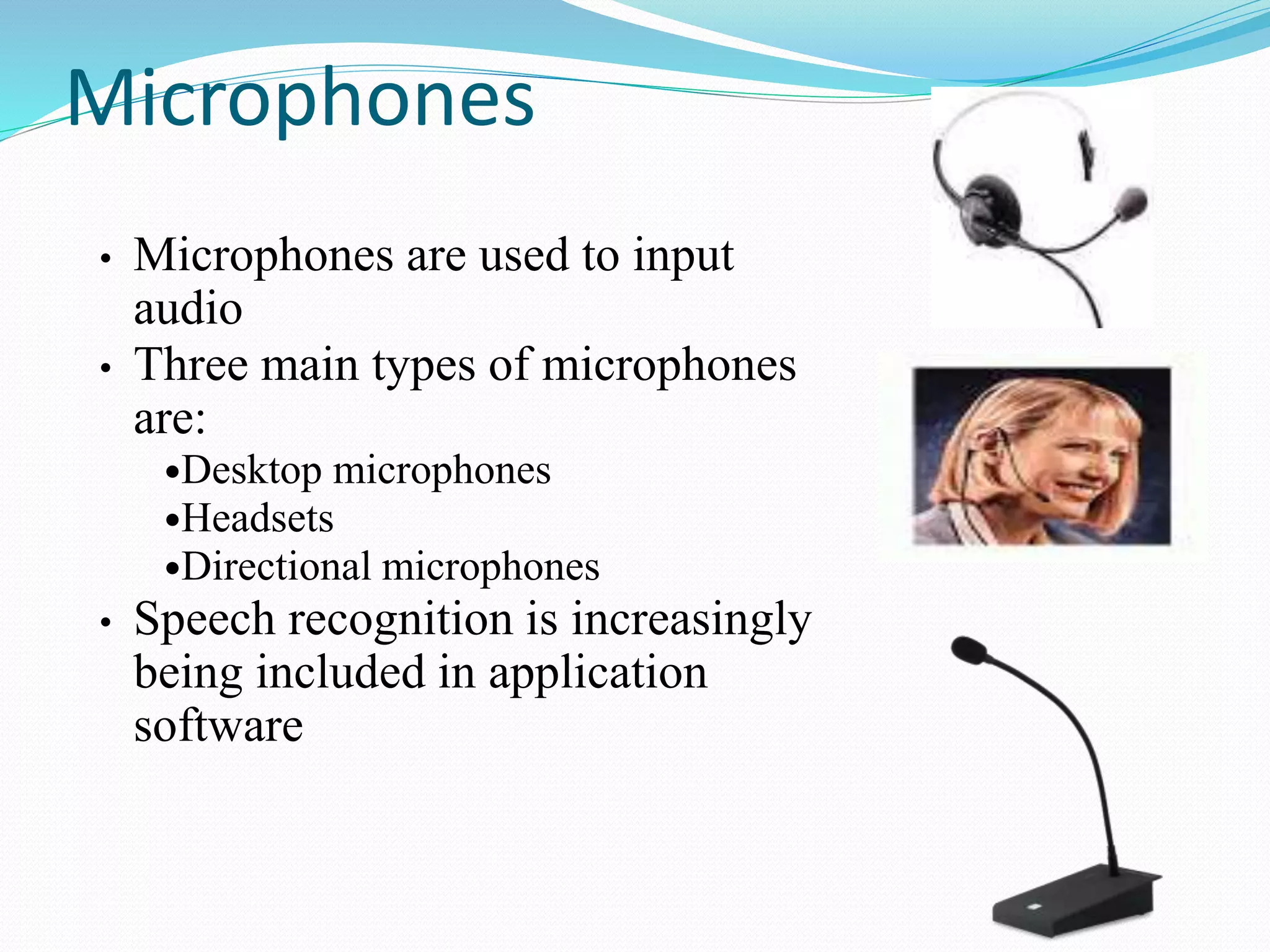
Microphones
• Microphones are used to input
audio
• Three main types of microphones
are:
Desktop microphones
Headsets
Directional microphones
• Speech recognition is increasingly
being included in application
software
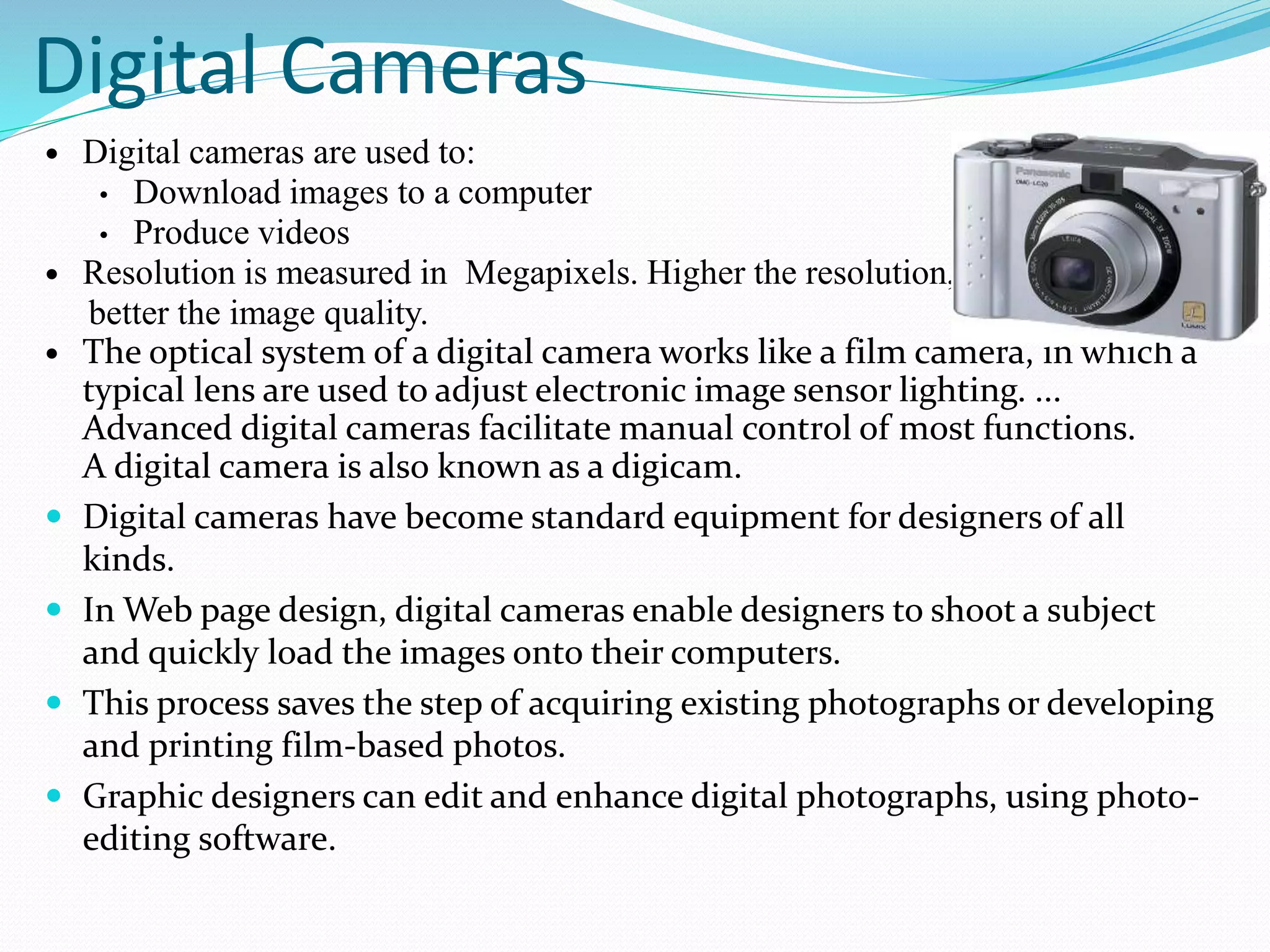
Digital Cameras
 Digital cameras are used to:
• Download images to a computer
• Produce videos
 Resolution is measured in Megapixels. Higher the resolution,
better the image quality.
 The optical system of a digital camera works like a film camera, in which a
typical lens are used to adjust electronic image sensor lighting. ...
Advanced digital cameras facilitate manual control of most functions.
A digital camera is also known as a digicam.
 Digital cameras have become standard equipment for designers of all
kinds.
 In Web page design, digital cameras enable designers to shoot a subject
and quickly load the images onto their computers.
 This process saves the step of acquiring existing photographs or developing
and printing film-based photos.
 Graphic designers can edit and enhance digital photographs, using photo-
editing software.
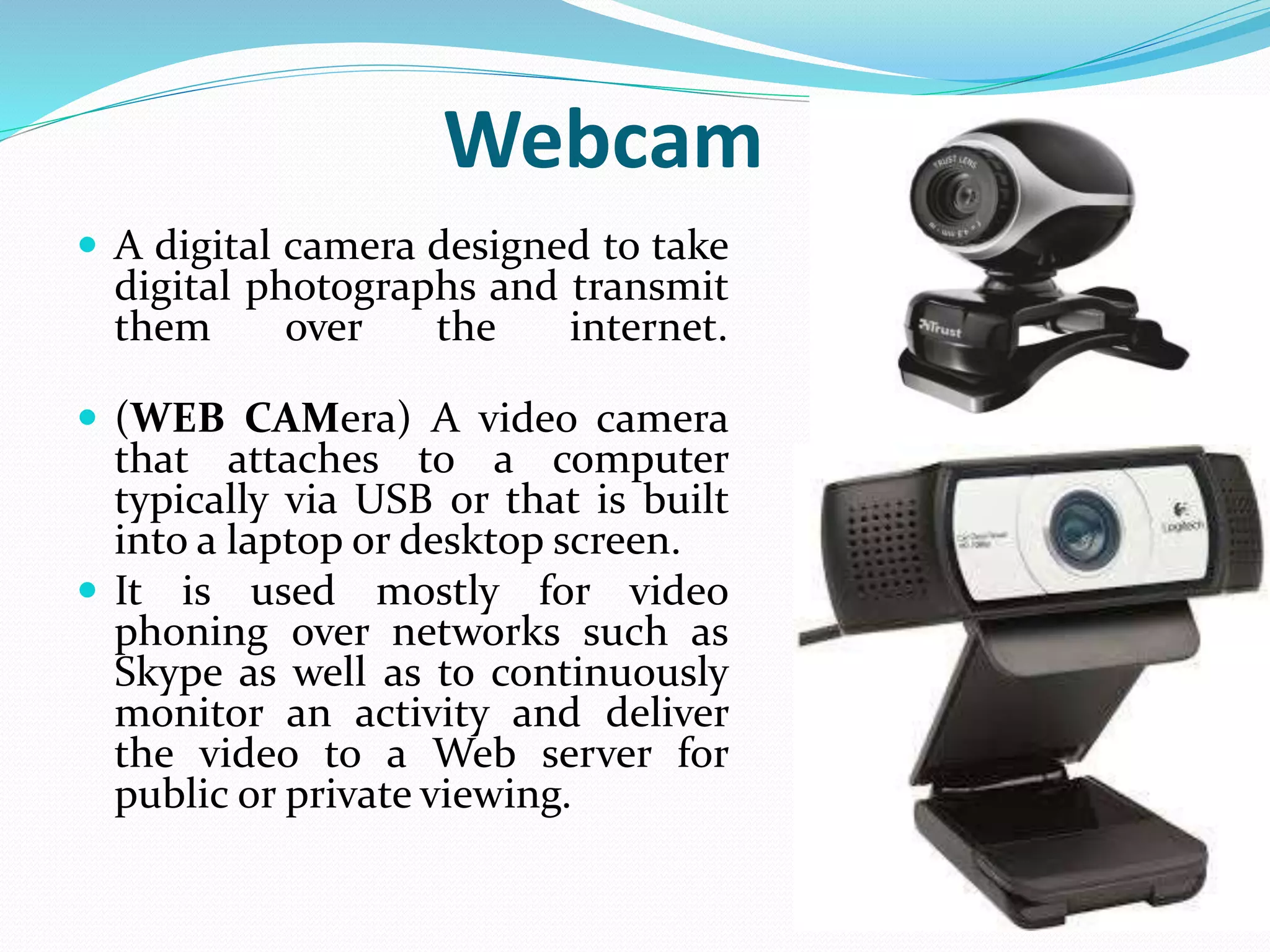
Webcam
 A digital camera designed to take
digital photographs and transmit
them over the internet.
 (WEB CAMera) A video camera
that attaches to a computer
typically via USB or that is built
into a laptop or desktop screen.
 It is used mostly for video
phoning over networks such as
Skype as well as to continuously
monitor an activity and deliver
the video to a Web server for
public or private viewing.
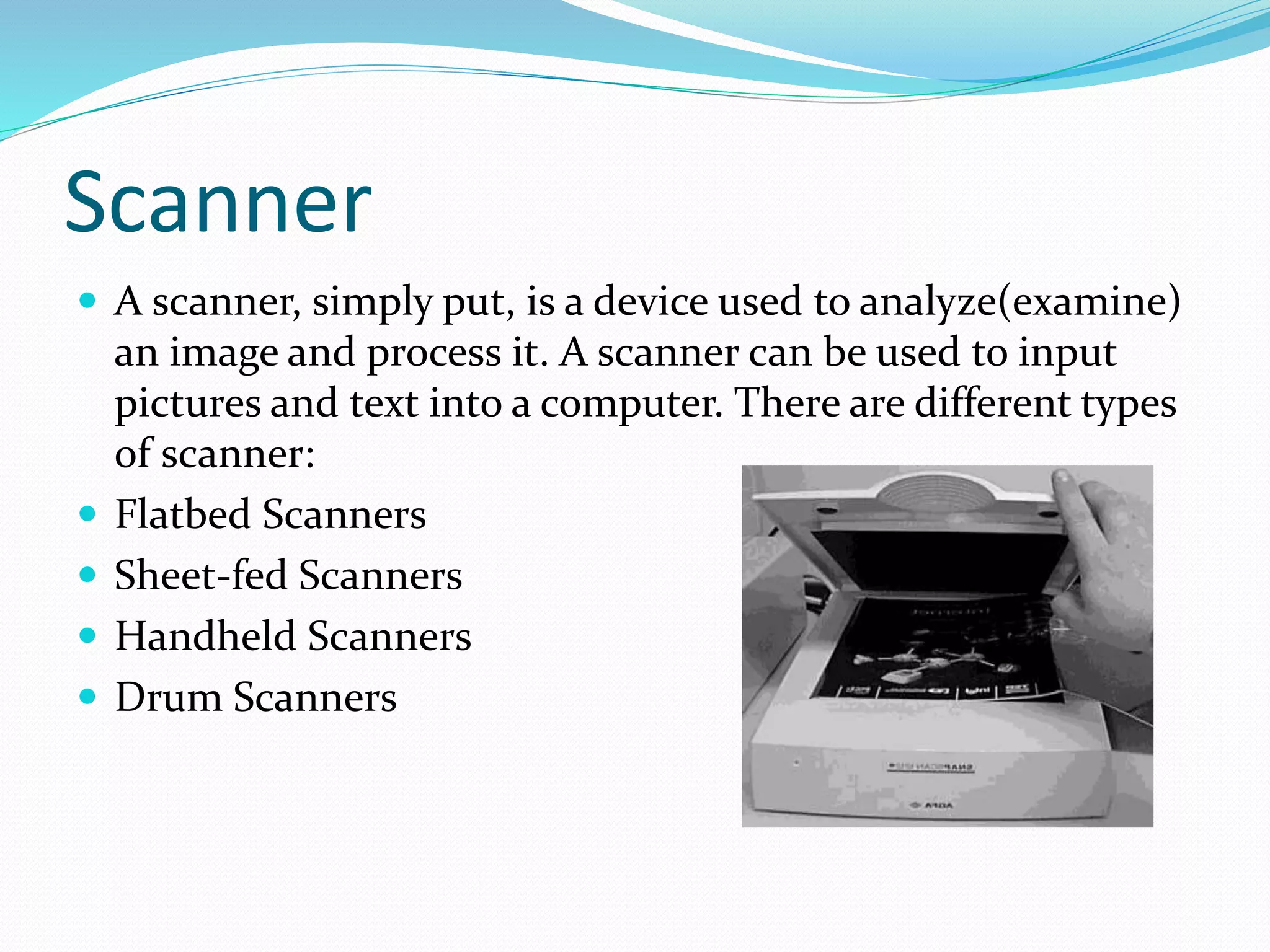
Scanner
 A scanner, simply put, is a device used to analyze(examine)
an image and process it. A scanner can be used to input
pictures and text into a computer. There are different types
of scanner:
 Flatbed Scanners
 Sheet-fed Scanners
 Handheld Scanners
 Drum Scanners
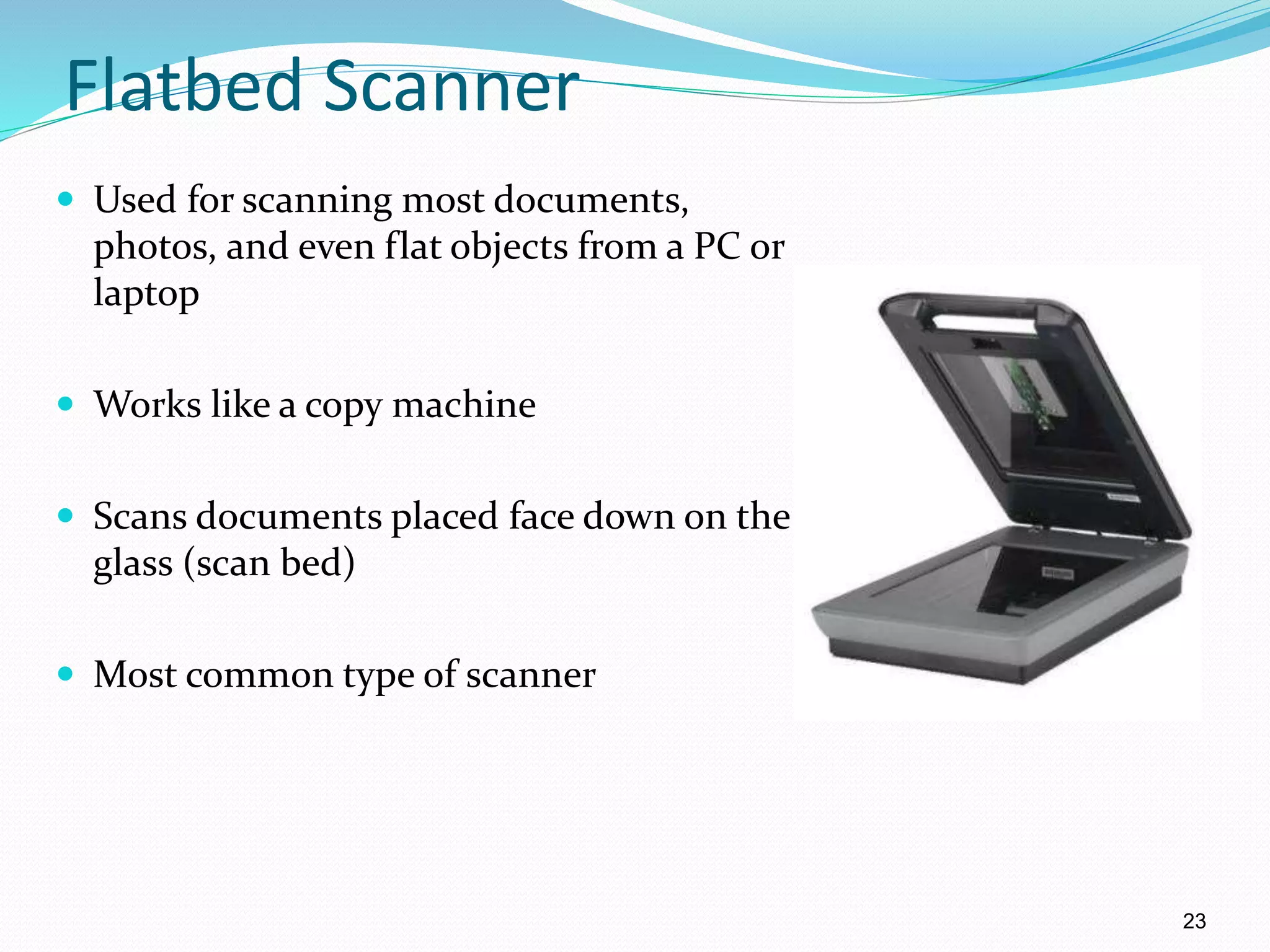
Flatbed Scanner
 Used for scanning most documents,
photos, and even flat objects from a PC or
laptop
 Works like a copy machine
 Scans documents placed face down on the
glass (scan bed)
 Most common type of scanner
23
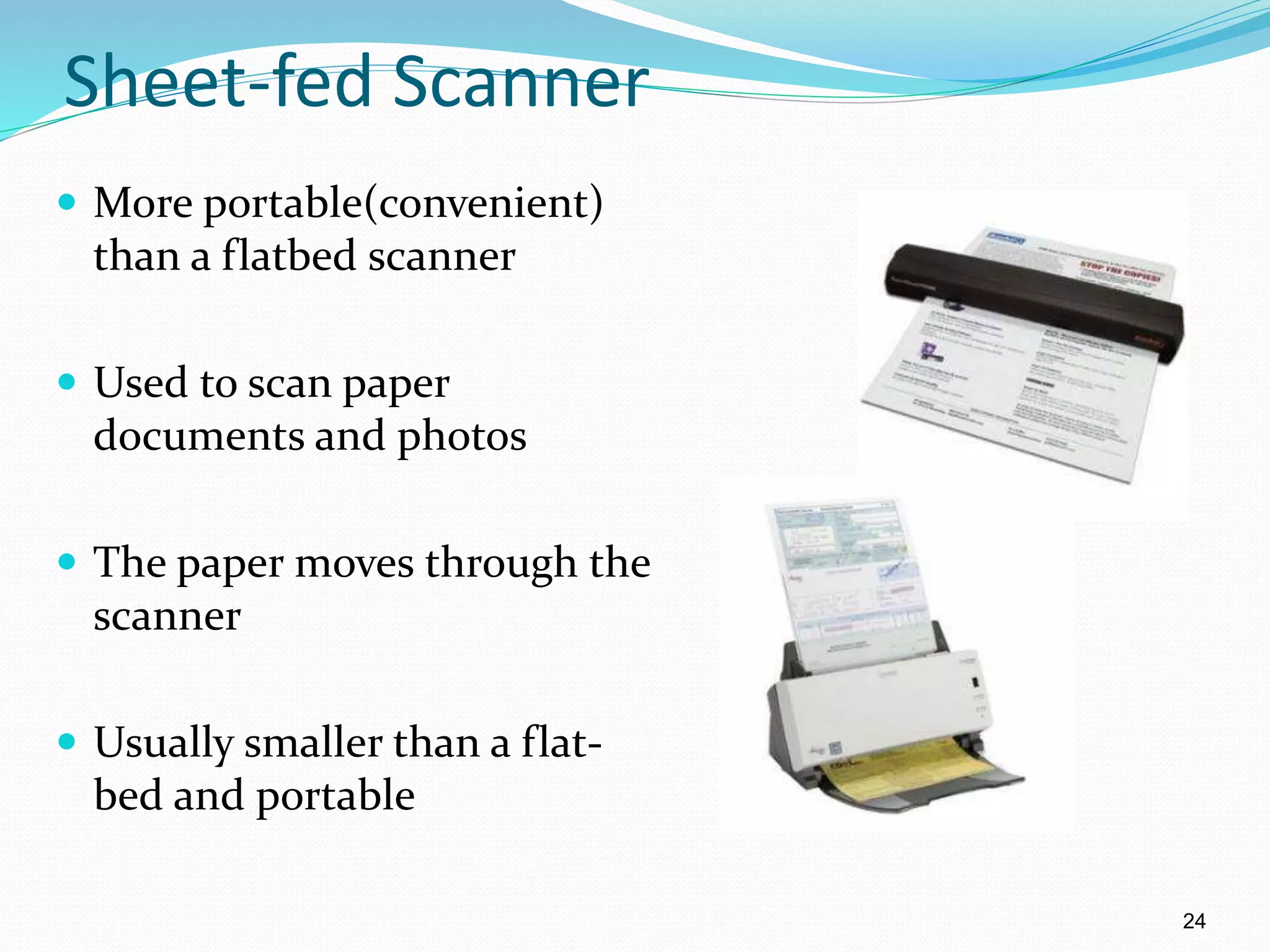
Sheet-fed Scanner
 More portable(convenient)
than a flatbed scanner
 Used to scan paper
documents and photos
 The paper moves through the
scanner
 Usually smaller than a flat-
bed and portable
24
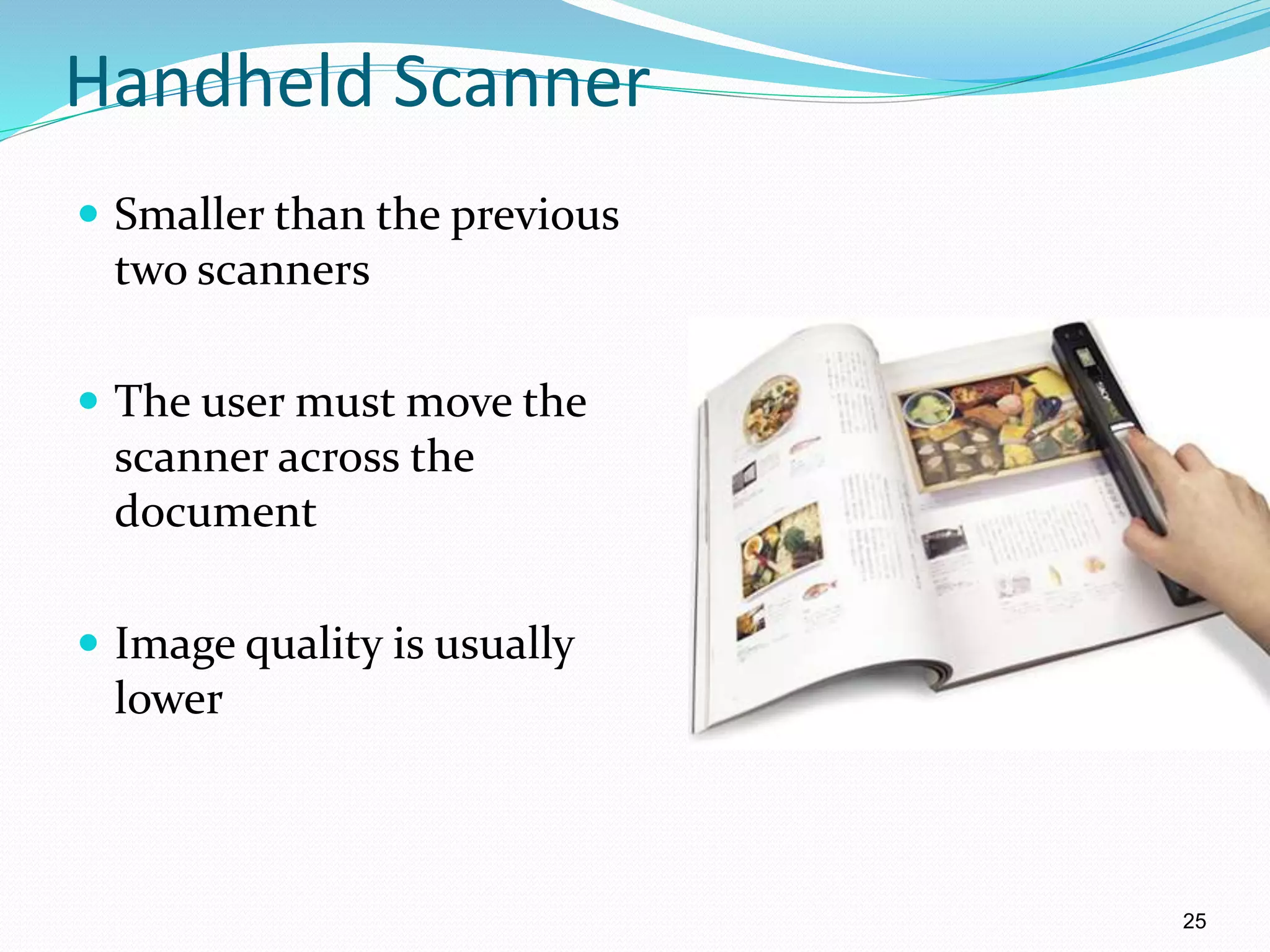
Handheld Scanner
 Smaller than the previous
two scanners
 The user must move the
scanner across the
document
 Image quality is usually
lower
25
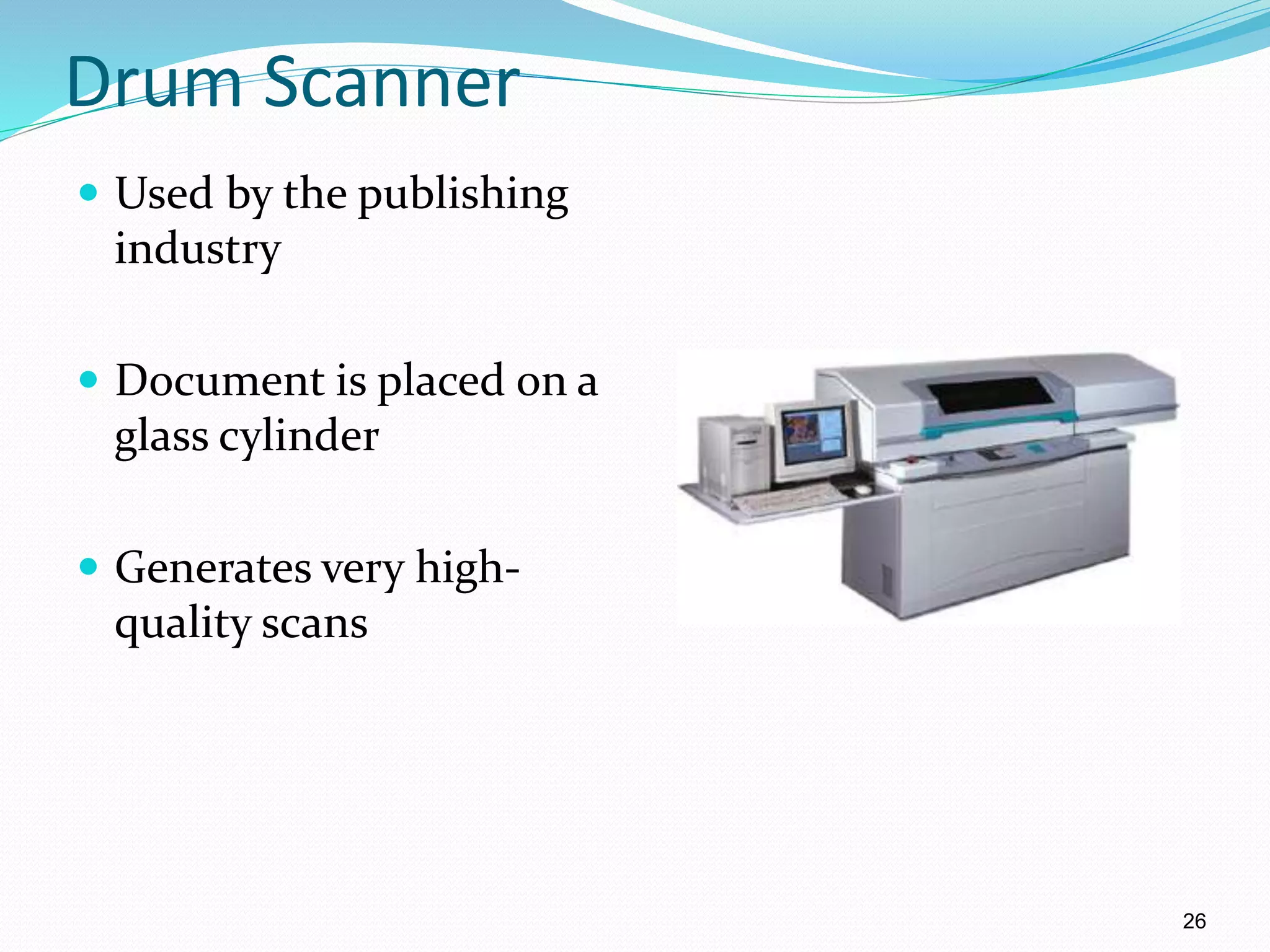
Drum Scanner
 Used by the publishing
industry
 Document is placed on a
glass cylinder
 Generates very high-
quality scans
26
27
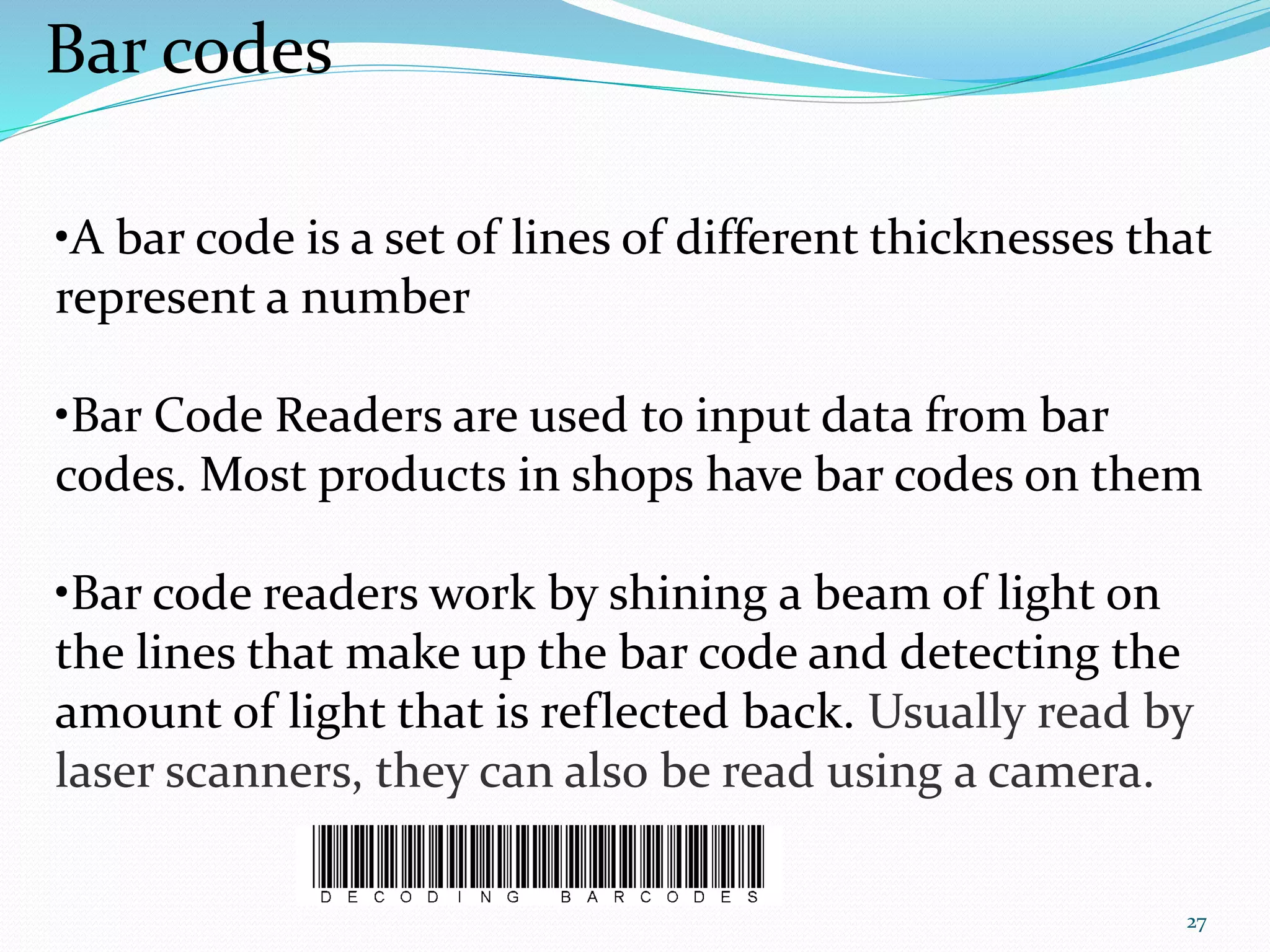
Bar codes
•A bar code is a set of lines of different thicknesses that
represent a number
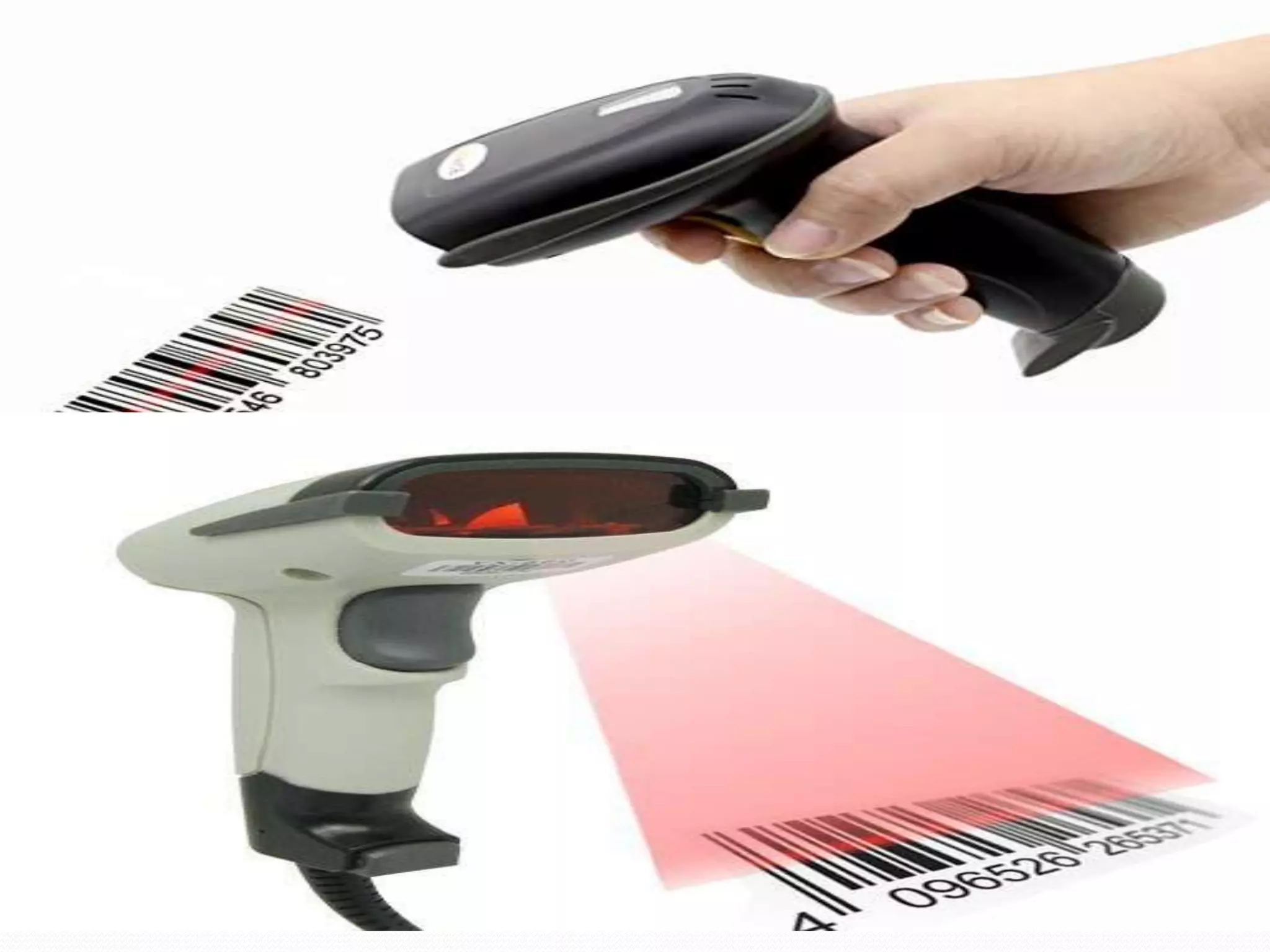
•Bar Code Readers are used to input data from bar
codes. Most products in shops have bar codes on them
•Bar code readers work by shining a beam of light on
the lines that make up the bar code and detecting the
amount of light that is reflected back. Usually read by
laser scanners, they can also be read using a camera.
Optical Character Recognition
(OCR)
 Stands for "Optical Character Recognition." OCR is a
technology that recognizes text in scanned documents.
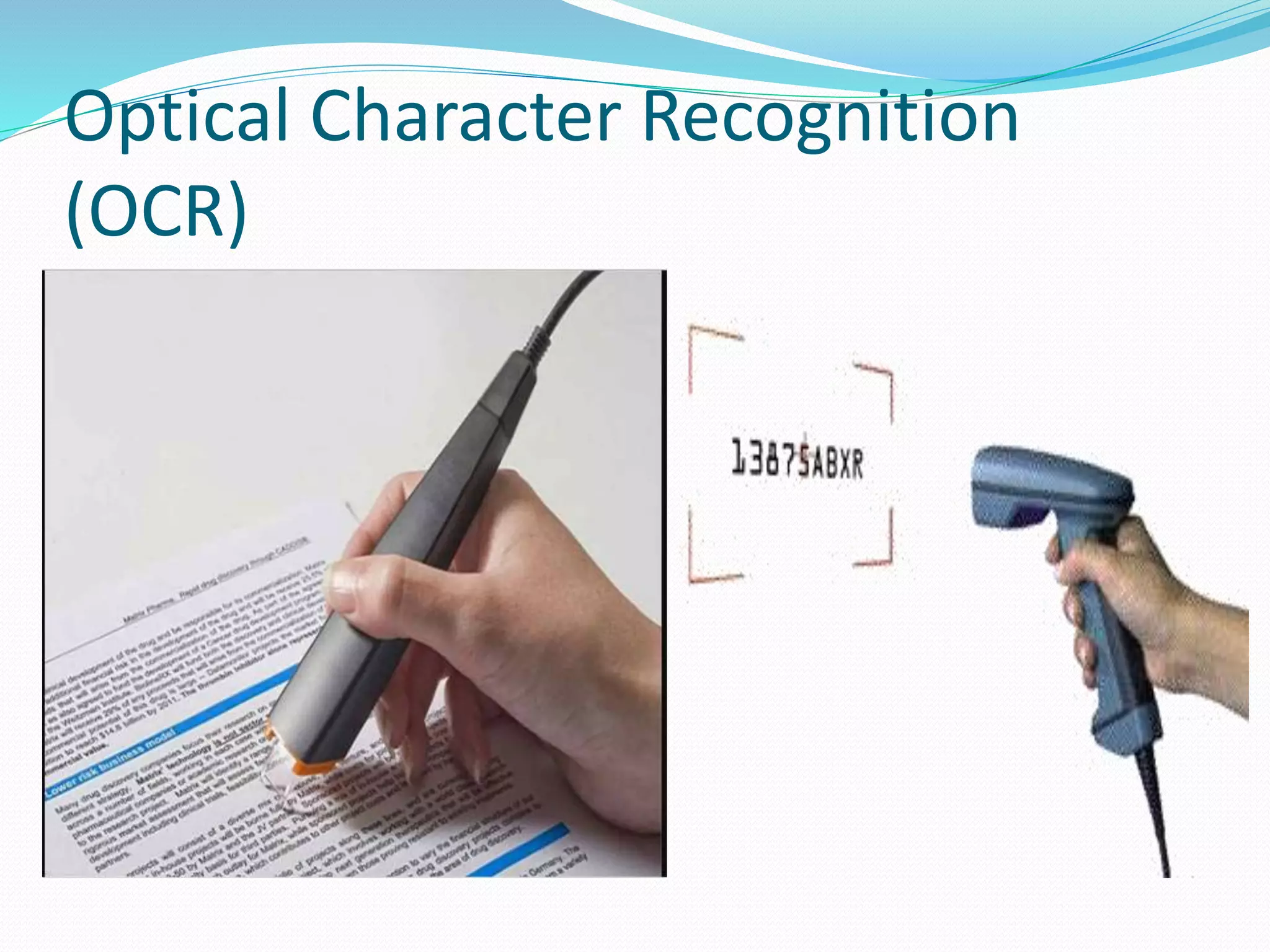
 OCR software processes a digital image by locating and
recognizing characters, such as letters, numbers, and symbols.
Some OCR software will simply export the text, while other
programs can convert the characters to editable text directly in
the image. Advanced OCR software can export(transfer) the
size and formatting of the text as well as the layout of the text
found on a page.
 OCR technology can be used to convert a hard copy of a
document into an electronic version ( soft copy). For example,
if you scan a multipage document into a digital image, you can
load the document into an OCR program, which will recognize
the text and convert the document to an editable text file.
Some OCR programs allow you to scan a document and
convert it to a word processing document in a single step.
29
Optical Character Recognition
(OCR)

Comp App Lect 5 part 2.pptx

  • 2.
    Input Devices • Inputdevice captures information and translates it into a form that can be processed and used by other parts of your computer. Keyboards Pointing devices Game controllers Scanners Styluses Microphones Digital cameras Web cams p. 5.130 Fig. 5-1
  • 3.
    Trackball  A trackballis a computer cursor control device used in many notebook and laptop computers. The trackball is usually located in front of the keyboard toward the user. Essentially, the trackball is an upside-down mouse that rotates in place within a socket. The user rolls the ball to direct the cursor to the desired place on the screen and can click one of two buttons (identical to mouse buttons) near the trackball to select desktop objects or position the cursor for text entry.  very fast for gaming
  • 4.
    Trackball Advantages of usinga trackball are:  Less work surface is required for trackball to function.  Trackball allows continuous and fast scrolling and does not require repositioning.  Unlike other input devices, trackballs require only minimal cleaning Disadvantages of using a trackball are:  Compared to mouse, trackballs are physically larger.  As they are little more expensive
  • 5.
    Touchpad/Trackpad  Small, flat,rectangular device that is sensitive to pressure and motion  You move the pointer by sliding your finger around  You tap the pad to initiate a “click”  Most often found on notebook computers
  • 6.
    Pointing Stick  Apointing stick is a small joystick used a pointing device typically mounted centrally in a computer keyboard. Like other pointing devices such as mice, touchpads or trackballs, operating system software translates manipulation of the device into movements of the pointer or cursor on the monitor.
  • 7.
    Pointing Stick  Pressuresensitive device shaped like a pencil eraser that is positioned between keys on the keyboard.  First developed by IBM for their notebook computers
  • 8.
    Joystick & Wheel These devices are used for game software or flight and driving software.  The name joystick comes from early history in aircraft control.  Joystick: a vertical lever mounted on a base. It is easily moved in multiple directions.  Wheel: a steering-wheel type device used in auto simulation games
  • 9.
    Light Pen  Ahandheld device that contains a light source or can detect light.  Some require specially designed monitors. • One problem is hand fatigue. A light pen is a small ‘pen-shaped’ wand (stick), which contains light sensors. • It is used to choose objects or commands on the screen either by pressing it against the surface of the screen or by pressing a small switch on its side. • A signal is sent to the computer, which then works out the light pen’s exact location on the screen. • The advantage of a light pen is that it doesn’t need a special screen.
  • 10.
  • 11.
    Touch Screen  Atouch sensitive display you interact with by touching areas of the screen with your fingers  Touch Screen is a video display screen that receives input from touch of finger.  Example: ATM machines
  • 12.
    Touch Screens  Humanpoints to a selection on the screen  A touchscreen is an input device and normally layered on the top of an electronic visual display of an information processing system.  A user can give input or control the information processing system through simple or multi- touch gestures by touching the screen with a special stylus or one or more fingers.
  • 13.
    Styluses • Stylus isan input device consisting of a thin stick that uses pressure to enter information or to click and point • Styluses are used with: PDAs Tablet PCs Graphics tablets
  • 14.
    Pen-based Computing  Smallhand-held devices  Electronic pen (stylus)  Pointer  Handwritten input  Personal Digital Assistants (PDA)
  • 15.
    Graphic Tablet  Itis a flat, rectangular electronic plastic board  Also called a “digitizer” or “digitizing tablet”  Used along with a stylus  One use: architects, map makers, artists, and designers create drawings and sketches using it
  • 16.
    Tablet PC  Usesa digital pen  Microsoft version uses Windows XP Professional  It has handwriting and voice recognition capabilities  Take notes and save them  Convert handwritten documents into typed documents
  • 17.
    Voice Recognition  Voicerecognition: a computer’s capability of distinguishing spoken words.  You speak into a microphone and the words display on the screen.  You can also edit and format a document by speaking or spelling instructions.
  • 18.
    Handwriting Recognition  Processby which handwritten letters and symbols are translated into characters that the computer understands.  Used by many notebook computers and handheld computers.  Requires the use of a stylus.
  • 19.
    Microphones • Microphones areused to input audio • Three main types of microphones are: Desktop microphones Headsets Directional microphones • Speech recognition is increasingly being included in application software
  • 20.
    Digital Cameras  Digitalcameras are used to: • Download images to a computer • Produce videos  Resolution is measured in Megapixels. Higher the resolution, better the image quality.  The optical system of a digital camera works like a film camera, in which a typical lens are used to adjust electronic image sensor lighting. ... Advanced digital cameras facilitate manual control of most functions. A digital camera is also known as a digicam.  Digital cameras have become standard equipment for designers of all kinds.  In Web page design, digital cameras enable designers to shoot a subject and quickly load the images onto their computers.  This process saves the step of acquiring existing photographs or developing and printing film-based photos.  Graphic designers can edit and enhance digital photographs, using photo- editing software.
  • 21.
    Webcam  A digitalcamera designed to take digital photographs and transmit them over the internet.  (WEB CAMera) A video camera that attaches to a computer typically via USB or that is built into a laptop or desktop screen.  It is used mostly for video phoning over networks such as Skype as well as to continuously monitor an activity and deliver the video to a Web server for public or private viewing.
  • 22.
    Scanner  A scanner,simply put, is a device used to analyze(examine) an image and process it. A scanner can be used to input pictures and text into a computer. There are different types of scanner:  Flatbed Scanners  Sheet-fed Scanners  Handheld Scanners  Drum Scanners
  • 23.
    Flatbed Scanner  Usedfor scanning most documents, photos, and even flat objects from a PC or laptop  Works like a copy machine  Scans documents placed face down on the glass (scan bed)  Most common type of scanner 23
  • 24.
    Sheet-fed Scanner  Moreportable(convenient) than a flatbed scanner  Used to scan paper documents and photos  The paper moves through the scanner  Usually smaller than a flat- bed and portable 24
  • 25.
    Handheld Scanner  Smallerthan the previous two scanners  The user must move the scanner across the document  Image quality is usually lower 25
  • 26.
    Drum Scanner  Usedby the publishing industry  Document is placed on a glass cylinder  Generates very high- quality scans 26
  • 27.
    27 Bar codes •A barcode is a set of lines of different thicknesses that represent a number •Bar Code Readers are used to input data from bar codes. Most products in shops have bar codes on them •Bar code readers work by shining a beam of light on the lines that make up the bar code and detecting the amount of light that is reflected back. Usually read by laser scanners, they can also be read using a camera.
  • 29.
    Optical Character Recognition (OCR) Stands for "Optical Character Recognition." OCR is a technology that recognizes text in scanned documents.  OCR software processes a digital image by locating and recognizing characters, such as letters, numbers, and symbols. Some OCR software will simply export the text, while other programs can convert the characters to editable text directly in the image. Advanced OCR software can export(transfer) the size and formatting of the text as well as the layout of the text found on a page.  OCR technology can be used to convert a hard copy of a document into an electronic version ( soft copy). For example, if you scan a multipage document into a digital image, you can load the document into an OCR program, which will recognize the text and convert the document to an editable text file. Some OCR programs allow you to scan a document and convert it to a word processing document in a single step. 29
  • 30.