This document provides 50 examples of C# programs that demonstrate basic coding concepts like printing text, taking user input, performing calculations, and using conditional logic. The examples progress from simple concepts like "Hello World" to more complex topics such as calculating factorials, Fibonacci sequences, and determining if a number is prime. Each example includes the full source code and output for that program.
![C# Console Application
Examples (50+ C# Examples)
4 years ago
2 Comments
by Mike
67,039 views
C# is a simple, modern, general-purpose, object-oriented and high-level programming language
originally developed by Microsoft and released in 2002. This tutorial gives a complete
understanding of C#. This reference will take you through simple and practical approaches while
learning C# Programming language.
There are more over 40 examples in this C# examples list. And C# Examples are listing from
basic to complex
Basic C# Examples
Example 1: C# Program to Print Hello World
1
2
3
4
5
6
7
8
9
10
class Program
{
staticvoid Main(string[] args)
{
Console.WriteLine("Hello World!");
Console.ReadKey();
}
}
Example 2: C# Program to Print an Integer Entered by User
1
2
3
4
5
6
7
8
9
10
11
12
13
14
class Program
{
staticvoid Main(string[] args)
{
int number;
Console.Write("Enter a number:");
number = Convert.ToInt32(Console.ReadLine());
Console.WriteLine("You entered :{0}",number);
Console.ReadLine();
}
}](https://image.slidesharecdn.com/c-220930061644-cbfcaeb0/85/C-console-applications-docx-1-320.jpg)
![Example 3: C# Program to Add Two Integers
1
2
3
4
5
6
7
8
9
10
11
12
13
14
15
16
17
18
class Program
{
staticvoid Main(string[] args)
{
int num1, num2, sum;
Console.WriteLine("Calculate the sum of two numbers:");
Console.Write("Input number1:");
num1 = Convert.ToInt32(Console.ReadLine());
Console.Write("Input number2:");
num2 = Convert.ToInt32(Console.ReadLine());
sum = num1 + num2;
Console.Write("Result:"+sum);
Console.ReadKey();
}
}
Example 4: C# Program to Multiply two Floating Point Numbers Entered by User
1
2
3
4
5
6
7
8
9
10
11
12
13
14
15
16
17
18
19
class Program
{
staticvoid Main(string[] args)
{
float number1,number2,product;
Console.Write("Enter a number1:");
number1 = Convert.ToSingle(Console.ReadLine());
Console.Write("Enter a number2:");
number2 = Convert.ToSingle(Console.ReadLine());
product = number1 * number2;
Console.WriteLine("{0} * {1} = {2}",number1,number2, product);
Console.ReadLine();
}
}
Example 5: Multiply Two Floating Point Numbers in C# Console
1
2
3
4
5
6
7
8
9
10
class Program
{
staticvoid Main(string[] args)
{
float number1,number2,product;
number1 = 12.45f;
number2 = 10.74f;
product = number1 * number2;](https://image.slidesharecdn.com/c-220930061644-cbfcaeb0/85/C-console-applications-docx-2-320.jpg)
![11
12
13
14
15
16
Console.WriteLine("{0} * {1} = {2}",number1,number2, product);
Console.ReadLine();
}
}
Example 6: C# Program to Compute Quotient and Remainder
1
2
3
4
5
6
7
8
9
10
11
12
13
14
15
16
17
18
class Program
{
staticvoid Main(string[] args)
{
int dividend = 50, divisor = 8;
int quotient = dividend / divisor;
int remainder = dividend % divisor;
Console.WriteLine("Dividend:{0} Divisor:{1}",dividend,divisor);
Console.WriteLine("Quotient = " + quotient);
Console.WriteLine("Remainder = " + remainder);
Console.ReadLine();
}
}
Example 7: Program To Calculate the Simple Interest in C#
Code:
1
2
3
4
5
6
7
8
9
10
11
12
13
14
15
int P, T;
float R, SI;
Console.Write("Enter Amount :");
P = Convert.ToInt32(Console.ReadLine());
Console.Write("Enter Rate :");
R = Convert.ToSingle(Console.ReadLine());
Console.Write("Enter Time :");
T = Convert.ToInt32(Console.ReadLine());
SI = P * R * T / 100;
Console.WriteLine("Interest is :{0}", SI);
Console.ReadKey();
Console.ReadLine();
Output:](https://image.slidesharecdn.com/c-220930061644-cbfcaeb0/85/C-console-applications-docx-3-320.jpg)
![Example 8: C# Calculate Rectangle Area
Code:
1
2
3
4
5
6
7
8
9
10
11
12
13
14
15
16
class Program
{
staticvoid Main(string[] args)
{
int area, length, width;
Console.Write("Please write the length of your rectangle: ");
length = Convert.ToInt32(Console.ReadLine());
Console.Write("Please write the width of your rectangle: ");
width = Convert.ToInt32(Console.ReadLine());
area = length * width;
Console.WriteLine("The area of rectangle : {0}", area);
Console.ReadKey();
}
}
Output:](https://image.slidesharecdn.com/c-220930061644-cbfcaeb0/85/C-console-applications-docx-4-320.jpg)
![Example 9: C# Square Area and Perimeter Calculator
Code:
1
2
3
4
5
6
7
8
9
10
11
12
staticvoid Main(string[] args)
{
int squareheight,area,perimeter;
Console.Write("What is theheight of your square? :");
squareheight = Convert.ToInt32(Console.ReadLine());
area = squareheight * squareheight;
perimeter = 4 * squareheight;
Console.WriteLine("Area : {0}nPerimeter : {1}",area,perimeter); // "n"--> new line
Console.ReadKey();
}
Output:
Example 10: Area and Perimeter of Circle in C# Console Application
Code:
1
2
3
4
5
6
7
8
9
10
11
12
13
14
15
16
17
class Program
{
staticvoid Main(string[] args)
{
double r,perimeter, area;
Console.Write("Please write the radius of your circle : ");
r = Convert.ToDouble(Console.ReadLine());
perimeter = 2 * 3.14 * r;
area = 3.14 * Math.Pow(r, 2);//area = 3.14 * r * r;
Console.WriteLine("=============================================");
Console.WriteLine("The perimeter of yor circle : {0}",perimeter);
Console.WriteLine("The area of yor circle : {0}", area);
Console.ReadKey();
}
}](https://image.slidesharecdn.com/c-220930061644-cbfcaeb0/85/C-console-applications-docx-5-320.jpg)
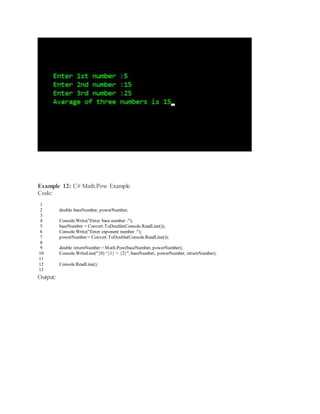
![Example 11: Program to finds the average of 3 numbers in C#
Code:
1
2
3
4
5
6
7
8
9
10
11
12
13
14
15
16
17
18
19
20
21
22
class Program
{
staticvoid Main(string[] args)
{
int number1,number2,number3,avarage;
Console.Write("Enter 1st number :");
number1 = Convert.ToInt32(Console.ReadLine());
Console.Write("Enter 2nd number :");
number2 = Convert.ToInt32(Console.ReadLine());
Console.Write("Enter 3rd number :");
number3 = Convert.ToInt32(Console.ReadLine());
avarage = (number1 + number2 + number3) / 3;
Console.Write("Avarage of three numbers is {0}",avarage);
Console.ReadKey();
}
}
Output:](https://image.slidesharecdn.com/c-220930061644-cbfcaeb0/85/C-console-applications-docx-6-320.jpg)
![Example 14: C# Program to Count Number of Words in a String
Code:
1
2
3
4
5
6
7
8
9
10
11
staticvoid Main(string[] args)
{
string sentence;
Console.Write("Enter String : ");
sentence = Console.ReadLine();
string[] words = sentence.Split(' ');
Console.WriteLine("Count of words :"+words.Length);
Console.ReadKey();
}
Output:](https://image.slidesharecdn.com/c-220930061644-cbfcaeb0/85/C-console-applications-docx-9-320.jpg)
![Example 15: Convert Dollars to Cents in C#
Solution 1: Calculate in Main Method
1
2
3
4
5
6
7
8
9
10
11
12
13
14
15
16
17
18
19
20
21
class Program
{
staticvoid Main(string[] args)
{
double dollar_amount;
int cents;
// int compute_cents;
Console.Write("Enter dollar amount :");
dollar_amount = Convert.ToDouble(Console.ReadLine());
cents =(int) (dollar_amount * 100);
Console.WriteLine("{0} $ = {1} ¢",dollar_amount,cents);
Console.ReadLine();
}
}
Solution 2: Calculate with Custom Method
1
2
3
4
5
6
7
8
9
10
11
12
13
14
15
16
17
18
19
20
21
22
23
24
25
26
class Program
{
staticvoid Main(string[] args)
{
double dollar_amount;
int cents;
// int compute_cents;
Console.Write("Enter dollar amount :");
dollar_amount = Convert.ToDouble(Console.ReadLine());
cents = compute_cents(dollar_amount);
Console.WriteLine("{0} $ = {1} ¢",dollar_amount,cents);
Console.ReadLine();
}
staticint compute_cents(double dollar_amount)
{
return (int)(dollar_amount * 100);
}
}
Output:](https://image.slidesharecdn.com/c-220930061644-cbfcaeb0/85/C-console-applications-docx-10-320.jpg)
![For More Simple Examples
C# Conditional Examples
Example 16: Fibonacci Series in C# with Method
C# Code:
1
2
3
4
5
6
7
8
9
10
11
12
using System;
using System.Collections.Generic;
using System.Linq;
using System.Text;
using System.Threading.Tasks;
namespace test
{
class Program
{
staticlong[] numbers;](https://image.slidesharecdn.com/c-220930061644-cbfcaeb0/85/C-console-applications-docx-11-320.jpg)
![13
14
15
16
17
18
19
20
21
22
23
24
25
26
27
28
29
30
31
32
33
34
35
36
37
staticlong Fib(int n)
{
if (0 == numbers[n])
{
numbers[n] = Fib(n - 1) + Fib(n - 2);
}
return numbers[n];
}
staticvoid Main()
{
Console.Write("n = ");
int n = int.Parse(Console.ReadLine());
numbers = new long[n + 2];
numbers[1] = 1;
numbers[2] = 1;
long result = Fib(n);
Console.WriteLine("fib({0}) = {1}", n, result);
Console.ReadKey();
}
}
}
Output:
Example 17: Find Number is Even or Odd using if else Statement in C#
Code 1:
1
2
3
4
5
6
7
8
9
10
11
staticvoid Main(string[] args)
{
int n;
Console.Write("Enter an integer : ");
n = Int32.Parse(Console.ReadLine());
if(n%2==0)
{
Console.WriteLine("{0} is even",n);
}
else](https://image.slidesharecdn.com/c-220930061644-cbfcaeb0/85/C-console-applications-docx-12-320.jpg)
![12
13
14
15
16
17
{
Console.WriteLine("{0} is odd", n);
}
Console.ReadKey();
}
Code 2 (with static method):
1
2
3
4
5
6
7
8
9
10
11
12
13
14
15
16
17
18
19
20
21
22
23
24
25
26
27
28
29
30
31
32
33
34
class Program
{
staticbool IsEvenNumber(int num)
{
if (num % 2 == 0)
{
return true;
}
else
{
return false;
}
}
staticvoid Main(string[] args)
{
int n;
Console.Write("Enter an integer : ");
n = Int32.Parse(Console.ReadLine());
if (IsEvenNumber(n))
{
Console.WriteLine("{0} is even", n);
}
else
{
Console.WriteLine("{0} is odd", n);
}
Console.ReadKey();
}
}
Output:](https://image.slidesharecdn.com/c-220930061644-cbfcaeb0/85/C-console-applications-docx-13-320.jpg)
![Example 18: Find Numbers Above and Below the Average in C#
C# Code:
1
2
3
4
5
6
7
8
9
10
11
12
13
14
15
16
17
18
19
20
21
22
23
24
25
26
27
28
29
30
31
32
staticvoid Main(string[] args)
{
int counter = 0;
int[] numbers = new int[10];
int sum=0,avg=0,low=0,high=0;
for(int i=0;i<10;i++)
{
Console.Write("Number {0}: ",(i+1));
numbers[i] = Convert.ToInt32(Console.ReadLine());
sum += numbers[i];
}
avg = sum / 10;
//avg = sum / numbers.Length;
for (int i=0;i<10;i++)
{
if(numbers[i]<avg)
{
low++;
}
else
{
high++;
}
}
Console.WriteLine("The average is : {0}", avg);
Console.WriteLine("The numbers above the average are: {0}", high);
Console.WriteLine("The numbers below the average are: {0}", low);
Console.ReadKey();
}
Output:](https://image.slidesharecdn.com/c-220930061644-cbfcaeb0/85/C-console-applications-docx-14-320.jpg)
![Example 19: C# Program to Print all Prime Numbers in an Interval
Source Code:
1
2
3
4
5
6
7
8
9
10
11
12
13
14
15
16
17
18
19
20
21
22
23
24
25
26
27
28
29
30
31
32
staticvoid Main(string[] args)
{
int num1, num2,sayac=0;
Console.Write("Enter lower range: ");
num1 = Convert.ToInt32(Console.ReadLine());
Console.Write("Enter upper range: ");
num2 = Convert.ToInt32(Console.ReadLine());
Console.WriteLine("Prime numbers between {0} and {1} are: ",num1,num2);
Console.WriteLine("==============================================");
for(int i=num1;i<num2;i++)
{
sayac = 0;
if(i>1)
{
for(int j=2;j<i;j++)
{
if(i%j==0)
{
sayac = 1;
break;
}
}
if(sayac==0)
{
Console.WriteLine(i);
}
}
}
Console.ReadKey();
}
Output:](https://image.slidesharecdn.com/c-220930061644-cbfcaeb0/85/C-console-applications-docx-15-320.jpg)
![Example 20: Finding the biggest of three numbers in C#
C# Code:
1
2
3
4
5
6
7
8
9
10
11
12
13
14
15
16
17
18
19
20
21
22
23
24
25
26
27
28
29
30
31
32
33
staticvoid Main(string[] args)
{
int number1, number2, number3;
string result;
Console.Write("Input the first number :");
number1 = Convert.ToInt32(Console.ReadLine());
Console.Write("Input the second number :");
number2 = Convert.ToInt32(Console.ReadLine());
Console.Write("Input the third number :");
number3 = Convert.ToInt32(Console.ReadLine());
if (number1 > number2 && number1 > number3)
{
result= "The 1st Number is the greatest among three. n";
}
else if (number2 > number1 && number2 > number3)
{
result = "The 2nd Number is the greatest among three n";
}
else
{
result= "The 3rd Number is the greatest among three n";
}
Console.WriteLine(result);
Console.ReadLine();
}
Output:
Example 21: Generates the Sum of N Numbers in C#](https://image.slidesharecdn.com/c-220930061644-cbfcaeb0/85/C-console-applications-docx-16-320.jpg)
![Code:
1
2
3
4
5
6
7
8
9
10
11
12
13
14
15
16
17
18
19
20
21
22
23
24
25
26
27
28
class Program
{
staticvoid Main(string[] args)
{
int number, sum=0;
Console.Write("Enter a Number : ");
number = Convert.ToInt32(Console.ReadLine());
if(number<0)
{
Console.Write("Please Enter Positive Number");
}
else
{
while(number>0)
{
sum += number;
number -=1;
}
}
Console.WriteLine("The sum is "+sum);
Console.ReadKey();
}
}
Output:](https://image.slidesharecdn.com/c-220930061644-cbfcaeb0/85/C-console-applications-docx-17-320.jpg)
![Example 22: Counting program the total letter in text in C# Console
Code:
1
2
3
4
5
6
7
8
9
10
11
12
13
14
15
16
17
18
19
20
staticvoid Main(string[] args)
{
string myString = Console.ReadLine();
int count = 0;
for (int i = 0; i < myString.Length; i++)
{
// check thechar for whitespace. If char is not whitespace, increase the count variable
if (!char.IsWhiteSpace(myString[i]))
{
count++;
}
}
Console.WriteLine("Total letters: "+ count);
Console.ReadLine();
}
Alternavite code (foreach loop):
1
2
3
4
5
6
7
8
9
10
11
12
13
14
15
16
17
18
19
20
staticvoid Main(string[] args)
{
Console.Write("Enter string :");
string myString = Console.ReadLine();
int count = 0;
foreach (char item in myString)
{
// check thechar for whitespace. If char is not whitespace, increase the count variable
if (!char.IsWhiteSpace(item))
{
count++;
}
}
Console.WriteLine("Total letters: "+ count);
Console.ReadLine();
}
Output:](https://image.slidesharecdn.com/c-220930061644-cbfcaeb0/85/C-console-applications-docx-18-320.jpg)
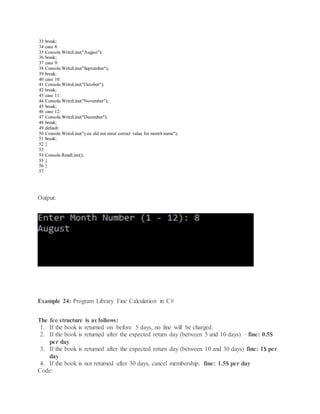
![Example 23: Get Month Name From Month Number – C#(Switch Case)
C# Code:
1
2
3
4
5
6
7
8
9
10
11
12
13
14
15
16
17
18
19
20
21
22
23
24
25
26
27
28
29
30
31
32
class Program
{
staticvoid Main(string[] args)
{
int monthNumber;
Console.Write("Enter Month Number (1 - 12): ");
monthNumber = Convert.ToInt32(Console.ReadLine());
switch (monthNumber)
{
case 1:
Console.WriteLine("January");
break;
case 2:
Console.WriteLine("February");
break;
case 3:
Console.WriteLine("March");
break;
case 4:
Console.WriteLine("April");
break;
case 5:
Console.WriteLine("May");
break;
case 6:
Console.WriteLine("June");
break;
case 7:
Console.WriteLine("July");](https://image.slidesharecdn.com/c-220930061644-cbfcaeb0/85/C-console-applications-docx-19-320.jpg)
![1
2
3
4
5
6
7
8
9
10
11
12
13
14
15
16
17
18
19
20
21
22
23
24
25
26
27
28
29
30
31
32
33
34
35
36
class Program
{
staticvoid Main(string[] args)
{
int days;
float fine=0;
Console.Write("Enter totaldays:");
days = Convert.ToInt32(Console.ReadLine());
if(days <= 5)
{
fine = 0;
}
else if(days > 5 && days <= 10)
{
fine = (days - 5) * 0.5F;
}
else if(days > 10 && days <=30)
{
// ----5 days--- --between 10 and 30---
fine = 5 * 0.5F + (days - 10) * 1;
}
else
{
// -5 days- -10 , 30- - >30 -
fine = 5 * 0.5F + 20 * 1 + (days-30) * 1.5F;
Console.WriteLine("Canceled your Membership");
}
Console.WriteLine("Your fine:"+fine);
Console.ReadLine();
}
}
Output](https://image.slidesharecdn.com/c-220930061644-cbfcaeb0/85/C-console-applications-docx-21-320.jpg)
![Example 25: Program to Find Leap Year in C#
Code:
1
2
3
4
5
6
7
8
9
10
11
12
13
14
15
staticvoid Main(string[] args)
{
int year;
Console.Write("Enter theYear :");
year = Convert.ToInt32(Console.ReadLine());
if (year % 400 == 0 || (year % 4 == 0 && year % 100 != 0))
Console.WriteLine("{0} is Leap Year",year);
else
Console.WriteLine("{0} is not a Leap Year",year);
Console.ReadLine();
}
Output:
For Mode If Else Examples
C# Loop Examples](https://image.slidesharecdn.com/c-220930061644-cbfcaeb0/85/C-console-applications-docx-22-320.jpg)
![Example 26: C# program to find min and max in an array
Code:
1
2
3
4
5
6
7
8
9
10
11
12
13
14
15
16
17
18
19
20
21
22
23
24
25
26
27
28
29
30
31
class Program
{
staticvoid Main(string[] args)
{
//www.csharp-console-examples.com
int[] numbers = new int[10];
Random rnd = new Random();
int min, max;
for (int i = 0; i < numbers.Length; i++)
{
numbers[i] = rnd.Next(1, 100);
Console.WriteLine(numbers[i]);
}
min = numbers[0];
max = numbers[0];
for (int i = 1; i < numbers.Length; i++)
{
if (min > numbers[i])
min = numbers[i];
if (max < numbers[i])
max = numbers[i];
}
Console.WriteLine("=====================================");
Console.WriteLine("The highest number in the array: > > > " + max);
Console.WriteLine("The lowest number in thearray: > > > " + min);
Console.ReadKey();
}
}
Output:
C# program using for loop to find maximum value from an array](https://image.slidesharecdn.com/c-220930061644-cbfcaeb0/85/C-console-applications-docx-23-320.jpg)
![Example 27: C# Program to Calculate the Power of a Number Without Using Math.Pow
Code:(With for loop)
1
2
3
4
5
6
7
8
9
10
11
12
13
14
15
16
17
18
19
20
21
22
23
24
25
26
27
28
29
class Program
{
staticvoid Main(string[] args)
{
int baseNumber, expNumber;
double result = 1;
Console.Write("Base Number : ");
baseNumber = Convert.ToInt32(Console.ReadLine());
Console.Write("exponent Number : ");
expNumber = Convert.ToInt32(Console.ReadLine());
bool sing = false;
if (expNumber > 0) sing = true;
expNumber = Math.Abs(expNumber);
for (int i = 1; i <= expNumber; i++)
{
if(sing)
result = result * baseNumber;
else
result /= baseNumber;
}
Console.WriteLine("Base {0} and exponent {1} Result = {2}", baseNumber, expNumber, result);
Console.ReadLine();
}
}](https://image.slidesharecdn.com/c-220930061644-cbfcaeb0/85/C-console-applications-docx-24-320.jpg)
![30
Code: (With While Loop)
1
2
3
4
5
6
7
8
9
10
11
12
13
14
15
16
17
18
19
20
21
22
23
24
class Program
{
staticvoid Main(string[] args)
{
int baseNumber, expNumber, result = 1;
Console.Write("Base Number : ");
baseNumber = Convert.ToInt32(Console.ReadLine());
Console.Write("exponent Number : ");
expNumber = Convert.ToInt32(Console.ReadLine());
while (expNumber != 0)
{
result *= baseNumber;
--expNumber;
}
Console.WriteLine("Result = {0}", result);
Console.ReadLine();
}
}
Output:](https://image.slidesharecdn.com/c-220930061644-cbfcaeb0/85/C-console-applications-docx-25-320.jpg)
![Example 28: C# Program to Find the Factorial of a Number
Source Code:
1
2
3
4
5
6
7
8
9
10
11
12
13
14
15
16
staticvoid Main(string[] args)
{
int i, number, fact;
Console.WriteLine("Enter theNumber");
number = int.Parse(Console.ReadLine());
fact = number;
for (i = number - 1; i >= 1; i--)
{
fact = fact * i;
}
Console.WriteLine("nFactorial of Given Number is: "+fact);
Console.ReadLine();
}
Output:
Example 29: Display Numbers Between 1 to N Using For Loop
Code:
1
2
3
4
5
6
staticvoid Main(string[] args)
{
int n;
Console.Write("Number :");
n = Convert.ToInt32(Console.ReadLine());](https://image.slidesharecdn.com/c-220930061644-cbfcaeb0/85/C-console-applications-docx-26-320.jpg)
![7
8
9
10
11
12
13
for (int i = 1; i <= n; i++)
{
Console.WriteLine(i);
}
Console.ReadKey();
}
Output:
Example 30: Generates the Sum of N Numbers in C#
Code:
1
2
3
4
5
6
7
8
9
10
11
12
13
14
15
16
17
18
19
20
21
22
23
class Program
{
staticvoid Main(string[] args)
{
int number, sum=0;
Console.Write("Enter a Number : ");
number = Convert.ToInt32(Console.ReadLine());
if(number<0)
{
Console.Write("Please Enter Positive Number");
}
else
{
while(number>0)
{
sum += number;
number -=1;
}
}
Console.WriteLine("The sum is "+sum);](https://image.slidesharecdn.com/c-220930061644-cbfcaeb0/85/C-console-applications-docx-27-320.jpg)
![24
25
26
27
28
Console.ReadKey();
}
}
Output:
Example 31: C# Program to Print all Prime Numbers in an Interval
Source Code:
1
2
3
4
5
6
7
8
9
10
11
12
13
14
15
16
17
18
19
20
staticvoid Main(string[] args)
{
int num1, num2,sayac=0;
Console.Write("Enter lower range: ");
num1 = Convert.ToInt32(Console.ReadLine());
Console.Write("Enter upper range: ");
num2 = Convert.ToInt32(Console.ReadLine());
Console.WriteLine("Prime numbers between {0} and {1} are: ",num1,num2);
Console.WriteLine("==============================================");
for(int i=num1;i<num2;i++)
{
sayac = 0;
if(i>1)
{
for(int j=2;j<i;j++)
{
if(i%j==0)
{
sayac = 1;](https://image.slidesharecdn.com/c-220930061644-cbfcaeb0/85/C-console-applications-docx-28-320.jpg)
![21
22
23
24
25
26
27
28
29
30
31
32
break;
}
}
if(sayac==0)
{
Console.WriteLine(i);
}
}
}
Console.ReadKey();
}
Output:
Example 32: Nested For Loop in C# (Multiplication Table)
Code 1:
1
2
3
4
5
6
7
8
9
10
11
12
13
14
staticvoid Main(string[] args)
{ //www.csharp-console-examples.com
for (int i=1;i<=10;i++)
{
for (int j = 0; j <= 10; j++)
{
Console.WriteLine("{0}x{1} = {2}", i, j, i * j);
}
Console.WriteLine("====================");
}
Console.ReadKey();
}
Output:](https://image.slidesharecdn.com/c-220930061644-cbfcaeb0/85/C-console-applications-docx-29-320.jpg)
![Code 2:
1
2
3
4
5
6
7
8
9
10
11
12
13
14
staticvoid Main(string[] args)
{ //www.csharp-console-examples.com
for (int j = 1; j <= 10; j++)
{
for (int i = 1; i <= 10; i++)
{
Console.Write("{0}*{1}={2}t", i, j, (i * j));
}
Console.WriteLine();
}
Console.ReadKey();
}
Output:](https://image.slidesharecdn.com/c-220930061644-cbfcaeb0/85/C-console-applications-docx-30-320.jpg)
![Example 33: Display Armstrong Number Between Two Intervals in C#
Code:
1
2
3
4
5
6
7
8
9
10
11
12
13
14
15
16
17
18
19
20
21
22
23
24
25
26
27
28
29
staticvoid Main(string[] args)
{
int num1,num2, n, sum, r;
Console.Write("Enter positivenumber1 :");
num1 = Convert.ToInt32(Console.ReadLine());
Console.Write("Enter positivenumber2 :");
num2 = Convert.ToInt32(Console.ReadLine());
Console.WriteLine("Armstrong Number from {0} to {1}",num1,num2);
for (int i = num1; i <= num2; i++)
{
sum = 0;
n = i;
while (n != 0)
{
r = n % 10;
sum = sum + (r * r * r);
n = n / 10;
}
if (i == sum)
Console.WriteLine(i);
}
Console.ReadKey();
}](https://image.slidesharecdn.com/c-220930061644-cbfcaeb0/85/C-console-applications-docx-31-320.jpg)
![Example 34: Checking for Palindrome Strings or Numbers in C#
Code:
1
2
3
4
5
6
7
8
9
10
11
12
13
14
15
16
17
18
19
20
21
22
23
24
25
26
27
28
29
30
staticvoid Main(string[] args)
{
Console.Write("Enter something for to check that is it palindrome :");
string text = Console.ReadLine();
int len = text.Length;
bool flag = true;
//check palindrome
for (int i = 0; i < len/2; i++)
{
if (text[i] != text[len - (i + 1)])
{
flag = false;
break;
}
}
//if flag true, text is palindrome
if (flag)
{
Console.WriteLine("{0} is palindrome", text);
}
else
{
Console.WriteLine("{0} is not palindrome", text);
}
Console.ReadLine();
}](https://image.slidesharecdn.com/c-220930061644-cbfcaeb0/85/C-console-applications-docx-32-320.jpg)
![Example 35: Converting Algorithm of Decimal to Binary in C#
1
2
3
4
5
6
7
8
9
10
11
12
13
14
15
16
17
18
19
20
21
22
23
24
25
26
class Program
{
staticvoid Main(string[] args)
{
int number;
Console.Write("Enter a Number : ");
number = int.Parse(Console.ReadLine());
int q;
string rem = "";
while (number >= 1)
{
q = number / 2;
rem += (number % 2).ToString();
number = q;
}
string binary = "";
for (int i = rem.Length - 1; i >= 0; i--)
{
binary = binary + rem[i];
}
Console.WriteLine("The Binary format for {0} is {1}",number, binary);
Console.ReadLine();
}
}
Other way: You can convert decimal to number, If you want to without think any algorithm
1
2
3
4
5
class Program
{
staticvoid Main(string[] args)
{](https://image.slidesharecdn.com/c-220930061644-cbfcaeb0/85/C-console-applications-docx-33-320.jpg)
![6
7
8
9
10
11
12
13
14
Console.Write("Enter a number : ");
int number = Convert.ToInt32(Console.ReadLine());
string binary = Convert.ToString(number, 2);
Console.WriteLine("The Binary format for {0} is {1}",number, binary);
Console.ReadLine();
}
}
Output:
Example 36: Find The Second Largest Number in Array Using C#
1
2
3
4
5
6
7
8
9
10
11
12
13
14
15
16
17
18
19
20
21
22
23
24
staticvoid Main(string[] args)
{
int n, i, j = 0, largest, secondLargest;
int[] arr1 = new int[50];
Console.Write("nnFind the second largest element in an array :n");
Console.Write("-----------------------------------------n");
Console.Write("Input the sizeof array : ");
n = Convert.ToInt32(Console.ReadLine());
/* Stored values into the array*/
Console.Write("Input {0} elements in the array :n", n);
for (i = 0; i < n; i++)
{
Console.Write("element - {0} : ", i);
arr1[i] = Convert.ToInt32(Console.ReadLine());
}
/* find location of the largest element in the array */
largest = 0;
for (i = 0; i < n; i++)
{
if (largest < arr1[i])](https://image.slidesharecdn.com/c-220930061644-cbfcaeb0/85/C-console-applications-docx-34-320.jpg)
![25
26
27
28
29
30
31
32
33
34
35
36
37
38
39
40
41
42
43
44
45
46
47
48
49
50
51
52
{
largest = arr1[i];
j = i;
}
}
/* ignore the largest element and find the 2nd largest element in the array */
secondLargest = 0;
for (i = 0; i < n; i++)
{
if (i == j)
{
i++; /* ignoring the largest element */
i--;
}
else
{
if (secondLargest < arr1[i])
{
secondLargest = arr1[i];
}
}
}
Console.Write("The Second largest element in the array is : {0} nn", secondLargest);
Console.ReadKey();
}
Example 36: Enter Only Numbers in C# Console Application using do-while loop
1
2
3
4
5
6
7
8
9
10
11
12
13
14
15
16
17
18
19
20
21
22
23
24
25
26
27
28
29
30
31
staticvoid Main(string[] args)
{
double val = 0;
string num = "";
Console.Write("Enter Number: ");
ConsoleKeyInfo chr;
do
{
chr = Console.ReadKey(true);
if (chr.Key != ConsoleKey.Backspace)
{
bool control = double.TryParse(chr.KeyChar.ToString(), out val);
if (control)
{
num += chr.KeyChar;
Console.Write(chr.KeyChar);
}
}
else
{
if (chr.Key == ConsoleKey.Backspace && num.Length > 0)
{
num = num.Substring(0, (num.Length - 1));
Console.Write("b b");
}
}
}
while (chr.Key != ConsoleKey.Enter);
Console.ReadKey();](https://image.slidesharecdn.com/c-220930061644-cbfcaeb0/85/C-console-applications-docx-35-320.jpg)
![32
33
}
Example 37: C# Program to Calculate the Power of a Number Without Using Math.Pow using
while loop
1
2
3
4
5
6
7
8
9
10
11
12
13
14
15
16
17
18
19
20
21
22
23
24
class Program
{
staticvoid Main(string[] args)
{
int baseNumber, expNumber, result = 1;
Console.Write("Base Number : ");
baseNumber = Convert.ToInt32(Console.ReadLine());
Console.Write("exponent Number : ");
expNumber = Convert.ToInt32(Console.ReadLine());
while (expNumber != 0)
{
result *= baseNumber;
--expNumber;
}
Console.WriteLine("Result = {0}", result);
Console.ReadLine();
}
}
Example 38: Fibonacci Series in C# with Method
1
2
3
4
5
6
7
8
9
10
11
12
13
14
15
16
17
18
19
20
21
22
23
24
25
26
using System;
using System.Collections.Generic;
using System.Linq;
using System.Text;
using System.Threading.Tasks;
namespace test
{
class Program
{
staticlong[] numbers;
staticlong Fib(int n)
{
if (0 == numbers[n])
{
numbers[n] = Fib(n - 1) + Fib(n - 2);
}
return numbers[n];
}
staticvoid Main()
{
Console.Write("n = ");](https://image.slidesharecdn.com/c-220930061644-cbfcaeb0/85/C-console-applications-docx-36-320.jpg)
![27
28
29
30
31
32
33
34
35
36
37
int n = int.Parse(Console.ReadLine());
numbers = new long[n + 2];
numbers[1] = 1;
numbers[2] = 1;
long result = Fib(n);
Console.WriteLine("fib({0}) = {1}", n, result);
Console.ReadKey();
}
}
}
Example 39: Calculate Sum and Average of an Array in C#
1
2
3
4
5
6
7
8
9
10
11
12
13
14
15
16
staticvoid Main()
{
double sum=0, avg=0;
double[] numbers = { 10, 20, 50, 40};
for(int i=0;i<numbers.Length;i++)
{
sum += numbers[i];
}
avg = sum / numbers.Length;
Console.WriteLine("The Sum is : "+sum);
Console.WriteLine("The Average is : "+avg);
Console.ReadKey();
}
Example 40: Find Numbers Above and Below the Average in C#
1
2
3
4
5
6
7
8
9
10
11
12
13
14
15
16
17
18
19
20
21
22
23
staticvoid Main(string[] args)
{
int counter = 0;
int[] numbers = new int[10];
int sum=0,avg=0,low=0,high=0;
for(int i=0;i<10;i++)
{
Console.Write("Number {0}: ",(i+1));
numbers[i] = Convert.ToInt32(Console.ReadLine());
sum += numbers[i];
}
avg = sum / 10;
//avg = sum / numbers.Length;
for (int i=0;i<10;i++)
{
if(numbers[i]<avg)
{
low++;
}
else
{
high++;](https://image.slidesharecdn.com/c-220930061644-cbfcaeb0/85/C-console-applications-docx-37-320.jpg)
![24
25
26
27
28
29
30
31
32
}
}
Console.WriteLine("The average is : {0}", avg);
Console.WriteLine("The numbers above the average are: {0}", high);
Console.WriteLine("The numbers below the average are: {0}", low);
Console.ReadKey();
}
Find The Longest Word in String
Array
class Program
{
staticvoid Main(string[] args)
{
string[] arr = { "Chsarp", "Console","Examples","www.csharp-console-examples.com" };
string longWord = "";
int Wordcount = 0;
foreach (string item in arr)
{
if (item.Length > Wordcount)
{
Wordcount = item.Length;
longWord = item;
}
}
Console.WriteLine("The longest word: {0} nLetters count : {1}", longWord, Wordcount);
Console.ReadKey();
}
}
Output:](https://image.slidesharecdn.com/c-220930061644-cbfcaeb0/85/C-console-applications-docx-38-320.jpg)


