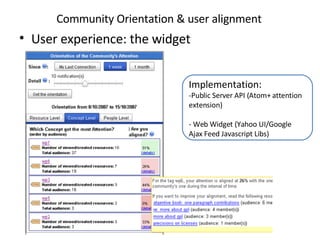
![Orientation Community & user alignment Objective 1: To understand the orientation of the community’s attention during the interval [t1, t2] following 3 levels: Resource: which resources (message, user’s profile) got the most attention? Attention Space ( an attention focus = a resource)](https://image.slidesharecdn.com/communityorientation-1193317516468416-4/85/Orientation-of-the-Community-s-attention-and-User-alignment-2-320.jpg)
![Orientation Community & user alignment Objective 1: To understand the orientation of the community’s attention during the interval [t1, t2] following 3 levels: Resource: which resources (message, user’s profile) got the most attention? Concept: Which concepts (tag/keyword) got the most attention? Attention Space (an attention focus = a concept)](https://image.slidesharecdn.com/communityorientation-1193317516468416-4/85/Orientation-of-the-Community-s-attention-and-User-alignment-3-320.jpg)
![Orientation Community & user alignment Objective 1: To understand the orientation of the community’s attention during the interval [t1, t2] following 3 levels: Resource: which resources (message, user’s profile) got the most attention? Concept: Which concepts (tag/keyword) got the most attention? User: which member got the most attention? Attention space (attention focus = a user )](https://image.slidesharecdn.com/communityorientation-1193317516468416-4/85/Orientation-of-the-Community-s-attention-and-User-alignment-4-320.jpg)
![Objective1: Orientation of the community’s attention during [t1, t2] Output: For each level, a List of elements in the given space (resources, concepts, users) sorted by their weights in the orientation of the community’s attention. “ their weights?” = Attention metrics = audience Resource Space: Social/Concept Space: , with , the resources related to k (e.g. a concept, a user) Orientation Community & user alignment](https://image.slidesharecdn.com/communityorientation-1193317516468416-4/85/Orientation-of-the-Community-s-attention-and-User-alignment-5-320.jpg)


![Next Step… maybe work quickly done (1 week..) Need to more formalized (+ connection with other research fields) TODO Change of entity (e.g. community, a user , an organization) + alignment between different entities (representing different levels) Alignment user/community [done] - [user/user] Alignment user1/user2 [todo] [Objectif] Alignment userattention/userintention [Time] Alignment userPast/ userPresent [Activity/Engagement] Alignment userWritingContext/ userReadingContext Add the notion of engagement in the metrics ( which concept stimulated the most the participation during [t1, t2]? )](https://image.slidesharecdn.com/communityorientation-1193317516468416-4/85/Orientation-of-the-Community-s-attention-and-User-alignment-9-320.jpg)

The document discusses evaluating the orientation and alignment of a community's attention on online resources. It aims to understand the orientation of the community's attention on resources like messages and user profiles during a time interval [t1, t2], and help individual users regulate their attention by aligning it with the community. It proposes calculating metrics to measure the alignment of a user's attention with the community's attention at different levels - resources, concepts, and other users. The metrics would indicate the degree of alignment and suggest resources/users for a individual to read to improve their alignment with the community.


![CTEV [ clubfoot] DR ARUN LAL ,DR MOHAMED ASHRAF travancore medical college k...](https://cdn.slidesharecdn.com/ss_thumbnails/ctevclubfootdrarunlaldrmohamedashraftravancoremedicalcollegekollamkeralaindia-260208063247-18fc466c-thumbnail.jpg?width=640&height=640&fit=bounds)


![ONFH[AVN HIP] -TRIPLE REGIME -A NOVAL SURGICAL CONCEPT .pptx](https://cdn.slidesharecdn.com/ss_thumbnails/onfhavnhip2026koaconcalicutdrgokuldevdrmashraf-260210064517-213ec005-thumbnail.jpg?width=640&height=640&fit=bounds)
