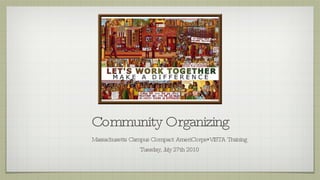
Community Organizing Massachusetts Campus Compact AmeriCorps*VISTA Training Tuesday, July 27th 2010
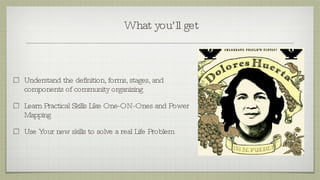
What you’ll get Understand the definition, forms, stages, and components of community organizing Learn Practical Skills Like One-ON-Ones and Power Mapping Use Your new skills to solve a real Life Problem
Workshop Overview defining community organizing building new leadership One to Ones Power Mapping real-life organizing scenarios
Community what? Community Organizing is a long-term approach where the people affected by an issue are supported in identifying problems and taking action to achieve collective solutions. It changes the balance of power and creates new power bases.
Community Organizing and  Campus Compact AmeriCorps*VISTAs Second years: how do MACC Vistas help people identify problems and achieve solutions?  What does Creating New Power Bases mean in the campus context? How do VISTAs empower students, faculty, and community?
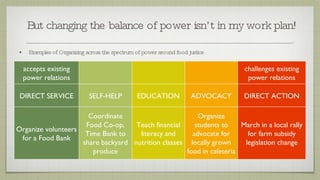
But changing the balance of power isn’t in my work plan! Examples of Organizing across the spectrum of power around food justice accepts existing power relations challenges existing power relations DIRECT SERVICE SELF-HELP EDUCATION ADVOCACY DIRECT ACTION Organize volunteers for a Food Bank Coordinate Food Co-op, Time Bank to share backyard produce Teach financial literacy and nutrition classes Organize students to advocate for locally grown food in cafeteria March in a local rally for farm subsidy legislation change
Primary Components of Organizing Inclusion (collective) help people figure out their motivation and their strategy Ownership  challenge people to take responsibility Relationship building develop new relationships out of old ones Leadership development identify, recruit, and develop leaders Reflection & celebration Action
Where Do I start? Six stages of Community Organizing: 1. Assess the community 2. Create an action team  3. Develop an action plan 4. Mobilize to action 5. Implement 6. Evaluate
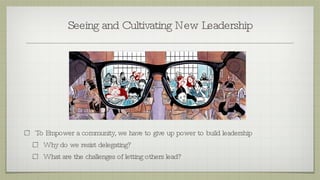
Seeing and Cultivating New Leadership To Empower a community, we have to give up power to build leadership Why do we resist delegating? What are the challenges of letting others lead?
Developing Leadership: second years How do you identify leaders and Potential leaders to meet needs? How do you create opportunities for leadership development?
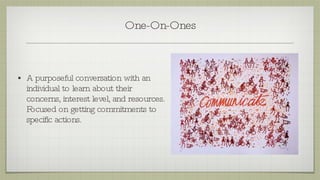
One-On-Ones A purposeful conversation with an individual to learn about their concerns, interest level, and resources. Focused on getting commitments to specific actions.
One-On-One Questions How long have you been involved in this issue? Why did you get involved? Who do you partner with? Who do you see as the big players?  What would you like to see happen on this issue? What is possible?  Would you be able to (insert commitment/action)? Could you give me the names of other people to talk to?
Power Mapping: Solving Problems through relationship building Step 1: Problem Location Step 2: Map Major Institutions Step 3: Map Individuals Associated with the Institutions Step 4: Map All Other Associations with these Individuals Step 5: Determine Relational Power Lines Step 6: Target Priority Relationship Step 7: make a plan
Power Mapping Practice students throw out tons of clothing and furniture into dumpsters at the end of the year. Use Power Mapping to identify who has the power and resources to stop this practice and link to the people who can make a better alternative.
Review What is Community organizing? What are some of its primary components? How is community organizing used by MACC VISTAs? What are one-on-ones? What is power mapping?
Organizing in Practice Split into 4 Groups, with one group of second years 5 minutes: Choose one person to take notes on flip chart, one to keep time, one to report out 20 minutes: Use organizing skills (one-on-ones, power mapping, stages of organizing) to create an action plan  one person will Report Out your Action Plan
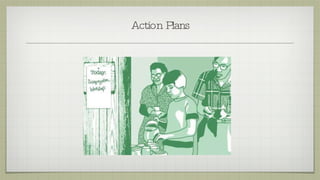
Action Plans
Final Thoughts on Organizing power rests in relationships never do for others what they can do for themselves action in reflection no permanent allies or enemies, only interests self-interest motivates us go in stupid, come out smart power defines the rules take people where they are/stay within experience relationships are reciprocal change involves tension define the situation and you’ll control the outcome organization is not about issues, but people who care about issues rewards go to the people who do the work when in doubt, do one-to-ones
TEXT QUESTIONS?

Community Organizing 2010

  • 1.
    Community Organizing MassachusettsCampus Compact AmeriCorps*VISTA Training Tuesday, July 27th 2010
  • 2.
    What you’ll getUnderstand the definition, forms, stages, and components of community organizing Learn Practical Skills Like One-ON-Ones and Power Mapping Use Your new skills to solve a real Life Problem
  • 3.
    Workshop Overview definingcommunity organizing building new leadership One to Ones Power Mapping real-life organizing scenarios
  • 4.
    Community what? CommunityOrganizing is a long-term approach where the people affected by an issue are supported in identifying problems and taking action to achieve collective solutions. It changes the balance of power and creates new power bases.
  • 5.
    Community Organizing and Campus Compact AmeriCorps*VISTAs Second years: how do MACC Vistas help people identify problems and achieve solutions? What does Creating New Power Bases mean in the campus context? How do VISTAs empower students, faculty, and community?
  • 6.
    But changing thebalance of power isn’t in my work plan! Examples of Organizing across the spectrum of power around food justice accepts existing power relations challenges existing power relations DIRECT SERVICE SELF-HELP EDUCATION ADVOCACY DIRECT ACTION Organize volunteers for a Food Bank Coordinate Food Co-op, Time Bank to share backyard produce Teach financial literacy and nutrition classes Organize students to advocate for locally grown food in cafeteria March in a local rally for farm subsidy legislation change
  • 7.
    Primary Components ofOrganizing Inclusion (collective) help people figure out their motivation and their strategy Ownership challenge people to take responsibility Relationship building develop new relationships out of old ones Leadership development identify, recruit, and develop leaders Reflection & celebration Action
  • 8.
    Where Do Istart? Six stages of Community Organizing: 1. Assess the community 2. Create an action team 3. Develop an action plan 4. Mobilize to action 5. Implement 6. Evaluate
  • 9.
    Seeing and CultivatingNew Leadership To Empower a community, we have to give up power to build leadership Why do we resist delegating? What are the challenges of letting others lead?
  • 10.
    Developing Leadership: secondyears How do you identify leaders and Potential leaders to meet needs? How do you create opportunities for leadership development?
  • 11.
    One-On-Ones A purposefulconversation with an individual to learn about their concerns, interest level, and resources. Focused on getting commitments to specific actions.
  • 12.
    One-On-One Questions Howlong have you been involved in this issue? Why did you get involved? Who do you partner with? Who do you see as the big players? What would you like to see happen on this issue? What is possible? Would you be able to (insert commitment/action)? Could you give me the names of other people to talk to?
  • 13.
    Power Mapping: SolvingProblems through relationship building Step 1: Problem Location Step 2: Map Major Institutions Step 3: Map Individuals Associated with the Institutions Step 4: Map All Other Associations with these Individuals Step 5: Determine Relational Power Lines Step 6: Target Priority Relationship Step 7: make a plan
  • 14.
    Power Mapping Practicestudents throw out tons of clothing and furniture into dumpsters at the end of the year. Use Power Mapping to identify who has the power and resources to stop this practice and link to the people who can make a better alternative.
  • 15.
    Review What isCommunity organizing? What are some of its primary components? How is community organizing used by MACC VISTAs? What are one-on-ones? What is power mapping?
  • 16.
    Organizing in PracticeSplit into 4 Groups, with one group of second years 5 minutes: Choose one person to take notes on flip chart, one to keep time, one to report out 20 minutes: Use organizing skills (one-on-ones, power mapping, stages of organizing) to create an action plan one person will Report Out your Action Plan
  • 17.
  • 18.
    Final Thoughts onOrganizing power rests in relationships never do for others what they can do for themselves action in reflection no permanent allies or enemies, only interests self-interest motivates us go in stupid, come out smart power defines the rules take people where they are/stay within experience relationships are reciprocal change involves tension define the situation and you’ll control the outcome organization is not about issues, but people who care about issues rewards go to the people who do the work when in doubt, do one-to-ones
  • 19.